



Public Speaker Tax Deductions in Canada: Travel, Marketing, Equipment & Business
Public speaker taxes Canada explained: equipment classes, meals, travel and bureau commissions
Understanding public speaker taxes Canada is key for maximizing your professional speaker tax deductions and managing business expenses like venue fees and educational materials. Gondaliya CPA provides practical advice tailored to public speakers to optimize tax savings and ensure accurate reporting.
Quick Summary
Computers and systems software sit in Class 50 at 55%; Class 14.1 is goodwill and intangibles at 5%. Meals for a self-employed speaker are actual cost limited to 50% under section 67.1, with no per-meal dollar cap. And business income is computed on the accrual basis under section 9 — there is no cash-basis election for a speaker.
Reading time: 46 minutes.
Table of Contents
- Three Things You Have Been Told
- Understanding Speaker Taxes and Deductions
- The Deductible Expense Categories
- Capital Cost Allowance and Depreciation
- Personal Versus Business, and Income Reporting
- Speaker Fees, Bureaus and Rebilled Travel
- Common Mistakes and Tax Season Preparation
- Frequently Asked Questions
- Essential Topics and Best Practices
- Businesses We Serve
- Professional Guidance and Quick Reference
The Numbers That Matter
This article covers Canada, with Ontario and Toronto context, and reflects rules current to 2 October 2026. It is written for professional speakers — keynote speakers, corporate trainers, author-speakers and workshop facilitators — operating as sole proprietors or through a corporation, including those booking through bureaus or rebilling travel. Gondaliya CPA performs compilation engagements; we do not perform audits or review engagements. Fee ranges shown are illustrative market observations, not CRA figures or quotes. Any masked engagement notes end with “Figures changed for privacy.” This is educational information only and not tax or legal advice.
Three Things You Have Been Told
Three Things You Have Been Told
The Corrections
Three points about speaker tax circulate widely and all three are wrong. The first appears with three different rates attached to the same class.
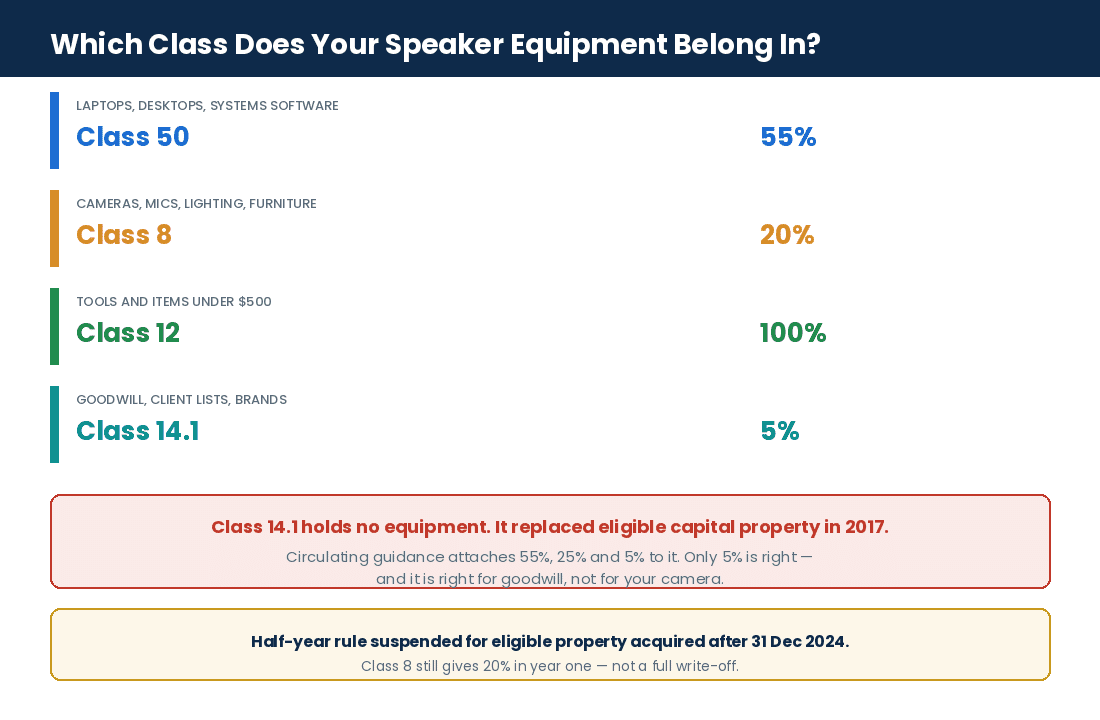
Class 14.1 Is Goodwill at 5%, Not Computers at 55%
Risk Warning: Class 14.1 does not hold computer equipment. It is the class that replaced eligible capital property on 1 January 2017, and it holds goodwill, client lists, trade names and other intangibles at 5% declining balance.
Computers and systems software acquired after 18 March 2007 go in Class 50 at 55%. That date is the one commonly attached to Class 14.1 by mistake — it is the Class 50 date.
| Rate in circulation for “Class 14.1” | What it actually belongs to |
|---|---|
| 55% | Class 50 — computers and systems software |
| 25% | Nothing — no speaker asset class carries 25% |
| 5% | Class 14.1 — goodwill and intangibles. Correct |
| Speaker asset | Class | Rate |
|---|---|---|
| Laptops, desktops, systems software | 50 | 55% |
| Purchased application software | 12 | 100% |
| Cameras, microphones, lighting, AV gear | 8 | 20% |
| Office furniture and staging | 8 | 20% |
| Tools and equipment under $500 | 12 | 100% |
| Goodwill, client lists, a purchased brand | 14.1 | 5% |
There Is No $25 Meal Limit for a Self-Employed Speaker
Risk Warning: “meal expenses during work travel days up to federal limits of $25 per meal” describes a rule that does not apply to you. A flat per-meal rate exists for employees using the simplified method on travel, moving and medical claims, and for long-haul truck drivers. It is not a business expense rule.
For a self-employed speaker, meals are deducted at actual cost, limited to 50% by section 67.1. Entertainment is subject to the same 50% — not a stricter rule — and alcohol with a meal is inside the 50%, not disallowed. The input tax credit is likewise recaptured to 50%.
Accrual Is Not Optional
Guidance offering a choice between cash and accrual — “cash basis suits small operations” — is describing an election that does not exist. Business income is computed on the accrual basis under section 9, with amounts included when receivable under paragraph 12(1)(b). The cash method in section 28 is confined to farming and fishing.
A speaking fee invoiced in December is December income even if the client pays in February. Holding the invoice does not move it either, since the amount became receivable when the engagement was performed.
A speaker had been pooling roughly $18,000 of camera, lighting and laptop purchases into “Class 14.1 at 55%”.
The laptops belonged in Class 50 at 55% and the AV gear in Class 8 at 20%, while Class 14.1 would have given 5% on everything. The claim was wrong in both directions at once, and the schedule had to be rebuilt from the purchase invoices. Figures changed for privacy.
Understanding Public Speaker Taxes and Deductions in Canada
Understanding Speaker Taxes and Deductions
Foundations
What Are Business Expenses for Public Speakers?
- Travel costs: airfare, accommodation, meals on the road and ground transport to engagements.
- Marketing expenses: website, showreel production, brochures and advertising.
- Equipment purchases: microphones, cameras, lighting and laptops, claimed through capital cost allowance rather than expensed.
- Professional development: courses and workshops maintaining your speaking skills.
The governing rule is paragraph 18(1)(a): an outlay is deductible where made for the purpose of gaining or producing income from the business, subject to reasonableness in section 67. Paragraph 18(1)(b) separates capital outlays, which run through capital cost allowance instead.
Why Tax Deductions Matter for Public Speakers
- Higher retained earnings: a deduction at a 43% personal marginal rate is worth 43 cents on the dollar.
- Better cash flow: tracked expenses change your instalment position, not just your April bill.
- Staying within CRA rules: claiming only genuine business expenses, with support, keeps a review short.
A speaker who spends $5,000 on travel and marketing and never claims it has given up roughly $2,150 of tax at a 43% marginal rate. Figures changed for privacy.
Key Stat: the agency administering this is the Canada Revenue Agency — CRA. “Canadian Revenue Agency” appears widely and is not the body’s name, which matters when you are searching its guidance.
The right publication for a self-employed speaker is T4002, Self-employed Business, Professional, Commission, Farming and Fishing Income. RC4060 is the Farming Income and the AgriStability and AgriInvest Programs guide, and is often cited for home office and accelerated investment rules it does not cover.
The Deductible Expense Categories
The Deductible Expense Categories
Deductions
Deductible Advertising and Promotional Costs
Website build and hosting, social media advertising, printed collateral, showreel production and event sponsorships, where connected to obtaining engagements or selling books. A speaker spending $2,000 on advertising for a seminar deducts it in full under paragraph 18(1)(a), with the invoices retained. Figures changed for privacy.
Business Start-Up Costs and Initial Expense Deductions
Risk Warning: there is no election to “amortize start-up costs over five years or expense them at once”. Costs incurred before the business begins are generally not deductible at all, because there is no source of income yet — the business must have commenced.
Incorporation costs are the specific exception: paragraph 20(1)(b) allows a deduction of up to $3,000, with any excess added to Class 14.1 at 5%. An $800 legal bill to incorporate is therefore deducted in full in the year incurred — immediately, and with no five-year alternative. Figures changed for privacy.
Deductible Business Taxes, Fees, Licences, and Dues
- Municipal business licences and registration fees.
- Speakers’ bureau and industry association dues, deductible under paragraph 18(1)(a) where related to the business. CPA Ontario does not approve or designate which speaking associations qualify — it regulates accountants.
- Paragraph 18(1)(l) denies dues for a club whose main purpose is dining, recreation or sport.
- Personal income taxes are never deductible.
Delivery, Freight, and Related Operational Expenses
Courier and shipping for books, workbooks and promotional material, where the destination matches a client order or event. A $150 courier charge for signed books after a seminar is deductible with the delivery receipt. Figures changed for privacy.
Insurance Premiums Relevant to Public Speakers
Commercial general liability, errors and omissions, event cancellation and equipment insurance are deductible under paragraph 18(1)(a), with subsection 18(9) allocating premiums across the policy period. Personal life insurance is denied by paragraph 18(1)(h) as a personal expense. There is no CRA bulletin series “IB”, so citations in that form do not resolve to anything.
Interest and Bank Charges: Eligibility and Limitations
Risk Warning: interest is not deductible under paragraph 18(1)(a). Paragraph 18(1)(b) denies outlays on account of capital, and interest on borrowed money is allowed back in by paragraph 20(1)(c) — which is the provision to cite.
The test is the use of the borrowed money, not the security given. Borrow to buy audio equipment used in the business and the interest is deductible; borrow against the same equipment to fund a holiday and it is not. Bank charges on a business account are deductible under 18(1)(a). Section 67.2 caps vehicle loan interest at $350 per month.
Legal, Accounting, and Professional Service Fees
Fees for contract review, intellectual property protection, bookkeeping and return preparation are deductible under paragraph 18(1)(a). Legal fees on a capital transaction — acquiring a business, defending title — are capital and go to the asset’s cost or to Class 14.1.
Maintenance, Repairs, and Office Expense Considerations
Routine repairs keeping an asset in its existing state are current expenses. Work that improves an asset or extends its useful life is capital and goes to the appropriate class. Fixing the HVAC in a home studio is a repair; installing soundproofing is an improvement and is capitalised.
Meals and Entertainment Expense Rules Applicable To Speakers
| Situation | Deductible | Provision |
|---|---|---|
| Meals while travelling for an engagement | 50% of actual cost | ITA 67.1 |
| Client meals and entertainment | 50% of actual cost | ITA 67.1 |
| Alcohol with a business meal | Inside the 50% | ITA 67.1 |
| Conference fee with meals not separately stated | $50 per day deemed food, then 50% | ITA 67.1(3) |
| Meals at a remote or temporary work site | Full, where conditions met | ITA 67.1(2) |
| Meals included in a conference you are paid to attend | Not your cost | — |
Travel Expenses Including Transportation, Accommodation, and Meals
| Item | Deductible | Condition |
|---|---|---|
| Airfare | Yes | Actual fare, invoice retained |
| Accommodation | Yes | Nights attributable to the engagement |
| Ground transport | Yes | Receipts, or a logbook for own vehicle |
| Meals on the road | 50% | Actual cost, ITA 67.1 |
| Companion travel | No | Personal, regardless of arrangement |
| Personal days added to a trip | Apportioned | Itinerary showing the split |
Companion travel is a personal expense for a self-employed speaker, and no reimbursement arrangement changes that. An employee reimbursed by an employer faces a taxable benefit question instead — a different analysis entirely.
Salaries, Wages, and Benefits When Employing Assistants or Staff
- Salaries deductible with CPP, EI and income tax withheld and remitted by your band under section 153 and Regulation 108.
- T4 slips for employees; T4A for self-employed assistants above $500 of fees for services. Both due the last day of February under Regulation 205(1).
- Classification is decided by the Wiebe Door factors as refined in Sagaz and Connor Homes — not by what the contract says it is. CRA Guide RC4110 and Form CPT1 cover it.
- Accrued remuneration paid within 179 days of year-end under subsection 78(4), or the deduction moves to the year of payment.
- Penalties for late payroll remittance under subsection 227(9), with director liability under section 227.1.
Telephone, Utilities, and Workspace-Related Deductions
Business-use proportion of phone, internet and utilities, supported by billing statements and a reasonable allocation. Home workspace costs follow subsection 18(12), covered in section five.
Supplies and Prepaid Expenses in Speaker Businesses
Stationery, presentation materials and annual software licences are deducted as incurred. Where a payment covers a period extending past year-end, subsection 18(9) pushes the portion relating to the later year forward — that is the prepaid expense rule. Section 230 concerns books and records and has nothing to do with timing.
A speaker had claimed interest on a line of credit secured against the family home, on the basis that the house was the security.
Paragraph 20(1)(c) tests the use of the borrowed money, not the security. The portion drawn to buy production equipment was deductible; the portion drawn for a renovation was not, and the two had never been tracked separately. Figures changed for privacy.
Capital Cost Allowance and Depreciation for Public Speakers
Capital Cost Allowance and Depreciation
Capital Assets
Overview of CCA Classes Relevant to Speaker Equipment
Classes and their rates are set by Schedule II of the Income Tax Regulations, with the rates applied under Regulation 1100. A $5,000 camera kit is Class 8 at 20%, giving $1,000 in the first full year. A $3,000 laptop is Class 50 at 55%, giving $1,650. Same money, very different first-year claim — which is why the class matters more than the total. Figures changed for privacy.
| Asset | Class | Rate | Note |
|---|---|---|---|
| Computers, systems software | 50 | 55% | Acquired after 18 March 2007 |
| Purchased application software | 12 | 100% | Separate from systems software |
| Cameras, microphones, lighting | 8 | 20% | The residual class for equipment |
| Office furniture, staging, cases | 8 | 20% | — |
| Tools and items under $500 | 12 | 100% | Per item |
| Vehicle | 10 or 10.1 | 30% | 10.1 capped at $39,000 |
| Zero-emission vehicle | 54 | 30% | Capped at $61,000 |
| Goodwill, client lists, brands | 14.1 | 5% | Replaced ECP on 1 January 2017 |
Mixed-use assets enter the class at full cost with the business-use proportion applied to the claim. A laptop used 60% for the business gives 60% of the calculated capital cost allowance, supported by a usage record.
Accelerated Capital Cost Allowance Options and Eligibility
Risk Warning: there is no general immediate expensing for “digital media gear or advanced tech tools”. The $1.5 million immediate expensing measure for CCPCs applied to property acquired before 2024 and has lapsed for most purposes.
What applies now is the suspension of the half-year rule for eligible property acquired after 31 December 2024 under Bill C-15, which gives a full first-year rate rather than half. A $10,000 lighting rig in Class 8 therefore gives $2,000 in year one, not $10,000. Figures changed for privacy.
The first claim is also gated by the available-for-use rule in subsections 13(26) to (32). Equipment still in its shipping case at year-end generates no capital cost allowance.
Treatment of Eligible Capital Property under Current Tax Rules
Eligible capital property was abolished on 1 January 2017. The cumulative eligible capital pool was converted into Class 14.1, which now holds goodwill, client lists, trade names, franchise rights and similar intangibles at 5% declining balance. A speaker who buys another speaker’s client list or brand is in Class 14.1; a speaker who buys a camera is not.
Only the capital cost — purchase price plus costs of acquisition — enters the class. Interest on money borrowed to buy the asset is deducted under 20(1)(c), not capitalised, unless an election under section 21 is made.
Handling Rebates, Grants, and Their Effect on CCA
Government assistance received for a capital asset reduces its capital cost under paragraph 13(7.1), so the class is entered net. A grant covering part of a studio build reduces the cost base before any capital cost allowance is calculated. Assistance against a current expense reduces that expense instead, under paragraph 12(1)(x). Either way the benefit is taken once, not twice.
Impact of Scientific Research and Experimental Development Credits on Speakers
Risk Warning: building an app is not by itself SR&ED. The definition in subsection 248(1) requires technological uncertainty, systematic investigation and technological advancement. Commissioning a custom audience-feedback tool from a developer, using known methods, meets none of them.
Paragraph 248(1)(g) also excludes research in the social sciences and humanities, which is where most research into audience engagement and presentation effectiveness sits. Where a genuine claim does exist, the reporting deadline under subsection 37(11) is 12 months after the T2 due date — 18 months after year-end — and CRA has no discretion to extend it.
A speaker expected a $10,000 studio lighting purchase to be fully deductible in the year of purchase.
It is Class 8 at 20%, so the first-year claim was $2,000, even with the half-year rule suspended. The money is all deductible eventually; it is simply spread. Budgeting a cash-flow saving that never arrives is the real cost of the misunderstanding. Figures changed for privacy.
Personal Versus Business Expenses, and Income Reporting
Personal Versus Business, and Income Reporting
Reporting
Distinguishing Between Personal and Business Expenses
- Stage wardrobe and grooming are personal under paragraph 18(1)(h), even where worn only on stage. The limited exception is distinctive clothing that is not suitable for ordinary wear — a costume, not a suit.
- Travel to meet a client is deductible; the leisure portion of the same trip is not.
- Every claim needs a record tying it to the business purpose.
Mixed-Use Asset Allocation
- Vehicle: business kilometres over total kilometres, from a logbook with date, destination, purpose and distance. The simplified method allows a full base year then a three-month sample, provided business use stays within 10 percentage points. Limits: $1,100 monthly lease, $39,000 in Class 10.1, $350 monthly interest under section 67.2. Schedule II holds the classes, not the mileage rules.
- Equipment: business-use percentage applied to the capital cost allowance claim, supported by a usage record.
- Home workspace: subsection 18(12) gives two alternative tests. Test (a) is that the home is your principal place of business, with no exclusivity requirement; test (b) is exclusive use plus regular client meetings. The deduction cannot create or increase a loss, and an incorporated speaker pays rent under a written agreement rather than claiming under 18(12).
Documentation Best Practices
- Receipts with date, vendor and amount; invoices for anything significant.
- Signed engagement contracts showing scope and what was billed.
- Itineraries linking each trip to a specific engagement.
- Logs for vehicles and for mixed-use equipment.
- Home workspace measurements with the household bills behind them.
Income Reporting Requirements for Professional Speakers: T4A and Self-Employment Income
- Some payers issue a T4A; many do not. The income is reportable either way, and the absence of a slip changes nothing.
- A sole proprietor reports on form T2125, Statement of Business or Professional Activities, with the T1.
- A corporation files a T2 with GIFI Schedules 100, 125 and 141.
- Rebilled travel billed separately to a client is income, reported in full, with the actual travel cost deducted against it. Netting the two understates both lines.
- Book and course sales, licensing and royalties reported separately from engagement fees.
Cash vs. Accrual Reporting
Business income is computed on the accrual basis under section 9. The cash method in section 28 is available to farming and fishing businesses only, so a speaker does not choose between the two. An amount is included when it becomes receivable under paragraph 12(1)(b), and work completed but unbilled at year-end is carried under subsection 10(5).
GST/HST Considerations and Registration Thresholds
Key Stat: there are two routes across the $30,000 threshold, and most guidance gives only one. The threshold is in section 148 of the Excise Tax Act; section 240(1) is the requirement to register.
Over $30,000 of taxable supplies across four consecutive calendar quarters ends small supplier status at the end of the following month, with a further month to register. Over $30,000 in a single calendar quarter ends it immediately, on the supply that crosses it, with 29 days to register. One large keynote can do it.
- One national registration covers GST and HST across Canada — you do not register province by province. Only BC PST, Saskatchewan PST, Manitoba RST and Quebec QST are separate.
- The rate follows the place of supply: for a service, generally the recipient’s address obtained in the ordinary course of business.
- Voluntary registration below the threshold is available and gives input tax credits, at the cost of charging and filing.
- Input tax credits under section 169, with documentary support under 169(4): over $30 the supplier’s name and date, over $150 the registration number, recipient and description. Four-year claim window.
- Filing frequency: annual to $1.5M of taxable supplies, quarterly to $6M, monthly above.
Speaking Abroad and Supplies to Non-Residents
A speaking service supplied to a non-resident is generally zero-rated under Schedule VI, Part V — which is not the same as exempt. Zero-rated means you charge 0% and still recover input tax credits on your costs. Treating it as exempt forfeits those credits.
Documentation and Record-Keeping for Tax Compliance: Retention Periods and Recommended Systems
Records are retained six years from the end of the taxation year to which they relate, under paragraph 230(4)(b) — subsection 230(1) is the requirement to keep them, not the period. Section 286 of the Excise Tax Act imposes the same for GST/HST. QuickBooks Online or Xero on bank feeds, with Hubdoc capturing receipts, keeps the evidence current rather than reconstructed.
Employment Status and CPP/EI Implications
- A self-employed speaker pays both halves of CPP on self-employment earnings above the $3,500 basic exemption, plus CPP2 above the first ceiling. Half is deductible, half is a credit. EI is not payable unless you opt into special benefits.
- An incorporated speaker drawing salary has CPP withheld and matched by the corporation; dividends carry neither CPP nor EI.
- Classification where you engage others follows the Wiebe Door factors, not the contract label.
Speaker Fees, Bureaus and Rebilled Travel
Speaker Fees, Bureaus and Rebilled Travel
Fees
Factors Influencing Speaker Fees and Associated Tax Treatments: Typical Fee Ranges in Canada
| Speaker type | Illustrative fee range (CAD) | Common deductible expenses |
|---|---|---|
| Keynote speakers | $2,000 – $15,000 per engagement | Travel, marketing, equipment |
| Corporate trainers | $150 – $500 per hour | Training materials, venue rental |
| Author-speakers | $1,000 – $7,500 plus royalties | Book production, promotional events |
These ranges are illustrative market observations, not published figures. CRA does not publish speaker fee guidance, and any table attributing such ranges to “CRA Business Income Guidelines” is sourcing them to a document that does not exist.
How Event Types, Audience, and Speaker Profile Affect Fees
Fee level matters for tax because section 67 requires an expense to be reasonable in the circumstances. Airfare and a hotel against a $5,000 national keynote are plainly reasonable. The same claim against an $800 local workshop invites the question — not because the rule changes, but because reasonableness is tested against what the expense was incurred to earn.
The provision is section 67. It has no subsection (1).
Booking Through Speaker Bureaus versus Direct Contracts
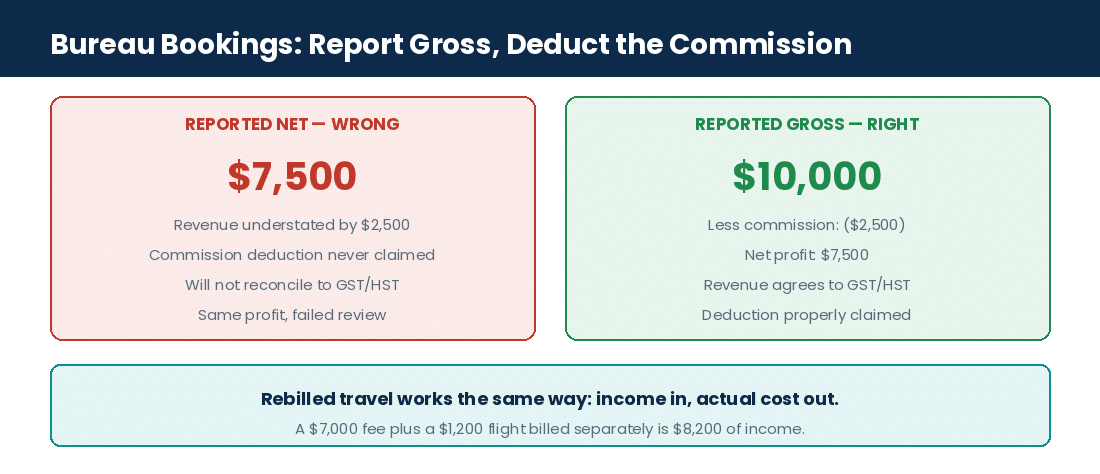
Key Stat: report the gross fee and deduct the commission — never report net. On a $10,000 engagement where a bureau retains $2,500, income is $10,000 and the commission is a $2,500 deduction. Profit is the same; the presentation is not.
Reporting $7,500 understates revenue, will not reconcile to a client’s records or to your GST/HST return, and removes a deduction you were entitled to claim. Figures changed for privacy.
- The bureau agreement and remittance statements retained as support for the commission deduction.
- GST/HST charged on the gross fee where you are the supplier, with the bureau’s own commission carrying its own tax, recoverable as an input tax credit.
- Bureau commissions typically run between 10% and 30%, by agreement.
Handling Travel and Other Reimbursed Expenses
- Travel rebilled separately is income, reported in full, with the actual cost deducted against it.
- Travel built into the fee is simply part of the fee, with the cost deducted as usual.
- Either way the GST/HST position follows the supply: a rebilled disbursement is ordinarily consideration for your taxable supply, not a pass-through, unless a genuine agency relationship is documented.
- Personal days added to a trip are apportioned on the itinerary.
An author-speaker invoicing $7,000 plus a separately billed $1,200 flight reports $8,200 of income and deducts the $1,200 actual cost. Figures changed for privacy.
A speaker reported bureau-booked work net of commission for three years, on the basis that the net amount was what arrived in the bank.
Revenue was understated by roughly $40,000 across the period and the commission deduction was never claimed. Profit was identical, but the revenue line did not agree to the GST/HST returns, which is what prompted the review. Figures changed for privacy.
Common Mistakes and Preparing for Tax Season
Common Mistakes and Tax Season Preparation
Pitfalls
Common Mistakes to Avoid When Claiming Speaker Business Expenses
- Stage wardrobe and grooming claimed as business costs — personal under paragraph 18(1)(h).
- Rebilled travel netted against the fee rather than reported as income with the cost deducted.
- Bureau commissions deducted with no agreement or remittance statement on file.
- Equipment pooled into the wrong class, most often Class 14.1.
- Meals claimed in full, or against a per-meal rate that does not apply to a business.
- Mixed-use vehicles and home workspace claimed without an allocation record.
- Interest claimed on the basis of what secured the loan rather than what the money bought.
Strategies for Accurate Allocation of Mixed-Use Expenses
- Itineraries showing which days were work and which were personal, written at the time.
- Client meals logged separately from meals taken alone on the road — both are 50%, but the business purpose must be evidenced.
- Vehicle logs maintained as you drive, with the simplified base-year method available afterwards.
- Home workspace measured once and documented, with the apportionment basis stated.
- Equipment usage sampled and recorded rather than estimated at year-end.
Tips on Preparing for Tax Season
| Obligation | Deadline | Provision |
|---|---|---|
| Self-employed T1 | File 15 June; pay 30 April | ITA 150(1); 156.1(4) |
| Corporate T2 | Six months after fiscal year-end | ITA 150(1)(a) |
| Corporate balance of tax | Two months; three for an eligible CCPC | ITA 157(1)(b) |
| Personal instalments | 15 March, 15 June, 15 September, 15 December | ITA 156(1) |
| Corporate instalments | Last day of each month or quarter | ITA 157(1)(a), 157(1.1) |
| T4 and T4A slips | Last day of February | Reg 205(1) |
The corporate payment date is the one most often missed, because it falls months before the filing deadline. Late filing is penalised under subsection 162(1) at 5% plus 1% per complete month to twelve months; interest under subsection 161(1) compounds daily and is separate. Section 150(1) sets the deadline, not the penalty.
Instalments are required where net tax owing exceeds $3,000 in the current year and in either of the two preceding years.
What Triggers a CRA Review of Public Speaker Tax Filings
- Revenue reported net of bureau commission, so it will not reconcile to the GST/HST return.
- Rebilled travel omitted from income.
- Meals claimed at more than 50%.
- Mixed-use allocations with no supporting record.
- Equipment written off entirely in the year of purchase.
- Corporate returns or balances filed or paid late.
How Can You Catch Up if Records Are Behind
- Reconstruct from bank and card statements, then request duplicate invoices from suppliers.
- Pull engagement contracts and bureau statements to rebuild the revenue line first.
- File the oldest year first, so balances and carryforwards flow correctly.
- Consider the Voluntary Disclosures Program under Information Circular IC00-1R6 before CRA makes contact.
- Request relief from penalties and interest under subsection 220(3.1) on Form RC4288, within ten calendar years, with CRA representation where a claim is challenged.
Reference to Official CRA Publications and Resources
- Guide T4002 for self-employed business and professional income.
- Section 67.1 for the 50% meals and entertainment limit.
- Paragraph 150(1)(a) for the corporate filing deadline and 157(1)(b) for the balance.
- Schedule II and Regulation 1100 for capital cost allowance classes and rates.
- Sections 148, 169 and 240(1) of the Excise Tax Act for GST/HST.
Contact and Support Options from Gondaliya CPA
Call 647-212-9559 or email info@gondaliyacpa.ca. We reply within one business day and offer a free initial consultation, a 30-Day Money-Back Guarantee and a 60-Day Fees-Matching Policy. Gondaliya CPA is a CPA Ontario Registered Firm with consistent Google-verified client feedback.
An incorporated speaker filed every T2 on time at six months and paid the balance with the return.
The balance had been due at three months throughout, as a CCPC claiming the small business deduction. No filing penalty arose, but arrears interest compounded daily on a three-month gap every year. The payment date and the filing date are two separate obligations. Figures changed for privacy.
Frequently Asked Questions About Public Speaker Tax Deductions Canada
Frequently Asked Questions
FAQ
What is the meals and entertainment deduction limit for public speakers?+
50% of actual cost under section 67.1, with the input tax credit recaptured to 50%. There is no per-meal dollar cap for a self-employed speaker — the flat per-meal rate applies to employees using the simplified method and to long-haul truck drivers, not to business expenses.
How does capital cost allowance apply to speaker equipment?+
By class. Computers and systems software are Class 50 at 55%; cameras, microphones and lighting are Class 8 at 20%; items under $500 are Class 12 at 100%. Class 14.1 is goodwill and intangibles at 5% and holds no equipment at all — it is not a 55% or 25% class.
What is the record retention period required by CRA?+
Six years from the end of the taxation year to which the records relate, under paragraph 230(4)(b) — not six years from filing. Subsection 230(1) is the requirement to keep records; section 286 of the Excise Tax Act imposes the same period for GST/HST.
When is the T2 corporate return due for an incorporated speaker?+
Six months after fiscal year-end under paragraph 150(1)(a). The balance of tax is due far earlier — two months after year-end under paragraph 157(1)(b), or three for a CCPC claiming the small business deduction. Paying with the return means interest.
How often should GST/HST filings be made?+
By assigned frequency, not by choice: annual to $1.5 million of taxable supplies with payment three months after year-end, quarterly to $6 million, monthly above. Most speakers are annual filers.
What instalment dates should public speakers remember?+
Individuals: 15 March, 15 June, 15 September and 15 December under subsection 156(1), where net tax owing exceeds $3,000. Corporations: the last day of each month under 157(1)(a), or each quarter for an eligible CCPC under 157(1.1) — not the personal dates.
Can bureau commissions be claimed as a deduction?+
Yes, with the agreement and remittance statements on file. Report the gross fee as income and deduct the commission. On a $10,000 engagement with a $2,500 commission, that is $10,000 in and $2,500 out — never $7,500 reported net.
How do home office deductions work for speakers?+
Subsection 18(12) gives two alternative tests: (a) the home is your principal place of business, with no exclusivity requirement; or (b) the space is used exclusively for the business and clients are met there regularly. Apportion by area, deduct the business share, and note the deduction cannot create or increase a loss. An incorporated speaker pays rent instead.
Are legal and accounting fees deductible?+
Yes, where incurred to earn business income, under paragraph 18(1)(a). Legal fees on a capital transaction — acquiring a business, defending title — are capital instead and go to the asset’s cost or to Class 14.1.
Does GST/HST apply to speaking fees charged abroad?+
A service supplied to a non-resident is generally zero-rated under Schedule VI, Part V — 0% charged, and input tax credits still recoverable. That is not the same as exempt, and treating it as exempt gives up the credits. Within Canada the rate follows the recipient’s address.
Is interest on a business loan deductible?+
Under paragraph 20(1)(c), not 18(1)(a). The test is the use of the borrowed money, not what secured it. Borrow against your home to buy production equipment and the interest is deductible; borrow against the equipment for a renovation and it is not.
Can I claim my stage wardrobe?+
Generally no. Clothing suitable for ordinary wear is a personal expense under paragraph 18(1)(h), however exclusively you reserve it for stage. The narrow exception is genuinely distinctive clothing not suitable for everyday use.
How are start-up costs treated?+
Costs incurred before the business commences are generally not deductible, since there is no source of income yet. Incorporation costs are the exception: up to $3,000 under paragraph 20(1)(b), with the excess to Class 14.1. There is no five-year amortisation election.
Can I write off equipment entirely in the year I buy it?+
Only items in Class 12 at 100%, broadly tools and equipment under $500. Everything else runs at its class rate. The half-year rule is suspended for eligible property acquired after 31 December 2024, giving a full first-year rate — so Class 8 gives 20%, not 100%.
Can a speaker claim SR&ED?+
Rarely. Subsection 248(1) requires technological uncertainty, systematic investigation and technological advancement, and paragraph 248(1)(g) excludes research in the social sciences and humanities. Commissioning an app with known methods qualifies for none of it. Where a genuine claim exists, the deadline under subsection 37(11) is 18 months after year-end, with no extensions.
Do grants reduce what I can claim?+
Yes. Assistance toward a capital asset reduces its capital cost under paragraph 13(7.1), so the class is entered net. Assistance toward a current expense reduces that expense under paragraph 12(1)(x). The benefit is taken once.
Must I report income with no T4A slip?+
Yes. The obligation to report is yours and does not depend on a payer issuing a slip. Report engagement fees, rebilled travel, book and course sales and royalties, on form T2125 or a T2 as applicable.
How much does professional speaker accounting cost in Canada?+
A flat annual fee including HST, quoted on your situation before work begins. What moves it is revenue, whether you are incorporated, how many engagements and provinces, whether you are GST/HST registered, and the state of your records.
Eighteen questions, and the capital cost allowance one accounts for more corrections on a speaker file than all the others together.
Three different rates get attached to Class 14.1 in circulating guidance — 55%, 25% and 5% — and only the last is right, for an asset class most speakers do not own. Figures changed for privacy.
Essential Tax Tips for Public Speakers
Essential Topics and Best Practices
Quick Reference
- Track bureau and agent commissions with signed agreements, and report the gross fee.
- Separate personal and business portions for home workspace, vehicle and equipment.
- Register for GST/HST once you cease to be a small supplier under section 148, by either route, and claim input tax credits properly.
- Pay personal instalments on 15 March, 15 June, 15 September and 15 December where net tax owing exceeds $3,000.
- File the corporate T2 within six months, and pay the balance at two or three months.
- Keep records six years from the end of the taxation year, under 230(4)(b).
- Avoid mixing personal costs into professional claims — wardrobe and grooming are the usual casualties.
- Rebuild missing records from bank statements, supplier duplicates and bureau statements.
- Decide between DIY bookkeeping and a CPA firm by complexity, not by revenue alone, and build annual tax planning around the capital asset schedule.
- Claim equipment through the correct class: Class 50 at 55%, Class 8 at 20%, Class 12 at 100%.
What To Prepare Before Starting Your Public Speaking Business Accounting
- Past invoices, engagement contracts and receipts.
- Travel documents separating work days from personal time.
- Bureau commission agreements and remittance statements.
- Home workspace measurements for the apportionment.
- Equipment purchase invoices with dates, so classes can be assigned correctly.
- Legal and professional fee invoices, with capital items identified.
Top Deduction Mistakes Public Speakers Should Avoid
- Stage clothing and grooming claimed as business expenses.
- Revenue reported net of bureau commission.
- Personal travel bundled into a business trip without apportionment.
- Records not retained for the full six years.
- Home workspace claimed without measurement or a stated basis.
- Equipment pooled into Class 14.1, or expensed outright.
- Meals claimed against a per-meal rate that does not apply.
How Does Gondaliya CPA Handle Speaker Accounting?
Books in QuickBooks Online or Xero with engagement revenue, rebilled travel and product sales coded separately; a capital asset schedule by class; the home workspace and vehicle working papers; GST/HST returns on your assigned frequency; T2125 or the T2 with GIFI; and compiled financial statements under CSRS 4200, which provide no assurance.
Best Practices Checklist for Public Speakers
- A separate bank account used only for the business.
- Mileage logs kept as you drive, not reconstructed.
- Digital copies of contracts, invoices and receipts stored securely.
- Financials reviewed before the deadline season rather than during it.
- The capital asset schedule checked annually for class and rate.
Points Worth Carrying
- Class 50 is 55%; Class 14.1 is 5%; neither is 25%.
- Eligible capital property was abolished on 1 January 2017.
- Meals are 50% of actual cost, with no per-meal cap.
- Accrual is mandatory under section 9.
- Interest is deductible under 20(1)(c), on the use of the money.
- Incorporation costs: $3,000 under 20(1)(b), no five-year election.
- Report gross, deduct the commission.
- The corporate balance is due at two or three months, not six.
- Zero-rated is not exempt — the credits survive.
- Records run six years from the year-end under 230(4)(b).
Thirty-eight points, and the ten at the end are all things a speaker was told confidently by something they read.
None are obscure. They are ordinary rules with the wrong class number, a limit borrowed from employee claims, or an election that does not exist. Figures changed for privacy.
Businesses We Serve
Industry Expertise
Speaking practices share the same issues whatever the stage. Here are ten and the usual finding.
| Practice | The Issue That Usually Appears |
|---|---|
| Keynote speakers | Revenue reported net of bureau commission |
| Corporate trainers | Rebilled travel netted against the fee |
| Author-speakers | Book production costs not separated from engagement fees |
| Workshop facilitators | Venue and materials claimed without apportionment |
| Speakers with a home studio | Equipment pooled into the wrong CCA class |
| Speakers who travel heavily | Meals claimed against a per-meal rate that does not apply |
| Speakers working abroad | Zero-rated treated as exempt, input tax credits forgone |
| Newly incorporated speakers | Balance paid at six months instead of two or three |
| Speakers engaging assistants | Classification untested, slips not issued |
| Speakers with a borrowed studio build | Interest claimed on the security rather than the use |
- Keynote speakers: gross in, commission out.
- Corporate trainers: rebilled travel is income.
- Author-speakers: code product revenue separately.
- Workshop facilitators: apportion shared costs on a stated basis.
- Speakers with a home studio: Class 50, Class 8, Class 12 — not 14.1.
- Speakers who travel heavily: actual cost, 50%, section 67.1.
- Speakers working abroad: zero-rated still recovers input tax.
- Newly incorporated speakers: pay before you file.
- Speakers engaging assistants: Wiebe Door first, slip second.
- Speakers with a borrowed studio build: 20(1)(c) tests the use.
The audience changes. The questions do not: was it gross or net, which class does it belong in, and was the trip actually for work.
A keynote speaker and a corporate trainer look nothing alike on stage and file nearly identical returns. Figures changed for privacy.
Professional Guidance and Quick Reference
Guidance
Why Choose Gondaliya CPA for Your Public Speaker Accounting Needs
Public speakers get into difficulty in a predictable set of ways: pooling cameras, lighting and laptops into Class 14.1, which is goodwill and intangibles at 5%, when computers belong in Class 50 at 55% and AV gear in Class 8 at 20%; claiming meals against a $25 per-meal rate that applies to employees rather than businesses, when section 67.1 allows 50% of actual cost; believing there is a choice between cash and accrual, when section 9 requires accrual and the cash method in section 28 is farming and fishing only; reporting speaking revenue net of bureau commission rather than gross with the commission deducted; claiming interest on the basis of what secured the loan, when paragraph 20(1)(c) tests the use of the money; amortising start-up costs over five years under an election that does not exist, when paragraph 20(1)(b) gives $3,000 for incorporation costs with the excess to Class 14.1; and paying a corporate balance with the return at six months when paragraph 157(1)(b) sets it at two, or three for an eligible CCPC. Gondaliya CPA handles public speaker accounting on a flat annual fee.
We handle what decides the outcome: building the capital asset schedule class by class from the purchase invoices, applying the 50% limit to actual meal cost rather than a borrowed per-meal rate, reporting gross engagement revenue with the commission as a deduction so the revenue line agrees to the GST/HST returns, separating rebilled travel income from the travel cost, tracing borrowed money to its use for the interest claim, measuring the home workspace against both limbs of subsection 18(12), testing the $30,000 threshold on both routes, treating supplies to non-residents as zero-rated rather than exempt, and diarising the corporate payment date separately from the filing date.
Our team starts with one month of invoices, your equipment purchase list and your last return. Whatever stage you speak on, you get clear advice and a fixed price before we start.
Quick Answers
At a Glance
- Computers: Class 50, 55%
- AV gear and furniture: Class 8, 20%
- Items under $500: Class 12, 100%
- Goodwill and intangibles: Class 14.1, 5%
- Meals: 50% of actual cost, ITA 67.1
- Interest: ITA 20(1)(c), on the use of the money
- Incorporation costs: $3,000, ITA 20(1)(b)
- Accrual: mandatory, section 9
- Bureau fees: gross income, commission deducted
- Corporate balance: two months; three for a CCPC
- GST/HST threshold: $30,000, ETA 148
- Records: six years from the taxation year-end
Who This Is For
Fit Check
- For: Professional speakers in Canada — keynote speakers, corporate trainers, author-speakers and workshop facilitators — operating as sole proprietors or through a corporation, including those booking through bureaus or rebilling travel.
- Not For: Employed speakers on a T4, whose expenses run through form T2200 on a personal return, and practices requiring a review or audit engagement, which we refer out.
People Also Ask
Quick Answers
Does my camera go in Class 14.1?+
No. Class 14.1 is goodwill and intangibles at 5%, the class that replaced eligible capital property in 2017. A camera is Class 8 at 20%; a laptop is Class 50 at 55%.
Is there a $25 limit on my meals?+
No. That flat rate belongs to employee simplified claims and long-haul drivers. A self-employed speaker deducts actual cost at 50% under section 67.1, alcohol with a meal included.
Can I report just what the bureau pays me?+
No. Report the gross fee and deduct the commission. Reporting net understates revenue, will not reconcile to your GST/HST return, and gives up a deduction you were entitled to.
Can I choose cash-basis accounting?+
No. Business income is computed on the accrual basis under section 9. The cash method in section 28 is confined to farming and fishing.
Can I spread my incorporation costs over five years?+
No such election exists. Paragraph 20(1)(b) allows up to $3,000 in the year incurred, with any excess added to Class 14.1 at 5%.
Glossary of Key Terms
Glossary
- Capital cost allowance: The tax depreciation claimed on business assets.
- Class 50: Computers and systems software at 55%.
- Class 8: The residual equipment and furniture class at 20%.
- Class 14.1: Goodwill and intangibles at 5%, replacing eligible capital property.
- Eligible capital property: Abolished 1 January 2017.
- Available-for-use rule: Subsections 13(26) to (32); no claim until the asset is in use.
- Half-year rule: Suspended for eligible property acquired after 31 December 2024.
- Section 67.1: The 50% meals and entertainment limitation.
- Paragraph 20(1)(c): Interest deductibility, tested on the use of borrowed money.
- Paragraph 20(1)(b): Incorporation costs up to $3,000.
- Rebilled travel: Travel billed separately to a client; income, with the cost deducted.
- Bureau commission: A deduction against gross fee income, not a reduction of revenue.
- Zero-rated: Taxed at 0% with input tax credits still recoverable.
- Form T2125: Statement of Business or Professional Activities.
- Section 148 (ETA): The $30,000 small supplier threshold.
- CSRS 4200: The compilation engagement standard, providing no assurance.
Public Speaker Tax Check
This quick self-check indicates where your practice most likely has room. Please answer the five questions below.
Public Speaker Tax Check
Five quick questions on your business. No fee shown.
Points to raise with us:
This is a general prompt, not tax or legal advice or a quote. Your position depends on your full facts. For a real review, please book a free consultation.
Want a checklist to work from? You can download our free public speaker tax checklist before your consultation.
Build your capital asset schedule class by class, because Class 50 runs at 55%, Class 8 at 20% and Class 14.1 at 5% on goodwill you probably do not own. Deduct meals at 50% of actual cost under section 67.1, and drop the per-meal dollar figure entirely, since that rate belongs to employee claims rather than business expenses. Accept that accrual is mandatory under section 9, so a December invoice is December income whenever it pays. Report bureau-booked work gross and deduct the commission, because reporting net will never reconcile to your GST/HST return. Claim interest under paragraph 20(1)(c) by tracing what the borrowed money bought, not what secured it. Deduct incorporation costs up to $3,000 under paragraph 20(1)(b) and forget the five-year amortisation that does not exist. Treat rebilled travel as income with the cost deducted against it. Measure your home workspace against both limbs of subsection 18(12). Pay your corporate balance at two or three months, well before the six-month filing deadline. And please keep six years of records from the year-end.
2026 Update — what is current: This article reflects rules current to 2 October 2026. The 50% meals and entertainment limit in section 67.1, the six-month T2 filing deadline under 150(1)(a), the $500 T4A threshold, the last-day-of-February slip deadline under Regulation 205(1) and the six-year retention requirement under 230(4)(b) are unchanged. Please note that Class 50 holds computers and systems software at 55% while Class 14.1 holds goodwill and intangibles at 5%, having replaced eligible capital property on 1 January 2017; that there is no per-meal dollar limit for a self-employed business, the flat rate being an employee simplified-method figure; that business income is computed on the accrual basis under section 9, with section 28’s cash method confined to farming and fishing; that interest is deductible under paragraph 20(1)(c) on the use of borrowed money, not under 18(1)(a); that incorporation costs are deductible up to $3,000 under paragraph 20(1)(b) with no amortisation election; that government assistance reduces capital cost under paragraph 13(7.1) or the expense under 12(1)(x); that the half-year rule is suspended for eligible property acquired after 31 December 2024 under Bill C-15, while the $1.5 million immediate expensing measure for CCPCs applied to property acquired before 2024; that the corporate balance is due two months after year-end under 157(1)(b), or three for a CCPC claiming the small business deduction; that the $30,000 threshold sits in section 148 of the Excise Tax Act and can be crossed in a single quarter; and that supplies to non-residents are generally zero-rated under Schedule VI Part V, so input tax credits remain recoverable.
Public Speaker Taxes Canada: How Gondaliya CPA Supports Speaking Businesses
Start with one month of invoices and your equipment list
Gondaliya CPA builds the capital asset schedule class by class from your purchase invoices, applies the 50% meals limit to actual cost, reports gross engagement revenue with bureau commission deducted so the revenue line agrees to your sales tax returns, separates rebilled travel income from travel cost, traces borrowed money to its use for the interest claim, measures the home workspace against both limbs of 18(12), tests the $30,000 threshold on both routes, and files the GST/HST, the compiled statements and your T2125 or T2 from one reconciled set of books — on a flat annual fee including HST with a one-business-day response. Please book a free consultation.
Next Steps
Please book a free consultation with Gondaliya CPA and bring one month of invoices, your equipment purchase list with dates, and your last return. Those three settle the capital cost allowance question, the gross-versus-net question and the deadline question, which is where most of the exposure sits for a speaking business. You will get a flat annual fee including HST before any work begins. We serve Toronto, Vaughan, Mississauga, Brampton, Ottawa and the rest of Ontario, and work with speakers across Canada. If our content helps, please add gondaliyacpa.ca as a preferred source on Google.
Published: · Last updated:
Editorial policy: We research against CRA, CPA Canada and CPA Ontario sources, fact-check the figures, and Sharad Gondaliya, CPA, reviews the content, which we update as the rules change.
Disclaimer: This article is educational information only and is not tax, legal, or financial advice. Fee ranges shown are illustrative market observations rather than published figures, quotes or guarantees. It reflects rules current to 2026, including the capital cost allowance classes in Schedule II, the 50% meals limit in section 67.1, the interest rule in paragraph 20(1)(c) and the six-year retention requirement. Rates and limits change and outcomes depend on your specific facts. Please consult a CPA Ontario member before acting.

Sharad Gondaliya is a CPA Canada & CPA USA with 15 Years+ experience of Accounting, Tax, Payroll of Corporate Small Businesses as Tax Accountant. He is a CPA Ontario member (61040184) and holds US CPA licences in Washington and Montana and is well known among corporate small businesses for tax planning, efficient tax solutions, and affordable CPA services. Sharad is the Principal (Director) of Gondaliya CPA – Affordable CPA Firm in Canada. Licenses: CPA Ontario: 61040184 | CPA USA (MT): PAC-CPAP-LIC-033176 | CPA USA (WA): 57629 | CPA Firm License: 61330051 View Full Author Bio