



Sleep Clinic Tax Deductions in Canada: Equipment, Rent, Staff & Business Expenses
Sleep clinic tax deductions Canada: business expenses, equipment, rent, and staff costs
Sleep clinic tax deductions in Canada cover rent, staff wages, diagnostic equipment, utilities and daily supplies, and getting them right can reduce a clinic’s corporate tax materially. Gondaliya CPA sets out how to claim these operating expenses properly for accurate sleep clinic tax filing and bookkeeping, where the capital line falls, and why the GST/HST side decides how much of an equipment purchase you actually get to deduct.
Quick Summary
Three things in the circulating guidance will cost a sleep clinic money. The MedSleep decision is a GST/HST exempt-supply ruling about fee sharing with physicians, not a capital-versus-current expense case, and reading it the other way means missing the one authority that speaks directly to a multi-clinician clinic. The half-year rule does not apply to equipment that becomes available for use in 2026 — the reinstated Accelerated Investment Incentive suspends it and gives three times the normal first-year amount, so a Class 8 addition claims 30% in year one, not 10%, and scoring workstations in Class 50 are written off in full. And payroll source deductions are remitted on the 15th of the following month for a clinic of ordinary size under Regulation 108; the three-working-day rule belongs to employers withholding $100,000 a month or more.
Reading time: 34 minutes.
Table of Contents
- Three Things You Have Been Told
- Understanding Sleep Clinic Tax Deductions
- Expense Eligibility and the Personal Line
- Capital Cost Allowance on Clinic Assets
- GST/HST, Exempt Supplies and MedSleep
- Payroll, Worker Status and Remittances
- Records, Filing and Procedure
- Credits, Resources and Special Situations
- Frequently Asked Questions
- Businesses We Serve & Industry Spotlights
- Professional Guidance and Quick Reference
The Numbers That Matter
This article covers Canada, with Ontario and Toronto context, and reflects rules current to 8 October 2026. It is written for incorporated sleep clinics — single-physician practices, multi-clinician clinics operating on fee-sharing or cost-sharing arrangements, and clinics that both perform diagnostic sleep studies and supply therapy devices. Gondaliya CPA performs compilation engagements; we do not perform audits or review engagements. Nothing here is clinical guidance, and device licensing under the Food and Drugs Act and the Medical Devices Regulations is a regulatory matter separate from tax. This is educational information only and not tax or legal advice.
Three Things You Have Been Told
Three Things You Have Been Told
The Corrections
Three claims circulate in sleep clinic tax guidance. One points at a real court decision and describes the wrong holding, one describes a rule that has been suspended since 2018, and one applies a deadline meant for large employers to clinics that will never reach it.
MedSleep Is a GST/HST Case About Fee Sharing, Not a Capital-Versus-Current Case
Risk Warning: the MedSleep decision did not rule on whether wiring or soundproofing is a capital expense. MedSleep Inc. v. The King, 2025 TCC 70, is a GST/HST appeal about whether a clinic’s fee-sharing arrangement with its sleep physicians created a separate taxable supply of administrative services.
CRA had assessed MedSleep on the 20% share of professional fees it retained, treating referral intake, scheduling, billing and communications as taxable services supplied to the physicians. The Court held there was a single compound supply made to patients — an end-to-end sleep study — whose predominant element was exempt medical service, and that section 2 of Part II of Schedule V best described MedSleep’s role as the operator of a health care facility.
For a multi-clinician sleep practice this is the most useful authority in the field, and reading it as a capital-expense case means missing it. Three things decided the outcome and all three are documentary:
- The agreements did not describe the retained amount as a fee for back-end services. Both parties called it fee sharing, and the Court took the contracts at their word.
- The clinical and non-clinical elements were integrated and interdependent, which is what made the supply single rather than several.
- The contracts matched what actually happened day to day. Applying the single-supply test from River Cree, the Court looked at the arrangement from the patient’s point of view.
The Court also rejected CRA’s argument that provincial health legislation left the clinic with no legal entitlement to the insured payments, holding that bona fide legal relationships are respected absent a sham. The decision does not make every fee-sharing arrangement safe. An arrangement documented as a management services agreement, priced like one and operated like one, is a taxable supply whatever the parties later call it.
The Half-Year Rule Does Not Apply to a 2026 Equipment Purchase
Risk Warning: “in the first year of purchase you can only claim half the usual depreciation” has not been the rule for an ordinary clinic addition since 2018.
The Accelerated Investment Incentive suspends the half-year rule in Regulation 1100(2) for eligible property and replaces it with an enhanced first-year allowance. Bill C-15, which received Royal Assent on 26 March 2026, reinstated the incentive on more generous terms than the original. For property acquired after 2024 and available for use before 2030, the allowance is three times the normal first-year amount — one and a half times where the half-year rule would not normally have applied. A 2× band runs from 2030 through 2033, and normal rates resume after that.
Scoring workstations, servers and systems software sit in Class 50, and the same bill gave Classes 44, 46 and 50 acquired after 15 April 2024 and available for use before 2027 a 100% first-year deduction. For a clinic that is the larger of the two measures: the computing side of a lab refit is written off in full, while the diagnostic equipment in Class 8 takes the three-times amount.
| $40,000 polysomnography system, Class 8 at 20% | First-year CCA |
|---|---|
| Half-year rule as the source describes it | $4,000 |
| Acquired and available for use in 2026, at 3× | $12,000 |
| Available for use between 2030 and 2033, in the 2× band | $8,000 |
| Available for use after 2033, normal rates | $4,000 |
Two dates matter, and they are not the same date. The acquisition date decides which version of the incentive applies — property acquired after 20 November 2018 but before 2025 stays under the original measure, which is itself phasing out, while property acquired after 2024 falls under the reinstated one. The available-for-use date then decides the factor within that version. A clinic planning a lab refit has a real reason to have the Class 50 equipment commissioned before the end of 2026, while the 100% deduction is still open.
Payroll Is Remitted on the 15th, Not Within Three Days
Risk Warning: “source deductions go to CRA within three days after payday” is the rule for employers withholding $100,000 a month or more. It is not the rule for a sleep clinic.
Regulation 108 sorts employers into bands by average monthly withholding amount. A clinic with a $450,000 annual payroll withholds roughly $11,000 a month including the employer’s share, which makes it a regular remitter: due the 15th of the month following the month the deductions were made.
| Remitter type | Average monthly withholding | Due |
|---|---|---|
| Quarterly | Under $3,000 with a clean compliance record | 15th of the month after the quarter |
| Regular | Under $25,000, and new employers | 15th of the following month |
| Threshold 1 | $25,000 to under $100,000 | 25th for the 1st to the 15th; 10th of the next month for the 16th to month-end |
| Threshold 2 | $100,000 or more | Within 3 working days of each quarter-month period |
The band is assigned from the withholding history of the second preceding calendar year, so a clinic that grows moves up without being told. Remitting on the wrong schedule is penalised under subsection 227(9) on a graded scale — 3% at one to three days late through to 10% beyond seven days — and directors can be personally liable under section 227.1. Remitting early on a three-day cycle costs nothing in penalties but ties up cash a clinic usually needs.
A clinic had been remitting source deductions within three working days of every payroll because that is what its template said.
Its average monthly withholding was nowhere near the threshold that requires it. Moving to the regular monthly schedule changed no amount of tax and gave the clinic about six weeks of float on each cycle. Figures changed for privacy.
Eligible Medical Expenses and Business Deductions for Sleep Clinics in Canada
Understanding Sleep Clinic Tax Deductions
Foundations
Knowing what a sleep clinic can deduct in Canada is most of the difference between a defensible return and an expensive one. The first thing to separate is the two meanings of “medical expense”, because the circulating guidance runs them together and they sit in different parts of the Act.
CRA’s Position on Medical and Business Expense Claims for Sleep Clinics
Key Stat: the medical expense tax credit in subsection 118.2(2) is a personal credit claimed by patients on a T1. It has nothing to do with what your clinic deducts.
A clinic’s own costs are business expenses deducted against business income under paragraph 18(1)(a), with capital outlays denied by 18(1)(b) and recovered instead through capital cost allowance. Interpretation Bulletin IT-519R2 and Folio S1-F1-C1 deal with the patient’s credit; they are not authority for a clinic’s deduction.
Overview of Tax Deductible Business Expenses for Sleep Clinics
Sleep clinic tax deductions in Canada cover the ordinary running costs of the clinic: rent, staff wages, diagnostic and monitoring equipment, utilities and the supplies consumed every night a bed is occupied. CRA allows a deduction for a reasonable expense incurred to earn business income, and the guide that actually governs is T4002 for unincorporated practices and T4012 for a corporation — not Folio S3-F9-C1, which deals with lottery winnings and miscellaneous receipts.
Common Deductible Business Expenses
- Staff wages: salaries paid to sleep technologists, scorers, reception and administrative staff, including overtime and overnight shift premiums.
- Rent deduction: rent on clinic premises, deductible in the year paid to the extent the space is used to earn business income.
- Utilities and insurance on the clinic space, and the professional liability and property coverage that goes with it.
- Consumables: electrodes, sensors, cannulae, bedding and single-use supplies, deducted as they are used.
- Office supplies and the administrative costs of running the practice day to day.
- Professional fees for accounting, legal and payroll services.
Each of these reduces taxable income in the year it is incurred. What they have in common is that nothing is left over at the end of the year — which is exactly the test that separates them from the next category.
Industry-Specific Considerations
Two features of a sleep clinic make its return different from a general medical practice. The first is the capital intensity: a diagnostic lab is a building full of depreciable property and a fit-out that is almost entirely capital. The second is that many clinics do two things at once — perform insured diagnostic studies and supply therapy devices — and those two activities sit on opposite sides of the GST/HST line.
| Asset | CCA class | Rate |
|---|---|---|
| Polysomnography and monitoring equipment | Class 8 | 20% |
| Scoring workstations, servers, systems software | Class 50 | 55% |
| Purchased application software | Class 12 | 100% |
| Medical instruments costing under $500 | Class 12 | 100% |
| Sleep room fit-out in leased premises | Class 13 | Straight-line over the lease term plus the first renewal |
| Furniture, beds, fixtures | Class 8 | 20% |
| Clinic building, non-residential, if owned | Class 1 | 4%, with elective additional allowances |
Class 8 is the residual class — property used in the business that is not described anywhere else — which is where diagnostic and monitoring equipment lands. Class 43 is machinery used in manufacturing and processing and has no application to a clinic’s monitors. Class 12 is worth knowing about for a different reason: medical instruments costing less than $500 are written off in full, so oximeters, sensor sets and small instruments do not need to sit in a pool at 20% for years.
Understanding Tax Deductions Specific to Sleep Clinic Operations
The distinction that governs everything else is between a current expense, deducted in full in the year, and a capital expenditure, added to a CCA class and recovered over time. Folio S3-F4-C1, General Discussion of Capital Cost Allowance, is the current CRA statement on how the classes and the timing rules work.
Legal Definitions Affecting Medical Expense Eligibility and Business Deductions
| Term | What it means | Provision |
|---|---|---|
| Current expenditure | Consumed in the year, with no lasting benefit left over | ITA 18(1)(a) |
| Capital expenditure | Acquires or improves an asset whose benefit endures beyond the year | ITA 18(1)(b) |
| Capital cost allowance | The annual deduction in place of depreciation, by class | ITA 20(1)(a); Regulation 1100; Schedule II |
| Available for use | The date from which CCA may first be claimed | ITA 13(26) to (32) |
| Reasonableness | An unreasonable amount is denied however it is characterised | ITA 67 |
Four questions settle the current-versus-capital call in practice: does the work produce a lasting benefit; does it restore the asset or improve it beyond its original condition; is the item part of a larger asset or a separate asset in its own right; and how does the cost compare to the value of the property worked on. Replacing a failed sensor amplifier is maintenance. Wiring and soundproofing a room so it can function as a sleep lab is not.
A clinic deducted a $50,000 room conversion in full as repairs and maintenance in the year it was done.
The work was acoustic isolation, cabling and a monitoring window in leased premises — a Class 13 leasehold improvement, amortised over the lease term. The deduction was not lost, only spread; the cost of getting it wrong was the reassessment and the interest. Figures changed for privacy.
Criteria for Expense Eligibility: Equipment, Rent, and Staff Costs
Expense Eligibility and the Personal Line
Eligibility
Definitions and Requirements for Deduction
For a cost to qualify under the sleep clinic tax deductions Canada rules it has to be incurred to earn business income, be reasonable in amount, and be documented well enough that someone else can follow it. Three categories carry their own conditions.
- Equipment depreciation: capital cost allowance is claimed by the person who owns the property. Equipment the clinic leases is not in its CCA pool at all — the lease payments are deducted as they are incurred instead, which is often the better outcome in the first two years.
- Rent claim portion: rent is deductible to the extent the space is used to earn business income. There is no 90% threshold and no all-or-nothing test; a floor plan and a square-footage calculation are what support the number.
- Staff wages deduction: salaries are deductible when incurred under paragraph 18(1)(a). Deductibility does not depend on having remitted the source deductions — failing to remit creates its own liability under subsection 227(9), it does not deny the wage deduction. What does bite is subsection 78(4): remuneration unpaid 180 days after the end of the year is deferred to the year it is actually paid.
Following these rules is what stops a problem later. The point of the documentation is not the audit itself but being able to reconstruct the reasoning two years after the person who made the entry has left.
CRA Guidelines and Standards
- File the corporate return on the T2, with financial data in GIFI codes on Schedules 100 and 125 and the reconciliation of accounting to taxable income on Schedule 1.
- Claim capital cost allowance on Schedule 8, with each class shown separately.
- Work from Guide T4012 for the corporate return and Folio S3-F4-C1 for the capital cost allowance mechanics.
- Know where the capital line falls before the entry is posted, not at year-end. It is far cheaper to classify a $50,000 fit-out correctly in March than to defend it in a review.
Differentiating Between Personal and Business Expenses in Sleep Clinics
Business expenses are the ones clearly incurred in running the clinic: lease payments on clinical premises, diagnostic equipment bought for the practice, and salaries for patient care and administrative support. Personal expenses are costs not mainly linked to earning clinic income — a home internet bill used largely for private purposes, or vehicle costs where the log does not separate client visits from personal trips.
Segregating Mixed-use Expenses
Where a cost serves both, claim the part actually used in the business. If 70% of a rented space is the clinic and 30% is personal, 70% of the rent is deductible. The allocation has to rest on something measurable — square footage, an occupancy schedule, a kilometre log — rather than an estimate applied after the fact.
| Expense type | Total cost ($) | % used clinically | Amount claimed ($) |
|---|---|---|---|
| Rent | 24,000 | 80% | 19,200 |
| Internet | 1,200 | 50% | 600 |
| Vehicle fuel | 3,000 | Based on km logs | Variable |
A clinic operated from the owner’s home runs into a further restriction. Subsection 18(12) limits a home workspace deduction to a space that is either the principal place of business or used exclusively to earn income and on a regular and continuous basis for meeting patients, and the deduction cannot exceed the income from the business — the excess carries forward rather than creating a loss. A clinic that sees patients overnight in a dedicated, separately serviced part of a residence can meet that test; a laptop on a kitchen table cannot.
Documentation Necessary for Distinction
- Lease agreements identifying the clinic premises, with the rent terms and the demised area.
- A floor plan or occupancy schedule supporting the business-use percentage, refreshed when the space changes.
- Payroll records showing hours worked, shift premiums, deductions withheld and the T4 issued.
- Invoices for equipment showing the date acquired and the date it was first available for use, which are frequently different.
- A kilometre log for any vehicle whose costs are claimed, contemporaneous rather than reconstructed.
Mixing personal spending into business claims is one of the few things that turns a routine review into a reassessment with penalties, because it goes to whether the return was prepared carefully. Solid paperwork is what lets you explain an allocation in one sentence instead of defending it over three letters.
Capital Cost Allowance Application Relevant to Sleep Clinics
Capital Cost Allowance on Clinic Assets
Capital
A sleep clinic’s return is largely decided in its CCA schedule. Getting the class right changes the rate; getting the available-for-use date right changes the year; and getting the first-year rule right changes the amount by a factor of two.
Diagnostic Equipment CCA Class and the Rates That Apply
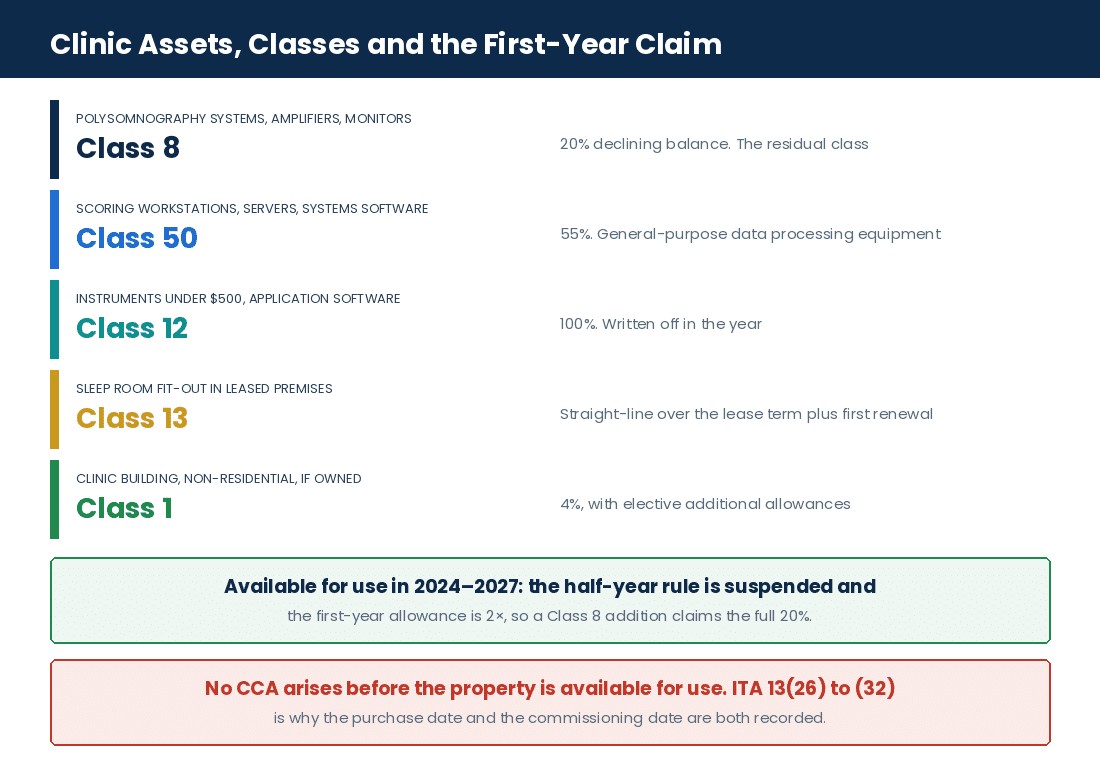
| Asset | Class | Rate and note |
|---|---|---|
| Polysomnography systems, amplifiers, monitors | Class 8 | 20% declining balance. Class 8 is the residual class for business property not described elsewhere |
| Scoring workstations, servers, systems software | Class 50 | 55% — general-purpose electronic data processing equipment acquired after 18 March 2007 |
| Purchased application software | Class 12 | 100% |
| Medical instruments costing under $500 | Class 12 | 100%, for instruments acquired after 1 May 2006 |
| Sleep room fit-out, leased premises | Class 13 | Straight-line over the lease term plus the first renewal period, minimum five years and maximum forty |
| Beds, furniture, fixtures, shelving | Class 8 | 20% |
| Clinic building, non-residential, owned | Class 1 | 4%, with an elective additional 2% for an eligible non-residential building acquired after 18 March 2007, each in a separate class |
| Passenger vehicle above the prescribed limit | Class 10.1 | 30%, with no recapture and no terminal loss |
Class 13 is amortised over the term of the lease plus the first renewal — land value plays no part in the calculation, which is a property-ownership concept rather than a leasehold one. The practical consequence is that a long fit-out on a short lease is written off quickly, and a clinic negotiating a five-year term with two renewals should know the renewal it includes changes the deduction.
Available-for-Use and the First-Year Claim
Key Stat: no capital cost allowance arises before the property is available for use, under subsections 13(26) to (32). Equipment delivered in November and commissioned in February belongs in the following year’s claim.
Once it is available for use, the Accelerated Investment Incentive suspends the half-year rule in Regulation 1100(2) and substitutes an enhanced first-year allowance. Bill C-15 reinstated it at 3× the normal first-year amount for property acquired after 2024 and available for use before 2030, which on a Class 8 addition is 30%, with a 2× band from 2030 through 2033.
Worked example. A Toronto clinic spends $50,000 upgrading its monitoring system during the year and the system is commissioned in September 2026. The cost is added to Class 8, and the first-year claim is $15,000 rather than the $5,000 the half-year rule would have given. The clinic keeps the purchase invoice and the commissioning record, because those two dates are what the claim rests on. Figures changed for privacy.
Property acquired after 20 November 2018 but before 2025 stays under the original incentive, which is in its own phase-out, so the acquisition date decides which version applies before the available-for-use date decides the factor. A separate measure in the same bill gives Classes 44, 46 and 50 acquired after 15 April 2024 and available for use before 2027 a 100% first-year deduction, which reaches a clinic’s scoring workstations, servers and systems software. The immediate expensing announced for manufacturing and processing buildings does not — that turns on property used directly in making or processing goods for sale.
What Happens When Equipment Is Replaced or Sold
- Recapture under subsection 13(1) where proceeds reduce the undepreciated capital cost of a class below zero: the negative balance is brought into income.
- Terminal loss under subsection 20(16) where a class is emptied of property and a positive balance remains: the balance is deducted.
- Trade-ins are a disposition at the value attributed to the old unit plus a separate acquisition, not a net purchase. Netting them hides the recapture.
- Class 10.1 vehicles are the exception: no recapture and no terminal loss, which is the whole point of the separate class.
- Pooling matters. Because CCA runs on class pools rather than individual assets, a clinic that replaces one of six amplifiers has a disposition but usually no gain or loss to recognise.
Software, Subscriptions and Devices Supplied to Patients
The shift from licensed software to subscription changes the tax treatment, and in the clinic’s favour. A perpetual licence purchased outright is depreciable property; a hosted subscription is a service consumed as it is used.
Worked example. A clinic replaces a $15,000 perpetual scoring software licence with a cloud subscription from January. The licence sat in Class 12 and was written off over two years under the old half-year rule; the subscription is a current expense deducted in full as the monthly fees are incurred. Figures changed for privacy.
| Item | Treatment | Why |
|---|---|---|
| Therapy devices held for sale or rental to patients | Inventory, valued under section 10 at the lower of cost and fair market value | Held for sale in the ordinary course, not used by the clinic |
| Devices rented out to patients under an ongoing arrangement | Depreciable property in the clinic’s hands | The clinic retains ownership and earns rental income from it |
| Devices given to patients at no charge | Deducted as incurred where they are consumable or promotional | No consideration received; the cost is a cost of earning income |
| Demo or loaner units taken out of stock for clinic use | Converted from inventory to capital property at fair market value, then Class 8 | A change of use is a disposition of the inventory |
Keeping a single asset list for everything is the usual source of error here. Inventory, rental fleet and clinic equipment are three different things under three different rules, and once they share a ledger account nobody can say which is which.
A clinic had every piece of equipment in one Class 8 pool, including its scoring workstations and its rental device fleet.
Moving the workstations to Class 50 at 55% and separating the rental fleet from clinic-use equipment increased the current-year claim substantially without changing a single purchase. The clinic had simply never been asked which assets were which. Figures changed for privacy.
Handling GST/HST Filing and Related Obligations
GST/HST, Exempt Supplies and MedSleep
GST/HST
This is where most of the money is, and where the circulating guidance is weakest. The usual treatment assumes a sleep clinic makes nothing but exempt supplies and therefore recovers no tax at all. Many clinics do two things, and the second one changes the arithmetic on every equipment purchase.
Analysis of Relevant Tax Cases and Regulatory Guidance
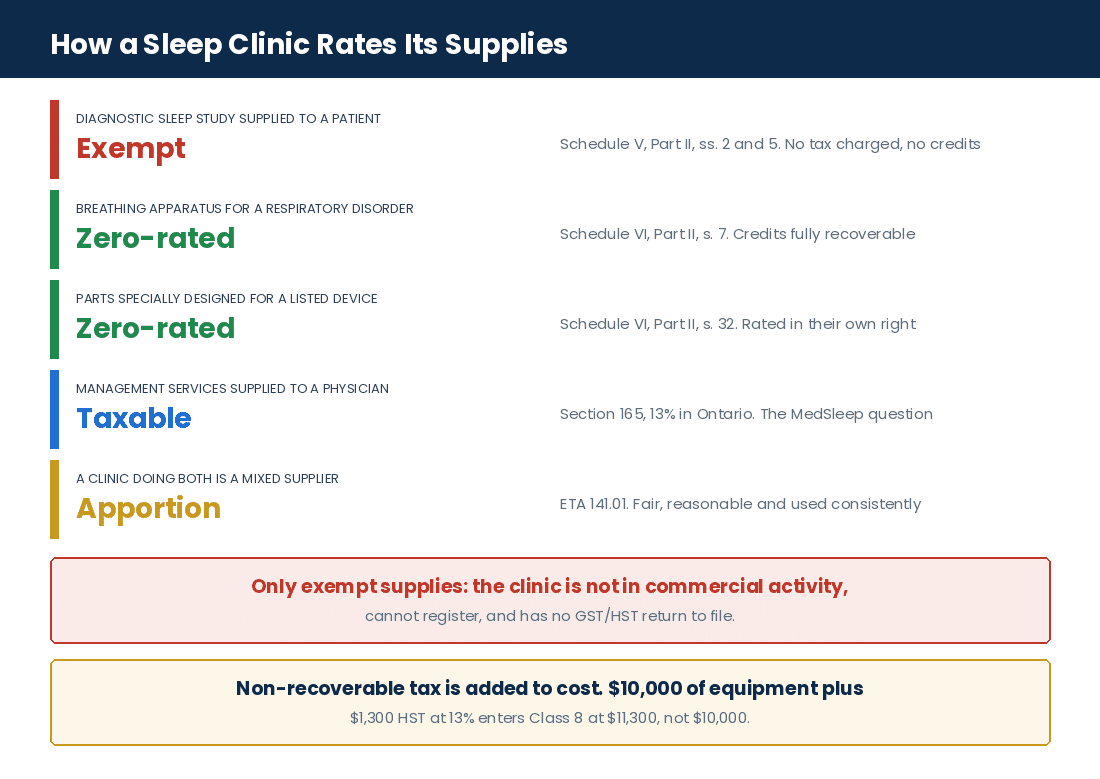
| Supply | Status | Where it is written | Credits on inputs? |
|---|---|---|---|
| Diagnostic sleep study delivered to a patient | Exempt | Schedule V, Part II, principally sections 2 and 5 | No |
| Breathing apparatus specially designed for a respiratory disorder | Zero-rated | Schedule VI, Part II, section 7 | Yes |
| Respiratory monitors usable in a residence | Zero-rated | Schedule VI, Part II, section 5.2 | Yes |
| Parts and accessories specially designed for a listed device | Zero-rated | Schedule VI, Part II, section 32 | Yes |
| Installing, repairing or modifying a listed device | Zero-rated | Schedule VI, Part II, section 34 | Yes |
| Management or administrative services supplied to a physician | Taxable | Section 165, at 13% in Ontario | Yes |
Exempt supplies are listed in Schedule V, with health care in Part II — not in “Part V” of the Act, and Part II of Schedule V is the exemption itself rather than a set of input tax credit restrictions. Credit entitlement is governed by subsection 169(1), the documentary standard by 169(4), and apportionment where a business does both by section 141.01.
The consequence is that a clinic supplying therapy devices alongside its diagnostic work is a mixed supplier, and the tax on inputs used in the device side comes back. That is worth stating plainly because the assumption that nothing is recoverable leads clinics to capitalise HST they were entitled to claim.
Summary of MedSleep Tax Court Decision and Its Impact on Sleep Clinics
In MedSleep Inc. v. The King, 2025 TCC 70, the clinic operator ran sleep facilities and handled intake, scheduling, overnight testing and staffing, retaining about 20% of the professional fees the sleep physicians billed. CRA assessed that share as consideration for a taxable supply of administrative services to the physicians.
The Tax Court disagreed. Looking at the arrangement from the patient’s perspective and applying the single-supply analysis from River Cree, it found one inseparable supply — the whole sleep study journey — whose predominant element was exempt medical service. Section 2 of Part II of Schedule V, covering institutional health care services supplied by the operator of a health care facility, best described MedSleep’s role, and satisfying one exemption is enough.
| What the Court relied on | What a clinic should be able to show |
|---|---|
| The agreements did not price a back-end service | Contracts describing fee sharing, with no schedule of administrative fees |
| Clinical and non-clinical elements were integrated | That the facility, staffing and interpretation cannot be bought separately |
| The documents matched the practice | Billing, scheduling and patient communications running as the contract describes |
| Bona fide legal relationships | No sham, and nothing in provincial law overriding the entitlement |
The decision is not a blanket safe harbour. CRA continues to look closely at arrangements that resemble management services supplied to health care professionals, and a clinic whose agreement sets a monthly administration fee, charges it separately and books it as service revenue has made a taxable supply regardless of how the relationship is described afterwards. The lesson is documentary: align the contract with the economics before anyone asks.
Why Non-Recoverable GST/HST Changes the Amount You Deduct
Risk Warning: where the tax is not recoverable it is added to the cost, which means it is capitalised rather than deducted. It increases the capital cost of the asset, not the current-year deduction.
A $10,000 monitoring unit bought for exclusively exempt use attracts $1,300 of HST at the Ontario rate of 13%. Because none of that tax can be claimed under 169(1), the capital cost added to Class 8 is $11,300 — the tax is on top of the price, not inside it.
The same logic runs through rent. Where a landlord charges HST on clinic premises and the tenant makes only exempt supplies, the unrecoverable tax forms part of the rent expense and is deducted with it. Where the clinic is a mixed supplier, the portion attributable to commercial activity is claimed as an input tax credit under 169(1) and only the balance is capitalised or expensed.
Registration and Filing, and When There Is Nothing to File
- A person making only exempt supplies is not engaged in commercial activity, cannot register, and has no GST/HST return to file. Filing nil returns in that position is not required and not useful.
- Registration is required once taxable and zero-rated supplies exceed the $30,000 small supplier threshold measured over four consecutive calendar quarters or in a single quarter, under section 148 with the requirement in 240(1).
- A clinic below the threshold that sells or rents devices may register voluntarily under subsection 240(3), which is usually the right call because registration is what makes the tax on device-side inputs recoverable.
- Filing frequency follows annual taxable supplies: annual to $1.5M, quarterly to $6M, monthly above, with more frequent filing available by election.
- Apportion inputs used in both activities on a method that is fair and reasonable and used consistently, under section 141.01. A revenue-based split is the usual starting point; a floor-area or staff-time measure is sometimes better and either must be documented.
- Records are kept six years under section 286, the same period as the income tax side.
Insured diagnostic services billed to a provincial plan are exempt wherever the clinic operates; the exemption turns on the nature of the supply under Part II of Schedule V, not on which province pays for it or whether the billing is public or private.
A clinic had been treating itself as wholly exempt and capitalising every dollar of HST on its device purchases.
About a third of its revenue came from selling and renting therapy devices, which is a commercial activity. Registering, apportioning under section 141.01 and claiming within the four-year window recovered a meaningful amount of tax, and reduced the capital cost of the equipment going forward. Figures changed for privacy.
Source Deductions, Worker Classification, and Timing for Remittances
Payroll, Worker Status and Remittances
Payroll
A sleep clinic runs overnight, which makes payroll more complicated than its size suggests: shift premiums, split schedules, scorers paid by study, and physicians who may not be employees at all. Remittance deadlines are set federally in Regulation 108 and apply the same way in every province.
How Overnight and Shift Staff Costs Are Deducted
- Wages, overtime and shift premiums are fully deductible when incurred and fully taxable to the employee. A night premium is remuneration, not an allowance.
- Employer CPP and EI contributions are deductible in addition to the gross wage.
- Remuneration still unpaid 180 days after the end of the taxation year is deferred to the year of payment under subsection 78(4) — the usual trap being an accrued bonus to an owner-manager.
- Taxable benefits such as parking at a clinic with ample free parking, or meals provided on night shifts, follow their own rules and belong on the T4 rather than buried in wage expense.
- T4 slips are due the last day of February following the calendar year, under Regulation 205(1).
Worked example. A Hamilton clinic with five technologists plus office staff runs a $450,000 annual payroll, of which about $15,000 is overtime and shift premium. All of it is deductible, the premium is on the T4s, and timesheets support the hours. Its average monthly withholding puts it in the regular band, so remittances are due the 15th of the following month. Figures changed for privacy.
Are Technologists and Physicians Employees or Contractors?
Risk Warning: worker status is decided on the facts, not on what the agreement calls the relationship.
The common-law factors come from Wiebe Door, as refined in Sagaz and Connor Homes: control, ownership of tools, chance of profit, risk of loss and integration into the business. CRA Guide RC4110, Employee or Self-employed?, sets them out, and a binding ruling is available on Form CPT1. The employer’s own obligations are in Guide T4001.
| Worker | Usual status | Why |
|---|---|---|
| Sleep technologists | Employees | Clinic schedules the shifts, supplies the equipment and bears the risk. Source deductions and a T4 are required |
| Scorers working remotely for several clinics | Depends on the facts | Own equipment and multiple clients point one way; set rates and clinic control point the other |
| Sleep physicians | Often independent | Exercise independent professional judgment and bill under their own billing number. Fee sharing rather than salary |
| Administrative staff | Employees | Integrated into the clinic’s operations on the clinic’s premises |
- A T4A is required for fees for services above $500 under Regulation 200(1), due the same last day of February.
- Getting it wrong the expensive way means the clinic owes the employee and employer CPP and EI it never withheld, plus penalty and interest, with no ability to recover the employee share from a worker who has left.
- A physician’s professional corporation that contracts with one clinic and looks like an incorporated employee risks being a personal services business, which loses the small business deduction, pays the full corporate rate and can deduct little beyond salary. That is the physician’s exposure rather than the clinic’s, but it affects how the arrangement should be structured.
- Review worker status on a schedule, not once at hiring. The facts drift.
Case Study: Claiming Business Expenses for Multi-Clinician Sleep Practices
A clinic with several clinicians has to get two things right at once, and they interact. The payroll side decides whether source deductions are owed; the GST/HST side decides whether the clinic is making a taxable supply to its own physicians. The same agreement governs both, which is why it is worth drafting once, carefully.
Worked example. A clinic pays five technologists on payroll and shares fees with three physicians under agreements that describe the arrangement as fee sharing and do not price any administrative service. Timesheets support the payroll; the lease shows 80% of the space in clinical use. The payroll is deductible, the physicians receive no T4, and the fee-sharing structure sits where MedSleep left it. Figures changed for privacy.
A clinic treated two long-serving technologists as contractors because that is how they had always invoiced.
Both worked the clinic’s shifts, on the clinic’s equipment, for the clinic alone. A CPT1 ruling would have confirmed employment at any point in the six years it ran. The reassessment covered both shares of CPP and EI plus interest, and neither worker was still there to recover anything from. Figures changed for privacy.
Procedures for Claiming Sleep Clinic Business Expenses on Tax Returns
Records, Filing and Procedure
Filing
Claiming sleep clinic tax deductions in Canada means being able to show, for each cost, what it was, when it was incurred, and how it was used in the clinic. The filing itself is mechanical once the classification work is done.
Documentation and Record-Keeping Requirements
Records are kept six years from the end of the last taxation year to which they relate under paragraph 230(4)(b), with the same period for GST/HST under section 286. Not six years from the filing date, and not seven years. Early destruction needs CRA permission on Form T137, and Guide RC188, Keeping Records, sets out the practical requirements. Regulation 5800 prescribes the longer periods that apply to a handful of records, including minute books and share registers, which are kept for two years after dissolution.
| Document | Retention | Why it is needed |
|---|---|---|
| Invoices and receipts | 6 years from the end of the taxation year | Prove the purchase and whether it was capital or current |
| Lease agreements | Term plus 6 years | Support the rent deduction and the Class 13 amortisation period |
| Equipment registers | Disposal plus 6 years | Track class, available-for-use date and recapture on disposal |
| Payroll records | 6 years | Confirm wages, shift premiums, withholdings and remittances |
| Fee-sharing and clinician agreements | Term plus 6 years | Support the GST/HST position on supplies to physicians |
| Minute books, share registers | 2 years after dissolution | Regulation 5800 prescribes the longer period |
Electronic records satisfy the requirement where they stay accessible and readable for the full period — which means a scoring system retired three years ago needs its data exported, not archived in a format nobody can open.
Step-by-Step Guide to Filing Business Tax Deductions in Canada
- Gather documents. Leases, equipment invoices with commissioning records, payroll registers including premiums, utility and supply bills, clinician agreements.
- Sort current from capital. Run the four tests on anything that looks like building work, and separate inventory, rental fleet and clinic-use equipment.
- Assign CCA classes. Diagnostic and monitoring equipment to Class 8, computers and systems software to Class 50, instruments under $500 and purchased application software to Class 12, fit-outs to Class 13, using Schedule II of the Income Tax Regulations.
- Apply the first-year rules. Confirm the available-for-use date, then take the enhanced first-year allowance rather than the half-year reduction.
- Work out the apportioned deductions. Rent and mixed-use costs at their business-use percentage; wages in full.
- Complete the T2. GIFI on Schedules 100 and 125, the reconciliation on Schedule 1, CCA on Schedule 8.
- Handle GST/HST separately. Rate the supplies, apportion the inputs under section 141.01, and capitalise only the tax that is genuinely not recoverable.
Electronic filing of the T2 is mandatory under subsection 150.1(2.1), with a $1,000 penalty for filing on paper under 162(7.2).
Corporate Tax Considerations for Incorporated Sleep Clinics
The T2 is due six months after fiscal year-end under paragraph 150(1)(a) — a fixed statutory deadline, with no extension available on request. The balance of tax falls earlier: two months under paragraph 157(1)(b), or three months for an eligible Canadian-controlled private corporation claiming the small business deduction. That gap is where clinics get caught, because the return feels like the deadline and interest has been running since month two.
- Split operating costs from depreciable assets correctly, because the error repeats in every later year through the class balances.
- Remit payroll source deductions on the band actually assigned under Regulation 108.
- Record shareholder loans carefully: an amount owed by a shareholder and not repaid within one year after the end of the corporation’s taxation year is included in income under subsection 15(2), and a benefit conferred is caught by 15(1).
- Disclose related-party transactions, which among physician shareholders are common and rarely documented.
- Watch the interaction between salary and dividends, which changes the payroll band as well as the personal tax result.
Examples and Practical Applications in Sleep Clinic Accounting
Each expense needs its own place on the books, because the ledger account is what carries the tax treatment into the return. The table below is the categorisation a clinic should be able to produce on request.
Sample Expense Categorization: Equipment, Rent, Payroll, and Operating Costs
| Expense category | How it is handled | What you need |
|---|---|---|
| Diagnostic equipment | Capitalised; CCA claimed by class from the available-for-use date | Invoices, asset list, commissioning record |
| Premises rent | Deducted as incurred, apportioned if the space is shared | Lease, payment proofs, floor plan |
| Staff wages | Fully deductible when incurred, subject to the 78(4) timing rule | Payroll register, timesheets, T4s |
| Utilities and insurance | Deducted as current business costs | Bills tied to the clinic premises |
| Consumables and supplies | Deducted as used | Purchase invoices, usage records |
| Sleep room fit-out | Capitalised to Class 13 over the lease term | Contractor invoices, scope of work, lease |
Common Pitfalls and How to Avoid Them in Tax Filing
| Mistake | What happens | How to fix it |
|---|---|---|
| Fit-out treated as repairs | Deduction denied and the year reassessed | Run the lasting-benefit and improvement tests before posting |
| Devices mixed into one class | Wrong rate, usually too low | Separate inventory, rental fleet and clinic equipment |
| Applying the half-year rule in 2026 | First-year claim understated by half | Use the enhanced first-year allowance for property available for use to 2027 |
| Overstated rent | The excess is disallowed | Use measured occupancy, not an estimate |
| Wrong worker classification | Back CPP and EI on both shares, plus penalties | Review status against RC4110; get a CPT1 ruling where it is close |
| Capitalising recoverable HST | Credits lost and the asset base overstated | Rate the supplies and apportion under section 141.01 |
Bad Debts and Expense Write-Offs
A clinic with private-pay patients or a device line will carry receivables that go bad, and the deduction has its own provision. Paragraph 20(1)(p) allows it where the amount was previously included in income and is established to have become bad in the year — age alone is not the test. There is a second recovery most clinics miss: where GST/HST was charged and remitted on an invoice that goes bad, section 231 of the Excise Tax Act allows the tax to be recovered on the written-off portion, which is a separate claim from the income tax deduction. A recovery in a later year comes back into income under paragraph 12(1)(i). Keep the collection file — statements, demand letters, the write-off decision and its date — and do not let bad debts share a general provision account with inventory or equipment write-downs, which run under different rules.
Addressing Penalties, Interest and Catch-Up Filing
| Failure | Consequence | Provision |
|---|---|---|
| Late T2 filing | 5% of the unpaid tax plus 1% per complete month, to twelve | ITA 162(1) |
| Repeat late filing after a demand | 10% plus 2% per month, to twenty | ITA 162(2) |
| Paper-filed T2 | $1,000 | ITA 162(7.2) |
| Late GST/HST return with tax owing | 1% plus 0.25% per month, to twelve months | ETA 280.1 |
| Late payroll remittance | 3% to 10%, graded by lateness, 20% on a repeat | ITA 227(9) |
| Arrears interest | Compounded daily | ITA 161(1) |
| Gross negligence | 50% of the understated tax | ITA 163(2) |
Where books have fallen behind, the order matters: rebuild from bank statements and supplier invoices, rebuild the asset register with acquisition and available-for-use dates, re-rate the supplies for GST/HST, then amend. Where something was not reported at all, the Voluntary Disclosures Program under Information Circular IC00-1R6 may limit penalties, but only where the disclosure is voluntary — made before CRA makes contact — and it must be complete, involve a penalty and concern information at least a year overdue. Relief from penalties and interest is a separate route under subsection 220(3.1), applied for on Form RC4288 within ten calendar years. Write-offs with no evidence behind them will not survive the exercise.
File It Yourself or Use a CPA Firm?
| Route | Works when | Breaks when |
|---|---|---|
| File it yourself | One location, no fit-out, no device sales, employees only | A capital project, a device line, or several clinicians sharing fees |
| Non-CPA bookkeeping service | Transaction processing on a clean chart of accounts | The capital line, CCA classes, GST/HST apportionment and CRA correspondence — none of which is bookkeeping |
| Licensed CPA firm | Mixed exempt and commercial activity, capital projects, a review under way | Costs more up front than doing nothing |
Professional Services: Bookkeeping, Payroll, and CRA Representation
Gondaliya CPA works with clinics across Canada on a flat annual fee covering bookkeeping in QuickBooks or Xero, payroll including overnight shift premiums, GST/HST returns, T2 preparation and CRA representation. The firm performs compilation engagements under CSRS 4200, which provide no assurance; audit and review engagements are referred out. We do not provide clinical guidance of any kind.
A clinic arrived three years behind, with every equipment purchase in a single expense account and no asset register.
Rebuilding the register from invoices and commissioning records produced several years of unclaimed capital cost allowance, and the amended returns recovered more than the catch-up work cost. The expensive part was not the tax; it was that nobody could answer a simple question about what the clinic owned. Figures changed for privacy.
Resources for Sleep Clinic Tax Planning and Compliance
Credits, Resources and Special Situations
Resources
Official CRA Forms, Publications, and Online Tools
- T2 Corporation Income Tax Return, with Schedule 8 for capital cost allowance and Schedules 100, 125 and 1 for the financial data and reconciliation.
- Guide T4012, the T2 Corporation Income Tax Guide, for the return itself.
- Folio S3-F4-C1, General Discussion of Capital Cost Allowance, and Schedule II of the Income Tax Regulations for the classes and rates.
- GST/HST Memorandum 4.2, Medical and Assistive Devices, for rating a device against Part II of Schedule VI.
- Guide RC4110 for worker status and Guide T4001, the Employer’s Guide to Payroll Deductions and Remittances, for the remittance bands.
- Guide RC188, Keeping Records, and Form T137 for permission to destroy records early.
- My Business Account for filing, remitting and checking the remitter type CRA has actually assigned you.
The Income Tax Regulations are published as C.R.C., c. 945; the capital cost allowance rules sit in sections 1100 to 1102 with the classes in Schedule II. Guide T4012 covers the return, not the class list.
Available Tax Credits Including SR&ED and Other Incentives
Risk Warning: delivering diagnostic sleep studies is not SR&ED, however advanced the equipment. The definition in subsection 248(1) expressly excludes quality control or routine testing and routine data collection, which is what a clinical sleep study is.
What can qualify is a genuine attempt to resolve a scientific or technological uncertainty by systematic investigation — developing a novel scoring algorithm, or a monitoring technique that cannot be achieved with existing methods. The clinical service delivered alongside it does not become eligible by association.
| Incentive | What it gives | Whether a sleep clinic qualifies |
|---|---|---|
| SR&ED investment tax credit | 35% refundable for a CCPC on qualifying expenditures up to the expenditure limit, 15% beyond | Only for genuine development work. The expenditure limit is $6 million, phased out on taxable capital between $15 million and $75 million, for taxation years beginning after 15 December 2024 |
| SR&ED capital expenditures | Eligible again for both the deduction and the credit | For property acquired after 15 December 2024, on rules broadly as they stood before 2014 |
| Apprenticeship Job Creation Tax Credit | 10% of wages to $2,000 per apprentice per year, claimed on Schedule 31 | No. It requires an apprentice in the first two years of a registered contract in a Red Seal trade, and sleep technologist is not a Red Seal trade |
| Small business deduction | Reduced corporate rate on the first $500,000 of active business income | Yes for an ordinary CCPC, subject to the associated-corporation and passive-income grinds |
| Accelerated Investment Incentive | Enhanced first-year CCA, half-year rule suspended | Yes, for property available for use through 2027 |
Most of what a clinic spends is an ordinary deductible business expense rather than a credit, and that is the right place to concentrate. Chasing a credit the clinic does not qualify for costs more in preparation fees than it ever returns.
Additional Considerations and Support from Gondaliya CPA
Two situations come up often enough in clinic practices to be worth setting out, and both are time-limited.
Advice on Handling Tax Filing for Deceased Stakeholders or Clients
- A terminal return is filed for the year of death under paragraph 150(1)(b), due the later of six months after the date of death and the date the return would otherwise have been due.
- Subsection 70(5) deems a disposition of capital property at fair market value immediately before death, which for a clinic shareholder means the shares are disposed of at that value.
- A transfer to a spouse or a qualifying spousal trust rolls over at cost under subsection 70(6), deferring the gain.
- Where the estate redeems the shares, subsection 164(6) allows a capital loss of the estate’s first taxation year to be applied against the terminal return — the election has to be made in time, and it is the main planning tool here.
- The estate may qualify as a graduated rate estate for up to 36 months, which affects both rates and the available elections.
- Update the corporation’s share register and minute book, and obtain a clearance certificate on Form TX19 before distributing, because distributing without one leaves the legal representative personally liable.
Get advice early rather than after the first deadline passes. The estate filings interact with corporate elections and with the timing of any redemption, and the 164(6) window closes quickly.
Best Practices for Audit Readiness and Documentation Retention
- An asset register showing, for each item, the purchase date, the available-for-use date, the cost, the class and the disposal.
- A supply rating file recording which of the clinic’s revenue streams are exempt, zero-rated and taxable, and the apportionment method used.
- Clinician agreements that say what actually happens, reviewed whenever the arrangement changes.
- Payroll registers reconciling gross pay to withholdings to remittances, month by month.
- Occupancy evidence for every apportioned cost, refreshed annually rather than carried forward indefinitely.
- A written note of any judgment call — a capital-versus-current conclusion, an apportionment basis — made at the time rather than reconstructed later.
Contact Information and Services Offered by Gondaliya CPA for Sleep Clinics
Gondaliya CPA Professional Corporation serves clinics in Toronto, Etobicoke, Vaughan and Mississauga and across the rest of Canada. Reach us at 647-212-9559 or info@gondaliyacpa.ca. The firm is listed on the CPA Ontario public firm directory.
A clinic had been quoted a substantial fee to prepare an SR&ED claim covering its routine diagnostic work.
None of it was eligible: the studies were routine testing and routine data collection, both excluded by the definition. A separate project the clinic had not thought to mention — building a scoring tool to handle an artefact its software could not — was the only part worth examining. Figures changed for privacy.
Frequently Asked Questions on Sleep Clinic Tax Deductions Canada
Frequently Asked Questions
20 Answers
Which sleep clinic costs are deducted now and which are written off over time?+
How is the sleep room fit-out treated for tax purposes?+
How much of the rent can the clinic claim as a deduction?+
What if the clinic owns its premises instead of renting?+
Which class does diagnostic and monitoring equipment fall into for CCA?+
Does the half-year rule still cut the first-year claim in half?+
What happens when equipment is replaced or sold?+
How are devices supplied to patients treated in accounting?+
Are computers, scoring software, and subscriptions deductible expenses?+
How are overnight and shift staff costs deducted for sleep clinics?+
Are the technologists and physicians employees or contractors for tax purposes?+
Which operating costs are fully deductible and which have limits?+
Why does non-recoverable GST/HST change the amount of deduction claimed?+
Does the clinic have to register for GST/HST at all?+
What does the MedSleep decision mean for a clinic sharing fees with its physicians?+
What does a newly opened clinic deduct first during start-up?+
What records support a sleep clinic’s deduction claims best?+
File it yourself or hand it to a CPA firm: which route fits a clinic best?+
What triggers a CRA review of sleep clinic tax returns?+
How do you catch up if your books are behind for prior years?+
Sleep Clinic Tax Check
Five quick questions on your clinic. No fee shown.
Points to raise with us:
This is a general prompt, not tax or legal advice or a quote. Your position depends on your full facts. For a real review, please book a free consultation.
Businesses We Serve & Industry Spotlights
Industry Expertise
A sleep clinic sits inside a wider health care and capital-intensive services practice, and the same three questions surface in every sector we act for. Here are eleven and the form the issue usually takes.
| Industry | The Sleep Clinic Angle |
|---|---|
| Medical doctors & physician professional corporations | Fee sharing, personal services business risk, exempt supplies |
| Dentists & dental practices | Operatory fit-outs in Class 13 and equipment in Class 8 |
| Daycare, childcare & CWELCC services | Exempt supplies, where no input tax credits arise at all |
| E-commerce & online retailers | The device side of a clinic, rated line by line |
| Technology startups & SaaS | Subscription software as a current expense, not Class 12 |
| Real estate investors, landlords & holding companies | Clinic premises held in a separate corporation |
| Property developers & builders | The current-versus-capital line on construction work |
| Construction, contractors & skilled trades | Who actually qualifies for the apprenticeship credit |
| Restaurants & food and beverage | Overnight shift payroll and the remittance bands |
| Transportation, logistics & trucking | Vehicle classes, logbooks and the 10.1 limit |
| Consulting firms | Management fees that create a taxable supply |
- Medical doctors & physician professional corporations: The other half of a sleep clinic. The same agreement that settles whether the clinic made a taxable supply also settles whether the physician’s corporation looks like an incorporated employee.
- Dentists & dental practices: An operatory build-out raises the identical question a sleep room raises: Class 13 over the lease term, or Class 1 if the premises are owned.
- Daycare, childcare & CWELCC services: A clean illustration of wholly exempt activity, where nothing comes back on inputs and the unrecoverable tax simply becomes part of the cost.
- E-commerce & online retailers: A clinic selling therapy devices online is running a retail business beside a health service, and each revenue line is rated on its own terms.
- Technology startups & SaaS: The vendors selling scoring platforms have moved to subscription, which moves the clinic’s cost out of a capital class and into a current deduction.
- Real estate investors, landlords & holding companies: Clinic premises are frequently held in a separate corporation, which raises association under section 256 and one business limit shared under 125(3).
- Property developers & builders: They live on the current-versus-capital line every day, and the four tests a clinic applies to a fit-out are the ones a developer applies to every invoice.
- Construction, contractors & skilled trades: This is where the apprenticeship credit actually lives, because the Red Seal trades are trades — which is why it does not reach a clinic’s technologists.
- Restaurants & food and beverage: Another sector running overnight and premium shifts, with the same Regulation 108 band question and the same tendency to remit on the wrong schedule.
- Transportation, logistics & trucking: Where a clinic runs a mobile testing or device delivery vehicle, the Class 10 against Class 10.1 question and the kilometre log work exactly as they do for a carrier.
- Consulting firms: A management fee charged to a professional is a taxable supply, which is precisely the characterisation CRA argued for in MedSleep and the one a clinic wants to avoid stumbling into.
The sector changes. The three questions do not: where does the capital line fall, what is each revenue line rated at, and does the paperwork say what actually happens.
A sleep clinic and a dental practice keep different equipment and file nearly identical returns. Figures changed for privacy.
Professional Guidance and Quick Reference
Guidance
Choosing Gondaliya CPA for Your Sleep Clinic
Sleep clinics get into difficulty in a predictable set of ways: reading MedSleep as a capital-versus-current case, when 2025 TCC 70 is a GST/HST exempt-supply ruling on fee sharing under section 2 of Part II of Schedule V; applying the half-year rule to a current addition, when the Accelerated Investment Incentive suspends it for property available for use through 2027; remitting payroll within three working days, when that band in Regulation 108 starts at $100,000 of average monthly withholding and a clinic is a regular remitter due on the 15th; expensing a sleep room fit-out as repairs, when it is a Class 13 leasehold improvement; assuming the clinic is wholly exempt and capitalising recoverable HST, when a device line is a commercial activity and section 141.01 apportions the inputs; putting diagnostic monitors in Class 43, which is manufacturing machinery, instead of Class 8; claiming the apprenticeship credit on technologists, when it requires a Red Seal apprentice; treating routine sleep studies as SR&ED, when 248(1) excludes routine testing and routine data collection; keeping records six years from filing, when paragraph 230(4)(b) says six from the end of the taxation year; citing subsection 67(2) for the meal limit, when it is section 67.1 at 50%; and paying the corporate balance with the return, when it was due at two months under 157(1)(b). Gondaliya CPA handles clinic accounting and tax on a flat annual fee.
We handle what decides the outcome: drawing the capital line before the entry is posted, building an asset register with acquisition and available-for-use dates so the enhanced first-year allowance is actually claimed, rating each revenue stream as exempt, zero-rated or taxable and apportioning inputs on a basis that is written down, reviewing clinician agreements so the documents say what happens, setting the payroll remittance band from the average monthly withholding amount, and preparing compiled statements under CSRS 4200 that state plainly that no assurance is provided. Audit and review engagements are referred out, and we offer no clinical guidance of any kind.
Our team starts with your lease, your equipment invoices and your last return. Whatever your clinic looks like, you get clear advice and a fixed price before we start.
Quick Answers
At a Glance
- MedSleep: 2025 TCC 70, a GST/HST exempt-supply case
- Exempt health care: Schedule V, Part II, sections 2 and 5
- Zero-rated breathing apparatus: Schedule VI, Part II, section 7
- Apportionment: ETA 141.01, fair and reasonable, consistent
- Current expense: ITA 18(1)(a)
- Capital expenditure: ITA 18(1)(b); CCA under 20(1)(a)
- Diagnostic equipment: Class 8 at 20%
- Workstations and systems software: Class 50 at 55%
- Instruments under $500: Class 12 at 100%
- Sleep room fit-out: Class 13, lease term plus first renewal
- Available for use: ITA 13(26) to (32)
- First-year claim: half-year rule suspended, 2× to 2027
- Meals and entertainment: 50%, ITA 67.1
- Payroll remittance: Regulation 108; regular is the 15th
- Unpaid remuneration: deferred after 180 days, ITA 78(4)
- Records: six years from the taxation year-end, ITA 230(4)(b)
- T2 filing: six months, ITA 150(1)(a)
- Balance of tax: two months, ITA 157(1)(b)
Who This Is For
Audience
- An incorporated sleep clinic running one or more diagnostic labs in Ontario or elsewhere in Canada.
- A multi-clinician practice sharing fees with sleep physicians who are not on payroll.
- A clinic that performs insured studies and sells or rents therapy devices, and so has both exempt and commercial activity.
- A clinic planning a lab build-out or an equipment refresh and deciding when to commission it.
- A clinic that has been remitting payroll on a schedule nobody has checked against Regulation 108.
- A clinic whose books have fallen behind and needs the asset register rebuilt before anything is amended.
Sleep Clinic Tax Deduction Essentials by Gondaliya CPA
Key Controls and Warning Signs
- Leasehold improvement CCA class: a sleep room fit-out in leased premises is Class 13, amortised straight-line over the lease term plus the first renewal, with a five-year minimum and a forty-year maximum. Land value does not enter the calculation.
- The half-year rule is suspended, not applied: for property available for use from 2024 through 2027 the enhanced first-year allowance is twice the normal first-year amount. Claiming half is leaving the other half on the table.
- Payroll remittance deadline: the 15th of the following month for a regular remitter under Regulation 108. The three-working-day cycle begins at $100,000 of average monthly withholding.
- Meals and entertainment limit: 50% of the amount paid under section 67.1, with the input tax credit recaptured to match. There is no per-meal dollar cap.
- Non-recoverable GST/HST forms part of cost: it increases the capital cost of the asset or the amount of the expense. Before accepting that it is non-recoverable, confirm the clinic is not a mixed supplier.
- Devices sold, rented or given away: inventory, depreciable property and current expense respectively. Three rules, three ledger accounts.
Audit Exposure Reduction Strategies
Controls
- Keep a detailed asset register showing, for every item, the purchase date, the available-for-use date, the cost and the CCA class.
- Separate personal from business expenses on measured business-use percentages, with the floor plan or log behind each one.
- Maintain payroll registers that reconcile gross pay to withholdings to remittances and to the T4 summary.
- Review worker status against Guide RC4110 on a schedule rather than once at hiring, and get a CPT1 ruling where it is close.
- Keep clinician agreements aligned with what actually happens, since that alignment is what carried MedSleep.
- Write down every judgment call — a capital-versus-current conclusion, an apportionment basis — at the time it is made.
Corporate Tax Filing Notes
Deadlines
- File the T2 within six months of fiscal year-end under paragraph 150(1)(a). There is no extension available on request.
- Pay the balance of tax at two months under paragraph 157(1)(b), or three for an eligible CCPC claiming the small business deduction.
- File electronically under subsection 150.1(2.1); paper filing carries a $1,000 penalty under 162(7.2).
- Record shareholder loans and payments carefully: an amount not repaid within a year of the corporation’s year-end is included in income under subsection 15(2), and a benefit conferred is caught by 15(1).
- Disclose related-party transactions transparently, which among physician shareholders are common and rarely documented.
People Also Ask
Related Questions
Is a sleep study subject to GST/HST?+
No. A diagnostic sleep study delivered to a patient is an exempt supply under Part II of Schedule V, so no tax is charged and no input tax credits arise on the inputs used to make it.
Can a sleep clinic claim input tax credits at all?+
Yes, to the extent it carries on commercial activity — typically selling or renting therapy devices. The inputs are apportioned under section 141.01 on a basis that is fair and reasonable and used consistently.
Is a CPAP machine taxable when the clinic sells it?+
A breathing apparatus specially designed for use by an individual with a respiratory disorder is zero-rated under section 7 of Part II of Schedule VI, and parts specially designed for a listed device are zero-rated under section 32. Rate each item against the actual statutory description rather than by category.
How much CCA can a clinic claim on new equipment in its first year?+
On a Class 8 addition available for use in 2026, 30%. The reinstated Accelerated Investment Incentive gives three times the normal first-year amount. Class 50 equipment acquired after 15 April 2024 and available for use before 2027 is deducted in full.
Does a sleep clinic need an audit?+
Almost never. Most clinics need compiled financial statements under CSRS 4200, which provide no assurance. Gondaliya CPA prepares compilations and refers audit and review engagements out.
Glossary
Definitions
- Current expenditure — a cost consumed in the year with no lasting benefit, deducted in full under paragraph 18(1)(a).
- Capital expenditure — a cost that acquires or improves an asset whose benefit endures beyond the year, denied by 18(1)(b) and recovered through capital cost allowance.
- Capital cost allowance — the annual deduction in place of depreciation, by class, under paragraph 20(1)(a) and Regulation 1100.
- Available for use — the date from which capital cost allowance may first be claimed, determined under subsections 13(26) to (32).
- Accelerated Investment Incentive — the measure that suspends the half-year rule and gives an enhanced first-year allowance, reinstated by Bill C-15 at three times the normal amount for property acquired after 2024 and available for use before 2030.
- Exempt supply — a supply listed in Schedule V on which no tax is charged and for which no input tax credits are available. Health care sits in Part II.
- Zero-rated supply — a supply listed in Schedule VI, taxable at 0%, on which input tax credits remain fully recoverable. Medical devices sit in Part II.
- Single compound supply — several elements so integrated that they are one supply for GST/HST purposes, rated by their predominant element.
- Average monthly withholding amount — the measure in Regulation 108 that assigns an employer to a remittance band.
- Recapture — the income inclusion under subsection 13(1) where proceeds of disposition reduce a class balance below zero.
- Terminal loss — the deduction under subsection 20(16) where a class is emptied of property and a positive balance remains.
- Personal services business — an incorporated worker whose corporation loses the small business deduction and most deductions beyond salary.
Want a checklist to work from? You can download our free sleep clinic tax checklist before your consultation.
Draw the capital line before the entry is posted, because a sleep room fit-out is a Class 13 leasehold improvement and calling it repairs is the single most common reassessment in this sector. Build an asset register that records the available-for-use date beside the purchase date, then take the enhanced first-year allowance rather than halving the claim, because the half-year rule is suspended and the first-year amount is three times the normal one. Put diagnostic monitors in Class 8, workstations and systems software in Class 50, instruments under $500 in Class 12, and keep inventory, rental fleet and clinic-use equipment in three separate accounts. Check whether the clinic actually makes only exempt supplies before capitalising a dollar of HST, because a device line is commercial activity and section 141.01 apportions the inputs. Read MedSleep for what it decided — that a properly documented fee-sharing arrangement is not a taxable supply to your physicians — and make sure your agreements say what actually happens. Set the payroll band from your average monthly withholding amount and remit on the 15th if that is your band. Apply section 67.1 to meals, not a subsection that does not exist. Keep six years from each year-end. And pay the corporate balance at two months, not with the return.
2026 Update — what is current: This article reflects rules current to 8 October 2026. MedSleep Inc. v. The King, 2025 TCC 70, is the leading authority on fee-sharing arrangements in a multi-clinician clinic, holding that the arrangement was a single exempt supply to patients under section 2 of Part II of Schedule V rather than a taxable supply of administrative services to the physicians. The Accelerated Investment Incentive was reinstated by Bill C-15: the half-year rule stays suspended and the enhanced first-year allowance is 3× the normal first-year amount for property acquired after 2024 and available for use before 2030, with a 2× band from 2030 through 2033 and normal rates after 2033. Property acquired before 2025 remains under the original measure. The same bill gives Classes 44, 46 and 50 acquired after 15 April 2024 and available for use before 2027 a 100% first-year deduction, which covers a clinic’s workstations, servers and systems software. The SR&ED reforms in Bill C-15 received Royal Assent on 26 March 2026: the expenditure limit for the enhanced 35% refundable credit is $6 million, giving up to $2.1 million of refundable credit, phased out on taxable capital between $15 million and $75 million; eligible Canadian public corporations now reach the enhanced rate; and capital expenditures are eligible again for property acquired after 15 December 2024 — all for taxation years beginning after that date. The immediate expensing announced for manufacturing and processing buildings does not reach a clinic — that turns on property used directly in making or processing goods for sale. Electronic filing of the T2 is mandatory under subsection 150.1(2.1), with a $1,000 penalty under 162(7.2) for paper. Unchanged: the exempt listing in Schedule V, Part II, the zero-rating listing in Schedule VI, Part II including the parts rule in section 32, apportionment under 141.01, the payroll bands in Regulation 108, the meal limit at 50% under 67.1, the six-year retention requirement in paragraph 230(4)(b) and section 286, and the corporate balance of tax at two months under 157(1)(b).
Sleep Clinic Tax Deductions Canada: How Gondaliya CPA Can Help
Start with your lease, your equipment invoices and your last return
Gondaliya CPA draws the capital line on your fit-out and equipment, builds the asset register with available-for-use dates so the enhanced first-year allowance is actually claimed, rates each revenue stream as exempt, zero-rated or taxable and apportions the inputs under section 141.01, reviews your clinician agreements against what MedSleep turned on, sets the payroll remittance band from your average monthly withholding amount, and files the GST/HST, payroll and T2 from one reconciled set of books — on a flat annual fee including HST with a one-business-day response. Please book a free consultation.
Next Steps
Please book a free consultation with Gondaliya CPA and bring your lease, your equipment invoices with commissioning dates, and your last filed return. Those three settle the capital line, the first-year allowance and the GST/HST rating question, which is where almost all of the exposure sits for a clinic. If you share fees with physicians, bring the agreement too. You will get a flat annual fee including HST before any work begins. We serve Toronto, Mississauga, Vaughan, Brampton, Etobicoke, Scarborough, Ottawa and the rest of Ontario, and work with clinics across Canada. If our content helps, please add gondaliyacpa.ca as a preferred source on Google.
Published: · Last updated:
Editorial policy: We research against CRA, Department of Finance, Tax Court of Canada, CPA Canada and CPA Ontario sources, fact-check the figures, and Sharad Gondaliya, CPA, reviews the content, which we update as the rules change.
Disclaimer: This article is educational information only and is not tax, legal, or financial advice. Figures marked illustrative are examples rather than quotes or guarantees. It reflects rules current to 2026, including the current-versus-capital distinction in paragraphs 18(1)(a) and 18(1)(b) of the Income Tax Act, capital cost allowance under Regulation 1100 and Schedule II with the available-for-use rules in subsections 13(26) to (32) and the Accelerated Investment Incentive, exempt health care supplies in Part II of Schedule V to the Excise Tax Act, zero-rated medical and assistive devices in Part II of Schedule VI, input tax credit apportionment in section 141.01, the payroll remittance bands in Regulation 108, and the six-year retention requirement in paragraph 230(4)(b). Nothing here is clinical guidance, and device licensing under the Medical Devices Regulations is a separate regulatory matter on which we do not advise. Gondaliya CPA performs compilation engagements under CSRS 4200 and does not perform audit or review engagements. Rates and limits change and outcomes depend on your specific facts. Please consult a licensed CPA before acting.

Sharad Gondaliya is a CPA Canada & CPA USA with 15 Years+ experience of Accounting, Tax, Payroll of Corporate Small Businesses as Tax Accountant. He is a CPA Ontario member (61040184) and holds US CPA licences in Washington and Montana and is well known among corporate small businesses for tax planning, efficient tax solutions, and affordable CPA services. Sharad is the Principal (Director) of Gondaliya CPA – Affordable CPA Firm in Canada. Licenses: CPA Ontario: 61040184 | CPA USA (MT): PAC-CPAP-LIC-033176 | CPA USA (WA): 57629 | CPA Firm License: 61330051 View Full Author Bio