



Data Analytics Company Tax Credits in Canada: SR&ED, R&D & Technology Incentives
Data analytics company tax credits Canada: SR&ED, R&D tax credits, and technology incentives
Data analytics company tax credits in Canada run through SR&ED, the provincial R&D credits that stack on top of it, and the ordinary deductions that sit alongside both. Gondaliya CPA helps data analytics firms claim eligible expenditures — R&D salaries, contractor payments, materials and now capital equipment — while handling corporate tax filing and the provincial research credits that have to be claimed alongside the federal return.
Quick Summary
The SR&ED program changed more in the last eighteen months than in the previous decade, and most circulating guidance has not caught up. Bill C-15 received Royal Assent on 26 March 2026. The expenditure limit for the enhanced 35% refundable credit is now $6 million, not $3 million, giving up to $2.1 million of refundable credit a year. Eligible Canadian public corporations reach that enhanced rate for the first time. Capital expenditures are claimable again for property acquired after 15 December 2024. The prescribed proxy amount is 55% of the salary base under Regulation 2900(4) — 65% has not been the rate since 2012. And the reporting deadline sits in subsection 37(11) and paragraph (m) of the investment tax credit definition in 127(9), with no statutory mechanism to extend it.
Reading time: 32 minutes.
Table of Contents
- Three Things You Have Been Told
- Overview of SR&ED and Technology Credits
- Scientific and Technological Criteria
- Eligible Expenditures
- Non-Eligible Activities and Expenses
- The Claiming Process
- Deadlines, Records and Catch-Up
- Provincial and Territorial R&D Credits
- Frequently Asked Questions
- Businesses We Serve & Industry Spotlights
- Professional Guidance and Quick Reference
The Numbers That Matter
This article covers Canada, with Ontario and Toronto context, and reflects rules current to 7 October 2026, including the SR&ED amendments enacted by Bill C-15 on 26 March 2026. It is written for incorporated data analytics firms — analytics consultancies, data platform and pipeline builders, machine learning teams and analytics SaaS companies — whether Canadian-controlled private corporations or publicly listed. Gondaliya CPA performs compilation engagements; we do not perform audits or review engagements. CRA is still updating its forms and policy pages to reflect the new rules, so a claim filed now may need to be amended once those are published. This is educational information only and not tax or legal advice.
Three Things You Have Been Told
Three Things You Have Been Told
The Corrections
SR&ED guidance ages badly, and it has aged faster in the last two years than at any time since the program’s capital rules were stripped out in 2014. Three claims in wide circulation are now wrong, and the first one is wrong by a factor of two.
The Expenditure Limit Is $6 Million, and Public Corporations Are Now In
Risk Warning: “up to 35% on qualified spending below $3 million” understates the limit by half and shuts out companies that now qualify.
Bill C-15, the Budget Implementation Act, 2025, No. 1, received Royal Assent on 26 March 2026. For taxation years beginning after 15 December 2024, the expenditure limit for the enhanced 35% refundable credit is $6 million — up to $2.1 million of refundable credit a year, against $1.05 million before.
| Feature | Old rule | In force now |
|---|---|---|
| Expenditure limit | $3 million | $6 million |
| Maximum refundable credit | $1.05 million | $2.1 million |
| Taxable capital phase-out | $10M to $50M | $15M to $75M |
| Who gets the enhanced rate | Qualifying CCPCs only | CCPCs and eligible Canadian public corporations |
| Alternative phase-out test | None | Election to use average gross revenue over the three preceding years, $15M to $75M |
| Capital expenditures | Excluded since 2014 | Eligible again for property acquired after 15 December 2024 |
Two consequences for an analytics firm. A company spending $5 million a year on qualifying work was previously getting the enhanced rate on $3 million of it and the basic 15% on the rest; it now gets the enhanced rate on all of it. And a listed Canadian analytics company that had written SR&ED off as a 15% non-refundable credit should look again, because an eligible Canadian public corporation now reaches the refundable rate, subject to a phase-out on its three-year average gross revenue.
CRA is still rebuilding its forms and policy pages around the new rules. A claim prepared on the old basis can be amended once the guidance lands, so the practical answer for a year already filed is to compute the adjusted limit and amend rather than wait.
The Proxy Rate Is 55%, Not 65%
Risk Warning: “a fixed overhead rate of about 65% of direct salaries for 2026 filings” is the rate that applied in 2012 and earlier.
The prescribed proxy amount is 55% of the salary base, set by subsection 2900(4) of the Income Tax Regulations. It was 65% to 2012, 60% for 2013, and has been 55% since 2014. Overstating it by ten points overstates the credit on every claim.
Two further points the usual summaries leave out. The proxy amount is a notional figure used only to compute the investment tax credit — it is not added to the pool of deductible SR&ED expenditures. And the salary base it applies to is narrower than payroll: bonuses, profit-based remuneration and taxable benefits are excluded, and for a specified employee the base is capped at 75% of time spent on SR&ED and at 2.5 times the year’s maximum pensionable earnings, under subsections 2900(7) and 2900(8).
The Deadline Is in Section 37(11), and Nothing Extends It
Risk Warning: the SR&ED reporting deadline is not in section 230. Section 230 is the books and records provision. It has nothing to do with when a claim must be filed.
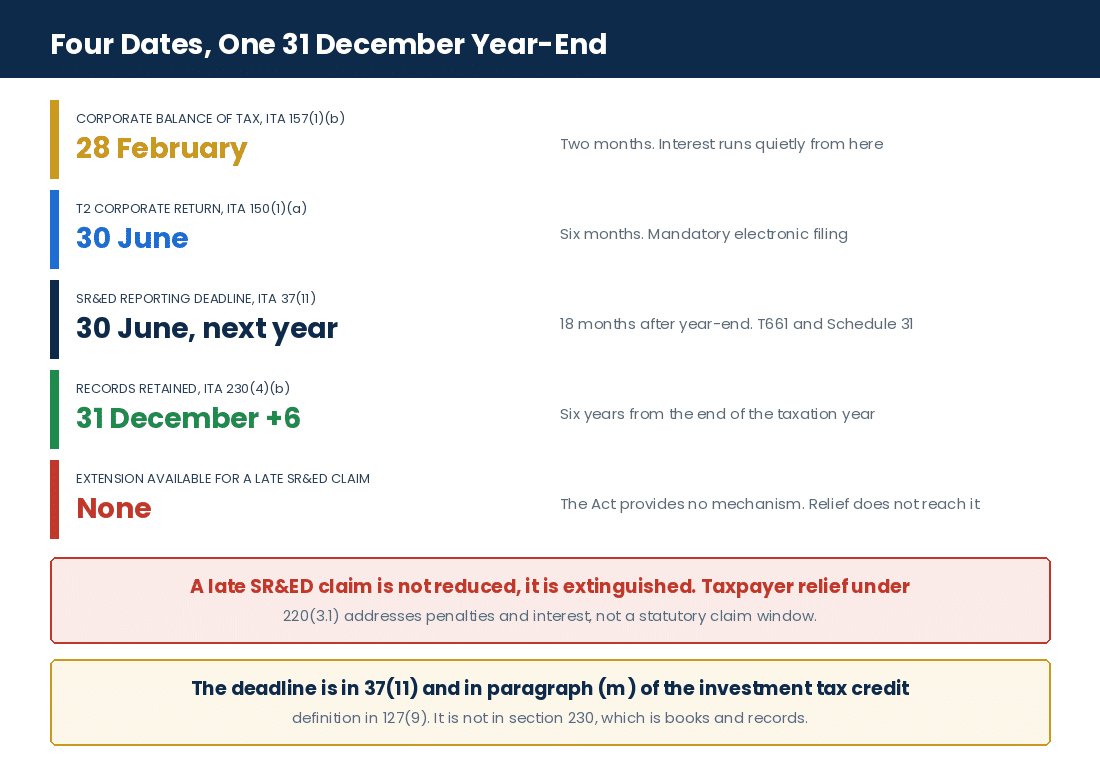
The deadline for the expenditure is in subsection 37(11), and the deadline for the investment tax credit is in paragraph (m) of the definition of investment tax credit in subsection 127(9). Both run to 12 months after the return filing due date — 18 months after the tax year end for a corporation.
The source of the confusion is the arithmetic: six months to the T2 due date under paragraph 150(1)(a), then twelve more. There is no “allowed six-month extension” to the T2 and never has been; the second twelve months is the SR&ED filing window, not an extension of anything.
What matters more is that the window is absolute. CRA’s own filing requirements policy states that the Act provides no mechanism for extending the SR&ED reporting deadline. Taxpayer relief under subsection 220(3.1) relieves penalties and interest; it does not revive a late claim. The one narrow allowance is where the prescribed forms were filed on time, CRA reviews them before the deadline and identifies missing information, and the claimant supplies it within the window.
An analytics firm came to us four months after its reporting deadline with a well-documented year of genuine development work.
The records were excellent and the technological uncertainty was obvious. None of it mattered: there is no relief provision, no appeal and no ministerial discretion for a late SR&ED claim. The credit was simply gone. Figures changed for privacy.
Overview of SR&ED and Technology Tax Credits for Data Analytics Companies
Overview of SR&ED and Technology Credits
Foundations
SR&ED is the largest federal support programme for business research in Canada, and for a data analytics company it is usually the only one that matters. The provincial credits stack on top of it and are computed from the same claim, which is why the federal eligibility work is where the effort belongs.
What Is the SR&ED Program?
Scientific Research and Experimental Development is defined in subsection 248(1) of the Income Tax Act. It is a federal programme delivering two benefits: a deduction for qualifying expenditures under section 37, and an investment tax credit under section 127 that is refundable in cash for companies that qualify for the enhanced rate. For an analytics firm it means that work done to resolve a genuine technological problem — not work done to deliver an engagement — carries wages, contractor payments, materials and, since Bill C-15, equipment back out as a credit.
Types of Tax Incentives under SR&ED and Related Technology Credits
| Claimant | Rate | Refundable? | Applies to |
|---|---|---|---|
| Qualifying CCPC, within the limit | 35% | Yes, fully on current expenditures | Up to $6 million of qualified expenditures |
| Eligible Canadian public corporation, within the limit | 35% | Yes | Limit phased out on three-year average gross revenue, $15M to $75M |
| Capital expenditures at the enhanced rate | 35% | Refundable up to 40% | Property acquired after 15 December 2024 |
| Any corporation, above the limit | 15% | Non-refundable | Reduces tax payable; carries back 3 years, forward 20 |
| Ontario Innovation Tax Credit | 8% | Yes | CCPCs, on up to $3 million of Ontario expenditures |
| Ontario Research and Development Tax Credit | 3.5% | No | Any corporation with an Ontario permanent establishment |
The two Ontario credits answer different situations: the OITC is the refundable one and is restricted to CCPCs, while the ORDTC is non-refundable and is what a larger or listed Ontario company claims. There is also the Ontario Business-Research Institute Tax Credit at 20% refundable, for research contracted to an eligible Ontario research institute, which an analytics firm collaborating with a university should know exists.
Note that the $3 million Ontario expenditure limit for the OITC is a separate figure from the $6 million federal limit. They are not the same number and they did not move together.
Eligibility Criteria: Who Can Claim?
- Eligible work. The work must address a technological uncertainty that cannot be resolved by standard practice, be pursued by systematic investigation, and aim at a technological advancement. Reapplying known tools to new data is not eligible however difficult the engagement.
- Work in Canada. The expenditures must relate to SR&ED carried on in Canada. Section 37(2) deals separately with research carried on outside Canada, which is deductible but does not generate the investment tax credit on the same basis.
- A taxable Canadian corporation for the corporate credit, with the enhanced rate turning on whether the company is a qualifying CCPC or an eligible Canadian public corporation and on the phase-out tests.
- Filed on time on Form T661 with Schedule T2SCH31, inside the window in subsection 37(11).
Key Stat: a qualifying CCPC can now receive up to $2.1 million a year in refundable SR&ED credit, on an expenditure limit of $6 million.
The limit is reduced as prior-year taxable capital employed in Canada rises from $15 million to $75 million, and it is shared among associated corporations under subsections 127(10.2) and 127(10.3). A group that has never filed an allocation agreement is the most common way the limit is lost.
A listed Canadian analytics company had stopped claiming SR&ED entirely, on the reasoning that a 15% non-refundable credit was not worth the preparation cost in a loss year.
As an eligible Canadian public corporation it now reaches the 35% refundable rate, and a loss year is exactly when a refundable credit is worth the most. The company had been right under the old rules and wrong under the new ones. Figures changed for privacy.
Scientific or Technological Criteria Relevant to Data Analytics
Scientific and Technological Criteria
Eligibility
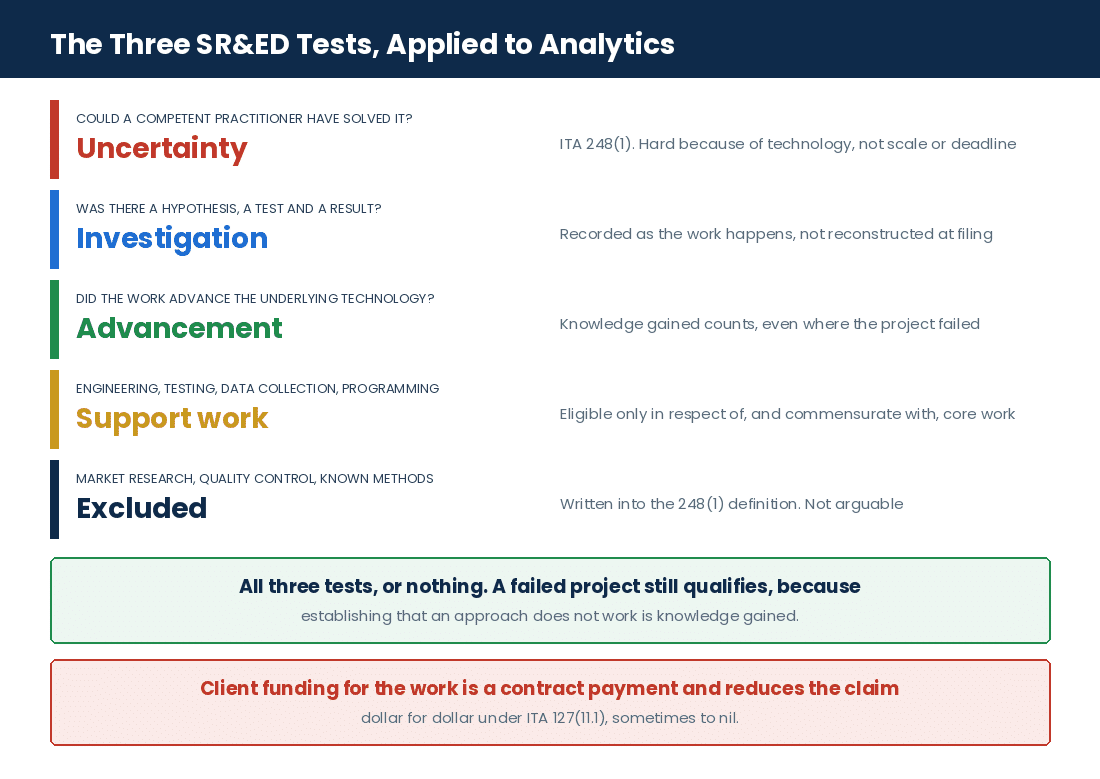
Eligibility turns on three tests, and an analytics project either meets all three or is not SR&ED. They come from the definition in subsection 248(1), not from section 127, which deals with what a qualified expenditure is once eligibility is settled, and not from 127(11.1), which reduces the claim for assistance and contract payments.
| Test | What it asks | What fails it |
|---|---|---|
| Technological uncertainty | Could the outcome be achieved by someone competent in the field using standard practice? | A problem that is hard because of scale, deadline or budget rather than technology |
| Systematic investigation | Was there a hypothesis, a test, a result and an iteration, recorded as you went? | Trial and error with no record of what was being tested or why |
| Technological advancement | Did the work generate knowledge that advances the underlying technology? | A business outcome, a new feature, or a product that is new only to you |
A failed project can still qualify. The advancement is in the knowledge gained, so work that establishes an approach does not work is eligible provided the uncertainty and the investigation were real and recorded.
Common Qualifying Data Analytics Activities
- Creating new algorithms where no known approach meets the accuracy or throughput required, and the shortfall is a property of the technology rather than of the implementation.
- Developing custom tooling to solve a problem that available tools cannot, where the gap was established before the build rather than asserted afterwards.
- Innovating system architecture for volumes, latencies or data shapes that published designs do not handle.
- Experimenting with model training where standard methods fail because of the data’s properties — extreme imbalance, label noise, drift — and the work tests alternatives systematically.
- Resolving performance uncertainty in a pipeline where the bottleneck is not understood and the investigation is what identifies it.
The distinguishing feature in every case is that the technology, not the schedule, is what stands in the way. A build that is simply large is not uncertain.
Is a Pipeline or Platform Build Eligible?
Usually not. Assembling a pipeline from managed services and known patterns is engineering, not SR&ED, however much of it there is. It becomes eligible at the point where a specific component cannot be made to work by standard means and the team sets out to establish why.
Worked example. A Toronto analytics SaaS company rebuilt its ingestion pipeline after establishing that its existing design could not sustain the required throughput. The eligible work was not the rebuild; it was the sequence of concurrency-control experiments that established which approach could hold consistency at that volume, each one recorded with a hypothesis, a test and a measured result. The surrounding integration work was support work. Figures changed for privacy.
Is Model Development Eligible?
Only where there is a real technological puzzle. Applying an established algorithm to a new dataset is not eligible, even where the dataset is difficult and the tuning is extensive. Developing an experimental training approach because the standard methods demonstrably fail on the data’s properties is eligible, and the demonstration of that failure is part of the evidence.
So What Can an Analytics Company Claim?
- Projects that tackle a technological uncertainty that standard practice cannot resolve.
- Work that follows a systematic method — hypothesis, experiment, observation, conclusion — recorded as it happens rather than reconstructed.
- Work aiming at a technological advancement, whether or not it succeeds.
- Support work that is commensurate with and directly supports the above: engineering, design, data collection, testing and operations research carried on in respect of the eligible work.
That last category is worth understanding, because it is where most of the hours sit. Support work is eligible only in respect of eligible core work and only to the extent it is commensurate with it. Data collection that supports a specific experiment is in; routine data collection as an end in itself is out, and the two look identical on a timesheet that records only “data prep”.
An analytics firm claimed an entire eighteen-month platform build as one SR&ED project.
About three months of it was genuine experimental work on a distributed join that no available engine handled at their cardinality. Narrowing the claim to that work and its support activity produced a smaller claim that survived review intact, where the original would have put the whole eighteen months at issue. Figures changed for privacy.
Eligible Expenditures: Salaries, Software Costs, Contractor Payments, and More
Eligible Expenditures
What Counts
Once a project is eligible, the question becomes which dollars attach to it. The answer depends on one structural choice made at the start of the claim: the traditional method or the proxy method.
Which Costs Can Go Into the Claim?
| Cost type | Inclusion | Note |
|---|---|---|
| Salaries and wages | Fully includable for time directly engaged in SR&ED | Bonuses, profit-based pay and taxable benefits are out of the proxy salary base |
| Contractor payments | 80% of the eligible contract amount | For SR&ED performed on the claimant’s behalf in Canada. The offshore portion does not qualify |
| Materials consumed or transformed | Included | Consumed in, or transformed by, the prosecution of SR&ED |
| Overhead, proxy method | 55% of the salary base, Regulation 2900(4) | Notional. Replaces actual overhead; counts for the credit only, not the deduction pool |
| Overhead, traditional method | Actual amounts | Each must be directly related to the SR&ED and incremental — not incurred but for the work |
| Capital expenditures | Eligible again | Property acquired after 15 December 2024, used 90% or more for SR&ED in Canada over its useful life. Credit refundable to 40% |
| Buildings, land, inventory, goodwill | Excluded | Excluded from the restored capital rules, other than a leasehold interest in a building |
The 80% figure on contract payments is the statutory inclusion rate for third-party SR&ED performed for you; it is not an estimate and not negotiable. Where a contractor works partly offshore, the Canadian portion has to be established from the engagement records rather than apportioned by assertion.
Used property is a trap worth knowing: it qualifies for the immediate deduction but not for the investment tax credit.
Can Cloud Compute and Software Subscriptions Be Claimed?
Risk Warning: cloud and subscription costs are claimable under the traditional method, not the proxy method. The common advice has this backwards.
Under the proxy method, actual overhead is not identified at all — the prescribed proxy amount stands in for it, so a cloud invoice cannot also be claimed. Under the traditional method, a cloud or subscription cost may be claimed where it is directly related to the prosecution of the SR&ED and incremental, meaning it would not have been incurred had the work not been carried on.
That second condition is the one that bites an analytics firm. A standing production cloud account that would have run anyway is not incremental. A cluster spun up specifically to run a series of training experiments, billed separately and shut down afterwards, can be. The difference is visible in the billing records or it is not claimable, which is why the account structure matters more than the argument.
The same logic applies to software subscriptions. A general-purpose analytics licence the firm would hold regardless is overhead; a tool acquired solely to conduct the experimental work is incremental. Neither is claimable under the proxy method.
Choosing Between the Proxy Method and the Traditional Method
| Proxy method | Traditional method | |
|---|---|---|
| Overhead | Notional, 55% of the salary base | Actual, itemised and justified |
| Record-keeping burden | Low — salary records drive everything | High — every amount identified and supported |
| Cloud and subscriptions | Not separately claimable | Claimable if directly related and incremental |
| Effect on the deduction pool | Proxy amount counts for the credit only | Actual overhead is added to the pool as well |
| Best suited to | Salary-heavy teams with modest incremental infrastructure | Compute-heavy work where cloud spend exceeds 55% of the salary base |
The decision is arithmetic, and it is worth doing rather than defaulting. For a team of five engineers at $600,000 of eligible salary, the proxy gives $330,000 of notional overhead. A firm whose genuinely incremental experimental compute runs well above that figure is giving money away by taking the proxy; a firm below it is buying a large documentation burden for nothing.
An analytics firm took the proxy method every year because its first accountant had, and separately expensed a substantial experimental compute bill it believed it was also claiming.
Under the proxy method it was not claiming that at all. The compute was genuinely incremental and separately billed, and the traditional method produced a materially larger claim on the same facts. Figures changed for privacy.
Non-Eligible Activities and Expenses
Non-Eligible Activities and Expenses
What Does Not Count
The exclusions are written into the definition of SR&ED in subsection 248(1) itself, which is why they are not arguable. Several of them describe the core business of a data analytics company.
- Routine data collection. Gathering data, even at scale and even with difficulty, is excluded unless it supports a specific eligible experiment.
- Market research and sales promotion. Business-focused insight is the output an analytics firm sells. It is not research in the statutory sense.
- Quality control and routine testing of materials, devices, products or processes.
- Applying known methods. Running established statistical models or standard software on new data, however complex the engagement, is excluded.
- Research in the social sciences or humanities, which catches more analytics work than firms expect.
- Style changes and commercial production of a new or improved product or process.
Routine maintenance and bug fixing are outside the programme unless the fix is the resolution of a documented technological uncertainty, which is rare and needs the documentation to have existed beforehand.
How Assistance and Client Funding Reduce the Claim
Risk Warning: money received for the work reduces the claim dollar for dollar, and the provisions are 127(11.1) and 127(18), not section 37(2). Section 37(2) deals with SR&ED carried on outside Canada.
Government assistance, non-government assistance and contract payments reduce qualified expenditures under subsections 127(11.1) and 127(18), and reduce the deduction pool under paragraph 37(1)(d). Client funding for work the client paid you to do is a contract payment.
This is the single most common reassessment in the sector, because an analytics firm’s development work is very often embedded in a client engagement. Where the client paid for the work, the firm did not bear the cost and the credit belongs to nobody. Where the firm developed something on its own account and happens to use it on client engagements afterwards, it did bear the cost and the credit stands — but the engagement letters have to show which it was.
| Receipt | Effect on the claim | Provision |
|---|---|---|
| Client payment for the development work | Reduces qualified expenditures dollar for dollar as a contract payment | ITA 127(11.1), 127(18) |
| Government grant or contribution | Reduces qualified expenditures and the deduction pool | ITA 127(11.1); 37(1)(d) |
| Non-government assistance, including forgivable loans | Treated the same as government assistance | ITA 127(11.1) |
| Provincial refundable credit received | Government assistance; reduces the following year’s federal claim | ITA 127(11.1) |
| Payment for a deliverable the client bought, not the research | No reduction where the research cost was genuinely the claimant’s own | Depends on the engagement terms |
The last row is where the analysis actually happens, and it is settled by the contract rather than by the invoice narrative. An agreement that assigns the intellectual property to the client and prices the development is a contract payment whatever it is called.
An analytics firm claimed a year of algorithm development that a single client had funded under a statement of work naming the deliverable and assigning the resulting code.
The work was genuinely novel and would have been eligible had the firm borne the cost. It had not. The contract payment reduced the qualified expenditures to nil, and the firm had already spent the expected refund. Figures changed for privacy.
Claiming Process for Data Analytics Company Tax Credits
The Claiming Process
Process
Identifying Eligible Projects and Activities
Start by separating projects from engagements. An SR&ED project is defined by the technological uncertainty it addresses, not by the client, the contract or the calendar. One client engagement can contain a two-week eligible project and nothing else; one eligible project can run across three engagements and a year of internal work.
- List the technological problems the team could not solve with standard practice, with the date each was identified.
- Test each against the three criteria. If you cannot state the uncertainty in a sentence, it is probably a business problem.
- Draw the project boundary around the experimental work and its commensurate support work, not around the whole build.
- Identify the funding for each project before computing anything, because a contract payment can take the claim to nil.
- Check the association group and agree the expenditure limit allocation before anyone files.
Tracking Time and Documenting Expenses Accurately
Time tracking is what converts an eligible project into a number, and it is the most common reason a defensible claim gets reduced. CRA expects records made at the time of the work, not reconstructed at filing.
- Time logs per employee and project, at a granularity that distinguishes experimental work from delivery work on the same day.
- Project records stating the technological issue being addressed, the hypothesis, what was tried and what the result was — a dated commit history, a design document with revisions, or an experiment log all serve.
- Invoices for contractors, materials and any incremental cloud or software, linked to the project they belong to.
- Payroll records supporting the salary base, with bonuses and taxable benefits identifiable so they can be excluded.
- Contracts with clients showing what was billed, and grant correspondence with dates and amounts, for the assistance reductions.
Analytics teams are unusually well placed here, because version control, ticket systems and experiment trackers generate contemporaneous records as a by-product. The failure is almost never the absence of records; it is that nobody mapped them to projects and hours before the window closed.
What Documentation Does a Review Ask For?
A CRA review asks for the evidence that the three criteria were met and that the costs attach. In practice that means the project records, the time allocation and the financial trail, reconciled to each other. Records are kept six years from the end of the last taxation year to which they relate under paragraph 230(4)(b) — measured from the year-end, not from the filing date.
Preparing and Filing Your Claim with CRA
The claim goes on Form T661, which carries the technical project descriptions and the expenditure calculation, with the credit computed on Schedule T2SCH31 and filed with the T2. Guide T4088 is CRA’s line-by-line guide to completing the T661. Subsection 127(5) is what actually allows the credit to be deducted against tax payable for the year, with the unused balance carried back three years and forward twenty. Provincial credits are claimed on their own schedules from the same underlying figures.
Before anything is filed, agree the T661 expenditures to the trial balance, the salary base to the payroll records, and the contract payments to the client agreements. A claim that does not reconcile to the financial statements invites the review that the documentation was meant to survive.
| Route | Works when | Breaks when |
|---|---|---|
| File it yourself | One clear project, no client funding, no associated companies, clean time records | Eligibility is arguable, funding is mixed, or a group shares the limit |
| Contingency-fee SR&ED shop | Volume preparation of straightforward claims | The fee scales with the claim, not with its defensibility, and nobody owns the T2 |
| Licensed CPA firm | Mixed funding, association groups, a method choice worth modelling, a review under way | Costs more up front than doing nothing |
Gondaliya CPA works with analytics firms across Canada on a flat annual fee covering bookkeeping, payroll, GST/HST returns, the T2 with its SR&ED schedules, and CRA audit representation. The firm performs compilation engagements under CSRS 4200, which provide no assurance; audit and review engagements are referred out.
Best Practices for Maximizing Data Analytics Tax Credits
Getting the most out of a claim is mostly a matter of preparation rather than argument. Good records, a deliberate method choice and a clear grip on what is eligible do more than any amount of advocacy after the fact.
Using the Proxy Method and Other Calculation Approaches
The method is chosen once per year and applies to the whole claim, so it is worth a calculation rather than a habit. Take the eligible salary base, multiply by 55%, and compare that figure against the overhead you could actually support as directly related and incremental. Salary-heavy teams with modest infrastructure almost always do better on the proxy; compute-heavy experimental work with separately billed clusters often does better on the traditional method. Whichever you pick, keep the records that method needs from the start of the year, because you cannot switch retroactively to the one your records happen to suit.
Avoiding Common Mistakes in Tax Credit Claims
| Mistake | What happens | How to avoid it |
|---|---|---|
| Claiming delivery work as research | The claim is reduced or denied on eligibility | State the technological uncertainty in a sentence before claiming the project |
| Confusing a business problem with a technological one | Same outcome, and it taints the rest of the claim | Ask whether a competent practitioner could have solved it with standard practice |
| Missing client funding or grants | Reassessment with interest, often years later | Identify every receipt against each project before computing |
| No contemporaneous time records | Hours reduced to what can be supported | Track at the project level from the day the project opens |
| Claiming cloud under the proxy method | The amount is simply disallowed | Pick the method deliberately; cloud belongs to the traditional method |
| Using the 65% proxy rate | Overstated credit, corrected on assessment | 55% of the salary base, Regulation 2900(4) |
| Ignoring the association rules | The group exceeds a limit it was always sharing | Agree and file the allocation under 127(10.3) before anyone claims |
| Filing late | Total loss of the credit, with no relief available | Diarise 18 months from each year-end |
Two associated analytics companies each claimed against what they believed was their own expenditure limit.
They had always been associated and had never filed an allocation agreement. The combined claim exceeded the single shared limit, both were reassessed, and the second company lost the enhanced rate on expenditures it had correctly identified. Figures changed for privacy.
Important Deadlines and Reporting Requirements
Deadlines, Records and Catch-Up
Deadlines
Key Stat: the SR&ED reporting deadline is 18 months after the tax year end — 12 months after the T2 filing due date.
The expenditure deadline is in subsection 37(11); the credit deadline is in paragraph (m) of the investment tax credit definition in subsection 127(9). The T2 itself is due at six months under paragraph 150(1)(a), and the SR&ED window runs twelve months beyond that.
| Year-end | T2 due | Balance of tax due | SR&ED reporting deadline |
|---|---|---|---|
| 31 December 2025 | 30 June 2026 | 28 February 2026 | 30 June 2027 |
| 31 March 2026 | 30 September 2026 | 31 May 2026 | 30 September 2027 |
| 30 June 2026 | 31 December 2026 | 31 August 2026 | 31 December 2027 |
Three different dates attach to one year, and the one that costs the most if missed is the last. The balance of tax at two months under paragraph 157(1)(b), or three for an eligible CCPC claiming the small business deduction, generates interest quietly. Late T2 filing is penalised under subsection 162(1) at 5% of the unpaid tax plus 1% per complete month to twelve, with arrears interest compounding daily under 161(1). Missing the SR&ED deadline costs the entire credit.
There is no discretion on that last one. CRA’s filing requirements policy is explicit that the Act provides no mechanism for extending the SR&ED reporting deadline, and taxpayer relief under subsection 220(3.1) does not reach it — relief addresses penalties and interest, not a statutory claim window. Keep an internal calendar carrying the SR&ED date alongside the T2, the GST/HST returns and the payroll remittance band under Regulation 108.
Documentation Tips and Record-Keeping Strategies
Before any work starts, have these ready and keep them current:
- Past T2 returns and notices of assessment, which establish the association group and any carried-forward credits.
- Trial balances covering the period, so the T661 reconciles to the books.
- A list of projects with start and end dates and the technological challenge each addressed.
- Timesheets assigning hours to projects, distinguishing experimental work from delivery and from support work.
- Payroll summaries identifying staff on SR&ED tasks, with bonuses and benefits separable from the salary base.
- Contractor agreements stating where the work was performed, for the Canadian portion of the 80%.
- Client payments linked to the projects claimed, for the contract payment reductions.
- Grant and assistance correspondence with amounts and timing.
- Cloud and software invoices for the claimed period, if the traditional method is being used.
Watch the deductions that sit alongside the claim. Hardware is Class 50 and purchased application software is Class 12 at 100%, each needing proof of purchase and of the date it became available for use. Bill C-15, which received Royal Assent on 26 March 2026, gives Classes 44, 46 and 50 acquired after 15 April 2024 and available for use before 2027 a 100% first-year deduction, so a compute cluster commissioned now is written off in full rather than at 55%. Outside those classes the half-year rule stays suspended, with the first-year allowance at three times the normal amount for property acquired after 2024 and available for use before 2030, and twice from 2030 through 2033. Property claimed as an SR&ED capital expenditure is not also depreciated.
How To Catch Up if the Books Are Behind
Reconstruct in a fixed order: rebuild the financial records from bank statements and invoices; rebuild the project list from version control, ticket systems and experiment logs, which usually survive even when timesheets do not; allocate hours from those contemporaneous artefacts rather than from memory; identify every client payment and grant against each project; then compute. A reconstruction built on dated technical artefacts is defensible. One built on an after-the-fact estimate of who spent what proportion of the year on research is not, and claiming it is worse than claiming nothing.
Check the window first. If the 18 months have passed for the year in question, there is nothing to catch up on for that year, and the effort belongs to the open ones.
An analytics firm with no timesheets at all rebuilt a year of SR&ED allocation from its Git history and its experiment tracker.
Commit timestamps, branch names and the experiment log gave a defensible mapping of engineer-days to projects, cross-checked against the payroll calendar. The claim survived a review that a spreadsheet of estimated percentages would not have. Figures changed for privacy.
Provincial and Territorial R&D Tax Credits for Data Analytics
Provincial and Territorial R&D Credits
Stacking
Provincial credits stack on the federal one and are computed from the same T661, so the marginal cost of claiming them is small once the federal work is done. The rules differ by province in what qualifies, what the limits are, and whether the credit is refundable.
Overview of Available Provincial Incentives
| Program | Rate | Refundable? | Notes |
|---|---|---|---|
| Federal SR&ED, enhanced | 35% | Yes | On up to $6 million of qualified expenditures, for CCPCs and eligible Canadian public corporations |
| Federal SR&ED, basic | 15% | No | Above the limit. Carries back 3 years and forward 20 |
| Ontario Innovation Tax Credit | 8% | Yes | CCPCs, on up to $3 million of Ontario expenditures. Phases out above $500,000 of taxable income or $25 million of taxable capital |
| Ontario Research and Development Tax Credit | 3.5% | No | Any corporation with an Ontario permanent establishment. Carry-forward available |
| Ontario Business-Research Institute Tax Credit | 20% | Yes | Research contracted to an eligible Ontario research institute |
| Quebec CRIC | 20%, rising to 30% | Yes | 30% on up to $1 million above the exclusion threshold. Replaced Quebec’s previous R&D credits |
Quebec’s regime changed completely and the old descriptions are obsolete. The CRIC — the refundable tax credit for research, innovation and pre-commercialization — applies to taxation years beginning after 25 March 2025 and consolidates the former credits for researchers’ salaries, university and public research centre contracts, research consortium fees and several others, all of which were eliminated. It is broader than what it replaced: capital expenditures for property used in R&D or pre-commercialization in Quebec qualify, and so do pre-commercialization activities such as technological validation and regulatory studies that continue the research work. The exclusion threshold is the greater of $50,000 and the employee-based thresholds. Taxation years beginning before 26 March 2025 still fall under the old credits.
Differences Between Federal SR&ED and Provincial Programs
- Who qualifies. The federal enhanced rate now reaches eligible Canadian public corporations; Ontario’s refundable OITC does not — it remains restricted to CCPCs, with the ORDTC as the route for everyone else.
- Different limits. The Ontario expenditure limit for the OITC is $3 million of Ontario expenditures and did not move when the federal limit went to $6 million.
- Different phase-outs. Ontario phases the OITC out on taxable income above $500,000 or taxable capital above $25 million — thresholds unrelated to the federal $15 million to $75 million range.
- Different eligible work. Some provinces exclude routine software maintenance or impose payroll limits the federal rules do not.
- They are assistance to each other. A provincial refundable credit received is government assistance that reduces the federal qualified expenditures under subsection 127(11.1), generally in the following year. Stacking is real but it is not additive at face value.
Coordinating Multiple Claims for Maximum Benefit
Where several associated companies do analytics work together, the federal expenditure limit is shared, not multiplied. Subsection 127(10.2) sets the limit and 127(10.3) governs its allocation among associated corporations, which must be agreed and filed. Section 256 is what determines whether the corporations are associated in the first place.
- Identify every associated corporation, including ones doing no research at all, because association is tested on control rather than on activity.
- Agree the allocation of the single $6 million limit and file it. Absent an agreement the Minister may allocate, and the result is rarely what the group wanted.
- Avoid double counting the same expenditure in two entities, and make sure an intercompany charge for research work is not claimed by both the payer and the performer.
- Net off client funding and grants once, in the entity that received them.
- Keep the project descriptions consistent between the federal T661 and the provincial schedules, because inconsistency between them is a review trigger in itself.
Frequently Asked Questions on Data Analytics Company Tax Credits
Frequently Asked Questions
20 Answers
What is the federal refundable SR&ED credit rate for CCPCs?+
What is the federal non-refundable SR&ED credit rate?+
How does the SR&ED expenditure limit affect enhanced credits?+
What is the proxy overhead rate for 2026 filings?+
When is the reporting deadline from T2 filing due date?+
What happens if you miss the SR&ED claim deadline?+
Which Capital Cost Allowance (CCA) class covers computer software?+
How long must typical SR&ED claim documentation be retained?+
What defines systematic investigation in data analytics projects?+
What constitutes advancement under SR&ED guidelines?+
What is considered support work in data analytics R&D claims?+
How does the proxy method differ from traditional overhead calculations?+
Are contract payments claimable under Canadian SR&ED rules?+
How does assistance impact eligible expenditures in claims?+
What is the expenditure limit for associated companies claiming SR&ED credits?+
Is the federal SR&ED credit refundable or non-refundable?+
Can a data analytics company claim cloud computing costs?+
Which other deductions matter for an analytics company claiming SR&ED?+
Which returns must a data analytics company file and when?+
What triggers a CRA review of an SR&ED claim?+
How do you catch up if books are behind during claim preparation?+
Data Analytics SR&ED Check
Five quick questions on your claim. No fee shown.
Points to raise with us:
This is a general prompt, not tax or legal advice or a quote. Your position depends on your full facts. For a real review, please book a free consultation.
Businesses We Serve & Industry Spotlights
Industry Expertise
Data analytics sits inside a wider technology and professional services practice, and the same three questions surface in every sector we act for. Here are eleven and the form the issue usually takes.
| Industry | The Analytics Angle |
|---|---|
| Technology startups & SaaS | The same three eligibility tests, applied to product development |
| Consulting firms | Client-funded work and the contract payment reduction |
| E-commerce & online retailers | Recommendation and pricing models built in house |
| Medical doctors & physician professional corporations | Clinical analytics, and where routine data collection stops being claimable |
| Dentists & dental practices | Practice analytics as a deduction rather than a credit |
| Real estate investors, landlords & holding companies | Association under section 256 and one shared expenditure limit |
| Property developers & builders | Capital versus current on the systems they commission |
| Transportation, logistics & trucking | Routing and scheduling optimisation, the classic eligible case |
| Construction, contractors & skilled trades | Where field innovation is SR&ED and where it is just a good idea |
| Restaurants & food and beverage | Demand forecasting bought in rather than built |
| Daycare, childcare & CWELCC services | Exempt supplies, and why the GST/HST side differs from a tech company’s |
- Technology startups & SaaS: The nearest neighbour. The hard part is identical — drawing the project boundary around the experimental work rather than around the release — and the expenditure limit change is worth the same to both.
- Consulting firms: Any firm that develops while delivering runs into the contract payment reduction, and the answer always comes from the engagement letter rather than from the invoice narrative.
- E-commerce & online retailers: Retailers building their own recommendation, pricing or fraud models face the same question an analytics firm does about whether standard practice could have got there.
- Medical doctors & physician professional corporations: Clinical data work is where the routine data collection exclusion does the most damage, because the volume of work is real and almost none of it is research in the statutory sense.
- Dentists & dental practices: Practice analytics bought as software is an ordinary deductible expense or a Class 12 asset, which is the right answer and a cheaper one than a failed credit claim.
- Real estate investors, landlords & holding companies: Holding structures are how analytics firms discover they are associated, since section 256 tests control rather than activity and a dormant holdco still shares the limit.
- Property developers & builders: They commission the systems analytics firms build, and the capital-versus-current line on that spend is decided on their side of the contract.
- Transportation, logistics & trucking: Routing and scheduling optimisation is one of the clearest eligible cases in the economy, because the uncertainty is mathematical and the failure of standard methods is measurable.
- Construction, contractors & skilled trades: Field innovation is frequently genuine and almost never documented, which is the mirror image of an analytics firm’s problem of excellent records and an overbroad claim.
- Restaurants & food and beverage: Forecasting bought as a subscription is a current expense; the same capability built in house may be a credit. Which one it is decides the whole treatment.
- Daycare, childcare & CWELCC services: A useful contrast on the sales tax side: a wholly exempt operator recovers nothing on its inputs, where an analytics firm making taxable supplies recovers all of it.
The technology changes. The three questions do not: was there a technological uncertainty, is the investigation recorded, and who paid for the work.
A machine learning team and a logistics optimisation team keep different codebases and file nearly identical claims. Figures changed for privacy.
Professional Guidance and Quick Reference
Guidance
Gondaliya CPA Support for Data Analytics Tax Credits
Data analytics companies get into difficulty in a predictable set of ways: using the $3 million expenditure limit when Bill C-15 raised it to $6 million; assuming only CCPCs reach the enhanced rate, when an eligible Canadian public corporation now does; applying the 65% proxy rate that has not applied since 2012, when Regulation 2900(4) sets it at 55%; claiming cloud costs under the proxy method, where the proxy amount already stands in for them; citing section 230 for the filing deadline, when it is subsection 37(11) and paragraph (m) of the investment tax credit definition in 127(9); assuming taxpayer relief can revive a late claim, when the Act provides no mechanism to extend the window; missing the contract payment reduction in 127(11.1) on client-funded development; claiming against an expenditure limit that is shared across an association group under 127(10.3); treating the whole platform build as one project rather than the experimental work inside it; overlooking that capital expenditures are claimable again for property acquired after 15 December 2024; and keeping records six years from filing, when paragraph 230(4)(b) runs from the end of the taxation year. Gondaliya CPA handles analytics company accounting and tax on a flat annual fee.
When and How to Consult Experts for Optimal Results
The cheapest point to involve someone is before the work starts, because that is when the uncertainty can be recorded as it arises rather than reconstructed. Three questions settle whether a project is worth preparing: was there a technological uncertainty, was a systematic investigation carried out, and did it aim at an advancement. A firm that can answer those three in writing at the time has already done most of the work a review asks for.
Comprehensive Assistance with SR&ED and R&D Tax Credit Claims
We test each project against the three statutory criteria before anything is written up, draw the project boundary around the experimental work and its commensurate support work, and document the uncertainty, the investigation and the advancement from the records your team already generates. We separate eligible development from client-paid delivery, allocate salaries by project from time records, and model the proxy method against the traditional method rather than defaulting to one.
Corporate Tax Filing and Compliance Services for Data Analytics Companies
The claim is part of a return, not a separate exercise. We prepare the T2 with Form T661 and Schedule T2SCH31, reconcile the claim to the trial balance before filing, and handle GST/HST returns, payroll remittances, instalments and the provincial credit schedules. We prepare compiled financial statements under CSRS 4200, which provide no assurance; audit and review engagements are referred out.
Expert Guidance on Eligible Business Expenses and Documentation
We separate the salary base from total payroll so bonuses and benefits do not inflate the proxy amount, apply the specified employee caps in Regulations 2900(7) and 2900(8), establish the Canadian portion of contractor work before applying the 80% inclusion, and test cloud and subscription costs for whether they are genuinely incremental before claiming them. Capital items are either an SR&ED capital expenditure or a capital cost allowance asset, never both.
Contact Information and Next Steps for Claim Support
Reach Gondaliya CPA at 647-212-9559 or info@gondaliyacpa.ca for a free consultation with no obligation. We serve Toronto, Etobicoke, Vaughan and Mississauga and work with analytics firms across Canada, with a one-business-day response and a flat annual fee agreed before any work begins.
Quick Answers
At a Glance
- Definition of SR&ED: ITA 248(1)
- Deduction: ITA 37; credit: ITA 127
- Expenditure limit: $6 million, ITA 127(10.2)
- Maximum refundable credit: $2.1 million a year
- Enhanced rate: 35%, refundable
- Basic rate: 15%, non-refundable
- Who qualifies: CCPCs and eligible Canadian public corporations
- Taxable capital phase-out: $15M to $75M
- Associated groups: share one limit, ITA 127(10.3)
- Proxy amount: 55% of the salary base, Reg 2900(4)
- Contract payments in: 80%, work in Canada
- Assistance and contract payments out: ITA 127(11.1), 127(18)
- Capital expenditures: eligible after 15 December 2024
- Cloud costs: traditional method only, if incremental
- Forms: T661 and Schedule T2SCH31
- Reporting deadline: 18 months after year-end, ITA 37(11)
- Extension available: none
- Records: six years from the taxation year-end, ITA 230(4)(b)
Who This Is For
Audience
- An incorporated data analytics firm doing genuine development work alongside client delivery.
- A company that has been claiming against the old $3 million limit and has not revisited it since Bill C-15.
- A listed Canadian analytics company that stopped claiming because 15% non-refundable was not worth the effort.
- A firm choosing between the proxy and traditional methods with substantial experimental cloud spend.
- A group of associated companies that has never filed an expenditure limit allocation.
- A firm whose development is embedded in client engagements and needs the contract payment position settled.
- A company approaching its 18-month window with the technical records in place but no claim prepared.
Key Considerations When Claiming Data Analytics Tax Credits with Gondaliya CPA
Key Controls and Warning Signs
- Confirm the three tests before the project starts. Technological uncertainty, systematic investigation, technological advancement — all three, stated in writing at the time.
- Track time by project, not by client. The project boundary is the uncertainty, and a timesheet organised by engagement cannot be reorganised afterwards.
- Choose the overhead method deliberately. Compare genuinely incremental overhead against 55% of the eligible salary base and pick the larger, then live with the documentation burden that follows.
- Establish the Canadian portion of contractor work before applying the 80% inclusion rate.
- Net off every receipt. Client funding, grants, forgivable loans and provincial refundable credits all reduce the claim under 127(11.1).
- Diarise 18 months from each year-end. A late claim is not reduced, it is extinguished, and there is no relief provision.
- Keep the records six years from the year-end under 230(4)(b), which for SR&ED runs well past the review.
- Agree the association group’s allocation of the single $6 million limit before anyone files.
- Apply the right CCA class to anything not claimed as an SR&ED capital expenditure: Class 50 for hardware and systems software, Class 12 for purchased application software.
- Reconcile the claim to the financial statements. A T661 that does not tie to the trial balance is the easiest review trigger there is.
People Also Ask
Related Questions
Does a failed project still qualify for SR&ED?+
Yes. The advancement is in the knowledge generated, so establishing that an approach does not work is eligible, provided the uncertainty was real and the investigation was systematic and recorded.
Can a company claim SR&ED in a loss year?+
Yes, and that is when the refundable credit is worth the most. Within the expenditure limit the credit is refundable in cash for a qualifying CCPC and, since Bill C-15, for an eligible Canadian public corporation.
Is machine learning work automatically SR&ED?+
No. Applying an established algorithm to new data is excluded as applying known methods, however difficult the dataset. It becomes eligible where standard methods demonstrably fail because of the data’s properties and the work tests alternatives systematically.
Do we need a separate agreement to share the expenditure limit?+
Yes. Associated corporations share one $6 million limit and must agree its allocation under subsection 127(10.3). Without a filed agreement the Minister may allocate, and claims across the group can quietly exceed the limit.
Does claiming SR&ED increase the chance of a CRA audit?+
A first or substantially larger claim is more likely to be reviewed, which is a technical review of the claim rather than an audit of the company. A claim that reconciles to the financial statements and rests on contemporaneous records usually closes quickly.
Glossary
Definitions
- SR&ED — scientific research and experimental development, as defined in subsection 248(1) of the Income Tax Act.
- Technological uncertainty — a problem whose resolution is not deducible by a competent practitioner from standard practice.
- Systematic investigation — hypothesis, experiment, observation and conclusion, recorded as the work proceeds.
- Technological advancement — knowledge generated that advances the underlying technology, whether or not the project succeeds.
- Support work — listed activities carried on in respect of, and commensurate with the needs of, eligible core work.
- Qualified expenditure — the expenditure base on which the investment tax credit is computed, defined in subsection 127(9).
- Expenditure limit — the ceiling on expenditures earning the enhanced 35% rate, $6 million, in subsection 127(10.2).
- Prescribed proxy amount — the notional overhead figure, 55% of the salary base, under Regulation 2900(4).
- Salary base — salaries of employees directly engaged in SR&ED, excluding bonuses, profit-based pay and taxable benefits.
- Specified employee — an employee who does not deal at arm’s length with the employer or is a specified shareholder, whose salary base is capped.
- Contract payment — an amount received for SR&ED performed for another person, which reduces the recipient’s own claim.
- Eligible Canadian public corporation — a Canadian-resident listed corporation, not controlled by non-residents, now able to access the enhanced refundable rate.
Want a checklist to work from? You can download our free data analytics SR&ED checklist before your consultation.
Recompute your expenditure limit before you file anything, because it is $6 million now and not $3 million, and amend any year already filed on the old basis. If you are a listed Canadian company that walked away from SR&ED when it was a 15% non-refundable credit, come back — you reach the refundable rate now. Draw the project boundary around the technological uncertainty rather than around the build, and be able to state that uncertainty in one sentence before you claim anything. Track time by project from the day the project opens; your version control and experiment tracker are contemporaneous records and a reconstructed percentage is not. Choose the overhead method by comparing genuinely incremental spend against 55% of the eligible salary base, and remember cloud costs belong to the traditional method or nowhere. Apply 80% to the Canadian portion of contractor work. Net off every client payment and grant under 127(11.1) before you celebrate a number. Agree the association group’s allocation of the one shared limit. Capital equipment acquired after 15 December 2024 is back in. And diarise 18 months from each year-end, because a late claim is not reduced, it is gone.
2026 Update — what is current: This article reflects rules current to 7 October 2026. Bill C-15, the Budget Implementation Act, 2025, No. 1, received Royal Assent on 26 March 2026 and enacted the largest SR&ED expansion in a decade. For taxation years beginning after 15 December 2024: the expenditure limit for the enhanced 35% refundable credit is $6 million, giving up to $2.1 million of refundable credit; the taxable capital phase-out runs from $15 million to $75 million, with an election to use average gross revenue over the three preceding years instead; eligible Canadian public corporations reach the enhanced refundable rate for the first time; and capital expenditures are claimable again for property acquired after 15 December 2024, used 90% or more for SR&ED in Canada, with the credit refundable up to 40%. Buildings, land, inventory and goodwill remain excluded, and used property earns the deduction but not the credit. CRA is still updating its forms and policy pages, so a claim filed now may need amending. In Quebec, the CRIC replaced the former R&D credits for taxation years beginning after 25 March 2025. Unchanged: the definition and exclusions in subsection 248(1), the 55% prescribed proxy amount in Regulation 2900(4), the 80% inclusion for contract payments, the assistance reductions in 127(11.1), the Ontario rates at 8% and 3.5%, the 18-month reporting deadline in subsection 37(11) with no extension mechanism, and the six-year retention requirement in paragraph 230(4)(b).
Data Analytics Company Tax Credits Canada: How Gondaliya CPA Can Help
Start with your project list, your time records and your last return
Gondaliya CPA tests each project against the three statutory criteria, draws the boundary around the experimental work, allocates salaries from your existing technical records, models the proxy method against the traditional method rather than defaulting, establishes the Canadian portion of contractor work, nets off client funding and grants, agrees the expenditure limit allocation across your association group, and files the T661 and Schedule 31 with a T2 that reconciles to your books — on a flat annual fee including HST with a one-business-day response. Please book a free consultation.
Next Steps
Please book a free consultation with Gondaliya CPA and bring your project list with the technological problem each one addressed, your time records however they are kept, and your last filed return. Those three settle the eligibility question, the quantum and the expenditure limit, which is where almost all of the value and almost all of the risk sits. If any of the work was client-funded, bring the engagement letters too. You will get a flat annual fee including HST before any work begins. We serve Toronto, Mississauga, Vaughan, Brampton, Etobicoke, Scarborough, Ottawa and the rest of Ontario, and work with analytics and technology firms across Canada. If our content helps, please add gondaliyacpa.ca as a preferred source on Google.
Published: · Last updated:
Editorial policy: We research against CRA, Department of Finance, Parliament of Canada, Revenu Québec, Ontario Ministry of Finance, CPA Canada and CPA Ontario sources, fact-check the figures, and Sharad Gondaliya, CPA, reviews the content, which we update as the rules change.
Disclaimer: This article is educational information only and is not tax, legal, or financial advice. Figures marked illustrative are examples rather than quotes or guarantees. It reflects rules current to 2026, including the SR&ED amendments enacted by Bill C-15 on 26 March 2026, the definition in subsection 248(1) of the Income Tax Act, the deduction and reporting deadline in section 37, the investment tax credit and expenditure limit in section 127, the prescribed proxy amount in Regulation 2900(4), and the six-year retention requirement in paragraph 230(4)(b). CRA is still updating its forms and policy guidance for the new rules, so a claim prepared now may require amendment. Provincial rates and rules change independently of the federal programme. Gondaliya CPA performs compilation engagements under CSRS 4200 and does not perform audit or review engagements. Rates and limits change and outcomes depend on your specific facts. Please consult a licensed CPA before acting.

Sharad Gondaliya is a CPA Canada & CPA USA with 15 Years+ experience of Accounting, Tax, Payroll of Corporate Small Businesses as Tax Accountant. He is a CPA Ontario member (61040184) and holds US CPA licences in Washington and Montana and is well known among corporate small businesses for tax planning, efficient tax solutions, and affordable CPA services. Sharad is the Principal (Director) of Gondaliya CPA – Affordable CPA Firm in Canada. Licenses: CPA Ontario: 61040184 | CPA USA (MT): PAC-CPAP-LIC-033176 | CPA USA (WA): 57629 | CPA Firm License: 61330051 View Full Author Bio