



Product Design Studio Tax Credits in Canada: SR&ED, Prototyping & Product Development Incentives
Product Design Studio Tax Credits Canada: A Guide to SR&ED, Prototyping, and Development Incentives with Gondaliya CPA
Product design studio tax credits in Canada come almost entirely from one program, SR&ED, and the rules governing it changed more in 2026 than in the previous decade. Gondaliya CPA helps product design studios work out which parts of a project actually qualify, which costs enter the expenditure pool and which merely look like they should, and how to file inside a deadline that carries no relief for missing it.
Quick Summary
Four things in the circulating guidance are wrong, and three of them cost money. The expenditure limit for the enhanced 35% refundable credit is $6 million, not $3 million — Bill C-15 raised it on 26 March 2026, giving up to $2.1 million of refundable credit. Cloud computing and software subscriptions are not eligible SR&ED expenditures; they are ordinary deductions that earn no credit, and under the proxy method they are already inside the 55% overhead amount. Equipment lease costs have not been SR&ED expenditures since 2014, while capital property is eligible again for property acquired after 15 December 2024 — so the usual advice has both of those backwards. And the 18-month reporting deadline cannot be extended by anyone: subsection 220(2.2) says so expressly, and a claim cannot be amended after it.
Reading time: 29 minutes.
Table of Contents
- Four Things in the Guidance That Are Wrong
- SR&ED Tax Incentives for Product Design Studios
- Eligibility Criteria
- Eligible Costs in a Claim
- Federal and Provincial Rates
- Claim Process and Deadlines
- Post-Claim Procedures and Audit Preparation
- Strategies to Maximize Product Design Tax Credits
- SR&ED Opportunities Specific to Product Design Studios
- Frequently Asked Questions
- Businesses We Serve & Industry Spotlights
- Professional Guidance and Quick Reference
The Numbers That Matter
This article covers Canada, with Ontario and Toronto context, and reflects rules current to 8 October 2026, including the SR&ED measures enacted by Bill C-15 on 26 March 2026. It is written for incorporated Canadian product design studios — industrial design, mechanical design, and multi-disciplinary studios building physical or connected products. Gondaliya CPA performs compilation engagements under CSRS 4200, which provide no assurance; audit and review engagements are referred out. Nothing here is engineering, product safety or intellectual property advice. This is educational information only and not tax or legal advice.
Four Things in the Guidance That Are Wrong
Four Things in the Guidance That Are Wrong
Corrections
The Limit Is $6 Million, Not $3 Million
Risk Warning: the $3 million expenditure limit for the enhanced 35% refundable credit is out of date, and so is the taxable capital range that goes with it.
Bill C-15, the Budget Implementation Act, 2025, No. 1, received Royal Assent on 26 March 2026 and raised the limit to $6 million, giving up to $2.1 million of refundable credit. The phase-out now runs on taxable capital employed in Canada from $15 million to $75 million, a much broader band than before.
Two further changes in the same bill matter to a growing studio. Eligible Canadian public corporations now reach the enhanced refundable rate for the first time — a corporation resident in Canada, Canadian-controlled and listed on a designated stock exchange, with its own limit set by average gross revenue over the preceding three years, full at $15 million and nil at $75 million. And a CCPC may elect the gross revenue test in place of the taxable capital test, which helps an asset-light design studio that has raised capital but earns modestly.
Cloud and Software Subscriptions Are Not Eligible Expenditures
Risk Warning: a cloud simulation subscription or a CAD licence is not a qualified SR&ED expenditure, however exclusively it was used for the research.
The categories are closed. A qualified expenditure is salary or wages of employees directly engaged in the work, materials consumed or transformed, a contract payment to a person performing SR&ED on your behalf, overhead under the traditional method or the prescribed proxy, and — again, since Bill C-15 — capital property. A subscription for computing capacity is none of those.
This does not mean the cost is lost. It is an ordinary business expense, fully deductible under paragraph 18(1)(a) as the fees are incurred. What it does not do is enter the qualified expenditure pool or earn an investment tax credit. And if the studio uses the proxy method, the point is doubly moot: overhead of every kind is already represented by the prescribed proxy amount of 55% of the salary base under Regulation 2900(4), so claiming the subscription separately would be claiming it twice.
Leases Are Out, Capital Is Back — the Usual Advice Has Both Backwards
Risk Warning: equipment lease costs stopped being SR&ED expenditures in 2014 and were not restored. Capital expenditures were restored.
The 2012 federal budget removed both capital expenditures and equipment lease costs from the program for 2014 onward. Bill C-15 brought capital back — property acquired after 15 December 2024 and available for use after that date, used all or substantially all for SR&ED, with land and buildings excluded. It did not bring back lease costs.
| What you did | SR&ED treatment | What it earns |
|---|---|---|
| Bought a CNC machine used ASA for prototyping, after 15 Dec 2024 | Qualified expenditure — capital, restored by Bill C-15 | ITC at the applicable rate, 40% refundable for a CCPC |
| Leased the same machine by the hour | Not an SR&ED expenditure | An ordinary deduction under 18(1)(a). No credit |
| Bought a machine used partly for production | Fails the all-or-substantially-all test; shared-use equipment rules may give a partial ITC | Up to 50% of capital cost, claimed 25% in each of two periods |
| Bought tooling or a mould for an experimental build | Capital, and eligible again on the same terms | ITC with 40% refundability for a CCPC |
So the common advice that “tooling and moulds don’t count because they’re capital assets” was right until 15 December 2024 and is now wrong, while the advice that leased prototyping equipment “may be claimed immediately” has been wrong since 2014. A studio that bought a machine in 2025 and wrote it off the old way has left a credit on the table it can no longer go back for.
The 18-Month Deadline Cannot Be Extended, and a Claim Cannot Be Amended After It
Risk Warning: “you can fix past returns up to three years after filing” is true of most things on a T2 and is not true of SR&ED.
Subsection 220(2.2) is titled No extension to file SR&ED prescribed forms, and it means what it says. CRA cannot grant more time. Taxpayer relief does not reach it. A late claim is not a reduced claim — it is no claim.
The deadline is 12 months after the income tax return filing due date for the year the expenditure was incurred, which for a corporation is 18 months after the taxation year end. It is set by subsection 37(11) for the expenditure deduction and by paragraph (m) of the definition of investment tax credit in subsection 127(9) for the credit. The ordinary three-year reassessment window for amending a return does not extend it, and after it passes no additional or substitute expenditure can be added — not even to replace an amount CRA has disallowed.
A studio came to us nineteen months after its year end with a well-documented project and roughly $210,000 of eligible salary.
There was nothing to do. The work qualified, the records were contemporaneous, and the deadline had passed by four weeks. Subsection 220(2.2) left no discretion anywhere in the system. The claim for the following year went in on time and the one before it was simply gone. Figures changed for privacy.
SR&ED Tax Incentives for Product Design Studios in Canada
SR&ED Tax Incentives for Product Design Studios
The Programme
Overview of SR&ED tax incentives and their relevance to product design studios
SR&ED — scientific research and experimental development — is the federal government’s largest support programme for industrial research, and it works through the tax system rather than through grants. A claim does two things at once: it deducts the qualifying expenditures under section 37, and it earns an investment tax credit under section 127 on top of that deduction. For a Canadian-controlled private corporation the credit is refundable, which means it arrives as cash whether or not the studio has taxable income.
That last point is what makes the programme matter to a design studio specifically. A studio in a heavy development year is often at or below break-even, so a deduction alone is worth nothing until there is profit to apply it against. A refundable credit is worth its face value immediately.
Key Stat: the deduction and the credit are separate, and the credit itself is taxable.
An investment tax credit claimed in one year reduces the SR&ED expenditure pool or is included in income in the following year under paragraph 12(1)(t). It is not free money in the accounting sense, and a studio that budgets the gross credit without allowing for the following year’s inclusion will be short.
Importance of tax credits for managing prototyping and product development expenses
The programme reduces the cost of the work that carries the most risk. Prototyping is where a design studio spends money with the least certainty of a result, and a refundable credit converts part of that spend back into cash within months of filing rather than years.
What it will not do is subsidise design. The entire programme turns on technological advancement, and the thing that makes a product design studio distinctive — the aesthetic and ergonomic judgment, the form, the user experience — sits outside it by definition. A studio that treats SR&ED as a rebate on its design work will have its claim denied. A studio that identifies the engineering problems inside its projects and claims only those will usually find a real credit it had not been claiming.
| What a studio does | Inside SR&ED? | Why |
|---|---|---|
| Iterating a product’s form, finish and proportions | No | Style change, excluded by paragraph (j) of the definition in 248(1) |
| Testing whether a snap-fit geometry survives repeated cycling, with no known answer | Yes | Technological uncertainty resolved by systematic investigation |
| Building an appearance model for a client presentation | No | No hypothesis, no experiment |
| Building an experimental prototype to test a hypothesis about function | Yes | Experimental development |
| Market research on what the product should be | No | Excluded expressly by paragraph (d) of the 248(1) definition |
| Routine engineering to a known specification | No | Excluded by paragraph (e). Standard practice resolves it |
The line is not between hard and easy, or between new and old. It is between work where the outcome could not be predicted from existing knowledge and work where it could, with enough effort. That distinction is where almost every denied claim in this sector is lost.
A studio brought us a claim prepared elsewhere covering an entire eight-month product programme at roughly $340,000 of salary.
Three weeks of it was experimental development on a hinge mechanism that had failed in two configurations before a third worked. The rest was industrial design, client revisions and production drawings. We filed the three weeks, it was accepted without a technical review, and the studio got a credit it would have lost entirely had the oversized version gone in. Figures changed for privacy.
Eligibility Criteria for Product Design and Development Tax Credits
Eligibility Criteria
What Qualifies
Defining eligible SR&ED activities in product design and prototyping
The definition is in subsection 248(1), and it has a positive limb and a list of exclusions. The positive limb requires a systematic investigation or search carried out in a field of science or technology by means of experiment or analysis. CRA applies it through three questions, and all three must be answered yes:
- Was there a technological uncertainty? Something you could not resolve from publicly available knowledge or standard practice. “We had not done it before” is not uncertainty; “the field does not know whether this works” is.
- Did you form a hypothesis and test it systematically? A documented idea about what might resolve the uncertainty, an experiment designed to test it, and a result recorded — including when the result was failure.
- Did it generate a technological advancement? New knowledge, even if the project itself failed commercially. A dead end that proved something does not work is an advancement.
Risk Warning: subsection 248(1) excludes more than most studios expect.
The excluded paragraphs are market research and sales promotion (d); quality control and routine testing (e); research in the social sciences or humanities (f); prospecting and exploring for minerals (g); commercial production of a new or improved material, device or product (h); style changes (i); and routine data collection (j). For a product design studio, the style change exclusion and the commercial production exclusion between them account for most of what gets stripped out of an over-broad claim.
Types of product development projects that qualify under SR&ED
- Creating brand new products — but only the parts where the engineering outcome was genuinely in doubt. A new product built entirely from known techniques qualifies for nothing.
- Improving current products with fresh ideas — an improvement that required experiment to achieve, not one that followed from applying existing knowledge more carefully.
- Testing solutions to technical problems — the clearest category, and the one where contemporaneous test records make or break the claim.
- Support work — engineering, design, operations research, mathematical analysis, computer programming, data collection, testing and psychological research are eligible when commensurate with and directly in support of the core work. They are not eligible on their own, which is the distinction between support work and excluded work.
Each project needs records showing it set out to resolve a technological problem. That is the carve-out strategy: separate the qualifying slice of a project from the rest at the time the work is done, rather than reconstructing a boundary afterwards from a client invoice.
Eligible businesses: product design studios, manufacturers, software developers
Any taxpayer carrying on business in Canada that performs SR&ED in Canada can claim. The rate and refundability depend on what kind of taxpayer you are, which is where the real differences lie.
| Claimant | Rate on expenditures to the limit | Refundability |
|---|---|---|
| CCPC within the $6 million limit | 35% | 100% refundable on current expenditures; 40% on capital |
| CCPC, expenditures above the limit | 15% | Up to 40% refundable where the taxable income and capital tests are met |
| Eligible Canadian public corporation | 35% within its own limit, by gross revenue | Refundable — new under Bill C-15 |
| Other corporations | 15% | Non-refundable; carried back 3 years or forward 20 under 127(9) |
| Unincorporated individuals and partnerships | 15% | 40% refundable for individuals |
Requirements for qualifying expenditures and documentation
The expenditure has to be incurred in the year, in Canada, and in respect of SR&ED related to a business the claimant carries on. Beyond that, three reductions apply and the source material tends to mention only the first:
- Contract payments. Where a client pays for the work, subsection 127(18) reduces the qualified expenditure pool by the amount of the contract payment. A studio doing client-funded development has, in most cases, no claim on that work — the client may.
- Government and non-government assistance. Grants, forgivable loans and provincial credits reduce the pool under subsections 127(18) and (11.1). Provincial SR&ED credits are themselves government assistance for this purpose, which is why stacking is not simple addition.
- Related-party contracts. A contract payment to a non-arm’s-length person follows its own rules rather than the 80% convention, and the two sides have to agree in filings.
A studio had an $80,000 provincial innovation grant on a project and claimed the full federal expenditure alongside it.
The grant is government assistance and reduces the pool under 127(18). The federal credit was recalculated on the net figure and the difference came back as a reassessment with interest. The grant was still worth having — it just was not additive the way the studio had modelled it. Figures changed for privacy.
Eligible Costs in Product Design Studio SR&ED Claims
Eligible Costs in a Claim
What Goes In
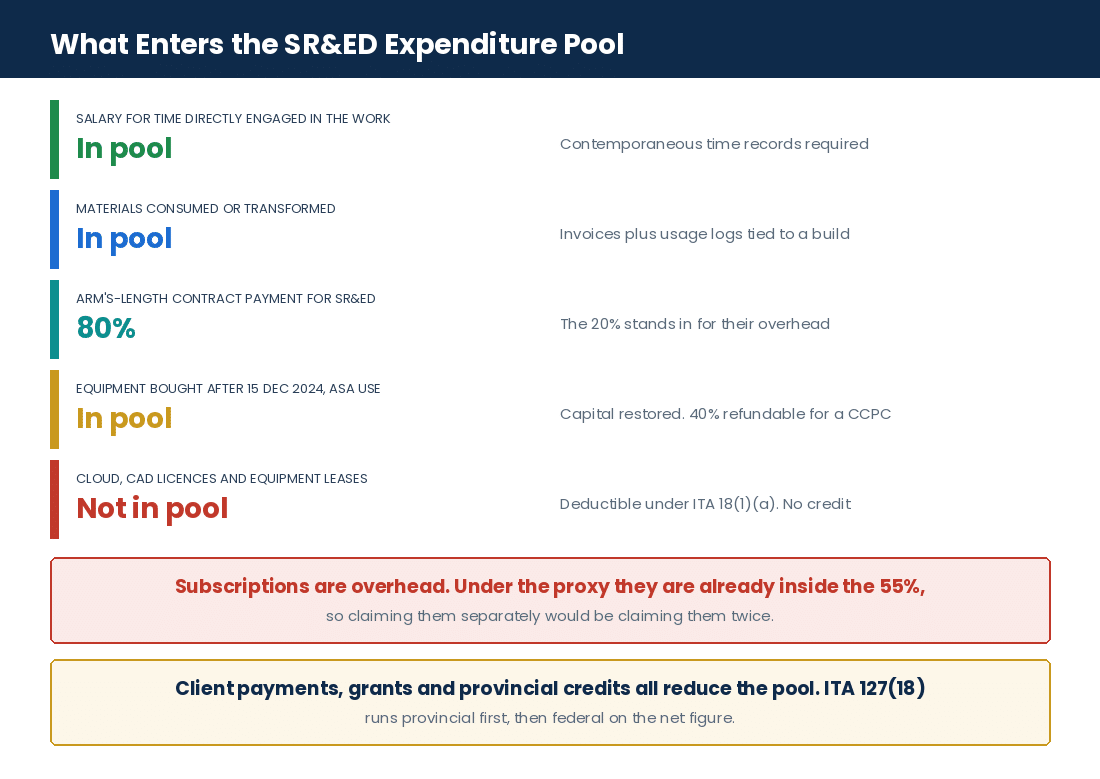
Five categories, and nothing else. A cost that is real, documented and plainly incurred for the research still earns no credit unless it falls into one of them.
| Category | What qualifies | Record required |
|---|---|---|
| Salary and wages | Employees directly engaged in the work, for the proportion of time spent on it | Contemporaneous time records plus payroll |
| Materials | Materials consumed or transformed in the work | Purchase invoices and usage logs tying them to a build |
| Contract payments | 80% of an arm’s-length contract payment for SR&ED performed on your behalf | Scope of work and invoices identifying the eligible activity |
| Overhead | Traditional method (actual, tracked) or the proxy at 55% of the salary base | Election made on the T661, irrevocable for that year |
| Capital property | Acquired after 15 Dec 2024, available for use after that date, used all or substantially all for SR&ED. Land and buildings excluded | Invoice, available-for-use date and evidence of use |
Wages and Salaries for Employees Involved in R&D and Prototyping
Salary is the largest line in almost every design studio claim, and it is also the salary base that drives the proxy. Designers, engineers and technical staff count for the proportion of their time directly engaged in resolving the uncertainty. Supervision and direct support count; general management does not.
- Keep time records as the work happens.
- Wages must link to a specific eligible activity, not to a project as a whole.
- Routine design iteration does not qualify, however many hours it absorbs.
- Specified employees — broadly, those owning 10% or more — are capped at five times the year’s maximum pensionable earnings and excluded from the proxy salary base under Regulation 2900(7) and (8).
Worked example. A Toronto studio logged 1,200 hours across three designers on a new ergonomic part, at $90,000 of salary. Of that, the hours spent testing successive geometries against a failure mode nobody had solved were eligible; the hours spent on surface finish and colourway were not. The claim was built from the time records, not from the project budget. Figures changed for privacy.
Materials and Supplies Used Specifically for Experimental Development
The statutory words are consumed or transformed. Material destroyed or rendered unusable by the work is consumed; material incorporated into a prototype that has value afterwards is transformed, and if the prototype is later sold the proceeds reduce the claim.
- Only materials used directly in the experimental work count.
- General office and studio supplies do not, and under the proxy they are inside the 55% in any event.
- Keep invoices showing what was bought and logs showing which build consumed it.
Worked example. An Ontario firm spent $15,000 on specialist polymers used only for prototype parts during a manufacturing test whose outcome was genuinely uncertain. Consumed in the work, tied to dated builds, and claimed in full. Figures changed for privacy.
Subcontractor and Consultant Costs Related to Product Design Projects
Where an arm’s-length contractor performs SR&ED on your behalf in Canada, 80% of the contract payment is a qualified expenditure. The 20% reduction stands in for the contractor’s own overhead, and it applies whether or not the contractor claims anything itself.
- The work must be SR&ED, performed on your behalf — not the contractor doing its own research and selling you the result.
- Non-arm’s-length contracts are outside the 80% convention and follow their own rules, with both parties’ filings needing to agree.
- Keep a scope of work describing the technological problem, and invoices that reference it.
Worked example. A British Columbia mechanical design firm engaged an arm’s-length consultant at $40 an hour for 300 hours on precision tooling problems with no known solution. The contract payment was $12,000, and 80% — $9,600 — went into the pool. Figures changed for privacy.
Cloud Computing and Software Expenses Applicable to Product Design R&D
Risk Warning: cloud computing and software subscriptions are not qualified SR&ED expenditures, no matter how exclusively they were used for the research.
They are not salary, not materials consumed or transformed, not a contract payment for SR&ED performed on your behalf, and not capital property acquired. The list in section 37 is exhaustive. A simulation platform or a CAD licence is overhead — which under the proxy method is already represented by the 55% prescribed amount, and under the traditional method must be shown to be directly attributable and incremental.
None of which means the money is wasted. The subscription is deductible in full as an ordinary business expense under paragraph 18(1)(a), apportioned under 18(9) where it is paid in advance for a period past the year end. It simply earns no credit. A studio that models a $12,000 annual simulation platform as part of its SR&ED claim has overstated the claim by $12,000 and, under the proxy, double-counted it as well.
Capital Equipment and Tool Leasing Relevant to Prototyping
This is the category that changed, and it changed in the opposite direction to what most guidance says.
- Purchased equipment is eligible again. Property acquired after 15 December 2024 and available for use after that date, used all or substantially all for SR&ED, is a qualified expenditure. Land and buildings are excluded. The ITC on capital is 40% refundable for a CCPC, against 100% on current expenditures.
- Shared-use equipment — not ASA for SR&ED but primarily used for it — gets a partial credit: up to 50% of the capital cost, claimed as 25% in each of two periods.
- Lease costs are not eligible. They were removed in 2014 and Bill C-15 did not restore them. An Alberta designer leasing CNC machinery at $25 an hour for 100 hours has a $2,500 deductible business expense and no SR&ED expenditure at all.
- Equipment bought and later sold or converted to commercial use can trigger ITC recapture under subsections 127(27) to (29).
A studio had leased its prototyping equipment for years on the understanding that leasing kept the cost inside the claim.
It had been outside the claim since 2014. On a replacement in 2025 the arithmetic had reversed: buying the machine outright now produced a qualified capital expenditure with a 40%-refundable credit, where continuing to lease produced only a deduction. The lease had been the more expensive option for over a decade without anyone noticing. Figures changed for privacy.
Federal and Provincial Product Design Tax Credit Rates
Federal and Provincial Rates
The Numbers
Breakdown of Federal SR&ED Tax Credit Rates and Refundability Distinctions
| Company type | Rate | Refundable? | Limit |
|---|---|---|---|
| CCPC, within the limit | 35% | 100% on current expenditures; 40% on capital | $6 million, phased out on taxable capital from $15M to $75M |
| CCPC, above the limit | 15% | Up to 40% where the taxable income and capital tests are met | — |
| Eligible Canadian public corporation | 35% | Refundable — new under Bill C-15 | Own limit by average gross revenue, full at $15M, nil at $75M |
| Other corporations | 15% | Non-refundable. Carry back 3 years, forward 20 | — |
| Individuals and partnerships | 15% | 40% refundable for individuals | — |
Key Stat: $6 million at 35% is $2.1 million of refundable credit.
That is the ceiling Bill C-15 set, up from $1.05 million under the old $3 million limit. A CCPC may also now elect to have its limit determined by average gross revenue over the preceding three years rather than by taxable capital — useful for a studio that has taken investment and shows capital out of proportion to its revenue.
Overview of Provincial SR&ED Credits Across Key Provinces For Product Design Studios
Federal vs Provincial Credit Rates – Illustrative Summary. The provincial picture is where circulating summaries go furthest wrong.
Ontario is not a single 10% credit, British Columbia’s credit is refundable for a CCPC, Quebec replaced its entire R&D regime in 2025, and Alberta has had a credit since 2021.
| Jurisdiction | Credit | Rate | Refundable? |
|---|---|---|---|
| Ontario | Ontario Innovation Tax Credit (OITC) | 8% on up to $3M of expenditures, capped at $240,000 | Yes |
| Ontario Research and Development Tax Credit (ORDTC) | 3.5% | No — carried back 3 years, forward 20 | |
| Ontario Business Research Institute Tax Credit (OBRITC) | 20% on up to $20M of eligible contracts with an institute | Yes | |
| Quebec | CRIC — research, innovation and pre-commercialization | 30% on the first $1M above the exclusion threshold, 20% above | Yes, fully |
| British Columbia | BC SR&ED tax credit | 10% | Yes for a CCPC up to 10% of the expenditure limit; non-refundable above |
| Alberta | Innovation Employment Grant (IEG) | 8% to the base level, 20% above it, on up to $4M a year | Yes |
Two of these need a note. Ontario’s OITC is ground down where prior-year federal taxable income exceeds $500,000, reaching nil at $800,000, and where prior-year taxable capital exceeds $25 million, reaching nil at $50 million — so a studio that has a good year can lose it the following one. And Quebec’s CRIC applies to taxation years beginning after 25 March 2025, consolidating and replacing the researcher salary credit, the university and public research centre credit, the research consortium credit, the pre-competitive private partnership credit, the technological adaptation services credit and the industrial design component of the design credits. A Quebec studio working from pre-2025 guidance is working from a regime that no longer exists.
Stacking of Federal and Provincial Credits To Maximize Benefits
Risk Warning: federal and provincial credits do not simply add together.
A provincial SR&ED credit is government assistance for federal purposes and reduces the federal qualified expenditure pool under subsection 127(18). The order of calculation is provincial first, then federal on the net figure — which means a studio that models 35% federal plus 8% Ontario as 43% of gross has overstated the combined benefit.
Keep the funding records separate by source and by project: federal expenditures, provincial credits claimed, grants received and client contract payments. All four reduce the pool, each under its own provision, and a claim that cannot show the reductions were made correctly tends to have them made for it on reassessment. Our guidance on tax credits for hardware businesses works through the same interaction.
Claim Process and Deadlines
Claim Process and Deadlines
Filing
Step-by-Step Guide to Filing SR&ED Claims for Product Design Studios
- Identify the uncertainty, not the project. Find the specific technological problems inside the year’s work whose outcome could not be predicted. This is the step that determines everything downstream.
- Carve out the eligible slice. Separate those activities from the design, production and client-revision work around them, and record the boundary while the work is live.
- Track the costs against the slice. Time records by person and activity, materials by build, contract payments by scope of work.
- Apply the reductions. Contract payments, grants and provincial credits all come off the pool under subsection 127(18).
- Choose the overhead method. Traditional or proxy, elected on the T661 and irrevocable for the year.
- File the T661 with the T2, inside the reporting deadline.
Identifying and Documenting Eligible Product Development Activities
Product design SR&ED in Canada covers projects that resolve real technological problems, not changes to how something looks. The evidence that persuades is dated and generated by the work itself: timesheets, test logs, failed-build notes, design review minutes, version-controlled CAD and simulation output. What persuades least is a narrative written at filing time describing what the team remembers doing.
There is no statutory requirement to keep timesheets. What the Act does is put the burden of proof on the claimant, and in a technical review contemporaneous records are the only thing that reliably discharges it. CRA has never been able to verify hours any other way, which is why a reconstructed timesheet is worth close to nothing — not because a rule forbids it, but because it proves nothing.
Calculating Qualifying Expenditures Related to Prototyping and Design
| Cost type | Inclusion in claim |
|---|---|
| Salaries and wages | Included for the proportion of time directly engaged in eligible work |
| Contractor payments | 80% of an arm’s-length contract payment for SR&ED performed on your behalf |
| Materials consumed | Included where consumed or transformed in the work |
| Overhead | Traditional method, or the 55% proxy on the salary base under Regulation 2900(4) |
| Tooling and moulds | Included where acquired after 15 December 2024 and used all or substantially all for SR&ED — this reversed under Bill C-15 |
| Computers and software bought outright | Qualified capital expenditure on the same terms. Not a CCA question — SR&ED and capital cost allowance are separate systems |
| Cloud and subscription software | Excluded. Overhead, inside the proxy. Deductible under 18(1)(a) but earns no credit |
| Equipment lease payments | Excluded since 2014 and not restored |
On overhead, the choice is annual and consequential. The proxy method takes 55% of the salary base — excluding specified employees’ amounts above the cap, under Regulation 2900(7) and (8) — and requires no tracking at all. The traditional method claims actual overhead directly attributable to the work and can be larger where a studio has dedicated space and equipment, but every dollar has to be traced. For most design studios the proxy wins on effort alone.
Filing the T661 SR&ED Claim Form Alongside Corporate Tax Returns
Form T661 asks for the project narrative in three parts, mapped to the three eligibility questions: what the technological uncertainty was, what work you did to resolve it, and what advancement resulted. Guide T4088 explains the fields. It is filed with the T2 together with Schedule 31 for the investment tax credit, and with the relevant provincial schedule.
Key Stat: there are two different deadlines and they are twelve months apart.
The T2 is due six months after the taxation year end under paragraph 150(1)(a), with the balance of tax at two months under 157(1)(b). The SR&ED reporting deadline is twelve months after that filing due date — 18 months after the year end. A studio can file its T2 on time and add the SR&ED claim by amendment up to the later date. What it cannot do is treat the six-month date as the SR&ED deadline, or the eighteen-month date as the T2 deadline.
Preparing and Organizing Supporting Technical and Financial Documentation
- Timesheets showing hours spent on qualifying work, by person and activity.
- Payroll records reconciling to the salary figure on the T661.
- Contractor invoices tied to a scope of work describing the technological problem.
- Receipts for materials used in prototyping, with usage logs linking them to builds.
- Project plans that identify the technical challenges at the outset.
- Test results, including failures — a failed experiment is evidence of experiment.
- Funding agreements showing every grant, client payment and provincial credit, so the reductions can be shown to have been made.
Submitting Claims Within the 18-Month Deadline to the Canada Revenue Agency
The deadline comes from subsection 37(11) for the expenditure deduction and paragraph (m) of the investment tax credit definition in subsection 127(9) for the credit. Subsection 220(2.2) removes any discretion to extend it. There is no relief application, no waiver and no late-filing provision — an expenditure filed after the deadline is not an SR&ED expenditure and earns nothing, even if the deficiency is corrected afterwards.
For a corporation with a 31 December year end, that is 30 June two calendar years later. Put it in the calendar the day the year closes.
A studio filed its T661 three days before the deadline with the technical narrative incomplete, intending to supplement it once the engineer returned from leave.
The claim as filed was what CRA assessed. Supplementary material arriving after the deadline cannot add expenditures, and the parts of the project that had not been described were simply not claimed. Filing early is not administrative tidiness in this programme — it is the only margin you get. Figures changed for privacy.
Post-Claim Procedures and Audit Preparation
Post-Claim Procedures and Audit Preparation
Review
What to Expect After Submitting a Claim Including CRA Reviews
Most first-time claims are reviewed. The review has two halves and they are conducted by different people: a research and technology adviser tests whether the work was SR&ED, and a financial reviewer tests whether the costs were correctly measured and reduced. A claim can survive one and fail the other.
The technical side comes back to the same three questions: was there a technological uncertainty, was it approached systematically, and did it produce an advancement. For a product design studio the recurring challenge is paragraph (i) of the 248(1) definition — style change — and the reviewer will want to see the boundary between the engineering work and the design work drawn by someone other than the person writing the claim.
CRA may write, request documents, or arrange a site visit. First-time claimants can request a pre-claim consultation before filing, which gives a non-binding view on eligibility and costs nothing.
Guidelines for Responding to Audit Requests With Detailed Project Evidence
- Answer within the time given, and ask for an extension in writing rather than letting a deadline pass.
- Lead with dated evidence. Timesheets made during the work, test logs, failed-build notes, design review minutes, CAD and simulation version history.
- Put the engineer in the room. A technical reviewer is an engineer or scientist and responds to a technical account of what was tried and why. An accountant describing the work secondhand rarely helps.
- Concede the weak parts. A claim defended in full down to the last questionable hour invites scrutiny of the strong parts. Withdrawing the marginal slice protects the rest.
- Do not produce reconstructed records. A timesheet created after the fact and presented as contemporaneous is worse than having none, and it changes the character of the file.
Key Stat: the burden of proof is on the claimant, and it is not a formality.
In a tax dispute the taxpayer must demolish the Minister’s assumptions. For SR&ED that means establishing, on the evidence, that a technological uncertainty existed, that systematic investigation addressed it, and that the hours and costs claimed attach to that work. Contemporaneous records are the only thing that reliably does it — not because a provision requires timesheets, but because nothing else proves what happened when.
Amending Past Returns To Recover Unclaimed SR&ED Expenses
Risk Warning: the three-year amendment window does not apply to SR&ED.
Most items on a T2 can be revisited within the normal reassessment period. SR&ED cannot. Subsection 220(2.2) denies any extension of the reporting deadline, and CRA’s filing requirements policy states that a claim cannot be filed or changed after it. Expenditures discovered later cannot be added, and additional or substitute expenditures cannot replace amounts CRA has disallowed.
What is available before the deadline is real and underused. A studio that filed its T2 without an SR&ED claim can amend to add one at any point in the following twelve months. That is the window to use when better records turn up or when someone finally reviews the year’s projects properly — and it closes at eighteen months, permanently.
Where the issue is not a missed claim but a dispute about one that was filed, the ordinary routes remain: a notice of objection within 90 days of the notice of assessment, and CRA audit representation through the review itself. Those are about the amount of a claim that exists, not about creating one that does not.
A studio asked us to go back four years and recover roughly $500,000 of development spend that had never been claimed, on the basis that its books supported it.
One year was still inside the eighteen months and we filed it. The other three were closed, and no quality of documentation could reopen them. The recoverable amount was about a quarter of what the studio had expected, and the difference was entirely a function of when someone looked. Figures changed for privacy.
Strategies to Maximize Product Design Tax Credits
Strategies to Maximize Product Design Tax Credits
Practice
The largest claims are not the broadest ones. They are the ones where the eligible work was identified while it was happening, recorded as it went, and separated cleanly from everything around it. A studio that does that will usually claim less of its total project spend and keep more of what it claims.
Best Practices for Enhancing SR&ED Claims in Product Development
- Keep clear technical narratives and track time as the work happens. When you build a prototype, record what hypothesis it tested and what the result was. An appearance model is not a prototype for this purpose. Log hours during the work — estimating them afterwards produces a number nobody can defend.
- Use accounting tools like QuickBooks or Xero to track costs. Set up project codes that match the carved-out eligible activities rather than the client engagements, so salary, materials and contract payments sort themselves. The tool matters less than the chart of accounts behind it; our bookkeeping setup for studios does this at the outset.
- Combine federal and provincial credits with the order of operations right. The federal refundable rate reaches 35% for a CCPC within the $6 million limit. Provincial credits sit on top but reduce the federal pool as government assistance, so model the net figure rather than the sum.
- Work with a licensed CPA firm when the claim is close to the line. The value is in the carve-out and the reductions, not in the writing. A firm that will tell you a project does not qualify is worth more than one that will claim it.
- Elect the overhead method deliberately. The proxy at 55% of the salary base is usually larger and always cheaper to support than tracked actual overhead, but it is irrevocable for the year, so decide before filing rather than after.
Common Claim Errors and What They Cost
| Error | What happens |
|---|---|
| Claiming full projects instead of the qualified slice | The whole claim goes to technical review, and a reviewer who finds obvious ineligible work scrutinises the rest harder |
| Calling style changes technological advances | Excluded expressly by paragraph (i) of the 248(1) definition. This is the single most common denial in this sector |
| Logging time after the fact | No reliable evidence of hours, and the burden of proof sits with you |
| Forgetting to reduce claims for client fees or grants | Reassessment under subsection 127(18), with interest from the original due date |
| Missing reporting dates | The claim is gone. Subsection 220(2.2) allows no extension |
| Claiming cloud and subscription software | Not a qualified expenditure, and under the proxy it is already inside the 55% |
| Claiming equipment lease payments | Removed from the programme in 2014 and not restored by Bill C-15 |
| Missing the restored capital expenditures | Equipment bought after 15 December 2024 for prototyping now qualifies. Studios still applying the 2014 rule are leaving credit behind |
Planning the Year Rather Than the Claim
- Decide buy versus lease on the new arithmetic. Purchased prototyping equipment used all or substantially all for SR&ED is now a qualified expenditure with a 40%-refundable credit. The same machine leased produces a deduction and nothing else.
- Watch the available-for-use date. Capital property has to be available for use after 15 December 2024, so commissioning records matter in a way they did not when capital was outside the programme entirely.
- Check whether the gross revenue election helps. A studio that has raised capital may have taxable capital that grinds its limit while its revenue would not.
- Keep client-funded and self-funded development in separate project codes. Subsection 127(18) reduces the pool for the first and not the second, and mixing them means reconstructing the split under review.
- Budget for the following year’s income inclusion. The credit is taxable in the subsequent year under paragraph 12(1)(t).
A studio moved from an annual look-back to a monthly fifteen-minute review of which work had hit a genuine technical wall.
The claimed hours fell by around a third. The accepted hours roughly doubled, because every one of them now had a dated record behind it and a named uncertainty attached. The claim got smaller and the credit got bigger. Figures changed for privacy.
SR&ED Opportunities Specific to Product Design Studios
SR&ED Opportunities Specific to Product Design Studios
Sector
Everything in this section turns on one distinction: the programme funds technological advancement, and a design studio’s defining skill is not technological. That does not mean studios have no claim. It means the claim lives in the engineering problems the design work creates, and finding them is the whole exercise.
How Product Engineering and Prototyping Fit Within SR&ED Eligibility
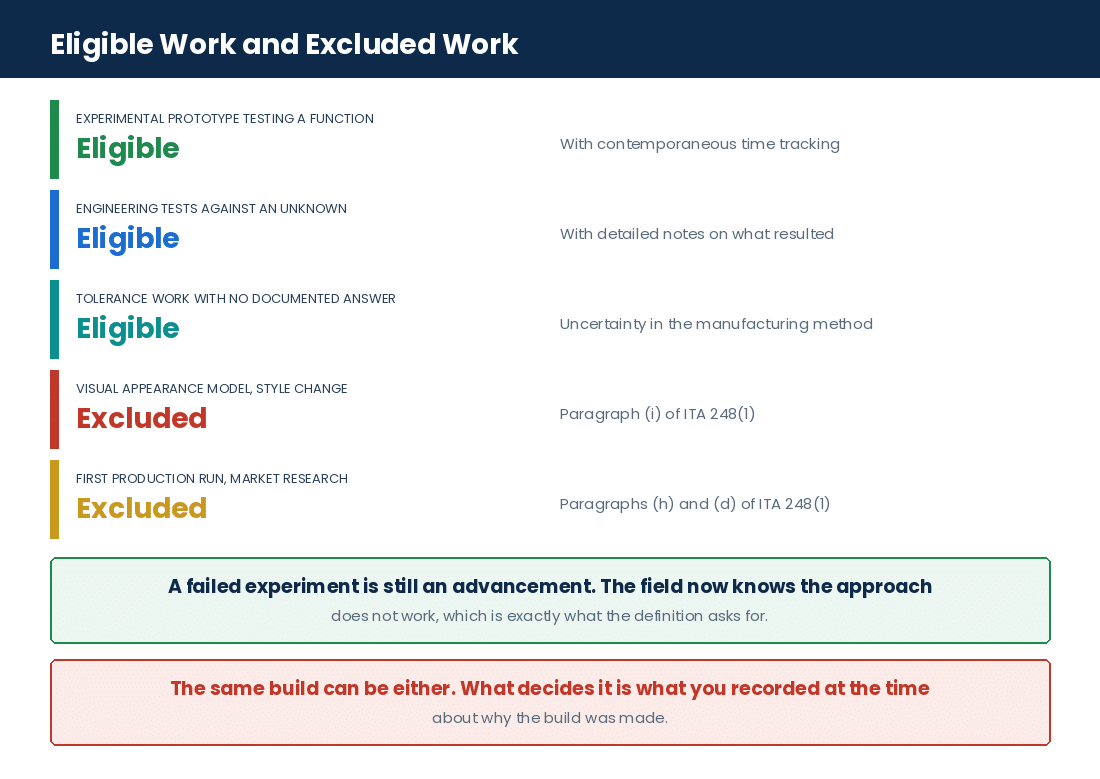
Prototyping qualifies where the build tests a hypothesis about how something works. It does not qualify where the build demonstrates how something looks. The same physical object can be either, depending on why it was made, which is why the record of intent at the time matters more than the artefact.
| Activity | Eligible? | What makes the difference |
|---|---|---|
| Experimental prototype build | Yes, with contemporaneous time tracking | A stated hypothesis about function and a recorded result |
| Visual appearance model | No | No uncertainty to resolve. Style change under paragraph (i) |
| Engineering tests | Yes, with detailed notes | Testing against an unknown, not verifying against a specification |
| Style change | No | Excluded by the definition itself |
| Design for manufacture on a known process | No | Standard practice resolves it |
| Tolerance work where the process has no documented answer | Yes | Technological uncertainty in the manufacturing method |
| First production run of the new product | No | Commercial production, excluded by paragraph (h) |
Application of SR&ED in Software-Related Product Design and Innovation
Software work inside a product programme qualifies on the same test, applied to code rather than to geometry. What counts is a technological uncertainty in the software or in how it meets the hardware — not whether the feature is new to the client.
- Usually eligible: firmware that has to meet a timing or resource constraint with no known approach; a control algorithm developed by experiment; a sensor fusion problem where the available methods fail; getting embedded software to behave predictably against hardware that does not.
- Usually not: routine updates, interface changes, configuring an existing framework, porting to a new platform by documented means, bug fixing.
- Separate the hours. The same developer will spend part of a sprint on genuine investigation and part on ordinary implementation. Only the first part is claimable, and the split has to exist in the time records before anyone asks for it.
Case Examples Illustrating Successful Product Design Tax Credit Claims
- A mechanical designer developed a new assembly method after several prototype iterations resolved a fit problem that standard tolerancing had not. The claim covered the iterations and the testing, not the drawings that followed.
- A digital studio worked on sensor integration in a wearable, including custom firmware tested experimentally against hardware behaviour the datasheet did not describe. The firmware hours were claimed; the companion app’s interface work was not.
- An industrial designer kept material performance testing in a separate project phase from the styling work on the same programme, billed by milestone. The separation existed in the time records from week one, which is why the technical review took one letter.
All three needed time records matching the specific innovative work rather than the project as a whole. Figures changed for privacy.
Industry Trends Impacting the Value and Scope of Product Development Incentives
- The programme got materially more generous in 2026. The limit doubled to $6 million, the phase-out band widened to $15M–$75M, eligible Canadian public corporations came in, and capital expenditures returned after eleven years out. This is the largest expansion in decades.
- Hardware and software are converging, which widens what a design studio can claim — a connected product generates uncertainty at the boundary between the two, and that boundary is often where the real engineering problem sits.
- The provincial map is moving. Quebec replaced its entire R&D credit structure with the CRIC for years beginning after 25 March 2025, and Alberta’s Innovation Employment Grant has been running since 2021. Guidance written before those changes is wrong about both.
- CRA scrutiny of the eligibility question has not loosened. A more generous programme with the same definition means more credit available to studios that can draw the line, and no more available to studios that cannot.
A studio with a connected-product line had claimed only its mechanical work for years, on the view that software was for software companies.
The firmware timing problem on the same product was the strongest technological uncertainty in the file — better documented than the mechanical work, because the developers used version control and the engineers used a notebook. Adding it roughly doubled the claim with no new work and no new risk. Figures changed for privacy.
Frequently Asked Questions on Product Design Studio Tax Credits Canada
Frequently Asked Questions
20 Answers
What is the claim filing deadline for product design studio tax credits in Canada?+
How does Income Tax Act s.127(5) define eligible work for product design SR&ED claims?+
Can contractor payments be fully claimed under product development tax credits?+
What is the proxy method overhead rate allowed by CRA for SR&ED claims?+
Why are rebuilt or backdated timesheets not accepted in SR&ED claims?+
Which form do I need to file along with my T2 corporate return for SR&ED claims?+
What does Income Tax Act s.248(1) exclude from SR&ED claims?+
How does Income Tax Regulations Schedule II relate to SR&ED expenses?+
What guidance does CRA provide about software costs in product design SR&ED claims?+
What is the expenditure limit for the enhanced 35% refundable credit?+
Are cloud computing and simulation subscriptions eligible SR&ED expenditures?+
Can we claim equipment we lease for prototyping?+
Do tooling and moulds qualify?+
Is the SR&ED credit itself taxable?+
Does a provincial credit reduce the federal claim?+
What if a client paid for the development work?+
Can an appearance prototype ever qualify?+
What is the difference between support work and excluded work?+
Should a studio request a pre-claim consultation?+
File it ourselves or engage a CPA firm?+
SR&ED Readiness Check
Five quick questions on your studio’s development work. No fee shown.
Points to raise with us:
This is a general prompt, not tax or legal advice or a quote. Your position depends on your full facts. For a real review, please book a free consultation.
Businesses We Serve & Industry Spotlights
Industry Expertise
Product design sits inside a wider innovation and technology practice, and the same two questions — where is the technological uncertainty, and which costs attach to it — decide every SR&ED claim we touch. Here are eleven sectors and the form the question takes in each.
| Industry | The Product Design Angle |
|---|---|
| Technology startups & SaaS | The same eligibility test applied to code rather than geometry |
| Hardware startups | Restored capital expenditures, and the buy-versus-lease arithmetic that reversed |
| Industrial manufacturers | Where process development ends and commercial production begins |
| Furniture manufacturers | Material and joinery testing against the style change exclusion |
| Engineering consultants | Client-funded work reduced to nothing by subsection 127(18) |
| Cybersecurity companies | Software uncertainty, and separating investigation from implementation |
| Data analytics companies | The same $6 million limit and the same contract payment trap |
| No-code development agencies | A useful contrast — platform assembly usually resolves nothing technological |
| Clothing manufacturers | Textile and construction testing, where almost all of it reads as style |
| Medical doctors & physician professional corporations | Clinical innovation, and where support work stops being eligible |
| Construction, contractors & skilled trades | Method development on site, documented by nobody unless someone insists |
- Technology startups & SaaS: The test is identical and the evidence is usually better, because version control and issue trackers produce dated records without anyone deciding to keep them.
- Hardware startups: The sector most affected by capital returning to the programme. A company that leased its test rigs on the old advice should rerun the arithmetic before the next purchase.
- Industrial manufacturers: Paragraph (h) of the 248(1) definition excludes commercial production, and the boundary between a pilot run that tests a process and a first production run that uses it is where their claims are won and lost.
- Furniture manufacturers: They face the style change exclusion in its sharpest form, and the answer is the same one a design studio needs: claim the structural and material testing, not the form.
- Engineering consultants: Almost everything they do is funded by a client, which makes subsection 127(18) the first provision to check rather than the last.
- Cybersecurity companies: Separating genuine investigation from ordinary implementation inside the same sprint is their recurring problem, and it is a studio’s problem too on any connected product.
- Data analytics companies: Same limit, same phase-out, same contract payment reduction. The difference is that their uncertainty lives in method rather than in material.
- No-code development agencies: A clarifying contrast. Assembling an application from commercial platforms generally resolves nothing technological, which is exactly why a design studio has to find its engineering problem rather than assume the project is one.
- Clothing manufacturers: The hardest sector for this programme, because so much of the work reads as style on its face. Performance textile and construction testing is the part that survives.
- Medical doctors & physician professional corporations: Clinical work raises the support-versus-excluded-work question directly, since data collection is eligible only when it supports core experimental work.
- Construction, contractors & skilled trades: Real method development happens on site constantly and is documented by nobody. The claim exists; the evidence usually does not.
The sector changes the subject matter and nothing else. Every one of these claims turns on two questions: where was the outcome genuinely unknown, and which hours and costs attach to answering it.
The studios that claim well are not the ones doing the most novel work. They are the ones who decided, while the work was live, which part of it was an experiment.
Professional Guidance and Quick Reference
Guidance
Accessing SR&ED Program Resources for Product Design Studios
Product design studios lose SR&ED money in a predictable set of ways: using the superseded $3 million limit when Bill C-15 raised it to $6 million; claiming cloud and CAD subscriptions that are not qualified expenditures and are already inside the proxy; claiming equipment lease payments removed from the programme in 2014; missing the capital expenditures restored for property acquired after 15 December 2024; believing the three-year amendment window applies when subsection 220(2.2) forbids any extension; citing 127(5) for the definition of SR&ED when it is in 248(1); citing Schedule II for the overhead proxy when it is Regulation 2900(4); citing section 230 for capital cost allowance when it is the record retention rule; treating Ontario as one 10% credit when it is three separate ones at 8%, 3.5% and 20%; calling British Columbia’s credit non-refundable when it is refundable for a CCPC; saying Alberta has no credit when the Innovation Employment Grant has run since 2021; working from a Quebec regime the CRIC replaced in 2025; adding federal and provincial rates together when provincial credits reduce the federal pool; and reconstructing timesheets after the fact. Gondaliya CPA handles product design studio accounting and SR&ED on a flat annual fee.
Official CRA Forms, Guidelines, and Policy Updates Relevant to Product Design
- Form T661 — the SR&ED claim, carrying the project narrative in three parts. Guide T4088 explains the fields.
- Schedule 31 — the investment tax credit calculation, filed with the T2.
- CRA’s SR&ED policies — principally the Eligibility of Work policy, the SR&ED Glossary, the Filing Requirements policy and the SR&ED Investment Tax Credit policy. These replaced the old information circulars and application papers; IC86-4R3 is archived.
- Pre-claim consultation — free, non-binding, before filing. Worth it on a first claim.
Tools and Platforms to Assist with Claim Preparation and Submission
- Contemporaneous time tracking, coded to eligible activities rather than to client engagements. This is the single highest-value habit in the programme.
- The proxy overhead method at 55% of the salary base under Regulation 2900(4), which removes overhead tracking from the exercise entirely.
- QuickBooks or Xero with project codes matching the carve-out, so salary, materials and contract payments sort themselves as they are posted.
- Version control and issue trackers, which generate dated technical evidence as a by-product of doing the work.
How Gondaliya CPA Supports Product Design Businesses with SR&ED
We assess eligibility first and tell you plainly where a project does not qualify, because an overstated claim costs more than an unclaimed one. Where it does qualify we carve out the eligible work, build the expenditure pool with the reductions under subsection 127(18) applied correctly, prepare the T661 and Schedule 31, and file with the T2 inside the reporting deadline. If a technical or financial review opens, we represent you through it.
Gondaliya CPA performs compilation engagements under CSRS 4200, which provide no assurance. Audit and review engagements are referred out. We do not advise on engineering, product safety or intellectual property.
Expert Eligibility Assessments Tailored to Product Design Studios
- Where the technological uncertainty sits inside each project, and where it does not.
- Which costs enter the pool — salary, materials consumed, 80% of arm’s-length contract payments, overhead, and capital under the restored rules.
- Which reductions apply: client contract payments, grants, provincial credits.
- Whether the capital rules change a buy-or-lease decision you have not made yet.
Comprehensive Claim Preparation, Filing, and Audit Support Services
A flat annual fee including HST, agreed in writing before any work begins, covering bookkeeping, the T2, the SR&ED claim and routine CRA correspondence. Integrating the bookkeeping matters here more than in most engagements, because the claim has to reconcile to the general ledger and the payroll records line by line.
Encouragement To Contact Gondaliya CPA For Personalized Consultation And Assistance With Maximizing Product Development Tax Credits
Reach us at 647-212-9559 or info@gondaliyacpa.ca, with a one-business-day response. If you have a year end approaching eighteen months, say so first — that is the only deadline in this programme with no relief behind it.
Quick Answers
At a Glance
- Definition of SR&ED: ITA 248(1)
- Expenditure deduction: ITA 37
- Investment tax credit: ITA 127(5) and 127(9)
- Enhanced rate: 35%, fully refundable for a CCPC
- Expenditure limit: $6 million, up to $2.1 million refundable
- Phase-out: taxable capital $15M to $75M
- General rate: 15%, non-refundable
- Contract payments: 80% of an arm’s-length payment
- Overhead proxy: 55% of the salary base, Reg 2900(4)
- Salary base rules: Reg 2900(7) and (8)
- Capital restored: acquired after 15 December 2024
- Capital refundability: 40% for a CCPC
- Shared-use equipment: up to 50% of cost, 25% in each of two periods
- Lease costs: excluded since 2014
- Cloud and subscriptions: not qualified expenditures
- Reductions: ITA 127(18) for contract payments and assistance
- Credit taxable: following year, ITA 12(1)(t)
- Reporting deadline: 18 months, ITA 37(11) and 127(9)(m)
- No extension: ITA 220(2.2)
- Records: six years from the taxation year end, ITA 230(4)(b)
Key Legal References and Guidelines for Product Design Studio Tax Credits Canada
Authorities, Correctly Cited
- Documentation requirements come from the filing requirement in subsection 37(11) and the prescribed form T661, together with the general record-keeping obligation in section 230 — which is about records, not capital cost allowance, and sets a six-year retention period in paragraph 230(4)(b).
- Review procedures are set out in CRA’s published SR&ED policies, principally the Claim Review Manual for research and technology advisers, which is public.
- Official interpretation of the eligibility test comes from the Eligibility of Work for SR&ED Investment Tax Credits policy and the SR&ED Glossary, not from an archived information circular.
- The programme is administered federally by CRA, with provincial credits administered either alongside the federal claim or separately, depending on the province.
- Form T661 instructions are in Guide T4088, which maps each field to the three eligibility questions.
- Support work vs excluded work: eight listed categories of support work are eligible when commensurate with and directly in support of core SR&ED. The excluded categories in 248(1) are never eligible — market research, quality control, social science research, prospecting, commercial production, style changes and routine data collection.
- Carve-out strategy: separate the eligible slice from the surrounding project while the work is live. A boundary drawn at filing time from an invoice is the weakest evidence in the file.
- Capital cost allowance is a separate system from SR&ED, governed by paragraph 20(1)(a), Regulation 1100 and Schedule II. An expenditure claimed as SR&ED capital is not also depreciated.
People Also Ask
Related Questions
Can a studio claim SR&ED on a project that failed?+
Yes, and failure often makes the claim stronger. The test is whether there was a technological uncertainty approached systematically, not whether the product shipped. A documented dead end is a technological advancement — the field now knows the approach does not work. What fails is a project with no uncertainty, however commercially unsuccessful it was.
Do we need an engineer or scientist on staff to claim?+
No. There is no credentialing requirement anywhere in the definition. What matters is that the work constituted a systematic investigation by means of experiment or analysis, and that someone competent in the field can explain it to a technical reviewer. In practice having that person available for the review matters far more than their job title.
Is a pilot plant or pre-production run claimable?+
It depends on why it ran. A run conducted to test whether a process works, with a hypothesis and a recorded result, can be experimental development. A run conducted to make product is commercial production, excluded by paragraph (h) of the 248(1) definition. Where a single run does both, only the experimental portion is claimable and the split needs to exist in the records.
How long does CRA take to process a claim?+
CRA publishes service standards of 60 calendar days for a refundable claim that is not selected for review and 180 days for one that is, measured from a complete filing. A claim filed with the T2 therefore usually pays out within a few months. A claim filed at the eighteen-month mark pays out a year and a half after the money was spent.
Can a studio claim work performed outside Canada?+
Generally no — SR&ED must be carried on in Canada. There is a narrow allowance for salary paid to an employee of the claimant for work performed outside Canada that is directly undertaken in connection with Canadian SR&ED, capped at 10% of the total salary for the work carried on in Canada. A contract with a foreign developer does not fit that exception.
Glossary
Definitions
- SR&ED — systematic investigation or search in a field of science or technology by means of experiment or analysis, as defined in subsection 248(1).
- Technological uncertainty — a question whose answer could not be determined from publicly available knowledge or standard practice at the time.
- Technological advancement — new knowledge generated by resolving the uncertainty, including knowledge that an approach does not work.
- Experimental development — work undertaken to achieve technological advancement in creating or improving materials, devices, products or processes.
- Support work — the eight listed categories eligible when commensurate with and directly in support of core SR&ED.
- Excluded work — the categories listed in 248(1) that are never eligible, including style changes and commercial production.
- Qualified expenditure — an expenditure that enters the pool on which the investment tax credit is calculated, after the reductions in 127(18).
- Proxy method — the election to claim a prescribed overhead amount of 55% of the salary base under Regulation 2900(4), in place of tracking actual overhead.
- Contract payment — an amount paid by a client for SR&ED performed on its behalf, which reduces the performer’s pool under 127(18).
- Specified employee — broadly an employee owning 10% or more of any class of shares, whose salary is capped and partly excluded from the proxy salary base.
- Shared-use equipment — equipment used primarily but not all or substantially all for SR&ED, attracting a partial credit of up to 50% of capital cost.
- Reporting deadline — 18 months after the taxation year end for a corporation, under 37(11) and 127(9), with no extension available under 220(2.2).
Want a checklist to work from? You can download our free product design studio SR&ED checklist before your consultation.
Diarise the 18-month deadline the day your year closes, because subsection 220(2.2) means a late claim is not a reduced claim but no claim, and the three-year amendment window every other line on the T2 enjoys does not reach it. Build the claim from the technological uncertainty outward, not from the project budget inward — the style change exclusion in 248(1) will remove the design work whatever you call it, and an oversized claim puts the defensible part under scrutiny it did not need. Use the $6 million limit, not the superseded $3 million, and check whether the gross revenue election beats the taxable capital test for you. Stop claiming cloud and CAD subscriptions, which are overhead already inside the 55% proxy, and start claiming purchased prototyping equipment, which came back into the programme for property acquired after 15 December 2024 — the buy-versus-lease arithmetic reversed and most studios have not noticed. Net the provincial credit off before calculating the federal one, because 127(18) treats it as assistance. Take 80% of arm’s-length contract payments and nothing on client-funded work. And log the hours while the work is happening, because the burden of proof is yours and nothing else discharges it.
2026 Update — what is current: This article reflects rules current to 8 October 2026. Bill C-15, the Budget Implementation Act, 2025, No. 1, received Royal Assent on 26 March 2026 and delivered the largest SR&ED expansion in decades, for taxation years beginning after 15 December 2024. The expenditure limit for the enhanced 35% refundable credit rose from $3 million to $6 million, giving up to $2.1 million of refundable credit, with the phase-out on taxable capital widened to $15 million to $75 million and a new election to use average gross revenue instead. Eligible Canadian public corporations can now claim the enhanced refundable credit, with their own limit set by gross revenue. Capital expenditures are eligible again for property acquired after 15 December 2024 and available for use after that date, used all or substantially all for SR&ED, with land and buildings excluded and the credit 40% refundable for a CCPC; equipment lease costs were not restored. Provincially, Quebec’s CRIC replaced the former R&D credits for taxation years beginning after 25 March 2025, at 30% on the first $1 million above the exclusion threshold and 20% above, fully refundable. Unchanged: the definition in 248(1) with its exclusions, the 80% arm’s-length contract payment rule, the 55% proxy in Regulation 2900(4), the reductions in 127(18), the 18-month reporting deadline in 37(11) and 127(9), and the prohibition on extending it in 220(2.2).
Product Design Studio Tax Credits Canada: How Gondaliya CPA Can Help
Start with your project list, your time records and your year-end date
Gondaliya CPA identifies where the technological uncertainty actually sits in each project and tells you plainly where it does not, carves the eligible work out from the design and production around it, builds the expenditure pool with the contract payment and assistance reductions applied in the right order, elects the overhead method deliberately rather than by default, checks whether the restored capital rules change a purchase you are about to make, prepares the T661 and Schedule 31, files inside the reporting deadline, and represents you through any technical or financial review — on a flat annual fee including HST with a one-business-day response. Please book a free consultation.
Next Steps
Please book a free consultation with Gondaliya CPA and bring three things: a list of the projects worked on in the year, whatever time records exist for them, and your fiscal year-end date. The third of those tells us immediately how much time is left, and on a year that closed more than a year ago that is the only question that matters. If any of the work was funded by a client or a grant, bring those agreements too, because the reductions change the arithmetic more than the rate does. You will get a flat annual fee including HST before any work begins. We serve Toronto, Mississauga, Vaughan, Brampton, Etobicoke, Scarborough, Ottawa and the rest of Ontario, and work with studios across Canada. If our content helps, please add gondaliyacpa.ca as a preferred source on Google.
Published: · Last updated:
Editorial policy: We research against CRA, Department of Finance, Parliament of Canada, CPA Canada and CPA Ontario sources, fact-check the figures, and Sharad Gondaliya, CPA, reviews the content, which we update as the rules change.
Disclaimer: This article is educational information only and is not tax, legal, financial, engineering, product safety or intellectual property advice. Figures marked illustrative are examples rather than quotes or guarantees. It reflects rules current to 2026, including the SR&ED measures enacted by Bill C-15 on 26 March 2026, the definition and exclusions in subsection 248(1) of the Income Tax Act, the expenditure deduction in section 37 with the filing requirement in subsection 37(11), the investment tax credit in subsections 127(5) and 127(9) with the reductions in 127(18), the prescribed proxy amount in Regulation 2900(4) and the salary base rules in 2900(7) and (8), the restoration of capital expenditures for property acquired after 15 December 2024, the prohibition on extending the SR&ED reporting deadline in subsection 220(2.2), and the six-year retention requirement in paragraph 230(4)(b). Provincial credits are administered separately and their rates and conditions differ by province; Quebec’s CRIC applies to taxation years beginning after 25 March 2025. Gondaliya CPA performs compilation engagements under CSRS 4200 and does not perform audit or review engagements. Rates and limits change and outcomes depend on your specific facts. Please consult a licensed CPA before acting.

Sharad Gondaliya is a CPA Canada & CPA USA with 15 Years+ experience of Accounting, Tax, Payroll of Corporate Small Businesses as Tax Accountant. He is a CPA Ontario member (61040184) and holds US CPA licences in Washington and Montana and is well known among corporate small businesses for tax planning, efficient tax solutions, and affordable CPA services. Sharad is the Principal (Director) of Gondaliya CPA – Affordable CPA Firm in Canada. Licenses: CPA Ontario: 61040184 | CPA USA (MT): PAC-CPAP-LIC-033176 | CPA USA (WA): 57629 | CPA Firm License: 61330051 View Full Author Bio