



No-Code Development Agency Tax Rules in Canada: Contractor Payments, Software Costs & Business Income
No-Code Development Agency Taxes Canada: A Guide to Business Taxes and Accounting with Gondaliya CPA
No-code development agency taxes in Canada turn on three things: when project and retainer income is earned, whether the people doing the work are contractors or employees, and which software costs belong to the agency rather than the client. Gondaliya CPA helps no-code development agencies get those three right, file the corporate return and the GST/HST returns from books that reconcile, and keep the records that make a deduction survive a review.
Quick Summary
Four things in the circulating guidance will cost a no-code agency money. Payroll source deductions are not remitted “within seven days after the pay period” — Regulation 108 sets four bands, and an ordinary agency remits on the 15th of the following month. A non-resident contractor who performs services in Canada is reported on a T4A-NR, not an NR4, and Regulation 105 reaches only services rendered in Canada, so a developer working from abroad is outside it entirely. The $30,000 small supplier test in section 148 of the Excise Tax Act measures your taxable supplies, not your clients’. And the single largest risk to an incorporated one-person agency is nowhere in the source material at all: personal services business status under 125(7), which denies the small business deduction, denies almost every expense under 18(1)(p), and adds a 5% tax on top.
Reading time: 30 minutes.
Table of Contents
- Four Things You Have Been Told That Are Wrong
- What a No-Code Development Agency Is, for Tax
- Overview of Business Taxes
- Key Tax Obligations and Filing Requirements
- Deductions and Tax Credits
- Accounting Practices and Record-Keeping
- Managing GST/HST and Sales Taxes
- Payroll and Contractor Tax Considerations
- The Personal Services Business Trap
- Frequently Asked Questions
- Businesses We Serve & Industry Spotlights
- Professional Guidance and Quick Reference
The Numbers That Matter
This article covers Canada, with Ontario and Toronto context, and reflects rules current to 8 October 2026. It is written for incorporated no-code and low-code development agencies — studios building on Bubble, Webflow, Airtable, Make, Zapier, Retool and similar platforms, whether billing by project, by retainer or by subscription. Gondaliya CPA performs compilation engagements under CSRS 4200, which provide no assurance; audit and review engagements are referred out. Nothing here is advice on intellectual property, contract law or platform licensing terms. This is educational information only and not tax or legal advice.
Four Things You Have Been Told About No-Code Agency Taxes That Are Wrong
Four Things You Have Been Told That Are Wrong
Corrections
Each of these circulates widely in guidance aimed at small Canadian agencies. Each has a specific provision behind the right answer, and in three of the four the wrong answer produces a filing failure rather than just a missed deduction.
Payroll Is Not Remitted Within Seven Days
Risk Warning: “payroll remittances are due within seven days after the pay period ends” is not a rule that exists.
There is no seven-day band. Regulation 108 assigns every employer to one of four schedules by its average monthly withholding amount, measured over the two preceding calendar years. A no-code agency with a handful of staff is almost always a regular remitter, due on the 15th day of the month following the month the amounts were withheld.
| Average monthly withholding amount | Band | Due |
|---|---|---|
| Under $3,000, with a clean compliance record | Quarterly | 15th of the month after each quarter |
| Under $25,000 | Regular | 15th of the following month |
| $25,000 to under $100,000 | Threshold 1, accelerated | Twice monthly — the 25th and the 10th |
| $100,000 or more | Threshold 2, accelerated | Within three working days of the pay period ending |
The three-working-day figure is real, but it belongs to the largest band. An agency applying it to itself is simply remitting early, which costs nothing. An agency applying the invented seven-day rule and then slipping to the 20th is late, and the penalty under subsection 227(9) starts at 3% of the amount and rises to 10% depending on how late it is, with 20% for a repeat failure made knowingly or through gross negligence.
A Non-Resident Contractor Gets a T4A-NR, Not an NR4
Risk Warning: NR4 is the wrong slip, and Regulation 105 does not reach a developer working outside Canada.
Regulation 105 requires a payer to withhold 15% from a fee paid to a non-resident for services rendered in Canada, and the amount is reported on a T4A-NR. The NR4 is for Part XIII amounts — rents, royalties, interest, dividends — which is a different regime with a different rate and a different trigger.
The location of the work is what decides it, not the residence of the person doing it. A Lisbon-based Bubble developer building screens from Lisbon is outside Regulation 105 entirely: nothing to withhold, no T4A-NR, no NR4. The same developer flown in for a two-week on-site sprint in Toronto is inside it for the fees relating to those two weeks.
And the relief is not automatic. Treaty protection requires a waiver, applied for by the non-resident on Form R105, generally at least 30 days before the services begin. Until CRA confirms it in writing, the withholding obligation stands, and it is the payer who is liable for an amount not withheld, not the contractor.
The Small Supplier Test Measures Your Sales, Not Your Client’s
Risk Warning: “you charge GST/HST unless your clients qualify as small suppliers” has the test pointing the wrong way.
Your client’s size is irrelevant to whether you charge tax. Section 148 of the Excise Tax Act defines a small supplier by reference to your own worldwide taxable supplies, including those of associated persons: $30,000 or less over the four preceding calendar quarters. Below it, registration under 240(1) is not required. Above it, you register and charge, whoever the customer is.
There is a trap inside the threshold that most summaries omit. If your taxable supplies exceed $30,000 in a single calendar quarter, you cease to be a small supplier immediately — from the supply that pushed you over — not at the end of the year. A no-code agency that lands one $45,000 build in a quarter after a slow year is registered from that invoice, and the tax on it is owed whether or not it was charged.
There Are Three GST/HST Filing Bands, Not Two
The guidance says agencies under $1.5 million file annually and those over it file monthly. The middle band is missing, and it is where most growing agencies actually sit.
| Annual taxable supplies | Assigned period | May elect |
|---|---|---|
| $1.5 million or less | Annual | Quarterly or monthly |
| Over $1.5 million to $6 million | Quarterly | Monthly |
| Over $6 million | Monthly | — |
Deadlines differ by band too. A monthly or quarterly filer files and remits one month after the period ends. An annual filer files and remits three months after the fiscal year end — and if its net tax for the previous year was $3,000 or more, it also owes quarterly instalments, due one month after each quarter. Annual filing with instalments is often worse than simply filing quarterly, because you pay on the same schedule and do four estimates instead of four returns.
An agency that had grown past $2 million in billings was still on annual GST/HST filing, remitting instalments it had set years earlier against a much smaller business.
The instalments were roughly a third of the actual net tax, and the shortfall had accumulated interest across three filing years before anyone looked. Moving to quarterly filing removed the estimate entirely. Figures changed for privacy.
What is a No-Code Development Agency?
What a No-Code Development Agency Is, for Tax
Characterisation
A no-code development agency builds working software without writing conventional code, assembling applications from visual builders, hosted databases and automation platforms — Bubble, Webflow, Airtable, Make, Zapier, Retool and the rest. For tax, none of that matters. What matters is that the agency supplies services for a fee, which makes its revenue ordinary business income under section 9, computed on an accrual basis.
The complications are not technical. They come from three structural features of the business model: income arrives before the work is done, the people doing the work are often not employees, and a large share of the cost base is software that may belong to the agency or to the client.
Tax Points for No-Code Development Agencies
- Business Income. Project fees, retainers and subscription revenue are business income. The question is never whether it is income but when. An amount becomes income when it is receivable under paragraph 12(1)(b), and an amount received for services not yet rendered is included under subparagraph 12(1)(a)(i) in the year it is received — with a reserve available, which section five sets out.
- Contractor Payments. A payment to a Canadian contractor is deductible as incurred and reportable on a T4A. A payment to a non-resident is deductible too, but withholding under Regulation 105 depends entirely on whether the services were rendered in Canada.
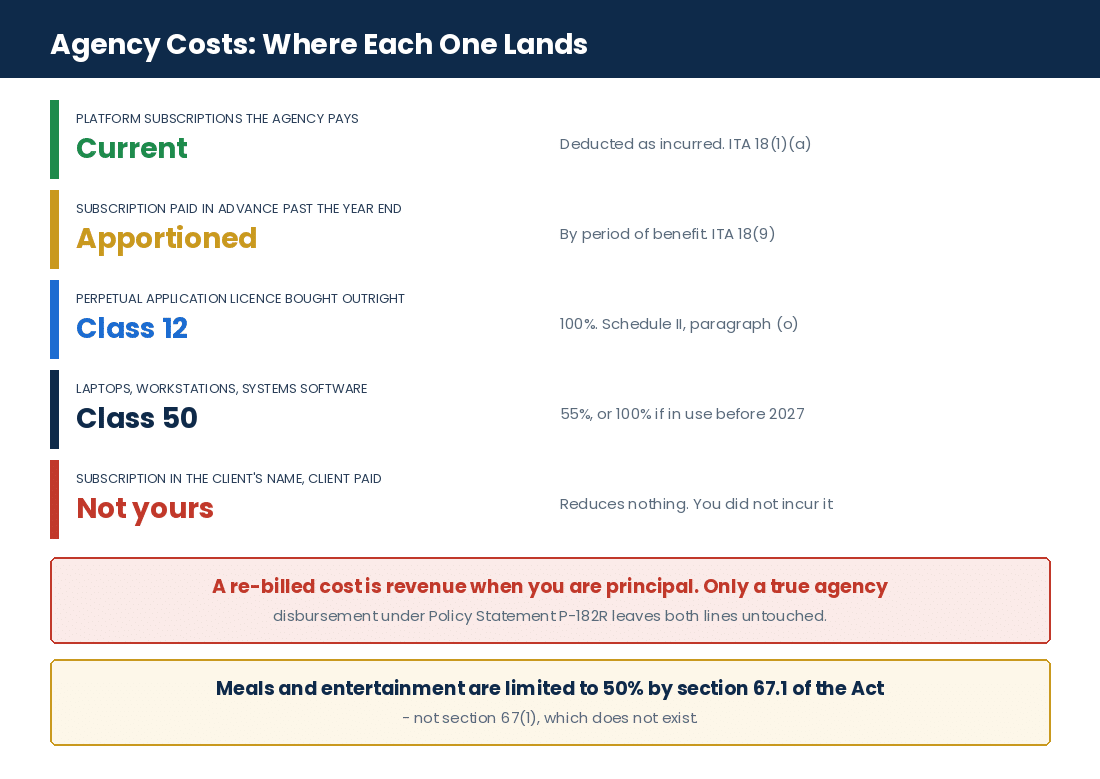
- Software Costs. A subscription is a service and a current expense. A perpetual licence bought outright is Class 12 application software. A subscription paid by the client in the client’s own name is neither — it is not the agency’s cost at all.
Unique Aspects of No-Code Agencies
Three features separate a no-code agency from a conventional software house, and each has a tax consequence that does not arise in the other.
| Feature | Why it is different | Tax consequence |
|---|---|---|
| Almost no capital spend | The platform is rented, not built. There is rarely a server, and often no office | Capital cost allowance is a minor item. The deduction profile is nearly all current expense, so timing rules matter more than classification |
| Revenue arrives early | Retainers, deposits and annual subscriptions are collected before delivery | Subparagraph 12(1)(a)(i) pulls the cash into income on receipt. The reserve in 20(1)(m) is what pushes it back out |
| A fluid workforce | Specialist builders are engaged per project, often across borders | Characterisation under the Wiebe Door factors, slip reporting on T4A or T4A-NR, and Regulation 105 on anything performed in Canada |
| Client-facing software spend | The agency buys tooling that the client ultimately uses | Whose expense it is decides whether it is deducted, re-billed as revenue, or ignored as a true agency disbursement |
Contractor Payments
- Keep the contract and the invoice. A deduction for a subcontractor fee rests on evidence that the service was supplied and the amount was paid or payable. An e-transfer with no paperwork behind it is the first thing a reviewer pulls.
- Characterisation is a question of fact, not of paperwork. A written agreement calling someone a contractor does not make them one. The courts work through the factors in Wiebe Door Services Ltd. v. M.N.R. and 671122 Ontario Ltd. v. Sagaz Industries — control, ownership of tools, chance of profit, risk of loss — filtered through the parties’ common intention as Connor Homes frames it.
- The cost of getting it wrong falls on the agency. Where CRA recharacterises a contractor as an employee, it assesses the employer for the source deductions that should have been withheld, including the employee’s share, plus the employer’s own CPP and EI, the penalty in 227(9) and interest. Directors are personally liable under section 227.1.
- A binding answer is available. A ruling request on Form CPT1 settles the status of a particular engagement for CPP and EI purposes, and CRA’s reasoning in Guide RC4110 sets out how it applies the tests.
Software Costs
- Subscriptions the agency pays — the Bubble plan, the Airtable seats, the Make operations — are current expenses deducted when incurred under paragraph 18(1)(a), with subsection 18(9) apportioning any amount that reaches past the year end.
- Perpetual licences bought outright are capital, in Class 12 at 100% under paragraph (o) of the class description in Schedule II. Systems software and the hardware it runs on are Class 50, which is a different class and a different rate.
- Subscriptions in the client’s name, paid by the client, are not the agency’s expense and reduce nothing. This is the most common misposting in this sector.
- Subscriptions the agency buys and re-bills depend on capacity. As principal, the cost is an expense and the re-bill is revenue, with GST/HST on the full amount. As a true agent for the client, it is a disbursement that touches neither line.
- Who owns the resulting intellectual property is a contract question that matters commercially. It is not what decides deductibility — the deduction turns on who incurred the cost, under 18(1)(a).
An agency deducted around $70,000 of annual platform subscriptions, roughly half of which sat in client accounts and were paid by the clients’ own cards.
Those were never the agency’s expenses. The deduction came out, and because the same amounts had also been re-billed inside project fees without being identified, the revenue side needed rebuilding too. The fix was a single ledger rule separating own-use licences from client-account licences at the point of entry. Figures changed for privacy.
Overview of Business Taxes Applicable to No-Code Development Agencies in Canada
Overview of Business Taxes
The Four Streams
An incorporated agency deals with four separate tax streams, each with its own return, its own deadline and its own penalty. They are not variations on one filing. Missing the corporate return and missing a payroll remittance are unrelated failures with unrelated consequences.
Key Types of Business Taxes
- Corporate Income Tax. The T2 is filed annually under paragraph 150(1)(a). Active business income earned by a Canadian-controlled private corporation attracts the small business deduction under section 125 on the first $500,000, shared among associated corporations under 125(3) and ground down where passive investment income in the associated group exceeds $50,000 under 125(5.1). In Ontario that is roughly 12.2% on eligible income against 26.5% above it.
- GST/HST. Registration is required once you stop being a small supplier under section 148, and the obligation to register is in 240(1). You charge on domestic supplies at the rate for the recipient’s province under the place-of-supply rules, and claim input tax credits under 169(1) on what you buy for the business.
- Payroll. If anyone is an employee, subsection 153(1) requires withholding of income tax, CPP and EI, remitted with the employer’s share on the band set by Regulation 108. T4 slips and the T4 Summary are due by the last day of February for the preceding calendar year.
- Non-resident withholding. Payments to non-residents fall under either Regulation 105 (15% on services rendered in Canada, reported on a T4A-NR) or Part XIII (25% on rents, royalties and similar amounts, often treaty-reduced, reported on an NR4). A no-code agency licensing foreign software for its own use can be in the second of those without realising it.
Key Stat: the balance of corporate tax is due two months after the year end, not six.
Paragraph 157(1)(b) sets the balance-due day at two months after the taxation year end — three months for an eligible Canadian-controlled private corporation claiming the small business deduction with taxable income under the business limit. The six-month figure everyone remembers is the filing deadline in paragraph 150(1)(a). Paying at six months generates interest under subsection 161(1), compounded daily at the prescribed rate, and it generates no notice — the first most agencies hear of it is the assessment.
CRA Representation
Where a review or an audit opens, a representative authorised on the corporation’s account deals with CRA directly. For a no-code agency the questions are predictable: the split between agency-paid and client-paid software, the basis for treating builders as contractors, and whether retainers were brought into income in the right year. Gondaliya CPA handles CRA audit representation on all three.
Choosing the Correct Industry Code for Your No-Code Development Business
The industry code on the T2 feeds Statistics Canada’s business register and sets the benchmark group CRA’s analytics compare you against. There is no NAICS code for no-code work specifically, so pick the one that describes what you actually deliver.
| NAICS code | Description | When it fits a no-code agency |
|---|---|---|
| 541511 | Custom Computer Programming Services | You build and configure applications to a client’s specification. This is the closest fit for most build-focused studios |
| 541512 | Computer Systems Design Services | You design the system and integrate several platforms, rather than building inside one |
| 541618 | Other Management Consulting Services | Advisory and process work dominates and the build is incidental |
Pick the one that matches the majority of your revenue and keep it consistent year to year. Changing the code without a change in the business invites the obvious question, and a code that puts a build studio in a consulting benchmark produces margin and expense ratios that look wrong against peers for no reason.
Key Tax Obligations and Filing Requirements for No-Code Agencies
Key Tax Obligations and Filing Requirements
Deadlines
Important Tax Filing Deadlines
Five dates run an agency’s year. Only one of them is the six-month filing deadline everybody knows.
| Obligation | Deadline | Authority |
|---|---|---|
| T2 corporate return filed | Six months after the taxation year end | Paragraph 150(1)(a) |
| Balance of corporate tax paid | Two months after the year end; three for an eligible CCPC | Paragraph 157(1)(b) |
| Corporate instalments | Monthly, or quarterly for an eligible CCPC | Subsection 157(1) |
| GST/HST return | One month after a monthly or quarterly period; three months after the year end for an annual filer | Section 238 |
| Payroll remittance | By the band in Regulation 108 — the 15th of the following month for a regular remitter | Subsection 153(1) |
| T4 and T4A slips and summaries | Last day of February for the preceding calendar year | Regulation 205(1) |
What Late Filing Actually Costs
The penalty is not “5% plus daily fees.” Subsection 162(1) sets it at 5% of the unpaid tax at the filing deadline, plus 1% for each complete month the return is late, to a maximum of twelve months — so 17% at worst on a first offence. Where CRA has issued a demand to file and the corporation was assessed a late-filing penalty in any of the three preceding years, subsection 162(2) doubles it: 10% plus 2% a month to twenty months.
Interest under subsection 161(1) runs separately from the balance-due day, at the prescribed rate compounded daily, and it is not deductible. An agency that files on time but pays at six months has no penalty and four months of interest.
Key Stat: electronic filing of the T2 is mandatory, and paper costs $1,000.
Subsection 150.1(2.1) requires most corporations to file the T2 electronically, through Corporation Internet Filing or an EFILE-certified preparer. Subsection 162(7.2) imposes a $1,000 penalty for each return filed on paper in breach of it. Information returns follow the same pattern: more than five slips of a given type must be filed electronically, with penalties under 162(7.02) scaled to the number of slips.
When Project and Retainer Income Is Earned
This is where more agencies get into difficulty than anywhere else, and the mechanism is usually described backwards. A retainer received in advance is not deferred until the work is done. It is included in income in the year it is received, and a reserve is then claimed to take it back out.
- The inclusion. Subparagraph 12(1)(a)(i) brings into income any amount received in the year on account of services not rendered before the end of the year. The cash lands in income the moment it lands in the bank.
- The reserve. Paragraph 20(1)(m) then allows a deduction for a reasonable reserve in respect of services reasonably anticipated to be rendered after the year end. The reserve is computed on the gross amount attributable to those services, not on the profit margin.
- The add-back. Paragraph 12(1)(e) brings the whole reserve back into income in the following year. A fresh reserve is then claimed if the conditions still hold. The reserve is a one-year rolling deferral, not a permanent one.
- Work in progress on a fixed-price build is a different question again. Unbilled work on an uncompleted contract is inventory, valued under subsection 10(1) at the lower of cost and fair market value.
The practical consequence is a documentation requirement. A reserve has to be reasonable, which means you need a schedule tying each unearned balance at the year end to the services still to be delivered under that engagement. A single figure labelled “deferred revenue” with nothing behind it is not a reserve CRA will accept.
An agency collected roughly $180,000 of annual retainers in November and December and reported none of it, on the view that the work belonged to the following year.
The right answer reached nearly the same place, but by a route that had to be on the file: the full amount into income under 12(1)(a)(i), then a 20(1)(m) reserve supported by a per-client schedule of undelivered hours. Without the schedule there was no reserve to claim, only an omission. Figures changed for privacy.
Deductions and Tax Credits Relevant to No-Code Development Businesses
Deductions and Tax Credits
What Comes Off
A no-code agency’s expense base is unusually simple. Almost everything is a current expense deducted when incurred under paragraph 18(1)(a), and the handful of exceptions are worth knowing precisely because they are rare enough to be mishandled.
| Cost | Treatment | Authority |
|---|---|---|
| Platform subscriptions the agency pays | Current expense, deducted as incurred | 18(1)(a), with 18(9) on anything crossing the year end |
| Subcontractor fees | Current expense, deducted as incurred | 18(1)(a); T4A reporting under Regulation 200 |
| Salaries, employer CPP and EI | Current expense; the 180-day rule in 78(4) defers anything still unpaid | 18(1)(a), 78(4) |
| Perpetual software licence bought outright | Capital — Class 12 at 100% | 20(1)(a), Schedule II Class 12(o) |
| Laptops, monitors, systems software | Capital — Class 50 at 55%; 100% in the first year where acquired after 15 April 2024 and available for use before 2027 | 20(1)(a), Schedule II Class 50 |
| Leasehold improvements to rented premises | Capital — Class 13, straight-line over the lease term plus the first renewal | 20(1)(a), Schedule II Class 13 |
| Incorporation costs | Deductible to $3,000; the excess goes to Class 14.1 at 5% | 20(1)(b) |
| Meals and entertainment | 50% of the amount paid | Section 67.1 — not 67(1) |
| Home workspace, unincorporated | Business share, restricted and capped at the income from the business | 18(12) |
The Software Classification Most Agencies Get Backwards
Risk Warning: “most software falls under Class 12” is only true of application software, and a subscription is not in Schedule II at all.
Three different treatments get collapsed into one. A subscription is a service, deducted as a current expense — it never enters a capital cost allowance class. A purchased application licence is Class 12 at 100% under paragraph (o). Systems software — the operating system, and the hardware it runs on — is Class 50 at 55%, a different class entirely.
The deduction authority is paragraph 20(1)(a) and Regulation 1100, with the classes set out in Schedule II. Subsection 13(1) is the recapture rule and has nothing to do with classifying an addition. For an agency whose only capital items are a few laptops and the occasional perpetual licence, the practical effect of getting this right is modest in dollars — but a misclassified class balance carries forward and repeats every year until someone unwinds it. Our capital cost allowance guide sets out the class descriptions in full.
Whether SR&ED Is Realistic for a No-Code Agency
Usually it is not, and the reason is structural rather than a matter of documentation quality. SR&ED under section 37 requires systematic investigation to resolve a technological uncertainty — an uncertainty that could not be removed by standard practice. Assembling an application from commercially available building blocks, however novel the resulting business process, generally resolves nothing technological. The platform resolved it.
- What usually fails. Configuring a Bubble workflow, designing a data model in Airtable, wiring up integrations, building client sites faster than before. Business novelty is not technological uncertainty.
- What can qualify. Building genuinely new infrastructure the platform does not supply — a custom runtime extension, a performance problem solved by experiment where standard practice gave no answer, work that pushes past a documented platform limit.
- Client work is reduced. Where a client pays for the work, the amount is a contract payment and subsection 127(18) reduces the qualified expenditure pool. The agency cannot claim a credit on development the client funded.
- The limit, if you do qualify. Bill C-15 raised the expenditure limit for the enhanced 35% refundable credit to $6 million, giving up to $2.1 million of refundable credit, phased out on taxable capital between $15 million and $75 million.
- The deadline is absolute. The claim must be filed within 18 months of the taxation year end under subsection 37(11). It cannot be extended, and taxpayer relief does not reach it.
Our guidance on SR&ED claims sets out the eligibility tests. For most no-code studios the honest answer is that the time spent assembling a claim is better spent elsewhere, and a firm quoting a success-fee percentage on a weak file is selling you the audit, not the credit.
An agency was quoted a contingency fee on an SR&ED claim covering roughly $140,000 of builder time spent on client projects.
Two problems, either fatal on its own. The work was platform configuration with no technological uncertainty, and every hour of it had been paid for by clients, so subsection 127(18) would have reduced the pool to nothing even if it had qualified. We said no and the agency kept the fee. Figures changed for privacy.
Accounting Practices Best Suited for No-Code Development Agencies
Accounting Practices and Record-Keeping
Records
Establishing Effective Record-Keeping
The records a no-code agency needs are narrow but specific: client agreements, invoices, subscription receipts, subcontractor contracts and payment proofs, and a schedule of what each retainer balance relates to. Paragraph 230(4)(b) requires them to be kept for six years from the end of the last taxation year to which they relate — the measuring point is the year end, not the filing date, which gives most agencies closer to seven years in practice. Section 286 of the Excise Tax Act imposes the parallel requirement for GST/HST.
Client agreements carry more tax weight here than in most sectors because they settle three things at once: who pays for which subscriptions, whether the agency is acting as principal or agent on re-billed costs, and when a fee becomes earned. Put all three in writing before the engagement starts, because reconstructing the intention afterwards is exactly what a reviewer will not accept.
Documentation Required for CRA Compliance
- Subcontractor agreements setting out scope, rate, independence and who supplies the tools — the Wiebe Door factors, evidenced rather than asserted.
- Invoices for re-billed costs, identified as such on the face of the invoice, so the principal-or-agent question answers itself.
- Proof of the subscriptions the agency itself pays, in the agency’s name, on the agency’s card.
- A retainer schedule by client showing the balance unearned at the year end and the services still to be delivered against it. This is what supports a 20(1)(m) reserve.
- Input tax credit documentation meeting the prescribed requirements in subsection 169(4) and the Input Tax Credit Information Regulations — above $150 that means the supplier’s GST/HST registration number on the invoice. A credit without the registration number is denied on a desk review, whatever the amount was really spent on.
Tracking Software Subscriptions, Contractor Payments, and Project Revenue
Three ledger disciplines do most of the work. Each takes a few minutes to set up and saves an unwinding exercise later.
| What to track | How to set it up | What it prevents |
|---|---|---|
| Software subscriptions | Two expense accounts — own-use licences and client-account licences — separated at entry, not at year end | Deducting a cost the client paid, which is the most common reassessment in this sector |
| Re-billed costs | A third account for pass-throughs, with the principal-or-agent conclusion recorded against each client | Revenue and expense lines that do not reconcile to the GST/HST returns |
| Contractor payments | A vendor record carrying residence, where the services are performed, and the slip type that follows | A missed T4A-NR, or Regulation 105 withholding not taken on Canadian-performed work |
| Project revenue | Milestones recognised as earned, with unearned balances carried separately by client | A deferred revenue figure with nothing behind it, which is not a reserve |
Disbursement or Re-Billed Cost: Which Lines Change
Key Stat: whether a pass-through is a disbursement or a re-billed cost changes both your income statement and your GST/HST return.
As principal, the agency incurs the cost and recovers it: the cost is an expense, the recovery is revenue, and GST/HST applies to the full invoiced amount including the recovery. As a true agent, the agency pays on the client’s behalf and is reimbursed: neither line moves, and no tax applies to the reimbursement. CRA’s Policy Statement P-182R sets out the agency tests, and GI-197 covers out-of-pocket expenses. The deciding facts are whether the client is legally liable to the supplier and whether the agency had authority to bind the client — not what the invoice line is called.
Most agency pass-throughs are not true agency. If the Bubble plan is in your name, you are liable to Bubble, and the recovery is revenue. Treating it as a disbursement understates both revenue and expenses by the same amount, which looks harmless until the GST/HST returns stop reconciling to the income statement.
Technology Tools and Software Recommendations for Efficient No-Code Agency Accounting
Bookkeeping in QuickBooks or Xero works perfectly well for an agency of this size. What matters is the chart of accounts rather than the platform:
- Separate expense accounts for own-use and client-account software, set up on day one.
- A pass-through account distinct from both, with the agency-or-principal conclusion noted per client.
- Vendor records carrying residence and place of performance for every contractor, so slip season is a report rather than an investigation.
- Deferred revenue tracked by client and engagement, not as a single control balance.
- Foreign currency converted under section 261 of the Income Tax Act at the Bank of Canada rate for the day the amount arose, with section 159 of the Excise Tax Act governing the GST/HST side. The two rules are separate and both apply.
An agency treated roughly $95,000 of annual platform re-bills as disbursements, keeping them off both the revenue and expense lines.
It was principal on every one — the contracts were in the agency’s name and the clients had no liability to the platforms. Revenue was understated by $95,000, expenses by the same, and the GST/HST returns had never reported tax on the recoveries. The net income effect was nil; the GST/HST exposure was not. Figures changed for privacy.
Managing GST/HST and Other Sales Taxes for No-Code Development Services
Managing GST/HST and Sales Taxes
Sales Tax
Determining If You Need To Collect GST/HST
Registration turns on your own taxable supplies, not your clients’. Section 148 makes you a small supplier while worldwide taxable supplies — yours and those of associated persons — stay at $30,000 or less over the four preceding calendar quarters. Once you exceed it, 240(1) requires registration. Below it, 240(3) lets you register voluntarily, and for an agency with real input costs that is usually worth doing: registration is what makes the tax on your subscriptions and subcontractor invoices recoverable. Our guide to GST/HST registration walks through the mechanics.
The timing rule inside the threshold catches people out. Exceeding $30,000 in a single calendar quarter ends small supplier status immediately, from the supply that crossed the line — not at the end of the quarter and not at the end of the year. Exceeding it over four quarters instead gives you to the end of the following month before registration is required.
Clients Outside Canada: Zero-Rated, Not Exempt
Risk Warning: the test for a US client is not “the service is consumed outside Canada.”
A service supplied to a non-resident person is zero-rated under section 7 of Part V of Schedule VI unless one of the exclusions in paragraphs (a) through (h) applies. Advisory, consulting and professional services are excluded from section 7 by paragraph (b) — and then brought back by section 23, which zero-rates them when supplied to a non-resident. Either way, the test is who the recipient is, not where the output is used.
- The exclusions that bite. A service rendered to an individual while that individual is in Canada is excluded, as is a service in respect of real property or tangible personal property situated in Canada, and acting as an agent for the non-resident. A no-code build delivered remotely to a US corporation hits none of these.
- A registered non-resident is different. Where the recipient is registered for GST/HST in Canada, section 7 does not apply to it, so check the registration status rather than assuming non-residence settles it.
- Zero-rated is not exempt. Zero-rated supplies are taxable at 0%, and you keep full input tax credits on everything you bought to make them. Exempt supplies carry no credits at all. An agency selling mostly into the United States is typically in a permanent refund position.
- Evidence the recipient’s status. Keep the contract, the billing address and whatever confirms the client is a non-resident person. Zero-rating a supply you cannot evidence is the same as not charging tax you owed.
Place of Supply Within Canada
For a Canadian client, the rate follows the place of supply. For a service, the general rule looks to the address of the recipient obtained in the ordinary course of business: an Ontario client at 13%, an Alberta client at 5%, a Nova Scotia client at the Nova Scotia rate. You charge the recipient’s rate, not yours, and an agency in Toronto billing across the country is charging several different rates in the same month.
When Tax on a Retainer Becomes Payable
This is a trap that income tax timing does not warn you about. Under section 168 of the Excise Tax Act, tax is payable on the earlier of the day the consideration is paid and the day it becomes due. A retainer received in December is a payment, so the GST/HST on it is payable in December — even though the income tax treatment may push most of the revenue into the following year through a 20(1)(m) reserve. The two regimes diverge here, and an agency that remits GST/HST on the income tax timing is late on every retainer it collects.
Filing Frequency and Remittance Tips
| Annual taxable supplies | Assigned period | Filing and remittance |
|---|---|---|
| $1.5 million or less | Annual | Three months after the fiscal year end, plus quarterly instalments where last year’s net tax was $3,000 or more |
| Over $1.5 million to $6 million | Quarterly | One month after each quarter |
| Over $6 million | Monthly | One month after each month |
- Elect a shorter period if you are in a refund position. An exporting agency filing annually waits up to fifteen months to recover credits it could claim quarterly or monthly.
- Consider the quick method only if your input costs are low. A no-code agency with heavy subscription spend usually does better on the regular method, because the quick method surrenders most input tax credits. Our quick method calculator compares the two on your own numbers.
- The four-year window on credits. Subsection 225(4) generally allows an input tax credit to be claimed within four years. Missed credits can be picked up, but not indefinitely.
- Imported services. A payment to a non-resident supplier with no Canadian registration carries no GST/HST, so there is nothing to claim — and if the agency is fully engaged in commercial activity, the self-assessment rules in section 218 produce no net cost either.
An agency billing almost entirely into the United States had registered for GST/HST, charged nothing on its exports, and never filed a return, on the view that nil tax meant nil filing.
A registrant files whether or not tax was collected. Three years of returns went in, each one claiming input tax credits on subscriptions and subcontractors that had been sitting unrecovered the whole time. The refund was substantial, and the failure-to-file exposure was the only thing that had ever been at risk. Figures changed for privacy.
Payroll and Contractor Tax Considerations for No-Code Agencies
Payroll and Contractor Tax Considerations
People
Handling Payroll for Employees
Where someone is an employee, subsection 153(1) requires the agency to withhold income tax, CPP contributions and EI premiums from each payment, and to remit those amounts together with the employer’s own share. The 2026 rates:
| Component | 2026 rate | Ceiling | Employer share |
|---|---|---|---|
| CPP | 5.95% of pensionable earnings | YMPE $74,600, less the $3,500 basic exemption | Matched dollar for dollar |
| CPP2 | 4.00% on earnings above the first ceiling | Second ceiling $85,000 | Matched dollar for dollar |
| EI | 1.63% of insurable earnings | Maximum insurable earnings $68,900 | 1.4× the employee premium |
| Income tax | Per the TD1 claims and the payroll tables | — | None |
Risk Warning: the CPP basic exemption applies per employee per pay period, not to the payroll as a whole.
Calculating contributions on a combined monthly figure gives one exemption where there should be several, and the per-employee amounts that go on the T4 slips will not reconcile to what was remitted. Run the calculation per person per pay period, every time.
Worked example. An agency pays two developers $4,000 each a month, $8,000 in total. Per employee, the monthly basic exemption is $3,500 ÷ 12 = $291.67, so pensionable earnings are $3,708.33 and CPP is $220.65 each — $441.30 across the two, not the $352 a combined calculation suggests. EI is $4,000 × 1.63% = $65.20 each, $130.40 in total. Add income tax of roughly $1,200 depending on the TD1 claims, the employer’s matching CPP of $441.30 and the employer’s EI at 1.4× of $182.56, and the monthly remittance is about $2,396. Figures changed for privacy.
That figure also sets the remittance band. An average monthly withholding amount under $3,000 makes this employer eligible to remit quarterly under Regulation 108, provided its compliance record over the preceding twelve months is clean. Without that, it is a regular remitter, due on the 15th of the following month. Neither band is seven days.
Paying Contractors and Freelancers
Before the first payment, settle two questions: is this person actually a contractor, and where will the work be performed. Everything else follows from the answers.
| Who you are paying | Slip | Withholding | Records to keep |
|---|---|---|---|
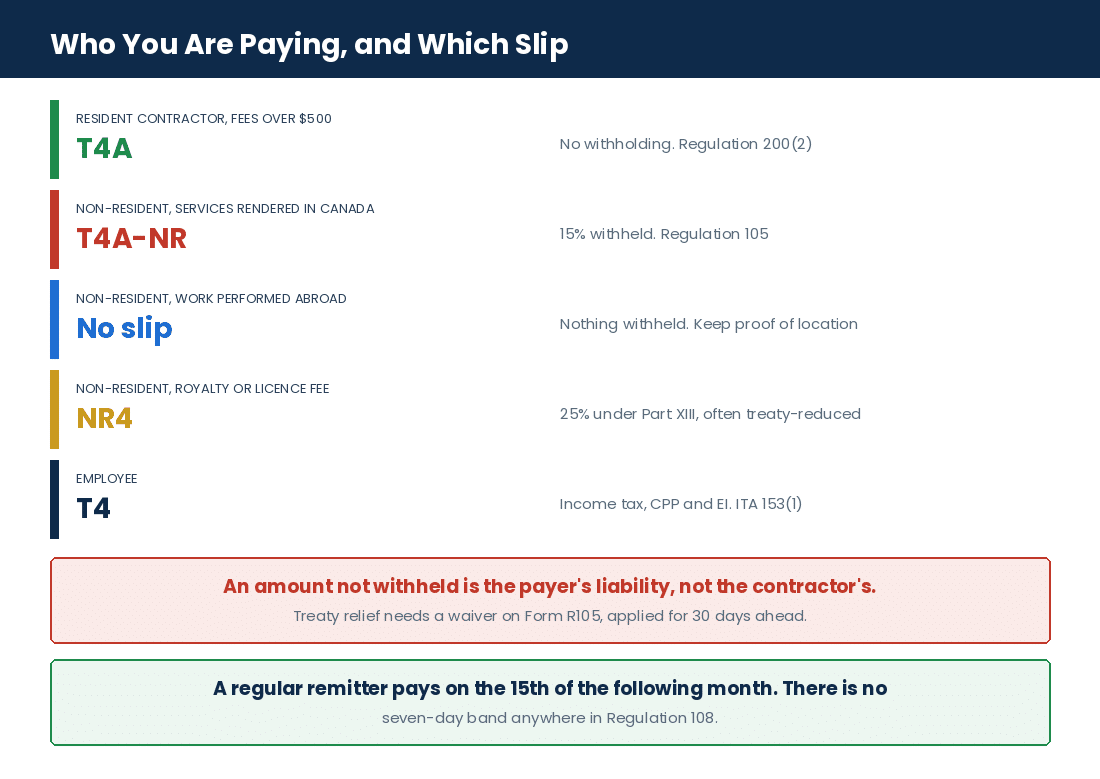
| Resident contractor | T4A, box 048, where fees exceed $500 in the calendar year | None | Contract and invoice |
| Non-resident, services performed in Canada | T4A-NR | 15% under Regulation 105, unless a waiver has been granted on Form R105 | Contract, invoice, and evidence of the days worked in Canada |
| Non-resident, services performed abroad | None | None — Regulation 105 does not reach it | Contract and evidence of where the work was done |
| Non-resident, royalty or licence fee | NR4 | 25% under Part XIII, often treaty-reduced | Licence agreement and treaty position |
| Employee | T4 | Income tax, CPP and EI under 153(1) | Payroll register and remittance proofs |
On the T4A: Regulation 200(2) sets the $500 reporting threshold for fees for services, and CRA’s long-standing administrative position, restated in Guide RC4157, is that it is not assessing penalties for failures relating to box 048 while it reviews business-to-business reporting. That is relief from the penalty, not from the requirement. File the slips.
Worked example. An agency pays an offshore developer $12,000 for work performed entirely from abroad. Regulation 105 applies only to services rendered in Canada, so there is nothing to withhold and no T4A-NR — but the file needs to show where the work was done, because the evidence is what answers the question if it is ever asked. If that same developer spends three weeks on site in Toronto the following year, the fees for those three weeks are inside Regulation 105 and a T4A-NR is required for them. Figures changed for privacy.
Key Stat: an amount not withheld under Regulation 105 is the payer’s liability, not the contractor’s.
CRA assesses the agency for the 15% it should have withheld, together with penalty and interest, and recovering it from the contractor afterwards is a commercial problem rather than a tax remedy. The same is true of source deductions on a recharacterised employee: subsection 227(9) penalises the payer, at 3% to 10% depending on lateness and 20% for a knowing or grossly negligent repeat, and section 227.1 extends liability to the directors personally.
An agency engaged four builders on long-term full-time arrangements, set their hours, supplied the platform accounts and the project management system, and paid them as contractors.
On the Wiebe Door factors they were employees. The assessment covered both halves of CPP and EI plus the income tax that should have been withheld, across two years, with penalty and interest on top — and because the amounts had already been paid out gross, none of it was recoverable from the builders. A CPT1 ruling before the first engagement would have cost nothing. Figures changed for privacy.
Navigating Tax Challenges and Leveraging Professional Support
The Personal Services Business Trap
Biggest Risk
The largest single tax risk facing a small no-code agency is not in the guidance at all. It is whether the corporation is carrying on a personal services business.
Risk Warning: a one-person agency working mainly for one client can be a personal services business, and the consequences are severe.
Subsection 125(7) defines a personal services business as one where an incorporated employee — the individual performing the services, who with non-arm’s-length persons holds 10% or more of any class of shares — would reasonably be regarded as an officer or employee of the client but for the existence of the corporation. The exception is where the corporation employs more than five full-time employees throughout the year.
Three things happen at once if the definition is met:
- The small business deduction is gone. Section 125 reaches only active business income, and personal services business income is excluded by definition. So is the 13% general rate reduction.
- Almost every expense is denied. Paragraph 18(1)(p) restricts deductions to the salary and benefits paid to the incorporated employee, plus certain amounts an employee could have deducted. Your subscriptions, your home office, your professional fees — none of it comes off.
- An extra 5% applies. Section 123.5 imposes an additional tax of 5% on taxable income from a personal services business, on top of the full 28% federal rate.
In Ontario that is roughly 44.5% on income that would otherwise have been taxed at about 12.2%, on a base with almost no deductions against it. Our personal services business calculator runs the comparison on real numbers.
What Pulls an Agency Away From the Definition
- Several unrelated clients, none of them dominant, engaged under separate agreements.
- Your own tools and accounts — platform subscriptions in the agency’s name, your own project management, your own devices.
- Control over how and when the work is done, with deliverables rather than hours as the contractual measure.
- Real chance of profit and risk of loss — fixed-price work, rework at your own cost, your own insurance.
- Staff. More than five full-time employees throughout the year takes the corporation outside the definition outright.
Common Tax Challenges Faced by No-Code Development Agencies and How to Address Them
| Challenge | What usually goes wrong | The fix |
|---|---|---|
| Mixed revenue | Project fees, retainers and subscriptions reported on one timing basis | Each has its own trigger. Separate them in the ledger and schedule the unearned balances by client |
| Client-paid software | Deducted alongside the agency’s own licences | Two accounts, split at entry. A cost in the client’s name is not yours |
| Cross-border clients | Zero-rating applied without evidence of the recipient’s status | Keep the contract and billing address, and check the client is not GST/HST-registered |
| Bundled engagements | Consulting and build priced as one, with no allocation on file | For GST/HST the supply is usually single and rated by its predominant element. Record the reasoning once |
| Subcontractor status | Assumed from the contract wording | Evidence the Wiebe Door factors, or get a CPT1 ruling |
| Retainers | Held off the income statement entirely | Include under 12(1)(a)(i), then claim a supported 20(1)(m) reserve |
How Gondaliya CPA Supports No-Code Development Agencies with Tax Planning and Accounting
We handle the corporate return, the GST/HST returns, payroll and the slips, and we review the bookkeeping before any of it is filed rather than after. The work specific to this sector is the three characterisation questions: whose software cost it is, whether each builder is a contractor or an employee, and when each engagement’s revenue is earned. Those three decide most of what appears on the return. We also take corporate tax return work for agencies whose prior years need rebuilding before the current one can be filed.
Gondaliya CPA performs compilation engagements under CSRS 4200, which provide no assurance. Audit and review engagements are referred out.
Steps for Accurate Tax Filing and Reporting for No-Code Development Businesses
- Reconcile revenue across the bank, the invoicing system and the GST/HST returns, including year-end retainer balances.
- Split the expense base into agency-paid and client-paid, and pass-throughs into principal and agent.
- Confirm each contractor’s status and place of performance, then issue T4A, T4A-NR or nothing, as the facts require.
- Convert foreign amounts under section 261 for income tax and section 159 of the Excise Tax Act for GST/HST, on a consistent basis.
- Schedule the 20(1)(m) reserve by client, with the undelivered services behind each balance.
- File electronically — the T2 under 150.1(2.1), and information returns where you have more than five slips of a type.
Understanding CRA Audits and How No-Code Agencies Can Prepare
Reviews in this sector are triggered by arithmetic, not judgment. The common ones: revenue on the T2 that does not reconcile to revenue on the GST/HST returns, a subcontractor line with no slips behind it, a software expense line out of proportion to the business, a deferred revenue balance with no schedule, and payroll remittances that do not agree to the T4 Summary. Each of those is a mismatch a system finds without a human looking.
Preparing for one is the same work as preparing to file properly: the contracts, the slips, the schedules and the reconciliations. Where something was never reported at all, the Voluntary Disclosures Program under IC00-1R6 may limit penalties if the disclosure is made before CRA makes contact, and relief from penalties and interest is a separate application on Form RC4288, available within ten calendar years.
Ongoing Tax Compliance and Updates Impacting No-Code Development Agencies in Canada
- Electronic filing is the default, not a coming change. The T2 is already mandatory under 150.1(2.1), GST/HST electronic filing is required of most registrants, and information returns above five slips of a type must be filed electronically.
- Review subscription ownership annually. Platform accounts migrate between agency and client without anyone updating the ledger.
- Watch the available-for-use date on anything capital. No capital cost allowance arises before the property is available for use, under subsections 13(26) to (32).
- Revisit the personal services business question whenever client concentration changes. It is a year-by-year test, not a once-at-incorporation one.
A solo founder incorporated and took on one enterprise client at a fixed monthly fee, working their hours on their systems under their direction, for close to two years.
The file met the personal services business definition on its face. The remedy was structural rather than accounting — a second and third client, deliverable-based contracts, the agency’s own tooling — and it took a year to put in place. Left alone, the exposure would have been the small business deduction, the general rate reduction, almost every expense claimed, and 5% on top. Figures changed for privacy.
Frequently Asked Questions (FAQs) on No-Code Development Agency Taxes Canada
Frequently Asked Questions
20 Answers
What is the T2 Corporation Income Tax Return deadline for no-code agencies?+
What is the Small Supplier GST/HST threshold in Canada?+
How does the retainer reserve period affect no-code agency income?+
What is the non-resident services withholding rate for contractors outside Canada?+
Which Capital Cost Allowance (CCA) class applies to software for no-code agencies?+
How long must a no-code agency keep its financial records?+
What is the meals expense deduction limit for no-code development businesses?+
What changes are coming in 2026 regarding non-resident payment filings?+
Can the agency deduct a subscription billed directly to the client?+
When is retainer income considered earned for tax purposes?+
How should milestone and project billing be reported?+
Are subcontracted builders treated as contractors for tax purposes?+
What changes when a builder works outside Canada?+
Is a client build an asset of the agency?+
When does an internal template become capital?+
How is revenue-share or referral income treated?+
Which operating costs are fully deductible and which are limited?+
Could any of this development support an SR&ED credit?+
What triggers a CRA review of a no-code agency?+
File It Yourself or Hand It to a CPA Firm: Which Route Fits an Agency?+
No-Code Agency Tax Check
Five quick questions on how your agency bills and staffs. No fee shown.
Points to raise with us:
This is a general prompt, not tax or legal advice or a quote. Your position depends on your full facts. For a real review, please book a free consultation.
Businesses We Serve & Industry Spotlights
Industry Expertise
No-code work sits inside a wider practice serving digital and professional service businesses, and the same three questions — whose cost, which worker, when earned — surface in every one of them. Here are eleven and the form the issue usually takes.
| Industry | The No-Code Agency Angle |
|---|---|
| Technology startups & SaaS | Your clients, with the same subscription and SR&ED questions from the other side |
| Consulting firms | Retainers received before the work, and the 20(1)(m) reserve that follows |
| E-commerce & online retailers | Export zero-rating under Schedule VI, Part V across the same border |
| Marketing & creative agencies | Re-billed costs, and whether the agency is principal or agent |
| Professional services & bookkeeping firms | Work in progress on an uncompleted engagement, valued under 10(1) |
| Construction, contractors & skilled trades | The employee-versus-contractor question in its most litigated form |
| Transportation, logistics & trucking | Subcontractor slips, and what happens when they are not filed |
| Restaurants & food and beverage | The Regulation 108 remittance bands, on a payroll that changes weekly |
| Real estate investors, landlords & holding companies | Association under section 256 and one business limit shared |
| Medical doctors & physician professional corporations | Exempt supplies, where none of the software tax comes back |
| Daycare, childcare & CWELCC services | Fees collected in advance, and when they become income |
- Technology startups & SaaS: Mostly your clients. They face the same subscription apportionment under 18(9) and the same SR&ED disappointment, usually a year later than you do.
- Consulting firms: Retainers reach them the same way, and the 12(1)(a)(i) inclusion with a 20(1)(m) reserve is the single most common adjustment we make in both sectors.
- E-commerce & online retailers: They cross the same border, and both sectors tend to zero-rate on the wrong test — where the output is used rather than who the recipient is.
- Marketing & creative agencies: Pass-through costs are their daily problem too, and the principal-or-agent conclusion changes revenue, expenses and the GST/HST return at once.
- Professional services & bookkeeping firms: Unbilled work on a part-finished engagement is inventory under 10(1) on exactly your analysis, and it is almost never on the balance sheet when we arrive.
- Construction, contractors & skilled trades: The sector where Wiebe Door has been argued most often, and where the cost of losing the argument is most visible.
- Transportation, logistics & trucking: A useful warning. CRA has been assessing slip penalties in that sector, which is a reminder that an administrative position on penalties is not a change in the law.
- Restaurants & food and beverage: The same Regulation 108 band question, on a payroll that moves every week, and the same tendency to remit on whatever schedule the software defaulted to.
- Real estate investors, landlords & holding companies: Where a founder runs an agency and a holding company side by side, section 256 associates them and 125(3) gives the pair one business limit.
- Medical doctors & physician professional corporations: A clean contrast. A practice making exempt supplies recovers no tax on the software you build for it, which makes the same invoice 13% more expensive in Ontario than it is for a registrant.
- Daycare, childcare & CWELCC services: Fees collected in advance, every month, which makes 12(1)(a)(i) and the 20(1)(m) reserve a permanent feature of the file rather than a year-end adjustment.
The platforms change every eighteen months. The three questions do not: whose cost is it, is that person an employee, and has the revenue been earned yet.
Across the agencies we act for, those three account for the overwhelming majority of adjustments. Not one of them is a judgment call about tax law. Each is a question about what the contracts and the ledger actually say.
Professional Guidance and Quick Reference
Guidance
Pricing Plans and Additional Resources for No-Code Agency Tax Filing
No-code agencies get into difficulty in a predictable set of ways: remitting payroll on a seven-day schedule that does not exist instead of the bands in Regulation 108; issuing an NR4 to a non-resident contractor where the slip is a T4A-NR; withholding under Regulation 105 on work performed outside Canada, or failing to withhold on work performed inside it; assuming treaty relief applies without a Form R105 waiver; reading the $30,000 small supplier test as a question about the client rather than the agency; skipping the quarterly GST/HST band between $1.5M and $6M; deferring retainers off the income statement instead of including them under 12(1)(a)(i) and claiming a supported 20(1)(m) reserve; deducting subscriptions the client paid; treating a re-billed cost as a disbursement when the agency is principal; putting every software purchase in Class 12 when a subscription is a current expense and systems software is Class 50; citing 67(1) for the meals limit, which is 67.1; computing CPP on the payroll total instead of per employee per pay period; paying the corporate balance at six months when 157(1)(b) sets it at two; and never checking the personal services business definition in 125(7). Gondaliya CPA handles no-code agency accounting and tax on a flat annual fee.
Overview of Basic, Plus, and Pro Tax Filing Plans
| Plan | Business size | Main features | Common costs covered |
|---|---|---|---|
| Basic | Solo and two-person studios, domestic clients only | T2 filing, GST/HST, bookkeeping, personal services business review | Subscriptions, subcontractor fees, home office |
| Plus | Agencies with staff and retainer clients | Payroll and slips, retainer schedules and the 20(1)(m) reserve, software cost allocation | Salaries, mixed own-use and client-account licences, re-bills |
| Pro | Cross-border agencies with offshore builders | Full accounting, export zero-rating, Regulation 105 and T4A-NR, contractor status review | Non-resident fees, foreign currency, multi-province place of supply |
Features Included in Each Plan for No-Code Development Agencies
- Basic: the annual T2, GST/HST returns, bookkeeping with own-use and client-account software separated at entry, and a personal services business assessment on the current client mix.
- Plus: payroll with the correct Regulation 108 band, T4 and T4A slips, a per-client retainer schedule supporting the 20(1)(m) reserve, and the principal-or-agent conclusion recorded for every pass-through.
- Pro: non-resident contractor analysis with Regulation 105 withholding and T4A-NR reporting, export zero-rating evidenced under Schedule VI Part V, foreign currency conversion under section 261 and ETA section 159, and contractor status reviews with CPT1 rulings where the facts are close.
Seamless Filing Across Devices and Platforms
We work inside your QuickBooks or Xero environment rather than taking copies, exchange documents through access-controlled channels rather than email attachments, and transmit the T2 through Corporation Internet Filing or as your EFILE-certified preparer against a signed T183CORP. Nothing requires you to move spreadsheets between systems, which is where distributed agencies lose version control.
Access to Resources, Support, and Tools for Ongoing Tax Management
- How long records are kept, and from which date.
- Which subscriptions are yours and which are the client’s, settled at the contract rather than at year end.
- Applying the export zero-rating correctly, with evidence of the recipient’s status on file.
- Managing contractor status, slips and withholding across borders.
- Watching client concentration, because the personal services business test is applied year by year.
Reach us at 647-212-9559 or info@gondaliyacpa.ca, with a one-business-day response and a flat annual fee including HST agreed in writing before any work begins.
Quick Answers
At a Glance
- Deductibility: ITA 18(1)(a); capital denied by 18(1)(b)
- Advance for services not rendered: ITA 12(1)(a)(i)
- Reserve for those services: ITA 20(1)(m); add-back 12(1)(e)
- Amounts receivable: ITA 12(1)(b)
- Work in progress: inventory, ITA 10(1)
- Prepaid amounts: ITA 18(9)
- Application software bought outright: Class 12, 100%
- Computers and systems software: Class 50, 55%
- Meals and entertainment: 50%, ITA 67.1
- Small business deduction: ITA 125, first $500,000
- Personal services business: ITA 125(7); 18(1)(p); 5% under 123.5
- Payroll withholding: ITA 153(1); bands in Regulation 108
- Failure to remit: 3% to 10%, ITA 227(9); directors under 227.1
- Resident contractor slip: T4A, over $500
- Services in Canada by a non-resident: 15%, Regulation 105, T4A-NR
- Royalties to a non-resident: 25%, Part XIII, NR4
- Small supplier: $30,000, ETA section 148
- Exported services: zero-rated, Schedule VI Part V, sections 7 and 23
- Tax on a retainer: ETA section 168, on the earlier of payment and due
- Records: six years from the taxation year end, ITA 230(4)(b)
Quick Comparison Table: Filing Deadlines and Key Thresholds
Dates and Limits
| Item | Deadline or limit | Notes |
|---|---|---|
| T2 corporate tax return | Six months after the year end | Paragraph 150(1)(a). Penalty of 5% plus 1% a month to twelve under 162(1) |
| Corporate balance of tax | Two months after the year end | Three for an eligible CCPC. Paragraph 157(1)(b); interest under 161(1) |
| GST/HST registration threshold | $30,000 over four preceding quarters | Your own supplies with associates, ETA section 148. One quarter above it ends small supplier status at once |
| GST/HST filing frequency | Annual to $1.5M, quarterly to $6M, monthly above | A shorter period may be elected. Annual filers owe instalments where last year’s net tax was $3,000 or more |
| Payroll remittance | By the Regulation 108 band — the 15th for a regular remitter | Quarterly under $3,000, twice monthly from $25,000, three working days from $100,000 |
| T4, T4A and T4A-NR slips | Last day of February | Electronic filing required above five slips of a type |
| T4A reporting threshold | $500 of fees for services in the calendar year | Regulation 200(2). CRA is not currently assessing box 048 penalties |
| Non-resident services withholding | 15%, services rendered in Canada only | Regulation 105, reported on a T4A-NR. Waiver on Form R105, 30 days ahead |
| Retainer income recognition | Into income on receipt, reserve for the undelivered part | 12(1)(a)(i), 20(1)(m), added back under 12(1)(e). GST/HST is payable earlier, under ETA 168 |
| SR&ED claim deadline | 18 months after the year end | Subsection 37(11). Cannot be extended |
| Record retention | Six years from the taxation year end | Paragraph 230(4)(b); ETA section 286 |
Key Bullet Points: Essential Insights for No-Code Agencies’ Taxes
Key Controls and Warning Signs
- Whose expense is it? Only costs the agency itself incurred are deductible under 18(1)(a). A subscription in the client’s name reduces nothing.
- Re-billed cost or disbursement: which lines change? As principal, the cost is an expense and the recovery is revenue with GST/HST on it. As a true agent, neither line moves. P-182R sets out the tests.
- Is a client build an asset of the agency? Generally no — it is work in progress under 10(1) until delivery, then revenue. The contract decides.
- When does an internal template become capital? When it produces an enduring benefit used across engagements. Code the development time separately so the question can be answered.
- How is revenue-share or referral income treated? As ordinary business income under section 9, and reportable on a T4A when paid out above $500.
- Which operating costs are fully deductible and which are limited? Subscriptions, subcontractors and salaries in full; meals at 50% under 67.1; club dues denied by 18(1)(l); fines denied by 67.6.
- Could any of this development support a credit? Rarely. SR&ED needs a technological uncertainty, and client-funded work is reduced by 127(18).
- What records does an agency need? Contracts, invoices, payment proofs, subscription receipts in the agency’s name, a retainer schedule by client, and ITC documentation meeting 169(4).
- Which returns does the agency file, and when? The T2 at six months with the balance at two, GST/HST on its assigned band, payroll on the Regulation 108 band, and slips by the last day of February.
- What triggers a CRA review? Revenue that does not reconcile between the T2 and the GST/HST returns, a subcontractor line with no slips, deferred revenue with no schedule, and late filings.
- How do you catch up if the books are behind? Rebuild from bank statements and invoices, re-split the software accounts, confirm each contractor’s status and place of performance, schedule the retainers, then amend.
- Top tax mistakes and how to prevent them: the invented seven-day remittance rule, the NR4 instead of the T4A-NR, client-paid software deducted, and the personal services business question never asked.
- What to Prepare Before the Work Starts (Checklist): signed contracts clarifying billing and ownership, a chart of accounts separating cost types, confirmed contractor status and payment terms, and a clear view of which credits and deductions are realistic.
- Agency Accounting: DIY vs CPA vs Non-CPA? A licensed firm carries professional obligations and can represent you before CRA. A bookkeeper cannot sign a compilation or appear on an audit.
- How Do We Handle an Agency at Gondaliya CPA? We settle the three characterisation questions first, rebuild the ledger split if it is not there, then file the GST/HST, payroll and T2 from one reconciled set of books.
- What Deliverables Do You Get? Compiled financial statements under CSRS 4200, the filed T2 and GST/HST returns, the payroll slips and summaries, and the schedules behind the reserve and the software split.
- How Much Does This Cost? A flat annual fee including HST, agreed in writing before any work begins, set by the complexity of the file rather than your revenue. Ask for the figure at the consultation.
- Best practices for an agency: settle the three characterisation questions at the contract, keep the ledger split from the first entry, and revisit client concentration every year.
People Also Ask
Related Questions
Do we charge GST/HST on a retainer before any work is done?+
Yes. Section 168 of the Excise Tax Act makes tax payable on the earlier of the day consideration is paid and the day it becomes due. The income tax treatment is separate: the amount goes into income under 12(1)(a)(i) with a 20(1)(m) reserve for the undelivered portion. The two timings diverge, and the GST/HST one comes first.
Does the agency need more than five employees to avoid a personal services business?+
That is one route out, but not the only one. More than five full-time employees throughout the year takes the corporation outside 125(7) outright. Short of that, the question is whether the individual would be regarded as an employee of the client but for the corporation — so several unrelated clients, your own tools, control over the work and real risk of loss all pull against it.
Is a Webflow or Bubble subscription a capital cost?+
No. A subscription is a service, deducted as a current expense under 18(1)(a) as the fees are incurred, with 18(9) apportioning anything paid in advance for a period past the year end. It never enters a capital cost allowance class. Only a perpetual licence bought outright is Class 12.
Do we file a T4A for every subcontractor?+
Regulation 200(2) requires a T4A where fees for services exceed $500 in the calendar year. CRA’s administrative position, restated in Guide RC4157, is that it is not assessing penalties for box 048 failures while it reviews business-to-business reporting — but that is relief from the penalty, not from the requirement, and it has been withdrawn in at least one sector. File them.
Can we deduct a laptop bought for a contractor to use?+
Yes, as the agency’s own capital asset — Class 50, or 100% in the first year where acquired after 15 April 2024 and available for use before 2027. But supplying the tools is one of the Wiebe Door factors pointing toward employment, so a contractor working on equipment you bought is a contractor whose status is worth re-examining.
Who This Is For / Not For
Fit
- For: incorporated Canadian no-code and low-code studios, whether billing by project, retainer or subscription, with or without staff, selling domestically or across the border.
- For: unincorporated no-code freelancers reporting on a T2125, for whom the software, contractor and GST/HST sections apply unchanged.
- Not for: agencies with no Canadian tax presence — no permanent establishment, no Canadian source income and no Canadian payroll.
- Not for: detailed advice on intellectual property ownership, platform licensing terms or contract law, none of which this covers. A corporation below the $30,000 GST/HST threshold is still squarely in scope: it files a T2 and may have payroll obligations whatever its sales.
Glossary
Definitions
- Current expense — a cost consumed in the year, deducted in full under paragraph 18(1)(a).
- Capital expenditure — a cost acquiring or improving an asset of enduring benefit, denied by 18(1)(b) and recovered through capital cost allowance.
- Reserve under 20(1)(m) — a deduction for the gross amount attributable to services still to be rendered after the year end, added back the following year under 12(1)(e).
- Work in progress — unbilled work on an uncompleted engagement, inventory valued under subsection 10(1) at the lower of cost and fair market value.
- Small supplier — a person whose worldwide taxable supplies, with those of associates, do not exceed $30,000 over four preceding calendar quarters, under ETA section 148.
- Zero-rated supply — a supply taxable at 0% on which input tax credits remain fully recoverable. Exported services sit in Schedule VI, Part V.
- Exempt supply — a supply listed in Schedule V on which no tax is charged and for which no input tax credits are available.
- Average monthly withholding amount — the measure in Regulation 108 that assigns an employer to one of four remittance bands.
- Regulation 105 — the 15% withholding on fees paid to a non-resident for services rendered in Canada, reported on a T4A-NR.
- Personal services business — a corporation whose incorporated employee would be regarded as an employee of the client but for the corporation, under subsection 125(7).
- Incorporated employee — the individual performing the services who, with non-arm’s-length persons, holds 10% or more of any class of the corporation’s shares.
- Contract payment — an amount paid by a client for SR&ED work, which reduces the qualified expenditure pool under subsection 127(18).
Want a checklist to work from? You can download our free no-code development agency tax checklist before your consultation.

Ask three questions at the contract, not at year end: whose cost is this, is this person an employee, and when is this revenue earned. Set the payroll band from your average monthly withholding amount under Regulation 108 — the 15th of the following month for most agencies, and never seven days. Before paying a non-resident, establish where the work is performed: services rendered in Canada carry 15% under Regulation 105 and a T4A-NR, work done abroad carries neither, and the NR4 belongs to royalties. Register for GST/HST on your supplies crossing $30,000 under section 148, and remember a single quarter above it ends small supplier status immediately. Zero-rate exports to non-residents under Schedule VI, Part V and keep the input tax credits. Bring retainers into income under 12(1)(a)(i) and claim a 20(1)(m) reserve with a per-client schedule behind it — and remit the GST/HST on them when received, because section 168 runs on a different clock. Keep own-use software apart from client-account software from the first ledger entry. Use 67.1 for meals, not a subsection that does not exist. Pay the corporate balance at two months. And if one client dominates your revenue, check 125(7) before anything else on this list.
2026 Update — what is current: This article reflects rules current to 8 October 2026. The 2026 payroll figures are a CPP rate of 5.95% on pensionable earnings to a YMPE of $74,600 less the $3,500 basic exemption, CPP2 at 4.00% to a second ceiling of $85,000, and EI at 1.63% to maximum insurable earnings of $68,900, with the employer at 1.4× the employee premium. Electronic filing of the T2 is mandatory under subsection 150.1(2.1) with a $1,000 penalty under 162(7.2) for paper, and information returns above five slips of a type must also be filed electronically. Bill C-15, the Budget Implementation Act, 2025, No. 1, received Royal Assent on 26 March 2026; for an agency its relevant measures are the SR&ED expenditure limit at $6 million for the enhanced 35% refundable credit and the 100% first-year deduction for Class 44, 46 and 50 property acquired after 15 April 2024 and available for use before 2027, which reaches laptops and workstations. CRA’s administrative position on T4A box 048 penalties remains in place but has been withdrawn in at least one sector, so treat it as relief that can be removed rather than as a rule. Unchanged: the $30,000 small supplier threshold in section 148, the GST/HST filing bands at $1.5 million and $6 million, the 15% Regulation 105 rate, the 50% meals limit in 67.1, the six-year retention requirement in paragraph 230(4)(b), and the corporate balance of tax at two months under 157(1)(b).
No-Code Development Agency Taxes Canada: How Gondaliya CPA Can Help
Start with your client contracts, your subcontractor list and your last return
Gondaliya CPA splits agency-paid software from client-paid at the ledger rather than at year end, records the principal-or-agent conclusion for every pass-through, reviews each builder’s status against the Wiebe Door factors before the slips are due, sets the payroll band from your actual average monthly withholding amount, schedules your retainers so the 20(1)(m) reserve is supportable, evidences the export zero-rating on your non-resident clients, and checks the personal services business question every year rather than once — then files the GST/HST, payroll and T2 from one reconciled set of books, on a flat annual fee including HST with a one-business-day response. Please book a free consultation.
Next Steps
Please book a free consultation with Gondaliya CPA and bring three things: a sample client contract showing who pays for which subscriptions, your list of builders with where each one actually works, and your last filed return. Those three settle the software split, the contractor question and the revenue timing, which between them account for almost every adjustment we make in this sector. If one client accounts for most of your billings, say so at the outset, because the personal services business test comes first and changes everything after it. You will get a flat annual fee including HST before any work begins. We serve Toronto, Mississauga, Vaughan, Brampton, Etobicoke, Scarborough, Ottawa and the rest of Ontario, and work with agencies across Canada. If our content helps, please add gondaliyacpa.ca as a preferred source on Google.
Published: · Last updated:
Editorial policy: We research against CRA, Department of Finance, Parliament of Canada, CPA Canada and CPA Ontario sources, fact-check the figures, and Sharad Gondaliya, CPA, reviews the content, which we update as the rules change.
Disclaimer: This article is educational information only and is not tax, legal, financial, intellectual property or contract advice. Figures marked illustrative are examples rather than quotes or guarantees. It reflects rules current to 2026, including profit computation under section 9 of the Income Tax Act, the advance payment inclusion in subparagraph 12(1)(a)(i) with the reserve in paragraph 20(1)(m), deductibility under paragraph 18(1)(a) with the capital restriction in 18(1)(b), the meals and entertainment limitation in section 67.1, capital cost allowance under Regulation 1100 and Schedule II, the small business deduction in section 125 and personal services business status under 125(7) with paragraph 18(1)(p) and section 123.5, payroll withholding under subsection 153(1) with the remittance bands in Regulation 108, Regulation 105 withholding and T4A-NR reporting on services rendered in Canada by non-residents, GST/HST registration under sections 148 and 240 of the Excise Tax Act with input tax credits under 169(1), the zero-rating of exported services in Schedule VI Part V sections 7 and 23, and the six-year retention requirement in paragraph 230(4)(b). CRA’s administrative position on T4A box 048 penalties is relief from penalty rather than from the reporting requirement, and it can be withdrawn. Gondaliya CPA performs compilation engagements under CSRS 4200 and does not perform audit or review engagements. Rates and limits change and outcomes depend on your specific facts. Please consult a licensed CPA before acting.

Sharad Gondaliya is a CPA Canada & CPA USA with 15 Years+ experience of Accounting, Tax, Payroll of Corporate Small Businesses as Tax Accountant. He is a CPA Ontario member (61040184) and holds US CPA licences in Washington and Montana and is well known among corporate small businesses for tax planning, efficient tax solutions, and affordable CPA services. Sharad is the Principal (Director) of Gondaliya CPA – Affordable CPA Firm in Canada. Licenses: CPA Ontario: 61040184 | CPA USA (MT): PAC-CPAP-LIC-033176 | CPA USA (WA): 57629 | CPA Firm License: 61330051 View Full Author Bio