



Corporate Tax Return Mistakes in Canada: Common Errors That Can Cost Your Business Money
Corporate tax return mistakes Canada: the penalties, the deadlines and the corrections that actually apply
Corporate tax return mistakes Canada often occur due to overlooked details in T2 tax return preparation and corporate tax filing mistakes, leading to penalties or missed deductions. Gondaliya CPA offers expert advice to help businesses avoid common corporate tax mistakes Canada and ensure accurate, compliant filings.
Quick Summary
The corporate late filing penalty is 5% of unpaid tax plus 1% per complete month to twelve months under subsection 162(1). Accrued remuneration must be paid within 179 days of year-end under 78(4). And specified foreign property over $100,000 is reported on form T1135 under section 233.3, not on a T1134.
Reading time: 50 minutes.
Table of Contents
- Three Things You Have Been Told
- Why Accurate Corporate Filing Matters
- Common Corporate Tax Return Mistakes
- Filing Requirements and Deadlines
- Solutions to Avoid Common Mistakes
- The Role of Professional Support
- Next Steps and Corrections
- Frequently Asked Questions
- Essential Topics and Best Practices
- Businesses We Serve & Industry Spotlights
- Professional Guidance and Quick Reference
The Numbers That Matter
This article covers Canada, with Ontario and Toronto context, and reflects rules current to 3 October 2026. It is written for incorporated Canadian businesses filing a T2 — owner-managed companies, associated groups, and corporations with shareholder loans, foreign property or GST/HST obligations. Gondaliya CPA performs compilation engagements; we do not perform audits or review engagements, and where a lender requires one we refer it out. Figures marked illustrative are examples, not quotes, and any masked engagement notes end with “Figures changed for privacy.” This is educational information only and not tax or legal advice.
Three Things You Have Been Told
Three Things You Have Been Told
The Corrections
Three points about T2 errors circulate widely and all three are wrong. The first is wrong in three different directions at once.
The Late Filing Penalty Is One Figure, Not Three
Risk Warning: circulating guidance gives three incompatible numbers for the same penalty. “$200 plus $100 for every extra month.” “$250 a day, up to $2,500.” And “5% of what you owe, plus 1% per month to twelve months.”
Only the last is right. Subsection 162(1) charges 5% of the unpaid tax plus 1% per complete month the return is late, to a maximum of twelve months — a 17% ceiling. The $250 figure belongs to subsection 162(7.2), the penalty for failing to file electronically where required. The $200-plus-$100 figure does not exist.
| Charge | Amount | Provision |
|---|---|---|
| Late filing | 5% of unpaid tax plus 1% per complete month, to twelve | ITA 162(1) |
| Repeat late filing after a demand | Doubled: 10% plus 2% per month, to twenty | ITA 162(2) |
| Failure to file electronically | $250 | ITA 162(7.2) |
| Arrears interest | Compounded daily at the prescribed rate | ITA 161(1) |
| Instalment interest | Plus a penalty where that interest exceeds $1,000 | ITA 161(2); 163.1 |
Note the shape of it. The penalty bites on unpaid tax, so a corporation that filed late but had already paid in full owes little or nothing under 162(1). And the penalty runs from the first day the return is late — not after three months, as is sometimes claimed.
Accrued Remuneration Has 179 Days, Not 180
Risk Warning: subsection 78(4) says 179 days, and the difference is a whole bonus. An amount of salary, wages or other remuneration unpaid on the 179th day after the end of the taxation year in which it was accrued is deemed not to be an expense of that year.
It becomes deductible in the year it is actually paid instead. For a 31 December year-end, day 179 falls on 28 June in a non-leap year. A bonus paid on 29 June because someone wrote “180 days” in the file shifts a full year’s deduction.
Foreign Property Over $100,000 Is a T1135, Not a T1134
Risk Warning: T1134 and T1135 are different forms for different things. T1135, the Foreign Income Verification Statement, reports specified foreign property with a total cost over CAD $100,000, under section 233.3.
T1134 is the information return for foreign affiliates — controlled and non-controlled — under section 233.4, and has nothing to do with the $100,000 threshold.
| Point | What applies |
|---|---|
| Form | T1135 for specified foreign property |
| Provision | ITA 233.3 — not Part XVIII, which is FATCA reporting |
| Threshold | Total cost amount over CAD $100,000 at any time in the year |
| Due | With the T2, six months after year-end |
| Effect of failing to file | Normal reassessment period extended by three years, ITA 152(4)(b.2) |
That last row corrects a figure that circulates widely. A missed T1135 extends the window by three years, not to ten. The ten-year figure belongs to taxpayer relief under subsection 220(3.1), which is a different thing entirely.
A client accrued a $120,000 bonus at a 31 December year-end and paid it on 29 June, working from a “180 days” note.
Day 179 was 28 June. The deduction moved to the following year under 78(4), and the corporation paid tax on $120,000 it had already paid out. One day. Figures changed for privacy.
Importance of Accurate Corporate Tax Filing in Canada
Why Accurate Corporate Filing Matters
Foundations
Consequences of Corporate Tax Return Mistakes
- Income reported without the Schedule 1 reconciliation from accounting profit to taxable income.
- Eligible deductions and credits left unclaimed, which costs money even though nothing is owed.
- Arithmetic and classification errors that put the return out of step with the financial statements.
- Slips, shareholder loan balances and GST/HST filings that do not reconcile to the T2.
Penalties and Interest Charges for Incorrect or Late Filing
| Charge | How it works |
|---|---|
| Late filing penalty | 5% of unpaid tax plus 1% per complete month to twelve, from the first day late |
| Repeat late filing | Doubled where a demand was issued and a prior penalty applied within three years |
| Arrears interest | Daily compounding from the day after the balance was due |
| Gross negligence | 50% of the understated tax, ITA 163(2) — a different order of magnitude |
| Failure to file electronically | $250 under 162(7.2), separate from everything above |
The two dates behave differently. Filing late triggers a penalty; paying late triggers interest. A corporation that files on time and pays late owes interest but no late filing penalty, and one that pays on time and files late owes a penalty calculated on a balance of nil.
Risks of CRA Audits and How Mistakes Increase Audit Probability
- Revenue on the T2 that does not reconcile to GST/HST returns for the same period.
- T4 totals that do not agree to the payroll account, or T5 dividends that do not agree to Schedule 3.
- Shareholder loan balances moving without documented repayments.
- Expense categories jumping year over year with no explanation.
- Deductions claimed with no supporting records.
- Associated corporations each claiming a full business limit.
Benefits of Accurate Corporate Tax Filing for Businesses
Accuracy is not only about avoiding penalties. A return that is right the first time claims every credit available, settles the reassessment clock running, keeps refunds moving, and leaves compiled financial statements that a lender or a buyer can rely on. Corrections after assessment cost more and achieve less.
Common Corporate Tax Return Mistakes in Canada
Common Corporate Tax Return Mistakes
The Errors
Missing Important Corporate Tax Filing Deadlines
The T2 is due six months after fiscal year-end under paragraph 150(1)(a), whether or not tax is owed and whether or not the corporation was active. The balance of tax is due two months after year-end under paragraph 157(1)(b), or three months for a CCPC claiming the small business deduction. Those are four months apart, and the payment one comes first.
Fix: Where CRA has not yet made contact, the Voluntary Disclosures Program under Information Circular IC00-1R6 may limit penalties. Where contact has been made, relief is sought under subsection 220(3.1) on Form RC4288, within ten calendar years.
Reporting Incorrect or Incomplete Information on T2 Tax Returns
- Accounting profit used as taxable income with no Schedule 1 reconciliation.
- Missing schedules: Schedule 1 (reconciliation), 8 (capital cost allowance), 50 (shareholder information), 23 (business limit agreement), 100, 125 and 141 (GIFI).
- Investment and other income sources omitted.
- Related-party transactions unreported.
Fix: There is no “Form T2 Adjustment Request” — no such form exists. A corporation requests a reassessment by letter, through My Business Account, or by refiling through certified software where supported. The T1-ADJ is the personal equivalent and does not apply.
Overlooking Eligible Tax Deductions and Credits
- SR&ED under section 37, with the reporting deadline in subsection 37(11): twelve months after the T2 due date, so 18 months after year-end, and CRA has no discretion to extend it.
- Provincial credits, including the Ontario Innovation Tax Credit at 3.5% refundable and the Ontario Research and Development Tax Credit at 3.5% non-refundable.
- Capital cost allowance not claimed, which is permissive and therefore easy to leave behind.
- Non-capital losses available to carry back three years or forward twenty under paragraph 111(1)(a).
General deductibility rests on paragraph 18(1)(a), with reasonableness in section 67. Paragraph 20(1)(a) is capital cost allowance and is not the general deduction provision.
Claiming Ineligible or Disallowed Deductions
| Claim | Treatment | Provision |
|---|---|---|
| Meals and entertainment | 50% of actual cost | ITA 67.1 |
| Dining, recreational and sporting club dues | Denied entirely, business purpose or not | ITA 18(1)(l)(ii) |
| Personal and living expenses | Denied | ITA 18(1)(h) |
| Capital outlays expensed | To the capital cost allowance schedule | ITA 18(1)(b); 20(1)(a) |
| Reserves and contingent liabilities | Denied unless expressly permitted | ITA 18(1)(e) |
The club dues row is commonly softened to “club dues not related to business”. Paragraph 18(1)(l)(ii) denies dues for the use or maintenance of a dining, recreational or sporting facility regardless of how business-related the membership is.
Misreporting Income or Mixing Personal and Business Finances
A shareholder loan is included in the shareholder’s income under subsection 15(2) unless an exception applies. The one most relied on is subsection 15(2.6): repayment within one year after the end of the lender corporation’s taxation year in which the loan was made, provided it is not part of a series of loans and repayments. Subsection 80.4(2) separately imputes an interest benefit while the loan is outstanding.
Inadequate Record Keeping and Documentation
Books and records are kept six years from the end of the taxation year to which they relate, under paragraph 230(4)(b) — subsection 230(1) is the requirement to keep them. Section 286 of the Excise Tax Act imposes the same for GST/HST records. T4 slips report employment income; T5 slips report investment income including dividends, and the two reconcile to different places.
Errors in GST/HST Filing and Sales Tax Registration
- Registration required under subsection 240(1) once small supplier status ends under section 148 — $30,000 of taxable supplies across four consecutive calendar quarters, or in a single quarter, which ends it immediately with 29 days to register.
- Zero-rated supplies are taxable at 0% with input tax credits preserved; exempt supplies carry no credits. Confusing the two forfeits recoverable tax.
- Input tax credits under section 169, with documentation to the thresholds in 169(4) at $30 and $150.
- Revenue on the GST/HST return reconciled to Schedule 125.
Forgetting to Report Foreign Income or Investments
Specified foreign property over CAD $100,000 in total cost is reported on T1135 under section 233.3, filed with the T2. Failure extends the normal reassessment period by three years under paragraph 152(4)(b.2). T1134 is the separate return for foreign affiliates under section 233.4. Part XVIII of the Act is the FATCA information-exchange regime and is not the foreign property rule.
Ignoring Tax Installment Payments and Prepayments
| Point | Rule | Provision |
|---|---|---|
| Monthly instalments | Last day of each month | ITA 157(1)(a) |
| Quarterly instalments | Last day of each quarter, eligible CCPC only | ITA 157(1.1) |
| None required | Taxes payable $3,000 or less, or first taxation year | ITA 157(2.1) |
| Instalment interest | Charged on deficient or late instalments | ITA 161(2) |
| Instalment penalty | Where that interest exceeds $1,000 | ITA 163.1 |
Section 161 imposes interest; the instalment obligation itself is in section 157. As a prepayments and instalment adjustments strategy, paying ahead of schedule reduces interest but earns no credit beyond that; instalments are better recalculated each quarter against current-year earnings than left at a prior-year estimate that has stopped fitting.
A corporation claimed its golf club membership on the basis that every round was spent with clients.
Paragraph 18(1)(l)(ii) denies dues for a recreational or sporting facility regardless of business purpose. The meals bought at the club stayed deductible at 50% under 67.1; the dues never were. Figures changed for privacy.

Key Corporate Tax Filing Requirements and Deadlines
Filing Requirements and Deadlines
Deadlines
Understanding Important Dates for Corporations: Filing and Payment Deadlines
| Obligation | Deadline | Provision |
|---|---|---|
| T2 return | Six months after fiscal year-end | ITA 150(1)(a) |
| Balance of tax | Two months; three for a CCPC claiming the small business deduction | ITA 157(1)(b) |
| Instalments | Last day of each month, or quarter for an eligible CCPC | ITA 157(1)(a), 157(1.1) |
| T4 and T4A slips | Last day of February | Reg 205(1) |
| T5 slips | Last day of February | Reg 205(1) |
| T1135, where required | With the T2 | ITA 233.3 |
| Notice of objection | 90 days from the notice of assessment | ITA 165(1) |
Electronic filing of the T2 is mandatory under subsection 150.1(2.1), and information returns must be filed electronically where more than five of a type are filed.
Overview of Fiscal Periods and Tax Year-End Options
Risk Warning: a corporate fiscal period cannot exceed 53 weeks. Paragraph 249.1(1)(a) sets that ceiling. Guidance describing a fiscal period as “between one month and twelve consecutive months” is wrong at both ends — there is no one-month minimum, and the maximum is expressed in weeks, which is what permits a 52- or 53-week year ending on a fixed weekday.
- A corporation sets its first year-end simply by filing its first T2 — no approval needed.
- Changing an established fiscal period requires CRA concurrence under subsection 249.1(7).
- Subsection 249(4) is a different rule — it deems a year-end on an acquisition of control.
- A short year compresses the capital cost allowance claim pro rata by days under Regulation 1100(3), and the business limit likewise.
- A short year does not reduce the filing deadline formula: still six months from the new year-end.
CRA Record Retention Requirements
Records are kept six years from the end of the last taxation year to which they relate, under paragraph 230(4)(b). Section 286 of the Excise Tax Act imposes the same for GST/HST. Electronic records are acceptable provided they are readable and retrievable; a scanned image of a destroyed original is generally sufficient, but CRA can require the original where authenticity is in question.
Procedures for Requesting Permission to Destroy Records Early
Form RC4428, Request to Dispose of Books and Records, seeks written permission under subsection 230(8). Permission is not given while an audit, objection or appeal is open, and is often conditional on retaining summaries. Destroying records early without permission is an offence.
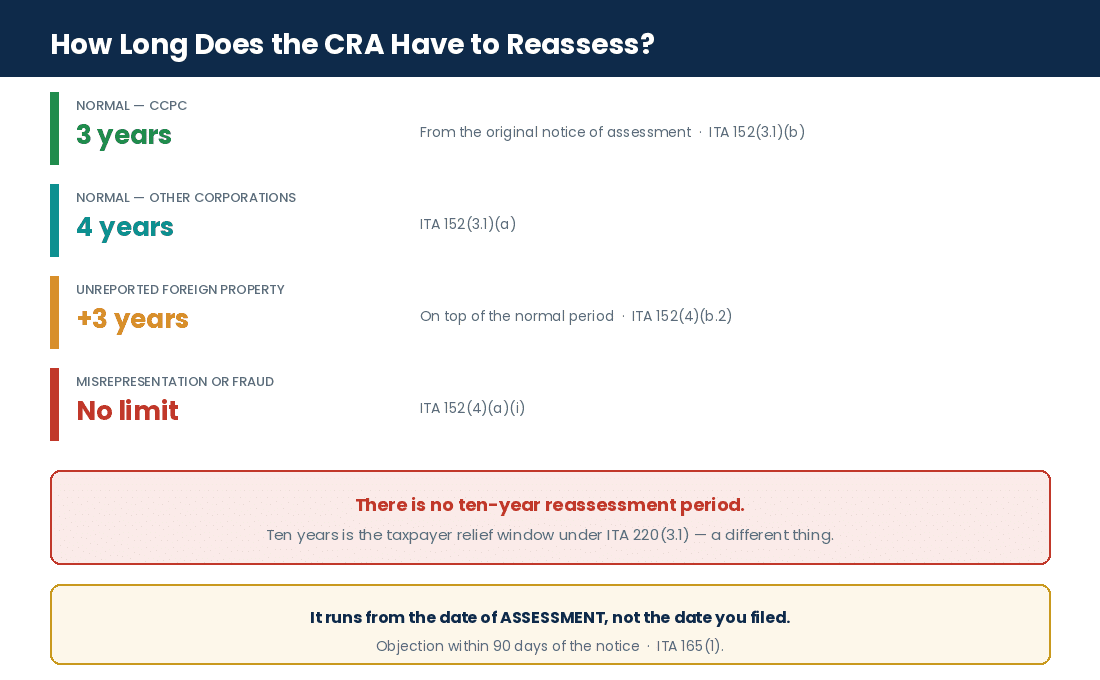
Key Stat: the reassessment window is not always three years. Subsection 152(3.1) sets the normal period at three years from the original notice of assessment for a CCPC, and four years for any other corporation.
It runs from the assessment date, not the filing date. It extends by three years for an unfiled or incorrect T1135 under 152(4)(b.2), and is unlimited where there has been misrepresentation attributable to neglect, carelessness or wilful default, or where a waiver on Form T2029 is filed.
Solutions to Avoid Common Corporate Tax Mistakes
Solutions to Avoid Common Mistakes
Prevention
Keeping Accurate Records: Revenue, Expenses and Receipts
- Transactions recorded as they happen, with a description that will still make sense in three years.
- Receipts retained digitally, sorted by category, for six years from the taxation year-end.
- Bank and card accounts reconciled monthly rather than at year-end.
- Partly deductible items coded separately at entry — meals for the 67.1 restriction, club dues for the 18(1)(l) denial — so the Schedule 1 add-backs fall out of the ledger.
Separating Business and Personal Finances
A shareholder loan outstanding beyond the 15(2.6) window is included in the shareholder’s income under 15(2), and subsection 80.4(2) imputes an interest benefit while it is outstanding. Both are avoidable with a separate business account, a written loan agreement, and a repayment that is not part of a series of loans and repayments — a repayment made days before year-end and re-drawn after it will not hold.
Utilizing Accounting Software and Cloud-Based Tools for Organization
- QuickBooks Online or Xero with bank feeds, so reconciliation is monthly and mechanical.
- GST/HST collected and input tax credits tracked as they arise rather than reconstructed quarterly.
- Document storage meeting the six-year requirement, with the originals retrievable.
- Payroll run through software that produces the T4 Summary rather than a manual schedule.
Registering Properly for GST/HST and Other Relevant Taxes
Check your position against section 148 on both routes — four consecutive quarters and a single quarter. Subsection 240(1) is the requirement to register, not the threshold. One GST/HST registration covers the country; only BC PST, Saskatchewan PST, Manitoba RST and Quebec QST need separate accounts. Revenue on the GST/HST return should tie to Schedule 125 for the overlapping periods.
Share Structure and Organizational Setup
Key Stat: association is decided by section 256, and the business limit is shared under subsection 125(3) on Schedule 23. Subsection 125(7) contains the definitions used in section 125 — it is not the association rule and not the sharing rule.
Associated corporations must allocate the $500,000 business limit between them. The limit is also ground down by $5 for every $1 of adjusted aggregate investment income over $50,000 under paragraph 125(5.1)(b), eliminating it entirely at $150,000 — the passive income rule that catches owner-managed companies holding investments inside the operating entity.
- Share structure settled with a CPA and a lawyer before incorporation, not after the first dividend.
- Schedule 23 filed where corporations are associated, with the allocation agreed.
- Tax on split income under section 120.4 tested where family members hold shares.
- Intercompany transactions priced at fair market value under subsection 69(1).
Double-Checking and Reviewing Before Filing
- Schedule 1 reconciles accounting income to taxable income, line by line.
- Schedules agree to the compiled financial statements.
- T4 totals agree to the payroll account; T5 dividends agree to Schedule 3.
- Shareholder loan continuity shows opening, advances, repayments and closing.
- GST/HST revenue reconciles to Schedule 125.
- Accrued remuneration is scheduled for payment within 179 days under subsection 78(4).
- Adjusted aggregate investment income is measured against the $50,000 threshold.
- Capital cost allowance is claimed, or deliberately not claimed, with the decision recorded.
Two associated corporations each claimed the full $500,000 business limit for three years running.
Association under section 256 required them to share one limit between them, allocated on Schedule 23. The reassessment moved $500,000 of income from 12.2% to 26.5% in Ontario across those years, with interest compounding daily throughout. Figures changed for privacy.
The Role of Professional Support in Corporate Tax Filing
The Role of Professional Support
Support
How Hiring a Professional Accountant Reduces Filing Errors
- Schedule 1 reconciliation built from the ledger rather than assembled at filing.
- Add-backs identified at source: the 67.1 restriction, the 18(1)(l) denial, 18(1)(e) provisions.
- Shareholder loan continuity tracked against the 15(2.6) window.
- Adjusted aggregate investment income measured against the $50,000 grind threshold before year-end, when something can still be done about it.
- Accrued remuneration diarised to day 179.
- Payment and filing dates diarised separately, since they are four months apart.
Advantages of Expert Assistance: Compliance, Maximizing Deductions and Audit Protection
| Area | What it means in practice |
|---|---|
| Compliance | Every required schedule filed; statements and return in agreement |
| Maximizing deductions | Meals at 50% rather than 0% or 100%; capital items in the right class |
| Audit protection | Support assembled before the question is asked, not after |
| Business limit | Schedule 23 allocation agreed across the associated group |
| Representation | Correspondence and audits handled directly with CRA |
Services Offered by Gondaliya CPA
- Review of filed T2 returns for the errors set out above.
- Correction through the proper route — a written reassessment request or My Business Account, not a second T2.
- Voluntary disclosure advice before CRA makes contact.
- Full preparation with bookkeeping cleanup in QuickBooks or Xero.
- A flat annual fee including HST covering bookkeeping, GST/HST, the T2 and CRA correspondence.
- Free consultation with a cleanup plan, and a response within one business day.
- Representation during CRA letters, reviews and audits.
Gondaliya CPA is a CPA Ontario Registered Firm, verifiable on the CPA Ontario public firm directory.
Simplifying Corporate Tax Filing with Professional Guidance
Most T2 errors come from the rules being layered rather than from carelessness. The reconciliation between GST/HST revenue and Schedule 125 is a worked exercise. The 179-day test under 78(4) is a diary entry. The business limit allocation is a Schedule 23 that someone has to agree. None of it is difficult; all of it is easy to leave out.
An owner-managed company held roughly $2,000,000 of investments inside the operating corporation, generating around $90,000 of adjusted aggregate investment income.
Paragraph 125(5.1)(b) grinds the business limit by $5 for every $1 over $50,000, so $40,000 of excess removed $200,000 of business limit. Nobody had modelled it before the year closed, by which point nothing could be done. Figures changed for privacy.
Next Steps for Businesses to Prevent Tax Filing Mistakes
Next Steps and Corrections
Corrections
Planning Ahead: Tracking Dates and Payments
- Payment date and filing date diarised separately — two months (or three) against six.
- Instalment dates set from the prior year or an estimate of the current year, whichever gives the lower total.
- Slip deadlines at the last day of February.
- Inactive and dormant corporations still file, and the penalty for not doing so is calculated on nil tax but the obligation stands — and gross negligence and demand-to-file penalties do not depend on a balance owing.
Regular Review of Financial Records
- Books reviewed monthly or quarterly against what the return will have to show.
- Add-back items flagged as they are coded rather than hunted at year-end.
- Shareholder loan balance reviewed at each quarter against the 15(2.6) deadline.
- Investment income tracked against the $50,000 passive income threshold while the year is still open.
Correcting Mistakes After Filing
Risk Warning: there is no “Form T2 Adjustment Request” or “Form T2 Request for Reassessment”. Neither form exists, and asking CRA for one wastes a cycle.
A corporation requests a reassessment by letter identifying the year, the lines affected and the reason, with supporting documents — or through My Business Account, or by refiling through certified software where the return qualifies. Never file a second T2 for the same year.
- Request within the normal reassessment period: three years from the original assessment for a CCPC, four for other corporations, under subsection 152(3.1).
- Where CRA has not made contact, consider the Voluntary Disclosures Program under IC00-1R6.
- Where it has, seek relief under subsection 220(3.1) on Form RC4288, within ten calendar years.
- Keep the supporting file assembled before the request goes in.
Preparing for CRA Reassessments and Appeal Processes
| Step | Timing | Provision |
|---|---|---|
| Normal reassessment period | 3 years CCPC; 4 years other corporations, from the assessment | ITA 152(3.1) |
| Extended for T1135 failure | Plus three years | ITA 152(4)(b.2) |
| Unlimited | Misrepresentation from neglect, carelessness or wilful default; or a waiver | ITA 152(4)(a) |
| Notice of objection | 90 days from the notice of assessment, Form T400A | ITA 165(1) |
| Extension of time to object | Within one further year | ITA 166.1, 166.2 |
| Appeal to the Tax Court | 90 days from confirmation, or after 90 days of silence | ITA 169(1) |
Encouragement to Seek Expert Help for Risk Mitigation and Tax Savings
The expensive errors on a T2 are the structural ones — the business limit, the shareholder loan, the accrued bonus, the passive income grind — and all four are settled before the year closes or not at all. After year-end, you are correcting; before it, you are planning.
A client spent two months trying to obtain a “T2 Adjustment Request form” from CRA before calling us.
No such form exists. A one-page letter identifying the year, the affected lines and the reason, with the supporting schedules attached, was accepted within the normal reassessment period. Two months of the window had gone to looking for a form. Figures changed for privacy.
Frequently Asked Questions on Corporate Tax Return Mistakes
Frequently Asked Questions
FAQ
What happens if I file nothing for my corporate tax return?+
The filing obligation in paragraph 150(1)(a) applies whether or not tax is owed and whether or not the corporation was active. The 162(1) penalty is a percentage of unpaid tax, so a corporation owing nothing has no percentage penalty — but CRA can demand the return under subsection 150(2), after which 162(2) doubles the rate, and an arbitrary assessment under subsection 152(7) may follow.
How do filing and payment deadlines differ?+
The T2 is filed within six months of fiscal year-end. The balance of tax is due at two months under paragraph 157(1)(b), or three months for a CCPC claiming the small business deduction. Filing on time while paying with the return produces no penalty and four months of daily compound interest.
What issues arise from taking accounting profit at face value?+
Accounting income is not taxable income. Schedule 1 reconciles the two, adding back amortisation, the non-deductible half of meals under 67.1, club dues under 18(1)(l), reserves and provisions under 18(1)(e), and penalties under 67.6, then deducting capital cost allowance. Skipping it is the most common T2 error there is.
Which expenses are non-deductible or misclassified capital?+
Meals and entertainment above 50% (section 67.1), dining and recreation club dues (18(1)(l)), personal and living expenses (18(1)(h)), reserves and contingent liabilities (18(1)(e)), and unreasonable amounts (section 67). Capital outlays are denied by 18(1)(b) and recovered through capital cost allowance under 20(1)(a) and Schedule II instead.
How does the business limit work with associated corporations?+
The $500,000 business limit in subsection 125(2) is shared among associated corporations under subsection 125(3), with association determined by section 256. It grinds on adjusted aggregate investment income over $50,000 under 125(5.1) and on taxable capital between $10 million and $50 million. Schedules 23 and 49 report the allocation.
What problems occur when shareholder loans and slips do not reconcile?+
An unrepaid loan is included in the shareholder’s income under subsection 15(2) unless repaid within one year after the corporation’s year-end under 15(2.6), with an imputed interest benefit under 80.4(2). Slip mismatches matter too: T4 reports employment income and T5 reports dividends and interest — a draw recorded as the wrong one will not reconcile to either.
What costs result from corporate tax return errors?+
The 162(1) penalty at 5% plus 1% per month to twelve; 161(1) interest compounding daily; the 163(2) gross negligence penalty at 50% of understated tax where that standard is met; deductions lost because the window closed; and professional fees on the dispute.
What should I do if CRA contacts me first?+
Respond within the stated deadline and gather the supporting records. Once CRA has made contact the Voluntary Disclosures Program is generally no longer available, so the routes are a corrected filing, relief under subsection 220(3.1) on Form RC4288, and if an assessment follows, an objection within 90 days.
Can I fix T2 mistakes myself or hire a CPA firm?+
A straightforward correction — a missed receipt, a transposed figure — is an amended T2 through Corporation Internet Filing. Where the issue touches the business limit, an associated group, shareholder loans, foreign property or a disputed position, the judgement is worth more than the filing. A non-CPA preparer also cannot represent you before CRA.
What triggers a CRA review or audit?+
T2 revenue that does not agree to the GST/HST returns, slip totals that do not agree to the ledger, accounting profit carried across with no Schedule 1, unexplained shareholder loan movement, expense ratios that jump year to year, missing schedules, and repeated late filing.
How far back can CRA reassess?+
Three years from the original notice of assessment for a CCPC, four years for other corporations, under subsection 152(3.1) — measured from assessment, not filing. Add three years where specified foreign property was unreported, under 152(4)(b.2). Where there is misrepresentation, neglect or fraud, subparagraph 152(4)(a)(i) imposes no limit at all.
Is voluntary disclosure still open?+
Only while CRA has not made contact about the matter. The programme operates under Information Circular IC00-1R6, requires the disclosure to be voluntary, complete, involve a penalty and be at least a year overdue, and offers penalty relief with partial interest relief — not a waiver of the tax itself.
What if I missed the filing deadline?+
The penalty is 5% of unpaid tax plus 1% per complete month to twelve months under 162(1), doubling to 10% plus 2% to twenty months under 162(2) on a repeat within three years following a demand. Interest under 161(1) compounds daily and runs from the balance due date, not the filing date.
What are the meals and entertainment expenses limitations?+
50% of actual cost under section 67.1, with the input tax credit recaptured to 50%. Exceptions in 67.1(2) include food supplied as part of what the business sells and certain remote work site situations; 67.1(3) deems $50 per day to be food where a conference fee does not state it separately.
How long do shareholder loans have?+
Repayment within one year after the end of the corporation’s taxation year in which the loan was made, under subsection 15(2.6), provided it is not part of a series of loans and repayments. Subsection 15(2) is the inclusion; 15(2.6) is the exception that gives the window.
How do I request an adjustment?+
There is no “T2 Request for Reassessment” form. File an amended T2 through Corporation Internet Filing, or write to the tax centre identifying the year, the change and the schedules affected, with supporting documents, inside the reassessment window.
How does the objection procedure work?+
A Notice of Objection within 90 days of the notice of assessment or reassessment under subsection 165(1), filed on Form T400A or through My Business Account. A further year is available on application under section 166.2. Collection of disputed corporate income tax is generally stayed while the objection is outstanding.
What relief is available for penalties and interest?+
Subsection 220(3.1) permits CRA to waive penalties and interest for circumstances beyond the taxpayer’s control, CRA delay or error, or financial hardship, on Form RC4288, covering any of the ten calendar years before the request. It is discretionary and reviewable only by judicial review.
What are the common GST/HST filing errors?+
Treating zero-rated supplies as exempt, which gives up input tax credits unnecessarily; missing the section 148 threshold on the single-quarter route; claiming credits without documentation meeting 169(4); and revenue that does not reconcile to Schedule 125 on the T2.
Why do SR&ED claims get missed?+
Because the reporting deadline in subsection 37(11) is twelve months after the T2 due date — 18 months after year-end — and CRA has no discretion to extend it. A claim identified at the next year-end is often already out of time.
Why does slip matching matter?+
Because CRA matches the slips you filed against the amounts on the return. T4 is employment income; T5 is dividends and interest. They are not interchangeable, and both are due the last day of February under Regulation 205(1).
What is the accrued remuneration rule?+
Subsection 78(4): salary, wages or other remuneration accrued at year-end and unpaid by the 180th day after year-end is deemed not to have been incurred that year. The window is 179 days, not 180 — a distinction that decides a full year’s deduction.
What are the capital cost allowance misclassification risks?+
Paragraph 18(1)(b) denies the deduction. The cost goes to a class under Schedule II and is recovered as capital cost allowance under 20(1)(a), subject to the available-for-use rule in subsections 13(26) to (32). The half-year rule is suspended for eligible property acquired after 31 December 2024.
When is Form T1135 required?+
Where the cost amount of specified foreign property exceeds CAD 100,000 at any time in the year, under section 233.3. The penalty is $25 per day to $2,500 under 162(7). T1134 is the separate foreign affiliate return under 233.4, and neither sits in Part XVIII of the Act.
What are the consequences of tax installment payments defaults?+
The obligation is in section 157; instalment interest arises under subsection 161(2), with a further penalty under section 163.1 where that interest exceeds $1,000. None are required where taxes payable are $3,000 or less or in a first taxation year, under 157(2.1).
Do prepayments help?+
Yes. Interest runs from the balance due date, so paying early stops it. CRA also applies contra interest where an overpaid instalment offsets an underpaid one. The instalment base can be the prior year, the second prior year or an estimate of the current year — whichever gives the lowest total, provided the estimate holds.
Can I destroy records before six years?+
Only with written permission, applied for on Form T137, Request for Destruction of Records, under subsection 230(8) — not RC4428. Destroying them without permission is an offence under 230(6), and anything you cannot substantiate afterwards is denied.
Twenty-seven questions, and the two that cost real money are the quietest ones: the balance date and the 179 days.
Neither produces a letter. Interest accrues silently from the balance due date, and a bonus paid on day 180 simply moves a deduction forward a year. Figures changed for privacy.
Essential Corporate Tax Return Correction Pathways
Essential Topics and Best Practices
Quick Reference
- File an amended T2 through Corporation Internet Filing, or write to the tax centre, inside the reassessment window.
- Use the Voluntary Disclosures Program under IC00-1R6 before CRA makes contact.
- Apply for relief under subsection 220(3.1) on Form RC4288 within ten calendar years.
- Object within 90 days under subsection 165(1), with an extension available under 166.2.
- Keep the supporting documents that justify each correction.
Quick Comparison: DIY Filing Versus a CPA Firm for Corporate Filing
| Feature | DIY Filing | CPA Firm |
|---|---|---|
| Schedule 1 reconciliation | Often skipped | Built from the ledger |
| Associated group and business limit | Rarely tested | Mapped under 125(3) and 256 |
| Audit and objection support | None | Full representation |
| Compiled statements | Not available | CSRS 4200, no assurance |
| Time investment | High | Low |
Key CRA Requirements for Corporations
- File the T2 within six months of fiscal year-end, active or not.
- Pay the balance within two months, or three for a CCPC claiming the small business deduction.
- Retain records six years from the end of the taxation year.
- Register for GST/HST once taxable supplies pass $30,000 on either route.
- File the T2 electronically under subsection 150.1(2.1).
Points Worth Carrying
- The late filing penalty is 5% plus 1% per month, ITA 162(1).
- $250 is the electronic filing penalty; $2,500 is the 162(7) ceiling.
- Accrued remuneration has 179 days, not 180.
- Foreign property is T1135 under 233.3; T1134 is foreign affiliates.
- A T1135 omission adds three years; fraud has no limit.
- There is no T2 adjustment form — file an amended T2.
- Early record destruction is Form T137, not RC4428.
- Shareholder loans: 15(2) includes, 15(2.6) gives the year.
- A fiscal period cannot exceed 53 weeks.
- The balance is due months before the return.
Twenty points, and the ten at the end are all things a business owner was told confidently by something they read.
None is obscure. They are ordinary provisions attached to a penalty figure from a different subsection, a form that does not exist, or a window one day shorter than stated. Figures changed for privacy.
Businesses We Serve & Industry Spotlights
Industry Expertise
T2 errors do not respect sector. Here are ten business types and the mistake that usually appears.
| Business | The Issue That Usually Appears |
|---|---|
| Owner-managed professional corporations | Bonus accrued and paid on day 180 |
| Holding and operating company pairs | Business limit claimed twice across an associated group |
| Corporations with retained investments | Passive income grind under 125(5.1) never measured |
| Dormant and inactive corporations | Return not filed because there was no activity |
| Corporations with shareholder draws | Loan balance past the 15(2.6) window |
| Exporters and zero-rated suppliers | T2 revenue not reconciled to GST/HST returns |
| Corporations holding foreign property | T1135 missed, extending reassessment by three years |
| Capital-intensive operations | Equipment expensed instead of classified |
| Businesses with research activity | SR&ED claim filed past the 18-month deadline |
| Corporations with a non-December year-end | Balance paid with the return rather than at two or three months |
- Professional corporations: diarise day 179.
- Holdco and opco pairs: test association under section 256.
- Corporations with investments: measure AAII before year-end.
- Dormant corporations: the obligation does not depend on activity.
- Shareholder draws: one year after the corporation’s year-end.
- Exporters: write the reconciliation down before anyone asks.
- Foreign property holders: cost amount, not market value.
- Capital-intensive operations: class it, then check available-for-use.
- Research-active businesses: 18 months, no extensions.
- Non-December year-ends: two dates, not one.
Industry Spotlights: Sectors We Represent
The same T2 errors appear across every sector we act for, but each one has its own version. Here are eleven and the form the problem usually takes.
| Industry | The T2 Angle |
|---|---|
| Medical doctors & physician professional corporations | Accrued bonuses paid past the 179th day |
| Dentists & dental practices | Equipment expensed rather than classified |
| Daycare, childcare & CWELCC services | Grant revenue reconciled to Schedule 125 |
| Real estate investors, landlords & holding companies | Passive income grinding the business limit |
| Property developers & builders | Associated project corporations sharing one limit |
| Construction, contractors & skilled trades | Shareholder draws outside the 15(2.6) window |
| Technology startups & SaaS | SR&ED claimed past the 18-month deadline |
| E-commerce & online retailers | T2 revenue not agreeing to the GST/HST returns |
| Restaurants & food and beverage | Meals and entertainment claimed at full cost |
| Transportation, logistics & trucking | Vehicles pooled into the wrong CCA class |
| Consulting firms | Accounting profit carried across with no Schedule 1 |
- Medical doctors & physician professional corporations: Year-end bonuses are the standard tool for managing a professional corporation’s income, and subsection 78(4) gives exactly 179 days to pay them before the deduction moves a year.
- Dentists & dental practices: Chairs, imaging and operatory fit-outs are capital, denied by paragraph 18(1)(b) and recovered through the right class under Schedule II rather than expensed in the year of purchase.
- Daycare, childcare & CWELCC services: Funded programme revenue has to appear on Schedule 125 and agree to what was reported elsewhere, because a mismatch is what prompts the review rather than the amount itself.
- Real estate investors, landlords & holding companies: Rental and investment income is adjusted aggregate investment income, and once it passes $50,000 the business limit grinds under subsection 125(5.1) until it is gone at $150,000.
- Property developers & builders: Project corporations are routinely associated under section 256, which means one $500,000 business limit between them under 125(3) rather than one each.
- Construction, general contractors & skilled trades: Owner draws taken through the year become a shareholder loan, and the repayment window in subsection 15(2.6) runs one year from the corporation’s year-end, not from the draw.
- Technology startups & SaaS: The SR&ED reporting deadline in subsection 37(11) is 18 months after year-end and CRA has no discretion to extend it, so a claim identified at the next year-end is often already gone.
- E-commerce & online retailers: Platform settlements, zero-rated exports and returns all move revenue, and the T2 figure has to reconcile to the GST/HST returns for the same period with the difference explained.
- Restaurants & food and beverage: Section 67.1 limits meals and entertainment to 50%, and the exceptions in 67.1(2) for food supplied as part of what the business sells are worth testing properly rather than assuming either way.
- Transportation, logistics & trucking: Class 10 at 30%, Class 10.1 for a passenger vehicle above the prescribed limit, and Class 16 for a heavy truck are three different answers, and pooling them together misstates the claim.
- Consulting firms: An incorporated consultant’s books often look simple enough to carry straight onto the return, which is exactly how Schedule 1 gets skipped and amortisation never gets added back.
The sector changes. The questions do not: does Schedule 1 exist, was the balance paid on time, and has anyone tested the associated group.
A dental corporation and a machine shop look nothing alike and get reassessed for the same three things. Figures changed for privacy.
Professional Guidance and Quick Reference
Guidance
Professional Guidance: How Gondaliya CPA Handles Your T2
Corporations get into difficulty in a predictable set of ways: budgeting for a late filing penalty of “$200 plus $100 a month” or “$250 a day to $2,500”, when subsection 162(1) charges 5% of unpaid tax plus 1% per complete month to twelve — the $250 belonging to the electronic filing penalty in 162(7.2) and the $2,500 to the general obligation penalty in 162(7); paying an accrued bonus on the 180th day, when subsection 78(4) allows 179; filing Form T1134 for foreign property, when that is Form T1135 under section 233.3 and T1134 covers foreign affiliates; believing a T1135 omission or fraud opens a ten-year window, when the extension in 152(4)(b.2) is three years and misrepresentation under 152(4)(a)(i) has no limit; hunting for a “T2 adjustment form” that does not exist, when the route is an amended T2 through Corporation Internet Filing; applying to destroy records on RC4428, when the form is T137; attributing the shareholder loan window to 15(2), when the inclusion is 15(2) and the one-year exception is 15(2.6); and above all filing on time at six months while paying with the return, when the balance was due at two or three months under 157(1)(b). Gondaliya CPA handles corporate tax filing on a flat annual fee.
We handle what decides the outcome: building Schedule 1 from the ledger so accounting income reconciles to taxable income, applying the 179-day test before a bonus deduction is claimed, tracking shareholder loans against the 15(2.6) window, testing the associated group under section 256 and allocating the business limit under 125(3), measuring passive income against the 125(5.1) grind, reconciling T2 revenue to the GST/HST returns and slip totals to the ledger, classifying capital items rather than expensing them, filing T1135 where any foreign property exists, diarising the balance date separately from the filing date, and preparing compiled statements under CSRS 4200 that state plainly that no assurance is provided.
Our team starts with your last filed T2, the trial balance behind it and your notice of assessment. Whatever you do, you get clear advice and a fixed price before we start.
Quick Answers
At a Glance
- Late filing: 5% + 1%/month to 12, ITA 162(1)
- Repeat late filing: 10% + 2%/month to 20
- E-filing penalty: $250, ITA 162(7.2)
- Interest: compounded daily, ITA 161(1)
- T2 filing: six months after year-end
- Balance: two months; three for a CCPC
- Accrued pay: 179 days, ITA 78(4)
- Shareholder loan: one year, ITA 15(2.6)
- Foreign property: Form T1135, ITA 233.3
- Reassessment: 3 years CCPC, 4 years other
- Record destruction: Form T137
- Records: six years from the taxation year-end
Who This Is For
Fit Check
- For: Incorporated Canadian businesses filing the T2 — owner-managed corporations, associated groups, corporations with shareholder loans, foreign property, or returns already filed that need review or correction.
- Not For: Sole proprietors and partnerships, who file the T2125 or T5013 on a different timetable, and businesses requiring a review or audit engagement, which we refer out.
People Also Ask
Quick Answers
Is the late filing penalty a flat fee?+
No. Subsection 162(1) charges 5% of the unpaid tax plus 1% per complete month to twelve months. Flat figures like $200, $250 or $2,500 belong to other provisions entirely.
Is it 179 days or 180 for an accrued bonus?+
179. Subsection 78(4) denies the deduction where the amount remains unpaid on the 180th day after year-end. A 31 December year-end means payment by 28 June.
Which form reports foreign property?+
Form T1135, under section 233.3, where the cost amount of specified foreign property exceeds CAD 100,000 at any time in the year. T1134 is the foreign affiliate return under 233.4.
Can I file a second T2 to correct the first?+
Yes — an amended T2 through Corporation Internet Filing is the normal route. There is no separate adjustment form for corporations, and the claim that a second return cannot be filed is wrong.
When exactly is my corporate tax payment due?+
Two months after fiscal year-end under paragraph 157(1)(b), or three months for a CCPC claiming the small business deduction. The return is due at six months, so the payment comes first.
Glossary of Key Terms
Glossary
- Subsection 162(1): The late filing penalty, 5% plus 1% per month.
- Subsection 162(7.2): The $250 penalty for not filing electronically.
- Subsection 161(1): Arrears interest, compounded daily.
- Paragraph 157(1)(b): The corporate balance of tax date.
- Schedule 1: Reconciles accounting income to taxable income.
- Subsection 78(4): The 179-day accrued remuneration window.
- Subsection 15(2.6): The one-year shareholder loan repayment exception.
- Subsection 125(3): Allocates the business limit among associated corporations.
- Subsection 125(5.1): Grinds the business limit on passive income.
- Section 233.3: The Form T1135 foreign property requirement.
- Subsection 152(3.1): The normal reassessment period.
- Subsection 163(2): The gross negligence penalty at 50%.
- Form T137: Request for Destruction of Records.
- Form RC4288: Request for Taxpayer Relief.
- IC00-1R6: The Voluntary Disclosures Program circular.
- CSRS 4200: The compilation engagement standard, providing no assurance.
Corporate Tax Filing Check
This quick self-check indicates where your business most likely has room. Please answer the five questions below.
Corporate Tax Filing Check
Five quick questions on your business. No fee shown.
Points to raise with us:
This is a general prompt, not tax or legal advice or a quote. Your position depends on your full facts. For a real review, please book a free consultation.
Want a checklist to work from? You can download our free T2 filing checklist before your consultation.
Diarise the balance of tax date separately from the filing date, because paying at six months when the balance was due at two or three accrues daily compound interest with no penalty notice to warn you. Pay accrued bonuses by the 179th day rather than the 180th, since one day moves a full year’s deduction. Build Schedule 1 from the ledger rather than carrying accounting profit across, because that single omission accounts for more reassessments than any aggressive position. Report foreign property on Form T1135 under section 233.3, not T1134, and understand that an omission adds three years to the reassessment window rather than opening a ten-year one. Correct a filed return with an amended T2 through Corporation Internet Filing, since no T2 adjustment form exists. Test the associated group under section 256 before claiming the business limit, and measure passive income against the 125(5.1) grind. Track shareholder loans against the 15(2.6) window, not 15(2). Apply on Form T137 if you want to destroy records early. And please keep six years of records from the year-end.
2026 Update — what is current: This article reflects rules current to 3 October 2026. The six-month T2 filing deadline under 150(1)(a), the six-year retention requirement under 230(4)(b), the last-day-of-February slip deadline under Regulation 205(1) and the 50% meals limit in section 67.1 are unchanged. Please note that the late filing penalty is 162(1) at 5% plus 1% per complete month to twelve, doubling under 162(2) on a repeat, with the $250 figure belonging to the electronic filing penalty in 162(7.2) and the $2,500 ceiling to the general obligation penalty in 162(7); that accrued remuneration must be paid within 179 days under 78(4); that shareholder loans are included under 15(2) with the one-year exception in 15(2.6); that foreign property is reported on Form T1135 under section 233.3 while T1134 covers foreign affiliates; that the normal reassessment period is three years for a CCPC and four for other corporations under 152(3.1), extended by three years for unreported foreign property under 152(4)(b.2) and unlimited for misrepresentation under 152(4)(a)(i); that a corporate return is corrected by an amended T2 rather than any adjustment form; that early record destruction is applied for on Form T137 under 230(8); that a fiscal period cannot exceed 53 weeks under 249.1(1)(a) and a new corporation chooses its first year-end without approval; that electronic filing of the T2 has been mandatory under 150.1(2.1) since 2024; and that the half-year rule is suspended for eligible property acquired after 31 December 2024 under Bill C-15. No change to corporate reassessment periods takes effect in 2026.
Corporate Tax Return Mistakes Canada: How Gondaliya CPA Supports Corporations
Start with your last filed T2 and the trial balance behind it
Gondaliya CPA builds Schedule 1 from the ledger so accounting income reconciles to taxable income, applies the 179-day test before a bonus deduction is claimed, tracks shareholder loans against the 15(2.6) window, tests the associated group and allocates the business limit, reconciles T2 revenue to the GST/HST returns and slips to the ledger, files T1135 where foreign property exists, diarises the balance date separately from the filing date, and files the T2 with its GIFI and compiled statements from one reconciled set of books — on a flat annual fee including HST with a one-business-day response. Please book a free consultation.
Next Steps
Please book a free consultation with Gondaliya CPA and bring your last filed T2, the trial balance behind it, and your most recent notice of assessment. Those three settle the Schedule 1 question, the payment date question and the associated group question, which is where most of the exposure sits. You will get a flat annual fee including HST before any work begins. We serve Toronto, Mississauga, Brampton, Vaughan, Ottawa and the rest of Ontario, and work with corporations across Canada. If our content helps, please add gondaliyacpa.ca as a preferred source on Google.
Published: · Last updated:
Editorial policy: We research against CRA, CPA Canada and CPA Ontario sources, fact-check the figures, and Sharad Gondaliya, CPA, reviews the content, which we update as the rules change.
Disclaimer: This article is educational information only and is not tax, legal, or financial advice. Figures marked illustrative are examples rather than quotes or guarantees. It reflects rules current to 2026, including the penalty provisions in section 162, the accrued remuneration rule in subsection 78(4), the shareholder loan provisions in section 15, the reassessment periods in section 152 and the six-year retention requirement in paragraph 230(4)(b). Rates and limits change and outcomes depend on your specific facts. Please consult a CPA Ontario member before acting.

Sharad Gondaliya is a CPA Canada & CPA USA with 15 Years+ experience of Accounting, Tax, Payroll of Corporate Small Businesses as Tax Accountant. He is a CPA Ontario member (61040184) and holds US CPA licences in Washington and Montana and is well known among corporate small businesses for tax planning, efficient tax solutions, and affordable CPA services. Sharad is the Principal (Director) of Gondaliya CPA – Affordable CPA Firm in Canada. Licenses: CPA Ontario: 61040184 | CPA USA (MT): PAC-CPAP-LIC-033176 | CPA USA (WA): 57629 | CPA Firm License: 61330051 View Full Author Bio