



Grant Writing Consultant Tax Rules in Canada: How Grant Writing Income Is Taxed
Grant writing consultant tax Canada explained: retainers, contingency fees, GST/HST and deductions
Grant writing consultant tax Canada requires careful attention to tax rules, bookkeeping, and business expenses such as home office and mixed-use costs. Gondaliya CPA helps manage GST/HST filing, payroll source deductions, and tax filing deadlines to ensure compliance with the Income Tax Act and Excise Tax Act.
Quick Summary
A retainer received before the work is done is included in income on receipt under paragraph 12(1)(a), with the deferral coming from a 20(1)(m) reserve claimed on the return. A self-employed consultant files the T1 by 15 June and pays the balance by 30 April. And the $30,000 threshold sits in section 148 of the Excise Tax Act, not Schedule V, which lists exempt supplies.
Reading time: 44 minutes.
Table of Contents
- Three Things You Have Been Told
- Grant Writing Support and Tax Considerations
- Eligibility, Process and Funding Types
- Best Practices, Retainers and Contingency Fees
- Corporate and Self-Employed Taxation
- Technology, Incentives and Advisory
- Resources, Records and Audit Readiness
- Frequently Asked Questions
- Essential Topics and Best Practices
- Businesses We Serve & Industry Spotlights
- Professional Guidance and Quick Reference
The Numbers That Matter
This article covers Canada, with Ontario and Toronto context, and reflects rules current to 3 October 2026. It is written for grant writing consultants — self-employed and incorporated — serving charities, non-profits, municipalities and private businesses, including those working on retainers, contingency fees or multi-year portfolios. Gondaliya CPA performs compilation engagements; we do not perform audits or review engagements, and where a funder or lender requires one we refer it out. Figures marked illustrative are examples, not quotes, and any masked engagement notes end with “Figures changed for privacy.” This is educational information only and not tax or legal advice.
Three Things You Have Been Told
Three Things You Have Been Told
The Corrections
Three points about grant writing consultant tax circulate widely and all three are wrong. The first is stated two different ways in the same guidance.
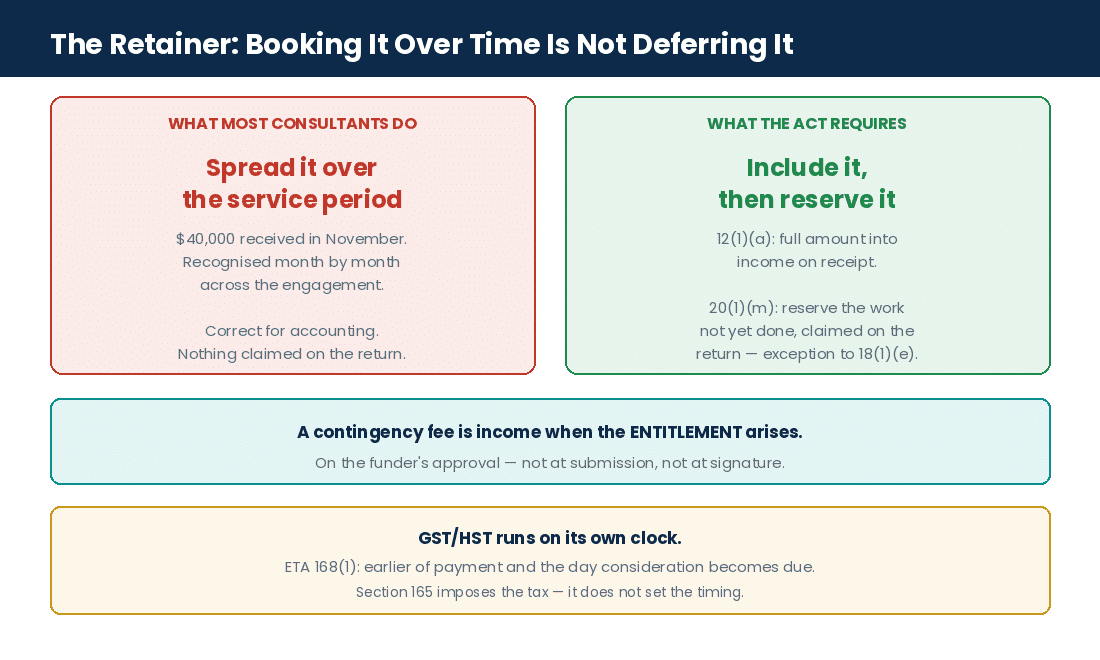
A Retainer Is Income on Receipt — the Deferral Is a Claimed Reserve
Risk Warning: “retainers are recorded over the time you provide services” is the accounting answer, not the tax answer. Paragraph 12(1)(a) includes an amount received for services not yet rendered in income when it is received.
The deferral comes from paragraph 20(1)(m), a reserve for services reasonably expected to be rendered after year-end, which is an exception to paragraph 18(1)(e) and must be claimed on the return. Spreading the retainer in the books without claiming the reserve leaves the inclusion unaddressed.
| Step | Provision | Effect |
|---|---|---|
| $15,000 retainer received 10 January | 12(1)(a) | Full amount in income on receipt |
| Reserve for work not yet done at year-end | 20(1)(m) | Deducted, claimed on the return |
| Reserve added back | 12(1)(e) | Into income the following year |
| New reserve claimed | 20(1)(m) | On whatever work remains undone |
The source guidance gets this right twice — “the retainer counts as income once received”, “that money counts as December’s taxable income” — and wrong once. Only one of those can be the rule, and it is the inclusion.
Self-Employed Consultants File 15 June, Not 30 April
Risk Warning: “self-employed people file personal tax returns by April 30” has the two dates the wrong way round. A self-employed individual files the T1 by 15 June under subsection 150(1); it is the balance of tax that is due 30 April under subsection 156.1(4).
The filing extension does not extend the payment date. Interest under subsection 161(1) runs from 1 May and compounds daily regardless of when the return goes in.
| Structure | File by | Pay by |
|---|---|---|
| Self-employed consultant | 15 June | 30 April |
| Incorporated consultancy | Six months after year-end, ITA 150(1)(a) | Two months; three for an eligible CCPC, ITA 157(1)(b) |
The corporate balance of tax date appears nowhere in most guidance, and it falls months before the return. That is the quietest cost on a consulting file, because it produces no penalty notice — only interest.
Schedule V Is Exemptions, Not the Registration Threshold
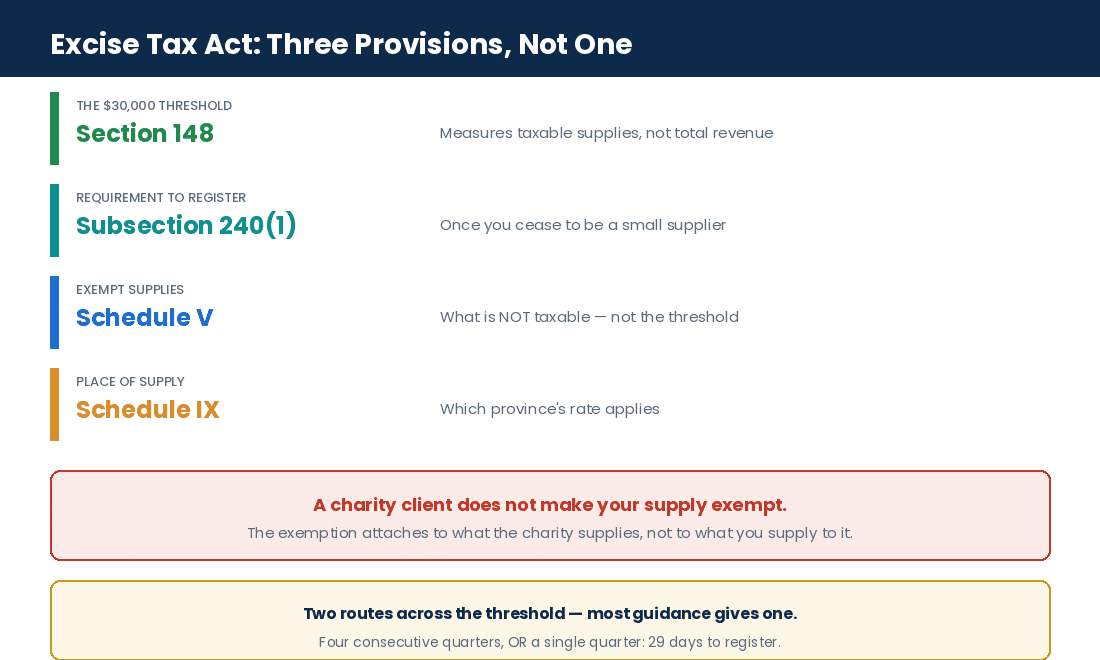
Risk Warning: the $30,000 threshold is not in Schedule V, and neither are the place of supply rules. Schedule V of the Excise Tax Act lists exempt supplies.
The threshold is section 148, measuring taxable supplies rather than total revenue. The requirement to register is subsection 240(1). Place of supply is Schedule IX with the Place of Supply Regulations. Three different provisions, routinely collapsed into one.
| Subject | Correct provision | Often cited instead |
|---|---|---|
| $30,000 small supplier threshold | ETA 148 | Schedule V; 123(1); 142; 240 |
| Requirement to register | ETA 240(1) | Schedule V |
| Exempt supplies | ETA Schedule V | — |
| Place of supply | ETA Schedule IX | Schedule V; section 240 |
| Imposition of tax | ETA 165 | Cited as a penalty provision |
| Input tax credits | ETA 169, with documents in 169(4) | — |
There is also a second route across the threshold that most guidance omits: over $30,000 in a single calendar quarter ends small supplier status immediately, on the supply that crosses it, with 29 days to register. One large municipal engagement can do that on its own.
A consultant received a $40,000 retainer in November covering an eighteen-month portfolio and deferred all but one month in the books.
Paragraph 12(1)(a) included the full amount on receipt. The accounting treatment was right; the 20(1)(m) reserve that gives it tax effect had never been claimed. The same engagement also crossed the section 148 threshold in a single quarter, which nobody had noticed. Figures changed for privacy.
Business Grant Writing Support and Tax Considerations in Canada
Grant Writing Support and Tax Considerations
Foundations
Understanding Tax Rules for Grant Writing Consultants
Consulting fees are business income under section 9, included when receivable under paragraph 12(1)(b), with advance receipts caught by 12(1)(a). Accrual applies: the cash method in section 28 is confined to farming and fishing.
| Fee type | When it is income | Provision |
|---|---|---|
| Hourly or milestone fees | When receivable | ITA 12(1)(b) |
| Retainer received in advance | On receipt, with a reserve | 12(1)(a); 20(1)(m) |
| Contingency or success fee | When the entitlement arises under the contract | ITA 12(1)(b) |
| Work done but unbilled at year-end | Work in progress | ITA 10(5) |
| Reimbursed disbursements billed on | Income, with the cost deducted separately | ITA 9 |
Key Business Expenses and Bookkeeping Practices
| Expense | Deductible? | Provision |
|---|---|---|
| Home office, reasonable share | Yes, subject to the workspace tests | ITA 18(12) |
| Professional development maintaining existing skills | Yes, as incurred | ITA 18(1)(a) |
| A programme conferring a lasting new qualification | Capital, to a CCA class | ITA 18(1)(b) |
| Software subscriptions and funder databases | Yes, as incurred | ITA 18(1)(a) |
| Purchased application software | Class 12 at 100% | Reg Schedule II |
| Computers | Class 50 at 55% | Reg Schedule II |
| Meals and entertainment | 50% of actual cost | ITA 67.1 |
| Dining, recreation and sport club dues | No | ITA 18(1)(l) |
| Subcontracted writers | Yes, with the slip issued | ITA 18(1)(a) |
The 50% meals limitation is section 67.1, not “section 67(2)” — section 67 is the reasonableness test and has no such subsection. There is also no per-meal dollar cap for a self-employed consultant; the restriction is 50% of what was actually spent.
Home Workspace
Subsection 18(12) gives two alternative tests: (a) the home is the principal place of business, with no exclusivity requirement; or (b) the space is used exclusively for the business and clients are met there on a regular and continuous basis. A consultant working online will usually rely on test (a). The deduction cannot create or increase a loss, with the excess carried forward under 18(12)(c) against income from the same business. An incorporated consultant pays rent under a written agreement rather than claiming under 18(12).
Tax Filing Requirements and Deadlines
| Obligation | Deadline | Provision |
|---|---|---|
| Self-employed T1 with form T2125 | 15 June | ITA 150(1) |
| Balance of tax, self-employed | 30 April | ITA 156.1(4) |
| Personal instalments | 15 March, 15 June, 15 September, 15 December | ITA 156(1) |
| Instalment trigger | Net tax owing over $3,000 | ITA 156.1(2) |
| Corporate T2 | Six months after fiscal year-end | ITA 150(1)(a) |
| Corporate balance of tax | Two months; three for an eligible CCPC | ITA 157(1)(b) |
| Corporate instalments | Last day of each month, or quarter for an eligible CCPC | ITA 157(1)(a); 157(1.1) |
| T4 and T4A slips | Last day of February | Reg 205(1) |
| Records retained | Six years from the end of the taxation year | ITA 230(4)(b) |
Instalments are quarterly for individuals under 156(1). A corporation pays on the last day of each month under 157(1)(a), with quarterly instalments available only to an eligible CCPC — so “quarterly instalments” is not a single answer across both structures.
Eligibility and Guidelines for Business Grant Writing Support Programs
Eligibility, Process and Funding Types
Eligibility
Eligibility turns on the client’s status — charity, non-profit, municipality or private business — and on whether you consult as a sole proprietor or through a corporation. The tax treatment of your fee does not change with the client’s status.
Key Stat: a charity client does not make your supply exempt. Whether you charge GST/HST depends on your registration under subsection 240(1) and on whether your supply is listed in Schedule V — not on whether the recipient is tax-exempt.
Grant writing consulting is an ordinary taxable supply. A registered charity may be exempt on what it supplies; that has no bearing on what you supply to it, and it may well recover the tax through a public service body rebate.
Steps in the Grant Application Process
| Stage | Income treatment | Expense treatment |
|---|---|---|
| Preparing the proposal | None until an entitlement arises | Deductible as incurred, ITA 18(1)(a) |
| Retainer received | Included on receipt, 12(1)(a), reserve under 20(1)(m) | Deductible as incurred |
| Success fee on approval | When the entitlement arises, 12(1)(b) | — |
| Milestone billing | When receivable; unbilled work under 10(5) | Deductible as incurred |
| Failed application | No income | Still deductible — the test is the purpose of earning income, not the outcome |
That last row is worth holding onto. Paragraph 18(1)(a) asks whether the outlay was made for the purpose of gaining or producing income from the business, not whether it succeeded. A lost bid is a deductible cost of being in the business.
Comparing Grants to Other Types of Business Funding
| Funding type | Consultant income treatment | Tax note |
|---|---|---|
| Grants | Fee income when the entitlement arises | Ordinary business income under section 9 |
| Loans | Not consultant revenue | Interest deductible under 20(1)(c), testing the use of the borrowed money |
| Equity investment | Not consultant revenue | Capital transaction for the client; your fee is still income |
Interest deductibility sits in paragraph 20(1)(c), and the test is what the borrowed money was used for, not what secured it.
Tailoring Services for Different Business Types
- Self-employed: fees on form T2125 with the T1; home workspace under 18(12); CPP paid at the combined employee and employer rate on Schedule 8, above the $3,500 basic exemption, with CPP2 above the first ceiling.
- Incorporated: T2 with GIFI Schedules 100, 125 and 141, Schedule 1 reconciling accounting income to taxable income, Schedule 8 for capital cost allowance; salary deductible with payroll remitted by band; rent paid for workspace; the small business deduction under section 125 on the first $500,000 of active business income.
- Municipal clients: fixed-fee contracts spanning fiscal years, where the cut-off and any unbilled work under 10(5) decide the year.
- Charitable clients: taxable supplies like any other, with GST/HST charged on your registration status.
A consultant had never charged GST/HST on roughly $85,000 of annual billings because every client was a registered charity.
Exempt status attaches to what the charity supplies, not to what is supplied to it. The consulting was taxable throughout, the tax was owed on the full amount, and the input tax credits had been forgone as well. Figures changed for privacy.
Best Practices for Successful Grant Proposal Writing
Best Practices, Retainers and Contingency Fees
Practice
- Engagement letters stating the fee type, the trigger for payment and whether a retainer is refundable.
- Time logs supporting unbilled work at year-end under subsection 10(5).
- A fee-timing schedule separating retainers, milestone fees and contingency fees — the working paper behind the 20(1)(m) reserve.
- Receipts for subscriptions, funder databases and travel.
- Costs on failed applications deducted under 18(1)(a), since the test is purpose rather than outcome.
- GST/HST charged on your registration status, whoever the client is.
Professional Grant Writing Consulting Services for Business Clients
Consulting services are taxable supplies. Whether you charge turns on your registration under subsection 240(1) and the section 148 threshold, not on an exception. Keep invoices, payment records and the documents supporting input tax credits under subsection 169(4): over $30 the supplier’s name and date; over $150 the supplier’s registration number, your name, the terms and a description.
Managing Retainers, Contingency Fees and Consultant Compensation
| Arrangement | Income tax timing | GST/HST timing |
|---|---|---|
| Retainer in advance | On receipt under 12(1)(a), with a 20(1)(m) reserve | Earlier of payment and the day consideration becomes due, ETA 168(1) |
| Milestone fee | When receivable, 12(1)(b) | ETA 168(1) |
| Contingency fee | When the entitlement arises on approval | ETA 168(1) |
| Unbilled work at year-end | Work in progress, 10(5) | Not yet payable |
The two clocks differ and that is normal. Section 165 of the Excise Tax Act imposes the tax; subsection 168(1) sets when it becomes payable.
Subcontracted Writers and Payroll
- Classification tested on the Wiebe Door factors as refined in Sagaz and, where there is a written agreement, Connor Homes: control, tools, chance of profit, risk of loss.
- CRA Guide RC4110 sets out the approach; either party may request a ruling on Form CPT1.
- Employees: T4, with income tax, CPP and EI withheld and remitted by band under section 153 and Regulation 108.
- Subcontractors: T4A where fees for services exceed $500 in the calendar year, by the last day of February under Regulation 205(1).
- Misclassification produces assessed source deductions for both shares, plus penalty under subsection 227(9) from 3% to 10%.
- Accrued remuneration paid within 179 days of year-end under subsection 78(4), or the deduction moves to the year of payment.
Addressing Common Challenges: Failed Applications and Reimbursed Costs
Costs on an unsuccessful bid are deductible under 18(1)(a) with no matching revenue. Reimbursed disbursements billed on to a client are income, with the underlying cost deducted separately — netting them understates both lines and will not reconcile to your GST/HST returns. Where a genuine agency relationship is documented, a true disbursement can be excluded from consideration; absent that, it is part of your taxable supply.
A consultant netted roughly $18,000 of rebilled travel and database fees against the invoices rather than reporting them.
Profit was identical. Revenue was understated by the full amount, the costs were never claimed, and the figure on the T1 did not agree to the GST/HST returns — which is what prompted the review. Figures changed for privacy.
Integrating Grant Writing with Corporate and Self-Employed Taxation
Corporate and Self-Employed Taxation
Structure
- Self-employed: income taxed at personal rates under section 9, reported on form T2125, with deductions under paragraph 18(1)(a) and reasonableness under section 67.
- Incorporated: fees are corporate income on the T2, with the small business deduction under section 125 on the first $500,000 of active business income — 12.2% combined in Ontario against 26.5% above it.
- Salary paid is deductible and creates RRSP room; dividends are not deductible and are tested under TOSI in section 120.4 where family hold shares, with the excluded shares exception unavailable to a services business.
- Shareholder loans cleared within one year after the corporation’s year-end under subsection 15(2.6).
- Incorporation costs deductible up to $3,000 under paragraph 20(1)(b), with the excess to Class 14.1.
Compliance and Reporting Management After Receiving Grant Funding
Your fee is income when the entitlement arises, not when the funder pays the client. Records to hold: engagement letters showing fee type, invoices, bank statements, and a clear separation between reimbursed costs and earned revenue.
Records are kept six years from the end of the taxation year to which they relate, under paragraph 230(4)(b) — subsection 230(1) is the requirement to keep them, and it carries no penalty for premature revenue recognition. Section 286 of the Excise Tax Act imposes the same period for GST/HST records.
Services to Charities, Municipalities and Businesses
- Register under subsection 240(1) once the section 148 threshold is passed, counting all taxable supplies including those to non-profits.
- Charge on your registration status. A charity’s own exemption does not flow through to your supply.
- Place of supply for a service generally follows the recipient’s address obtained in the ordinary course, under Schedule IX and the Place of Supply Regulations — which is what decides the rate for an out-of-province client.
- Services to a non-resident are often zero-rated under Schedule VI, Part V: 0% charged with input tax credits still recoverable. Zero-rated is not exempt.
- One national GST/HST registration covers the country; only BC PST, Saskatchewan PST, Manitoba RST and Quebec QST are separate.
Coordination of Grants with Scientific Research and Experimental Development and Tax Incentives
Risk Warning: grant writing fees are not SR&ED expenditures. The definition in subsection 248(1) requires systematic investigation addressing technological uncertainty and aimed at technological advancement. Writing a funding application is none of those.
Your fee is an ordinary business deduction under paragraph 18(1)(a) for the client. Where your client does claim SR&ED, the reporting deadline in subsection 37(11) is twelve months after the T2 due date — 18 months after year-end — and CRA has no discretion to extend it.
Government assistance reduces the qualified expenditure pool under subsection 127(11.1) rather than reducing the credit dollar for dollar — the point behind “assistance reduces eligible expenses”. Whether a cost is current or capital is decided by paragraphs 18(1)(a) and 18(1)(b); CSRS 4200 is the compilation engagement standard, providing no assurance, and does not decide capitalisation.
An incorporated consultant had treated $22,000 of grant writing fees earned on an R&D client’s file as SR&ED-related and deferred recognition to match the client’s claim.
The fee was ordinary consulting income when the entitlement arose, and nothing about the client’s SR&ED position changed that. Figures changed for privacy.
Leveraging Technology and Tools for Efficient Grant Writing and Compliance
Technology, Incentives and Advisory
Tools
- QuickBooks Online or Xero with bank feeds reconciled monthly; Hubdoc for receipt capture.
- Time tracking per engagement, which is what supports both the 10(5) work in progress figure and the 20(1)(m) reserve.
- Deadline alerts carrying both dates: the balance at 30 April and the return at 15 June.
- A fee-timing register separating retainers, milestone fees and contingency fees.
- Records held six years under paragraph 230(4)(b), backed up.
Maximizing Capital Through Strategic Use of Business Incentives and Grants
| Asset or cost | Treatment | Rate |
|---|---|---|
| Computers and systems software | Class 50 | 55% |
| Purchased application software | Class 12 | 100% |
| Desk, chair, shelving | Class 8 | 20% |
| Tools costing under $500 | Class 12 | 100% |
| Research database subscriptions | Current expense | Deducted as incurred |
| Travel to client meetings | Current expense | Receipts and a logbook |
| Meals on the road | Current expense | 50%, ITA 67.1 |
Computers are Class 50 at 55%, not Class 8 at 20% — a material difference on a laptop. The claim begins when the asset is available for use under subsections 13(26) to (32), and the half-year rule is suspended for eligible property acquired after 31 December 2024 under Bill C-15, so a full first-year rate currently applies. Prepaid costs spanning year-end are apportioned under subsection 18(9).
Expert Advisory for Complex Multi-Year and Multiprogram Funding Portfolios
- Success fees recognised when the entitlement arises, not at signature and not at submission.
- Unbilled work carried under 10(5) so a year-end does not either inflate or understate income.
- Retainers covering more than one year included under 12(1)(a) with the reserve recalculated annually.
- Place of supply applied per client under Schedule IX where the portfolio crosses provinces.
- Non-resident clients tested for zero-rating under Schedule VI, Part V.
Contact Gondaliya CPA for Specialized Grant Writing Consultant Tax Services
Call 647-212-9559 or email info@gondaliyacpa.ca. We reply within one business day and offer a free initial consultation, a 30-Day Money-Back Guarantee and a 60-Day Fees-Matching Policy. A flat annual fee including HST covers bookkeeping, GST/HST filings, the T1 or T2 and CRA correspondence, quoted before work begins. Gondaliya CPA is a CPA Ontario Registered Firm, verifiable on the CPA Ontario public firm directory.
A consultant had pooled a $3,400 laptop into Class 8 at 20% alongside the office furniture.
It is Class 50 at 55%, giving $1,870 in year one with the half-year rule suspended, against the $680 claimed. The money was not lost, only deferred — but the cash-flow planning behind it was wrong by more than a thousand dollars. Figures changed for privacy.
Additional Resources and Support for Grant Writing Professionals
Resources, Records and Audit Readiness
Resources
Where to Look Things Up
| Subject | The right source | Often cited instead |
|---|---|---|
| Business income and expenses | CRA Guide T4002 | “IT-400R3”, which does not exist |
| GST/HST registrants | CRA Guide RC4022, General Information for GST/HST Registrants | Described as an exemptions guide |
| Employee or self-employed | CRA Guide RC4110, with Form CPT1 | — |
| Retainers received in advance | ITA 12(1)(a) and 20(1)(m) | Folio S4-F7-C1, which is Amalgamations |
| Contingency fee timing | ITA 9 and 12(1)(b) | IT-470R, which is Employees’ Fringe Benefits |
| Deductible expenses | ITA 18(1)(a), with section 67 | Folio S4-F16-C1, which is What is a Partnership? |
| Meals and entertainment | ITA 67.1 | “Section 67(2)”; a policy statement on meal limits |
| Registration threshold | ETA 148 | GI-131, which concerns the phasing out of the penny |
Frequently Addressed Questions
- Contingency fees: income when the entitlement to payment arises, not on submission.
- Charities: yes, charge GST/HST — it follows your registration, not their status.
- Retainers: included on receipt under 12(1)(a), with the deferral claimed as a 20(1)(m) reserve.
- Failed applications: deductible, because 18(1)(a) tests purpose rather than outcome.
- Registration: once taxable supplies pass $30,000 over four consecutive quarters, or in a single quarter.
Maintaining Accurate Records and Preparing for Audits
- Engagement letters showing fee type and the payment trigger.
- Time logs supporting unbilled hours at year-end.
- Invoices matched to deposits, with reimbursed costs grossed up rather than netted.
- Retainer contracts stating the service period and refundability.
- Receipts for subscriptions, travel and meals, with the 50% restriction applied at year-end rather than at entry.
- Subcontractor agreements with T4A slips above $500 by the last day of February.
- Asset invoices supporting capital cost allowance by class.
- Workspace measurements supporting the 18(12) claim.
- Everything held six years from the end of the taxation year under paragraph 230(4)(b).
Final Notes on Sustaining Compliance and Optimizing Funding Opportunities
Key Stat: the 2026 changes worth knowing are not the ones in circulation. There is no new revenue recognition rule, no change to the $30,000 threshold, and no new input tax credit documentary standard. Subsection 169(4) still works at $30 and $150.
What has changed: the half-year rule is suspended for eligible property acquired after 31 December 2024 under Bill C-15; mandatory electronic filing of the T2 under subsection 150.1(2.1) has applied since 2024; and the information return e-filing threshold dropped from 50 returns to five for returns filed after 2023.
Where a prior year is wrong, the Voluntary Disclosures Program under Information Circular IC00-1R6 may limit penalties if you come forward before CRA makes contact, with relief separately available under subsection 220(3.1) on Form RC4288 within ten calendar years. CRA representation is available where a position is challenged.
A consultant had budgeted for “2026 revenue recognition amendments” and a new registration threshold.
Neither exists. The changes that do matter — the half-year rule suspension and the five-return filing threshold — were already in force and neither had been applied. Figures changed for privacy.
Frequently Asked Questions on Grant Writing Consultant Tax Canada
Frequently Asked Questions
FAQ
What is the GST/HST registration threshold for grant writing consultants?+
$30,000 of taxable supplies under section 148 of the Excise Tax Act, with registration required by subsection 240(1). It can be crossed over four consecutive calendar quarters, or in a single quarter, which ends small supplier status immediately with 29 days to register. Schedule V lists exempt supplies and is not the threshold.
How is retainer income recognized for tax purposes?+
Included in income on receipt under paragraph 12(1)(a), because it is an amount received for services not yet rendered. The deferral is a reserve under paragraph 20(1)(m), an exception to 18(1)(e), added back the following year under 12(1)(e) and re-claimed on what remains. Spreading it in the books without claiming the reserve does not defer the tax.
When do I report contingency fee income?+
When the entitlement to payment arises under the contract — typically on the funder’s approval — and the amount becomes receivable under paragraph 12(1)(b). Not on submission, and not at signature.
Are meals and entertainment fully deductible?+
No. 50% of actual cost under section 67.1, with the input tax credit recaptured to 50%. The provision is 67.1, not “section 67(2)”, and there is no per-meal dollar cap for a self-employed consultant. Subsection 67.1(3) deems $50 per day to be food where a conference fee does not state it separately.
What records must I keep, and for how long?+
Six years from the end of the taxation year to which they relate, under paragraph 230(4)(b) — not six years from the filing deadline. Subsection 230(1) is the requirement to keep them. Section 286 of the Excise Tax Act imposes the same for GST/HST records.
When should I issue T4A slips to subcontractors?+
Where fees for services to a self-employed subcontractor exceed $500 in the calendar year, filed by the last day of February under Regulation 205(1). Electronic filing is mandatory above five returns of a type.
How does capital cost allowance apply to my equipment?+
By class. Computers are Class 50 at 55%; furniture is Class 8 at 20%; purchased application software and tools under $500 are Class 12 at 100%. Treating a laptop as Class 8 understates the claim by more than half. The claim starts when the asset is available for use under 13(26) to (32), and the half-year rule is suspended for property acquired after 31 December 2024.
Should I charge GST/HST to registered charities?+
Yes, if you are registered. The charity’s exemption attaches to what it supplies, not to what is supplied to it. Grant writing consulting is an ordinary taxable supply, and the charity may recover the tax through a public service body rebate.
Can I deduct costs on failed applications?+
Yes. Paragraph 18(1)(a) asks whether the outlay was made for the purpose of gaining or producing income from the business, not whether it produced any. A lost bid is a deductible cost of being in the business, with the receipts kept.
When must I register for GST/HST?+
Once you cease to be a small supplier under section 148. Over the four-quarter route, status ends at the end of the following month with a further month to register. Over the single-quarter route, it ends immediately on the supply that crosses $30,000, with 29 days. Voluntary registration is available at any time below the threshold.
When do I file and when do I pay?+
Self-employed: file by 15 June, pay by 30 April. Incorporated: file the T2 within six months of year-end, but pay the balance at two months, or three for a CCPC claiming the small business deduction, under paragraph 157(1)(b).
Do I have to pay instalments?+
As an individual, where net tax owing exceeds $3,000 in the current year and either of the two preceding years, on 15 March, 15 June, 15 September and 15 December under subsection 156(1). A corporation pays on the last day of each month under 157(1)(a), or each quarter if it is an eligible CCPC.
Can I claim a home office?+
Subsection 18(12) gives two alternative tests: (a) the home is your principal place of business, with no exclusivity requirement; or (b) exclusive use plus regular client meetings at the space. The deduction cannot create or increase a loss, with the excess carried forward under 18(12)(c). An incorporated consultant pays rent instead.
Are my grant writing fees SR&ED?+
No. The definition in subsection 248(1) requires systematic investigation addressing technological uncertainty and aimed at technological advancement. Preparing a funding application is an ordinary business cost deductible under 18(1)(a), whatever the client is researching.
How do I treat rebilled travel and disbursements?+
As income, with the underlying cost deducted separately. Netting them understates revenue, loses the deduction, and will not reconcile to your GST/HST returns. A true disbursement can sit outside consideration only where a genuine agency relationship is documented.
What if a prior year was filed wrong?+
Correct it with an adjustment request for a T1 or an amended T2. Where CRA has not made contact, the Voluntary Disclosures Program under Information Circular IC00-1R6 may limit penalties, with relief under subsection 220(3.1) on Form RC4288 available within ten calendar years.
Should I incorporate?+
It depends on whether profit is consistently retained beyond what you draw. The small business deduction gives 12.2% combined in Ontario on the first $500,000 of active business income, but the benefit is deferral rather than absolute saving if everything is drawn out, and TOSI under section 120.4 limits income splitting in a services business.
How much does grant writing consultant accounting cost?+
A flat annual fee including HST, quoted on your situation before work begins. What moves it is revenue, whether you are incorporated, how many retainers and contingency arrangements are in play, whether you subcontract, and how many provinces you bill into.
Eighteen questions, and the two that cost real money are the retainer reserve and the charity question.
One leaves an inclusion unaddressed; the other leaves years of uncollected tax on taxable supplies. Both are settled in an afternoon if they are caught early. Figures changed for privacy.
Essential Tax Points for Grant Writing Consultants
Essential Topics and Best Practices
Quick Reference
- Register for GST/HST once taxable supplies pass $30,000 under section 148, on either route.
- Include retainers under 12(1)(a) and claim the 20(1)(m) reserve on the return.
- Recognise contingency fees when the entitlement arises, not at submission.
- Limit meals and entertainment to 50% of actual cost under section 67.1.
- Claim capital cost allowance from the available-for-use date, by class.
- Apportion home workspace under the correct limb of subsection 18(12).
- Keep contracts, invoices and receipts six years from the end of the taxation year.
- Issue T4A slips above $500 by the last day of February.
- Apply place of supply under Schedule IX for out-of-province clients.
- Classify workers on the Wiebe Door factors before the slip run.
- Pay instalments on the right schedule: quarterly for individuals, monthly for most corporations.
Preparing Before Starting Your Grant Writing Engagement
- Confirm your GST/HST registration status against the section 148 threshold.
- Draft the engagement letter stating fee type, payment trigger and refundability.
- Set up bookkeeping with bank feeds and a separate code for reimbursed disbursements.
- Establish time tracking for retainers, milestones and contingency work.
- Measure the workspace and identify which limb of 18(12) applies.
Top Reporting Mistakes and Prevention Tips
- Deferring a retainer in the books without claiming the 20(1)(m) reserve.
- Not charging GST/HST because clients are charities.
- Missing the single-quarter route across the threshold.
- Netting reimbursed costs against invoices.
- Pooling a computer into Class 8 instead of Class 50.
- Filing a self-employed return by 30 April and paying on 15 June, which is both dates reversed.
- Missing a T4A above $500.
Points Worth Carrying
- Retainers: 12(1)(a) in, 20(1)(m) reserve out.
- Self-employed file 15 June, pay 30 April.
- The corporate balance is due at two or three months.
- Schedule V is exemptions; section 148 is the threshold; Schedule IX is place of supply.
- A charity client does not make your supply exempt.
- Meals are 67.1 at 50%, with no per-meal cap.
- Computers are Class 50 at 55%.
- The half-year rule is suspended after 31 December 2024.
- Failed bids are deductible — purpose, not outcome.
- Records run six years from the taxation year-end under 230(4)(b).
Glossary of Key Terms
- Contingency fee: Payable on a successful outcome; income when the entitlement arises.
- Retainer: Advance payment; included under 12(1)(a) with a 20(1)(m) reserve.
- Capital cost allowance: The deduction for depreciable property, by class under Schedule II.
- Small supplier threshold: The $30,000 test in section 148 of the Excise Tax Act.
- Place of supply: Schedule IX and the Place of Supply Regulations, deciding the rate.
- Zero-rated: Taxed at 0% with input tax credits still recoverable, unlike exempt.
Twenty-eight points, and the ten at the end are all things a grant writing consultant was told confidently by something they read.
None is obscure. They are ordinary provisions attached to the wrong schedule, two deadlines swapped, or a class number half the right rate. Figures changed for privacy.
Businesses We Serve & Industry Spotlights
Industry Expertise
Grant writing practices share the same issues whoever they write for. Here are ten and the usual finding.
| Practice | The Issue That Usually Appears |
|---|---|
| Solo consultants on retainer | Retainer deferred in the books with no 20(1)(m) reserve |
| Contingency and success-fee writers | Fee recognised at submission rather than approval |
| Consultants serving charities | GST/HST never charged on taxable supplies |
| Municipal and government-facing writers | Fixed-fee contracts straddling fiscal year-ends |
| Incorporated consultancies | Corporate balance paid with the return, not at two months |
| Consultants who subcontract writing | No T4A above $500 and no classification analysis |
| Home-based consultants | Workspace claim abandoned over a supposed exclusivity rule |
| Multi-province portfolios | One flat HST rate applied regardless of recipient |
| Consultants billing disbursements | Rebilled travel netted against invoices |
| Consultants with recent equipment | Computers pooled into Class 8 instead of Class 50 |
- Solo consultants on retainer: the reserve is a schedule, not an assumption.
- Contingency writers: entitlement, not submission.
- Consultants serving charities: your registration decides, not theirs.
- Municipal writers: 10(5) carries the unbilled work across the year-end.
- Incorporated consultancies: two months, or three for a CCPC.
- Consultants who subcontract: $500, last day of February.
- Home-based consultants: test (a) requires no exclusivity.
- Multi-province portfolios: the recipient’s address decides the rate.
- Consultants billing disbursements: gross in, cost out.
- Consultants with equipment: Class 50 at 55%.
Industry Spotlights: Sectors We Represent
Grant writers work across every sector we act for, and each client type brings its own tax question into the engagement. Here are eleven and the form it usually takes.
| Industry | The Grant Writing Angle |
|---|---|
| Medical doctors & physician professional corporations | Research and equipment funding applications |
| Dentists & dental practices | Community oral health and access programme bids |
| Daycare, childcare & CWELCC services | Funded programme applications and reporting |
| Real estate investors, landlords & holding companies | Affordable and supportive housing funding streams |
| Property developers & builders | Infrastructure and retrofit programme applications |
| Construction, contractors & skilled trades | Apprenticeship and training grant submissions |
| Technology startups & SaaS | Innovation funding alongside SR&ED claims |
| E-commerce & online retailers | Digital adoption and export development programmes |
| Restaurants & food and beverage | Tourism, main street and energy retrofit funding |
| Transportation, logistics & trucking | Fleet modernisation and training programme bids |
| Consulting firms | Incorporated writers who are themselves the consultancy |
- Medical doctors & physician professional corporations: Research and equipment applications often run on contingency, and the fee is income when the funder approves rather than when the proposal is filed.
- Dentists & dental practices: Community programme bids are frequently placed through non-profits, and the consulting supply stays taxable however the recipient is constituted.
- Daycare, childcare & CWELCC services: Funded programme work usually comes with a retainer, which is included under 12(1)(a) on receipt with the undelivered portion reserved under 20(1)(m).
- Real estate investors, landlords & holding companies: Housing funding streams run over multiple fiscal years, so unbilled work at a year-end has to be carried under subsection 10(5) rather than ignored.
- Property developers & builders: Infrastructure and retrofit applications often involve municipal clients, whose fixed-fee contracts make the cut-off at year-end the whole question.
- Construction, general contractors & skilled trades: Apprenticeship and training programme bids are high-volume and low-value, which is exactly how a consultant crosses the section 148 threshold without noticing.
- Technology startups & SaaS: Innovation funding often sits beside an SR&ED claim, but the grant writing fee itself is never an SR&ED expenditure under subsection 248(1) — it is an ordinary 18(1)(a) deduction.
- E-commerce & online retailers: Digital adoption and export programmes bring clients in other provinces and sometimes outside Canada, which puts Schedule IX and zero-rating under Schedule VI Part V into play.
- Restaurants & food and beverage: Main street and retrofit funding work tends to involve site visits and meals, which are limited to 50% of actual cost under section 67.1 with no per-meal cap.
- Transportation, logistics & trucking: Fleet and training programme bids often reimburse travel, and a rebilled disbursement is revenue with the cost deducted separately rather than netted off.
- Consulting firms: Most grant writers are incorporated consultants themselves, which brings the corporate balance date, TOSI under section 120.4 and the shareholder loan window in 15(2.6) into their own file.
The funder changes. The questions do not: was the retainer reserved, when did the entitlement arise, and did anyone charge the tax.
A consultant writing for a childcare centre and one writing for a SaaS startup file nearly identical returns. Figures changed for privacy.
Professional Guidance and Quick Reference
Guidance
Why Trust Gondaliya CPA: Professional Guidance for Grant Writing Consultants
Grant writing consultants get into difficulty in a predictable set of ways: spreading a retainer across the service period in the books without claiming the 20(1)(m) reserve, when paragraph 12(1)(a) includes it on receipt; filing a self-employed return by 30 April and paying in June, when the T1 is filed by 15 June and the balance paid by 30 April; not charging GST/HST because the client is a registered charity, when the exemption attaches to what the charity supplies rather than what is supplied to it; looking for the $30,000 threshold in Schedule V, which lists exempt supplies, when it sits in section 148 with registration in 240(1) and place of supply in Schedule IX; missing the single-quarter route across that threshold; limiting meals under “section 67(2)”, when the provision is 67.1 at 50% of actual cost with no per-meal cap; pooling a computer into Class 8, when it is Class 50 at 55%; netting rebilled disbursements against invoices; and treating grant writing fees as SR&ED, which subsection 248(1) does not support. Gondaliya CPA handles grant writing consultant accounting on a flat annual fee.
We handle what decides the outcome: building the fee-timing schedule so the 20(1)(m) reserve is a calculation rather than an argument, recognising contingency fees when the entitlement arises, testing the section 148 threshold on both routes and registering on time, applying place of supply per client, grossing up rebilled disbursements with the cost deducted, classifying each asset by its proper class from the available-for-use date, measuring the workspace under the right limb of 18(12), classifying subcontractors before the slip run, diarising the payment date separately from the filing date, and preparing compiled statements under CSRS 4200 that state plainly that no assurance is provided.
Our team starts with one engagement letter, your last return and a month of invoices. Whoever you write for, you get clear advice and a fixed price before we start.
Quick Answers
At a Glance
- Retainer in: ITA 12(1)(a)
- Reserve out: ITA 20(1)(m)
- Contingency fee: when the entitlement arises
- Self-employed filing: 15 June; balance 30 April
- Corporate balance: two months; three for a CCPC
- Threshold: $30,000, ETA 148
- Registration: ETA 240(1)
- Exempt supplies: ETA Schedule V
- Place of supply: ETA Schedule IX
- Meals: 50% of actual cost, ITA 67.1
- Computers: Class 50, 55%
- Records: six years from the taxation year-end
Who This Is For
Fit Check
- For: Canadian grant writing consultants, self-employed and incorporated, serving charities, non-profits, municipalities and private businesses, including those on retainers, contingency fees or multi-year portfolios.
- Not For: Employed grant writers on a T4, whose expenses run through form T2200, and charities and non-profits seeking advice on the funding they receive rather than the consulting they buy, which is a different analysis throughout.
People Also Ask
Quick Answers
Do I charge GST/HST to a charity?+
Yes, if you are registered. The exemption attaches to what the charity supplies, not to what is supplied to it. Your consulting is an ordinary taxable supply.
Can I just defer a retainer until I do the work?+
Not without the reserve. Paragraph 12(1)(a) includes it on receipt; the deferral is a 20(1)(m) reserve claimed on the return.
Is my filing deadline 30 April?+
No. A self-employed consultant files by 15 June. It is the balance that is due 30 April, and interest runs from 1 May regardless of the filing extension.
Where is the $30,000 threshold?+
Section 148 of the Excise Tax Act. Schedule V lists exempt supplies, Schedule IX governs place of supply, and subsection 240(1) is the requirement to register.
Is my laptop Class 8?+
No. Computers are Class 50 at 55%; Class 8 at 20% is the residual for furniture. The difference is more than half the first-year claim.
Glossary of Key Terms
Glossary
- Paragraph 12(1)(a): Includes amounts received for services not yet rendered.
- Paragraph 20(1)(m): The reserve for undelivered goods and services.
- Paragraph 18(1)(e): Denies reserves generally; 20(1)(m) is its exception.
- Subsection 10(5): Work in progress at year-end.
- Section 148 (ETA): The $30,000 small supplier threshold.
- Schedule V (ETA): The list of exempt supplies.
- Schedule IX (ETA): The place of supply rules.
- Subsection 168(1) (ETA): When GST/HST becomes payable.
- Section 67.1: The 50% meals and entertainment limitation.
- Subsection 18(12): The two alternative home workspace tests.
- Class 50: Computers and systems software at 55%.
- Subsection 78(4): The 179-day accrued remuneration window.
- Subsection 15(2.6): The one-year shareholder loan repayment exception.
- Form T2125: Statement of Business or Professional Activities.
- IC00-1R6: The Voluntary Disclosures Program circular.
- CSRS 4200: The compilation engagement standard, providing no assurance.
Grant Writing Consultant Tax Check
This quick self-check indicates where your practice most likely has room. Please answer the five questions below.
Grant Writing Consultant Tax Check
Five quick questions on your business. No fee shown.
Points to raise with us:
This is a general prompt, not tax or legal advice or a quote. Your position depends on your full facts. For a real review, please book a free consultation.
Want a checklist to work from? You can download our free grant writing consultant tax checklist before your consultation.
Include every retainer in income on receipt under paragraph 12(1)(a) and claim the 20(1)(m) reserve on the return, because deferring in the books alone leaves the inclusion unaddressed. Recognise contingency fees when the entitlement arises under the contract rather than when the proposal goes in. Charge GST/HST on your own registration status, since a charity’s exemption attaches to what it supplies and not to what you supply to it. Test the $30,000 threshold in section 148 on both routes, because one large engagement can cross it in a single quarter with only 29 days to register. Look up exemptions in Schedule V, place of supply in Schedule IX and the threshold in section 148, which are three different provisions. Claim meals at 50% of actual cost under section 67.1, with no per-meal cap. Put computers in Class 50 at 55% and apply the full first-year rate, since the half-year rule is suspended. Gross up rebilled disbursements with the cost deducted separately. File by 15 June and pay by 30 April. And please keep six years of records from the year-end.
2026 Update — what is current: This article reflects rules current to 3 October 2026. The 15 June filing date and 30 April payment date, the $30,000 threshold in section 148, the 50% meals limit in section 67.1, the $500 T4A threshold, the last-day-of-February slip deadline under Regulation 205(1), the six-year retention requirement under 230(4)(b) and the input tax credit thresholds of $30 and $150 in subsection 169(4) are all unchanged. Please note that a retainer is included under paragraph 12(1)(a) with the deferral coming from a 20(1)(m) reserve, an exception to 18(1)(e); that Schedule V lists exempt supplies while Schedule IX governs place of supply and section 165 imposes the tax with 168(1) setting when it is payable; that a charity client does not make your supply exempt; that computers are Class 50 at 55%; that the half-year rule is suspended for eligible property acquired after 31 December 2024 under Bill C-15, with the first claim still gated by the available-for-use rule in 13(26) to (32); that mandatory electronic filing of the T2 under 150.1(2.1) has applied since 2024 and the information return threshold is now five; and that grant writing fees are not SR&ED expenditures under subsection 248(1). There is no 2026 amendment to revenue recognition, no change to the registration threshold, and no new input tax credit documentary standard.
Grant Writing Consultant Tax Canada: How Gondaliya CPA Supports Consultants
Start with one engagement letter and your last return
Gondaliya CPA builds the fee-timing schedule so the 20(1)(m) reserve is a calculation rather than an argument, recognises contingency fees when the entitlement arises, tests the section 148 threshold on both routes, applies place of supply per client under Schedule IX, grosses up rebilled disbursements, classifies each asset from its available-for-use date, measures the workspace under the right limb of 18(12), classifies subcontractors before the slip run, and files the GST/HST and your T1 or T2 from one reconciled set of books — on a flat annual fee including HST with a one-business-day response. Please book a free consultation.
Next Steps with Gondaliya CPA
Please book a free consultation with Gondaliya CPA and bring one engagement letter with its fee terms, a month of invoices, and your last return. Those three settle the retainer question, the registration question and the deadline question, which is where most of the exposure sits for a grant writing consultant. You will get a flat annual fee including HST before any work begins. We serve Toronto, Ottawa, Mississauga, Brampton, Vaughan and the rest of Ontario, and work with consultants across Canada. If our content helps, please add gondaliyacpa.ca as a preferred source on Google.
Published: · Last updated:
Editorial policy: We research against CRA, CPA Canada and CPA Ontario sources, fact-check the figures, and Sharad Gondaliya, CPA, reviews the content, which we update as the rules change.
Disclaimer: This article is educational information only and is not tax, legal, or financial advice. Figures marked illustrative are examples rather than quotes or guarantees. It reflects rules current to 2026, including the paragraph 20(1)(m) reserve, the section 148 small supplier threshold, the capital cost allowance classes in Schedule II, the meals limitation in section 67.1 and the six-year retention requirement in paragraph 230(4)(b). Rates and limits change and outcomes depend on your specific facts. Please consult a CPA Ontario member before acting.

Sharad Gondaliya is a CPA Canada & CPA USA with 15 Years+ experience of Accounting, Tax, Payroll of Corporate Small Businesses as Tax Accountant. He is a CPA Ontario member (61040184) and holds US CPA licences in Washington and Montana and is well known among corporate small businesses for tax planning, efficient tax solutions, and affordable CPA services. Sharad is the Principal (Director) of Gondaliya CPA – Affordable CPA Firm in Canada. Licenses: CPA Ontario: 61040184 | CPA USA (MT): PAC-CPAP-LIC-033176 | CPA USA (WA): 57629 | CPA Firm License: 61330051 View Full Author Bio