



Truck Dispatch Business Tax Deductions in Canada: Dispatch Software, Home Office & Operating Expenses
Truck dispatch business tax deductions Canada explained: software, workspace, vehicles and offshore staff
Truck dispatch business tax deductions Canada help reduce your overall tax burden by including truck dispatch business expenses, home office expenses, and dispatch software tax deductions. Gondaliya CPA offers expert advice on truck dispatcher taxes Canada, bookkeeping, and corporate tax to maximize your write-offs and operating expense claims.
Quick Summary
Salary is deductible to a corporation; dividends are not. Regulation 105 withholding on a non-resident’s services performed in Canada is 15% and a treaty does not reduce it on its own — relief requires an approved waiver. And test (a) of subsection 18(12) asks only whether the home is your principal place of business, with no exclusivity requirement at all.
Reading time: 48 minutes.
Table of Contents
- Three Things You Have Been Told
- Truck Dispatch Business Taxes: An Overview
- Common Deductions and Expenses
- Strategies to Maximize Write-Offs
- Filing, Deadlines and GST/HST
- Financial Planning and Support
- Case Examples and Year-End Preparation
- Frequently Asked Questions
- Essential Topics and Best Practices
- Businesses We Serve & Industry Spotlights
- Professional Guidance and Quick Reference
The Numbers That Matter
This article covers Canada, with Ontario and Toronto context, and reflects rules current to 3 October 2026. It is written for truck dispatch businesses — sole proprietors and incorporated agencies — charging flat or percentage fees to carriers and owner-operators, including those working from home or engaging offshore staff. It is not written for carriers or owner-operators themselves, whose per-diem, fuel tax and logbook rules differ throughout. Gondaliya CPA performs compilation engagements; we do not perform audits or review engagements. Figures marked illustrative are examples, not quotes, and any masked engagement notes end with “Figures changed for privacy.” This is educational information only and not tax or legal advice.
Three Things You Have Been Told
Three Things You Have Been Told
The Corrections
Three points about truck dispatch tax circulate widely and all three are wrong. The first would change what a corporation actually owes.
Dividends Are Not Deductible
Risk Warning: “you can deduct salaries paid or dividends taken” is wrong on the second half. Salary is deductible to the corporation under paragraph 18(1)(a) and taxable to the recipient. A dividend is a distribution of after-tax profit and is never deductible.
That is the whole point of the dividend tax credit — it exists precisely because the corporation already paid tax on the money. Treating dividends as a deduction overstates the saving from incorporating by the full corporate rate.
| Payment | Deductible to the corporation? | Other effects |
|---|---|---|
| Salary or bonus | Yes | Creates RRSP room; CPP payable; payroll remittances required |
| Dividend | No | No RRSP room; no CPP; tested under TOSI, ITA 120.4 |
| Shareholder loan drawn and not repaid | No | Included in income under 15(2) unless repaid within the 15(2.6) window |
Incorporating still helps where profit is retained: the small business deduction under section 125 gives 12.2% combined in Ontario on the first $500,000 of active business income against 26.5% above it. But the benefit is deferral, not an absolute saving, once everything is drawn out.
A Treaty Does Not Reduce Regulation 105 by Itself
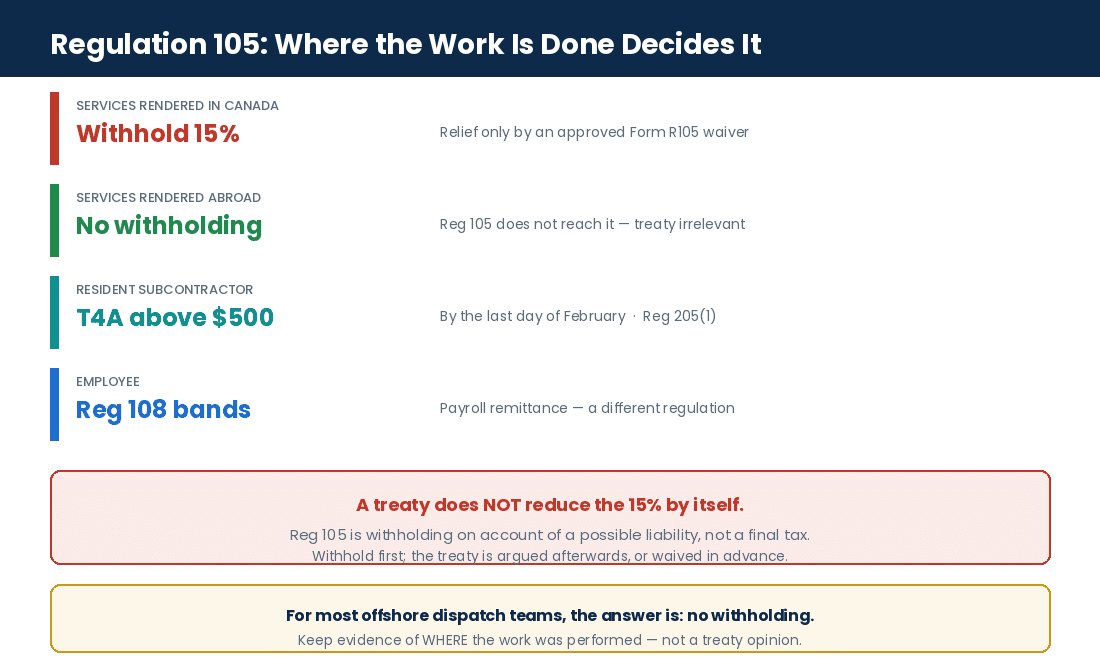
Risk Warning: “15% withheld unless a treaty says otherwise” describes the wrong mechanism. Regulation 105, under paragraph 153(1)(g), requires 15% to be withheld from a fee paid to a non-resident for services rendered in Canada. It is withholding on account of a possible Canadian tax liability, not a final tax.
A treaty may ultimately mean no tax is owed — but it does not relieve you of withholding. Relief comes from an approved waiver on Form R105, applied for in advance, or the non-resident files a Canadian return and recovers it. Withhold first; the treaty is argued afterwards.
| Where the work is performed | Regulation 105 applies? |
|---|---|
| In Canada, by a non-resident | Yes — 15%, unless a waiver is approved first |
| Outside Canada, by a non-resident | No — the regulation does not reach it at all, treaty or no treaty |
| In Canada, by a resident contractor | No Reg 105; a T4A above $500 instead |
For most dispatch agencies using offshore staff who never set foot in Canada, the answer is that Regulation 105 does not apply — so the documentation you need is proof of where the work was done, not a treaty analysis.
Test (a) of 18(12) Needs No Exclusive Room
Risk Warning: “only if you use part of your home just for work, regularly and exclusively” is half of one test and none of the other. Subsection 18(12) gives two alternative tests.
Test (a): the workspace is your principal place of business — no exclusivity required. Test (b): exclusive use and clients met there on a regular and continuous basis. A dispatcher running the business from a desk at home satisfies test (a), and the carriers they serve are never in the room.
The deduction cannot create or increase a loss, with the excess carried forward under paragraph 18(12)(c) against income from the same business. An incorporated dispatcher pays rent to the shareholder under a written agreement rather than claiming under 18(12) at all.
An incorporated dispatcher had been “deducting” roughly $60,000 of annual dividends alongside a modest salary.
Dividends are paid from after-tax profit and are not deductible. The corporate return had been understating taxable income by the full dividend every year, and the reassessment covered three of them. Figures changed for privacy.
Truck Dispatch Business Taxes: An Overview
Truck Dispatch Business Taxes: An Overview
Foundations
Key Tax Obligations for Truck Dispatchers
| Obligation | Rule | Provision |
|---|---|---|
| GST/HST registration | $30,000 of taxable supplies over four consecutive quarters, or in a single quarter | ETA 148; requirement in 240(1) |
| Non-resident services performed in Canada | 15% withheld, waiver on Form R105 | Reg 105; ITA 153(1)(g) |
| Non-resident services performed outside Canada | No withholding | Reg 105 does not apply |
| Resident subcontractors | T4A above $500, last day of February | Reg 200(1); 205(1) |
| Employees | Income tax, CPP and EI withheld and remitted by band | ITA 153; Reg 108 |
Payroll remittance sits in Regulation 108. Regulation 105 is a different rule entirely — withholding on non-resident service fees — and the two are routinely confused.
How CRA Views Dispatch Income and Expenses
- Dispatch fees are taxable income under section 9, included when receivable under paragraph 12(1)(b).
- Freight revenue belongs to the carrier, not the dispatcher. You report your fee, gross, whether it is a flat charge or a percentage. Netting a settlement understates revenue and will not reconcile to your GST/HST returns.
- Whether a receipt is yours or the carrier’s turns on agent versus principal — who contracts with the shipper, who bears the credit risk, whose authority moves the freight.
- Deductions follow paragraph 18(1)(a), subject to reasonableness in section 67.
Importance of Accurate Bookkeeping and Accounting for Dispatch Businesses
Books and records are kept six years from the end of the taxation year to which they relate, under paragraph 230(4)(b) — not six years from filing. Subsection 230(1) is the requirement to keep them, and section 286 of the Excise Tax Act imposes the same period for GST/HST records.
Specialized Tax Considerations for Incorporated Versus Sole Proprietor Dispatch Services
| Item | Sole proprietor | Corporation |
|---|---|---|
| Return | T1 with form T2125 | T2 with GIFI Schedules 100, 125, 141 |
| Filing deadline | 15 June | Six months after fiscal year-end |
| Payment deadline | 30 April | Two months; three for an eligible CCPC, ITA 157(1)(b) |
| Instalments | 15 March, 15 June, 15 September, 15 December over $3,000 | Last day of each month, or quarter for an eligible CCPC |
| Home workspace | Claimed under 18(12) | Rent paid under a written agreement |
| Owner pay | Draws, not deductible | Salary deductible; dividends not |
| CPP | Both halves on Schedule 8 | Employer and employee shares through payroll |
| Tax rate | Personal graduated rates | 12.2% in Ontario on the first $500,000 |
A sole proprietor does not get fewer deductions than a corporation. The rules in paragraph 18(1)(a) are the same, both claim capital cost allowance, and the sole proprietor additionally has the 18(12) workspace deduction that a corporation cannot use. What differs is the rate, the timing and the administration.
Common Tax Deductions and Expenses for Truck Dispatch Businesses
Common Deductions and Expenses
Deductions
Typical Expenses Eligible for Deduction
- Load board and dispatch software subscriptions.
- Offshore and domestic staff costs, with the location of the work documented.
- Vehicle costs attributable to dispatch duties.
- Office supplies, phone and internet, apportioned where mixed.
- Professional fees, insurance and association dues.
Home Office Expenses: What Qualifies and How to Claim
Subsection 18(12) gives two alternative tests: (a) the workspace is your principal place of business, with no exclusivity requirement; or (b) exclusive use and regular client meetings at the space. A dispatcher working from home almost always relies on test (a), which does not require a dedicated room.
| Cost | Renter | Owner |
|---|---|---|
| Rent | Business share | — |
| Heat, electricity, water | Business share | Business share |
| Home insurance | Business share | Business share |
| Property tax | — | Business share |
| Mortgage interest | — | Business share — interest only, never principal |
| Maintenance on the workspace | Business share | Business share |
| Capital cost allowance on the home | — | Do not claim — it can expose that share to a taxable capital gain on sale |
Apportion by area, reduced further by time where the space is shared with the household. A 150 square foot office in a 1,000 square foot home is 15%; if that room is also the family den for half its waking hours, the claim is lower again. The deduction cannot create or increase a loss, with the excess carried forward under 18(12)(c).
Dispatch Software and Technology
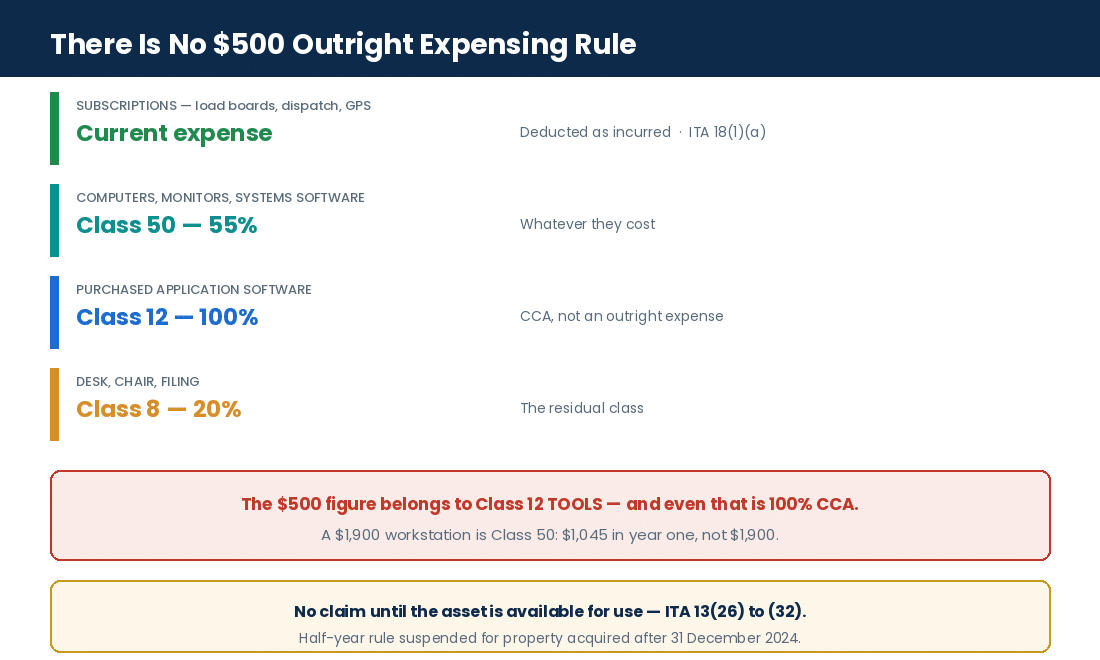
Risk Warning: “software bought outright under $500 can be expensed right away” is not a rule. Purchased application software is Class 12 at 100% — which is capital cost allowance, not an outright expense. The $500 figure belongs to Class 12 tools, a separate entry.
Either way it is CCA rather than a current deduction, and the claim is gated by the available-for-use rule in subsections 13(26) to (32).
| Item | Treatment | Rate |
|---|---|---|
| Subscriptions — load boards, dispatch software, GPS | Current expense | Deducted as incurred |
| Purchased application software | Class 12 | 100% |
| Computers, monitors, systems software | Class 50 | 55% |
| Desk, chair, filing | Class 8 | 20% |
| Tools costing under $500 | Class 12 | 100% |
The half-year rule is suspended for eligible property acquired after 31 December 2024 under Bill C-15, so a full first-year rate currently applies where it would once have been halved. Subscriptions that straddle a year-end are apportioned under subsection 18(9).
Vehicle-Related Operating Expenses
- Fuel, insurance, maintenance, registration and lease payments, apportioned on business kilometres.
- A logbook showing date, destination, purpose and kilometres; the simplified method allows a full base year then a three-month sample, provided business use stays within 10 percentage points.
- A passenger vehicle is Class 10.1 above the prescribed capital cost limit, with no recapture or terminal loss; otherwise Class 10 at 30%.
- Lease payments on a passenger vehicle are capped by section 67.3.
- Interest on a vehicle loan is restricted by paragraph 67.2.
- Travel between home and a regular place of business is personal.
Office Supplies, Communications and Membership Fees
Supplies consumed are deducted as used. Phone and internet apportioned on documented business use. Trade and professional association dues are deductible under 18(1)(a); dining, recreation and sport club dues are denied outright by paragraph 18(1)(l) — which is a provision, not a judgement call.
Legal, Accounting and Professional Fees
Fees for carrier contracts, bookkeeping, GST/HST support and corporate tax work are deductible under paragraph 18(1)(a). Legal fees on a capital transaction are capital; incorporation costs are deductible up to $3,000 under paragraph 20(1)(b), with the excess to Class 14.1. Fines and penalties are denied by section 67.6, and meals and entertainment are limited to 50% of actual cost by section 67.1 — with no per-person cap.
A dispatcher had abandoned the workspace claim entirely because the desk sat in a shared living room.
Under test (a) of 18(12) the home was the principal place of business and exclusivity was irrelevant. The claim was simply reduced for shared use by time rather than lost. Roughly $2,900 a year had gone unclaimed. Figures changed for privacy.
Strategies to Maximize Truck Dispatch Tax Write-Offs
Strategies to Maximize Write-Offs
Strategy
How to Organize and Track Truck Dispatch Business Expenses Effectively
- Receipts, invoices, bank statements and carrier agreements captured as they arise.
- Fee income tracked separately from freight revenue, so the gross figure is always visible.
- QuickBooks Online or Xero with bank feeds reconciled monthly.
- Expense categories fixed at entry rather than sorted in April.
- Mixed-use items tagged with the apportionment basis at the point of entry.
Using Capital Cost Allowance for Depreciable Assets
- Add the asset to its class at full cost under Schedule II, with rates in Regulation 1100.
- Check available for use under subsections 13(26) to (32) — an unopened box at 31 December generates nothing.
- Apply the class rate on the declining balance: Class 50 at 55% for computers, Class 8 at 20% for furniture, Class 12 at 100% for software and tools under $500.
- Apply the business-use percentage to the resulting claim.
- No halving: the half-year rule is suspended for eligible property acquired after 31 December 2024.
Worked example. A $2,400 workstation used 90% for dispatch, acquired in 2026: $2,400 × 55% × 90% = $1,188 in year one. Figures changed for privacy.
Claiming Fuel and Travel Expenses
- Kilometres logged per trip with date, destination and purpose.
- Fuel, maintenance and insurance apportioned on that log.
- Meals on the road at 50% of actual cost under section 67.1.
- Parking and tolls on business trips, with receipts.
- Personal travel excluded, including the commute to a regular place of business.
Leasing Versus Buying Equipment
| Route | Deduction | Qualification |
|---|---|---|
| Lease | Payments deducted as incurred under 18(1)(a) | Apportioned across periods under 18(9); a passenger vehicle lease is capped by section 67.3 |
| Buy | Capital cost allowance by class | From the available-for-use date, at the full rate with the half-year rule suspended |
Lease payments are deducted as incurred rather than simply “when paid” — the distinction matters where a payment covers a period that straddles the year-end, which subsection 18(9) apportions.
Managing Subcontractor Payments
- Classification tested on the Wiebe Door factors as refined in Sagaz and Connor Homes: control, tools, chance of profit, risk of loss. CRA Guide RC4110, with a ruling on Form CPT1.
- Resident subcontractors: T4A above $500, by the last day of February under Regulation 205(1).
- Non-resident, services performed in Canada: 15% withheld under Regulation 105, with relief only by an approved waiver on Form R105.
- Non-resident, services performed outside Canada: no withholding — keep the evidence of location.
- Misclassification produces assessed source deductions for both shares, plus penalty under subsection 227(9) and director liability under 227.1.
- Electronic filing mandatory above five information returns of a type.
Benefits of Incorporating
- Small business deduction under section 125: 12.2% combined in Ontario on the first $500,000 of active business income.
- Limited liability, separate from the tax question.
- Salary deductible and creating RRSP room; dividends not deductible and tested under TOSI in section 120.4, where the excluded shares exception is unavailable to a services business.
- Accrued remuneration paid within 179 days of year-end under subsection 78(4).
- Shareholder loans repaid within one year after the corporation’s year-end under subsection 15(2.6).
- The advantage is deferral where profit is retained; drawing everything out largely neutralises it.
An agency paid roughly $70,000 a year to a team working entirely from outside Canada and withheld 15% throughout, on the view that a treaty might not apply.
Regulation 105 reaches services rendered in Canada. None were. The withholding was never required, and the remittances had to be recovered. Figures changed for privacy.
Filing Taxes for Truck Dispatch Businesses in Canada
Filing, Deadlines and GST/HST
Filing
Steps to Prepare and File Accurately
- Separate dispatch fee income from carrier freight revenue, whether charged flat or as a percentage.
- Code expenses: software, phone, workspace, vehicle, advertising, insurance, professional fees.
- Reconcile fee income to settlement reports.
- Classify each worker before the slip run.
- Build the capital cost allowance schedule by class with business-use percentages.
- Review mixed-use splits and document the basis.
- Reconcile GST/HST collected against input tax credits.
Deductions rest on paragraph 18(1)(a) with reasonableness in section 67. Paragraph 20(1)(p) is the bad debt provision and has nothing to do with general deductibility or advertising.
Key Filing Deadlines and Requirements
| Obligation | Deadline | Provision |
|---|---|---|
| Self-employed T1 with T2125 | 15 June; balance 30 April | ITA 150(1); 156.1(4) |
| Corporate T2 | Six months after fiscal year-end | ITA 150(1)(a) |
| Corporate balance of tax | Two months; three for an eligible CCPC | ITA 157(1)(b) |
| GST/HST returns | Annual to $1.5M; quarterly to $6M; monthly above | ETA 228 for remittance |
| T4 and T4A slips | Last day of February | Reg 205(1) |
| Records | Six years from the end of the taxation year | ITA 230(4)(b) |
Payroll Remittance Bands
Risk Warning: “within 15 days after month-end, or next day for big employers” compresses four bands into two and gets both wrong. The schedule is set by your average monthly withholding amount under section 153 and Regulation 108 — not Regulation 105.
| Remitter type | Average monthly withholding | Due |
|---|---|---|
| Quarterly | Under $1,000 with a perfect compliance record | 15th of the month after the quarter |
| Regular | Under $25,000 | 15th of the following month |
| Accelerated, threshold 1 | $25,000 to $99,999.99 | 25th of the same month; 10th of the following |
| Accelerated, threshold 2 | $100,000 or more | Within 3 working days of each quarter-month period |
Penalties
- Late filing: 5% of unpaid tax plus 1% per complete month to twelve, subsection 162(1) — not $100 per day.
- Arrears interest: compounded daily, subsection 161(1).
- Late payroll remittance: 3% to 10% by lateness, subsection 227(9).
- Late GST/HST filing: 1% plus 0.25% per month, section 280.1 — again, no daily $100 charge.
- Failure to file electronically: $250, subsection 162(7.2).
GST/HST Registration and Filing
The threshold is section 148 of the Excise Tax Act, measuring taxable supplies, with registration required by subsection 240(1). Section 123(1) is definitions. Two routes cross it: four consecutive quarters, or a single quarter, which ends small supplier status immediately with 29 days to register.
- Dispatch fees are taxable supplies. The zero-rating for international freight transportation in Schedule VI, Part VII applies to the carriage, not to your dispatch fee — so a cross-border load does not make your fee zero-rated.
- Place of supply for a service generally follows the recipient’s address under Schedule IX and the Place of Supply Regulations.
- Input tax credits under section 169, with documents to the 169(4) thresholds: over $30 the supplier’s name and date; over $150 the registration number, your name, terms and a description. Claims lost after four years.
- Meals credits recaptured to 50% to match section 67.1.
Common Filing Mistakes
- Not charging GST/HST after crossing the threshold, particularly on the single-quarter route.
- Reporting fee income net of settlements rather than gross.
- No evidence of where offshore work was performed.
- Abandoning the workspace claim over an exclusivity rule test (a) does not impose.
- Expensing capital items instead of classifying them.
- Deducting dividends.
How Gondaliya CPA Supports Dispatch Businesses
Fee income separated from carrier revenue, offshore work location documented, the capital cost allowance schedule built by class, workspace measured under the right limb of 18(12), remittance band set correctly, and the GST/HST, payroll and T1 or T2 filed from one reconciled set of books — on a flat annual fee including HST.
An agency reported roughly $140,000 of dispatch fees net of what it passed through to carriers.
The fee is the revenue, reported gross. Netting it understated the top line, hid the GST/HST base, and meant the figure on the return never agreed to the settlement reports — which is what prompted the review. Figures changed for privacy.
Financial Planning and Support for Truck Dispatch Operators
Financial Planning and Support
Planning
Budgeting for Operating Expenses and Tax Liabilities
- Personal and business spending separated, with a dedicated account and card.
- Recurring costs tracked monthly: software, load boards, phone, insurance.
- Tax set aside as fee income is received rather than found at year-end.
- Receipts captured at the point of spend.
Planning Cash Flow Around Tax Payments and Refund Timelines
| Payment | When | Trigger |
|---|---|---|
| Personal balance of tax | 30 April | Always, for a self-employed dispatcher |
| Personal instalments | 15 March, 15 June, 15 September, 15 December | Net tax owing over $3,000, ITA 156.1(2) |
| Corporate balance of tax | Two months; three for an eligible CCPC | Always, ITA 157(1)(b) |
| Corporate instalments | Last day of each month, or quarter for an eligible CCPC | Taxes payable over $3,000, ITA 157(2.1) |
| GST/HST | By assigned frequency | Annual to $1.5M; quarterly to $6M; monthly above |
On refund timelines, CRA does not publish a guaranteed turnaround; an electronically filed return with direct deposit is generally processed faster than a paper one, and a figure such as “about eight weeks” is an expectation rather than a rule. The corporate balance date is the one that catches dispatch operators, because it falls months before the return and produces no penalty notice — only daily compound interest under subsection 161(1). Tax money held in a separate account, with software reminders on both dates, removes most of the problem.
Insurance Premiums and Other Mandatory Costs
- Commercial general liability and errors and omissions premiums, deductible under 18(1)(a) with subsection 18(9) allocating across the policy period.
- Municipal business licences where required.
- Employer health taxes where they apply — Ontario EHT and the equivalents in Manitoba and British Columbia, each with its own exemption and rate.
- Workers’ compensation registration per province, separate from payroll.
- Fines and penalties are denied by section 67.6, however they arise.
Using Tax Savings to Reinvest
Upgraded dispatch software, marketing, training and workspace improvements are all deductible under paragraph 18(1)(a) where incurred to earn income. Advertising is deductible under 18(1)(a) — not paragraph 20(1)(p), which is bad debts — with sections 19 and 19.1 restricting advertising placed in non-Canadian newspapers and broadcasters.
Importance of Professional Bookkeeping Services for Dispatch Operators
What a licensed firm adds is the judgement rather than the data entry: gross versus net on settlements, which limb of 18(12) applies, whether Regulation 105 reaches a payment, which remittance band you sit in, and whether an asset is Class 50 or Class 8. Compiled statements under CSRS 4200 provide no assurance — where a lender or factoring company needs more, that is a review or audit engagement and a different piece of work.
Financing Options for Growing Dispatch Companies
- Small business loans and operating lines, where interest is deductible under paragraph 20(1)(c) on the use of the borrowed money.
- The Canada Small Business Financing Program, which covers equipment and leasehold improvements rather than working capital.
- Equipment leasing, deducted as incurred under 18(1)(a) with 18(9) apportionment.
- Invoice factoring, where the discount is a deductible cost and the gross fee remains the revenue figure.
An incorporated agency with a 31 August year-end filed its T2 each February and paid the balance with it.
As a CCPC claiming the small business deduction the balance had been due 30 November. Three months of daily compound interest every year, on returns that were never late and never penalised. Figures changed for privacy.
Case Examples and Practical Advice from Gondaliya CPA
Case Examples and Year-End Preparation
Examples
Real-World Examples of Deduction Applications
A solo dispatcher charging owner-operators a weekly flat fee deducts software subscriptions, the business share of phone and internet, and the workspace, with invoices and logs behind each. The fee is taxable income under section 9; the freight revenue it generates is the carrier’s.
An agency using offshore staff keeps evidence of where the work was performed, because that single fact decides whether Regulation 105 applies at all. Work done entirely outside Canada is outside the regulation, whatever treaty exists. Work done in Canada attracts 15% withholding unless a waiver is approved in advance on Form R105.
How Home Office Deductions Made a Difference
A 150 square foot office in a 1,000 square foot home is 15% of eligible household costs. Where the room is shared with the household, that percentage is reduced again by the proportion of time it is used for the business. Keep a floor plan or measurements, the utility and rent or mortgage statements, and the calculation itself.
Under test (a) of subsection 18(12) the space need not be used exclusively for the business — only the apportionment changes. Owners claim the business share of mortgage interest, never principal, and should not claim capital cost allowance on the home, since doing so can expose that portion to a taxable capital gain on sale.
Dispatch Software and Tools: Tax Benefits Illustrated
| Item | Monthly cost | Business use | Deductible |
|---|---|---|---|
| Dispatch software subscription | $120 | 100% | $120 |
| Load board subscription | $75 | 100% | $75 |
| Phone plan | $80 | 60% | $48 |
Figures changed for privacy. Where you are registered, the GST/HST on each is also an input tax credit under section 169 to the extent of commercial use. Unreasonable claims are reduced under section 67 — which has no subsection (1) doing this.
Addressing Complex Situations: Incorporating Dispatch Services
- T2 filed within six months, with the balance at two or three months.
- Computers in Class 50 at 55%; furniture in Class 8 at 20%; purchased software in Class 12 at 100%.
- Regulation 105 tested on where the work was performed, with voluntary disclosure under IC00-1R6 available before CRA makes contact.
- Owner pay set between salary and dividends — salary deductible, dividends not — with TOSI under section 120.4 tested where family hold shares.
- Shareholder balances tracked against the 15(2.6) window and the imputed interest benefit in 80.4(2).
- Schedule 1 reconciling accounting income to taxable income, with non-deductible items added back.
Year-End Preparation Checklist
- Separate fee income from freight revenue and reconcile to settlement reports.
- Check the section 148 threshold on both routes.
- Collect software and subscription invoices.
- Confirm worker status before the slip run; T4A above $500.
- Document where offshore work was performed.
- Measure the workspace and record the apportionment.
- Match equipment invoices to available-for-use dates.
- Split phone and internet on documented usage.
- Apply the 50% meals restriction at year-end rather than at entry.
- Diarise the payment date separately from the filing date.
A dispatcher expensed a $1,900 workstation in full, having read that equipment under a certain amount can be written off.
There is no such threshold. It is Class 50 at 55%, giving $1,045 in year one with the half-year rule suspended. The money is all deductible eventually — the cash-flow planning behind it was not. Figures changed for privacy.
FAQs on Truck Dispatch Business Tax Deductions Canada
Frequently Asked Questions
FAQ
What is the record retention period for truck dispatch businesses?+
Six years from the end of the taxation year to which the records relate, under paragraph 230(4)(b) — not six years from filing. Subsection 230(1) is the requirement to keep them. Section 286 of the Excise Tax Act imposes the same for GST/HST records.
When is the T2 corporate return due?+
Within six months of fiscal year-end under paragraph 150(1)(a). But the balance of tax is due at two months, or three months for a CCPC claiming the small business deduction, under paragraph 157(1)(b). Paying with the return means months of daily compound interest with no penalty notice to warn you.
Are meals and entertainment deductible?+
50% of actual cost under section 67.1, with the input tax credit recaptured to 50%. There is no per-person cap — the restriction is half of what was spent. Subsection 67.1(3) deems $50 per day to be food where a conference fee does not state it separately.
Percentage fee or flat fee — does it change the tax?+
No. Both are dispatch fee income under section 9, reported gross when receivable under 12(1)(b), and both are taxable supplies for GST/HST. What changes is the arithmetic, not the treatment. A percentage fee must never be reported net of the carrier’s settlement.
How are offshore contractors taxed?+
By where the work is performed. Services rendered in Canada by a non-resident attract 15% withholding under Regulation 105, and a treaty does not reduce that by itself — relief requires an approved waiver on Form R105, or the non-resident files a Canadian return. Work performed outside Canada is outside the regulation entirely.
What is a taxable supply in a dispatch business?+
Your dispatch fee. Registration is required once taxable supplies pass $30,000 under section 148 of the Excise Tax Act, with the requirement in subsection 240(1). Section 123(1) is definitions, not the threshold.
Is my dispatch fee zero-rated on a cross-border load?+
No. The zero-rating in Schedule VI, Part VII applies to international freight transportation — the carriage itself. Your dispatch service is a separate taxable supply, and the fact that the load crosses a border does not change that.
How does mixed use affect vehicle and workspace claims?+
Claim only the business portion, with the basis documented. Vehicles: a logbook with date, destination, purpose and kilometres, or the simplified base-year-plus-sample method within 10 percentage points. Workspace: area, reduced by time where the space is shared. Mixed-use allocation is a factual exercise, not a rule in IT-533R, which concerns interest deductibility.
When is an asset considered available for use for capital cost allowance purposes?+
Generally when it is first used, or at the start of the second taxation year after acquisition, whichever is earlier, under subsections 13(26) to (32). No capital cost allowance arises before that date — a workstation still boxed at year-end generates nothing.
What are the pros and cons of DIY dispatch accounting versus hiring a CPA firm?+
DIY works where income is simple and everything runs through one account. What a licensed firm adds is the judgement: gross versus net on settlements, which limb of 18(12) applies, whether Regulation 105 reaches a payment, and the remittance band. Only a licensed firm can issue a CSRS 4200 compilation report, and a non-CPA preparer cannot represent you before CRA.
Can I deduct dividends I pay myself?+
No. A dividend is a distribution of after-tax profit and is never deductible to the corporation. Salary is deductible, creates RRSP room and attracts CPP. Dividends are instead tested under TOSI in section 120.4 where family hold shares.
Do I need an exclusive room for the home office?+
Not under test (a) of subsection 18(12), which asks only whether the home is your principal place of business. Test (b) does require exclusive use, but also requires clients to be met there regularly — which a dispatcher serving carriers remotely cannot satisfy, making test (a) the route.
What is the penalty for filing late?+
Subsection 162(1): 5% of unpaid tax plus 1% per complete month to twelve, doubling under 162(2) on a repeat within three years following a demand. There is no $100 per day late filing penalty. Late GST/HST filing is 1% plus 0.25% per month under ETA 280.1.
When are payroll remittances due?+
By band on your average monthly withholding amount, under section 153 and Regulation 108. Under $25,000 is regular: the 15th of the following month. $25,000 to $99,999.99 is accelerated threshold 1. $100,000 or more is threshold 2, within 3 working days of each quarter-month period.
Can I expense software bought outright?+
Not as a current expense. Purchased application software is Class 12 at 100% capital cost allowance, gated by the available-for-use rule. Subscriptions are different — those are current expenses deducted as incurred.
Should I lease or buy?+
Lease payments are deducted as incurred under 18(1)(a), apportioned across periods under subsection 18(9), with a passenger vehicle lease capped by section 67.3. A purchase goes to a CCA class. The difference is timing and cash flow rather than total deduction.
What triggers a CRA review?+
Fee income that does not agree to settlement reports or to the GST/HST returns, workspace percentages with no measurement behind them, offshore payments with no evidence of work location, missing T4A slips, expense ratios that jump year to year, and capital items expensed outright.
How do I catch up if records are behind?+
Rebuild from bank and card statements and carrier settlement reports, request duplicate invoices, and reconstruct the workspace measurement. File the oldest year first. Consider the Voluntary Disclosures Program under Information Circular IC00-1R6 before CRA makes contact, with relief under subsection 220(3.1) on Form RC4288 within ten calendar years.
What deliverables do you get from hiring Gondaliya CPA, and how much does it cost?+
Bookkeeping, GST/HST returns, payroll processing, compiled statements under CSRS 4200, the T1 or T2, and CRA correspondence, on a flat annual fee including HST quoted on your situation before work begins. What moves it is fee volume, whether you are incorporated, whether you engage offshore staff, how many carriers settle through you, and how many provinces you bill into.
Nineteen questions, and three of them — dividends, Regulation 105 and the workspace test — account for most of what we fix on a dispatch file.
One overstates a deduction, one creates a withholding obligation that never existed, and one gives up a claim that was always available. Figures changed for privacy.
Best Practices and Key Considerations for Truck Dispatchers
Essential Topics and Best Practices
Quick Reference
Additional Important Points on Truck Dispatch Taxes
- Top deduction mistakes: dividends treated as deductible, workspace abandoned over exclusivity, capital items expensed, settlements netted.
- What to prepare before starting: signed carrier agreements, bookkeeping software, a separate business account, and a method for separating fee income from freight revenue.
- Which items matter across expense groups: software, workspace, vehicle, subcontractors, phone and internet, insurance, professional fees, advertising, association dues, equipment.
- A realistic numeric walkthrough: measure the workspace, log the kilometres, and apply the percentage to documented costs rather than estimating the result.
- Choosing a CPA firm: look for trucking and dispatch experience, a flat fee quoted before work begins, and the ability to represent you before CRA.
Payroll and Tax Reporting Essentials
- Owner pay: salary deductible with payroll remitted; dividends not deductible; shareholder loans tracked against 15(2.6).
- Source deductions: income tax, CPP and EI, remitted by band under Regulation 108, with the employer matching CPP and paying EI at 1.4 times the employee premium.
- T4A slips: above $500 of fees for services, by the last day of February.
- Non-resident payments: Regulation 105 only where the work is performed in Canada.
- Late GST/HST: 1% plus 0.25% per month under ETA 280.1 — there is no daily $100 charge.
- Settlements: report the fee gross; never net it against freight revenue.
Points Worth Carrying
- Dividends are never deductible; salary is.
- Regulation 105 turns on where the work was performed, not on a treaty.
- Regulation 108 is payroll remittance; Regulation 105 is non-resident withholding.
- Test (a) of 18(12) requires no exclusive room.
- There is no $500 outright expensing rule for software or equipment.
- Computers are Class 50 at 55%; the half-year rule is suspended.
- Late filing is 162(1) at 5% plus 1% a month, not $100 a day.
- The corporate balance is due at two or three months.
- Dispatch fees are taxable; only the carriage can be zero-rated.
- Records run six years from the taxation year-end under 230(4)(b).
Twenty-one points, and the ten at the end are all things a dispatch operator was told confidently by something they read.
None is obscure. They are ordinary provisions with one regulation swapped for another, a penalty invented, or half a test quoted. Figures changed for privacy.
Businesses We Serve & Industry Spotlights
Industry Expertise
Dispatch practices share the same issues whatever they move. Here are ten and the usual finding.
| Practice | The Issue That Usually Appears |
|---|---|
| Solo dispatchers on flat weekly fees | Workspace claim abandoned over a supposed exclusivity rule |
| Percentage-fee dispatchers | Fee reported net of the carrier settlement |
| Agencies using offshore staff | Regulation 105 applied to work done outside Canada |
| Incorporated dispatch agencies | Dividends treated as a deduction |
| Dispatchers with employees | Remittance band read from the wrong row |
| Cross-border dispatch | Fee treated as zero-rated because the load crosses a border |
| Dispatchers running a vehicle | No logbook behind the business-use percentage |
| Recently equipped offices | Workstations expensed instead of classified |
| Dispatchers approaching $30,000 | Single-quarter registration route missed |
| Multi-province billing | One flat HST rate applied regardless of recipient |
- Solo dispatchers: test (a) needs no dedicated room.
- Percentage-fee dispatchers: the fee is the revenue, gross.
- Agencies using offshore staff: document where the work was done.
- Incorporated agencies: salary deducts, dividends do not.
- Dispatchers with employees: four bands, Regulation 108.
- Cross-border dispatch: Schedule VI Part VII covers carriage only.
- Dispatchers running a vehicle: log it, then apportion.
- Recently equipped offices: Class 50 at 55%.
- Dispatchers near the threshold: one quarter can cross it.
- Multi-province billing: the recipient’s address decides the rate.
Industry Spotlights: Sectors We Represent
Dispatch sits inside a wider transportation practice, and the same questions surface across every sector we act for. Here are eleven and the form the issue usually takes.
| Industry | The Angle |
|---|---|
| Transportation, logistics & trucking | Carrier settlements reconciled to dispatch fees |
| Construction, contractors & skilled trades | Vehicle logbooks and Class 10 versus 10.1 |
| Property developers & builders | Material haulage arranged through dispatch |
| E-commerce & online retailers | Last-mile and LTL freight arrangement |
| Restaurants & food and beverage | Refrigerated and time-sensitive loads |
| Real estate investors, landlords & holding companies | Yard and warehouse premises held separately |
| Technology startups & SaaS | Dispatch platforms and the software classes |
| Consulting firms | Incorporated owner-operators of the dispatch agency |
| Medical doctors & physician professional corporations | Specimen and supply courier arrangements |
| Dentists & dental practices | Lab and appliance transport scheduling |
| Daycare, childcare & CWELCC services | Supply delivery and programme procurement |
- Transportation, logistics & trucking: The core relationship. Dispatch fees are reported gross and must reconcile to the carrier settlement reports, because netting the two hides both the revenue and the GST/HST base.
- Construction, general contractors & skilled trades: Vehicles are the recurring issue, and Class 10 at 30%, Class 10.1 above the prescribed limit and Class 16 for heavy trucks are three different answers with a logbook behind each.
- Property developers & builders: Aggregate and material haulage is often arranged rather than owned, which puts the agent-versus-principal question squarely on the books.
- E-commerce & online retailers: Last-mile and less-than-truckload arrangement brings clients in several provinces, which puts Schedule IX place of supply into play on every invoice.
- Restaurants & food and beverage: Refrigerated and time-sensitive loads often carry accessorial charges, each of which is income when the service is performed and receivable.
- Real estate investors, landlords & holding companies: Yard and warehouse premises are frequently held in a separate corporation, which raises association under section 256 and one shared business limit.
- Technology startups & SaaS: Dispatch platforms sit across three treatments — subscriptions as current expense, purchased application software in Class 12, systems software with the hardware in Class 50.
- Consulting firms: Most dispatch agencies are owner-managed consultancies in substance, which brings the corporate balance date, TOSI and the shareholder loan window into their own file.
- Medical doctors & physician professional corporations: Specimen and supply courier arrangements are services supplied to a professional corporation, taxable on the dispatcher’s own registration status.
- Dentists & dental practices: Lab and appliance transport is scheduled rather than carried, so the fee is the revenue and the carriage belongs to whoever moves it.
- Daycare, childcare & CWELCC services: Supply delivery and programme procurement run on fixed-fee arrangements, where the cut-off at a year-end decides which period the fee falls in.
The freight changes. The questions do not: was the fee reported gross, where was the work performed, and which class is the asset in.
A refrigerated food dispatcher and a construction haulage dispatcher look nothing alike on the load board and file nearly identical returns. Figures changed for privacy.
Professional Guidance and Quick Reference
Guidance
Professional Guidance: How Gondaliya CPA Handles Your Dispatch Business
Truck dispatch businesses get into difficulty in a predictable set of ways: treating dividends as a deduction, when a dividend is a distribution of after-tax profit and only salary is deductible; withholding 15% under Regulation 105 on offshore staff who never work in Canada, or failing to withhold on those who do and relying on a treaty that does not relieve the obligation without an approved Form R105 waiver; confusing Regulation 105 with Regulation 108, which is payroll remittance and runs on four bands rather than “15 days after month-end”; abandoning the workspace claim over an exclusivity rule that test (a) of subsection 18(12) does not impose; expensing software or equipment on a $500 rule that does not exist, when purchased application software is Class 12 at 100% and computers are Class 50 at 55%; reporting percentage fees net of carrier settlements; budgeting for a $100 per day late filing penalty, when subsection 162(1) charges 5% plus 1% per month; treating a dispatch fee as zero-rated because the load crosses a border, when Schedule VI Part VII covers the carriage and not the arrangement; and paying the corporate balance with the return, when it was due at two or three months under 157(1)(b). Gondaliya CPA handles truck dispatch accounting on a flat annual fee.
We handle what decides the outcome: separating fee income from carrier revenue so the gross figure reconciles to the settlement reports, documenting where offshore work was performed before any withholding decision is made, setting the right remittance band, measuring the workspace under the correct limb of 18(12), classifying each asset from its available-for-use date with the half-year rule suspension applied, testing the section 148 threshold on both routes, applying place of supply per client, setting owner pay between salary and dividends with TOSI tested, diarising the balance date separately from the filing date, and preparing compiled statements under CSRS 4200 that state plainly that no assurance is provided.
Our team starts with one carrier agreement, a month of settlement reports and your last return. However you charge, you get clear advice and a fixed price before we start.
Quick Answers
At a Glance
- Salary: deductible
- Dividends: not deductible
- Reg 105: 15%, services in Canada only
- Reg 108: payroll remittance, four bands
- Workspace test (a): no exclusivity
- Computers: Class 50, 55%
- Purchased software: Class 12, 100%
- Half-year rule: suspended after 31 Dec 2024
- Meals: 50% of actual cost, ITA 67.1
- Threshold: $30,000, ETA 148
- Self-employed: file 15 June, pay 30 April
- Records: six years from the taxation year-end
Who This Is For
Fit Check
- For: Canadian truck dispatch businesses, sole proprietors and incorporated agencies, charging flat or percentage fees to carriers and owner-operators, including those working from home or engaging offshore staff.
- Not For: Carriers and owner-operators themselves, whose per-diem meal claims, fuel tax reporting and logbook rules differ throughout, and businesses requiring a review or audit engagement, which we refer out.
People Also Ask
Quick Answers
Can I deduct the dividends I pay myself?+
No. Dividends come out of after-tax profit and are never deductible. Salary is deductible to the corporation and creates RRSP room, at the cost of CPP and payroll remittances.
Do I withhold on my offshore dispatch team?+
Only where the services are performed in Canada. Regulation 105 does not reach work done entirely abroad, so the document you need is evidence of location rather than a treaty opinion.
Does a treaty reduce the 15%?+
Not by itself. Reg 105 withholding is required regardless; relief comes from an approved waiver on Form R105 applied for in advance, or the non-resident files a Canadian return and recovers it.
Is my fee zero-rated on an international load?+
No. Schedule VI, Part VII zero-rates the international freight transportation itself. Your dispatch fee is a separate taxable supply whether the load crosses a border or not.
Can I write off a laptop under $500?+
No such rule. Computers are Class 50 at 55% at any price. The $500 figure belongs to Class 12 tools, and even that is 100% capital cost allowance rather than an outright expense.
Glossary of Key Terms
Glossary
- Regulation 105: 15% withholding on non-resident fees for services rendered in Canada.
- Form R105: The waiver application that relieves that withholding in advance.
- Regulation 108: The payroll source deduction remittance schedule.
- Average monthly withholding amount: The figure that sets the remittance band.
- Subsection 18(12): The two alternative home workspace tests.
- Paragraph 18(12)(c): The carry-forward of unused workspace amounts.
- Class 50: Computers and systems software at 55%.
- Class 12: Purchased application software and tools under $500 at 100%.
- Class 10.1: A passenger vehicle above the prescribed capital cost limit.
- Available-for-use rule: Subsections 13(26) to (32).
- Section 67.1: The 50% meals and entertainment limitation.
- Section 67.6: Denies the deduction of fines and penalties.
- Section 148 (ETA): The $30,000 small supplier threshold.
- Schedule VI, Part VII: Zero-rating for international freight transportation.
- Agent versus principal: Decides whether a settlement is your revenue or the carrier’s.
- CSRS 4200: The compilation engagement standard, providing no assurance.
Truck Dispatch Tax Check
This quick self-check indicates where your business most likely has room. Please answer the five questions below.
Truck Dispatch Tax Check
Five quick questions on your business. No fee shown.
Points to raise with us:
This is a general prompt, not tax or legal advice or a quote. Your position depends on your full facts. For a real review, please book a free consultation.
Want a checklist to work from? You can download our free truck dispatch tax checklist before your consultation.
Stop treating dividends as a deduction, because they come from after-tax profit and only salary reduces corporate income. Decide Regulation 105 on where the work was performed rather than on whether a treaty exists, since work done entirely outside Canada is outside the regulation and work done inside it needs an approved Form R105 waiver before you can stop withholding. Set the payroll remittance band from your average monthly withholding under Regulation 108, which has four bands rather than the two usually quoted. Work from test (a) of subsection 18(12), where the home being your principal place of business carries no exclusivity requirement, and reduce the area percentage by time where the space is shared. Put computers in Class 50 at 55% and purchased software in Class 12, because there is no $500 outright expensing rule. Report dispatch fees gross and reconcile them to the settlement reports. Treat your fee as taxable even on a cross-border load, since the zero-rating covers the carriage. Pay the corporate balance at two or three months. And please keep six years of records from the year-end.
2026 Update — what is current: This article reflects rules current to 3 October 2026. The 15 June self-employed filing date with the 30 April payment date, the $30,000 threshold in section 148, the 50% meals limit in section 67.1, the $500 T4A threshold, the last-day-of-February slip deadline under Regulation 205(1), the 15% rate in Regulation 105 and the six-year retention requirement under 230(4)(b) are all unchanged. Please note that dividends are not deductible while salary is; that Regulation 105 reaches only services rendered in Canada and a treaty does not relieve the withholding without an approved Form R105 waiver; that payroll remittance under Regulation 108 runs on four bands set by the average monthly withholding amount; that subsection 18(12) provides two alternative tests, with test (a) requiring no exclusive use; that there is no $500 outright expensing rule, computers sitting in Class 50 at 55% and purchased application software in Class 12 at 100%; that the half-year rule is suspended for eligible property acquired after 31 December 2024 under Bill C-15; that the corporate balance of tax is due at two months under 157(1)(b), or three for a CCPC claiming the small business deduction; that late filing is penalised under subsection 162(1) at 5% plus 1% per month rather than any daily amount; and that zero-rating under Schedule VI, Part VII applies to international freight transportation and not to dispatch fees. No change to offshore staffing withholding takes effect in 2026.
Truck Dispatch Business Tax Deductions Canada: How Gondaliya CPA Supports Dispatchers
Start with one carrier agreement and a month of settlement reports
Gondaliya CPA separates fee income from carrier revenue so the gross figure reconciles, documents where offshore work was performed before any withholding decision, sets the right remittance band, measures the workspace under the correct limb of 18(12), classifies each asset from its available-for-use date, tests the section 148 threshold on both routes, sets owner pay between salary and dividends with TOSI tested, and files the GST/HST, payroll and your T1 or T2 from one reconciled set of books — on a flat annual fee including HST with a one-business-day response. Please book a free consultation.
Next Steps
Please book a free consultation with Gondaliya CPA and bring one carrier agreement with its fee terms, a month of settlement reports, and your last return. Those three settle the gross-versus-net question, the offshore withholding question and the workspace question, which is where most of the exposure sits for a dispatch business. You will get a flat annual fee including HST before any work begins. We serve Toronto, Brampton, Mississauga, Vaughan, Ottawa and the rest of Ontario, and work with dispatchers and fleets across Canada. If our content helps, please add gondaliyacpa.ca as a preferred source on Google.
Published: · Last updated:
Editorial policy: We research against CRA, CPA Canada and CPA Ontario sources, fact-check the figures, and Sharad Gondaliya, CPA, reviews the content, which we update as the rules change.
Disclaimer: This article is educational information only and is not tax, legal, or financial advice. Figures marked illustrative are examples rather than quotes or guarantees. It reflects rules current to 2026, including the two workspace tests in subsection 18(12), the capital cost allowance classes in Schedule II, Regulation 105 withholding on non-resident services rendered in Canada, the payroll remittance bands in Regulation 108 and the six-year retention requirement in paragraph 230(4)(b). Rates and limits change and outcomes depend on your specific facts. Please consult a CPA Ontario member before acting.

Sharad Gondaliya is a CPA Canada & CPA USA with 15 Years+ experience of Accounting, Tax, Payroll of Corporate Small Businesses as Tax Accountant. He is a CPA Ontario member (61040184) and holds US CPA licences in Washington and Montana and is well known among corporate small businesses for tax planning, efficient tax solutions, and affordable CPA services. Sharad is the Principal (Director) of Gondaliya CPA – Affordable CPA Firm in Canada. Licenses: CPA Ontario: 61040184 | CPA USA (MT): PAC-CPAP-LIC-033176 | CPA USA (WA): 57629 | CPA Firm License: 61330051 View Full Author Bio