



CPA Compilation Report for Commercial Lease Applications in Canada: Financial Statements for Landlords
CPA compilation reports for commercial leases: the acceptance test, the basis of accounting note, and what no assurance actually means
CPA Compilation Report for commercial lease financial statements is essential for landlords and tenants in Canada to meet Canadian CPA standards, including CSRS 4200 compliance. This report involves compilation engagement with no assurance, covering basis of accounting, interim statements, and third-party use while ensuring landlord financial statements align with commercial tenancy legislation.
Quick Summary
CSRS 4200 has applied since fiscal periods ending on or after 14 December 2021 — no change arrives in 2026. The acceptance condition is not consent: a practitioner may compile information intended for a third party only where that third party is in a position to request and obtain further information from the entity. And a compilation produces compiled financial information carrying a basis of accounting note, each page marked “Unaudited — See Compilation Engagement Report.”
Reading time: 34 minutes.
Table of Contents
- Three Things You Have Been Told
- Understanding Compilation Reports for Commercial Leases
- Who Requires Financial Statements and the Decision Process
- What Compilation Engagements Cover
- Preparing for a Compilation Engagement
- What Landlords Look for in Submitted Statements
- Final Steps and Professional Support
- Frequently Asked Questions
- Key Points and Cost Drivers
- Businesses We Serve & Industry Spotlights
- Professional Guidance and Quick Reference
The Standards That Apply
This article covers Canada, with Ontario and Toronto context, and reflects standards current to 4 October 2026. It is written for incorporated small and medium businesses submitting financial information in support of a commercial lease application, and for the landlords, property managers and leasing agents who receive it. Gondaliya CPA performs compilation engagements only. We do not perform audits or review engagements, and where a landlord requires either we say so plainly and refer the work out. Nothing here is legal advice on a lease or on provincial tenancy legislation. This is educational information only and not tax, legal, or accounting advice for your specific facts.
Three Things You Have Been Told
Three Things You Have Been Told
The Corrections
Three points about compilation engagements circulate widely, including among accountants. All three are wrong, and the first one decides whether we can take the engagement at all.
It Is Not “Third-Party Usage Consent”
Risk Warning: “third-party usage consent” is not a term in CSRS 4200, and consent is not the test. Nobody signs anything to permit a compilation.
The acceptance condition is about access. A practitioner may accept a compilation engagement where the compiled financial information is intended for a third party only if that third party is in a position to request and obtain further information from the entity. The question is whether the landlord can ask you for more — not whether anyone agreed to anything.
| Situation | Can we compile? |
|---|---|
| Landlord reviewing your application, able to come back with questions | Yes — the ordinary case |
| Landlord contractually barred from contacting you further | No — a review or audit engagement instead |
| Information prepared for your own internal use only | Yes, and the acceptance condition does not arise |
| Landlord has specified audited statements | Not our engagement — we refer it out |
In practice almost every commercial lease application satisfies the condition, because a landlord assessing a prospective tenant can always ask for more. Where it fails, it fails for a structural reason, and the answer is a different engagement rather than a form to sign.
No CSRS 4200 Change Arrives in 2026
Risk Warning: “the CSRS 4200 changes coming in 2026” do not exist. CSRS 4200 replaced Section 9200 and the old Notice to Reader, and has applied to compiled financial information for fiscal periods ending on or after 14 December 2021.
The basis of accounting note, the acceptance condition and the “Compilation Engagement Report” title have all been in force since then. If a landlord or an adviser tells you the rules are about to change, the change they are describing already happened five years ago.
There is also no new requirement about “safe electronic delivery fitting newer standards after 2026.” Delivery method is a matter between you and your accountant.
The Assurance Words Are Specific
Risk Warning: “high” and “moderate” assurance are the wrong terms, and the wrong standards get cited constantly.
| Engagement | Standard | Assurance |
|---|---|---|
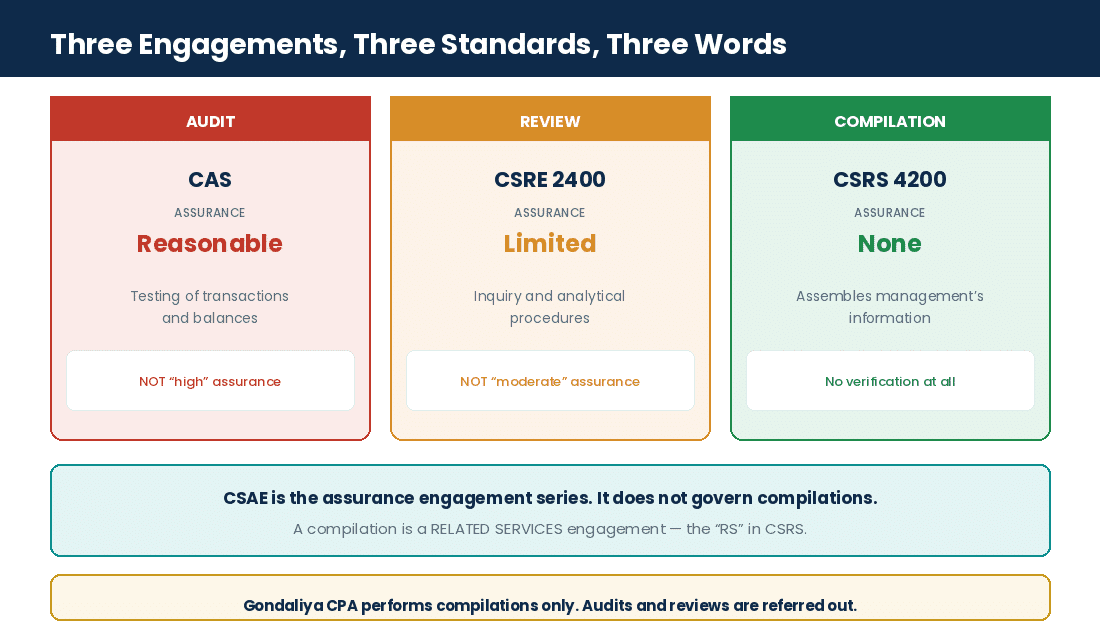
| Audit | CAS — Canadian Auditing Standards | Reasonable assurance, not “high” |
| Review | CSRE 2400 | Limited assurance, not “moderate” |
| Compilation | CSRS 4200 | None |
CSAE is the Canadian Standards for Assurance Engagements series, which covers other assurance work entirely — it has nothing to do with compilations. “CSA” is not an accounting standard-setter at all. A compilation engagement is a related services engagement, which is what the “RS” in CSRS stands for.
A tenant was told by a leasing agent that the deal was stalled pending “third-party usage consent forms” from the landlord.
No such form exists. The engagement could be accepted the moment it was clear the landlord could come back with questions, which they obviously could. The delay was entirely invented. Figures changed for privacy.
Understanding CPA Compilation Reports for Commercial Leases in Canada
Understanding Compilation Reports for Commercial Leases
Foundations
A CPA Compilation Report for a commercial lease application presents compiled financial information assembled by a CPA Ontario member from information supplied by management. Landlords ask for it when assessing whether a prospective tenant can carry the rent. It shows the shape of a business. It does not confirm that any figure in it is correct.
- Shows financial position as management reports it.
- Prepared by a CPA, with no assurance of any kind.
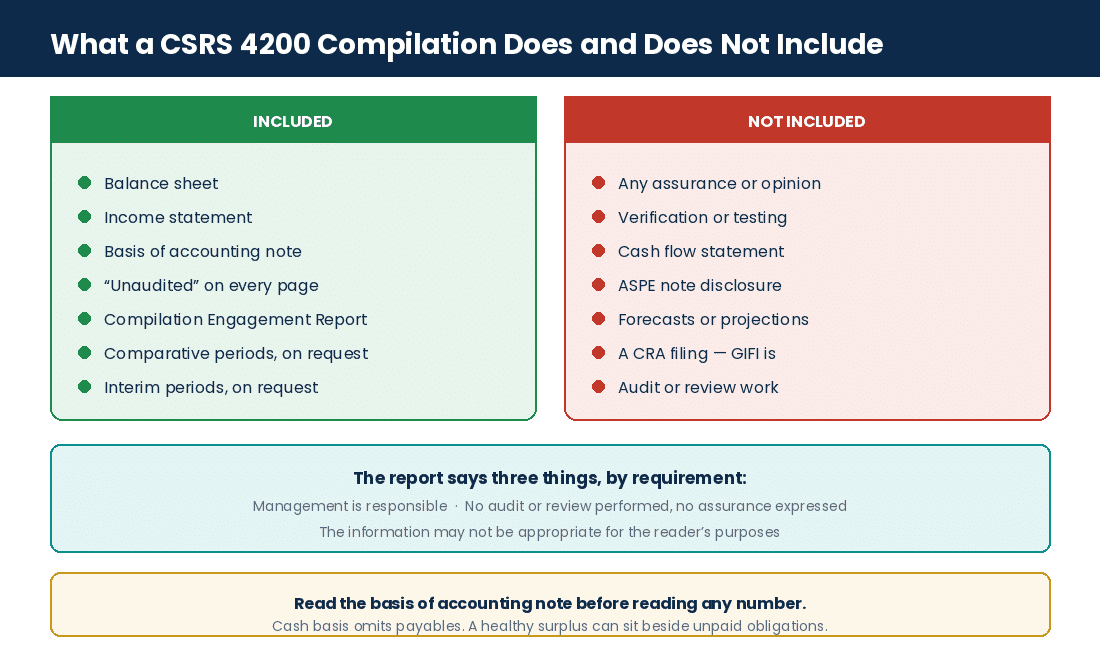
- Typically a balance sheet and income statement, with a basis of accounting note.
- No verification, no testing, no inquiry of third parties.
- Every page marked “Unaudited — See Compilation Engagement Report.”
The Role of Compilation Engagements in Lease Applications
Under CSRS 4200 the practitioner obtains knowledge of the entity’s business, its operations and its accounting system and records — enough to compile the information competently — and then assembles it. There is no obligation to verify, corroborate or test what management provides.
- Based on management’s information.
- No assurance given on accuracy or completeness.
- Used by landlords as one input into a tenant risk assessment.
- Says nothing about future performance.
One distinction gets lost: compiled financial information is not required to comply with a financial reporting framework such as ASPE. It is prepared on a basis of accounting, which the note describes. That is why the information usually carries no notes beyond that one, and often no cash flow statement at all.
Key Differences: Audit, Review, and Compilation Engagements
| Type of Engagement | Standard | Assurance Level | Purpose |
|---|---|---|---|
| Audit | CAS | Reasonable assurance | Opinion on fair presentation, supported by testing of transactions and balances |
| Review | CSRE 2400 | Limited assurance | Conclusion based on inquiry and analytical procedures, no testing |
| Compilation | CSRS 4200 | None | Assembles management’s information, with a basis of accounting note |
Some landlords want reviewed or audited statements instead of compilations. This firm only does compilations — no audits or reviews here. Where a landlord requires either, we say so at the outset and refer the engagement to a firm that performs it. Knowing which is being asked for clears up expectations early and avoids a wasted fee.
- Audits give reasonable assurance through testing.
- Reviews give limited assurance through inquiry and analysis.
- Compilations present information without verification.
Key Stat: the compilation engagement report must say three things. That management is responsible for the information and for the basis of accounting. That the practitioner has not performed an audit or a review and accordingly expresses no assurance. And that readers are cautioned the information may not be appropriate for their purposes.
That third sentence is the one landlords skip. It is in every compilation engagement report by requirement, not as boilerplate.
Who Requires Financial Statements and the Decision Process
Who Requires Financial Statements and the Decision Process
Scoping
Identifying Who Is Requesting Your Financial Statements
Landlords, property managers and leasing agents are the usual requesters. A landlord might want two years of income statements and balance sheets to look at profitability and liquidity; a property manager may ask again at renewal or on a rent review. Knowing who is asking, and what they will do with it, determines which engagement fits.
Matching Engagement Level to Lender or Landlord Requirements
- A compilation assembles what you provide and gives no assurance.
- An audit tests transactions and balances and gives reasonable assurance.
- A review uses inquiry and analytical procedures and gives limited assurance.
The acceptance condition turns on whether the landlord can request and obtain further information from you. It is about access, not permission, and no consent form is involved. Picking the right level stops you promising more than a compilation delivers and stops the landlord expecting verification that nobody performed.
Confirming Engagement Level Requirements in Writing
Get the requirement in writing from the landlord before work starts. It should say whether audited or reviewed information is required, how the information will be used, and who will receive it. An engagement letter then records the scope, management’s responsibilities, the limitations and the absence of assurance — which CSRS 4200 requires be agreed before the engagement begins.
Factors That Influence the Required Level
| Factor | Effect on Engagement Level |
|---|---|
| Entity type | Incorporated businesses usually have records that compile straightforwardly; a sole proprietor’s may need more preparation first |
| Lease size | A landlord carrying more exposure is more likely to ask for a review or an audit |
| Revenue | Higher revenue often prompts a request for verified figures |
| Third-party access | If the landlord cannot obtain further information from you, a compilation cannot be issued for their use |
Landlords generally look at revenue, profitability over time, equity, liabilities and liquidity. All of that appears in compiled information — presented as management reports it, on the basis the note describes.
A tenant submitted compiled information to a landlord who then asked why there was no cash flow statement and no notes.
Compiled financial information carries a basis of accounting note and generally nothing further. The landlord had been reading it as though it were ASPE financial statements. One sentence of explanation settled it. Figures changed for privacy.
What Compilation Engagements Cover for Commercial Leases
What Compilation Engagements Cover
The Standard
Overview of Compilation Engagements Under CSRS 4200
A compilation engagement assembles financial information the business provides. The practitioner obtains knowledge of the entity’s business, operations, accounting system and records, discusses the basis of accounting with management, and compiles. CSRS 4200 applies to historical financial information only.
A worked example: a store owner applying for space sends two years of compiled information prepared under CSRS 4200. The landlord reads it knowing no audit or review was performed and that no assurance is expressed.
Basis of Accounting and Its Relevance
The basis of accounting is how the business recorded its transactions — cash, accrual, or a basis described in the note. CSRS 4200 requires the compiled financial information to include a note describing the basis of accounting applied, and the compilation engagement report refers to it.
This matters because the two bases tell different stories. Cash basis information omits payables and receivables, so a business can look solvent on cash and carry significant unpaid obligations. A landlord reading cash basis information without noticing the note is reading something other than what they think.
General presentation requirements for ASPE financial statements sit in Section 1400 of Part II of the CPA Canada Handbook. Section 3400 is Revenue, and is not a presentation standard — a misattribution that circulates widely.
Third-Party Use and Acceptance Conditions
Where compiled financial information is intended for a third party, the practitioner may accept the engagement only if that third party is in a position to request and obtain further information from the entity. Where the third party cannot, the engagement cannot be accepted and a review or audit should be considered instead.
The purpose is protection on both sides: the reader is not left relying on unverified information with no route to ask questions, and the practitioner is not associated with information being used in a way it cannot bear.
Interim Statements, Comparative Figures, and Future-Oriented Information
- Interim compiled information covers a period shorter than a year and is common between year-ends.
- Comparative figures from a prior period help a landlord see direction of travel. CSRS 4200 does not require them.
- Future-oriented information — forecasts and projections — is outside the scope of CSRS 4200, which deals with historical information. It is not that forecasts are forbidden; they are a different kind of work under different guidance.
No Assurance Provided: What This Means
For landlords: you receive an organised summary of the business, with no practitioner confirmation of any figure, and you can ask the tenant for more. For tenants: you get a cost-effective way to present your finances, and you must never describe the result as audited or reviewed, because it is neither.
Common Misconceptions
- Audits test details and give reasonable assurance.
- Reviews use inquiry and analysis and give limited assurance.
- Compilations do neither and give none.
Where a landlord specifically requires audited or reviewed information, that is work this firm does not perform. We tell you plainly and refer it out.
A tenant’s compiled information was prepared on a cash basis and showed a healthy surplus. The landlord approved, then discovered roughly $180,000 of trade payables at signing.
Nothing was concealed. The basis of accounting note said cash basis on the face of the information, and cash basis does not report payables. Nobody had read the note. Figures changed for privacy.
Preparing for a Compilation Engagement
Preparing for a Compilation Engagement
Preparation
Importance of Up-to-Date Bookkeeping Before Starting an Engagement
Compiled information rests on a trial balance, ledgers, bank reconciliations and supporting documents. Where the books are behind, transactions get missed, balances are wrong, the work takes longer, and the practitioner cannot compile competently without first understanding what the records actually show. Bring the bookkeeping current before requesting the engagement.
Typical Timeline and Deadlines
One to three weeks from receipt of complete records is typical, depending on how complete the trial balance and bank statements are, how complex the business is, and whether prior-period comparatives are wanted. Commercial lease deadlines are set by the landlord rather than by any filing rule — compiled information is not a CRA filing. What CRA requires with a T2 is the GIFI schedules, not a compilation engagement report.
Costs and Bookkeeping Cleanup
Gondaliya CPA charges a flat annual fee including HST, quoted on your situation before any work begins. What moves it:
- Completeness of the records — missing data means cleanup first.
- Number of periods compiled.
- Complexity of the business; incorporated entities generally involve more than a sole proprietorship.
- Interim periods in addition to year-end.
- Turnaround time, where a rush is required.
Comparing Compilation, Review, and Audit Costs
| Engagement Type | Standard | Assurance | Relative Cost | Offered at Gondaliya CPA? |
|---|---|---|---|---|
| Compilation | CSRS 4200 | None | Lowest | Yes |
| Review | CSRE 2400 | Limited | Moderate | No — referred out |
| Audit | CAS | Reasonable | Highest | No — referred out |
Relative cost reflects the work involved rather than any quoted range. For most commercial lease applications a compilation is what the landlord actually needs.
Acceptance Criteria and When Audits Can Be Waived
A compilation can be issued for a landlord’s use where the landlord is able to request and obtain further information from the tenant. An audit is not required simply because a third party will read the information. Where a landlord does require audited information, we decline the engagement and refer it, because performing it would be outside what this firm does.
Special Considerations for Not-for-Profits and Registered Charities
- Not-for-profit organisations report under ASNPO, Part III of the CPA Canada Handbook, which has its own requirements including the treatment of contributions.
- Registered charities account for restricted funds under either the deferral method or the restricted fund method. A compilation describes the basis used; it assures nothing about stewardship.
- Charities file Form T3010 within six months of their fiscal year-end, separately from anything prepared for a landlord.
- Many incorporated NFPs have an audit or review requirement in their governing statute or bylaws regardless of what a landlord asks for.
Tell us upfront if you are an NFP or a registered charity so the basis of accounting note describes the position correctly.
Alignment With Canadian Standards and Tenancy Legislation
Compilation engagements follow CSRS 4200: no audit or review performed, no assurance expressed, the basis of accounting described in a note, and the information marked unaudited. Commercial leases themselves are governed by provincial legislation — in Ontario the Commercial Tenancies Act — which is a separate matter from the accounting standards and a question for a lawyer rather than a CPA.
A not-for-profit tenant requested a compilation for a lease, without mentioning that its own bylaws required an annual audit.
The compilation would have satisfied the landlord and left the organisation in breach of its own constating documents. The audit requirement came first, and the audited statements then served both purposes. Figures changed for privacy.
What Landlords Look for in Submitted Financial Statements
What Landlords Look for in Submitted Statements
The Reader
Landlords want steady revenue, liabilities under control and positive equity. Compiled information shows all three as management reports them. Because CSRS 4200 expresses no assurance, a landlord cannot treat any figure as verified — which is precisely why the standard preserves their ability to ask for more.
Standard Content in Lease Applications
Compiled information for a lease application typically includes a balance sheet and an income statement with the basis of accounting note. A cash flow statement is not standard in a compilation and is often absent. One year is workable; two gives the landlord a trend.
- Revenue, and where relevant the revenue tied to the leased premises.
- Operating costs and the resulting margin.
- Assets and liabilities, showing liquidity and leverage.
Best Practices for Security Deposit Tracking and Trust Reconciliation
This section applies to landlord-side records rather than tenant submissions. A landlord holding deposits should carry them as a liability, not as revenue, since the money is held against future obligations and is generally refundable.
- Record the deposit per tenant, with the lease it relates to.
- Where deposits are held separately, reconcile that account monthly to the ledger.
- Describe the treatment in the basis of accounting note.
- Note that commercial tenancies are not governed by residential legislation, so the interest and handling rules applying to residential deposits do not apply here. Your lease and the provincial commercial statute govern.
Owner Draws, Vendor Payments and Month-End Close
- Confirm all sales invoices are recorded before the period closes.
- Match vendor payments to invoices and purchase orders.
- Keep owner draws out of expenses; a draw reduces equity and is not a business cost.
- Reconcile bank and credit card accounts before the trial balance is handed over.
These are bookkeeping controls that make compiled information reliable for your own purposes. They do not convert it into an assurance engagement.
Choosing Accounting Software
QuickBooks Online, Xero and similar packages produce the trial balance and prior-period comparatives a compilation works from, and make the basis of accounting easy to identify. The benefit is fewer transcription errors and faster turnaround, not a higher level of assurance.
Avoiding Common Bookkeeping Mistakes
| Mistake | Impact |
|---|---|
| Calling compiled information “audited” | Misleads the landlord and misrepresents the engagement |
| Mixing personal and business finances | Obscures the actual position of the business |
| Using inconsistent fiscal year-end dates | Periods do not compare; figures look stale |
| Proceeding without an engagement letter | Scope and responsibilities undocumented, which CSRS 4200 requires |
| Submitting forecasts as compiled information | Outside the scope of CSRS 4200, which covers historical information |
| Removing the “Unaudited” marking | The marking is required on each page of compiled information |
A tenant retyped the compiled information onto their own letterhead for a cleaner-looking submission, dropping the “Unaudited — See Compilation Engagement Report” line and the basis of accounting note.
What reached the landlord was no longer compiled information at all. It was a spreadsheet with a CPA firm’s name on it, which is the one outcome the markings exist to prevent. Figures changed for privacy.
Final Steps and Professional Support
Final Steps and Professional Support
Next Steps
If You Are Unsure Which Engagement Level You Need
Start with what the landlord asked for in writing. A compilation organises your financial information and gives no assurance. If the landlord requires audited or reviewed information, this firm will tell you so and refer the engagement rather than attempt it.
Sending Requests and Documentation
Send the landlord’s written request together with your trial balance, bank statements, any prior compiled information and your corporate filings. That is enough to confirm the engagement can be accepted under CSRS 4200 and to scope the work. Early is better, because missing records are the usual cause of delay.
Additional Professional Services
Alongside the compilation we handle corporate tax filing and the T2, GST/HST returns, payroll, bookkeeping cleanup and CRA correspondence. Keeping those current makes each year’s compilation straightforward rather than a reconstruction exercise.
Transparent Cost Ranges and Service Descriptions
A flat annual fee including HST, quoted on your situation before work begins. The drivers:
- Records condition: clean records cost less, messy ones cost more.
- Periods requested: more periods, more work.
- Entity type: incorporated entities generally involve more than a sole proprietorship.
- Interim periods: additional to year-end, additional work.
- Turnaround: a rush carries a premium.
Keeping Up With Standards and Deadlines
CSRS 4200 has applied since fiscal periods ending on or after 14 December 2021, and no amendment takes effect in 2026. What does matter on timing is your own corporate filing position: unfiled returns make it harder to compile information that agrees to anything, and a landlord asking for two years will expect two years that reconcile.
Final Thoughts on Meeting Lease and Landlord Requirements With Confidence
A compilation presents organised historical financial information without audit-level checking. Understanding that — and making sure the landlord understands it — is most of the job. The errors that cause trouble are mislabelling compiled information as audited, mixing personal and business figures, and submitting forecasts where historical information was requested.
A tenant was three years behind on corporate filings and asked for two years of compiled information for a lease.
The information could be compiled, because a compilation does not depend on returns being filed. But the figures would not have agreed to anything CRA held, and the landlord asked. Bringing the filings current first took longer and was the right order. Figures changed for privacy.
Frequently Asked Questions
Frequently Asked Questions
FAQ
What is third-party usage consent in a CPA compilation report?+
There is no such thing, and no form to sign. The acceptance condition in CSRS 4200 is about access: where compiled financial information is intended for a third party, the practitioner may accept the engagement only if that third party is in a position to request and obtain further information from the entity. A landlord assessing your application almost always is.
Who signs and delivers the compilation report?+
The licensed CPA prepares and signs the Compilation Engagement Report and delivers it to you as the client. You submit it to the landlord or property manager. The information must carry “Unaudited — See Compilation Engagement Report” on each page, and that marking stays on whatever you forward.
Can I include projections or future-oriented information?+
Not in a compilation. CSRS 4200 applies to historical financial information, so forecasts and projections fall outside its scope — they are not forbidden, they are simply a different kind of engagement under different guidance. If a landlord wants forward-looking figures, that is a separate conversation.
What is an engagement letter and why does it matter?+
It records the scope, management’s responsibilities, the practitioner’s responsibilities, the limitations, the intended use and the fact that no assurance will be expressed. CSRS 4200 requires the terms to be agreed and documented before the engagement begins. It protects both sides by making expectations explicit in advance.
How do audits and reviews differ from compilations?+
An audit under CAS gives reasonable assurance after testing transactions and balances. A review under CSRE 2400 gives limited assurance through inquiry and analytical procedures. A compilation under CSRS 4200 gives none. The terms “high” and “moderate” assurance are outdated and not what the standards say.
What deliverables do I get from Gondaliya CPA?+
Compiled financial information — typically a balance sheet and income statement — with the basis of accounting note, each page marked unaudited, and the signed Compilation Engagement Report. Plus a short plain-English summary you can give the landlord explaining what the report does and does not say.
Do you provide audited or reviewed statements?+
No. Gondaliya CPA performs compilation engagements only. Where a landlord requires an audit or a review, we say so at the outset and refer the engagement to a firm that performs that work, rather than taking it on.
Is a compilation report filed with CRA?+
No. Compiled information is not a CRA filing. What CRA requires with a T2 is the GIFI schedules — 100, 125 and 141 — rather than a compilation engagement report. The compilation exists for the landlord, the bank or whoever else asked for it.
Did CSRS 4200 change in 2026?+
No. CSRS 4200 replaced Section 9200 and the old Notice to Reader, and has applied to compiled financial information for fiscal periods ending on or after 14 December 2021. Nothing takes effect in 2026, and there is no new electronic delivery requirement either.
Why is there no cash flow statement or notes?+
Because compiled financial information is not required to comply with a financial reporting framework such as ASPE. It is prepared on a basis of accounting, described in a single note. A cash flow statement and full note disclosure belong to ASPE financial statements, which is a different output.
Does the basis of accounting actually matter to a landlord?+
Considerably. Cash basis information omits payables and receivables, so a business can show a healthy cash surplus while carrying substantial unpaid obligations. Accrual basis captures both. The note on the face of the information tells you which you are reading.
Can my landlord rely on compiled information?+
They can read it, but they cannot treat it as verified. The report states expressly that no audit or review was performed, that no assurance is expressed, and that the information may not be appropriate for their purposes. Their remedy is the one the standard preserves: ask the tenant for more.
What if my bookkeeping is behind?+
It gets brought current first. A practitioner cannot compile competently without understanding the entity’s accounting system and records, and incomplete books produce information that agrees to nothing. Cleanup is the usual reason a compilation takes longer or costs more than expected.
We are a not-for-profit. Does anything change?+
Tell us at the outset. NFPs report under ASNPO in Part III of the Handbook, restricted funds follow either the deferral or restricted fund method, and registered charities file T3010 within six months of year-end. Many incorporated NFPs also have an audit or review obligation in their bylaws or governing statute, independent of what the landlord wants.
Fourteen questions, and the first one is the question we are asked most often.
There is no consent form, there never was, and chasing one has delayed more lease applications than any genuine accounting problem. Figures changed for privacy.
Key Points: Handling Lease Financial Statements with Gondaliya CPA
Key Points and Cost Drivers
Quick Reference
- CPA Ontario Registered Firm preparing compiled financial information for commercial lease applications.
- The acceptance condition is access, not consent — the landlord must be able to request and obtain further information.
- Engagement letters specifying scope, responsibilities, intended use and the absence of assurance.
- Comparative and interim compiled information on request.
- Compilations only. No audits, no reviews; both referred out.
- Liabilities and equity presented, including shareholder loans and owner investment.
- Projections, personal net worth statements and forecasts fall outside CSRS 4200.
- Flat annual fee including HST, quoted before work begins.
- Corporate filings brought current where they affect what the information agrees to.
- Guidance on avoiding mislabelling and mixed personal and business figures.
- A documented workflow from request to delivery.
- Free consultation to scope the engagement.
What Affects Compilation Report Costs
- Bookkeeping condition — cleanup is the single biggest driver.
- Number of periods compiled.
- Business complexity; incorporated entities over sole proprietorships.
- Interim periods beyond the year-end.
- Rush turnaround.
Common Tenant Mistakes with Lease Financials
| Mistake | Impact |
|---|---|
| Calling compiled information “audited” | Misleads the landlord and misrepresents the engagement |
| Mixing personal and business funds | Distorts the financial position |
| Inconsistent fiscal year-end dates | Information looks outdated or will not compare |
| No engagement letter | Scope undocumented, contrary to CSRS 4200 |
| Submitting forecasts | Outside the scope of the standard |
| Stripping the “Unaudited” marking | Removes the one thing identifying what the reader has |
Points Worth Carrying
- CSRS 4200, in force since fiscal periods ending on or after 14 December 2021.
- No consent form exists; the test is whether the landlord can obtain further information.
- Audit is CAS and reasonable assurance; review is CSRE 2400 and limited assurance.
- CSAE is the assurance series and does not apply to compilations.
- Compiled information carries a basis of accounting note and little else.
- Cash basis omits payables; read the note before reading the numbers.
- Every page marked “Unaudited — See Compilation Engagement Report.”
- Forecasts are outside the scope, not forbidden.
- Compiled information is not a CRA filing; GIFI is.
- Where an audit is required, we refer it out.
The commonest reason a lease application stalls on our side of the work is not the engagement at all.
It is bookkeeping that stops nine months before the landlord asked. The compilation takes days; reconstructing the records takes weeks. Figures changed for privacy.
Businesses We Serve & Industry Spotlights
Industry Expertise
Commercial lease applications arrive from every sector, and the compilation question takes a slightly different shape in each. Here are eleven and the form it usually takes.
| Industry | The Lease Application Angle |
|---|---|
| Restaurants & food and beverage | Landlords scrutinise margin and seasonality hardest |
| E-commerce & online retailers | Warehouse leases where revenue sits online, not at the premises |
| Medical doctors & physician professional corporations | Clinic space, with regulated billing revenue |
| Dentists & dental practices | Operatory fit-outs and leasehold improvements |
| Daycare, childcare & CWELCC services | Funded revenue and restricted amounts in the note |
| Technology startups & SaaS | Losses on the face of the information, funding behind it |
| Transportation, logistics & trucking | Yard and warehouse leases with heavy equipment |
| Construction, contractors & skilled trades | Shop and yard space, revenue recognised on contracts |
| Real estate investors, landlords & holding companies | On the receiving side, reading what tenants submit |
| Property developers & builders | Both sides, as landlord and as tenant |
| Consulting firms | Small premises, owner-manager compensation in the figures |
- Restaurants & food and beverage: Landlords look hardest at margin and seasonality here, which makes the accrual basis far more informative than cash, and makes the basis of accounting note the first thing a reader should check.
- E-commerce & online retailers: A warehouse lease where the revenue is earned online means the landlord cannot judge the business from foot traffic, so the compiled information carries more weight than usual.
- Medical doctors & physician professional corporations: Clinic leases involve a professional corporation whose revenue and structure a landlord may not recognise, which is exactly the situation the ability to ask further questions is designed for.
- Dentists & dental practices: Operatory fit-outs make leasehold improvements a significant balance, and how they are presented depends on the basis of accounting the note describes.
- Daycare, childcare & CWELCC services: Funded revenue and restricted amounts need describing in the note, and an incorporated not-for-profit operator may carry an audit obligation in its bylaws regardless of the landlord.
- Technology startups & SaaS: A loss on the face of the information is common and not disqualifying, but a landlord reading it without context will ask, and a compilation gives them the standing to.
- Transportation, logistics & trucking: Yard and warehouse leases come with equipment on the balance sheet, and how it is carried follows the basis of accounting rather than any assurance work.
- Construction, general contractors & skilled trades: Shop and yard leases, with revenue recognised on contracts in progress, which is a presentation question the note has to address plainly.
- Real estate investors, landlords & holding companies: Usually on the receiving side. Deposits belong in liabilities rather than revenue, and commercial tenancies are outside residential legislation entirely.
- Property developers & builders: Frequently on both sides at once, leasing space out while taking space themselves, which makes the distinction between the two roles worth keeping clear in the records.
- Consulting firms: Small premises and an owner-manager whose salary and dividends sit inside the figures, which a landlord assessing capacity to pay will want explained.
The sector changes what the landlord worries about. It does not change the engagement.
A dental practice and a trucking yard get the same compilation engagement report, with the same three sentences in it. What differs is the conversation afterwards. Figures changed for privacy.
Professional Guidance and Quick Reference
Guidance
Why Trust Gondaliya CPA for Commercial Lease Compilations
Commercial lease compilations go wrong in a predictable set of ways: chasing a “third-party usage consent” form that does not exist, when the condition is whether the landlord can request and obtain further information; waiting on CSRS 4200 changes “coming in 2026”, when the standard has applied since fiscal periods ending on or after 14 December 2021; describing a review as moderate assurance and an audit as high, when the standards say limited under CSRE 2400 and reasonable under CAS; citing CSAE for compilation requirements, when that is the assurance series and compilations sit in related services; expecting ASPE-style notes and a cash flow statement, when compiled information carries a basis of accounting note and little else; reading cash basis figures as though payables were in them; stripping the “Unaudited” marking off each page; and submitting forecasts, which fall outside the standard’s historical scope. Gondaliya CPA handles compilation engagements on a flat annual fee.
We handle what decides the outcome: confirming the engagement can be accepted before any work starts, agreeing scope in an engagement letter, bringing the bookkeeping to a state where the information means something, discussing and documenting the basis of accounting, compiling the information with the required markings, issuing the Compilation Engagement Report, and telling you plainly — before you have spent anything — when what the landlord actually wants is an audit or a review that we do not perform.
Gondaliya CPA holds over a decade and a half of experience in Canada and the USA, in Washington and Montana. Our licensed Ontario firm prepares CSRS 4200 compliant compilation engagements for commercial lease applications. With a decade of five-star client feedback, we deliver clear communication, fair pricing and timely results you can count on.
Quick Answers
At a Glance
- Compilation standard: CSRS 4200
- In force since: periods ending on or after 14 December 2021
- Assurance given: none
- Review standard: CSRE 2400, limited assurance
- Audit standard: CAS, reasonable assurance
- Acceptance test: can the third party obtain further information
- Required note: basis of accounting
- Required marking: Unaudited — See Compilation Engagement Report
- Forecasts: outside the scope
- CRA filing: GIFI with the T2, not a compilation
- NFP framework: ASNPO, Part III
- Charity return: T3010, six months after year-end
Who This Is For
Fit Check
- For: Incorporated small and medium businesses submitting financial information for a commercial lease application, and the landlords, property managers and leasing agents assessing it.
- Not For: Anyone who needs an audit or a review engagement, which this firm does not perform and refers out, and anyone seeking legal advice on a lease or on provincial tenancy legislation.
People Also Ask
Quick Answers
Is there a consent form for third-party use?+
No. The condition is whether the third party is in a position to request and obtain further information from the entity. Nothing is signed, and no landlord grants permission.
Is a compilation the same as a Notice to Reader?+
It replaced it. The old Notice to Reader under Section 9200 gave way to the Compilation Engagement Report under CSRS 4200 for periods ending on or after 14 December 2021. Landlords still use the old name out of habit.
Can I call compiled information “audited” if a CPA prepared it?+
No. A CPA preparing information is not an audit. The report states expressly that no audit or review was performed and that no assurance is expressed, and every page is marked unaudited.
Will a landlord accept a compilation?+
Usually, for ordinary commercial premises. Larger leases and institutional landlords sometimes require a review or an audit. Ask in writing before anyone starts work, because that answer determines which firm you need.
Does the compilation prove I can pay the rent?+
It proves nothing. It presents historical information as management reported it. A landlord forms their own view, and the standard preserves their ability to ask you for whatever else they need.
Glossary of Key Terms
Glossary
- CSRS 4200: The Canadian Standard on Related Services governing compilation engagements.
- Compiled financial information: The output of a compilation; not audited or reviewed financial statements.
- Compilation Engagement Report: The report issued, which replaced the Notice to Reader.
- Basis of accounting: How the information was prepared, described in a required note.
- Acceptance condition: The third party must be able to request and obtain further information.
- No assurance: No opinion and no conclusion is expressed on the information.
- CSRE 2400: The review engagement standard, giving limited assurance.
- CAS: Canadian Auditing Standards, giving reasonable assurance.
- CSAE: The assurance engagement series, which does not apply to compilations.
- ASPE: Accounting Standards for Private Enterprises, Part II of the Handbook.
- ASNPO: Accounting standards for not-for-profit organisations, Part III.
- GIFI: The General Index of Financial Information filed with a T2.
- Engagement letter: The written terms agreed before the engagement begins.
- Commercial Tenancies Act: Ontario’s legislation governing commercial leases.
Commercial Lease Compilation Check
This quick self-check indicates what your engagement is likely to involve. Please answer the five questions below.
Commercial Lease Compilation Check
Five quick questions on your business. No fee shown.
Points to raise with us:
This is a general prompt, not tax or legal advice or a quote. Your position depends on your full facts. For a real review, please book a free consultation.
Want a checklist to work from? You can download our free commercial lease compilation checklist before your consultation.
Get the landlord’s requirement in writing before anyone starts, because whether they want a compilation, a review or an audit decides which firm you need. Stop looking for a third-party consent form, since none exists and the condition is simply whether the landlord can come back to you with questions. Treat CSRS 4200 as settled law rather than something changing in 2026. Use the right words for the right engagements: reasonable assurance under CAS, limited assurance under CSRE 2400, and none at all under CSRS 4200. Read the basis of accounting note before reading any number on the page, because cash basis information does not report what you owe. Leave the “Unaudited” marking exactly where it is on every page. Keep forecasts out of it. And bring the bookkeeping current first, because that is what actually delays these engagements.
2026 Update — what is current: This article reflects standards current to 4 October 2026. CSRS 4200 has applied to compiled financial information for fiscal periods ending on or after 14 December 2021, replacing Section 9200 and the Notice to Reader, and no amendment takes effect in 2026. Please note that the acceptance condition concerns whether a third party is in a position to request and obtain further information from the entity, and is not a consent process; that compiled financial information must include a note describing the basis of accounting and be marked “Unaudited — See Compilation Engagement Report”; that the compilation engagement report states no audit or review was performed, that no assurance is expressed, and that the information may not be appropriate for the reader’s purposes; that reviews under CSRE 2400 provide limited assurance and audits under CAS provide reasonable assurance, the terms “moderate” and “high” being outdated; that CSAE is the assurance engagement series and does not govern compilations; that future-oriented financial information falls outside the scope of CSRS 4200; and that no new electronic delivery requirement applies. Gondaliya CPA performs compilation engagements only and refers audits and reviews out.
CPA Compilation Report for Commercial Leases: How Gondaliya CPA Can Help
Send the landlord’s written request and your trial balance to start
Gondaliya CPA confirms the engagement can be accepted before any work begins, agrees the scope in an engagement letter, brings the bookkeeping to a usable state, documents the basis of accounting, compiles the information with the required markings, and issues the Compilation Engagement Report — on a flat annual fee including HST with a one-business-day response. Where the landlord actually needs an audit or a review, we tell you before you have spent anything. Please book a free consultation.
Next Steps
Please book a free consultation with Gondaliya CPA and bring the landlord’s written request, your trial balance for the periods wanted, and your last filed return. Those three settle whether the engagement can be accepted, what the basis of accounting is, and whether the bookkeeping needs work first. You will get a flat annual fee including HST before anything begins, and a straight answer if what you need is an audit we do not perform. We serve Toronto, Mississauga, Vaughan, Brampton, Ottawa and the rest of Ontario, and work with businesses across Canada. If our content helps, please add gondaliyacpa.ca as a preferred source on Google.
Published: · Last updated:
Editorial policy: We research against the CPA Canada Handbook, CPA Ontario and CRA sources, fact-check the references, and Sharad Gondaliya, CPA, reviews the content, which we update as the standards change.
Disclaimer: This article is educational information only and is not accounting, tax, or legal advice. It reflects standards current to 2026, including CSRS 4200 for compilation engagements, CSRE 2400 for review engagements and the Canadian Auditing Standards for audits. Gondaliya CPA performs compilation engagements only and does not perform audit or review engagements. Commercial lease terms and provincial tenancy legislation are legal matters outside the scope of an accounting engagement. Outcomes depend on your specific facts. Please consult a CPA Ontario member, and where the question is a lease term, a lawyer, before acting.

Sharad Gondaliya is a CPA Canada & CPA USA with 15 Years+ experience of Accounting, Tax, Payroll of Corporate Small Businesses as Tax Accountant. He is a CPA Ontario member (61040184) and holds US CPA licences in Washington and Montana and is well known among corporate small businesses for tax planning, efficient tax solutions, and affordable CPA services. Sharad is the Principal (Director) of Gondaliya CPA – Affordable CPA Firm in Canada. Licenses: CPA Ontario: 61040184 | CPA USA (MT): PAC-CPAP-LIC-033176 | CPA USA (WA): 57629 | CPA Firm License: 61330051 View Full Author Bio