



Newcomer Business Owner Tax Filing in Canada: What New Entrepreneurs Need to Know
Newcomer entrepreneur tax filing Canada: residency, business number, input tax credits and foreign reporting
Newcomer entrepreneur tax filing Canada requires attention to business number registration, tracking taxable supplies, and claiming input tax credits properly, which Gondaliya CPA simplifies for new immigrant business owners. Our tips also cover foreign income reporting, the foreign tax credit, and proration methods to manage self-employed or corporation tax filing effectively.
Quick Summary
The corporate balance of tax is due two months after year-end under paragraph 157(1)(b), with three months available only to an eligible CCPC — the reverse of what circulates. Form T1135 is required by section 233.3 of the Income Tax Act, not the Excise Tax Act, and section 233.7 exempts you from filing it for the year you first became resident. And subsection 18(12) gives two alternative home workspace tests, not one combined test.
Reading time: 38 minutes.
Table of Contents
- Three Things You Have Been Told
- Newcomers and Tax Residency for Business Owners
- Tax Filing Requirements and Registration
- Reporting Business Income and Claiming Expenses
- Reporting Foreign Income and Assets
- Filing Your First Newcomer Business Tax Return
- Common Questions, Rights and Benefits
- Frequently Asked Questions
- Essential Points for Newcomer Business Owners
- Businesses We Serve & Industry Spotlights
- Professional Guidance and Quick Reference
The Numbers That Matter
This article covers Canada, with Ontario and Toronto context, and reflects rules current to 4 October 2026. It is written for newcomers to Canada starting or running a business here — sole proprietors and incorporated owners alike — in their first few filing years. Residency for tax purposes is a question of fact decided on your own circumstances, and nothing here determines your status. Gondaliya CPA performs compilation engagements; we do not perform audits or review engagements. This is educational information only and not tax, legal, or immigration advice. Immigration questions belong with a licensed immigration professional.
Three Things You Have Been Told
Three Things You Have Been Told
The Corrections
Three points circulate widely in newcomer business guidance. All three are wrong, and the first one will have you paying interest on money you thought was not yet due.
The Corporate Balance Is Two Months, Not Three
Risk Warning: “three months, or two for some CCPCs” has it exactly backwards.
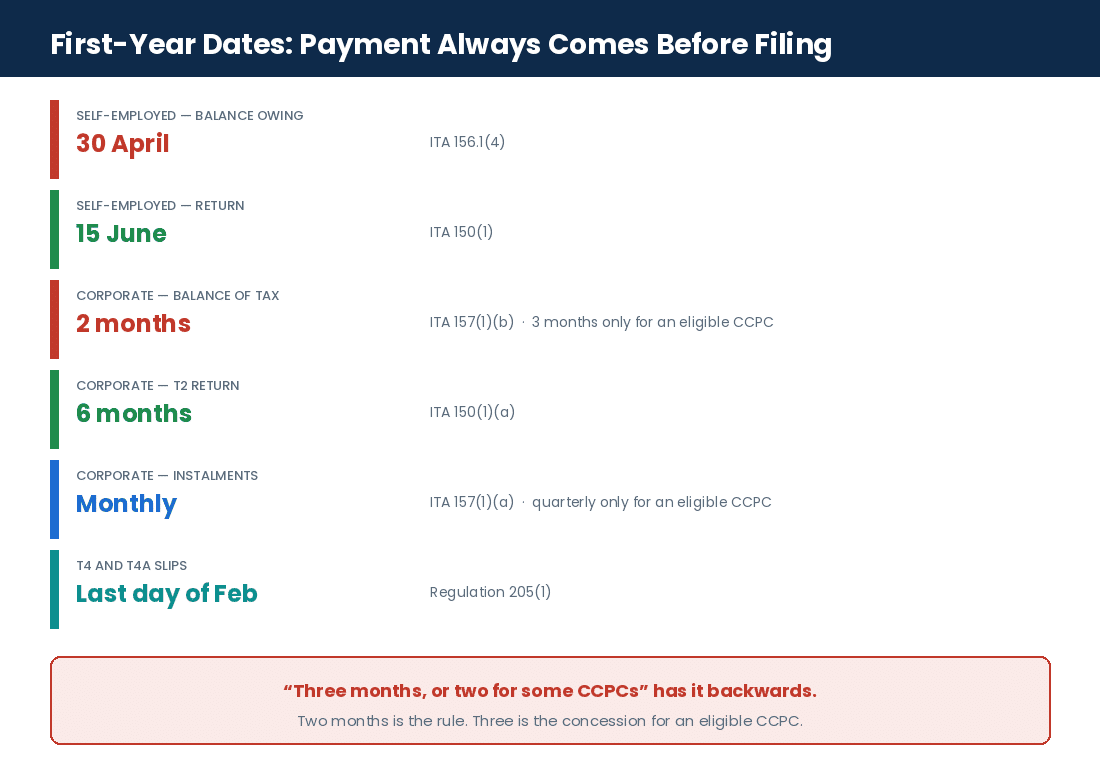
The corporate balance of tax is due two months after fiscal year-end under paragraph 157(1)(b). Three months is the extension available only to an eligible CCPC claiming the small business deduction. Default is two; three is the concession.
| Obligation | Due | Provision |
|---|---|---|
| Corporate balance of tax | Two months; three for an eligible CCPC | ITA 157(1)(b) |
| Corporate instalments | Last day of each month, or quarterly for an eligible CCPC | ITA 157(1)(a); 157(1.1) |
| Corporate T2 return | Six months after fiscal year-end | ITA 150(1)(a) |
| Self-employed T1 return | 15 June; balance 30 April | ITA 150(1); 156.1(4) |
| Individual instalments | 15 March, 15 June, 15 September, 15 December | ITA 156(1) |
Note also that corporate instalments are monthly, not quarterly. The quarterly dates belong to individuals under section 156(1), and section 156 is the individual instalment provision — not the corporate balance rule.
T1135 Is in the Income Tax Act, and Not in Your First Year
Risk Warning: Form T1135 has nothing to do with the Excise Tax Act. The requirement sits in section 233.3 of the Income Tax Act. The Excise Tax Act governs GST/HST.
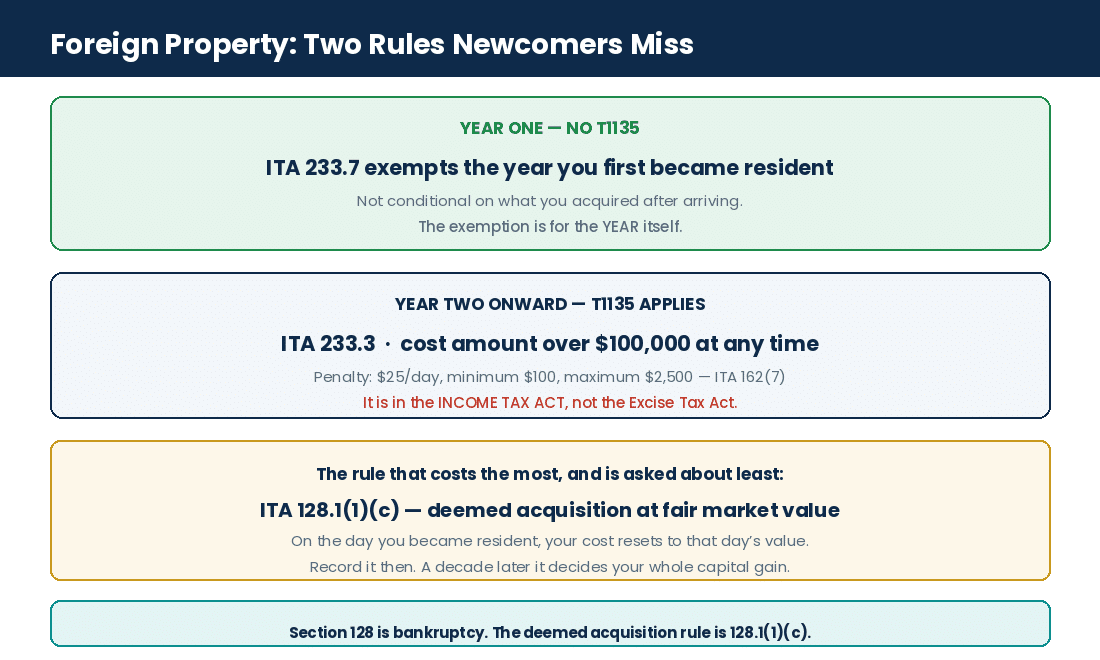
More usefully: section 233.7 relieves an individual from filing T1135 for the taxation year in which they first became resident in Canada. Not because of what you owned after arriving — the exemption is for the year itself.
From your second year, T1135 is required where the cost amount of specified foreign property exceeds $100,000 at any time in the year. The penalty under subsection 162(7) is $25 per day, minimum $100, to a maximum of $2,500.
The Home Workspace Test Is Two Tests, Not One
Risk Warning: “used only for business AND your main place of work OR where you meet clients” merges two separate tests into one impossible one.
Subsection 18(12) gives two alternatives. Test (a): the workspace is your principal place of business — with no exclusivity requirement. Test (b): exclusive use and clients met there on a regular and continuous basis. You need one, not both.
Most newcomers running a business from home satisfy test (a), where no dedicated room is needed and the claim is simply apportioned. The deduction cannot create or increase a loss, with the excess carried forward under paragraph 18(12)(c) against the same business.
A newcomer incorporated in March, took the “three months” figure at face value and paid the balance three months after a year-end that was not a CCPC year-end.
The balance had been due at two months. A month of daily compound interest on a first-year corporation, with no penalty notice to signal the error, because the return itself was filed on time. Figures changed for privacy.
Newcomers to Canada and Tax Residency for Business Owners
Newcomers and Tax Residency for Business Owners
Residency
Defining Newcomer Status According to CRA
CRA treats a newcomer as someone who has recently moved to Canada and established significant residential ties. Those ties, rather than your immigration documents, decide what income you report and from when. Residency for tax purposes is a question of fact, and CRA will give an opinion on Form NR74 where the position is unclear.
Importance of Residency Status in Determining Tax Obligations
A resident reports world income from the date residency begins. A non-resident is taxed only on Canadian-source income under Part XIII withholding or Part I where carrying on business in Canada. Income earned before you became resident is generally not taxed here, though it is reported on the return because it affects your entitlement to certain credits.
Key Residential Ties Affecting Tax Residency for New Immigrant Entrepreneurs
| Tie | Weight |
|---|---|
| A home in Canada, owned or rented | Significant |
| Spouse or common-law partner in Canada | Significant |
| Dependants in Canada | Significant |
| Bank accounts, credit cards, a driver’s licence, a vehicle | Secondary |
| Health coverage, memberships, professional registration | Secondary |
The three significant ties carry the most weight; the secondary ones are considered together rather than individually.
Immigration Status and Its Impact on Business Tax Responsibilities
Immigration status does not determine tax residency. A work permit holder with a home and family here can be a resident for tax purposes while a permanent resident living abroad may not be. The two systems ask different questions, and the answer to one does not settle the other.
For a corporation, residency is separate from yours. A corporation incorporated in Canada after 26 April 1965 is deemed resident under subsection 250(4), regardless of where its owner lives.
Obtaining Your Social Insurance Number and Individual Tax Number for Business Purposes
Key Stat: there is no “Temporary Tax Number.” The current identifier is an Individual Tax Number (ITN), applied for on Form T1261, and it is for individuals who are not eligible for a SIN. A corporation never needs one.
A SIN is issued by Service Canada and is what you need for payroll and most government programmes. A corporation receives a Business Number from CRA, not an ITN. These are three different identifiers for three different purposes.
The GST/HST registration threshold is federal and uniform across the country under section 148 of the Excise Tax Act. What varies by province is the rate you charge — 13% HST in Ontario, 5% GST plus a separate provincial tax in British Columbia, Saskatchewan, Manitoba and Quebec — not the threshold itself.
A newcomer delayed registering for GST/HST on the view that the threshold was higher in Ontario than where they had first landed.
The $30,000 figure is federal and identical in every province. Only the rate changes. By the time it was raised, roughly four months of supplies had been made without charging tax that was nonetheless owed. Figures changed for privacy.
Overview of Tax Filing Requirements for Newcomer Business Owners
Tax Filing Requirements and Registration
Registration
Canadian Tax System Essentials for New Immigrant Entrepreneurs
Your first return covers the part of the year from when residency began. Certain non-refundable credits, including the basic personal amount, are prorated by days resident under section 118.91 — not section 118, which is the credit itself. Where 90% or more of your net world income for the non-resident part of the year was Canadian-source, section 118.94 may allow the full amounts instead.
Deadlines and Payment Dates
| Obligation | Due Date | Provision |
|---|---|---|
| Self-employed T1 return | 15 June | ITA 150(1) |
| Balance owing, self-employed | 30 April | ITA 156.1(4) |
| Corporate T2 return | Six months after fiscal year-end | ITA 150(1)(a) |
| Corporate balance of tax | Two months; three for an eligible CCPC | ITA 157(1)(b) |
| Corporate instalments | Last day of each month, or quarterly for an eligible CCPC | ITA 157(1)(a) |
| GST/HST returns | Annual to $1.5M, quarterly to $6M, monthly above | ETA 228 for remittance |
| Payroll remittance | By band on average monthly withholding | ITA 153; Reg 108 |
Interest on an unpaid self-employed balance runs from 1 May, compounded daily under subsection 161(1). Late filing is penalised under subsection 162(1) at 5% of the unpaid tax plus 1% per complete month to twelve — for both individuals and corporations. There is no “$200 late corporate return” penalty.
Section 165 of the Excise Tax Act imposes GST/HST; it does not set remittance dates, and it has nothing to do with income tax instalments.
Registering Your Business Number and GST/HST
A Business Number is the account root; GST/HST, payroll, corporate income tax and import/export accounts hang off it. Registration is required under subsection 240(1) once you cease to be a small supplier, and the threshold itself is section 148.
- $30,000 of taxable supplies over four consecutive calendar quarters, or
- $30,000 in a single calendar quarter, which ends small supplier status immediately, with 29 days to register.
- Voluntary registration below the threshold, which lets you claim input tax credits on startup costs before you are required to register.
- Taxi and ride-share drivers must register from their first fare regardless of the threshold.
Understanding Taxable Supplies and When to Register
Taxable supplies are supplies made in the course of a commercial activity, as defined in subsection 123(1). Exempt supplies are listed in Schedule V and zero-rated supplies in Schedule VI. What counts toward the threshold:
- Whether the supply is taxable (including zero-rated) rather than exempt.
- Where the supply is made, under the place of supply rules in Schedule IX.
- Worldwide taxable supplies of the person and any associates.
Your customer’s registration status is not a factor. It makes no difference to the threshold calculation whether the people you sell to are registered, and it never did.
Worked example: online sales reach $31,000 across four consecutive quarters with orders shipping to Ontario after you became resident. You are no longer a small supplier, you register, and you charge 13% HST on Ontario-destined supplies.
Recordkeeping and Documentation Obligations
Books and records are kept six years from the end of the taxation year to which they relate, under paragraph 230(4)(b) — not six years from the filing date. Section 286 of the Excise Tax Act imposes the same period for GST/HST records.
- Sales invoices issued and supplier invoices received.
- Bank and credit card statements, with business transactions in a separate account.
- Expenses split between current costs and capital additions.
- Payroll records and T4 or T4A slips where you have staff or contractors.
- Workspace measurements supporting any 18(12) claim.
- Fair market value evidence for property owned on the day you became resident.
A newcomer’s first-year personal credits were claimed in full on a return covering seven months of residency.
Section 118.91 prorates them by days resident. The relief in 118.94 was unavailable because most of the pre-arrival income was foreign-source. The reassessment was straightforward and entirely avoidable. Figures changed for privacy.
Reporting Business Income and Claiming Allowable Expenses as a Newcomer
Reporting Business Income and Claiming Expenses
Income
A sole proprietor reports business income on Form T2125, Statement of Business or Professional Activities, filed with the T1. The T1-WS is a worksheet for calculating amounts on the return and is not where business income goes. An incorporated owner reports on the T2 with its GIFI schedules.
Eligible Business Expenses
- Office supplies, advertising, professional fees, insurance and rent.
- Vehicle costs apportioned on a logbook, with Class 10.1 applying to a passenger vehicle above the prescribed capital cost limit.
- Meals and entertainment at 50% of actual cost under section 67.1.
- Startup costs incurred before the first sale, provided the business had actually commenced.
- Capital items to their CCA class — computers to Class 50 at 55%, furniture to Class 8 — from the available-for-use date in subsections 13(26) to (32).
- Fines and penalties are denied by section 67.6.
Home Workspace Deductions
Subsection 18(12) provides two alternative tests. Test (a): the space is your principal place of business, with no exclusivity requirement. Test (b): exclusive use and regular client meetings there. One or the other, not both.
| Cost | Renter | Owner |
|---|---|---|
| Rent | Business share | — |
| Heat, electricity, water | Business share | Business share |
| Home insurance and property tax | — | Business share |
| Mortgage interest | — | Business share — interest only, never principal |
| Maintenance on the workspace | Business share | Business share |
| Internet | Business share | Business share |
| Capital cost allowance on the home | — | Do not claim — it can expose that share to a taxable capital gain on sale |
Apportion by area, reduced by time where the space is shared. The deduction cannot create or increase a loss, with the excess carried forward under 18(12)(c).
Input Tax Credits: Eligibility and Claiming Procedures for Newcomer Entrepreneurs
Once registered you charge GST/HST on taxable supplies and claim input tax credits under section 169 on the tax paid on inputs used in commercial activity. Documentary requirements sit in subsection 169(4): over $30, the supplier’s name and the date; over $150, the registration number, your name, the terms and a description. Claims are lost after four years.
Note that zero-rated supplies still carry full input tax credits, while exempt supplies do not. Meals credits are recaptured to 50% to match section 67.1.
Handling Payroll Source Deductions and Issuing T4 and T4A Slips
Risk Warning: “deadlines usually fall 15 days after the payroll period ends” is not the rule. Remittance follows four bands set by your average monthly withholding amount under section 153 and Regulation 108.
| Remitter type | Average monthly withholding | Due |
|---|---|---|
| Quarterly | Under $1,000 with a clean record | 15th of the month after the quarter |
| Regular | Under $25,000 | 15th of the following month |
| Accelerated, threshold 1 | $25,000 to $99,999.99 | 25th of the same month; 10th of the following |
| Accelerated, threshold 2 | $100,000 or more | Within 3 working days of each quarter-month period |
- Withhold income tax, CPP and EI; the employer matches CPP and pays EI at 1.4 times the employee premium.
- T4 slips for employment income; T4A for fees for services above $500.
- Both are due by the last day of February under Regulation 205(1).
- Late remittance is penalised at 3% to 10% by lateness under subsection 227(9), with director liability under 227.1.
- Electronic filing is mandatory above five information returns of a type.
Managing Instalment Payments and Avoiding Penalties
Individuals pay instalments where net tax owing exceeds $3,000 in the current year and in either of the two preceding years, on 15 March, 15 June, 15 September and 15 December under section 156(1). In your first year there is no prior-year threshold to meet, so instalments generally do not arise. Corporations pay monthly under 157(1)(a), or quarterly as an eligible CCPC, where taxes payable exceed $3,000.
Filing Corporate Tax Returns for Newly Established Businesses
The T2 is filed within six months of fiscal year-end under paragraph 150(1)(a), with the balance at two or three months. Electronic filing is mandatory under subsection 150.1(2.1), carrying a $1,000 penalty where a paper return is filed instead. A new corporation chooses its first fiscal period end without CRA approval, subject to a maximum of 53 weeks under paragraph 249.1(1)(a).
A newcomer with a single employee remitted payroll on the fifteenth day after each pay period, reading “15 days” literally.
As a regular remitter the due date was the 15th of the following month. Half the remittances were early, which costs nothing, and the ones following a late-month pay period were late, which did. Figures changed for privacy.
Reporting Foreign Income and Assets for New Immigrant Business Owners
Reporting Foreign Income and Assets
Foreign
From the day you become resident you report world income. Business profits, investment income and rents from outside Canada all come in, with the foreign tax credit relieving double taxation.
Treatment of World Income and Proration for Part-Year Residents
Residency begins when significant ties are established, and the rules for a part-year resident sit in section 114. Income earned before that date is not taxed here, although it is reported on the return because it determines credit entitlement.
- Became resident 1 July? World income is taxed from 1 July forward.
- Prorated non-refundable credits for those days, under section 118.91.
- Full credits may be available under section 118.94 where 90% or more of net world income for the non-resident part was Canadian-source.
The proration provision is 118.91. Section 118 is the credit itself, and subsection 250(3) concerns a person “ordinarily resident” rather than setting a start date.
Deemed Acquisition and Fair Market Value on Arrival
Key Stat: the deemed acquisition rule is paragraph 128.1(1)(c), not section 128. Section 128 deals with bankruptcy.
On becoming resident you are deemed to have acquired most property at its fair market value on that day. The gain accrued before you arrived is not taxed in Canada. Certain property is excluded, including Canadian real property and property used in a business carried on in Canada.
Document the value on arrival day while you can still obtain it: an appraisal, a broker statement, a market valuation. Years later, when you sell, that figure is your cost base, and reconstructing it from memory is not evidence.
Example: a rental property abroad worth $200,000 CAD on your arrival date becomes your cost for Canadian purposes, whatever you originally paid for it.
Specified Foreign Property and Form T1135
The requirement is section 233.3 of the Income Tax Act. T1135 is required where the cost amount of specified foreign property exceeds $100,000 at any time in the year. What it covers:
- Funds and bank accounts held outside Canada.
- Shares of non-resident corporations, and shares of Canadian corporations held abroad.
- Foreign real property other than personal-use property.
- Debts owed by non-residents, and interests in non-resident trusts.
- Not personal-use property, and not property used exclusively in an active business.
| Item | Requirement |
|---|---|
| Threshold | Cost amount over CAD 100,000 at any time in the year |
| First year of residency | Not required — ITA 233.7 |
| Filing deadline | With the income tax return |
| Penalty | $25 per day, minimum $100, maximum $2,500 — ITA 162(7) |
| Reassessment extension | Three additional years where T1135 is missed — 152(4)(b.2) |
The first-year exemption is for the year you became resident, under section 233.7. It is not conditional on what you acquired after arriving.
Foreign Tax Credit Eligibility and Application Process
The foreign tax credit sits in section 126 and is claimed on Form T2209, Federal Foreign Tax Credits, with the provincial or territorial portion on Form T2036. It is a form, not a schedule.
- Report the foreign income gross, before foreign tax.
- The credit is limited to the Canadian tax otherwise payable on that income.
- Business and non-business income tax are computed separately, and separately again by country.
- Unused business income tax carries back three years and forward ten; unused non-business income tax does not carry over.
- Keep the foreign assessment and proof of payment.
Strategies to Avoid Double Taxation
- Check the relevant tax treaty; Canada has treaties with more than 90 countries, and they often reduce withholding at source.
- Claim the foreign tax credit with the documentation to support it.
- Where the tie-breaker rules in a treaty apply, residency can be determined by the treaty rather than domestic law alone.
- Consider the timing of a disposition against the deemed acquisition date.
A newcomer filed T1135 in their first year out of caution and skipped it in year two, when the holdings had grown.
Section 233.7 exempted the first year; year two was the one that was required. The filing was reversed in both directions, and the penalty ran on the year that mattered. Figures changed for privacy.
Step-by-Step Guide to Filing Your First Newcomer Business Tax Return
Filing Your First Newcomer Business Tax Return
Process
Choosing Between Online and Paper Filing
CRA processes electronic returns faster and confirms receipt immediately. For a corporation, electronic filing is mandatory under subsection 150.1(2.1), with a $1,000 penalty for filing on paper where it applies. For a personal return including business income, paper remains possible but slower.
One practical limitation for newcomers: a first Canadian return often cannot be NETFILED and may have to be paper-filed, because CRA has no prior-year record to authenticate against. That is normal and resolves from the second year.
Utilizing Available Free Tax Filing Resources and CRA Support Services
- My Business Account: balances, returns, instalments and account updates.
- Community Volunteer Income Tax Program: free help for eligible people with modest income and simple situations — note that self-employment income generally falls outside what CVITP volunteers prepare.
- CRA guides and webinars, including guidance written for newcomers.
- Guide T4002 for self-employed business and professional income.
How to Use Auto-Fill and Certified Software to Simplify Filing
Certified software supports Auto-fill my return, which imports slips CRA already holds against your SIN. In a first year there is usually little or nothing to import, since CRA holds no history for you. Certified packages also handle the credit proration under 118.91 correctly, which is the calculation most often got wrong by hand.
Maintaining Accurate Records and Compliance for Future Filings
- A separate bank account for the business from day one.
- Workspace measurements and the apportionment calculation.
- Fair market value evidence for property owned on arrival day.
- Receipts for pre-commencement costs, where the business had genuinely begun.
- Foreign tax assessments and proof of payment, for the foreign tax credit.
Accessing CRA Portals
- My Business Account for GST/HST returns, payroll remittances and instalments.
- Represent a Client, which lets us file and correspond on your behalf once authorised.
- Payment through online banking, pre-authorised debit or a third-party service provider.
Authorisation takes a few days to process, so set it up before a deadline rather than against one.
A newcomer planned to NETFILE a first return on 14 June and found the submission rejected.
CRA had no prior-year record to authenticate against, which is ordinary for a first filing. The return went in on paper, in time, but the discovery was made with one day left rather than one month. Figures changed for privacy.
Common Questions Newcomer Business Owners Have About Tax Filing
Common Questions, Rights and Benefits
Rights
A sole proprietor reports on Form T2125 with the T1; a corporation files a separate T2. You report Canadian-source income and, from the date residency begins, world income. The questions that come up most:
- When does tax residency begin for me and for my corporation?
- World income or Canadian income only, and from what date?
- Which deadlines apply to me, and which to the corporation?
- When do I register for GST/HST, and should I register voluntarily first?
Rights and Responsibilities
Your obligation is an accurate and timely return. Your rights sit in the Taxpayer Bill of Rights, and include the right to a formal review and to file a Notice of Objection on Form T400A.
- Deduct expenses incurred to earn business income under paragraph 18(1)(a), subject to reasonableness in section 67.
- Request relief from penalties and interest under subsection 220(3.1) on Form RC4288, within ten calendar years.
- Correct a past error through the Voluntary Disclosures Program under Information Circular IC00-1R6, before CRA makes contact.
- Object to an assessment within 90 days of the notice.
Protecting Yourself from Tax Scams
CRA does not demand payment by gift card, cryptocurrency or e-transfer, does not threaten arrest or deportation, and does not send a link asking you to enter banking details. Newcomers are targeted deliberately, precisely because the real processes are unfamiliar.
- Hang up and call CRA directly on a number you looked up yourself, or call us.
- Check My Account or My Business Account, where any genuine balance will appear.
- Report to the Canadian Anti-Fraud Centre.
Government Benefits and Credits
| Benefit | Position for a newcomer |
|---|---|
| Canada Workers Benefit | Generally not available in the year of arrival — section 122.7 requires residency in Canada throughout the year |
| GST/HST credit | Available on application; newcomers apply on Form RC151 |
| Canada Child Benefit | Available to newcomers meeting the residency condition; Form RC66 with RC66SCH |
| Small business deduction | Section 125, giving 12.2% combined in Ontario on the first $500,000 of active business income |
| Input tax credits | Once registered, under section 169 |
| Prorated personal amounts | Section 118.91, by days resident |
The Canada Workers Benefit is worth singling out. It is commonly listed in newcomer guidance as available to self-employed arrivals, and in the year of arrival it generally is not, because the statutory condition is residency throughout the year.
Keeping Your Information Updated with CRA
- Address and direct deposit details, which drive benefit payments.
- Marital status, which affects benefit calculations.
- Business structure changes, including incorporating a proprietorship.
- New payroll, GST/HST or import accounts under the Business Number.
- Your authorised representative, so we can act without a delay each time.
Support Resources for Newcomer Entrepreneurs
Gondaliya CPA offers a free consultation for newcomers starting businesses in Toronto, Brampton, Mississauga and across Canada. Beyond us: CRA’s own newcomer guidance, provincial Small Business Enterprise Centres, settlement agencies funded under Immigration, Refugees and Citizenship Canada, and the Business Development Bank of Canada for financing.
A newcomer claimed the Canada Workers Benefit on a first-year return covering five months of residency.
Section 122.7 requires residency in Canada throughout the year. The claim was denied, which was the correct outcome, and the client had been relying on a guide that listed it as a newcomer benefit without the condition. Figures changed for privacy.
Frequently Asked Questions for Newcomer Business Owner Tax Filing in Canada
Frequently Asked Questions
FAQ
What determines tax residency under CRA rules for newcomer business owners?+
Residential ties, not immigration status. The significant ones are a home in Canada, a spouse or common-law partner here, and dependants here. Secondary ties — bank accounts, a licence, a vehicle, memberships — are weighed together. It is a question of fact, and CRA will give an opinion on Form NR74.
How should newcomers report foreign income in their first year?+
Report world income from the date residency begins. Income earned before that date is not taxed in Canada, but it is reported on the return because it determines whether your non-refundable credits are prorated under 118.91 or available in full under 118.94.
When must a newcomer business register for GST/HST?+
Once taxable supplies exceed $30,000 over four consecutive calendar quarters, or in a single calendar quarter, under section 148 of the Excise Tax Act, with the requirement to register in 240(1). The single-quarter route ends small supplier status immediately with 29 days to register. You can also register voluntarily to claim input tax credits earlier.
What are the filing deadlines?+
Self-employed: file by 15 June, pay by 30 April. Corporate: file the T2 within six months, but the balance of tax is due at two months, or three for an eligible CCPC, under 157(1)(b). GST/HST follows your assigned frequency. The payment date always precedes the filing date.
Which form reports foreign assets?+
Form T1135, required by section 233.3 of the Income Tax Act, where the cost amount of specified foreign property exceeds $100,000 at any time in the year. Section 233.7 exempts you from filing for the year you first became resident.
What penalties apply for late filing?+
Subsection 162(1): 5% of the unpaid tax plus 1% per complete month to twelve, for individuals and corporations alike. There is no $200 corporate late filing penalty. Interest compounds daily under 161(1). Late payroll remittance is 3% to 10% under 227(9), and filing a corporate return on paper where electronic filing is required costs $1,000.
Which provision sets my residency start date?+
Part-year residence is computed under section 114, with the deemed acquisition on arrival in paragraph 128.1(1)(c). Subsection 250(3) concerns a person “ordinarily resident” in Canada and does not set a start date for newcomers.
Why does fair market value on arrival matter?+
Paragraph 128.1(1)(c) deems you to have acquired most property at its fair market value on the day you became resident, which resets your cost base. Gains accrued before you arrived are not taxed here. Document the value then, because years later that number is the whole basis of your capital gain calculation.
Do I need a Temporary Tax Number?+
No such thing. If you are eligible for a SIN, that is your identifier. If you are not, you apply for an Individual Tax Number on Form T1261. A corporation uses a Business Number and never needs either.
Is the $30,000 threshold different in Ontario?+
No. The threshold is federal and identical everywhere. What changes by province is the rate — 13% HST in Ontario, 5% GST plus a separate provincial sales tax in British Columbia, Saskatchewan, Manitoba and Quebec.
Do I need an exclusive room to claim home office costs?+
Not under test (a) of subsection 18(12), which asks only whether the space is your principal place of business. Test (b) requires exclusive use but also regular client meetings there. They are alternatives, and most home-based businesses rely on test (a).
When do corporate instalments start?+
Corporate instalments are monthly under 157(1)(a), or quarterly for an eligible CCPC, where taxes payable exceed $3,000. For individuals the test in section 156(1) looks at the current year and both preceding years, so a first-year filer generally has no instalment obligation.
Can I claim the Canada Workers Benefit in my arrival year?+
Generally no. Section 122.7 requires you to be resident in Canada throughout the year, which a part-year resident is not. It is frequently listed in newcomer guidance without that condition attached.
What records do I keep, and for how long?+
Six years from the end of the taxation year to which they relate, under paragraph 230(4)(b) — not from the filing date. Section 286 of the Excise Tax Act imposes the same for GST/HST records. For a newcomer, add arrival-day valuations, which you may need far longer than six years later.
Fourteen questions, and the one that costs the most money is rarely asked at all.
It is the arrival-day fair market value. Nobody thinks about it in the first year, and it decides the capital gain a decade later. Figures changed for privacy.
Essential Bullet Points for Newcomer Business Owner Tax Filing in Canada
Essential Points for Newcomer Business Owners
Quick Reference
- Business Number: the root account for GST/HST, payroll, corporate income tax and import or export.
- Registration threshold: $30,000 of taxable supplies over four quarters or in a single quarter, ETA 148.
- Payroll remittances: income tax, CPP and EI, by band under Regulation 108 — not a fixed 15 days.
- T4 and T4A slips: by the last day of February, Regulation 205(1).
- Corporate return: six months after fiscal year-end, ITA 150(1)(a).
- Corporate balance: two months, three for an eligible CCPC, ITA 157(1)(b).
- Self-employed: file 15 June, pay 30 April.
- Late filing: 5% plus 1% per month to twelve, ITA 162(1).
- Records: six years from the end of the taxation year, ITA 230(4)(b).
- T1135: ITA 233.3, over $100,000 cost amount, not required in your first year under 233.7.
- Foreign tax credit: section 126, Form T2209 federally and T2036 provincially.
- Part-year credits: prorated under 118.91, with relief possible under 118.94.
- Deemed acquisition: fair market value on arrival, paragraph 128.1(1)(c).
- Catching up: the Voluntary Disclosures Program under IC00-1R6 closes once CRA makes contact.
- Verify your CPA: the CPA Ontario public firm directory confirms licensing.
- First-year best practice: separate bank account, arrival valuations, early registration.
- DIY, CPA or non-CPA: only a CPA Ontario member can represent you before CRA and issue a compilation report.
- Before filing: receipts, contracts, bank statements, SIN or BN, foreign income details, payroll records, arrival-day valuations.
- How we handle it: residency position, registration, bookkeeping setup, then the filings.
- Top first-year mistakes: late GST/HST registration, full personal credits on a part-year return, and no arrival valuation.
Points Worth Carrying
- The corporate balance is two months; three is the CCPC concession.
- Corporate instalments are monthly; quarterly belongs to individuals.
- T1135 is Income Tax Act 233.3, and not in your first year.
- Deemed acquisition is 128.1(1)(c), not section 128.
- Credit proration is 118.91, not 118.
- 18(12) gives two alternative tests.
- Payroll remittance follows four bands under Regulation 108.
- The $30,000 threshold is federal; only the rate is provincial.
- Your customer’s registration status is irrelevant to the threshold.
- The Canada Workers Benefit generally is not available in your arrival year.
Thirty points, and the ten at the end are all things a newcomer was told confidently by a guide written for them.
None of it is obscure. It is ordinary provisions with a number transposed, a statute swapped, or a concession reported as the rule. Figures changed for privacy.
Businesses We Serve & Industry Spotlights
Industry Expertise
Newcomers start businesses across every sector we act for, and the first-year question takes a different shape in each. Here are eleven.
| Industry | The Newcomer Angle |
|---|---|
| Restaurants & food and beverage | Payroll accounts opened before the first filing |
| E-commerce & online retailers | Cross-border sales crossing the threshold quickly |
| Transportation, logistics & trucking | Ride-share registration from the first fare |
| Construction, contractors & skilled trades | Credentials recognised here, income earned here |
| Technology startups & SaaS | Foreign shareholdings triggering T1135 in year two |
| Consulting firms | Clients abroad, residency established here |
| Medical doctors & physician professional corporations | Licensing first, professional corporation second |
| Dentists & dental practices | Practice purchase against arrival-day valuations |
| Real estate investors, landlords & holding companies | Property abroad, deemed acquired on arrival |
| Property developers & builders | Capital brought in, with the source documented |
| Daycare, childcare & CWELCC services | Funded programmes with their own reporting |
- Restaurants & food and beverage: Staff are usually hired before the first return is ever filed, which makes the payroll account and the Regulation 108 remittance band the first real deadline a newcomer meets.
- E-commerce & online retailers: Online sales reach $30,000 faster than most owners expect, and the single-quarter route can end small supplier status in one strong month.
- Transportation, logistics & trucking: Ride-share and taxi drivers must register for GST/HST from the first fare, with no threshold at all — a rule that catches newcomers driving while a business gets going.
- Construction, general contractors & skilled trades: Credentials often need recognising here before work can be invoiced, so the residency date and the first income date rarely coincide.
- Technology startups & SaaS: Shares in a company left behind abroad are specified foreign property, which means T1135 from the second year once the cost amount crosses $100,000.
- Consulting firms: Clients abroad with the consultant resident here raises both the foreign tax credit and the zero-rating of exported services at the same time.
- Medical doctors & physician professional corporations: Licensing comes first and incorporation second, so the professional corporation often has a short first fiscal period with its own two-month balance date.
- Dentists & dental practices: A practice purchase funded from abroad needs the source of funds documented and the arrival-day valuations of whatever was sold to fund it.
- Real estate investors, landlords & holding companies: Foreign rental property is deemed acquired at fair market value on arrival, which is the single most valuable number a newcomer landlord will ever record.
- Property developers & builders: Capital brought into Canada is not income, but the paper trail showing that is worth assembling on arrival rather than under review.
- Daycare, childcare & CWELCC services: Funded programmes carry reporting of their own, which runs alongside the corporate filings rather than replacing any of them.
The sector changes what gets missed. The residency date does not.
Every one of these files turns on the same two dates: when you became resident, and what you owned that day. Figures changed for privacy.
Professional Guidance and Quick Reference
Guidance
Professional Guidance: How Gondaliya CPA Supports Newcomer Business Owners
Newcomer first filings go wrong in a predictable set of ways: paying the corporate balance at three months, when the rule is two under 157(1)(b) and three is the CCPC concession; treating corporate instalments as quarterly, when monthly is the default under 157(1)(a); looking for T1135 in the Excise Tax Act, when it is ITA 233.3, and filing it in the first year when 233.7 exempts that year; citing section 128 for deemed acquisition, when it is 128.1(1)(c) and section 128 is bankruptcy; claiming full personal credits on a part-year return, when 118.91 prorates them by days resident; treating 18(12) as one combined test, when it offers two alternatives and test (a) needs no exclusive room; remitting payroll “15 days after the period”, when Regulation 108 sets four bands; believing the $30,000 threshold varies by province, when only the rate does; counting a customer’s registration status toward that threshold, which has never been a factor; and claiming the Canada Workers Benefit in the arrival year, when section 122.7 requires residency throughout the year. Gondaliya CPA handles newcomer business filings on a flat annual fee.
We handle what decides the outcome: establishing the residency position and the date it began, recording arrival-day fair market values while they can still be obtained, registering the Business Number and the GST/HST, payroll and corporate accounts under it, setting the right remittance band, prorating the credits correctly, assessing T1135 from the second year, claiming the foreign tax credit with the documentation behind it, deciding between proprietorship and incorporation on the numbers rather than on habit, and diarising the balance date separately from the filing date.
Our team starts with your date of arrival, a list of what you owned that day, and whatever the business has done since. However you got here, you get clear advice and a fixed price before we start.
Quick Answers
At a Glance
- Corporate balance: two months; three for an eligible CCPC
- Corporate return: six months
- Self-employed: file 15 June, pay 30 April
- Corporate instalments: monthly, ITA 157(1)(a)
- Individual instalments: 15 March, June, September, December
- GST/HST threshold: $30,000, ETA 148, federal
- T1135: ITA 233.3; exempt in year one under 233.7
- Deemed acquisition: ITA 128.1(1)(c)
- Credit proration: ITA 118.91
- Home workspace: ITA 18(12), two alternative tests
- Payroll remittance: Regulation 108, four bands
- Records: six years from the taxation year-end
Who This Is For
Fit Check
- For: Newcomers to Canada starting or running a business here, sole proprietors and incorporated owners, in their first few filing years, including those with income, property or shareholdings left abroad.
- Not For: Non-residents with no Canadian business presence, anyone needing immigration advice, which is a licensed profession of its own, and businesses requiring a review or audit engagement, which we refer out.
People Also Ask
Quick Answers
Does my work permit decide whether I pay tax here?+
No. Residential ties decide it. A work permit holder with a home and family here is usually a resident for tax purposes; a permanent resident living abroad may not be.
Is my corporation resident because I am?+
Separately. A corporation incorporated in Canada is deemed resident under subsection 250(4), whatever your own status. The two questions are answered independently.
Do I file T1135 in my first year?+
No. Section 233.7 exempts the year you first became resident. From the second year it applies where the cost amount of specified foreign property exceeds $100,000.
Is income I earned before arriving taxed in Canada?+
Generally no, but it is reported on the return, because it determines whether your non-refundable credits are prorated under 118.91 or available in full under 118.94.
What is the single most valuable thing to do on arrival?+
Record the fair market value of everything you own that day. Paragraph 128.1(1)(c) makes that your cost base, and it decides a capital gain you may not realise for a decade.
Glossary of Key Terms
Glossary
- Residential ties: The connections to Canada that establish tax residency.
- Part-year resident: Someone resident for only part of the taxation year, computed under section 114.
- Deemed acquisition: Paragraph 128.1(1)(c), resetting cost to fair market value on arrival.
- Specified foreign property: The T1135 category, defined in subsection 233.3(1).
- Section 233.7: The first-year exemption from T1135.
- Section 118.91: Proration of non-refundable credits by days resident.
- Section 118.94: The 90% rule allowing full credits in some cases.
- Business Number: The CRA account root for all business programme accounts.
- Individual Tax Number: Form T1261, for individuals ineligible for a SIN.
- Small supplier: Below the $30,000 threshold in ETA section 148.
- Input tax credit: Recovery of GST/HST on business inputs, section 169.
- Regulation 108: The payroll remittance bands.
- Form T2125: Where a sole proprietor reports business income.
- Form T2209: The federal foreign tax credit form.
- Form NR74: The request for a CRA opinion on residency.
Newcomer Business Tax Check
This quick self-check indicates where your first filings most likely need attention. Please answer the five questions below.
Newcomer Business Tax Check
Five quick questions on your business. No fee shown.
Points to raise with us:
This is a general prompt, not tax or legal advice or a quote. Your position depends on your full facts. For a real review, please book a free consultation.
Want a checklist to work from? You can download our free newcomer business tax checklist before your consultation.
Record the fair market value of everything you own on the day you become resident, because paragraph 128.1(1)(c) makes that your cost base and you cannot reconstruct it later. Fix the residency date, since every other answer follows from it. Pay the corporate balance at two months rather than three, and treat corporate instalments as monthly. Leave T1135 alone in your first year and assess it properly from the second. Prorate your personal credits under 118.91 unless the 90% rule in 118.94 applies. Work from test (a) of subsection 18(12) for the home workspace, where no exclusive room is required. Set the payroll remittance band from your average monthly withholding rather than a fixed number of days. Register for GST/HST on either threshold route, remembering the figure is federal and only the rate is provincial. And please keep six years of records from the end of the taxation year.
2026 Update — what is current: This article reflects rules current to 4 October 2026. The $30,000 small supplier threshold in ETA 148, the $100,000 T1135 threshold in ITA 233.3, the 15 June filing and 30 April payment dates for the self-employed, the six-year retention requirement in 230(4)(b) and the $500 T4A threshold are unchanged. Please note that the corporate balance of tax is due at two months under 157(1)(b), with three available only to an eligible CCPC; that corporate instalments are monthly under 157(1)(a) while the quarterly dates belong to individuals under 156(1); that T1135 sits in the Income Tax Act and section 233.7 exempts the year you first became resident; that deemed acquisition at fair market value is paragraph 128.1(1)(c); that non-refundable credits are prorated under 118.91 with relief under 118.94; that subsection 18(12) provides two alternative workspace tests; that payroll remittance follows four bands under Regulation 108; that electronic filing of the T2 is mandatory under 150.1(2.1) with a $1,000 penalty; and that the Canada Workers Benefit under section 122.7 requires residency throughout the year and is generally unavailable in the year of arrival.
Newcomer Entrepreneur Tax Filing Canada: How Gondaliya CPA Can Help
Start with your arrival date and a list of what you owned that day
Gondaliya CPA establishes your residency position, records the arrival-day valuations while they are still obtainable, registers your Business Number with the GST/HST, payroll and corporate accounts under it, sets the right remittance band, prorates your credits correctly, assesses T1135 from the second year, and files your T1 or T2 from one reconciled set of books — on a flat annual fee including HST with a one-business-day response. Please book a free consultation.
Next Steps
Please book a free consultation with Gondaliya CPA and bring your date of arrival in Canada, a list of what you owned on that day with values if you have them, and whatever the business has done since. Those three settle the residency position, the cost base question and the registration question, which is where almost all of the first-year exposure sits. You will get a flat annual fee including HST before any work begins. We serve Toronto, Brampton, Mississauga, Vaughan, Ottawa and the rest of Ontario, and work with newcomers across Canada. If our content helps, please add gondaliyacpa.ca as a preferred source on Google.
Published: · Last updated:
Editorial policy: We research against CRA, CPA Canada and CPA Ontario sources, fact-check the figures, and Sharad Gondaliya, CPA, reviews the content, which we update as the rules change.
Disclaimer: This article is educational information only and is not tax, legal, or immigration advice. It reflects rules current to 2026, including the residency rules and part-year computation in section 114, the deemed acquisition in paragraph 128.1(1)(c), the T1135 requirement in section 233.3 with the first-year exemption in 233.7, credit proration under section 118.91, the corporate balance of tax in paragraph 157(1)(b) and the six-year retention requirement in paragraph 230(4)(b). Residency for tax purposes is a question of fact determined on your own circumstances. Immigration matters are a separate licensed profession. Rates and limits change and outcomes depend on your specific facts. Please consult a CPA Ontario member before acting.

Sharad Gondaliya is a CPA Canada & CPA USA with 15 Years+ experience of Accounting, Tax, Payroll of Corporate Small Businesses as Tax Accountant. He is a CPA Ontario member (61040184) and holds US CPA licences in Washington and Montana and is well known among corporate small businesses for tax planning, efficient tax solutions, and affordable CPA services. Sharad is the Principal (Director) of Gondaliya CPA – Affordable CPA Firm in Canada. Licenses: CPA Ontario: 61040184 | CPA USA (MT): PAC-CPAP-LIC-033176 | CPA USA (WA): 57629 | CPA Firm License: 61330051 View Full Author Bio