



Third-Party Logistics Tax Planning in Canada: Managing Revenue, Contracts & Business Taxes
Third party logistics tax planning Canada explained: revenue timing, asset classes, imports and payroll
Third party logistics tax planning Canada requires precise expertise in navigating corporate tax rules, GST/HST compliance, and payroll management under the Income Tax Act and Excise Tax Act. Gondaliya CPA offers tailored tax strategies, bookkeeping, and accounting services to help logistics companies optimize business expenses and meet CRA regulations effectively.
Quick Summary
Prepaid storage fees are included in income on receipt under paragraph 12(1)(a), with the deferral coming from a 20(1)(m) reserve claimed on the return. Only the GST paid at the border under Division III is recoverable — customs duty goes into landed cost. And the corporate late filing penalty is 5% plus 1% per month under 162(1), not a $250 flat fee.
Reading time: 49 minutes.
Table of Contents
- Three Things You Have Been Told
- Understanding 3PL Tax Planning
- Corporate Tax, GST/HST and Payroll
- Accounting Practices for 3PL Providers
- Strategies to Optimize Business Expenses
- CRA Compliance and Risk Management
- Market Overview and Industry Insights
- Frequently Asked Questions
- Essential Topics and Best Practices
- Businesses We Serve
- Professional Guidance and Quick Reference
The Numbers That Matter
This article covers Canada, with Ontario and Toronto context, and reflects rules current to 2 October 2026. It is written for incorporated third-party logistics providers — warehousing, fulfilment, distribution and freight arrangement — including multi-site and multi-province operators handling client-owned goods and imported inventory. Gondaliya CPA performs compilation engagements; we do not perform audits or review engagements, and where a lender or surety requires one we refer it out. Figures marked illustrative are examples, not quotes, and any masked engagement notes end with “Figures changed for privacy.” This is educational information only and not tax or legal advice.
Three Things You Have Been Told
Three Things You Have Been Told
The Corrections
Three points about 3PL tax circulate widely and all three are wrong. The first is the single most common error on a warehousing file.
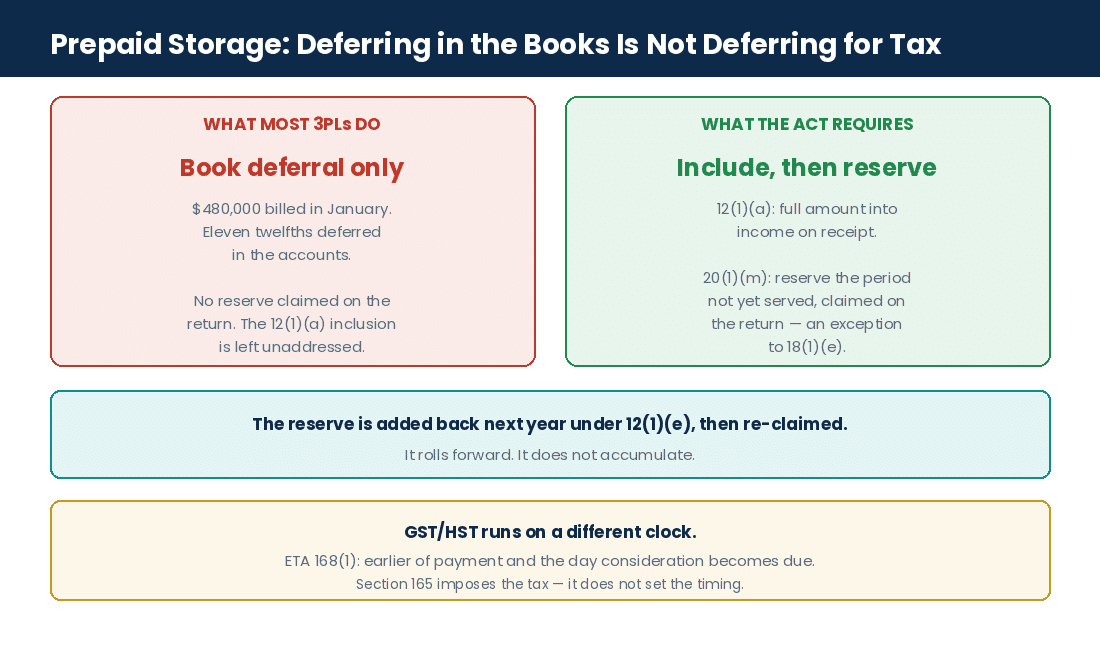
Prepaid Storage Is Income on Receipt — the Deferral Is a Claimed Reserve
Risk Warning: “record prepaid amounts as deferred revenue and recognize them gradually” is the accounting answer, not the tax answer. Paragraph 12(1)(a) includes an amount received for services not yet rendered in income when received.
The deferral comes from paragraph 20(1)(m), which permits a reserve for services reasonably expected to be rendered after year-end. That reserve is an exception to paragraph 18(1)(e), which otherwise denies reserves outright, and it must be claimed on the return. Simply deferring the revenue in the books without claiming the reserve leaves the inclusion unaddressed.
| Step | Provision | Effect |
|---|---|---|
| Twelve months of storage billed in advance | 12(1)(a) | Full amount in income on receipt |
| Reserve for months not yet served | 20(1)(m) | Deducted at year-end |
| Reserve added back | 12(1)(e) | Into income the following year |
| New reserve claimed | 20(1)(m) | On the remaining unserved period |
For GST/HST, the timing is different again: tax is payable under subsection 168(1) on the earlier of the day consideration is paid and the day it becomes due — which on a prepaid invoice is usually well before the storage period ends. Section 165 imposes the tax; 168 sets when it becomes payable.
Customs Duty Is Never an Input Tax Credit
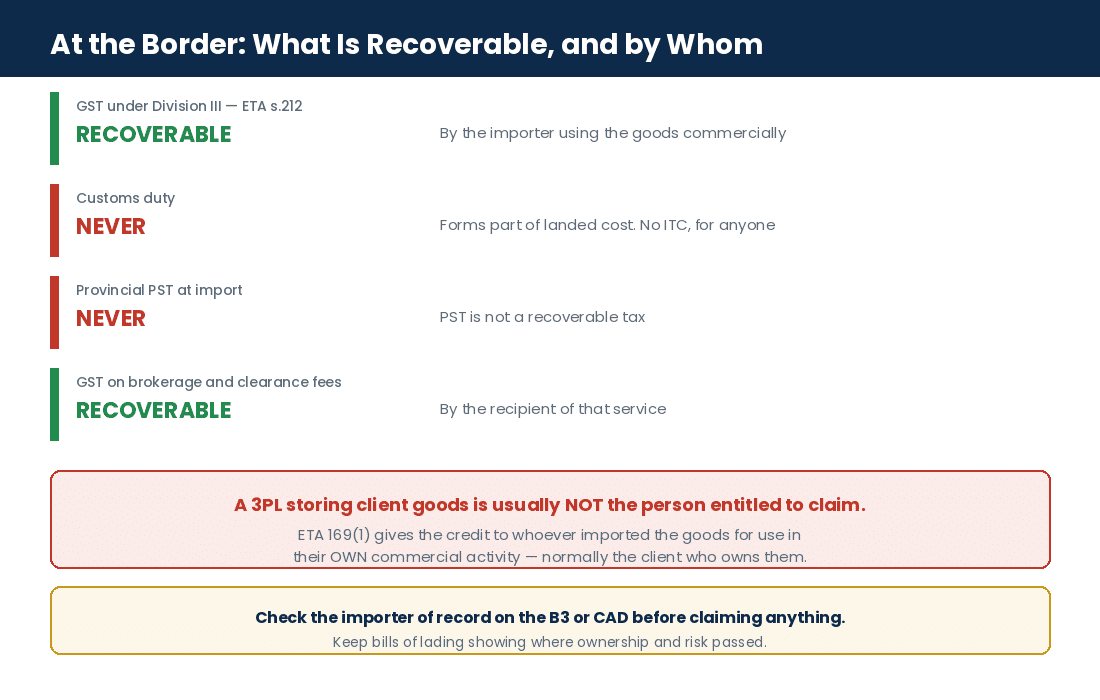
Risk Warning: “claim import duties paid as ITCs” describes something the Excise Tax Act does not allow. Customs duty is not a recoverable tax. It goes into the landed cost of the goods and is never an input tax credit.
What is recoverable is the GST paid at the border under Division III of Part IX, imposed by section 212, claimed by the person who imported the goods for consumption, use or supply in their commercial activity, under subsection 169(1). A 3PL arranging shipment for a client’s goods is generally not that person.
| Charge at the border | Recoverable? |
|---|---|
| GST under Division III (ETA 212) | Yes, by the importer using the goods in commercial activity |
| Customs duty | No — part of landed cost |
| Brokerage and clearance fees | GST on the fee is an ITC for the recipient of that service |
| Provincial PST at import | No — PST is never an ITC |
The Late Filing Penalty Is Not $250
Risk Warning: “penalties starting at $250 plus daily fines” conflates two unrelated provisions. The corporate late filing penalty under subsection 162(1) is 5% of the unpaid tax plus 1% per complete month to a maximum of twelve months — a 17% ceiling.
The $250 figure is the separate penalty under subsection 162(7.2) for failing to file electronically where required. And the 1% accrues monthly; it is the interest under subsection 161(1) that compounds daily.
The date almost everyone misses is not the filing one. The balance of tax is due two months after year-end under paragraph 157(1)(b), or three for a CCPC claiming the small business deduction — months before the six-month filing deadline.
A Mississauga warehousing operator billed $480,000 of annual storage contracts each January and deferred eleven twelfths in the books.
Paragraph 12(1)(a) included the full amount on receipt. The accounting deferral was correct; the 20(1)(m) reserve that gives it tax effect had never been claimed on a return. Reassessment covered three years, and the fix was a one-line schedule that had always been available. Figures changed for privacy.
Understanding Third Party Logistics Tax Planning in Canada
Understanding 3PL Tax Planning
Foundations
What Is Third Party Logistics and Its Role in Canadian Supply Chains
Third party logistics means outsourcing warehousing, fulfilment, distribution and freight arrangement to a provider. The tax consequence that distinguishes a 3PL from an ordinary service business is that it holds goods it does not own while earning fees that are recognised on a different clock from the invoices.
Importance of Specialized Tax Planning for 3PL Businesses
- Revenue timing across storage periods, handling events and contract shortfalls.
- Client inventory kept off the balance sheet as a bailment, with only the service fee in income.
- Asset classes that actually apply to racking, forklifts, leasehold work and software.
- Import GST recovery turning on who imported the goods, not who stored them.
- Provincial allocation where warehouses sit in more than one province.
Key Stat: client-owned goods are held under bailment and never enter your inventory. Only the service fee is income; the value of the goods is not.
The source commonly cited for this is IT-470R, which is Employees’ Fringe Benefits and has nothing to do with bailment. The correct position rests on general principles of ownership and on section 9: income is from the business of providing services, not from holding another person’s property.
Reporting Requirements for Logistics Businesses
| Obligation | Deadline | Provision |
|---|---|---|
| T2 return with GIFI Schedules 100, 125 and 141 | Six months after fiscal year-end | ITA 150(1)(a) |
| Balance of tax | Two months; three for an eligible CCPC | ITA 157(1)(b) |
| Corporate instalments | Last day of each month, or quarter for an eligible CCPC | ITA 157(1)(a), 157(1.1) |
| Schedule 5, provincial allocation | With the T2 | Regs 400(2), 402 |
| T4 and T4A slips | Last day of February | Reg 205(1) |
| Records retention | Six years from the end of the taxation year | ITA 230(4)(b) |
The statute is the Income Tax Act, R.S.C. 1985, c. 1 (5th Supp.) and the Excise Tax Act, R.S.C. 1985, c. E-15. Citations to “c. I-3” or to the Excise Tax Act as a Statute of Canada rather than a Revised Statute do not resolve.
Taxable Income Sources for 3PL Providers
| Revenue | When it is income | Provision |
|---|---|---|
| Storage billed in arrears | When receivable | ITA 12(1)(b) |
| Storage billed in advance | On receipt, with a reserve | 12(1)(a); 20(1)(m) |
| Pick-and-pack and handling fees | When the service is performed and receivable | ITA 12(1)(b) |
| Receiving surcharges | On confirmed receipt | ITA 12(1)(b) |
| Freight arrangement | Gross or net by agent versus principal | ITA 9 |
| Shortfall and volume commitment fees | When the entitlement arises under the contract | ITA 12(1)(b) |
| Damage recoveries | When the amount becomes receivable | ITA 12(1)(b) |
| Work performed but unbilled at year-end | Work in progress | ITA 10(5) |
Freight gross versus net is not decided by whether a “net billing agreement” exists. It turns on whether you contract as agent for the shipper or as principal buying and reselling the carriage — who is liable to the carrier, who bears the credit risk, whose name is on the contract.
Corporate Tax, GST/HST and Payroll Compliance
Corporate Tax, GST/HST and Payroll
Compliance
GST/HST Registration: Understanding Taxable Supplies and Eligibility
Registration is required under subsection 240(1) once you cease to be a small supplier under section 148 — $30,000 of taxable supplies. Two routes cross it: over $30,000 across four consecutive calendar quarters, or over $30,000 in a single calendar quarter, which ends the status immediately with 29 days to register.
| Supply | Treatment |
|---|---|
| Warehousing and storage in Canada | Taxable at the applicable rate |
| Pick-and-pack, handling, receiving | Taxable |
| International freight transportation | Zero-rated under Schedule VI, Part VII |
| Freight arrangement services relating to zero-rated carriage | Often zero-rated — check the specific listing |
| Services to a non-resident | Often zero-rated under Schedule VI, Part V |
That international freight row matters. A supply being zero-rated means 0% charged with input tax credits still recoverable — it is not exempt, and treating it as exempt forfeits the credits.
Applying Input Tax Credits for Warehousing and Freight
- Credits under section 169 to the extent of use in commercial activity.
- Warehouse rent, utilities, forklifts, racking, software subscriptions, professional fees — all recoverable where used commercially.
- Documentary support under subsection 169(4): over $30 the supplier’s name and date; over $150 the supplier’s registration number, the recipient’s name, terms and a description.
- Claims lost after the four-year window.
- Meals and entertainment credits recaptured to 50% under section 67.1.
Filing GST/HST Returns Accurately
| Annual taxable supplies | Frequency | Due |
|---|---|---|
| $1.5 million or less | Annual | Three months after fiscal year-end |
| Over $1.5M to $6 million | Quarterly | One month after quarter-end |
| Over $6 million | Monthly | One month after month-end |
Frequency is assigned by threshold, not chosen, and most established 3PLs are monthly filers. Remittance sits in section 228; late filing is penalised under section 280.1 at 1% plus 0.25% per month, with interest under 280 — not under section 240, which is registration.
Employee Versus Contractor Classification
- Tested on the Wiebe Door factors as refined in Sagaz and, where there is a written agreement, Connor Homes: control, tools, chance of profit, risk of loss.
- CRA Guide RC4110 sets out the approach; either party may request a ruling on Form CPT1.
- Agency labour is the pressure point in a 3PL. Where a staffing agency is the employer, it withholds and issues the T4 — but the placement agency rules in CPP Regulation 34 and EI Regulation 6(g) can attach obligations to the agency even for workers it does not employ, and a direct engagement without an agency puts the question back on you.
- Misclassification produces assessed source deductions for both employer and employee shares, plus penalty under subsection 227(9) from 3% to 10% and director liability under section 227.1.
Source Deduction Compliance and Remittance Deadlines
Risk Warning: “over $25,000 average monthly withholding means payment within three days after payday; otherwise quarterly” describes two bands wrongly and omits two others. There are four.
| Remitter type | Average monthly withholding | Due |
|---|---|---|
| Quarterly | Under $1,000 with a perfect compliance record | 15th of the month after the quarter |
| Regular | Under $25,000 | 15th of the following month — not quarterly |
| Accelerated, threshold 1 | $25,000 to $99,999.99 | 25th of the same month; 10th of the following |
| Accelerated, threshold 2 | $100,000 or more | Within 3 working days of each quarter-month period |
- Deductions are income tax, CPP and EI — CPP is frequently omitted from the list and is the largest employer cost after the wage itself.
- The employer matches CPP and pays EI at 1.4 times the employee premium, with CPP2 above the first earnings ceiling.
- Remittance deadlines are set by section 153 and Regulation 108 — these are federal and uniform, not set province by province. Quebec operations remit QPP, QPIP and Quebec income tax to Revenu Québec separately.
- Accrued remuneration paid within 179 days of year-end under subsection 78(4), or the deduction moves to the year of payment.
A multi-site operator with roughly $40,000 of average monthly withholding had been remitting on the 15th of the following month.
That is the regular band. At $40,000 it was accelerated threshold 1, due on the 25th of the same month and the 10th of the following. Every remittance had been late for two years, with 227(9) penalties accruing on each. Figures changed for privacy.
Effective Accounting Practices for Canadian 3PL Providers
Accounting Practices for 3PL Providers
Accounting
Bookkeeping Essentials for Warehousing and Distribution
- Service fees tracked separately from client-owned goods, which never enter inventory or cost of sales.
- Accessorial charges — pick-and-pack, receiving, special handling, shortfalls — coded individually so the revenue date is visible.
- A storage schedule showing contract period, amount billed and period served, which is the working paper behind the 20(1)(m) reserve.
- A chart of accounts breaking out labour, agency labour, equipment maintenance, leasehold work, utilities and carrier costs.
- Bookkeeping in QuickBooks Online or Xero with bank feeds reconciled monthly.
Managing Revenue Timing and Service Fees
Income is computed under section 9 on the accrual basis, with amounts included when receivable under paragraph 12(1)(b) and advance receipts caught by 12(1)(a). The cash method in section 28 is farming and fishing only.
| Charge type | When revenue is recognised | Cut-off reference |
|---|---|---|
| Pick-and-pack fees | Service performed, when receivable | End of month, 12(1)(b) |
| Receiving surcharges | Confirmed receipt | Billing cycle, 12(1)(b) |
| Prepaid storage | On receipt, reserved under 20(1)(m) | Contract period |
| Shortfall fees | When the entitlement arises under the contract | As the contract states |
| Unbilled work at year-end | Work in progress | ITA 10(5) |
Schedule II of the Regulations holds the capital cost allowance classes, not revenue timing guidelines, and is frequently cited for the latter in circulating guidance.
Classifying Asset Types: Leasehold Improvements, Equipment and Building Systems
Risk Warning: warehouse racking is not Class 43. Class 43 at 30% is manufacturing and processing machinery used directly in the manufacture or processing of goods for sale or lease. A 3PL stores and handles goods; it does not manufacture them.
Racking is ordinarily Class 8 at 20%, or Class 13 where it is affixed as a leasehold improvement to leased premises.
| Asset | Class | Method |
|---|---|---|
| Forklifts, pallet jackets, conveyors | 8 | 20% declining balance |
| Racking and shelving | 8 (or 13 if a leasehold improvement) | 20%, or straight-line |
| Leasehold improvements | 13 | Straight-line over the lease term plus the first renewal, minimum 5 years, maximum 40 |
| Computers and systems software | 50 | 55% |
| Purchased application software | 12 | 100% — not amortised over five years |
| Software subscriptions | Not capital | Deducted as incurred |
| Trucks and automotive equipment | 10 | 30% |
| Clean energy and energy conservation equipment | 43.1 / 43.2 | 30% / 50% |
Class 13 is not “up to ten years”. Schedule III of the Regulations sets it as straight-line over the lease term plus the first renewal option, subject to a minimum of five years and a maximum of forty. And there is no “five-year amortisation outside tangible classes” for purchased software — application software is Class 12 at 100%.
The first claim is gated by the available-for-use rule in subsections 13(26) to (32), and the half-year rule is suspended for eligible property acquired after 31 December 2024 under Bill C-15.
Electronic Filing and Records Retention
- Mandatory electronic filing of the T2 under subsection 150.1(2.1), with a $250 penalty under 162(7.2) for failing to comply.
- Information returns filed electronically where more than five of a type are filed.
- Records retained six years from the end of the taxation year to which they relate, paragraph 230(4)(b) — subsection 230(1) is the requirement to keep them.
- Section 286 of the Excise Tax Act imposes the same period for GST/HST records.
- Contracts with rate and storage schedules, invoices, payroll registers by province, unbilled work listings, bills of lading and customs documents.
Addressing Multi-Site and Multi-Province Tax Allocations
Key Stat: provincial allocation is 50% gross revenue and 50% salaries and wages — not “mostly revenue”. Regulation 402 splits taxable income across provinces on that two-factor formula, applied to permanent establishments as defined in Regulation 400(2), and reported on Schedule 5.
Revenue is attributed to the permanent establishment to which it reasonably relates — generally where the goods are delivered or the service performed — not to the client’s billing address. A warehouse is a permanent establishment; a client in another province is not.
- Payroll registers maintained by province, since provincial income tax tables differ even though the remittance schedule is federal.
- Employer health taxes applied where they exist — Ontario EHT, Manitoba HELT, BC Employer Health Tax — each with its own exemption and rate.
- Workers’ compensation registration per province, separate from payroll.
- One GST/HST registration covers the country; only BC PST, Saskatchewan PST, Manitoba RST and Quebec QST require their own.
- Intercompany transfers between related entities priced at fair market value under subsection 69(1).
Tax Strategies to Optimize Business Expenses for 3PL Firms
Strategies to Optimize Business Expenses
Strategy
Tax Treatment of Warehousing, Freight and Fulfillment Services: Identifying Eligible Deductions
- Warehouse lease payments, utilities, security and maintenance.
- Labour, including agency labour, coded separately from direct payroll.
- Capital cost allowance on forklifts and racking in Class 8, leasehold work in Class 13, and vehicles in Class 10.
- Warehouse management and inventory software — subscriptions as a current expense, purchased licences in Class 12.
- Liability, cargo and property insurance, allocated across the policy period under subsection 18(9).
- Carrier payments, fuel and tolls on your own fleet.
The tax implications for fulfillment operations follow the same clock as warehousing: revenue is recognised when the service is performed and the amount becomes receivable, and recording prepaid expenses for tax efficiency means apportioning costs that span periods under subsection 18(9) while apportioning prepaid revenue through the 20(1)(m) reserve rather than a book deferral.
Only the service fee is income; the value of client goods stored is not. That is the distinction that governs which costs match which revenue under section 9.
Utilizing SR&ED and Other Incentives Relevant to 3PL Operations
Risk Warning: building warehouse software is not automatically SR&ED. The definition in subsection 248(1) requires technological uncertainty, systematic investigation and technological advancement. Configuring a warehouse management system, or commissioning a custom module using known methods, meets none of them.
Where a genuine claim exists — a cold-chain monitoring approach whose behaviour could not be predicted from standard practice, say — the reporting deadline under subsection 37(11) is twelve months after the T2 due date, so 18 months after year-end, and CRA has no discretion to extend it.
- 35% refundable for a CCPC within the expenditure limit; 15% above.
- Arm’s length SR&ED contract payments included at 80%.
- Government assistance reduces the qualified expenditure pool under subsection 127(11.1).
- Class 43.1 and 43.2 for clean energy and energy conservation equipment, at 30% and 50%, where the property qualifies and the available-for-use date is documented.
Structuring Labour Costs
Classification is decided by the Wiebe Door factors, not by the contract label or by whether an agency sits in between. Where agency staff fill peak-season gaps, the agency’s own obligations do not displace yours if the working relationship points to employment with you. Keep the agreement, the rate card and the day-to-day direction evidence together.
Accessorial Charges, Shortfall Fees and Volume Commitments
| Charge type | When revenue counts | Provision |
|---|---|---|
| Pick-and-pack fees | Service performed, when receivable | ITA 12(1)(b) |
| Receiving surcharges | Confirmed receipt | ITA 12(1)(b) |
| Shortfall fees | When the entitlement arises under the contract | ITA 12(1)(b) |
| Prepaid storage | On receipt, with a reserve | ITA 12(1)(a); 20(1)(m) |
For GST/HST, timing follows subsection 168(1): the earlier of payment and the day consideration becomes due. Section 165 imposes the tax and does not set the timing, despite being commonly cited for it.
Damage Provisions and Bad Debts
Risk Warning: a damage provision is not deductible just because it is well documented. Paragraph 18(1)(e) denies a deduction for a reserve or contingent liability except where the Act expressly permits one, and nothing permits a damage provision.
The cost becomes deductible when it is incurred. The accounting provision is recognised under ASPE and added back on Schedule 1. Recoveries from clients or insurers are income under 12(1)(b) when receivable.
- Bad debts deducted under paragraph 20(1)(p)(i) where previously included in income and established to have become bad.
- Paragraph 20(1)(l) is the separate reserve for doubtful debts.
- The GST/HST already remitted on a written-off receivable is recovered under section 231 of the Excise Tax Act — a step most 3PLs miss.
Import Tax Recovery and Customs Planning
| Situation | Who can claim the Division III GST |
|---|---|
| Goods owned by the client, client is importer of record | The client, for its commercial activity |
| Goods owned and imported by the provider | The provider, if registered and using them commercially |
| Provider arranges carriage only, no ownership | Neither — the provider has no claim |
| Customs duty, any scenario | Nobody — duty is landed cost, never an ITC |
Confirm the importer of record on the B3 or CAD before anything is claimed, and keep the bills of lading and customs accounting documents showing where ownership and risk passed. A provider that appears as importer of record on goods it does not own and does not use in its own commercial activity has a documentation problem, not a credit.
A fulfilment operator claimed input tax credits on roughly $90,000 of charges at the border on client inventory, including the duty.
The duty was never recoverable by anyone, and the Division III GST belonged to the client, which was the importer of record and the owner. The whole claim was reversed with interest. Figures changed for privacy.
Navigating CRA Compliance and Risk Management for 3PL Providers
CRA Compliance and Risk Management
Risk
Penalties, Interest and CRA Audit Triggers
| Item | Rule | Provision |
|---|---|---|
| Corporate late filing | 5% of unpaid tax plus 1% per complete month, to twelve months | ITA 162(1) |
| Repeat late filing | Doubled: 10% plus 2% per month to twenty months | ITA 162(2) |
| Failure to file electronically | $250 | ITA 162(7.2) |
| Arrears interest | Compounded daily, prescribed rate set quarterly | ITA 161(1) |
| Instalment interest | Plus a penalty where that interest exceeds $1,000 | ITA 161(2); 163.1 |
| Late payroll remittance | 3% to 10% by lateness | ITA 227(9) |
| Late GST/HST filing | 1% plus 0.25% per month | ETA 280.1 |
Penalties sit in sections 162 and 163 of the Act, not in Part XII of the Regulations, which deals with resource deductions.
Common Audit Triggers
- Client-owned goods shown as the provider’s inventory.
- Prepaid storage deferred in the books with no 20(1)(m) reserve on the return.
- Input tax credits claimed without documentation meeting subsection 169(4).
- Import credits claimed by a provider that was not the importer, or claimed on duty.
- Racking in Class 43 instead of Class 8 or 13.
- Freight reported net where the provider contracted as principal.
- Damage provisions deducted rather than added back under 18(1)(e).
- Agency labour with no classification analysis behind it.
Maintaining Compliance with Excise Tax Act Requirements
- Every taxable supply invoiced with the registration number and the tax shown.
- Input tax credits supported to the 169(4) thresholds at $30 and $150.
- Zero-rated international freight identified as such rather than treated as exempt, so the credits survive.
- Import documentation tying the Division III GST to the person entitled to claim it.
- Records held six years under section 286.
Accurate T2 Filing and Avoiding Arrears
- Return filed within six months of year-end under paragraph 150(1)(a), electronically under 150.1(2.1).
- Balance paid at two months, or three for a CCPC claiming the small business deduction, under paragraph 157(1)(b).
- Instalments on the last day of each month under 157(1)(a), or each quarter for an eligible CCPC under 157(1.1), with none required below $3,000 of taxes payable or in a first year.
- Agency labour reported separately from direct payroll in the GIFI.
- Asset classes checked annually against the schedule, particularly racking and leasehold work.
- Schedule 1 reconciliation showing added-back provisions.
Importance of Timely Record Keeping and Documentation
| Document | Retention | Reference |
|---|---|---|
| Contracts, rate cards, storage schedules | Six years from the end of the taxation year | ITA 230(4)(b) |
| Payroll registers by province | Same | ITA 230(4)(b) |
| GST/HST invoices and ITC support | Same | ETA 286; 169(4) |
| Bills of lading and customs accounting documents | Same | ETA 286 |
| Unbilled work listings | Same | ITA 230(4)(b) |
GST/HST Audits and Mitigating Tax Assessment Risks
Import credits draw the most attention, because the provider is visible on the shipping documents while the entitlement usually belongs to the client. Confirm the importer of record, confirm ownership, and confirm that duty was excluded from anything claimed. Where a prior year is wrong, the Voluntary Disclosures Program under Information Circular IC00-1R6 may limit penalties if you come forward before CRA makes contact, with relief separately available under subsection 220(3.1) on Form RC4288 within ten calendar years. CRA representation is available where a claim is challenged.
An operator filed every T2 on time at six months and paid the balance with the return, expecting a “$250 plus daily fines” exposure if anything slipped.
No filing penalty arose, because the returns were on time. What did accrue was arrears interest under 161(1), compounding daily on a balance that had been due at three months throughout as a CCPC claiming the small business deduction. Figures changed for privacy.
Market Overview and Industry Insights Impacting 3PL Tax Planning
Market Overview and Industry Insights
Context
Canadian 3PL Market Size, Growth and Trends
The sector is growing on the back of e-commerce fulfilment, multi-site networks and automation. We do not publish a market size figure here: the “past CAD 20 billion by 2026” number circulates without a traceable source, and a tax article is the wrong place to launder an unsourced statistic. What matters for tax is that the revenue mix is getting more fragmented — storage, handling, accessorials, shortfalls, freight arrangement — and each line has its own timing rule.
Regulatory Landscape Influencing Tax and Accounting Requirements
- Revenue timing under section 9, paragraphs 12(1)(a) and 12(1)(b), with the reserve in 20(1)(m).
- Client-owned goods held as a bailment, outside inventory.
- Asset classification under Schedule II with rates in Regulation 1100 and Class 13 terms in Schedule III.
- Input tax credits under section 169, with import entitlement under 169(1) turning on who imported for commercial use.
- Provincial allocation under Regulations 400(2) and 402.
Competitive Environment, Pricing and Profitability
Margin pressure makes the gross-versus-net question material: a provider reporting freight gross when it acts as agent inflates revenue without improving profit, and one reporting net when it acts as principal understates it. The test is agent versus principal — who is liable to the carrier, who bears the credit risk, whose name is on the contract — not whether a net billing arrangement is written down.
Agency labour is the other margin lever, and the one that carries classification risk. Provisions taken against expected damages or shortfalls are added back under 18(1)(e) until incurred, so booking them does not reduce current tax.
E-Commerce and Cross-Border Trade
- Higher volumes of short-period storage, which makes the prepaid reserve calculation a monthly exercise rather than an annual one.
- Import entitlement resting with the owner-importer, not the provider holding the goods.
- Zero-rated international freight under Schedule VI, Part VII, which preserves input tax credits rather than restricting them.
- Place of supply for domestic services generally following the recipient’s address under Schedule IX.
- Non-resident platform operators within the digital economy rules in sections 211.1 to 211.25 since 1 July 2021.
Emerging Challenges in Labour, Technology and Sustainability Compliance
- Agency and seasonal labour classified before the season, not after a ruling request.
- Multi-province payroll registers maintained per province, while the remittance schedule stays federal.
- Warehouse management software split between subscriptions (current) and purchased licences (Class 12 at 100%).
- Energy conservation and clean energy equipment in Class 43.1 or 43.2, with the available-for-use date documented under 13(26) to (32).
- Financial statements prepared under ASPE, compiled under CSRS 4200, which provides no assurance.
Gondaliya CPA’s Approach to Supporting 3PL Tax and Accounting Needs
Books built so the storage schedule, accessorial revenue and agency labour fall out of the ledger; the 20(1)(m) reserve calculated rather than assumed; asset classes checked against what the equipment actually is; import entitlement confirmed against the customs documents before anything is claimed; and the compiled statements, GST/HST and T2 filed from one reconciled set of records, on a flat annual fee including HST.
A provider had capitalised $340,000 of racking to Class 43 at 30% on the view that it was processing equipment.
Class 43 is manufacturing and processing machinery. Racking in a storage facility is Class 8 at 20%, or Class 13 where affixed to leased premises. The claim was overstated by a third in year one and the pool had to be rebuilt from the installation invoices. Figures changed for privacy.
Frequently Asked Questions on Third Party Logistics Tax Planning
Frequently Asked Questions
FAQ
What is the importance of Income Tax Act section 9 in 3PL tax planning?+
Section 9 computes profit from the business on the accrual basis. Amounts are included when receivable under paragraph 12(1)(b), and advance receipts for services not yet rendered are included on receipt under 12(1)(a). Section 9 alone does not let you defer prepaid storage — the reserve in 20(1)(m) does.
How does Class 13 apply to leasehold improvements?+
Straight-line over the lease term plus the first renewal option, subject to a minimum of five years and a maximum of forty under Schedule III of the Regulations. It is not “up to ten years”. Racking affixed to leased premises can fall here rather than in Class 8.
What is the CRA interest rate on late tax?+
The prescribed rate is set quarterly and arrears interest under subsection 161(1) compounds daily. Interest is separate from the late filing penalty in 162(1), which accrues monthly.
When are payroll remittances due?+
By band, on average monthly withholding amount. Under $25,000 is regular: the 15th of the following month. $25,000 to $99,999.99 is accelerated threshold 1: the 25th of the same month and the 10th of the following. $100,000 or more is threshold 2: within 3 working days of each quarter-month period. Quarterly applies only below $1,000 with a perfect compliance record.
How is prepaid storage income recognised?+
Included in full on receipt under paragraph 12(1)(a), with a reserve under paragraph 20(1)(m) for the period not yet served — an exception to 18(1)(e), added back the following year under 12(1)(e) and re-claimed on the remainder. Deferring in the books without claiming the reserve does not defer the tax.
How long must records be kept?+
Six years from the end of the taxation year to which they relate, under paragraph 230(4)(b). Subsection 230(1) is the requirement to keep them. Section 286 of the Excise Tax Act imposes the same for GST/HST records.
How should shortfall charges be treated?+
As income when the entitlement arises under the contract and the amount becomes receivable, under paragraph 12(1)(b). Accruing them before the measurement period closes overstates revenue; leaving them out once earned understates it.
What are accessorial charges?+
Fees beyond base storage — pick-and-pack, receiving surcharges, special handling, rush processing, disposal. Each is income when the service is performed and the amount is receivable, and each is a taxable supply for GST/HST with tax payable under subsection 168(1).
How does amortization of leasehold improvements work under Canadian tax rules?+
Class 13 is straight-line, not declining balance, over the lease term plus the first renewal, bounded at five and forty years. Improvements added in later years each get their own amortisation period running from when they are made.
What does bailment mean for client-owned goods?+
The goods remain the client’s property throughout. They do not appear on your balance sheet, do not enter inventory or cost of sales, and generate no income for you — only the service fee does. IT-470R, often cited here, is Employees’ Fringe Benefits and is not the authority.
Gross or net for freight revenue?+
By agent versus principal, not by whether a net billing agreement exists. If you contract with the carrier as principal and bear the credit risk, report gross with the carrier cost deducted. If you arrange carriage as the shipper’s agent, only the commission is your revenue.
Why does agency labour classification matter?+
Because misclassification produces assessed source deductions for both employer and employee shares, plus penalty under subsection 227(9) and director liability under 227.1. The placement agency rules in CPP Regulation 34 and EI Regulation 6(g) can also attach obligations to an agency for workers it does not employ.
How is income allocated across provinces?+
50% on gross revenue and 50% on salaries and wages under Regulation 402, attributed to permanent establishments as defined in Regulation 400(2), reported on Schedule 5. Revenue follows the establishment to which it reasonably relates — not the client’s billing address.
What documents support an input tax credit?+
Subsection 169(4) sets thresholds: over $30 the supplier’s name and the date; over $150 the supplier’s registration number, the recipient’s name, the terms of payment and a description of the supply. Claims are lost after the four-year window.
Who claims import-related credits?+
The person who imported the goods for consumption, use or supply in their own commercial activity, under subsection 169(1), on the Division III GST imposed by section 212. A 3PL arranging carriage without owning the goods is not that person. Customs duty is never recoverable — it is landed cost.
Employee or contractor?+
Tested on the Wiebe Door factors as refined in Sagaz and Connor Homes: control, tools, chance of profit, risk of loss, tested against the actual relationship. CRA Guide RC4110 sets out the approach and Form CPT1 obtains a ruling.
What must employers remit?+
Income tax, CPP and EI — CPP is routinely omitted from the list and is a major employer cost, matched dollar for dollar with CPP2 above the first ceiling, while EI costs the employer 1.4 times the employee premium. The remittance schedule is federal and uniform; Quebec operations remit QPP, QPIP and Quebec tax to Revenu Québec separately.
When is the T2 due, and what is the penalty?+
Filed within six months of fiscal year-end under paragraph 150(1)(a); the balance of tax is due at two months, or three for a CCPC claiming the small business deduction, under 157(1)(b). Late filing is penalised under 162(1) at 5% plus 1% per month to twelve months — the $250 figure is the separate electronic filing penalty in 162(7.2).
Are damage provisions deductible?+
No. Paragraph 18(1)(e) denies reserves and contingent liabilities except where the Act expressly permits one, and nothing permits a damage provision. The cost is deductible when incurred; the accounting provision is added back on Schedule 1. Recoveries are income under 12(1)(b) when receivable.
Nineteen questions, and three of them — the reserve, the remittance band and the import credit — account for most of what we reassess on a 3PL file.
None is exotic. Each is an ordinary rule applied one step short: the deferral booked but not claimed, the band read from the wrong row, the credit taken by the wrong party. Figures changed for privacy.
Additional Key Points on Third Party Logistics Tax Planning
Essential Topics and Best Practices
Quick Reference
- Damage recovery income: included under 12(1)(b) when receivable, not when the claim is lodged.
- Electronic filing: mandatory for the T2 under 150.1(2.1), with the $250 penalty in 162(7.2) for non-compliance.
- Audit triggers: client goods in inventory, prepaid storage with no reserve, unsupported credits, racking in the wrong class.
- GST/HST audit focus: import entitlement, duty wrongly claimed, zero-rated freight treated as exempt.
- Amendments: correct errors promptly, with the Voluntary Disclosures Program under IC00-1R6 where a prior year is materially wrong.
- Record keeping: ledgers separating client goods from provider assets, with contracts and customs documents filed chronologically.
- Preventing mistakes: settle the reserve, the asset classes and the import position before year-end rather than at filing.
- Compliance: statements reflecting actual service dates, compiled under CSRS 4200 with no assurance.
- Freight arrangers: agent or principal decides gross or net, and the answer must be consistent across income tax and GST/HST.
- Damage provisions: added back under 18(1)(e) until the cost is incurred.
Points Worth Carrying
- Prepaid storage: 12(1)(a) in, 20(1)(m) reserve out.
- Customs duty is never an input tax credit.
- Only Division III GST is recoverable, by the importer using the goods commercially.
- Racking is Class 8 or 13, never Class 43.
- Class 13 runs the lease plus first renewal, five to forty years.
- Purchased application software is Class 12 at 100%.
- Remittance has four bands, and under $25,000 is monthly, not quarterly.
- Provincial allocation is 50% revenue and 50% salaries, Regulation 402.
- The late filing penalty is 162(1), not $250.
- The corporate balance is due at two or three months, under 157(1)(b).
Twenty points, and the ten at the end are all things a 3PL operator was told confidently by something they read.
None is obscure. They are ordinary rules attached to a class number that means something else, a remittance band read one row off, or a border charge that was never recoverable in the first place. Figures changed for privacy.
Businesses We Serve
Industry Expertise
Logistics businesses share the same issues whatever they move. Here are ten and the usual finding.
| Practice | The Issue That Usually Appears |
|---|---|
| Warehousing and storage operators | Prepaid storage deferred in the books with no 20(1)(m) reserve |
| E-commerce fulfilment providers | Client inventory shown on the provider’s balance sheet |
| Cold chain and temperature-controlled | Refrigeration and racking in the wrong CCA class |
| Freight arrangers and brokers | Gross versus net decided by the invoice, not by agency |
| Cross-border and customs-facing 3PLs | Import credits claimed on duty, or by the wrong party |
| Multi-province network operators | Allocation weighted to revenue instead of 50/50 under Reg 402 |
| Peak-season and agency labour users | No classification analysis behind the staffing arrangement |
| Distribution and transload operators | Leasehold work pooled with equipment rather than Class 13 |
| Contract logistics with volume commitments | Shortfall fees accrued before the entitlement arises |
| Providers carrying damage exposure | Provisions deducted rather than added back under 18(1)(e) |
- Warehousing operators: the reserve is a schedule, not an assumption.
- Fulfilment providers: bailment keeps client goods off the balance sheet.
- Cold chain: check the class against what the asset is.
- Freight arrangers: agent or principal, consistently applied.
- Cross-border 3PLs: Division III GST only, importer only.
- Multi-province operators: 50% revenue, 50% salaries.
- Agency labour users: Wiebe Door before the season.
- Distribution operators: Class 13 straight-line.
- Contract logistics: 12(1)(b) when the entitlement arises.
- Providers with damage exposure: deduct when incurred.
The cargo changes. The questions do not: was the service rendered, who owned the goods, and which class is the asset in.
A cold chain operator and a parcel fulfilment house look nothing alike on the floor and file nearly identical returns. Figures changed for privacy.
Professional Guidance and Quick Reference
Guidance
Professional Guidance: How Gondaliya CPA Handles Your 3PL
Third-party logistics providers get into difficulty in a predictable set of ways: deferring prepaid storage in the books without claiming the 20(1)(m) reserve on the return, when paragraph 12(1)(a) includes the full amount on receipt; claiming customs duty as an input tax credit, when duty is landed cost and only the Division III GST under section 212 is recoverable, and then only by the person who imported the goods for their own commercial use under subsection 169(1); putting warehouse racking in Class 43, which is manufacturing and processing machinery, when it belongs in Class 8 or Class 13; reading Class 13 as a ten-year write-off, when Schedule III sets it as straight-line over the lease plus first renewal, bounded at five and forty years; amortising purchased software over five years, when application software is Class 12 at 100%; remitting payroll on the 15th at a withholding level that puts them in accelerated threshold 1; allocating provincial income mostly on revenue, when Regulation 402 is 50% revenue and 50% salaries; deducting damage provisions that paragraph 18(1)(e) denies until incurred; and budgeting for a $250 late filing penalty, when 162(1) charges 5% plus 1% per month. Gondaliya CPA handles 3PL accounting on a flat annual fee.
We handle what decides the outcome: building the storage schedule so the reserve is a calculation rather than an argument, keeping client goods off the balance sheet as a bailment, classifying racking, leasehold work and software by what they actually are, confirming the importer of record against the customs documents before any credit is claimed and excluding duty from all of it, setting the right remittance band, identifying zero-rated international freight so the credits survive, applying the two-factor allocation on Schedule 5, adding back provisions on Schedule 1, diarising the corporate balance date separately from the filing date, and preparing compiled statements under CSRS 4200 that state plainly that no assurance is provided.
Our team starts with one client contract, your lease and your last return. Whatever you move, you get clear advice and a fixed price before we start.
Quick Answers
At a Glance
- Prepaid storage in: ITA 12(1)(a)
- Reserve out: ITA 20(1)(m)
- Accrued fees: ITA 12(1)(b) when receivable
- Racking and forklifts: Class 8, 20%
- Leasehold work: Class 13, straight-line, 5 to 40 years
- Purchased software: Class 12, 100%
- Import GST: Division III only, ETA 212
- Customs duty: never an ITC
- Remittance under $25,000: 15th of the following month
- Provincial split: 50% revenue, 50% salaries, Reg 402
- Corporate balance: two months; three for a CCPC
- Records: six years from the taxation year-end
Who This Is For
Fit Check
- For: Incorporated Canadian third-party logistics providers — warehousing, fulfilment, distribution, transload and freight arrangement — including multi-site and multi-province operators handling client-owned and imported goods.
- Not For: Owner-operator truckers and carriers, whose per-diem, fuel tax and logbook issues are different throughout, and businesses requiring a review or audit engagement, which we refer out.
People Also Ask
Quick Answers
Can I defer prepaid storage revenue for tax?+
Only by claiming the 20(1)(m) reserve. Paragraph 12(1)(a) includes the fee in income on receipt; deferring it in the accounts without the reserve on the return leaves the inclusion unaddressed.
Can I claim the duty I paid at the border?+
No. Customs duty is never an input tax credit — it forms part of landed cost. Only the Division III GST under section 212 is recoverable, by the person who imported the goods for use in their own commercial activity.
Is warehouse racking Class 43?+
No. Class 43 is manufacturing and processing machinery. Racking in a storage facility is Class 8 at 20%, or Class 13 where it is affixed as a leasehold improvement.
Do my payroll remittance dates change by province?+
No. The federal remittance schedule in section 153 and Regulation 108 is uniform across Canada, set by your average monthly withholding amount. Quebec operations remit QPP, QPIP and Quebec income tax to Revenu Québec on their own schedule.
Is the late filing penalty $250?+
No. Subsection 162(1) charges 5% of unpaid tax plus 1% per complete month to twelve months. The $250 is the separate penalty in 162(7.2) for failing to file electronically where required.
Glossary of Key Terms
Glossary
- Paragraph 12(1)(a): Includes amounts received for services not yet rendered.
- Paragraph 20(1)(m): The reserve for undelivered goods and services.
- Paragraph 18(1)(e): Denies reserves and contingent liabilities.
- Bailment: Holding another person’s goods without acquiring ownership.
- Class 8: Forklifts, racking and residual equipment at 20%.
- Class 13: Leasehold improvements, straight-line over lease plus first renewal.
- Class 43: Manufacturing and processing machinery — not warehouse racking.
- Division III tax: The GST imposed on imported goods by ETA section 212.
- Importer of record: The person accounting for the goods at the border.
- Regulation 402: Provincial allocation on revenue and salaries, equally weighted.
- Regulation 400(2): Defines a permanent establishment.
- Average monthly withholding amount: Sets the payroll remittance band.
- Accessorial charge: A fee beyond base storage, such as pick-and-pack.
- Zero-rated: Taxed at 0% with input tax credits still recoverable.
- Agent versus principal: Decides gross or net reporting of freight.
- CSRS 4200: The compilation engagement standard, providing no assurance.
3PL Tax Check
This quick self-check indicates where your business most likely has room. Please answer the five questions below.
3PL Tax Check
Five quick questions on your business. No fee shown.
Points to raise with us:
This is a general prompt, not tax or legal advice or a quote. Your position depends on your full facts. For a real review, please book a free consultation.
Want a checklist to work from? You can download our free 3PL tax checklist before your consultation.
Include prepaid storage in income on receipt under paragraph 12(1)(a) and claim the 20(1)(m) reserve on the return, because deferring in the books alone does not defer the tax. Exclude customs duty from everything, since it is landed cost and never an input tax credit, and claim the Division III GST only where you were the importer using the goods in your own commercial activity. Put racking and forklifts in Class 8, leasehold work in Class 13 straight-line over the lease plus first renewal, and purchased application software in Class 12 at 100%. Check your average monthly withholding against all four remittance bands rather than assuming monthly or quarterly. Allocate provincial income 50% on revenue and 50% on salaries under Regulation 402, to permanent establishments rather than billing addresses. Add damage provisions back under 18(1)(e) until the cost is incurred, and recover GST/HST on written-off receivables under section 231. Pay the corporate balance at two or three months rather than with the return. And please keep six years of records from the year-end.
2026 Update — what is current: This article reflects rules current to 2 October 2026. The six-month T2 filing deadline under 150(1)(a), the six-year retention requirement under 230(4)(b), the last-day-of-February slip deadline under Regulation 205(1) and the input tax credit thresholds in 169(4) are unchanged. Please note that prepaid storage is included under paragraph 12(1)(a) with the deferral coming from a 20(1)(m) reserve, an exception to 18(1)(e); that customs duty is never an input tax credit and only the Division III GST imposed by ETA 212 is recoverable, by the importer using the goods commercially under 169(1); that warehouse racking is Class 8 or Class 13, never Class 43, which is manufacturing and processing machinery; that Class 13 runs straight-line over the lease plus first renewal with a five-year minimum and forty-year maximum under Schedule III; that purchased application software is Class 12 at 100%; that payroll remittance has four bands on the average monthly withholding amount, with under $25,000 due the 15th of the following month, and the schedule is federal rather than provincial; that provincial allocation under Regulation 402 is 50% gross revenue and 50% salaries and wages; that the corporate balance is due at two months under 157(1)(b), or three for a CCPC claiming the small business deduction; that the late filing penalty is 162(1) at 5% plus 1% per month, with the $250 figure belonging to the electronic filing penalty in 162(7.2); and that the half-year rule is suspended for eligible property acquired after 31 December 2024 under Bill C-15.
Third Party Logistics Tax Planning Canada: How Gondaliya CPA Supports 3PL Providers
Start with one client contract, your lease and your last return
Gondaliya CPA builds the storage schedule so the 20(1)(m) reserve is a calculation rather than an argument, keeps client goods off the balance sheet as a bailment, classifies racking, leasehold work and software by what they actually are, confirms the importer of record before any credit is claimed and excludes duty from all of it, sets the right remittance band, identifies zero-rated international freight so the credits survive, applies the two-factor allocation on Schedule 5, and files the GST/HST, the compiled statements and the T2 with its GIFI from one reconciled set of books — on a flat annual fee including HST with a one-business-day response. Please book a free consultation.
Next Steps
Please book a free consultation with Gondaliya CPA and bring one client contract with its storage and accessorial terms, your warehouse lease, and your last return. Those three settle the reserve question, the asset classification question and the import question, which is where most of the exposure sits for a 3PL. You will get a flat annual fee including HST before any work begins. We serve Toronto, Mississauga, Brampton, Vaughan, Ottawa and the rest of Ontario, and work with logistics providers across Canada. If our content helps, please add gondaliyacpa.ca as a preferred source on Google.
Published: · Last updated:
Editorial policy: We research against CRA, CPA Canada and CPA Ontario sources, fact-check the figures, and Sharad Gondaliya, CPA, reviews the content, which we update as the rules change.
Disclaimer: This article is educational information only and is not tax, legal, or financial advice. Figures marked illustrative are examples rather than quotes or guarantees. It reflects rules current to 2026, including the paragraph 20(1)(m) reserve, the capital cost allowance classes in Schedule II and Schedule III, the Division III import rules in the Excise Tax Act, the provincial allocation formula in Regulation 402 and the six-year retention requirement. Rates and limits change and outcomes depend on your specific facts. Please consult a CPA Ontario member before acting.

Sharad Gondaliya is a CPA Canada & CPA USA with 15 Years+ experience of Accounting, Tax, Payroll of Corporate Small Businesses as Tax Accountant. He is a CPA Ontario member (61040184) and holds US CPA licences in Washington and Montana and is well known among corporate small businesses for tax planning, efficient tax solutions, and affordable CPA services. Sharad is the Principal (Director) of Gondaliya CPA – Affordable CPA Firm in Canada. Licenses: CPA Ontario: 61040184 | CPA USA (MT): PAC-CPAP-LIC-033176 | CPA USA (WA): 57629 | CPA Firm License: 61330051 View Full Author Bio