



Virtual Assistant Tax Deductions in Canada: Home Office, Software, Equipment & Business Expenses
Virtual assistant tax deductions Canada explained: the workspace tests, equipment classes and GST/HST
Virtual assistant tax deductions Canada include home office expenses, software costs, and equipment tax deductions that are essential for reducing taxable income. Gondaliya CPA outlines how to correctly apply business use of home rules, reasonable portion apportionment, and carry-forward options to maximize your business tax deductions.
Quick Summary
Subsection 18(12) gives two alternative tests, and test (b) requires you to meet clients at the workspace on a regular basis — which rules it out for most virtual assistants, leaving test (a) with no exclusivity requirement. There is no general $500 immediate-expensing rule. And the half-year rule is suspended for eligible property acquired after 31 December 2024.
Reading time: 47 minutes.
Table of Contents
- Three Things You Have Been Told
- Tax Obligations and Income Reporting
- Business Expenses and Deductible Costs
- Home Office and Workspace Deductions
- Workers, Slips and Payment Structures
- Records, Tools and Input Tax Credits
- Maximizing Benefits and Filing
- Frequently Asked Questions
- Essential Topics and Best Practices
- Businesses We Serve
- Professional Guidance and Quick Reference
The Numbers That Matter
This article covers Canada, with Ontario and Toronto context, and reflects rules current to 2 October 2026. It is written for self-employed virtual assistants and incorporated VA businesses, including those working through platforms, serving clients outside Canada, or engaging subcontractors. Gondaliya CPA performs compilation engagements; we do not perform audits or review engagements. Figures marked illustrative are examples, not quotes, and any masked engagement notes end with “Figures changed for privacy.” This is educational information only and not tax or legal advice.
Three Things You Have Been Told
Three Things You Have Been Told
The Corrections
Three points about virtual assistant tax circulate widely and all three are wrong. The first decides whether you can claim a home office at all.
Test (b) Needs Client Meetings, Which Most VAs Do Not Have
Risk Warning: “exclusive and regular use” is only half of test (b), and the missing half excludes most virtual assistants. Subsection 18(12) gives two alternative tests, and test (b) requires the space to be used exclusively for the business and used on a regular and continuous basis for meeting clients, customers or patients.
A virtual assistant who works entirely online and never meets a client in person cannot satisfy test (b), no matter how exclusive the room. The route is test (a) — the home is your principal place of business — which carries no exclusivity requirement at all.
| Test | What it requires | Fits a VA? |
|---|---|---|
| (a) Principal place of business | The home is where the business is principally carried on. No exclusive use needed | Usually yes |
| (b) Exclusive use plus client meetings | Space used only for the business and clients met there regularly | Rarely — the meetings are the problem |
This is good news for most VAs working from a corner of a room. Test (a) does not care that the desk shares space with a bedroom; it cares where the business is principally carried on. The apportionment still has to be reasonable.
There Is No $500 Immediate Expensing Rule
Risk Warning: “a laptop under $500 is expensed in the year bought” is not a rule. The $500 figure comes from Class 12, which includes tools costing less than $500 — and even then it is 100% capital cost allowance, not an outright expense.
A computer is Class 50 at 55% whatever it cost. A $400 laptop and a $4,000 laptop go in the same class at the same rate. There is no general threshold below which business assets are simply written off.
| Asset | Class | Rate |
|---|---|---|
| Laptops, desktops, monitors, systems software | 50 | 55% |
| Purchased application software | 12 | 100% |
| Desk, chair, shelving, filing | 8 | 20% |
| Tools costing less than $500 | 12 | 100% |
| Software subscriptions | Not capital | Deducted as incurred |
The Half-Year Rule Is Suspended, and the Worked Example Was Wrong Anyway
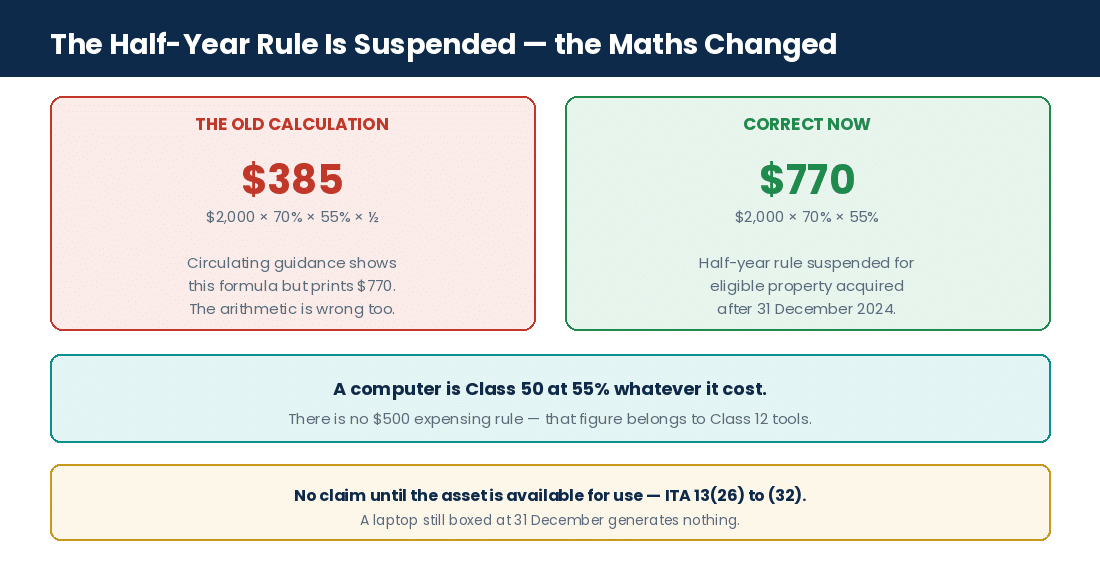
Guidance showing $2,000 × 70% × 55% × ½ = $770 contains two errors that cancel out. The arithmetic is wrong — that calculation gives $385, not $770 — and the half-year rule it applies has been suspended for eligible property acquired after 31 December 2024 under Bill C-15.
| Calculation | Result | Status |
|---|---|---|
| $2,000 × 70% × 55% × ½ | $385 | The half-year answer, correctly computed |
| $2,000 × 70% × 55% | $770 | Correct now — half-year rule suspended |
The half-year rule never depended on buying “mid-year” either; it applied to net additions in the year of acquisition regardless of month. And the first claim is still gated by the available-for-use rule in subsections 13(26) to (32) — a laptop still in its box at 31 December generates nothing.
A virtual assistant had stopped claiming a home office entirely, having read that the space must be used exclusively for work.
She worked from a desk in a spare bedroom that also held a guest bed. Under test (a) of 18(12) the home was her principal place of business and exclusivity was irrelevant. Roughly $3,600 a year had gone unclaimed across three years. Figures changed for privacy.
Understanding Virtual Assistant Tax Obligations and Income Reporting in Canada
Tax Obligations and Income Reporting
Foundations
Overview of Tax Responsibilities for Self-Employed VAs
VA income is business income under section 9, included when receivable under paragraph 12(1)(b), reported on form T2125, Statement of Business or Professional Activities, with the T1. Deductions follow paragraph 18(1)(a), subject to reasonableness in section 67.
Accrual applies. The cash method in section 28 is confined to farming and fishing, so an invoice issued in December is December income even if the client pays in February.
Reporting Business Income: Requirements and Best Practices
- Every invoice recorded, whether or not collected at year-end.
- Gross earnings reported before platform commission, with the commission deducted separately.
- Expenses coded by category at entry: office supplies, software, home workspace, equipment, professional fees.
- Books in QuickBooks Online or Xero with bank feeds reconciled monthly.
- Records retained six years from the end of the taxation year under paragraph 230(4)(b).
GST/HST Registration Threshold and Implications
Key Stat: there are two routes across the $30,000 threshold, and most guidance gives only one. The threshold is in section 148 of the Excise Tax Act and measures taxable supplies, not total revenue; subsection 240(1) is the requirement to register.
Over $30,000 across four consecutive calendar quarters ends small supplier status at the end of the following month, with a further month to register. Over $30,000 in a single calendar quarter ends it immediately, on the supply that crosses it, with 29 days to register.
| Item | Detail |
|---|---|
| Threshold | $30,000 of taxable supplies, ETA 148 |
| Routes across | Four consecutive quarters, or a single quarter |
| Voluntary registration | Available at any time, with no growth condition |
| Filing frequency | Annual to $1.5M; quarterly to $6M; monthly above |
| Registration | One national account — not province by province |
Voluntary registration below the threshold is always available and gives input tax credits, at the cost of charging and filing. It is not conditional on expecting growth.
Services to Non-Residents and Place of Supply
- Services supplied to a non-resident are generally zero-rated under Schedule VI, Part V — 0% charged, with input tax credits still recoverable. Zero-rated is not exempt, and treating it as exempt forfeits the credits.
- Exclusions apply, including services relating to real property in Canada and services rendered to an individual while in Canada.
- Within Canada, the rate for a service generally follows the recipient’s address obtained in the ordinary course of business, under Schedule IX and the Place of Supply Regulations.
- Non-resident platform operators may themselves be registered under the digital economy rules in sections 211.1 to 211.25, in force since 1 July 2021, and charge GST/HST on their fee — recoverable by you as an input tax credit if you are registered.
Instalments, Filing Deadlines and CRA Representation
| Obligation | Date | Provision |
|---|---|---|
| Self-employed T1 filing | 15 June | ITA 150(1) |
| Balance of tax | 30 April | ITA 156.1(4) |
| Personal instalments | 15 March, 15 June, 15 September, 15 December | ITA 156(1) |
| Instalment trigger | Net tax owing over $3,000 | ITA 156.1(2) |
| Incorporated VA, T2 | Six months after year-end; balance at two or three | ITA 150(1)(a); 157(1)(b) |
The six-week filing extension does not extend the payment date. Interest under subsection 161(1) runs from 1 May and compounds daily; the late filing penalty under subsection 162(1) is 5% plus 1% per complete month, which is monthly rather than daily. CRA representation is available where a claim is questioned.
Business Expenses and Deductible Costs for Virtual Assistants
Business Expenses and Deductible Costs
Deductions
Defining Business Expenses Versus Personal Expenses for Virtual Assistants
Paragraph 18(1)(a) allows outlays made to earn income; paragraph 18(1)(h) denies personal and living expenses; paragraph 18(1)(b) separates capital outlays, which run through capital cost allowance instead. Section 67 tests reasonableness over all of it.
Home Office Expenses: The Two Tests and Apportionment
Covered in full in section four. In short: subsection 18(12) test (a) is the principal place of business with no exclusivity requirement; test (b) requires exclusive use and regular client meetings at the space. The deduction cannot create or increase a loss, with the excess carried forward.
Software and Subscription Expenses
- Subscriptions — project management, scheduling, communication, bookkeeping — are current expenses deducted as incurred under paragraph 18(1)(a).
- Purchased application software is Class 12 at 100%; systems software rides with the hardware in Class 50.
- Mixed personal and business subscriptions apportioned on actual use, with the basis documented.
- Platform fees are an expense; report income gross and deduct the fee.
- IT-519R2 is Medical Expense and Disability Tax Credits and is not authority for software deductions — paragraph 18(1)(a) is.
Equipment: Current Versus Capital
| Item | Treatment |
|---|---|
| Laptop, any price | Class 50 at 55% — no $500 exception |
| Monitor, dock, headset | Class 50 where part of the computer system; otherwise Class 8 |
| Desk, chair, shelving | Class 8 at 20% |
| Tool costing under $500 | Class 12 at 100% |
| Printer ink, paper, stationery | Supplies, deducted as used |
The claim begins when the asset is available for use under subsections 13(26) to (32), not when paid for. Mixed-use assets enter the class at full cost with the business-use percentage applied to the claim.
Supplies, Office Expenses and Prepaid Expenses
Supplies consumed in the year are deducted as used. A payment covering a period extending past year-end — an annual domain or hosting fee — is apportioned under subsection 18(9), which is the prepaid expense provision. Paragraph 20(1)(p) concerns bad debts and has no application to supplies.
Professional Fees
Accounting, bookkeeping and legal fees for contracts are deductible under paragraph 18(1)(a) — not 18(1)(b), which denies capital outlays. Legal fees on a capital transaction, including incorporation, are capital; incorporation costs are specifically deductible up to $3,000 under paragraph 20(1)(b), with the excess to Class 14.1.
Insurance, Business Taxes, Fees, Licences and Dues
- Commercial general liability and errors and omissions premiums, deductible under 18(1)(a), with subsection 18(9) allocating across the policy period.
- Municipal business licences where required.
- Professional association dues, with paragraph 18(1)(l) denying dining, recreation and sport club dues.
- Property tax beyond the workspace share is personal under 18(1)(h).
Meals and Entertainment Expenses: Allowable Portions and Industry Rules
50% of actual cost under section 67.1, with the input tax credit recaptured to 50%. Entertainment is subject to the same 50% limit, not a stricter one, and alcohol with a business meal falls inside it. Where a conference fee includes food not separately stated, subsection 67.1(3) deems $50 per day to be food, which is then halved.
Travel and Communication
- Travel to meet a client, with receipts and — for a vehicle — a logbook showing date, destination, purpose and kilometres.
- The simplified logbook method: a full base year then a three-month sample, provided business use stays within 10 percentage points.
- Mobile and internet apportioned on business use, with the basis documented.
- Training maintaining existing skills is deductible under 18(1)(a); a programme conferring a lasting new qualification is capital under paragraph 18(1)(b) — the test is capital versus current, not whether it is an “investment”.
- Folio S3-F7-C1 is Currency Conversion, not telephone and utilities.
A VA expensed a $1,800 laptop in full on the basis that “equipment under a certain amount can be written off”.
It is Class 50 at 55%, so the year-one claim was $990 even with the half-year rule suspended, not $1,800. The money is all deductible eventually — but the cash-flow saving that had been budgeted for did not arrive. Figures changed for privacy.
Handling Home Office and Workspace Deductions Effectively
Home Office and Workspace Deductions
Home Office
Criteria for Claiming Business Use of Home Expenses
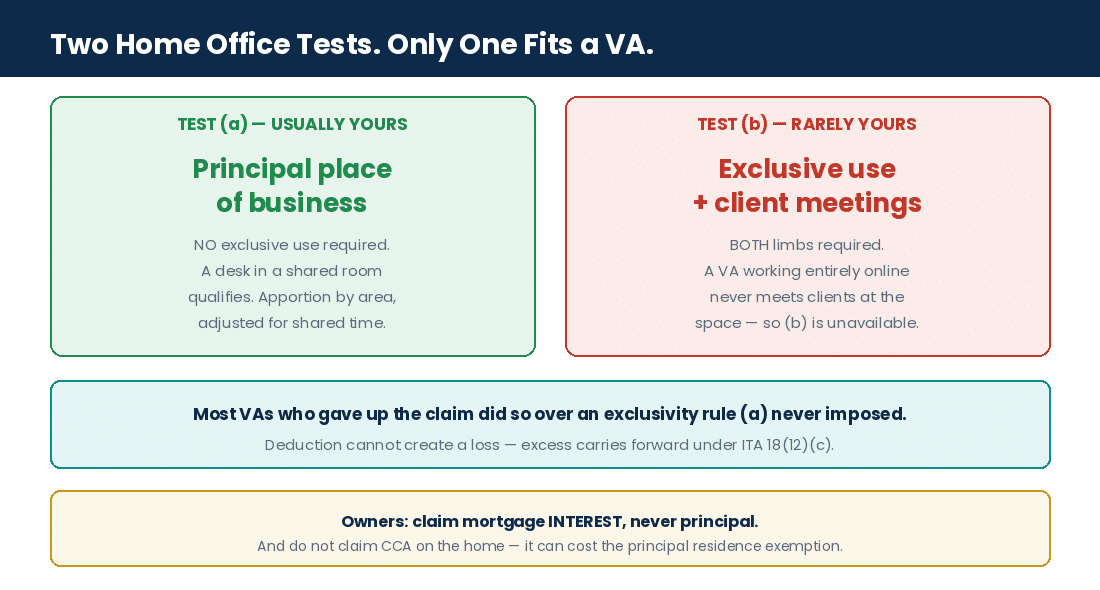
Subsection 18(12) permits a deduction for work space in the home where either test is met:
- Test (a): the work space is the individual’s principal place of business. No exclusive use is required. A desk in a shared room qualifies if the business is principally carried on there.
- Test (b): the space is used exclusively for the business and on a regular and continuous basis for meeting clients, customers or patients. Both limbs are required.
For a virtual assistant working entirely online, test (b) is usually unavailable because the client meetings never happen in the space. That is not a problem, because test (a) almost always applies — and it is the more generous test, since it does not demand a dedicated room.
Supporting records: a floor plan or measurements, utility and rent or mortgage statements, and a note of the apportionment basis. The rule applies to a self-employed individual; an incorporated VA pays rent to the shareholder under a written agreement instead.
Apportionment Methods: Calculating the Reasonable Portion of Workspace Expenses
| Method | When to use | Example |
|---|---|---|
| Square footage | A room or area used wholly or principally for the business | 150 of 1,200 sq ft = 12.5% |
| Area and time combined | A shared space used for the business part of the time | 12.5% area × 40 of 168 hours = 3% |
Where a space serves the household as well, the area percentage is further reduced by the proportion of time it is used for the business. Whichever method you use, keep the calculation with the return. Figures changed for privacy.
Carry-Forward Rules for Unused Home Office Deductions
Key Stat: the workspace deduction cannot create or increase a loss, and the excess carries forward under paragraph 18(12)(c) — not under section 67, which is the reasonableness test and has no subsection (1).
The carried amount is deductible in a later year against income from that same business. It is not a general loss carryforward, and it does not survive the business ceasing. On $10,000 of workspace costs against $8,000 of net income before the claim, you deduct $8,000 and carry $2,000 forward.
| Situation | Claim now | Carry forward |
|---|---|---|
| Costs at or below net business income | Full amount | None |
| Costs above net business income | Limited to net income | The excess, against the same business |
| Business ceases | — | Unused amount is lost |
Utilities, Rent, Property Taxes and Interest
| Cost | Renter | Owner |
|---|---|---|
| Rent | Business share | — |
| Utilities, heat, electricity, water | Business share | Business share |
| Home insurance | Business share | Business share |
| Property tax | — | Business share |
| Mortgage interest | — | Business share — interest only, never principal |
| Maintenance and repairs | Business share | Business share |
| Capital cost allowance on the home | — | Do not claim |
Risk Warning: claiming capital cost allowance on a home you own can cost you the principal residence exemption on that portion. Claiming CCA is treated as a change in use of that part of the property, which can expose the business-use share to a taxable capital gain on sale.
The deduction saved is small; the gain exposed is not. We do not recommend it for a home-based virtual assistant, and the source guidance’s “unless done carefully in incorporated setups” does not describe a route that helps here — an incorporated VA pays rent and does not claim CCA on the shareholder’s home at all.
Avoiding Common Errors
- Abandoning the claim over an exclusivity requirement that test (a) does not impose.
- Claiming a shared family room at the full area percentage without the time adjustment.
- Claiming full device cost without the business-use split.
- Forgetting the carried-forward amount from a prior year.
- Claiming capital cost allowance on an owned home.
- Keeping no measurement or calculation with the return.
A VA who owned her home had been claiming capital cost allowance on the workspace share for four years, saving a few hundred dollars annually.
On sale, that portion of the property was exposed to a taxable capital gain rather than being sheltered by the principal residence exemption. The accumulated saving was a fraction of the gain brought into income. Figures changed for privacy.
Workers, Slips and Payment Structures
Workers, Slips and Payment Structures
Workers
Employee Versus Independent Contractor
- Tested on the Wiebe Door factors as refined in 671122 Ontario Ltd. v. Sagaz Industries and, where there is a written agreement, Connor Homes: control, tools, chance of profit and risk of loss, tested against the actual relationship rather than the label.
- CRA Guide RC4110, Employee or Self-Employed?, sets out the approach; either party may request a ruling on Form CPT1.
- Section 230 of the Act concerns books and records and is not the classification authority.
| Consequence | Employee | Contractor |
|---|---|---|
| Slip | T4 | T4A above $500 |
| Withholding | Income tax, CPP, EI | None |
| CPP | Split with the employer | Both halves on Schedule 8, plus CPP2 |
| EI | Payable | Not payable unless opted into special benefits |
| Expenses | Limited, via T2200 | Full business deductions on T2125 |
The “both halves” row is the one self-employed VAs underestimate. A sole proprietor pays the employee and employer contribution on self-employment earnings above the $3,500 basic exemption, with half deductible and half a credit.
Payroll Source Deductions, T4 and T4A Slips
- Where you employ someone: register a payroll account, withhold income tax, CPP and EI, and remit by your band under section 153 and Regulation 108 — the band follows your average monthly withholding amount.
- T4 slips by the last day of February under Regulation 205(1).
- T4A slips for self-employed subcontractors where fees for services exceed $500 in the calendar year, also by the last day of February.
- Electronic filing is mandatory where you file more than five information returns of a type.
- Late remittance penalised under subsection 227(9) from 3% to 10%, with director liability under section 227.1 for a corporation.
- T5018 is the construction subcontractor return and does not apply to a virtual assistant business.
Payment Agreements and Structures Suitable for Canadian Virtual Assistants
- Hourly billed monthly, fixed fee per milestone, or a monthly retainer.
- Written terms stating scope, rate, payment timing and who bears platform fees.
- Platform commissions deducted as an expense, with gross revenue reported — the statement and the bank deposit will differ, and both belong in the records.
- Where a retainer covers work not yet performed, the fee is included under paragraph 12(1)(a) with a reserve available under paragraph 20(1)(m) for the undelivered portion.
Employer Obligations When Hiring Virtual Assistants: CPP and EI Considerations
- CPP withheld on pensionable earnings above the $3,500 basic exemption, matched by the employer, with CPP2 above the first ceiling.
- EI withheld at the employee rate, with the employer paying 1.4 times that amount.
- Rates and ceilings are set annually by CRA and change each January.
- Accrued remuneration paid within 179 days of year-end under subsection 78(4), or the deduction shifts to the year of payment.
Managing Subcontractors and Payment Compliance
- Classification tested before engagement, not after a ruling request.
- Payments tracked per subcontractor against the $500 threshold.
- Written agreements on file showing scope, independence and payment terms.
- Slips reconciled to the ledger before the February run, so what you report matches what they receive.
A VA subcontracted overflow work to three others and issued no slips, on the basis that they invoiced her directly.
Each exceeded $500, so T4A slips were required by the last day of February. Invoicing does not displace the reporting obligation, and the slips had to be filed late with penalties on each. Figures changed for privacy.
Records, Tools and Input Tax Credits
Records, Tools and Input Tax Credits
Records
Documentation Requirements
Records are kept six years from the end of the taxation year to which they relate, under paragraph 230(4)(b) — subsection 230(1) is the requirement to keep them, not the period. Section 286 of the Excise Tax Act imposes the same for GST/HST.
- Client invoices and platform statements.
- Receipts for equipment, software and supplies.
- Subcontractor agreements and payment records.
- Bank and card statements showing business activity.
- Workspace measurements and the apportionment calculation.
- Vehicle logbook where a vehicle is claimed.
Organizational Strategies: Using Bookkeeping and Accounting Tools Tailored for Virtual Assistants in Canada
- Expenses coded at entry into fixed categories rather than sorted in April.
- Recommended software: QuickBooks Online or Xero with bank feeds; Hubdoc for receipt capture; Wagepoint where payroll runs.
- Mixed-use items tagged with the apportionment basis at the point of entry.
- Monthly reconciliation, with backups.
- Accounting and payroll software fully deductible where used only for the business; mixed tools apportioned.
Tool Selection and Mixed-Use Splits
| Item | Basis for the split |
|---|---|
| Laptop | Business hours against total use |
| Phone plan | Business calls and data against total |
| Internet | A reasonable share, documented |
| Software subscription | Business features and hours against total |
Section 67 requires the result to be reasonable; it has no subsection (1). Platform fees are an expense, deducted against gross revenue — the source of that rule is paragraph 18(1)(a) and the general income provisions, not a GST/HST memorandum.
Claiming Input Tax Credits
- Registration required under subsection 240(1) once the section 148 threshold is passed, by either route; voluntary registration is available at any time.
- Input tax credits under section 169, to the extent of use in commercial activity.
- Documentary support under subsection 169(4): over $30 the supplier’s name and date; over $150 the supplier’s registration number, the recipient’s name, terms and a description.
- Credits claimed within the four-year window.
- Meals and entertainment credits recaptured to 50% to match section 67.1.
Input Tax Credit Calculation
Apportionment follows section 141.01 — by the extent of use in making taxable supplies. On $600 of HST paid on an internet bill that is 60% business, the credit is $360. Zero-rated exports to non-residents are taxable supplies at 0%, so they support full credits; only genuinely exempt supplies restrict them. Figures changed for privacy.
Handling Penalties, Arrears Interest and Compliance Issues
| Item | Rule | Provision |
|---|---|---|
| Late filing penalty | 5% of unpaid tax plus 1% per complete month, to twelve months | ITA 162(1) |
| Repeat late filing | Doubled: 10% plus 2% per month to twenty months | ITA 162(2) |
| Arrears interest | Compounded daily | ITA 161(1) |
| Instalment interest | Plus a penalty where that interest exceeds $1,000 | ITA 161(2); 163.1 |
| Late GST/HST filing | 1% plus 0.25% per month | ETA 280.1 |
Sections 152 to 157 concern assessment and instalments, not penalties. Where a prior year is wrong, the Voluntary Disclosures Program under Information Circular IC00-1R6 may limit penalties if you come forward before CRA makes contact, with relief separately available under subsection 220(3.1) on Form RC4288 within ten years.
Common Compliance Pitfalls
- Incomplete support for claimed expenses.
- Reporting patterns that change year to year with no explanation.
- Full home percentages claimed on shared space.
- Device and software splits unsupported by any record.
- Subcontractor slips missed.
- Revenue reported net of platform fees.
Penalty Avoidance Strategies
- Full documentation kept as you go, since a denied deduction usually fails on evidence rather than on law.
- Books reviewed quarterly, so an error is corrected before it is filed rather than after it is assessed.
- A written note of each apportionment basis, dated when the decision was made.
- A licensed firm engaged where the position is unclear, particularly across provinces.
Capital Cost Allowance Calculation Basics
- Add the asset to its class at full cost.
- Apply the class rate on the declining balance: Class 50 at 55%, Class 8 at 20%, Class 12 at 100%.
- Apply the business-use percentage to the resulting claim.
- Check available-for-use under subsections 13(26) to (32).
- The half-year rule is suspended for eligible property acquired after 31 December 2024 — so no halving on recent additions.
Worked example. A $2,000 laptop used 70% for the business, acquired in 2026: $2,000 × 55% × 70% = $770 in year one. Under the former half-year rule the same calculation gave $385. Figures changed for privacy.
Reporting Bad Debts
A receivable written off is deducted under paragraph 20(1)(p)(i) where it was previously included in income and is established to have become bad, with collection efforts documented. Paragraph 20(1)(l) is the separate reserve for doubtful debts. The GST/HST already remitted on the written-off amount is recovered separately under section 231 of the Excise Tax Act — the step most VAs miss.
A VA wrote off $4,500 of unpaid invoices and claimed the deduction but never adjusted the GST/HST.
Section 231 of the Excise Tax Act permits recovery of the tax already remitted on a bad debt. On a 13% rate that is roughly $518 left on the table, on top of the income tax deduction that was claimed correctly. Figures changed for privacy.
Maximizing Tax Benefits and Efficient Filing Strategies
Maximizing Benefits and Filing
Filing
Strategic Planning to Maximize Deductions
- Every receipt and invoice captured at the point of spend.
- Personal and business use separated with a stated basis, not an estimate made in April.
- Current and capital costs distinguished before year-end, since the class decides the claim.
- Taxable supplies monitored against the section 148 threshold on both routes.
- Tax planning on whether to incorporate once profit is consistently retained beyond what you draw.
Navigating Mixed-Use Assets and Depreciation for Virtual Assistant Equipment
| Equipment | Class | Rate |
|---|---|---|
| Computer hardware | 50 | 55% |
| Office furniture | 8 | 20% |
| Purchased application software | 12 | 100% |
A $1,200 laptop used 70% for the business gives $1,200 × 55% × 70% = $462 in year one, with the half-year rule suspended. No claim arises before the asset is available for use. Figures changed for privacy.
Leveraging Professional Advice for Optimized Tax Preparation
What a licensed firm adds on a VA file is the judgement rather than the data entry: which limb of 18(12) applies, the class for each asset, the apportionment basis that will hold up, whether registration is required, and whether a subcontractor needs a slip. A non-CPA preparer cannot represent you before CRA, and only a licensed firm can issue a CSRS 4200 compilation report, which provides no assurance.
Filing: Step-by-Step Process and Critical Forms
- Gather income records: invoices, platform statements, bank deposits.
- Report gross revenue; deduct platform commission separately.
- Code expenses, separating current from capital.
- Prepare the workspace calculation under the correct limb of 18(12).
- Build the capital cost allowance schedule by class, with business-use percentages.
- Issue T4A slips above $500 by the last day of February.
- Reconcile GST/HST collected against input tax credits.
- File T2125 with the T1 by 15 June, having paid the balance by 30 April.
Planning for Future Tax Years
| Obligation | Deadline |
|---|---|
| Self-employed T1 filing | 15 June |
| Balance of tax | 30 April |
| Personal instalments | 15 March, 15 June, 15 September, 15 December |
| Incorporated: T2 filing | Six months after fiscal year-end |
| Incorporated: balance | Two months; three for an eligible CCPC |
| T4 and T4A slips | Last day of February |
Instalments arise where net tax owing exceeds $3,000 in the current year and in either of the two preceding years. The late filing penalty grows monthly under 162(1); it is the interest under 161(1) that compounds daily.
Final Checklist
- Workspace measured, with the correct limb of 18(12) identified.
- Receipts stored digitally by category.
- Personal and business splits explained in writing.
- Hours logged where a time-based apportionment is used.
- Subcontractor agreements on file with slips issued above $500.
- Platform statements reconciled to bank deposits monthly.
- Carried-forward workspace amounts from prior years picked up.
You can download our free virtual assistant deduction checklist to work from. Email info@gondaliyacpa.ca or call 647-212-9559 with questions about your situation.
A VA had been filing by 30 April every year, on the understanding that was her deadline.
She files by 15 June and pays by 30 April. Filing early cost nothing, but she had also been paying on 15 June in two of those years, which did — interest under 161(1) runs from 1 May and compounds daily regardless of the filing extension. Figures changed for privacy.
Frequently Asked Questions on Virtual Assistant Tax Deductions Canada
Frequently Asked Questions
FAQ
What is the T4A slip issuance requirement for subcontractor payments?+
A T4A is required where fees for services to a self-employed subcontractor exceed $500 in the calendar year, filed by the last day of February under Regulation 205(1). Electronic filing is mandatory above five returns of a type. T5018 is the construction subcontractor return and does not apply here.
How does the meals and entertainment limit apply?+
50% of actual cost under section 67.1, with the input tax credit recaptured to 50%. Entertainment is subject to the same limit, not a stricter one, and alcohol with a business meal is inside it. Where a conference fee includes food not separately stated, subsection 67.1(3) deems $50 per day to be food, then halves it.
Can I create a tax loss by claiming the maximum home office deduction?+
No. The workspace deduction cannot create or increase a loss. The excess carries forward under paragraph 18(12)(c), deductible in a later year against income from the same business — it is not a general loss carryforward and it does not survive the business ceasing.
What is the records retention period?+
Six years from the end of the taxation year to which the records relate, under paragraph 230(4)(b) — not six years from the filing date. Subsection 230(1) is the requirement to keep them. Section 286 of the Excise Tax Act imposes the same for GST/HST.
When is the filing deadline for a self-employed VA?+
You file by 15 June under subsection 150(1) but the balance is due 30 April under subsection 156.1(4). The filing extension does not extend the payment date, and interest under 161(1) runs from 1 May and compounds daily.
Which home office costs can renters and owners claim?+
Renters: the business share of rent, utilities, home insurance and maintenance. Owners: the same, plus property tax and mortgage interest — interest only, never principal. Owners should not claim capital cost allowance on the home, because it can expose that portion to a taxable capital gain on sale.
Are training, travel and meals deductible for an incorporated VA?+
Training maintaining existing skills is deductible under 18(1)(a); a programme conferring a lasting new qualification is capital under 18(1)(b). Business travel is deductible with receipts and a logbook. Meals are 50% under 67.1. An incorporated VA pays rent for the workspace rather than claiming under 18(12).
Should I file myself or use a CPA firm?+
DIY works where income is simple and everything runs through one account. What a licensed firm adds is the judgement calls: the right limb of 18(12), asset classification, apportionment that holds up, and registration timing. A non-CPA preparer cannot represent you before CRA.
What triggers a CRA review?+
Revenue reported net of platform fees, workspace percentages with no measurement behind them, device and software splits with no record, expense patterns that jump year to year, subcontractor payments with no slip, and capital items expensed outright.
How do I catch up if my records are behind?+
Rebuild from bank and card statements and platform reports, request duplicate invoices, and reconstruct the workspace measurement. File the oldest year first. Consider the Voluntary Disclosures Program under Information Circular IC00-1R6 before CRA makes contact, with relief under subsection 220(3.1) on Form RC4288 within ten years.
What are the top deduction mistakes VAs make?+
Abandoning the home office claim over an exclusivity rule that test (a) does not impose; expensing a laptop on a “$500 rule” that does not exist; applying the half-year rule that is now suspended; reporting net of platform fees; claiming CCA on an owned home; and missing T4A slips above $500.
What should I prepare before starting as a VA?+
A separate business bank account and card, bookkeeping software with bank feeds, written client agreements, a workspace measurement, a time log if the space is shared, a system for capturing receipts, and a note of where you stand against the $30,000 threshold.
Must my workspace be used only for business?+
Not under test (a) of subsection 18(12), which asks only whether the home is your principal place of business. Test (b) does require exclusive use, but it also requires you to meet clients regularly at the space — which most virtual assistants never do, making test (a) the practical route.
Is there a $500 rule for writing off equipment?+
No general rule. The $500 figure belongs to Class 12, which includes tools costing less than $500 at 100% capital cost allowance. A computer is Class 50 at 55% whatever it cost.
Does the half-year rule still apply?+
It is suspended for eligible property acquired after 31 December 2024 under Bill C-15, so a full first-year rate applies. A $2,000 laptop at 70% business use gives $770, where the half-year rule would have given $385.
How are services to clients outside Canada treated?+
Generally zero-rated under Schedule VI, Part V — 0% charged, with input tax credits still recoverable. Zero-rated is not exempt, and treating it as exempt gives up the credits. Exclusions apply, including services rendered to an individual while in Canada.
Do I report the gross invoice or what the platform pays me?+
Gross, with the platform commission deducted separately as an expense. Reporting net understates revenue and will not reconcile to the platform statement or to your GST/HST return.
Can I recover GST/HST on a bad debt?+
Yes. Deduct the bad debt under paragraph 20(1)(p)(i) where it was previously included in income and has become bad, and recover the GST/HST already remitted under section 231 of the Excise Tax Act — a separate step that is frequently missed.
Eighteen questions, and the home office one is the only correction that reliably puts money back.
Most VAs who have given up the claim did so over an exclusivity requirement that test (a) does not impose. The other seventeen tighten the file; that one is a refund. Figures changed for privacy.
Key Deduction Categories Every Canadian Virtual Assistant Should Know
Essential Topics and Best Practices
Quick Reference
- Home office costs with apportionment under the correct limb of subsection 18(12).
- Software subscriptions used for the business, apportioned where mixed.
- Equipment through capital cost allowance: Class 50 at 55%, Class 8 at 20%, Class 12 at 100%.
- Meals and entertainment at 50% of actual cost under section 67.1.
- Professional fees for accounting, bookkeeping and contract work.
- Business insurance premiums, allocated across the policy period under 18(9).
- Travel to clients, with receipts and a logbook.
- GST/HST registration under section 148 and input tax credits under section 169.
- Subcontractor payments with T4A slips above $500 by the last day of February.
- Communication bills split between personal and business on a documented basis.
Next Steps to Optimize Your Business Expenses
- Organise income sources and expense receipts into fixed categories.
- Measure the workspace and identify which limb of 18(12) applies.
- Track software licences with a business-use percentage for each.
- Build the capital cost allowance schedule by class.
- Check your position against the $30,000 threshold on both routes.
- Put subcontractor agreements and the $500 slip threshold in place.
- Bring in a licensed firm early where the position is unclear.
Points Worth Carrying
- Test (a) of 18(12) has no exclusivity requirement.
- Test (b) requires client meetings, which rules it out for most VAs.
- There is no $500 immediate-expensing rule for business assets.
- Computers are Class 50 at 55%, whatever they cost.
- The half-year rule is suspended for property acquired after 31 December 2024.
- Report gross; deduct platform fees separately.
- File 15 June, pay 30 April.
- Zero-rated exports still recover input tax credits.
- Do not claim capital cost allowance on an owned home.
- Records run six years from the taxation year-end under 230(4)(b).
Twenty-seven points, and the ten at the end are all things a virtual assistant was told confidently by something they read.
None are obscure. They are ordinary rules with half the test missing, a threshold that does not exist, or a calculation that was suspended two years ago. Figures changed for privacy.
Businesses We Serve
Industry Expertise
Virtual assistant practices share the same issues whatever the specialism. Here are ten and the usual finding.
| Practice | The Issue That Usually Appears |
|---|---|
| Admin and inbox support VAs | Home office abandoned over a supposed exclusivity rule |
| Social media and content VAs | Software subscriptions claimed at 100% with no split |
| Bookkeeping and ops VAs | Laptop expensed outright on a “$500 rule” |
| Platform-based VAs | Revenue reported net of platform commission |
| VAs serving US and overseas clients | Zero-rated treated as exempt, input tax credits forgone |
| VAs who subcontract overflow | No T4A slips above $500 |
| VAs who own their home | Capital cost allowance claimed on the workspace share |
| VAs working from a shared room | Full area percentage with no time adjustment |
| VAs approaching $30,000 | Single-quarter registration route missed |
| VAs with unpaid invoices | Bad debt deducted but GST/HST never recovered |
- Admin and inbox support VAs: test (a) needs no exclusive room.
- Social media and content VAs: apportion and document the basis.
- Bookkeeping and ops VAs: Class 50 at 55%.
- Platform-based VAs: gross in, commission out.
- VAs serving overseas clients: Schedule VI Part V, credits survive.
- VAs who subcontract: $500, last day of February.
- VAs who own their home: leave the CCA alone.
- VAs in a shared room: area times time.
- VAs approaching $30,000: one quarter can do it.
- VAs with unpaid invoices: 20(1)(p)(i) and ETA 231.
The client list changes. The questions do not: which limb of the workspace test applies, which class the asset is in, and was it gross or net.
An inbox support VA and a social media VA look nothing alike commercially and file nearly identical returns. Figures changed for privacy.
Professional Guidance and Quick Reference
Guidance
Why Choose Gondaliya CPA for Your Virtual Assistant Taxes in Canada
Virtual assistants get into difficulty in a predictable set of ways: abandoning the home office claim because the space is not used exclusively, when test (a) of subsection 18(12) asks only whether the home is the principal place of business and imposes no exclusivity at all — while test (b), which does require exclusive use, also requires regular client meetings at the space and is therefore unavailable to most VAs; expensing a laptop under a $500 rule that does not exist, when a computer is Class 50 at 55% whatever it cost and the $500 figure belongs to Class 12 tools; applying the half-year rule, which has been suspended for eligible property acquired after 31 December 2024; reporting revenue net of platform commission rather than gross with the fee deducted; claiming capital cost allowance on an owned home, which can expose that share to a taxable capital gain on sale; treating zero-rated exports as exempt and giving up the input tax credits; and deducting a bad debt without recovering the GST/HST under section 231. Gondaliya CPA handles virtual assistant accounting on a flat annual fee.
We handle what decides the outcome: identifying which limb of 18(12) actually applies and measuring the workspace accordingly, building the capital cost allowance schedule by class with business-use percentages, applying the suspended half-year rule correctly, reporting gross revenue with platform fees deducted so the books agree to the platform statements, testing the $30,000 threshold on both routes, treating non-resident supplies as zero-rated so the credits survive, classifying subcontractors before the slip run, picking up carried-forward workspace amounts from prior years, and recovering GST/HST on written-off receivables.
Our team starts with one month of invoices, your workspace measurement and your last return. Whatever you do for clients, you get clear advice and a fixed price before we start.
Quick Answers
At a Glance
- Test (a): principal place of business, no exclusivity
- Test (b): exclusive use plus client meetings
- Carry-forward: ITA 18(12)(c), same business
- Computers: Class 50, 55%
- Furniture: Class 8, 20%
- Tools under $500: Class 12, 100%
- Half-year rule: suspended after 31 Dec 2024
- Meals: 50% of actual cost, ITA 67.1
- Filing: 15 June; balance 30 April
- GST/HST threshold: $30,000, ETA 148
- Exports to non-residents: zero-rated, credits survive
- Records: six years from the taxation year-end
Who This Is For
Fit Check
- For: Self-employed virtual assistants and incorporated VA businesses in Canada, including those working through platforms, serving clients abroad, or subcontracting overflow work.
- Not For: Employed assistants on a T4, whose expenses run through form T2200 with a much narrower set of deductions, and businesses requiring a review or audit engagement, which we refer out.
People Also Ask
Quick Answers
Does my workspace have to be a dedicated room?+
Not under test (a) of subsection 18(12), which asks only whether the home is your principal place of business. A desk in a shared room qualifies, with the apportionment adjusted for the shared use.
Why can’t I use the exclusive-use test?+
You can, if you also meet clients at the space on a regular and continuous basis — both limbs of test (b) are required. A VA working entirely online cannot satisfy the second, which is why test (a) is the route.
Can I write off a laptop under $500?+
No. The $500 figure belongs to Class 12, which covers tools, and even then it is 100% capital cost allowance rather than an outright expense. A computer is Class 50 at 55% at any price.
Should I claim CCA on my house?+
No. Claiming capital cost allowance on the workspace share of an owned home can expose that portion to a taxable capital gain on sale, and the annual saving is small by comparison.
Do I charge GST/HST to a client in the United States?+
Generally no — the supply is zero-rated under Schedule VI, Part V. That is 0%, not exempt, so your input tax credits remain recoverable.
Glossary of Key Terms
Glossary
- Subsection 18(12): The two alternative home workspace tests.
- Principal place of business: Test (a), requiring no exclusive use.
- Paragraph 18(12)(c): The carry-forward of unused workspace amounts.
- Class 50: Computers and systems software at 55%.
- Class 8: Furniture and residual equipment at 20%.
- Class 12: Tools under $500 and application software at 100%.
- Available-for-use rule: Subsections 13(26) to (32).
- Half-year rule: Suspended for eligible property acquired after 31 December 2024.
- Section 67.1: The 50% meals and entertainment limitation.
- Subsection 18(9): Apportions prepaid expenses across periods.
- Paragraph 20(1)(p)(i): The bad debt deduction.
- Section 231 (ETA): Recovery of GST/HST remitted on a bad debt.
- Section 148 (ETA): The $30,000 small supplier threshold.
- Zero-rated: Taxed at 0% with input tax credits still recoverable.
- Form T2125: Statement of Business or Professional Activities.
- CSRS 4200: The compilation engagement standard, providing no assurance.
Virtual Assistant Tax Check
This quick self-check indicates where your business most likely has room. Please answer the five questions below.
Virtual Assistant Tax Check
Five quick questions on your business. No fee shown.
Points to raise with us:
This is a general prompt, not tax or legal advice or a quote. Your position depends on your full facts. For a real review, please book a free consultation.
Work from test (a) of subsection 18(12), because the home being your principal place of business carries no exclusivity requirement, and test (b) is out of reach for a VA who never meets clients at the space. Measure the area, adjust for shared use by time, and keep the calculation with the return. Put computers in Class 50 at 55% whatever they cost, since there is no $500 expensing rule for business assets. Apply the full first-year rate rather than halving it, because the half-year rule is suspended for eligible property acquired after 31 December 2024. Report platform revenue gross and deduct the commission separately, so your books agree to the platform statement. Leave capital cost allowance on an owned home alone, because the small annual saving can cost you part of the principal residence exemption. Treat supplies to non-residents as zero-rated rather than exempt, so the input tax credits survive. Recover the GST/HST on a bad debt under section 231 as well as deducting it under 20(1)(p)(i). File by 15 June and pay by 30 April. And please keep six years of records from the year-end.
2026 Update — what is current: This article reflects rules current to 2 October 2026. The 15 June filing date and 30 April payment date, the 50% meals limit in section 67.1, the $500 T4A threshold, the last-day-of-February slip deadline under Regulation 205(1) and the six-year retention requirement under 230(4)(b) are unchanged. Please note that subsection 18(12) provides two alternative tests, with test (a) requiring no exclusive use and test (b) requiring exclusive use and regular client meetings at the space, and the excess carried forward under 18(12)(c) against income from the same business; that there is no $500 immediate-expensing rule, computers sitting in Class 50 at 55% and the $500 figure belonging to Class 12 tools; that the half-year rule is suspended for eligible property acquired after 31 December 2024 under Bill C-15, with the first claim still gated by the available-for-use rule in 13(26) to (32); that the $30,000 small supplier threshold sits in section 148 of the Excise Tax Act, measures taxable supplies, and can be crossed in a single quarter; that supplies to non-residents are generally zero-rated under Schedule VI, Part V, so input tax credits remain recoverable; that non-resident platform operators have been within the digital economy rules in sections 211.1 to 211.25 since 1 July 2021; and that GST/HST remitted on a bad debt is recoverable under section 231 alongside the deduction in paragraph 20(1)(p)(i).
Virtual Assistant Tax Deductions Canada: How Gondaliya CPA Supports VAs
Start with one month of invoices and your workspace measurement
Gondaliya CPA identifies which limb of subsection 18(12) actually applies and measures the workspace accordingly, builds the capital cost allowance schedule by class with business-use percentages, applies the suspended half-year rule correctly, reports gross platform revenue with commission deducted, tests the $30,000 threshold on both routes, treats non-resident supplies as zero-rated so the credits survive, classifies subcontractors before the slip run, and files the GST/HST, your T2125 or T2, and the slips from one reconciled set of books — on a flat annual fee including HST with a one-business-day response. Please book a free consultation.
Next Steps
Please book a free consultation with Gondaliya CPA and bring one month of invoices, your workspace measurement, and your last return. Those three settle the home office question, the equipment classification question and the gross-versus-net question, which is where most of the value sits for a virtual assistant. You will get a flat annual fee including HST before any work begins. We serve Toronto, Brampton, Mississauga, Vaughan, Ottawa and the rest of Ontario, and work with VAs across Canada. If our content helps, please add gondaliyacpa.ca as a preferred source on Google.
Published: · Last updated:
Editorial policy: We research against CRA, CPA Canada and CPA Ontario sources, fact-check the figures, and Sharad Gondaliya, CPA, reviews the content, which we update as the rules change.
Disclaimer: This article is educational information only and is not tax, legal, or financial advice. Figures marked illustrative are examples rather than quotes or guarantees. It reflects rules current to 2026, including the two workspace tests in subsection 18(12), the capital cost allowance classes in Schedule II, the suspension of the half-year rule, the section 148 threshold and the six-year retention requirement. Rates and limits change and outcomes depend on your specific facts. Please consult a CPA Ontario member before acting.

Sharad Gondaliya is a CPA Canada & CPA USA with 15 Years+ experience of Accounting, Tax, Payroll of Corporate Small Businesses as Tax Accountant. He is a CPA Ontario member (61040184) and holds US CPA licences in Washington and Montana and is well known among corporate small businesses for tax planning, efficient tax solutions, and affordable CPA services. Sharad is the Principal (Director) of Gondaliya CPA – Affordable CPA Firm in Canada. Licenses: CPA Ontario: 61040184 | CPA USA (MT): PAC-CPAP-LIC-033176 | CPA USA (WA): 57629 | CPA Firm License: 61330051 View Full Author Bio