



Common Tax and Accounting Mistakes Canadian Companies Make When Expanding to the US
Canadian companies expanding to US taxes: Avoid common cross border business tax mistakes Canada US with Gondaliya CPA
Canadian companies expanding to US taxes need to be aware of common cross border business tax mistakes Canada US to meet US tax obligations properly. Gondaliya CPA helps businesses avoid errors such as misreporting income and misunderstanding filing requirements in both countries, from entity choice through to annual compliance.
Quick Summary
Expanding south goes wrong in a predictable order. First, the filing obligation starts before the entity does — selling into the US, stationing an employee there, holding inventory in a warehouse or letting an agent sign contracts can each create a permanent establishment, and the return is due whether or not tax is. Second, the treaty does not bind the states — profits exempt federally can still be taxable in a state where you have nexus, and since Wayfair that nexus can be purely economic, commonly at $100,000 of sales or 200 transactions. Third, the paperwork carries its own penalties — Form 1120-F annually, Form 5472 for related-party dealings at $25,000 a return, Form 8833 to disclose a treaty position, and W-8BEN to bring 30% withholding down to the treaty rate. And fourth, the Canadian side does not go quiet: T1134, FAPI and transfer pricing documentation under section 247 all follow the expansion home.
Reading time: 14 minutes.
Table of Contents
- US Tax Obligations and Permanent Establishment
- State Tax Nexus and Compliance Challenges
- Choosing the Right US Business Structure
- Withholding Taxes, Treaty Rates and Filings
- Common Mistakes and Advanced Considerations
- Strategic Planning and Risk Management
- Frequently Asked Questions
- Essential Cross-Border Compliance Points
- Businesses We Serve & Industry Spotlights
- Professional Guidance and Quick Reference
The Numbers That Matter
This article covers Canada and the United States, with Ontario and Toronto context, and reflects rules current to 15 October 2026. It is written for Canadian corporations selling, hiring, holding stock or setting up entities in the United States, and it covers permanent establishment, state nexus, entity choice, withholding and the information returns on both sides. It is not advice on US immigration or visa requirements, on customs and tariffs, or on the specific rules of any individual state. Gondaliya CPA performs compilation engagements under CSRS 4200, which provide no assurance; audit and review engagements are referred out. This is educational information only and not tax or legal advice.
Understanding US Tax Obligations for Canadian Companies Expanding to the US
US Tax Obligations and Permanent Establishment
Where It Starts
Doing Business in the US for Canadian Companies: Definition and Tax Implications
When Canadian companies start selling or offering services in the U.S., they need to watch out for tax rules. Even without setting up a formal office, selling into the U.S. might create a Permanent Establishment (PE). That means they could owe taxes or have to file reports.
Does selling into the US create US tax obligations? Yes. If your business sells products or services there, you might have to pay federal and state taxes. It depends on where and how you do business.
A Dependent Agent is someone working for your company in the U.S. If this person can make contracts, that can also trigger a PE. Then, the profits tied to that agent may get taxed.
To avoid surprises, companies often file Treaty-Based Return Position Disclosure (Form 8833). This form shows they are using treaty benefits from the Canada-U.S. Tax Treaty.
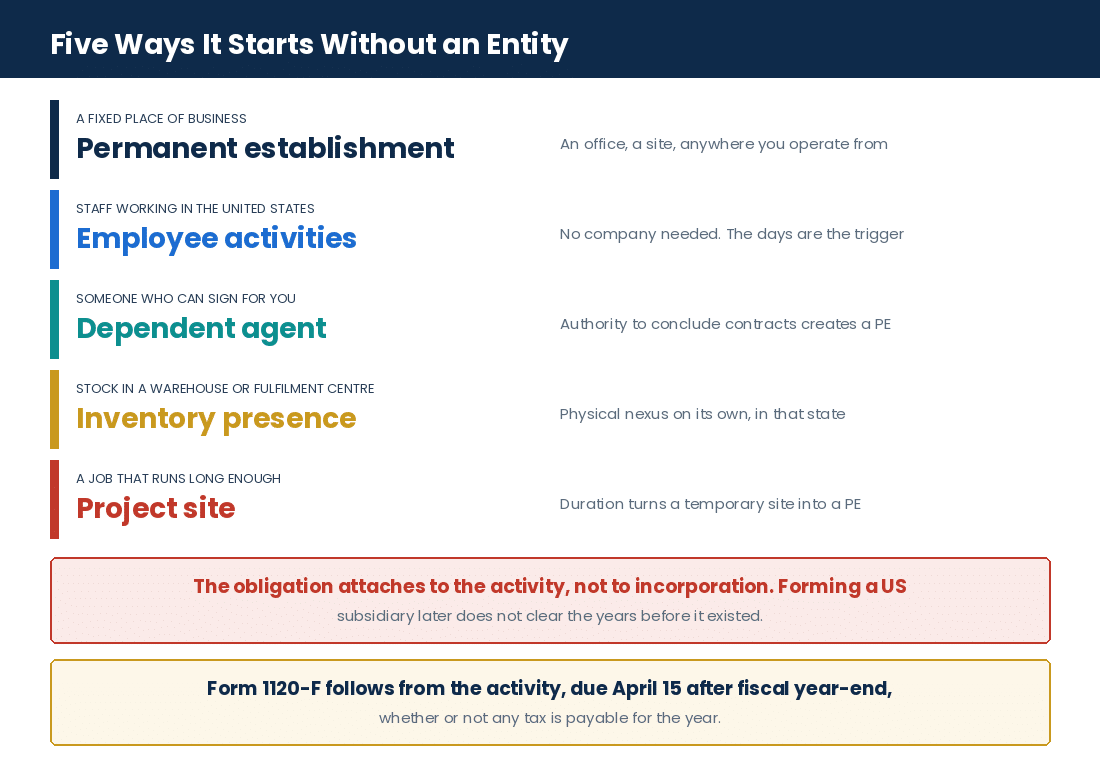
The Five Levels of US Business Activity Impacting Tax Liability
Different business activities can change how much tax you owe:
- Permanent Establishment (PE): A fixed place where your company does business.
- Employee Activities: Staff working in the U.S., even if there’s no official company set-up.
- Agent Relationships: Agents who can sign contracts for your business.
- Inventory Presence: Stock kept in U.S. warehouses or fulfillment centers.
- Project Sites: Temporary work locations that last long enough to count as PE.
Each of these affects your tax filings and what laws you must follow federally and at state levels.
Distinguishing Federal Tax and State Tax Responsibilities
Canadian businesses must know federal and state taxes are different:
- The Canada-U.S. Treaty often exempts some profits from being taxed by either country, but you might still need to file returns.
- Many think this treaty covers all states too — it doesn’t. States have their own rules.
- You may skip federal taxes because of treaty protection, but states can still require filings if you have “nexus” there.
Ignoring these differences risks fines or unexpected bills later on.
The treaty and the states answer to different authorities.
A tax treaty is an agreement between two national governments. A state is not a party to it and is not bound by it. That is why profits can be exempt from federal income tax under Article V and still be fully taxable in a state where the company has nexus — the two questions have nothing to do with each other.
Overview of the Canada-US Tax Treaty and Its Role in Cross-Border Taxation
The Canada-U.S. Tax Treaty helps avoid being taxed twice on cross-border income:
- Article 10 covers withholding taxes on dividends paid between countries.
- Transfer pricing rules make sure related companies price deals fairly to stop shifting profits unfairly.
- Rules about Foreign Affiliates offer relief for companies with earnings abroad marked as Foreign Accrual Property Income (FAPI).
Knowing these points helps companies reduce risks when moving into the U.S.
Employment Income Exemption under the Canada-US Tax Treaty and the Three-Part Test
Article 15(1) of the treaty talks about when employees are exempt from U.S. tax:
- Employee mostly lives outside North America;
- Employer has no presence or operations in North America;
- Pay doesn’t go over $10,000 USD per year.
If these fit, then payroll withholding may not apply when employees work remotely above the border—a detail many overlook!
Practical Examples of Treaty Exemption Applications for Employees, Representatives, and Owners
Sending staff temporarily into the U.S without handling payroll right causes problems.
For example: If an employee spends weeks working in another state but you don’t register or file on time, penalties for missing withholdings can happen.
The registration is rarely the hard part. What catches companies is that the obligation attaches to the days worked, so by the time anyone asks the question the deadline has usually passed. Figures changed for privacy.
Also, some firms skip filing “protective returns” because they assume treaties mean no tax due. That’s risky—taking precautions now avoids trouble later!
Navigating US State Tax Nexus and Compliance Challenges
State Tax Nexus and Compliance Challenges
Fifty Answers
State Nexus Rules and Their Impact on Canadian Businesses
Canadian businesses moving into the US often don’t expect how tricky state nexus rules can be. Each state decides on its own if a company has enough presence—called nexus—to owe taxes. This causes many common cross border business tax mistakes Canada US. Without knowing the rules, companies might miss filings or pay taxes they didn’t plan for. It’s smart to learn these rules early. That way, you avoid penalties and keep your Canadian company US tax obligations in check, both federally and by each state.
Physical Nexus and Economic Nexus Post-Wayfair Decision
The 2018 Supreme Court case South Dakota v. Wayfair changed how states apply sales tax. Before, you needed to have offices or property there (physical nexus). Now, many states look at economic nexus too. That means if your sales or transactions in a state pass a certain limit, you owe sales tax—even if you don’t have a physical spot there.
Usually, if sales hit $100,000 or more or 200 transactions in a year, economic nexus kicks in. But every state sets its own rule. Many Canadian companies make cross border business tax mistakes Canada US by missing these limits and not registering properly.
Key point: You must check both physical presence and economic activity for every state to handle Canadian company US tax obligations correctly.
Common Activities Creating State Nexus: Inventory, Employees, Agents, and Offices
Certain things often create taxable nexus inside a US state:
- Keeping inventory in warehouses
- Having employees working from that state
- Using agents who sign contracts locally
- Leasing office space or any fixed place of business
If your company does these things, you likely need to file IRS Form 1120-F (U.S. Foreign Corporation Return) every year. Also, payroll withholding applies when employees work physically in those states.
Missing these can cause you to overlook filing duties. That risks trouble under federal rules and different state laws tied to Canadian company US tax obligations.
The Complexity of Multi-State Compliance and Varying State Filing Requirements
Running business in many states makes compliance tricky because each one has its own deadlines, forms, and penalties. For example:
| Aspect | Variation Across States |
|---|---|
| Registration Thresholds | Very different; no single standard |
| Sales vs Income Tax | States treat these separately |
| Penalties | Range from fines to losing licenses |
| Related Party Reporting | Some states want extra disclosures |
States also enforce penalties for missing related-party returns like Form 5472, plus there are transfer pricing documentation deadlines set by Canada’s Income Tax Act. You’ll need detailed tracking to keep up with everything when expanding south.
Managing the Compliance Burden from Multiple State Registrations and Tax Filings
Having registrations in several states raises admin work—and risk from unfiled returns with penalties at both federal level (like late Form 5472 submissions) and local authorities.
Also, withholding taxes on dividends paid by U.S. subsidiaries change a lot by state—even if federal treaty rates stay stable. So it pays to review all payments carefully before sending money back home.
Good practices include keeping a unified calendar for all filings; tracking sales thresholds; watching for legal changes; making sure withholding certificates are proper; plus doing internal audits focused on multi-state risks important for cross border corporate tax Canada-US cases.
The state that causes trouble is almost never the one anyone was watching.
Companies track the big markets carefully and cross a threshold somewhere they sell twice a month. Economic nexus does not care how small the state is or how incidental the sales were, and the registration backlog is always discovered at once rather than one state at a time. A single spreadsheet of sales by state, updated quarterly, prevents most of it. Figures changed for privacy.
CRA – Carrying On Business Outside Canada canada.ca · Income Tax Act RSC 1985 c1 (5th Supp), sections relating permanent establishment & associated enterprises · South Dakota v Wayfair Inc., Supreme Court ruling June 2018 supremecourt.gov · IRS Publication – Foreign Corporations irs.gov · IRS Form 1120-F Instructions irs.gov · CRA – Payroll Deductions When Employees Work Outside Canada canada.ca · Penalty Provisions Section – Missing Related Party Information Returns cra.gc.ca · Various U.S. State Revenue Authority Websites — Registration & Filing Guidelines · Transfer Pricing Documentation Deadline CRA Guidance IC87R12 canada.ca · Treaty Between Canada And The United States Of America With Respect To Taxes On Income And On Capital Article XI Dividends justice.gc.ca · Gondaliya CPA Internal Procedures Manual
For expert assistance navigating complex multi-state nexus issues during your expansion into the U.S., contact Gondaliya CPA at info@gondaliyacpa.ca or call 647-212-9559 for a free consultation today.
Choosing the Right US Business Structure for Canadian Expansion
Choosing the Right US Business Structure
Entity Choice
Picking the right US business structure matters a lot when Canadian companies expand. It affects taxes, reporting, and can help avoid cross border business tax mistakes Canada US. Knowing these options lets Canadian companies handle their US tax obligations better and dodge common errors.
Overview of US Business Structures: C-Corporation, S-Corporation, LLC, and Branches
Canadian companies moving into the US usually look at four main structures:
- C-Corporation: This is a separate taxable entity under federal law. It pays corporate income tax and files Form 1120 with the IRS. There can be double taxation: once on company profits, then again on dividends paid to shareholders. Canadian companies must watch their US tax filing duties carefully here.
- S-Corporation: Income passes through to shareholders’ personal returns. But only U.S. citizens or residents can own shares. That usually rules out Canadian corporations as owners.
- Limited Liability Company (LLC): Flexible by nature. It defaults as a disregarded entity or partnership for taxes but can choose to be taxed as a corporation. Many Canadians don’t fully get this mix, which leads to cross border business tax mistakes Canada US.
- Branch: It’s an extension of the Canadian parent company in the US. The branch pays tax on effectively connected income via Form 1120-F. Branch profits may also face branch profits tax unless treaties say otherwise.
Each choice has different effects on compliance in both countries CRA Income Tax Folio S5-F2-C1 | Canada-US Treaty Article V.
Key Tax Differences Between LLCs and Corporations for Canadian Businesses
Canadian businesses often get confused about how LLCs and corporations differ tax-wise when crossing borders.
| Aspect | LLC | Corporation |
|---|---|---|
| Federal Tax Treatment | Pass-through by default; no entity-level tax unless chosen | Separate taxable entity |
| Filing Requirements | May need partnership return (Form 1065) or corporate return if chosen | Corporate return (Form 1120) |
| Impact on Shareholders | Income goes to members’ returns; tricky for non-resident aliens | Dividends may have withholding taxes |
| Transfer Pricing & Documentation | Rules apply equally | Same transfer pricing rules apply |
Wrongly classifying an LLC can cause unexpected bills or lost deductions—one big cause of Canadian business US tax mistakes. Good planning aligns with CRA rules about related-party transactions Income Tax Act sections 247 & 233.
Limitations and Considerations of S-Corporations for Canadian Owners
S-corporations limit ownership to certain U.S.-based people only:
- Shareholders must be U.S citizens or residents.
- No partnerships or other corporations allowed as owners.
- Shareholder count capped around 100.
Many Canadian business US tax mistakes happen when companies assume they qualify without checking these rules.
Also:
- Losing S-election status can push you back into C-corp tax rules without warning.
- Reporting gets complex because you must prepare K-1 schedules showing each shareholder’s share correctly.
Knowing these limits stops costly errors with Canadian company US tax obligations IRS Instructions Form 2553.
Decision Framework for Selecting an Entity Based on Profitability, Liability, and Credibility
Your choice depends mainly on three things that affect cross border business tax mistakes Canada US risk:
- Profitability: Big profits might lean toward incorporation since it may delay some taxes even with double taxation risks in C-corps versus pass-through options.
- Liability Exposure: LLCs offer limited liability like corporations but state rules differ; branches put parent companies directly at risk needing strong controls.
- Credibility & Market Presence: Setting up locally looks more stable to clients than just running a branch office.
This approach helps manage Canadian company’s US tax obligations, so legal safety doesn’t turn into surprise tax problems CRA Foreign Affiliate Rules.
The LLC is the structure Canadian owners reach for and the one that causes the most trouble.
It is flexible, cheap to set up and limited in liability, so it reads as the obvious answer. The difficulty is that the two countries can classify the same entity differently, and a mismatch is not something you discover from the US return alone. The entity decision is one worth taking on both sides before it is made, rather than after.
Tax Implications of Branch Profits Tax and Proposed Section 899 Legislation
Branches face special taxes called branch profits taxes targeting foreign firms earning connected income in the US:
- The current system adds a flat extra levy besides normal corporate income taxes filed using Form 1120-F.
- The proposed Section 899 law aims to redefine what counts as “branch” activities starting fiscal year 2026 — this changes how taxes get calculated and means more detailed records including transfer pricing docs must follow CRA guidelines Proposed Reg §1.899.
Ignoring this causes one common type of cross border business tax mistakes Canada-US: underestimated taxes leading to penalties during audits by either country’s agencies.
Contact Gondaliya CPA today at info@gondaliyacpa.ca or call 647‑212‑9559 for expert guidance tailored specifically toward your company’s expansion needs across borders respecting all relevant regulations.
US Expansion Exposure Check
Five quick questions on where your US obligations stand. No fee shown.
Points to raise with us:
This is a general prompt, not tax or legal advice or a quote. Your position depends on your full facts. For a real review, please book a free consultation.
Withholding Taxes, Treaty Rates, and Filing Requirements
Withholding Taxes, Treaty Rates and Filings
The Forms
Understanding US Withholding Tax Obligations for Canadian Companies
When Canadian companies expand into the US, they face withholding tax rules. The US requires withholding on payments like dividends, interest, royalties, and service fees sent to foreign firms. The default rate is 30% unless a treaty or exemption lowers it. Not withholding properly can trigger penalties and interest per IRS rules (see IRS Publication 515). Correct withholding keeps you in line with both US tax laws and Canada-US cross-border rules.
Treaty Rates for Dividends, Interest, Royalties, and Capital Gains
The Canada-US Tax Treaty sets lower withholding rates on certain payments. For example, Article 10 cuts dividend withholding from 30% down to 5% or 15%, depending on ownership. Interest and royalties also get lower rates under Articles 11 and 12. Usually, capital gains are exempt from US withholding but may still require filings if linked to a permanent establishment. You need proper paperwork to apply these treaty rates; otherwise, standard rates apply.
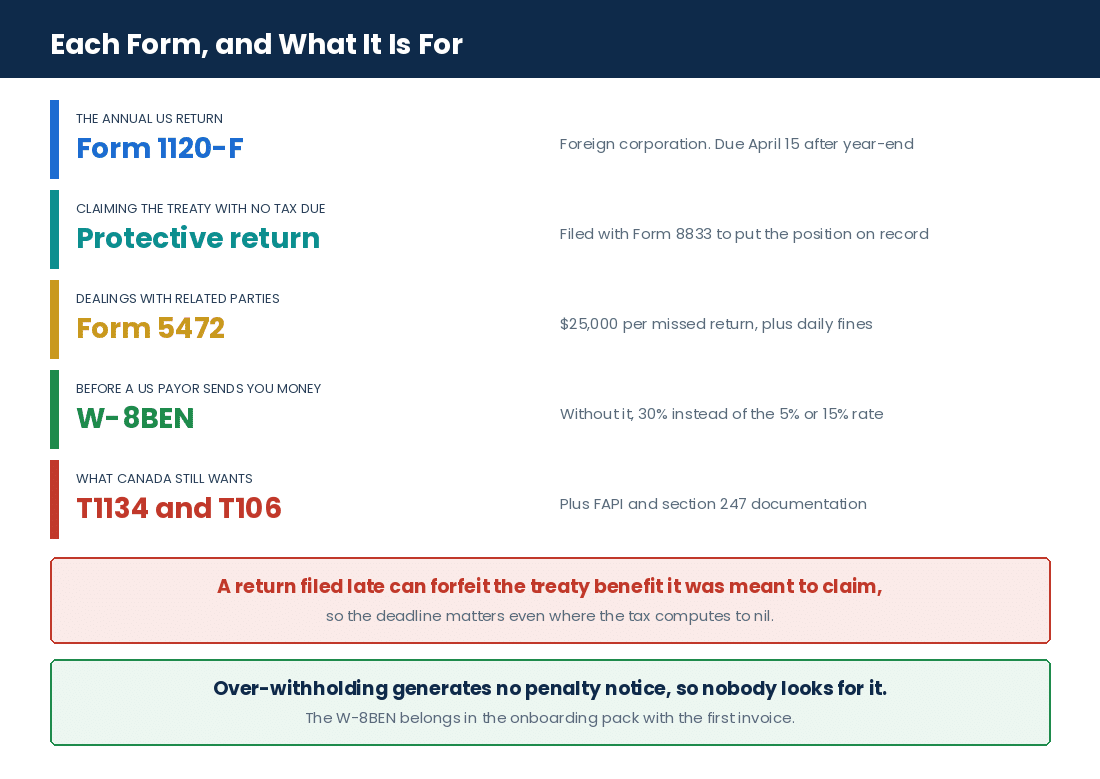
Importance of the W-8BEN Form in Claiming Treaty Benefits and Avoiding Excess Withholding
US payors must get Form W-8BEN from Canadian recipients before reducing withholding rates. This form proves foreign status and treaty eligibility. Without it—or a CRA-issued residency certificate—the payor must withhold at the full rate regardless of treaties (see IRS Instructions for Form W-8BEN). Submitting this form stops Canadian companies from getting taxed too much on cross-border payments.
Over-withholding is the quiet one. Nobody gets a penalty notice for it, so nobody looks.
A missing W-8BEN means the payor withholds at the full rate and keeps doing it, payment after payment, until someone asks. It is recoverable, but only by filing to claim it back, and only for as long as the years stay open. The form takes minutes and belongs in the onboarding pack with the first invoice. Figures changed for privacy.
Overview of US Federal Filing Requirements Including Forms 1120-F, 1040-NR, and 5472
Canadian corporations doing business in the US usually file Form 1120-F yearly by April 15 after their fiscal year (IRC §6072(b)). Individuals with US trade/business income file Form 1040-NR by June 15 if they have no wages subject to Social Security taxes; otherwise April 15 applies. If related-party transactions exist, Form 5472 must be filed with pro forma returns as per IRC §6038A/B—missing this can cost $25,000 per return plus daily fines after notice (26 CFR §1.6038A–1). Companies sometimes file protective returns if treaties exempt profits but presence exists. Transfer pricing documents are due around the same time to prove arm’s length pricing.
Here’s a quick look:
- No profit? Still file protective return.
- Related-party deals? File Form 5472 on time.
- No transfer pricing docs? Prepare contemporaneous documentation.
Missing any leads to IRS or CRA scrutiny.
State-Level Filing Requirements and Deadlines for Canadian Companies
Each US state has its own rules for taxing Canadian firms. States don’t follow federal treaties or have uniform nexus tests. They check physical presence or economic activity differently to decide on income tax or sales/use tax obligations (Nexus Standards). If your company has employees working in a state, employer payroll registration is required no matter when the company formed (IRS Pub). Skipping these registrations risks back taxes plus state-level penalties that add up fast.
The Reality of Compliance Burden and Penalties for Non-Compliance
Not filing or late filing carries heavy costs. Missing related-party info returns like Form 5472 can trigger $25K+ fines each time under IRC §6038A/B. Federal late filing penalties (§6651) also hit hard; states charge their own fees too (IRS Penalty Guidance). Late filings may block access to treaty benefits by missing deadlines needed for credits against double taxation—a common cross border business tax mistake Canada US companies make without expert help.
For tailored guidance on managing your Canadian company’s complex U.S. withholding obligations efficiently contact Gondaliya CPA at info@gondaliyacpa.ca or call us at 647-212-9559 today for a free consultation.
Common Tax Mistakes and Advanced Cross-Border Tax Considerations
Common Mistakes and Advanced Considerations
Where It Goes Wrong
Frequent Tax Errors by Canadian Companies Expanding to the US: Half-Knowledge and Overlooked Nexus
Canadian companies expanding to US taxes often make mistakes because they don’t fully get their tax duties. They may think they owe nothing until they officially form a US entity. But just doing business can mean filing taxes federally and in states. Missing this can cause late or forgotten returns, which leads to trouble.
States also have their own rules. Each looks at income and sales taxes separately. Some check physical presence; others look at sales amounts. Ignoring these details causes many cross border business tax mistakes Canada US firms see.
Here’s an example: A software reseller in Toronto hired a US sales rep before starting a subsidiary. They thought no filings were needed since no US company was set up yet.
However, the sales rep made a permanent establishment that required federal Form 1120-F and state registrations. This mistake cost time and money. Figures changed for privacy.
Ownership Loops and Improper Income Recognition Timing
When Canadian firms mess up ownership structures, their US tax duties get tangled. Complex loops between parent, subsidiary, and affiliates can lead to wrong timing for reporting income or wrong transaction types.
The tax law demands precise reports on related-party deals. Forms like 5472 must be filed on time with correct documentation. Missing this risks penalties under section 233.1. Getting the income recognized on the right date helps keep both countries happy.
One Canadian company delayed recording royalty income from its new US affiliate past year-end because of unclear accounting rules.
This triggered changes during CRA audits and affected reports on foreign property income (T1134). It made things messy. Figures changed for privacy.
Misunderstanding LLC Tax Treatment and FIRPTA Implications
Many Canadian businesses don’t understand how LLCs are taxed in the US versus Canada. The IRS may treat an LLC as ignored (not separate from owner), but Canada might see it as a corporation. This mismatch complicates cross-border tax work.
Another snag is FIRPTA—tax withholding when non-residents sell US real estate interests. Canadians often miss this rule or wrongly assume treaties cover them automatically.
For instance: A company in Ontario bought commercial property via an LLC but didn’t file FIRPTA forms when selling because they thought exemptions applied without checking details about asset types or holding times as IRS requires IRS.gov. This oversight caused issues.
Incorrect Assumptions About US Tax Rates and Record-Keeping Deficiencies
Many Canadians guess wrongly that US federal corporate rates are standard everywhere or ignore state rate differences. Poor record-keeping around intercompany deals weakens transfer pricing positions too.
Without solid, timely documentation showing arm’s length pricing—along with proper Form 5472 filings—penalties jump quickly when auditors dig in.
An exporter from Mississauga underestimated combined federal and state taxes affecting instalments.
Their slim records for Delaware subsidiary dealings triggered penalties after CRA audits focused on transfer pricing gaps revealed through internal data tools like QuickBooks used at Gondaliya CPA®. Figures changed for privacy.
Advanced Topics: Controlled Foreign Affiliate Rules, Transfer Pricing, and US Estate Tax Exposure
Canadian companies expanding to US taxes face complex rules about controlled foreign affiliates. These rules track surplus funds impacting dividend payouts alongside treaty terms in the Canada-US Treaty CanadaUS-Treaty.pdf CRA.gc.ca/foreign-affiliates.
Transfer pricing needs contemporaneous documentation proving transactions meet arm’s length standards per OECD guidelines, embedded in Section 247(1) of Canada’s law IncomeTaxAct.ca. Detailed memos covering goods, services, and payments across borders must be ready every year.
US estate tax risks pop up when Canadians hold investments over $60K USD directly in the States. Without planning, double taxation happens despite treaty relief efforts DOJ-IncomeTaxAct Sections 212 & 113.
Gondaliya CPA helped a Hamilton client build full transfer pricing docs matching upcoming January 2026 rules to lower audit risk.
They also prepared affiliate surplus reconciliations vital for T1134 accuracy, easing CRA examiners reviewing North America-wide operations. Figures changed for privacy.
Challenges with Sale or Exit Planning for Cross-Border Businesses
Cross border business tax mistakes Canada US companies make during exits often come from not syncing different capital gains rules CRA Capital Gains Guide, withholding laws IRC §1445, and deal timing perfectly IRS Publication.
Ignoring trapped earnings inside subsidiaries can trigger surprise taxable dividends with Part XIII withholding unless certified properly Canada-US Treaty Articles XI & XXIV.
Exit planning also needs a look at past unfiled years that may cause interest charges or penalties if not fixed quickly via voluntary disclosures CRA Voluntary Disclosure Program Guidelines.
For example: Some clients didn’t know selling shares directly versus through multiple affiliates changed net proceeds calculations. That led to extra provincial surtaxes found later during audits against original purchase prices—issues solved after professional help by Gondaliya CPA® in Greater Toronto Area handling international growth since day one.
CRA – Carrying On Business Outside Canada · Canada-U.S Treaty – Permanent Establishment Article · State Nexus Guidance – Multistate.org · Income Tax Act RSC 1985 c1 (5th Supp.) ss95(1), s93(1)(a) · CRA Information Circular IC87-2R – Transfer Pricing Documentation Requirements · IRS Publication 3402 – Limited Liability Company Federal Classification Election · IRS FIRPTA Withholding FAQs · IRS Corporate Rate Tables · CRA Penalties Guide PGR-031 · Canada-US Treaty.pdf · CRA.gc.ca/foreign-affiliates · IncomeTaxAct.ca · DOJ-IncomeTaxAct Sections 212 & 113 · CRA Capital Gains Guide · IRC §1445 · IRS Publication · Canada-US Treaty Articles XI & XXIV · CRA Voluntary Disclosure Program Guidelines
Strategic Tax Planning and Risk Management for Cross-Border Expansion
Strategic Planning and Risk Management
Getting Ahead
Pre-Expansion Planning: Assessing Tax Residency and Permanent Establishment Risks
When Canadian companies expand to US taxes, they need to check tax residency and permanent establishment (PE) risks carefully. If a Canadian firm has employees or agents in the US, owns fixed business spots there, or signs contracts through dependent agents, it might create a US tax presence. These situations bring Canadian company US tax obligations under the Income Tax Act (ITA) s. 2(3) and the Canada-US Tax Treaty Article V on Business Profits. Mistakes in judging PE status often lead to cross border business tax mistakes Canada US. That causes unexpected filings, penalties, and sometimes double taxation.
Sometimes, a protective return must be filed if treaty exemptions don’t fully cover the activities. Even if a subsidiary forms later, earlier taxable activity still means filing obligations. Spotting this early saves costly surprises.
For example: A Toronto software company sent two sales reps to New York for 45 days each but didn’t set up a US entity. Their presence created a PE anyway.
They had to file federal Form 1120-F for those years, possibly with treaty-based position disclosures. Figures changed for privacy.
Building a Compliance Framework to Manage Dual US and Canadian Tax Obligations
Avoiding Canadian business US tax mistakes means building a solid compliance framework. The ITA requires foreign affiliates’ information returns (T1134), while the IRS wants Forms 5471 or 5472 depending on ownership. Missing these can cause heavy penalties under ITA sections 233.1 and 233.4.
Transfer pricing documentation helps show arm’s length pricing between related parties across borders. Keeping track of income that falls under Foreign Accrual Property Income (FAPI) rules also matters for correct Canadian reporting.
Using accounting tools like QuickBooks or Xero with payroll systems helps track cross-border transactions accurately. This way, companies can meet CRA and IRS deadlines smoothly.
Risk Management Strategies for State Nexus and Federal Tax Exposure
Many cross border business tax mistakes Canada US happen because firms ignore state nexus rules along with federal ones. Each state sets its own economic or physical presence rules separate from federal nexus tests.
States don’t have to follow the Canada-US Treaty. So even if profits are exempt federally, states may still tax income or sales. That means separate registrations might be needed. Companies should keep clear records showing where staff work, property sits, or sales happen for every state involved.
Updating this “nexus register” often helps companies register on time and avoid surprises during audits.
Tax Tips for Canadians Owning US Property and Handling Rental Income
Canadian companies expanding into US real estate face special issues with Foreign Accrual Property Income (FAPI). Rental income from US properties usually counts as FAPI unless exceptions apply under ITA section 95(2)(a).
How you classify this income matters a lot. Rental earnings often must be included every year in Canadian taxable income—even if money stays in the US longer than expected. This area trips up many cross-border taxpayers new to these rules.
Getting advice early ensures proper treatment on both sides: U.S.-source rental income needs U.S. filings like Schedule E plus matching entries on T2 returns reflecting foreign affiliate activity properly.
Utilizing Cross-Border Tax Treaties to Reduce Withholding and Avoid Double Taxation
The Canada-US Tax Treaty sets limits on withholding taxes for dividends, interest, royalties, or service fees crossing borders. These caps are usually lower than regular statutory rates.
To claim treaty benefits, companies submit forms like W-8BEN-E and sometimes IRS Form 8833 to disclose treaty-based return positions. Forgetting Form 8833 can cause denial of benefits plus penalties under IRC Section 6676(c).
It’s wise to track all payments subject to Part XIII withholding carefully within internal records. This keeps withholding consistent with current treaty terms updated through calendar year 2026.
US Business Expansion Checklist Covering Entity Choice, Compliance, and Risk Controls
Here’s a checklist that helps manage key compliance needs during expansion:
- Transfer Pricing Documentation: Keep up-to-date files proving arm’s length prices per ITA s.247
- Related-Party Return Filing: File Forms T106/5472 promptly detailing related-party deals
- Economic Nexus Monitoring: Track revenue & transaction numbers against each state’s threshold
- Payroll Registration: Register employer accounts where employees physically work
- Protective Returns: File protective federal returns when claiming treaty exemptions
This approach lowers risk from tricky multi-jurisdictional tax rules faced by many Ontario firms expanding south of the border.
Encouraging Professional Consultation to Optimize Tax Planning and Minimize Mistakes
Getting expert help matters when dealing with Canadian company US tax obligations during expansion. Gondaliya CPA brings Ontario CPA experience plus solid knowledge of CRA rules and U.S. federal filing demands.
Early advice catches permanent establishment flags before they become costly issues. It also builds strong controls that stop common pitfalls seen in many cross border business tax mistakes Canada-US clients make regularly.
Department of Justice – Income Tax Act s.2(3), s91 · Canada-US Treaty Article V – Business Profits · IRS Instructions – Protective Return Filing · CRA Guide T1134 – Foreign Affiliates Information Return · IRS Instructions – Forms 5471 & 5472 · CRA Transfer Pricing Guidelines & Penalties Section 233.1 · State Revenue Authorities – Nexus Rules Overview · Treasury Regulations – State vs Federal Jurisdiction · ITA Section 95(2)(a) – FAPI Definition · Canada-US Treaty Articles XI-XIII – Withholding Taxes · IRS Form 8833 Instructions – Treaty-Based Position Disclosure · Internal Revenue Code Section 6676(c) · CRA Guidance on Contemporaneous Documentation Deadline · Multistate Sales & Use Taxes Economic Nexus Thresholds Summary · Gondaliya CPA Service Experience Notes · CPA Ontario Public Directory Verification
Frequently Asked Questions on Cross-Border Expansion Taxes
Frequently Asked Questions
Answers
What is a protective return and why should Canadian companies file it when expanding to the US?+
Can federal treaty protection be assumed to cover state tax obligations?+
How should Canadian companies test state nexus for income and sales tax purposes?+
Is it correct to register for sales tax in all states or none without checking thresholds?+
Why is pricing parent-to-subsidiary sales with proper documentation important?+
What risks come from lacking contemporaneous documentation and related-party returns?+
How does funding a US subsidiary with debt affect tax compliance?+
Are withholding taxes required on dividends, interest, royalties, or service fees paid to Canadian companies?+
What payroll and withholding considerations apply when sending employees from Canada to the US?+
How can ignoring Canadian-side tax implications complicate US expansion?+
What happens if US federal and state filings are left unfiled due to perceived no tax owed?+
Essential Cross-Border Compliance Points
Key Points
Essential Cross-Border Tax Compliance Points for Canadian Companies Expanding to the US
- Always file a protective return even if you claim treaty exemptions.
- Understand federal treaties do not override individual state tax laws.
- Test economic nexus thresholds separately for sales and income taxes per state.
- Register only where nexus exists; avoid blanket sales tax registrations.
- Maintain detailed transfer pricing documentation under Income Tax Act Section 247.
- File Form 5472 timely for all related-party transactions; avoid penalties under Section 233.1.
- Review debt funding of US subsidiaries against thin capitalization rules regularly.
- Withhold on cross-border payments unless appropriate IRS forms (W-8BEN) are on file.
- Register payroll accounts when employees work physically in any US state.
- Monitor Canadian foreign affiliate reporting obligations including FAPI compliance.
- File all required federal (Form 1120-F) and multi-state returns even if no taxes are owed.
Contact Gondaliya CPA for expert advice on avoiding costly cross-border business tax mistakes between Canada and the US.
Businesses We Serve & Industry Spotlights
Industry Expertise
Expansion into the United States raises the same three questions whatever the business sells — has something created a permanent establishment, which states have been triggered, and what has to be filed even when nothing is owed — and those questions recur across every one of these sectors.
| Industry | The US Expansion Angle |
|---|---|
| Cross-border e-commerce sellers | Economic nexus crossed in states nobody was watching |
| Wholesale e-commerce sellers | Inventory in fulfilment centres, creating nexus by itself |
| Direct-to-consumer brands | Transaction counts that pass the threshold before revenue does |
| Exporters | Selling into the US long before anyone forms an entity there |
| Distributors | Warehousing and agents, two of the five activity levels at once |
| Customs brokers | Fluent in the border rules, less so in the income tax treaty |
| Freight brokers | Agents arranging carriage in states with no office |
| Software resellers | A single US sales rep with authority to sign |
| IT staffing companies | Placed workers creating payroll registration in each state |
| Cloud service providers | Service fees withheld at 30% without a W-8BEN on file |
| Managed service providers | Intercompany charges needing transfer pricing documentation |
- Cross-border e-commerce sellers: The clearest case for a nexus register, because sales accumulate state by state with nothing to signal that a threshold has been passed.
- Wholesale e-commerce sellers: Stock sitting in a third-party fulfilment centre is inventory presence, which is one of the five activity levels on its own.
- Direct-to-consumer brands: Where orders are small and frequent, the 200-transaction test usually arrives well before the dollar threshold does.
- Exporters: Selling into the United States is where the obligation can begin, which is the part most often assumed to be safe until an entity exists.
- Distributors: Warehoused stock and local agents together hit two of the five activity levels, which is usually enough to settle the question.
- Customs brokers: Expert in one set of cross-border rules and often caught by the other, since the income tax treaty works nothing like the tariff schedule.
- Freight brokers: Arranging carriage through agents who commit the company is the dependent agent test, whatever the arrangement is called.
- Software resellers: One US-based sales representative with authority to close deals can create a permanent establishment before any subsidiary is incorporated.
- IT staffing companies: Placed workers mean payroll registration in each state where they physically work, regardless of where the contract was signed.
- Cloud service providers: Service fees from US customers are withheld at the full rate until the W-8BEN is on file, and the over-withholding goes unnoticed.
- Managed service providers: Charges between the Canadian parent and the US arm need contemporaneous documentation showing the pricing is at arm’s length.
In every one of these, the expansion happened months before anyone treated it as a tax event.
A rep was hired, stock was moved to a warehouse, a threshold was crossed. None of those feel like forming a company, which is why the filing obligation is usually discovered a year or two after it began. The register costs nothing to keep and is the only thing that catches it at the time.
Professional Guidance and Quick Reference
Guidance
Essential Tax Points for Canadian Companies Expanding South
Canadian companies expanding into the United States go wrong in a predictable set of ways: assuming no filing is due until a US entity exists; treating federal treaty protection as covering the states; testing nexus once rather than state by state and separately for income and sales tax; registering everywhere or nowhere instead of where a threshold has actually been crossed; pricing parent-to-subsidiary transactions with nothing in writing; missing Form 5472 on related-party dealings; paying cross-border amounts without a W-8BEN on file and absorbing 30% withholding; and forgetting that the Canadian side still wants T1134, FAPI reporting and transfer pricing documentation. Gondaliya CPA handles cross-border corporate compliance on a flat annual fee.
Quick Answers
At a Glance
- Five activity levels: permanent establishment, employees, agents, inventory, project sites
- Dependent agent: authority to conclude contracts can create a PE by itself
- Treaty and the states: federal exemption does not bind any state
- Economic nexus: commonly $100,000 in sales or 200 transactions, but set state by state
- Physical nexus: inventory, employees, local agents, leased premises
- Form 1120-F: annual US return for a foreign corporation, due April 15 after year-end
- Form 1040-NR: June 15 where there are no wages subject to Social Security tax
- Form 5472: related-party transactions, $25,000 per missed return plus daily fines
- Form 8833: discloses a treaty-based return position
- W-8BEN: without it, the payor withholds at 30% regardless of the treaty
- Dividend withholding: reduced to 5% or 15% under Article 10, depending on ownership
- Protective return: filed where the treaty exempts the profits but presence exists
- Entity options: C-corporation, S-corporation, LLC or branch
- S-corporation: US citizens and residents only, so a Canadian corporation cannot own shares
- Branch: taxed on effectively connected income, with branch profits tax on top
- Section 899: proposed, would redefine branch activities from fiscal 2026
- Canadian side: T1134 for foreign affiliates, FAPI on passive income, section 247 documentation
- US estate tax: exposure where US investments held directly exceed $60K USD
Who This Is For / Not For
Fit Check
- For: Canadian corporations selling into the United States, placing employees or agents there, holding inventory in US warehouses, or setting up a subsidiary or branch.
- For: Ontario companies already operating south of the border that have never tested state nexus, filed a protective return, or documented intercompany pricing.
- Not for: advice on US immigration, visas or work authorisation, on customs duties and tariffs, or on the specific registration rules of any individual state, each of which is administered separately.
- Not for: Canadian companies with no US customers, staff, agents or stock. A company selling into the US with no entity, no office and no tax payable is still squarely in scope, because the return may still be due.
People Also Ask
Related Questions
We have no US company. Do we really have a US filing obligation?+
Possibly, yes. The obligation attaches to activity rather than incorporation. A fixed place of business, an employee working in the US, an agent with authority to sign contracts, inventory in a warehouse or a long-running project site can each create a permanent establishment, and Form 1120-F follows from the activity. Forming a subsidiary later does not retroactively clear the earlier years.
The treaty exempts our profits. Why file anything?+
Because the exemption is claimed on a return, not assumed instead of one. A protective return notifies the authorities of the presence and puts the treaty position on record, usually with Form 8833. Leaving it unfiled risks penalties and, where deadlines pass, the loss of the treaty benefit itself.
Does the treaty keep the states off our back?+
No. A treaty binds the two national governments; a state is not a party to it. Profits exempt from federal income tax can still be taxable in a state where you have nexus, and since Wayfair that nexus can be purely economic — commonly $100,000 of sales or 200 transactions, though every state sets its own rule.
Should we just register for sales tax everywhere to be safe?+
No. Registering where there is no nexus creates filing obligations, deadlines and penalties you did not have before. The thresholds have to be tested state by state, and separately for income tax and sales tax, because states treat the two differently. Register where a threshold has actually been crossed.
What does CRA still want once we are operating in the US?+
More than most companies expect. T1134 for foreign affiliates, FAPI reporting where the US entity earns passive income such as rent, contemporaneous transfer pricing documentation under section 247 showing intercompany pricing is at arm’s length, and T106 for related-party transactions. Penalties under sections 233.1 and 233.4 apply on their own terms.
Glossary of Key Terms
Definitions
- Permanent establishment (PE): a fixed place of business, or equivalent activity, that gives the US the right to tax business profits.
- Dependent agent: a person acting for the company with authority to conclude contracts, which can create a PE.
- Nexus: the connection with a state sufficient to make a company subject to that state’s tax.
- Economic nexus: nexus based on sales volume or transaction count rather than physical presence, following Wayfair.
- Protective return: a return filed to preserve a treaty position where no tax is thought to be due.
- Form 1120-F: the annual US income tax return of a foreign corporation.
- Form 5472: the US information return for reportable transactions with related parties.
- Form 8833: the treaty-based return position disclosure.
- W-8BEN: the certificate of foreign status that allows a payor to apply the reduced treaty withholding rate.
- Branch profits tax: an additional levy on a foreign corporation’s effectively connected earnings.
- Thin capitalization: rules limiting the interest deductible where a subsidiary is funded disproportionately by debt.
- Transfer pricing: the requirement that transactions between related parties be priced at arm’s length, under section 247.
- FAPI: Foreign Accrual Property Income — passive income of a foreign affiliate, taxable in Canada as it arises.
- T1134: the CRA information return for foreign affiliates.
- FIRPTA: the US withholding regime on dispositions of US real property interests by non-residents.
Want a checklist to work from? You can download our free US expansion tax checklist before your consultation.
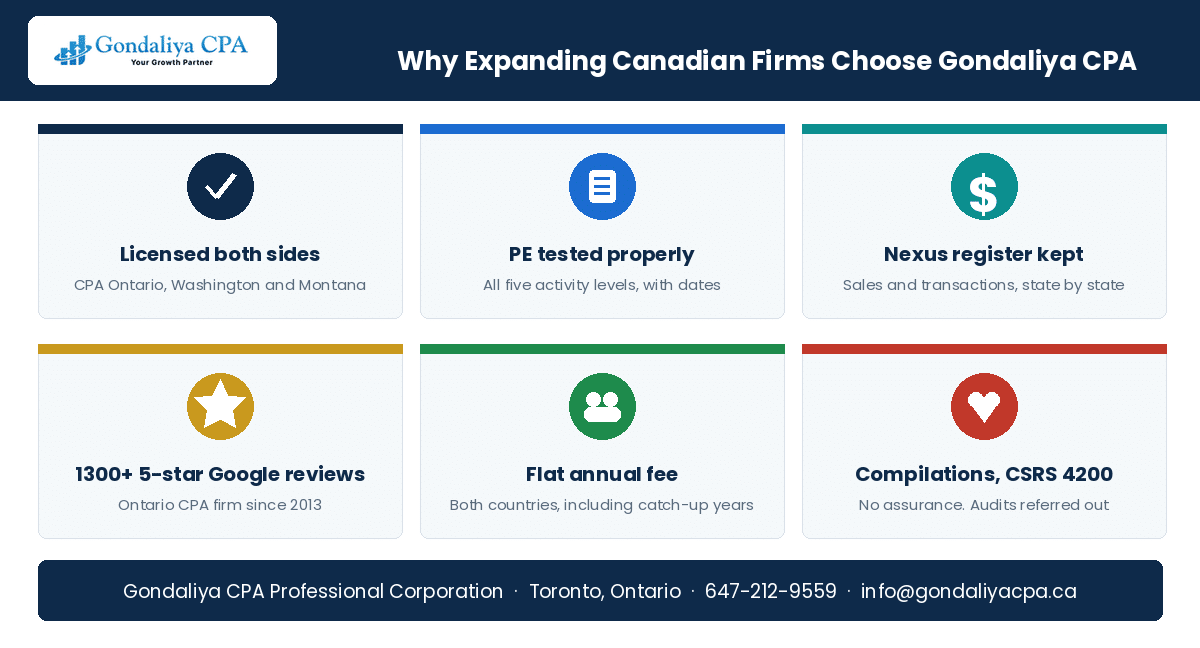
Four things decide how a US expansion goes. Activity, not incorporation — a fixed place, an employee, an agent who can sign, inventory in a warehouse or a long project site can each create a permanent establishment, and Form 1120-F follows from that, due April 15 after year-end whether or not tax is owed. The states are separate — no treaty binds them, nexus is tested state by state and separately for income and sales tax, and since Wayfair it can be purely economic at around $100,000 or 200 transactions. The forms carry the penalties — Form 5472 at $25,000 a return, Form 8833 for the treaty position, a protective return where the exemption is claimed, and W-8BEN before 30% withholding drops to the 5% or 15% treaty rate. And Canada does not go quiet — T1134, FAPI and section 247 documentation all follow the expansion home.
Three questions tell you where you stand, and you can answer all of them today. First, is there anyone in the United States acting for your company — an employee, a contractor, a sales rep, an agent who can commit you? If so, the permanent establishment question is live and the answer is not obvious. Second, do you know your sales and transaction count by state for the last two years? If not, you cannot know which thresholds you have crossed, and the backlog is always found all at once. Third, is there anything in writing behind what the Canadian parent charges the US arm? Without contemporaneous documentation the transfer pricing position is whatever an auditor decides it is.
Canadian Companies Expanding to US Taxes: How Gondaliya CPA Can Help
Start with your US activity, your sales by state and your intercompany charges
Gondaliya CPA works through the five activity levels to settle whether a permanent establishment exists and from when, builds a nexus register tracking sales and transactions against each state’s threshold, chooses between a C-corporation, LLC and branch with both tax systems in view rather than one, prepares Form 1120-F with protective returns and Form 8833 disclosures where the treaty is relied on, gets W-8BEN certificates in place before withholding starts, files Form 5472 and T106 on related-party dealings, and prepares the contemporaneous transfer pricing documentation along with T1134 and FAPI reporting on the Canadian side — on a flat annual fee including HST with a one-business-day response. Please book a free consultation.
Next Steps
Please book a free consultation with Gondaliya CPA and bring three things: a note of who acts for you in the United States and since when, your sales and transaction counts broken down by state, and whatever exists in writing about what the Canadian company charges the US one. Those three settle the permanent establishment question, the state registrations and the transfer pricing position — which between them account for nearly every adjustment we make on a cross-border expansion file. If you have been selling south for a while with nothing filed, say so at the outset, because unfiled years are routine to work through in sequence and expensive to discover during an audit. You will get a flat annual fee including HST before any work begins. We serve Toronto, Mississauga, Brampton, Vaughan, Etobicoke, Scarborough, Hamilton, Ottawa and the rest of Ontario, and work with expanding companies across Canada. If our content helps, please add gondaliyacpa.ca as a preferred source on Google.
Published: · Last updated:
Editorial policy: We research against CRA, Department of Finance, Parliament of Canada, CPA Canada and CPA Ontario sources, fact-check the figures, and Sharad Gondaliya, CPA, reviews the content, which we update as the rules change.
Disclaimer: This article is educational information only and is not tax, legal, financial or immigration advice. It covers Canadian and United States federal and state tax obligations arising when a Canadian corporation expands into the United States, and it does not cover US immigration, visas or work authorisation, customs duties and tariffs, or the specific registration and filing rules of any individual state, each of which is administered separately. Economic nexus thresholds, withholding rates, penalty amounts and the proposed Section 899 legislation all change, and Section 899 is described in the source material as proposed rather than enacted; the figures in this article are those stated in the source material and every one should be confirmed against current CRA, IRS and state guidance before a return is filed. Whether a particular activity creates a permanent establishment or state nexus turns on the full facts. Gondaliya CPA performs compilation engagements under CSRS 4200 and does not perform audit or review engagements. Please consult a licensed CPA before acting.

Sharad Gondaliya is a CPA Canada & CPA USA with 15 Years+ experience of Accounting, Tax, Payroll of Corporate Small Businesses as Tax Accountant. He is a CPA Ontario member (61040184) and holds US CPA licences in Washington and Montana and is well known among corporate small businesses for tax planning, efficient tax solutions, and affordable CPA services. Sharad is the Principal (Director) of Gondaliya CPA – Affordable CPA Firm in Canada. Licenses: CPA Ontario: 61040184 | CPA USA (MT): PAC-CPAP-LIC-033176 | CPA USA (WA): 57629 | CPA Firm License: 61330051 View Full Author Bio