



The Ultimate Guide to Musician Taxes in Canada
Musician Taxes Canada: Deductions, Income Streams and Accounting
Musician taxes Canada require careful attention to specific musician tax deductions Canada and accurate musician accounting Canada to maximize savings. Gondaliya CPA offers advice on expense tracking, income reporting, and the treatment of royalties, grants and instruments for Canadian musicians and performing artists.
Quick Summary
The question that shapes a musician’s return is what kind of income each stream is. Performance and session fees are business income. Royalties are the one most people get wrong: they are not automatically property income, and where you are in the business of creating the music, royalties on your own catalogue are generally active business income, which is CRA’s position following the Tax Court in Gagliese Productions. That single characterisation decides whether expenses can be set against the income, whether it enters your CPP base, and whether an incorporated musician gets the small business deduction. Beyond it, the rules are ordinary. Instruments go into Class 8 and tools under $500 into Class 12, where they are fully deductible rather than halved. Repairs that restore are deducted now; overhauls that improve are capital, denied as current by paragraph 18(1)(b). An advance received before the work is done is income on receipt under paragraph 12(1)(a), with a reserve under paragraph 20(1)(m) for what is still to come. Grants to produce a work are largely offset by the expenses you incurred to meet their conditions, under subsection 56(3). And the home studio test in subsection 18(12) has two limbs, of which being your principal place of business is the one most musicians meet.
Reading time: 16 minutes.
Table of Contents
- Income Streams and How Each Is Taxed
- Deductions, Instruments and Equipment
- Home Studio, Travel and Touring Costs
- Accounting Method and Record Keeping
- Filing, Deadlines and GST/HST
- DIY Filing Against Professional Help
- Frequently Asked Questions
- Essential Points for Musicians
- Businesses We Serve & Industry Spotlights
- Professional Guidance and Quick Reference
The Numbers That Matter
This article covers Canadian federal income tax and GST/HST for musicians resident in Canada, with Ontario and Toronto context, and reflects rules current to 4 November 2026. It is written for performers, session players, composers, teachers and recording artists operating as sole proprietors on Form T2125 or through a corporation, and it covers the characterisation of performance fees, session work, teaching income, royalties and grants, advances and recoupment, deductions for instruments and equipment, capital cost allowance, repairs against overhauls, the home studio, touring and vehicle costs, meals, record keeping, the choice between cash and accrual reporting, GST/HST registration, and the separate rules that apply to a musician employed by an orchestra. It is not a guide to copyright law, publishing or recording contract terms, royalty rate negotiation, performing rights organisation membership, or immigration and work permits for touring. Gondaliya CPA performs compilation engagements under CSRS 4200, which provide no assurance; audit and review engagements are referred out. This is educational information only and not tax or legal advice.
Income Streams and How Each Is Taxed
Income
Understanding Musician Taxes in Canada and Why the Income Type Matters
Musicians in Canada earn from several places at once, and each is taxed on its own footing. Getting the characterisation right at the start is most of the work, because it decides what you can deduct against each stream and how the whole return is built.
Performance and Session Income
Fees from shows and studio sessions are business income, reported on Form T2125, Statement of Business or Professional Activities, with the T1. Keep track of every payment from gigs and sessions, and keep the contract or invoice that explains what each one was for.
Royalties and Licensing
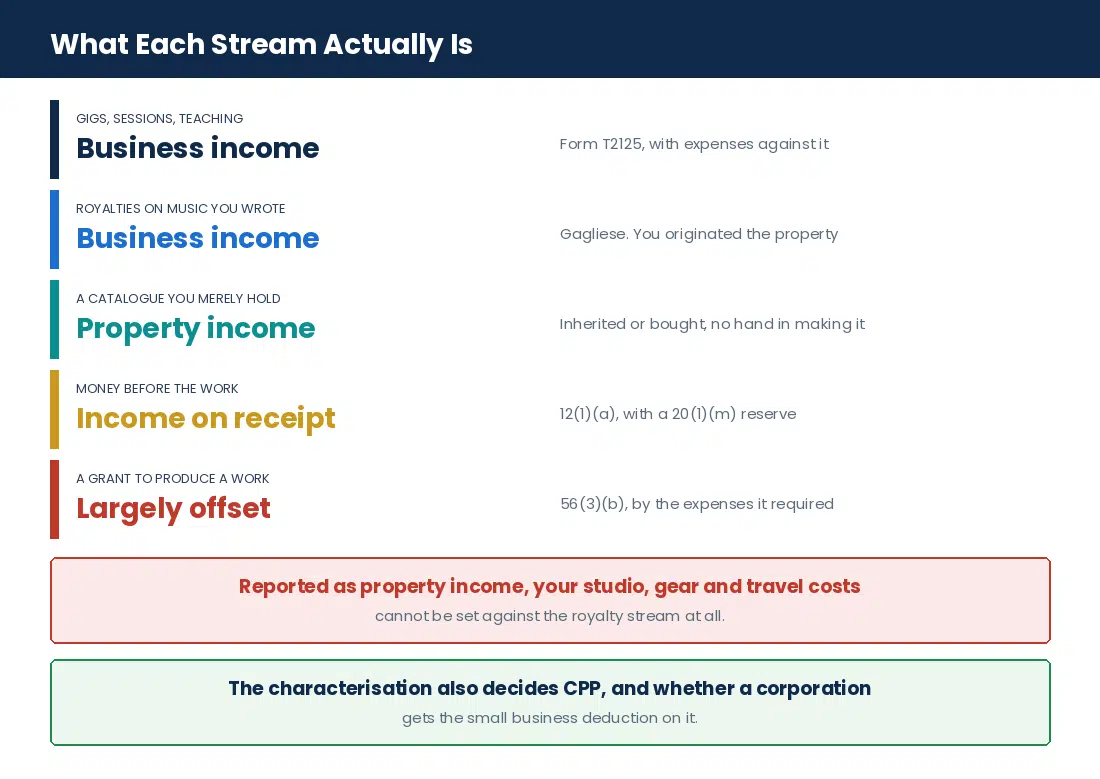
Here is the one most musicians are told wrong. Royalties are not automatically income from property.
Whether royalties are business income or property income depends on where they come from, not on the fact that they are called royalties. Where you are in the business of creating the music — writing it, recording it, exploiting the catalogue — royalties on your own works are generally active business income, which is CRA’s position following the Tax Court’s decision in Gagliese Productions. Royalties are property income in the passive case: an heir receiving a songwriter’s stream, or an investor who bought a catalogue they had no hand in making.
The distinction decides more than it looks:
- Whether your expenses can be set against the income at all
- Whether the income enters your CPP contribution base
- For an incorporated musician, whether it is active business income eligible for the small business deduction, or the income of a specified investment business taxed at a materially higher rate
If royalties come from outside Canada, foreign withholding may apply. The foreign tax credit in section 126 is limited to the Canadian tax otherwise payable on that same foreign income, so it prevents double tax rather than refunding the withholding. Where the foreign tax exceeds what the credit can absorb, a deduction may be available instead, and which route applies turns on whether the royalty is business or property income — which is the question this section settles.
A songwriter in Toronto had been reporting about $41,000 a year of streaming and performance royalties as property income, on advice from a preparer who had read that royalties always are. He was also touring and recording, so the music was plainly a business. Reported as property income, none of his studio, equipment or travel costs could be set against the royalty stream, and the income did not enter his CPP base either. We refiled the open years with the royalties as business income from the catalogue he had written himself, which brought roughly $16,000 of previously stranded expenses into play against it. It also mattered for the corporation he set up the following year, where the same characterisation decided whether the small business deduction applied. Figures changed for privacy.
Teaching Income
Lesson fees are business income. Supplies bought for teaching and local travel between teaching locations are deductible against it on the same basis as any other business cost.
Merchandise Sales
Selling shirts, vinyl and CDs is business income too, and it counts towards the GST/HST threshold alongside everything else. Once your worldwide taxable supplies exceed $30,000 over four consecutive calendar quarters — or in a single calendar quarter — you cease to be a small supplier under section 148 of the Excise Tax Act and must register under section 240. The merch table is often what pushes a musician over, because nobody adds it to the gig income when they are counting.
Advances and Recoupment
An advance received before the work is done is income in the year you receive it, under subparagraph 12(1)(a)(i). What the Act then gives you is a deduction: a reasonable reserve under paragraph 20(1)(m) for the part still to be performed, which comes back into income the following year under paragraph 12(1)(e), against which a fresh reserve is claimed. The money is reported and reserved, not left off the return. Recoupment against future royalties reduces what is payable to you later rather than reversing the earlier income.
Grants, Prizes and Awards
Not simply taxable, and the detail is worth money. A grant to produce a musical work is brought into income by paragraph 56(1)(n) only to the extent it exceeds the scholarship exemption in subsection 56(3). Paragraph 56(3)(b) exempts the lesser of the amount of the award and the eligible expenses you incurred in the year to meet its conditions — so a grant spent on what it was given for is largely offset.
Personal and living costs do not count as eligible expenses, except travel, meals and lodging while away from your usual residence for the period the award covers, and expenses already reimbursed or deducted elsewhere are excluded. Paragraph 56(3)(c) adds up to $500 of whatever remains. A prescribed prize is outside paragraph 56(1)(n) entirely.
A composer received a $25,000 arts council grant to write a chamber piece and reported the whole amount as income, paying tax on all of it. Under paragraph 56(3)(b) the exemption is the lesser of the award and the eligible expenses incurred to meet its conditions — and she had spent about $19,000 of it on exactly what the grant letter specified: copyist fees, a recording session, score preparation and travel to two residencies. Reported properly, roughly $19,000 came out of income. She had read that grants were taxable and stopped there, which is true as far as it goes and misses the whole of subsection 56(3). The grant letter, with its conditions, was the document that made the claim. Figures changed for privacy.
Key Dates
| What | When |
|---|---|
| T1 filing, self-employed | 15 June |
| Balance owing | 30 April, with interest from 1 May |
| Quarterly instalments | 15 March, 15 June, 15 September, 15 December |
| Instalment threshold | Net tax owing over $3,000, or $1,800 in Quebec |
| T2 corporate filing | Six months after the fiscal year-end |
| Records | Six years after the last tax year they relate to |
Quarterly instalments are required where your net tax owing is more than $3,000 — $1,800 for Quebec residents — in the current year and in either of the two preceding years. Late filing costs 5 per cent of the tax unpaid when the return was due, plus 1 per cent for each complete month the return is late, to a maximum of twelve months, under subsection 162(1). The base is the tax outstanding at the due date, so a musician who pays on time and files late has nothing to be charged on.
Deductions, Instruments and Equipment
Deductions
Essential Musician Tax Deductions Available in Canada
Profit is computed under subsection 9(1). Paragraph 18(1)(a) denies anything not incurred for the purpose of earning income, and section 67 requires the amount to be reasonable in the circumstances. Both tests have to be met, and the second one catches more musicians than the first.
Identifying Eligible Expenses
You can claim costs that relate directly to earning money from your music — studio fees, session costs, repairs, touring costs, promotion, teaching supplies. Save the invoices, contracts and payment records, with service dates and who paid, because the link between the cost and the income is what gets tested.
Repairs Against Overhauls
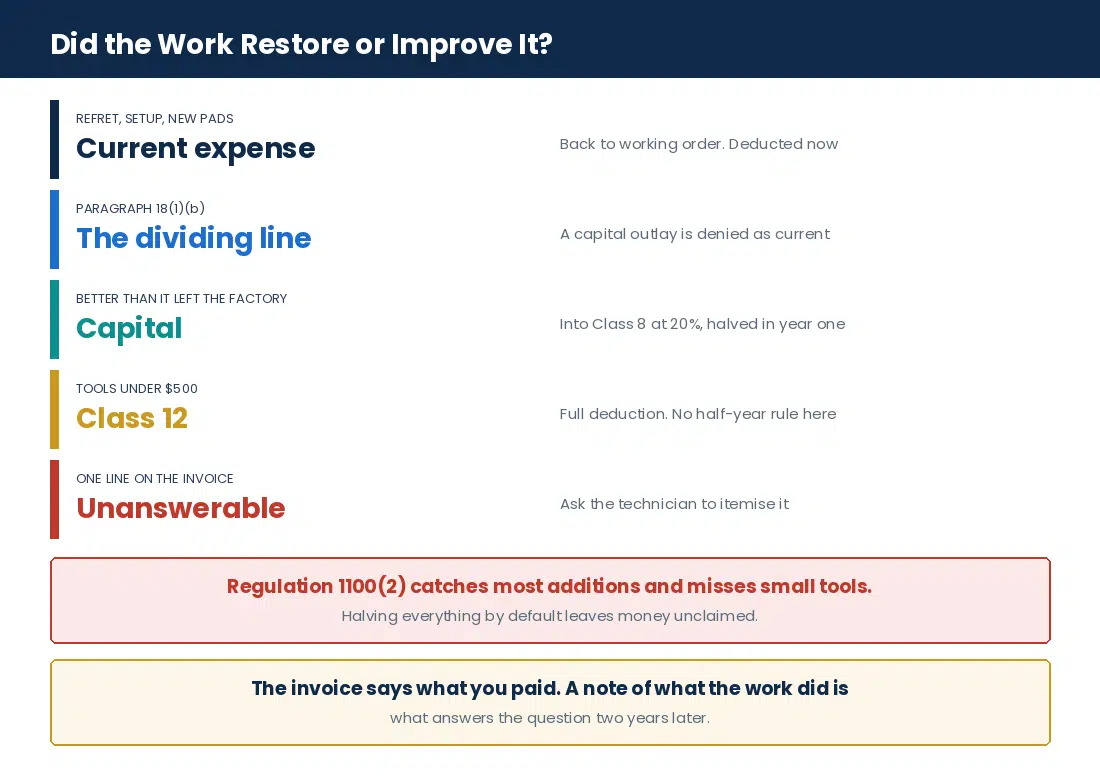
Fixing an instrument so it works as it did is a current expense, deducted in the year. But if you upgrade or overhaul it so that the instrument is better than it was, that is an outlay on account of capital, denied as a current expense by paragraph 18(1)(b) and added to the asset’s class instead.
A refret, a setup, a new set of pads on a saxophone: repairs. A vintage instrument rebuilt with better components than it left the factory with, or an amp rewired to a specification it never had: capital. The invoice description rarely settles it, so a note of what the work actually did is worth more than the receipt alone.
Capital Cost Allowance on Instruments and Gear
| Asset Type | Class | Treatment |
|---|---|---|
| Instruments, amps, PA and recording gear | Class 8 | 20% declining balance, half-year rule applies |
| Tools costing less than $500 | Class 12 | 100%, fully deductible in the year of purchase |
| Computers and systems software | Class 50 | 55% declining balance |
| Purchased application software | Class 12 | 100%, but halved in the first year |
| Software subscriptions | Current expense | A recurring service fee, not an asset |
Schedule II of the Income Tax Regulations lists the classes and Regulation 1100 sets the rates. Regulation 1100(2), the half-year rule, limits the claim on an addition to half the normal amount in the year the asset becomes available for use — but it does not catch everything. Tools costing less than $500 in Class 12 are fully deductible in the year you buy them, which is a point worth knowing before you assume everything gets halved.
Where an instrument is used partly for pleasure, only the business proportion is claimable, and that proportion needs to be something you can explain.
A session player bought a vintage bass for about $8,200 and had roughly $3,400 of work done on it in the same year — a neck reset, a refret, and a replacement pickup to a different specification than the original. She expensed the whole $3,400 as repairs. The neck reset and refret were restoration and held. The pickup swap improved the instrument beyond its original state and was capital, which moved about $900 into Class 8 at 20 per cent, halved in the first year. The adjustment was small. The useful part was that the luthier’s invoice described all three items in one line, and after that she started asking for them itemised, which has made every year since straightforward. Figures changed for privacy.
A drummer bought a set of specialist tuning keys, stands and hardware tools across a year, about $2,100 in total, no single item over $400, and put the lot into Class 8 at 20 per cent halved in the first year. That gave him roughly $210 of deduction. Tools costing less than $500 belong in Class 12 and are fully deductible in the year of purchase, so the correct figure was the full $2,100. He had applied the half-year rule as a general principle because that is how it is usually described. It is not general: it catches most additions and misses that one. Figures changed for privacy.
Promotion and Business Development
Advertising, photography, website hosting, press materials and distribution fees are deductible where they relate directly to earning music income and you have the receipt or contract behind them. So are commissions paid to an agent or manager on bookings they secured, and the fees charged by a booking platform, provided the link to the engagement is documented.
Union Dues and Professional Memberships
For a self-employed musician, union and association dues are an ordinary business expense under subsection 9(1). For an employed musician they fall under subparagraph 8(1)(i)(iv), which is a different and narrower provision. Which one applies depends on your status, and the two should not be blurred on one line.
Employed Musicians in Orchestras
If you are employed rather than self-employed, most of this section does not apply to you, but one provision does. Paragraph 8(1)(p) lets an employed musician deduct maintenance, rental, insurance and capital cost allowance on an instrument they were required to supply as a condition of employment — but capped at the income from their employment as a musician for the year. The excess is not carried forward.
Orchestra players who also gig and teach on the side are running both regimes at once: paragraph 8(1)(p) against the employment income, and an ordinary business computation against everything else. They are kept separate.
Home Studio, Travel and Touring Costs
Studio & Road
Claiming the Home Studio, Travel and Performance Costs
The Home Studio
Subsection 18(12) gives two routes and you need only one. Either the space is your principal place of business — which is where most working musicians land, because the writing, the admin and the invoicing all happen there — or it is used exclusively to earn business income and used on a regular and continuous basis for meeting clients.
The exclusivity requirement belongs to the second limb only. There is no rule anywhere requiring separately metered utilities, and no percentage threshold. Measure the space, apportion rent or mortgage interest, utilities, property tax, insurance and maintenance on floor area, and keep the bills.
Two limits apply. The deduction cannot create or increase a loss from the business, and any amount disallowed on that basis carries forward indefinitely against future income from the same business.
A producer in Hamilton had never claimed his home studio across five years of filing, because the room had a sofa bed in it for visiting collaborators and he had read that the space must be used only for business. The first limb of subsection 18(12) applied to him without difficulty: the room was his principal place of business, where every session was tracked and every invoice raised, and the exclusivity requirement was never in play. The room was about 220 square feet in a 1,900 square foot house, and the claim came to roughly $2,400 a year. We adjusted the years still open. The earlier ones stayed lost, which is the part worth avoiding. Figures changed for privacy.
Travel and Touring
Keep a tour itinerary with dates and the engagement each trip served, and keep the tickets, hotel bills and receipts. Accommodation and transportation for performance dates are deductible where the trip was for the work.
Meals on tour are limited by subsection 67.1(1) to 50 per cent of the lesser of what you paid and a reasonable amount, and that applies to food, beverages and entertainment together. On the GST/HST side, section 236 of the Excise Tax Act requires half the input tax credit claimed on meals and entertainment to be recaptured.
Vehicle Expenses
Keep a logbook recording dates, destinations, the purpose of each trip, the odometer readings and business kilometres against total. The log does not produce the deduction by itself; it establishes the business-use fraction, which is then applied to the year’s actual vehicle costs — fuel, insurance, licence and registration, maintenance, interest and capital cost allowance within the prescribed limits.
For a musician hauling backline to gigs, the proportion can be high and the claim substantial, which is exactly why the log needs to be contemporaneous rather than reconstructed in April from a calendar.
A vehicle log rebuilt after the fact from gig posters and bank records is materially weaker than one filled in as you drive, and on a claim representing a large share of vehicle costs that difference shows. The same applies to the tour itinerary: a list of dates with no note of what each trip was for answers the wrong question.
Studio, Production and Session Costs
Studio rental, engineering, mixing, mastering, session players you hire and production services are deductible business costs where you have the invoices. Where you engage other players, a short written agreement setting out the scope and the fee before the session is worth the five minutes, because it is what makes the payment legible later.
Musician Tax Readiness Check
Five quick questions on where your music file stands. No fee shown.
Points to raise with us:
This is a general prompt, not tax or legal advice or a quote. Your position depends on your full facts. For a real review, please book a free consultation.
Accounting Method and Record Keeping
Records
Best Practices for Musician Accounting in Canada
Tracking Income and Expenses
Musicians earn from shows, sessions, teaching, royalties, merch and sometimes grants, often in the same month. Keeping the streams apart from the outset is what makes the return possible, because each is characterised differently and some carry expenses the others do not.
- Record every payment received, with the stream it belongs to
- Keep receipts for anything bought for the work
- Keep contracts, which explain what a payment was for when the bank record does not
Separating Personal and Business
Run the music income and expenses through an account used for nothing else. Where an instrument serves both the stage and the living room, only the business proportion is claimable, and a mixed account is where that proportion stops being provable.
Cash or Accrual
Cash reporting counts income when the money arrives and expenses when they are paid. It is simpler and it suits a musician whose income is mostly gig fees paid on the night.
Accrual reporting counts income when it is earned and matches expenses to the same period, under subsection 9(1) and paragraph 12(1)(b). A session recorded in December and invoiced in January is December’s income. This gives a truer picture where work and payment separate, and it is required of most businesses.
One thing is not a matter of method. An advance received before the work is done is income on receipt under subparagraph 12(1)(a)(i) whichever way you report, with the reserve under paragraph 20(1)(m) available only to an accrual filer — subsection 20(7) denies it to anyone on the cash method. That is worth knowing before you choose.
A touring artist took a $30,000 advance in November against an album delivered the following June and left it off the return entirely, reasoning that she had not earned it. Under paragraph 12(1)(a) the whole amount was income in the year she received it, with a reserve available under 20(1)(m) for the part still to be delivered. Had she claimed the reserve, roughly $26,000 would have come back out and the tax effect would have been small. Leaving it off instead produced an understatement, with no reserve on the return to point to, and a revenue figure that did not match a deposit anyone could see. We refiled the year properly. The tax moved by a few hundred dollars; the exposure, had CRA found it first, was the whole advance. Figures changed for privacy.
Records and How Long to Keep Them
The duty to keep records is in subsection 230(1), and subsection 230(4) sets the six-year retention period, running from the end of the last tax year the records relate to. For a musician that means contracts and invoices, the tour itineraries, the vehicle log, receipts for instruments and repairs with a note of what the work did, the floor measurements behind the studio claim, and grant letters with the conditions attached.
Software and Tools
QuickBooks Online and Xero both handle a self-employed music practice well: invoices, expense categories, linked bank feeds, GST/HST reports and year-end summaries. Receipt-capture apps on a phone are useful on the road, where paper does not survive.
What software will not do is tell you that an overhaul was capital, that a royalty stream is business income, or that an advance needs a reserve rather than being left out. Those are the judgements that move the number.
Filing, Deadlines and GST/HST
Filing
Preparing Your Musician Tax Return in Canada
Deadlines
If you are self-employed your T1 is due 15 June, but the balance owing is due 30 April and interest runs daily from 1 May. These are two different dates and only one of them is the one people remember.
Quarterly instalments are required where your net tax owing is more than $3,000 — $1,800 for Quebec residents — in the current year and in either of the two preceding years, on 15 March, 15 June, 15 September and 15 December. CRA sends reminders, but the obligation comes from the Act rather than the notice.
A musician operating through a corporation files the T2 within six months of the fiscal year-end. The balance is due at two months, extended to three for a Canadian-controlled private corporation that claimed the small business deduction and meets the conditions, so arrears interest can be running while the return is not yet late.
Slips and Documents
You will receive T4A slips for fees for services from venues, labels and institutions, and royalty statements from your distributor or performing rights organisation. Keep every contract and invoice connected to the work, along with receipts showing the date, the supplier, the amount and why it was a business cost.
Form T2125
Self-employed income goes on Form T2125, Statement of Business or Professional Activities, filed with the T1. Report the income by stream and keep the expenses matched to the stream they relate to, so that the characterisation work from section one survives onto the form.
GST/HST
Registration is required once worldwide taxable supplies exceed $30,000 over four consecutive calendar quarters, or in a single quarter. Everything counts towards it together: gig fees, session work, teaching, merch and taxable royalties. Below the threshold registration is optional, and voluntary registration is worth considering for a musician buying significant equipment, because it lets the GST/HST on those purchases be recovered through input tax credits.
Once registered you charge tax on your taxable supplies, file returns on the assigned frequency, and claim input tax credits on invoices that carry the required information.
A musician registered voluntarily in the year she bought a touring rig — about $34,000 of PA, backline and recording equipment — and recovered roughly $4,400 of HST she would otherwise have absorbed entirely. Her clients were venues and production companies, all registered, so the tax she charged cost them nothing. She had spent two years below the threshold deliberately, believing registration would make her more expensive. On the work she was actually doing, it would not have. Figures changed for privacy.
Common Filing Mistakes
- Missing the home studio entirely, usually because of an exclusivity test that was never the relevant limb
- Treating every royalty as property income, which strands the expenses
- Leaving an advance off the return instead of reporting it and claiming the reserve
- Expensing an overhaul that improved the instrument
- Reconstructing the vehicle log after the year has closed
- Forgetting merch when counting towards the $30,000 threshold
For help with musician taxes in Canada and bookkeeping that holds up, contact Gondaliya CPA at 647-212-9559 or info@gondaliyacpa.ca for a free consultation.
DIY Filing Against Professional Help
Getting Help
Doing It Yourself, and When That Stops Working
Filing your own return works where the practice is simple: gig fees, a few expenses, no advances, no royalties worth characterising, no incorporation. A great many working musicians are in exactly that position for years, and paying someone would be waste.
It stops working at the points this article has been circling. Whether a royalty stream is business or property income is not a data-entry question. Nor is whether an overhaul was capital, whether an advance needs a reserve, or which limb of subsection 18(12) your studio sits under. Software will not raise any of them, because none of them are arithmetic.
How Gondaliya CPA Works With Musicians
We start by characterising each income stream, because everything downstream depends on it: performance and session fees, teaching, royalties on your own catalogue against royalties you merely hold, merch, advances and grants. Then we match expenses to the streams they belong to, test each instrument cost as a repair or an improvement, put equipment into the right class with the half-year rule applied where it applies and not where it does not, and set the studio claim under the limb that fits.
What you get:
- Income characterised stream by stream, with the reasoning recorded
- A reserve schedule where advances span a year-end
- Grant income reconciled against the expenses that offset it under subsection 56(3)
- A capital asset schedule for instruments and gear, with repairs separated from improvements
- Form T2125 or a T2, with the schedules behind it
Employment Status for Orchestra Players
Whether an orchestra player is an employee or self-employed is decided at common law, on control, ownership of tools, chance of profit and risk of loss, and the intention of the parties — the factors CRA sets out in Guide RC4110. It matters because it decides whether paragraph 8(1)(p) governs the instrument deduction or whether an ordinary business computation does, and the two produce very different numbers.
A violinist employed by an orchestra also taught privately and played weddings, and her previous return had put everything through one business computation — including about $5,800 of instrument insurance, maintenance and capital cost allowance. The orchestra income is employment income and those instrument costs belong under paragraph 8(1)(p), capped at her income from employment as a musician. The teaching and wedding work is a separate business. Splitting them changed where the deductions sat and what they were capped against, and it changed her total modestly. What it mainly changed was whether the return would survive being looked at, since one computation covering both regimes does not. Figures changed for privacy.
Incorporation
Incorporating changes the analysis rather than simply reducing the tax. The characterisation question from section one becomes sharper, because a corporation whose principal purpose is deriving income from property is a specified investment business and loses the small business deduction. A musician whose corporation actively creates and exploits its own catalogue is generally in a different position, but it turns on the facts.
We advise on what the structure means for your filings and what to track. The incorporation itself is a legal step taken elsewhere.
What It Costs
Fees depend on how many income streams there are, whether foreign royalties and withholding are involved, how much asset tracking the instrument schedule needs, whether past years need catching up, and whether GST/HST registration applies. You get a fixed annual fee with no hourly billing, shown before tax with sales tax on its own line, agreed before any work begins.
Frequently Asked Questions
FAQs
Frequently Asked Questions on Musician Taxes in Canada
Are my royalties business income or property income?+
Generally business income, if you created the music. CRA’s position, following the Tax Court in Gagliese Productions, is that royalties are normally property income but are active business income where they relate to a business you carry on or where you are in the business of originating the property producing them. A musician earning royalties on a catalogue they wrote and recorded is in that second category. Royalties are property income in the passive case — an heir, or someone who bought a catalogue they had no hand in making.
What is the GST/HST threshold for a musician?+
$30,000 of worldwide taxable supplies over four consecutive calendar quarters, or in a single calendar quarter. Everything counts together: gig fees, session work, teaching, merchandise and taxable royalties. Merch is the stream most often forgotten in the count. Past the threshold you cease to be a small supplier under section 148 of the Excise Tax Act and must register under section 240.
How does the half-year rule affect my instrument claim?+
Regulation 1100(2) halves the claim on an addition in the year the asset becomes available for use, so an instrument or amp in Class 8 gets 10 per cent rather than 20 in year one. It does not catch everything, though: tools costing less than $500 in Class 12 are fully deductible in the year of purchase. Assuming everything is halved leaves money on the table.
What can an employed orchestra musician deduct?+
Paragraph 8(1)(p) allows maintenance, rental, insurance and capital cost allowance on an instrument you were required to supply as a condition of employment — capped at your income from employment as a musician for the year, with no carryforward of the excess. If you also gig and teach on the side, that side activity is a separate business computation and the two are kept apart.
When do instalments apply?+
Where your net tax owing is more than $3,000 — $1,800 for Quebec residents — in the current year and in either of the two preceding years. The dates are 15 March, 15 June, 15 September and 15 December. CRA sends reminders but the obligation comes from the Act, so not receiving one does not excuse the instalments and interest runs from each missed date.
How is a foreign royalty taxed?+
It is included in your Canadian income, and the foreign withholding is relieved through the foreign tax credit in section 126, which is limited to the Canadian tax otherwise payable on that same income. It prevents double tax rather than refunding the withholding. Where the foreign tax exceeds what the credit absorbs, a deduction may be available instead, and which route applies depends on whether the royalty is business or property income.
When is my return due, and when is the money due?+
The T1 is due 15 June because you carried on a business, and the balance owing is due 30 April with interest running from 1 May. Late filing costs 5 per cent of the tax unpaid at the due date plus 1 per cent per complete month to a maximum of twelve, under subsection 162(1) — so filing late after paying on time carries nothing.
How do advances and recoupment work?+
An advance is income in the year you receive it, under subparagraph 12(1)(a)(i). You then claim a reasonable reserve under paragraph 20(1)(m) for the part still to be performed, which returns to income the next year under paragraph 12(1)(e). The reserve is unavailable on the cash method under subsection 20(7). Recoupment reduces what is later payable to you rather than reversing the original income.
Are grants and prizes taxable?+
Only to the extent they exceed the scholarship exemption. Paragraph 56(1)(n) brings a grant into income net of subsection 56(3), and paragraph 56(3)(b) exempts the lesser of the award and the eligible expenses you incurred in the year to meet its conditions. Travel, meals and lodging away from your usual residence for the award period count; other personal costs do not. Paragraph 56(3)(c) adds up to $500 of any remainder, and a prescribed prize is outside 56(1)(n) altogether.
How long do I keep my records?+
Six years after the end of the last tax year they relate to, under subsection 230(4), with the duty to keep them imposed by 230(1). For a musician that means contracts, invoices, tour itineraries, the vehicle log, instrument and repair receipts with a note of what the work did, studio measurements and grant letters with their conditions.
Essential Points for Musicians
Key Points
Essential Points on Managing Musician Taxes
- Royalties on your own catalogue: generally active business income, not property income.
- Performance, session and teaching fees: business income on Form T2125.
- Advances: income on receipt under 12(1)(a), with a reserve under 20(1)(m) for the unearned part.
- Grants: offset by the eligible expenses incurred to meet their conditions, under 56(3)(b).
- Prescribed prizes: outside paragraph 56(1)(n) entirely.
- Repairs: restore to working order, deducted now.
- Overhauls: improve beyond original state, capital, denied as current by 18(1)(b).
- Instruments and amps: Class 8 at 20%, halved in the first year.
- Tools under $500: Class 12, fully deductible in the year of purchase.
- Home studio: subsection 18(12), two alternative limbs, no metering requirement, no loss.
- Meals on tour: 50% under subsection 67.1(1).
- Vehicle: business-use share of actual costs, established by a contemporaneous log.
- Employed musicians: paragraph 8(1)(p), capped at musical employment income.
- GST/HST: $30,000 across all streams including merch.
- Filing: 15 June to file, 30 April to pay, interest from 1 May.
- Records: six years under subsection 230(4).
Top Reporting Mistakes and How to Prevent Them
- Treating every royalty as property income, which strands the expenses that should offset it
- Expensing an overhaul that improved the instrument rather than restoring it
- Leaving an advance off the return instead of reporting it and claiming the reserve
- Abandoning the home studio claim over an exclusivity test that was never the relevant limb
- Reconstructing the vehicle log after the year closed
- Counting gig income towards the $30,000 threshold but forgetting the merch table
- Confusing employment status, and so applying the wrong regime to instrument costs
Before You Hand Anything Over
- Contracts and invoices from gigs, sessions and teaching
- Royalty statements from your distributor and performing rights organisation
- Grant letters, with the conditions attached
- Instrument purchase and repair receipts, with a note of what each job did
- The vehicle log and the tour itineraries
- Studio measurements and the household bills
- Any advance agreements spanning a year-end
Choosing a CPA Firm in Ontario
Look for experience with mixed income streams and with the characterisation question specifically, rather than general small business work. Ask how they would treat a royalty on your own recording, and whether an advance needs a reserve. Fees agreed before the work starts, and a willingness to say a deduction is not available, matter more than a long client list.
Why Trust Gondaliya CPA?
Gondaliya CPA Professional Corporation is a registered Ontario CPA firm, performing compilation engagements under CSRS 4200. Sharad Gondaliya, CPA, is licensed in Ontario and in Washington and Montana. We work with musicians and performers across Toronto, Mississauga, Hamilton, Ottawa and the rest of Ontario, on fixed annual fees with no hourly billing.
Businesses We Serve & Industry Spotlights
Industry Expertise
Musicians sit inside a wider group of creative and performance practices, and the questions that decide one of these files — what each income stream actually is, whether an advance needs a reserve, and whether a piece of work on an asset restored it or improved it — recur across every one of these situations.
| Who | The Creative Angle |
|---|---|
| Musicians | Royalties on your own catalogue, instruments and touring |
| DJs | Equipment classes, bookings and merch at the same table |
| Performing arts companies | Advances, grants and season subscriptions across year-ends |
| Audio visual companies | Gear-heavy capital schedules and site travel |
| Cultural centres | Grant conditions and the expenses that offset them |
| Art galleries | Inventory against consignment, and whose income it is |
| Publishers | Royalty characterisation from the other side of the contract |
| Online course creators | Prepaid access and the reserve under 20(1)(m) |
| Public speakers | Deposits, cancellations and multi-province dates |
| Corporate trainers | Seat blocks sold in advance of delivery |
| Digital product businesses | Licensing income and when it is earned |
Spotlights: musicians · DJs · performing arts companies · audio visual companies · cultural centres · art galleries · publishers · online course creators · public speakers · corporate trainers · digital product businesses.
Professional Guidance and Quick Reference
Guidance
Essential Tax Points for Canadian Musicians
Musician files go wrong in a predictable set of ways: every royalty reported as property income, which strands the expenses that should offset it; an advance left off the return instead of reported and reserved; an overhaul expensed as a repair; the whole CCA table halved when tools under $500 are not; a home studio claim abandoned over an exclusivity test that was never the relevant limb; the merch table left out of the GST/HST count; and a grant reported gross when the expenses incurred to meet its conditions would have offset most of it. Gondaliya CPA prepares musician returns on a fixed annual fee.
Quick Answers
At a Glance
- Performance and session fees: business income, Form T2125
- Teaching income: business income
- Royalties on your own catalogue: generally active business income
- Royalties held passively: property income
- The authority: Gagliese Productions, and CRA’s position following it
- Merch: business income, and it counts towards the threshold
- Advance received: income on receipt, 12(1)(a)(i)
- Unearned part: reserve under 20(1)(m)
- Reserve next year: back into income, 12(1)(e)
- Cash method: no reserve available, subsection 20(7)
- Grant to produce a work: offset under 56(3)(b) by eligible expenses
- Prescribed prize: outside 56(1)(n) entirely
- Repair: restores, deducted now
- Overhaul: improves, capital, denied by 18(1)(b)
- Instruments and amps: Class 8 at 20%
- Tools under $500: Class 12, no half-year rule
- Computers: Class 50 at 55%
- Half-year rule: Regulation 1100(2)
- Home studio: subsection 18(12), two limbs, no loss
- Meals on tour: 50%, subsection 67.1(1)
- Vehicle: business-use share of actual costs
- Employed musician: paragraph 8(1)(p), capped at musical employment income
- Foreign royalties: credit under section 126
- GST/HST: $30,000, sections 148 and 240
- Filing: 15 June; paying: 30 April
- Late filing: 5% plus 1% a month, maximum twelve, under 162(1)
- Instalments: net tax owing over $3,000, quarterly
- Records: six years, subsection 230(4)
Who This Is For / Not For
Fit Check
- For: performers, session players, composers, teachers and recording artists resident in Canada, filing on Form T2125 or through a corporation.
- For: musicians with more than one income stream, with advances or grants crossing a year-end, or with a home studio and a vehicle carrying gear.
- Not for: copyright law, publishing or recording contract terms, royalty rate negotiation, or performing rights organisation membership — none of which is a tax question.
- Not for: immigration and work permits for touring, which matter a great deal to a working musician and are handled by someone else entirely.
People Also Ask
Related Questions
Someone told me royalties are always property income. Is that right?+
No, and it is the costliest thing a musician gets told. CRA’s position, following the Tax Court in Gagliese Productions, is that royalties are normally property income but are active business income where they relate to a business you carry on or where you are in the business of originating the property that produces them. If you wrote and recorded the catalogue, you are in that second category. Reported as property income, your studio, equipment and travel costs cannot be set against the stream at all.
I got a $20,000 advance in December for an album due next summer. Do I report it now?+
Yes, all of it, under subparagraph 12(1)(a)(i) — and then you claim a reserve under paragraph 20(1)(m) for the part still to be delivered, which takes most of it back out. The reserve returns to income next year under 12(1)(e) and you claim a fresh one against whatever remains. Leaving the advance off the return entirely is an understatement rather than a deferral, with no reserve on the return to point to. One catch: the reserve is unavailable on the cash method under subsection 20(7).
I had my guitar overhauled. Repair or capital?+
It depends on what the work did. Restoring the instrument to working order — a refret, a setup, new pads — is a current expense deducted now. Work that leaves it better than it was, such as components to a higher specification than it originally had, is an outlay on account of capital, denied as a current expense by paragraph 18(1)(b) and added to Class 8 instead. Ask your luthier to itemise the invoice, because one line covering three jobs makes the question unanswerable.
Does my Canada Council grant get taxed in full?+
Usually not in full. Paragraph 56(1)(n) brings a grant into income only to the extent it exceeds the scholarship exemption in subsection 56(3), and paragraph 56(3)(b) exempts the lesser of the award and the eligible expenses you incurred in the year to meet its conditions. So a grant spent on what it was given for is largely offset. Travel, meals and lodging away from your usual residence for the award period count as eligible; other personal costs do not. Keep the grant letter with its conditions, because the conditions define what qualifies.
My studio is the spare room and guests sleep there twice a year. Can I claim it?+
Almost certainly yes, under the first limb of subsection 18(12): the space is your principal place of business, which is where the writing, the admin and the invoicing happen. That limb carries no exclusivity requirement. Exclusive use belongs to the second limb, which also requires that you meet clients there regularly. There is no rule about separately metered utilities either, whatever you may have read. Measure the room, apportion on floor area, keep the bills.
Glossary of Key Terms
Definitions
- Business income: profit from an activity carried on as a business, computed under subsection 9(1).
- Property income: income from holding property passively rather than from a business.
- Royalty: a payment for the use of a work, business or property income depending on the facts.
- Advance: money received before the work is performed.
- Reserve: the paragraph 20(1)(m) deduction for services still to be rendered.
- Recoupment: an advance recovered out of later royalties payable to you.
- Current expense: a cost that restores or maintains, deducted in the year.
- Capital expenditure: a cost that improves, recovered through CCA instead.
- Capital cost allowance (CCA): the deduction spreading an asset’s cost over several years.
- Class 8: instruments, amplifiers and general equipment, at 20%.
- Class 12: tools costing less than $500, deducted in full in the year of purchase.
- Class 50: computer hardware and systems software, at 55%.
- Half-year rule: Regulation 1100(2), halving the first-year claim on most additions.
- Work space in the home: the deduction governed by subsection 18(12).
- Scholarship exemption: subsection 56(3), which offsets a grant by eligible expenses.
- Prescribed prize: an award outside paragraph 56(1)(n) altogether.
- Foreign tax credit: section 126 relief against Canadian tax on foreign income.
- Form T2125: the Statement of Business or Professional Activities.
- T4A: the slip reporting fees for services.
- Paragraph 8(1)(p): the instrument deduction available to an employed musician.
Want a checklist to work from? You can download our free musician tax checklist before your consultation.
Four things decide a musician’s return. What each stream actually is — and the one that matters most is royalties, which on a catalogue you wrote are generally active business income rather than property income, following the Tax Court in Gagliese Productions. What happens to money received early — an advance is income on receipt under paragraph 12(1)(a), with a reserve under paragraph 20(1)(m) for what is still to come, and leaving it off the return is an understatement rather than a deferral. What the work on an instrument did — restoring is deducted now, improving is capital and denied as current by paragraph 18(1)(b), and the invoice rarely says which. And whether the obvious deductions were taken at all — the home studio under the limb that actually applies, tools under $500 in full rather than halved, and a grant offset by the expenses you incurred to earn it under subsection 56(3).
Three questions tell you where you stand, and the first one you can answer from last year’s return. First, how were your royalties reported? If they went in as property income and you wrote the music, expenses that should have offset them are sitting unused. Second, did any advance cross a year-end? If so, check whether it was reported with a reserve or simply left out, because those look identical in the bank and very different on a return. Third, have you ever claimed the home studio? If the answer is no because the room is not used only for music, the reason is probably the wrong limb of the test.
Musician Taxes Canada: How Gondaliya CPA Can Help
Start with your royalty statements and last year’s return
Gondaliya CPA characterises each income stream before anything else, because the royalty question decides what can be deducted against what, sets advances up with a reserve schedule rather than leaving them off, tests every instrument invoice as a restoration or an improvement, puts gear into the right class with the half-year rule applied where it applies and not where it does not, reconciles grant income against the expenses that offset it under subsection 56(3), claims the home studio under the limb that fits your practice, keeps employment and self-employment regimes apart for orchestra players who also gig, and prepares the T2125 or T2 with the schedules behind it — on a fixed annual fee with no hourly billing, shown before tax with sales tax on its own line and agreed before any work begins. Please book a free consultation.
Next Steps
Please book a free consultation with Gondaliya CPA and bring four things: your royalty statements from the distributor and your performing rights organisation, your instrument purchase and repair invoices with a note of what each job did, any grant letters with their conditions attached, and last year’s return. Those four settle the characterisation, the capital schedule, the grant offset and whatever the previous preparer did — which between them account for nearly every difficulty we see on a musician’s file. If an advance has been left off a past return, say so at the outset; the reserve usually means the tax effect of putting it right is small, and it is very much better corrected before anyone asks. We advise on Canadian federal tax and GST/HST; copyright, publishing and recording contract terms, royalty rate negotiation and touring work permits are separate matters handled elsewhere. You will get a fixed annual fee, shown before tax, agreed before any work begins. We serve Toronto, Mississauga, Brampton, Vaughan, Etobicoke, Scarborough, Hamilton, Ottawa and the rest of Ontario, and work with musicians across Canada. If our content helps, please add gondaliyacpa.ca as a preferred source on Google.
Published: · Last updated:
Editorial policy: We research against CRA, Department of Finance, Parliament of Canada, CPA Canada and CPA Ontario sources, fact-check the figures, and Sharad Gondaliya, CPA, reviews the content, which we update as the rules change.
Disclaimer: This article is educational information only and is not tax, legal or financial advice. It covers Canadian federal income tax and GST/HST for musicians resident in Canada, including the characterisation of performance, session, teaching, royalty, merchandise and grant income, advances and the reserve for amounts not yet earned, deductions for instruments and equipment, capital cost allowance and the distinction between repairs and improvements, the work space in the home, touring, vehicle and meal costs, record keeping, the choice between cash and accrual reporting, GST/HST registration, and the separate regime applying to an employed orchestra musician. It does not address copyright law, publishing or recording contract terms, royalty rate negotiation, performing rights organisation membership, or immigration and work permits for touring. Whether a particular royalty stream is business income or income from property, and whether particular work on an instrument restored or improved it, both turn on the full facts and cannot be settled by general guidance. Rates, thresholds, classes, filing deadlines and statutory references change; every reference should be confirmed against current CRA guidance before a return is filed. Gondaliya CPA performs compilation engagements under CSRS 4200 and does not perform audit or review engagements. Please consult a licensed CPA before acting.

Sharad Gondaliya is a CPA Canada & CPA USA with 15 Years+ experience of Accounting, Tax, Payroll of Corporate Small Businesses as Tax Accountant. He is a CPA Ontario member (61040184) and holds US CPA licences in Washington and Montana and is well known among corporate small businesses for tax planning, efficient tax solutions, and affordable CPA services. Sharad is the Principal (Director) of Gondaliya CPA – Affordable CPA Firm in Canada. Licenses: CPA Ontario: 61040184 | CPA USA (MT): PAC-CPAP-LIC-033176 | CPA USA (WA): 57629 | CPA Firm License: 61330051 View Full Author Bio