



The Ultimate Guide to Trade School Taxes and Accounting in Canada
Trade School Taxes Canada: Vocational School Status, GST/HST and Tax Deductions
Trade school taxes in Canada turn on one question with a long answer: whether the school is a vocational school making exempt supplies under Schedule V to the Excise Tax Act. Gondaliya CPA works with vocational training businesses on that status question, on the apportionment of input tax credits across mixed programme streams, on T2 filing and on bookkeeping that keeps exempt tuition and taxable sales apart from the first enrolment.
Quick Summary
Almost everything that goes wrong on a trade school file comes from treating the GST/HST exemption as a benefit rather than a constraint. Tuition for a qualifying course is exempt under section 8 of Part III of Schedule V, which means the school charges no tax and also recovers none of the tax it pays on rent, shop equipment, consumables and utilities. That unrecovered tax is a real operating cost, and the public service bodies’ rebate under section 259 does not fix it for a school run for profit. Whether the exemption applies at all depends on the definition in section 1 of the same Part: an organization established and operated primarily to provide courses that develop or enhance occupational skills, which CRA reads as more than half of total annual revenues, tested every year. A school can elect out of the exemption on Form GST29, which is kept in its own records and never sent to CRA. Flight schools have their own line to watch: dual and solo time up to the federal minimum is exempt, hours above it and build-up time are not, and private pilot licence training is not exempt at all. On the income tax side the T2 is due six months after the year end but the money is due at two months, or three for a qualifying Canadian-controlled private corporation. There is no tuition certificate return under the Excise Tax Act; the certificate obligation is the T2202, an income tax information return filed by a designated educational institution by the last day of February.
Reading time: 18 minutes.
Table of Contents
- Vocational School Status and the GST/HST Exemption
- Tuition, Materials, Seminars and Online Delivery
- The Election to Make Exempt Supplies Taxable
- Input Tax Credits, Apportionment and the Rebate Question
- Flight Training and Pilot Ratings
- Income Tax, Certificates, Records and Expenses
- Frequently Asked Questions
- Essential Points for Trade Schools
- Businesses We Serve & Industry Spotlights
- Professional Guidance and Quick Reference
The Numbers That Matter
This article covers Canadian federal GST/HST and income tax for privately operated trade schools and vocational training businesses, with Ontario and Toronto context, and reflects the law and CRA guidance current to 3 November 2026. It is written for incorporated schools filing a T2 and for owner-operated schools, and it covers the vocational school definition in section 1 of Part III of Schedule V, the exemptions in sections 6, 8 and 11 of that Part, the Form GST29 election, zero-rating under section 18 of Part V of Schedule VI, course materials, seminars and admissions, online delivery, flight training, input tax credit apportionment under section 141.01, the public service bodies’ rebate, small supplier status and registration, T2 filing and payment dates, the T2202 information return, capital cost allowance classes, and the records a mixed-supply school needs. It is not a guide to provincial career-college regulation, to programme licensing, approval or accreditation, to student protection or tuition assurance funds, or to the regulatory requirements of any particular trade credential. Gondaliya CPA performs compilation engagements under CSRS 4200, which provide no assurance; audit and review engagements are referred out. This is educational information only and not tax or legal advice.
Vocational School Status and the GST/HST Exemption
Status
Trade School Taxes Canada: What the Exemption Actually Turns On
Schedule V to the Excise Tax Act lists the supplies that are exempt from GST/HST, and Part III of it covers educational services. Two sections of that Part matter to a trade school, and a third matters to some. None of them is section 165 or section 221: those impose the tax and the duty to collect it, which is the opposite of what a school is looking for.
The exemption that most trade schools rely on is section 8 of Part III of Schedule V. It exempts a supply made by a government, school authority, vocational school, public college or university of a service of instructing individuals in, or administering examinations in respect of, courses leading to certificates, diplomas, licences or similar documents, or classes or ratings in respect of licences, that attest to the competence of individuals to practise or perform a trade or vocation. It excludes a zero-rated supply, and it does not apply where the supplier has made an election under the section, which is dealt with in section three below.
The Definition That Decides It
Before any of that engages, the school has to be a vocational school. Section 1 of the same Part defines one as an organization established and operated primarily to provide students with correspondence courses, or instruction in courses, that develop or enhance students’ occupational skills. Those two adverbs carry the whole test, and CRA’s reading of them in GST/HST Memorandum 20-4, Vocational Schools and Courses, is where a school’s status is won or lost.
Established primarily looks at what the organization was set up to do. For a corporation CRA reads the governing documents: letters patent, articles, by-laws. Where those are unavailable or not decisive, it weighs provincial registration, municipal licences, business name registration, a pre-launch business plan and the school’s own website.
Operated primarily is a revenue test. CRA generally treats it as met where more than 50 per cent of total annual revenues come from occupational-skills courses, and every revenue stream of the business counts in the denominator. Qualifying revenue includes tuition, government grants for that instruction, and related items such as textbook, residence, lab and transcript fees. The test is reviewed annually, and where the share falls to half or below the organization may stop being a vocational school for supplies made after that year. A new school can meet the test on documented intent, such as a business plan.
Provincial registration is evidence CRA will look at, but it is not conclusive either way. Whether the definition is met is a question of fact, and a school registered provincially can still fail it on the revenue figures.
A welding and fabrication school in Mississauga had charged no tax on anything for four years on the strength of its provincial registration. When we built the revenue analysis, occupational-skills tuition was $610,000 of $1.34 million — 46 per cent. The rest was equipment rental to local shops at $340,000, a retail consumables counter at $255,000, and weekend hobby courses at $135,000. On those numbers it was not operated primarily to provide occupational-skills courses, which meant the tuition was never exempt and four years of HST had gone uncollected on roughly $2.4 million of supplies. The fix was structural rather than retrospective: the rental and retail operations moved into a separate corporation, which brought the school’s own ratio to 71 per cent, and we made a voluntary disclosure for the open years. The school’s own instinct had been that registration settled it. Registration is evidence. The revenue figures are the test. Figures changed for privacy.
What the Course Itself Has to Do
Status is necessary but not sufficient. The course has to clear three further hurdles, all of them from CRA’s reading of section 8.
- An employment link. The course must relate directly to the skills needed to gain employment in a field or to keep it. Recreational, personal-interest, sports and hobby courses fail, and why a particular student enrolled is irrelevant.
- Documentation attesting competence. The institution has to issue documentation on completion attesting to the individual’s competence. A course that issues nothing is not exempt.
- One of three categories. The course must be part of a programme, or an upgrade course that is not part of a programme, or a preparatory course for a federal or provincial licence.
Whether courses form a programme depends on their length, cost, curriculum and how they are described in the school’s own promotional material. The whole programme has to be pass/fail, assessed on tests, graded material or projects, and the pass/fail element is met where a student can be held back for want of competence. A credit system requiring a set number of credits for a diploma points to a programme. A single course that is a component of a programme is exempt even for a student not enrolled in the full programme — which is how a one-off security guard course that meets provincial training requirements comes out exempt, while four stand-alone floral design courses, each with its own certificate, do not, because they are not a programme.
The Other Exemption: Accreditation and Designation Courses
There is a second exemption many trade schools fall under and few know about. Section 6 of Part III of Schedule V exempts instruction in courses leading to, or maintaining or upgrading, a professional or trade accreditation or designation recognised by a regulatory body — a body constituted or empowered by federal or provincial legislation to regulate a profession or trade by setting standards of knowledge and proficiency. It also exempts the certificates and the administering of examinations for those courses. The supplier has to be a professional or trade association, government, vocational school, university, public college or regulatory body.
Two things follow. First, once a course qualifies under section 6 the exemption covers every student in it, not only those pursuing the designation. Second, a course that merely broadens knowledge does not qualify, and nor does a course a professional association requires where no regulatory body exists. Section 6 carries its own election, and a school whose courses fall under both sections 6 and 8 has to elect under both for the election to cover all of them.
| Provision | What It Does |
|---|---|
| Sch V, Pt III, s.1 | Defines “vocational school”: established and operated primarily to provide occupational-skills courses |
| Sch V, Pt III, s.6 | Exempts accreditation and designation courses recognised by a regulatory body |
| Sch V, Pt III, s.8 | Exempts courses leading to credentials attesting competence to practise or perform a trade or vocation |
| Sch V, Pt III, s.11 | Exempts second-language instruction in English or French |
| Sch VI, Pt V, s.18 | Zero-rates instruction supplied to a non-resident organization that is not a registrant |
| ETA s.165 | Imposes the tax. Not an exemption provision |
| ETA s.221 | The supplier’s duty to collect. Not an exemption provision |
| ETA s.123(1) | Definitions, including “exempt supply” as a supply included in Schedule V |
Sole Proprietors and Contracted Instructors
CRA accepts that a sole proprietor can be an organization and so can be a vocational school. But two exclusions bite. A sole proprietor giving one-on-one instruction normally is not a vocational school. And a self-employed instructor contracting to a vocational school is not one either: the school’s status does not pass through to the instructor it hires. That second point is the one that produces unbilled tax, because the instructor invoices the school for a service that is taxable in the instructor’s hands while the school’s own tuition is exempt — and the school, making exempt supplies, cannot recover the tax on that invoice.
The expensive failure is not charging tax you need not charge. It is not charging tax you were required to charge. A school that has treated itself as a vocational school for years, charged nothing, and then fails the “operated primarily” test on its own revenue figures is liable for the tax it never collected, on supplies it can no longer go back and re-price. The ratio should be computed every year, on all revenue streams, and kept on file with the numbers behind it.
Tuition, Materials, Seminars and Online Delivery
Supplies
Vocational School Taxes: Which Supplies Are Exempt and Which Are Not
A trade school rarely sells one thing. It sells tuition, books, kits, uniforms, examination sittings, equipment rental, weekend workshops and sometimes seat blocks bought by employers. Each of those is characterised on its own terms, and the exemption in section 8 reaches only some of them. Getting the line right is the difference between an input tax credit claim that survives review and one that does not.
Course Materials
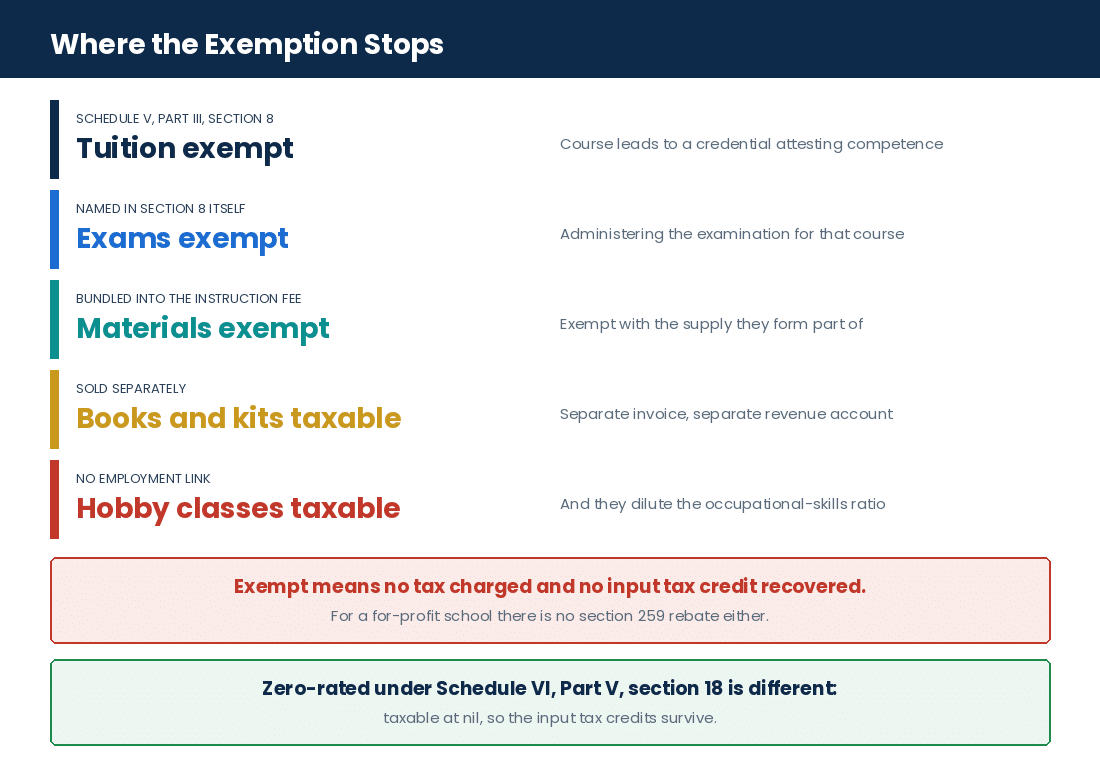
CRA’s test is bundling, not usefulness. Materials supplied together with an exempt instruction service form part of that supply and are exempt along with it. Materials sold separately — a textbook bought at the counter, a tool kit invoiced on its own line, a uniform ordered through the school shop — are generally taxable. The question is whether the material is part of the supply of instruction, not whether it helps with skill building.
Examination fees sit on the exempt side where the examination is in respect of a qualifying course, because administering examinations is named in section 8 itself as part of the exempt supply. That is a point the common framing gets backwards, and it matters on a programme where the sitting is billed separately from the teaching.
| Supply Component | Usual Treatment | What the Records Need |
|---|---|---|
| Tuition for a qualifying course | Exempt, s.8 or s.6 | Curriculum, pass/fail basis, the credential issued |
| Administering the examination for that course | Exempt, named in s.8 | Link to the qualifying course |
| Materials bundled into the instruction fee | Exempt with the instruction | One fee, one invoice line, no separate pricing |
| Books, kits and uniforms sold separately | Generally taxable | Separate invoice and separate revenue account |
| Shop or equipment rental to third parties | Taxable | Lease or rental agreement on file |
| Hobby and recreational courses | Taxable | Kept out of the occupational-skills revenue ratio |
| Instruction supplied to a non-resident organization | Zero-rated, Sch VI Pt V s.18 | Recipient’s non-residence and non-registration |
An electrical trade school in Brampton bundled everything into one $8,400 programme fee: instruction, the code book, a meter, safety boots and the licensing examination sitting. It charged no tax on the lot, which was right, and claimed no input tax credits, which left $4,100 a year of unrecovered tax on the meters and boots it bought in. We unbundled the tools. The code book and the examination stayed inside the instruction fee, and the meter and boots came out as a separately invoiced $740 equipment package, taxable, against which the school now recovers the tax on its own purchases. Net benefit in the first year was about $3,600, and the enrolment paperwork changed by one line. The exemption is not something to maximise. It is something to place deliberately. Figures changed for privacy.
Upgrade Courses and Preparatory Courses
An upgrade course that is not part of a programme is exempt where two things hold: competence is assessed pass/fail on tests, graded material or projects, and documentation attesting to competence is issued on completion. A course that turns on attendance or participation fails, and issuing a certificate of attendance does not save it. CRA’s own contrast makes the line clear: a graded and certified upgrade course in a particular technology is exempt, while an attendance-based course in another is not, even though both hand out a certificate.
A preparatory course for a federal or provincial licence is exempt where any one of three things is true: the course is required by federal or provincial law, or the licensing body accepts the course’s certificate in place of its own examination, or the course is equivalent to an upgrade course that would itself qualify. An air brake endorsement course whose certificate the province accepts is the pattern most trade schools will recognise.
What a course cannot be is partly exempt. A supply is exempt or it is not. A single fee can cover more than one supply, in which case each is characterised separately, but there is no status under which one course comes out half taxed.
| Programme Type | GST/HST Status | ITC Recovery | Deciding Factor |
|---|---|---|---|
| Accredited vocational diploma programme | Exempt | None on exempt-side inputs | Pass/fail programme, credential attesting competence |
| Skill upgrade workshop | Exempt if graded and certified, otherwise taxable | Follows the status | Graded assessment, not attendance |
| Licensing examination preparation | Exempt if one of the three limbs is met | Follows the status | Required by law, accepted in place of the exam, or equivalent to a qualifying upgrade course |
| Hobby or recreational course | Taxable | Full recovery on its own inputs | No employment link |
Second-Language Instruction
Section 11 of Part III of Schedule V exempts instruction in, or the administering of examinations in respect of, language courses that form part of a programme of second-language instruction in English or French, where the supplier is a school authority, vocational school, public college, university or government, or an organization established and operated primarily to provide that instruction. There is no requirement that the language be tied to a trade, and no requirement that it lead to a certification. A trade school running English-for-the-trades classes should check section 11 before it reaches for section 8, because the conditions are different and easier.
Seminars, Events and the Service-Versus-Admission Line
A one-day session can be a service of instruction or it can be an admission to an event, and the two are taxed differently. CRA sets out the factors. Pointing to a service: systematic instruction, monitoring of the student’s progress, prerequisites, and a structure running over several sessions. Pointing to an admission: a stand-alone, brief, public event with little interaction. Mislabelling a bundled seminar misstates both the tax on the supply and the credits claimed against it, which is a problem in the current year and does not need a future rule change to become one.
Funded seat programmes add a layer. Where an employer or a funding body buys seats, the school still has to characterise what it supplied, separate the funded tuition from any other income stream in the same contract, and keep programme records showing which activities relate to the certified content and which are optional extras.
Non-Residents and Zero-Rating
Zero-rating comes from section 18 of Part V of Schedule VI, and it is narrower than it sounds. The supply has to be made to a non-resident person other than an individual that is not registered for GST/HST — a foreign employer, agency or sponsoring organization — of a service of instructing non-resident individuals in, or administering examinations in respect of, courses leading to certificates, diplomas, licences or similar documents, or classes or ratings in respect of licences, that attest to the competence of those individuals to practise or perform a trade or vocation.
Three consequences follow. A course sold directly to a non-resident student is not zero-rated by this section. A supply to a non-resident organization that happens to be registered is not either. And where the section does apply, the supply is zero-rated rather than exempt, which preserves input tax credits on the related inputs — which is precisely why section 8 excludes a zero-rated supply from its own exemption. Section 18 does not require the supplier to be a vocational school at all.
Section 8 itself has no delivery-in-Canada condition. What it turns on is who supplies the instruction and what is taught — the supplier’s status under the section 1 definition, and whether the course leads to a credential attesting competence. Where the student lives matters only through section 18, and section 18 looks at the recipient of the supply rather than the student’s address.
A heavy equipment operator school near Barrie had a contract with a Nigerian construction group to train twenty of its employees, invoiced to the group at $186,000. The school treated it as exempt tuition like everything else and recovered nothing on the $41,000 of fuel, machine hours and instructor time behind it. On the facts the supply was zero-rated under section 18 of Part V of Schedule VI: the recipient was a non-resident corporation, not registered here, and the trainees were non-resident individuals taking a course leading to a credential attesting competence. Zero-rated is still a taxable supply, so the input tax credits came with it — about $5,300 recovered on that contract, and a different answer for every international contract the school has signed since. Exempt and zero-rated are not synonyms, and the difference is the whole credit side. Figures changed for privacy.
Online Delivery
CRA’s position is that the exemptions in Part III can apply to instruction given online where the section’s conditions are met, and that whether a particular online supply is a service or intangible personal property is decided case by case. The practical consequences sit in the place of supply rules and in revenue recognition. Where a supply is taxable, the provincial rate follows the place of supply, so a school selling into several provinces is charging several rates and needs the recipient’s address captured at enrolment rather than reconstructed afterwards. Where access runs over a period, the revenue follows the contract term. Either way the school needs records showing where each supply was made, which is a configuration question in the enrolment system before it is an accounting one.
The Election to Make Exempt Supplies Taxable
Election
Trade School Accounting Canada: Electing Out of the Exemption
Exemption is not always the better answer. A school with heavy capital spending, a shop fit-out, a fleet of training vehicles or a student body made up of employers rather than individuals may be better off charging tax and recovering it on the way in. The Excise Tax Act allows exactly that, and the mechanism is not where most summaries say it is.
The election is in the exempting provision itself. Section 8 of Part III of Schedule V exempts the supply “except where the supplier has made an election under this section in prescribed form containing prescribed information”. Section 6 carries its own election in the same words. Section 221, by contrast, is the duty to collect tax, and its subsections deal with when a supplier need not collect on a supply of real property.
How It Is Made
The prescribed form is Form GST29, Educational Services — Election and Revocation of the Election to Make Certain Supplies Taxable. CRA’s guidance on it is GST/HST Memorandum 20-9.
- It is not sent to CRA. The form is completed and kept in the school’s own books and records, for as long as the election is in effect and for six years after the end of the year to which it relates. There is no filing, so there is no filing deadline and nothing CRA can refuse.
- It covers eligible courses. The election applies to the otherwise exempt supplies of instructing individuals in, providing certificates for, and administering examinations in respect of the eligible courses under the section elected.
- Both sections, where both apply. A school whose courses fall under sections 6 and 8 must elect under both. Electing under one leaves the other section’s supplies exempt.
- Another exemption can still catch the supply. If a different section of Schedule V applies to a supply, that supply stays exempt notwithstanding the election.
- Revocation is on the same form. Form GST29 is both the election and the revocation, and the supplies become exempt again from the revocation’s effective date.
From the election’s effective date the school charges and collects tax on the courses it covers. Those supplies then count toward worldwide taxable revenues for registration and reporting purposes, which can push a school over the registration threshold and into a filing frequency it did not previously have. Input tax credits become available on the inputs used to make them, and the change-in-use rules can apply to capital property the school already holds.
An automotive service technician school in Scarborough was fitting out a second bay: $480,000 of hoists, diagnostic equipment, compressors and leasehold work, with about $62,000 of HST in it. All of its tuition was exempt, so all of that $62,000 was going to stay on the school’s own books as cost. Nearly all of its students were sponsored by dealerships, which are registered and recover tax themselves, so charging them tax cost them nothing. We filed nothing, because there is nothing to file: the school completed Form GST29, kept it on file, registered, and began charging HST on the sponsored programmes. It recovered the $62,000 on the fit-out and now recovers tax on consumables and tooling as well, roughly $19,000 a year. Had its students been individuals paying their own way, the answer would have gone the other way, because the tax would have been a real 13 per cent price rise to them. Figures changed for privacy.
Three patterns make the election attractive. Registered customers — where employers, dealerships, unions or government bodies pay the fees and recover the tax themselves, charging it costs them nothing and buys the school its full input tax credit position. Capital spending — a shop fit-out, vehicles, simulators or a building carries enough embedded tax to justify the administration on its own. A high taxable-input ratio — a programme that consumes consumables, fuel, materials and equipment is carrying far more unrecovered tax per dollar of fee than a classroom programme is. Against all three sits the one pattern that makes it a bad idea: students who are individuals paying their own fees, for whom the tax is a straight price increase.
Documenting the Decision
Because nothing is filed, the school’s own records are the only evidence the election exists. The file should hold the completed Form GST29, the effective date, a note of which section or sections were elected under and which courses are covered, the calculation that supported the decision, and the revocation form if one is later signed. Keep all of it for six years after the end of the year to which it relates. A school that charged tax for three years and cannot produce the form has collected tax on supplies that were, on the record, exempt.
Trade School Tax Readiness Check
Five quick questions on where your trade school file stands. No fee shown.
Points to raise with us:
This is a general prompt, not tax or legal advice or a quote. Your position depends on your full facts. For a real review, please book a free consultation.
Input Tax Credits, Apportionment and the Rebate Question
Credits
Trade School Taxes Canada: Where the Real Cost Sits
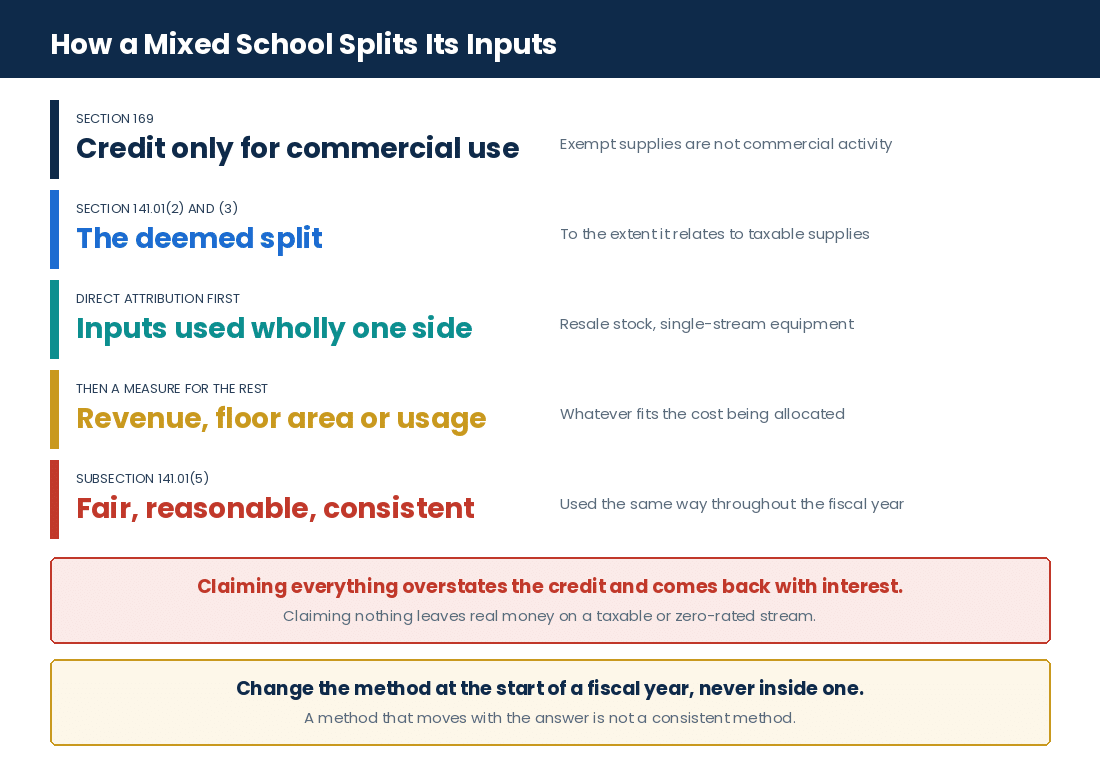
This is the section that decides what the exemption costs. A registrant recovers tax on inputs under section 169 to the extent the property or service was acquired for consumption, use or supply in the course of commercial activities. Making exempt supplies is not a commercial activity, so tax paid on inputs used to make exempt tuition is not recoverable. It is a cost of running the school, and it sits in rent, utilities, shop consumables, equipment, software, insurance and professional fees.
The Apportionment Rule
Almost no trade school is purely exempt. The moment there is a taxable stream — books sold separately, equipment rental, hobby courses, an elected programme, a zero-rated international contract — the school’s inputs have to be split. The provision is section 141.01, not section 169.
Subsections 141.01(2) and (3) deem property, a service, or the consumption or use of either, to be for use in the course of commercial activities only to the extent it relates to the making of taxable supplies for consideration, and otherwise to be for use outside commercial activity. Subsection 141.01(5) then sets the standard the school’s method has to meet: the methods used in a fiscal year to determine those extents must be fair and reasonable and used consistently by the person throughout the year.
There is no CRA menu of approved methods and nothing is approved in advance. What there is, is a test. Methods that commonly meet it:
| Approach | When It Fits | What Supports It |
|---|---|---|
| Direct attribution | An input used wholly on one side — a textbook bought for resale, a hoist used only in the elected programme | Purchase order or invoice tied to the stream |
| Revenue proportion | General overhead: head office rent, administration, software, accounting | Revenue by stream, taken from the general ledger, not estimated |
| Floor area | Premises costs where shops and classrooms serve different streams | A measured floor plan with the use of each space recorded |
| Time or usage | Shared equipment and shared instructors | Timetables, booking logs, machine hour records |
Because subsection 141.01(5) requires consistency throughout the fiscal year, the time to change a method is at the start of a year, not in the middle of one. A method that moves with the answer is not consistent, and a method chosen at year end to suit the result is the first thing a reviewer will unpick.
A hairstyling and aesthetics school in Hamilton ran exempt diploma programmes alongside a student salon open to the public and a retail product counter. It had been claiming 100 per cent of the tax on everything, including the building, on the view that the salon and retail made it a commercial business. Taxable supplies were $395,000 of $1.42 million in revenue. We rebuilt the claim: direct attribution for retail stock and salon-only consumables, a measured floor plan for the premises costs that put 31 per cent of the building to the taxable side, and the revenue proportion for administration and software. The claim fell from about $47,000 to $21,000 a year, which was an unwelcome conversation, but the $26,000 difference was never recoverable and would have come back with interest on review. The method has been used unchanged for three fiscal years since, which is what subsection 141.01(5) asks for. Figures changed for privacy.
The Public Service Bodies’ Rebate Does Not Apply
It is worth being blunt about this, because the suggestion that it “partly applies” to a private vocational school circulates widely and would lead a school to claim a rebate it has no entitlement to.
The public service bodies’ rebate is in section 259 of the Excise Tax Act. It is available to a person that, on the last day of a claim period, is a charity, a qualifying non-profit organization — a non-profit organization whose percentage of government funding for the year is at least 40 per cent — or a selected public service body. The selected public service bodies are hospital authorities, school authorities, universities, public colleges, municipalities, facility operators and external suppliers, and the school authority and public college in that list have to be established and operated otherwise than for profit.
A privately owned trade school run for profit is none of these. It is not a charity, it cannot be a qualifying non-profit organization because it is not a non-profit organization, and it is not a school authority or public college established otherwise than for profit. CRA’s own vocational school guidance says the same thing: a vocational school unable to claim input tax credits on exempt supplies may qualify for the rebate if it is also a charity or qualifying non-profit. For a for-profit school there is no rebate, which means the unrecovered tax on the exempt side has to be budgeted as a cost of delivery rather than treated as something to be reclaimed later.
Two errors run in opposite directions and both cost money. Claiming full input tax credits across a mixed school overstates the claim and brings it back with interest on review. Claiming none at all, on the view that “we are exempt”, leaves real money on the table where there is a taxable, elected or zero-rated stream. The school that has never written down an apportionment method is almost always making one of these two mistakes, and it cannot tell which without the revenue analysis.
Small Supplier Status and Registration
Under subsection 148(1) a person stops being a small supplier once taxable supplies — the person’s own and those of associates — exceed $30,000 over the four calendar quarters immediately preceding the quarter in question. Under subsection 148(2) the person ceases to be a small supplier immediately before the supply that takes a single calendar quarter over $30,000, for the remainder of that quarter. Subsection 240(1) then requires registration, unless the person is a small supplier.
For most trade schools the threshold is beside the point, and this is the part the common summary misses. Tuition exempted by section 8 is not a taxable supply at all, so it never counts toward $30,000. A school whose supplies are entirely exempt is not required to register however large its revenue, and a $3 million exempt school and a $300,000 exempt school are in the same position. What counts is the taxable side: the books sold separately, the kits, the upgrade courses that fail the pass/fail test, the equipment rentals, the hobby classes. Those can take a school over the threshold while tuition is doing nothing at all.
A small supplier is not required to register but may register voluntarily, and a school that has made the Form GST29 election is making taxable supplies and will usually want to. The general mechanics of registration, returns, collection and credits are set out in CRA guide RC4022, General Information for GST/HST Registrants, which is the right starting point for a school that has just registered.
Flight Training and Pilot Ratings
Flight Schools
Vocational School Taxes: How CRA Splits Flight Training
Flight training is the one trade school sector with its own detailed CRA position, and it turns on a single line: the minimum flight time set by federal legislation — the Aeronautics Act, the Canadian Aviation Regulations and their standards. CRA sets this out in GST/HST Memorandum 20-4, and a flight school that does not know where that line falls for each licence it teaches cannot invoice correctly.
Flight time divides into three. Dual time, flown with an instructor. Solo time, flown alone under the instructor’s direction. Both are treated as instruction under direct supervision. Build-up time is additional flight time beyond the dual and solo requirements, where the student is not under instruction or direct supervision.
What Is Exempt
- Ground school for the commercial pilot licence (aeroplane and helicopter), the integrated CPL(A) and CPL(A)/IR courses, the airline transport pilot licence (aeroplane and helicopter), the integrated ATP(A) course, the related ratings, and flight instructor ratings and classes.
- Dual and solo flight time up to and including the federal minimum for those same licences and ratings.
- Class and instrument ratings — sea plane, land plane, multi-engine class, multi-engine centre line thrust class, the VFR over-the-top rating and instrument ratings — for commercial and airline transport licence holders, again only up to the federal minimum flight time.
- Night training that meets the night requirements of a commercial or airline transport licence.
- Flight instructor ratings: dual and solo time up to the federal minimum, plus the related ground school.
What Is Not
- Additional dual or solo hours bought above the federal minimum. The exemption stops at the minimum, not at the student’s total.
- Build-up time, for any of those licences or ratings, including for flight instructor ratings — and some of the four classes of aeroplane and helicopter instructor rating require build-up time.
- Private pilot licence instruction and flight time. CRA treats these as personal interest rather than vocational, and they are not exempt. Night flight time for a private licence is not exempt either.
- Short health and safety courses on their own — first aid, WHMIS and the like — although these can qualify where they form part of a larger programme that does.
A flight school at a regional airport north of Toronto sold a commercial pilot package at $74,500 covering ground school, the dual and solo requirements, and 90 hours of optional build-up time. It treated the whole package as exempt. On CRA’s analysis that is two supplies: one exempt supply of the ground school, the dual and solo time and the aircraft used for that instruction, and a separate taxable supply of the build-up hours, in the nature of a lease of the aircraft. The build-up component priced out at $18,900 per student, which meant uncollected HST of about $2,460 a student across an intake of eleven. Against that, the school picked up input tax credits on the fuel, maintenance and insurance attributable to the build-up hours, roughly $6,800 in the year. It also had six private licence students it had been treating as exempt, which was the larger exposure. The enrolment contract now shows the two components separately, priced separately. Figures changed for privacy.
| Component | Treatment | Why |
|---|---|---|
| CPL / ATPL ground school | Exempt | Named in CRA’s exempt list for these licences |
| Dual and solo time, up to the federal minimum | Exempt | Instruction under direct supervision |
| Dual or solo hours above the minimum | Taxable | Beyond what the exemption reaches |
| Build-up time | Taxable | Not instruction; no direct supervision |
| Aircraft used for the exempt instruction | Part of the exempt supply | Supplied with the instruction, not separately |
| Aircraft for optional build-up hours | Taxable | Treated as a lease, not incidental to instruction |
| Private pilot licence instruction and flight time | Taxable | Personal interest, not vocational |
| Night time for a PPL | Taxable | Follows the private licence |
| Night time meeting CPL or ATPL requirements | Exempt | Part of the qualifying licence requirement |
| Flight instructor rating, dual and solo to the minimum | Exempt | Plus the related ground school |
A flight school cannot sell a single all-in package and get the tax right. The enrolment agreement has to show the exempt instruction component and the taxable component as separate priced items, because that is what CRA’s own treatment of a bundled fee produces. The school also needs, for every student, a record of the hours flown against the federal minimum for the licence being pursued — which is the same log the regulator requires, used for a second purpose. Where CRA’s guidance states no position, as it does on flight simulators and on standalone aircraft rental, that is a question to take to a ruling rather than a gap to fill with an assumption.
On the input side, the split runs straight into section 141.01. The fuel, maintenance, insurance and hangarage behind exempt instruction hours give no credit; the same costs behind build-up hours and private licence training do. Machine hours flown by purpose is the record that makes the apportionment defensible, and it is the obvious usage measure for a fleet. Capital cost allowance on the aircraft is a separate question answered in the Income Tax Act and is unaffected by the GST/HST characterisation.
Income Tax, Certificates, Records and Expenses
Income Tax
Trade School Accounting Canada: Filing, Paying and Classifying
Everything above is GST/HST. The income tax side is simpler but has its own traps, and the largest of them is a date most schools have never been told about.
The T2, and the Date the Money Is Due
A trade school corporation files its T2 Corporation Income Tax Return within six months after the end of the taxation year, under paragraph 150(1)(a). Both exempt tuition and taxable sales are income for this purpose; the exemption is a GST/HST concept and has no effect on what goes into the T2.
Filing and paying are different dates. Under paragraph 157(1)(b) the remainder of the tax is due on the corporation’s balance-due day, which is two months after the year end, or three months for a Canadian-controlled private corporation meeting the conditions — among them that it claimed the small business deduction for the year or the preceding year, that its taxable income and taxable capital are within the limits, and that its returns and remittances were on time through the preceding twelve months. A school that files inside six months and pays at the same time has been accruing interest for three or four months. Instalments are a separate obligation and a qualifying small CCPC may pay them quarterly rather than monthly.
| Obligation | Date | Provision |
|---|---|---|
| T2 return | Six months after the taxation year end | ITA 150(1)(a) |
| Balance of tax | Two months after year end | ITA 157(1)(b) |
| Balance of tax, eligible CCPC | Three months after year end | ITA 157(1)(b) and the balance-due day rules |
| T2202 information return | Last day of February after the calendar year | Income tax information return, filed electronically |
| Records, GST/HST | Six years after the end of the year they relate to | ETA 286(1) and 286(3) |
| Records, income tax | Six years after the end of the year they relate to | ITA 230(4) |
The Certificate Obligation, and What It Is Not
Nothing in the Excise Tax Act requires a return about tuition certificates. There is no GST/HST tuition certificate return, no 31 March deadline for one, and no monthly penalty attached to one. The certificate obligation that does exist is an income tax obligation.
A designated educational institution files the T2202, Tuition and Enrolment Certificate, and the matching summary, with CRA on or before the last day of February following the calendar year it covers. If that day falls on a weekend or a CRA-recognised holiday, the next business day applies. The return runs on the calendar year, not the school’s fiscal year. Filing is electronic, through Internet file transfer or Web Forms; paper and physical media are not accepted. CRA’s guide for the return is RC4654.
What goes on it is the eligible tuition fees paid in respect of the calendar year, together with the months of part-time and full-time enrolment — not every amount a student was billed, and not a notional programme-required figure. Fees that are not eligible tuition under the Income Tax Act are left off, which is why the certificate total and the school’s own revenue for the student rarely agree.
Not every trade school files one. The obligation attaches to a designated educational institution, and for a private trade school that route is certification by the Minister of Employment and Social Development as an institution providing courses, other than courses designed for university credit, that furnish a person with skills for an occupation or improve their skills in one. Students must be at least 16 by the end of the year. A school without that certification does not file T2202s at all, and telling students to expect one is a problem of its own.
The penalty is not monthly. It is $100 or, if greater, a per-certificate daily amount for up to 100 days, on CRA’s volume bands: $10 a day to a $1,000 maximum for 1 to 50 certificates, rising through the bands to $75 a day and $7,500 for 10,001 or more. Filing on paper where electronic filing is required carries a separate penalty, from $125 for 6 to 50 certificates up to $2,500 for 2,501 or more.
A private college in Etobicoke teaching medical office administration had been issuing what it called tuition certificates to students every spring, on its own letterhead, and had been told by a previous adviser that it needed to file a GST/HST return about them by 31 March. It had been filing nothing, worrying about it annually, and quoting the deadline to students. There was nothing to file: no such GST/HST return exists. What it did have was a real exposure in the other direction. It was ESDC-certified, which made it a designated educational institution, and it had never filed a single T2202 information return with CRA for 340 students a year across three years. We filed the outstanding returns electronically and sought relief on the penalties. The imagined obligation had displaced the real one for three years running. Figures changed for privacy.
Expense Classification and Capital Cost Allowance
Income from the business is the school’s profit for the year under subsection 9(1). Paragraph 18(1)(a) is the gate: an outlay is not deductible except to the extent it was made for the purpose of gaining or producing income from the business. Instructor salaries, shop consumables, the utilities on the shop and the rent on the premises all pass through that gate as current expenses. Paragraph 20(1)(a) is not the authority for any of them — it is capital cost allowance, the deduction for such part of the capital cost of property as is allowed by regulation.
Capital cost allowance is federal. The classes in Schedule II to the Income Tax Regulations apply the same way in every province, Ontario included.
| Asset | Class | Rate or Computation |
|---|---|---|
| Buildings | Class 1 | 4% |
| Shop equipment, tools of $500 or more, furniture, general machinery | Class 8 | 20%, the residual class for property not in another class |
| Leasehold improvements | Class 13 | No flat rate: the lesser of one fifth of the capital cost and the cost spread over the twelve-month periods to the end of the lease, to a maximum of forty |
| Computer hardware and systems software | Class 50 | 55% |
| Parking lot, yard, access road, storage area, runway | Class 17 | 8% |
Class 17 is worth stating plainly, because it is widely misdescribed. It is the 8 per cent class for a road, sidewalk, airplane runway, parking area, storage area or similar surface construction, together with certain telephone, telegraph and data communication switching equipment and certain electrical generating and water or steam distribution equipment. A trade school meets Class 17 in the parking lot and the yard, not in the shop. It is not the class for leasehold improvements, which go to Class 13, and it is not a class for specialised machinery, which goes to Class 8.
Shop equipment is capitalised into a class and written down; consumables are deducted as incurred. Where an asset is used wholly to make exempt supplies, the GST/HST on it is unrecoverable and forms part of its capital cost for income tax purposes, which is the one place the two taxes meet on the same number.
Instructors: Employee or Self-Employed
Whether an instructor is an employee or self-employed is decided on the common-law factors CRA sets out in guide RC4110, Employee or Self-employed? — control, ownership of tools, chance of profit and risk of loss, and integration. The Payroll Deductions Online Calculator computes the deductions once status is settled; it decides nothing about status.
If the instructor is an employee, the duty to withhold is in subsection 153(1) of the Income Tax Act, the remittance dates follow from the school’s remitter type under Part I of the Income Tax Regulations, and CPP contributions and EI premiums are determined under their own statutes. Instructor pay is a standing audit interest in this sector, partly because the pattern — a timetabled person, teaching the school’s curriculum, on the school’s premises, with the school’s equipment — looks like employment on most of the factors. Our payroll services work covers the withholding and the slips, and the mechanics are set out in our guide to running payroll in Canada.
A commercial truck driver training school in Vaughan treated all nine of its instructors as subcontractors on invoices, and had done for six years. They drove the school’s trucks, taught the school’s curriculum on the school’s timetable, held no other clients and carried no risk of loss. On review CRA reassessed for the employer’s CPP and EI on about $740,000 of payments over the open years, plus interest, which came to roughly $71,000 before penalty relief. The instructors themselves were unaffected. What made it worse was the GST/HST side: as exempt-supply makers the school had never been able to recover the tax those instructors had charged on their invoices either, so it had been paying 13 per cent on top of wages it was going to be assessed on anyway. Two of the nine were genuinely independent and stayed that way. The other seven went on payroll. Figures changed for privacy.
Records
Subsections 286(1) and 286(3) of the Excise Tax Act require the records necessary to determine the person’s liabilities to be kept and retained until six years after the end of the year to which they relate. Subsection 230(4) of the Income Tax Act does the same on the income tax side. For a trade school the list has a sector shape to it: course registers with the credential issued against each completion, the annual occupational-skills revenue ratio with its workings, the apportionment method and its calculation, Form GST29 if an election has been made, enrolment agreements showing how fees were allocated between instruction and separately sold items, flight or machine hour logs where the apportionment rests on usage, and the fixed asset register by class. Our bookkeeping services keep the streams separated from the first entry, and where a school is behind, catch-up bookkeeping rebuilds them before a return is filed on them.
Frequently Asked Questions
FAQs
The questions trade school owners actually ask us, answered against the provisions.
What is the GST/HST small supplier threshold for a trade school?+
The test is not an annual one. Under subsection 148(1) a person stops being a small supplier once taxable supplies, including those of associates, exceed $30,000 over the four calendar quarters immediately preceding the quarter in question, and under subsection 148(2) small supplier status ends immediately before the supply that takes a single calendar quarter over $30,000, for the rest of that quarter. Subsection 240(1) then requires registration. For most trade schools the threshold is beside the point, because tuition exempted by section 8 of Part III of Schedule V is not a taxable supply and never counts toward $30,000. A school with $3 million of exempt tuition and nothing else is not required to register. What counts is the taxable side: books sold separately, kits, equipment rental, hobby courses and upgrade courses that fail the pass/fail test.
What happens if I miss the T2202 filing deadline?+
The T2202 is due on or before the last day of February following the calendar year it covers, and it is filed electronically. The penalty is $100 or, if greater, a per-certificate daily amount for up to 100 days: $10 a day to a $1,000 maximum for 1 to 50 certificates, rising through the bands to $75 a day and $7,500 for 10,001 or more. Filing on paper where electronic filing is required carries its own penalty on a separate scale. There is no monthly penalty, and there is no GST/HST return about tuition certificates to be late with — nothing in the Excise Tax Act requires one.
Is there a tuition certificate return under the Excise Tax Act?+
No. Part IX of the Excise Tax Act contains no information return about tuition certificates, and CRA’s guidance on vocational schools — which covers the definition, the exemptions, zero-rating, input tax credits and the rebate — does not mention one. The certificate obligation is the T2202, an income tax information return filed by a designated educational institution by the last day of February. If you have been told you owe a GST/HST filing about certificates by 31 March, or by the last day of the second month after your fiscal year end, neither is a real deadline. The second of those is the return and payment date for an annual GST/HST filer, which is a different return entirely.
How long must a trade school keep its records?+
Six years after the end of the year to which they relate, on both sides. Subsection 286(1) of the Excise Tax Act requires the records necessary to determine the person’s liabilities to be kept, and subsection 286(3) sets the six-year retention period. Subsection 230(4) of the Income Tax Act does the same for income tax records. Where an election has been made on Form GST29, the form itself is kept for as long as the election is in effect and for six years after the end of the year to which it relates.
Which capital cost allowance class applies to shop equipment?+
Class 8 at 20 per cent, which is the residual class for tangible capital property not included in another class — shop machinery, tools costing $500 or more, furniture and general equipment. Class 17 does not apply to specialised machinery and does not apply to leasehold improvements, whatever you have read. Class 17 is the 8 per cent class for roads, sidewalks, airplane runways, parking areas, storage areas and similar surface construction, plus certain telephone, telegraph and switching equipment and certain electrical generating equipment. Leasehold improvements go to Class 13, buildings to Class 1 at 4 per cent, and computer hardware to Class 50 at 55 per cent.
Can I claim input tax credits if my tuition is exempt?+
Not on inputs used to make the exempt supplies. Section 169 gives the credit only to the extent property or a service was acquired for use in commercial activity, and making exempt supplies is not commercial activity. Where the school also has a taxable, elected or zero-rated stream, the inputs are apportioned under section 141.01, and subsection 141.01(5) requires the method to be fair and reasonable and used consistently throughout the fiscal year. The tax on the exempt share is a real cost of delivery. It is not recoverable later and, for a for-profit school, there is no rebate for it.
Does the public service bodies’ rebate apply to my school?+
Not if the school is run for profit. Section 259 gives the rebate to a charity, a qualifying non-profit organization — a non-profit whose government funding for the year is at least 40 per cent — or a selected public service body, and the school authority and public college on that list have to be established and operated otherwise than for profit. A privately owned trade school operating for profit is none of these. CRA’s vocational school guidance puts it the same way: the rebate is available to a vocational school that is also a charity or qualifying non-profit. There is no partial entitlement based on some activities looking like a public service.
When is the corporate tax return due, and when is the tax?+
They are different dates, and this is the commonest avoidable cost on a school’s file. The T2 is due within six months after the end of the taxation year under paragraph 150(1)(a). The balance of tax is due on the corporation’s balance-due day under paragraph 157(1)(b): two months after the year end, or three months for a Canadian-controlled private corporation that meets the conditions, which include having claimed the small business deduction and having filed and remitted on time through the preceding twelve months. File at six months and pay then and interest has been running for three or four months.
How do I elect to make my exempt courses taxable?+
On Form GST29, and you do not send it anywhere. The election sits in the exempting provision itself: section 8 of Part III of Schedule V exempts the supply “except where the supplier has made an election under this section in prescribed form containing prescribed information”, and section 6 carries its own election in the same words. Complete Form GST29, keep it in your books and records while the election is in effect and for six years afterwards, and charge tax from the effective date. If your courses fall under both sections 6 and 8 you have to elect under both. Revocation is on the same form.
Is flight training exempt?+
Partly, and the line is the minimum flight time set by federal legislation. Ground school for the commercial and airline transport licences, the integrated courses, the related ratings and flight instructor ratings is exempt, as is dual and solo flight time up to and including that federal minimum. Hours bought above the minimum are not exempt, and build-up time is not exempt for any of those licences or ratings. Private pilot licence instruction and flight time are treated as personal interest and are not exempt at all, and nor is night time for a private licence — though night training meeting the commercial or airline transport requirements is exempt. Where a school sells ground school, instruction and the aircraft for one fee, CRA treats that as one exempt supply plus a separate taxable supply of the optional build-up hours.
Essential Points for Trade Schools
Key Points
If a trade school file is going to be got right, these are the things that have to be right first.
- Status before anything else. The exemption needs the school to be a vocational school under section 1 of Part III of Schedule V — established and operated primarily to provide occupational-skills courses, which CRA reads as more than half of total annual revenues, tested every year on every revenue stream.
- The exemption is section 8, not 165 or 221. Sections 165 and 221 impose the tax and the duty to collect it. Subsection 123(1) is definitions. Nothing is exempted by any of them.
- Section 6 is the other half. Accreditation and designation courses recognised by a regulatory body are exempt under section 6, the exemption then covers every student in the course, and a school in both sections must elect under both.
- A course is exempt or it is not. There is no partially exempt course. A single fee can carry more than one supply, and then each is characterised on its own.
- Upgrade courses can be exempt. Where competence is assessed pass/fail on tests, graded material or projects and documentation attesting competence is issued, an upgrade course is exempt. Attendance-based courses are not, certificate or no certificate.
- Bundling decides the materials. Materials supplied with the instruction are exempt with it; materials sold separately are generally taxable. Administering examinations for a qualifying course is named in section 8 and is exempt.
- Zero-rating needs a non-resident organization. Section 18 of Part V of Schedule VI applies to a supply made to a non-resident person other than an individual that is not a registrant. A course sold directly to a non-resident student is not zero-rated by it.
- Exempt and zero-rated are not synonyms. A zero-rated supply is a taxable supply at nil, which preserves the input tax credits. That is why section 8 excludes zero-rated supplies from its own exemption.
- Apportionment is section 141.01. Subsection 141.01(5) requires the method used in a fiscal year to be fair and reasonable and used consistently throughout the year. Nothing is pre-approved, and a method chosen at year end to suit the answer is the first thing a reviewer unpicks.
- No rebate for a for-profit school. The public service bodies’ rebate under section 259 goes to charities, qualifying non-profits and not-for-profit public bodies. The unrecovered tax on the exempt side is a cost of delivery and belongs in the fee model.
- The election is kept, not filed. Form GST29 stays in the school’s own records while in effect and for six years afterwards. There is no filing, so there is no late filing.
- Flight training stops at the federal minimum. Dual and solo time to the minimum is exempt; above it, and build-up time, is not. Private pilot licence training is not exempt at all.
- Exempt tuition does not count toward $30,000. The small supplier test in section 148 measures taxable supplies. A wholly exempt school need not register at any size; its taxable side is what can cross the line.
- Two months, not six. The T2 is due six months after year end under paragraph 150(1)(a), but the tax is due on the balance-due day under paragraph 157(1)(b) — two months, three for an eligible CCPC.
- The certificate return is the T2202, in February. It is an income tax information return filed by a designated educational institution by the last day of February, on a calendar-year basis, electronically. There is no Excise Tax Act equivalent.
- Not every school files one. The T2202 obligation needs designated educational institution status, which for a private trade school means certification by the Minister of Employment and Social Development for occupational-skills courses.
- Class 17 is the parking lot. Roads, sidewalks, runways, parking and storage areas at 8 per cent. Leasehold improvements are Class 13 at the lesser of a fifth of cost and the lease-term spread. Shop equipment is Class 8 at 20 per cent.
- Paragraph 20(1)(a) is capital cost allowance. Salaries, consumables, utilities and rent are deducted as profit items under subsection 9(1) through the gate in paragraph 18(1)(a), not under 20(1)(a).
- Instructor status is decided on the facts. RC4110’s common-law factors settle it; the Payroll Deductions Online Calculator computes the deductions once it is settled. Withholding is subsection 153(1).
- Six years, from the end of the year they relate to. Subsections 286(1) and 286(3) of the Excise Tax Act and subsection 230(4) of the Income Tax Act.
One invoice for everything. Exempt tuition and taxable kits on a single undifferentiated line, which makes both the tax charged and the credits claimed indefensible — bill them separately from the first enrolment. No revenue ratio. A school relying on provincial registration for its vocational school status, having never computed the occupational-skills share of total revenue, which is the test that actually decides it. Full credits or no credits. A mixed school claiming everything, or claiming nothing, when section 141.01 requires a written method applied consistently through the year. Assets in the wrong class. Shop fit-out treated as Class 17, leasehold improvements given a flat rate, and consumables capitalised — each of which misstates the deduction in both directions across years.
Businesses We Serve & Industry Spotlights
Industry Expertise
Trade schools sit inside a wider group of education and training businesses, and the questions that decide one of these files — whether the supply is exempt, how the inputs are apportioned, and whether the organization meets the definition it is relying on — recur across every one of these situations.
| Who | The Education Angle |
|---|---|
| Trade schools | Vocational school status on the revenue ratio, shop assets by class |
| Career colleges | Prepaid tuition across year ends and refund obligations |
| Online education businesses | Place of supply across provinces and access periods |
| Educational consultants | Advisory fees taxable where instruction would be exempt |
| Corporate trainers | Seat blocks sold to registered employers in advance of delivery |
| E-learning platforms | Service against intangible personal property on each supply |
| Driving schools | Provincially required courses and the preparatory limb |
| Martial arts schools | Recreational instruction against graded certification streams |
| Dance schools | Examination syllabus work against open recreational classes |
| After-school programmes | Mixed childcare and instruction revenue in one entity |
| Summer camps | Seasonal revenue, staff on payroll, and taxable admissions |
Spotlights: trade schools · career colleges · online education businesses · educational consultants · corporate trainers · e-learning platforms · driving schools · martial arts schools · dance schools · after-school programmes · summer camps.
Beyond the sector pages, the firm’s work on educational institutions covers the same ground across the whole group, and the distinction this article turns on is set out on its own in our note on GST/HST exempt vs zero-rated.
Professional Guidance and Quick Reference
Guidance
Essential Tax Points for Canadian Trade Schools
Trade school files go wrong in a predictable set of ways: vocational school status assumed from a provincial registration rather than computed from the revenue figures; tuition and separately sold kits on one invoice line; input tax credits claimed in full or not at all, with no written apportionment method behind either; the public service bodies’ rebate claimed by a for-profit school that has no entitlement to it; an election believed to have been filed when nothing is ever filed; private pilot licence training treated as exempt; the shop fit-out in Class 17; and a corporate balance paid at six months when it was due at two. Gondaliya CPA prepares trade school returns on a fixed annual fee.
Quick Answers
At a Glance
- Vocational school definition: Schedule V, Part III, section 1
- Operated primarily: more than 50% of total annual revenues, tested annually
- Trade and vocation exemption: Schedule V, Part III, section 8
- Accreditation and designation exemption: Schedule V, Part III, section 6
- Second-language instruction: Schedule V, Part III, section 11
- Section 165: imposes the tax, not an exemption
- Section 221: duty to collect, not an exemption
- Subsection 123(1): definitions, including “exempt supply”
- Election to tax: in sections 6 and 8 themselves, on Form GST29
- Form GST29: kept in the school’s records, never filed with CRA
- Revocation: same form, effective from its own date
- Zero-rating to non-residents: Schedule VI, Part V, section 18
- Section 18 recipient: a non-resident person other than an individual, not a registrant
- Input tax credits: section 169, only to the extent of commercial activity
- Apportionment: section 141.01
- Method standard: fair and reasonable, consistent through the year, subsection 141.01(5)
- Public service bodies’ rebate: section 259, not available to a for-profit school
- Small supplier: $30,000 over four calendar quarters, subsection 148(1)
- Single-quarter rule: subsection 148(2)
- Registration: subsection 240(1), unless a small supplier
- Exempt tuition: not a taxable supply, so outside the threshold
- GST/HST records: six years, subsections 286(1) and 286(3)
- Income tax records: six years, subsection 230(4)
- T2 filing: six months after year end, paragraph 150(1)(a)
- Corporate balance: two months, three for an eligible CCPC, paragraph 157(1)(b)
- T2202 deadline: last day of February, on a calendar-year basis
- T2202 penalty: $100 or more, on CRA’s per-certificate daily scale
- Who files a T2202: a designated educational institution only
- Business income: profit for the year, subsection 9(1)
- Expense gate: paragraph 18(1)(a)
- Paragraph 20(1)(a): capital cost allowance only
- Buildings: Class 1 at 4%
- Shop equipment and tools: Class 8 at 20%
- Leasehold improvements: Class 13, lesser of a fifth of cost and the lease spread
- Computers: Class 50 at 55%
- Parking, yards, runways: Class 17 at 8%
- Flight training: exempt to the federal minimum flight time
- Build-up time: taxable
- Private pilot licence: taxable
- Instructor withholding: subsection 153(1)
- Employee or self-employed: CRA guide RC4110
- CRA guidance: GST/HST Memoranda 20-4 and 20-9
Who This Is For / Not For
Fit Check
- For: privately operated trade and vocational schools in Canada, incorporated or owner-operated, including welding, automotive, electrical, construction trades, truck driving, flight, hairstyling and aesthetics, and medical office and allied health training.
- For: schools running more than one revenue stream — exempt diploma programmes alongside retail, equipment rental, hobby classes, international contracts or employer-funded seats — where the input tax credit apportionment is the live question.
- For: schools weighing the Form GST29 election, particularly where students are sponsored by registered employers or where a capital fit-out is coming.
- Not for: provincial career-college regulation, programme licensing, approval or accreditation, student protection or tuition assurance funds, or the regulatory requirements of any particular trade credential — none of which is a tax question and none of which is covered here.
- Not for: a conclusion on whether your own school meets the vocational school definition. That turns on your governing documents and your actual revenue figures and is not something a web page can settle.
People Also Ask
Related Questions
How do I catch up if my books are behind?+
Start with the two things a trade school file cannot be rebuilt without: the enrolment records showing what each student was charged for and what credential they received, and the bank statements. From those, revenue is rebuilt by stream — exempt tuition, separately sold materials, rental, recreational classes — because the apportionment and the vocational school revenue ratio both depend on that split and neither can be reconstructed from a single revenue total. Then the input side against the method. Doing it the other way round, reconciling the bank first and allocating later, produces a figure nobody can support.
Can I handle trade school accounting in-house?+
The bookkeeping, often. The characterisation, rarely, because it is not an accounting question. Deciding whether an upgrade course is graded enough to be exempt, whether a seminar is a service or an admission, whether a non-resident contract is zero-rated, and how the inputs split under subsection 141.01(5) are all judgements against the Act and CRA’s published positions. What works in practice is in-house bookkeeping into a chart of accounts structured by supply type, set up once so the entries land in the right place as they are made, with the characterisation decisions documented separately and reviewed annually.
What do my financial statements have to show?+
Revenue separated by supply type, because that split drives the vocational school revenue ratio and the input tax credit apportionment, and it is the first thing anyone reviewing the file will ask for. Expenses need the exempt-side unrecovered tax visible rather than buried, because for a for-profit school it is a permanent cost and belongs in the fee model. Fixed assets need to tie to the capital cost allowance schedule by class. Gondaliya CPA prepares compiled financial statements under CSRS 4200, which provide no assurance and whose basis of accounting is described in the compilation engagement report; audit and review engagements are referred out.
What if registration or certificates were missed in past years?+
Deal with them separately, because they are different problems. Unfiled T2202 information returns are filed now, electronically, with relief sought on the penalties. Unregistered GST/HST where the school should have registered is the harder one, because the tax was never collected from students who have since left, and that is a voluntary disclosure conversation rather than a filing. The worst version of this is the school that has been worrying about an obligation that does not exist — a GST/HST return about tuition certificates — while a real one went unfiled. Establish which obligations actually apply before working out which were missed.
Should I elect to make my courses taxable?+
It depends almost entirely on who pays the fees. Where employers, dealerships, unions or government bodies pay and recover the tax themselves, charging it costs them nothing and buys the school its full input tax credit position, which is worth real money if there is a shop fit-out, a vehicle fleet or heavy consumable use behind the programme. Where students are individuals paying their own way, the tax is a straight price increase and the election usually makes the school less competitive for no gain. Run the arithmetic on the embedded tax in your inputs against the mix of who pays, and remember the election is kept on Form GST29 rather than filed, so it can be made from a decision rather than a deadline.
Glossary of Key Terms
Definitions
- Vocational school: an organization established and operated primarily to provide courses that develop or enhance occupational skills, defined in section 1 of Part III of Schedule V.
- Operated primarily: CRA’s revenue test for that definition, generally more than 50% of total annual revenues, reviewed each year.
- Exempt supply: a supply included in Schedule V, on which no tax is charged and for which no input tax credit is available.
- Zero-rated supply: a supply included in Schedule VI, taxable at 0%, which preserves input tax credits.
- Taxable supply: a supply made in the course of a commercial activity, on which tax is charged at the applicable rate.
- Certificate attesting competence: the documentation a qualifying course must issue on completion for section 8 to apply.
- Regulatory body: a body constituted or empowered by federal or provincial legislation to regulate a profession or trade by setting standards, relevant to section 6.
- Programme: courses that together form a pass/fail course of study, assessed on tests, graded material or projects.
- Upgrade course: a course improving existing skills outside a programme, exempt where graded and certified.
- Preparatory course: a course for a federal or provincial licence, exempt on one of CRA’s three limbs.
- Form GST29: the prescribed form on which the election to make educational supplies taxable is made and revoked, kept in the supplier’s own records.
- Input tax credit (ITC): recovery of GST/HST paid on inputs, available only to the extent of use in commercial activity under section 169.
- Apportionment: the split of a mixed-use input between commercial and non-commercial use, governed by section 141.01.
- Fair and reasonable: the standard subsection 141.01(5) sets for an apportionment method, together with consistency throughout the fiscal year.
- Public service bodies’ rebate: the section 259 rebate for charities, qualifying non-profits and not-for-profit public bodies, unavailable to a for-profit school.
- Small supplier: a person whose taxable supplies do not exceed $30,000 over four consecutive calendar quarters, under section 148.
- Designated educational institution: the status, in a private school’s case through ESDC certification, that brings the T2202 obligation.
- Build-up time: flight time beyond the dual and solo requirements, flown without instruction or direct supervision, and taxable.
- Balance-due day: the date a corporation’s remaining tax is payable, two months after year end or three for an eligible CCPC.
- Compilation engagement: the CSRS 4200 engagement producing compiled financial statements, which provide no assurance.
Want a checklist to work from? You can download our free trade school tax checklist before your consultation.
Four things decide a trade school’s file. Whether the school is a vocational school at all — section 1 of Part III of Schedule V needs it established and operated primarily to provide occupational-skills courses, and CRA reads that as more than half of total annual revenues, tested every year, which is a calculation rather than a status conferred by a provincial registration. Which supplies the exemption actually reaches — section 8 covers instruction and examinations for courses leading to credentials attesting competence, section 6 covers accreditation and designation courses, section 11 covers second-language instruction, and separately sold materials, equipment rental and recreational classes sit outside all three. How the inputs are split — because section 169 gives the credit only to the extent of commercial activity, section 141.01 does the apportionment, subsection 141.01(5) requires a fair and reasonable method used consistently through the year, and for a for-profit school there is no section 259 rebate to fall back on, so the unrecovered tax is a permanent cost that belongs in the fee. And whether the election is worth making — Form GST29, kept rather than filed, which turns the whole picture around where registered employers are paying the fees.
Three questions tell you where you stand, and the first one is a division you can do today. First, what share of your total revenue came from occupational-skills courses last year? If it is not comfortably above half, the exemption you have been relying on may not have applied, and that is a liability for tax never collected rather than a refund. Second, can you produce a written apportionment method? If the answer is that you claim everything, or that you claim nothing, section 141.01 has not been applied and one of those two answers is costing you money. Third, who actually pays your fees? If the answer is employers, dealerships, unions or government bodies, the Form GST29 election is probably worth the arithmetic, and the arithmetic is the embedded tax in your inputs against nothing at all, because registered payers recover what you charge them.
Trade School Taxes Canada: How Gondaliya CPA Can Help
Start with your revenue by stream and your enrolment agreements
Gondaliya CPA computes the occupational-skills revenue ratio that decides vocational school status and keeps it on file with its workings, characterises each programme against sections 6, 8 and 11 of Part III of Schedule V and documents the reasoning, separates exempt tuition from separately sold materials in the chart of accounts and on the enrolment agreement, builds and writes down an input tax credit apportionment method that meets subsection 141.01(5) and holds it steady through the fiscal year, tests whether the Form GST29 election is worth making and keeps the form where it belongs, applies section 18 of Part V of Schedule VI to international contracts so zero-rated work keeps its credits, splits flight training at the federal minimum, puts shop assets and leasehold work into the right classes, files the T2 and the T2202 information return, and sets the balance-due day against the filing date so the money goes in on time — on a fixed annual fee with no hourly billing, shown before tax with sales tax on its own line and agreed before any work begins. Please book a free consultation.
Next Steps
Please book a free consultation with Gondaliya CPA and bring five things: a complete list of your programmes with the credential each one issues, your revenue for the last year broken down by stream, your enrolment agreements showing how fees are allocated, your GST/HST returns and input tax credit claims for the year, and your fixed asset list. Those five settle the vocational school status question, the characterisation of each programme, the apportionment method and the capital cost allowance classes — which between them account for nearly every difficulty we see on a trade school file. If tax has gone uncollected on supplies that turn out not to have been exempt, say so at the outset; it is a common position, it is better addressed through a voluntary disclosure than after a letter arrives, and the arithmetic is almost never as bad as the owner has been imagining. We advise on Canadian federal income tax and GST/HST; provincial career-college regulation, programme approval and accreditation, student protection funds and the requirements of individual trade credentials are separate matters and are not something we advise on. You will get a fixed annual fee, shown before tax with sales tax on its own line, agreed before any work begins. We also prepare corporate tax return filing and GST/HST return filing, handle CRA audit support as your authorised representative, work through GST/HST registration where the election makes it necessary, and look at tax planning before the year closes rather than after. We serve Toronto, Mississauga, Brampton, Vaughan, Etobicoke, Scarborough, Hamilton, Ottawa and the rest of Ontario, and work with trade schools across Canada. If our content helps, please add gondaliyacpa.ca as a preferred source on Google.
Published: · Last updated:
Editorial policy: We research against CRA, Department of Finance, Parliament of Canada, CPA Canada and CPA Ontario sources, fact-check the figures, and Sharad Gondaliya, CPA, reviews the content, which we update as the rules change.
Disclaimer: This article is educational information only and is not tax, legal or financial advice. It covers Canadian federal GST/HST and income tax for privately operated trade schools and vocational training businesses, including the vocational school definition and the exemptions in Part III of Schedule V to the Excise Tax Act, the Form GST29 election, zero-rating under Part V of Schedule VI, course materials, seminars and admissions, online delivery, flight training, input tax credit apportionment under section 141.01, the public service bodies’ rebate, small supplier status and registration, T2 filing and payment dates, the T2202 information return, capital cost allowance classes, instructor classification and record retention. It does not cover provincial career-college regulation, programme licensing, approval or accreditation, student protection or tuition assurance funds, or the regulatory requirements for any particular trade credential, none of which is a tax matter. Whether a particular organization meets the definition of a vocational school, and whether a particular course falls within an exemption, both turn on the full facts and cannot be settled by general guidance. Rates, thresholds, filing deadlines and statutory references change; every reference should be confirmed against current CRA guidance before a return is filed. Gondaliya CPA performs compilation engagements under CSRS 4200, which provide no assurance and whose basis of accounting is described in the compilation engagement report; audit and review engagements are referred out. Please consult a licensed CPA before acting.

Sharad Gondaliya is a CPA Canada & CPA USA with 15 Years+ experience of Accounting, Tax, Payroll of Corporate Small Businesses as Tax Accountant. He is a CPA Ontario member (61040184) and holds US CPA licences in Washington and Montana and is well known among corporate small businesses for tax planning, efficient tax solutions, and affordable CPA services. Sharad is the Principal (Director) of Gondaliya CPA – Affordable CPA Firm in Canada. Licenses: CPA Ontario: 61040184 | CPA USA (MT): PAC-CPAP-LIC-033176 | CPA USA (WA): 57629 | CPA Firm License: 61330051 View Full Author Bio