



How Auto Repair Shops in Canada Can Reduce Taxes and Improve Cash Flow With Strategic Tax Planning
Auto Repair Shop Tax Planning Canada: Effective Auto Repair Business Tax Strategies with Gondaliya CPA
Auto repair shop tax planning Canada is key for managing your business finances smartly, and Gondaliya CPA offers expert auto repair business tax strategies to help maximize your savings. Their knowledge in automotive tax planning Canada and understanding as an auto repair tax accountant ensure your shop stays compliant while optimizing deductions.
Quick Summary
Tax planning matters a lot for automotive businesses in Canada, especially for auto repair shops. Smart auto repair shop tax planning helps lower taxable income and improve cash flow. Knowing the ins and outs of automotive tax planning lets business owners claim deductions and credits well.
Reading time: 49 minutes.
Table of Contents
- Industry Overview and Key Considerations
- Vehicle CCA, HST and Shop Deductions
- Eight Key Tax Strategies
- Year-Round Tax Planning Checklist
- Gondaliya CPA’s Integrated Services
- Clarifications on Classes, HST and Structure
- Frequently Asked Questions
- Essential Tax Planning Points
- Shop Types We Serve
- Professional Guidance and Quick Reference
The Numbers That Matter
This article covers Canada, with Ontario and Toronto context, and reflects rules current to 2026. It assumes an incorporated auto repair shop, collision centre, quick lube or automotive service business with equipment, parts inventory and shop vehicles. Figures marked illustrative are examples, not quotes, and any masked engagement notes end with “Figures changed for privacy.” This is educational information only and not tax or legal advice. Vehicle cost limits, expensing measures and incentive programs change, so please confirm current figures before acting.
Tax Planning for Automotive Businesses in Canada: Industry Overview
Industry Overview and Key Considerations
The Basics
Here are some key points:
- Know your deductions: Auto repair shops can write off things like tools, vehicles, and employee pay.
- Use tax credits: Credits such as the apprenticeship job creation credit add more savings.
- Follow CRA rules: Keeping up with Canadian tax laws avoids penalties and missed chances.
By focusing on these steps, automotive businesses can put smart tax plans in place that fit their money goals.
Automotive Business Types and Their Tax Complexity
Different kinds of automotive businesses have different tax challenges. For example:
- General Repair & Maintenance Shops: These usually claim expenses easily but might miss capital cost allowances on tools.
- Collision & Body Shops: They fix costly parts, so tracking inventory carefully is key for correct taxes.
- Quick Lube Services: These handle many customers fast but need to manage payroll taxes well because of staff changes.
Each type needs specific plans under auto repair shop tax planning to handle taxes right and follow Canadian rules.
The Role of an Auto Repair Tax Accountant
A good auto repair tax accountant helps shops keep more money by offering special knowledge on taxes. They do things like:
- Checking which industry-specific deductions you qualify for.
- Advising whether it’s better to pay yourself salary or dividends to save tax.
- Making sure tax returns are filed on time and meet CRA guidelines, cutting audit chances.
Hiring an expert simplifies your finances. It also gives you ideas on auto repair business tax strategies to stay ahead in the market.
Why Integrated Tax and Financial Planning Benefits Shops
Mixing tax planning with overall financial management gives real benefits:
- Big picture thinking: You see how day-to-day choices affect your taxes and money together.
- Manage cash flow: Timing purchases or handling customer payments right keeps cash flowing without extra tax.
- Plan for growth: You spot chances to reinvest or expand based on real financial facts.
This combined view supports steady growth while following automotive tax planning Canada rules closely.
Accounting for Auto Enterprises in Rural Canada
Rural auto businesses face special issues with taxes. They might not know about all local deductions or credits available where they operate, and higher transport costs from being far away affect profits and therefore their taxes too.
To tackle these problems, rural owners should work with advisors who know regional rules well. This helps them apply federal rules properly, a key part of good automotive tax planning.
The most common miss is not a clever deduction. It is a hoist or an alignment rack sitting in the expense account instead of a capital class, or the other way round. Figures changed for privacy.
Risk Warning: Auto repair is a cash-handling industry, which draws CRA attention. Please make sure every work order ties to an invoice and every deposit reconciles.
Vehicle CCA, HST and Shop Deductions
Vehicle CCA, HST and Shop Deductions
The Mechanics
Vehicle Capital Cost Allowance Strategies
Vehicle capital cost allowance (CCA) helps auto repair shops in Canada lower their taxes. Claiming the right vehicle assets at the right time cuts taxable income and saves cash.
Auto repair businesses often buy vehicles like service trucks, loaner cars, or tow trucks. These fall under CCA classes like Class 10 or 10.1. Each has different depreciation rates and cost limits set by regulation. Passenger vehicles above the prescribed cost limit fall into Class 10.1, where the deduction is capped, and that limit is revised periodically.
The half-year rule means you can generally claim only half the usual CCA in the first year an asset becomes available for use. This affects when you get deductions. Buying just before year-end can still be worthwhile, but the asset must be ready to use before the claim starts.
Here are some strategies to consider:
- Decide whether leasing or buying works better for your shop’s tax and cash flow.
- Track how much vehicles are used for business versus personal trips to avoid problems.
- Keep detailed mileage logs to back up your expense claims.
Keeping good records is key. Save invoices with purchase dates and proof the vehicle was ready for use. Wrong classification risks a review that can undo your tax savings.
A collision centre in Toronto bought two vans in late December. The half-year rule cut their first-year CCA claim, and because one van was not yet plated and in service, the available-for-use rule pushed part of the claim into the following year. Figures changed for privacy.
HST on Vehicle Sales, Parts and Services
HST rules affect how auto repair shops charge and claim tax on sales, parts, and services.
If your business is registered for GST/HST, you must charge tax on most sales including labour and parts. You can claim input tax credits on expenses such as buying vehicles used in the business.
Keep these points in mind:
- Vehicle sales by dealerships or service centres usually include HST unless a specific exemption applies.
- Parts bought with HST allow input tax credit claims if they relate to your taxable supplies.
- Environmental fees included in part prices may need special handling depending on your province, so please check local rules.
How often you file affects cash flow. Monthly filers get credits back quicker but must submit more often, so good bookkeeping helps.
Watch out: penalties under section 285.01 of the Excise Tax Act apply where sales data is electronically suppressed, a real risk given how many transactions happen by cash or card.
Keep clear invoices from work orders through final billing to prove what you charged.
Labour, Parts, Equipment and Environmental Costs
Deductions cut taxable income. Auto repair shops should know what they can claim safely under Canadian rules.
Labour costs take up a big part of expenses. Pay technicians with proper payroll deductions including CPP. Owner-manager salaries count as expenses if reported properly with T4 slips each year.
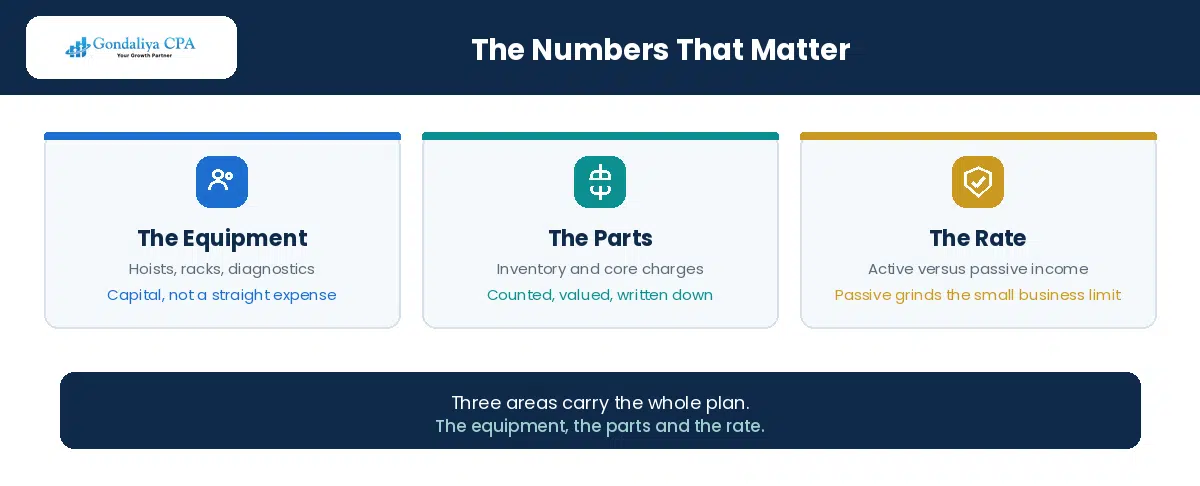
Parts used in repairs count too. Claim them at cost less any core refunds when parts are returned. Write-downs for obsolete stock need evidence following CRA expectations.
Equipment such as hoists or diagnostic tools usually enters a capital cost pool rather than an immediate expense line, unless a specific expensing measure applies to the property and period.
Environmental costs like waste disposal fees or recycling charges should be tracked separately. Make sure you comply without mixing in non-deductible amounts.
Avoid mixing personal expenses here, since that can trigger shareholder benefit treatment that adds tax.
Fleet and Commercial Vehicle Planning
Running a fleet means knowing which rules reduce cost while avoiding extra taxable benefits.
Commercial vehicles fall into classes based on type and weight as defined in the regulations. Heavier trucks are not subject to the passenger vehicle cost ceiling that applies to cars.
Smart fleet tax planning includes:
- Choosing lease or ownership based on which gives better deductible interest or lease payments.
- Watching standby charges if employees use company loaner cars privately, since logbooks help avoid surprises.
- Structuring apprentice employment to access the apprenticeship job creation credit when eligible.
Fuel and surcharge costs must be recorded correctly so input tax credits match real business use.
Dealerships and Service Centres
Dealerships that also run service centres face mixed issues because they handle retail sales plus repairs.
Dealerships must collect GST/HST on vehicle sales unless an exemption applies. How they value inventory affects profits and eligibility for the small business deduction, especially where multiple locations share control.
Service centres often share overhead with dealerships. Clear intercompany rent agreements matter to avoid problems affecting the small business limit.
Owners should balance salary and dividends carefully to manage payroll cost while keeping retirement savings room intact.
Incorporation and Corporate Structure
Incorporating shields owners from personal liability and offers corporate tax advantages. That is why advice from a good auto repair tax accountant matters for Canadian shops.
Choosing the right structure depends on factors like how many bays you have, whether you own real estate, who works there, funding needs, equipment plans, and exit strategy goals.
| Structure Type | Description | Key Benefit |
|---|---|---|
| Single Corporation | One company runs all operations | Simple filing and management |
| Holding Company Model | Separate holdco owns property leased back | Protects assets and splits income |
| Multiple Corporations | Each location incorporated separately | Requires care with associated corporation rules |
Make sure rent between related companies is at fair market value. Note that incorporating each location separately does not multiply the small business limit where the corporations are associated.
Working with CPAs experienced in automotive businesses helps keep everything sound as rules change.
Loaner cars are where standby charge surprises come from. A vehicle available for personal use creates a benefit whether or not it was actually driven that way. Figures changed for privacy.
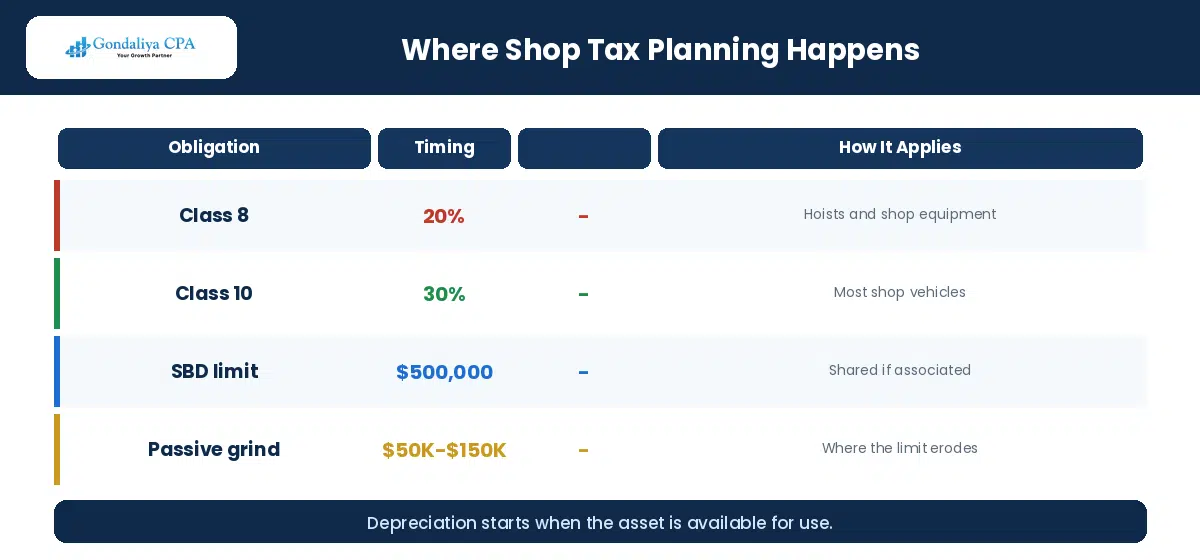
Key Stat: Depreciation starts when the asset is available for use, not when it is paid for. Please confirm the in-service date before claiming.
Eight Key Tax Strategies for Canadian Automotive Businesses
Eight Key Tax Strategies
The Strategies
Canadian auto repair shops can cut their taxes and boost cash flow by using smart automotive tax planning Canada tactics. These strategies include taking advantage of expensing measures where available, income splitting, dividend planning, managing floor plan financing interest, getting input tax credits, and preparing for zero-emission vehicle incentives. Each step needs you to balance timing, paperwork, and how it affects your cash flow.
Expensing Options for Shop Equipment
Where an expensing measure applies, businesses can deduct more of the cost of eligible equipment in the year they buy it. For Canadian auto repair shops, this means gear like hoists, alignment racks, diagnostic tools, and shop machinery. Availability depends on the property type and the period, so please confirm before timing a purchase around it.
- Buy qualifying equipment and have it available for use before year end to claim in that year.
- You get lower taxable income now but fewer deductions later.
- This helps your cash flow by deferring tax.
- Keep invoices and proof that the asset was ready to use within the fiscal year.
Income Splitting and Dividend Planning
Deciding between paying yourself a salary or dividends matters. Salary reduces corporate tax but costs more because of payroll contributions like CPP. Dividends do not reduce corporate tax but can work out better personally through the gross-up and credit mechanism.
You can split income with family if they do real work paid at a reasonable amount. The CRA applies the reasonableness test in section 67 and the tax on split income rules.
- Weigh salary against dividends based on RRSP room, CPP cost, and personal rates.
- Salary raises payroll cost; relying only on dividends builds no RRSP room.
- The right mix improves net income without unnecessary payroll cost.
- Keep contracts, T4 slips, and dividend resolutions.
Zero-Emission Vehicle Transition
Auto businesses moving toward zero-emission vehicles may access federal incentives that lower purchase cost or support charging infrastructure. Some purchases qualify for accelerated capital cost allowance classes designed to encourage cleaner fleets.
Plan carefully to match fleet changes with federal and provincial programs, which change from time to time.
- Time investment to match programme deadlines.
- Initial costs are higher but fuel and maintenance drop.
- Grants help offset upfront spending.
- Keep purchase invoices, grant approvals, and usage logs.
Floor Plan Financing Interest and Inventory
Floor plan interest is generally deductible where it relates to inventory held for sale. Keeping good records helps support the deduction and the year-end inventory value.
Interest must be reasonable relative to your business activity. Borrowing not connected to inventory risks denial. Keep personal loans separate from floor plan facilities.
- Track loans related only to inventory purchases.
- Match statements monthly against your books.
- Avoid capitalizing interest longer than the rules allow.
This careful approach protects your deductions while supporting solid automotive tax planning Canada.
Inventory Accounting and Tax Compliance
Inventory rules require a consistent method such as first in first out or weighted average, applied year over year. Parts with core charges need care since deposits affect the calculation.
Key steps:
- Count stock regularly and compare with records.
- Write down obsolete items with evidence such as slow-moving reports.
- Track core returns properly within the right period.
Good records help calculate cost of goods sold correctly when filing.
Family Member Employment
Paying a spouse or adult children is fine when they do real work at a rate matching the job. Common roles are bookkeeping, service writing or customer service where the duties justify the pay.
Keep timesheets, job descriptions, and written arrangements to meet the reasonableness test.
Owner-Manager Remuneration
Choosing salary versus dividends affects short-term cash flow plus retirement savings, since RRSP room is created only by earned income.
| Method | Corporate Deduction | Personal Tax Impact | RRSP Room Effect | Payroll Costs |
|---|---|---|---|---|
| Salary | Deductible expense | Taxable income | Creates room | CPP and EI where applicable |
| Dividend | Not deductible | Gross-up and credit | No effect | None |
A blend tailored yearly maximizes after-tax money while keeping records solid for CRA review.
Input Tax Credits and HST Recovery
Input tax credits let you recover GST/HST paid on parts, equipment and overhead, as long as you are registered and the costs relate to taxable supplies.
Reporting all revenue fully is key. Match receipts exactly with vendor invoices so reviews go smoothly.
Choosing quarterly over monthly filing can help keep working capital without changing what you owe. Timing supplier payments relative to remittances also helps liquidity. This takes balancing administrative effort against modest financial gains.
Demonstrator, Loaner and Commercial Vehicles
Vehicles used by shops fall into capital cost allowance classes that affect yearly depreciation claims, and passenger vehicle limits cap the deduction.
Loaner cars often cause standby charges unless logs prove minimal personal use. Keep daily mileage logs showing business versus private trips to avoid surprise taxable benefits.
Every deduction needs a paper trail: leases, purchase agreements, mileage logs, insurance papers and maintenance schedules, retained for six years.
Core charges are the inventory item shops most often get wrong. The deposit is not revenue and the refund is not a discount, and treating them as either distorts cost of goods sold. Figures changed for privacy.
Risk Warning: Paying a family member more than the work is worth invites reassessment. Please keep timesheets and a job description on file from the start.
Year-Round Tax Planning Checklist for Automotive Businesses
Year-Round Tax Planning Checklist
The Calendar
Running an auto repair shop means tax planning can’t wait until year-end. You need to keep at it all year long. This helps you manage cash flow and cut corporate taxes where possible.
Here’s a simple checklist to follow:
- Review your bookkeeping every month. Make sure every sale, whether parts or labour, has proper invoices.
- Check payroll quarterly. Confirm wages, bonuses, and benefits match what you report on T4 slips.
- Count your inventory often. Spot slow-moving or outdated parts that can be written down under the inventory valuation rules.
- Track your capital assets carefully. Know which equipment fits in which CCA class to claim the right depreciation.
- Keep your GST/HST records tidy. This helps with input tax credits and matches the filing frequency rules.
- Update how you pay yourself quarterly. Find the best mix between salary and dividends to save personal tax and keep RRSP room.
- At year-end, review accruals. Bonuses paid within the statutory window let you deduct them in the right fiscal year.
Stick to this plan to keep your books clean and your tax moves smart in automotive tax planning Canada.
Quarterly and Monthly Compliance Activities
Auto repair shops in Canada have firm deadlines for filings and payments. Missing these costs money in interest and penalties.
Corporate income tax. Your corporation files a T2 once a year, six months after year end, and pays instalments during the year based on prior-year or estimated current-year tax. Instalment due dates run against your fiscal year rather than fixed calendar months, so please confirm your own schedule.
GST/HST filing frequency. How often you file depends on your annual taxable supplies:
| Annual Revenue Threshold | Filing Frequency |
|---|---|
| Under $1.5 million | Annually, with the option to file more often |
| $1.5 million to $6 million | Quarterly, with the option to file monthly |
| Over $6 million | Monthly |
If you cross these thresholds, the CRA expects more frequent filing.
Electronic sales suppression. Watch out for electronic sales suppression, meaning software that hides or alters sales records. This is a particular risk in cash-heavy businesses like auto shops, and the penalties under the Excise Tax Act are severe.
Stay on top of deadlines with clear books. That lowers audit risk and keeps cash flowing by paying instalments when needed.
Timing Purchases and Capital Asset Management
When you buy new equipment matters a lot for claiming CCA deductions.
Equipment like hoists usually falls under Class 8 with a 20% rate. Shop vehicles go in Class 10 or 10.1 depending on cost relative to the prescribed limit.
Remember the half-year rule: in the year the asset becomes available for use, you can generally claim only half the normal CCA unless a specific expensing measure applies.
| Factor | Buy | Lease | Finance |
|---|---|---|---|
| Ownership | Yes | No | Conditional |
| Deduction | CCA, subject to half-year rule | Lease payments deductible | CCA plus deductible interest |
| Cash Flow Impact | Higher upfront | Lower ongoing payments | Moderate |
| Record Keeping | Keep asset register | Keep lease agreements | Keep loan papers |
Buying works if you want full ownership over time. Leasing helps when cash is tight short-term. Financing balances both. Buy before year-end so assets count as available for use, letting you claim CCA that year.
Monitoring Passive Income and Small Business Status
Keeping your small business deduction is key for incorporated auto shops in Canada.
The small business limit is $500,000 of active business income. Where passive investment income passes $50,000, that limit begins to shrink and is eliminated once passive income reaches $150,000.
If you own multiple locations or related companies, their incomes combine for this test.
- Keep active profits within the limit
- Manage passive investments closely
- Consider restructuring if passive income climbs
Doing this keeps the lower corporate rate available, which is essential in auto repair shop tax planning Canada.
Documentation Best Practices
Good records lower audit chances and keep the CRA satisfied. The CRA looks closely at cash-handling industries, so auto shops need clean documentation.
To stay safe:
- Keep work orders sequentially linked to invoices
- Hold detailed payroll showing hours worked versus pay
- Track vehicle mileage carefully where vehicles are also used personally
- Document shareholder loans properly within the repayment rules
- Do regular physical counts of inventory supporting adjustments
These steps build strong proof for audits while keeping things sound in automotive tax planning Canada.
For personalized advice on making these plans fit your auto repair business, email info@gondaliyacpa.ca or call 647-212-9559 for a free chat.
Passive income creeps up quietly. A shop that parks surplus cash in investments can lose part of its small business rate the following year without anyone noticing until the return. Figures changed for privacy.
Key Stat: Passive investment income above $50,000 starts grinding the small business limit, and it is fully eliminated at $150,000. Please monitor this during the year, not after.
Gondaliya CPA’s Integrated Accounting and Advisory Services
Gondaliya CPA’s Integrated Services
The Service
Gondaliya CPA combines accounting expertise with advice that fits your auto repair shop tax planning Canada needs. We help you follow tax rules and find ways to save money. Our approach looks at your whole business, aiming to improve cash flow and lower corporate taxes.
Tax Strategy, Compliance and Business Advisory
Good auto repair shop tax planning Canada mixes smart thinking with strict CRA rules. We create custom auto repair business tax strategies for incorporated shops in Ontario and Canada. This means:
- Choosing the right pay mix of salary and dividends
- Claiming capital cost allowance on equipment like hoists or diagnostic tools
- Handling inventory valuation under the inventory rules
- Using apprenticeship job creation credits if eligible
We don’t just help at filing time. We check payroll deductions, optimize GST/HST credits on parts, and manage year-end accruals. We keep records like work orders linked to invoices or lease agreements for bay build-outs so you are ready if reviewed.
Coordinated Year-Round Support
Automotive tax planning Canada changes often. Gondaliya CPA offers support all year long. We review bookkeeping and calculate instalments based on expected income shifts seen in seasonal tire shops or quick-lube places.
This ongoing help lets us adjust things like GST/HST filing frequency when needed. We prepare you before key dates, such as bonus payment deadlines for technician payroll. Our calendar helps balance cash flow and legal duties, lowering penalty risk.
Services for Rural Garages and Ontario Businesses
Auto repair shop tax planning Canada needs to fit rural garages’ unique conditions, which differ from big cities like Toronto. Gondaliya CPA handles these cases with planning that suits local challenges.
Rural automotive businesses face different problems. They might lack local advisors who know the market or provincial rules outside cities. We fill this gap by helping with:
- Apprenticeship job creation credit eligibility
- Navigating provincial environmental fees
- Structuring multi-location operations with the associated corporation rules in mind
We also advise on capital cost allowance classes for service equipment, since rural shops replace assets less often than city collision centres.
We run outreach through virtual sessions about auto repair business tax strategies like:
- Handling deferred revenue from prepaid service packages
- Keeping proper documentation to avoid shareholder loan issues
- Timing payroll remittances
These sessions give rural owners practical tips within CRA rules, helping them stay financially steady during quiet periods common in small towns.
Tools and Resources for Ongoing Planning
Success in automotive businesses relies on easy-to-use tools that track expenses, revenues, payroll, and equipment purchases. These tools support effective auto repair shop tax planning Canada.
We provide calculators made for Canadian-controlled private corporations. They estimate small business deduction phase-outs caused by passive income above the threshold, and they fit different shop types from fleet operations to performance restoration shops focused on labour margin more than parts.
Our checklists cover important year-end tasks like:
- Confirming asset availability for use before claiming
- Verifying whether technicians are correctly classified as employees or contractors
Clients get guides summarising rule changes affecting corporate taxes, covering topics such as half-year rule effects on equipment purchases, passenger vehicle cost limits impacting loaner fleets, and changes to apprenticeship credit rules. Regular updates prevent surprises while making full use of legal benefits.
Working With an Auto Repair Tax Accountant
Working with an auto repair tax accountant helps simplify complex decisions tied to incorporated automotive businesses across provinces including Ontario’s payroll specifics.
Our first conversations focus on understanding your business details, including the number of bays, yearly labour hours billed, parts margin rates, and pay structures balancing salary against dividends with CPP in mind. From there we build plans covering:
- Best times for major equipment purchases using expensing options where available
- Paying family members reasonably to stay clear of the split-income rules
- Forecasting cash flow integrating GST/HST schedules to reduce instalment interest
All advice follows the rules with clear record keeping supported by digital tools for audit readiness.
Once you engage us, we start with intake forms collecting past corporate filings plus personal return information needed to analyse the dividend and salary balance against RRSP room. We link bookkeeping accounts too, giving real-time access to transactions sorted by a chart of accounts tailored for automotive expenses.
Addressing Common Pain Points
Knowing typical challenges helps us focus solutions that improve compliance and cash management for collision centres and quick lube outlets across Ontario and Toronto where we serve most clients.
Cash flow. Keeping enough working capital is key during demand swings like tire changeover season. Careful stock control avoids tying up money unnecessarily, which raises financing costs and hurts free cash flow after tax.
Options include negotiating longer supplier terms balanced against early payment discounts. We model leasing versus buying diagnostic equipment, since depreciation affects taxable income timing differently, which improves after-tax profit steadily rather than relying on write-offs alone.
Compliance changes. Rules change, and missed steps can cause costly reassessments discovered only during an audit. Staying current on filing obligations, expensing measures and payroll requirements is far cheaper than correcting afterwards, which is why we review the position with clients each year rather than only at filing time.
Tire changeover season is the cash flow test every shop faces. Stock builds in September and the money comes back in November, with the instalment falling somewhere in between. Figures changed for privacy.
Pro Tip: Please forecast the instalment against your seasonal peak, not your average month. Shops run short in the quarter they stock up, not the quarter they sell.
Clarifications on Classes, HST, Expenses and Structure
Clarifications on Classes, HST and Structure
The Detail
Vehicle CCA Classes and Limits
Vehicle capital cost allowance classes play a big role in tax deductions for auto repair shops in Canada. Understanding these classes helps with automotive tax planning Canada and gets you the most from depreciation claims.
Passenger vehicles fall into Class 10 or Class 10.1 depending on whether the cost exceeds the prescribed limit before tax. Vehicles above that limit move to Class 10.1, where the deductible cost is capped. The limit is revised periodically, so please confirm the current figure. Heavy trucks and special service vehicles may qualify for different classes.
The half-year rule means you can generally claim only half the usual CCA rate in the year the asset becomes available for use, unless a specific expensing measure applies. The asset must be ready to use before you claim.
To optimize deductions, split costs correctly between business and personal use. Keep detailed mileage logs to back up this division. If leasing, track lease terms carefully.
Correctly classifying vehicles in their proper categories helps you maximize deductions without raising questions.
HST on New and Used Vehicle Sales
HST treatment differs depending on whether a shop sells new or used vehicles. Knowing this is part of good auto repair business tax strategies and of handling GST/HST filing frequency correctly.
New vehicle sales include HST at the time of sale. You can claim input tax credits for HST paid on purchases tied to taxable sales. Used vehicles work differently. If sold as inventory, charge HST. If sold as a capital asset, the treatment depends on how the asset was used, and the proceeds must still be reported correctly.
Auto repair shops registered for GST/HST must watch their taxable revenue against the filing frequency thresholds, since this affects whether you file annually, quarterly, or monthly, and your choice affects cash flow timing.
Planning involves picking a filing frequency that fits your revenue pattern and managing fees like environmental levies where these apply. Always report all taxable supplies as required.
Eligible Shop Expenses and Deductible Costs
Knowing what counts as deductible lowers your taxable income under Canadian rules for auto repair shop tax planning Canada.
Labour costs include wages paid to technicians plus bonuses where backed by records. Other deductible costs cover:
- Parts used in repairs
- Utilities prorated for workspaces
- Insurance tied directly to operations
- Lease payments for premises or rented equipment
Equipment depreciation follows the rate for its asset class. Hoists often fall under Class 8 with a 20% declining balance rate, and diagnostic tools commonly sit in the same class.
Meal expenses linked to client meetings are only half deductible; personal meals never qualify. Separate personal expenses from business ones to avoid problems, and apply the reasonableness test in section 67 of the Income Tax Act.
Incorporation and Holding Companies
When an auto repair shop incorporates, it affects eligibility for the small business deduction. This matters because associated corporations sharing control combine their income against the limit.
Holding companies owning shop buildings separately protect assets but complicate rent charged between entities. Rent must reflect fair market value. Combined active business income across associated companies shares the $500,000 federal limit, and that limit is reduced where passive investment income exceeds $50,000.
A knowledgeable auto repair tax accountant can help balance the benefits against extra paperwork like bookkeeping consolidation and intercompany agreements needed during audits.
Using holding companies works best for larger shops wanting creditor protection but needs strict records and fair rent practices.
Avoiding Audit Triggers and Handling CRA Inquiries
Reporting all revenue fully is the foundation under Canadian law, even though many automotive businesses handle cash transactions.
Electronic sales suppression penalties apply where software alters sales data, under section 285.01 of the Excise Tax Act.
Common audit triggers include unreported cash jobs and off-the-books labour payments. Keep complete work orders tied to invoices and reconcile deposits carefully.
The CRA also focuses on shareholder loan mishandling causing inclusions under section 15(2), family member pay that fails the reasonableness test, and worker classification errors affecting payroll.
Contact a CPA firm experienced with automotive audits early when CRA inquiries come up, since that reduces penalty risk.
How Integrated Planning Improves Margins and Cash Flow
Combining instalment planning with the right GST/HST filing frequency frees up cash without changing your annual tax bill.
Good receivable collection plus smart parts inventory keeps liquidity steady so operations don’t stall. How you finance purchases versus buying outright affects short-term cash flow and long-term depreciation schedules, which matters at year-end reviews.
Auto repair shop tax planning Canada that uses legitimate deferral methods improves after-tax profit while staying compliant. This approach supports steady growth tailored to your shop size and local market.
Contact Gondaliya CPA at info@gondaliyacpa.ca or call 647-212-9559 for a consultation about your automotive business finances.
Where the building sits matters more than owners expect. A shop in a holdco with no written lease and no market rent is a structure the CRA will test. Figures changed for privacy.
Pro Tip: Please put intercompany rent in writing at a market rate. It costs an afternoon to document and settles the question permanently.
FAQs on Auto Repair Shop Tax Planning Canada
Frequently Asked Questions
FAQ
What are the instalment payment obligations for auto repair shop corporations?+
Corporations generally pay instalments during the year based on prior-year or estimated current-year tax. Due dates run against your fiscal year, so please confirm your own schedule rather than assuming fixed calendar dates.
How does the small business deduction business limit affect auto repair shops?+
The federal limit is $500,000 of active business income per year. Passive investment income above $50,000 reduces this limit, and it is eliminated once passive income reaches $150,000.
What is the Capital Cost Allowance Class 10 rate and passenger vehicle cost limit?+
Class 10 has a 30% declining balance rate. Passenger vehicles costing more than the prescribed limit fall into Class 10.1, where the deductible cost is capped. The limit is revised periodically.
How can apprenticeship job creation tax credits benefit an auto repair business?+
Employing eligible apprentices in a qualifying trade can provide a credit against tax payable, lowering overall tax liability.
What triggers an electronic sales suppression penalty in auto repair shops?+
Using software that hides or alters sales data leads to severe penalties under section 285.01 of the Excise Tax Act. Accurate invoicing and record keeping prevent this risk.
What drives an auto repair shop’s tax bill primarily?+
Key drivers include labour margin, parts margin, technician payroll costs, equipment depreciation, and occupancy expenses.
How should shop owners decide between salary or dividends?+
Salary offers RRSP room and a corporate deduction but increases payroll cost. Dividends avoid payroll contributions but build no RRSP room. The best mix depends on personal and corporate circumstances each year.
When is it appropriate to pay a spouse or family member in the business?+
Payment is fine if they perform genuine work at a rate matching the role, in line with the reasonableness test and the split-income rules.
How do you maintain the small business deduction without losing it?+
Watch active income against the limit and keep passive investment income under control. Be aware that associated corporations combine their income for this test.
Should an auto repair shop buy, lease, or finance equipment?+
Buying gives ownership with CCA benefits but requires upfront cash. Leasing lowers initial cost with deductible lease payments. Financing balances cash flow with deductible interest plus CCA.
How are leasehold improvements and bay build-outs treated for tax purposes?+
These costs are capitalized and written off over time, typically in Class 13 as leasehold improvements over the lease term.
Is it beneficial for the shop building to sit in a separate company?+
Separating real estate into a holdco can protect assets but requires a written lease at market rent, and the corporations will usually be associated.
How should parts inventory be managed for tax and cash flow?+
Use a consistent valuation method such as first in first out. Count stock regularly and write down obsolete items with evidence.
How do you handle deferred revenue from prepaid service packages and warranties?+
Record the amount as a liability when received and recognize income as the service is performed.
What payroll planning levers exist for managing a technician team’s costs?+
Control overtime, use apprenticeship credits where applicable, structure bonuses carefully, and classify workers correctly rather than defaulting to contractor treatment.
Are shop vehicles such as loaners or tow trucks deductible?+
Yes, where used for business. Keep detailed mileage logs to support claims and to manage standby charge exposure on vehicles available for personal use.
What GST/HST planning applies specifically to an auto repair shop?+
Charge HST on labour and parts if registered. Claim input tax credits on eligible purchases related to taxable supplies while filing at the correct frequency.
How do shareholder loans and personal spending cause tax problems?+
Unrepaid loans can trigger income inclusion under section 15(2). Mixing personal expenses with business invites shareholder benefit assessments.
What year-end planning moves optimize taxes for an incorporated shop?+
Review bonus accruals and pay within the statutory window, buy capital assets so they are available for use before year end, adjust the salary and dividend mix, and reconcile inventory counts.
Which tax strategies should shop owners avoid to prevent audits or penalties?+
Avoid electronic sales suppression, claiming personal expenses as business deductions, paying unreasonable family wages without documentation, and poor record keeping.
Twenty questions and one running through them: is this a current expense or a capital one. Shops that get that call right rarely need the rest of the list. Figures changed for privacy.
Essential Tax Planning Points for Canadian Auto Repair Shops
Essential Tax Planning Points
Quick Reference
Numbers and Rules That Shape the Plan
- Track labour margin, parts margin, technician payroll, equipment depreciation and occupancy expenses, which shape your taxable income.
- Know your instalment obligations and pay them on schedule to avoid interest.
- Use the small business deduction limit of $500,000 of active income, and manage passive income below $50,000.
- Apply the Class 10 rate of 30% for shop vehicles, noting the prescribed passenger vehicle cost ceiling.
- Leverage the apprenticeship job creation credit when hiring eligible apprentices.
- Avoid electronic sales suppression penalties by keeping full sales records linked to invoices.
- Plan your remuneration strategy, balancing salary against dividends with CPP and RRSP room in mind.
- When paying family members, make sure the work justifies the pay under the reasonableness test.
- Choose deliberately between buying, leasing and financing equipment, aligning cash flow with tax benefit.
- Capitalize leasehold improvements and bay build-outs, typically written off in Class 13 over the lease term.
Operational Practices That Protect the Position
- Consider separating the building into a holdco, with a written lease at market rent.
- Manage parts inventory using a consistent method and review stock health regularly.
- Record deferred revenue from prepaid packages as a liability and recognize it over the service period.
- Optimize technician payroll by controlling overtime and applying apprenticeship credits correctly.
- Claim shop vehicles including loaners and tow trucks used for business, with detailed logs.
- Charge HST on applicable sales, claim input tax credits responsibly, and file at the right frequency.
- Prevent shareholder loan issues by keeping clear repayment terms and separating personal spending.
- Execute year-end actions on time, including bonus accruals and asset purchases before year end.
- Steer clear of audit triggers like suppressed sales records or undocumented family wages.
- Maintain documentation supporting every deduction, including invoices, contracts, timesheets and mileage logs.
- Evaluate your corporate structure regularly, considering the associated corporation rules.
- Choose a CPA experienced with automotive businesses who understands your industry’s specifics.
- Model the passive income impact on your small business limit before it becomes a surprise.
- Stay current with rule changes affecting expensing and vehicle cost limits.
- Run frequent bookkeeping reviews aligned with your GST/HST filing frequency.
For tailored support applying these principles in your Canadian auto repair shop, contact Gondaliya CPA at info@gondaliyacpa.ca, call 647-212-9559, or reach us here.
Twenty-five points and one underneath them: know which side of the capital line each purchase falls on. That single call drives most of the numbers above. Figures changed for privacy.
Shop Types We Serve
Industry Expertise
Which lever matters most differs by shop type. Here are ten and the usual focus.
| Shop Type | Where the Planning Concentrates |
|---|---|
| General repair and maintenance | Equipment classification and capital versus current |
| Collision and body shop | Parts inventory valuation and core charges |
| Quick lube and express service | Payroll turnover and cash handling documentation |
| Tire and seasonal service | Inventory build-up against instalment timing |
| Mobile and fleet servicing | Vehicle CCA classes and mileage logs |
| Dealership service department | Shared overhead and intercompany agreements |
| Shops with loaner vehicles | Standby charges and personal-use benefits |
| Owner holding the building | Holdco rent at market rate, in writing |
| Multiple locations | Associated corporations sharing the limit |
| Shops with surplus cash | Passive income grinding the small business rate |
- General repair and maintenance: Hoists and diagnostic gear belong in a class, not an expense line.
- Collision and body shop: Core charges and obsolete stock drive cost of goods sold.
- Quick lube and express service: High volume and cash means documentation carries the file.
- Tire and seasonal service: Stock builds months before the cash comes back.
- Mobile and fleet servicing: Logs are the difference between a claim and a denial.
- Dealership service department: Shared costs need written intercompany terms.
- Shops with loaner vehicles: Availability creates the benefit, not actual use.
- Owner holding the building: Market rent documented protects the deduction.
- Multiple locations: Incorporating separately does not multiply the limit.
- Shops with surplus cash: Investment income this year affects next year’s rate.
The shop type changes which lever matters. It does not change the method, which is classify every purchase correctly, count the inventory, then time the spending deliberately. Figures changed for privacy.
Professional Guidance and Quick Reference
Guidance
Professional Guidance for Shops: How Gondaliya CPA Builds Your Tax Plan
Incorporated auto repair shops reduce tax and improve cash flow through a handful of levers: putting equipment in the right capital cost allowance class, timing purchases so assets are available for use before year end, valuing parts inventory consistently and writing down obsolete stock, recovering input tax credits on parts and equipment, keeping passive investment income from grinding the small business limit, and setting the salary and dividend mix deliberately. Gondaliya CPA handles shop tax planning on a fixed annual fee.
We handle what decides the outcome: separating capital purchases from current repairs, assigning hoists, diagnostic gear and shop vehicles to the correct class, timing equipment purchases against the half-year and available-for-use rules, valuing parts inventory and handling core charges properly, documenting mileage and standby charges on loaner vehicles, monitoring passive income against the small business limit, reviewing associated corporation status across multiple locations, and building the documentation a cash-handling business needs.
Our team starts with the asset register and the inventory count, because those two drive most of the numbers on a shop’s return. General repair, collision, quick lube or fleet servicing, you get clear advice and a fixed price before we start.
Quick Answers: Key Numbers & Concepts at a Glance
At a Glance
- Small business limit: $500,000, shared if associated
- Passive income grind: $50,000 to $150,000
- Class 8: 20% for hoists and shop equipment
- Class 10: 30% for shop vehicles
- Class 13: Bay build-outs over the lease term
- First year: Half-year rule applies
- Depreciation starts: When available for use
- Meals: 50% deductible
- Corporate return: T2, six months after year end
- Records: Six years retention
Who This Is For / Not For
Fit Check
- For: Incorporated auto repair shops, collision centres, quick lube outlets and automotive service businesses in Canada.
- Not For: Technicians employed on a T4 by a shop, who file a personal return rather than a corporate one.
People Also Ask
Related Questions
Can I write off a shop truck in full in the year I buy it?+
Usually not. Vehicles go into a capital cost allowance class and the half-year rule applies in the first year. Expensing measures, where available, are property and period specific.
Do core charges count as revenue?+
No. A core deposit is not a sale and the refund is not a discount. Treating them as either distorts your cost of goods sold.
Is a courtesy car a taxable benefit for my staff?+
It can be. A vehicle made available for personal use creates a standby charge whether or not it is actually driven privately, so logs matter.
Glossary of Key Terms
- T2: The corporation income tax return.
- Capital cost allowance: Tax depreciation on equipment and vehicles.
- Class 8: The 20% class covering hoists and shop equipment.
- Class 10: The 30% class covering most shop vehicles.
- Class 10.1: The capped class for passenger vehicles above the limit.
- Class 13: Leasehold improvements written off over the lease term.
- Half-year rule: The first-year restriction on CCA claims.
- Available for use: When an asset becomes eligible for depreciation.
- Core charge: A refundable deposit on a returnable part.
- Standby charge: The benefit arising when a vehicle is available for personal use.
- Input tax credit: GST/HST recoverable on business purchases.
- Small business deduction: The reduced federal rate on active business income.
- Passive investment income: Investment earnings that can grind the small business limit.
- Associated corporations: Related companies sharing one business limit.
- Section 15(2): The shareholder loan and benefit provision.
- Electronic sales suppression: Software that hides or alters sales records.
Shop Tax Planning Readiness Check
This quick self-check indicates where your operation most likely has room. Please answer the six questions below.
Shop Tax Planning Readiness Check
Six quick questions on your shop. No fee shown.
Points to raise with us:
This is a general prompt, not tax or legal advice or a quote. Your position depends on your full facts. For a real review, please book a free consultation.
Want a checklist to work from? You can download our free auto repair shop tax planning checklist before your consultation.
Put every purchase on the right side of the capital line. Keep an asset register by CCA class. Count parts inventory and write down obsolete stock. Log mileage on every shop vehicle. Watch passive investment income against the limit. Tie every work order to a numbered invoice. Declare bonuses before year end and pay within the window. Please keep six years of records.
2026 Update — what is current: This article reflects rules current to 2026. The $500,000 small business limit, the $50,000 to $150,000 passive investment income grind, the Class 8 rate of 20%, the Class 10 rate of 30%, Class 13 leasehold treatment over the lease term, the half-year and available-for-use rules, the 50% meals limit, the electronic sales suppression penalties in section 285.01 of the Excise Tax Act and the six-year retention requirement are unchanged. Please note that the passenger vehicle capital cost limit is revised periodically and the figures of $30,000 and $34,000 that appear in older guidance are both out of date; that immediate and accelerated expensing measures have applied only to specified property in specified periods and must be confirmed before a purchase is timed around them; and that instalment due dates run against your fiscal year rather than fixed calendar months.
Auto Repair Shop Tax Planning Canada: How Gondaliya CPA Helps Shops Cut Tax and Improve Cash Flow
Start with the asset register
Gondaliya CPA separates capital purchases from current repairs, assigns hoists, diagnostic gear and shop vehicles to the correct CCA class, times equipment purchases against the half-year and available-for-use rules, values parts inventory and handles core charges properly, documents mileage and standby charges on loaner vehicles, monitors passive income against the small business limit and reviews associated corporation status across multiple locations, on a flat annual fee including HST with a one-business-day response. Please book a free consultation.
Next Steps
Please book a free consultation with Gondaliya CPA and bring a list of your shop equipment with purchase dates, your most recent parts inventory count, and your last filed corporate return. Those three tell us immediately what remains to claim on your assets, whether cost of goods sold is right, and where the cash flow is being squeezed. You will get a flat annual fee including HST before any work begins. If our content helps, please add gondaliyacpa.ca as a preferred source on Google.
Published: · Last updated:
Editorial policy: We research against CRA and CPA Ontario sources, fact-check the figures, and Sharad Gondaliya, CPA, reviews the content, which we update as the rules change.
Disclaimer: This article is educational information only and is not tax, legal, or financial advice. Figures marked illustrative are examples rather than quotes or guarantees. It reflects CRA rules current to 2026, including the $500,000 small business limit, the passive income grind from $50,000, the Class 8 and Class 10 CCA rates, the half-year rule, and the six-year retention requirement. Rates, limits and expensing rules change and outcomes depend on your specific facts. Please consult a CPA Ontario member before acting.
Q

Sharad Gondaliya is a CPA Canada & CPA USA with 15 Years+ experience of Accounting, Tax, Payroll of Corporate Small Businesses as Tax Accountant. He is a CPA Ontario member (61040184) and holds US CPA licences in Washington and Montana and is well known among corporate small businesses for tax planning, efficient tax solutions, and affordable CPA services. Sharad is the Principal (Director) of Gondaliya CPA – Affordable CPA Firm in Canada. Licenses: CPA Ontario: 61040184 | CPA USA (MT): PAC-CPAP-LIC-033176 | CPA USA (WA): 57629 | CPA Firm License: 61330051 View Full Author Bio