



Tax Deductions for Mechanics in Canada: What Mechanics Can Legally Claim as Business Expenses
Mechanic business expenses and automotive tax deductions in Canada: A guide to tax savings, CCA classes, and CRA requirements
Understanding mechanic business expenses and automotive tax deductions in Canada is key to maximizing tax savings on tools, shop supplies, advertising, and training costs. Gondaliya CPA helps both self-employed and incorporated mechanics navigate CRA business expense records, capital cost allowance limits, mileage logs, and proper bookkeeping for smooth corporate tax filing.
Quick Summary
Mechanics in Canada can save money by knowing what business expenses they can deduct on taxes. These are called mechanic tax deductions. They lower your taxable income and reduce how much you owe the CRA. Some common expenses you can claim are tools, equipment, rent for your shop, vehicle costs, and training.
Reading time: 46 minutes.
Table of Contents
- Overview and Eligibility
- Deductible Mechanic Business Expenses
- Tools and Equipment in Detail
- Motor Vehicle Expense Deductions
- Bookkeeping, Records and Incorporation
- Credits, Licensing and Non-Deductibles
- Frequently Asked Questions
- Best Practices and Review Preparation
- Mechanic Situations We Serve
- Professional Guidance and Quick Reference
The Numbers That Matter
This article covers Canada, with Ontario and Toronto context, and reflects rules current to 2026. It applies to employed mechanics, self-employed mechanics and incorporated shop owners, since the rules differ sharply between them. Figures marked illustrative are examples, not quotes, and any masked engagement notes end with “Figures changed for privacy.” This is educational information only and not tax or legal advice. Tool deduction limits, vehicle cost ceilings and per-kilometre rates are all indexed or amended periodically, so please confirm current amounts before filing.
Overview of Mechanic Business Expenses and Automotive Tax Deductions
Overview and Eligibility
The Basics
Automotive tax deductions are especially important for mechanics who run their own business or have a corporation. The rules differ depending on how you work. Knowing these rules helps you claim the right expenses. This way, you follow CRA guidelines and keep more money in your pocket.
Eligibility Criteria for Claiming Mechanic Tax Deductions
To claim mechanic tax deductions in Canada, you need to meet some rules:
- The expense must be for earning money from mechanic work.
- The amount you claim should be reasonable, meaning what most mechanics would spend.
- Keep receipts and invoices to prove your expenses if the CRA asks.
If you stick to these points, you can get the best mechanic tax savings without trouble from the CRA.
Employee, Self-Employed and Incorporated: The Differences
| Employment Status | Deductible Expenses | Key Requirements |
|---|---|---|
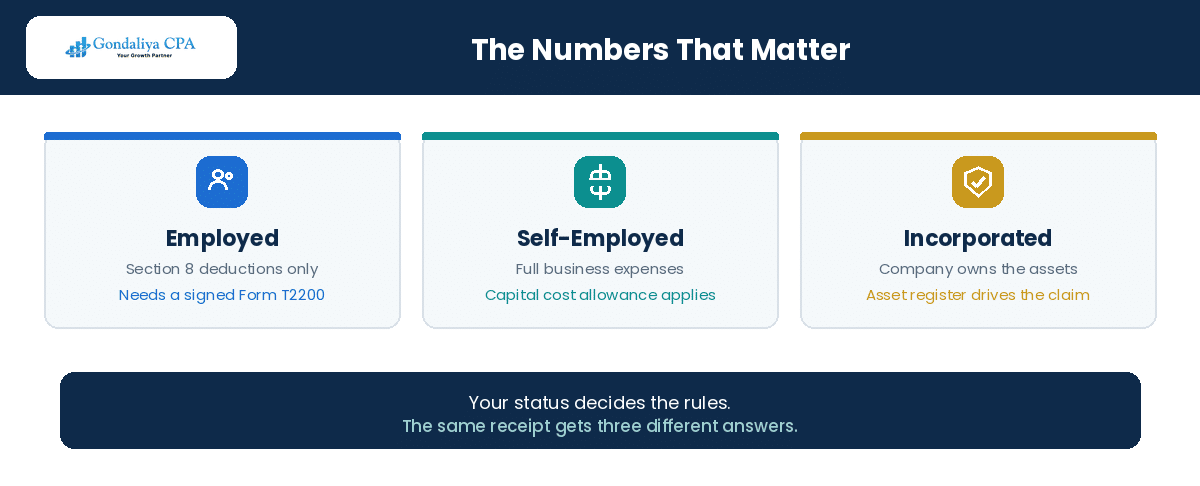
| Employed Mechanics | Limited, mostly the section 8 deductions | Need a signed T2200 form from employer |
| Self-Employed | Many expenses like tools and supplies | Reported as business income and expenses |
| Incorporated | Like self-employed plus capital cost allowance options | Follow corporate filing rules |
Each type has its own way to report and document expenses so the CRA accepts your claims.
Keeping Up With Rule Changes
Some rules affecting mechanic business expenses change from year to year. For example:
- Limits on how much you can claim for tool purchases have been amended before and may change again.
- Capital cost allowance rules and vehicle cost ceilings are revised periodically.
Keep an eye out for these changes so you don’t miss out on mechanic tax savings or run into trouble with the CRA. Staying informed means you can plan your expenses right.
The first question is never which expense. It is whether you are an employee, a sole proprietor or a corporation, because the same receipt gets three different answers. Figures changed for privacy.
Risk Warning: Employed mechanics cannot claim business expenses the way self-employed mechanics do. Please confirm your status before assuming a deduction is available.
Deductible Mechanic Business Expenses Explained
Deductible Mechanic Business Expenses
The Expenses
If you’re a mechanic in Canada, you can claim business expenses to lower your taxes. But these costs must relate directly to your work. The Canada Revenue Agency says deductible mechanic business expenses must be reasonable, supported by proof, and incurred to earn income. Some common expenses are tools, equipment depreciation, rent for your shop, vehicle costs where you use your vehicle for work, insurance on business property, advertising fees, and training courses to keep your skills sharp.
For mechanics who run their own business or have a corporation, it is important to separate personal from business costs clearly. Employees have fewer options and need Form T2200 from their employer before they claim expenses. Keep good records like receipts and mileage logs. This helps if the CRA asks questions later.
Key things to remember:
- Only expenses incurred to earn income count.
- Expenses should be reasonable compared with what others in the industry spend.
- Don’t include personal use costs.
- Keep invoices and contracts as proof.
Shop Rent, Supplies and Work Clothing
If you pay rent for your shop as a mechanic running your own business or corporation, that rent is deductible where the space is used for work. Renting bays works the same way but needs clear evidence you don’t use the space personally.
Supplies like lubricants or cleaning materials used during repairs are deductible when bought, unless they are held as inventory. Parts meant for resale count as inventory and follow different rules.
Work clothing deductions depend on whether the items are protective gear. Uniforms with company branding worn only at work qualify, and safety boots meeting the required standards count too. Ordinary clothes don’t qualify even if worn on the job. Laundry costs for eligible uniforms can sometimes be claimed.
- Must relate to earning income
- Keep purchase receipts
- No personal use in the claim
Advertising, Training and Professional Fees
You can deduct advertising costs like online ads targeting customers in Toronto or Ontario if they promote your mechanic services.
Vehicle wraps carrying your branding also count as advertising if documented properly.
Training fees paid for manufacturer-approved courses that maintain your existing skills are current expenses. Costs tied to obtaining a new lasting qualification are treated differently, so please check before claiming.
Travel costs specifically for training trips are partly deductible, but commuting between home and workshop is not.
Professional fees such as accounting by licensed CPAs or licensing renewals needed to operate also count, provided they are not linked to personal activities outside your trade.
Vehicle Expenses: Fuel, Insurance, Repairs and Maintenance
If you drive vehicles used for work, such as service vans carrying diagnostic gear, you can deduct fuel costs in proportion to business kilometres driven. You will need detailed mileage logs meeting CRA standards.
Repair bills that keep vehicles running qualify too, though cosmetic upgrades unrelated to function do not.
Insurance premiums on commercial vehicles protecting against work risks are deductible. Life insurance premiums are not.
Lease payments are subject to prescribed limits, and interest on money borrowed to buy a passenger vehicle is also capped.
Passenger vehicles have cost ceilings limiting how much depreciation or leasing can be claimed.
Commuting between home and your main workplace isn’t deductible, but trips between jobsites or client locations do count when logged properly.
GST/HST Input Tax Credits
If your business is registered for GST/HST and you pay tax on supplies, equipment, rent, or other qualifying expenses, you can generally claim input tax credits for the tax paid, provided you keep proper documentation such as invoices and payment records.
Only the portion relating to business use counts. Employees claiming employment expenses cannot claim input tax credits, though a separate rebate mechanism exists for certain employees of registrants.
The CRA expects detailed records ready for filing and review.
Common eligible items include tools, diagnostic equipment purchases, fuel bills, business insurance premiums, and advertising fees paid by incorporated mechanics or self-employed workers.
Without good records there is a risk of disallowed claims leading to penalties. If mistakes happen but are corrected early through voluntary disclosure or an amended return, penalties may be reduced.
Work clothing is the claim we deny most often before the CRA gets the chance. A branded uniform qualifies; the jeans you wear under the coveralls do not. Figures changed for privacy.
Key Stat: Only the business-use portion is deductible. Please split mixed-use costs before claiming rather than after a query.
Detailed Guide to Tools Tax Deductions for Mechanics
Tools and Equipment in Detail
The Tools
The tradesperson’s tools deduction limit and the apprentice mechanic tools deduction have both been amended in recent years, and the apprentice deduction is calculated by formula rather than being a flat dollar amount. Please confirm the current figures with the CRA or with us before claiming, rather than relying on any single number quoted in general guidance.
If you’re a mechanic in Canada, you can claim tax deductions on tools and equipment you buy for work. These mechanic business expenses help lower your taxable income. But you need to know which tools count and when you can claim them. It depends on whether you’re an employee or self-employed.
Tools must be bought mainly to earn money from your job or business. The Income Tax Act splits expenses into two groups. Current expenses can be fully deducted the same year. Capital costs are written off over time using Capital Cost Allowance. This split affects how you report tool purchases on your return.
Tradesperson’s and Apprentice Mechanic Tools Deductions
If you’re an employed mechanic, there are two deductions to know about:
- Tradesperson’s tools deduction: Journeypersons who pay for their own eligible tools can claim a deduction under section 8(1)(s) of the Income Tax Act, subject to an annual cap that has been increased in recent years.
- Apprentice vehicle mechanics’ tools deduction: Apprentices registered in a vehicle mechanic programme can claim a further deduction under section 8(1)(r), calculated by a formula rather than a flat amount.
You need a signed Form T2200 from your employer. It confirms that providing these tools is a condition of your employment. Self-employed or incorporated mechanics don’t use these deductions. They write off tool costs as business expenses and follow the capital cost allowance rules instead.
When Tool Costs Become Deductible: Conditions and Timing
For self-employed or incorporated mechanics, tools costing more than the prescribed threshold count as capital assets. You can’t deduct the full cost right away.
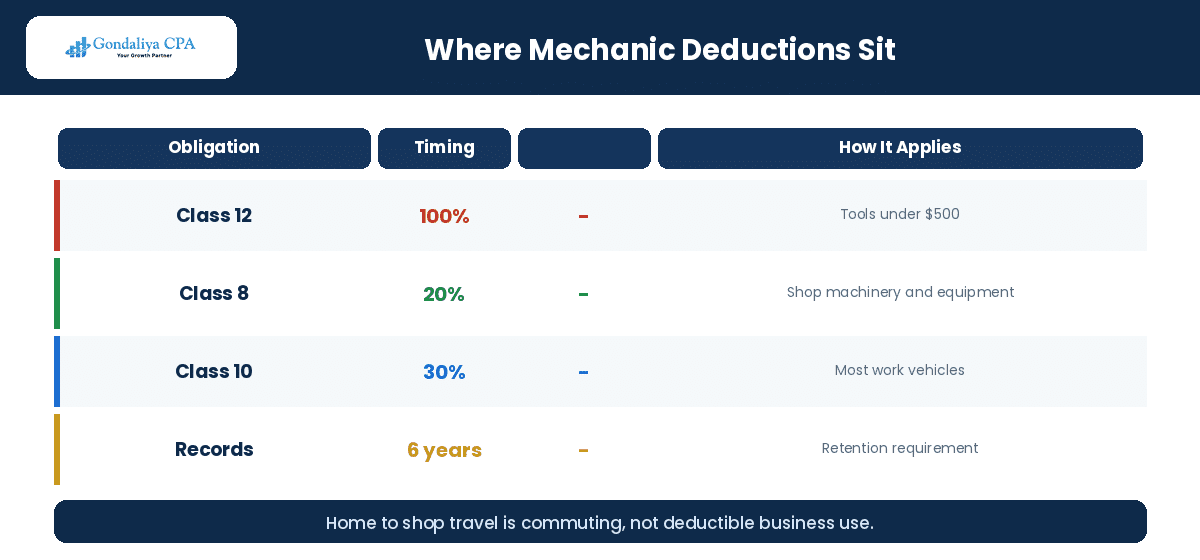
Most hand tools costing less than $500 fall into Class 12, which carries a 100% rate.
Bigger items go into other classes:
- Class 8: Machinery like compressors or hoists, written off at 20% declining balance.
- Class 10 and 10.1: Passenger vehicles such as service vans, subject to a prescribed cost ceiling.
Generally only half the normal capital cost allowance is available in the first year, unless a specific accelerated measure applies to the property and period. Assets must also be available for use in the tax year before you can claim. If a tool is not yet in service, the claim waits.
| Item | CCA Class | Rate | Notes |
|---|---|---|---|
| Hand tools under $500 | Class 12 | 100% | Subject to the half-year rule in some cases |
| Machinery and shop equipment | Class 8 | 20% declining balance | Compressors, hoists, benches |
| Passenger vehicles | Class 10 or 10.1 | 30% declining balance | Prescribed cost ceiling applies |
Toolboxes, Repairs and Leased Equipment
Toolboxes can be capitalized if the cost is significant, though inexpensive ones are often written off immediately. Repairing your tools is a current expense in the year paid.
If you lease equipment like scan tools or hoists, lease payments are current costs rather than capital costs.
Completing Form T2200 and Form T777
If you’re an employee claiming tool deductions, you must get Form T2200 signed by your employer. It confirms that providing certain tools is required for your job.
Form T777 goes with your tax return. It lists all employment expenses including tools, supported by receipts.
Without these forms, your claim may be denied even if you spent the money.
Self-employed mechanics don’t use these forms. They report through their business filings instead.
Remember to keep good records:
- Employer-signed Form T2200
- A list of each tool bought with dates and prices
- Receipts kept for six years after filing
| Document | Purpose |
|---|---|
| Form T2200 | Employer certification needed by employees claiming trade or apprentice tool deductions |
| Form T777 | Employee statement reporting detailed employment expense amounts |
| Receipts and invoices | Proof supporting purchase dates and costs, required regardless of status |
| Mileage logs | Required where vehicle use relates directly to work; supports fuel and repair claims |
| Business agreements and bank statements | Supplementary proof during a review, showing payment methods and dates |
Record-Keeping Requirements
Keeping good records is key when claiming mechanic tax deductions Canada-wide. Both employees and businesses must show clear proof of what they spend on tools.
The CRA wants original receipts or invoices showing the purchase date, vendor name, description of the item, and the amount paid.
If something is used partly for personal reasons, such as a vehicle, you need to separate business use from personal use in your records.
Keep documents for at least six years after filing, and longer if the CRA is reviewing your file. Electronic copies work as long as they stay legible.
If you don’t keep good records, the CRA may deny claims and apply penalties.
| Requirement | Details |
|---|---|
| Receipt detail | Item description must match what is claimed |
| Proof of payment | Bank or card statements showing the purchase date |
| Usage evidence | Logs or photos proving work use if questioned |
| Retention period | Keep documents at least six years after filing |
If you want help sorting out mechanic tax savings with proper paperwork, contact us at info@gondaliyacpa.ca or call 647-212-9559 for a no-pressure chat.
Tool purchases are the claim most often lost to missing paperwork. The money was spent, the tool is on the bench, and there is no invoice showing who sold it or when. Figures changed for privacy.
Pro Tip: Please photograph the invoice at the counter. Thermal till receipts fade to blank well inside the six-year retention period.
Motor Vehicle Expense Deductions for Mechanics
Motor Vehicle Expense Deductions
The Vehicle
In Canada, mechanics can claim certain vehicle expenses on their taxes. Both self-employed and incorporated mechanics can deduct eligible automotive costs under the Income Tax Act. But if you’re an employed mechanic, the rules are tighter because of the employment expense limits. Knowing which motor vehicle expenses count as mechanic business expenses helps you save on taxes without trouble.
Deducting Car Repairs and Maintenance
If you run your own mechanic business or have a corporation, you can claim car repairs and maintenance that relate directly to earning your income. This includes oil changes, brake work, tire swaps, and regular servicing for vehicles used at work. Fuel costs for service calls or mobile repairs also count if you keep good records.
Employees need a signed Form T2200 from their employer to claim any vehicle expenses, and even then the scope is narrow.
To deduct these expenses:
- The cost must relate to earning mechanic business income.
- Keep receipts or invoices for every expense.
- Split personal use from business use fairly, using mileage logs.
If you don’t document well or mostly use the vehicle personally, the CRA will likely reject the claims.
The Half-Year Rule and Available-for-Use Rule
Mechanics who buy vehicles for their business apply the capital cost allowance rules to claim depreciation. Vehicles fall under Class 10 or 10.1 depending on cost:
| Class | What It Covers | Rate and Limit |
|---|---|---|
| Class 10 | Passenger vehicles at or below the prescribed cost limit | 30% declining balance |
| Class 10.1 | Passenger vehicles above the prescribed cost limit | 30% declining balance, capped at the limit |
The half-year rule means that in the first year you own a vehicle, you generally get half the usual capital cost allowance no matter when during the year you acquired it.
The available-for-use rule says you start claiming once your vehicle is ready to be used in the business, not simply when it is bought.
You also need to know whether a cost is a current expense or a capital asset:
- Routine maintenance is a current expense.
- Major upgrades or buying a new vehicle are capital.
How you classify affects when and how much deduction you get.
Lease Costs, Interest and Mileage Tracking
If you lease your work vehicle, the CRA sets limits on how much lease cost you can deduct for a passenger vehicle. The monthly ceiling is prescribed and revised periodically, so please confirm the current figure.
Interest on money borrowed to buy a passenger vehicle is also capped on a per-day basis.
Keeping detailed mileage records is key. These show which trips were personal, which are not deductible, and which were business-related.
The CRA expects logs that include:
- Trip date
- Where you started and ended
- Why you made the trip
- Odometer readings before and after
- Total kilometres driven each year with the personal and business split
Without good records:
- Your claims might be denied.
- You could face reassessment or penalties.
- You might lose input tax credits where applicable.
Commuting Versus Business Use
You can’t claim daily commuting, meaning travel from home to your regular workplace. The CRA is clear on this.
But driving between job sites or to customer locations beyond your usual commute does count. Examples include:
- Mobile repair calls
- Hauling parts or tools between locations
- Trips between multiple shops you operate
Your mileage log should record the date of each trip, start and end addresses, the business reason, odometer readings, and distance travelled.
A representative sample period can be used only where a full base-year log already exists, so please keep the detailed records rather than relying on a short sample alone.
Clear separation like this keeps your deductions defensible.
Need help making sure your automotive tax deductions fit Canadian rules? Contact Gondaliya CPA at 647-212-9559 or info@gondaliyacpa.ca for advice focused on Toronto-area mechanics running incorporated businesses or mobile services.
The mileage log is what separates a claim that stands from one that falls. Reconstructing a year of trips from memory in an audit almost never works. Figures changed for privacy.
Risk Warning: Home to shop travel is commuting, not business use, no matter how early the shift starts. Please exclude it from the log.
Maximizing Mechanic Tax Savings Through Bookkeeping and Documentation
Bookkeeping, Records and Incorporation
The Records
To get the best mechanic tax savings, you need good bookkeeping and solid records. Track all your mechanic business expenses carefully. This helps prove every claim to the CRA, covering tools, vehicle costs, shop rent, and training fees.
Keep your expenses sorted clearly. For example, separate tool purchases from consumables, or fuel from repairs. Save all receipts and invoices, since you will need them if the CRA asks. Cloud accounting makes it easier to log transactions and check numbers at year-end.
Also keep a detailed mileage log for any vehicles you use for work. If you run a corporation, keep your personal and company money separate with different bank accounts. This shows clear business spending and avoids mix-ups.
Common CRA Review Triggers
The CRA often checks certain mechanic business expenses because errors and overclaims are common there. Things that raise flags include:
- Large tool purchases without proper invoices.
- Vehicle expense claims with no mileage log.
- Home office deductions that are overstated.
- Shop rent claimed without a formal lease.
- The tradesperson’s tools deduction claimed by a self-employed mechanic, which is an employee deduction only.
| Risk Area | Typical Issue | Consequence if Missed |
|---|---|---|
| Tool Purchases | Missing invoice | Deduction denied |
| Vehicle Expenses | No mileage log | Denied plus interest |
| Home Office Deductions | Workspace percentage overstated | Partial or full denial |
| Shop Rent | No lease agreement | Expense disallowed |
Amended Returns and Voluntary Disclosures
If you made mistakes in past filings about mechanic tax deductions or missed some mechanic business expenses, you can fix them with an adjustment request. Individuals use the T1 adjustment process; corporations use the T2 equivalent.
You can also use the Voluntary Disclosures Program to report missed income or incorrect deductions before the CRA raises it. This may reduce penalties, though interest generally still applies.
- File adjustments within the normal reassessment window where possible.
- Provide clear documents explaining the changes.
- Avoid repeated corrections, since a pattern attracts attention.
Fixing errors promptly keeps your standing good with the CRA and can recover refunds you missed.
Incorporation: Corporate Filing and Payroll
Incorporating can offer advantages including access to the small business rate and more flexibility in how you take income. But it adds rules about corporate returns and payroll.
- Clearly separate personal from corporate expenses. Only genuine business costs are deductible.
- Handle payroll properly when paying wages, including CPP and EI remittances.
Also track capital cost allowance for equipment bought by the company rather than expensing tools directly as an employee would under the section 8 rules. An accountant can guide you through the filing obligations that apply.
Home Office and Shop Lease Costs
To claim workspace-in-home costs, you must show part of your home is used for work and meets the CRA conditions. The amount you claim depends on how much space you use compared to the total home.
For shop lease costs, whether renting bays as a mobile mechanic or leasing a commercial unit, certain conditions apply:
- You need a written lease with rent amounts clearly stated.
- The rental period must be matched to your fiscal year.
- Utilities are deductible if metered separately or split reasonably.
Calculate rent based on the area rented multiplied by months used, divided by total months in the year. Utilities should also be split according to how much is used for work versus personal purposes.
Keeping signed leases and utility bills helps support your claims during any review.
| Expense Type | Deduction Basis | Eligibility | Notes |
|---|---|---|---|
| Home Office Workspace | Share based on exclusive-use area versus total home | Self-employed or incorporated | Floor plans help support claims |
| Shop Bay or Commercial Lease | Formal written lease with monthly rent tracked | Mobile, self-employed or shop-based | Utilities apportioned reasonably |
Employees generally cannot claim workspace-in-home costs unless the employer certifies the conditions on Form T2200.
By keeping clear books and knowing what counts as deductible, whether self-employed or incorporated, you’ll avoid problems with mechanic tax savings or automotive tax deductions in Canada. For guidance on filing or a records cleanup, we can help.
Contact us at info@gondaliyacpa.ca or call 647-212-9559 for a free consultation about maximizing your mechanic business expenses within Canada’s tax laws.
Self-employed mechanics claiming the tradesperson\u2019s tools deduction is the error we correct most. It is an employee provision, and the claim comes straight back off. Figures changed for privacy.
Key Stat: The tradesperson’s tools deduction is available to employees only. Please use the capital cost allowance rules instead if you are self-employed.
Additional Tax Credits and Deductions for Mechanics and Apprentices
Credits, Licensing and Non-Deductibles
The Extras
Mechanics and apprentices in Canada have some extra tax breaks beyond the usual business expenses. Employed mechanics can claim the tradesperson’s tools deduction, and apprentices registered in a vehicle mechanic programme can claim a further deduction. Both are subject to their own limits and conditions, so please confirm the current amounts before claiming.
If you run your own mechanic business or incorporate, you can deduct more. This includes capital cost allowance for equipment and vehicles used in the work. You can also claim input tax credits for GST/HST paid on business purchases where you are registered.
Remember, the CRA expects expenses to be reasonable and to relate to earning income. Keep good records showing how much is for work versus personal use.
Licensing, Certification and Apprenticeship Expenses
If you pay fees for licensing or certification needed for your mechanic work, those costs are deductible business expenses. In Ontario this includes certification through the provincial skilled trades authority.
Training courses that maintain your existing skills usually count too, particularly where they do not confer a new lasting qualification. Travel costs tied to these courses may also be deductible with proper support.
Apprentice mechanics should note that the apprentice deduction interacts with the tools you buy in the year, so the calculation depends on both your purchases and the applicable formula.
Always keep receipts or invoices showing when you paid these fees in the tax year. If you don’t support your claims well, the CRA may reject them during a review.
Advertising and Promotion Expenses
If you run a mechanic business, many advertising expenses qualify as deductions. This includes online ads aimed at local areas like Toronto or Ontario. Signs at your shop or branding on your service vehicles count too.
You can also deduct costs for printed flyers distributed locally, hosting fees as current expenses, and social media marketing campaigns. Website development is often capital rather than current, depending on what was built.
Subscriptions to shop management software that supports customer contact also qualify where they support the business. Promotional items tied to advertising may be deductible.
Keep these tips in mind:
- Save detailed invoices showing what was advertised and where.
- Separate large capital costs, such as building a website, from recurring expenses.
- If software is partly for personal use, only claim the business portion.
Following CRA rules helps maximize your mechanic business expenses while avoiding mistakes.
Non-Deductible Expenses to Avoid Claiming
Some expenses seem work-related but aren’t deductible:
- Everyday clothes, unless they are safety gear meeting the required standards.
- Personal grooming such as haircuts.
- Commuting between home and your usual workplace.
- Fines such as parking tickets or traffic violations.
- Life insurance premiums unrelated to an employee benefit plan.
- Club memberships without a genuine trade connection.
Avoid claiming more than your receipts show, or mixing personal costs with business claims without clear records.
Incorrect claims increase the chance of a review, reassessment, and interest charges. Keep personal and mechanic business expenses separate.
Practical Examples
Here are some situations mechanics often face when claiming deductions:
A mobile mechanic buys a tool set costing $900. Because the cost exceeds the Class 12 threshold for individual tools, the treatment depends on whether the set is a single asset or separately identifiable items, which changes whether it is written off immediately or depreciated. Figures changed for privacy.
A collision technician who owns a company pays roughly $4,000 to wrap a service van with branding. Because the wrap promotes the business, the cost is treated as advertising, with any personal-use element excluded. Figures changed for privacy.
These cases show why knowing the thresholds matters, and why good records support your claims during a CRA review.
Official CRA Forms and Resources
For guidance on mechanic tax deductions, the CRA provides the relevant forms directly:
- Form T2200: The declaration of conditions of employment that employees need before claiming the tradesperson’s tools deduction.
- Form T777: The statement of employment expenses listing all work-related costs an employee claims.
The CRA also publishes guidance on business expenses and on workspace-in-home costs where those apply.
Rules change, so if you work around Toronto or Ontario and need help with these forms before filing deadlines, please get in touch.
Apprentices are the group most often short-changed. The deduction exists, the tools were bought, and nobody asked the employer for a signed form. Figures changed for privacy.
Pro Tip: Please request Form T2200 from your employer in January, not in April. Chasing a signature at filing time is how claims get abandoned.
FAQs on Mechanic Tax Deductions in Canada
Frequently Asked Questions
FAQ
What is the Tradesperson’s Tools Deduction for employed mechanics?+
Employed journeypersons can deduct eligible tool purchases under section 8(1)(s), subject to an annual cap that has been increased in recent years. A signed Form T2200 from the employer is required.
How much can apprentice vehicle mechanics claim for tools?+
Apprentices registered in a vehicle mechanic programme can claim a further deduction under section 8(1)(r). It is calculated by formula rather than a flat dollar amount, so please confirm your figure before filing.
What is the Class 12 tool cost threshold and its significance?+
Tools costing less than $500 fall under Class 12, which carries a 100% rate, meaning the cost can be written off much faster than in other classes.
Are there limits on passenger vehicle costs for tax purposes?+
Yes. A prescribed capital cost ceiling applies to passenger vehicles for CCA purposes, and vehicles above that ceiling fall into Class 10.1. The limit is revised periodically.
What per-kilometre rate applies to vehicle expense claims?+
The CRA prescribes a per-kilometre rate for business use, revised annually. Please confirm the current rate before calculating your claim.
Can employees recover GST/HST on mechanic expenses?+
Employees cannot claim input tax credits, but employees of a GST/HST registrant may be able to claim a separate rebate for tax paid on deductible employment expenses.
What are typical Capital Cost Allowance rates for mechanic assets?+
Class 8 equipment is 20% declining balance, Class 10 and 10.1 vehicles are 30% declining balance, and Class 12 tools carry a 100% rate.
How long must a mechanic keep records after filing taxes?+
The CRA requires records to be kept for at least six years after filing to support expense claims if reviewed.
What does the half-year rule mean for capital assets?+
The half-year rule generally limits your CCA claim to half the usual amount in the year the asset becomes available for use.
Which form do employees file to claim employment-related mechanic expenses?+
Employees use Form T777 with their tax return, supported by a signed Form T2200 from their employer.
How do you distinguish repairs and maintenance from capital expenses?+
Routine repairs that keep an asset working are current expenses deductible immediately. Work that betters the asset beyond its original condition is capital and depreciated over time.
Are there limits on vehicle lease costs and interest deductions?+
Yes. The deductible monthly lease cost for a passenger vehicle is capped at a prescribed amount, and interest on money borrowed to buy one is also limited. Both are revised periodically.
Why can’t commuting costs between home and workplace be deducted?+
The CRA treats travel between home and your regular workplace as personal, regardless of how far it is or when the shift starts.
How do GST/HST input tax credits work on mechanic business costs?+
If registered, you can recover GST/HST paid on business purchases in proportion to business use, provided you hold supporting documentation.
Fourteen questions and one underneath them: are you an employee or a business. Answer that first and most of the rest resolves itself. Figures changed for privacy.
Best Practices and Preparing for a Deduction Review
Best Practices and Review Preparation
Quick Reference
Best Practices and Common Issues
- Keep receipts and invoices organized by category: tools, supplies, vehicle, advertising.
- Separate personal and business expenses clearly in your bookkeeping.
- Use detailed mileage logs including trip date, start and end locations, purpose, and odometer readings.
- Avoid claiming fines, grooming costs, personal clothes, or club memberships as business expenses.
- Obtain Form T2200 signed by your employer before claiming employee tool deductions.
- Review prior filings promptly and use adjustment requests or voluntary disclosure where needed.
What Triggers a CRA Review of Mechanic Expense Claims
- Large tool purchases without proper invoices or proof of payment.
- Missing or incomplete mileage logs supporting vehicle expense claims.
- Overstated home office or shop rent deductions without supporting agreements.
- Using the employee tool deduction when self-employed, which is not permitted.
How We Review Your Mechanic Deductions
- Analyze expense records against CRA rules and current guidance.
- Check capital asset classification versus current expense treatment.
- Verify that Forms T2200 and T777 are in place where applicable.
- Provide clear deliverables including summary reports and recommendations.
Preparing for Your Review
- Collect all receipts, invoices, and bank statements related to mechanic expenses.
- Prepare mileage logs reflecting business versus personal kilometres driven.
- Gather employment forms such as a signed T2200 if you are employed.
- Have documentation of shop leases or rental agreements ready if applicable.
Why Choose Gondaliya CPA
We work with mechanics, technicians and shop owners across Ontario, and our team makes sure your deductions comply with CRA standards while capturing everything you are entitled to. Fees are a flat annual amount including HST, quoted before any work begins.
Contact us at info@gondaliyacpa.ca, call 647-212-9559, or book a free consultation today.
Every list above reduces to one habit: capture the paperwork at the moment of purchase. Nothing recovered in April matches what could have been filed in real time. Figures changed for privacy.
Mechanic Situations We Serve
Industry Expertise
Which rules apply differs by situation. Here are ten and the usual focus.
| Mechanic Situation | Where the Deductions Sit |
|---|---|
| Employed journeyperson | Tradesperson’s tools deduction with a signed T2200 |
| Registered apprentice | The additional apprentice mechanic deduction |
| Self-employed sole proprietor | Full business expenses and capital cost allowance |
| Incorporated shop owner | Corporate filing, payroll and asset register |
| Mobile mechanic | Vehicle costs, mileage logs and equipment in the van |
| Bay renter | Written lease and utility apportionment |
| Home-based operator | Workspace-in-home conditions and floor plan |
| Heavy tool investment year | Class 12 threshold versus Class 8 treatment |
| Buying a service van | Class 10 or 10.1 and the prescribed cost ceiling |
| Behind on records | Reconstruction, adjustment requests and disclosure |
- Employed journeyperson: No employer signature means no claim, whatever you spent.
- Registered apprentice: The additional deduction is formula-based, not a flat figure.
- Self-employed sole proprietor: The section 8 employee deductions do not apply to you.
- Incorporated shop owner: The company owns the assets, so the asset register drives the claim.
- Mobile mechanic: The log is the claim; without it the vehicle costs fall.
- Bay renter: A verbal arrangement with the shop next door will not support the deduction.
- Home-based operator: The conditions are specific and the percentage must be defensible.
- Heavy tool investment year: Where each purchase lands changes the timing significantly.
- Buying a service van: Cost relative to the ceiling decides which class applies.
- Behind on records: Correcting first costs less than correcting after contact.
The situation changes which rules apply. It does not change the method, which is confirm your status, capture the paperwork, then classify each purchase correctly. Figures changed for privacy.
Professional Guidance and Quick Reference
Guidance
Professional Guidance for Mechanics: How Gondaliya CPA Reviews Your Deductions
Mechanics lose deductions in a predictable set of ways: claiming the tradesperson’s tools deduction while self-employed, buying tools without keeping the invoice, claiming vehicle costs with no mileage log, treating a capital purchase as a current expense, claiming commuting as business travel, and never asking the employer for a signed Form T2200. Gondaliya CPA reviews mechanic deductions on a fixed annual fee.
We handle what decides the outcome: confirming whether you are employed, self-employed or incorporated, since the same receipt gets three different answers, applying the correct tools deduction for employees and the capital cost allowance rules for businesses, placing each purchase in the right class against the Class 12 threshold, separating current repairs from capital betterment, calculating the business-use share of vehicle and workspace costs, and building the documentation the CRA expects.
Our team starts with employment status, because everything downstream depends on it. Employed technician, mobile mechanic or incorporated shop owner, you get clear advice and a fixed price before we start.
Quick Answers: Key Numbers & Concepts at a Glance
At a Glance
- Employees: Section 8 deductions only
- Required form: T2200 signed by employer
- Employee filing: Form T777 with the return
- Class 12: Tools under $500, 100% rate
- Class 8: 20% for shop equipment
- Class 10 and 10.1: 30% for vehicles
- First year: Half-year rule applies
- Depreciation starts: When available for use
- Commuting: Not deductible
- Records: Six years retention
Who This Is For / Not For
Fit Check
- For: Employed mechanics, self-employed technicians, mobile operators and incorporated shop owners across Canada.
- Not For: Hobby vehicle work with no intention to profit, where the expenses are not deductible at all.
People Also Ask
Related Questions
Can I claim tools if my employer reimbursed me?+
No. A reimbursed cost is not your expense. Only amounts you bear yourself and are not repaid for can be claimed.
Does a tool set count as one asset or many?+
It depends on whether the items are separately identifiable and usable. That distinction decides whether the Class 12 threshold applies per item or to the set.
Should I incorporate as a mechanic?+
It depends on income level, whether you employ others, and how much you leave in the business. Incorporation adds cost and filing obligations, so the benefit has to justify it.
Glossary of Key Terms
- Form T2200: The employer declaration of conditions of employment.
- Form T777: The employee statement of employment expenses.
- Tradesperson’s tools deduction: The employee claim under section 8(1)(s).
- Apprentice deduction: The additional employee claim under section 8(1)(r).
- Current expense: A cost deducted in full in the year incurred.
- Capital expense: A cost written down over time through depreciation.
- Capital cost allowance: Tax depreciation on tools, equipment and vehicles.
- Class 12: The 100% class covering tools under the threshold.
- Class 8: The 20% class covering shop machinery and equipment.
- Class 10: The 30% class covering most work vehicles.
- Class 10.1: The capped class for passenger vehicles above the limit.
- Half-year rule: The first-year restriction on CCA claims.
- Available for use: When an asset becomes eligible for depreciation.
- Workspace in home: The business-use portion of your residence.
- Input tax credit: GST/HST recoverable on business purchases.
- Voluntary disclosure: The route to correcting past errors with reduced penalties.
Mechanic Deduction Readiness Check
This quick self-check indicates where your operation most likely has room. Please answer the six questions below.
Mechanic Deduction Readiness Check
Six quick questions on your situation. No fee shown.
Points to raise with us:
This is a general prompt, not tax or legal advice or a quote. Your position depends on your full facts. For a real review, please book a free consultation.
Want a checklist to work from? You can download our free mechanic deduction checklist before your consultation.

Confirm whether you are employed, self-employed or incorporated. Request Form T2200 in January if employed. Keep the invoice for every tool purchase. Log every business kilometre with date and purpose. Split each purchase into current or capital. Measure the workspace and keep a floor plan. Exclude commuting from the mileage claim. Please keep six years of records.
2026 Update — what is current: This article reflects rules current to 2026. The requirement for Form T2200 and Form T777, the Class 12 threshold of $500 for tools, the Class 8 rate of 20%, the Class 10 and 10.1 rate of 30%, the half-year and available-for-use rules, the treatment of commuting as personal travel and the six-year retention requirement are unchanged. Please note that the tradesperson’s tools deduction cap has been increased in recent years and the apprentice mechanic deduction under section 8(1)(r) is calculated by formula rather than being a flat amount, so neither should be assumed from older guidance; and that the passenger vehicle capital cost ceiling, the deductible monthly lease limit and the prescribed per-kilometre rate are all revised periodically.
Mechanic Tax Deductions Canada: How Gondaliya CPA Helps Technicians and Shop Owners Claim Correctly
Start with employment status
Gondaliya CPA confirms whether you are employed, self-employed or incorporated, applies the correct tools deduction or capital cost allowance treatment, places each purchase in the right class against the Class 12 threshold, separates current repairs from capital betterment, calculates the business-use share of vehicle and workspace costs, checks that Forms T2200 and T777 are in place where needed and builds the documentation the CRA expects, on a flat annual fee including HST with a one-business-day response. Please book a free consultation.
Next Steps
Please book a free consultation with Gondaliya CPA and bring a year of tool and equipment invoices, your mileage log if you have one, and your last filed return. Those three tell us immediately what can be claimed, what needs reclassifying, and where the documentation is thin. You will get a flat annual fee including HST before any work begins. If our content helps, please add gondaliyacpa.ca as a preferred source on Google.
Sharad Gondaliya, CPA — Founder & Managing Director, Gondaliya CPA Professional Corporation
Sharad Gondaliya, CPA, has over 15 years of experience serving mechanics, automotive technicians and shop owners, covering employed versus self-employed versus incorporated treatment, the tradesperson’s and apprentice mechanic tools deductions, Form T2200 and T777 requirements, capital cost allowance classes for tools, equipment and vehicles, the half-year and available-for-use rules, mileage logs and vehicle cost limits, workspace-in-home and shop lease claims, GST/HST input tax credits, and CRA audit representation. Gondaliya CPA is a CPA Ontario Registered Firm, serving clients across Toronto, Etobicoke, Vaughan, Mississauga, Brampton, Scarborough, Ottawa, Oshawa, Guelph, Hamilton, North York, Windsor, and Canada-wide. Verify our firm on the CPA Ontario public firm directory.
CPA Ontario | US CPA licences in Washington and Montana | CPA Ontario Registered Firm | 1450+ 5-star Google reviews
Published: · Last updated:
Editorial policy: We research against CRA and CPA Ontario sources, fact-check the figures, and Sharad Gondaliya, CPA, reviews the content, which we update as the rules change.
Disclaimer: This article is educational information only and is not tax, legal, or financial advice. Figures marked illustrative are examples rather than quotes or guarantees. It reflects CRA rules current to 2026, including Form T2200 and T777 requirements, the Class 12 tool threshold, the Class 8 and Class 10 CCA rates, the half-year rule, and the six-year retention requirement. Rates, limits and expensing rules change and outcomes depend on your specific facts. Please consult a CPA Ontario member before acting.

Sharad Gondaliya is a CPA Canada & CPA USA with 15 Years+ experience of Accounting, Tax, Payroll of Corporate Small Businesses as Tax Accountant. He is a CPA Ontario member (61040184) and holds US CPA licences in Washington and Montana and is well known among corporate small businesses for tax planning, efficient tax solutions, and affordable CPA services. Sharad is the Principal (Director) of Gondaliya CPA – Affordable CPA Firm in Canada. Licenses: CPA Ontario: 61040184 | CPA USA (MT): PAC-CPAP-LIC-033176 | CPA USA (WA): 57629 | CPA Firm License: 61330051 View Full Author Bio