



.gcpa-post{–navy:#0f2a4a;–navy-2:#15355c;–blue:#1c6dd0;–blue-soft:#e8f1fc;–teal:#0c8f8f;–teal-soft:#e3f4f4;–gold:#c9991f;–gold-soft:#fbf3dc;–green:#1f8a4c;–green-soft:#e6f5ec;–red:#c0392b;–red-soft:#fbeae8;–ink:#1d2733;–muted:#5a6b7b;–line:#d8e0e8;–bg:#ffffff;–bg-alt:#f5f8fb;–radius:14px;–shadow:0 6px 22px rgba(15,42,74,.08);–shadow-lg:0 14px 40px rgba(15,42,74,.14);font-family:-apple-system,BlinkMacSystemFont,”Segoe UI”,Roboto,Helvetica,Arial,sans-serif;color:var(–ink);line-height:1.7;font-size:17px;max-width:1080px;margin:0 auto;padding:0 18px 60px;} .gcpa-post *{box-sizing:border-box;} .gcpa-hero{background:linear-gradient(135deg,var(–navy) 0%,var(–navy-2) 60%,#1c4a78 100%);color:#fff;border-radius:20px;padding:46px 40px 42px;margin:26px 0 34px;position:relative;overflow:hidden;} .gcpa-hero::after{content:””;position:absolute;right:-80px;top:-80px;width:280px;height:280px;z-index:0;background:radial-gradient(circle,rgba(28,109,208,.45),transparent 70%);} .gcpa-post .gcpa-eyebrow{display:inline-block;font-size:13px;letter-spacing:1.4px;text-transform:uppercase;font-weight:700;color:#cfe2f8 !important;background:rgba(255,255,255,.14);border:1px solid rgba(255,255,255,.3);padding:7px 15px;border-radius:30px;margin-bottom:18px;} .gcpa-post .gcpa-hero h1{font-size:34px;line-height:1.25;margin:0 0 16px;font-weight:800;color:#fff !important;letter-spacing:-.3px;position:relative;z-index:2;} .gcpa-post .gcpa-hero p{font-size:18px;color:#eaf3fc !important;margin:0;max-width:760px;position:relative;z-index:2;} .gcpa-eyebrow{position:relative;z-index:2;} .gcpa-post h2{font-size:27px;font-weight:800;color:var(–navy);line-height:1.3;margin:48px 0 18px;padding-bottom:14px;border-bottom:3px solid var(–blue-soft);letter-spacing:-.2px;position:relative;} .gcpa-post h2::after{content:””;position:absolute;left:0;bottom:-3px;width:70px;height:3px;background:var(–blue);} .gcpa-post h3{font-size:22px;font-weight:800;color:var(–navy-2);margin:40px 0 14px;line-height:1.35;} .gcpa-post h4{font-size:19px;font-weight:700;color:var(–navy-2);margin:36px 0 12px;line-height:1.4;padding-left:16px;border-left:4px solid var(–teal);} .gcpa-post p{margin:0 0 16px;color:#1d2733 !important;} .gcpa-post li{color:#1d2733;} .gcpa-post a{color:var(–blue);text-decoration:none;font-weight:600;} .gcpa-post a:hover{text-decoration:underline;} .gcpa-post ul,.gcpa-post ol{margin:0 0 18px !important;padding-left:0 !important;list-style:none !important;} .gcpa-post ul{list-style-type:none !important;} .gcpa-post ul li{position:relative;padding:8px 0 8px 34px;margin:0;border-bottom:1px solid var(–line);color:var(–ink);list-style:none !important;list-style-type:none !important;} .gcpa-post ul li::marker{content:”” !important;font-size:0 !important;} .gcpa-post ul li:last-child{border-bottom:none;} .gcpa-post ul li::before{content:””;position:absolute;left:6px;top:15px;width:9px;height:9px;border-radius:2px;background:var(–teal);transform:rotate(45deg);} .gcpa-post ol{counter-reset:gcpa;} .gcpa-post ol li{position:relative;padding:10px 0 10px 44px;margin:0 0 10px;counter-increment:gcpa;list-style:none !important;list-style-type:none !important;} .gcpa-post ol li::marker{content:”” !important;font-size:0 !important;} .gcpa-post ol li::before{content:counter(gcpa);position:absolute;left:0;top:9px;width:28px;height:28px;border-radius:8px;background:var(–navy);color:#fff;font-weight:700;font-size:14px;display:flex;align-items:center;justify-content:center;} .gcpa-post .wp-block-table,.gcpa-post figure.wp-block-table{margin:22px 0 26px;overflow-x:auto;} .gcpa-post table{width:100%;border-collapse:collapse;font-size:15.5px;background:#fff;border:1px solid var(–navy);border-radius:10px;overflow:hidden;box-shadow:var(–shadow);} .gcpa-post thead th{background:var(–navy);color:#fff;text-align:left;padding:13px 15px;font-weight:700;font-size:15px;border:1px solid var(–navy-2);} .gcpa-post tbody td{padding:12px 15px;border:1px solid var(–line);vertical-align:top;color:var(–ink);} .gcpa-post tbody tr:nth-child(even){background:var(–bg-alt);} .gcpa-post tbody tr:hover{background:var(–blue-soft);} .gcpa-post tbody td:first-child{font-weight:600;color:var(–navy-2);} .gcpa-metrics{display:grid;grid-template-columns:repeat(auto-fit,minmax(200px,1fr));gap:16px;margin:30px 0 36px;clear:both;} .gcpa-metric{background:#fff;border:1px solid var(–line);border-top:4px solid var(–blue);border-radius:var(–radius);padding:22px 18px;box-shadow:var(–shadow);transition:transform .2s,box-shadow .2s;} .gcpa-metric:hover{transform:translateY(-4px);box-shadow:var(–shadow-lg);} .gcpa-metric:nth-child(2){border-top-color:var(–teal);} .gcpa-metric:nth-child(3){border-top-color:var(–gold);} .gcpa-metric:nth-child(4){border-top-color:var(–green);} .gcpa-metric .ic{width:46px;height:46px;border-radius:11px;background:var(–blue-soft);display:flex;align-items:center;justify-content:center;margin-bottom:14px;color:var(–blue);} .gcpa-metric:nth-child(2) .ic{background:var(–teal-soft);color:var(–teal);} .gcpa-metric:nth-child(3) .ic{background:var(–gold-soft);color:var(–gold);} .gcpa-metric:nth-child(4) .ic{background:var(–green-soft);color:var(–green);} .gcpa-metric .big{font-size:22px;font-weight:800;color:var(–navy);line-height:1.2;margin-bottom:4px;} .gcpa-metric .lbl{font-size:14px;color:var(–muted);line-height:1.45;} .gcpa-numhead{display:flex;align-items:center;gap:14px;flex-wrap:wrap;margin:46px 0 8px;clear:both;} .gcpa-numhead h4{margin:0 !important;} .gcpa-numhead .gcpa-pill{margin:0 !important;} .gcpa-numhead .num{flex:0 0 auto;width:48px;height:48px;border-radius:12px;background:var(–navy);color:#fff;font-size:22px;font-weight:800;display:flex;align-items:center;justify-content:center;box-shadow:var(–shadow);} .gcpa-callout{border-radius:var(–radius);padding:20px 22px;margin:22px 0;border:1px solid var(–line);background:var(–bg-alt);position:relative;} .gcpa-callout.blue{background:var(–blue-soft);border-color:#bcd9f6;} .gcpa-callout.teal{background:var(–teal-soft);border-color:#b7e3e3;} .gcpa-callout.gold{background:var(–gold-soft);border-color:#ecd79a;} .gcpa-callout.green{background:var(–green-soft);border-color:#b6e2c6;} .gcpa-callout.red{background:var(–red-soft);border-color:#f0c4be;} .gcpa-callout .co-tag{display:inline-block;font-size:12.5px;font-weight:700;letter-spacing:.6px;text-transform:uppercase;padding:4px 11px;border-radius:20px;margin-bottom:10px;color:#fff;} .gcpa-callout.blue .co-tag{background:var(–blue);} .gcpa-callout.teal .co-tag{background:var(–teal);} .gcpa-callout.gold .co-tag{background:var(–gold);} .gcpa-callout.green .co-tag{background:var(–green);} .gcpa-callout.red .co-tag{background:var(–red);} .gcpa-callout p:last-child{margin-bottom:0;} .gcpa-cta{background:linear-gradient(135deg,var(–navy) 0%,#1c4a78 100%);color:#fff;border-radius:18px;padding:34px 32px;margin:38px 0;text-align:center;box-shadow:var(–shadow-lg);position:relative;overflow:hidden;} .gcpa-cta::before{content:””;position:absolute;left:-60px;bottom:-60px;width:220px;height:220px;background:radial-gradient(circle,rgba(12,143,143,.4),transparent 70%);} .gcpa-post .gcpa-cta h4{color:#fff !important;border:none;padding:0;margin:0 0 12px;font-size:22px;font-weight:800;position:relative;z-index:1;} .gcpa-post .gcpa-cta p{color:#eaf3fc !important;max-width:680px;margin:0 auto 22px;position:relative;z-index:1;} .gcpa-post .gcpa-cta .btn{display:inline-block;background:#fff !important;color:var(–navy) !important;font-weight:700;padding:13px 26px;border-radius:30px;margin:6px;font-size:16px;position:relative;z-index:1;transition:transform .15s;text-decoration:none !important;} .gcpa-post .gcpa-cta .btn:hover{transform:translateY(-2px);text-decoration:none !important;} .gcpa-post .gcpa-cta .btn.primary{background:var(–teal) !important;color:#fff !important;} .gcpa-btnrow{display:flex;flex-wrap:wrap;gap:14px;justify-content:center;align-items:center;position:relative;z-index:1;} .gcpa-trust{display:flex;flex-wrap:wrap;gap:10px;justify-content:center;margin-bottom:22px;position:relative;z-index:1;} .gcpa-post .gcpa-trust span{font-size:13px;font-weight:700;background:rgba(255,255,255,.18) !important;border:1px solid rgba(255,255,255,.45);padding:7px 14px;border-radius:20px;color:#ffffff !important;} .gcpa-post svg{display:block;} .gcpa-pill{display:inline-flex;align-items:center;gap:8px;font-size:14px;font-weight:700;padding:8px 16px;border-radius:30px;margin:10px 0 6px;line-height:1.2;} .gcpa-pill svg{width:16px;height:16px;flex:0 0 auto;} .gcpa-pill.green{background:var(–green-soft);color:var(–green);border:1px solid #b6e2c6;} .gcpa-pill.blue{background:var(–blue-soft);color:var(–blue);border:1px solid #bcd9f6;} .gcpa-pill.teal{background:var(–teal-soft);color:var(–teal);border:1px solid #b7e3e3;} .gcpa-pill.gold{background:var(–gold-soft);color:#9a7416;border:1px solid #ecd79a;} .gcpa-pill.red{background:var(–red-soft);color:var(–red);border:1px solid #f0c4be;} .gcpa-pillhead{display:flex;align-items:center;gap:14px;flex-wrap:wrap;margin:38px 0 12px;clear:both;} .gcpa-pillhead h4{margin:0 !important;} .gcpa-pillhead .gcpa-pill{margin:0 !important;} @media(max-width:560px){.gcpa-pillhead{gap:8px;}} .gcpa-toc{background:var(–bg-alt);border:1px solid var(–line);border-left:5px solid var(–blue);border-radius:var(–radius);padding:24px 26px;margin:30px 0 36px;box-shadow:var(–shadow);} .gcpa-toc h5{margin:0 0 14px;font-size:16px;font-weight:800;color:var(–navy);letter-spacing:.4px;text-transform:uppercase;display:flex;align-items:center;gap:9px;} .gcpa-toc h5 svg{width:20px;height:20px;color:var(–blue);} .gcpa-toc ol{counter-reset:toc;margin:0 !important;padding:0 !important;columns:2;column-gap:36px;list-style:none !important;} .gcpa-toc ol li{counter-increment:toc;position:relative;padding:7px 0 7px 30px;margin:0;border-bottom:1px dashed var(–line);break-inside:avoid;list-style:none !important;} .gcpa-toc ol li::before{content:counter(toc);position:absolute;left:0;top:7px;width:21px;height:21px;border-radius:6px;background:var(–blue-soft);color:var(–blue);font-size:12px;font-weight:700;display:flex;align-items:center;justify-content:center;} .gcpa-toc ol li::marker{content:”” !important;font-size:0 !important;} .gcpa-toc a{color:var(–navy-2);font-weight:600;font-size:15px;} .gcpa-toc a:hover{color:var(–blue);} .gcpa-post [id^=”toc-“]{scroll-margin-top:90px;} .gcpa-banner{display:block;background:linear-gradient(135deg,#0d3b66 0%,#0c7a7a 100%);color:#fff;border-radius:16px;padding:30px 32px;margin:36px 0;box-shadow:var(–shadow-lg);} .gcpa-banner .bt{font-size:20px;font-weight:800;line-height:1.45;margin:0 0 20px;max-width:760px;} .gcpa-banner .bb{display:flex;flex-wrap:wrap;gap:14px;align-items:center;} .gcpa-banner a{display:inline-block;background:rgba(255,255,255,.18);border:1px solid rgba(255,255,255,.6);color:#fff !important;font-weight:700;padding:13px 24px;border-radius:30px;font-size:15px;text-decoration:none !important;} .gcpa-banner a.solid{background:#ffffff !important;color:#0d3b66 !important;border-color:#fff;} .gcpa-disclaimer{background:var(–bg-alt);border:1px solid var(–line);border-radius:12px;padding:18px 22px;margin:34px 0 10px;font-size:14.5px;color:var(–muted);line-height:1.6;} .gcpa-disclaimer strong{color:var(–navy-2);} .gcpa-byline{display:flex;align-items:center;gap:12px;flex-wrap:wrap;margin:0 0 22px;font-size:15px;} .gcpa-byline .av{width:42px;height:42px;border-radius:50%;background:var(–navy);color:#fff;display:flex;align-items:center;justify-content:center;font-weight:800;font-size:16px;flex:0 0 auto;} .gcpa-byline .nm{font-weight:700;color:var(–navy-2);} .gcpa-byline .rl{color:var(–teal);font-weight:700;} .gcpa-byline .sep{color:var(–line);} .gcpa-author{display:flex;gap:18px;align-items:flex-start;background:var(–bg-alt);border:1px solid var(–line);border-left:5px solid var(–teal);border-radius:14px;padding:24px 26px;margin:34px 0 40px;} .gcpa-author .ava{width:64px;height:64px;border-radius:50%;background:linear-gradient(135deg,var(–navy),var(–teal));color:#fff;display:flex;align-items:center;justify-content:center;font-weight:800;font-size:22px;flex:0 0 auto;} .gcpa-author .info h5{margin:0 0 6px;font-size:17px;font-weight:800;color:var(–navy);line-height:1.4;} .gcpa-author .info .role{font-size:14px;color:var(–teal);font-weight:700;margin:0 0 12px;} .gcpa-author .info p{font-size:14.5px;color:var(–muted) !important;margin:0;line-height:1.65;} .gcpa-faq{margin:18px 0 26px;border:1px solid var(–line);border-radius:14px;overflow:hidden;box-shadow:var(–shadow);} .gcpa-faq details{border-bottom:1px solid var(–line);background:#fff;} .gcpa-faq details:last-child{border-bottom:none;} .gcpa-faq summary{list-style:none;cursor:pointer;padding:18px 22px;font-weight:700;color:var(–navy-2);font-size:16px;display:flex;justify-content:space-between;align-items:center;gap:14px;transition:background .15s;} .gcpa-faq summary::-webkit-details-marker{display:none;} .gcpa-faq summary:hover{background:var(–bg-alt);} .gcpa-faq summary .pl{flex:0 0 auto;width:24px;height:24px;border-radius:50%;background:var(–blue-soft);color:var(–blue);display:flex;align-items:center;justify-content:center;font-size:18px;font-weight:700;transition:transform .2s;} .gcpa-faq details[open] summary{background:var(–bg-alt);color:var(–navy);} .gcpa-faq details[open] summary .pl{transform:rotate(45deg);background:var(–blue);color:#fff;} .gcpa-faq .ans{padding:0 22px 20px;color:#1d2733;font-size:15.5px;line-height:1.7;} .gcpa-img-right{float:right;max-width:250px;width:32%;margin:6px 0 24px 28px;border-radius:12px;box-shadow:var(–shadow-lg);border:1px solid var(–line);} .gcpa-img-right img{display:block;width:100%;height:auto;border-radius:12px;} @media(max-width:560px){.gcpa-img-right{float:none;width:70%;max-width:260px;margin:14px auto 18px;}} .gcpa-closing{font-size:24px;font-weight:800;color:var(–navy);margin:48px 0 14px;padding-bottom:12px;border-bottom:3px solid var(–teal-soft);position:relative;} .gcpa-closing::after{content:””;position:absolute;left:0;bottom:-3px;width:70px;height:3px;background:var(–teal);} @media(max-width:560px){.gcpa-post{font-size:16px;} .gcpa-hero{padding:32px 22px;} .gcpa-hero h1{font-size:26px;} .gcpa-post h2{font-size:23px;} .gcpa-cta{padding:26px 20px;} .gcpa-banner .bb{width:100%;} .gcpa-banner .bb a{flex:1 1 auto;text-align:center;}}
The Ultimate Guide to Accounting and Tax Services for Staffing Agencies in Canada
Staffing agency accountant Canada: Expert CPA Services, Tax Planning, and Accounting for Staffing Agencies in Toronto and Across Canada
Gondaliya CPA specializes in staffing agency accountant Canada services, offering expert tax planning, payroll reporting, and GST/HST compliance tailored for recruitment and temp agencies across Toronto and Canada. Their expertise includes corporate tax filing, bookkeeping for staffing agencies, CRA representation, and managing employment standards adherence to support smooth financial statement compilation and tax compliance.
Quick Summary
Staffing agencies in Canada have financial needs that differ from other businesses. A staffing agency accountant knows these needs well and offers services made just for them. They help with cash flow and payroll, which are often tricky for staffing firms. This kind of accounting service keeps things running smoothly and makes sure the agency follows all rules.
Reading time: 48 minutes.
Table of Contents
- Staffing Agency Accounting in Canada
- Comprehensive Accounting and Tax Services
- Industry-Specific Accounting Solutions
- Hiring Process and Client Engagement
- Client Outcomes and Data-Driven Insights
- Serving Toronto and Surrounding Areas
- Frequently Asked Questions
- Essential Accounting Insights
- Agency Types We Serve
- Professional Guidance and Quick Reference
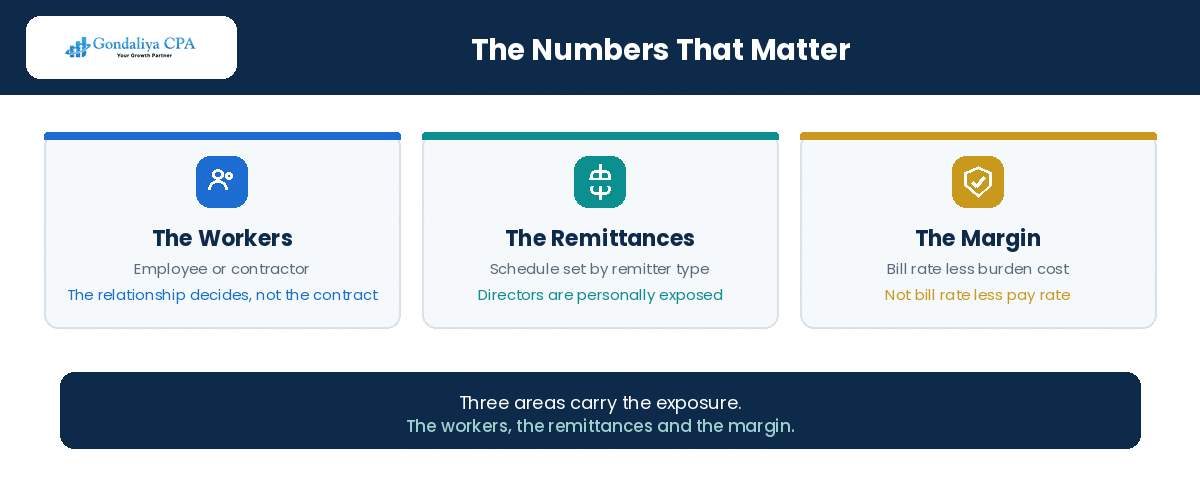
The Numbers That Matter
This article covers Canada, with Ontario and Toronto context, and reflects rules current to 2026. It assumes an incorporated staffing, recruitment or temporary placement agency with payroll, statutory deductions and client billing. Figures marked illustrative are examples, not quotes, and any masked engagement notes end with “Figures changed for privacy.” This is educational information only and not tax or legal advice. Licensing rules for temporary help agencies are provincial and outside accounting scope, so please take legal advice on those.
Staffing Agency Accounting Services in Canada
Staffing Agency Accounting in Canada
The Basics
- Focus on cash flow management
- Accurate payroll processing
- Compliance with Canadian regulations
- Financial performance optimization
Choosing the right accounting services is key to managing daily operations without stress.
Specialized CPA Support for Staffing Agencies and Temp Firms
Working with a staffing agency CPA brings clear benefits. They understand temp firms and their specific tax rules. Gondaliya CPA provides services like bookkeeping, corporate tax filing, and payroll management that suit staffing agencies all across Canada.
- Expert knowledge of staffing industry tax rules
- Bookkeeping tailored for temp firms
- Corporate tax filing assistance
- Payroll management made easy
These CPAs help reduce errors and keep your business compliant.
Key Benefits of Partnering with a Staffing Agency Accountant
Hiring a staffing agency accountant offers many advantages:
- Keeps your business in line with CRA rules on deductions and payments
- Creates financial plans focused on taxes and cash flow
- Saves you time by handling complex accounting tasks
- Prepares accurate reports to guide your decisions
A good staffing agency tax accountant helps avoid penalties from misfilings or wrong employee classifications. This support adds security to your business’s future.
Our Approach to Tax Planning and Compliance
Gondaliya CPA works closely with staffing agencies to plan taxes ahead of time and stay within legal limits. We look for ways to save money while making sure everything follows the law. Our team knows about GST/HST issues on billing and how to handle payroll duties properly.
- Proactive tax planning
- Careful compliance monitoring
- Guidance on GST/HST related to billing rates
- Effective payroll management
By using our expertise as a trusted provider, staffing businesses can keep their finances steady and succeed even when rules change.
The first thing we check is whether GST/HST is being charged on the full bill rate or only the margin. Getting that wrong quietly builds a liability across every invoice. Figures changed for privacy.
Risk Warning: Directors can be assessed personally for unremitted source deductions. Please treat payroll remittances as the first payment out of the account each cycle.
Comprehensive Accounting and Tax Services for Staffing Agencies
Comprehensive Accounting and Tax Services
The Services
Staffing agencies face unique challenges in managing payroll, taxes, and finances. A staffing agency accountant Canada knows these issues well. They provide services that keep financial records accurate and taxes filed on time. With their help, staffing agency accounting services run smoothly. A staffing agency CPA Canada can also help manage cash flow and keep everything compliant with Canadian tax laws.
Corporate Tax Filing and GST/HST Registration
Corporate tax filing for staffing agencies needs careful attention to revenue and expenses. A staffing agency tax accountant ensures the T2 return includes all necessary adjustments under the Income Tax Act. This covers things like employment costs and statutory deductions.
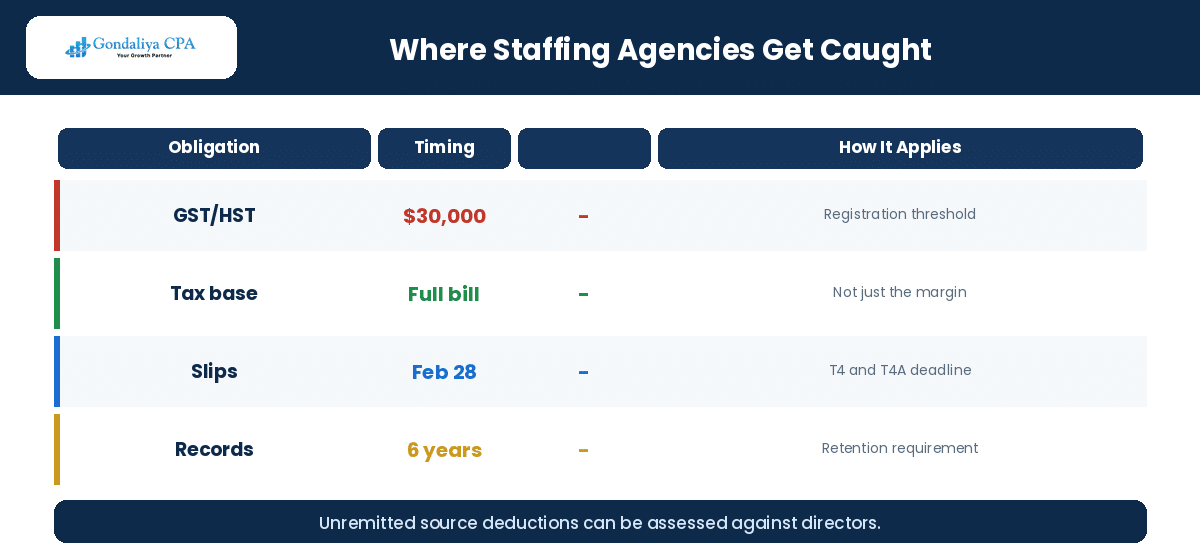
GST/HST registration is required once taxable supplies go over $30,000 a year. This amount counts total sales across all provinces where placements happen. Staffing agencies must charge GST/HST on the full bill rate, not just their margin. This means invoices must follow CRA rules carefully.
A good staffing agency accountant Canada will register your business correctly based on where workers are placed. That avoids mistakes with how often you file or the rates you apply.
- Accurate T2 filing with all expense claims
- GST/HST registration after $30,000 taxable supplies
- Charge GST/HST on full billing amounts
- Proper registration by place-of-supply rules
Payroll Reporting, Source Deductions and Remittance
Payroll reporting gets tricky with high turnover in temp work. Staffing agencies often run weekly payroll but get paid by clients after 30 to 60 days. That gap can make managing source deductions tough.
Staffing agency accounting services handle CPP contributions up to the annual maximum and EI premiums at current rates. Employers must send these payments on time to avoid penalties.
Worker classification matters here. Treating someone as a contractor instead of an employee can cause big problems later, including retroactive amounts and interest.
A staffing agency CPA Canada makes sure slips like T4 or T4A are issued correctly following CRA guidelines.
Remittance management means tracking due dates closely, since late remittances attract graduated penalties that increase with how late the payment is, plus interest.
- Calculate CPP and EI properly per employee
- Meet payment deadlines based on your remitter type
- Confirm worker status: employee versus contractor
- Use software tools to track remittance dates
Bookkeeping and Financial Statement Preparation
Bookkeeping for recruitment firms needs careful record keeping of hours worked versus wages paid. It also tracks liabilities like vacation pay accruals. You should separate direct labour costs from overhead expenses like workplace insurance premiums where relevant.
Financial statements follow ASPE standards for small to mid-sized companies. Compilation engagements under CSRS 4200 help lenders and stakeholders trust the numbers, using proper GIFI codes covering balance sheets, income statements, and cash flows.
Monthly reconciliations focus heavily on accounts receivable since clients often pay late in this industry.
- Track billable hours versus wages accurately
- Segregate labour costs from overheads
- Prepare ASPE-compliant financial statements
- Monitor receivables closely each month
Employment Standards and Contractor Classification
Employment standards tie closely to how workers get classified for payroll taxes in Ontario or other provinces.
The CRA uses tests based on control over the work, ownership of tools, chance of profit and risk of loss, and integration into the business to decide if a worker is an employee or contractor. Getting this wrong risks retroactive CPP and EI amounts plus penalties, and can engage director liability.
Licensing for temporary help agencies falls under provincial rules. Please take legal advice on licensing questions, as this sits outside accounting scope.
Keeping thorough documentation for contractors lowers risk but does not guarantee their status during a CRA review.
- Worker status affects payroll tax duties
- The CRA applies a facts-based test to classification
- Licensing varies by province, so seek legal input
- Documentation helps but does not determine the outcome
CRA Representation for Audits and Notices
If the CRA reviews your payroll or GST/HST files, a staffing agency tax accountant can represent you. They act quickly using the authorization form to communicate with the CRA on your behalf.
Representation means preparing clear replies about source deduction issues arising from worker classification, late payments, or input tax credit disputes.
Early action can support a request for penalty relief where the circumstances warrant it.
Good representation lets owners focus on day-to-day operations despite the pressure of a review, which is common in the Toronto and Ontario temp market.
- File authorization forms promptly
- Respond fully to CRA questions
- Request penalty relief where valid
- Keep detailed logs of correspondence
Tax Planning Strategies for Canadian Staffing Companies
Tax planning helps balance salary against dividends so owner-managers stay within the small business deduction limit while avoiding personal services business exposure common in incorporated setups.
Timing bonuses affects how expenses land in taxable income when matched properly to fiscal years.
Capital cost allowance claims apply to office equipment used for billing or payroll systems, which matters in tight-margin environments like light industrial or executive search.
Planning instalment payments prevents interest charges caused by income shifts tied to slow client payments, a familiar pattern for agencies serving Ottawa, Guelph and similar markets.
- Mix salary and dividends deliberately
- Time bonuses near year-end thoughtfully
- Claim capital cost allowances prudently
- Schedule instalments to avoid interest
Weekly payroll against sixty-day receivables is the structural problem. Everything else, from factoring cost to instalment timing, is a consequence of it. Figures changed for privacy.
Key Stat: GST/HST applies to the full bill rate, not the margin. Please check your invoice template before assuming this is right.
Roles and Industry-Specific Accounting Solutions
Industry-Specific Accounting Solutions
By Agency Type
Staffing agencies in Canada face unique accounting challenges. A staffing agency accountant Canada knows the payroll intensity and tight margins well. Staffing agency CPA Canada experts offer staffing agency accounting services designed to handle these specifics. They help keep finances accurate, tax compliance in check, and cash flow steady.
Contract, Permanent and Temporary Recruitment
Accounting differs based on the type of recruitment. Each needs a different way to track revenue and costs. Contract recruitment bills hourly work as it happens. Permanent recruitment fees show up when a candidate starts. Temporary agencies manage weekly payrolls but bill clients later.
A staffing agency accountant Canada helps classify income correctly:
- Matches labour costs with billing
- Tracks CPP and EI deductions properly
- Reconciles timesheets with invoices
For example, a Toronto temp agency placing 50 workers weekly must watch pay rates versus bill rates closely. This prevents losing money when client payments vary. Staffing agency accounting services use cloud accounting combined with payroll tools to automate these tasks.
Managing Payroll and Statutory Costs
Payroll is the biggest cost for incorporated staffing firms. Staffing agency tax accountants calculate CPP and EI employer contributions carefully. They ensure payments follow CRA deadlines.
T4 slips report employee income with deductions taken out. T4A slips cover contractors classified correctly per CRA rules. Wrong classification risks assessment of the amounts that should have been withheld, plus penalties and interest.
Agencies file T4 and T4A returns by the last day of February after year-end. Payroll records must be kept for six years. Good record keeping lowers director liability exposure tied to unpaid remittances.
Financial Management for Incorporated Agencies
Incorporated staffing firms in Canada need solid financial control combining tax planning with cash flow tracking. Staffing agency CPA Canada advisors watch accounts receivable because clients usually pay after 60 days while workers get paid weekly.
Financial statements use ASPE standards, showing gross revenue where the agency acts as principal rather than agent. This helps meet lender requirements by reporting detailed margins including labour costs and factoring where used.
Ontario companies also deal with rules like the Employment Standards Act affecting accruals for vacation or statutory holidays. Incorporation can support small business deduction claims where the conditions are met.
Director Liability and Business Number Requirements
Directors can be personally liable if source deductions are not withheld or remitted, under section 227.1 of the Income Tax Act. This makes having a staffing agency tax accountant important for following CRA remittance schedules based on your remitter type.
Getting a business number with the right program accounts, such as payroll and GST/HST, is required before starting operations. Missing this step causes penalties that affect the company and can reach directors.
Regularly checking filings helps catch mismatches between wages reported and amounts remitted, avoiding costly reviews later.
| Director Liability Risk | Description |
|---|---|
| Late Remittance | Penalties and interest begin immediately |
| Failure To Deduct | The corporation, and potentially directors, remain liable |
| Incorrect Classification | Retroactive assessments and penalties possible |
Bad Debt Deductions and Receivable Financing
Bad debts happen when clients delay payment past contract terms or become insolvent, a common problem given fast payroll cycles but slow collections. Staffing agency accounting services apply the bad debt deduction tests in the Income Tax Act.
GST/HST adjustments must also happen, since tax previously accounted for may be recoverable where the conditions are met. Keeping full documentation helps defend these claims if the CRA reviews them.
Factoring receivables can boost cash flow but needs proper accounting to separate proceeds from revenue, which avoids misstating earnings. Agencies should weigh factoring costs against recourse obligations carefully, with the treatment explained clearly in CPA-prepared financials.
Industry-Specific Challenges in Taxation and Compliance
Tax rules for staffing agencies mix federal law with provincial licensing rules. The many short-term contracts mean lots of slips across provinces. A staffing specialist CPA knows how to handle cross-border withholding where it applies.
Common mistakes include:
- Charging GST/HST only on markup instead of the full bill rate, causing reassessments
- Missing taxable benefits hidden in pay packages
- Poor accruals skewing profit margins
- Forgetting instalment payments, which causes interest charges
An experienced staffing agency CPA Canada avoids these issues through careful planning that keeps pace with legislative change.
Worker classification is the file we are asked to fix most. The contract says contractor, the working relationship says employee, and the CRA looks at the relationship. Figures changed for privacy.
Risk Warning: Reporting revenue net when you act as principal understates your top line and can breach lender covenants. Please confirm the principal-agent position before the statements are prepared.
Hiring Process and Client Engagement
Hiring Process and Client Engagement
The Process
If you run a staffing agency in Canada, finding the right accountant matters. Gondaliya CPA knows the ins and outs of staffing agency accounting services. We focus on Canadian rules and the payroll challenges you face. Being a CPA Ontario Registered Firm helps us guide you through everything from bookkeeping to corporate tax filing.
We start by learning about your business setup and payroll schedule. Whether you’re in Toronto or elsewhere in Canada, our team acts as your staffing agency accountant Canada trusts. You get financial reports that match your daily operations.
Steps from Initial Consultation to Ongoing Support
Working with Gondaliya CPA follows clear steps:
- Initial consultation: We review your accounting, payroll, and tax needs in staffing.
- Customized proposal: We offer options like cleanup or full annual packages.
- Onboarding: Set up accounts that separate bill rates from pay rates and include all statutory costs.
- Ongoing support: Monthly checks keep track of receivables and client payments.
- Annual close and tax filing: Prepare financial statements per CSRS 4200 and file T2 returns for incorporated agencies.
This process helps owners and payroll teams avoid costly mistakes like misclassification or late remittances.
Solutions for Small, Medium and Large Agencies
Staffing agencies come in all sizes. Each size needs different services:
- Small firms get basic bookkeeping, GST/HST filings, and year-end tax preparation at a fixed annual fee.
- Medium firms benefit from payroll systems plus detailed reporting for multi-provincial work.
- Large agencies require more complex reviews and tax planning around owner-operator rules.
Gondaliya CPA adjusts its staffing agency accounting services to fit your scale while keeping a close eye on compliance. This matters when you juggle paying workers weekly but getting paid monthly.
Clear Communication Throughout the Process
Good communication matters with complex staffing finances. We keep you updated on key dates like remittance calendars matching CRA deadlines. You will see margin analyses that explain cost pressures such as overtime or factoring fees.
We answer questions about T4 versus T4A slips, vacation accruals, or GST/HST billing quickly, often within one business day, and we are sometimes available on weekends. This helps reduce stress when you make cash flow decisions in busy markets like Toronto’s temp sector.
Integration With Your Accounting Software
Manual data entry causes errors, especially in recruitment with many contracts across provinces. Gondaliya CPA works with the main cloud accounting, payroll and payment platforms so timekeeping data syncs with the invoices your finance team manages.
Integration automates CPP and EI deductions at current thresholds. It cuts down delays from mismatched data. It also helps generate the slips the CRA requires each year without repeats or missed deadlines that cause penalties.
Support for Payroll Managers and HR Teams
Payroll managers pay workers weekly but often wait up to 60 days to collect from clients. Tracking cash gaps gets tricky. Our team acts like an extension of your HR group to help.
We guide worker classification based on the CRA’s tests, assist with records of employment under employment standards requirements, and send alerts before key filing deadlines arrive. This lowers the risk tied to director liability under section 227.1.
Throughout each pay cycle, we verify hours billed versus paid rates and reconcile statutory holiday payouts carefully. Payroll professionals at Canadian staffing companies rely on us to keep numbers right while staying flexible enough for daily operations.
Onboarding starts with the chart of accounts, not the ledger. If bill rate and pay rate share an account, no margin report will ever be trustworthy. Figures changed for privacy.
Pro Tip: Please separate bill rate from pay rate in your chart of accounts from day one. Splitting them afterwards means rebuilding a year of entries.
Client Outcomes and Data-Driven Insights
Client Outcomes and Data-Driven Insights
In Practice
Staffing agencies in Canada often face tricky accounting needs. Gondaliya CPA is a staffing agency accountant in Canada that has worked with many firms to improve their financial compliance and cut tax costs. Our staffing agency accounting services focus on real issues for incorporated staffing companies.
Here’s what we have helped with:
- Fixing payroll problems
- Improving GST/HST filing accuracy
- Avoiding tax penalties
- Boosting cash flow management
This kind of specialized help makes a difference for staffing agencies navigating complex rules.
Examples of Improved Compliance and Tax Savings
One recruitment agency in Toronto had payroll delays and errors in GST/HST filings. Our team found problems in source deductions and missed input tax credits on cross-provincial work. New bookkeeping systems brought the filings back on schedule and late-filing penalties fell sharply within a year. Figures changed for privacy.
Another client, an IT contract placement firm, faced personal services business exposure tied to owner-operated contractors. The team reviewed the contractor classifications against the CRA’s employee versus self-employed guidance, then restructured the arrangements to reduce that exposure and make proper use of the small business deduction.
These examples show how good staffing agency accounting services turn difficult rules into a manageable position.
Payroll Efficiency and GST/HST Accuracy
Payroll can be tricky when agencies pay workers weekly but get paid by clients much later.
A healthcare staffing firm was losing cash because its remitter type was set incorrectly, distorting the timing of CPP and EI payments. Correcting the remittance schedule against the CRA’s rules stopped the overpayments. Figures changed for privacy.
In another case, a logistics staffing company charged GST only on its margin rather than the full billing rate. That is not what the Excise Tax Act requires and it invites reassessment. Fixing it meant correct GST charged going forward and proper input tax credits on costs such as workplace insurance.
These cases show the value of a staffing agency accountant who knows both payroll mechanics and GST/HST rules.
Common Pitfalls and How to Avoid Them
Many agencies slip up by treating placed workers as independent contractors without enough support. That leads to retroactive source deductions plus penalties. Others report revenue net when they should report it gross as principal. Common mistakes also include:
- Forgetting to accrue vacation pay properly
- Ignoring burden costs when calculating margins
- Missing statutory liability accruals monthly
Avoid these by:
- Keeping solid worker classification files using the CRA’s guidance
- Reporting revenue gross when you control service delivery
- Including all labour costs like overtime in cost accounts
- Accruing liabilities monthly alongside payroll periods
Working with accountants who know employment agency accounting makes these controls routine and stops costly fixes later.
Cash Flow Timing and Margin Calculation
Cash flow timing causes stress because agencies pay wages weekly but wait roughly 60 days for client payments. A rolling cash gap analysis helps spot problems early.
| Metric | Example Value | Impact |
|---|---|---|
| Weekly Payroll Cost | $120,000 | Cash goes out immediately |
| Average Days Outstanding | 60 days | Payments come late |
| Factoring Usage | 20% | Helps but adds expense |
Figures are illustrative only. Margins must cover all labour costs including the employer share of CPP and EI, workplace insurance premiums where required, vacation accruals, plus administrative overhead. Keeping an eye on these numbers lets agencies plan better, whether by negotiating deposits or arranging factoring, to avoid cash crunches while growing.
Regular Compilation and Tax Planning Reviews
Monthly financial statement compilations give owners a clear view of client margin and headcount cost each month. Yearly tax planning reviews find ways to lower taxable income, for example by timing bonus accruals or optimizing capital cost allowance claims.
Regular contact with a trusted staffing agency CPA lowers the risk of filing errors or wrong instalment payments, and finds savings through planning that keeps pace with legislative change.
For advice suited to your incorporated temp or recruitment firm, email Gondaliya CPA at info@gondaliyacpa.ca or call 647-212-9559 for a free consultation.
Burden costs are the number owners underestimate most. A margin that looks healthy on pay rate alone often disappears once the employer share and accruals are loaded in. Figures changed for privacy.
Key Stat: Margin must cover the fully burdened cost, not just the pay rate. Please load employer contributions, accruals and insurance before quoting a bill rate.
Serving Staffing Agencies Across Toronto, Etobicoke, Vaughan, Mississauga and Surrounding Areas
Serving Toronto and Surrounding Areas
Get in Touch
Gondaliya CPA works closely with staffing agencies all over Toronto and nearby areas like Etobicoke, Vaughan, and Mississauga. We offer staffing agency accounting services made for incorporated staffing companies. Our team knows the local rules and CRA requirements well. That helps your business stay on track and avoid costly mistakes. We also keep an eye on the payroll details that matter most in this tight-margin industry.
If your agency runs anywhere in Ontario, you will find our experience helpful. We focus on keeping your cash flow steady while following all regulations. That is why many staffing firms trust us as their staffing agency accountant across Canada.
How to Contact Gondaliya CPA
Need advice from a staffing agency accountant Canadian businesses count on? Reach out to Gondaliya CPA by phone at 647-212-9559 or email info@gondaliyacpa.ca. Our Ontario CPA firm answers fast, usually within one business day.
We offer consultations in the evenings or on weekends too, so you can talk when it suits you. We work with incorporated small and mid-sized staffing businesses, so we understand the CRA rules and provincial requirements that apply specifically to your operations.
Corporate Tax Filing and Bookkeeping
Looking for help with corporate tax filing? We provide a flat annual fee plan that covers bookkeeping all year plus year-end T2 returns. Many call us the staffing agency CPA Canada relies on for accuracy and compliance.
We help manage statutory costs while keeping your books clean and review-ready. If you want to simplify your reporting duties, please set up a free consultation.
Tax Preparation, Employment Compliance and CRA Representation
Our team includes staffing agency tax accountants who know employment taxes well. This includes reconciling source deductions and issuing T4 and T4A slips. We also stand up for you if the CRA reviews your business or questions worker classifications.
If there is a risk of retroactive assessment for amounts that should have been withheld, getting help early can save money and stress.
Getting Started
Start protecting your staffing firm’s finances by working with accountants who know payroll from the inside. Our team understands the recruitment industry’s challenges across Ontario, Toronto included.
We make sure filings happen on time without surprises at year-end. Call Gondaliya CPA at 647-212-9559, email info@gondaliyacpa.ca, or reach us here for a no-pressure chat about keeping your margins safe through accurate accounting.
Related Topics Worth Understanding
These areas come up repeatedly for Canadian staffing agencies:
- Payroll remittance deadlines: Due dates differ by remitter type, so confirm which category applies to your business.
- GST/HST on bill rates: Tax applies to the full bill rate rather than the margin, and the place-of-supply rules decide the rate.
- Statutory cost management: Tracking CPP and EI contributions alongside vacation pay accruals keeps margins honest.
These sit alongside our hands-on work as a staffing agency accountant Canadian companies rely on to handle complex rules.
Agencies in the Greater Toronto Area rarely fail on the tax rules themselves. They fail on the calendar, because weekly payroll leaves no slack for a missed remittance date. Figures changed for privacy.
Pro Tip: Please confirm your remitter type in writing rather than assuming monthly. The wrong assumption produces late remittances every single cycle.
Frequently Asked Questions on Staffing Agency Accounting
Frequently Asked Questions
FAQ
What are the key filing deadlines a staffing agency must meet in Canada?+
Staffing agencies must file T4 and T4A slips by the last day of February. Corporate tax returns are due six months after the fiscal year-end. Payroll remittances follow the CRA’s due dates based on remitter type.
How do you track bill rate, pay rate, and gross margin in staffing agency accounting?+
Track bill rates separately from pay rates in your chart of accounts. Calculate gross margin by subtracting total labour costs, including statutory contributions and accruals, from billing revenue.
Should revenue be reported gross or net for a staffing agency?+
Revenue should be reported gross when you control service delivery and act as principal. Net reporting applies only if you act as an agent, which is rare for staffing agencies.
How do placement and employment agency rules affect CPP and EI contributions?+
CPP and EI apply to employees. Correct worker classification ensures proper deduction. Misclassification leads to penalties and retroactive amounts.
What payroll obligations come with a large temporary workforce?+
You must calculate CPP and EI contributions correctly, issue accurate T4 and T4A slips, remit source deductions on time, and comply with employment standards.
What happens if payroll remittances are late or short?+
The CRA applies graduated penalties that increase with how late the remittance is, plus interest. Directors can face personal liability for unpaid deductions under section 227.1.
How do you handle vacation pay, statutory holidays, and accruals?+
Accrue vacation pay monthly based on employee entitlements. Track statutory holiday pay separately. Include these liabilities in payroll cost calculations.
How do you manage cash when you pay weekly but collect in sixty days?+
Use cash flow forecasting and consider factoring receivables or a line of credit to bridge the timing gap between payroll and collections.
Factoring or a line of credit: which route fits a staffing agency?+
Factoring offers immediate cash but can be costly and may carry recourse. A line of credit is cheaper but requires strong credit standing. Choose based on your cash cycle.
How do you recognize permanent placement fees and handle guarantees?+
Recognize permanent placement fees when the candidate starts work. Provide for the guarantee obligation until the guarantee period expires.
How do you handle bad debts and client non-payment?+
Apply the bad debt deduction rules in the Income Tax Act. Maintain documentation to support claims and adjust GST/HST where the conditions are met.
What financial statements will lenders or the CRA expect?+
Prepare ASPE-compliant financial statements including balance sheet, income statement, and cash flow statement with notes on key assumptions.
Which reports should an owner review every week and month?+
Owners should review weekly cash flow reports, receivables aging and payroll summaries, plus monthly profit margin analyses by client or contract type.
What tax planning options suit a Canadian staffing agency?+
Combine salary and dividends deliberately to use the small business deduction. Time bonus payments to land the deduction in the right year and claim capital cost allowance prudently.
What triggers a CRA review of a staffing agency?+
Triggers include worker misclassification, late payroll remittances, inconsistent GST/HST filings, or unusual expense claims relative to revenue.
How do you catch up on missed filings and messy books?+
Engage professionals for cleanup that reconciles accounts, files outstanding returns promptly, and establishes an organized bookkeeping system going forward.
What are best practices to run the fiscal year efficiently?+
Maintain timely reconciliations, track statutory liabilities monthly, monitor cash flow closely, plan taxes quarterly, and communicate regularly with your CPA.
Seventeen questions and one running beneath them: who is the employer. Almost every staffing agency file turns on that single answer. Figures changed for privacy.
Essential Staffing Agency Accounting Insights
Essential Accounting Insights
Quick Reference
Numbers and Rules That Shape the File
- What makes it different: Staffing agency accounting differs because frequent payroll cycles combine with delayed client payments, which demands precise cash management.
- Contribution rates: CPP and EI rates and ceilings change annually, so please confirm current figures each year.
- Payroll remittance due dates: These vary by remitter type. Confirm whether you are a regular, quarterly or accelerated remitter.
- GST/HST threshold: Registration is required once taxable supplies exceed $30,000 annually, and filing frequency depends on revenue size.
- Corporate tax filing: The T2 is due six months after fiscal year-end, and late filing attracts penalties.
- Records retention: Keep records for at least six years.
- Director liability: Directors can face personal liability under section 227.1 for unremitted source deductions.
- Scope of services: Bookkeeping, tax planning, payroll reporting and CRA representation specific to staffing agencies.
- Who this suits: Best for incorporated staffing firms with employees, rather than sole proprietors without payroll.
Practices That Protect Margin and Compliance
- Chart of accounts: Separate billable revenue streams from labour expenses and track statutory costs distinctly.
- Worker classification: Classification depends on control, tools, chance of profit and integration. Misclassification risks assessment.
- Late remittances: Penalties apply immediately and interest accumulates, so the remittance calendar is not negotiable.
- Financial statements: Lenders and the CRA expect ASPE-compliant statements with supporting notes tailored to staffing.
- DIY versus CPA: Professional services give better support during a review, while doing it yourself carries compliance risk. Choose on complexity.
- How we handle files: We integrate your software with processes that match billing against payroll.
- Deliverables: Monthly reconciliations, tax planning reviews, and year-end financial statements.
- Pricing: A flat annual fee including HST, quoted before any work begins.
- Top mistakes: Misclassification and late filings, both preventable through disciplined bookkeeping.
- Before engagement: Assemble past financials, worker classification documents, and business number registrations.
- By agency type: Permanent placement needs fee recognition policy; temp agencies focus on weekly payroll compliance.
- Margin walkthrough: Model wages plus employer costs against billed amounts less factoring fees to see true profit.
- Choosing a firm: Look for recruitment-specific experience plus proactive communication.
- Why us: Backed by 1450+ five-star Google reviews and focused on Canadian incorporated businesses.
- Key terms: Principal versus agent, remitter type, personal services business, burden cost and gross margin.
For professional guidance tailored to your Canadian staffing firm’s needs, contact Gondaliya CPA at info@gondaliyacpa.ca or call 647-212-9559 today.
Twenty-four points and one underneath them: know your fully burdened cost per hour. Every pricing and margin decision an agency makes depends on that number. Figures changed for privacy.
Agency Types We Serve
Industry Expertise
Which issue dominates differs by agency type. Here are ten and the usual focus.
| Agency Type | Where the Exposure Sits |
|---|---|
| Temporary and light industrial | Weekly payroll against sixty-day receivables |
| Permanent placement | Fee recognition and guarantee obligations |
| Contract and IT placement | Personal services business exposure on owner-operators |
| Healthcare staffing | Remitter type accuracy across high headcount |
| Executive search | Revenue timing on retained versus contingent fees |
| Multi-provincial placements | Place-of-supply rules and slip volume |
| Agencies using factoring | Separating proceeds from revenue in the statements |
| Heavy contractor engagement | Worker classification documentation |
| Rapid growth agencies | Instalment obligations lagging real income |
| Behind on filings | Catch-up returns and director liability exposure |
- Temporary and light industrial: The cash gap is the business model, so it has to be funded deliberately.
- Permanent placement: Fees are earned on start date, and the guarantee is a real obligation.
- Contract and IT placement: Owner-operated contractors carry the sharpest classification risk.
- Healthcare staffing: High headcount magnifies any error in the remittance schedule.
- Executive search: Retainers and contingent fees are recognised on different bases.
- Multi-provincial placements: The rate follows the place of supply, not your head office.
- Agencies using factoring: Proceeds are financing, not revenue, and must be shown that way.
- Heavy contractor engagement: Documentation lowers risk but does not settle status.
- Rapid growth agencies: Instalments based on last year leave a shortfall at filing.
- Behind on filings: Unremitted source deductions reach directors personally.
The agency type changes where the exposure sits. It does not change the method, which is classify the workers, remit on schedule, then fund the cash gap deliberately. Figures changed for privacy.
Professional Guidance and Quick Reference
Guidance
Professional Guidance for Agencies: How Gondaliya CPA Handles Your File
Staffing agencies run into trouble in a predictable set of ways: workers treated as contractors when the relationship says employee, GST/HST charged on the margin instead of the full bill rate, source deductions remitted on the wrong schedule, revenue reported net when the agency acts as principal, margins quoted before burden costs are loaded, and a cash gap between weekly payroll and sixty-day receivables that nobody funded. Gondaliya CPA handles staffing agency accounting on a fixed annual fee.
We handle what decides the outcome: reviewing and documenting worker classification against the CRA tests, confirming your remitter type and building the remittance calendar around it, charging GST/HST on the full bill rate with the right place-of-supply rate, setting a chart of accounts that separates bill rate from pay rate, loading employer contributions and accruals into true burden cost, deciding the principal-agent position before the statements are prepared, and managing director liability exposure on source deductions.
Our team starts with worker classification and the remittance calendar, because those two carry the personal exposure. Temp, permanent, contract or executive search, you get clear advice and a fixed price before we start.
Quick Answers: Key Numbers & Concepts at a Glance
At a Glance
- GST/HST: $30,000 registration threshold
- Tax base: Full bill rate, not the margin
- Slips: T4 and T4A by end of February
- Corporate return: T2, six months after year end
- Remittances: Schedule set by remitter type
- Director liability: Section 227.1
- Revenue: Gross where you act as principal
- Statements: ASPE, compiled under CSRS 4200
- Small business limit: $500,000, shared if associated
- Records: Six years retention
Who This Is For / Not For
Fit Check
- For: Incorporated staffing, recruitment and temporary placement agencies in Canada running payroll and billing clients.
- Not For: Sole proprietors with no employees, and provincial temporary help agency licensing, which needs legal advice rather than accounting.
People Also Ask
Related Questions
Can I invoice a client without charging GST/HST if the worker is a contractor?+
No. If you are registered, the supply you make to the client is your service, and tax applies to the full bill rate regardless of how you engage the worker.
Does a placed worker count as my employee or the client’s?+
In most temporary staffing arrangements the agency is the employer and carries the payroll obligations, but the facts govern. Please have the arrangement reviewed.
How long am I exposed as a director after resigning?+
Director liability for source deductions is time-limited after you cease to be a director, but the limit is fact-specific. Please take advice before relying on it.
Glossary of Key Terms
- T2: The corporation income tax return.
- Bill rate: The hourly amount charged to the client.
- Pay rate: The hourly amount paid to the worker.
- Burden cost: Pay rate plus employer contributions, accruals and insurance.
- Gross margin: Billing revenue less fully burdened labour cost.
- Principal versus agent: Whether revenue is reported gross or net.
- Source deductions: CPP, EI and income tax withheld from wages.
- Remitter type: The CRA classification setting your remittance due dates.
- T4 slip: The statement of remuneration paid to an employee.
- T4A slip: The statement of other income paid to a contractor.
- Worker classification: Whether a person is an employee or a contractor.
- Personal services business: An incorporated employee arrangement taxed punitively.
- Director liability: Personal exposure for unremitted source deductions.
- Factoring: Selling receivables for immediate cash, at a cost.
- Place of supply: The rules deciding which provincial rate applies.
- CSRS 4200: The standard governing compilation engagements.
Agency Compliance Readiness Check
This quick self-check indicates where your operation most likely has room. Please answer the six questions below.
#gcpa-stf{–n:#0f2a4a;–n2:#15355c;–bl:#1c6dd0;–tl:#0c8f8f;–gd:#c9991f;–rd:#c0392b;–ink:#1d2733;–mut:#5a6b7b;–ln:#d8e0e8;–alt:#f5f8fb;
border:1px solid var(–ln);border-radius:14px;overflow:hidden;background:#fff;box-shadow:0 10px 30px rgba(15,42,74,.08);font-family:inherit;color:var(–ink);margin:24px 0;}
#gcpa-stf *{box-sizing:border-box;}
#gcpa-stf .p-head{background:linear-gradient(135deg,var(–n),var(–n2));color:#fff;padding:18px 22px;}
#gcpa-stf .p-head h5{margin:0;font-size:19px;font-weight:700;color:#fff!important;}
#gcpa-stf .p-head p{margin:4px 0 0;font-size:13px;color:#cfe2f8!important;}
#gcpa-stf .p-body{padding:20px 22px;}
#gcpa-stf .p-q{padding:13px 0;border-bottom:1px solid var(–ln);display:flex;justify-content:space-between;align-items:center;gap:14px;}
#gcpa-stf .p-q:first-child{padding-top:2px;}
#gcpa-stf .p-q span.p-lab{font-weight:600;font-size:14.5px;color:var(–n);}
#gcpa-stf .p-seg{display:inline-flex;border:1px solid var(–ln);border-radius:10px;overflow:hidden;flex:0 0 auto;}
#gcpa-stf .p-seg label{cursor:pointer;padding:8px 18px;font-size:14px;font-weight:600;color:var(–mut);background:var(–alt);transition:.15s;user-select:none;}
#gcpa-stf .p-seg label+label{border-left:1px solid var(–ln);}
#gcpa-stf .p-seg input{position:absolute;opacity:0;width:0;height:0;}
#gcpa-stf .p-seg input:checked+label{background:var(–n);color:#fff!important;}
#gcpa-stf .p-go{margin-top:18px;width:100%;border:none;border-radius:11px;padding:14px 18px;font-size:15.5px;font-weight:700;color:#fff!important;cursor:pointer;background:linear-gradient(135deg,var(–bl),var(–tl));}
#gcpa-stf .p-go:hover{filter:brightness(1.05);}
#gcpa-stf .p-msg{display:none;margin-top:12px;font-size:13.5px;color:var(–rd);font-weight:600;}
#gcpa-stf .p-out{display:none;margin-top:18px;border-radius:12px;border:1px solid var(–ln);overflow:hidden;}
#gcpa-stf .p-out .p-status{padding:14px 18px;font-weight:700;font-size:16px;color:#fff!important;background:linear-gradient(135deg,var(–n),var(–n2));}
#gcpa-stf .p-out .p-inner{padding:16px 18px;background:var(–alt);}
#gcpa-stf .p-row{font-size:14.5px;margin:0 0 10px;line-height:1.5;}
#gcpa-stf .p-count{display:inline-block;background:#fff;border:1px solid var(–ln);border-radius:9px;padding:8px 14px;font-weight:700;color:var(–n);font-size:14.5px;}
#gcpa-stf .p-list{margin:8px 0 0;padding-left:18px;}
#gcpa-stf .p-list li{font-size:13.5px;color:var(–ink);margin:4px 0;}
#gcpa-stf .p-cta{display:inline-block;margin-top:14px;background:var(–gd);color:#fff!important;font-weight:700;font-size:14.5px;text-decoration:none;padding:11px 20px;border-radius:10px;}
#gcpa-stf .p-note{font-size:12.5px;color:var(–mut);margin:12px 0 0;}
@media(max-width:560px){#gcpa-stf .p-q{flex-direction:column;align-items:flex-start;gap:8px;}}
Agency Compliance Readiness Check
Six quick questions on your agency. No fee shown.
Points to raise with us:
This is a general prompt, not tax or legal advice or a quote. Your position depends on your full facts. For a real review, please book a free consultation.
(function(){
var root=document.getElementById(‘gcpa-stf’);
function rv(n){var x=root.querySelector(‘input[name=”‘+n+'”]:checked’);return x?parseInt(x.value,10):null;}
root.querySelector(‘#p-go’).addEventListener(‘click’,function(){
var ks=[‘p-a’,’p-b’,’p-c’,’p-d’,’p-e’,’p-f’],vals=ks.map(rv);
var msg=root.querySelector(‘#p-msg’), out=root.querySelector(‘#p-out’);
if(vals.indexOf(null)!==-1){msg.style.display=’block’;out.style.display=’none’;return;}
msg.style.display=’none’;
var items=[];
if(rv(‘p-a’)===0) items.push(‘A worker classification review, which carries the personal exposure’);
if(rv(‘p-b’)===1) items.push(‘A remitter type confirmation, before the calendar is built on a guess’);
if(rv(‘p-c’)===1) items.push(‘An invoice template fix, since tax applies to the full bill rate’);
if(rv(‘p-d’)===1) items.push(‘A chart of accounts rebuild, since margin reporting depends on it’);
if(rv(‘p-e’)===1) items.push(‘A monthly accrual routine, so liabilities do not pile up at year end’);
if(rv(‘p-f’)===1) items.push(‘A catch-up plan, since unremitted deductions reach directors personally’);
root.querySelector(‘#p-count’).textContent=items.length+’ of 6′;
var lw=root.querySelector(‘#p-listwrap’), ul=root.querySelector(‘#p-list’), done=root.querySelector(‘#p-done’);
ul.innerHTML=”;
if(items.length){lw.style.display=’block’;done.style.display=’none’;items.forEach(function(t){var li=document.createElement(‘li’);li.textContent=t;ul.appendChild(li);});}
else{lw.style.display=’none’;done.style.display=’block’;}
root.querySelector(‘#p-status’).textContent = items.length>=4 ? ‘Several points to work through’ : (items.length>=1 ? ‘Worth a closer look’ : ‘Nothing obvious flagged’);
out.style.display=’block’;
});
})();
Want a checklist to work from? You can download our free staffing agency compliance checklist before your consultation.
Document worker classification against the CRA tests. Confirm your remitter type in writing. Charge GST/HST on the full bill rate. Split bill rate from pay rate in the accounts. Load burden costs before quoting a margin. Accrue vacation and statutory pay monthly. Decide the principal-agent position before year end. Please keep six years of records.
2026 Update — what is current: This article reflects rules current to 2026. The $30,000 GST/HST registration threshold, the requirement to charge tax on the full bill rate, the end-of-February deadline for T4 and T4A slips, the six-month T2 filing deadline, director liability for source deductions under section 227.1, ASPE reporting and CSRS 4200 compilation standards, and the six-year retention requirement are unchanged. Please note that CPP and EI rates and ceilings are set annually; that late remittance penalties are graduated by how late the payment is rather than a flat monthly 3%; that director liability is time-limited after a person ceases to be a director rather than running for a fixed six years; and that temporary help agency licensing is provincial and requires legal rather than accounting advice.
Staffing Agency Accountant Canada: How Gondaliya CPA Keeps Recruitment and Temp Agencies Compliant
Start with worker classification
Gondaliya CPA reviews and documents worker classification against the CRA tests, confirms your remitter type and builds the remittance calendar around it, applies GST/HST to the full bill rate at the right place-of-supply rate, sets a chart of accounts separating bill rate from pay rate, loads employer contributions and accruals into true burden cost, settles the principal-agent position before the statements are prepared and manages director liability exposure, on a flat annual fee including HST with a one-business-day response. Please book a free consultation.
Next Steps
Please book a free consultation with Gondaliya CPA and bring a sample client invoice, a recent payroll register, and your last filed corporate return. Those three tell us immediately whether the GST/HST treatment is right, whether the classification and remittances hold up, and where the margin actually sits. You will get a flat annual fee including HST before any work begins. If our content helps, please add gondaliyacpa.ca as a preferred source on Google.
Sharad Gondaliya, CPA — Founder & Managing Director, Gondaliya CPA Professional Corporation
Sharad Gondaliya, CPA, has over 15 years of experience serving incorporated staffing, recruitment and temporary placement agencies, covering worker classification and the employee versus contractor tests, CPP and EI calculation across high-turnover payrolls, source deduction remittance schedules and remitter types, T4 and T4A slip preparation, GST/HST on full bill rates and place-of-supply rules, gross versus net revenue recognition, vacation and statutory holiday accruals, receivable factoring, bad debt deductions, director liability and CRA audit representation. Gondaliya CPA is a CPA Ontario Registered Firm, serving clients across Toronto, Etobicoke, Vaughan, Mississauga, Brampton, Scarborough, Ottawa, Oshawa, Guelph, Hamilton, North York, Windsor, and Canada-wide. Verify our firm on the CPA Ontario public firm directory.
CPA Ontario | US CPA licences in Washington and Montana | CPA Ontario Registered Firm | 1450+ 5-star Google reviews
Published: August 27, 2026 · Last updated: August 27, 2026
Editorial policy: We research against CRA and CPA Ontario sources, fact-check the figures, and Sharad Gondaliya, CPA, reviews the content, which we update as the rules change.
Disclaimer: This article is educational information only and is not tax, legal, or financial advice. Figures marked illustrative are examples rather than quotes or guarantees. It reflects CRA rules current to 2026, including the $30,000 GST/HST threshold, the full bill rate tax base, the end-of-February slip deadline, director liability under section 227.1, and the six-year retention requirement. Rates, limits and expensing rules change and outcomes depend on your specific facts. Please consult a CPA Ontario member before acting.
{
“@context”: “https://schema.org”,
“@graph”: [
{
“@type”: “BlogPosting”,
“@id”: “https://gondaliyacpa.ca/staffing-agency-accountant-canada/#article”,
“headline”: “The Ultimate Guide to Accounting and Tax Services for Staffing Agencies in Canada”,
“description”: “Accounting and tax services for Canadian staffing agencies: worker classification, CPP and EI across high-turnover payrolls, source deduction remittance schedules, GST/HST on the full bill rate, gross versus net revenue recognition, burden cost and margin, receivable factoring and director liability.”,
“datePublished”: “2026-08-27”,
“dateModified”: “2026-08-27”,
“inLanguage”: “en-CA”,
“image”: “https://gondaliyacpa.ca/wp-content/uploads/2026/08/StaffingTax-Featured-27-August-2026.jpg”,
“mainEntityOfPage”: { “@type”: “WebPage”, “@id”: “https://gondaliyacpa.ca/staffing-agency-accountant-canada/” },
“author”: { “@id”: “https://gondaliyacpa.ca/#sharad” },
“reviewedBy”: { “@id”: “https://gondaliyacpa.ca/#sharad” },
“publisher”: { “@id”: “https://gondaliyacpa.ca/#organization” }
},
{
“@type”: “Person”,
“@id”: “https://gondaliyacpa.ca/#sharad”,
“name”: “Sharad Gondaliya”,
“jobTitle”: “CPA (Canada and USA), Founder and Managing Director”,
“worksFor”: { “@id”: “https://gondaliyacpa.ca/#organization” },
“knowsAbout”: [“Restaurant tax planning”, “GST/HST for food service”, “Tip income reporting”, “Payroll source deductions”, “Capital cost allowance”, “Leasehold improvements”, “Small business deduction”, “Holding companies”, “CRA representation”],
“hasCredential”: [
{ “@type”: “EducationalOccupationalCredential”, “credentialCategory”: “CPA Ontario (Canada)” },
{ “@type”: “EducationalOccupationalCredential”, “credentialCategory”: “CPA USA (Washington and Montana)” }
]
},
{
“@type”: “Organization”,
“@id”: “https://gondaliyacpa.ca/#organization”,
“name”: “Gondaliya CPA Professional Corporation”,
“url”: “https://gondaliyacpa.ca/”,
“telephone”: “+1-647-212-9559”,
“email”: “info@gondaliyacpa.ca”,
“areaServed”: “CA”,
“address”: { “@type”: “PostalAddress”, “addressLocality”: “Toronto”, “addressRegion”: “ON”, “addressCountry”: “CA” },
“aggregateRating”: { “@type”: “AggregateRating”, “ratingValue”: “5”, “reviewCount”: “1300”, “bestRating”: “5” }
},
{
“@type”: “Service”,
“name”: “Staffing and Recruitment Agency Accounting and Tax Services Canada”,
“serviceType”: “Worker classification review and documentation, remitter type confirmation and remittance calendar setup, CPP and EI calculation across high-turnover payrolls, T4 and T4A slip preparation, GST/HST registration and full bill rate application, place-of-supply rate determination, chart of accounts design separating bill and pay rates, burden cost and gross margin analysis, vacation and statutory holiday accruals, principal versus agent revenue recognition, receivable factoring treatment, bad debt deductions, ASPE financial statements under CSRS 4200, T2 corporate return preparation, director liability management and CRA audit representation”,
“provider”: { “@id”: “https://gondaliyacpa.ca/#organization” },
“areaServed”: “CA”,
“audience”: { “@type”: “Audience”, “audienceType”: “Incorporated staffing, recruitment, temporary placement, executive search and contract placement agencies across Toronto, Ontario and Canada” }
},
{
“@type”: “HowTo”,
“name”: “How to Run Accounting for a Canadian Staffing Agency”,
“description”: “The order in which a Canadian restaurant corporation works through its tax planning during the year.”,
“step”: [
{ “@type”: “HowToStep”, “position”: 1, “name”: “Classify the workers”, “text”: “Test each engagement against the CRA employee versus contractor factors.” },
{ “@type”: “HowToStep”, “position”: 2, “name”: “Confirm the remitter type”, “text”: “Establish your remittance schedule in writing rather than assuming monthly.” },
{ “@type”: “HowToStep”, “position”: 3, “name”: “Fix the invoice”, “text”: “Charge GST/HST on the full bill rate at the correct place-of-supply rate.” },
{ “@type”: “HowToStep”, “position”: 4, “name”: “Split the accounts”, “text”: “Separate bill rate from pay rate so margin reporting is meaningful.” },
{ “@type”: “HowToStep”, “position”: 5, “name”: “Load the burden”, “text”: “Add employer contributions, accruals and insurance to true labour cost.” },
{ “@type”: “HowToStep”, “position”: 6, “name”: “Accrue monthly”, “text”: “Record vacation and statutory holiday liabilities alongside payroll.” },
{ “@type”: “HowToStep”, “position”: 7, “name”: “Fund the cash gap”, “text”: “Plan for weekly payroll against sixty-day receivables deliberately.” }
]
},
{
“@type”: “FAQPage”,
“@id”: “https://gondaliyacpa.ca/staffing-agency-accountant-canada/#faq”,
“mainEntity”: [
{ “@type”: “Question”, “name”: “What are the key filing deadlines a staffing agency must meet in Canada?”, “acceptedAnswer”: { “@type”: “Answer”, “text”: “Staffing agencies must file T4 and T4A slips by the last day of February. Corporate tax returns are due six months after the fiscal year-end. Payroll remittances follow the CRA’s due dates based on remitter type.” } },
{ “@type”: “Question”, “name”: “How do you track bill rate, pay rate, and gross margin in staffing agency accounting?”, “acceptedAnswer”: { “@type”: “Answer”, “text”: “Track bill rates separately from pay rates in your chart of accounts. Calculate gross margin by subtracting total labour costs, including statutory contributions and accruals, from billing revenue.” } },
{ “@type”: “Question”, “name”: “Should revenue be reported gross or net for a staffing agency?”, “acceptedAnswer”: { “@type”: “Answer”, “text”: “Revenue should be reported gross when you control service delivery and act as principal. Net reporting applies only if you act as an agent, which is rare for staffing agencies.” } },
{ “@type”: “Question”, “name”: “How do placement and employment agency rules affect CPP and EI contributions?”, “acceptedAnswer”: { “@type”: “Answer”, “text”: “CPP and EI apply to employees. Correct worker classification ensures proper deduction. Misclassification leads to penalties and retroactive amounts.” } },
{ “@type”: “Question”, “name”: “What payroll obligations come with a large temporary workforce?”, “acceptedAnswer”: { “@type”: “Answer”, “text”: “You must calculate CPP and EI contributions correctly, issue accurate T4 and T4A slips, remit source deductions on time, and comply with employment standards.” } },
{ “@type”: “Question”, “name”: “What happens if payroll remittances are late or short?”, “acceptedAnswer”: { “@type”: “Answer”, “text”: “The CRA applies graduated penalties that increase with how late the remittance is, plus interest. Directors can face personal liability for unpaid deductions under section 227.1.” } },
{ “@type”: “Question”, “name”: “How do you handle vacation pay, statutory holidays, and accruals?”, “acceptedAnswer”: { “@type”: “Answer”, “text”: “Accrue vacation pay monthly based on employee entitlements. Track statutory holiday pay separately. Include these liabilities in payroll cost calculations.” } },
{ “@type”: “Question”, “name”: “How do you manage cash when you pay weekly but collect in sixty days?”, “acceptedAnswer”: { “@type”: “Answer”, “text”: “Use cash flow forecasting and consider factoring receivables or a line of credit to bridge the timing gap between payroll and collections.” } },
{ “@type”: “Question”, “name”: “Factoring or a line of credit: which route fits a staffing agency?”, “acceptedAnswer”: { “@type”: “Answer”, “text”: “Factoring offers immediate cash but can be costly and may carry recourse. A line of credit is cheaper but requires strong credit standing. Choose based on your cash cycle.” } },
{ “@type”: “Question”, “name”: “How do you recognize permanent placement fees and handle guarantees?”, “acceptedAnswer”: { “@type”: “Answer”, “text”: “Recognize permanent placement fees when the candidate starts work. Provide for the guarantee obligation until the guarantee period expires.” } },
{ “@type”: “Question”, “name”: “How do you handle bad debts and client non-payment?”, “acceptedAnswer”: { “@type”: “Answer”, “text”: “Apply the bad debt deduction rules in the Income Tax Act. Maintain documentation to support claims and adjust GST/HST where the conditions are met.” } },
{ “@type”: “Question”, “name”: “What financial statements will lenders or the CRA expect?”, “acceptedAnswer”: { “@type”: “Answer”, “text”: “Prepare ASPE-compliant financial statements including balance sheet, income statement, and cash flow statement with notes on key assumptions.” } },
{ “@type”: “Question”, “name”: “Which reports should an owner review every week and month?”, “acceptedAnswer”: { “@type”: “Answer”, “text”: “Owners should review weekly cash flow reports, receivables aging and payroll summaries, plus monthly profit margin analyses by client or contract type.” } },
{ “@type”: “Question”, “name”: “What tax planning options suit a Canadian staffing agency?”, “acceptedAnswer”: { “@type”: “Answer”, “text”: “Combine salary and dividends deliberately to use the small business deduction. Time bonus payments to land the deduction in the right year and claim capital cost allowance prudently.” } },
{ “@type”: “Question”, “name”: “What triggers a CRA review of a staffing agency?”, “acceptedAnswer”: { “@type”: “Answer”, “text”: “Triggers include worker misclassification, late payroll remittances, inconsistent GST/HST filings, or unusual expense claims relative to revenue.” } },
{ “@type”: “Question”, “name”: “How do you catch up on missed filings and messy books?”, “acceptedAnswer”: { “@type”: “Answer”, “text”: “Engage professionals for cleanup that reconciles accounts, files outstanding returns promptly, and establishes an organized bookkeeping system going forward.” } },
{ “@type”: “Question”, “name”: “What are best practices to run the fiscal year efficiently?”, “acceptedAnswer”: { “@type”: “Answer”, “text”: “Maintain timely reconciliations, track statutory liabilities monthly, monitor cash flow closely, plan taxes quarterly, and communicate regularly with your CPA.” } },
{ “@type”: “Question”, “name”: “Can I invoice a client without charging GST/HST if the worker is a contractor?”, “acceptedAnswer”: { “@type”: “Answer”, “text”: “No. If you are registered, the supply you make to the client is your service, and tax applies to the full bill rate regardless of how you engage the worker.” } },
{ “@type”: “Question”, “name”: “Does a placed worker count as my employee or the client’s?”, “acceptedAnswer”: { “@type”: “Answer”, “text”: “In most temporary staffing arrangements the agency is the employer and carries the payroll obligations, but the facts govern. Please have the arrangement reviewed.” } },
{ “@type”: “Question”, “name”: “How long am I exposed as a director after resigning?”, “acceptedAnswer”: { “@type”: “Answer”, “text”: “Director liability for source deductions is time-limited after you cease to be a director, but the limit is fact-specific. Please take advice before relying on it.” } }
]
},
{
“@type”: “BreadcrumbList”,
“itemListElement”: [
{ “@type”: “ListItem”, “position”: 1, “name”: “Home”, “item”: “https://gondaliyacpa.ca/” },
{ “@type”: “ListItem”, “position”: 2, “name”: “Staffing Agency Accounting”, “item”: “https://gondaliyacpa.ca/tax-planning/” },
{ “@type”: “ListItem”, “position”: 3, “name”: “Staffing Agency Accounting Guide”, “item”: “https://gondaliyacpa.ca/staffing-agency-accountant-canada/” }
]
},
{
“@type”: “DefinedTermSet”,
“name”: “Staffing Agency Accounting Glossary”,
“hasDefinedTerm”: [
{ “@type”: “DefinedTerm”, “name”: “T2”, “description”: “The corporation income tax return.” },
{ “@type”: “DefinedTerm”, “name”: “Bill rate”, “description”: “The hourly amount charged to the client.” },
{ “@type”: “DefinedTerm”, “name”: “Pay rate”, “description”: “The hourly amount paid to the worker.” },
{ “@type”: “DefinedTerm”, “name”: “Burden cost”, “description”: “Pay rate plus employer contributions, accruals and insurance.” },
{ “@type”: “DefinedTerm”, “name”: “Gross margin”, “description”: “Billing revenue less fully burdened labour cost.” },
{ “@type”: “DefinedTerm”, “name”: “Principal versus agent”, “description”: “Whether revenue is reported gross or net.” },
{ “@type”: “DefinedTerm”, “name”: “Source deductions”, “description”: “CPP, EI and income tax withheld from wages.” },
{ “@type”: “DefinedTerm”, “name”: “Remitter type”, “description”: “The CRA classification setting your remittance due dates.” },
{ “@type”: “DefinedTerm”, “name”: “T4 slip”, “description”: “The statement of remuneration paid to an employee.” },
{ “@type”: “DefinedTerm”, “name”: “T4A slip”, “description”: “The statement of other income paid to a contractor.” },
{ “@type”: “DefinedTerm”, “name”: “Worker classification”, “description”: “Whether a person is an employee or a contractor.” },
{ “@type”: “DefinedTerm”, “name”: “Personal services business”, “description”: “An incorporated employee arrangement taxed punitively.” },
{ “@type”: “DefinedTerm”, “name”: “Director liability”, “description”: “Personal exposure for unremitted source deductions.” },
{ “@type”: “DefinedTerm”, “name”: “Factoring”, “description”: “Selling receivables for immediate cash, at a cost.” },
{ “@type”: “DefinedTerm”, “name”: “Place of supply”, “description”: “The rules deciding which provincial rate applies.” },
{ “@type”: “DefinedTerm”, “name”: “CSRS 4200”, “description”: “The standard governing compilation engagements.” }
]
}
]
}
(function(){
var M=[“January”,”February”,”March”,”April”,”May”,”June”,”July”,”August”,”September”,”October”,”November”,”December”];
var d=new Date(), pad=function(n){return (n<10?"0":"")+n;};
var pretty=M[d.getMonth()]+" "+d.getDate()+", "+d.getFullYear();
var iso=d.getFullYear()+"-"+pad(d.getMonth()+1)+"-"+pad(d.getDate());
var els=document.querySelectorAll(".gcpa-updated");
for(var i=0;i<els.length;i++){ els[i].textContent=pretty; }
var t=document.querySelectorAll(".gcpa-updated-time");
for(var j=0;j<t.length;j++){ t[j].setAttribute("datetime",iso); }
var blocks=document.querySelectorAll('script[type="application/ld+json"]');
for(var k=0;k<blocks.length;k++){
try{
var data=JSON.parse(blocks[k].textContent), changed=false;
var walk=function(o){
if(!o||typeof o!=="object")return;
if(Object.prototype.hasOwnProperty.call(o,"dateModified")){ o.dateModified=iso; changed=true; }
for(var p in o){ if(Object.prototype.hasOwnProperty.call(o,p)) walk(o[p]); }
};
walk(data);
if(changed){ blocks[k].textContent=JSON.stringify(data); }
}catch(e){}
}
})();

Sharad Gondaliya is a CPA Canada & CPA USA with 15 Years+ experience of Accounting, Tax, Payroll of Corporate Small Businesses as Tax Accountant. He is a CPA Ontario member (61040184) and holds US CPA licences in Washington and Montana and is well known among corporate small businesses for tax planning, efficient tax solutions, and affordable CPA services. Sharad is the Principal (Director) of Gondaliya CPA – Affordable CPA Firm in Canada. Licenses: CPA Ontario: 61040184 | CPA USA (MT): PAC-CPAP-LIC-033176 | CPA USA (WA): 57629 | CPA Firm License: 61330051 View Full Author Bio