



Can a Canadian Startup Benefit From a Holding Company? Key Tax and Business Considerations for Founders
Setting up a startup holding company in Canada offers important tax planning advantages and asset protection for founders looking to optimize their corporate ownership structure. Gondaliya CPA explains how holding company tax benefits, including corporate restructuring and tax-efficient strategies, can support Canadian startups in managing operating companies and investments effectively.
Quick Summary
A holding company earns its cost when three things are true: there are retained earnings to move out of the operating company, there are assets worth protecting from operating risk, and a sale or succession is on the horizon. Please note it is a deferral, not an exemption, and every corporation added brings its own T2 return and annual return.
| Aspect | Details |
|---|---|
| The protection case | Assets held away from operating company risk. |
| The deferral case | Intercorporate dividends flowing tax-free under section 112. |
| The exit case | Estate freezes and multiplied LCGE claims on QSBC shares. |
| The cost side | A second T2, a second annual return, and passive income limits. |
Reading time: 35 minutes.
Table of Contents
- What is a Holding Company and Its Role for Startups
- Holding Company Benefits and How They Support Founders
- Overview of Relevant Legislation: TOSI, LCGE, Section 85 Rollover
- Setting Up and Running a Startup Holding Company
- Advanced Strategies and Industry-Specific Considerations
- Getting Started with Holdco and Tax Planning
- Frequently Asked Questions
- Key Numbers at a Glance
- Industry Spotlights: Sectors We Represent
- Professional Guidance and Quick Reference
The Numbers That Matter
This article covers Canada, with Ontario and Toronto context, and reflects CRA rules current to 2026. It assumes an incorporated Canadian startup considering or already using a holding company. Figures marked illustrative are examples, not quotes, and any masked engagement notes end with “Figures changed for privacy.” This is educational information only and not tax, legal, or financial advice. Rates, thresholds, and rules change, so please confirm your own situation with a Registered CPA before acting.
What is a Holding Company and Its Role for Startups
What is a Holding Company and Its Role for Startups
The Basics
A holding company in Canada is mostly an entity that owns shares of other companies. It doesn’t run daily business but holds assets instead. For startups, this means founders can keep their operating activities separate from managing investments or property.
Here’s what a holding company does for startups:
- Protects assets: Valuable assets stay safe inside the holding company, away from risks linked to the main business.
- Helps with tax planning: It can lower taxes by moving money between companies using dividends and capital gains rules.
- Simplifies succession: Ownership can be set up so transferring control or wealth later is easier.
So, starting a holdco in Canada gives startups a way to manage risk and plan money better.
Overview of Canadian Startup Corporate Structure
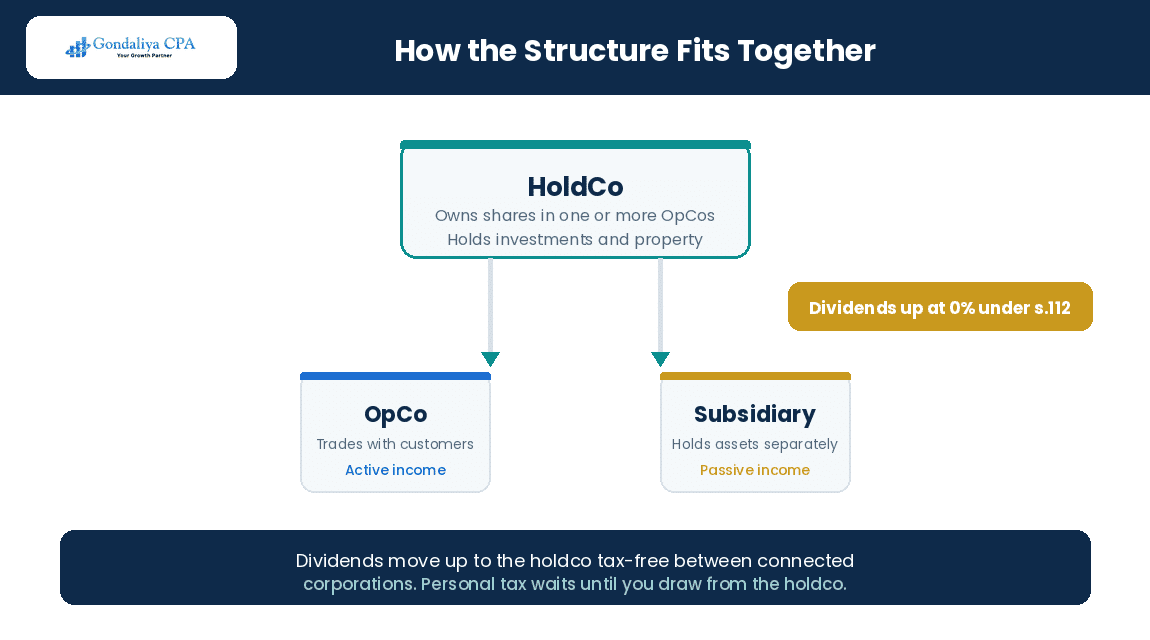
If you’re thinking about a startup holding company in Canada, you need to know how the structure works. Usually, there are two parts: an operating company (OpCo) and a holding company (HoldCo).
Here’s how they break down:
- Operating Company (OpCo):
- Deals directly with customers.
- Makes money through sales or services.
- Holding Company (HoldCo):
- Owns shares in one or more OpCos.
- Handles investments or property without running day-to-day tasks.
This setup protects liability and helps with corporate tax planning. For example, profits can move between OpCo and HoldCo through dividends without triggering extra taxes right away.
Key Summary: Benefits and Tax Considerations When Using a Holdco
Using a holdco offers some clear benefits and tax points to keep in mind:
Benefits:
- Limits liability: Personal assets stay protected from business claims.
- Manages investments: Easier to oversee various investments under one company.
- Defers taxes: Money kept inside the holdco may get taxed less than personal income.
Tax considerations:
- Intercorporate dividends: These often avoid taxes thanks to CRA rules, which helps move cash around without paying tax immediately.
- Lifetime Capital Gains Exemption (LCGE): If shares qualify, shareholders can reduce capital gains taxes when selling through the holdco.
- Passive income rules: New limits affect how much passive income a corporation can earn without losing small business tax benefits. Watching this closely matters.
Overall, setting up a startup holdco helps protect assets while offering ways to plan corporate taxes wisely as your business grows.
A founder set up a holdco in year one with no retained earnings to move and no assets to hold. It added a second return and a second annual filing, and did nothing else until the third year. Figures changed for privacy.
Key Stat: Dividends between connected corporations flow at a 0% inclusion rate under section 112. That is the mechanism behind almost every holdco structure, and it is a deferral of personal tax rather than a removal of it.
Holding Company Benefits and How They Support Founders
Holding Company Benefits and How They Support Founders
The Benefits
Asset Protection Strategies for Startup Owners
A holding company helps startup owners in Canada protect their assets by keeping them separate from business risks. Usually, the holdco owns shares of the operating company but does not run any business activities itself. This separation shields valuable things like money saved up, intellectual property, real estate, or investments from lawsuits or creditors going after the operating company.
If you’re thinking about setting up a holding company for your startup, it can limit your risk if something goes wrong with daily operations. Plus, it makes passing on assets easier because everything important is grouped under one parent company without messing up the main business.
Some benefits are:
- Keeps extra funds and capital gains safe inside the holdco
- Puts real estate or investments away from business risks
- Lets you build multiple subsidiaries under one main corporation
- Gives more control over how assets get passed on
This setup follows CRA rules on intercorporate dividends and restructuring. It’s a smart move for startups growing in Ontario and all over Canada.
Tax-Deferral and Dividend Planning with Holdcos
Holding companies open doors to tax deferral by moving dividends between related companies in Canada. When an operating company pays dividends to its holding company, those payments are usually tax-free at the corporate level (thanks to section 112 of tax law). This lets money grow inside the holdco without immediate personal tax on shareholders.
So, founders using a holding company tax Canada approach can keep profits inside the holdco instead of taking them out as salary or dividends right away. Experts in corporate tax planning Canada often suggest using different share classes to handle dividend payments that suit each shareholder.
Here’s a quick look:
| Feature | Benefit | CRA Reference |
|---|---|---|
| Intercorporate Dividends | Tax-free transfers between connected corps | Income Tax Act §112 |
| Retained Earnings in Holdco | Delays personal taxes until money is taken out | CRA IT Bulletin |
| Salary vs Dividend Balance | Manages CPP contributions & taxable income | CPA Canada guidance |
Tax deferral through a holdco helps founders reinvest earnings while controlling their pay efficiently — which is key for long-term growth in Canadian startups.
A company paid a dividend from the operating corporation to the holdco to move surplus out of reach of trade creditors. The transfer itself was tax-free; the personal tax simply waited until the founder drew from the holdco. Figures changed for privacy.
Estate Planning, Wealth Transfer, and Income Splitting Opportunities
A good holding company design supports estate freeze strategies that help families keep wealth intact while using lifetime capital gains exemption amounts on QSBC shares. By moving future growth shares into new classes held by heirs or trusts (via section 85 rollovers), founders lock in today’s value for capital gains but let future growth go to others.
Income splitting rules allow dividends from a holdco’s passive investments or profits to go to family members who own different share classes — but recent anti-avoidance rules like TOSI can limit this.
Key points to know:
- QSBC shares offer up to $971,190 lifetime capital gains exemption amount per person (2026).
- Estate freezes done through share changes lower probate fees and ease succession.
- Following income splitting rules closely avoids surprises from TOSI.
Founders get better control over when and how wealth moves while possibly cutting family taxes by using these CRA-compliant setups.
Investment Flexibility and Managing Personal Income Through a Holdco
Holdcos give you room to manage passive investments apart from your active business work. But watch out: too much passive investment income can reduce your small business deduction limit. Once adjusted aggregate investment income goes over $50,000 yearly across connected companies, you start losing that benefit until it disappears completely at $150K.
In practice:
- Passive investments inside a holdco make portfolio returns grow without personal tax right away.
- Too much passive income means higher overall corporate taxes because you lose preferred rates.
You need to balance taking money out and keeping low-tax status on active businesses—this balancing act is key in corporate tax planning across Canada.
Risk Warning: Passive income inside the holdco is measured across all connected corporations, not just the one holding the investments. A portfolio moved into a holdco for protection can quietly grind the operating company’s small business deduction. Please model the combined figure before moving assets.
Overview of Relevant Legislation: TOSI, LCGE, Section 85 Rollover
Overview of Relevant Legislation: TOSI, LCGE, Section 85 Rollover
The Rules
If you’re thinking about setting up a startup holding company Canada, knowing the main laws helps a lot. The Tax on Split Income (TOSI) rules stop people from avoiding taxes by sharing income with family who don’t actively work in the business. So, dividends paid between your operating company and holdco can get taxed at high rates if you’re not careful.
The Lifetime Capital Gains Exemption (LCGE) lets you exempt up to $971,190 (for 2026) when selling Qualified Small Business Corporation shares. Using a founder holding company can make it easier to claim this exemption and plan who gets the business later.
Section 85 rollover lets you move property—like shares—from one company or person to another without paying tax right away. This is handy when startups want to reorganize but avoid big tax bills upfront. You do need to fill out special forms and follow CRA rules exactly.
These rules matter for corporate tax planning Canada with startups and holdcos. It’s smart to talk with a tax pro early since the details get tricky fast.
Small Business Deduction and Passive Income Rules
Holding companies in Canada face limits on small business deductions. The federal small business deduction business limit is $600,000 per year in 2026. This limit is shared among associated corporations, including holdcos that share control or ownership.
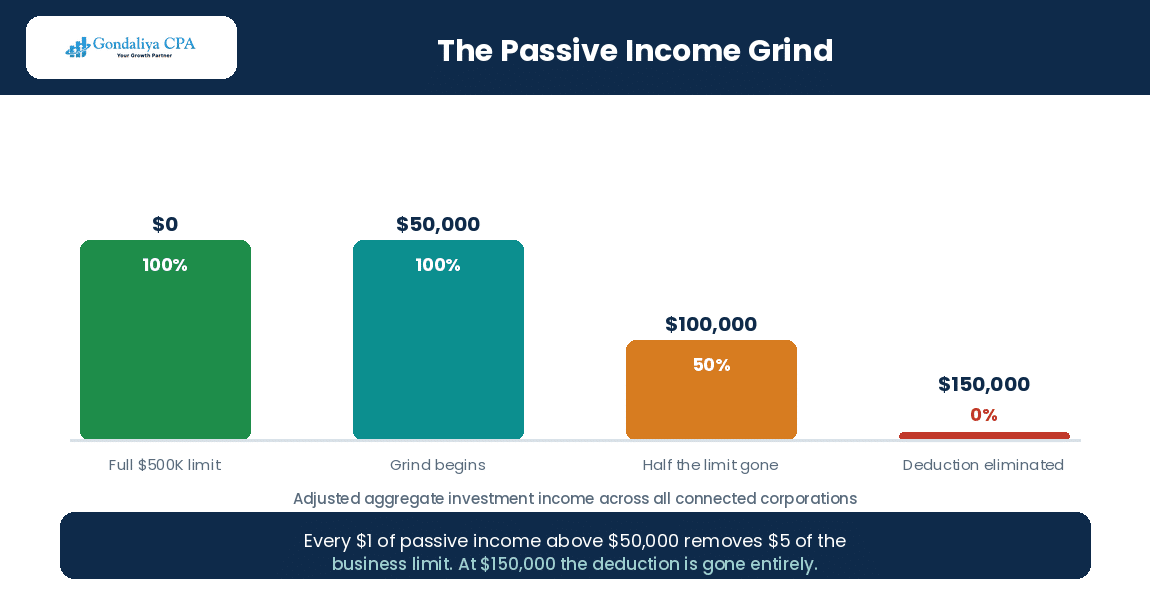
If your holding company holds too much passive income—like investment earnings—it can reduce your deduction. Once passive income passes $50,000 per year, your small business deduction shrinks dollar for dollar. When it hits $150,000, you lose the deduction completely until passive income drops again.
This “passive income grind” means holding too many investments inside your holdco could push your taxes higher overall—even if some tax deferral benefits exist elsewhere. You’ll want to watch where assets sit between operating companies and holdcos based on CRA rules.
Here’s a quick look:
- Federal Small Business Limit: $600,000
- Passive Income Threshold Start: $50,000
- Full SBD Reduction Threshold: $150,000
Founders should think about these limits when planning their startup asset protection under holding company tax Canada rules.
Connected Corporation Requirements for Tax-Free Dividend Transfers
Moving dividends between connected companies can save taxes in startup structures Canada. Section 112 of the Income Tax Act says dividends paid between connected corporations often pass tax-free if conditions apply.
Here’s what matters:
- Both companies must be connected by common ownership above certain thresholds.
- Dividends can’t be taxable capital gains distributions.
Also, associated corporations share their combined small business deduction limit. If two related businesses have the same controlling shareholders (more than 50%), they only get one $600K federal small business limit total.
This connection affects whether you create multiple subsidiaries under one holdco or keep things simpler—because association status might lower deductions across entities and add more paperwork.
Part IV Tax, Refundable Dividend Tax on Hand, and Other Tax Mechanisms
Part IV tax hits private corporations when they get intercorporate dividends from non-connected taxable Canadian corporations. Holding companies often build up refundable dividend tax on hand (RDTOH) from these dividends.
The good news? When they pay taxable dividends later on, they get a refund of that Part IV tax. This prevents double taxation within groups that use startup holding arrangements often seen in Canada.
RDTOH encourages companies to pay out earnings rather than just sit on investments inside holdcos where higher personal taxes might come later after distributions.
Corporate tax planning Canada needs careful balancing between keeping earnings and paying dividends while considering Part IV tax rules and whether to take salary or dividends under subsection 15(2).
Compliance, Complexity, and Ongoing Costs for Holdco Structures
Using holding companies means extra paperwork for startups in Canada. Every corporation—holdco or operating—must file separate annual T2 returns even if they don’t do much during the year.
You also need detailed books showing all intercompany transactions plus updated records for share changes or director moves required by Corporations Canada or ServiceOntario depending on where you’re located.
Fees apply too: federal online filing costs about $20 CAD; Ontario charges around $30 CAD plus HST yearly for annual returns.
Accountants help keep filings correct and avoid penalties. CRA fines start at 5% of unpaid tax monthly after deadlines and grow fast if you delay longer.
Startups should plan yearly budgets covering incorporation upkeep plus bookkeeping costs based on how many owners or share classes are involved.
Some firms offer flat fees with clear pricing plus weekend/evening support making deadlines easier for Toronto-area clients across Canada.
A group with three corporations under common control assumed each had its own business limit. They shared one, and the allocation had to be corrected across all three returns before any of them could be assessed. Figures changed for privacy.
Setting Up and Running a Startup Holding Company
Setting Up and Running a Startup Holding Company
The Setup
Setting up a startup holding company in Canada means planning your corporate taxes carefully. The holdco usually owns the shares of the operating company. This helps founders keep risks separate from their investments. It also makes future growth or selling easier.
Steps in Incorporating and Structuring a Holdco
You can incorporate a startup holding company in Canada either federally or provincially, like in Ontario. Federal incorporation protects your company name across Canada. But it costs about $200 to file federally, while Ontario charges $360.
Here’s what you need to do:
- Pick federal or provincial incorporation based on where you want to expand and how much you want to spend.
- Choose your share structure carefully. You might want different classes for voting rights or control.
- File the Articles of Incorporation and pay the fees.
- Get a NUANS name search report to make sure your company name is unique.
How you set up the holdco matters a lot for your corporate tax planning in Canada. It lays the groundwork for future deals, dividends, and section 85 rollovers.
Transferring Operating Company Shares and Corporate Documentation
When you move shares from your operating company to the holdco, you often use a section 85 rollover. This lets you delay paying capital gains taxes by transferring shares at an agreed value.
You’ll need to:
- Prepare legal papers that describe the share transfer.
- Choose the right amount to elect under section 85(1).
- Update your shareholder records.
- Keep detailed minutes that show new ownership.
After this transfer, dividends paid from the operating company to its holdco are usually tax-free because of intercorporate dividend rules under section 112. This means you can keep money inside the holdco without extra tax bills right away.
Governance Best Practices and Annual Compliance Needs
Holding companies must follow all Canadian corporate governance rules plus some extra duties:
- File separate T2 income tax returns every year, even if you only earn passive income.
- Keep accurate minutes for board meetings and resolutions about dividends or shares.
- Submit annual returns through Corporations Canada or ServiceOntario.
Good governance means having regular board meetings with appointed directors. Keeping records clear helps if CRA audits your company. It also sets clear rules for dividend payments between your companies.
If you don’t follow these rules, you risk fines or losing your good standing status. Good recordkeeping from day one lowers this risk.
Operating Company and Holdco Dividend Flow Strategies
One big reason to have a startup holding company is tax-efficient dividend flow. Under section 112(1), dividends paid from an operating Canadian-controlled private corporation (CCPC) to its holdco are usually tax-free.
This lets you:
- Delay personal taxes until money leaves the group as dividends.
- Keep profits inside the holdco for reinvesting without immediate personal taxes.
- Manage payouts among shareholders easily when using layered structures.
Balancing salary and dividend payments helps optimize cash flow and tax burdens. Coordinated planning can protect founder wealth while staying within CRA rules about reasonable pay.
Good corporate tax planning thinks through dividend flows before picking fiscal year ends or making distributions each period.
Pro Tip: Do the section 85 rollover before the operating company has built significant value. The elected amount and the paperwork are the same either way, but the accrued gain being deferred is far smaller, which lowers the risk if anything is later challenged.
Advanced Strategies and Industry-Specific Considerations
Advanced Strategies and Industry-Specific Considerations
The Strategies
Many Canadian startups use holding companies to get better tax benefits and protect their assets. Setting up a startup holding company Canada can help with tax planning and prepare for growth or sale. Founders who understand how to use a holding company for startup ventures can keep more money in the business and reduce risks.
- Holding companies improve tax efficiency.
- They protect assets from business risks.
- They make it easier to sell or grow the business later.
Corporate Restructuring and Tax Purification Tactics
Startups often split their operating business from passive investments by using a holdco. This separation helps with holding company tax Canada planning. It reduces risks and controls how money flows between companies.
One common tool is the section 85 rollover. It lets shareholders move property, like shares, into a holdco without paying taxes right away. This defers capital gains taxes until the shares are sold later.
For example:
- Transfer shares of the operating company to a holdco using section 85.
- Defer taxes on any gain until you sell the shares.
- Keep the operating company’s active business income clean.
- Protect eligibility for small business tax deductions.
Estate Freeze Transactions and Multiplying Lifetime Capital Gains Exemption
An estate freeze helps lock in current share values while letting future growth go to family members or trusts. This avoids paying capital gains tax immediately.
You can use the lifetime capital gains exemption amount (QSBC shares) more than once across related companies under one holdco. That means different people in your family might each claim an exemption when they sell shares.
This fits well with corporate tax planning Canada by helping multiply lifetime capital gains exemptions over time. It also sets you up for easier succession while saving taxes when selling your business.
Key points:
- Lock share values today.
- Pass future growth to others.
- Use multiple lifetime capital gains exemptions.
- Plan for smooth succession.
Integrating Holdcos with Professional Corporations or Real Estate Holdings
Professional corporations have strict rules that often prevent ownership by holding companies. Make sure to check these professional corporation restrictions before setting up structures involving holdcos.
For real estate inside a holdco, watch out for passive income rules. If rental income goes over the passive income threshold for business limit grind, it can cut into small business tax benefits.
A smart move is to put real estate into separate subsidiaries owned by your holdco. This way:
- You keep investment risks separate from your operating businesses.
- Your accounts stay clean and easier to manage.
- You avoid hitting income thresholds that reduce tax breaks.
Mistakes to Avoid With Holdco Structures and Common Misconceptions
Some startups create holdcos too early, spending money on setup before it makes sense. Legal fees pile up, but earnings might not be enough yet.
Watch out for these common errors:
- Ignoring extra filings like annual T2 returns increases compliance risks.
- Thinking a holdco means no taxes—wrong! It just delays taxes if done right.
- Not keeping proper records like minutes or registers can cause penalties.
- Mixing personal and corporate money blurs protection benefits and complicates audits.
Be patient and make sure you’re ready before setting up a holding company structure.
Considerations for Technology, Manufacturing, Construction, and Healthcare Startups
Different industries need different holdco setups. Here are some quick notes on common sectors:
- Technology startups often separate IP ownership from operations. This helps with SR&ED claims and equity plans.
- Manufacturing businesses benefit by placing equipment in subsidiaries under one parent to protect assets from creditors.
- Construction firms isolate risk between contracting units but must watch licensing rules that limit structure choices.
- Healthcare startups face strict professional corporation ownership rules; they must get advice to stay compliant without losing practice standards (like OHIP regulations).
Each sector has its own mix of operational needs and legal limits on deductions or ownership structures.
Practical Example: Startup Founder Asset Protection and Tax Optimization Scenario
We helped Toronto tech founders who created an Ontario holding company owning two separate businesses: one software development firm earning active revenue; another managing patents that bring passive royalty income affected by investment income rules.
They used intercompany dividends following section 112 of the Income Tax Act plus section 85 rollovers at start-up stages. The results were:
- Retained earnings stayed safely inside the holdco,
- Passive income stayed isolated so small business deductions stayed intact,
- Personal assets were protected through clear company divisions,
- Sale proceeds qualified partly for lifetime capital gains exemptions thanks to QSBC shares across related firms,
This case shows how careful planning pays off in asset protection and tax savings for Canadian startups.
A technology startup held its patents in a separate subsidiary under the holdco. The royalty stream stayed out of the operating company, and the active business income kept its full small business rate. Figures changed for privacy.
Getting Started with Holdco and Tax Planning
Getting Started with Holdco and Tax Planning
Getting Started
Starting a holding company for your startup in Canada can be a smart move. It gives you more control over profits, helps protect your assets, and can improve your tax situation. Many founders use a holdco to manage growth or plan for a future sale.
Corporate tax planning in Canada means understanding things like how dividends flow between companies and what limits apply to small businesses. You’ll want to check if a holding company fits your startup’s finances and ownership setup before you jump in.
Here are some basics to consider:
- How intercorporate dividends work
- Rules around passive investment income
- Limits on the small business deduction
Thinking about these now can save you headaches later.
Importance of Consulting Qualified Advisors for Individual Situations
Tax rules around holding companies in Canada aren’t simple. Your best bet is to talk to a Registered Ontario CPA who knows these matters well. Every situation is unique — things like who owns shares or what investments you hold can change the picture.
A good CPA will help you follow CRA rules, such as section 112 about dividends and how related companies share tax breaks. Lawyers might also need to get involved for drafting shareholder agreements or handling reorganizations correctly.
Getting advice early helps avoid mistakes like bad rollovers under section 85 or unintended tax hits from surplus stripping under section 84.1. In short: experts keep your startup’s structure solid and legal.
Author Credentials and Experience in Canadian Startup Corporate Structure
Gondaliya CPA is a Registered Ontario CPA firm working with startups across Toronto and beyond. We’ve earned over 1300+ 5-star Google reviews, showing clients trust our help setting up holding companies for founders.
Sharad Gondaliya, CPA Gondaliya, CPA (Canada & USA), leads our team with more than ten years of experience. We focus on helping small and medium businesses create proper holdcos that fit their growth and exit plans while keeping taxes in check.
Our services include:
- Incorporation advice at federal or provincial levels
- Share structure planning
- Section 85 rollover coordination
- Bookkeeping setup using QuickBooks or Xero
- Ongoing T2 tax filings
- Estate freeze support
- SR&ED claim assistance
- CRA representation throughout your holdco process
We aim to make things clear and manageable for startup founders.
Legal and Tax Disclaimers for Startup Holdco Content
Tax laws around holding companies can change often. For example, updates expected in 2026 may affect dividend rules or passive income limits. This content is meant to educate based on current CRA info but isn’t legal advice or a promise of results.
Accounting compilation reports don’t guarantee accuracy beyond what was agreed upon. Setting up a holdco also requires legal steps like issuing shares, which usually means getting lawyers involved. You must check all rates, deadlines, and rules every year because missing them can bring penalties from CRA or government agencies like Corporations Canada or ServiceOntario. Always get advice from professionals Registered in Ontario who know the local requirements before changing your startup’s ownership structure.
For guidance about setting up your startup holding company in Canada with solid corporate tax planning, reach out to Gondaliya CPA at info@gondaliyacpa.ca or call 647-212-9559 for a no-pressure chat.
Frequently Asked Questions
Frequently Asked Questions
FAQ
Can a Canadian Startup Benefit From a Holding Company?+
Yes. A holding company offers asset protection, tax deferral, and succession planning advantages to Canadian startups.
Does Your Startup Actually Need a Holding Company Yet?+
Consider your startup’s growth stage, retained earnings, and investment plans before forming a holding company.
What Are the Downsides, Costs, and Risks of a Holding Company?+
Extra compliance costs, complex filings, and potential loss of small business deduction due to passive income can be risks.
Holding Company vs Single Operating Company – Which Structure Fits Your Startup?+
Holding companies suit startups needing asset protection and tax planning. Single companies fit simpler operations with fewer assets.
How Does a Holding Company Affect the Small Business Deduction and Passive Income?+
Passive income over $50,000 reduces your small business deduction. At $150,000 passive income, the deduction fully disappears.
How Does a Holding Company Help With Selling Your Business?+
A holdco enables estate freezes and multiplies lifetime capital gains exemptions for smoother sales and lower taxes.
How Do You Set Up a Holding Company in Canada?+
Incorporate federally or provincially, choose share structure, file articles of incorporation, and conduct a NUANS name search.
What CRA and Compliance Obligations Come With a Holding Company?+
File annual T2 returns for each corporation. Keep accurate minutes and shareholder records for CRA audits.
What Does It Cost to Set Up and Maintain a Holding Company in Canada?+
Federal filing fees cost about $200; Ontario charges around $300 plus HST annually for returns and registrations.
Holding Company Route: DIY vs Lawyer vs CPA Firm – Which Route Fits?+
DIY saves money but risks errors. Lawyers handle legal steps; CPA firms provide tax planning plus ongoing compliance support.
How Do We Set Up and Manage a Holding Company at Gondaliya CPA?+
We guide incorporation, share structuring, section 85 rollovers, bookkeeping setup, tax filings, and ongoing advice.
What Deliverables Do You Get With a Holding Company Setup?+
Legal incorporation documents, corporate minute books, shareholder registers, tax filing setups, and personalized tax plans.
What Are the Risks, Compliance Issues, and Prevention Controls?+
Risks include late filings penalties and TOSI misapplication. Controls involve timely recordkeeping and expert tax review.
What Should a Founder Prepare Before Setting Up a Holding Company?+
Review ownership details, investment types, planned growth strategies, and consult with your CPA early on.
How Does Holding Company Use Differ Across the 10 Industries We Serve?+
Use varies by sector—from IP separation in tech to asset protection in manufacturing or compliance in healthcare startups.
A Realistic Numeric Walkthrough+
Example: Federal $200 filing fee; SBD limit $500K; passive income threshold $50K; LCGE amount $971K; max first fiscal period 53 months.
How to Choose the Right CPA Firm in Toronto/Ontario for Holding Company Planning?+
Select firms Registered in Ontario with startup experience. Check reviews like Gondaliya CPA’s 1300+ 5-star ratings.
Why Trust Gondaliya CPA? (E-E-A-T) + Editorial Policy + Disclaimers+
We hold Canadian & US CPA licenses. We deliver expert advice with transparency based on current law while disclosing limits.
Key Numbers at a Glance
Key Numbers at a Glance
Quick Reference
- Small Business Deduction Business Limit: $500,000
- Passive Income Threshold for Business Limit Grind: $50,000
- Small Business Deduction Fully Eliminated at Adjusted Aggregate Investment Income: $150,000
- Lifetime Capital Gains Exemption Amount (QSBC shares): $971,190 (2026)
- Intercorporate Dividend Inclusion Rate under Section 112: 0%
- Number of Associated Corporations Sharing Business Limit: Up to 10
- Minimum Number of Directors for Federal Corporation: 1 director (majority must be Canadian residents)
- Federal Incorporation Filing Fee: $200
- Ontario Incorporation Filing Fee: $300
- Maximum First Fiscal Period Length for New Corporation: 53 months
Glossary of Key Terms
- LCGE: Lifetime Capital Gains Exemption for QSBC shares reducing capital gains tax upon sale.
- TOSI: Tax on Split Income rules limiting income splitting with family members not actively involved in the business.
- Section 85 Rollover: A mechanism allowing tax-deferred transfer of property or shares between individuals or corporations.
- RDTOH: Refundable Dividend Tax on Hand related to refundable taxes paid on dividends received from taxable corporations.
The question founders ask most is when a holdco starts paying for itself. In practice it is the year retained earnings first exceed what the business needs for working capital, not the year the company incorporates. Figures changed for privacy.
Industry Spotlights: Sectors We Represent
Industry Expertise
A holdco does different work in different sectors. Here are eleven and what the structure is usually there to do.
| Industry | What the Holdco Is Usually There to Do |
|---|---|
| Technology startups & SaaS | Hold intellectual property away from the operating risk |
| E-commerce & online retailers | Move surplus out of reach of supplier and platform claims |
| Consulting firms | Defer personal tax on retained earnings between contracts |
| Construction, contractors & skilled trades | Separate equipment and surplus from job site liability |
| Property developers & builders | Sit above project corporations that share one business limit |
| Real estate investors & holding companies | Hold property, while watching the passive income grind |
| Transportation, logistics & trucking | Keep fleet assets apart from operating claims |
| Restaurants & food and beverage | Protect surplus from lease and supplier exposure |
| Daycare, childcare & CWELCC services | Hold the premises separately from the Registered operation |
| Dentists & dental practices | Often restricted, since the college limits who may hold shares |
| Medical doctors & physician corporations | Often restricted, for the same reason under a different college |
- Technology startups & SaaS: Separating IP ownership from operations protects the most valuable asset and keeps royalty income out of the active business.
- E-commerce & online retailers: Surplus built up quickly in a good year is safer in the holdco than sitting in an operating company exposed to platform disputes.
- Consulting Firms: Income arrives unevenly, and a holdco lets a strong year fund a quiet one without pushing the founder into a top personal bracket.
- Construction, general contractors & skilled trades: Job site liability is real and immediate, which makes the separation of accumulated surplus more valuable here than almost anywhere.
- Property developers & builders: Project corporations under one holdco are associated, so they share a single business limit rather than claiming one each.
- Real estate investors, landlords & holding companies: Rental income counts toward the passive income threshold, so the protection can cost the operating company its small business rate.
- Transportation, logistics & trucking: Vehicles held in a separate corporation stay clear of claims arising from operations, and the lease between them has to be at fair value.
- Restaurants & food and beverage: Margins are thin and exposure is high, so moving surplus out each year does more than the tax deferral alone would suggest.
- Daycare, childcare & CWELCC services: Holding the premises separately keeps the Registered operating entity clean for programme reporting purposes.
- Dentists & dental practices: The college restricts who may hold shares in a professional corporation, which limits what a holdco can own before any tax question arises.
- Medical doctors & physician professional corporations: The same restriction applies, so the structure usually sits alongside the practice rather than above it.
Across holdco reviews in one year, the two most common findings were a structure set up before there was anything to protect, and rental income quietly grinding the operating company’s business limit. Figures changed for privacy.
Professional Guidance and Quick Reference
Guidance
Professional Guidance on Holding Companies: How Gondaliya CPA Supports Canadian Founders
A holdco is worth building when there is surplus to protect, risk to separate, or an exit to plan for. You need the structure designed, the shares transferred properly under section 85, the dividend flow mapped, the passive income position modelled, and two sets of filings kept current. Gondaliya CPA sets up and maintains holding company structures for Canadian startups.
We handle the work that determines whether the structure actually helps: assessing whether a holdco is justified yet, incorporating federally or provincially, planning the share classes, coordinating the section 85 rollover, setting the dividend policy, and filing both T2 returns with the annual returns behind them.
Our team follows CRA practice closely and builds the structure around your own facts rather than a template. Whether you are considering a first holdco, restructuring an existing group, or preparing for a sale, we give clear advice based on the current rules.
Quick Answers: Key Numbers & Concepts at a Glance
At a Glance
- Section 112 inclusion rate: 0% on connected intercorporate dividends
- Passive income grind starts: $50,000
- Small business deduction gone at: $150,000
- LCGE on QSBC shares: $971,190 for 2026
- Associated corporations: Up to 10 sharing one limit
- Federal incorporation fee: $200
- Federal annual return filing: About $20 online
- Ontario annual return: About $30 plus HST
- T2 returns required: One per corporation, every year
- Late-filing penalty: Starts at 5% of unpaid tax
Who This Is For / Not For
Fit Check
- For: Incorporated Canadian startups with retained earnings beyond working capital needs, founders holding assets exposed to operating risk, and companies planning a sale or succession.
- Not For: Early-stage companies with no surplus to move, where the second set of filings costs more than the deferral saves, and regulated professionals whose college restricts corporate share ownership.
People Also Ask
Quick Answers
Can I claim LCGE multiple times across companies under one holding company?+
Yes; estate freeze strategies enable multiple lifetime capital gains exemptions among related corporations.
How many directors does my federal holding company need?+
At least one director who must be majority Canadian resident(s).
What happens if passive income exceeds thresholds within my holdco structure?+
Small business deductions reduce or disappear progressively as passive income rises past limits.
Do associated corporations share the small business deduction limit?+
Yes; up to 10 associated corporations pool one combined business limit.
Glossary of Key Terms
Plain-English Definitions
- LCGE: Lifetime Capital Gains Exemption for QSBC shares reducing capital gains tax upon sale.
- TOSI: Tax on Split Income rules limiting income splitting with family members not actively involved in the business.
- Section 85 Rollover: A mechanism allowing tax-deferred transfer of property or shares between individuals or corporations.
- RDTOH: Refundable Dividend Tax on Hand related to refundable taxes paid on dividends received from taxable corporations.
- Holding company: A corporation that owns shares or assets rather than carrying on active business.
- Operating company: The corporation that actually trades with customers and earns active income.
- Intercorporate dividend: A dividend paid from one corporation to another within a group.
- Connected corporations: Corporations linked by ownership above the thresholds in the Act.
- Associated corporations: Corporations under common control that share one business limit.
- Passive income: Investment earnings rather than income from active business operations.
- Adjusted aggregate investment income: The measure of passive income used for the business limit grind.
- Estate freeze: Locking in today’s share value so future growth accrues to others.
- QSBC shares: Qualified Small Business Corporation shares eligible for the LCGE.
- Part IV tax: Refundable tax on certain dividends received by a private corporation.
- Section 84.1: The anti-avoidance rule aimed at surplus stripping on share transfers.
- Tax purification: Removing non-active assets so shares stay eligible for the LCGE.
Holding Company Readiness Check
This quick self-check flags whether a holdco would do useful work for you yet. Please answer the six questions below.
Holding Company Readiness Check
Six quick questions on your position. No fee shown.
Points to review:
This is a general prompt, not tax or legal advice or a quote. Your position depends on your full facts. For a real review, please book a free consultation.
Want a checklist to work from? You can download our free holding company checklist before your consultation.
Build the holdco when there is surplus to move, assets to protect, or an exit in sight, and not before. Use section 112 for the dividend flow, section 85 for the share transfer while values are still low, watch the $50,000 passive income threshold across the whole group, and budget for a second T2 every year. The structure is a deferral, not an exemption.
2026 Update — what is current: The passive income grind still begins at $50,000 of adjusted aggregate investment income and eliminates the small business deduction at $150,000. The intercorporate dividend inclusion rate under section 112 remains 0% for connected corporations, and up to 10 associated corporations share one business limit. Please confirm the current small business limit, the LCGE amount, and filing fees before relying on the figures in this article.
Startup Holding Company Canada: Key Tax Considerations and Corporate Tax Planning for Startups by Gondaliya CPA
Build the holdco when it earns its cost, not before
Gondaliya CPA assesses whether a holding company is justified yet, handles the incorporation and share structure, coordinates the section 85 rollover, sets the dividend policy, and files both T2 returns, on a fixed annual fee including HST with a one-business-day response. Please book a free consultation.
Next Steps
If you plan to set up your startup holding company in Canada or need corporate tax planning help contact Gondaliya CPA. Email info@gondaliyacpa.ca or call 647-212-9559 for tailored advice today. If our content helps, please add gondaliyacpa.ca as a preferred source on Google.
Published: July 6, 2026 · Last updated: July 6, 2026
Editorial policy: We research against CRA, CPA Canada, and CPA Ontario sources, fact-check the figures, and Sharad Gondaliya, CPA, reviews the content, which we update as the rules change.
Disclaimer: This article is educational information only and is not tax, legal, or financial advice. Figures marked illustrative are examples rather than quotes or guarantees. It reflects CRA rules current to 2026, including the $50,000 passive income threshold, the $150,000 elimination point, the $971,190 LCGE amount on QSBC shares, the 0% section 112 inclusion rate, and stated filing fees. Rates, thresholds, and rules change and outcomes depend on your specific facts. Please consult a Registered CPA before acting.

Sharad Gondaliya is a CPA Canada & CPA USA with 15 Years+ experience of Accounting, Tax, Payroll of Corporate Small Businesses as Tax Accountant. He is a CPA Ontario member (61040184) and holds US CPA licences in Washington and Montana and is well known among corporate small businesses for tax planning, efficient tax solutions, and affordable CPA services. Sharad is the Principal (Director) of Gondaliya CPA – Affordable CPA Firm in Canada. Licenses: CPA Ontario: 61040184 | CPA USA (MT): PAC-CPAP-LIC-033176 | CPA USA (WA): 57629 | CPA Firm License: 61330051 View Full Author Bio