



Salary, Dividends or Both? How Canadian Startup Founders Can Plan Owner Compensation
TLDR:
Salary vs dividends Canada is key for startup founder salary and owner compensation planning to reduce tax liability. Gondaliya CPA offers guidance on corporate salary dividends, shareholder compensation, and dividend strategy for efficient founder income tax planning in incorporated business owner compensation.
Quick Summary
The choice is not really salary against dividends. It is how much of each, and the answer moves with your income level, your retirement plans, and what paperwork you are willing to run. Please note salary is deductible to the corporation while dividends are not, and that difference sits underneath every other consideration.
| Aspect | Details |
|---|---|
| The salary side | RRSP room, CPP credits, T4 slips, payroll remittances. |
| The dividend side | No source deductions, gross-up and tax credit, T5 slips. |
| The mixed approach | Base salary for RRSP room, dividends on top for flexibility. |
| The compliance layer | Directors’ resolutions, remittance deadlines, slip filing. |
Reading time: 34 minutes.
Table of Contents
- Introduction – Salary vs Dividends for Canadian Business Owners and Startup Founders
- Defining Salary and Dividends in a Canadian Corporation
- Comparing Salary and Dividends – Tax, Cash Flow, and Administrative Impact
- How to Pay Yourself with a Salary
- How to Withdraw Money as Dividends
- Combining Salary and Dividends: Mixed Strategies and When It Makes Sense
- Case Examples and Real-World Scenarios for Startup Founders
- FAQs on Salary vs Dividends and Owner Compensation in Canada
- Industry Spotlights: Sectors We Represent
- Professional Guidance and Quick Reference
The Numbers That Matter
This article covers Canada, with Ontario and Toronto context, and reflects CRA rules current to 2026. It assumes an incorporated Canadian startup founder deciding how to pay themselves. Figures marked illustrative are examples, not quotes, and any masked engagement notes end with “Details changed for privacy.” This is educational information only and not tax, legal, or financial advice. Rates, thresholds, and rules change, so please confirm your own situation with a Registered CPA before acting.
Introduction – Salary vs Dividends for Canadian Business Owners and Startup Founders
Introduction – Salary vs Dividends for Canadian Business Owners and Startup Founders
The Basics
Key Insights and Takeaways on Owner Compensation in Canada
Figuring out how to pay yourself is a big deal if you own a business or started a company in Canada. Choosing salary or dividends changes how much tax you pay and affects your finances. This guide talks about these options so you can pick what works best for you.
Addressing the core question of how founders and corporate business owners should pay themselves
Many founders wonder whether to take a salary or dividends. The answer depends on things like taxes, how much cash you need now, and your future plans. Both choices have pros and cons that affect your take-home money after taxes.
What you will learn about tax implications, compliance, and strategic owner compensation
We’ll cover how salary and dividends work in Canadian startups. You’ll see how each method changes your tax bills at the personal and company level. Plus, we explain rules from the CRA to keep things legal.
Immediate call to action for personalized consultation
If this sounds tricky, get in touch with Gondaliya CPA. They can give advice that fits your situation. Their knowledge about founder pay strategies can help you follow the rules while keeping more money in your pocket.
A founder took dividends only for three years because the paperwork was simpler, then discovered they had built no RRSP room at all across that period. Rebuilding it is not possible retroactively. Details changed for privacy.
Key Stat: Salary is deductible to the corporation, dividends are not. That single difference is the starting point for every comparison, because the corporation has already paid tax on the profits behind a dividend.
Defining Salary and Dividends in a Canadian Corporation
Defining Salary and Dividends in a Canadian Corporation
The Definitions
Understanding Salary as Owner Compensation and Its Tax Treatment
Salary is a usual way startup founders pay themselves from their corporation. It counts as employment income. The corporation pays the owner and takes off payroll deductions like income tax, CPP contributions, and EI premiums if needed. Paying salary lets the company reduce its taxable income by that amount.
For founders in Canada, salary adds to earned income. This earned income helps increase RRSP contribution room each year. The RRSP limit equals 18% of earned income but can’t go over the set dollar limit by CRA. This makes salary useful for saving toward retirement.
Both employee and employer must pay CPP on salaries above $3,500 and below $66,600 for 2026. Recently, CPP added a second earnings ceiling that affects some higher incomes.
The company sends T4 slips every year. These slips show total salary paid and payroll deductions made. Salaries need to be reasonable—if they seem too high or too low, CRA might check it out.
Here’s a quick overview:
- CPP Contribution Rate: Employee + Employer = 11.9% on pensionable earnings (2026)
- RRSP Dollar Limit: Lesser of $31,560 or 18% of previous year’s earned income
- Reporting Requirement: T4 slips yearly; payroll remittances monthly or quarterly
We helped a Toronto SaaS founder paying herself $75,000 yearly salary. She paid about $13,500 combined CPP contributions and gained full RRSP room for retirement savings planning.
Explaining Dividends and Their Taxation from a Corporate Perspective
Dividends are payouts from profits after corporate taxes. Shareholders get them without payroll deductions like CPP or EI. For owners in Canada choosing salary vs dividends, dividends mean no source deductions and no new RRSP room.
CRA sees two main dividend types:
- Eligible Dividends: Come from higher taxed corporate income. They have a 38% gross-up and about a 15% federal tax credit.
- Non-Eligible Dividends: Usually come from small business active income with lower tax rates. They get a 15% gross-up and roughly 9% federal tax credit.
Companies report dividends with T5 slips each year for shareholders who receive them. Unlike salaries reported on T4s needing regular remittances, dividends require directors’ approval but no ongoing payroll filings.
Dividend taxation tries to balance total taxes paid at personal plus corporate levels similar to if money was taken as salary. But differences in gross-ups and credits cause some variation across provinces like Ontario.
Quick glance:
| Dividend Type | Gross-Up % | Federal Dividend Tax Credit % | Use Case |
|---|---|---|---|
| Eligible Dividend | 38 | ~15 | From general active business income |
| Non-Eligible Dividend | 15 | ~9 | From small CCPC active business |
We worked with a client in professional services who took non-eligible dividends totaling $40,000 after filing taxes. It eased cash flow without adding personal CPP costs or admin work usually tied to salaries.
Key Stat: The new CPP second earnings ceiling now applies to owner-employees earning above normal limits starting fiscal year 2026 (CRA – Enhanced CPP)
Statutory Requirement: Corporations must file T4 slips for salaries and T5 slips for dividends separately (CRA Reporting Obligations)
Pro Tip: Using a mix of fair salary plus both eligible and non-eligible dividends can help lower overall taxes while boosting RRSP room through earned income for retirement savings.
Sharad Gondaliya, CPA, has over 10 years helping Canadian business owners handle these compensation choices.
Comparing Salary and Dividends – Tax, Cash Flow, and Administrative Impact
Comparing Salary and Dividends – Tax, Cash Flow, and Administrative Impact
The Comparison
If you’re a founder in Canada, picking between salary and dividends for your pay isn’t simple. Both affect your taxes differently. Plus, they change how money flows and what paperwork you must file. Whether your startup is in Ontario or elsewhere, understanding these differences helps with tax planning and keeping things smooth.
Taxation of Salary Versus Dividends for Business Owners
When you pay yourself a salary from your corporation, the company treats it as a business expense. This lowers corporate tax. But you have to take out income tax, Employment Insurance (EI), and Canada Pension Plan (CPP) contributions first. The salary shows up on a T4 slip for your personal taxes. Then, you pay regular income tax rates based on how much you earn.
Dividends work differently. They come from the company’s after-tax profits. The corporation can’t deduct them as expenses. On your personal return, dividends get “grossed up” before taxes apply. Then, you get a dividend tax credit that stops you from being taxed twice.
Two types of dividends matter here:
- Eligible Dividends
- Gross-up: 38%
- Tax credit (Federal): 15.02%
- Usually from active business income benefiting from small business deduction
- Non-Eligible Dividends
- Gross-up: 15%
- Tax credit (Federal): 9.03%
- Often come from passive or investment earnings
Here’s a quick example: If an Ontario founder gets $50,000 as eligible dividends, they report $69,000 ($50k + 38%) on their tax return. The credits reduce the taxes owed compared to getting $50k salary taxed fully plus CPP.
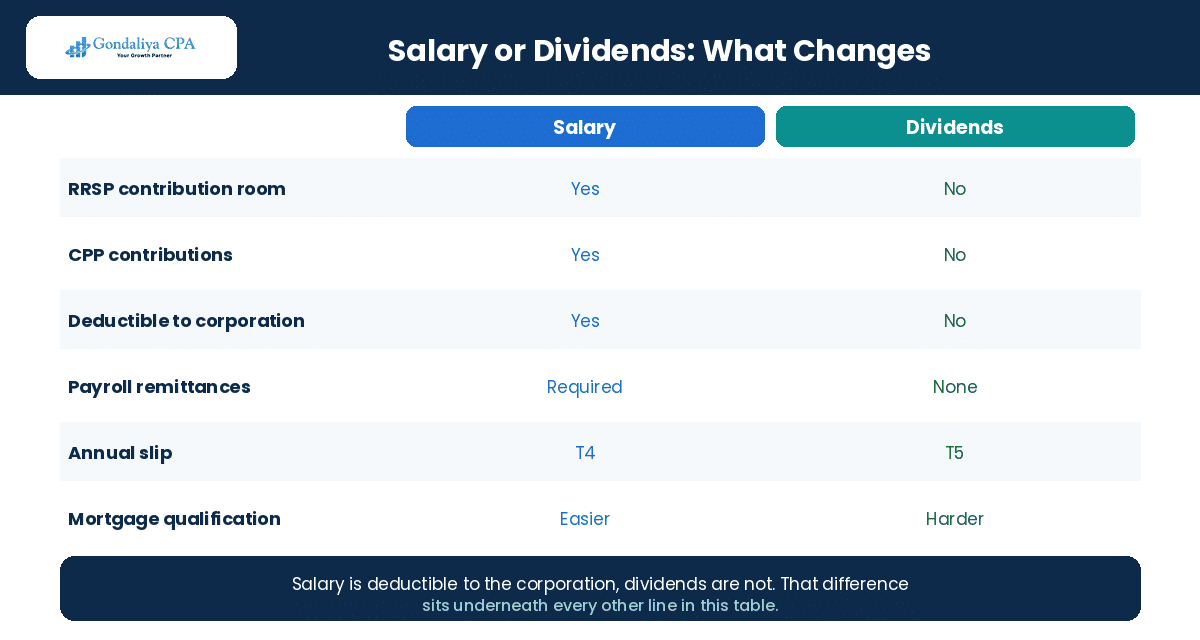
How Each Method Affects RRSP Room, CPP Contributions, and Mortgage Eligibility
| Your Situation | Salaries | Dividends |
|---|---|---|
| Generates RRSP Contribution Room? | Yes | No |
| Subject to CPP Contributions? | Yes | No |
| Max Pensionable Earnings (YMPE – 2026) | $66,600 | N/A |
| Enhanced CPP Available? | Yes | No |
| Easier Mortgage Qualification? | Yes | No |
| RRSP Limit (% Earned Income) | Up to 18%, capped | None |
Administrative Steps and Compliance Requirements for Paying Salary and Dividends
Paying yourself a salary means your corporation needs to register as an employer with CRA if it hasn’t yet. You must deduct payroll taxes like federal and provincial income taxes at source. You also handle EI and CPP deductions and send those payments regularly—monthly or quarterly based on your threshold. Each year you give yourself a T4 slip showing total pay and deductions.
With dividends:
- Directors must pass formal resolutions authorizing dividend payments.
- The company issues T5 slips yearly listing dividends paid per shareholder.
- There are no payroll remittances or source deductions with dividends.
Missing any steps can lead to fines or other legal troubles under Canadian law.
Summary table of key compliance items:
| Obligation | Deadline | Applies To | Penalty If Missed |
|---|---|---|---|
| Payroll Registration | Before first pay period | Corporation paying salary | Penalties; interest charges |
| Source Deductions Remittance | Monthly/Quarterly per CRA rules | Salaries | Late payment penalties & interest |
| Issuing T4 Slips | Last day February following year | Salaries | Penalties; delayed refunds |
| Directors’ Resolutions for Dividend | At time of declaration | Dividends | Legal risks; invalid payments |
| Issuing T5 Slips | Last day February following year | Dividends | Possible penalties |
In practice, many founders combine salary and dividends to balance cash flow with tax benefits while keeping paperwork manageable under Canadian rules.
Sharad Gondaliya CPA Ontario │ CPA USA │ Registered Ontario CPA Firm │1300+ 5-star Google reviews
Reading time: approximately 7 minutes
Risk Warning: Missed payroll remittances create personal liability for directors, not just corporate penalties. A dividend can be declared late and corrected; a remittance cannot. Please diarize the deadlines the moment payroll starts.
How to Pay Yourself with a Salary
How to Pay Yourself with a Salary
The Salary Route
Paying yourself a salary from your incorporated startup means following some clear steps. You must handle payroll properly, take out the right taxes, and stick to CRA rules. When you get a salary, you build RRSP room and both you and your company pay CPP contributions.
Step-by-step Process to Set Up Payroll and Pay Corporate Salary
To start paying yourself legally in Canada:
- Register for a payroll account with the CRA.
- This lets you send in income tax deductions, EI premiums if they apply, and CPP contributions. The current combined CPP rate is 11.9% on earnings between $3,500 and $70,000 (2026 max).
- Figure out your gross salary based on what’s reasonable for your job.
- Use CRA payroll tables to deduct federal and provincial taxes.
- Send all withheld taxes plus employer CPP parts every month or quarter before deadlines.
- Give yourself a T4 slip every year showing total pay.
These steps keep you within the reasonable compensation doctrine that says your salary should match your actual work.
Important Documentation: Directors’ Resolutions, Payroll Records
You have to keep good paperwork when paying salaries. Your corporation’s board needs to pass directors’ resolutions saying how much salary you get each period. These records back up your salary if the CRA checks.
Also keep:
- Pay stubs or earnings statements
- Receipts of source deductions paid
- Copies of T4 slips filed by February 28 after the year ends
This paperwork stops problems about how you pay yourself or missed reports.
Ensuring Reasonable Compensation in Line With CRA Expectations
The CRA expects salaries to be fair — not too high or low for the job. If it looks off, they can reassess or reclassify under subsection 67(2).
Remember tax integration: corporate taxes plus personal taxes should balance out whether you use salary or dividends. Salaries add to RRSP room; dividends do not but avoid CPP costs.
Talk to pros who can help pick a good mix of salary and dividends that fits legal rules and saves tax.
Common Errors and How to Avoid Them
Watch out for these common mistakes:
- Not registering payroll accounts on time causes penalties
- Missing remittance deadlines brings fines and director liability
- Forgetting to issue correct T4 slips results in penalties
- Paying unreasonable salaries triggers audits
Avoid these by keeping records neat, following CRA deadlines strictly, checking compensation with pros regularly, and using CPA help for compliance.
A founder set a salary well above what the role warranted in a strong year to clear out corporate profit. The reasonableness question came up on review, and the amount had to be supported with evidence of the actual work performed. Details changed for privacy.
How to Withdraw Money as Dividends
How to Withdraw Money as Dividends
The Dividend Route
Dividends give flexible income without CPP costs but come with different tax rules. The dividend gross-up makes your taxable income higher but dividend tax credits reduce the tax owed.
How To Declare And Distribute Dividends Legally And Tax-Efficiently
You must approve dividends formally with directors’ resolutions. These show amounts, type (eligible or non‑eligible), payment dates, and who gets paid based on shares.
Eligible dividends get better federal tax credits because they come from active business profits taxed at lower rates than non‑eligible ones that usually come from passive income.
Using proper resolutions helps with timing and avoids surprises on tax bills next year.
Preparing Dividend Resolutions And Issuing T5 Slips
Keep detailed minutes of all dividend declarations as Corporations Canada requires.
After paying dividends each year, prepare T5 slips listing amounts paid per shareholder. File them by the last day of February after the fiscal year ends.
Late filings bring fines—$25 per slip up to $7,500 max—so file on time!
Good record keeping helps if an audit happens, especially when there are many share classes needing exact allocation.
Planning Dividend Payments To Minimize Tax Impact And Avoid Surprises
Choosing eligible vs non‑eligible dividends depends on where profits come from:
- Active business profits usually qualify as eligible (38% gross-up)
- Passive investments yield non‑eligible dividends (15% gross-up)
Capital Dividend Accounts let you pay some capital gains tax-free — handy beyond regular taxable dividends.
Timing payments when your personal tax rate is low helps reduce total taxes across family members.
Managing Cash Flow And Timing Considerations For Dividend Distributions
Unlike salaries that need steady cash for regular payments plus remittances, dividends can be paid irregularly based on cash availability.
This suits startups with unpredictable income who want flexible access to funds without payroll overheads or mandatory deductions.
Common Pitfalls And Ways To Manage Compliance
| Compliance Failure | Penalty / Risk |
|---|---|
| Missed payroll remittances | Interest + fines; directors personally liable |
| Late filing of T4/T5 slips | $25 minimum per late slip; max $7,500 penalty |
| Incomplete directors’ resolutions | Audit risk & reclassification threats |
Doing both salary and dividend payments adds complexity fast without help.
A CPA can keep track of reminders and rules so you don’t miss anything. This cuts errors while making sure you follow all laws for paying yourself in Ontario or Toronto.
References
- CRA – CPP Contribution Rates
- CRA – Payroll Deductions Remittance Schedule
- CRA – Filing Information Returns – T-slips
- 4–24 Various sections adapted from official Canadian Revenue Agency publications on Owner Compensation Planning
Sharad Gondaliya, CPA, has over 10 years helping Canadian business owners manage their finances.
A company declared dividends verbally through the year and prepared the resolutions afterwards. The amounts were fine; the timing of the paperwork was the problem, and it took a full afternoon to reconstruct properly. Details changed for privacy.
Pro Tip: Sign the directors’ resolution on the date the dividend is declared, not at year-end when the accountant asks for it. The resolution is the authority for the payment, and a reconstructed one is far weaker evidence than a contemporaneous one.
Combining Salary and Dividends: Mixed Strategies and When It Makes Sense
Combining Salary and Dividends: Mixed Strategies and When It Makes Sense
The Mix
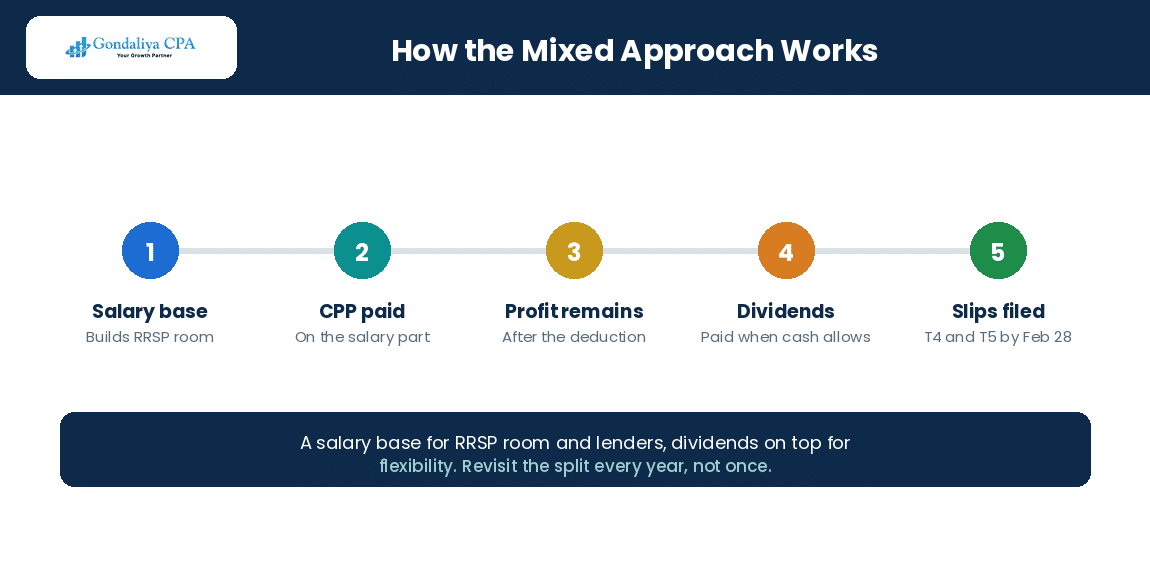
When Canadian founders decide how to pay themselves, mixing salary and dividends often works well. Salary gives you RRSP contribution room and counts toward CPP benefits. Dividends, on the other hand, are easier to handle and come with tax credits.
Founders usually take a salary to build earned income for retirement and government perks. Dividends then top up cash flow without payroll taxes or CPP contributions. This combo suits incorporated businesses that want flexible ways to manage personal taxes alongside profits.
| Factor | Salary | Dividends | Mixed Strategy |
|---|---|---|---|
| Tax Treatment | Corporation deducts salary; personal tax plus CPP¹ | Paid from after-tax corporate profits; taxed at dividend rates² | Mixes deductible salary with dividends to lower overall tax |
| RRSP Contribution Room | Creates RRSP room based on earned income³ | No effect on RRSP room | Partial RRSP room from the salary portion |
| CPP Contributions | Employer and employee must pay CPP⁴ | No CPP contributions | Only pay CPP on the salary part |
| Administrative Complexity | Payroll system needed, T4 slips issued | Directors approve dividends, issue T5 slips | Both payroll and dividend paperwork required |
| Cash Flow Flexibility | Usually regular payments | Can pay lump sums flexibly | Steady base salary plus variable dividends |
Bottom line: Many Canadian startup founders find a mix of salary plus dividends helps balance retirement savings with taking money out of their corporation efficiently.
Our Actual Experience: We helped a Toronto SaaS founder who took $75,000 as a salary to get full RRSP room. They also received $40,000 in eligible dividends quarterly. This setup lowered their overall personal taxes by matching corporate deductions with dividend credits. Details changed for privacy.
Other Methods of Tax-Efficient Compensation
Besides salaries and dividends, there are other ways to save on taxes when paying yourself from your startup in Canada:
- Capital Dividend Account (CDA): The CDA lets corporations pay out certain tax-free amounts like capital gains or life insurance proceeds as capital dividends³. Founders should watch their CDA balance when planning payouts.
- Shareholder Loans: These loans let you borrow money from your corporation temporarily but must follow strict rules under subsection 15(2) of the Income Tax Act´. You need good records.
- Bonuses: Paying bonuses through payroll increases corporate expenses but also means you must handle payroll deductions just like regular salaries.
- Retirement Compensation Arrangements (RCA): RCAs offer deferred compensation plans funded by the corporation but involve complex rules.
These methods add options for taking money out or deferring taxes while following CRA rules.
Our Actual Experience: We worked with a real estate holding company that repaid shareholder loans carefully, staying within CRA deadlines to avoid extra taxes. They also used their CDA each year for tax-free distributions. Details changed for privacy.
Timing, TOSI Rules, Income Splitting Family Members Canada & Small Business Deduction Considerations
When you choose when and how to pay yourself or family members, timing matters because of key rules like TOSI, income splitting limits, and small business deductions:
- TOSI Rules: These rules limit who can get dividends without extra tax unless shares qualify as excluded or the business is active³. Founders must check if family shareholders fall under these rules.
- Income Splitting Limits: You must think carefully before paying family members. Adult kids’ eligibility has tightened if they don’t work actively in the business´.
- Small Business Deduction Limit: Businesses get a special tax rate on up to $500,000 of taxable income³. High salaries reduce net profit, which affects this limit indirectly.
Also, dividend payments need directors’ resolutions before the fiscal year-end under Ontario law´.
Our Actual Experience: We advised a Mississauga professional firm where spouse-shareholders met excluded share criteria. This avoided extra TOSI taxes while keeping full small business deduction benefits every year-end. Details changed for privacy.
¹ CRA – Payroll Deductions Online Calculator Guide
² CRA – Eligible vs Non-Eligible Dividends Explained
³ CRA – Registered Retirement Savings Plan (RRSP) Contribution Limits
⁴ CRA – Enhanced CPP Contributions & Second Earnings Ceiling Details
⁵ Corporations Canada – Capital Dividend Account Guidance
⁶ Income Tax Act Subsection 15(2) – Shareholder Loan Provisions
⁷ CRA – Updated TOSI Rules Overview
⁸ CRA – Family Member Income Splitting Restrictions
⁹ Federal Small Business Deduction Thresholds & Rates
¹º ServiceOntario – Corporate Records & Directors’ Resolutions Requirements
Case Examples and Real-World Scenarios for Startup Founders
Case Examples and Real-World Scenarios for Startup Founders
The Scenarios
If you’re a startup founder in Canada, deciding how to pay yourself can feel tricky. Should you take salary? Dividends? Or maybe both? Each choice affects your taxes, retirement savings, and the way your company runs. Let’s look at some real examples to make these ideas clearer. We’ll talk about salary vs dividends Canada, how to plan before selling your startup, paying your team with options and RSUs, and what you need to watch for with CRA compliance.
Scenarios Comparing Salary and Dividends at Different Income Levels
How much you earn changes which option works best—salary or dividends.
At lower incomes, say under $60K, salary makes sense. It creates RRSP room because RRSP contributions depend on earned income. For 2026, the max RRSP contribution limit is $31,560[^1]. Also, salary triggers CPP contributions up to the maximum pensionable earnings (YMPE) of $70,700 in 2026[^2]. This means you build retirement benefits for later.
Dividends don’t add RRSP room and don’t require CPP payments. But they get tax breaks like dividend tax credits. Eligible dividends have a federal gross-up rate of 38%, while non-eligible dividends are grossed up by 15%[^3]. The tax credit lowers the amount of tax you pay on dividends. For higher incomes where CPP maxes out or cash flow matters more than building retirement savings, dividends can save payroll costs.
Here’s a quick look:
- Low Income Scenario
- Corporate profit: $100K
- Salary: $50K
- Dividends: None
- CPP paid: Yes (up to YMPE)
- RRSP room: Big increase
- Complexity: Moderate
- High Income Scenario
- Corporate profit: $500K
- Salary: $150K
- Dividends: Remaining profit after salary
- CPP paid: Yes (max YMPE)
- RRSP room: Limited growth
- Complexity: Higher
Lower-income founders usually gain more from salaries that boost retirement funds. At higher levels, mixing salary and dividends often balances tax savings with cash needs.
In Toronto, we helped SaaS startups who started with modest salaries under YMPE to maximize their RRSP limits. Then they added eligible dividends as profits rose. The numbers here are changed for privacy.
Planning Compensation Ahead of a Startup Sale
When you’re getting ready to sell your startup, how you pay yourself matters a lot for taxes.
You want to manage your income carefully around the small business deduction limit — it’s $600K federally in 2026[^4]. Also, your company might have a capital dividend account (CDA). CDA lets you pay out certain tax-free amounts like capital gains or life insurance proceeds as capital dividends instead of regular taxable ones[^5].
Here’s the catch:
- Too much salary cuts corporate profits and might reduce small business deductions.
- Paying eligible dividends helps keep CDA benefits intact.
You need the right timing here so you don’t end up paying more tax than necessary during the sale. Also, make sure all dividend payments are properly approved with directors’ resolutions per Corporations Canada rules[^6].
We worked with real estate holding firms that planned founder pay months before asset sales using detailed forecasts. Again, numbers here are private.
Compensating Teams: Options, RSUs, and Cross-Border Considerations
Founder compensation in Canada isn’t just about paying yourself. Many startups share ownership or pay family members too. But CRA’s Tax on Split Income (TOSI) rules keep this tricky[^7].
If you pay family members a salary through your corporation, it must be fair based on work done. Paying them dividends risks TOSI penalties unless they own shares that meet specific tests or actively work in the business[^8].
Equity rewards like Restricted Stock Units (RSUs) get even more complex when teams span countries. U.S.-Canada tax treaties affect withholding and reporting rules there.
To keep things clean:
- Follow payroll rules with proper remittances.
- File correct T4 slips for salaries.
- File T5 slips for dividends each year[^9][^10].
We’ve helped health tech startups balance Canadian salaries with U.S.-based equity grants through subsidiaries to avoid double taxation issues. Figures are adjusted here.
Related Resources, Compliance, and Next Steps
It’s important to follow CRA rules when paying yourself from your corporation anywhere in Canada:
- Salaries mean payroll registration and remitting deductions like CPP and EI unless exempted for self-employed owners[^11].
- Dividends must be declared formally by directors.
- You have to file T4 slips for salaries paid and T5 slips for dividends each year.
Missing payroll remittances can lead to fines or personal liability for directors under Ontario law[^12]. Wrong moves on shareholder loans can trigger reassessments if CRA sees disguised wages[^13].
Make sure all dividend declarations have proper board minutes per Corporations Canada guidelines[^6].
Professional corporations have their own owner-pay rules depending on provincial regulators[14].
If you want help making sense of owner compensation planning tailored to your startup structure call Gondaliya CPA at 647‑212‑9559 or email info@gondaliyacpa.ca for a free chat about paying yourself properly within CRA rules.
References
- CRA – RRSP Contribution Limits
- CRA – CPP Maximum Pensionable Earnings
- CRA – Eligible vs Non-Eligible Dividends
- Small Business Deduction Limit – Federal Budget Update
- Capital Dividend Account Overview – CRA
- Corporations Canada – Declaring Dividends Requirements
- Tax on Split Income Rules – CRA Guidance
- Excluded Shares Criteria & Reasonableness Tests – CRA Interpretation Bulletin IT–533R3
Note: Professional corporation references available upon request.
Key Stat: $31,560 — Max RRSP dollar limit based on earned income percentage allowed in 2026.
Must-do: T4 slips go out every year if paying salaried wages.
Risk: Directors face personal liability if payroll remittances aren’t made on time under Ontario law.
Tip: Always document dividend declarations properly with board resolutions as required.
Sharad Gondaliya, CPA, has over a decade of experience advising Canadian business owners on paying themselves right through their corporations across tech startups and real estate companies mainly in Toronto/Ontario area.
FAQs on Salary vs Dividends and Owner Compensation in Canada
FAQs on Salary vs Dividends and Owner Compensation in Canada
FAQ
What is the Small Business Deduction Business Limit and how does it affect owner compensation?+
The Small Business Deduction limit allows a reduced corporate tax rate on the first $500,000 to $600,000 of active business income. Paying high salaries reduces taxable income, which can lower this deduction. Balancing salary and dividends helps preserve this benefit.
What is the CPP Maximum Pensionable Earnings (YMPE) for 2026?+
The YMPE for 2026 is $66,600. CPP contributions apply on salary earnings up to this limit. Earnings above YMPE do not require CPP payments.
How do Eligible Dividend Gross-Up and Non-Eligible Dividend Gross-Up work?+
Eligible dividends have a 38% gross-up while non-eligible dividends have a 15% gross-up. This increases the taxable amount before applying dividend tax credits.
What are the Federal Dividend Tax Credit Rates for Eligible Dividends?+
Federal tax credit on eligible dividends is approximately 15%, reducing personal taxes owed on grossed-up dividend income.
What are TOSI rules and how do they impact family shareholder dividends?+
TOSI rules prevent income splitting through dividends unless family members meet specific work or ownership criteria. Non-compliance leads to higher taxes on dividends paid to related parties.
What is the Reasonable Compensation Doctrine in owner pay?+
CRA expects salaries paid to owner-employees to be reasonable for their role and responsibilities. Excessive or too low pay may trigger audits or reassessments.
Why are Directors’ resolutions important for dividend payments?+
Directors’ resolutions approve dividend amounts officially. They ensure legal compliance and proper corporate record-keeping under Canadian law.
What are Payroll remittance deadlines and why must they be met?+
Payroll remittances must be sent monthly or quarterly depending on payroll size. Missing deadlines results in fines and possible personal liability for directors.
Are Employment Insurance (EI) premiums mandatory for founders paying themselves salary?+
EI premiums usually apply unless exempted due to owner status or provincial regulations. Confirm with your CPA about specific EI obligations.
Key Points on Owner Compensation Planning Costs and Compliance
- DIY compensation planning risks errors with CRA rules, leading to penalties.
- Payroll software can automate deductions but may miss complex tax strategy nuances.
- Registered CPA firms provide expert guidance tailored to startup founder needs.
- CPA firms like Gondaliya CPA offer compliance assurance with Ontario laws.
- Owner compensation planning costs vary based on complexity and services offered.
- Planning deliverables include customized salary-dividend mix recommendations.
- Risk mitigation includes avoiding CRA reassessments, late filings, and excessive pay issues.
- Prevention controls include timely remittances, proper resolutions, and accurate slip issuance.
- Founders should prepare detailed records of compensation decisions before setting pay.
- Industry-specific owner pay rules differ; consulting specialists ensures compliance across sectors.
- Glossaries of key terms help founders understand technical concepts during planning.
Choosing the Right CPA Firm in Toronto/Ontario for Owner Compensation
- Look for firms Registered in Ontario with experience in founder compensation.
- Check reviews; Gondaliya CPA boasts 1300+ 5-star Google ratings for client satisfaction.
- Assess if they provide personalized tax planning aligned with your startup’s goals.
- Ensure clear communication about costs and expected deliverables upfront.
- Verify knowledge of CPP YMPE updates, TOSI rules, and Small Business Deduction limits.
- Confirm support for mixed salary-dividend strategies to optimize RRSP room and tax savings.
The question we are asked most is which is better. Neither is, on its own. The answer is a number, and it moves every year with income, RRSP room already banked, and whether a mortgage application is coming. Details changed for privacy.
Industry Spotlights: Sectors We Represent
Industry Expertise
The right mix shifts by sector. Here are eleven and what usually drives the decision in each.
| Industry | What Usually Drives the Mix |
|---|---|
| Technology startups & SaaS | Salary base for RRSP room, dividends as profits arrive |
| E-commerce & online retailers | Uneven cash flow favours dividends on top of a modest salary |
| Consulting firms | Salary smooths income across strong and quiet years |
| Construction, contractors & skilled trades | Salary, because lenders want T4 income for equipment finance |
| Property developers & builders | Timing around the small business deduction across projects |
| Real estate investors & holding companies | Non-eligible dividends from passive earnings |
| Transportation, logistics & trucking | Salary, since fleet financing depends on documented income |
| Restaurants & food and beverage | Modest salary with dividends only when cash allows |
| Daycare, childcare & CWELCC services | Salary, where funding programmes expect payroll records |
| Dentists & dental practices | Both, with college restrictions on who may hold shares |
| Medical doctors & physician corporations | Both, with the same restriction under a different college |
- Technology startups & SaaS: Founders often start with a salary under YMPE to bank RRSP room, then layer dividends on once the company is reliably profitable.
- E-commerce & online retailers: Revenue arrives in bursts, and dividends can follow the cash rather than committing the company to a fixed payroll obligation.
- Consulting Firms: A steady salary evens out a lumpy year, and the deduction to the corporation matters more here because margins are largely labour.
- Construction, general contractors & skilled trades: Equipment financing and mortgages both want T4 income, which usually tips the balance toward salary regardless of the pure tax answer.
- Property developers & builders: Salary reduces corporate profit, which interacts with the small business deduction shared across associated project corporations.
- Real estate investors, landlords & holding companies: Passive earnings generally produce non-eligible dividends, and there is often no active role to justify a salary at all.
- Transportation, logistics & trucking: Fleet finance applications look for documented earnings, so a T4 salary is worth more than the equivalent dividend on paper.
- Restaurants & food and beverage: Cash is tight and payroll is already running for staff, so the owner salary is easy to add but is usually kept modest.
- Daycare, childcare & CWELCC services: Funding reporting is built around payroll, which makes a documented salary the simpler route for the operator.
- Dentists & dental practices: A mix is common, but the college decides who may hold shares, which narrows the dividend options before tax planning starts.
- Medical doctors & physician professional corporations: The same restriction applies, and TOSI further limits paying dividends to family who are not active in the practice.
Across compensation reviews in one year, the two most common findings were dividend-only founders with no RRSP room banked, and salaries set once and never revisited as income changed. Details changed for privacy.
Professional Guidance and Quick Reference
Guidance
Professional Guidance on Owner Compensation: How Gondaliya CPA Supports Canadian Founders
Owner compensation looks like one decision and behaves like several. You need the mix set, the payroll account registered, the remittances scheduled, the directors’ resolutions signed on time, the T4 and T5 slips filed by the end of February, and the TOSI position checked wherever family members hold shares. Gondaliya CPA handles owner compensation planning and the payroll compliance behind it for Canadian startups.
We handle the work that determines your after-tax result: modelling the salary and dividend mix against your income level, registering and running payroll, preparing the resolutions, filing both slip types, and reviewing the position each year as your income and RRSP room change.
Our team follows CRA practice closely and builds the plan around your own facts rather than a rule of thumb. Whether you are paying yourself for the first time, switching approach, or preparing for a sale, we give clear advice based on the current rules.
Quick Answers: Key Numbers & Concepts at a Glance
At a Glance
- Combined CPP rate: 11.9% on pensionable earnings
- CPP starts above: $3,500 of salary
- RRSP dollar limit: $31,560, or 18% of earned income
- Eligible dividend gross-up: 38%
- Non-eligible dividend gross-up: 15%
- Federal credit, eligible: About 15%
- Federal credit, non-eligible: About 9%
- T4 and T5 deadline: Last day of February
- Late slip penalty: $25 per slip, up to $7,500
- Remittance frequency: Monthly or quarterly by CRA threshold
Who This Is For / Not For
Fit Check
- For: Incorporated Canadian founders deciding how to pay themselves, owners revisiting a mix set years ago, and those planning around a mortgage application or a business sale.
- Not For: Unincorporated sole proprietors, who draw from the business rather than choosing between salary and dividends, and employees of a company they do not own shares in.
People Also Ask
Quick Answers
Can I switch from dividends to salary mid-year?+
Yes, but the payroll account has to exist before the first pay run and the remittance schedule starts from that point. Switching the other way is simpler.
Does taking dividends affect getting a mortgage?+
Often yes. Lenders look for T4 income, and dividend-only founders usually need two years of personal returns and corporate financials instead.
Do I have to pay myself at all if the company made a profit?+
No. Profits can stay in the corporation and be taxed at corporate rates, with the personal tax deferred until you draw them out.
Glossary of Key Terms
Plain-English Definitions
- Salary: Employment income paid through payroll, deductible to the corporation.
- Dividend: A distribution of after-tax corporate profits to shareholders.
- Eligible dividend: A dividend carrying a 38% gross-up and the higher tax credit.
- Non-eligible dividend: A dividend carrying a 15% gross-up and the lower tax credit.
- Gross-up: The increase applied to a dividend before personal tax is calculated.
- Dividend tax credit: The credit that offsets tax already paid at the corporate level.
- T4 slip: The annual slip reporting salary and payroll deductions.
- T5 slip: The annual slip reporting dividends paid to a shareholder.
- CPP: The Canada Pension Plan, contributed on salary by employee and employer.
- YMPE: The maximum pensionable earnings on which CPP contributions apply.
- RRSP room: Contribution capacity generated by earned income such as salary.
- Source deductions: Amounts withheld from salary and remitted to the CRA.
- Directors’ resolution: The formal record authorising a dividend declaration.
- TOSI: Tax on Split Income, limiting dividends to inactive family members.
- Capital Dividend Account: The account allowing certain tax-free distributions.
- Reasonable compensation: The CRA expectation that pay matches the work performed.
Owner Compensation Mix Check
This quick self-check flags which compensation factors apply to you. Please answer the six questions below.
Owner Compensation Mix Check
Six quick questions on your position. No fee shown.
Factors to review:
This is a general prompt, not tax or legal advice or a quote. Your position depends on your full facts. For a real review, please book a free consultation.
Want a checklist to work from? You can download our free owner compensation checklist before your consultation.
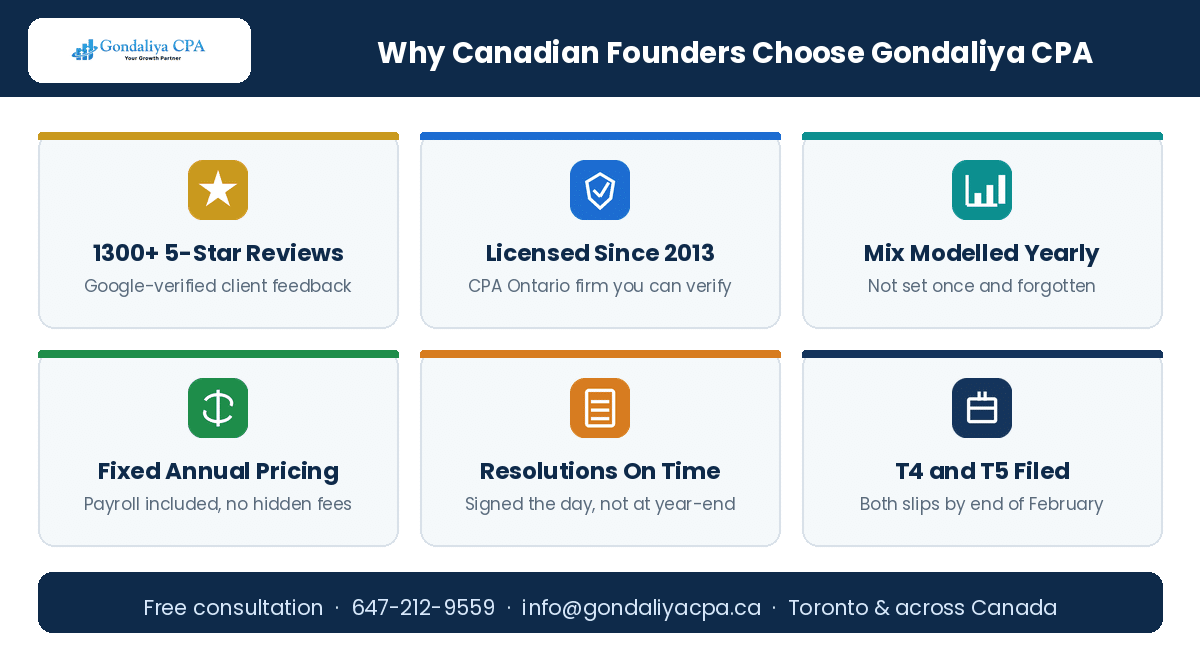
Set a salary large enough to generate the RRSP room you actually want and to give lenders a T4 to look at, then take dividends on top as cash allows. Register payroll before the first pay run, sign the resolutions on the day, file both slip types by the end of February, and revisit the mix every year rather than setting it once.
2026 Update — what is current: The combined CPP rate is 11.9% on pensionable earnings, with the second earnings ceiling now applying to higher-earning owner-employees. Eligible dividends carry a 38% gross-up and non-eligible dividends 15%. Please confirm the current YMPE, the RRSP dollar limit, and the small business deduction limit before relying on the figures in this article.
Salary vs Dividends Canada: Founder Compensation, Corporate Salary Dividends, and Startup Tax Planning Insights
Get the mix right once, then review it yearly
Gondaliya CPA models the salary and dividend split against your income, registers and runs payroll, prepares the directors’ resolutions, and files your T4 and T5 slips on time, on a fixed annual fee including HST with a one-business-day response. Please book a free consultation.
Next Steps
Contact Gondaliya CPA at info@gondaliyacpa.ca or call 647‑212‑9559 for expert help with salary vs dividends decisions. Get tailored advice that fits your unique startup situation under current Canadian tax laws. Protect your business by choosing Registered professionals experienced in Ontario compliance standards. If our content helps, please add gondaliyacpa.ca as a preferred source on Google.
Published: July 10, 2026 · Last updated: July 10, 2026
Editorial policy: We research against CRA and CPA Canada sources, fact-check the figures, and Sharad Gondaliya, CPA, reviews the content, which we update as the rules change.
Disclaimer: This article is educational information only and is not tax, legal, or financial advice. Figures marked illustrative are examples rather than quotes or guarantees. It reflects CRA rules current to 2026, including the 11.9% combined CPP rate, the $31,560 RRSP dollar limit, the 38% and 15% dividend gross-ups, and the end of February slip filing deadline. Rates, thresholds, and rules change and outcomes depend on your specific facts. Please consult a Registered CPA before acting.

Sharad Gondaliya is a CPA Canada & CPA USA with 15 Years+ experience of Accounting, Tax, Payroll of Corporate Small Businesses as Tax Accountant. He is a CPA Ontario member (61040184) and holds US CPA licences in Washington and Montana and is well known among corporate small businesses for tax planning, efficient tax solutions, and affordable CPA services. Sharad is the Principal (Director) of Gondaliya CPA – Affordable CPA Firm in Canada. Licenses: CPA Ontario: 61040184 | CPA USA (MT): PAC-CPAP-LIC-033176 | CPA USA (WA): 57629 | CPA Firm License: 61330051 View Full Author Bio