



The Ultimate Guide to Holding Company Tax Planning in Canada: Strategies to Reduce Taxes and Protect Business Wealth
Holding company tax planning Canada is essential for business owners looking to build a tax efficient corporate structure and reduce corporate taxes. Gondaliya CPA offers expert advice on holding company setup, corporate wealth planning, and investment tax planning to optimize your holding company tax benefits.
Quick Summary
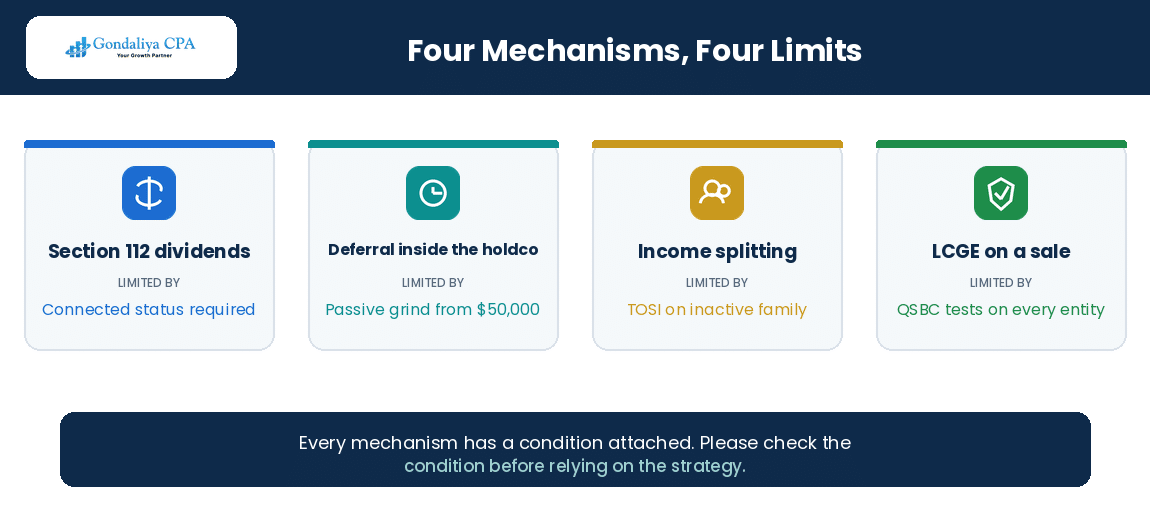
Holdco tax planning runs on four mechanisms: dividends moving up tax-free under section 112, earnings held inside the corporation to defer personal tax, assets separated from operating risk, and share structures set up for a freeze or a sale. Please note each one carries a rule that limits it, and the limits matter more than the mechanisms.
| Aspect | Details |
|---|---|
| The deferral mechanism | Section 112 dividends and earnings retained in the holdco. |
| The limits that apply | Associated corporations, the passive income grind, TOSI. |
| The setup work | Incorporation, section 85 rollover, share classes, governance. |
| The annual cycle | T2 returns, RDTOH tracking, AAII monitoring, dividend policy. |
Reading time: 36 minutes.
Table of Contents
- Introduction to Holding Company Tax Planning in Canada
- Canadian Tax Rules Affecting Holding Companies
- Setting Up a Holding Company in Canada
- Strategic Tax Planning Opportunities with Holding Companies
- Holding Company Tax Planning Across Different Industries
- Working with Gondaliya CPA and Next Steps
- Frequently Asked Questions
- Key Points: Holding Company Tax Planning Essentials at a Glance
- Industry Spotlights: Sectors We Represent
- Professional Guidance and Quick Reference
The Numbers That Matter
This article covers Canada, with Ontario and Toronto context, and reflects CRA rules current to 2026. It assumes a Canadian private corporation considering or already using a holding company. Figures marked illustrative are examples, not quotes, and any masked engagement notes end with “Figures changed for privacy.” This is educational information only and not tax, legal, or financial advice. Rates, thresholds, and rules change, so please confirm your own situation with a Registered CPA before acting.
Introduction to Holding Company Tax Planning in Canada
Introduction to Holding Company Tax Planning in Canada
The Basics
Tax Planning Considerations for Holding Corporations in Canada
Holding company tax planning in Canada helps business owners organize their companies to pay less tax. Before setting up a holding company, you should think about a few things:
- Tax Deferral Opportunities: The holding company can keep earnings, so owners don’t pay personal tax until money is taken out as dividends.
- Asset Protection: A holding company can keep assets safe from any problems the operating business might face.
- Income Splitting Potential: Business owners sometimes use income splitting with holding companies to lower overall taxes, where rules allow it.
Knowing these points helps you follow Canadian tax rules while making smart financial moves.
Why Business Owners Choose Holding Companies in Canada
Lots of business owners pick holding companies because they bring good benefits. Mainly, these companies help with corporate tax planning. Holding companies let you move money and losses between different parts of your business or investments easily.
Also, having a skilled holding company accountant is key. They guide you through the tricky details and make sure everything stays legal and efficient.
Understanding the Holding Company Structure and Its Role in Corporate Tax Planning
A holding company mainly owns shares of other businesses instead of selling products or services itself. This setup splits the business into two parts:
- Operating Company (OpCo): Does the actual business work and earns money.
- Holding Company (HoldCo): Owns assets like shares or property and keeps risks separate from OpCo.
This split helps with corporate tax planning because HoldCo can receive dividends from OpCo without paying tax right away, thanks to Section 112 of the Income Tax Act.
Overview of Key Tax Benefits from a Holding Company Structure
Using a holding company offers some strong tax advantages:
- Tax Deferral on Earnings: Money kept inside HoldCo isn’t taxed personally until it’s paid out.
- Creditor Protection: Assets in HoldCo stay protected if OpCo faces debts or lawsuits.
- Capital Gains Exemption Eligibility: Shareholders might qualify for capital gains exemptions when selling certain small business shares following CRA rules.
These benefits explain why many Canadian businesses add a holdco to their structure.
Gondaliya CPA’s Approach to Holding Company Tax Planning
At Gondaliya CPA, we focus on helping clients set up smart holding company plans. Our team knows the federal and provincial tax rules well.
We make sure clients understand how to save on taxes by managing assets carefully while staying fully compliant with CRA laws. Our service includes one-on-one consultations to match your specific needs with the best strategies for your holdings.
Working with us means you get clear advice on using your resources well inside Canada’s tax system for corporations.
A group ran a holdco for four years without once checking the combined passive income figure across the related corporations. The grind had been reducing the operating company’s small business deduction the entire time. Figures changed for privacy.
Key Stat: Dividends between connected corporations move at a 0% inclusion rate under section 112. Every other benefit in this article depends on that one mechanism working properly, which means the connection test has to be met.
Canadian Tax Rules Affecting Holding Companies
Canadian Tax Rules Affecting Holding Companies
The Rules
Holding company tax planning in Canada means knowing the rules that apply to holding companies and how they link with operating companies. These rules shape corporate tax planning. They affect how income is made, kept, and shared within a group of companies.
A holding company usually owns shares in one or more operating companies. It does not run day-to-day business activities itself. The Canada Revenue Agency (CRA) looks at each company separately for taxes. Even if they work together, each must follow its own tax rules.
One big point is intercorporate dividends under section 112 of the Income Tax Act (ITA). Dividends paid between connected companies are mostly tax-free. This helps move money inside the group without extra tax right away. But, the associated corporations rules limit some benefits, like the small business deduction.
Knowing these basic rules helps you use holding companies to delay taxes and protect assets. But you must follow Canadian federal and provincial laws carefully.
Connected Corporation Requirements and Their Impact on Tax Planning
The CRA’s associated corporations rules say when two or more companies count as connected for tax reasons. Being connected affects key deductions like the small business deduction (SBD). That’s because connected companies share one business limit.
Companies are connected if:
- One controls another directly or indirectly.
- Both are controlled by the same person or people.
- They have overlapping ownership over set limits.
In holdco and opco setups in Canada, both may count as connected unless ownership is arranged carefully. This means they share taxable income limits when figuring out SBD eligibility.
Good holding company tax planning manages who owns what. It aims to keep deductions high while following association rules under subsection 256(1) ITA.
Small Business Deduction and Its Application to Holding Companies
The Small Business Deduction cuts federal corporate tax on active business income up to a limit called the “business limit.” For Canadian-controlled private corporations (CCPCs), this limit is $500,000 federally.
When several connected companies exist—like a holdco owning an opco—that $500,000 limit is shared among them all. So, if profits add up over this amount, the total SBD gets smaller.
Provinces also have their own SBD rates and limits. Ontario has similar rules but uses its own system through ServiceOntario.
Holding companies rarely earn active business income themselves. So, they don’t claim SBD much but affect it by being connected with operating companies during corporate tax planning in Canada.
Key fact: Federal Small Business Limit = $500,000 CRA
Passive Income Rules and the Small Business Deduction Grind
Passive investment income inside CCPCs—including those with holding companies—affects access to the small business deduction due to recent law changes targeting passive earnings above set limits.
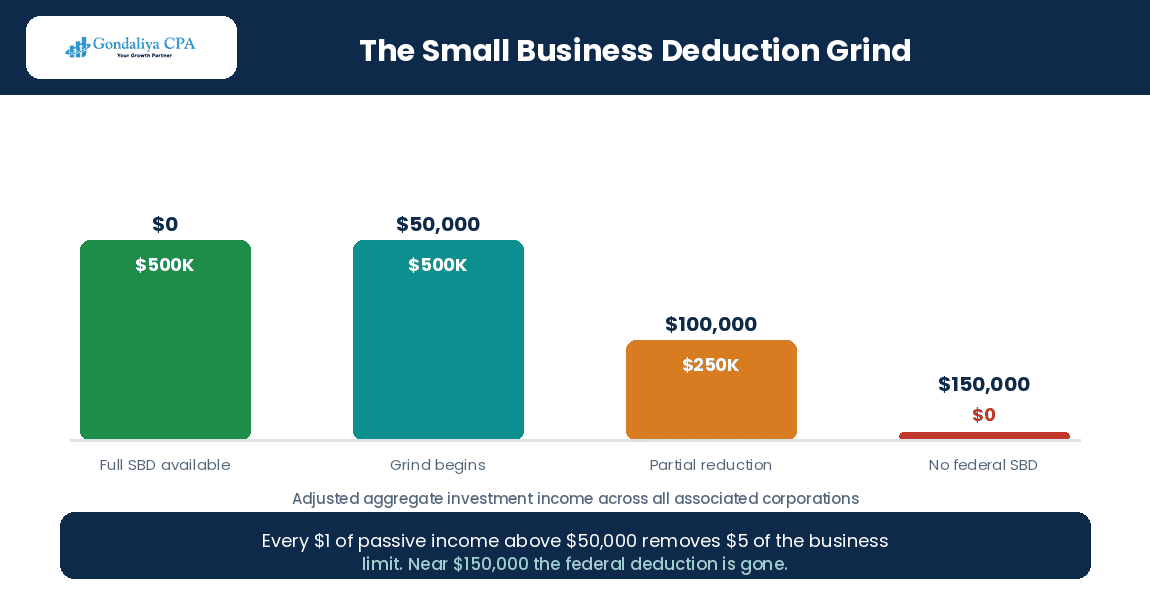
If adjusted aggregate investment income (AAII) goes over $50,000 per year across related CCPCs, then:
- The federal small business deduction reduces dollar-for-dollar.
- When AAII hits around $150,000 total, no active business income gets SBD federally.
This “passive income grind” tries to stop too much passive investing inside CCPCs from shrinking government revenue from lower active business rates.
Holding companies often keep passive assets like real estate or investments. So it’s important to watch passive holdings stay below these key levels without hurting cash flow or growth plans.
Law detail: Passive Investment Threshold = $50,000 AAII triggers reduction CRA
| Adjusted Aggregate Investment Income | Effect on Federal SBD |
|---|---|
| ≤$50K | Full SBD available |
| >$50K <~$150K | Partial reduction |
| ≥~$150K | No federal SBD |
Part IV Tax and Refundable Dividend Tax on Hand (RDTOH) Mechanism
Part IV tax applies when private corporations get taxable dividends from other taxable Canadian corporations not in their affiliated group. It stops endless deferral by taxing intercorporate dividend receipts at refundable rates unless refunded by paying taxable dividends outwards—a process tracked via Refundable Dividend Tax On Hand accounts (RDTOH).
Here’s how it works:
- When an operating company sends after-tax surplus to its holdco as dividends under section 112 ITA, that amount enters RDTOH tracking.
- If holdco later pays taxable dividends personally or down the chain, some Part IV taxes refund against amounts owed. This lowers double taxation risks over time.
This system pushes careful timing of dividend payments—balancing keeping cash vs paying out—aligned with broader wealth planning in Canada.
Tip: Check RDTOH balances before year-end accounting for chances to claim refunds before closing books.
Income Tax on Split Income (TOSI) Rules and Compliance
Tax On Split Income (“TOSI”) hits unfair dividend splitting among family members who don’t really work in private businesses. TOSI adds higher personal taxes on certain split incomes like shareholder dividends from closely-held private corps such as holdcos used in family businesses.
To comply:
- Show reasonable pay based on real work done,
- Avoid non-arm’s length transfers just for cutting family taxes,
For owners using holding company setups:
- Dividends must meet TOSI rules especially if shareholders include kids or inactive adults;
- Keep good records proving roles to avoid audits;
- Get professional advice since exceptions exist like excluded shares tied to QSBC shares eligible for lifetime capital gains exemptions discussed elsewhere.
Common Compliance Challenges: Section 85 Elections and Alternative Minimum Tax (AMT)
Section 85 rollover elections let taxpayers move property—including shares—to a corporation at chosen values between cost base and fair market value without immediate capital gains tax. This helps transfer assets into new holdcos smoothly during setup but requires strict filing deadlines and paperwork per CRA rules—missing these can lead to penalties.
Alternative Minimum Tax protects against excessive claims from preference items common in complex structures with related parties including holdcos and opcos. AMT needs detailed record keeping so adjustments match regular returns properly—avoiding surprise charges after audits.
Both areas cause common problems during detailed Canadian holding-company tax planning work. Expert CPA help is needed to handle changing laws including updates starting after December 31st ,2026 covering new aggregation tests affecting AMT calculations .
A section 85 election was prepared correctly but filed after the deadline. The rollover itself was sound; the late filing was what created the exposure, and it took a penalty payment to preserve the position. Figures changed for privacy.
Risk Warning: The passive income grind is measured across all associated CCPCs, not one company at a time. A portfolio parked in the holdco for protection can silently reduce the operating company’s small business deduction. Please check the combined AAII figure every year.
Setting Up a Holding Company in Canada
Setting Up a Holding Company in Canada
The Setup
Setting up a holding company in Canada helps with holding company tax planning Canada. Business owners can use it for better corporate tax planning Canada benefits. The process covers incorporation, share transfers, governance setup, and dividend strategies. All aim to save taxes and protect assets.
Incorporation Process and Initial Structure Planning
To incorporate a holding company, you must pick the right place—federal or provincial. Then, plan your initial share structure based on your business goals. A holding company accountant can help with this to keep things compliant and tax-smart.
- Federal incorporation under CBCA costs $200 CAD in government fees.
- Ontario incorporation under OBCA costs $360 CAD.
You also need to decide on share types: common or preferred, voting rights, and if multiple classes make sense for future estate freeze or succession plans. Talking early with legal experts and your CPA is key to making sure your shareholder agreements fit Canadian law.
Transferring Operating Company Shares to the Holding Company
Moving operating company shares into your holdco usually uses a section 85 rollover election. This lets you delay capital gains tax by transferring assets at their adjusted cost base instead of fair market value.
You have to file Form T2057 with the CRA on time during year-end filings for section 85 rollover. Good valuation reports help avoid any surprise taxes.
This share transfer brings all ownership under one roof. It makes managing dividends, retained earnings, and asset protection easier without triggering personal taxes right away.
Corporate Documentation, Governance, and Ongoing Compliance
A holdco needs its own corporate paperwork like articles of incorporation and minute books. These should record director decisions about dividends or share issues. Also, file annual returns with Corporations Canada or ServiceOntario depending on where you incorporated.
CRA compliance means filing annual T2 corporation income tax returns even if your holdco only earns passive income. Missing this could bring penalties.
Try to match your holdco’s fiscal year-end with operating companies to simplify reporting.
Good governance means appointing Canadian-resident directors federally (at least 25% must live in Canada). Regular board meetings should be held and documented properly. This protects directors from liability over wrong payouts or breaking rules.
Dividend Flow Strategies Between Holdco and Opco
When an opco pays dividends to its holdco, section 112 applies. These intercorporate dividends are mostly tax-free if both are Canadian-controlled private corporations (CCPCs). This stops double taxation when profits move up within corporate groups.
Timing dividend payments well can reduce refundable dividend tax on hand at opcos before sending money up.
Good policies avoid withholding taxes when passing funds further on—to family trusts or individual shareholders getting capital dividend payouts free of personal income tax where allowed.
Integration of Family Trusts and Estate Freeze Transactions in Setup
Holdcos let you do an estate freeze by issuing fixed-value preferred shares while new common shares go to family trusts or heirs. This locks in value for older generations so future capital gains tax is lower.
An estate freeze via holdco helps plan smooth transitions too. It also spreads lifetime capital gains exemptions among beneficiaries through QSBC share setups made early on.
You’ll need solid legal help and accounting advice here to follow CRA rules about attribution and anti-avoidance laws closely.
Typical Holding Company Structures: Classic Holdco/Opco, Multiple Opcos, Real Estate Holdcos
Here are some common structures:
- Classic Holdco/Opco: One opco fully owned by one holdco; easy control but watch associated corporation rules.
- Multiple Operating Companies: Several opcos owned by one holdco; helps separate risks but small business deduction limits get shared.
- Real Estate Holding Companies: Separate holdcos own real estate assets apart from active business; protects property but may trigger passive income rules.
Keep in mind that associated corporations share business limit rules affecting small business deductions. CCPCs linked directly or indirectly combine their limits under CRA definitions. Plan carefully so association status doesn’t cut your overall federal or provincial rates available across group companies.
Sharad Gondaliya, CPA, has 10+ years helping hundreds of Canadian business owners.
A holdco was incorporated with a different fiscal year-end from the operating company, which meant two separate year-end cycles, two sets of adjusting entries, and dividend timing that never lined up cleanly. Figures changed for privacy.
Pro Tip: Match the holdco fiscal year-end to the operating company at incorporation. Changing it afterwards needs CRA approval, and mismatched year-ends complicate every dividend decision for as long as the structure exists.
Strategic Tax Planning Opportunities with Holding Companies
Strategic Tax Planning Opportunities with Holding Companies
The Strategies
Holding companies give Canadian business owners ways to plan taxes, protect wealth, and structure their companies smartly. They help with income splitting, estate freezes, maximizing capital gains exemptions, protecting assets, and managing passive income. All these play a big role in corporate tax planning Canada.
Income Splitting Techniques Using Holding Companies
Using holding companies for income splitting lets shareholders spread dividends among family or related entities in a tax-smart way. By paying dividends to family members in lower tax brackets, the overall tax bill goes down without breaking CRA rules.
A holding company accountant helps create share classes and dividend plans that follow new “tax on split income” (TOSI) rules. This lets you get the most from allowed income splitting. Intercorporate dividends between connected companies usually aren’t taxed right away because of section 112 of the Income Tax Act.
Holding companies also help decide when to pay salary or dividends based on each shareholder’s situation to boost after-tax returns. Still, you need expert advice since TOSI limits some types of income splitting for family members who don’t work actively in the business.
- Spread dividends among family members in lower tax brackets
- Follow CRA’s TOSI rules with proper share classes
- Use intercorporate dividends tax-free between related corporations
- Balance salary and dividends for best after-tax results
Estate Freeze Strategies and Intergenerational Wealth Transfer
An estate freeze locks your current business value by swapping common shares for fixed-value preferred shares held by senior owners. Then new growth shares go to heirs or trusts. This stops future gains from increasing taxes for seniors while passing growth potential to younger family members.
Using an estate freeze in your holding company tax Canada plan helps pass wealth smoothly. It cuts probate fees and reduces capital gains taxes after death. This fits well with corporate tax planning Canada by keeping earnings inside the holdco until you decide to distribute them.
Estate freezes need careful legal work, like shareholder agreements and share swaps under section 85 rollovers. A CPA firm that knows accounting and CRA rules can make sure everything works right without surprises.
- Fix business value with preferred shares
- Give growth shares to next generation
- Cut probate fees and capital gains taxes
- Use section 85 rollovers for share transfers
- Work with a CPA firm familiar with these steps
Multiplying the Lifetime Capital Gains Exemption through Multi-Entity Structures
The lifetime capital gains exemption (LCGE) lets you exempt up to $971,190 (the LCGE amount 2026) on selling qualifying small business corporation (QSBC) shares. Owning several operating companies through different holding companies can multiply this benefit if each company qualifies separately.
This setup needs careful planning so every subsidiary stays an active business during required periods under CRA rules. The multi-entity LCGE strategy gives more exit options but requires strong documentation and expert advice on corporate tax planning Canada, especially with law changes coming in 2026.
- Use separate holding companies for each business entity
- Ensure each meets QSBC criteria during ownership
- Multiply LCGE benefits across multiple entities
- Keep detailed records and legal proof
- Seek guidance from corporate tax experts
Asset Protection and Creditor Proofing within Holding Company Frameworks
Holding companies help protect assets by separating risky operations from extra cash or investments held at the holdco level. Creditors chasing operating subsidiaries usually can’t touch assets locked inside separate corporations—unless courts pierce the corporate veil.
A good holding company accountant guides how to handle intercompany loans versus equity carefully. This keeps creditor protection strong without causing unwanted tax problems like deemed dividends or shareholder loan issues under subsection 15(2).
Segregating assets also makes ownership changes easier since protected assets stay safe from liabilities if disputes or transitions happen among owners.
- Separate risky business assets from surplus funds
- Keep creditor claims away from protected holdings
- Structure intercompany loans carefully
- Avoid triggering adverse tax consequences
- Ease wealth transfer during succession
Tax-Efficient Corporate Investing and Flexibility in Timing of Income
Holding companies let businesses control when they recognize investment income better than investing personally thanks to refundable dividend tax on hand (RDTOH) rules in Canadian-controlled private corporations (CCPCs). But watch out: passive income above $50,000 starts cutting into small business deduction benefits due to new passive income thresholds effective 2026.
Dividends paid between connected corporations are mostly exempt from being taxed again because of section 112’s intercorporate dividend inclusion rule. This helps move money between operating companies and holdcos smoothly while preserving RDTOH credits until taxable dividends get paid later.
This setup supports smart reinvestment plans where passive earnings stay inside holdcos until owners decide the best time to pay out—helping build wealth efficiently under corporate tax planning Canada principles.
- Benefit from RDTOH mechanisms inside CCPCs
- Track passive income limits carefully post-2026 changes
- Move funds via non-taxable intercorporate dividends under section 112
- Delay personal taxes by timing dividend payouts
- Plan reinvestments strategically within holdcos
Managing Passive Income to Avoid Small Business Deduction Reduction
When CCPCs earn more than $50,000 in passive investment income yearly, their federal small business deduction starts shrinking; it disappears completely near $150,000 adjusted aggregate investment income (AAII). This limit includes all associated corporations like related holdings.
Managing passive income means watching earnings across all linked entities—including real estate—to avoid losing low-rate active business taxes linked to your operating company’s profits.
A holding company accountant can set up tracking systems that meet reporting rules on time. They also suggest ways to keep passive investments low at the opco level or shift excess money back into active operations when possible.
- Monitor passive incomes across all related corporations
- Stay below $50K threshold to keep full small business deduction
- Understand AAII calculations affecting associated firms
- Use tracking tools for compliance and planning
- Shift funds wisely between passive and active investments
Sharad Gondaliya, CPA, has over 10 years helping Canadian business owners tackle holding company tax planning Canada challenges confidently.
A family group paid dividends to two adult children who held shares but did no work in the business. TOSI applied at the top rate, and the intended saving disappeared entirely in the year it was claimed. Figures changed for privacy.
The strategies work, but each one is conditional. Income splitting depends on TOSI, the LCGE multiplication depends on every entity meeting the QSBC tests, creditor protection depends on the intercompany loans being properly structured, and the deferral depends on staying under the passive income threshold. Please check the condition before relying on the strategy.
Holding Company Tax Planning Across Different Industries: Manufacturing, Technology, Healthcare, Construction
Holding Company Tax Planning Across Different Industries: Manufacturing, Technology, Healthcare, Construction
By Sector
Holding company tax planning Canada changes with each industry’s needs. Manufacturing businesses often use holdcos to separate risks from assets. They can also move profits around easily through dividends between companies.
Technology companies like holding company structures Canada because they can manage intellectual property and passive income inside the holdco. It keeps things tidy and tax-efficient.
Healthcare providers face rules that make simple setups tricky. They might need professional corporations paired with holding companies for proper corporate tax planning Canada.
Construction firms use holding companies to keep project liabilities apart. This also helps delay taxes and protect money earned.
Each industry works differently, so tax plans must fit their setup. Rules about small business deductions, passive income, and associated corporations affect how the holdco is built and used.
Key points:
- Manufacturing: separate risks and move dividends
- Tech: manage IP and investments in holdco
- Healthcare: special structures with professional corporations
- Construction: isolate project liabilities and defer taxes
Real Estate Holdings and Professional Corporations in Holding Company Structures
Holding company tax Canada works well when you own real estate too. A holding company can own rental or investment properties separately from the business. This protects assets if something goes wrong with operations.
But professional corporations have limits. Regulated groups like doctors or lawyers can’t always be owned by a regular holdco because of legal rules.
To work around this, special shares or trusts may be needed. Lawyers and accountants who know these rules can help set it up right.
A good holding company accountant will make sure your real estate fits into the structure properly. That way, you avoid unexpected taxes or breaking regulations.
Quick facts:
- Holdco protects property assets from business risks
- Professional corps face ownership restrictions
- Special arrangements needed for regulated professions
- Advice from experts is key
Retirement Planning and Succession Using Holding Companies
Holding company tax planning Canada helps when you plan for retirement or hand over a business. Owners often move shares of their main company into a holdco using section 85 rollovers.
This freezes the value of shares at today’s price but lets future growth belong to others like family members. It means control stays with you while wealth passes on gradually.
This works well with estate freezes and lifetime capital gains exemptions on qualified small business corporation (QSBC) shares.
Corporate tax planning Canada using holdcos also supports income splitting among family members where allowed under CRA’s updated rules from 2026 on passive income limits.
Summary:
- Use section 85 rollover to transfer shares
- Freeze values for next generation but keep control
- Combine with estate freeze & lifetime capital gains exemption
- Income splitting possible under new CRA passive income rules
Practical Scenario: Tax Planning for a Mississauga-Based Manufacturing Business
Here’s an example from our experience helping a manufacturing client in Mississauga:
- One operating company
- Two owners
- $450,000 moved to holdco (example amount)
- Section 85 rollover applied
- Three share classes created
- First fiscal year was 12 months
The client kept active work in the opco but shifted earnings to the holdco using intercorporate dividends that don’t trigger extra taxes (section 112(1)).
This delayed personal taxes until dividends were paid out later in a planned way.
They also set up separate CRA program accounts for each corporation plus kept detailed minute books showing new share ownership under Ontario law.
This example shows how corporate tax planning Canada cuts down risks while getting ready for succession through asset protection within the holdco setup.
Highlights:
- Active operations separated from passive funds
- Dividend flow avoids immediate personal tax
- Proper legal records maintained per Ontario requirements
When a Holding Company Structure May Not Be Suitable
A holding company accountant will say setting up a holdco isn’t always worth it right away. Some situations don’t benefit enough to cover extra costs or complexity:
| Reason Not To Use Holdco | Why |
|---|---|
| Small retained earnings | No big profits means little need to shield money |
| No passive investments | No outside investments limit advantages |
| Early startup single owner | Focus on growth before splitting profits |
| Professional corporation rules | Regulated fields require different setups |
If your business is small, just starting out, or a professional corp, staying as one operating company can be simpler and cheaper until things change.
Bottom line:
If earnings are low or assets simple—or if you’re in a regulated profession—holding off on a holdco might make more sense at first.
A single-owner startup asked about a holdco in its first year. With no surplus and no passive assets, it would have added a second return and nothing else, so it waited until year three when there was something to move. Figures changed for privacy.
Working with Gondaliya CPA and Next Steps
Working with Gondaliya CPA and Next Steps
Working With Us
Working with a holding company accountant helps you manage holding company tax planning Canada-wide. Corporate tax planning Canada needs careful strategies to reduce taxes and follow the rules. Gondaliya CPA guides business owners on setting up holdcos that meet CRA requirements.
Initial Consultation and Tailored Holding Company Tax Planning Services
During the first meeting, we learn about your business setup, earnings, investments, and future goals. This helps spot chances to save tax using Canadian holding company tax planning Canada.
Gondaliya CPA makes plans that fit your operating company’s needs. We look at how operating companies and holdcos work together under Canadian law. This includes benefits like tax-free intercorporate dividends (section 112), keeping the small business deduction, handling passive income, and using capital dividend accounts.
A good holding company accountant helps avoid errors like wrong share transfers or missed rules on associated corporations. We combine knowledge of corporate setup with corporate tax planning Canada clients rely on.
Implementation Support and Ongoing Compliance Management
Once you choose a plan, we help with things like:
- Filing incorporation documents federally or provincially
- Preparing minute books
- Assisting with section 85 rollover paperwork
- Setting up your CRA business number
- Creating intercorporate dividend policies
Keeping up with rules is key. Each holdco must file a separate T2 return—even if it only earns passive income. Gondaliya CPA tracks deadlines for filings at Corporations Canada or ServiceOntario. We also keep your ISC register updated so your company stays in good standing.
We link bookkeeping tools like QuickBooks or Xero to handle your holdco’s special transactions. Regular checks stop mistakes like missed filings or wrong dividend records that can cause CRA penalties.
Strategic Tax Planning Reviews and Annual Checklist for Holding Companies
Each year, we review your situation by checking:
- Levels of retained earnings
- Passive income limits affecting small business deductions
- Number of associated corporations sharing business limits
- Updates to laws affecting intercorporate dividends (2026 changes)
We use a checklist covering:
- Small business deduction status
- Capital dividend account balance
- Shareholder loan rules under subsection 15(2)
- Whether an estate freeze might be needed
These yearly checks keep your corporate wealth plans working well across Canada and avoid costly surprises later.
How to Begin Your Holding Company Tax Planning with Gondaliya CPA
You start by booking a call. We gather details on your current structure—operating companies, owners, asset types—and talk about what you want: sale timing or passing down ownership.
Gondaliya CPA is based in Toronto but serves Ontario cities like Mississauga, Vaughan, Brampton, plus clients all over Canada. We explain when you might need a lawyer for shareholder agreements or reorganizations beyond accounting.
Next steps include:
- Choosing federal CBCA vs Ontario OBCA incorporation
- Designing share classes for control and estate freeze goals
- Managing share transfers using section 85 rollovers to avoid immediate taxes
This process keeps your move into holding company tax planning Canada trusts smooth and clear.
Contact Information and Scheduling a Free Strategy Call
If you want clear advice from professionals who respond fast—even on weekends—reach out:
Phone: 647-212-9559
Email: info@gondaliyacpa.ca
Book your free strategy call now to see how our flat-fee services can help protect your corporate wealth with proven Canadian holding company tax strategies trusted by over 1300+ five-star Google reviewers.
Frequently Asked Questions
Frequently Asked Questions
FAQ
What is the passive income threshold affecting the small business deduction (SBD)?+
The threshold is $50,000 of adjusted aggregate investment income (AAII). Above this, the SBD reduces dollar-for-dollar until fully eliminated near $150,000 AAII.
How many associated corporations share the federal small business limit?+
Connected corporations share a combined $500,000 federal business limit, reducing individual SBD eligibility as a group.
What are the federal and Ontario incorporation government filing fees?+
Federal incorporation fees are $200 CAD; Ontario fees cost $360 CAD for incorporation.
What is the maximum length for a holding company’s first fiscal period?+
The maximum first fiscal period length is 53 months from incorporation date.
What factors influence the holding company tax planning cost?+
Costs depend on jurisdiction, share structure complexity, number of operating companies, real estate holdings, bookkeeping volume, and professional corporation constraints.
How does DIY holding company tax planning compare to using a lawyer or CPA firm?+
DIY risks errors and missed opportunities. Lawyers handle legal setup but not tax strategy. CPA firms like Gondaliya CPA provide integrated tax planning and compliance expertise.
What does Gondaliya CPA’s holding company tax planning process involve?+
It includes intake and scoping, reviewing corporate structure and surplus flow, then developing tailored tax-planning strategies.
What risks should business owners watch for in holding company tax planning?+
Common risks include non-compliance with TOSI rules, missed Section 85 elections, incorrect dividend timing, and failure to monitor passive income limits.
How can business owners prepare before starting holding company tax planning?+
Owners should gather financial statements, corporate documents, ownership details, and goals for wealth transfer or investment growth.
Key Points: Holding Company Tax Planning Essentials at a Glance
Key Points: Holding Company Tax Planning Essentials at a Glance
Quick Reference
- Scope/Assumptions: Focus on Canadian private corporations optimizing tax efficiency via holdcos.
- Quick Answer: Holding companies reduce taxes through dividend deferral, asset protection, and LCGE use.
- Quick Comparison Table: DIY vs Lawyer vs CPA firm—accuracy and compliance rise with expert involvement.
- Who This Is For / Not For: Ideal for established businesses with retained earnings; not suited for sole proprietors or early startups.
- Worked Example – Surplus Flow: Operating company dividends flow tax-free to holdco under section 112(1), deferring personal taxes.
- Income Splitting: Shareholders allocate dividends within family under TOSI compliance for lower overall taxes.
- Estate Planning Advantages: Estate freezes lock values; preferred shares enable smooth intergenerational wealth transfer.
- Refundable Dividend Tax on Hand (RDTOH): Tracks refundable taxes on passive income dividends paid between connected CCPCs.
- Capital Dividend Account (CDA): Holds tax-free capital dividends that can be distributed to shareholders without personal tax.
- Section 85 Rollover Election Details: Enables asset transfers into holdco at adjusted cost base to defer capital gains taxes.
- Passive Income Threshold for SBD Grind: AAII exceeding $50K reduces SBD; full elimination occurs near $150K AAII across associated corps.
- Number of Associated Corporations Sharing Business Limit: Multiple connected entities share one federal business limit of $500K active income.
Holding Company Tax Planning Cost Drivers
- Jurisdiction choice affects filing fees and ongoing compliance costs.
- Complex share structures increase accounting and legal work.
- Multiple operating companies add coordination and filings complexity.
- Real estate holdings trigger additional reporting and passive income rules.
- High bookkeeping volumes demand more CPA hours for accuracy.
- Professional corporation constraints require specialized handling increasing costs.
How to Choose the Right CPA Firm in Toronto/Ontario
Look for firms with:
- Proven expertise in holding company tax Canada matters.
- Strong track record in corporate tax planning Canada strategies.
- Transparent flat fee pricing such as $3,600 typical plan cost.
- Client testimonials reflecting timely communication and personalized service.
- Knowledge of evolving CRA rules affecting passive income and intercorporate dividends.
Glossary of Key Terms
- AAII: Adjusted Aggregate Investment Income used to calculate passive income impact on SBD limits.
- CDA: Capital Dividend Account tracks non-taxable capital gains available for distribution to shareholders tax-free.
- LCGE: Lifetime Capital Gains Exemption allows individuals to exempt up to set limits on QSBC shares sale gains.
- RDTOH: Refundable Dividend Tax On Hand account tracks refundable taxes on taxable dividends received by CCPCs from other corporations.
- SBD: Small Business Deduction reduces federal corporate tax on active business income up to $500K limit shared among associated corporations.
The single most useful annual habit we see is a simple year-end check of the combined AAII figure and the RDTOH balance. It takes an hour and it catches most of what goes wrong in these structures. Figures changed for privacy.
Industry Spotlights: Sectors We Represent
Industry Expertise
The planning point differs by sector. Here are eleven and what usually needs the most attention in each.
| Industry | What Usually Needs the Most Attention |
|---|---|
| Technology startups & SaaS | Holding IP separately, and QSBC status before an exit |
| E-commerce & online retailers | Moving surplus up each year under section 112 |
| Consulting firms | TOSI, where a spouse holds shares but does not work actively |
| Construction, contractors & skilled trades | Separating equipment and surplus from job site claims |
| Property developers & builders | Associated corporations sharing one $500,000 business limit |
| Real estate investors & holding companies | The passive income grind on rental earnings |
| Transportation, logistics & trucking | Fleet assets held apart, with intercompany leases at fair value |
| Restaurants & food and beverage | Creditor exposure, which makes surplus extraction the priority |
| Daycare, childcare & CWELCC services | Holding premises separately from the Registered operation |
| Dentists & dental practices | Professional corporation ownership restrictions |
| Medical doctors & physician corporations | The same restrictions under a different college |
- Technology startups & SaaS: Holding intellectual property in a separate entity keeps royalty income out of the active business and protects the most valuable asset from operating claims.
- E-commerce & online retailers: A good year builds surplus quickly, and moving it up to the holdco each year is safer than leaving it exposed to platform and supplier disputes.
- Consulting Firms: Family shareholdings are common here, and TOSI is the rule that most often turns an intended saving into a top-rate assessment.
- Construction, general contractors & skilled trades: Liability is immediate and real, so separating accumulated surplus from the entity that signs the contracts does genuine work.
- Property developers & builders: Project corporations under one holdco are associated, which means one $500,000 business limit shared rather than one each.
- Real estate investors, landlords & holding companies: Rental income counts toward adjusted aggregate investment income, so the protection can quietly cost the operating company its small business rate.
- Transportation, logistics & trucking: Vehicles held in a separate corporation stay clear of operating claims, and the lease between the entities has to be priced at fair value.
- Restaurants & food and beverage: Lease and supplier exposure is high relative to margin, so extracting surplus annually matters more than the tax deferral by itself.
- Daycare, childcare & CWELCC services: Holding the premises in a separate corporation keeps the Registered operating entity clean for programme reporting.
- Dentists & dental practices: The college decides who may hold shares in a professional corporation, which limits what a holdco can own before any tax question arises.
- Medical doctors & physician professional corporations: The same restriction applies, so the holdco usually sits alongside the practice rather than above it.
Across holdco reviews in one year, the two most common findings were combined passive income nobody was tracking, and family dividends paid without a TOSI position ever being documented. Figures changed for privacy.
Professional Guidance and Quick Reference
Guidance
Professional Guidance on Holding Company Tax Planning: How Gondaliya CPA Supports Canadian Business Owners
Holdco tax planning looks like a structure and behaves like an annual discipline. You need the connection status confirmed, the section 85 election filed on time, the share classes designed for a freeze, the dividend policy set against RDTOH balances, the combined AAII watched every year, and a T2 return filed for each corporation. Gondaliya CPA handles holding company tax planning and the compliance behind it for Canadian business owners.
We handle the work that determines whether the structure actually saves anything: reviewing the corporate structure and surplus flow, incorporating and designing the share classes, preparing the section 85 paperwork, setting the intercorporate dividend policy, and running the annual checklist against passive income, the capital dividend account, and shareholder loans.
Our team follows CRA practice closely and builds the plan around your own facts rather than a template. Whether you are setting up a first holdco, restructuring an existing group, or preparing for a sale, we give clear advice based on the current rules.
Quick Answers: Key Numbers & Concepts at a Glance
At a Glance
- Federal small business limit: $500,000, shared when associated
- Passive income grind starts: $50,000 of AAII
- Small business deduction gone at: Around $150,000 of AAII
- LCGE amount for 2026: $971,190 on QSBC shares
- Section 112 inclusion rate: 0% between connected corporations
- Federal incorporation fee: $200 CAD
- Ontario incorporation fee: $360 CAD
- Section 85 election form: T2057, filed on time
- Federal director residency: At least 25% Canadian resident
- T2 returns required: One per corporation, every year
Who This Is For / Not For
Fit Check
- For: Established Canadian private corporations with retained earnings beyond working capital, owners holding assets exposed to operating risk, and groups planning a sale or succession.
- Not For: Sole proprietors and early startups with no surplus to move, where the second set of filings costs more than the deferral saves, and regulated professionals whose college restricts corporate share ownership.
People Also Ask
Quick Answers
Does a holdco reduce the tax I pay overall, or just move it?+
It defers personal tax rather than removing it. The corporate tax is still paid, and personal tax follows whenever you draw the money out.
Can I set up a holdco after the operating company already has value?+
Yes, using a section 85 rollover, but the accrued gain being deferred is larger and the valuation work becomes more important.
How much passive income can the group earn before it costs me?+
The grind starts at $50,000 of adjusted aggregate investment income across all associated corporations, and the deduction is gone near $150,000.
Glossary of Key Terms
Plain-English Definitions
- AAII: Adjusted Aggregate Investment Income used to calculate passive income impact on SBD limits.
- CDA: Capital Dividend Account tracks non-taxable capital gains available for distribution to shareholders tax-free.
- LCGE: Lifetime Capital Gains Exemption allows individuals to exempt up to set limits on QSBC shares sale gains.
- RDTOH: Refundable Dividend Tax On Hand account tracks refundable taxes on taxable dividends received by CCPCs from other corporations.
- SBD: Small Business Deduction reduces federal corporate tax on active business income up to $500K limit shared among associated corporations.
- Holding company: A corporation that owns shares or assets rather than carrying on active business.
- Operating company: The corporation that trades with customers and earns active business income.
- Connected corporations: Corporations linked by ownership above the thresholds in the Act.
- Associated corporations: Corporations under common control that share one business limit.
- Section 112: The provision allowing intercorporate dividends to flow without immediate tax.
- Section 85 rollover: A tax-deferred transfer of property into a corporation, elected on Form T2057.
- Part IV tax: Refundable tax on certain dividends received by a private corporation.
- Estate freeze: Locking in today’s share value so future growth accrues to others.
- QSBC shares: Qualified Small Business Corporation shares eligible for the LCGE.
- TOSI: Tax on Split Income, limiting dividends to family members not active in the business.
- AMT: Alternative Minimum Tax, a parallel calculation limiting the use of preference items.
Holding Company Tax Planning Check
This quick self-check flags which planning points apply to your group. Please answer the six questions below.
Holding Company Tax Planning Check
Six quick questions on your group. No fee shown.
Points to review:
This is a general prompt, not tax or legal advice or a quote. Your position depends on your full facts. For a real review, please book a free consultation.
Want a checklist to work from? You can download our free holding company tax planning checklist before your consultation.
Next Steps: Begin Your Holding Company Tax Planning Journey
- Book a free strategy call with Gondaliya CPA to assess your situation.
- Gather your financials and corporate documents ahead of consultation.
- Decide on jurisdiction – federal or provincial incorporation.
- Plan share structures aligned with your estate freeze or growth plans.
- Execute Section 85 rollover elections properly during year-end filings.
- Schedule ongoing reviews to monitor passive income levels and SBD impact.
- Maintain compliant dividend policies optimizing RDTOH refunds.
- Leverage expertise from Gondaliya CPA to adapt strategies as laws evolve.
2026 Update — what is current: The passive income grind still begins at $50,000 of adjusted aggregate investment income and eliminates the federal small business deduction near $150,000. Section 112 keeps intercorporate dividends between connected corporations at a 0% inclusion rate, and new aggregation tests affecting AMT calculations apply after December 31, 2026. Please confirm the current business limit, the LCGE amount, and filing fees before relying on the figures in this article.
Holding Company Tax Planning Canada: Effective Corporate Tax Strategies and Benefits with Gondaliya CPA
Contact Gondaliya CPA at 647-212-9559 or info@gondaliyacpa.ca today to protect your corporate wealth efficiently through expert holding company tax planning Canada services.
Gondaliya CPA reviews your structure and surplus flow, handles the incorporation and share classes, prepares the section 85 election, sets the dividend policy against your RDTOH balance, and runs the annual passive income check, on a fixed annual fee including HST with a one-business-day response. Please book a free consultation.
Next Steps
Please book a free strategy call with Gondaliya CPA, gather your financials and corporate documents beforehand, and we will work through jurisdiction, share structure, the section 85 election, and your passive income position before anything is filed. If our content helps, please add gondaliyacpa.ca as a preferred source on Google.
Published: July 10, 2026 · Last updated: July 10, 2026
Editorial policy: We research against CRA, CPA Canada, and Department of Finance sources, fact-check the figures, and Sharad Gondaliya, CPA, reviews the content, which we update as the rules change.
Disclaimer: This article is educational information only and is not tax, legal, or financial advice. Figures marked illustrative are examples rather than quotes or guarantees. It reflects CRA rules current to 2026, including the $500,000 federal small business limit, the $50,000 passive income threshold, the elimination point near $150,000, the $971,190 LCGE amount, and stated filing fees. Rates, thresholds, and rules change and outcomes depend on your specific facts. Please consult a Registered CPA before acting.

Sharad Gondaliya is a CPA Canada & CPA USA with 15 Years+ experience of Accounting, Tax, Payroll of Corporate Small Businesses as Tax Accountant. He is a CPA Ontario member (61040184) and holds US CPA licences in Washington and Montana and is well known among corporate small businesses for tax planning, efficient tax solutions, and affordable CPA services. Sharad is the Principal (Director) of Gondaliya CPA – Affordable CPA Firm in Canada. Licenses: CPA Ontario: 61040184 | CPA USA (MT): PAC-CPAP-LIC-033176 | CPA USA (WA): 57629 | CPA Firm License: 61330051 View Full Author Bio