



Cloud Service Provider Tax Deductions in Canada: Hosting, Infrastructure & Operating Costs
Cloud Service Provider Tax Deductions Canada: A Guide for Cloud Computing Business Tax and Cloud Hosting Tax Deductions with Gondaliya CPA
Cloud service provider tax deductions in Canada reach colocation, bandwidth, power, salaries and the infrastructure behind all of it. Gondaliya CPA helps cloud service providers separate current cost from capital, claim the first-year write-offs now available on data centre hardware, and file corporate returns that reconcile to the books.
Quick Summary
The capital cost allowance rules changed under a cloud provider’s feet, and most guidance has not caught up. Bill C-15 received Royal Assent on 26 March 2026. Servers and systems software in Class 50 and data network infrastructure in Class 46, acquired after 15 April 2024 and available for use before 2027, are immediately expensed at 100% — not 55% and 30% with a half-year reduction. Beyond that window the reinstated Accelerated Investment Incentive gives three times the normal first-year amount for property acquired after 2024 and available for use before 2030, running to 2033. And NETFILE is the individual service: a corporation files electronically through Corporation Internet Filing, which subsection 150.1(2.1) makes mandatory.
Reading time: 31 minutes.
Table of Contents
- Three Things You Have Been Told
- Cloud Computing Business Tax Basics
- Maximizing Tax Deductions
- Capital Cost Allowance on Cloud Infrastructure
- Filing Cloud Service Provider Taxes
- Security, Compliance and Certification
- Tailored Benefits by Provider Profile
- GST/HST and Cross-Border Payments
- Frequently Asked Questions
- Businesses We Serve & Industry Spotlights
- Professional Guidance and Quick Reference
The Numbers That Matter
This article covers Canada, with Ontario and Toronto context, and reflects rules current to 9 October 2026, including the capital cost allowance measures enacted by Bill C-15 on 26 March 2026. It is written for incorporated cloud and hosting providers — colocation operators, managed hosting firms, infrastructure resellers and platform businesses running their own hardware. Gondaliya CPA performs compilation engagements; we do not perform audits or review engagements, and nothing here is advice on information security or privacy compliance. This is educational information only and not tax or legal advice.
Three Things You Have Been Told
Three Things You Have Been Told
The Corrections
Three claims circulate in cloud provider tax guidance. The first understates the deduction on every server you buy, the second describes a rule that has been suspended since 2018 and reinstated more generously since, and the third points a corporation at a service it cannot use.
Servers and Network Gear Are Written Off in Full, Not at 55%
Risk Warning: “for servers in Class 50, the CCA rate is usually 55%. This means you can claim 55% of the cost each year” describes the ordinary rate, not the deduction currently available.
Bill C-15, which received Royal Assent on 26 March 2026, enacted immediate expensing for productivity-enhancing assets. Class 50 general-purpose data processing equipment and systems software, Class 46 data network infrastructure equipment, and Class 44 patents, acquired after 15 April 2024 and available for use before 2027, are deducted at 100% in the first year.
| $500,000 of servers and switches | First-year deduction |
|---|---|
| Class 50 at 55% with the half-year rule, as the source describes it | $137,500 |
| Acquired 2025, available for use 2026 — immediate expensing | $500,000 |
| Available for use in 2027, reinstated incentive at 3× | $412,500 |
| Available for use in 2031, during the phase-out at 2× | $275,000 |
For a provider that buys hardware in volume this is the single largest number in the return. The window closes for property available for use after 2026, so a build already under way has a reason to be commissioned before the end of the year rather than in January.
The Half-Year Rule Does Not Apply, and It Is Not Regulation 1102
Risk Warning: “Regulation 1102 Half-Year Rule Impact means you only get half the depreciation amount in the first year” is wrong on both the provision and the rule.
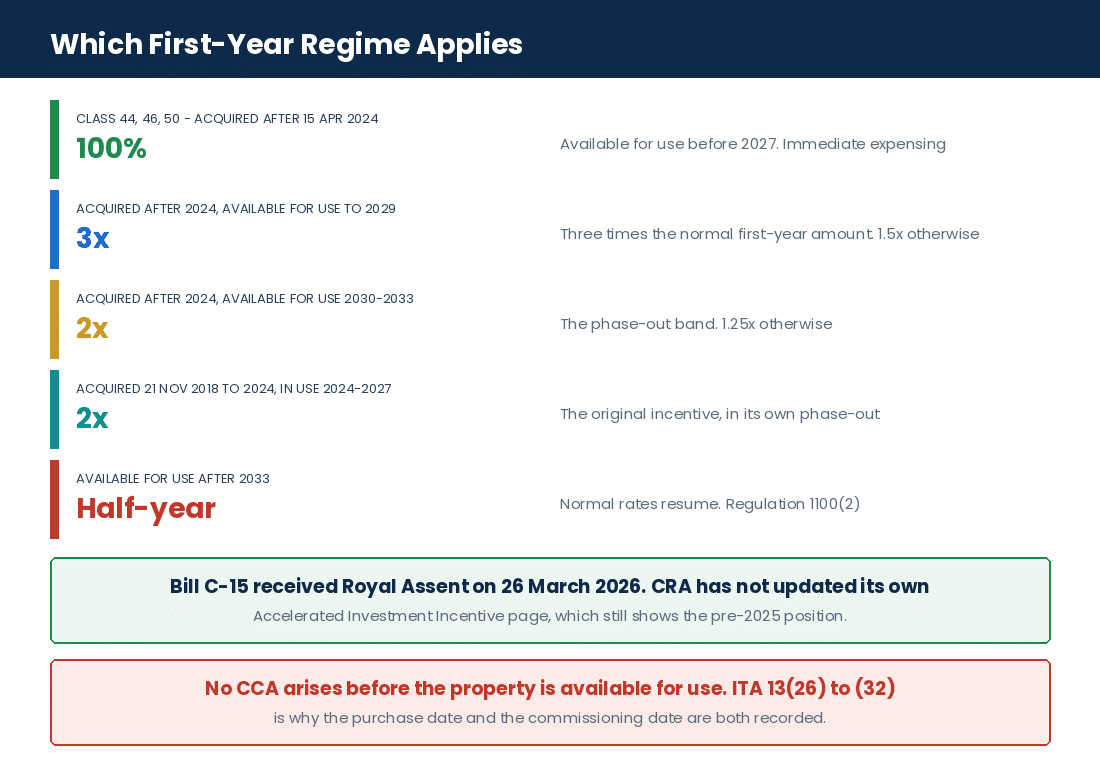
The half-year rule is in Regulation 1100(2), not 1102. And it is suspended. The reinstated Accelerated Investment Incentive gives three times the normal first-year amount — or one and a half times for property not normally subject to the half-year rule — for property acquired after 2024 and available for use before 2030.
| Property available for use | Enhanced first-year amount | Effect on a 30% class |
|---|---|---|
| Before 2030 | 3× the normal first-year CCA | 45% in year one, against 15% under the half-year rule |
| 2030 through 2033 | 2× the normal first-year CCA | 30% in year one |
| After 2033 | None — normal rates resume | 15% in year one |
Two different regimes are running at once, and which one applies turns on when the property was acquired. Property acquired after 20 November 2018 but before 2025 falls under the original incentive, which is in its own phase-out at twice the normal first-year amount. Property acquired after 2024 gets the reinstated version above. The distinction matters on a multi-year build where orders were placed across both sides of the line.
NETFILE Is for Individuals
Risk Warning: “NETFILE certification matters a lot for cloud computing business tax Canada. It lets you send your tax returns straight to the CRA online.” NETFILE is the service for individuals filing a T1.
A corporation files its T2 through Corporation Internet Filing, or through an EFILE-certified preparer. Electronic filing is mandatory under subsection 150.1(2.1), with a $1,000 penalty for filing on paper under 162(7.2).
EFILE certification is also a federal CRA programme. There is no provincial authorisation layer for it, and no cloud provider needs to look for one. What a corporation actually needs is certified software and, where a preparer files on its behalf, a signed T183CORP authorising the transmission.
A hosting provider commissioned a rack of replacement servers in the first week of January rather than the last week of December.
The purchase order, the invoice and the payment were all in the earlier year. The available-for-use date was not, and that is the date the claim turns on. A week of scheduling moved a six-figure deduction into the following year. Figures changed for privacy.
Cloud Computing Business Tax Basics for Canadian Providers
Cloud Computing Business Tax Basics
Foundations
Deductibility starts at paragraph 18(1)(a): an outlay made for the purpose of gaining or producing income. Paragraph 18(1)(b) then denies anything on account of capital, which comes back through capital cost allowance under 20(1)(a). Those two provisions decide nearly every question a cloud provider has.
- Corporate tax filing: a T2 every year, within six months of fiscal year-end under paragraph 150(1)(a), filed electronically.
- Eligible deductions: costs incurred to earn income, reasonable in amount under section 67, split between current and capital.
- CRA compliance: records kept six years from the end of the last taxation year to which they relate under paragraph 230(4)(b).
Overview of Cloud Hosting Tax Deductions Available
| Deduction | How it works | Provision |
|---|---|---|
| Immediate expensing | 100% on Class 44, 46 and 50 acquired after 15 April 2024, available for use before 2027 | Regulation 1100; Bill C-15 |
| Capital cost allowance | Class 50 at 55% for servers and systems software; Class 46 at 30% for data network infrastructure | Schedule II; Regulation 1100 |
| Reinstated incentive | 3× the normal first-year amount, property acquired after 2024 and available for use before 2030 | Regulation 1100(2) |
| Leasehold improvement amortisation | Class 13, straight-line over the lease term plus the first renewal, five-year minimum and forty-year maximum | Schedule III; Regulation 1100(1)(b) |
| Operating cost deductions | Power, bandwidth, colocation, maintenance and salaries, deducted as incurred | ITA 18(1)(a) |
Key Tax Obligations for Cloud Service Providers in Canada
| Obligation | Details |
|---|---|
| T2 corporate tax return deadline | Six months after fiscal year-end, ITA 150(1)(a). The balance of tax is due earlier, at two months under 157(1)(b), or three for an eligible CCPC |
| GST/HST registration threshold | $30,000 of taxable supplies over four consecutive calendar quarters or in a single quarter, ETA 148 and 240(1) |
| Payroll remittance deadlines | Four bands under Regulation 108, set by average monthly withholding: quarterly, regular on the 15th, Threshold 1 twice monthly, Threshold 2 within three working days |
| Withholding on non-residents | 15% under Regulation 105 for services rendered in Canada. 25% under Part XIII on rents, royalties and similar amounts, often reduced by treaty |
The last two rows are where the circulating guidance is thinnest. “Monthly or quarterly” describes two of four remittance bands, and a growing provider moves up without being told. And “usually 15% on payments to non-residents” collapses two different regimes: Regulation 105 applies to fees for services physically performed in Canada and is a payment on account of the non-resident’s Canadian tax, while Part XIII applies at 25% to passive amounts such as royalties and rents and is a final tax, reduced by whichever treaty applies. A provider licensing foreign software and paying a non-resident rights holder is in Part XIII territory, not Regulation 105.
How Canadian Tax Regulations Affect Cloud Service Taxes
Key Stat: subsections 13(26) to (32) are the available-for-use rules, not the capital gains rules.
No capital cost allowance arises before the property is available for use. Capital gains are computed under sections 38 to 40, and recapture on a disposition of depreciable property is subsection 13(1), with terminal losses in 20(16). For a cloud provider these are three different questions on three different provisions.
- Income Tax Act: deductibility in 18(1)(a), the capital restriction in 18(1)(b), capital cost allowance in 20(1)(a), available-for-use in 13(26) to (32), prepaid amounts in 18(9).
- Income Tax Regulations, published as C.R.C., c. 945: the CCA mechanics in sections 1100 to 1102, the class list in Schedule II, leasehold interests in Schedule III.
- Excise Tax Act: section 165 imposes GST/HST and 240 requires registration, but neither decides what kind of supply you have — place of supply runs through Schedule IX and the Place of Supply Regulations, and exports of services to non-residents are zero-rated under Schedule VI, Part V.
A provider had been withholding 15% on every payment to a non-resident, including licence fees to an offshore software vendor.
Those were royalties, which fall under Part XIII at 25% and were reduced by treaty once the vendor’s residency was certified. The firm had been under-withholding on one stream and over-withholding on another, and the liability for the shortfall sat with it rather than the vendor. Figures changed for privacy.
Maximizing Tax Deductions for Cloud Service Providers
Maximizing Tax Deductions
Operating Costs
Eligible Expenses for Cloud Computing Businesses
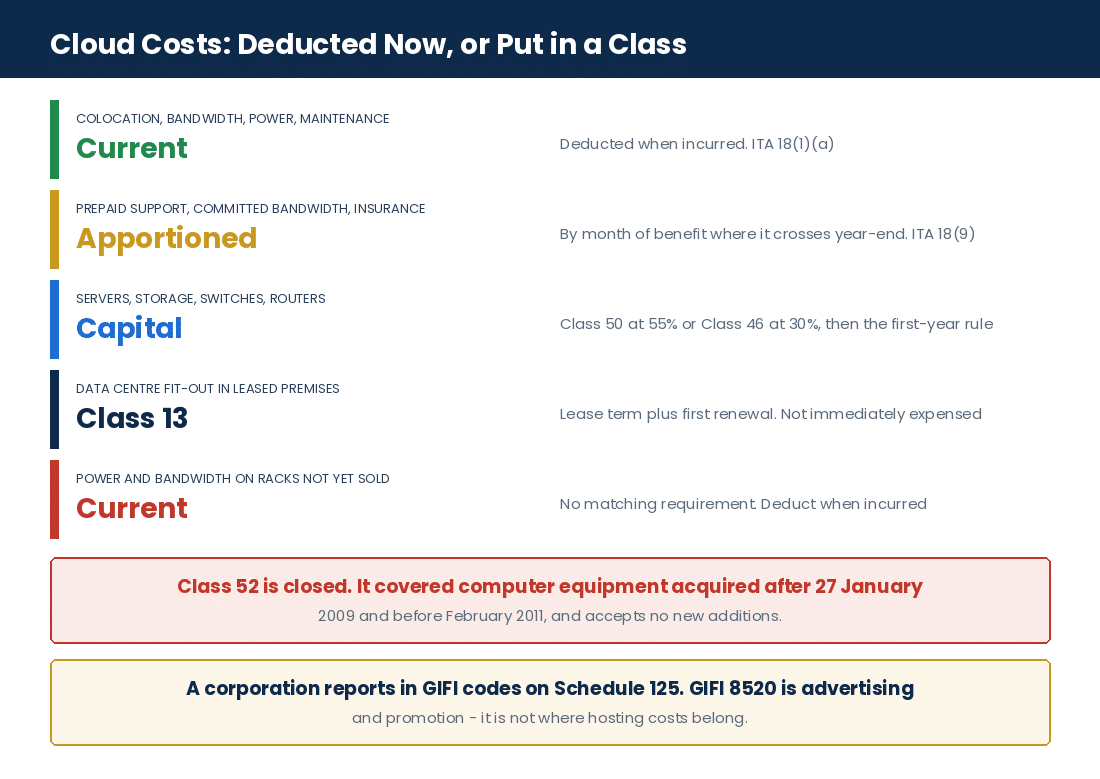
Most of what a cloud provider spends month to month is a current expense, deductible when incurred. The recurring cost base is unusually clean compared with other sectors, because the big items arrive as metered invoices with the period printed on them.
- Colocation and rack fees, deducted as incurred.
- Bandwidth and transit charges, including committed-rate contracts.
- Power and cooling, on invoices tied to the facility.
- Maintenance and support contracts, apportioned under subsection 18(9) where they run past the year-end.
- Upstream compute and storage resupplied to customers, which is cost of sales rather than overhead.
- Salaries, including shift premiums for staff covering a 24-hour operation.
In GIFI these land in the operating expense codes on Schedule 125, not at “line 8520” — GIFI 8520 is advertising and promotion. A corporation reports in GIFI codes rather than the numbered expense lines on a T2125, which is the unincorporated form. Getting the code right matters less than getting the current-versus-capital split right, but a hosting cost sitting in the advertising code is the kind of thing a reviewer notices.
Optimizing Cloud Hosting Costs for Tax Savings
| Cost | Treatment | What supports it |
|---|---|---|
| Monthly bandwidth and transit | Current expense when incurred | Metered invoices showing the period |
| Power consumption | Current expense; apportion if billed in advance | Utility invoices tied to the facility or rack |
| Routine maintenance | Current expense | Service records distinguishing repair from upgrade |
| Fixed rent on the facility | Current expense | The lease, separated from variable utility charges |
| Fit-out and leasehold improvements | Class 13, amortised over the lease term plus first renewal | Contractor invoices and the scope of work |
| Servers, storage, switches | Capital — Class 50 or Class 46, with immediate expensing where it applies | Invoices plus the commissioning record |
Idle capacity is deductible now. There is no rule deferring a current expense until the capacity it relates to is sold. Power, bandwidth and rent on unsold racks are deducted when incurred under paragraph 18(1)(a), because Canadian tax law has no general matching requirement that holds an expense until the revenue arrives. What the source describes as a special CRA position on idle capacity is simply the ordinary rule, and there is no technical interpretation needed to support it.
Joint Deduction Strategies for Cloud Service Providers
Providers that share data centre space, staff or platform costs across related entities have to allocate those costs on a defensible basis and charge them at an arm’s length price. Two different regimes can apply, and the source runs them together.
- Between Canadian related parties, the question is reasonableness under section 67 and whether the charge reflects services actually rendered. Transfer pricing does not apply domestically.
- Across a border, section 247 applies and the arm’s length principle governs, with contemporaneous documentation required within three months of the filing due date. Bill C-15 also shortened the CRA documentation request deadline to 30 days and reformed the adjustment provisions, so the documentation has to exist before it is asked for.
- Allocation keys that hold up: rack units occupied, power drawn, compute hours sold, headcount. Keys that do not: revenue share applied after the fact, or a flat split with no measurement behind it.
- Associated corporations share one $500,000 small business limit under subsection 125(3), which is a separate question from how costs are allocated.
Common Mistakes to Avoid When Claiming Deductions
| Mistake | Result | How to fix it |
|---|---|---|
| Claiming CCA from the invoice date | Claim denied for the year | Record the available-for-use date separately, under 13(26) to (32) |
| Missing the immediate expensing window | A 100% deduction taken at 55% | Check acquisition after 15 April 2024 and available for use before 2027 |
| Network gear in Class 52 | A closed class that accepts no new additions | Class 46 for data network infrastructure, Class 50 for servers |
| Deferring idle capacity costs | Deduction taken a year late | Deduct when incurred; there is no matching requirement |
| Mixing repairs with betterments | Reassessment on the capitalised portion | Restoration is current; improvement beyond original condition is capital |
| Lease payments plus CCA on the same hardware | Double deduction, disallowed | An operating lease is a current expense with no CCA. Check Regulation 1100(1.1) for specified leasing property |
| Prepaid support expensed on payment | Reassessment under 18(9) | Apportion by month of benefit |
A provider deferred roughly a year of power and bandwidth on racks it had built out but not yet sold, on the theory that the cost should match the revenue.
There is no such requirement. The amounts were deductible when incurred, and deferring them simply moved a deduction out of a year that could use it. Correcting the treatment and amending the return recovered the timing. Figures changed for privacy.
Capital Cost Allowance on Cloud Infrastructure
Capital Cost Allowance on Cloud Infrastructure
Capital
A cloud provider’s balance sheet is mostly depreciable property, so the CCA schedule is where the return is decided. Three things settle every line: the class, the available-for-use date, and which first-year regime applies.
The Classes That Matter
| Asset | Class | Ordinary rate |
|---|---|---|
| Servers, storage arrays, general-purpose computers, systems software | Class 50 | 55% |
| Switches, routers, data network infrastructure and its systems software | Class 46 | 30% |
| Purchased application software | Class 12 | 100% |
| Data centre fit-out in leased premises | Class 13 | Straight-line over the lease term plus first renewal |
| Generators, UPS, cooling plant, racking | Class 8 | 20% |
| Owned building, non-residential | Class 1 | 4%, with elective additional allowances |
| Class 52 | Closed. It covered computer equipment acquired after 27 January 2009 and before February 2011 and accepts no new additions | |
The Class 46 against Class 50 split is the one most often got wrong, and it is worth money in both directions. Network infrastructure runs at 30% rather than 55%, so misclassifying switches as Class 50 overstates the ordinary claim — but both classes are inside the immediate expensing measure, so for property in the current window the distinction does not change the first-year result at all. It starts to matter again for anything available for use from 2027.
When Depreciation Starts
Key Stat: capital cost allowance begins when the property is available for use, under subsections 13(26) to (32) — not when it is ordered, invoiced or delivered.
For a server that generally means racked, powered, configured and capable of carrying production load. The rule also has a second-year backstop: property is deemed available for use no later than the beginning of the second taxation year after the year of acquisition, whatever its actual state.
This is the single most common adjustment on a cloud provider’s return, and it is entirely avoidable. Record the commissioning date beside the purchase date in the asset register, from a change ticket or a monitoring system that can show when the host came up. Both dates sit in systems a provider already runs.
The First-Year Regimes, Side by Side
| Situation | First-year treatment |
|---|---|
| Class 44, 46 or 50, acquired after 15 April 2024, available for use before 2027 | 100% immediate expensing |
| Acquired after 2024, available for use before 2030 | 3× the normal first-year amount, or 1.5× where the half-year rule would not normally apply |
| Acquired after 2024, available for use 2030 to 2033 | 2×, or 1.25× |
| Acquired after 20 November 2018 and before 2025, available for use 2024 to 2027 | 2×, under the original incentive’s phase-out |
| Available for use after 2033 | Normal rates with the half-year rule in Regulation 1100(2) |
Worked example. A provider spends $500,000 on servers and switches, ordered in 2025 and commissioned in June 2026. Every item is Class 46 or Class 50, acquired after 15 April 2024 and available for use before 2027, so the whole $500,000 is deducted in that year. Under the half-year rule the same spend would have produced roughly $137,500. Figures changed for privacy.
Disposals, Leases and the Register
- Recapture under subsection 13(1) where proceeds take a class balance below zero. A provider that immediately expensed a class and then sells hardware into the secondary market will see recapture, because the pool is already at nil.
- Terminal loss under subsection 20(16) where a class is emptied and a positive balance remains.
- Scrapped equipment still needs a disposition entry at its actual proceeds, which for decommissioned servers is often nil but is not nothing.
- Operating leases are current expenses with no CCA. The lessee does not own the property and has no pool. Claiming both is a double deduction.
- Specified leasing property rules in Regulation 1100(1.1) can recharacterise a lease that is a purchase in substance, which changes who claims what.
- The equipment register carries purchase date, available-for-use date, cost, class, disposal date and proceeds for every item. For a provider refreshing hardware continuously, it is the single document a review will ask for first.
A provider immediately expensed a full hardware refresh, then sold the displaced servers to a secondary market broker and recorded the proceeds as other income.
The class balance was already nil, so the proceeds were recapture under 13(1) rather than ordinary income — a different line and, in that year, a different rate. The register had no disposal entries at all, which is what made it hard to find. Figures changed for privacy.
Filing Cloud Service Provider Taxes with Gondaliya CPA
Filing Cloud Service Provider Taxes
Filing
Step-by-Step Tax Filing Process for Cloud Providers
- Close the asset register. Every addition with its purchase date, available-for-use date, cost and class; every disposal with its proceeds.
- Apply the right first-year regime to each addition, which depends on when it was acquired as well as when it became available for use.
- Schedule the prepaid amounts under subsection 18(9) — support contracts, committed bandwidth, insurance.
- Split resupplied compute from own-use infrastructure, so cost of sales matches the revenue it supports.
- Reconcile revenue per the T2 to revenue per the GST/HST returns, split between taxable, zero-rated and anything else.
- Pay the balance of tax at two months under paragraph 157(1)(b).
- File the T2 within six months under paragraph 150(1)(a), electronically.
Risk Warning: filing within six months is not the whole deadline. The balance of tax falls at two months under paragraph 157(1)(b), or three for an eligible CCPC claiming the small business deduction.
It generates interest rather than a notice, so nothing tells you it has passed. Late filing is penalised separately under subsection 162(1) at 5% of the unpaid tax plus 1% per complete month to twelve, with arrears interest compounding daily under 161(1). A provider also pays instalments where its tax exceeds the threshold, which is a third date again.
Personalized Support Options to Simplify Your Filing
Gondaliya CPA works with cloud and hosting providers on a flat annual fee covering bookkeeping, payroll including shift premiums for round-the-clock operations, GST/HST returns with the place of supply analysis, the T2 with its capital cost allowance schedules, and CRA audit representation. We maintain the asset register and the prepaid schedules rather than reconstructing them at year-end.
Audit Protection and Expert Guidance Throughout the Process
- Depreciation claimed from the invoice date rather than the available-for-use date — the most common adjustment in this sector.
- A missing or incomplete equipment register, which makes every other question harder to answer.
- Inconsistent lease-versus-buy treatment, especially where the same vendor supplies both.
- Current expenses deferred against unsold capacity, which is a deduction taken late rather than wrongly.
- Revenue that does not reconcile between the T2 and the GST/HST returns, particularly where exports are zero-rated.
- Large one-time deductions with no matching asset addition visible on Schedule 8.
The immediate expensing measure is likely to draw attention for exactly that last reason: a six-figure deduction against a nil closing balance in Class 50 looks unusual until the register explains it. Keep the acquisition dates and commissioning records attached to the claim.
Ensuring Accuracy with Error Checking and Compliance
- Equipment invoices showing the delivery date, with the commissioning record showing when the asset became available for use.
- Colocation and power agreements with their terms and periods.
- Bandwidth contracts, including committed-rate arrangements that straddle year-ends.
- Lease documents, so operating and capital treatment can be told apart.
- Payroll registers reconciling gross pay to withholdings to remittances.
- Non-resident payment records showing where services were physically performed and what was withheld.
All of it is kept six years from the end of the last taxation year to which the records relate, under paragraph 230(4)(b) — measured from the year-end rather than the filing date. Guide RC188 sets out the practical requirements and Form T137 is how you get permission to destroy records early.
A provider could not produce an equipment register at all. Its fixed asset listing was a single line per purchase order.
Rebuilding it from procurement records, rack diagrams and monitoring history produced commissioning dates for several hundred assets and moved a material amount of capital cost allowance into the right years. The exercise cost less than the deduction it recovered. Figures changed for privacy.
Security, Compliance, and Certification in Cloud Tax Filing
Security, Compliance and Certification
Filing Channels
NETFILE Certification and Its Importance for Cloud Taxes
Risk Warning: NETFILE is the CRA’s electronic filing service for individuals filing a T1. It has no application to a corporate return.
A corporation files its T2 through Corporation Internet Filing using CRA-certified software, or through an EFILE-certified preparer transmitting on its behalf. Electronic filing is mandatory under subsection 150.1(2.1), and paper filing carries a $1,000 penalty under 162(7.2).
| Service | Who uses it | For what |
|---|---|---|
| NETFILE | Individuals, filing their own return | T1 personal income tax |
| Corporation Internet Filing | A corporation, filing its own return | T2 corporate income tax |
| EFILE | A registered preparer, filing on a client’s behalf | T1 and T2, with a signed authorisation |
| My Business Account | The corporation’s own representatives | GST/HST returns, payroll remittances, account management |
Where a preparer transmits the T2, the corporation signs a T183CORP authorising it. EFILE certification is a federal CRA programme; there is no provincial authorisation layer, and a provider does not need to look for one.
Data Security and Privacy Standards for Canadian Cloud Providers
A cloud provider handling customer data in Canada is generally subject to PIPEDA, or to substantially similar provincial legislation in Alberta, British Columbia and Quebec. PIPEDA is built on ten fair information principles rather than a prescribed technical standard: it requires safeguards appropriate to the sensitivity of the information, not a specific encryption algorithm or audit cycle. Quebec’s Law 25 adds its own requirements, including privacy impact assessments and breach reporting, for personal information of Quebec residents.
None of that is tax law, and none of it changes what you can deduct. It is mentioned here only because the spend it drives — compliance tooling, audits, certifications such as SOC 2 or ISO 27001 — is itself deductible, as a current expense where it maintains an existing capability and as capital where it produces an asset of enduring benefit. We do not advise on security or privacy compliance itself.
How Gondaliya CPA Safeguards Your Tax Information
We hold client financial records in access-controlled systems with multi-factor authentication, exchange documents through secure channels rather than email attachments, and retain working papers to the professional standards CPA Ontario requires. Where your records live in QuickBooks or Xero, we work in your environment under our own credentials rather than taking copies.
Transparent Fees and No Hidden Costs
Our pricing is a flat annual fee including HST, agreed in writing before any work begins, covering bookkeeping, payroll, GST/HST, the T2 and routine CRA correspondence. The fee tracks the complexity of your return — the number of entities, the size of the asset register, whether you have cross-border payments — rather than your revenue. You get the figure up front, and it does not move unless the scope does.
Tailored Tax Benefits for Diverse Cloud Service Provider Profiles
Tailored Benefits by Provider Profile
Profiles
Tax Advantages for Startups and Small Cloud Businesses
A startup reselling capacity rather than owning it has an unusually simple return: almost everything is a current expense. Colocation fees, bandwidth and upstream compute are deducted as incurred under paragraph 18(1)(a), with subsection 18(9) the only timing restriction where a payment reaches past the year-end.
Worked example. A startup pays $24,000 a year for cloud hosting, billed monthly. The full amount is deducted in the year, and it does not matter that the company is pre-revenue — there is no rule holding an expense until the income arrives. Had the same $24,000 been paid up front for two years of service, subsection 18(9) would split it across both. Figures changed for privacy.
- Hosting fees are deductible as incurred.
- Servers bought outright are capital — but under the current immediate expensing measure a Class 50 purchase available for use before 2027 is deducted in full anyway.
- Incorporation costs are deductible up to $3,000 under paragraph 20(1)(b), with the excess going to Class 14.1 at 5%.
- Keep invoices showing the period covered, not just the amount.
Tax Savings for Self-Employed Cloud Professionals
Risk Warning: there is no rule that hardware must be used “over 50% for work” before it can be depreciated.
Capital cost allowance is claimed on the business-use portion of the cost, whatever that proportion is. A laptop used 40% for the business supports a claim on 40% of the capital cost. The 50% threshold appears in other contexts and has been borrowed into this one, where it does not belong.
An unincorporated professional reports on Form T2125 as part of the T1, working from Guide T4002, deducting software subscriptions, internet and the business share of home workspace costs. Subsection 18(12) restricts the home workspace deduction to a space that is either the principal place of business or used exclusively to earn income and regularly for meeting clients, and caps it at the income from the business, with the excess carried forward. Keep business and personal spending in separate accounts; where they mix, the allocation has to be measurable.
Benefits for Investors and Partners in Cloud Service Companies
- Dividends are paid out of after-tax corporate income, and the deductions a provider claims affect how much is available. Section 112 is the inter-corporate dividend deduction — section 125 is the small business deduction and has nothing to do with dividends received.
- Partnership income is computed at the partnership level under section 96 and allocated to the partners, who include their share whether or not it is distributed. A distribution is not itself income; it draws down the partner’s adjusted cost base, and a draw beyond that base produces a gain under subsection 40(3.1) for a limited partner.
- Immediate expensing changes the shape of the return for an investor reading it. A year with a large hardware build can show a loss on a profitable operation, because the whole capital cost lands at once.
- Leasehold improvements amortise over the lease term and do not benefit from the immediate expensing measure, which reaches Classes 44, 46 and 50 only.
Tax Considerations for Newcomers Operating Cloud Services in Canada
- Start-up costs are deductible only from the point the business has actually commenced. Costs incurred before that are generally not deductible, which makes the commencement date worth documenting. Incorporation costs are the exception, with their own rule in 20(1)(b).
- Hosting charges are current expenses when incurred, whether or not customers have started paying.
- Foreign currency amounts are converted under section 261 of the Income Tax Act at the relevant spot rate for the day the amount arose — the Bank of Canada rate — with an average rate accepted for recurring income items. The Excise Tax Act has its own conversion rule in section 159 for GST/HST purposes; the two are separate.
- Payroll for staff working in Canada follows Regulation 102 for employees, with remittance bands under Regulation 108. Payments to a non-resident contractor for services rendered in Canada are a different rule again, at 15% under Regulation 105.
- Permanent establishment is worth early advice for a foreign parent. Servers in a Canadian data centre can constitute a fixed place of business, which changes what is taxable here.
A newly incorporated provider deducted eighteen months of pre-launch costs in its first year, including legal and consulting fees from well before it had any infrastructure.
Most of it predated commencement of the business. The incorporation costs were deductible under 20(1)(b) to $3,000 with the balance to Class 14.1, and some of the rest was capital. Sorting it at the outset would have cost a fraction of sorting it afterwards. Figures changed for privacy.
GST/HST and Cross-Border Payments
GST/HST and Cross-Border Payments
Cross-Border
Cloud services are sold across borders by default, which puts two questions on every provider’s return: what rate applies to the sale, and what has to be withheld on the purchase.
Place of Supply and Exports
| Customer | Treatment | Where it comes from |
|---|---|---|
| Ontario business or consumer | 13% HST | Section 165 with Schedule IX and the Place of Supply Regulations |
| Customer in another province | That province’s rate, by the place of supply rules | Schedule IX |
| Non-resident customer, services exported | Zero-rated — 0%, with input tax credits fully recoverable | Schedule VI, Part V |
| Non-resident registered for GST/HST and present in Canada | Taxable — the export relief has conditions | Schedule VI, Part V exclusions |
Zero-rating is not an exemption and the difference is the whole point: a zero-rated supply carries full input tax credit recovery under subsection 169(1), so a provider selling mostly to US customers is usually in a persistent refund position. That is the expected result, not a red flag, and it is a reason to elect a more frequent filing frequency than the $1.5M and $6M thresholds would otherwise assign.
The export relief in Schedule VI, Part V carries conditions and exclusions, and whether a particular service qualifies turns on what it relates to and where the recipient is. A provider with meaningful export revenue should have the analysis written down once rather than decided invoice by invoice.
Input Tax Credits
- Entitlement is under subsection 169(1) for tax paid on property and services acquired for use in commercial activity.
- The documentary standard is subsection 169(4): over $30 the supplier’s name and the date, over $150 the supplier’s registration number, your name, the terms and a description.
- A non-resident supplier with no Canadian registration charges no GST/HST, so there is no credit to claim — a point worth checking before someone books one.
- Claims are made within the window in subsection 225(4), generally four years and two for larger registrants.
- Meals and entertainment credits are recaptured to 50% to match section 67.1.
Withholding on Payments to Non-Residents
Risk Warning: “usually 15% on payments to non-residents” collapses two separate regimes with different rates, different triggers and different consequences.
Regulation 105: 15% on fees paid to a non-resident for services rendered in Canada. It is a payment on account of the non-resident’s potential Canadian tax, and a waiver can be applied for. Part XIII: 25% on rents, royalties, interest and similar amounts paid to a non-resident, often reduced by treaty — a final tax, not an instalment.
| Payment | Regime | Rate |
|---|---|---|
| Offshore engineer working on site in Toronto | Regulation 105 | 15%, waiver available |
| Offshore engineer working entirely from abroad | Neither | Nothing to withhold |
| Licence fee to a foreign software vendor | Part XIII | 25%, commonly reduced by treaty |
| Rent for equipment located in Canada, paid abroad | Part XIII | 25%, treaty-reduced |
| Non-resident employee working in Canada | Regulation 102 | Ordinary payroll withholding |
In every case the liability for failing to withhold falls on the payer, which is what makes this worth settling before the invoice is paid rather than after. A treaty rate is available only where the recipient’s residency is certified, usually on Form NR301, and the form has to be on file at the time of payment rather than produced later.
A provider selling mostly to US customers had been charging 13% HST on every invoice, including exports.
Those supplies were zero-rated. It had collected and remitted tax it never owed, its customers had absorbed a 13% premium against competitors, and unwinding it meant credit notes across two years of invoicing. The input tax credits had been claimed correctly throughout, which was the one part nobody had doubted. Figures changed for privacy.
Frequently Asked Questions (FAQs) on Cloud Service Provider Tax Deductions Canada
Frequently Asked Questions
20 Answers
What is the Capital Cost Allowance (CCA) rate for servers under Class 50?+
How does the Half-Year Rule impact depreciation for cloud assets?+
Which CCA class covers switches, routers and network infrastructure?+
When does depreciation on a server start according to Canadian tax rules?+
What is the Non-Resident Withholding Tax Rate in Canada?+
Which cloud costs can be deducted immediately and which must be depreciated over time?+
How are lease payments treated compared to buying hardware?+
How are colocation, power, and bandwidth costs treated for tax deductions?+
Can we deduct power and bandwidth on racks we have not sold yet?+
How should cloud providers treat leasehold improvements and data centre fit-outs?+
What records do cloud service providers need to keep for CRA compliance?+
What triggers a CRA audit review for cloud service providers?+
How do we file a T2 electronically — is NETFILE the right service?+
Do we charge GST/HST to customers outside Canada?+
What happens when we sell or scrap decommissioned servers?+
How do we allocate shared data centre costs between related companies?+
Could cloud development work support a tax credit?+
What currency rules apply to invoices that are not in Canadian dollars?+
Which returns does a cloud provider file, and when?+
Should we file ourselves or engage a CPA firm?+
Cloud Provider Tax Check
Five quick questions on your infrastructure. No fee shown.
Points to raise with us:
This is a general prompt, not tax or legal advice or a quote. Your position depends on your full facts. For a real review, please book a free consultation.
Businesses We Serve & Industry Spotlights
Industry Expertise
Cloud and hosting sits inside a wider technology and capital-intensive services practice, and the same three questions surface in every sector we act for. Here are eleven and the form the issue usually takes.
| Industry | The Cloud Provider Angle |
|---|---|
| Technology startups & SaaS | The customers, and the same 18(9) question on their subscriptions |
| Consulting firms | Resupplied capacity as cost of sales rather than overhead |
| E-commerce & online retailers | Export zero-rating and place of supply across the same border |
| Property developers & builders | The current-versus-capital line on a data centre fit-out |
| Real estate investors, landlords & holding companies | Facilities held in a separate corporation, and association |
| Construction, contractors & skilled trades | Regulation 105 on specialists brought in from abroad |
| Transportation, logistics & trucking | Heavy capital registers and available-for-use discipline |
| Restaurants & food and beverage | Shift payroll and the Regulation 108 remittance bands |
| Medical doctors & physician professional corporations | Exempt supplies, where none of the input tax comes back |
| Dentists & dental practices | Practice infrastructure in Class 50 and Class 46 |
| Daycare, childcare & CWELCC services | What a wholly exempt operator cannot recover |
- Technology startups & SaaS: Your customers, mostly. Their subscription spend is apportioned under 18(9) exactly as your committed bandwidth is, which makes the two returns mirror images.
- Consulting firms: Any firm that buys capacity to pass on to a client faces the cost of sales question, and the answer comes from the engagement terms rather than the invoice narrative.
- E-commerce & online retailers: They cross the same border you do, and the Schedule VI Part V analysis on exported services is the one both sectors most often get wrong in the same direction.
- Property developers & builders: They live on the repair-versus-improvement line every day, and a data centre fit-out is the same test applied to cooling, power and containment.
- Real estate investors, landlords & holding companies: Facilities are frequently held in a separate corporation, which raises association under section 256 and one business limit shared under 125(3).
- Construction, contractors & skilled trades: The sector that meets Regulation 105 most often, for the same reason a provider does when a vendor’s engineer flies in to commission hardware.
- Transportation, logistics & trucking: Another heavy capital register where available-for-use dates and disposal entries decide the return, and where nobody keeps them without a system.
- Restaurants & food and beverage: Round-the-clock shift payroll, the same Regulation 108 band question, and the same tendency to remit on whichever schedule the template defaulted to.
- Medical doctors & physician professional corporations: A useful contrast. A practice making exempt supplies recovers nothing on its hosting spend, which makes the identical invoice materially more expensive than it is for you.
- Dentists & dental practices: Practice systems and the hardware behind them are Class 50 and Class 46 on exactly your analysis, including the immediate expensing window.
- Daycare, childcare & CWELCC services: A clean illustration of wholly exempt activity, where unrecoverable tax simply becomes part of the cost of everything bought.
The hardware changes. The three questions do not: is it current or capital, when did it become available for use, and who is the customer.
A colocation operator and a managed hosting firm keep different racks and file nearly identical returns. Figures changed for privacy.
Professional Guidance and Quick Reference
Guidance
Pricing Plans and Additional Resources for Cloud Tax Filing
Cloud service providers get into difficulty in a predictable set of ways: applying 55% to Class 50 additions when the immediate expensing measure gives 100%; applying the half-year rule when the reinstated incentive gives three times the normal first-year amount; putting network gear in Class 52, a class closed since 2011, instead of Class 46; claiming capital cost allowance from the invoice date rather than the available-for-use date in 13(26) to (32); deferring idle capacity costs as though Canadian tax law had a matching requirement; citing Regulation 1102 for the half-year rule, which is 1100(2); reading 13(26) as a capital gains rule when it is the available-for-use rule; treating 20(1)(p) as the lease deduction when it is the bad debt provision; collapsing Regulation 105 at 15% and Part XIII at 25% into one withholding rate; charging 13% HST on services exported to non-residents that are zero-rated under Schedule VI, Part V; looking for NETFILE certification for a corporate return; and keeping records six years from filing, when paragraph 230(4)(b) runs from the end of the taxation year. Gondaliya CPA handles cloud provider accounting and tax on a flat annual fee.
Overview of Basic, Plus, and Pro Tax Filing Plans
| Plan | Business size | Main features | Common costs covered |
|---|---|---|---|
| Basic | Startups and resellers with no owned hardware | T2 filing, GST/HST, bookkeeping on recurring costs | Colocation, bandwidth, power, salaries |
| Plus | Growing providers running their own infrastructure | Asset register, class assignment, first-year regime analysis, lease versus buy | Mixed current and capital, prepaid schedules |
| Pro | Multi-site and cross-border providers | Full accounting and planning, export analysis, withholding, cost allocation across entities | Fit-outs, offshore payroll, Part XIII, transfer pricing documentation |
Features Included in Each Plan for Cloud Service Providers
- Basic: the annual T2, GST/HST returns, and bookkeeping on recurring operating costs with the 18(9) apportionment maintained.
- Plus: an equipment register with available-for-use dates, class assignment across Class 46, 50, 12 and 13, the immediate expensing and reinstated incentive analysis, and lease-versus-buy modelling.
- Pro: payroll including non-resident withholding under Regulations 102 and 105 and Part XIII, fit-out classification, place of supply and export zero-rating, resupplied compute matched to revenue, and cost allocation across related entities with the documentation section 247 requires.
Seamless Filing Across Devices and Platforms
We work in your QuickBooks or Xero environment rather than taking copies, exchange documents through access-controlled channels, and transmit the T2 through Corporation Internet Filing or as your EFILE-certified preparer against a signed T183CORP. Nothing requires you to move spreadsheets between platforms, which is where multi-site providers usually lose version control.
Access to Resources, Support, and Tools for Ongoing Tax Management
- How long records are kept, and from which date.
- Handling idle capacity costs — deducted when incurred, with no deferral.
- Applying place of supply rules and the export zero-rating for non-resident customers.
- Managing source deductions and withholding on offshore payroll and contractors.
- Tracking the capital cost allowance windows, which now close at different dates for different classes.
Reach us at 647-212-9559 or info@gondaliyacpa.ca, with a one-business-day response and a flat annual fee including HST agreed before any work begins.
Quick Answers
At a Glance
- Deductibility: ITA 18(1)(a); capital denied by 18(1)(b)
- Prepaid amounts: ITA 18(9)
- Capital cost allowance: ITA 20(1)(a); Regulation 1100
- Servers and systems software: Class 50, 55%
- Network infrastructure: Class 46, 30%
- Class 52: closed since February 2011
- Immediate expensing: 100%, Classes 44, 46, 50
- Acquired after: 15 April 2024
- Available for use before: 2027
- Reinstated incentive: 3× to 2029, 2× to 2033
- Half-year rule: Regulation 1100(2), suspended
- Available for use: ITA 13(26) to (32)
- Recapture: ITA 13(1); terminal loss 20(16)
- Fit-outs: Class 13, lease term plus first renewal
- Exported services: zero-rated, Schedule VI Part V
- Input tax credits: ETA 169(1); documents to 169(4)
- Services in Canada by a non-resident: 15%, Regulation 105
- Royalties and rents to a non-resident: 25%, Part XIII
- Records: six years from the taxation year-end, ITA 230(4)(b)
- Filing: Corporation Internet Filing, not NETFILE
Essential Tax Points for Cloud Service Providers by Gondaliya CPA
Key Controls and Warning Signs
- Servers, storage and network gear fall in Class 50 or Class 46 — not Class 52, which is closed. Both are inside the immediate expensing window.
- The half-year rule does not limit the first year. The reinstated incentive gives three times the normal first-year amount for property acquired after 2024 and available for use before 2030.
- Costs on capacity not yet sold are deducted when incurred. There is no deferral and no matching requirement.
- The class you choose affects recapture on disposal. An immediately expensed class sits at nil, so proceeds come straight back as recapture under 13(1).
- Lease payments are current expenses with no CCA. Claiming both on the same hardware is a double deduction; check Regulation 1100(1.1) on specified leasing property.
- Financing interest on equipment is deductible under paragraph 20(1)(c) where the borrowing was for the purpose of earning income; arrangement fees spread over five years under 20(1)(e).
- Recurring occupancy costs — power, cooling, rent, bandwidth — are current, apportioned under 18(9) only where the payment reaches past the year-end.
- Data centre upgrades need the repair-versus-betterment call made at the invoice, because Class 13 is outside the immediate expensing measure.
- Upstream compute resupplied to customers is cost of sales matched to the revenue, not overhead.
- Salaries and shift pay are deductible when incurred, with the remittance band set by average monthly withholding under Regulation 108 and the 180-day rule in subsection 78(4) on anything accrued and unpaid.
- Place of supply decides the rate on domestic sales; exports to non-residents are generally zero-rated, which preserves full input tax credit recovery.
- Marketing, insurance and travel are deductible; meals and entertainment are limited to 50% under section 67.1 with the input tax credit recaptured to match.
- The equipment register shows purchase date, class, available-for-use date, disposals and write-offs. It is the first document a review asks for.
- Four deadlines: the balance of tax at two months, the T2 at six, GST/HST on its own frequency, and payroll on the assigned band.
- Doing it yourself works until you own hardware. After that the register, the dates and the first-year regimes repeat annually and compound.
People Also Ask
Related Questions
Does the immediate expensing measure apply to a data centre fit-out?+
No. It reaches Classes 44, 46 and 50 only. A fit-out is Class 13 and amortises over the lease term plus the first renewal. Splitting a build between hardware and leasehold improvement therefore changes the first-year deduction substantially.
What if we bought hardware in 2024 but commissioned it in 2026?+
Acquisition date and available-for-use date are tested separately. If it was acquired after 15 April 2024 and is available for use before 2027, immediate expensing applies in the commissioning year. If it was acquired before that date, the original incentive applies instead at twice the normal first-year amount.
Is a committed bandwidth contract a prepaid expense?+
Only to the extent it is paid in advance for a period past the year-end. A commitment billed monthly in arrears is deducted as incurred. Subsection 18(9) turns on when the service is rendered against when the payment is made, not on the length of the contract.
Do we withhold on a cloud vendor we pay in US dollars?+
It depends what the payment is for and where the work happens, not on the currency. A licence or royalty paid to a non-resident is Part XIII at 25%, commonly treaty-reduced. A fee for services performed in Canada is Regulation 105 at 15%. A pure service performed abroad is neither.
Can a provider in a persistent GST/HST refund position file more often?+
Yes. Filing frequency follows annual taxable supplies — annual to $1.5M, quarterly to $6M, monthly above — but a registrant may elect a more frequent period. A provider whose revenue is largely zero-rated exports usually should, because the refund arrives sooner.
Glossary
Definitions
- Current expense — a cost consumed in the year, deducted in full under paragraph 18(1)(a).
- Capital expenditure — a cost acquiring or improving an asset of enduring benefit, denied by 18(1)(b) and recovered through capital cost allowance.
- Available for use — the date from which capital cost allowance may first be claimed, under subsections 13(26) to (32).
- Immediate expensing — the 100% first-year deduction for Class 44, 46 and 50 property acquired after 15 April 2024 and available for use before 2027.
- Reinstated Accelerated Investment Incentive — the enhanced first-year allowance of three times the normal amount for property acquired after 2024 and available for use before 2030, phasing down to 2033.
- Half-year rule — the ordinary first-year restriction in Regulation 1100(2), currently suspended for eligible property.
- Recapture — the income inclusion under subsection 13(1) where proceeds take a class balance below zero.
- Zero-rated supply — a supply taxed at 0% on which input tax credits remain fully recoverable; exported services generally sit in Schedule VI, Part V.
- Regulation 105 withholding — 15% withheld from fees paid to a non-resident for services rendered in Canada, on account of their Canadian tax.
- Part XIII tax — 25% withheld on rents, royalties, interest and similar amounts paid to a non-resident, often treaty-reduced, as a final tax.
- Corporation Internet Filing — the CRA service through which a corporation transmits its own T2, as distinct from NETFILE for individuals and EFILE for preparers.
Want a checklist to work from? You can download our free cloud service provider tax checklist before your consultation.
Check two dates on every piece of hardware before applying any rate: when it was acquired and when it became available for use. Class 46 and Class 50 property acquired after 15 April 2024 and available for use before 2027 is deducted at 100%, which on a serious refresh is the largest number in the return — and the window closes for anything commissioned from 2027. Outside it, the reinstated incentive gives three times the normal first-year amount to 2029 and twice to 2033, so the half-year rule should not be reducing anything. Put switches and routers in Class 46, not the closed Class 52. Record the commissioning date beside the purchase date, because a week of scheduling moves a six-figure deduction between years. Deduct power and bandwidth on unsold racks when incurred; there is no matching requirement. Keep fit-outs in Class 13 and out of the expensing measure. Zero-rate exported services rather than charging 13%, and keep the input tax credits. Split Regulation 105 at 15% from Part XIII at 25% before you pay a non-resident, because the liability is yours. File through Corporation Internet Filing, not NETFILE. And pay the balance of tax at two months, not with the return.
2026 Update — what is current: This article reflects rules current to 9 October 2026. Bill C-15, the Budget Implementation Act, 2025, No. 1, received Royal Assent on 26 March 2026 and enacted two measures that change a cloud provider’s first-year deduction. Immediate expensing at 100% applies to Class 44, 46 and 50 property acquired after 15 April 2024 and available for use before 2027. The Accelerated Investment Incentive is reinstated for property acquired after 2024: 3× the normal first-year amount (1.5× where the half-year rule would not normally apply) for property available for use before 2030, then 2× (1.25×) through 2033, with normal rates resuming after that. Property acquired after 20 November 2018 but before 2025 stays under the original incentive and its 2024 to 2027 phase-out at 2×. Bill C-15 also raised the SR&ED expenditure limit to $6 million, extended the enhanced refundable credit to eligible Canadian public corporations, reformed transfer pricing and shortened the CRA documentation request deadline to 30 days, and made the Canada Carbon Rebate for Small Businesses non-taxable. Note that CRA’s own Accelerated Investment Incentive page has not been updated for the reinstatement and still shows the pre-2025 position. Unchanged: the available-for-use rules in 13(26) to (32), the prepaid apportionment in 18(9), Class 13 for fit-outs, zero-rating of exported services in Schedule VI, Part V, the 15% Regulation 105 and 25% Part XIII withholding rates, and the six-year retention requirement in paragraph 230(4)(b).
Cloud Service Provider Tax Deductions Canada: How Gondaliya CPA Can Help
Start with your asset register, your vendor contracts and your last return
Gondaliya CPA builds the equipment register with acquisition and available-for-use dates, applies the right first-year regime to each addition rather than one rule to all of them, keeps switches in Class 46 and servers in Class 50, maintains the prepaid schedules your accounting software will not, rates your supplies for place of supply and export zero-rating, splits Regulation 105 from Part XIII before you pay a non-resident, and files the GST/HST, payroll and T2 from one reconciled set of books — on a flat annual fee including HST with a one-business-day response. Please book a free consultation.
Next Steps
Please book a free consultation with Gondaliya CPA and bring your asset register or whatever stands in for it, your colocation and bandwidth contracts with their periods, and your last filed return. Those three settle the first-year deduction, the prepaid position and the capital line, which is where almost all of the value sits for a cloud provider right now. If you sell outside Canada or pay non-residents, bring a sample invoice from each. You will get a flat annual fee including HST before any work begins. We serve Toronto, Mississauga, Vaughan, Brampton, Etobicoke, Scarborough, Ottawa and the rest of Ontario, and work with providers across Canada. If our content helps, please add gondaliyacpa.ca as a preferred source on Google.
Published: · Last updated:
Editorial policy: We research against CRA, Department of Finance, Parliament of Canada, CPA Canada and CPA Ontario sources, fact-check the figures, and Sharad Gondaliya, CPA, reviews the content, which we update as the rules change.
Disclaimer: This article is educational information only and is not tax, legal, financial, security or privacy-compliance advice. Figures marked illustrative are examples rather than quotes or guarantees. It reflects rules current to 2026, including the capital cost allowance measures enacted by Bill C-15 on 26 March 2026, deductibility under paragraph 18(1)(a) of the Income Tax Act, the prepaid apportionment in subsection 18(9), the available-for-use rules in subsections 13(26) to (32), capital cost allowance under Regulation 1100 and Schedule II, zero-rating of exported services in Schedule VI Part V of the Excise Tax Act, input tax credits under subsection 169(1), Regulation 105 and Part XIII withholding on payments to non-residents, and the six-year retention requirement in paragraph 230(4)(b). CRA guidance pages have not all been updated for the Bill C-15 measures. Gondaliya CPA performs compilation engagements under CSRS 4200 and does not perform audit or review engagements. Rates and limits change and outcomes depend on your specific facts. Please consult a licensed CPA before acting.

Sharad Gondaliya is a CPA Canada & CPA USA with 15 Years+ experience of Accounting, Tax, Payroll of Corporate Small Businesses as Tax Accountant. He is a CPA Ontario member (61040184) and holds US CPA licences in Washington and Montana and is well known among corporate small businesses for tax planning, efficient tax solutions, and affordable CPA services. Sharad is the Principal (Director) of Gondaliya CPA – Affordable CPA Firm in Canada. Licenses: CPA Ontario: 61040184 | CPA USA (MT): PAC-CPAP-LIC-033176 | CPA USA (WA): 57629 | CPA Firm License: 61330051 View Full Author Bio