



Common Tax and Accounting Mistakes Denturists Make in Canada
Denturist Taxes Canada: Common Denturist Tax Mistakes and How Gondaliya CPA Can Help Your Business Taxes
Denturist taxes in Canada are simpler than most guidance makes them, and the guidance usually gets the central fact backwards. Gondaliya CPA helps Canadian denture clinics rate their supplies correctly, recover the input tax credits that come with zero-rating, track deposits and work in progress to the right year, and file corporate returns from books that reconcile.
Quick Summary
Three things in the circulating guidance will cost a denture clinic real money. A denturist’s supplies are zero-rated, not exempt — artificial teeth are zero-rated by section 11 of Part II of Schedule VI whoever supplies them, and the service of fitting, adjusting or repairing them is zero-rated by section 34. Denturists are not on the exempt practitioner list in Part II of Schedule V, so a consultation fee is not exempt either. That makes a registered denturist fully engaged in commercial activity with full input tax credit recovery — typically in a permanent refund position, which is the opposite of a dentist’s position. The 35% administrative arrangement CRA revoked in October 2024 was a dentists’ arrangement and never applied to denturists at all. And the medical expense lines are the other way round from how they are usually described: line 33099 covers you, your spouse and children under 18; line 33199 is for other dependants.
Reading time: 30 minutes.
Table of Contents
- Three Things the Guidance Gets Backwards
- Denturist Business Taxes: Overview
- Common Tax Mistakes and How to Avoid Them
- GST/HST in Denturist Accounting
- Medical Expenses and the METC
- Practice Deductions and Capital Costs
- Programs, Plans and Deposits
- Filing, Records and Compliance
- Tax Planning and Cash Flow
- Frequently Asked Questions
- Businesses We Serve & Industry Spotlights
- Professional Guidance and Quick Reference
The Numbers That Matter
This article covers Canada, with Ontario and Toronto context, and reflects rules current to 9 October 2026. It is written for Canadian denture clinics, incorporated or not — single-operator practices, multi-chair clinics and clinics with an in-house lab. Gondaliya CPA performs compilation engagements under CSRS 4200, which provide no assurance; audit and review engagements are referred out. Nothing here is clinical advice or advice on College licensing requirements. This is educational information only and not tax or legal advice.
Three Things the Guidance Gets Backwards
Three Things the Guidance Gets Backwards
Corrections
A Denturist’s Supplies Are Zero-Rated, Not Exempt
Risk Warning: rating a consultation fee as exempt is the most expensive mistake available to a denture clinic, because exempt supplies carry no input tax credits.
Section 11 of Part II of Schedule VI zero-rates artificial teeth. It does not depend on who supplies them and it requires no prescription. Section 34 of the same Part zero-rates the service of installing, maintaining, restoring, repairing or modifying a zero-rated device, except where that service is itself an exempt supply under Part II of Schedule V. Denturists are not on the practitioner list in Part II of Schedule V, so the exception does not reach them.
The practitioner list in Part II of Schedule V covers medical practitioners — physicians and dentists — and a closed list of other professions including optometrists, chiropractors, physiotherapists, chiropodists, podiatrists, osteopaths, audiologists, speech-language pathologists, occupational therapists, psychologists, midwives, dietitians, social workers, acupuncturists and naturopaths, with dental hygienists added separately. Denturists appear nowhere in it. Nothing a denturist supplies is exempt.
| Charge | Source said | Actual treatment |
|---|---|---|
| The denture itself | Zero-rated | Zero-rated — Schedule VI, Part II, s.11 |
| Fitting, adjusting, relining, repairing | “Might be taxable” | Zero-rated — Schedule VI, Part II, s.34 |
| Consultation fee | Exempt | Not exempt. Either part of the single zero-rated supply, or taxable at 13% in Ontario where billed as a separate service |
| Teeth whitening and purely cosmetic work | Not addressed | Taxable — cosmetic services are carved out of both regimes |
| Cleaning supplies, adhesives and care products sold over the counter | Not addressed | Taxable unless separately zero-rated |
Key Stat: zero-rated is taxable at 0%, and that is what makes a denturist’s position so much better than a dentist’s.
A zero-rated supply is a commercial activity. You charge no tax, and you recover every dollar of GST/HST you paid on lab fees, materials, equipment, rent, software and professional fees, under subsection 169(1). An exempt supply is not a commercial activity and recovers nothing. A clinic that rates its work as exempt is leaving its entire input tax credit entitlement on the table — and on a practice with heavy lab costs, that is one of the largest numbers on the return.
The 35% Administrative Arrangement Was Never Yours
Risk Warning: the CRA administrative arrangement revoked in October 2024 applied to dentists and orthodontists. It never applied to denturists.
Under that arrangement CRA permitted a dentist to claim input tax credits on up to 35% of the GST/HST paid on general practice expenses, as a rough proxy for the zero-rated appliance portion of an otherwise exempt practice. CRA withdrew it in October 2024, effective 1 January 2025, so dentists now apportion on actual use. A denturist never needed a proxy, because a denturist’s supplies are not exempt in the first place.
The background is Canada v. Dr. Kevin L. Davis Dentistry Professional Corporation, 2023 FCA 76, where the Federal Court of Appeal held that an orthodontist supplying appliances makes a separate zero-rated supply of the appliance alongside the exempt professional service, and so is entitled to input tax credits on the appliance portion. Leave to appeal was refused. It is an important decision for dentists and orthodontists, and it is simply not a denturist’s problem. A denturist already recovers everything.
Line 33199 Is for Other Dependants, Not for a Spouse or a Child
Risk Warning: “line 33199 is for expenses paid on behalf of a dependent spouse or child under 18” is wrong, and so is leaving the threshold out.
Line 33099 covers eligible medical expenses paid for yourself, your spouse or common-law partner, and your or their children under 18 at the end of the year. Line 33199 covers expenses paid for other dependants — children aged 18 or over, grandchildren, and a parent, grandparent, brother, sister, uncle, aunt, nephew or niece resident in Canada at any time in the year.
- Expenses can be claimed for any 12-month period ending in the year, provided they were not claimed in the prior year. Choosing the window deliberately is where most of the value is.
- The credit applies only to the amount exceeding the lesser of $2,834 or 3% of net income — a threshold the source never mentions, and the reason small claims are worth nothing.
- On line 33199 the threshold is calculated separately for each dependant, against that dependant’s own net income.
- For someone who has died, the final return may claim expenses paid in any 24-month period that includes the date of death — not, as the source says, only up to the date of death.
A denture clinic had been filing GST/HST returns on the view that its services were exempt and only the appliance was zero-rated, claiming input tax credits on roughly a third of its costs.
Everything it supplied was zero-rated. The unclaimed credits across the open period came to about $46,000, recoverable within the four-year window in subsection 225(4). The practice had been treating its own best feature as a problem. Figures changed for privacy.
Denturist Business Taxes in Canada: Overview and Key Considerations
Denturist Business Taxes: Overview
The Basics
What taxes do denturists need to pay?
- Corporate Income Tax. A denturist practising through a corporation files a T2 within six months of the fiscal year end under paragraph 150(1)(a). Active business income gets the small business deduction under section 125 on the first $500,000, which in Ontario is roughly 12.2% against 26.5% above it.
- GST/HST. Registration is required once taxable supplies — which for a denturist means zero-rated supplies, since those count toward the threshold — exceed $30,000 over four preceding calendar quarters under section 148. You charge nothing and recover everything.
- Payroll. Where there are employees, subsection 153(1) requires withholding of income tax, CPP and EI, remitted with the employer’s share on the band assigned by Regulation 108.
Key Stat: the corporate balance of tax is due at two months, not six.
Paragraph 157(1)(b) sets the balance-due day at two months after the year end, or three for an eligible Canadian-controlled private corporation claiming the small business deduction. The six-month figure is the filing deadline in paragraph 150(1)(a). Paying at six months generates interest under subsection 161(1), compounded daily and not deductible, with no notice until the assessment arrives.
Distinctions between sole proprietorships, partnerships, and corporations for denturists
| Structure | How income is taxed | What it changes |
|---|---|---|
| Sole proprietorship | Reported on Form T2125 with the T1, at personal rates | Simplest to run. No deferral, and no separate legal person. The GST/HST position is identical |
| Partnership | Income computed at the partnership level under section 96 and allocated to the partners, who include their share whether or not it is distributed | A distribution is not income — it draws down the partner’s adjusted cost base |
| Professional corporation | T2, with the small business deduction on active business income | Deferral while profits stay in the corporation, separate books, and shareholding restrictions set by the provincial college |
In Ontario a denturist may practise through a professional corporation authorised by the College of Denturists of Ontario, and the shareholding rules matter for planning: voting shares must be held by members of the profession, which limits the income-splitting structures available to other small businesses. That sits on top of the tax on split income rules in section 120.4, which restrict dividends to family members who are not actively engaged in the business.
The structure changes the income tax picture and changes nothing about GST/HST. A sole proprietor denturist and an incorporated one both make zero-rated supplies and both recover full input tax credits.
Common Tax Mistakes Made by Denturists and How to Avoid Them
Common Tax Mistakes and How to Avoid Them
Errors
Overclaiming deductions
Most of what a clinic spends is fully deductible under paragraph 18(1)(a). The limited items are a short list, and the circulating guidance gets several of them wrong in the direction of denying deductions that are perfectly good.
| Cost | Often said | Actual treatment |
|---|---|---|
| Marketing and advertising | “Non-deductible when promoting elective services” | Fully deductible under 18(1)(a). There is no elective-services carve-out |
| Office supplies | “Non-deductible without clear business use” | Fully deductible where used in the business. The business-use test is not a higher bar for supplies |
| College dues and liability insurance | “Non-deductible if not strictly related” | Fully deductible. College of Denturists dues and professional liability coverage are ordinary business costs |
| Meals and entertainment | “Non-deductible when mixed with personal” | 50% deductible under section 67.1, with the input tax credit recaptured to match. The personal portion is simply not a business cost |
| Club dues for dining, recreation or sport | Not mentioned | Denied outright by paragraph 18(1)(l) |
| Fines and penalties | Not mentioned | Denied by section 67.6 |
| Passenger vehicle costs | “A mileage log is required by 67.1” | Lease costs capped by 67.3 and interest by 67.2. The log supports the business-use proportion under 18(1)(a) and the record rule in 230 — 67.1 is meals |
- Keep clear records for each expense, and keep them for six years from the end of the taxation year to which they relate under paragraph 230(4)(b).
- Learn which expenses carry a statutory limit, rather than guessing at a general reasonableness standard. Everything is subject to section 67; only a handful have their own cap.
- Ask before claiming an item you cannot place in one of the categories above.
Incorrect GST/HST collection or remittance
The distinction that matters is zero-rated versus taxable, not zero-rated versus exempt, because a denturist makes no exempt supplies.
- Zero-rated supplies — the denture, and the fitting, adjustment, reline and repair service that goes with it. Taxable at 0%, with full input tax credit recovery.
- Taxable supplies — purely cosmetic work, retail care products, and anything billed as a standalone service outside the appliance. Charged at the recipient’s provincial rate, with full recovery.
- Exempt supplies — none, in an ordinary denture practice. If someone has told you a consultation fee is exempt, that is the error to fix first.
Because every supply is either zero-rated or taxable, no apportionment of input tax credits is required. The section 141.01 apportionment exercise that dominates dental practice accounting does not arise here. That is worth saying plainly, because guidance written for dentists is routinely handed to denturists and it imports a problem they do not have.
What does matter is the registration threshold. Zero-rated supplies count toward the $30,000 small supplier test in section 148 exactly as taxable ones do, so a clinic charging no tax can still be required to register — and will want to, because registration is what unlocks the refunds.
A new clinic stayed unregistered for two years on the view that charging no tax meant there was nothing to register for.
It had crossed the threshold in its first eight months, and in the meantime it had paid HST on lab fees, a chair, a fit-out and a software subscription with none of it recoverable for the unregistered period. Voluntary registration on day one would have been worth several thousand dollars a year from the start. Figures changed for privacy.
The Role of GST/HST in Denturist Accounting and Its Impact on Business Taxes
GST/HST in Denturist Accounting
Sales Tax
Determining taxable versus exempt services
For a denture clinic the question is never taxable versus exempt. It is zero-rated versus taxable at the ordinary rate, and the two differ only in what appears on the invoice — both preserve full input tax credit recovery.
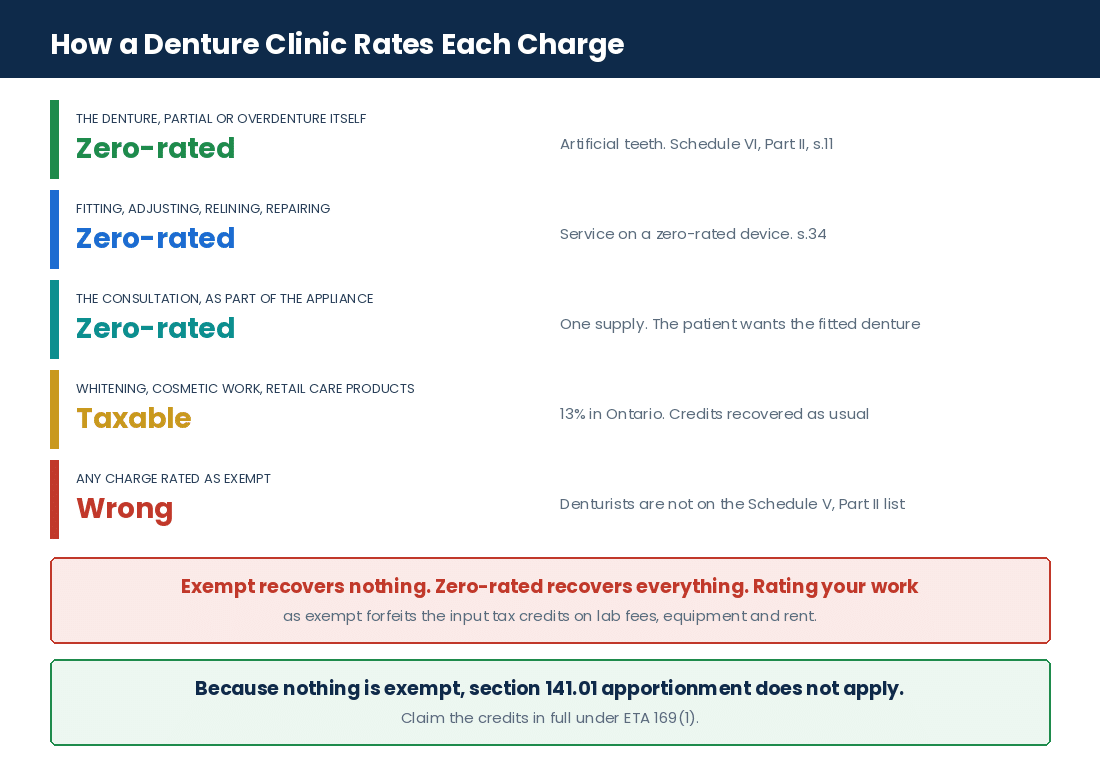
Rate each line against the statutory description rather than by category. A complete denture, a partial, an immediate denture, an implant-retained overdenture and a reline are all built on section 11 and section 34 of Part II of Schedule VI. A whitening tray sold alongside is not.
Where the appliance and the clinical work are supplied together, they are usually a single supply — the patient wants the fitted denture, not a box of acrylic. That single supply is zero-rated, so splitting the invoice is not strictly necessary for the tax, though it remains good practice for the patient’s own records and for any insurer or plan involved.
GST/HST registration thresholds for denturists
- $30,000 of worldwide taxable supplies — including zero-rated ones — over the four preceding calendar quarters, under section 148. Above it, registration is required under 240(1).
- Exceeding $30,000 in a single calendar quarter ends small supplier status immediately, from the supply that crossed it — not at the end of the quarter.
- Below the threshold, voluntary registration under 240(3) is almost always worth it for a denture clinic, because the practice charges no tax and recovers all of it. There is no downside in collected tax to offset against the refund.
- Registration also starts the clock on recovery. Tax paid before the effective date of registration is generally not recoverable, so an early start matters.
Key Stat: a registered denture clinic is normally in a permanent refund position.
You collect nothing on zero-rated supplies and reclaim the tax on everything you buy — lab fees, acrylic and teeth, chairs and equipment, rent, utilities, software, professional fees. Each return is a refund claim, which makes the reporting frequency a cash flow decision rather than an administrative one. Filing annually when you could file quarterly means waiting up to fifteen months for money you are owed.
Input Tax Credits (ITCs) for Denturists: Eligibility and Claiming Procedures
Which expenses qualify for input tax credits? Entitlement is broad here, and the documents behind each claim are prescribed rather than discretionary.
Entitlement comes from subsection 169(1): tax paid on property or services acquired for consumption, use or supply in the course of commercial activities. For a denturist that is essentially everything, because essentially everything supports zero-rated supplies.
- Lab fees — the largest single input in most practices. A lab’s supply of an artificial tooth to a clinic is itself zero-rated under section 11, so there may be no tax on it to recover; where the lab charges tax on a taxable component, that tax is recoverable in full.
- Materials — acrylic, teeth, impression materials, articulators.
- Equipment — chairs, cabinetry, lab equipment, computers and scanners.
- Occupancy — commercial rent, utilities, cleaning, leasehold improvements.
- Overheads — software subscriptions, professional fees, insurance, marketing.
Proper documentation for ITCs
The documentary standard is prescribed, not discretionary. Subsection 169(4) and the Input Tax Credit Information Regulations require, for a supply of $150 or more, the supplier’s name, the date, the amount, a description sufficient to identify the supply, the recipient’s name, the terms of payment, and the supplier’s GST/HST registration number. A credit claimed on an invoice without the registration number is denied on a desk review, however real the expense.
- Keep job files showing what was made and for whom.
- Keep supplier invoices with the registration number visible.
- Claim within the four-year window in subsection 225(4) — missed credits can be recovered, but not indefinitely.
Effects of Recent Changes to GST/HST Administrative Arrangements on Denturists
The honest answer is: none. The administrative arrangement CRA revoked in October 2024, effective 1 January 2025, let dentists claim input tax credits on up to 35% of GST/HST paid on general practice expenses as a proxy for the zero-rated appliance share of an otherwise exempt practice. Denturists were never inside it and are not affected by its withdrawal.
Where it does reach a denture clinic is indirectly. Dentists now apportion on actual use, which has made them far more attentive to how appliance work is invoiced — so a clinic that takes referrals from, or supplies appliances to, dental practices may find the paperwork expectations on the other side of those arrangements have tightened.
A clinic filing annually was carrying refunds of roughly $9,000 a year and waiting until three months after its year end to collect them.
Electing quarterly filing moved the same money forward by up to twelve months with no change to the underlying position. For a practice funding lab work out of cash flow, that was the single most useful thing we did in the first year. Figures changed for privacy.
What Dental Expenses Are Deductible Medical Expenses for Denturists?
Medical Expenses and the METC
Two Different Things
This section is about the patient’s tax return, not the clinic’s. The two get confused constantly, and the confusion is the point worth clearing up first: a denturist’s practice costs are business deductions, and a patient’s denture fees are personal medical expenses. They never appear on the same return in the same character.
What qualifies as a medical expense
- Dentures and dental implants are listed eligible devices. So are fees paid to a medical practitioner or dentist, and fees paid to other practitioners authorised to practise in the province where the service was given — which is how a denturist’s fees qualify, since denturists are a regulated profession in every province that licenses them.
- Not eligible: purely cosmetic procedures, over-the-counter products not prescribed, and amounts reimbursed by insurance or a public plan. A patient claims only the portion actually borne.
- A clinic’s supplies, equipment and lab costs are never medical expenses. They are business deductions under 18(1)(a) and 20(1)(a).
How to Properly Claim Dental Expenses on Canadian Income Tax Returns
Specific Tax Return Lines for Dental Expense Claims: Line 33099 and Line 33199. The two lines are not what the circulating guidance says.
Risk Warning: Schedule 1 was eliminated in 2019, and the two medical expense lines are not what the circulating guidance says.
Federal non-refundable tax credits are now calculated in Step 5 of the T1 itself, not on a separate Schedule 1. And the lines run the other way from how they are usually described.
| Line | Covers expenses paid for | Threshold |
|---|---|---|
| 33099 | Yourself, your spouse or common-law partner, and your or their children under 18 at the end of the year | Reduced by the lesser of $2,834 or 3% of your net income |
| 33199 | Other dependants — children 18 or over, grandchildren, and a parent, grandparent, brother, sister, uncle, aunt, nephew or niece resident in Canada at any time in the year | Calculated separately for each dependant, against that dependant’s net income |
- The claim may cover any 12-month period ending in the year, provided the expenses were not claimed in the prior year. Choosing that window deliberately — so a large denture fee and other costs fall in the same period — is usually worth more than anything else in the exercise.
- It is generally better for the lower-income spouse to claim, because the 3% floor is lower in dollar terms.
- A corporation claims nothing here. Practice costs go on the T2, and a sole proprietor’s go on Form T2125.
Documentation Required to Support Dental and Medical Expense Claims
Receipts must show the date paid, the amount, the provider’s name and professional standing, what was supplied, and evidence that payment was made. Keep them for six years from the end of the taxation year to which they relate, under paragraph 230(4)(b) — the clock runs from the year end, not from the filing date, which in practice gives closer to seven years.
Digital copies are acceptable provided they remain accessible and unaltered for the full period. A scan backed up properly is as good as the paper.
Claiming Dental Expenses for Deceased Individuals: Rules and Procedures
On a final return the claim period widens. Expenses paid in any 24-month period that includes the date of death may be claimed, provided they were not claimed in another year — so costs incurred after death, which an executor often settles, remain claimable. The executor collects the receipts, avoids claiming the same amount on both the final return and a surviving spouse’s return, and applies the usual threshold.
Understanding the Medical Expense Tax Credit and Its Application to Denturists
The Medical Expense Tax Credit is a non-refundable personal credit at the lowest federal rate, with a provincial equivalent. It belongs to the patient. A denturist’s corporation cannot claim it, cannot pass it through, and gains nothing by trying — which is the error the source material is reaching for when it warns against practices “claiming credits wrongly on their corporate taxes.”
How Non-Refundable Dental Expenses Can Become Refundable Through Tax Credits. Where it becomes partly refundable is through the refundable medical expense supplement in section 122.51, available to a lower-income individual with earned income. That is the only route by which an otherwise non-refundable medical expense produces cash, and it has nothing to do with input tax credits.
Risk Warning: the medical expense tax credit and the input tax credit are unrelated, and conflating them produces nonsense.
The METC is a personal income tax credit claimed by a patient under section 118.2. An input tax credit is a GST/HST recovery claimed by a registrant under subsection 169(1). A non-refundable medical expense does not “become refundable through input tax credits” — the two sit in different statutes and belong to different people.
A clinic owner claimed the family’s own denture work as a business expense of the corporation because the appliances had been made in-house.
Work done for the shareholder and family is a shareholder benefit under subsection 15(1), taxable in their hands at fair market value, and the corporation deducts nothing. The right route was a personal medical expense claim on the T1 at the correct line. Figures changed for privacy.
Eligible Dental Procedures for Tax Deduction in Denturist Practices
Practice Deductions and Capital Costs
What Comes Off
A denture clinic’s deductions are straightforward. The money is in getting the current versus capital line right, because a misclassified asset repeats through the class balances every year until someone unwinds it.
- Lab fees for denture fabrication done outside the clinic — current, deducted as incurred under 18(1)(a).
- Materials used during denture creation — acrylic, teeth, impression materials. Current, with unused stock on hand at the year end valued as inventory under subsection 10(1).
- Wages paid to staff helping with procedures — current, with employer CPP and EI on top, and the 180-day rule in subsection 78(4) deferring anything accrued and still unpaid.
- Overhead costs that support these dental services — rent, utilities, insurance, software, professional fees, College dues, marketing. All current.
Capital Cost Allowance: the Classes and the First-Year Rules
| Asset | Class | Rate and first-year treatment |
|---|---|---|
| Operatory chairs, cabinetry, lab equipment, furniture | Class 8 | 20% declining balance — 30% in the first year under the reinstated incentive |
| Computers, scanners, CAD workstations, systems software | Class 50 | 55% — or 100% in the first year where acquired after 15 April 2024 and available for use before 2027 |
| Purchased application software | Class 12 | 100% |
| Clinic build-out in leased premises | Class 13 | Straight-line over the lease term plus the first renewal period, five-year minimum and forty-year maximum |
| Clinic building, if owned | Class 1 | 4%, with elective additional allowances for an eligible non-residential building |
| Small tools and instruments under $500 | Class 12 | 100% |
Risk Warning: leasehold improvements are Class 13, not Class 1, and the half-year rule no longer halves the first-year claim.
A clinic build-out in leased premises is Class 13, amortised straight-line over the lease term plus the first renewal. Class 1 is for a building you own. And the half-year rule in Regulation 1100(2) is suspended: Bill C-15, which received Royal Assent on 26 March 2026, reinstated the Accelerated Investment Incentive at three times the normal first-year amount for property acquired after 2024 and available for use before 2030, dropping to twice from 2030 through 2033.
Worked example. A clinic spends $15,000 a year on outside lab fees and buys $50,000 of CAD/CAM equipment. The lab fees are a current expense, deducted in full. The equipment is capital — and the split matters: the scanner and workstation are Class 50, deducted at 100% in the first year if acquired after 15 April 2024 and commissioned before 2027, while the mill and chairside hardware are Class 8 at 30% in year one rather than the 20% the old advice suggests. Expensing the whole $50,000 outright would be wrong; so would running all of it through Class 8 at 20%. Figures changed for privacy.
No capital cost allowance arises before the property is available for use under subsections 13(26) to (32), so record the commissioning date beside the invoice date. On disposal, recapture under subsection 13(1) and terminal loss under 20(16) apply, and an immediately expensed class sits at nil, so proceeds come straight back as income.
Non-Deductible Dental Procedures and Services in Denturist Accounting
The genuinely non-deductible list is much shorter than the circulating one, and quite different:
- Personal expenses of the owner or family. Not a category of business cost at all, and where the corporation pays them they become a shareholder benefit under subsection 15(1), taxable in the shareholder’s hands.
- Club dues for dining, recreation or sport — denied outright by paragraph 18(1)(l).
- Fines and penalties — denied by section 67.6.
- Capital expenditures — not denied, but denied as a current deduction by paragraph 18(1)(b) and recovered instead through capital cost allowance.
- Amounts that are not reasonable in the circumstances — section 67.
Marketing, office supplies and College dues are not on that list. Claiming them is correct; omitting them on the strength of guidance that says otherwise is simply paying more tax than the law requires.
Scientific research credits
The source material suggests looking into research credits for clinic or lab work. For almost every denture practice the answer is no. SR&ED under section 37 requires a technological uncertainty that standard practice could not resolve, and fabricating an appliance to a known technique — however skilled — resolves nothing technological. Where a clinic genuinely develops a new material or process by experiment, the claim exists and the deadline is 18 months after the year end under subsection 37(11), which cannot be extended. It is worth checking once and then not thinking about again.
A clinic had expensed its entire $38,000 build-out as repairs and maintenance in the year it opened.
It was a Class 13 leasehold improvement, amortised over the lease term plus the first renewal. The reassessment pulled the deduction and spread it, and because the clinic had been in a loss position that first year the timing change cost more than the amount suggested. Classifying it at the invoice would have taken a minute. Figures changed for privacy.
Programs and Government Assistance Available to Support Denturists and Patients
Programs, Plans and Deposits
Revenue Timing
The Canadian Dental Care Plan
The largest change to this sector in a generation is one the circulating guidance mentions only as “government dental care plans.” The Canadian Dental Care Plan is a federal plan administered by Sun Life for residents without private dental insurance, and denturists are among the providers who can bill it. Participation is voluntary and confirmed through Sun Life under a claims processing and payment agreement.
- Plan payments are ordinary business income, recognised when the service is performed under section 9, not when the payment arrives.
- Patient co-payments are also business income, and the two halves of one appliance fee should land in the same period.
- GST/HST is unaffected. A denture supplied under the plan is zero-rated exactly as any other is. Who pays does not change the rating.
- Track plan receipts separately from fee-for-service revenue in the ledger. Not because they are taxed differently, but because reconciling a remittance statement to the job files afterwards is far harder than coding it correctly at entry.
Provincial plans, subsidies and grants
| Receipt | Treatment | Authority |
|---|---|---|
| Plan or provincial programme payment for a service | Ordinary business income when the service is performed | Section 9 |
| Wage subsidy | Income inclusion, or a reduction of the wage expense | Paragraph 12(1)(x) |
| Grant toward equipment | Reduces the capital cost of the asset rather than being income | Subsection 13(7.1) |
| Grant toward operating costs | Income inclusion, or a reduction of the related expense | Paragraph 12(1)(x) |
| Forgivable loan | Income in the year the forgiveness is reasonably certain | Paragraph 12(1)(x) |
The distinction that matters is between a grant that reduces an asset’s cost and one that is income. A clinic that takes an equipment grant into revenue and then claims capital cost allowance on the gross cost has double-counted, and subsection 13(7.1) exists precisely to prevent it.
Deposits, Payment Plans and Work in Progress
Risk Warning: there is no “LOCK principle” in Canadian tax or accounting. The real mechanism has a name and two provisions.
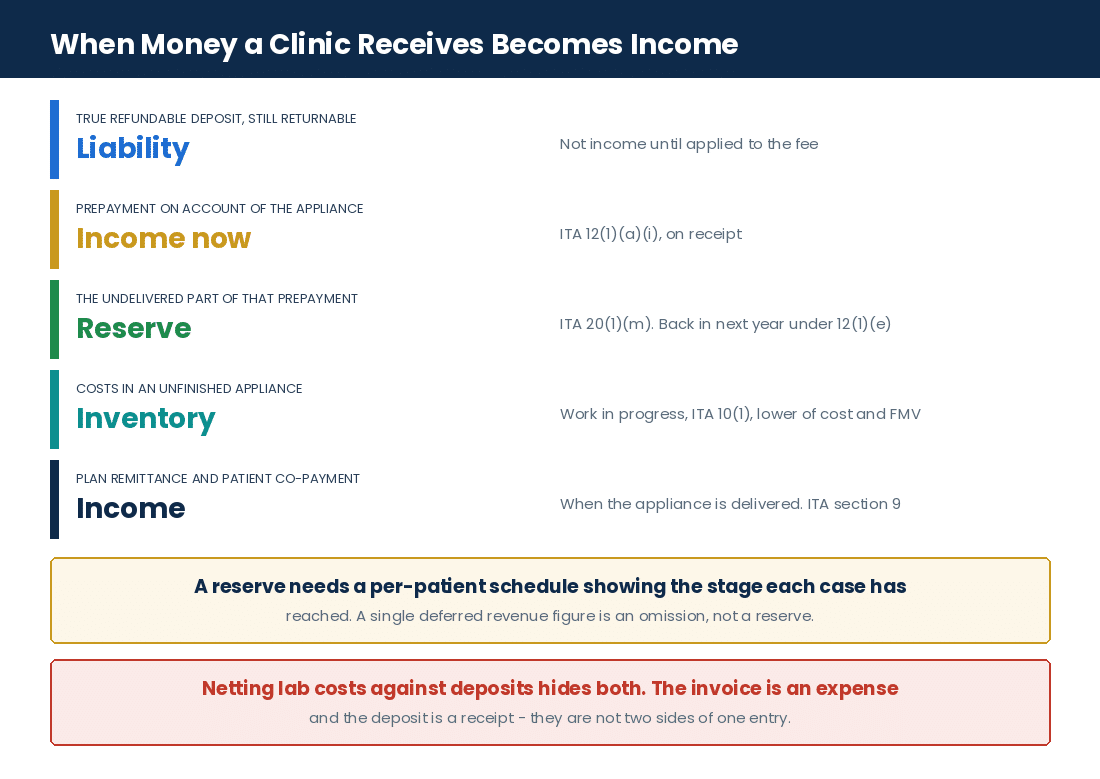
An amount received for services not yet rendered is included in income when received under subparagraph 12(1)(a)(i). Paragraph 20(1)(m) then allows a reserve for the services reasonably anticipated to be rendered after the year end, computed on the gross amount, and paragraph 12(1)(e) brings that reserve back into income the following year. It is a one-year rolling deferral that needs a schedule behind it.
The source material cites subsection 18(1)(a) as the reserve provision. It is not — 18(1)(a) is the income-earning purpose test for deductions. Reserves of this kind live in 20(1)(m), and the distinction matters because a reserve has conditions and a general deduction does not.
- A true refundable deposit the clinic holds and may have to return is a liability, not income, until it is applied to the fee.
- A prepayment on account of the appliance is a different thing. It enters income on receipt under 12(1)(a)(i), with the 20(1)(m) reserve available for the undelivered portion.
- Unbilled work on an unfinished appliance is work in progress — inventory valued under subsection 10(1) at the lower of cost and fair market value.
- Netting lab costs against deposits hides both figures. The lab invoice is an expense and the deposit is a receipt; they are not two sides of one entry.
- Payment plan instalments follow the same rule as any other receipt: in on receipt, out again by reserve to the extent the work is still to come.
What makes a 20(1)(m) reserve stand up is a per-patient schedule at the year end showing the balance received and the stage the appliance has reached. A single “deferred revenue” figure with nothing behind it is not a reserve CRA will accept — and a clinic that simply left the deposits off the income statement entirely has not claimed a reserve at all, it has omitted income.
A clinic kept roughly $70,000 of year-end deposits off its income statement on the view that the work was not finished.
The right answer landed in almost the same place, by a route that had to be documented: the whole amount into income under 12(1)(a)(i), then a 20(1)(m) reserve supported by a schedule of cases at the try-in stage. Without the schedule there was no reserve to claim, only an omission — and an omission is a different conversation with CRA. Figures changed for privacy.
Step-by-Step Guide to Filing Denturist Business Taxes in Canada
Filing, Records and Compliance
Deadlines
Timeline and Deadlines
| Obligation | Deadline | Authority |
|---|---|---|
| T2 corporate return filed | Six months after the taxation year end | Paragraph 150(1)(a) |
| Balance of corporate tax paid | Two months after the year end; three for an eligible CCPC | Paragraph 157(1)(b) |
| GST/HST return | One month after a monthly or quarterly period; three months after the year end for an annual filer | Section 238 |
| Payroll remittance | By the band in Regulation 108 — the 15th of the following month for a regular remitter | Subsection 153(1) |
| T4 slips and summary | Last day of February | Regulation 205(1) |
The late-filing penalty is not “5% plus daily interest.” Subsection 162(1) sets it at 5% of the unpaid tax at the deadline plus 1% for each complete month the return is late, to a maximum of twelve months — 17% at worst on a first offence, doubling to 10% plus 2% to twenty months under 162(2) for a repeat after a demand. Interest under subsection 161(1) is a separate charge running from the balance-due day, compounded daily.
On payroll: Regulation 108 assigns four bands by average monthly withholding amount — quarterly under $3,000 with a clean record, regular on the 15th under $25,000, twice monthly from $25,000, and within three working days from $100,000. “Monthly or quarterly” describes two of the four. The penalty for late remittance under subsection 227(9) runs from 3% to 10%, with 20% for a knowing or grossly negligent repeat, and directors are personally liable under section 227.1.
Online versus Paper Filing
Electronic filing is not a preference. Subsection 150.1(2.1) makes it mandatory for most corporations, with a $1,000 penalty under 162(7.2) for a paper return. A corporation files its T2 through Corporation Internet Filing or through an EFILE-certified preparer against a signed T183CORP. NETFILE is the individual service and will not accept a T2. GST/HST electronic filing is required of most registrants, and information returns above five slips of a type must also be filed electronically.
Managing GST/HST Reporting and Input Tax Credit Claims for Denturist Practices
Periodic Reporting Requirements. A registrant reports on the frequency its taxable supplies assign it.
| Annual taxable supplies | Assigned period | May elect |
|---|---|---|
| $1.5 million or less | Annual | Quarterly or monthly |
| Over $1.5 million to $6 million | Quarterly | Monthly |
| Over $6 million | Monthly | — |
For a refund-position clinic the election is a cash flow lever. An annual filer waits up to fifteen months for money it is owed; a quarterly filer waits four. Electing a shorter period costs a few minutes of bookkeeping a quarter and brings the refund forward by up to a year.
Avoiding Common Reporting Errors
- Do not apportion input tax credits. A denture clinic makes no exempt supplies, so the section 141.01 apportionment exercise does not apply. Claiming a fraction of the tax paid is the most common and most expensive error in this sector, and it comes from applying guidance written for dentists.
- Do rate each line. A retail care product or a cosmetic service on the same invoice as a denture is taxable; the denture and its fitting are zero-rated.
- Do keep the registration number on supplier invoices above $150, as subsection 169(4) requires.
- Do reconcile revenue between the T2 and the GST/HST returns. A mismatch is arithmetic a system finds without a human looking.
Record-Keeping Best Practices for Denturists to Support Tax Filings
Retention Periods for Documents. Paragraph 230(4)(b) requires records for six years from the end of the last taxation year to which they relate, with the parallel GST/HST requirement in section 286 of the Excise Tax Act. The clock runs from the year end, not from the filing date.
Digital versus Paper Records. Electronic records are acceptable provided they remain readable, accessible and unaltered for the full period. Cloud bookkeeping in QuickBooks or Xero works perfectly well for a clinic of this size; what matters is the chart of accounts, not the platform. Keep the deposit ledger, the job files and the lab invoices in a structure that lets you rebuild any one case end to end.
Ensuring Compliance with CRA Requirements to Avoid Tax Penalties
Common Compliance Pitfalls. Deposits taken into income without a supporting reserve, or left out of income entirely; build-out costs expensed instead of capitalised to Class 13; equipment run through the wrong class; payroll remitted on the wrong band; and input tax credits apportioned when they should be claimed in full.
CRA Audit Triggers and How To Be Prepared. Reviews here start from mismatches rather than judgment: revenue on the T2 that does not reconcile to revenue on the GST/HST returns, input tax credits with no supplier registration numbers behind them, payroll remittances that do not agree to the T4 Summary, a deferred revenue balance with no per-patient schedule, associate payments with no slips, and repeated late filings.
Preparing is the same work as filing properly: job files per appliance with lab costs and delivery dates, a deposit ledger showing what is still a liability, and a revenue figure that agrees across every return the clinic files. Where something was never reported, the Voluntary Disclosures Program under IC00-1R6 may limit penalties if the disclosure comes before CRA makes contact.
Associates: Employee or Contractor
Where a clinic engages an associate denturist, characterisation is a question of fact decided on the Wiebe Door and Sagaz factors — control, ownership of tools, chance of profit, risk of loss — filtered through the parties’ common intention as Connor Homes frames it. A written agreement calling someone a contractor does not settle it. Where CRA recharacterises, it assesses the clinic for the source deductions that should have been withheld, including the associate’s share, with penalty and interest. A binding ruling is available on Form CPT1.
A clinic paid two associates as contractors while setting their hours, supplying the lab, the chair and the patient list, and requiring them to work only there.
On the Wiebe Door factors they were employees. The assessment covered both halves of CPP and EI plus the income tax that should have been withheld across two years, and because the amounts had been paid out gross none of it was recoverable from the associates. A CPT1 ruling before the first engagement would have cost nothing. Figures changed for privacy.
Tax Planning Tips for Denturists to Maximize Eligible Deductions and Credits
Tax Planning and Cash Flow
Planning
Getting the deductions right before getting them bigger
Most of the money in a denture clinic’s return is not in finding new deductions. It is in three decisions that are usually made wrongly and then repeated every year: whether supplies are zero-rated, whether a cost is current or capital, and when a deposit becomes income.
- Claim the input tax credits in full. This is worth more than everything else on this list combined, and a clinic apportioning them is giving away the single structural advantage of being a denturist rather than a dentist.
- Draw the capital line at the invoice, not at the year end. Lab fees and materials are current. Chairs, cabinetry and lab equipment are Class 8; scanners and workstations are Class 50; the build-out is Class 13.
- Record the available-for-use date beside the purchase date. No capital cost allowance arises before it, under subsections 13(26) to (32), and a few weeks of scheduling moves a deduction between years.
- Take the first-year amount that actually applies. The half-year rule is suspended. A Class 8 addition claims 30% in year one under the reinstated incentive, and Class 50 equipment acquired after 15 April 2024 and commissioned before 2027 is deducted at 100%.
- Keep a mileage log where a vehicle is used for the business. It supports the business-use proportion under 18(1)(a) and the record requirement in section 230 — section 67.1 is the meals limitation and has nothing to do with vehicles.
- Pay the corporate balance at two months. Interest under 161(1) is the quietest cost on this list.
Optimizing Denturist Accounting Practices to Improve Cash Flow and Tax Efficiency
Cash flow in a denture clinic is shaped by two things the ledger has to handle properly: deposits collected before the work is done, and GST/HST refunds collected after it.
- Separate deposits from earned revenue at entry, with a per-patient ledger showing the stage each case has reached. That ledger is both the cash flow tool and the support for the 20(1)(m) reserve.
- Elect a shorter GST/HST reporting period if you are in a refund position, which almost every registered clinic is.
- Reconcile the bank to the deposit ledger monthly, so payment plan instalments are not drifting into revenue ahead of the work.
- Run every dollar of staff pay through formal payroll. Cash paid outside payroll produces an unremitted source deduction, a 227(9) penalty and a deduction CRA can challenge for want of a T4.
- Keep the corporation’s account out of personal use. Amounts drawn without salary or dividend treatment are a shareholder benefit under subsection 15(1), or a shareholder loan caught by 15(2) if not repaid within the required time.
Navigating GST/HST Changes with Strategic Input Tax Credit Management
The Excise Tax Act provisions that actually govern a denture clinic are narrower than the usual list suggests. Section 165 imposes the tax and section 169 gives the credit, but neither decides the rating. That is done by Schedule VI, Part II, sections 11 and 34 — artificial teeth, and the services of installing, maintaining, restoring, repairing or modifying them.
Because there are no exempt supplies, there is no apportionment method to keep consistent and no apportionment change for CRA to question. What the clinic does need to keep consistent is its rating of taxable items: a care product or cosmetic service charged with tax one month and without it the next is the kind of inconsistency that draws attention, and the fix is a rating decision recorded once per item rather than made at each invoice.
Leveraging Available Dental Care Plans and Subsidies to Reduce Patient Costs and Enhance Business Revenue
Plan participation brings predictable volume and predictable paperwork. The accounting requirement is to post plan receipts and patient co-payments to the same engagement, recognise both when the appliance is delivered, and keep the remittance statements filed against the job files. Posting a plan remittance as a lump of undifferentiated revenue makes the year-end reconciliation between the ledger, the GST/HST returns and the job files impossible to complete.
Where associates are involved, plan participation can also change how they are paid, and a change in the payment arrangement is a reason to revisit the employee-or-contractor question rather than assume last year’s conclusion survives.
How Gondaliya CPA Supports Denturists with Accurate Accounting and Tax Preparation
Importance of Professional Advice for Complex Denturist Tax Situations.
The questions worth paying for in this sector are narrow and recurring: whether deposits have been brought into income correctly and supported by a reserve, whether the build-out and equipment are in the right classes, whether associates are employees, and — above all — whether the clinic is claiming its input tax credits in full. Those four account for nearly every adjustment we make on a denture practice file.
Gondaliya CPA performs compilation engagements under CSRS 4200, which provide no assurance. Audit and review engagements are referred out. We do not give clinical advice.
A clinic’s corporate account had been covering a vehicle lease, a family phone plan and several personal purchases, posted to miscellaneous expenses.
None of it was deductible, and each item was a shareholder benefit under subsection 15(1) taxable in the owner’s hands at fair market value — so the clinic lost the deduction and the owner picked up the income. Running the same amounts through salary would have produced a deduction and one tax bill instead of two. Figures changed for privacy.
FAQs on Denturist Taxes and Accounting Mistakes
Frequently Asked Questions
20 Answers
What is the LOCK principle in denturist accounting?+
How does reserve accounting apply to denturist business taxes?+
What is Work in Progress inventory in denturist tax filings?+
Which Capital Cost Allowance class covers operatory equipment?+
How are leasehold improvements classified for tax purposes?+
When is the T2 Corporate Tax Return deadline for denturists?+
What is the typical payroll remittance frequency for denturist practices?+
What triggers CRA review in denturist tax filings?+
How long must denturists retain tax records?+
What is Input Tax Credit apportionment and why does it matter?+
Are a denturist’s services exempt from GST/HST?+
Should a clinic below $30,000 register for GST/HST voluntarily?+
Does the 35% rule for dentists affect our clinic?+
Is a patient’s denture fee a medical expense?+
Which line does a patient use, 33099 or 33199?+
How are Canadian Dental Care Plan payments treated?+
Does an equipment grant count as income?+
Can the corporation pay for the owner’s own dentures?+
Is a denture clinic likely to have an SR&ED claim?+
File it ourselves or engage a CPA firm?+
Denture Clinic Tax Check
Five quick questions on how your clinic bills and records. No fee shown.
Points to raise with us:
This is a general prompt, not tax or legal advice or a quote. Your position depends on your full facts. For a real review, please book a free consultation.
Businesses We Serve & Industry Spotlights
Industry Expertise
Denture clinics sit inside a wider health care and regulated-profession practice, and the question that decides a denturist’s return — is this supply exempt, zero-rated or taxable — is the same question we answer in every one of these sectors, with a different answer each time.
| Industry | The Denturist Angle |
|---|---|
| Dentists & dental practices | The instructive contrast — exempt supplies, partial recovery, and the 35% arrangement now gone |
| Dental practice accounting in Ontario | Associate agreements and hygiene revenue, on the same worker-status test |
| Medical doctors & physician professional corporations | Wholly exempt, so every dollar of tax paid becomes a cost |
| HST-exempt health care services | The list denturists are not on, and why that is good news |
| Sleep clinics | Mixed exempt services and zero-rated devices, with real apportionment to do |
| Medical device distributors | The same Schedule VI, Part II listing applied to a product business |
| Fertility clinics | Exempt treatment alongside taxable ancillary services on one invoice |
| Healthcare bookkeeping | Deposit ledgers, job files and the ledger structure that supports a reserve |
| Healthcare corporate tax filing | The two-month balance and the six-month filing date, confused everywhere |
| Construction, contractors & skilled trades | Deposits and progress billing, and when a receipt becomes income |
| Restaurants & food and beverage | The Regulation 108 remittance bands on a payroll that moves weekly |
- Dentists & dental practices: The contrast that explains everything on this page. A dentist’s professional services are exempt, so recovery is partial and contested; a denturist’s are not, so recovery is complete and uncontested.
- Dental practice accounting in Ontario: Associate arrangements and the employee-or-contractor question reach dental practices in exactly the form they reach a denture clinic, and get settled the same way.
- Medical doctors & physician professional corporations: Wholly exempt, which means unrecoverable tax simply becomes part of the cost of everything bought. A useful reminder of what zero-rating is worth.
- HST-exempt health care services: The closed list in Part II of Schedule V, profession by profession. Denturists are not on it, and that absence is the single most valuable fact on a denture clinic’s return.
- Sleep clinics: Exempt diagnostic services alongside zero-rated breathing apparatus, which is the genuinely mixed case a denture clinic is often wrongly assumed to be.
- Medical device distributors: They rate against the same Schedule VI, Part II listing, line by line, and face the same temptation to rate a whole invoice at once.
- Fertility clinics: Exempt treatment with taxable ancillary services beside it — the apportionment exercise a denturist is frequently told to perform and does not need to.
- Healthcare bookkeeping: The ledger structure is what makes a reserve defensible. Deposit ledgers and job files are the same discipline across every clinic that takes money before delivering.
- Healthcare corporate tax filing: The gap between the two-month balance-due day and the six-month filing deadline catches clinics in every one of these sectors, every year.
- Construction, contractors & skilled trades: Deposits and progress payments reach them constantly, and the 12(1)(a)(i) inclusion with a 20(1)(m) reserve is the same adjustment we make in both sectors.
- Restaurants & food and beverage: The same Regulation 108 band question on a payroll that changes every week, and the same tendency to remit on whichever schedule the software defaulted to.
Across every health care file we act on, one question decides more money than all the others combined: exempt, zero-rated or taxable. The answer differs by profession and it is set by statute, not by how the work feels.
A denturist has the best position of any clinic on this list. More of them are filing as though they had the worst one than are filing correctly.
Professional Guidance and Quick Reference
Guidance
Additional Resources and Contact Information for Denturist Tax Assistance
Denture clinics lose money in a predictable set of ways: rating a consultation fee as exempt when denturists are not on the Part II of Schedule V practitioner list; apportioning input tax credits under section 141.01 when there are no exempt supplies to apportion against; staying unregistered because the clinic charges no tax, when zero-rated supplies count toward the $30,000 threshold; applying the 35% dentists’ arrangement that never covered denturists; putting the build-out in Class 1 instead of Class 13; taking a Class 8 addition at 20% in the first year when the reinstated incentive gives 30%; leaving deposits off the income statement instead of including them under 12(1)(a)(i) and claiming a supported 20(1)(m) reserve; citing 18(1)(a) as a reserve provision; citing 67.1 for vehicle logs when it is the meals limitation; putting a spouse’s medical expenses on line 33199 instead of 33099; omitting the $2,834 or 3% threshold entirely; paying the corporate balance at six months when 157(1)(b) sets it at two; and running associate pay and personal costs outside formal payroll. Gondaliya CPA handles denturist accounting and tax on a flat annual fee.
Where to Find Official CRA Resources and Publications for Denturist Taxes
- GST/HST Memorandum 4-2, Medical and Assistive Devices — the operative guidance on Schedule VI, Part II, including section 11 on artificial teeth and section 34 on installation and repair services.
- Guide RC4022, General Information for GST/HST Registrants — registration, reporting periods, input tax credits and the documentary requirements.
- Guide RC4065, Medical Expenses — the eligible expense list, the 12-month claim window, the threshold, and lines 33099 and 33199.
- Guide T4012, T2 Corporation Income Tax Guide — filing, instalments and the balance-due day.
- Guide T4001, Employers’ Guide to Payroll Deductions and Remittances — the Regulation 108 bands and the remittance schedule.
On apportionment, the provision is section 141.01 and CRA’s guidance is in the Memoranda Series chapter on input tax credits, not Memorandum 19.1, which deals with real property. For a denture clinic the question does not arise at all.
How to Access Further Information About GST/HST Notices and Input Tax Credit Rules
- Distinguishing zero-rated from exempt supplies. Zero-rated supplies are listed in Schedule VI and taxed at 0% with full recovery. Exempt supplies are listed in Schedule V and carry no recovery. A denturist’s work is in Schedule VI.
- Claiming ITCs correctly on lab work and materials. Entitlement under 169(1), documents to 169(4), and the four-year window in 225(4). Claim in full; there is nothing to apportion.
- Understanding apportionment methods on mixed invoices. Rate each line against the statutory description. Where the appliance and the clinical work form a single supply, the whole supply is zero-rated and no split is needed for the tax.
Contact Gondaliya CPA for Personalized Denturist Accounting and Tax Support
We set the GST/HST rating first, because it is worth more than everything else combined. Then the deposit ledger and the reserve schedule, the class assignments on equipment and the build-out, the associate status review, and the corporate and GST/HST filings from one reconciled set of books. Gondaliya CPA is a registered Ontario CPA firm serving clinics across Canada.
- Detailed bookkeeping support, with the deposit ledger and job files structured to support a reserve.
- Tax filing guidance tailored to denturists, starting from the zero-rating position rather than a dentist’s.
- Help managing deposits, payment plans and plan billing.
- Corporate filings, compilation engagements under CSRS 4200, and CRA representation.
Appointment Booking and Consultation Services for Denturist Tax Planning
A first consultation reviews three documents: a recent invoice, the deposit ledger or whatever stands in for it, and the last filed GST/HST return. Those three settle the rating, the revenue timing and whether credits are being claimed in full, which between them account for nearly every adjustment we make on a denture practice file. Reach us at 647-212-9559 or info@gondaliyacpa.ca, with a one-business-day response and a flat annual fee including HST agreed in writing before any work begins.
Legal Disclaimer Regarding Tax Advice and Consultation Recommendations
This is educational information about denture practice business taxes. It is not clinical advice, legal advice, or advice tailored to your facts. It reflects the Excise Tax Act and Income Tax Act as they stand at publication, and both change. Gondaliya CPA performs compilation engagements under CSRS 4200, which provide no assurance; audit and review engagements are referred out. Please consult a licensed CPA before acting on anything here.
Quick Answers
At a Glance
- Artificial teeth: zero-rated, Schedule VI Part II, s.11
- Fitting, adjusting, repairing: zero-rated, s.34
- Denturist services: not exempt — not on the Schedule V Part II list
- Input tax credits: claimed in full, ETA 169(1)
- ITC documents: ETA 169(4), registration number above $150
- ITC window: four years, ETA 225(4)
- Apportionment: s.141.01 — does not apply here
- Registration threshold: $30,000, ETA s.148
- Voluntary registration: ETA 240(3)
- Deposits received: ITA 12(1)(a)(i)
- Reserve: ITA 20(1)(m); add-back 12(1)(e)
- Work in progress: inventory, ITA 10(1)
- Operatory equipment: Class 8, 30% in year one
- Computers and scanners: Class 50, 100% if in use before 2027
- Clinic build-out: Class 13, lease term plus first renewal
- Meals and entertainment: 50%, ITA 67.1
- Payroll bands: four, Regulation 108
- Patient medical expense lines: 33099 self and under-18s; 33199 other dependants
- Records: six years from the taxation year end, ITA 230(4)(b)
- Corporate balance of tax: two months, ITA 157(1)(b)
Critical Denturist Tax Mistakes to Avoid
Key Controls and Warning Signs
- Rating a consultation fee as exempt. Denturists are not on the practitioner list. Nothing you supply is exempt, and treating it as exempt forfeits your input tax credits.
- Claiming input tax credits without proper apportionment. There is nothing to apportion. Claim them in full — the error here runs in the opposite direction from the one usually warned about.
- Never verifying if you should register for GST/HST. Zero-rated supplies count toward the $30,000 threshold, and registration is what unlocks the refunds.
- Rating an entire invoice uniformly. A care product or cosmetic service on the same invoice as a denture is taxable.
- Assuming zero-rated supplies are the same as exempt. One recovers everything and the other recovers nothing. It is the most expensive confusion in the sector.
- Treating deposits as revenue before service completion. A true refundable deposit is a liability; a prepayment enters income under 12(1)(a)(i) with a 20(1)(m) reserve available.
- Taking payment plan money into income too early. Same rule, same reserve, same requirement for a per-patient schedule.
- Netting lab costs directly against deposits. The lab invoice is an expense and the deposit is a receipt. Netting hides both figures.
- Misposting government program payments as regular revenue. Plan receipts are income when the appliance is delivered; an equipment grant reduces the asset’s cost under 13(7.1) rather than being income.
- Expensing operatory and lab equipment fully rather than using CCA. Capital is denied as a current deduction by 18(1)(b) and recovered through capital cost allowance.
- Lumping build-out costs with equipment. The fit-out is Class 13 and outside the immediate expensing measure; the equipment is Class 8 or Class 50.
- Never reviewing associate worker status. The Wiebe Door factors decide it, and the clinic carries the assessment when CRA recharacterises.
- Running staff pay outside formal payroll. An unremitted source deduction, a 227(9) penalty and a deduction CRA can challenge for want of a T4.
- Claiming limited allowable expenses in full. Meals at 50% under 67.1; club dues denied by 18(1)(l); fines denied by 67.6.
- Treating the corporation like a chequing account. Shareholder benefits under 15(1) and shareholder loans under 15(2), taxable in your hands with no deduction to the corporation.
Essential Practice File Types for Denturists
Documents
- Deposit ledger tracking prepayments by patient as liabilities until the job is complete, with the stage each case has reached. This is what supports a 20(1)(m) reserve.
- Job files documenting work progress, lab invoices and appliance delivery dates — the link between a cost, a supply and a date.
- Associate agreements setting out scope, rate, independence and who supplies the tools, evidencing the Wiebe Door factors rather than asserting a label.
- Supplier invoices carrying the GST/HST registration number above $150, as subsection 169(4) requires.
- Plan remittance statements filed against the job files they relate to.
Professional Corporation Shareholding Rules Overview
Structure
A denturist practising through a professional corporation is subject to shareholding restrictions set by the provincial regulator — in Ontario, the College of Denturists of Ontario — which require voting shares to be held by members of the profession. That limits the ownership structures available and, with the tax on split income rules in section 120.4, limits dividend planning to family members actually engaged in the business. Salary for hours genuinely worked remains available and is deductible to the corporation; a dividend to a non-participating family member is generally taxed at the top marginal rate.
People Also Ask
Related Questions
If we charge no GST/HST, why register at all?+
Because registration is what lets you recover the tax you pay. Zero-rated means taxable at 0%, which is a commercial activity — you charge nothing and reclaim everything under 169(1). An unregistered clinic charges nothing and reclaims nothing, which is strictly worse. Zero-rated supplies also count toward the $30,000 threshold, so registration may be mandatory in any event.
Are teeth whitening and cosmetic services zero-rated too?+
No. Purely cosmetic work is carved out, and a retail care product sold over the counter is an ordinary taxable supply. Charge tax at the recipient’s provincial rate and recover the input tax credits as usual. Record the rating decision once per item rather than deciding at each invoice, because inconsistency is what draws attention.
Can we claim input tax credits on the clinic fit-out?+
Yes, in full, in the reporting period the tax became payable — the GST/HST recovery is immediate even though the income tax deduction is spread over the lease term through Class 13. Those are two separate systems running on different clocks, and a clinic that waits to claim the credit alongside the amortisation has delayed a refund by years.
Does a patient’s insurance reimbursement reduce their medical expense claim?+
Yes. Only the portion the patient actually bore qualifies under section 118.2. A reimbursement from private insurance or a public plan comes off first, and the credit then applies only to what exceeds the lesser of $2,834 or 3% of net income. For most patients with coverage, a single denture fee alone will not clear the threshold.
How do we treat a denture remake under warranty?+
The remake costs are ordinary current expenses — lab fees, materials, staff time — deducted when incurred under 18(1)(a). There is no new supply and no further revenue, so nothing is added to income. Where a remake is in progress at the year end, the costs invested sit in work in progress under subsection 10(1) if the original fee has not yet been fully earned.
Glossary
Definitions
- Zero-rated supply — a supply listed in Schedule VI, taxable at 0%, on which input tax credits remain fully recoverable. Artificial teeth sit in Part II, section 11.
- Exempt supply — a supply listed in Schedule V on which no tax is charged and for which no input tax credits are available. Denturists make none.
- Practitioner — the closed list of professions in Part II of Schedule V whose services are exempt. It does not include denturists.
- Commercial activity — a business other than one making exempt supplies. Zero-rated supplies are commercial activity; exempt supplies are not.
- Input tax credit — recovery of GST/HST paid on inputs to commercial activity, under subsection 169(1).
- Reserve under 20(1)(m) — a deduction for the gross amount attributable to services still to be rendered after the year end, added back the following year under 12(1)(e).
- Work in progress — costs invested in an unfinished appliance, inventory valued under subsection 10(1) at the lower of cost and fair market value.
- Available for use — the date from which capital cost allowance may first be claimed, under subsections 13(26) to (32).
- Recapture — the income inclusion under subsection 13(1) where proceeds take a class balance below zero.
- Shareholder benefit — a benefit conferred on a shareholder, included in their income at fair market value under subsection 15(1), with no deduction to the corporation.
- Average monthly withholding amount — the measure in Regulation 108 that assigns an employer to one of four payroll remittance bands.
- Medical Expense Tax Credit — the non-refundable personal credit in section 118.2, claimed by the patient, with a refundable supplement in section 122.51 for lower-income earners.
Want a checklist to work from? You can download our free denturist tax checklist before your consultation.
Settle the GST/HST rating before anything else, because it is worth more than every other item on this page combined. Artificial teeth are zero-rated by section 11 of Part II of Schedule VI whoever supplies them, and fitting, adjusting, relining and repairing them is zero-rated by section 34. Denturists are not on the practitioner list in Part II of Schedule V, so nothing you supply is exempt — which means you are in commercial activity, you claim your input tax credits in full under 169(1), and you do not apportion under 141.01. Register even below $30,000, because zero-rated supplies count toward the threshold and registration is what turns the HST on lab fees and equipment into refunds. Elect a shorter reporting period, since a refund-position clinic filing annually waits up to fifteen months. Put the build-out in Class 13, the chairs in Class 8 at 30% in year one, and the scanner in Class 50 at 100% if commissioned before 2027. Bring deposits into income under 12(1)(a)(i) and claim a 20(1)(m) reserve with a per-patient schedule behind it. Use line 33099 for a spouse and under-18 children, 33199 for other dependants. And pay the corporate balance at two months, not with the return.
2026 Update — what is current: This article reflects rules current to 9 October 2026. The CRA administrative arrangement that let dentists claim input tax credits on up to 35% of GST/HST paid on general practice expenses was revoked in October 2024, effective 1 January 2025; it never applied to denturists. In Canada v. Dr. Kevin L. Davis Dentistry Professional Corporation, 2023 FCA 76, the Federal Court of Appeal confirmed that an appliance supplied by an orthodontist is a separate zero-rated supply attracting input tax credits, and leave to appeal was refused — important for dentists, and not a denturist’s problem, since a denturist already recovers in full. The Canadian Dental Care Plan is open to denturists as participating providers; plan payments are ordinary business income under section 9 and do not change the zero-rating. Bill C-15 received Royal Assent on 26 March 2026: the half-year rule stays suspended, with the reinstated incentive at 3× the normal first-year amount for property acquired after 2024 and available for use before 2030, and Classes 44, 46 and 50 acquired after 15 April 2024 and available for use before 2027 deducted at 100%. Electronic filing of the T2 is mandatory under subsection 150.1(2.1), with a $1,000 penalty under 162(7.2) for paper. Unchanged: the zero-rating of artificial teeth in Schedule VI, Part II, section 11 and of related services in section 34, the $30,000 small supplier threshold in section 148, input tax credits under 169(1) with the documentary standard in 169(4) and the four-year window in 225(4), the payroll bands in Regulation 108, the 50% meals limit in 67.1, the six-year retention requirement in paragraph 230(4)(b), and the corporate balance of tax at two months under 157(1)(b).
Denturist Taxes Canada: How Gondaliya CPA Can Help
Start with one invoice, your deposit ledger and your last GST/HST return
Gondaliya CPA sets the rating on every line you bill, claims your input tax credits in full instead of apportioning them away, registers you if you are not and elects the reporting period that gets your refunds in sooner, builds a deposit ledger that actually supports a 20(1)(m) reserve, puts the build-out in Class 13 and the equipment in the right class with the available-for-use dates recorded, reviews associate status against the Wiebe Door factors before the slips are due, and files the GST/HST, payroll and T2 from one reconciled set of books — on a flat annual fee including HST with a one-business-day response. Please book a free consultation.
Next Steps
Please book a free consultation with Gondaliya CPA and bring three things: a recent patient invoice showing how you bill each line, your deposit ledger or whatever stands in for it, and your last filed GST/HST return. Those three settle the rating, the revenue timing and whether you are claiming your credits in full, which between them account for nearly every adjustment we make on a denture practice file. If you have been apportioning input tax credits or treating any part of your work as exempt, say so at the outset — the four-year window in subsection 225(4) may still allow recovery, and that is usually the largest single number available. You will get a flat annual fee including HST before any work begins. We serve Toronto, Mississauga, Vaughan, Brampton, Etobicoke, Scarborough, Ottawa and the rest of Ontario, and work with clinics across Canada. If our content helps, please add gondaliyacpa.ca as a preferred source on Google.
Published: · Last updated:
Editorial policy: We research against CRA, Department of Finance, Parliament of Canada, CPA Canada and CPA Ontario sources, fact-check the figures, and Sharad Gondaliya, CPA, reviews the content, which we update as the rules change.
Disclaimer: This article is educational information only and is not tax, legal, financial or clinical advice, and it is not advice on College licensing or practice requirements. Figures marked illustrative are examples rather than quotes or guarantees. It reflects rules current to 2026, including the zero-rating of artificial teeth in section 11 of Part II of Schedule VI to the Excise Tax Act and of related services in section 34, registration under sections 148 and 240, input tax credits under subsection 169(1) with the documentary requirements in 169(4), profit computation under section 9 of the Income Tax Act with the advance payment inclusion in subparagraph 12(1)(a)(i) and the reserve in paragraph 20(1)(m), inventory valuation under subsection 10(1), deductibility under paragraph 18(1)(a) with the capital restriction in 18(1)(b), capital cost allowance under Regulation 1100 and Schedule II with the available-for-use rules in subsections 13(26) to (32), the medical expense tax credit in section 118.2, payroll withholding under subsection 153(1) with the remittance bands in Regulation 108, and the six-year retention requirement in paragraph 230(4)(b). Gondaliya CPA performs compilation engagements under CSRS 4200 and does not perform audit or review engagements. Rates and limits change and outcomes depend on your specific facts. Please consult a licensed CPA before acting.

Sharad Gondaliya is a CPA Canada & CPA USA with 15 Years+ experience of Accounting, Tax, Payroll of Corporate Small Businesses as Tax Accountant. He is a CPA Ontario member (61040184) and holds US CPA licences in Washington and Montana and is well known among corporate small businesses for tax planning, efficient tax solutions, and affordable CPA services. Sharad is the Principal (Director) of Gondaliya CPA – Affordable CPA Firm in Canada. Licenses: CPA Ontario: 61040184 | CPA USA (MT): PAC-CPAP-LIC-033176 | CPA USA (WA): 57629 | CPA Firm License: 61330051 View Full Author Bio