



The Ultimate Guide to Software Reseller Taxes and Accounting in Canada
Software Reseller Taxes Canada: Gondaliya CPA’s Guide to Tax and Accounting for Software Resellers
Software reseller taxes in Canada turn on three questions: whether you are a principal or an agent, when the tax on a supply becomes payable, and when subscription revenue becomes income. Gondaliya CPA helps Canadian software resellers settle all three, file GST/HST and corporate returns from books that reconcile, and avoid the common pitfalls that turn a growth year into a reassessment.
Quick Summary
Five things in the circulating guidance are wrong, and three of them appear in the same sentence. The $30,000 registration threshold is in section 148 of the Excise Tax Act and the obligation to register is in 240(1) — section 165 imposes the tax and does neither. Tax becomes payable on the earlier of invoicing and payment under section 168(1), not 165(1), and not 221(1). The billing agent election is in subsection 177(1.1), not section 225 and not 165(1). Software bought for resale is inventory under subsection 10(1) of the Income Tax Act, not a Class 12 or Class 50 capital asset. And subscription revenue is not simply “spread”: an amount received for services not yet rendered is included in income on receipt under subparagraph 12(1)(a)(i), with a reserve then claimed under paragraph 20(1)(m).
Reading time: 29 minutes.
Table of Contents
- Understanding Software Reseller Taxes
- GST/HST and PST Explained
- Income Reporting Requirements
- Accounting Best Practices
- Sales Tax Software and Automation
- Professional Support and Advisory Options
- Bundles, Reserves, Place of Supply and Digital Rules
- Frequently Asked Questions
- Businesses We Serve & Industry Spotlights
- Professional Guidance and Quick Reference
The Numbers That Matter
This article covers Canada, with Ontario and Toronto context, and reflects rules current to 9 October 2026. It is written for Canadian software resellers, value-added resellers and distributors — whether selling perpetual licences, annual subscriptions or multi-year enterprise agreements, as principal or as agent. Gondaliya CPA performs compilation engagements under CSRS 4200, which provide no assurance; audit and review engagements are referred out. Nothing here is advice on software licensing terms, contract law or provincial sales tax registration in a specific province. This is educational information only and not tax or legal advice.
Understanding Software Reseller Taxes in Canada
Understanding Software Reseller Taxes
The Basics
What are Software Reseller Taxes?
Software reseller taxes in Canada include the GST and HST a reseller must collect and remit. When a business sells software products or services, these taxes apply. If your taxable supplies exceed $30,000 over four consecutive calendar quarters you have to register for GST/HST — but that rule does not come from section 165.
Risk Warning: section 165 of the Excise Tax Act is cited throughout the circulating guidance for three different rules, and it is the right provision for none of them.
Section 165 imposes the tax. The small supplier definition and the $30,000 threshold are in section 148, and the obligation to register is in subsection 240(1). The rule that tax becomes payable on the earlier of invoicing and payment is subsection 168(1). And the billing agent election is subsection 177(1.1).
| Rule | Often cited as | Correct provision |
|---|---|---|
| The $30,000 registration threshold | s.165 | s.148 (small supplier), with registration required by 240(1) |
| Tax payable on the earlier of invoicing and payment | s.165(1), s.221(1) | s.168(1) |
| The billing agent election | s.225, s.165(1) | s.177(1.1) |
| Imposition of GST/HST on a taxable supply | — | s.165, which is all it does |
| Requirement for the supplier to collect | — | s.221(1) |
| Net tax calculation for a reporting period | — | s.225 |
Definition and Role of Software Resellers
Software resellers work as intermediaries between software makers and users. They can act as either principals or agents. A principal sells software in its own name and reports all revenue and costs. An agent arranges sales for someone else and reports only the commissions it earns. Knowing which you are matters because it decides who charges and remits the tax, and whether your income statement shows gross revenue or net commission.
The question is one of fact, not of what the contract calls you. CRA sets out the tests in Policy Statement P-182R, and the three that decide most files are whether the customer is legally liable to the vendor rather than to you, whether you had authority to bind the vendor, and who bears the credit risk if the customer does not pay. A reseller that buys the licence on its own account, carries the receivable and absorbs the loss on a bad debt is a principal, whatever the vendor agreement calls it.
Specific Tax Obligations for Software Resellers
- Charge GST/HST once registered. At the recipient’s provincial rate, determined by the place-of-supply rules.
- Recognize income when you deliver the product or service. Under section 9, with amounts receivable brought in by paragraph 12(1)(b) whether or not invoiced — and amounts received for services not yet rendered brought in by subparagraph 12(1)(a)(i), with a reserve available under 20(1)(m).
- Keep all sales records for at least six years as per CRA rules. Paragraph 230(4)(b) of the Income Tax Act measures that from the end of the last taxation year to which the records relate, not from the filing date, with the parallel GST/HST requirement in section 286 of the Excise Tax Act.
Why Tax Compliance Matters for Software Resellers
Paying attention to tax rules saves you from trouble:
- Ignoring tax rules leads to penalties and interest charges from the CRA. Late filing of a T2 costs 5% of the unpaid tax plus 1% a month to twelve months under subsection 162(1), doubling under 162(2) for a repeat after a demand. Late GST/HST carries its own penalty under section 280.1 of the Excise Tax Act, with interest under 280.
- Canadian resellers can get fined for late filings or wrong tax amounts. Failure to remit payroll source deductions on time attracts 3% to 10% under subsection 227(9), and 20% for a knowing or grossly negligent repeat, with directors personally liable under section 227.1.
- The CRA may review your business if they spot income and expense mismatches or odd reporting. The commonest trigger in this sector is revenue on the T2 that does not reconcile to revenue on the GST/HST returns — which is exactly what a principal-or-agent error produces.
Keeping solid records helps avoid problems with the CRA and keeps your business running smoothly. Knowing how software reseller taxes work in Canada lets you handle your duties better and cuts down the chance of tax problems later on.
A reseller reported roughly $2.4 million of gross licence sales on its GST/HST returns and about $310,000 of net commission on its T2, having been told it was an agent.
It was a principal on every one of those contracts — it bought the licences on its own account, invoiced in its own name and wrote off the bad debts itself. The two returns had never agreed, which is precisely the mismatch that opens a review. Figures changed for privacy.
Key sales tax obligations for software resellers: GST/HST and PST explained
GST/HST and PST Explained
Sales Tax
Software reseller taxes in Canada can be tricky. You need to know about GST/HST and the provincial sales taxes. Who charges the tax? When does the tax become payable — under subsection 168(1), not section 165? How does place of supply affect things? These questions matter a lot. And the billing agent election in subsection 177(1.1) changes who reports the tax.
Overview of GST/HST and PST in Canada
GST is a federal 5% tax that applies everywhere in Canada. HST combines GST with the provincial component in Ontario, New Brunswick, Nova Scotia, Prince Edward Island and Newfoundland and Labrador. PST operates separately in British Columbia, Manitoba and Saskatchewan, and Quebec runs QST under its own statute, administered by Revenu Québec rather than CRA.
Software reseller accounting Canada needs to treat these taxes differently because they have different rules for registering and paying them. To sum up:
- GST applies across Canada on taxable sales. Imposed by section 165.
- HST replaces both GST and PST where it’s harmonized. One registration, one return, one rate per province.
- PST stays separate in provinces without HST. A separate registration, a separate return, and rules set provincially — and in BC, Manitoba and Saskatchewan, software is generally taxable, which catches resellers who assume federal treatment carries across.
What if your customer isn’t from Canada or lives outside your province? Place of supply rules decide which tax you charge. Here’s what happens:
| Customer | GST/HST treatment | Authority |
|---|---|---|
| Canadian customers pay GST/HST or PST depending on their province. | Rate set by the recipient’s address obtained in the ordinary course of business | Place-of-supply rules, Schedule IX and the New Harmonized Value-added Tax System Regulations |
| Non-resident customers might get zero-rated or exempt sales but you must keep proof — and only half of that is right | Zero-rated, not exempt — software supplied to a non-resident person falls in Schedule VI, Part V, generally section 10.1 for intangible personal property or section 7 for a service | Schedule VI, Part V |
| A non-resident who is registered for GST/HST | The zero-rating does not apply. Check registration status before rating | Schedule VI, Part V |
Risk Warning: “non-resident customers might get zero-rated or exempt sales” conflates two things that behave in opposite ways.
A sale to a non-resident is zero-rated, taxable at 0%, and you keep full input tax credits on everything you bought to make it. An exempt supply carries no credits at all. Software sold to a non-resident is never exempt, and treating it that way would forfeit the recovery on your vendor invoices.
Note too that “proof of export” is the test for goods. Software delivered electronically is intangible personal property or a service, and what you evidence is the recipient’s non-residence and non-registration — the contract, the billing address and a registration check — not a shipping document. Knowing where the supply happens matters. It tells you whether you charge federal GST/HST or a provincial sales tax instead.
Registration Requirements for Software Resellers
If you are a software reseller with more than $30,000 of taxable supplies over four consecutive calendar quarters, you have to register for GST/HST under subsection 240(1). The test in section 148 counts your worldwide taxable supplies, including those of associated persons, and zero-rated supplies count toward it.
There is a timing trap the usual summaries omit: exceeding $30,000 in a single calendar quarter ends small supplier status immediately, from the supply that crossed the line — not at the end of the quarter and not at year end. A reseller that closes one large enterprise deal after a slow year is registered from that invoice, and the tax on it is owed whether or not it was charged.
Selling across provinces makes this trickier:
- You may have to register separately for PST in provinces that still use it. British Columbia, Manitoba and Saskatchewan each have their own registration rules, and each reaches out-of-province sellers with a nexus into the province.
- In harmonized provinces, one HST registration covers everything. You charge the recipient’s provincial rate and file one return.
- Missing registration deadlines can lead to fines plus interest on what you owe. Unregistered does not mean untaxed — the tax is owed from the day registration was required, and it comes out of your margin because you never charged it.
On digital supplies specifically: the regime that actually exists is the simplified GST/HST registration for digital economy businesses, in force since 1 July 2021, which requires non-resident vendors and distribution platform operators supplying digital products to Canadian consumers to register and collect. A Canadian reseller is not inside that simplified regime — it registers normally — but it should know that its foreign vendors may now be charging it tax they did not charge before.
Collecting and Remitting Sales Tax
Key Stat: tax becomes payable on the earlier of invoicing and payment, and the provision is subsection 168(1).
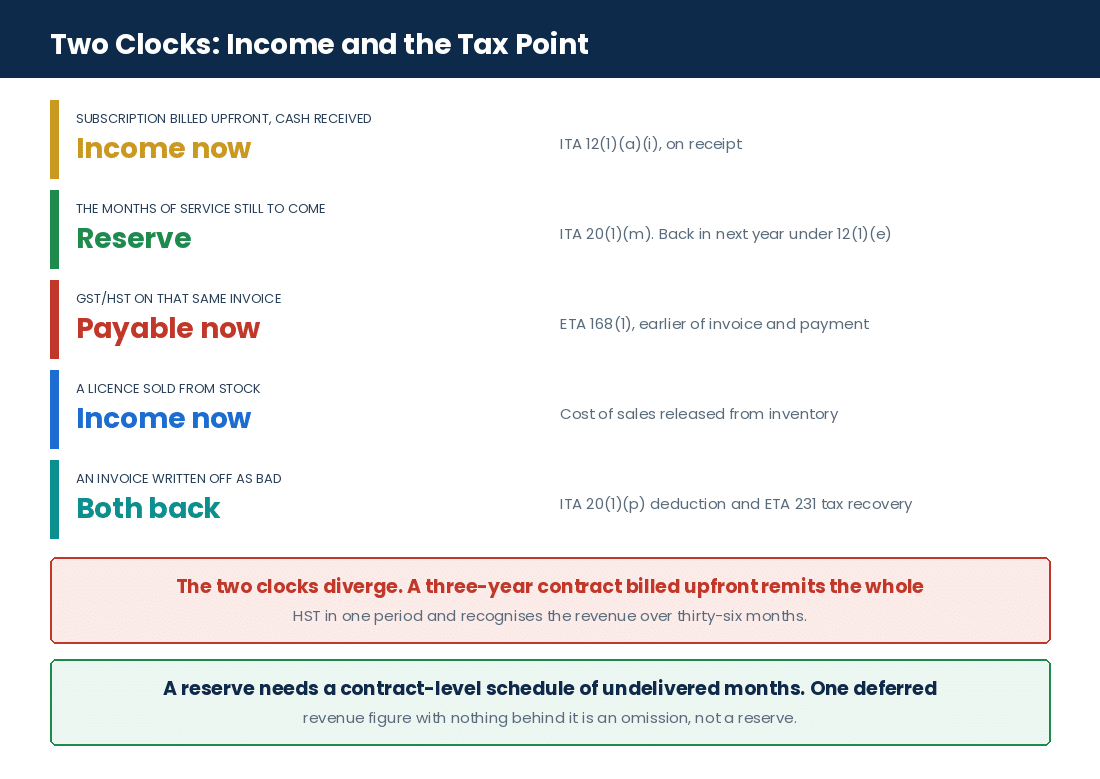
Subsection 168(1) makes tax payable on the earlier of the day the consideration is paid and the day it becomes due, and subsection 168(3) fixes the day it becomes due by reference to the invoice. Section 165(1) imposes the tax; subsection 221(1) requires the supplier to collect it. Even if you spread income over a subscription for income tax purposes, you owe the tax when the money moves — and that divergence is the single biggest cash flow issue in this sector.
Payroll source deduction remittance dates differ from sales tax deadlines. Keep track of both so your records stay right. Payroll runs on the band assigned by Regulation 108; GST/HST runs on the reporting period assigned by your annual taxable supplies. They are unrelated schedules.
Key tips for collecting sales tax:
- Charge clients correctly using their location. The recipient’s address obtained in the ordinary course of business, not yours.
- Keep good records explaining how you decided where the supply happened. A place-of-supply conclusion recorded once per customer is worth more than one reconstructed per invoice.
- You file returns regularly — monthly, quarterly or annually based on your total taxable supplies — and pay what you owe by CRA deadlines.
Here’s what returns usually look like:
| Return Type | Filing Frequency | Due Date |
|---|---|---|
| GST/HST Return | Annual to $1.5M; quarterly to $6M; monthly above | One month after a monthly or quarterly period; three months after the year end for an annual filer, plus quarterly instalments where last year’s net tax was $3,000 or more |
| Corporate Income Tax | Annual | Filed six months after fiscal year-end under 150(1)(a); balance of tax at two months under 157(1)(b), or three for an eligible CCPC |
| Payroll Source Deductions | Four bands by average monthly withholding amount, not employer size | Quarterly under $3,000; 15th of the following month under $25,000; twice monthly from $25,000; within three working days from $100,000 — Regulation 108 |
The billing agent election lets someone else collect and send HST/GST for you under certain rules. It is in subsection 177(1.1), and it is a joint election between the principal and the billing agent that lets the agent account for the tax on the principal’s supplies in its own net tax. It does not change who made the supply, and it does not move the income tax reporting.
A reseller billed a $180,000 three-year enterprise subscription in December and deferred almost all of the revenue for income tax, which was right.
It also deferred the HST, which was not. Subsection 168(1) made the full $23,400 payable in the December reporting period, because the invoice had gone out. The return was short, interest ran under section 280, and the cash had been spent on the vendor licence. Figures changed for privacy.
For advice about managing software reseller business taxes across Canadian provinces including Ontario’s rules, contact Gondaliya CPA at 647-212-9559 or info@gondaliyacpa.ca today.
Income reporting requirements for Canadian software resellers
Income Reporting Requirements
Timing
If you sell software in Canada, you need to report your income right. This matters for software reseller taxes Canada and other business taxes. You have to show your income correctly so you do not get into trouble with CRA. Here we cover corporate income tax, what counts as taxable income, and how to keep good records.
Corporate Income Tax for Software Resellers
Canadian software resellers pay corporate income tax on what they earn after expenses. The deadline to file depends on when your fiscal year ends — usually six months after that date under paragraph 150(1)(a). You must report income when it is earned, not just when you bill or get paid.
You should know whether you are a principal or an agent, because that changes whether you report gross revenue or commissions. And if you sell multi-year subscriptions, you often cannot take all the money into income at once — but the mechanism is not what the guidance usually describes.
Risk Warning: multi-year subscription revenue is not simply “spread.” It is included on receipt and then reserved, and the difference is a documentation requirement.
An amount received in the year on account of services not rendered before the end of the year is included in income by subparagraph 12(1)(a)(i). Paragraph 20(1)(m) then allows a reserve for the services reasonably anticipated to be rendered after the year end, computed on the gross amount. Paragraph 12(1)(e) brings that reserve back into income the following year, where a fresh one may be claimed.
The practical consequence is that a reserve has to be reasonable, which means a schedule tying each unearned balance at the year end to the months of service still to be delivered under that contract. A single figure labelled “deferred revenue” with nothing behind it is not a reserve CRA will accept — and a reseller that simply left the receipts off the income statement has not claimed a reserve at all, it has omitted income.
Key points:
- Corporate tax return filing deadline is six months after fiscal year-end — with the balance of tax at two months under 157(1)(b), three for an eligible Canadian-controlled private corporation. Paying at six months generates interest under 161(1) and no notice.
- Income recognition means report revenue when earned, under section 9, with amounts receivable caught by paragraph 12(1)(b).
- Multi-year subscription revenue may need deferral — through the 12(1)(a)(i) inclusion and the 20(1)(m) reserve, rolling forward one year at a time.
- Business structure considerations (sole proprietor vs. corporation) change the rates, the deadlines and the compliance load.
Business structure considerations
Risk Warning: a self-employed sole proprietor does not file by April 30.
Where you or your spouse carried on a business, the T1 filing deadline is June 15 under subparagraph 150(1)(d)(ii). The balance of tax is still due April 30, and interest runs from May 1 under subsection 161(1). The two dates are different and the guidance collapses them into the wrong one.
| Structure | Return and deadline | What it changes |
|---|---|---|
| Sole proprietor | Form T2125 with the T1 — filed by June 15, balance due April 30 | Personal rates on all profit. No deferral. GST/HST position identical |
| Corporation | T2 filed within six months, balance at two months | Small business deduction under section 125 on the first $500,000 — roughly 12.2% in Ontario against 26.5% above it |
| Partnership | Income computed at the partnership level under section 96 and allocated | Partners include their share whether or not it is distributed |
Being incorporated has perks like limited liability and the small business deduction. But it also means more rules: separate books, GST/HST registration if needed, payroll remittances, and formal financial statements. Remember:
- Sole proprietors file T1 returns by April 30 — corrected: the filing deadline is June 15 where there is business income, and April 30 is the payment deadline.
- Corporations file T2 returns six months after fiscal year-end, with the balance payable at two months.
- Incorporation needs extra compliance steps — and mandatory electronic filing of the T2 under subsection 150.1(2.1), with a $1,000 penalty under 162(7.2) for paper.
Taxable income definition
Taxable income is profit from the business computed under section 9, less the deductions the Act allows. Paragraph 18(1)(a) is frequently cited as the source of “allowable deductions” and it is the opposite — it is a prohibition, denying any deduction except to the extent the outlay was made to earn income. Specific deductions come from subsection 20(1), and limits from sections 67, 67.1, 67.6 and 18(1)(l).
If you get paid upfront for multi-year subscriptions, only the portion applicable to the current period stays in income; the rest is relieved by the 20(1)(m) reserve and returns next year. This aligns with the accounting treatment under ASPE Section 3400, though the two systems are not the same — the accounting defers, the Act includes and then reserves. Keeping solid paperwork avoids audits or disputes about early income reporting.
Record Keeping and Documentation
Canadian law says keep good records for at least six years after the last tax year they relate to. Software resellers should hold on to the documents below — and the measuring point is worth stating precisely: paragraph 230(4)(b) of the Income Tax Act and section 286 of the Excise Tax Act both run from the end of the last taxation year to which the records relate, not from the filing date, which in practice gives closer to seven years.
- Vendor agreements showing if you’re principal or agent — the single most important document in the file.
- Customer contracts with subscription details, showing the service period that supports the reserve.
- Sales invoices with dates and amounts, which fix the 168(1) tax point.
- Subscription schedules tracking deferred revenue, by contract rather than as one control balance.
- Rebate statements that adjust costs, with the vendor credit matched to the purchase it reduces.
- Credit notes for returns or cancellations, supporting both the revenue reversal and the GST/HST adjustment.
- Foreign currency exchange records used — section 261 for income tax and section 159 of the Excise Tax Act for GST/HST, applied consistently.
- Payroll records with salaries, commissions, deductions, reconciling to the T4 Summary.
- Supplier invoices carrying the GST/HST registration number above $150, as subsection 169(4) requires for an input tax credit.
Good record retention helps with GST/HST filings, accurate bookkeeping, T2 corporate returns, and CRA audits.
A reseller carried about $640,000 of unearned subscription revenue at its year end and showed it as one line on the balance sheet with no schedule behind it.
The amount was right. The support was not. Rebuilding it contract by contract from start dates took two days and turned an omission into a defensible 20(1)(m) reserve. The difference between those two characterisations is what a reviewer decides first. Figures changed for privacy.
For help handling software reseller taxes Canada or finding expert software reseller accounting services Canada, contact Gondaliya CPA at info@gondaliyacpa.ca or call 647-212-9559 for a free consultation.
Effective accounting best practices for software resellers
Accounting Best Practices
Bookkeeping
Software reseller accounting in Canada needs careful handling of money coming in and going out. This helps with taxes and keeps your records neat. Good bookkeeping makes filing GST/HST and corporate taxes easier, and it also helps you make smart business choices. Here are the key practices for managing software reseller business taxes the right way.
Managing Revenue and Expenses
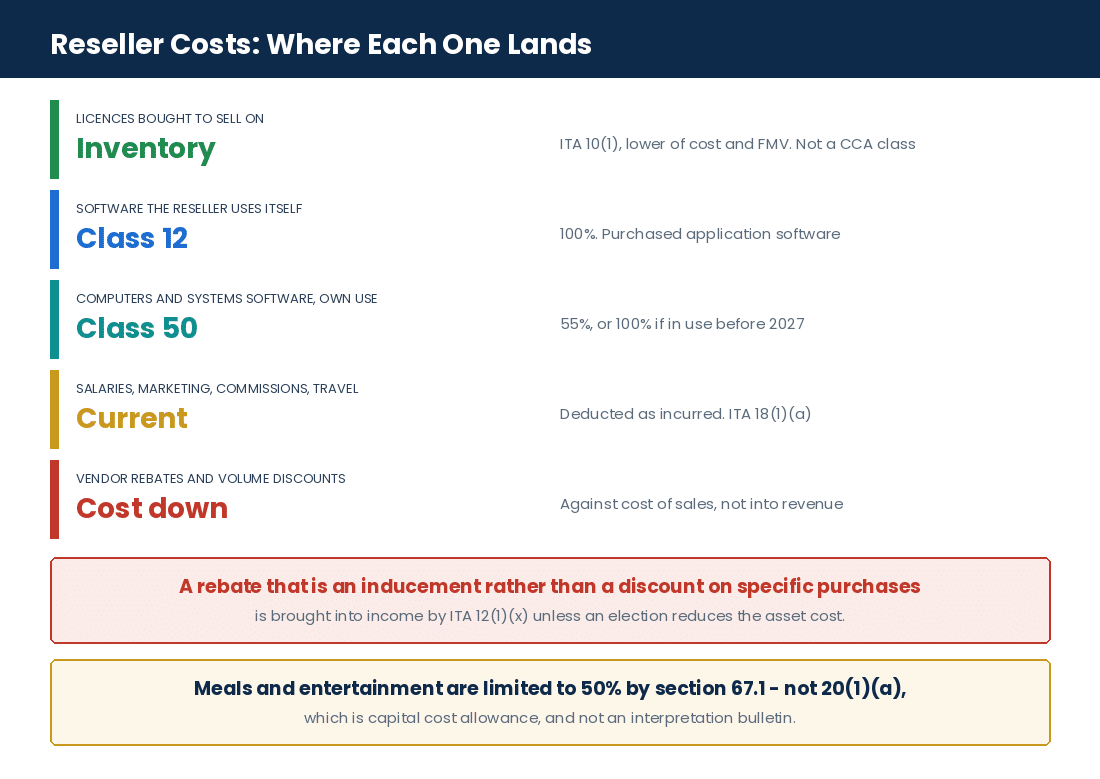
You must keep track of all money you make, especially from software license sales and subscriptions. Deferred revenue schedules let you show income only as you provide the service — they are the evidence behind the 20(1)(m) reserve, not a substitute for the 12(1)(a)(i) inclusion. Vendor rebates should lower your cost of sales, not be counted as extra income. You can deduct staff pay and sales commissions, with proper proof.
Track costs carefully. Include direct costs like buying licences from vendors and indirect ones like market development funds that reduce your expenses. Detailed records help if CRA checks your books and stop you paying penalties for wrong reports or disallowed deductions.
Risk Warning: software bought for resale is inventory, not a capital asset in Class 12 or Class 50.
Licences you acquire to sell on are inventory, valued under subsection 10(1) at the lower of cost and fair market value, on the same basis as the prior year under 10(2.1). They enter cost of sales when sold. Capital cost allowance only reaches software the reseller uses itself — and there, purchased application software is Class 12 at 100% and systems software with the hardware it runs on is Class 50.
Tracking software license sales and subscriptions
Subscriptions lasting several years count as income over time, not all at once. If you bill a year upfront, the receipt enters income under 12(1)(a)(i) and the unearned months are relieved by the reserve, so the net effect is the revenue spread across the twelve months in your books and your return. This stops early income reporting, which distorts both the corporate tax and the cash position — though it does not change the GST/HST, which is payable on the invoice date under 168(1).
Use deferred revenue schedules to show money received but not earned yet. These schedules do the work at year-end when you prepare your T2 corporate tax return. Keep clear subscription terms and payment documents to prove why income timing differs from cash flow — a reviewer will ask that question before any other.
Categorizing common expenses
You can write off many business expenses related to running your reseller company. These usually include:
| Expense | Treatment | Authority |
|---|---|---|
| Software licenses bought (cost of goods sold) | Inventory until sold, then cost of sales | Subsection 10(1) |
| Marketing costs | Current expense, deducted as incurred | Paragraph 18(1)(a) |
| Salaries for sales or admin staff | Current, with employer CPP and EI on top; the 180-day rule defers anything accrued and unpaid | 18(1)(a), 78(4) |
| Sales commissions paid | Current, deducted as incurred, reportable on a T4A above $500 where paid to a contractor | 18(1)(a), Regulation 200(2) |
| Travel for client meetings | Fully deductible, subject to the reasonableness test | Section 67 |
| Meals and entertainment | 50% of the amount paid, with the input tax credit recaptured to match | Section 67.1 |
| Own-use software and hardware | Capital — Class 12 at 100%, or Class 50 at 55% and 100% in the first year where acquired after 15 April 2024 and in use before 2027 | 20(1)(a), Schedule II |
Meals can only be half-deducted (50%) per CRA rules unless exceptions apply. The provision is section 67.1 — not an interpretation bulletin, and not section 20(1)(a), which is capital cost allowance. Putting expenses in the right category stops disallowed claims that cause penalties.
For wages, you must withhold source deductions under subsection 153(1); commissions paid to employees fall under the same rule, while commissions paid to independent contractors do not but are reportable on a T4A. Keep contracts, commission agreements, pay stubs and invoices ready to support these deductions if CRA asks.
Financial Reporting and Statement Preparation
Good financial reports help you see how well the business does. They also help you meet GST/HST deadlines, because a return that reconciles to the ledger takes minutes and one that does not takes days.
Creating accurate financial reports
Your statements should reflect real activity, showing gross or net amounts based on your role as principal or agent. A principal reports gross revenue and gross cost of sales; an agent reports net commission only. Getting this wrong does not change the profit, but it changes the revenue figure by a multiple — and it is the revenue figure CRA compares across your returns.
Keep supporting papers — vendor invoices, customer contracts, bank records — for six years after the taxation year end as paragraph 230(4)(b) requires. Clear reports make it easier for a CPA firm to prepare a compilation engagement under CSRS 4200, which provides no assurance and is what almost every reseller actually needs.
Reconciling accounts regularly
Check accounts often to spot errors between bank records, ledgers, deferred revenue, rebate schedules, payroll and actual cash flow. If your books are behind because of missing information or missed transactions — common in fast-growing resellers — catch up by rebuilding subscription deferrals from contract start dates onward, and verify rebates against the vendor credits actually issued.
Doing this regularly cuts risk by making sure the GST/HST collected matches taxable sales each period — important because tax is payable on the invoicing or payment date under subsection 168(1) of the Excise Tax Act, while the revenue in your ledger follows a different clock.
A reseller capitalised roughly $95,000 of licences bought for resale into Class 12 and claimed them at 100%, which looked like the same answer as expensing them.
It was not. Those licences were inventory under 10(1), and about a third of them were still unsold at the year end. Capitalising them had moved a third of the cost into the wrong year and emptied an inventory balance that should have been on the balance sheet. Figures changed for privacy.
For help with tricky software reseller taxes in Canada — including setting up bookkeeping that fits your business — contact Gondaliya CPA’s team at 647-212-9559 or info@gondaliyacpa.ca for a free consult.
Leveraging Sales Tax Software in Canada for Automation and Compliance
Sales Tax Software and Automation
Tooling
Sales tax software helps software resellers in Canada handle their taxes more easily. It makes accounting simpler and keeps business taxes on track. These tools help with GST/HST obligations, keep good records, and support correct corporate tax reporting for resellers across the country.
Features of Sales Tax Software Tools
Sales tax software for Canadian resellers automates a lot. It tracks the $30,000 registration threshold in section 148, applies the place-of-supply rules to set the right rate, and records input tax credits with the documentary detail subsection 169(4) requires. It applies the timing rule in subsection 168(1) — tax payable on the earlier of invoicing and payment — which is where manual systems most often go wrong, because the bookkeeper is thinking about revenue rather than about the tax point.
These tools also connect with accounting programs like QuickBooks or Xero. That link helps manage deferred revenue schedules, which matter for subscriptions running more than a year, and makes vendor cost tracking and rebate matching easier.
By putting sales information and Canadian tax rules in one place, sales tax software cuts manual errors and keeps records ready if CRA wants to review them. What it will not do is decide whether you are a principal or an agent, and that is the decision that sets everything downstream. Configure the system to the conclusion; do not expect it to reach one.
Advantages for Software Resellers
- Fewer calculation errors. Automated rating removes the manual mistakes common in multi-province billing, where a single reseller may charge four different rates in one month.
- Reports that match the deadlines. Output aligned to the T2 and the GST/HST return, so the two reconcile before they are filed rather than after a query.
- Documentation kept. Receipts, rebates, commissions and subscription schedules in one place, which is what lowers the risk of a penalty for late filing or missing records during a review.
- Remittance reminders. The system can track the Regulation 108 payroll band and the GST/HST reporting period, which run on unrelated schedules and are the two deadlines most often confused.
Risk Warning: there is no new digital supply place-of-supply regime arriving in 2026.
The change that actually happened is the simplified GST/HST registration for digital economy businesses, in force since 1 July 2021, requiring non-resident vendors and distribution platform operators supplying digital products to Canadian consumers to register and collect. A Canadian reseller registers under the ordinary rules, not the simplified one. Treat an undated claim that rules are “coming in 2026” as a reason to check rather than a reason to act.
What a reseller should actually watch for is the practical consequence of that 2021 regime: foreign vendors who historically invoiced without GST/HST may now be charging it. That tax is recoverable as an input tax credit if the invoice carries a valid registration number, and not recoverable if it does not.
A reseller’s billing system was configured to charge Ontario HST on every invoice because the company was based in Toronto.
Place of supply follows the recipient, not the supplier. Alberta customers had been charged 13% where 5% was due, and the over-collected tax still had to be remitted under section 222 while the customers asked for it back. The configuration took an afternoon to fix and two quarters to unwind. Figures changed for privacy.
For help with your software reseller accounting Canada using sales tax software, reach out to Gondaliya CPA at 647-212-9559 or info@gondaliyacpa.ca for a free consultation today.
Professional support and advisory options for software reseller tax management
Professional Support and Advisory Options
Advisory
Software reseller taxes in Canada can be tricky. You need to handle them carefully to stay on the right side of the law and keep your finances healthy. Software reseller accounting Canada involves figuring out whether you are a principal or an agent, watching the GST/HST registration threshold, and knowing what triggers a CRA review. Expert help makes this easier — and the value is concentrated in a handful of decisions rather than spread across the whole file.
Role of Tax Advisors for Software Resellers
Tax advisors help software resellers understand their duties. The first question is always principal or agent, because it decides whether you report all your sales or just your commission, and it changes both the income tax and the GST/HST. The second is the registration threshold, which is $30,000 of taxable supplies over four consecutive calendar quarters under section 148 — with the single-quarter rule that ends small supplier status immediately.
Advisors know what makes the CRA pay attention to your accounts. For example:
- Mixing up agency arrangements — gross on one return and net on another, which is an arithmetic mismatch a system finds without a human looking.
- Wrongly handling deferred subscription income — a balance with no contract-level schedule, which is an omission rather than a reserve.
- Not using billing agent elections when needed — the joint election in subsection 177(1.1), which has to be in place before the supplies it covers.
- Misreporting vendor rebates — taken into revenue instead of against cost of sales, which inflates both lines and distorts the margin.
Catching these issues early helps avoid audits or fines. Each one is cheap to prevent and expensive to unwind, because every one of them repeats annually until someone looks.
How Tax Professionals Add Value
Tax pros bring specific skills that help software resellers stay on track:
- Billing Agent Election: guidance on the joint election under subsection 177(1.1) — not section 165(1), which imposes the tax, and not section 225, which calculates net tax. The election lets the agent account for the tax on the principal’s supplies in its own net tax; it does not change who made the supply.
- Deferred Revenue Schedules: They break down subscription fees over time instead of recording everything at once. Broken down by contract and service period, so the 20(1)(m) reserve is supportable rather than asserted.
- Vendor Rebates Treatment: recording rebates as cost reductions rather than income, with the inducement rules in paragraph 12(1)(x) checked where the payment is not simply a volume discount.
- Audit Readiness Best Practices: keeping the vendor agreements and customer contracts that evidence principal or agent status on the P-182R tests — legal liability, authority to bind, and who carries the credit risk.
These steps make compliance smoother and help with managing your tax cash flow, which in this sector means managing the gap between the 168(1) tax point and the 20(1)(m) revenue recognition.
Choosing the Right CPA Firm Specializing in Technology Resellers
Picking a licensed Ontario CPA firm familiar with tech resellers matters. Gondaliya CPA knows software reseller accounting in Canada and offers flat-fee annual services for tech resellers across Ontario and beyond. We handle principal-agent roles, bundled supplies, deferred revenue and the place-of-supply rules as they actually stand — including the simplified registration regime for digital economy businesses that has applied since 1 July 2021.
We combine fixed pricing with experience filing corporate returns (T2), bookkeeping, compilation engagements under CSRS 4200, and payroll run through QuickBooks or Xero. We also represent clients before CRA. Compilations provide no assurance; audit and review engagements are referred out.
How Gondaliya CPA Can Help Software Resellers in Canada
Gondaliya CPA offers affordable help designed just for Canadian software resellers’ business taxes:
- Corporate tax filing following current Income Tax Act rules, with the balance paid at two months rather than six.
- Bookkeeping that shows gross vs net revenues correctly — the principal-or-agent conclusion recorded per vendor and carried consistently across both returns.
- GST/HST filings done on time per Excise Tax Act invoicing/payment rules, applying subsection 168(1) rather than the revenue schedule.
- Planning around deferred income from multi-year subscriptions, with the 12(1)(a)(i) inclusion and the 20(1)(m) reserve documented contract by contract.
- Representing clients during CRA audits or assessments with solid facts, which in this sector means the vendor agreements and the deferral schedule.
Our licensed Ontario CPA status gives clients confidence, backed by a public record of client reviews and verifiable registration on the CPA Ontario firm directory.
Tailored Tax Planning and Compliance Support
Good tax planning means matching income recognition to service periods, especially for multi-year subscriptions. That runs through section 9 and the reserve in paragraph 20(1)(m) — not paragraph 18(1)(a), which is a prohibition on deducting outlays not made to earn income and has nothing to do with revenue timing. Separately, subsection 168(1) makes GST/HST payable on the earlier of invoicing and payment.
These rules affect cash flow because the taxable event comes before the income is recognised. A reseller that bills three years upfront has remitted the whole HST in the first reporting period and will recognise the revenue over thirty-six months. Smart planning manages that gap — by invoicing annually rather than for the full term where the contract allows, by matching the vendor purchase to the customer billing cycle, and by electing a GST/HST reporting period that does not leave a large remittance sitting against an empty bank account.
Contact Information for Consultation
Need advice on software reseller taxes Canada? Gondaliya CPA can help wherever you are in Ontario, including Toronto or Brampton:
- Phone: 647-212-9559
- Email: info@gondaliyacpa.ca
Get in touch for a free consultation about your software reseller accounting Canada needs, with a flat annual fee including HST agreed in writing before any work begins.
A reseller and its largest vendor had operated an informal billing arrangement for years, with the vendor invoicing the end customer directly and the reseller taking a margin.
No 177(1.1) election was ever filed, and the reseller had been reporting gross revenue on supplies it had not made. Putting the election in place fixed it prospectively; the open years had to be corrected by amended returns on both sides, which required the vendor’s cooperation and took most of a quarter. Figures changed for privacy.
Additional Topics Relevant to Software Reseller Taxes
Bundles, Reserves, Place of Supply and Digital Rules
Four Hard Cases
How to handle bundled sales mixing your own services with software products
A bundled supply arises when software is sold together with other goods or services as one package — a licence with implementation, training, support or managed services. The GST/HST question is whether that is a single supply or multiple supplies, and it is a question of fact decided on what the customer actually wanted.
- Single supply — the elements are so integrated that the customer would not want one without the other. Rate the whole thing by its predominant element.
- Multiple supplies — the elements are separately useful and separately priced. Rate each one on its own terms.
- Where the supply crosses a border, the distinction decides whether the whole bundle is zero-rated to a non-resident or only part of it is.
- Record the conclusion once, per product bundle, and apply it consistently. An inconsistent rating between periods is what draws the question.
For income tax the bundle also needs splitting, because the licence component may be inventory sold at a point in time while the support component is a service rendered over a period — which means one part lands in income immediately and the other runs through the 20(1)(m) reserve.
Managing reserves for potential returns or doubtful debts in accounting records
Two different reserves, two different provisions, and both are commonly missed.
| Situation | Income tax | GST/HST |
|---|---|---|
| A receivable that may not be collected | Reserve for doubtful debts under paragraph 20(1)(l), added back the following year under 12(1)(d) | No adjustment yet — the tax stays remitted |
| A receivable established to be bad | Deduction under paragraph 20(1)(p), where the amount was previously included in income | Bad debt adjustment under section 231 of the Excise Tax Act, recovering the tax remitted on the written-off portion |
| A product returned or a subscription cancelled | Revenue reversed in the year | Credit note under section 232, with the tax adjustment flowing through both parties’ returns |
| An amount not yet due under the contract | Reserve for unpaid amounts under paragraph 20(1)(n) where the proceeds are payable after the year end | No effect |
The section 231 recovery is the one resellers most often leave on the table. Where you charged and remitted HST on an invoice that later goes bad, you can recover the tax on the written-off portion — a separate claim from the income tax deduction under 20(1)(p), with its own time limit, and it is real money on a sector with enterprise receivables.
Understanding place-of-supply rules that determine which taxes apply by customer location
For a service or intangible personal property supplied to a Canadian recipient, the general rule looks to the recipient’s address obtained in the ordinary course of business. An Ontario customer pays 13%, an Alberta customer 5%, a Nova Scotia customer the Nova Scotia rate. A Toronto reseller billing nationally charges several different rates in the same month, and the rate follows the customer rather than the office.
- Collect and record the address at onboarding, not at invoicing.
- Where you hold more than one address for a recipient, the rules set an order of priority — use it rather than choosing.
- For a non-resident recipient, check registration status before zero-rating, because a registered non-resident is outside the relief.
- PST is a separate question again, decided provincially, and software is generally taxable in British Columbia, Manitoba and Saskatchewan.
Effects of new digital supply laws coming into force in 2026 on tax compliance
Risk Warning: there is no digital supply regime coming into force in 2026. The one that matters has been in force since 1 July 2021.
The simplified GST/HST registration for digital economy businesses requires non-resident vendors and distribution platform operators supplying digital products and services to Canadian consumers to register and collect. It was not deferred and it is not new. A Canadian reseller registers under the ordinary rules in 240(1), not the simplified one.
The practical effect on a Canadian reseller is on the purchase side: foreign vendors who historically invoiced without GST/HST may now charge it. That tax is a recoverable input tax credit under subsection 169(1) if the invoice carries a valid registration number and meets the documentary standard in 169(4) — and is simply a cost if it does not. Check your vendor invoices for a registration number before assuming either way.
Where a foreign vendor is not registered and charges nothing, the self-assessment rules in section 218 can apply to an imported taxable supply. For a reseller fully engaged in commercial activity that produces no net cost, because the self-assessed tax is immediately recoverable as a credit. For one with any exempt activity, it does.
A reseller wrote off roughly $140,000 of enterprise receivables across two years and claimed the income tax deduction under 20(1)(p) correctly.
It never made the section 231 claim, so about $18,200 of HST it had remitted on those invoices stayed with CRA. The adjustment was still available on the more recent write-offs and was claimed on the next return. The older ones had run out of time. Figures changed for privacy.
For personalized assistance with these areas, contact Gondaliya CPA at 647-212-9559 or info@gondaliyacpa.ca.
Frequently Asked Questions on Software Reseller Taxes and Accounting in Canada
Frequently Asked Questions
20 Answers
What is the Capital Cost Allowance Rate for software assets?+
When is the T2 corporate tax return filing deadline?+
What are the payroll source deduction remittance dates?+
When does tax on supply become payable for software sales?+
How does income deferral work for multi-year subscriptions?+
What is the required record retention period for software resellers?+
What is the meals deduction limit under CRA rules?+
What is bundled supply in software resale?+
How are vendor rebates and funds treated for tax purposes?+
What happens when customers return products or have unpaid invoices?+
How does selling to a non-resident affect tax obligations?+
What about sales to hospitals, schools, or public bodies?+
Which costs can a reseller deduct on their tax return?+
Which assets qualify as capital assets for software resellers?+
How are staff salaries and sales commissions deducted?+
What records should a software reseller keep?+
Which returns does a reseller need to file and when?+
Am I a principal or an agent, and how do I prove it?+
What is the billing agent election and when should we use it?+
File it ourselves or engage a CPA firm?+
Software Reseller Tax Check
Five quick questions on how your reseller business bills. No fee shown.
Points to raise with us:
This is a general prompt, not tax or legal advice or a quote. Your position depends on your full facts. For a real review, please book a free consultation.
Businesses We Serve & Industry Spotlights
Industry Expertise
Software resale sits inside a wider technology and distribution practice, and the question that decides a reseller’s return — principal or agent, and when does the money become income — is the same question we answer in every one of these sectors.
| Industry | The Software Reseller Angle |
|---|---|
| Technology startups & SaaS | Your vendors, with the same 12(1)(a)(i) and 20(1)(m) problem from the other side |
| Managed service providers | Resold licences inside a bundled monthly fee, rated as a single supply |
| Cloud service providers | Upstream capacity resold as cost of sales, not overhead |
| No-code development agencies | Client-account subscriptions, and whose expense they are |
| Cybersecurity companies | Class 12 versus Class 50 on software they use themselves |
| IT staffing companies | Gross versus net reporting on a pass-through, in its purest form |
| Wholesale e-commerce sellers | Inventory under 10(1) and vendor rebates against cost of sales |
| Cross-border e-commerce sellers | Place of supply and zero-rating across the same border |
| Digital product businesses | The 2021 digital economy registration regime, from the vendor side |
| Subscription box businesses | Money received before delivery, every single month |
| Freight brokers | The classic agency question, litigated for a century in another sector |
- Technology startups & SaaS: Mostly your vendors. They face the same advance payment inclusion and the same reserve, usually on a larger subscription base and with the same missing schedule.
- Managed service providers: They bundle resold licences into a monthly fee, which raises the single-versus-multiple supply question on every invoice they issue.
- Cloud service providers: Upstream capacity bought to resell is cost of sales matched to the revenue it supports, on exactly the analysis a licence reseller applies to inventory.
- No-code development agencies: Platform subscriptions bought for clients raise the same principal-or-agent conclusion, and the same consequence for whether the recovery is revenue.
- Cybersecurity companies: They buy a great deal of software for their own use, which is where Class 12 and Class 50 actually apply — and where the immediate expensing window is worth checking.
- IT staffing companies: The purest version of the gross-versus-net question. Whether a placement fee is revenue or a pass-through changes the top line by a multiple without touching the profit.
- Wholesale e-commerce sellers: Inventory valued under 10(1) and supplier rebates netted against cost of sales — the same two entries a licence reseller gets wrong most often.
- Cross-border e-commerce sellers: They cross the same border, and both sectors tend to zero-rate on the wrong test — where the output is used rather than who the recipient is.
- Digital product businesses: The 2021 simplified registration regime looks at them from the vendor side, which is why your foreign supplier invoices may now carry tax they did not before.
- Subscription box businesses: Money collected before delivery every month, which makes the 12(1)(a)(i) inclusion and the 20(1)(m) reserve a permanent feature rather than a year-end adjustment.
- Freight brokers: The agency question in its oldest and most litigated form. Everything CRA knows about principal versus agent it learned in sectors like this one.
The product changes and the two questions do not: whose supply is it, and when does the money become income. Every reseller adjustment we make sits in one of those two.
Neither is a judgment call about tax law. Both are questions about what the vendor agreement and the customer contract actually say. Figures changed for privacy.
Professional Guidance and Quick Reference
Guidance
Key Insights for Software Reseller Tax Compliance
Software resellers lose money in a predictable set of ways: citing section 165 for the registration threshold, the timing rule and the billing agent election, when those are sections 148, 168(1) and 177(1.1); capitalising licences bought for resale into Class 12 when they are inventory under 10(1); deferring subscription revenue without the 12(1)(a)(i) inclusion and a documented 20(1)(m) reserve; deferring the GST/HST alongside the revenue when 168(1) made it payable on the invoice; reporting gross on one return and net on another; treating sales to schools and hospitals as exempt when they are taxable and the buyer claims a 259 rebate; calling a non-resident sale exempt when it is zero-rated; taking vendor rebates into revenue instead of against cost of sales; missing the section 231 bad debt adjustment; thinking a self-employed proprietor files by April 30 when the filing deadline is June 15; paying the corporate balance at six months when 157(1)(b) sets it at two; and citing 18(1)(a) as the source of allowable deductions when it is a prohibition. Gondaliya CPA handles software reseller accounting and tax on a flat annual fee.
- File Yourself or Use a CPA Firm: choose based on complexity. CPA firms provide expertise and audit support, and the value concentrates where the principal-or-agent conclusion is contested or multi-year contracts need a defensible reserve.
- Common CRA Review Triggers: Include mismatched income/expenses and improper agency reporting — above all, revenue on the T2 that does not reconcile to revenue on the GST/HST returns.
- Catching Up if Books Are Behind: rebuild deferred revenue schedules from contract start dates, verify rebates against the vendor credits actually issued, then amend.
- Best Practices: maintain clear documentation, reconcile accounts regularly, and meet all filing deadlines — recording the principal-or-agent conclusion per vendor before the first invoice.
- DIY vs CPA vs Non-CPA Accounting: CPAs offer licensed expertise; non-CPAs may lack specialized knowledge. A CPA can also represent you before CRA and sign a compilation; a bookkeeper cannot.
- Gondaliya CPA’s Approach: focus on tech resellers with flat-fee services tailored to Ontario businesses and clients across Canada.
- Typical Deliverables from Gondaliya CPA: Accurate books, timely filings, compliance advice, audit support — with compiled financial statements under CSRS 4200.
- Cost Considerations: flat fees reduce surprises; costs vary by service scope and business size, agreed in writing before any work begins.
Quick Answers
At a Glance
- Imposition of GST/HST: ETA s.165
- Tax payable, earlier of invoice and payment: ETA 168(1)
- Supplier must collect: ETA 221(1)
- Net tax for a period: ETA 225
- Small supplier, $30,000: ETA s.148; see Guide RC4022
- Requirement to register: ETA 240(1); voluntary 240(3)
- Billing agent election: ETA 177(1.1)
- Agency tests: CRA Policy Statement P-182R
- Input tax credits: ETA 169(1); documents 169(4); four years 225(4)
- Exported supplies: zero-rated, Schedule VI Part V
- Public body sales: taxable; buyer rebate under ETA 259
- Bad debt tax recovery: ETA s.231; credit notes s.232
- Inventory: ITA 10(1), lower of cost and FMV
- Advance for services: ITA 12(1)(a)(i); reserve 20(1)(m); add-back 12(1)(e)
- Doubtful debts: ITA 20(1)(l); bad debts 20(1)(p)
- Own-use software: Class 12 at 100%; hardware Class 50
- Meals and entertainment: 50%, ITA 67.1
- Payroll bands: four, Regulation 108
- Records: six years from the taxation year end, ITA 230(4)(b)
- Corporate balance of tax: two months, ITA 157(1)(b)
People Also Ask
Related Questions
If we defer the revenue, can we defer the HST too?+
No. Subsection 168(1) makes the tax payable on the earlier of payment and the day consideration becomes due, which for an invoiced subscription is the invoice date. The income tax reserve under 20(1)(m) runs on a different clock. A three-year subscription billed upfront remits the whole tax in the first reporting period and recognises the revenue over thirty-six months.
A school asked us not to charge HST. Can we agree?+
No. Sales to schools, hospitals, universities, municipalities and charities are taxable supplies — charge the tax. What the buyer has is a public service body rebate under section 259, claimed on their own return at a percentage set by body type. There is no exemption certificate in the GST/HST system for this, and a reseller that stops charging is liable for the tax it failed to collect.
Does buying licences for resale go on the balance sheet?+
Yes, as inventory under subsection 10(1), valued at the lower of cost and fair market value, on the same basis as the prior year under 10(2.1). It enters cost of sales when the licence is sold. Capitalising it to a CCA class or expensing it on purchase both put the cost in the wrong period and empty a balance that should be there.
Our vendor pays us a market development fund. Is that income?+
It depends what it is. A volume discount on specific purchases is a price adjustment reducing cost of sales. A payment that is an inducement or reimbursement not tied to particular purchases is brought into income by paragraph 12(1)(x), unless an election applies the amount to reduce the cost of related property instead. Read the vendor programme terms before posting it.
Can we recover the HST on an invoice the customer never paid?+
Yes, through the bad debt adjustment in section 231 of the Excise Tax Act, once the debt is written off in the books. It recovers the tax you remitted on the written-off portion and is a separate claim from the income tax deduction under paragraph 20(1)(p). It has its own time limit, and it is the most commonly missed recovery in this sector.
Glossary
Definitions
- Principal — a reseller supplying in its own name, reporting gross revenue and gross cost of sales, and carrying the credit risk.
- Agent — a reseller arranging a supply for another person, reporting net commission only. Tested on CRA Policy Statement P-182R.
- Billing agent election — the joint election in subsection 177(1.1) letting an agent account for tax on the principal’s supplies in its own net tax.
- Tax point — the day tax becomes payable, being the earlier of payment and the day consideration becomes due, under subsection 168(1).
- Zero-rated supply — a supply taxable at 0% on which input tax credits remain fully recoverable. Exports sit in Schedule VI.
- Exempt supply — a supply in Schedule V carrying no input tax credits. A software reseller makes none.
- Public service body rebate — the partial recovery in section 259 available to the purchasing body, not an exemption for the seller.
- Inventory — property held for sale, valued under subsection 10(1) at the lower of cost and fair market value.
- Reserve under 20(1)(m) — a deduction for the gross amount attributable to services still to be rendered after the year end, added back the following year under 12(1)(e).
- Bundled supply — software sold with other goods or services as one package, rated as a single supply by its predominant element or as multiple supplies.
- Place of supply — the rules fixing which province’s rate applies, generally by the recipient’s address obtained in the ordinary course of business.
- Average monthly withholding amount — the measure in Regulation 108 assigning an employer to one of four payroll remittance bands.
Want a checklist to work from? You can download our free software reseller tax checklist before your consultation.
Settle principal or agent per vendor before the first invoice, because it decides whether your top line is gross revenue or net commission and it is the mismatch between those two numbers that opens a review. Cite the right provisions: the $30,000 threshold is section 148 with registration in 240(1), the tax point is subsection 168(1), and the billing agent election is 177(1.1) — section 165 only imposes the tax. Put licences bought for resale in inventory under 10(1), not a CCA class; Class 12 and Class 50 reach only the software you use yourself. Bring subscription receipts into income under 12(1)(a)(i) and claim a 20(1)(m) reserve with a contract-level schedule behind it — and remit the GST/HST on the invoice date regardless, because the two clocks diverge and that gap is the cash flow problem in this sector. Charge tax on sales to schools and hospitals; they claim a 259 rebate, you do not grant an exemption. Zero-rate non-resident sales rather than calling them exempt, and keep the credits. Net vendor rebates against cost of sales. Claim the section 231 adjustment on bad debts. And pay the corporate balance at two months, not with the return.
2026 Update — what is current: This article reflects rules current to 9 October 2026. There is no new digital supply place-of-supply regime arriving in 2026; the change that matters is the simplified GST/HST registration for digital economy businesses, in force since 1 July 2021, which requires non-resident vendors and distribution platform operators supplying digital products to Canadian consumers to register and collect — so foreign vendor invoices may now carry tax that is recoverable as an input tax credit where the registration number appears. Bill C-15 received Royal Assent on 26 March 2026: for a reseller its relevant measure is the 100% first-year deduction on Classes 44, 46 and 50 acquired after 15 April 2024 and available for use before 2027, covering computers and systems software the business uses itself, with the half-year rule suspended and the reinstated incentive at 3× the normal first-year amount elsewhere. Electronic filing of the T2 is mandatory under subsection 150.1(2.1), with a $1,000 penalty under 162(7.2) for paper, and information returns above five slips of a type must also be filed electronically. Unchanged: the $30,000 small supplier threshold in section 148, the tax point in 168(1), the billing agent election in 177(1.1), the GST/HST filing bands at $1.5 million and $6 million, input tax credits under 169(1) with documents to 169(4), the public service body rebate in 259, the bad debt adjustment in 231, the 50% meals limit in 67.1, the six-year retention requirement in paragraph 230(4)(b), and the corporate balance of tax at two months under 157(1)(b).
Software Reseller Taxes Canada: How Gondaliya CPA Can Help
Start with one vendor agreement, one customer contract and your last two returns
Gondaliya CPA settles the principal-or-agent conclusion per vendor against the P-182R tests and records it so both returns agree, puts resale licences in inventory and own-use software in the right class, builds a deferred revenue schedule contract by contract so the 20(1)(m) reserve is supportable, applies the 168(1) tax point rather than the revenue schedule to your GST/HST, rates your exports and your public body sales correctly, claims the section 231 adjustment on write-offs, and files the GST/HST, payroll and T2 from one reconciled set of books — on a flat annual fee including HST with a one-business-day response. Please book a free consultation.
Next Steps
Please book a free consultation with Gondaliya CPA and bring three things: your largest vendor agreement, a representative customer contract showing the subscription term, and your last filed T2 and GST/HST return. Those settle the principal-or-agent question, the revenue timing and whether the two returns reconcile — which between them account for nearly every adjustment we make on a reseller file. If you bill multi-year subscriptions upfront, say so at the outset, because the gap between the 168(1) tax point and the 20(1)(m) reserve is the one that catches growing resellers with a remittance due and the cash already spent. You will get a flat annual fee including HST before any work begins. We serve Toronto, Mississauga, Vaughan, Brampton, Etobicoke, Scarborough, Ottawa and the rest of Ontario, and work with resellers across Canada. If our content helps, please add gondaliyacpa.ca as a preferred source on Google.
Published: · Last updated:
Editorial policy: We research against CRA, Department of Finance, Parliament of Canada, CPA Canada and CPA Ontario sources, fact-check the figures, and Sharad Gondaliya, CPA, reviews the content, which we update as the rules change.
Disclaimer: This article is educational information only and is not tax, legal, financial, contract or software licensing advice. Figures marked illustrative are examples rather than quotes or guarantees. It reflects rules current to 2026, including the imposition of GST/HST in section 165 of the Excise Tax Act, the tax point in subsection 168(1), the collection requirement in 221(1), registration under sections 148 and 240, the billing agent election in subsection 177(1.1), input tax credits under subsection 169(1) with the documentary requirements in 169(4), zero-rating of exported supplies in Schedule VI Part V, the public service body rebate in section 259, bad debt adjustments in section 231 and credit notes in section 232; and, under the Income Tax Act, profit computation in section 9, the advance payment inclusion in subparagraph 12(1)(a)(i) with the reserve in paragraph 20(1)(m), inventory valuation in subsection 10(1), deductibility under paragraph 18(1)(a) with the capital restriction in 18(1)(b), the meals limitation in section 67.1, capital cost allowance under Regulation 1100 and Schedule II, and the six-year retention requirement in paragraph 230(4)(b). Provincial sales taxes in British Columbia, Manitoba and Saskatchewan, and the Quebec sales tax, are administered separately and their rules differ. Gondaliya CPA performs compilation engagements under CSRS 4200 and does not perform audit or review engagements. Rates and limits change and outcomes depend on your specific facts. Please consult a licensed CPA before acting.

Sharad Gondaliya is a CPA Canada & CPA USA with 15 Years+ experience of Accounting, Tax, Payroll of Corporate Small Businesses as Tax Accountant. He is a CPA Ontario member (61040184) and holds US CPA licences in Washington and Montana and is well known among corporate small businesses for tax planning, efficient tax solutions, and affordable CPA services. Sharad is the Principal (Director) of Gondaliya CPA – Affordable CPA Firm in Canada. Licenses: CPA Ontario: 61040184 | CPA USA (MT): PAC-CPAP-LIC-033176 | CPA USA (WA): 57629 | CPA Firm License: 61330051 View Full Author Bio