



Lash and Brow Studio Tax Filing in Canada: Business Tax Returns, Expenses & Filing Requirements
Lash and Brow Studio Tax Filing Canada: A Complete Guide for Lash Business and Brow Studio Tax Return with Gondaliya CPA
Lash and brow studio tax filing in Canada turns on three questions: whether the technician at the chair is staff, a contractor or a station renter; whether a product was used on the client or sold to them; and when money taken in advance becomes income. Gondaliya CPA helps lash and brow studios settle all three, register for GST/HST at the right moment, and file returns from books that reconcile.
Quick Summary
Four things in the circulating guidance will cost a studio money. $3,500 is not a filing threshold — it is the CPP basic exemption, and above it a self-employed technician pays both halves of CPP at 11.90%, which is the single largest surprise on a first self-employed return. A gift card and a prepaid package are not the same thing: a gift certificate is not a supply under section 181.2 of the Excise Tax Act so no tax applies until redemption, while a prepaid service package is consideration and the tax is payable under 168(1) when it is paid. Guide RC4022 is General Information for GST/HST Registrants, not the worker status guide — that is RC4110, which the source material itself cites correctly elsewhere. And the Excise Tax Act is R.S.C., 1985, c. E-15, with penalties in 280.1 and interest in 280 — sections 323 and 325 are director liability and property transfers.
Reading time: 22 minutes.
Table of Contents
- Four Things the Guidance Gets Wrong
- What Lash and Brow Studio Tax Filing Is
- Filing Step by Step
- Savings Strategies and Common Mistakes
- Software, Tools and Security
- Accounting Services for Beauty Professionals
- Getting Started and Resources
- Frequently Asked Questions
- Businesses We Serve & Industry Spotlights
- Professional Guidance and Quick Reference
The Numbers That Matter
This article covers Canada, with Ontario and Toronto context, and reflects rules current to 9 October 2026. It is written for Canadian lash and brow studios and independent technicians — sole proprietors, incorporated studios, home studios, mobile artists and studios renting stations to other technicians. Gondaliya CPA performs compilation engagements under CSRS 4200, which provide no assurance; audit and review engagements are referred out. Nothing here is advice on provincial licensing, health and safety regulation or consumer protection law. This is educational information only and not tax or legal advice.
Four Things the Guidance Gets Wrong
Four Things the Guidance Gets Wrong
Corrections
$3,500 Is the CPP Exemption, Not a Filing Threshold
Risk Warning: “file a T1 personal return every year if your net income is over $3,500” is not a rule, and the real significance of $3,500 is far more expensive.
The obligation to file a T1 comes from paragraph 150(1)(d) and arises where tax is payable — and in practice a self-employed technician files every year regardless, because CPP is calculated on the return. $3,500 is the CPP basic exemption. Above it, a self-employed person pays both the employee and employer halves, at a combined 11.90% on pensionable self-employment earnings up to the year’s maximum, plus CPP2 at 8.00% combined on earnings between the two ceilings.
That is the number that catches a new lash tech. On $50,000 of net self-employment income, CPP alone is roughly $5,530 before a dollar of income tax — and nobody withheld it during the year. Half of it is deductible under paragraph 60(e) and half gives a credit, which softens the blow but does not remove it. Plan for it in instalments rather than meeting it in one payment the following April.
A Gift Card and a Prepaid Package Are Taxed Differently
Risk Warning: “income is recognized when services or goods are delivered, not at the time of package sale or gift card redemption” collapses two instruments that behave in opposite ways, and it describes the income tax rule incorrectly as well.
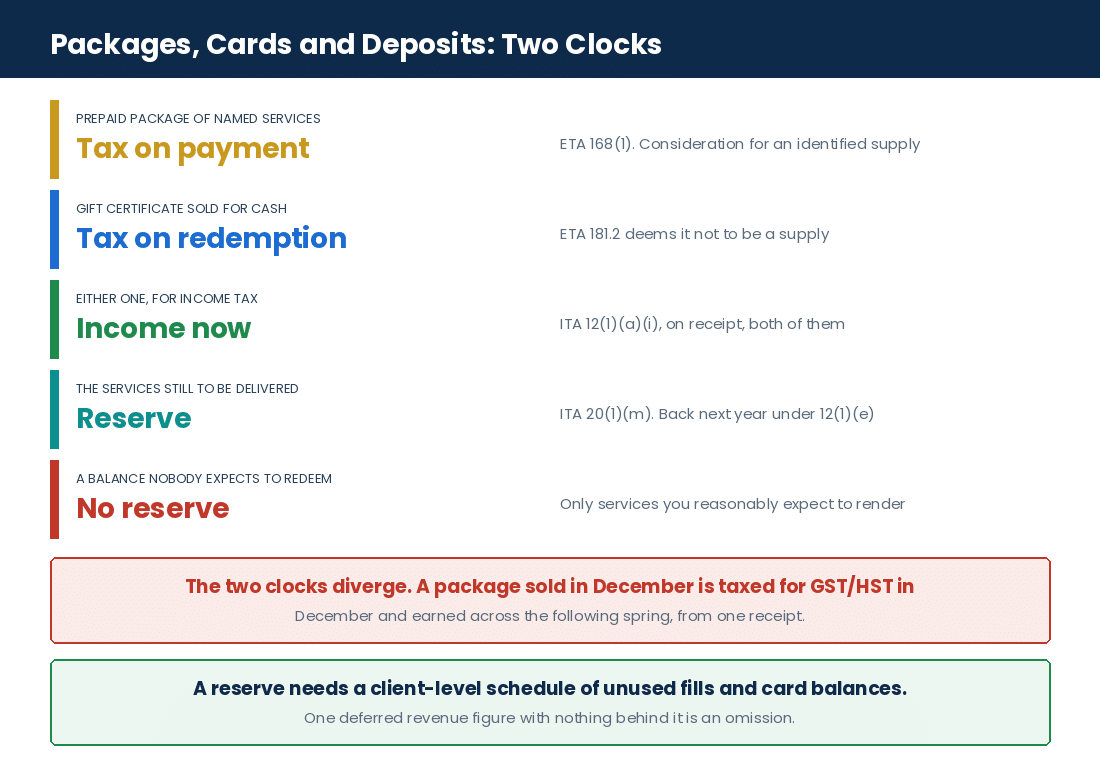
For GST/HST: a gift certificate is deemed not to be a supply by section 181.2 of the Excise Tax Act, so no tax applies on issue — it applies when the card is redeemed against a taxable service. A prepaid service package is consideration for an identified supply, so tax is payable under subsection 168(1) when the money is paid.
For income tax, both are included in income on receipt under subparagraph 12(1)(a)(i), because they are amounts received on account of services not yet rendered. A reserve is then claimed under paragraph 20(1)(m) for the services still to come, and paragraph 12(1)(e) brings that reserve back the following year. The money is not simply held off the income statement — it goes in and comes back out, and the reserve needs a schedule of unredeemed balances behind it.
| What the client paid for | GST/HST | Income tax |
|---|---|---|
| Gift certificate for a dollar value | Not a supply on issue — ETA 181.2. Tax on redemption | In on receipt under 12(1)(a)(i), reserve under 20(1)(m) |
| Prepaid package of six fills | Payable on payment — ETA 168(1) | Same — in on receipt, reserve for the unused fills |
| A single service paid on the day | Payable on payment | Income when earned, section 9 |
| A deposit the studio may have to refund | Not consideration until applied | Liability until applied to a fee |
RC4022 Is Not the Worker Status Guide
Risk Warning: the circulating guidance cites “CRA Guide RC4022 — Employee or Contractor? Determining Worker Status” and then, three sections later, cites RC4110 for the same point.
RC4022 is General Information for GST/HST Registrants. The worker status guide is RC4110, Employee or Self-Employed?, and the test it applies comes from Wiebe Door Services Ltd. v. M.N.R. and 671122 Ontario Ltd. v. Sagaz Industries — control, ownership of tools, chance of profit, risk of loss — read through the parties’ common intention as Connor Homes frames it. A binding ruling is available on Form CPT1.
The Excise Tax Act Citations Point at the Wrong Provisions
| Cited as | What that provision actually is | Correct provision |
|---|---|---|
| “Excise Tax Act S.C., 1997 c. 27“ | An amending statute | The Act is R.S.C., 1985, c. E-15 |
| ITC documentation at “ss221 & 240“ | 221 is the duty to collect; 240 is registration | 169(4) and the Input Tax Credit Information Regulations |
| Penalties at “ETA s323“ | Director liability for unremitted net tax | 280.1 for failure to file |
| Interest at “ETA s325“ | Transfers of property to non-arm’s-length persons | 280 |
| Record retention at “ITA 230(1)“ | The duty to keep records | The six-year period is 230(4)(b) |
| Training at “ITA s248(1)“ | Definitions | 18(1)(a) current vs 18(1)(b) capital; GST/HST exemption in Schedule V, Part III |
| Leasehold improvements at “Schedule II Part IX“ | Part IX is of the Excise Tax Act, not Schedule II | Class 13, with the computation in Regulation 1100(1)(b) and Schedule III |
A technician in her first full self-employed year set aside about $4,000 for tax on roughly $52,000 of net income, having been told she would owe “about 20% after the basic amount.”
The income tax was close to that. The CPP was another $5,770 on top, because a self-employed person pays both halves and nobody had withheld anything. She also owed instalments for the following year from that moment. Figures changed for privacy.
What is Lash and Brow Studio Tax Filing?
What Lash and Brow Studio Tax Filing Is
The Basics
Lash and brow studio tax filing in Canada means reporting the money you make and spend in your beauty business. It covers lash technicians, brow artists, and studios offering these services. The key parts are business income reporting, expense deductions, and GST/HST registration.
Business Income Reporting
When your lash or brow business earns money from services or sales, you report it correctly. A sole proprietorship reports income on a T1 personal return using Form T2125. A corporation files a T2 corporate tax return. Income is profit computed under section 9, with amounts receivable brought in by paragraph 12(1)(b) whether or not invoiced, and amounts received for services not yet rendered brought in by subparagraph 12(1)(a)(i).
Expense Deductions
You can subtract business costs to pay less tax. Some common deductible expenses are:
- Supplies like eyelash extensions or brow products — deducted as used where they are backbar, held as inventory where they are retail stock.
- Rent if you lease space for your studio — current, deducted as incurred.
- Utilities such as electricity and water bills — current.
- Training costs for improving your skills — current under 18(1)(a) where they maintain or update existing skills; capital under 18(1)(b) where the qualification confers a lasting advantage.
Keep all receipts to prove these expenses when claiming them, for six years from the end of the taxation year to which they relate under paragraph 230(4)(b).
GST/HST Registration
If your lash and brow business makes more than $30,000 CAD from taxable sales — including services and product sales — over four consecutive calendar quarters, you must register for GST/HST under subsection 240(1), with the small supplier test in section 148. After registering, you add GST/HST to client bills and remit it to the CRA.
Two refinements the usual summaries leave out. Exceeding $30,000 in a single calendar quarter ends small supplier status immediately, from the supply that crossed it. And the threshold counts the taxable supplies of associated persons together under sections 127 and 128 of the Excise Tax Act — so a studio with two corporations under common control cannot use two thresholds.
Who Needs to File?
In Canada’s beauty field, knowing who must file taxes helps avoid problems. Both sole proprietors and corporations in professional beauty services have clear filing duties.
| Structure | Return and deadline | Payment |
|---|---|---|
| Sole proprietorship | T1 with Form T2125, filed by June 15 under subparagraph 150(1)(d)(ii) | Balance due April 30, with interest from May 1 under 161(1) |
| Corporation | T2 within six months of the fiscal year end, under paragraph 150(1)(a) | Balance at two months under 157(1)(b), three for an eligible CCPC |
| Partnership of two technicians | Income computed at the partnership level under section 96 and allocated | Each partner includes their share whether or not it is distributed |
Sole Proprietorships. If you are an independent lash tech or brow artist working alone, you file a T1 every year. The $3,500 figure that circulates as a threshold is the CPP basic exemption, not a filing rule — and above it you pay both halves of CPP on your net self-employment income. The obligation to file is in paragraph 150(1)(d), and in practice a self-employed person files annually because the CPP calculation lives on the return.
Corporations. If your business is a corporation — a larger studio with staff, perhaps — you file a T2 no matter what profit you make, including a nil return in a loss year. Corporations follow different rules from individuals and get the small business deduction under section 125 on the first $500,000 of active business income, roughly 12.2% in Ontario against 26.5% above it. Electronic filing is mandatory under subsection 150.1(2.1), with a $1,000 penalty under 162(7.2) for paper.
Figuring out whether you are a sole proprietor or a corporation tells you which forms to fill out, so you can send your taxes on time and follow Canada’s rules for lash and brow studio tax return filings.
A studio incorporated mid-year and filed only the T2, assuming the corporation replaced the personal return entirely.
The months before incorporation were still sole proprietorship income reportable on a T2125 with the T1, and the transfer of equipment into the corporation was a disposition at fair market value unless a section 85 election was filed. Neither had been done. Figures changed for privacy.
Step-by-Step Guide to Filing Taxes for Lash Artists and Brow Studios
Filing Step by Step
Process
Business Classification and Income Reporting
Lash and brow studios in Canada classify their business correctly for tax filing. A sole proprietorship reports income on a T1 using Form T2125; an incorporated studio files a T2.
Income comes from service revenue, whether from the studio or the technicians working there. But if a technician rents a station on her own account, the studio reports only the rent received as income, and the renting technician reports her own service income separately. This depends on who controls bookings, provides tools and performs the services — not on what the contract says. The authorities are section 9 for profit and paragraph 12(1)(a) for amounts received, with worker status decided on the Wiebe Door factors.
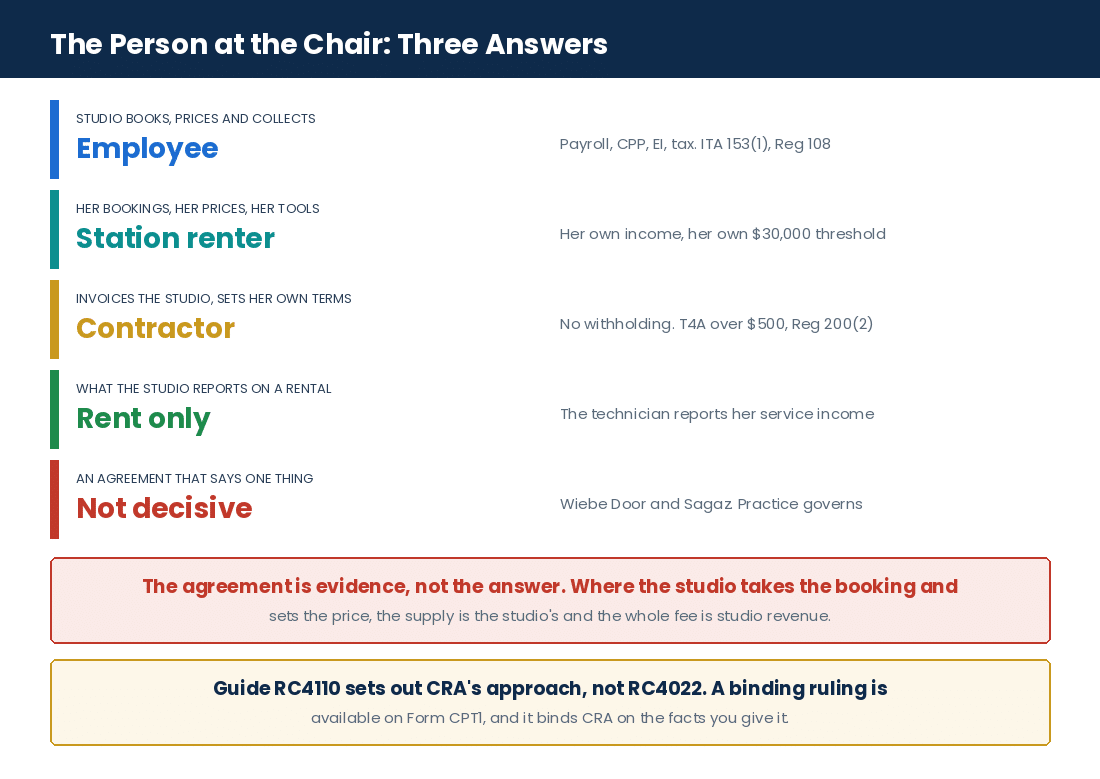
For example: Studio A rents stations to three techs. Those techs bring their own tools. They book clients on their own. Here, Studio A reports only rental income, and each tech files her personal taxes on her own earnings.
Keeping signed agreements helps prove control over work scope and equipment use. It does not settle the question on its own — CRA looks at what actually happens — but an agreement that matches the practice is the strongest evidence available, and one that contradicts it is the worst.
Key Stat: when a “contractor” is recharacterised, the studio is assessed, not the technician.
CRA assesses the studio for the source deductions that should have been withheld — including the worker’s share — plus the employer’s own CPP and EI, the penalty in subsection 227(9) at 3% to 10%, 20% for a knowing or grossly negligent repeat, and interest. Directors are personally liable under section 227.1. Because the money was already paid out gross, none of it is recoverable from the technician.
Expense Tracking and Recommended Write-Offs
Tracking expenses carefully is key for lash business tax filing in Canada. Here are main deductible costs:
- Backbar supplies: These are products used during client services. You expense them as you use them.
- Retail inventory: These are products you sell separately. You count these as inventory until sold.
- Training fees: Certification or course renewals usually count as current expenses unless they provide long-term benefits.
- Insurance premiums: Protecting your business assets counts as deductible costs.
- Leasehold improvements: These have different rules based on their nature and useful life.
Each of those sits in a different place in the Act, and the table below pins each one to the provision that puts it there.
| Cost | Treatment | Authority |
|---|---|---|
| Backbar supplies — adhesives, tints, products used during a service | Current expense, deducted as used | 18(1)(a) |
| Retail inventory — products sold to the client | Inventory until sold, lower of cost and fair market value | 10(1), consistency under 10(2.1) |
| Staff costs — wages, commissions, source deductions | Current, with the 180-day rule deferring anything accrued and unpaid | 18(1)(a), 153(1), 78(4) |
| Training fees — certification or course renewals | Current where they maintain or update skills; capital where the qualification confers a lasting advantage | 18(1)(a) vs 18(1)(b) |
| Insurance premiums | Current, deducted as incurred | 18(1)(a) |
| Furniture and equipment — beds, lamps, trolleys, sterilisers | Capital — Class 8 at 20%, and 30% in the first year because the half-year rule is suspended | 20(1)(a), Schedule II |
| Computers, tablets, booking terminals | Class 50 at 55% — or 100% in the first year where acquired after 15 April 2024 and available for use before 2027 | 20(1)(a), Schedule II |
| Leasehold improvements — the studio build-out | Class 13, straight-line over the lease term plus the first renewal period, five-year minimum and forty-year maximum | Regulation 1100(1)(b), Schedule III |
Keep invoices that separate backbar from retail purchases. This helps when claiming GST/HST input tax credits if you are registered, and it is the single most useful bookkeeping habit in this sector, because one supplier invoice routinely contains both.
On the first-year capital claim: the half-year rule in Regulation 1100(2) is suspended. Bill C-15, which received Royal Assent on 26 March 2026, reinstated the Accelerated Investment Incentive at three times the normal first-year amount for property acquired after 2024 and available for use before 2030, dropping to twice from 2030 through 2033. A $6,000 lash bed therefore gives $1,800 in year one, not $600. Class 13 is outside the immediate expensing measure, so the fit-out still amortises.
GST/HST Considerations for Lash and Brow Professionals
If your studio sells taxable supplies, watch whether you pass the $30,000 small supplier threshold over four consecutive quarters. Passing it triggers mandatory registration under 240(1).
Risk Warning: “each technician has their own $30K threshold unless they’re part of a corporation with shared control” is only half the rule.
The threshold aggregates across associated persons under sections 127 and 128 of the Excise Tax Act, which reaches common control between corporations and between an individual and a corporation they control. More importantly, a technician only has her own threshold if she is genuinely making her own supplies. Where the studio takes the booking, sets the price and collects the money, the supply is the studio’s — and the whole fee counts toward the studio’s threshold, whatever the internal split.
Once registered, you charge GST/HST on services directly provided by the studio and on retail product sales through the studio. You can claim Input Tax Credits to recover GST/HST paid on eligible expenses like backbar products, under subsection 169(1), with the documentary standard in 169(4) — above $150 that means the supplier’s registration number on the invoice. Keep all receipts, and note the four-year window in subsection 225(4) for missed credits.
Even if below the threshold, registering might help — voluntary registration is in 240(3) — but it means filing returns on your assigned period: annual to $1.5 million, quarterly to $6 million, monthly above. For a studio whose costs are mostly labour rather than product, the Quick Method under the Streamlined Accounting Regulations is usually better than the regular method and is worth comparing before you choose.
A studio with four “station renters” had never registered, on the view that each technician was under her own $30,000 threshold.
The studio took every booking, set every price and ran every payment through its own terminal. Those were the studio’s supplies, and it had passed the threshold in its second quarter of operation. The unremitted tax across the open period came out of margin that had already been spent. Figures changed for privacy.
Tax Savings Strategies and Common Mistakes to Avoid
Savings Strategies and Common Mistakes
Errors
Common mistakes in lash business tax filing Canada include:
| Mistake | What it actually costs |
|---|---|
| Reporting technicians’ incomes as part of studio revenue when they should file separately | Overstated revenue on both returns, and a GST/HST threshold crossed on money that was never the studio’s |
| Mixing up invoices between backbar supplies (used immediately) versus retail stock (counted at year-end) | Retail expensed on purchase instead of held as inventory under 10(1), moving cost into the wrong year |
| Missing GST/HST registration thresholds leading to uncollected taxes | The tax is owed from the day registration was required, out of margin, because it was never charged |
| Counting prepaid package fees entirely as income instead of deferring some until service delivery | Tax paid a year early — or, done the other way, income omitted. The fix is the 12(1)(a)(i) inclusion with a 20(1)(m) reserve |
| Ignoring daily cash sale records inviting audit risks | No defensible revenue figure. A net worth or deposit analysis then sets it for you |
| Misclassifying staff versus contractors risking penalties for missing source deductions | Both halves of CPP and EI plus the income tax, penalty under 227(9), interest, and director liability under 227.1 |
| Expensing furniture outright instead of using CCA rules properly | Denied by 18(1)(b) and spread over Class 8 — though at 30% in year one, not 20% |
| Overclaiming home office space beyond CRA limits | Subsection 18(12) requires the space to be the principal place of business, or used exclusively to earn income and regularly for meeting clients, and caps the deduction at the income from the business with the excess carried forward |
Best practices suggest:
- Keeping daily appointment logs with matching payment records to avoid gaps. The booking system and the bank should reconcile to the same number every month.
- Having signed rental agreements clarifying worker status clearly — and then operating consistently with them, because practice beats paperwork when the two disagree.
- Splitting mixed invoices into backbar vs retail lines carefully documented, at the point of entry rather than at year-end.
- Doing physical inventory counts before year-end valuing stock consistently, on the same basis as the prior year as subsection 10(2.1) requires.
- Tracking training expenses separately verifying eligibility for deductions, with the current-versus-capital call recorded at the invoice.
- Scheduling payroll remittances on time with up-to-date employee records, on the band assigned by Regulation 108 — four bands by average monthly withholding amount, which for most studios means the 15th of the following month.
Tips, Cash and the Records That Support Them
Tips are income. A self-employed technician includes them in business income on the T2125. An employee includes them in employment income, and where the studio controls the tip pool — collecting, allocating and paying it out — those are controlled tips, which are pensionable and insurable and run through payroll with CPP, EI and income tax withheld. Tips a client hands directly to a technician are direct tips and are not the employer’s to withhold on, though the technician still reports them.
That distinction is worth settling before an audit, because a studio that pools tips through its terminal and pays them out without withholding has an unremitted source deduction it does not know about.
Instalments: Three Different $3,000 Thresholds
| Who | Rule | Authority |
|---|---|---|
| Individual (sole proprietor technician) | Instalments required where net tax owing exceeds $3,000 in the current year and in either of the two preceding years. Due the 15th of March, June, September and December | Section 156.1 |
| Corporation | No instalments required where total tax payable is $3,000 or less. Otherwise monthly, or quarterly for an eligible CCPC | Subsections 157(1) and 157(2.1) |
| GST/HST annual filer | Quarterly instalments where net tax for the previous year was $3,000 or more | Section 237 of the Excise Tax Act |
The source material gives one $3,000 figure without saying which regime it belongs to. All three exist, they are different rules with different triggers, and a studio can easily be inside two of them at once.
If you want clear advice on managing these tax details, consultations with Gondaliya CPA can help. Reach out at info@gondaliyacpa.ca or call 647-212-9559 to get assistance managing your lash and brow business taxes without confusion.
A studio sold roughly $38,000 of prepaid lash packages in November and December and reported none of it, on the view that the services had not been delivered.
The right answer landed close to the same place by a route that had to be documented: the whole amount into income under 12(1)(a)(i), then a 20(1)(m) reserve supported by a schedule of unused fills per client. Without the schedule there was no reserve to claim, only an omission — and the GST/HST on those packages had been payable in December under 168(1) in any event. Figures changed for privacy.
Tax Software and Tools for Canadian Lash and Brow Businesses
Software, Tools and Security
Tooling
Choosing the Right Tax Software
Picking the right tax software makes lash and brow studio tax filing in Canada much easier. The best software tracks income, expenses, GST/HST and payroll if you have employees. Whether you handle lash business tax filing or a brow studio tax return, your tool has to manage service sales and retail products well — because those are two different tax treatments on one invoice.
Here’s what to look for:
- Easy to use and fits with bookkeeping apps like QuickBooks or Xero.
- Supports corporate T2 returns if you’ve incorporated, and transmits through Corporation Internet Filing or an EFILE-certified preparer — NETFILE is the individual service and will not accept a T2.
- Meets CRA rules for record keeping, retaining records in readable and unaltered form for the full period.
- Offers beauty studio templates that separate backbar supplies from retail stock. This is the single feature that matters most in this sector.
Good software lets studios with staff or renting techs keep separate records based on worker status. Cloud options also store your data safely and let you reach it from anywhere in Ontario or another province.
Using a solid system cuts down mistakes in reporting taxable items versus exempt ones — and on that point, be careful: a studio’s services are taxable, not exempt. The only exemption that plausibly reaches a lash business is for vocational training supplied by a vocational school under Schedule V, Part III, and a one-day certification course run by a studio almost never qualifies. Assume your training revenue is taxable unless someone has checked the definition against your facts.
Features and Security Measures
Tax software should handle GST/HST registration well. It should track when the small supplier limit is passed — by the person actually making the supply, which is the studio where the studio takes the booking and sets the price, and the technician only where she genuinely supplies on her own account. Mixing personal thresholds up is the error, and the fix is getting the supply right rather than the software.
You need a program that keeps records for six years from the end of the taxation year to which they relate, under paragraph 230(4)(b) — not 230(1), which is the duty to keep records without the period — with the parallel GST/HST requirement in section 286 of the Excise Tax Act. Digital storage helps locate invoices where backbar costs share one supplier bill with retail purchases, which happens constantly in eyelash extension work.
Input Tax Credit tracking is a must to claim GST/HST paid on business purchases correctly. The software should exclude amounts tied to personal use and should flag invoices missing the supplier’s GST/HST registration number above $150, because subsection 169(4) and the Input Tax Credit Information Regulations make that a condition of the claim — not sections 221 and 240, which are the duty to collect and the duty to register.
Protecting Personal Information and Desktop Application Safety
Security matters too. Your data needs encryption in transit, user permissions to block unauthorized access, regular backups, and compliance with Canadian privacy laws like PIPEDA where personal information is involved. Keep desktop applications updated, since old software is the common route in, and add multi-factor authentication on QuickBooks or Xero.
Tax System Limitations by Tax Year
Lash businesses face some limits when filing for several years at once. CRA’s systems and the software change over time, and older years may need paper filing or a manual adjustment request rather than a transmitted return. That matters if your bookkeeping has lagged but everything still has to be reported.
What does not change with the software is the law. A late return is still assessed under subsection 162(1) at 5% of the unpaid tax plus 1% a month to twelve months, doubling under 162(2) after a demand, with interest under 161(1) running from the balance-due day. And the normal reassessment period is three years from the original notice for an individual or a CCPC — so a year left unfiled never starts that clock at all.
Risk Warning: there are no “CRA 2026 updates” to electronic filing that a lash studio needs to prepare for.
The requirements already in force are the ones that matter: T2 electronic filing is mandatory under subsection 150.1(2.1) with a $1,000 penalty under 162(7.2) for paper; most GST/HST registrants must file electronically; and information returns above five slips of a type must be filed electronically. Treat an undated claim that rules are “starting in 2026” as a reason to check rather than a reason to act.
Desktop and Mobile Tax Solutions for Windows, Mac, Android, iPhone/iPad
Canadian studios want tax software that works everywhere — Windows and Mac desktops plus Android phones and iPhones or iPads. These tools let beauty pros:
- Keep daily sales records digitally, including cash and tips.
- Snap photos of receipts on their phone, which satisfies the record requirement provided the image stays readable and unaltered.
- Check inventory counts from anywhere, which makes the year-end physical count a verification rather than a reconstruction.
- Prep money summaries before accountant checks, so the engagement starts from reconciled numbers.
Cloud systems sync data safely across devices. This keeps info fresh during busy times like year-end. Picking software built for Canadian taxes means it connects cleanly to CRA’s portals for T1 and T2 filings and GST/HST remittances.
A studio’s booking software reported about $214,000 of service revenue for the year and the bank showed roughly $187,000 of deposits.
The gap was tips paid out in cash the same day and never recorded either way, plus a terminal that netted its fees before depositing. Both are ordinary and both need recording gross. Reconciled properly the revenue was higher and so were the deductions, and the file stopped looking like unreported income. Figures changed for privacy.
Choosing the Right Support: Accounting Services for Beauty Professionals
Accounting Services for Beauty Professionals
Support
How Salon Accountants Assist Lash and Brow Studios
Salon accountants help lash and brow studios with their tax filing in Canada. They handle the paperwork and make sure the returns are prepared correctly under CRA rules. The useful ones know the sector, because the questions that decide a studio’s return are specific to it.
They show studios how to sort income types — service fees, station rent, retail sales and training fees tracked separately, because each has a different GST/HST and income tax treatment. They also identify which costs are deductions and in what form: backbar supplies used in services are current expenses, while retail products are inventory under subsection 10(1) until sold. Keeping that clear under the Income Tax Act is what avoids the audit.
Say a tech rents a station. The accountant determines whether she reports her own income or the studio reports rent only — which affects GST/HST registration thresholds and input tax credit claims on both sides. Good support keeps studios on time for sole proprietors (T1, filed by June 15 with the balance due April 30) and corporations (T2, filed at six months with the balance at two), so no late penalties arise.
Available Products: Personal Tax (T1), Self-Employed, GST/HST Support
Beauty pros get specific tax products made for their needs:
- Personal Tax Returns (T1): used by solo lash techs filing personal taxes with business income on Form T2125 — including the CPP calculation on net self-employment income above $3,500, at both halves.
- Corporate Tax Returns (T2): for incorporated studios reporting services, retail sales and rent, less expenses, with the small business deduction under section 125.
- GST/HST Registration: Advice on when to sign up based on $30,000 yearly sales per person — measured over four consecutive calendar quarters — measured against the person making the supply, and aggregated across associated persons under sections 127 and 128.
- Input Tax Credit Documentation: tracking GST/HST paid so credits are claimed correctly under subsection 169(1), with the documentary requirements in 169(4) and the four-year window in 225(4).
These link bookkeeping to the filings that fit each business type. Separating self-employed earnings from employment income is what meets CRA’s worker status rules — set out in Guide RC4110, Employee or Self-Employed?, with a binding ruling available on Form CPT1.
Security and Compliance When Preparing Your Tax Return
Studios hold a great deal of private information about clients, employees and the business, so securing it during tax filing and bookkeeping matters. Desktop applications need firewalls, antivirus, encrypted storage and strong passwords. Back files up regularly and keep the backup away from the main computer. Restrict access to people who need it and who understand the obligation.
Install official updates promptly, because old software is the usual way in, and enable multi-factor authentication on QuickBooks, Xero and your booking platform. Where personal information is involved, PIPEDA applies — it requires safeguards appropriate to the sensitivity of the information rather than a prescribed technical standard, and Quebec’s Law 25 adds its own requirements for Quebec residents’ information.
CRA Requirements for Canadian Lash and Brow Businesses
CRA requires registration for GST/HST once taxable supplies exceed $30,000 over four consecutive quarters, whether or not the studio is incorporated. A technician genuinely making her own supplies has her own threshold; one whose bookings, pricing and payments run through the studio does not.
Keeping good records is a big deal here:
- Save receipts and invoices (split supplier bills if needed) — between backbar and retail, where both appear on one bill.
- Keep contracts showing worker status — and operate consistently with them.
- Hold on to payroll slips like T4s or T4As, reconciling to the T4 Summary due the last day of February.
- Record bank statements and daily sales logs (including cash tips) — gross, rather than net of terminal fees.
- Keep GST/HST remittance reports handy and the returns they support.
- Keep documents about equipment purchases showing capital cost allowance classes — and the class and the available-for-use date under subsections 13(26) to (32).
- Store lease agreements detailing build-out classifications, because Class 13 runs over the lease term plus the first renewal and the lease is the evidence.
- Track home office expenses carefully following space rules — the conditions and the cap in subsection 18(12).
- Maintain vehicle logbooks that separate business trips from commuting — travel between home and a regular place of work is personal.
- Separate training fees paid vs revenue recognized, since the first is an expense with a current-or-capital question and the second is taxable revenue.
Claiming input tax credits requires clear proof that the expense ties to taxable supplies. CRA watches whether technicians are employees, with payroll deductions, or independent contractors filing their own returns — because that determines who files what, and who is assessed when it is wrong.
Missing any of this brings penalties under subsections 162(1) and 227(9) and section 280.1 of the Excise Tax Act, interest under 161(1) and section 280, audits triggered by poor records, and damage to the trust clients place in the business.
A studio claimed a home office on a spare room used for admin two evenings a week while operating from a leased commercial space.
Subsection 18(12) requires the space to be the principal place of business or used exclusively to earn income and regularly for meeting clients. A leased studio was plainly the principal place of business, and the room was not exclusive. The claim came out, and the deduction it displaced — the actual studio rent — had been there all along. Figures changed for privacy.
Getting Started with Tax Filing Assistance
Getting Started and Resources
Next Steps
Contact and Consultation Options for Lash and Brow Studio Tax Filing in Canada
Lash and brow studio tax filing in Canada needs careful handling of income, expenses and GST/HST registration. Gondaliya CPA offers a free consultation on your lash and brow business tax return needs in Ontario or anywhere else in Canada. Here’s what you get when you reach out:
- Quick answers on lash business tax filing Canada, starting with whether the person at the chair is staff, a contractor or a station renter.
- Tips on reporting income right for eyelash technicians, including the CPP that lands on net self-employment income above $3,500.
- Guidance on GST/HST registration for beauty businesses, including who actually holds the threshold.
Personalized Support for Lash and Brow Professionals
Eyelash technicians report several kinds of income — service fees, product sales, station rent, training fees — and that mix is what makes the reporting tricky. We set out how each one is treated for income tax and for GST/HST, and where they diverge, which they do on prepaid packages and gift cards.
Client Experiences and Professional Testimonials
Gondaliya CPA is a licensed Ontario CPA firm with experience in lash and brow studio accounting across Canada, with a public record of client reviews and verifiable registration on the CPA Ontario firm directory. Clients tell us we respond fast — usually within one business day — that our pricing is a clear flat annual fee, and that we explain the corporate-versus-personal question in terms they can act on.
Feedback on the Tax Filing Process with Accounting Experts
Many studios wonder whether to do the accounting themselves or hire a professional. Some keep basic records perfectly well. The parts that reward expertise are narrow and recurring: splitting backbar supplies from retail goods, settling worker status, and handling money taken in advance. Those three account for nearly every adjustment we make on a studio file.
Our clients find it easier when CPAs guide them on best studio practices like:
- Keeping records for at least six years — from the end of the taxation year to which they relate, not from the filing date.
- Tracking expenses carefully for lash & brow work — with the backbar and retail split made at entry rather than at year-end.
This helps avoid problems later on.
Quick Links for Additional Resources and Support
Studios keep all financial documents per CRA rules — six years from the end of the taxation year to which they relate, under paragraph 230(4)(b) of the Income Tax Act and section 286 of the Excise Tax Act. Those records are what support the filings if they are questioned.
Here are some useful links:
- Business records retention period: six years — measured from the year end, not the filing date, which in practice gives closer to seven years.
- Documentation rules that fit beauty studios to keep audit trails clear — the appointment log, the payment record and the supplier invoice, each tying to the same transaction.
Checklists, Templates, and Online Resources for Beauty Business Taxes
| Resource | What It Does |
|---|---|
| Tax filing checklist – Lash Studios Canada | Helps check all receipts before sending taxes, with the backbar and retail split confirmed |
| Expense tracking template – Lash & Brow | Sorts costs like furniture versus consumables, so Class 8 items do not get expensed |
| Deferred revenue schedule | Unused package fills and unredeemed gift cards by client, which is what supports a 20(1)(m) reserve |
| Worker status file | Agreement, tool ownership and booking control recorded per technician |
These help studios stay in line with CRA demands every year. Using simple tools can make managing money easier for busy studios: they organise invoices by type — separating supplies used during services from products sold — which makes tax time a report rather than an investigation.
Direct Links to Client Portal and Booking System Guidance
You can read more here: file it yourself or hand it to a CPA firm: which route fits a studio? The answer depends on how comfortable you are with the Canadian rules that actually apply to a lash business — not with tax generally. A solo technician with one income stream and no staff can reasonably file her own T2125. A studio with renters, prepaid packages, retail stock and a build-out has four separate characterisation questions, each of which repeats annually until someone settles it.
When you work with Gondaliya CPA, we manage everything from start to finish smoothly; learn more at how do we handle a studio at Gondaliya CPA? We settle worker status first, then the backbar and retail split, then the deferred revenue schedule, then the capital classes — and file the GST/HST, payroll and income tax returns from one reconciled set of books. Our compilation engagements are under CSRS 4200 and provide no assurance; audit and review engagements are referred out.
If you want help sorting out lash business tax filing Canada, call 647-212-9559 or email info@gondaliyacpa.ca for a free talk — no strings attached.
A two-chair studio came to us three years behind, with a shoebox of receipts and a booking system nobody had reconciled to the bank.
Rebuilding took the appointment log as the revenue spine, the bank as the check, and the supplier invoices split backbar from retail line by line. The three returns went in together under the Voluntary Disclosures Program in IC00-1R6, which limited the penalties because the disclosure came before CRA made contact. Figures changed for privacy.
Frequently Asked Questions (FAQs) on Lash and Brow Studio Tax Filing Canada
Frequently Asked Questions
20 Answers
Which tax return does a lash or brow business file?+
Is the technician staff, a contractor, or a station renter?+
If she rents a station, what does the studio report?+
Is training course revenue treated differently?+
When is package and gift card money income?+
How are tips and cash sales recorded?+
Product used on the client or sold to the client?+
Which furniture, equipment and build-out costs are capital?+
What can a home studio or mobile artist claim?+
Are training, certification and insurance deductible?+
How are staff costs deducted?+
What records does a studio need?+
Which returns does the studio file, and when?+
File it yourself or hand it to a CPA firm: which route fits a studio?+
What triggers a CRA review?+
How do you catch up if the books are behind?+
How much CPP does a self-employed lash tech actually pay?+
Should a studio under $30,000 register for GST/HST voluntarily?+
Is the Quick Method worth using?+
Do I need to pay tax instalments?+
Lash & Brow Studio Tax Check
Five quick questions on how your studio operates. No fee shown.
Points to raise with us:
This is a general prompt, not tax or legal advice or a quote. Your position depends on your full facts. For a real review, please book a free consultation.
Businesses We Serve & Industry Spotlights
Industry Expertise
Lash and brow studios sit inside a wider personal services and small retail practice, and the questions that decide a studio’s return — who is at the chair, what was used versus sold, and when did the money become income — recur across every one of these sectors.
| Industry | The Lash & Brow Angle |
|---|---|
| Hair salons & barbershops | Chair rental versus employment, in the sector where it is most litigated |
| Spas & wellness centres | Prepaid packages and gift cards, and the two different GST/HST answers |
| Nail salons | Backbar versus retail on a single supplier invoice, every week |
| Tattoo & piercing studios | Artist agreements and who holds the GST/HST threshold |
| Fitness studios & personal trainers | Memberships sold in advance, relieved by a 20(1)(m) reserve |
| Massage therapy clinics | The contrast — an exempt practitioner service, with no input tax credits |
| Medical spas & cosmetic clinics | Cosmetic work is taxable even where the practitioner is listed |
| Retail stores | Inventory under 10(1) and the year-end physical count |
| Restaurants & food and beverage | Controlled versus direct tips, and the payroll consequences |
| Cleaning & janitorial businesses | Contractor classification across a dispersed workforce |
| Photographers & creative studios | Deposits taken months before delivery, and when they become income |
- Hair salons & barbershops: The chair rental question in its oldest form. Everything CRA knows about distinguishing a renter from an employee it learned in salons, and a lash studio inherits the whole body of it.
- Spas & wellness centres: They sell packages and gift cards at scale, which makes the ETA 181.2 distinction and the 20(1)(m) reserve a monthly discipline rather than a year-end adjustment.
- Nail salons: The same backbar-and-retail invoice arriving every week, and the same temptation to post the whole thing to supplies.
- Tattoo & piercing studios: Artist agreements that look like rental and operate like employment, with the studio carrying the assessment when CRA disagrees.
- Fitness studios & personal trainers: Memberships sold upfront are the same 12(1)(a)(i) inclusion and the same reserve, usually on a larger unearned balance.
- Massage therapy clinics: A useful contrast. Their services are exempt, so they recover nothing on their inputs — which is why a lash studio’s taxable status, with full credits, is worth more than it looks.
- Medical spas & cosmetic clinics: Cosmetic procedures are carved out of the health care exemption, so a clinic with a listed practitioner can still be making taxable supplies on much of its revenue.
- Retail stores: Inventory valued under 10(1) with a year-end physical count, which is exactly the discipline a studio’s retail shelf needs and rarely gets.
- Restaurants & food and beverage: Controlled tips run through payroll and direct tips do not, which is the same distinction a studio faces the moment it pools tips through its terminal.
- Cleaning & janitorial businesses: Worker classification across people who set their own hours and supply their own equipment, decided on the same four factors.
- Photographers & creative studios: Deposits taken months before the work is delivered, which is the 12(1)(a)(i) inclusion arriving in a different costume.
The service changes and the three questions do not: who is at the chair, was the product used or sold, and has the money been earned yet.
Across the studios we act for, those three account for the overwhelming majority of adjustments. None of them is a judgment call about tax law — each is a question about what the agreements, the invoices and the booking system actually say. Figures changed for privacy.
Professional Guidance and Quick Reference
Guidance
Essential Tax Points for Lash & Brow Studios in Canada
Studios lose money in a predictable set of ways: treating $3,500 as a filing threshold when it is the CPP basic exemption and both halves are payable above it; assuming every technician holds her own $30,000 threshold when the supply belongs to whoever takes the booking and sets the price; taxing a gift card on issue when section 181.2 says it is not a supply, or failing to remit on a prepaid package when 168(1) made the tax payable on payment; keeping prepaid money off the income statement instead of including it under 12(1)(a)(i) and claiming a supported 20(1)(m) reserve; posting a whole supplier invoice to supplies when half of it is retail inventory under 10(1); expensing a lash bed instead of claiming Class 8 at 30% in the first year; putting the build-out anywhere but Class 13; claiming a home office that fails 18(12); paying out pooled tips without withholding; and paying the corporate balance at six months when 157(1)(b) sets it at two. Gondaliya CPA handles lash and brow studio accounting and tax on a flat annual fee.
- Small Supplier Threshold: businesses with less than $30,000 in taxable sales over four consecutive quarters may not need GST/HST registration — measured against the person making the supply, and aggregated across associated persons under ETA sections 127 and 128.
- Corporate Tax Return Due Date: T2 returns must be filed within six months after fiscal year-end, with the balance of tax at two months under 157(1)(b).
- Sole Proprietorship Tax Return Due Date: T1 business income is due June 15; payment deadline is April 30 each year, with interest running from May 1.
- Tax Instalment Threshold: pay instalments if net tax owing exceeds $3,000 — but check which regime: individuals under section 156.1, corporations under 157(2.1), GST/HST annual filers under ETA section 237.
- Capital Cost Allowance Class—Furniture: Furniture generally falls under Class 8 at 20% declining balance rate — 30% in the first year while the half-year rule stays suspended.
- Leasehold Improvements Class: the studio build-out is Class 13, straight-line over the lease term plus the first renewal period, with a five-year minimum and forty-year maximum under Regulation 1100(1)(b) and Schedule III.
- GST/HST Input Tax Credit Documentation: Maintain detailed invoices splitting backbar supplies from retail products for ITC claims, with the supplier’s registration number above $150 as subsection 169(4) requires.
- Record Retention Period: Keep all tax-related documents for six years from the end of the tax year to which they relate, under paragraph 230(4)(b).
Quick Answers
At a Glance
- CPP basic exemption: $3,500 — not a filing threshold
- Self-employed CPP: both halves, 11.90% combined; CPP2 at 8.00%
- T1 filing: June 15; payment April 30
- T2 filing: six months; balance at two months, ITA 157(1)(b)
- Small supplier: $30,000, ETA s.148; register under 240(1)
- Associated persons: ETA ss.127 and 128
- Gift certificate: not a supply, ETA s.181.2
- Prepaid package: tax payable on payment, ETA 168(1)
- Advance for services: ITA 12(1)(a)(i); reserve 20(1)(m)
- Retail stock: inventory, ITA 10(1)
- Backbar: current expense, ITA 18(1)(a)
- Furniture and equipment: Class 8, 30% in year one
- Computers and terminals: Class 50, 100% if in use before 2027
- Build-out: Class 13, lease term plus first renewal
- Home workspace: ITA 18(12), capped at business income
- Worker status: Guide RC4110; ruling on Form CPT1
- Payroll bands: four, Regulation 108
- Input tax credits: ETA 169(1); documents 169(4); four years 225(4)
- Records: six years from the taxation year end, ITA 230(4)(b)
- Late filing: 5% plus 1% a month, ITA 162(1)
Who This Is For / Not For
Fit Check
- For: Canadian lash and brow studios and independent technicians — sole proprietors, incorporated studios, home studios, mobile artists and studios renting stations to other technicians.
- For: studios selling retail product alongside services, or taking prepaid packages and gift cards.
- Not for: advice on provincial licensing, health and safety regulation or consumer protection law.
- Not for: technicians employed by a studio and paid on a T4, who have no business return to file. A studio below the $30,000 GST/HST threshold is still squarely in scope.
People Also Ask
Related Questions
Do I charge HST on a gift card when I sell it?+
No. Section 181.2 of the Excise Tax Act deems a gift certificate not to be a supply, so no tax applies on issue. Tax applies when the card is redeemed against a taxable service. A prepaid package of named services is different — that is consideration for an identified supply, and the tax is payable on payment under 168(1).
My tech uses her own lash supplies. Does that make her a renter?+
It is one factor, not the answer. Ownership of tools is one of the Wiebe Door factors alongside control, chance of profit and risk of loss. A technician who buys her own adhesive but works the studio’s hours, on the studio’s clients, at the studio’s prices, with the studio collecting the money, is very likely an employee. The booking and the money matter more than the supplies.
Can I deduct the lash extension course I took before opening?+
Generally no. Costs incurred before the business has commenced are not deductible, and a first qualification that lets you enter the trade confers a lasting advantage, which makes it capital under 18(1)(b) in any event. Tuition paid to a certified institution may support the tuition tax credit under section 118.5 on your personal return instead. Courses that maintain or update existing skills, once trading, are current.
What happens to unredeemed gift cards that expire?+
Consumer protection legislation in most provinces, including Ontario, prohibits expiry dates on most gift cards, so the liability generally persists. For tax, the amount stays in income under 12(1)(a)(i) and the 20(1)(m) reserve can only be claimed for services you reasonably expect to render — so a very old unredeemed balance stops supporting a reserve and simply remains in income.
Should the studio incorporate?+
It depends on whether profits stay in the business. A corporation gets the small business deduction under section 125 at roughly 12.2% in Ontario, which is a real deferral if you leave money in. If every dollar is drawn out, the combined corporate-plus-personal tax lands close to the personal rate and you have added a T2, separate books and a payroll obligation for nothing. Run the numbers on your actual drawings.
Glossary of Key Terms for Lash & Brow Tax Filing
Definitions
- Backbar Supplies: Products consumed during client services (e.g., adhesives) — a current expense under paragraph 18(1)(a).
- Retail Inventory: Products held for resale to clients (e.g., mascara) — inventory under subsection 10(1) until sold.
- Input Tax Credit (ITC): Credit for GST/HST paid on business expenses after registration, recovered under subsection 169(1) of the Excise Tax Act.
- Capital Cost Allowance (CCA): tax depreciation claimed on capital assets like furniture or equipment, under paragraph 20(1)(a) and Schedule II.
- Small Supplier Threshold: the $30,000 annual sales limit in ETA section 148 under which GST/HST registration is optional.
- Station renter: a technician supplying on her own account — her bookings, her pricing, her tools — who holds her own threshold and files her own return.
- Controlled tips: tips collected and allocated by the studio, which are pensionable and insurable and run through payroll.
- Gift certificate: deemed not to be a supply by ETA section 181.2, so tax applies on redemption rather than on issue.
- Reserve under 20(1)(m): a deduction for the gross amount attributable to services still to be rendered, added back the following year under 12(1)(e).
- Available for use: the date from which capital cost allowance may first be claimed, under subsections 13(26) to (32).
Want a checklist to work from? You can download our free lash and brow studio tax checklist before your consultation.
Settle three things before anything else. Who is at the chair — the Wiebe Door factors decide it, Guide RC4110 explains CRA’s approach, and the studio carries the assessment when it is wrong. Whether a product was used or sold — backbar is a current expense under 18(1)(a), retail is inventory under 10(1), and the supplier invoice has to be split at entry. And when the money became income — prepaid packages and gift cards both go in on receipt under 12(1)(a)(i) with a 20(1)(m) reserve, but for GST/HST a gift certificate is not a supply under 181.2 while a package is taxed on payment under 168(1). Then the rest: budget for both halves of CPP above the $3,500 exemption, register when your supplies pass $30,000 and compare the Quick Method, put beds and lamps in Class 8 at 30% in year one and the build-out in Class 13, keep the home office inside 18(12), run pooled tips through payroll, file the T1 by June 15 and pay by April 30, and pay the corporate balance at two months.
2026 Update — what is current: This article reflects rules current to 9 October 2026. Bill C-15 received Royal Assent on 26 March 2026: the half-year rule in Regulation 1100(2) stays suspended, with the reinstated Accelerated Investment Incentive at 3× the normal first-year amount for property acquired after 2024 and available for use before 2030 and 2× from 2030 through 2033, so a Class 8 lash bed claims 30% in year one; and Classes 44, 46 and 50 acquired after 15 April 2024 and available for use before 2027 are deducted at 100%, which covers computers and booking terminals. Electronic filing of the T2 is mandatory under subsection 150.1(2.1), with a $1,000 penalty under 162(7.2) for paper, and information returns above five slips of a type must also be filed electronically. There is no new CRA electronic filing regime arriving in 2026 that a studio needs to prepare for. Unchanged: the $3,500 CPP basic exemption with both halves payable by the self-employed, the $30,000 small supplier threshold in ETA section 148 with associated persons aggregated under 127 and 128, the gift certificate rule in 181.2, the tax point in 168(1), input tax credits under 169(1) with documents to 169(4), the payroll bands in Regulation 108, the home workspace restriction in 18(12), the six-year retention requirement in paragraph 230(4)(b), and the corporate balance of tax at two months under 157(1)(b).
Lash and Brow Studio Tax Filing Canada: How Gondaliya CPA Can Help
Start with one technician agreement, one supplier invoice and your booking export
Gondaliya CPA settles worker status against the Wiebe Door factors before the slips are due, splits backbar from retail at the ledger rather than at year end, builds the deferred revenue schedule that makes a 20(1)(m) reserve supportable, gets gift cards and prepaid packages onto the right side of section 181.2, registers you at the right moment and compares the Quick Method against the regular one, puts beds in Class 8 and the build-out in Class 13 with the available-for-use dates recorded, runs pooled tips through payroll properly, and files the GST/HST, payroll and income tax returns from one reconciled set of books — on a flat annual fee including HST with a one-business-day response. Please book a free consultation.
Next Steps
Please book a free consultation with Gondaliya CPA and bring three things: a technician agreement if anyone rents a station, a recent supplier invoice showing both backbar and retail lines, and an export from your booking system for the last full month. Those three settle worker status, the inventory split and whether your revenue reconciles — which between them account for nearly every adjustment we make on a studio file. If you sell prepaid packages or gift cards, say so at the outset, because the income tax and GST/HST answers differ and getting them the wrong way round is the most common error in this sector. You will get a flat annual fee including HST before any work begins. We serve Toronto, Mississauga, Vaughan, Brampton, Etobicoke, Scarborough, Ottawa and the rest of Ontario, and work with studios across Canada. If our content helps, please add gondaliyacpa.ca as a preferred source on Google.
Published: · Last updated:
Editorial policy: We research against CRA, Department of Finance, Parliament of Canada, CPA Canada and CPA Ontario sources, fact-check the figures, and Sharad Gondaliya, CPA, reviews the content, which we update as the rules change.
Disclaimer: This article is educational information only and is not tax, legal, financial, licensing or regulatory advice. Figures marked illustrative are examples rather than quotes or guarantees. It reflects rules current to 2026, including profit computation under section 9 of the Income Tax Act, the advance payment inclusion in subparagraph 12(1)(a)(i) with the reserve in paragraph 20(1)(m), inventory valuation under subsection 10(1), deductibility under paragraph 18(1)(a) with the capital restriction in 18(1)(b), the home workspace restriction in subsection 18(12), capital cost allowance under Regulation 1100 and Schedule II with the available-for-use rules in subsections 13(26) to (32), payroll withholding under subsection 153(1) with the remittance bands in Regulation 108, filing and payment deadlines under paragraphs 150(1)(a), 150(1)(d) and 157(1)(b), and the six-year retention requirement in paragraph 230(4)(b); and, under the Excise Tax Act, the small supplier threshold in section 148 with associated persons under sections 127 and 128, registration under section 240, the tax point in subsection 168(1), the gift certificate rule in section 181.2, input tax credits under subsection 169(1) with the documentary requirements in 169(4), and record retention under section 286. Gondaliya CPA performs compilation engagements under CSRS 4200 and does not perform audit or review engagements. Rates and limits change and outcomes depend on your specific facts. Please consult a licensed CPA before acting.

Sharad Gondaliya is a CPA Canada & CPA USA with 15 Years+ experience of Accounting, Tax, Payroll of Corporate Small Businesses as Tax Accountant. He is a CPA Ontario member (61040184) and holds US CPA licences in Washington and Montana and is well known among corporate small businesses for tax planning, efficient tax solutions, and affordable CPA services. Sharad is the Principal (Director) of Gondaliya CPA – Affordable CPA Firm in Canada. Licenses: CPA Ontario: 61040184 | CPA USA (MT): PAC-CPAP-LIC-033176 | CPA USA (WA): 57629 | CPA Firm License: 61330051 View Full Author Bio