



The Ultimate Guide to Closing a Business in Canada: Tax Filing, CRA Obligations & Final Returns
Closing a Business Tax Canada: Complete Guide to Business Closure Tax Filing, Winding Down a Business, and Business Dissolution Tax Canada with Gondaliya CPA
Closing a business tax Canada requires careful attention to final corporate tax return Canada, business dissolution tax filing, and CRA requirements when closing a business. Gondaliya CPA helps simplify the process by managing business closure tax filing Canada, corporation wind up tax Canada, and obtaining the CRA clearance certificate business closure.
Quick Summary
Closing a corporation in Canada runs in a fixed order, and the order is what protects you. Shareholders and directors approve the dissolution, the articles of dissolution go to Corporations Canada or the provincial registry, the final corporate tax return (T2) is filed and marked as final, payroll and GST/HST balances are settled and the accounts closed, and a CRA clearance certificate is obtained before remaining assets are distributed. Assets are treated as sold at fair market value whether or not they change hands, which is what produces the capital gains and recaptured depreciation in the last return. Amounts distributed above paid-up capital are deemed dividends under section 84(2). Shareholder loans need to be cleared or documented. And directors stay personally exposed for unremitted source deductions under section 227.1 until CRA has issued the certificate — which is why distributing first and asking later is the single most expensive mistake in a wind-up.
Reading time: 28 minutes.
Table of Contents
- Understanding Business Closure and Dissolution
- The Dissolution Process Step by Step
- Tax Implications of Closing a Business
- Legal and Operational Obligations
- Challenges, Risks and Strategic Considerations
- Final Guidance and Support
- Frequently Asked Questions
- Checklists and Choosing Your Route
- Businesses We Serve & Industry Spotlights
- Professional Guidance and Quick Reference
The Numbers That Matter
This article covers Canada, with Ontario and Toronto context, and reflects rules current to 9 October 2026. It is written for owners of Canadian corporations that are winding down voluntarily — retirement, an exit, a strategic decision, or ongoing losses — and it follows the sequence from shareholder approval through to the clearance certificate and the distribution of what is left. It does not cover bankruptcy or insolvency, which are handled by licensed insolvency trustees under a different statutory regime. Gondaliya CPA performs compilation engagements under CSRS 4200, which provide no assurance; audit and review engagements are referred out. This is educational information only and not tax or legal advice.
Understanding Business Closure and Dissolution in Canada
Understanding Business Closure and Dissolution
The Basics
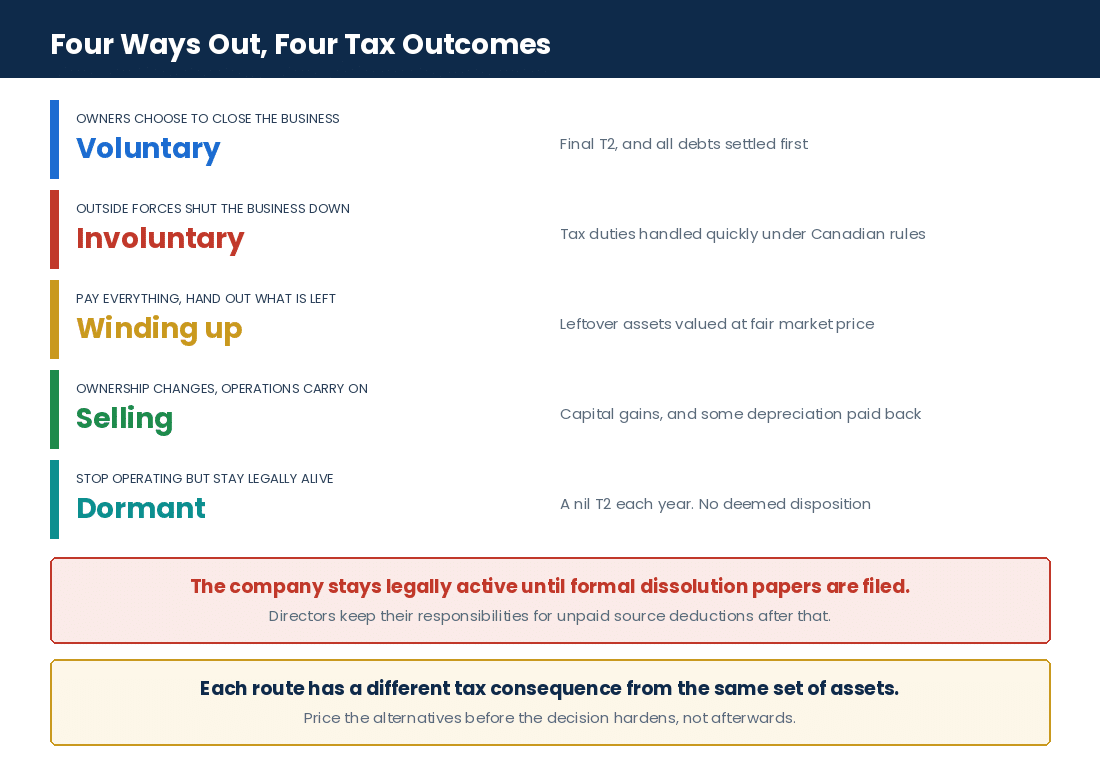
Types of Business Closure in Canada: Voluntary, Involuntary, Winding Up, and Selling
There are different ways to close a business in Canada. Each way affects your taxes differently. Knowing these can help you avoid trouble with the government.
| Route | What It Means | The Tax Consequence |
|---|---|---|
| Voluntary Closure | Owners choose to close the business for reasons they decide | They must file a final corporate tax return (T2). Also, they have to settle any debts before the business is officially closed |
| Involuntary Closure | Sometimes, outside forces make a business shut down. This could happen if there are legal problems or money issues | In this case, the company has to handle its tax duties quickly under Canadian rules |
| Winding Up | Winding up means finishing all payments and handing out assets before shutting down legally | Taxes on leftover assets may apply. These assets get valued at fair market price for tax purposes |
| Selling the Business | When selling a business, ownership changes but operations keep going | Sellers face taxes on capital gains from selling assets. They may also have to pay back some depreciation claims from before |
Key Definitions: Business Dissolution, Corporation Wind Up, and Closure Tax Filing
Knowing these terms makes closing a business easier to understand:
- Business Dissolution: Dissolution means ending the company by law. You must send papers to provincial offices and clear all tax dues with CRA during this time.
- Corporation Wind Up: Wind up means completing all steps to stop running the business while following laws. Different provinces have their own rules for winding up companies.
- Final Tax Filing: The last tax filing happens after you stop operating. You report all income earned until closure and claim any deductions allowed in that final short tax year.
Reasons for Closing a Business in Canada
People close businesses for many reasons like:
- Retirement or Exit Strategy: Owners may want to retire or leave the business for personal reasons.
- Financial Difficulties: Ongoing losses can push owners to shut down instead of risking more debt.
- Strategic Decision: Changing markets or competition might lead owners to stop operations.
- Regulatory Issues: New laws or rules can cause problems that make staying open too hard.
Legal Status of a Corporation During and After Closure
While closing—like during winding up—the company stays legally active until it files formal dissolution papers with local authorities.
After dissolution, directors still face responsibilities, especially if taxes like unremitted source deductions remain unpaid. These obligations don’t vanish right away unless cleared by CRA through clearance certificates before distributing assets during wind-up steps.
An owner filed articles of dissolution first, on the view that the company had stopped trading and the paperwork should follow.
The corporation was gone before the final return was prepared, before the payroll account was closed and before anyone had looked at the equipment still sitting in the unit. Reviving it to file properly cost more than the whole wind-up would have, and took four months nobody had planned for. The order is not administrative. Figures changed for privacy.
The Dissolution Process Step by Step
The Dissolution Process Step by Step
The Sequence
Initiating Dissolution: Approval Requirements for Shareholders and Directors
To start closing a business tax Canada requires, shareholders and directors must approve the dissolution. This step is the legal way to begin winding down a business Canada-wide.
Here’s what you need to know:
- Shareholders and directors must give formal approval.
- This approval is required by law before any filings.
- It helps make sure tax rules for closing a business tax Canada get followed.
Meeting Resolutions
Shareholders usually pass a resolution during a meeting or sign one in writing. This says, “Yes, let’s dissolve the company.” The resolution lets management start the business dissolution tax Canada process.
Directors also pass resolutions to confirm the company is ready to close. Having this on record is important. It supports later steps like filing articles of dissolution and doing final tax returns.
Voting Thresholds
The rules for voting depend on company bylaws, but usually:
- Two-thirds (66⅔%) of voting shareholders must approve.
- Sometimes everyone must agree if stated in agreements.
- Directors usually follow majority vote rules.
These voting thresholds protect everyone and ensure compliance before filing business closure tax forms in Canada.
Filing the Notice or Articles of Dissolution with Corporations Canada or Provincial Registry
You end your corporation officially by filing a notice or articles of dissolution. Doing this triggers CRA’s processes for closing a business tax Canada.
Federal vs. Provincial Process. If your corporation is federal, you file online with Corporations Canada. If provincial, use the province’s registry like Ontario’s Ministry of Government Services.
Both need forms filled out with fees paid. Each jurisdiction has its own timelines and rules. Knowing these helps when winding down a business Canada-wide so you don’t miss steps or deadlines.
Required Documentation. You’ll need:
- Signed articles or notice of dissolution by authorized officers.
- Proof all debts are paid or plans made.
- Clearance certificates if required before sharing assets.
Having all documents ready avoids delays in processing and later tax filings linked to business closure tax filing canada.
A two-shareholder company had a written resolution to dissolve, signed and dated, and no director resolution at all.
The registry accepted the filing. The problem surfaced two years later when one shareholder disputed how the remaining cash had been split, and there was no board record of who had authorised the distribution or on what basis. The resolutions are cheap to produce at the time and impossible to produce afterwards.
Completing Final Corporate Tax Returns and Marking Them as Final
Filing your final corporate return properly is key when closing a corporation in Canada. It shows income earned up until the business stopped plus asset disposals during wind-up.
Tax Year End Adjustment. Your last return covers from the last year-end up to just before dissolving. Adjustments include:
- Reporting only income earned before closure.
- Handling terminal losses and inventory changes.
These align your taxable income correctly under Canadian tax laws so no gaps appear after closure.
Indicating ‘Final Return’. On your T2 form, tick box 125 marked “final return.” This tells CRA no more returns will come unless the company restarts. It’s an important step when winding down a business canada properly.
Settling Outstanding Balances with CRA, Including Payroll and GST/HST Accounts
Before closing payroll accounts and GST/HST files, settle all amounts owed to avoid penalties after closure.
| Account | What Has to Happen |
|---|---|
| Outstanding Debts | Pay all taxes owed, including any from previous years. Unpaid source deductions can make directors personally responsible even after closure. So clear debts early to reduce risks |
| Payroll Remittances | Close payroll accounts soon after stopping employee pay. Send remaining source deductions on time per CRA rules about payroll account closed canada. Submit T4/T4A slips within six months of stopping payroll no matter how much you paid |
| GST/HST Finalizations | Deregister GST/HST accounts when sales stop. Then file your final return covering sales till deregistration date. Property held may trigger deemed disposition rules needing reporting in this last return |
Closing CRA Business Numbers and Other Government Accounts Using Relevant Forms
Close all government accounts linked to your BN number to finish admin tasks beyond taxes. Use Form RC145 “Request To Close Business Number” with other forms like PD7A for payroll closure and GST34 for HST deregistration as needed. This cleans up registrations across programs involved during winding down operations across Canada.
Obtaining a CRA Clearance Certificate and Its Importance
The clearance certificate proves you paid all federal taxes including source deductions. It lets you safely distribute remaining assets without personal risk for directors.
Request it with Form TX19 after filing final returns and fully paying balances. This certificate shields those distributing assets from later reassessments because dissolved corporations can still be audited long after they close.
A company paid out its remaining cash to two shareholders in December and applied for the clearance certificate in February.
CRA came back with an unremitted payroll balance from the final period that nobody had reconciled. The money was already gone, the shareholders had spent it, and the person who had signed the cheques was personally on the hook for it. The certificate exists precisely to stop that sequence. Figures changed for privacy.
Distributing Remaining Assets and Handling Shareholder Transactions
When you distribute assets during liquidation:
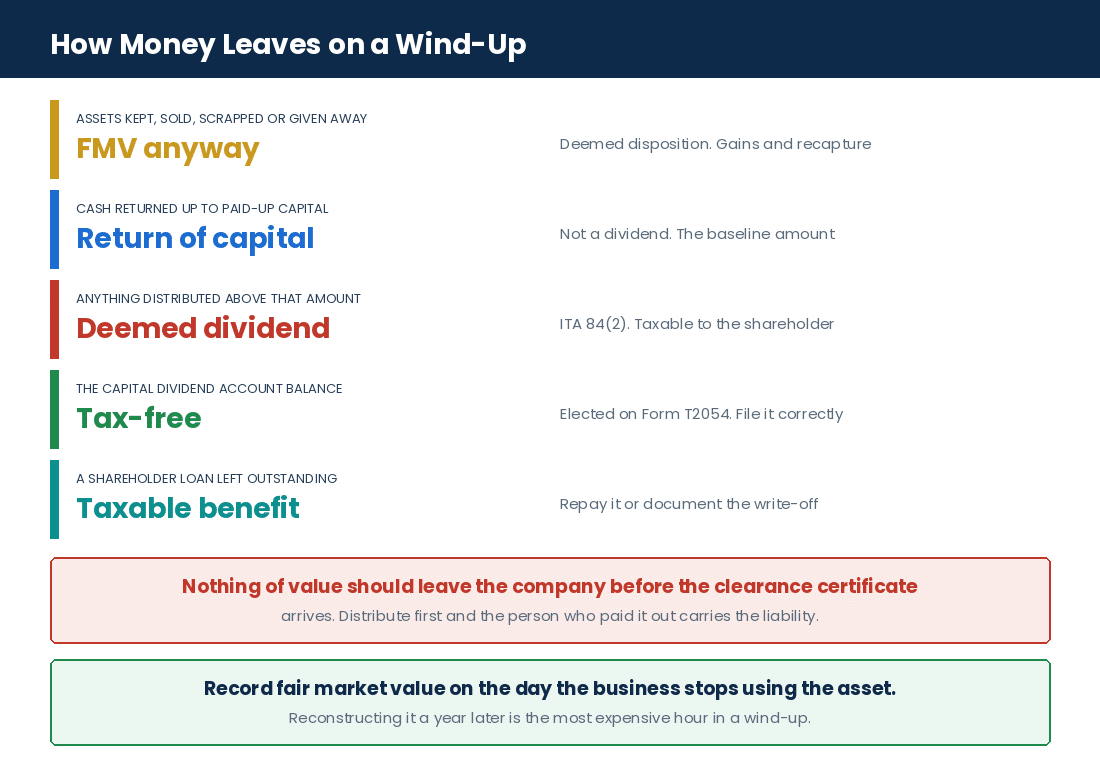
- Use fair market values; these count as deemed dispositions.
- Amounts over paid-up capital are dividends subject to tax.
- Clear shareholder loans before closing; if not repaid, they might cause taxable benefits.
Keep good records showing what assets went where. This prevents fights later about unpaid loans versus money shareholders got.
Timeline Expectations for the Closure Process
Closing a corporation usually follows steps starting with approvals, then filings, final returns, and waiting for clearance certificates. Here’s a rough schedule:
| Phase | Typical Duration |
|---|---|
| Shareholder & Director Approvals | 1–2 weeks |
| Filing Articles/Notices | Up to 1 week |
| Preparing & Filing Final Returns | Within 6 months |
| Receiving Clearance Certificate | About 4–8 weeks |
Planning ahead avoids missed deadlines that cause problems or personal liability risks if payments aren’t done despite formal closure.
Tax Implications of Closing a Business in Canada
Tax Implications of Closing a Business
The Tax Bill
Deemed Disposition Rules and Their Effect on Corporate Assets
When you wind down a business in Canada, the tax law says you must treat all corporate assets as if they were sold at their fair market value (FMV) right before closing. It doesn’t matter if you actually sold them or not. This rule can cause capital gains or recapture of depreciation income.
For instance, if shareholders keep equipment after closing, it counts as sold at FMV. That may mean you have to include recaptured depreciation as income for that year. Inventory is treated the same way—it’s valued at FMV and seen as sold. This helps figure out any terminal loss or income.
Here’s what happens by asset type:
| Asset Type | What Happens |
|---|---|
| Equipment | Considered sold at FMV; may cause recapture |
| Inventory | Valued at FMV; leads to terminal loss or income |
| Land & Buildings | Capital gain or loss based on FMV |
| Shares | Treated as disposed unless properly transferred |
If you don’t report these “sales,” the CRA can reassess your taxes with penalties and interest.
Tax Treatment of Retained Earnings, Dividends, and Salary Payouts to Shareholders
Retained earnings are profits your company kept after paying taxes. When you close a business, these usually come out as dividends to shareholders.
Dividends count as taxable income for shareholders but don’t reduce the company’s taxable profit again since tax was already paid. Salary payouts near closure still count as expenses for the business but need correct payroll remittances up to shutdown.
If distributions go over the paid-up capital, the excess is treated as a deemed dividend under section 84(2). This means shareholders pay more personal tax than just return-of-capital.
Keep salary payments and dividends clearly separate in your records. That avoids confusion if CRA audits your files.
A retiring owner assumed the cash left in the company after the last customer paid was simply his, because the company was his.
It was not, and the distribution produced a deemed dividend he had not budgeted for, in a year he had also taken a final salary. The combined personal tax arrived the following April with no instalments behind it. Splitting the distribution across two calendar years would have cost nothing and saved a bracket. Figures changed for privacy.
Capital Dividend Account Distributions and Filing Requirements
The Capital Dividend Account (CDA) holds non-taxable amounts like certain capital gains exemptions or life insurance proceeds received on death. When dissolving a business, CDA balances can be paid out tax-free to Canadian shareholders through capital dividends.
To do this right:
- File Form T2054 with CRA.
- Calculate CDA amounts carefully including all adjustments.
- Keep proof supporting each distribution.
Missing the deadline or filing wrong can cause CRA to treat these as regular dividends. That means extra tax for shareholders.
Final GST/HST Return Filing and Related Considerations
Once you stop all commercial activity and close your business, you must deregister your GST/HST account. Before that:
- File your final GST/HST return covering sales up to deregistration date.
- Report any asset sales subject to GST/HST.
- Pay any taxes owing promptly.
If assets stay after deregistration without being sold, you lose input tax credits on related expenses going forward. The CRA wants final returns within one month after cancellation. Miss this deadline, and you could face audits even though you’re closed.
Shareholder Tax Consequences During and After Dissolution
Shareholders should watch out for several taxes when dissolving a corporation:
- Amounts over paid-up capital are taxed as deemed dividends.
- Selling shares triggers capital gains or losses based on cost versus sale price.
- Forgiven shareholder loans create taxable benefits unless repaid before closing.
Even after dissolution, CRA can reassess if info about distributions or asset moves is missing from filings. Keep clear records during winding down to avoid surprises.
Managing Taxes on Money Remaining Inside the Corporation
Money left inside a corporation after it stops operating still faces corporate tax until distributed or properly handled during liquidation.
Plan distributions carefully:
- Consider withholding taxes if foreign residents get funds.
- Balance paying retained earnings with clearing debts like source deductions before applying for clearance certificates.
Ignoring leftover money risks ongoing liabilities for both company and directors—even if formal dissolution is done earlier.
A company kept a van, a trailer and a rack of tools after it stopped trading, and the owner went on using them.
Nothing was sold, no money moved, and nothing was reported. The deemed disposition still happened on the day the corporation was dissolved, at the fair market value of equipment that had been written down almost to nil. The recapture was the single largest number in the final return, and it was entirely predictable a year earlier. Figures changed for privacy.
Legal and Operational Obligations Before and After Closure
Legal and Operational Obligations
Obligations
Closing a business tax Canada means you have to handle legal and operational steps carefully. Before, during, and after winding down a business Canada, you must follow rules set by the CRA. Doing this right helps avoid penalties. It also protects directors from personal risks.
Employee Termination Requirements: Notice, Severance, and Records
When you close a business in Canada, you have to follow rules about letting employees go. This means giving proper notice or pay instead of notice. Provinces decide how much notice or severance is needed based on how long people worked.
You also need to pay all final wages, vacation pay, bonuses up to the closure date, and any severance owed. These payments should match the last day employees worked or their official end date.
Keep all records of terminations like notices given, severance agreements (if any), and payroll info for at least six years according to CRA rules.
Also, send out T4 slips showing final payments by the deadlines—even if your business is closed.
If you don’t do this right during business closure tax filing Canada, you might face legal claims or tax problems.
Managing Vendor Contracts and Business Obligations During Closure
Winding down a business Canada means checking all your vendor contracts closely. You should tell suppliers early about your plans to close. This helps avoid surprises.
Contracts may ask for advance notice before canceling or charge fees if ended early. Ignoring these could cause extra costs.
Pay any bills you owe on time. Try to work out contract endings where possible.
Don’t forget other obligations like leases, utilities, and insurance policies. Cancel these properly as your contracts say.
Write down all communications so you can prove what happened later if needed.
Taking care of these steps lowers risks when finishing your closing a business tax Canada work.
A business stopped trading in March and told its landlord in May, on a lease with nine months left and a clause requiring sixty days’ written notice.
The landlord was entitled to the balance, and the corporation could not be dissolved cleanly until that claim was settled or provided for. The lease is almost always the largest remaining obligation in a wind-up, and it is the one most often discovered last. Figures changed for privacy.
Corporate Record Keeping Obligations Post-Dissolution
Even after you dissolve a company under Canadian law, you must keep certain records. The Income Tax Act says keep financial books and statements for six years after your last tax year ends.
These include:
- Accounting ledgers
- Asset registers showing values when winding up
- Shareholder loan papers
- GST/HST filings
- Clearance certificate requests
- Payroll remittances
- Letters from CRA
Keeping good records helps if CRA reviews your returns later. Dissolving does not cancel company debts or director duties for unpaid taxes.
If you ignore this duty, it can block future fixes like voluntary disclosures for late filings related to closing a business tax Canada situations.
Addressing Personal Liability Risks for Directors and Officers
Directors can be personally responsible for unpaid taxes when they wind down a corporation.
Unpaid source deductions—like income tax taken from employee paychecks—stay due even after the company dissolves. Directors must pay unless they took reasonable steps to avoid it.
The Income Tax Act holds directors jointly liable unless they show they did everything expected under the circumstances.
This means directors might get hit with assessments plus interest and penalties after dissolution if duties were ignored.
Getting a clearance certificate before distributing assets helps reduce risks but doesn’t erase all director liability if laws were broken earlier.
It’s smart to get legal advice about director risks during closing a business tax Canada tasks involving officers’ roles. Knowing this avoids surprises long after the company closes.
Responsibilities Concerning Bankrupt or Insolvent Corporations
Winding down an insolvent company works differently from regular closures because bankruptcy involves trustees licensed federally. These trustees handle selling assets and paying creditors in order according to insolvency laws.
Tax filing still matters in bankruptcy but some deadlines change since trustees take over instead of management making all decisions.
CRA focuses on recovering amounts through receivership but expects cooperation on final returns showing liquidation results properly.
Directors shouldn’t confuse insolvency advice with regular winding-down rules explained here since they cover different processes under winding down a business Canada plans not involving bankruptcy protection.
If your company struggles financially but plans a normal wind-up without bankruptcy, understand that separate rules apply outside insolvency law regimes discussed elsewhere here.
Reversing Dissolution Decisions: When and How It Is Possible
You can bring back dissolved companies in some cases but provincial laws set limits on when this is allowed. Usually, there’s a deadline counted from the date of dissolution that you must meet.
Bringing back the company makes it exist again as if it never ended. This lets you fix missed filings including final returns needed at dissolution time.
For example, in Ontario—which many follow—you apply with Articles of Revival and pay fees within about two years of dissolution unless courts allow more time.
This process gives you a chance to correct errors made while closing your books and dealing with CRA expectations for closing accounts under closing a business tax Canada rules.
However, reviving does not remove past debts or guarantee any relief on old obligations so professional help remains important here too.
If you’re handling employee matters or worried about director liabilities during closure—or need tips on keeping records—contact Gondaliya CPA at 647-212-9559 or info@gondaliyacpa.ca for advice focused on Canadian businesses.
Common Challenges, Risks, and Strategic Considerations
Challenges, Risks and Strategic Considerations
Risk
Frequent Mistakes in Business Closure and How to Avoid Them
Closing a business tax Canada needs careful steps. People often miss deadlines or file wrong tax returns. This causes penalties from the CRA. Another mistake is ignoring deemed disposition rules. This means forgetting to report income on assets kept by shareholders at fair market value.
Some owners don’t get a clearance certificate before handing out property. That puts directors at risk of personal liability for unpaid deductions. Others forget to close payroll and GST/HST accounts properly. That leads to ongoing tax duties.
To avoid trouble:
- File all returns before closing.
- Report deemed dispositions with proof.
- Get a clearance certificate before sharing assets.
- Close all CRA program accounts.
Following these helps with winding down a business Canada and meets business closure tax filing Canada rules.
A corporation stopped operating in one year and dissolved in the next, and nobody filed anything for the stub period in between.
There was no income and the owner reasoned there was nothing to report. A return was still due, the clock on the reassessment period never started because none was filed, and the voluntary disclosure that fixed it was only available because CRA had not made contact first. A nil return costs an hour. Figures changed for privacy.
CRA Audits, Reassessments, and Post-Closure Compliance Risks
Business dissolution tax Canada doesn’t stop the CRA from acting. They can audit or reassess dissolved companies for years after closing if filings are missing or wrong. Dissolution doesn’t erase debts; directors still owe unpaid taxes.
Common triggers include wrong deemed disposition reports or asset distribution without considering paid-up capital. Missing slips like T4s can also cause problems.
Keep records for six years after closing. This helps if CRA asks questions later. Using voluntary disclosure programs might reduce penalties but only if done before reassessment notices show up.
Knowing these risks helps businesses plan their wind-up under 2026 rules about final returns and account closures.
Comparing Closing a Business Versus Keeping a Corporation Dormant
Winding down a business Canada doesn’t always mean shutting everything now. Keeping a corporation dormant means stopping operations but staying legally alive. You file simple annual returns and no active business work.
Dormancy avoids the tax hit from deemed dispositions that happen with full closure. But you must still file T2 returns marked as non-active each year. This suits companies that might restart or sell later without paying liquidation taxes now.
Closing a business means selling assets at fair market value, settling loans, asking for clearance certificates, deregistering GST/HST accounts, and officially dissolving articles. Each step causes tax effects shown in final corporate return Canada forms.
| Question | Dormant | Closed |
|---|---|---|
| Deemed disposition of assets | No — nothing is disposed of | Yes — everything at fair market value |
| Annual T2 return | Yes, every year, marked non-active | One final return, then none |
| Can it restart or be sold later | Yes | Only by revival, within the provincial limit |
| Ongoing cost | A nil return and the annual registry filing | None once the certificate is issued |
| Clearance certificate needed | No | Yes, before distributing |
Deciding between dormancy and closing depends on your plan for taxes and paperwork.
Impact of Closure on Personal Assets and Director Liability
Business dissolution tax Canada raises serious issues about director liability even after closure. Directors stay responsible for unpaid source deductions like payroll taxes until CRA issues clearance certificates.
Giving out property before getting this certificate puts directors at personal risk. The person distributing stays liable until CRA confirms no debts remain. Also, any owing taxes last forever within reassessment time frames under Income Tax Act rules.
Personal assets usually don’t face claims unless directors gave guarantees or broke trust duties. Those cases need legal advice more than accounting help.
Knowing these risks helps manage winding down steps under Canadian law through 2026 updates.
Alternatives to Closure: Selling, Handing Off, or Declaring Bankruptcy
Winding down a business Canada does not always mean closing shop outright; other options exist:
- Selling: Passing ownership keeps things going and may delay some taxes compared to liquidation.
- Handing off: Giving control inside the family avoids immediate deemed dispositions linked to full closure.
- Declaring bankruptcy: Used when debts can’t be paid; this is outside usual tax-focused wind-down talks.
Each choice affects timing of taxable events like loss recaptures or dividend treatment during transfers. Getting advice early clarifies which suits your finances best while managing federal law requirements updated to 2026.
An owner close to retirement was set on dissolving, until we ran the two routes side by side on his actual numbers.
The company held goodwill nobody had valued and a customer list a competitor wanted. Selling produced a materially better after-tax result than liquidating the assets and distributing the cash, and it took the same amount of time. The question is worth asking once, properly, before the decision hardens. Figures changed for privacy.
When Consulting an Accountant or Legal Professional Is Advised
Closing a business tax Canada involves tricky laws from different sources — Income Tax Act short-year rules, Excise Tax Act GST/HST deregistration, payroll remittances, plus provincial laws about dissolving articles.
Accountants who know corporate wind-ups help ensure correct order — catching up filings, valuing assets for deemed dispositions, requesting clearance certificates to protect directors. Early help avoids costly errors from missed deadlines or ignored risks across Canadian regions including Ontario and Toronto.
Lawyers help too, especially with director liability after closing, interpreting shareholder deals affecting loan paybacks, and handling revival if you want to undo closures.
For tailored support on Canadian federal rules updated through 2026 contact trusted professionals offering fixed fees backed by strong client reviews.
Business Closure Tax Check
Five quick questions on where your wind-up stands. No fee shown.
Points to raise with us:
This is a general prompt, not tax or legal advice or a quote. Your position depends on your full facts. For a real review, please book a free consultation.
Final Guidance and Support for Business Closure
Final Guidance and Support
Practical
Closing a business tax Canada means you have to pay close attention to your tax filings and CRA rules. Winding down a business Canada isn’t just about stopping work; it’s about finishing all tax duties before closing. Knowing how business dissolution tax Canada works helps you avoid penalties and keeps you in line with federal laws.
Practical Tips for a Smooth and Compliant Business Closure
- Start planning early. The CRA has deadlines you can’t miss. You need to prepare final corporate tax returns that cover the short period before you close. Make sure payroll is up to date and T4 slips get sent out within 90 days after you stop paying employees.
- Keep good records of asset values at fair market price. The government treats these as if you sold them, even if you didn’t. This stops surprises like extra taxes from recapture or losses when you file your last return.
- Close your GST/HST accounts quickly after deregistration. File your last GST/HST return by the due date, usually one month later. Ask for a clearance certificate early—it helps protect directors when giving out assets during wind-up.
- Don’t skip any steps in order. Missing filings or ending the company too soon can cause reassessments or make directors responsible for unpaid deductions. Use checklists and keep files neat to reduce mistakes while winding down a business Canada.
Essential Documentation and Checklists for Business Owners
You’ll need these papers for business closure tax filing Canada:
| Document | What It Covers |
|---|---|
| Final Corporate Tax Return (T2) | Shows income up to closure; file it within six months after fiscal year-end |
| Payroll Records | All last payments and T4/T4A slips sent on time |
| GST/HST Returns | Your last one after canceling registration |
| Asset Valuation Sheets | Fair market values for deemed sale rules in the Income Tax Act |
| Distribution Ledgers | Track money paid out vs paid-up capital to find dividends under ITA rules |
| Shareholder Loan Records | Show repayments or write-offs clearly |
| Clearance Certificate Application (RC435) | Send this before paying out assets |
Keep all these documents safe because CRA can audit up to three years after filing, even if your business closed long ago. Organized files make fixing errors easier later on.
A client brought us a dissolution that was already done and a box of paper that had never been sorted.
Reconstructing the asset register took longer than the final return itself, because nobody had written down what the equipment was worth on the day it stopped being used. A single valuation sheet, prepared at the time, is the cheapest document in a wind-up and the one most often missing.
How Gondaliya CPA Supports Business Owners in Closure and Tax Filing
Gondaliya CPA guides owners through closing a business tax Canada while following all rules. We check your filings, prepare final returns with needed adjustments like deemed sales, recapture amounts, losses, payroll endings, GST/HST deregistrations, and shareholder loans.
We help get clearance certificates on time before asset payouts start—this lowers director risks from unpaid taxes under ITA section 227.1. Our team has over 1300 five-star Google reviews showing our work quality. We offer fixed-fee services aimed at winding down a business Canada cases across Ontario and beyond.
Our goal is to stop delays caused by missed dates or missing paperwork while keeping everything CRA-compliant based on current 2026 tax rules.
Accessing Government Resources and Official Forms for Closure
Use official sources when closing your business. The CRA website has guides on closing payroll accounts (PD7A), cancelling GST/HST registration (RC145), filing final T2 returns, and requesting clearance certificates (RC435).
Clearance certificates protect people who pay out company property from being held personally liable but only after taxes are settled or arrangements made under Excise Tax Act rules.
Filing forms on time matters: submit your final T2 within six months of fiscal year-end that includes closure; send employee slips on schedule; cancel GST/HST once deregistered—these are all required steps you can’t skip.
Encouraging Proactive Planning and Expert Consultation Before Closure
Planning ahead makes winding down a business Canada much easier. Talking with experts early helps spot issues like loss carrybacks that expire or loans needing repayment before shutting down.
Getting advice about closing a business tax Canada stops costly mistakes like dissolving too soon without completing filings—which might leave directors responsible for unpaid deductions even after the company ends.
Planning also helps coordinate bookkeeping with closure timing so everything matches legal deadlines. Good advice leads to smart moves about selling or transferring assets that affect taxable income correctly.
Disclaimer on Legal and Tax Advice and the Importance of Professional Guidance
This info covers only federal tax filing steps when closing corporations in Canada. It’s not legal advice nor does it cover insolvency or bankruptcy rules handled by licensed trustees provincially.
Business owners should get expert help tailored to their situation because wrong assumptions about asset sales can cause big problems under Income Tax Act sections mentioned here.
Tax pros help keep you compliant while lowering risks before and after dissolution—including handling clearance certificates that shield directors from leftover liabilities even after formal company closure.
For personal help with closing your corporation according to Canadian laws including Ontario details, contact Gondaliya CPA at info@gondaliyacpa.ca or call 647‑212‑9559 for a free chat about closing a business tax Canada challenges handled nationwide including Toronto clients.
Frequently Asked Questions (FAQ) on Closing a Business Tax Canada
Frequently Asked Questions
Answers
What is the maximum length of a short taxation year when closing a business?+
What is the retention period for records after business dissolution?+
What triggers a CRA review or reassessment post-closure?+
Can I apply for voluntary disclosure penalty relief after closing my corporation?+
What is the typical sequence of steps in winding up a business in Canada?+
How do shareholder loans get cleared during business closure?+
How is the payroll account closed with CRA after stopping employees?+
How do you close the GST/HST account upon business closure?+
Is tax charged on the sale of assets in the final tax return?+
What is a clearance certificate and who needs it?+
What exposure do directors keep after dissolution?+
What if the business is behind on filings or already dissolved?+
Checklists and Choosing Your Route
Work From This
The Ultimate Checklist for Closing Your Business Tax Canada
- Obtain shareholder and director approvals for dissolution.
- File articles or notice of dissolution with Corporations Canada or provincial registry.
- Prepare and file final corporate tax return marked as “final.”
- Settle outstanding balances including payroll source deductions and GST/HST amounts.
- Submit T4/T4A slips within six months of employee termination.
- Close payroll accounts using Form PD7A and GST/HST accounts via Form RC145.
- Request CRA clearance certificate (Form TX19) before distributing assets.
- Value assets at fair market value for deemed disposition rules.
- Clear shareholder loans or properly document any write-offs.
- Keep corporate records securely for at least six years post-dissolution.
- Avoid distributing property before obtaining clearance certificates to protect directors.
- Plan distributions carefully to manage dividend taxes properly under ITA rules.
Choosing Between DIY Wind-Up vs CPA Assistance: What Fits Your Business?
Your Call
- DIY suits small businesses with simple finances and no outstanding issues.
- CPA firms offer expertise in filing complex final returns and managing tax risks effectively.
- Professional help ensures timely clearance certificates minimizing director liability exposure.
- CPAs guide you through valuation rules, loss claims, and asset distribution correctly.
- Gondaliya CPA offers fixed-fee services with 1300+ five-star reviews tailored for Canadian businesses closing operations.
Why Trust Gondaliya CPA for Business Closure Tax Filing in Canada?
Why Us
- Proven track record with over 1300 positive Google reviews from Ontario clients and beyond.
- Specialized knowledge in closing corporations under 2026 Canadian federal tax laws.
- Expert handling of deemed dispositions, clearance certificates, payroll endings, GST deregistration, and shareholder matters.
- Timely filing services prevent costly CRA penalties and director personal liabilities post-dissolution.
- Transparent fixed pricing with personalized support throughout every wind-up step nationwide including Toronto region clients.
The owners who handle a wind-up themselves without trouble have one thing in common: no employees, no inventory and no assets worth keeping.
Everything else — a payroll account, a lease, equipment going to a shareholder, a loan balance that was never cleaned up — adds a characterisation question that has to be answered before the final return can be right. Count those four first, and the DIY question answers itself.
Businesses We Serve & Industry Spotlights
Industry Expertise
A wind-up asks the same questions of every business, but the answers land in different places depending on what the company owns and who it owes. These are the sectors where we see closures most often, and the part of the process that tends to decide the outcome in each.
| Industry | What Usually Decides the Wind-Up |
|---|---|
| Businesses winding down | The whole sequence — approvals, final return, accounts closed, certificate, then distribute |
| Family-owned businesses | Retirement timing, and whether the next generation wants it |
| Business buyers and sellers | Whether selling beats liquidating once the goodwill is valued |
| Restaurants | The lease, the payroll account and the equipment going out the door |
| Distributors | Inventory valued at fair market value whether or not it is sold |
| Clothing and retail stores | Stock on hand at the closing date, and what it is actually worth |
| Commercial landlords | The property disposition, which is usually the largest single number |
| Construction equipment rental companies | Recapture on a fleet written down over many years |
| Family doctors and professional corporations | Retained earnings, and how they come out |
| Cross-border e-commerce sellers | GST/HST deregistration with property still held |
| Fleet owners | Vehicle disposals, each one with its own class and its own recapture |
- Businesses winding down: The core of this work. Approvals, articles, the final return, the accounts, the certificate, the distribution — in that order, because every step depends on the one before it.
- Family-owned businesses: Retirement is the commonest reason a profitable company closes, and the one where the alternatives to closure deserve the most scrutiny before the decision hardens.
- Business buyers and sellers: Selling and liquidating produce different after-tax results from the same company. Running both before committing is usually the highest-value hour in the whole process.
- Restaurants: A lease with years left, a payroll account with final remittances outstanding and a kitchen full of equipment. All three have to be dealt with before the corporation can go.
- Distributors: Stock is the whole balance sheet, and on a wind-up it is treated as disposed of at fair market value whether a buyer was found for it or not.
- Clothing and retail stores: The closing-down sale sets the real value of the inventory, and the final return has to reflect what the stock was actually worth rather than what it cost.
- Commercial landlords: A property disposition dwarfs everything else in the final return, and the capital gain usually determines whether the distribution can happen at all.
- Construction equipment rental companies: Years of capital cost allowance come back as recapture on the day the fleet is treated as sold, and the number surprises owners every time.
- Family doctors and professional corporations: Few assets and substantial retained earnings, which makes the distribution question — and the paid-up capital comparison — the entire wind-up.
- Cross-border e-commerce sellers: Deregistration while inventory is still sitting in a warehouse, which is exactly the situation the final GST/HST return is designed to catch.
- Fleet owners: Vehicles leaving to shareholders or to the open market, each a separate disposition with its own class balance behind it.
Across every sector, the wind-ups that go wrong go wrong in the same place: something of value left the company before CRA had signed off.
It is rarely deliberate. A van gets driven home, stock gets taken, the last of the cash gets split because the work is finished. Each one is a distribution, and each one happened before the certificate. The fix costs nothing at the time and a great deal afterwards. Figures changed for privacy.
Professional Guidance and Quick Reference
Guidance
Essential Points for Closing a Corporation in Canada
A wind-up fails in a predictable set of ways: assets that leave the company before the clearance certificate arrives, a final return that never gets marked as final, payroll and GST/HST accounts left open after the business has stopped, shareholder loans that were never cleared, and a dissolution filed before the filings behind it were finished. Each one is cheap to avoid at the time and expensive to unwind afterwards. Gondaliya CPA handles corporate wind-ups on a flat fee.
Quick Answers
At a Glance
- Final corporate return: T2, filed within six months after fiscal year-end
- Marking it final: tick box 125, “final return,” on the T2
- Short taxation year: up to 53 weeks, usually ending on the dissolution date
- Approval threshold: two-thirds (66⅔%) of voting shareholders, unless agreements say otherwise
- Clearance certificate: Form TX19, requested after final returns are filed and balances paid
- Closing the business number: Form RC145
- Payroll remittances: Form PD7A
- GST/HST: final return within one month after cancellation
- Capital dividend election: Form T2054
- Deemed dividend: amounts above paid-up capital, ITA section 84(2)
- Director liability: unremitted source deductions, ITA section 227.1
- Distribution before clearance: ITA section 159(3)
- Deemed disposition: everything at fair market value, sold or not
- Record retention: six years after the final tax year
- Revival: Articles of Revival, within the provincial limit
- Dormant instead: a nil T2 every year, no deemed disposition
Who This Is For / Not For
Fit Check
- For: owners of Canadian corporations winding down voluntarily — retirement, an exit, a strategic decision or ongoing losses.
- For: directors of companies already dissolved or sitting dormant who need to catch up filings or consider revival.
- Not for: bankruptcy or insolvency, which are administered by licensed insolvency trustees under a separate statutory regime.
- Not for: unincorporated sole proprietors simply ceasing to trade, who have no articles of dissolution to file. A corporation with no assets left is still squarely in scope.
People Also Ask
Related Questions
Do I have to dissolve, or can I just stop filing?+
Stopping is not an option. A corporation that exists has to file a T2 every year whether or not it traded, and a year left unfiled never starts the reassessment clock at all. The two real choices are to dissolve properly or to keep the company dormant and file a nil return annually. Doing neither leaves the obligation running and the directors exposed.
Can I distribute the cash now and get the certificate later?+
You can, and it is the mistake that costs the most. Clearance certificates protect the person paying out company property from being held personally liable. Distribute first and that protection is gone — if CRA later finds an unremitted balance, the money is with the shareholders and the liability is with whoever signed the cheques.
What happens to the equipment if nobody buys it?+
It is still treated as disposed of at fair market value. The deemed disposition does not depend on a sale, which is why equipment kept by a shareholder, scrapped, or simply left in a unit still produces recapture or a terminal loss in the final return. Record what it was worth on the day the business stopped using it.
Should I sell the business instead of closing it?+
Worth checking before you commit. Selling passes ownership and keeps the operation going, and where there is goodwill, a customer list or a transferable location, it can produce a materially better after-tax result than liquidating the assets and distributing the cash. Run both on your own numbers once, properly, early.
How long does the whole thing take?+
Plan for a few months rather than a few weeks. Approvals take one to two weeks, the registry filing up to a week, the final returns are due within six months of the year end, and the clearance certificate follows after that. The distribution comes last, so the certificate is what sets the finish date.
Glossary of Key Terms for Closing a Business
Definitions
- Business Dissolution: Ending the company by law, by filing papers with the federal or provincial registry.
- Corporation Wind Up: Completing all the steps to stop running the business while following the applicable corporate statute.
- Final Tax Filing: The last return, reporting income earned until closure and the deductions allowed in that final short tax year.
- Deemed Disposition: Corporate assets treated as sold at fair market value immediately before closing, whether or not they actually change hands.
- Recapture: Depreciation previously claimed and brought back into income when the asset is disposed of above its undepreciated cost.
- Paid-Up Capital: The amount shareholders can receive back without a dividend arising; anything above it is a deemed dividend under section 84(2).
- Capital Dividend Account: The balance of non-taxable amounts that can be paid out tax-free to Canadian shareholders, elected on Form T2054.
- Clearance Certificate: CRA’s confirmation that all taxes and source deductions are paid, requested on Form TX19 before any assets are distributed.
- Articles of Revival: The filing that brings a dissolved corporation back into existence so missed filings can be corrected.
- Dormant Corporation: A company that has stopped operating but stays legally alive, filing a nil T2 each year instead of dissolving.
Want a checklist to work from? You can download our free business closure tax checklist before your consultation.
Work the sequence and almost nothing can go wrong. Approvals first — shareholder and director resolutions on the record, because they are impossible to produce afterwards. Then the filings — the final T2 marked as final, payroll and GST/HST balances settled, and the program accounts closed on Form RC145. Then the certificate — Form TX19, and nothing of value leaves the company until it arrives, because that is the only thing standing between a distribution and personal liability. Then the distribution — assets at fair market value, amounts above paid-up capital as deemed dividends under 84(2), shareholder loans cleared or documented, and a ledger showing what went where. And only then the dissolution. Keep the records for six years. If any of it is already out of order, say so at the start — revival and voluntary disclosure both exist, and both work better before CRA makes contact.
Three things decide how hard your wind-up will be, and you can check them today. First, does the company still hold anything worth money — equipment, stock, a vehicle, a property? Each one is a deemed disposition at fair market value on the way out, so record what it is worth now rather than reconstructing it later. Second, is there a shareholder loan balance in either direction? Clear it or document it before the final return, not after. Third, is there a lease, a payroll account or a GST/HST registration still open? Those are the three obligations that keep running after the business has stopped, and the three most often discovered at the end. Answer those three and the rest of the process is sequence rather than judgment.
Closing a Business Tax Canada: How Gondaliya CPA Can Help
Start with your last financial statements, your asset list and your shareholder loan balance
Gondaliya CPA runs the wind-up in the order that protects you: catching up any filings that are behind, valuing the assets for the deemed disposition, preparing the final corporate return and marking it final, settling payroll and GST/HST and closing the program accounts, requesting the clearance certificate before anything is distributed, and planning the distribution so the paid-up capital, the capital dividend account and the shareholder loans are all dealt with before the money moves — on a flat fee including HST with a one-business-day response. Please book a free consultation.
Next Steps
Please book a free consultation with Gondaliya CPA and bring three things: your most recent financial statements, a list of what the company still owns with a rough idea of what each item is worth, and the shareholder loan balance. Those three settle the deemed disposition, the distribution and the personal tax that follows it — which between them account for nearly every surprise in a wind-up. If anything is already out of sequence — the company dissolved, returns unfiled, assets already distributed — say so at the outset, because revival and voluntary disclosure are both available and both work far better before CRA makes contact. You will get a flat fee including HST before any work begins. We serve Toronto, Mississauga, Vaughan, Brampton, Etobicoke, Scarborough, Ottawa and the rest of Ontario, and work with businesses across Canada. If our content helps, please add gondaliyacpa.ca as a preferred source on Google.
For detailed assistance closing your Canadian corporation compliant with current regulations, contact Gondaliya CPA at info@gondaliyacpa.ca or call 647‑212‑9559 today.
Published: · Last updated:
Editorial policy: We research against CRA, Department of Finance, Parliament of Canada, CPA Canada and CPA Ontario sources, fact-check the figures, and Sharad Gondaliya, CPA, reviews the content, which we update as the rules change.
Disclaimer: This article is educational information only and is not tax, legal, financial, licensing or regulatory advice. It covers the federal tax filing steps involved in closing a Canadian corporation voluntarily, and it does not cover bankruptcy or insolvency, which are administered by licensed insolvency trustees under a separate statutory regime. Corporate dissolution and revival are governed by the federal or provincial statute the corporation was incorporated under, and the procedure, fees and time limits differ by jurisdiction. Figures and form numbers change, processing times vary, and outcomes depend on your specific facts, including what the corporation owns, what it owes, who its shareholders are and whether any of them are non-residents. Gondaliya CPA performs compilation engagements under CSRS 4200 and does not perform audit or review engagements. Please consult a licensed CPA, and where director liability, shareholder agreements or revival are involved, a lawyer, before acting.

Sharad Gondaliya is a CPA Canada & CPA USA with 15 Years+ experience of Accounting, Tax, Payroll of Corporate Small Businesses as Tax Accountant. He is a CPA Ontario member (61040184) and holds US CPA licences in Washington and Montana and is well known among corporate small businesses for tax planning, efficient tax solutions, and affordable CPA services. Sharad is the Principal (Director) of Gondaliya CPA – Affordable CPA Firm in Canada. Licenses: CPA Ontario: 61040184 | CPA USA (MT): PAC-CPAP-LIC-033176 | CPA USA (WA): 57629 | CPA Firm License: 61330051 View Full Author Bio