



The Ultimate Guide to Security Company Taxes and Accounting in Canada
Security Company Taxes Canada: Tax Filing, Payroll, GST/HST, and Accounting Services by Gondaliya CPA
Gondaliya CPA specializes in security company taxes Canada, offering expert tax filing, payroll management, GST/HST compliance, and accounting services tailored to the security industry. Their knowledge extends to security company payroll taxes, bookkeeping, and maximizing tax deductions to support accurate financial statements and smooth business operations.
Quick Summary
A security company’s return turns on three questions, and all three are about timing and ownership rather than rates. When does monitoring revenue become income — it follows the contract period rather than the billing date, which is what the reserve provisions exist for. Is the installed equipment an asset or a sale — devices the company still owns at the client site are depreciable property under Class 8 or Class 10, not goods sold, and treating them as sold is the reassessment risk this sector is known for. And is the installation fee separated from the monitoring fee — because they are recognised on different clocks. Around those sit the ordinary obligations: a T2 within six months of year-end, GST/HST once taxable sales pass $30,000, payroll remittances on the assigned frequency for guard wages and subcontractors, and records kept for six years.
Reading time: 29 minutes.
Table of Contents
- Overview of Security Company Taxes and Accounting
- Business Structures and Their Tax Implications
- Tax Filing Processes and Deadlines
- Deductions, Credits and Planning
- Compliance, Audits and Risk Management
- Professional Support and Advanced Services
- Frequently Asked Questions
- Essential Insights and Key Points
- Businesses We Serve & Industry Spotlights
- Professional Guidance and Quick Reference
The Numbers That Matter
This article covers Canada, with Ontario and Toronto context, and reflects rules current to 9 October 2026. It is written for Canadian security businesses — guard and patrol companies, alarm monitoring providers, camera and access control installers, mobile patrol operators and private investigation firms — whether operating as sole proprietorships, partnerships or corporations. It does not cover provincial licensing under private security legislation, which is a separate regulatory regime. Gondaliya CPA performs compilation engagements under CSRS 4200, which provide no assurance; audit and review engagements are referred out. This is educational information only and not tax or legal advice.
Overview of Security Company Taxes and Accounting in Canada
Overview of Security Company Taxes and Accounting
The Basics
Security Industry Tax Obligations in Canada
Security companies in Canada must follow certain tax rules. These include paying corporate income taxes and dealing with GST and HST properly. Knowing these rules helps businesses stay legal and avoid fines.
Corporate Income Tax Requirements for Security Companies
Security companies pay corporate income tax on the money they earn. The federal rate is 15%. Provinces add their own rates. For example, Ontario charges about 11.5% more, making a total of 26.5%. It’s important to report all income, like money from service contracts or equipment sales, as the Income Tax Act says.
Key Accounting Principles for Security Businesses
Good accounting helps security businesses keep track of money well. Some main ideas are:
- Accrual Basis: Record income when earned, not when money arrives.
- Matching Principle: Match expenses to the income they create in the same time period.
- Consistency: Use the same accounting methods regularly so reports are comparable.
These ideas help make financial reports clear and accurate.
Understanding GST/HST Compliance for Security Services
Security services usually have to charge GST or HST under Canadian law. Here’s what companies need to know:
- If your yearly taxable sales pass $30,000, you must register with the CRA.
- Once registered, you charge GST or HST based on where your customer lives.
- You must file GST/HST returns regularly to send taxes collected on time.
Missing these steps can lead to fines or interest charges.
Payroll Tax Responsibilities Specific to Security Companies
Payroll taxes matter a lot if your security company has employees or subcontractors:
- Employers take tax deductions from workers’ paychecks as the CRA requires.
- Taxes get sent monthly or quarterly, depending on how much you pay workers overall.
- Keep good records of hours worked and wages paid, including overtime if needed by law.
Following these rules lowers risks of trouble with tax authorities.
Importance of Accurate Bookkeeping for Security Businesses
Keeping neat books matters a lot for managing security company finances:
- Clear records show where cash goes and how well the business does.
- Good bookkeeping makes filing taxes easier at year end.
- Proper papers prove you follow rules set by the CRA.
Spending time on detailed record keeping saves money by avoiding mistakes during audits or filings. It also makes running the business smoother overall.
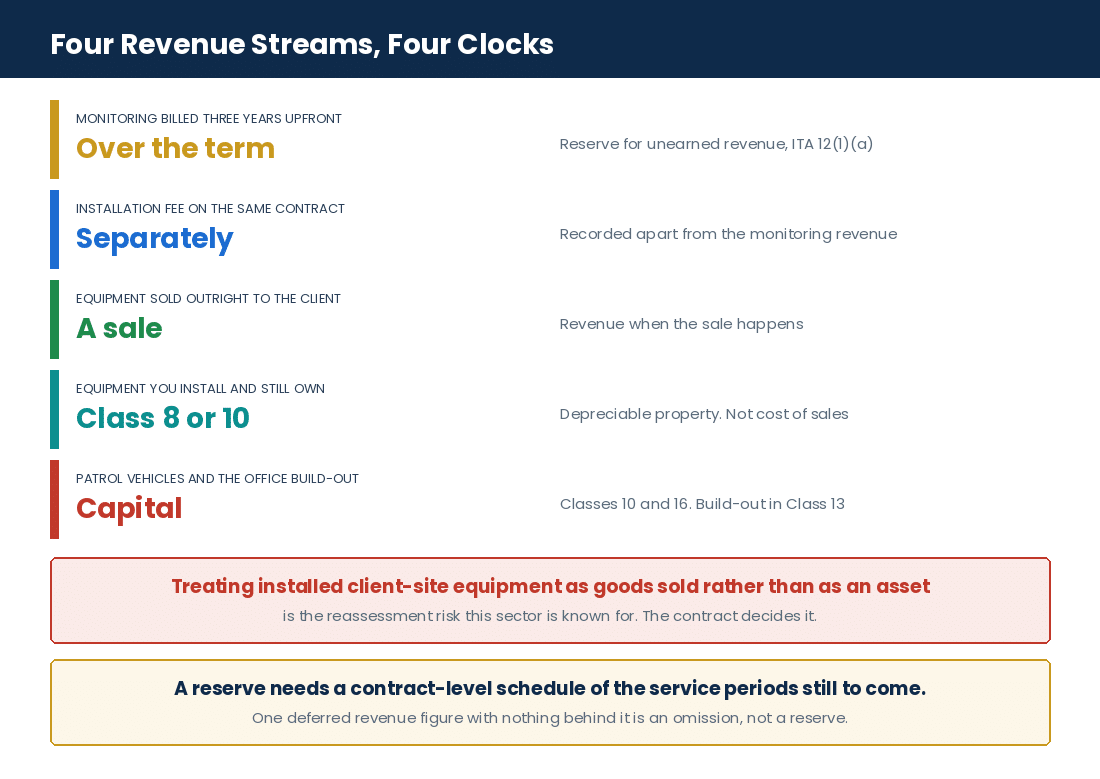
A monitoring company billed three years upfront on most of its contracts and recorded every dollar as revenue in the month the invoice went out.
The books showed a spike in one year and almost nothing in the next two, on a business whose actual activity was perfectly level. The reserve was available the whole time and nobody had claimed it. Fixing it moved tax out of a high year and into two low ones without changing a single contract. Figures changed for privacy.
Business Structures and Their Tax Implications for Security Companies
Business Structures and Their Tax Implications
Structure
Picking the right business structure matters a lot for security company taxes Canada. It affects how you handle your accounts and taxes too. The main types are sole proprietorships, partnerships, and corporations. Each one changes your liability, tax setup, record keeping, and how you follow CRA rules.
Security companies should choose based on their size and goals. That way, they can save on taxes and keep clear financial records that fit Canadian laws.
Comparing Sole Proprietorship, Partnership, and Corporation for Security Firms
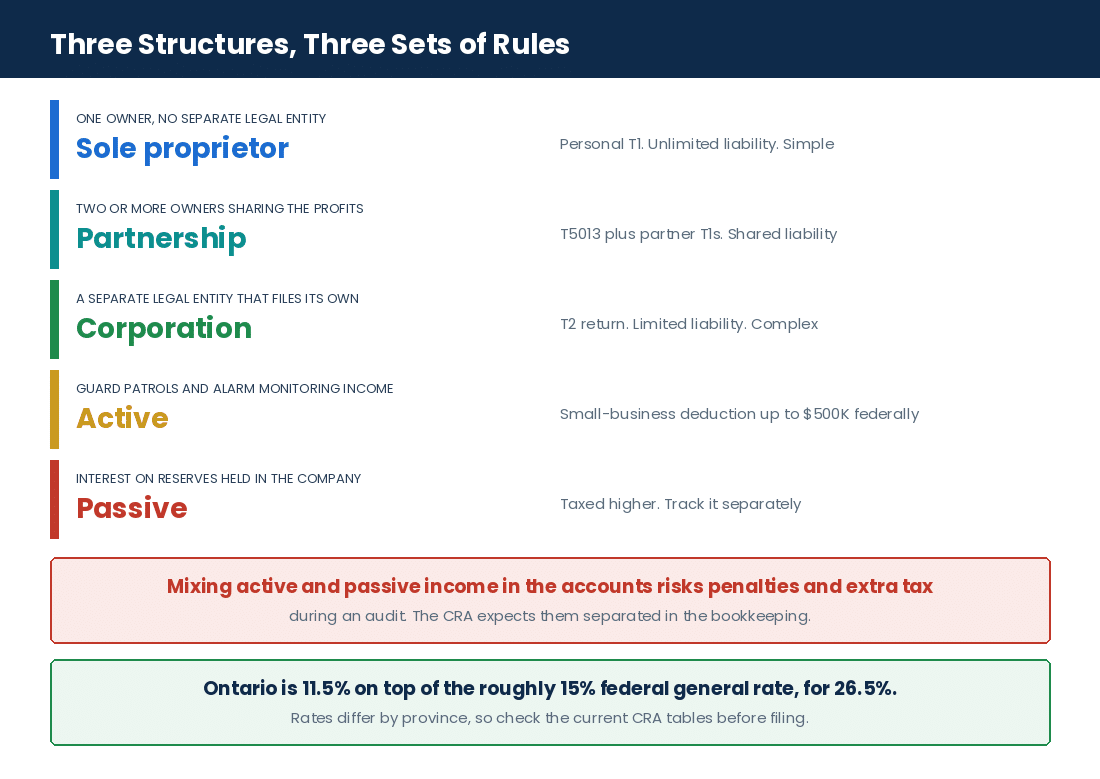
A sole proprietorship means one person owns the business. They report all income on their personal tax return (T1). This makes bookkeeping simple but puts the owner at risk for unlimited liability. Taxes are paid at the personal rate. There’s no separate corporate filing needed.
Partnerships file a T5013 partnership info return. But profits go to partners’ personal returns based on shares agreed upon. Partnerships don’t pay income tax themselves but must keep good records showing each partner’s share of profits or losses.
Corporations file separate T2 corporate tax returns. They pay federal and provincial corporate tax rates. Incorporating limits owners’ liability but brings more complex reporting needs. Corporations must prepare financial statements following CPA guidelines. They can also take advantage of lower small-business deduction limits in security business tax Canada.
| Structure | Tax Filing | Liability | Accounting Complexity |
|---|---|---|---|
| Sole Proprietorship | Personal T1 Return | Unlimited | Simple |
| Partnership | T5013 + Partner T1 Returns | Shared | Moderate |
| Corporation | Corporate T2 Return | Limited | Complex |
Sources: CRA – Business Structures
Benefits and Drawbacks of Incorporating a Security Business in Canada
Incorporation protects personal assets from business risks. This is key in security services where equipment or contracts can cause liabilities.
Some benefits include:
- Lower small-business corporate tax rates (around 12% federal plus provincial surtaxes).
- More credibility with clients.
- Easier ways to raise capital.
- Formal accounting systems following Canadian GAAP or ASPE.
Drawbacks include:
- Extra paperwork like annual filings with detailed financial statements by CPAs such as Gondaliya CPA Professional Corporation.
- Stricter compliance rules.
- Possible double taxation if dividends are not planned well.
- Higher costs for bookkeeping software licenses like QuickBooks used in security company accounting Canada.
You should think about these factors when planning to grow your business in Ontario or other parts of Canada where rules differ by province.
Impact of Business Structure on Tax Filing and Accounting Practices
Your business type decides which forms you file every year:
- Sole proprietors report net income on Schedule 4 with their T1.
- Partnerships file Form T5013 showing income shares but partners report it personally.
- Corporations submit detailed T2 returns with GIFI codes for security businesses plus GST/HST filings if registered.
Accounting gets trickier from sole proprietors to corporations:
- Sole proprietors track basic receipts like signed contracts.
- Corporations use accrual accounting that matches revenue over multi-year monitoring contracts per Income Tax Act rules.
Getting income classification right matters too. Reporting mistakes can cause penalties during CRA reviews focused on contract revenue timing.
Using tools like Xero along with payroll summaries helps keep everything organized across all structures. This also makes it easier for accountants to prepare year-end reports tailored to your industry needs.
Corporate Tax Rates Affecting Security Companies by Province
| Province/Territory | General Corporate Rate (%) |
|---|---|
| Ontario | 11.5 |
| Quebec | 11.5 |
| British Columbia | 12 |
| Alberta | 8 |
| Manitoba | 12 |
- Federal general rate is about 15%.
- Small-business deduction lowers federal rate under $500K active business limit.
- Rates show combined federal-provincial amounts after deductions.
- Check current CRA tables before filing taxes.
These rates impact where you decide to incorporate—especially if you serve clients across multiple provinces versus focusing in Ontario where Gondaliya CPA knows local rules well.
Effects of Active versus Passive Income on Security Business Taxation
Active income comes from actual services like guard patrols or alarm monitoring. This kind of income gets special tax breaks through the small-business deduction that reduces taxable amounts up to $500K federally. This helps manage cash flow in competitive fields like private investigations tied to security work.
Passive income means earnings inside a corporation from investments such as interest on reserves kept for future costs. This gets taxed higher because the law does not favor sheltering operating profits this way.
It’s important to keep these incomes separate in your accounts following strict bookkeeping rules required by the CRA for accurate reporting.
Mixing them up risks penalties and extra taxes during audits, so specialized knowledge in security company taxes Canada really helps make sure you’re filing correctly each year ending December unless you choose otherwise.
A guard company with two owners ran unincorporated for six years because incorporating looked like paperwork they did not need.
By the time they came to us they were leaving the whole profit on two personal returns at the top marginal rate, on a business that reinvested most of it in vehicles and equipment. The structure was costing them more every year than the compliance it avoided. Figures changed for privacy.
For clear advice matched to your security company accounting Canada needs—like picking the best structure based on your firm’s size—reach out to professionals familiar with this field such as Gondaliya CPA Professional Corporation known for thorough, accurate support backed by strong client feedback.
Security Company Tax Filing Processes and Deadlines
Tax Filing Processes and Deadlines
Filing
Filing taxes for a security company in Canada takes careful attention. You need to follow rules about income, deadlines, and documents. Doing tax work right helps you avoid penalties or audits. This part covers how to prepare returns, what to do if you have no income, when to file, what happens if you file late, record keeping, and corporate rules.
Key points to keep in mind:
- Follow Income Tax Act and CRA rules strictly
- File on time to avoid penalties
- Keep good records for proof
Preparing and Filing the T2 Corporation Income Tax Return
Every incorporated security company in Canada must file a T2 return. It shows your taxable income from services like monitoring contracts, installation fees, and equipment sales. You must separate fees by contract terms. Financial statements should match CRA guidelines, especially about deferred revenue from long contracts.
Make sure you have:
- Detailed contract schedules breaking down payments
- Info on owned equipment for claiming capital cost allowance (CCA)
- Accurate bookkeeping covering revenues and expenses
Use certified software to e-file the T2 return before the deadline. Also, report GST/HST collected separately but consistently with your tax filing.
Understanding Nil Corporate Tax Returns for Security Companies
If your security company made no taxable income or ran at a loss this year, you still have to file a complete T2 return—this is called a nil return. New companies or those investing heavily may fall here.
For nil returns:
- Show zero net income after deductions like payroll taxes or amortization
- File fully to avoid penalties
- Keep eligibility for future GST/HST credits or refunds
Submitting a nil return keeps your business in good standing with tax authorities.
Overview of Canada’s Corporate Tax Calendar and Deadlines
| Deadline Type | What It Means | Source |
|---|---|---|
| Fiscal Year-End | Set by company; many use Dec 31 | CRA Guide |
| T2 Tax Return Due Date | Within 6 months after fiscal year-end | Income Tax Act s230 |
| Payment Deadline | Usually 2 months post year-end; 3 months if small CCPCs | CRA Payments |
Late filings bring penalties and interest until full payment is made.
Consequences of Late Filings and Penalties
Missing deadlines costs money:
- Late-Filing Penalty: 5% of unpaid tax plus 1% each month up to 12 months
- Repeated Late Penalties: Extra charges if late more than once in 3 years
- Interest Charges: Interest grows daily on unpaid amounts after due date
You might get penalty relief if you show valid reasons for delay with evidence. Quick action helps here.
A company filed its T2 on time every year and paid the balance with the return, six months after year-end.
The filing was never late. The payment was, every single year, by four months. Interest had been accruing quietly on every balance for as long as the company had existed, and nobody had looked at the two deadlines separately. They are not the same date and they never have been. Figures changed for privacy.
Required Documentation for Accurate Security Company Tax Filing
Good records make tax filing easier and correct. Keep:
- Contracts that separate installation fees from monitoring fees
- Invoices showing equipment purchases by CCA class
- Financial statements following CPA standards
- Payroll summaries for guard wages
- GST/HST remittance files proving registration thresholds met
- Cancellation notes adjusting unearned revenue properly
Hold original documents for six years after the last related tax year. This helps during audits or reviews.
Role of Minute Books and Annual Returns in Corporate Compliance
Minute books hold important legal documents needed under Ontario law and by licensed CPA firms:
- Shareholder resolutions approving annual financials filed with T2 returns
- Records of directors’ meetings approving major moves like selling assets
- Annual returns confirming your company still legally exists
These support federal filings and keep you compliant, especially when dealing with complex contracts and asset ownership distinctions.
For help with security company taxes Canada including bookkeeping support specific to this sector, contact Gondaliya CPA — a licensed Ontario CPA firm with over “1300+ 5-star Google reviews.” Free consultation at info@gondaliyacpa.ca / 647‑212‑9559.
CRA Guide T4012, T2 Corporation Income Tax Guide · ITA Section 12(1)(a) & CRA Interpretation Bulletins re Deferred Revenue · ITA Schedule II — Capital Cost Allowance Classes Relevant To Security Equipment · CRA, Filing a corporation income tax return (nil returns) · ITA Section 230 – Time Limit For Assessments And Reassessments · CRA, Penalties, interest and relief · CRA, Business records retention requirements · Ontario Business Corporations Act – Record Keeping Requirements
Tax Deductions, Credits, and Planning for Security Businesses
Deductions, Credits and Planning
Savings
Security companies in Canada need to keep a close eye on their taxes. Knowing which expenses count, which credits you can claim, and how to plan owner pay helps your business save money. This guide covers what you should know about security company taxes Canada and security business tax Canada rules.
Eligible Business Expenses and Security Equipment Tax Deductions
You can write off many costs that relate directly to running your security company. These include:
- Wages for guards and subcontractors with contracts
- Insurance that applies just to your security work
- Training costs needed to meet licensing rules (but not the license fees)
- Uniforms used only at work
- Vehicle costs if you keep proper logs as CRA says
- Rent or lease expenses for your office space
- Accounting or bookkeeping fees
For equipment like alarm panels or monitoring devices installed at client sites, treat them as assets you own. You must add these to your capital cost allowance (CCA), usually under Class 8 or another fitting class. You can’t expense them all at once. Instead, claim depreciation over time based on CRA rates from when the equipment is ready to use.
Risk Warning: Treating installed client-site equipment wrongly as goods sold instead of assets can cause big reassessment risks (Income Tax Act).
If you treat these installed devices as goods sold instead of assets, it could cause trouble later. Keep detailed records like invoices tied to each site and maintain a current equipment list for smooth security company tax filing Canada.
Income Tax Act s.20(1)(a); CRA Guide T4002 · ITA s.18(1)(a) · ITA s.20(1)(m) · ITA Schedule II; CCA Classes 8 & 10 · CRA CCA guide
Utilizing Input Tax Credits (ITCs) in Security Company GST/HST Filings
When your security business registers for GST/HST, you can get back the taxes paid on eligible purchases through input tax credits (ITCs). If your total taxable sales go over $30,000 in a calendar quarter or four straight quarters, you must register.
You can claim ITCs on things like:
- GST/HST paid for monitoring gear
- Leasing vehicles used only for your services
- Utilities for offices used only by your business
- Professional services such as accounting linked to taxable sales
Always keep original receipts showing GST/HST amounts clearly separated from total charges. File GST/HST returns on time to avoid penalties.
Key Stat: The GST/HST registration threshold is $30,000 annual revenue across associated entities (Excise Tax Act).
Excise Tax Act ss.240(1),(3) · ETA s.165; CRA Interpretation Bulletin GI-010 · ETA s.169; CRA Guide RC4022 · ETA Schedule V; CRA Info Sheet GI-040R4 · Excise Tax Act ss123(1),221
Commonly Missed Tax Credits Applicable to Incorporated Security Firms
Some tax credits often slip past incorporated security firms’ radars. For example:
- Refundable scientific research credits if you develop surveillance tech improvements
- Investment tax credits if you spend money qualifying under federal innovation rules
Missed deadlines can trigger penalties, but relief may be possible if you act quickly after missing the corporate income tax filing deadline T2 (six months after fiscal year-end).
Review available credits yearly. This keeps more cash in hand and avoids needless fines.
Scientific Research & Experimental Development Program – Government of Canada · Income Tax Act s230(1); Penalty Relief Policy CPS-019 · T2 Corporation Income Tax Return Filing Deadlines – CRA
An alarm company spent two years building its own event-filtering logic to cut false dispatches, and never considered it research.
The work was done by staff who were otherwise billed to operations, so the cost was buried in wages and nobody had tracked it by project. The claim that could have been made was lost not because the work did not qualify but because nothing recorded who had spent what time on it. Figures changed for privacy.
Tax Strategies for Owner Compensation: Salary versus Dividends
Choosing between salary and dividends affects taxes and cash flow differently.
Salary means withholding payroll deductions sent monthly or quarterly based on CRA rules. It also adds CPP/QPP contributions and EI premiums unless exceptions apply.
Dividends don’t trigger payroll taxes but don’t build RRSP room or CPP pension credits either.
Many owners mix salary with dividends for better overall results while following payroll remittance frequency schedules carefully.
Getting advice tuned to incorporated Canadian security businesses helps make smart pay choices especially with changing rules expected into 2026.
Payroll Remittances – Frequency Rules – CRA Publication RC4010 · Employment Insurance Premiums – Source Deduction Tables – CRA · Dividend vs Salary Comparison – CPA Canada Insights
Managing Shareholder Loans and Related Tax Considerations
Shareholder loans need good paperwork showing they are real loans—not hidden dividends subject to Income Tax Act section 230(1).
If loans stay unpaid past one year end, CRA may add them back as income unless repaid or exceptions apply. Charging interest at market rates helps prove bona fide loans.
Keep clear records of why loans exist plus repayments made. This lowers audit risks common with private corporations including Ontario-based guard services advised by Gondaliya CPA.
If you file a voluntary disclosure before audits start, penalty relief may apply reducing extra charges.
Income Tax Act S230(1) · CPS-022 Voluntary Disclosures Program Guidelines · Corporate Finance Manual – Loan Documentation Best Practices · Penalty Relief Policies – CRA Official Guidance
Succession Planning and Tax Implications When Selling a Security Business
Selling your security company means watching out for capital cost allowance (CCA) recapture rules on depreciable assets like monitoring systems usually in Class 8. They depreciate at about 20% per year starting when first installed.
Recapture happens if sale proceeds exceed the asset’s undepreciated capital cost (UCC), adding taxable income. Terminal losses reduce income if proceeds fall short of UCC.
Good fixed asset records help calculate this right and avoid surprises during reassessments.
Smart succession plans might use phased buyouts with planned depreciation claims to cut immediate tax hits while keeping ownership smooth between shareholders. This is key in competitive Canadian markets including Ontario where Gondaliya CPA handles these complexities.
Income Taxes Technical News No55 — Capital Cost Allowance Updates · ITA Schedule II — Asset Classification Rules · Recapture & Terminal Loss Provisions — CRA Interpretative Bulletins · Fixed Asset Register Requirements — CPA Compilation Standards
Pro Tip: Keep an updated fixed asset register showing purchase dates, locations, class codes, and disposals for accurate CCA claims each year.
Our Take: Separating installation costs (capitalized) from ongoing monitoring service revenue lowers audit risks.
2026 Update: New guidance clarifies timing differences between billing installation fees versus monitoring revenue recognizing each separately (CRA Revenue Timing Bulletin).
For advice on security company accounting Canada needs—including deductions and tax planning—contact our licensed team at Gondaliya CPA today at info@gondaliyacpa.ca or call 647-212-9559.
Compliance, Audits, and Risk Management for Security Companies
Compliance, Audits and Risk Management
Risk
Security companies in Canada deal with complex tax rules. They need to get their security company taxes Canada right to avoid trouble. Filing taxes properly helps lower audit chances and keeps the business in good shape. This section breaks down what to expect from audits, time limits, tricky tax issues, and ways to reduce risks tied to security company tax filing Canada.
Understanding the Corporate Tax Audit Process in Canada
The CRA checks if a security company’s income and expenses match the rules in the Income Tax Act. They pick returns that show signs of risk—like odd revenue numbers or strange expense claims linked to security services.
During an audit, they want papers showing contract details, who owns equipment, schedules for deferred revenue, payroll info, GST/HST returns, and proof of bookkeeping. Here’s what they look for:
- Monitoring contract revenue: Income should match the contract’s timeline (LOCK rule).
- Installed equipment: Assets owned by the company must appear on books.
- Payroll: Source deductions must be paid on time.
Missing or messy records can cause reassessments or fines. Getting help early from a CPA who knows about security company accounting Canada can make audits less painful.
Statute of Limitations and Voluntary Disclosure Program (VDP) Benefits
CRA usually has three years after a notice of assessment to ask for changes. But if someone hides info or messes up reporting, this limit can stretch longer.
If a security company finds mistakes before CRA contacts them, it can fix things using the Voluntary Disclosure Program (VDP). VDP lets companies correct errors without penalties or charges if they’re honest and complete.
Here are some basics:
- VDP only works before an audit starts.
- All related years must be fully disclosed.
- Interest still applies but penalties might not.
Using VDP on time helps with proper security company tax filing Canada and lowers costs.
A patrol company classified every driver as a subcontractor because that is how the industry around it operated.
They used company vehicles, wore company uniforms, worked schedules the company set and had no other clients. When CRA looked, the assessment covered both halves of CPP and EI plus the income tax that should have been withheld, across three years, with penalties and interest on top. Nothing about the arrangement had changed in all that time. Figures changed for privacy.
Dealing with Uncertain Tax Treatments and Notifiable Transactions
Sometimes it’s hard to decide how tax rules apply. This happens with things like spreading income over long monitoring contracts or deciding if installed equipment counts as a capital asset.
Certain complicated deals—called notifiable transactions—must be reported under CRA rules. Examples for security firms include unique financing tied to equipment leases or packages mixing installation and monitoring fees.
Keeping solid contracts and talking with advisors early helps avoid problems. It makes sure the tax treatment fits current laws and cuts chances of fights later on.
Addressing Topics of Focus for Tax Authorities in the Security Sector
CRA auditors watch certain tricky areas closely:
| Focus Area | What They Check |
|---|---|
| When revenue is recorded | They check that long-term contracts report income over time, not all at once |
| Equipment ownership | Auditors verify if installed devices stay as assets or were sold |
| Cost types | They separate capital spending from regular expenses |
| Subcontractor payments | Proper worker classification and records matter here |
These areas often get more scrutiny because they’re complex. Keeping good books and clear proof strengthens your case during audits.
Preventing Tax Evasion and Aggressive Tax Avoidance
Tax evasion means hiding info or faking records to pay less tax. Aggressive avoidance uses tricky loopholes beyond what lawmakers meant. Both can hurt a business financially and damage its reputation in Canada.
To stay safe:
- Record everything honestly reflecting real business activity
- Follow Income Tax Act rules strictly
- Review numbers inside regularly against source papers
- Work with pros who know this industry well
Strong controls protect payroll taxes, GST/HST registration, depreciation claims, subcontractor rules, and other key areas important across provinces like Ontario.
Implications of the General Anti-Avoidance Rule (GAAR) on Security Firms
GAAR stops deals made mainly just to get tax breaks when those breaks go against the law’s spirit—even if technically legal otherwise. For Canadian security firms that split installation sales from monitoring services just for tax reasons, GAAR might undo benefits plus add interest fees.
GAAR looks at facts like contract terms plus court decisions applied nationwide but also pays attention to where operations happen provincially.
Companies should keep clear notes showing why deals exist beyond taxes—to prove real business reasons. Consulting CPAs who understand GAAR helps avoid surprise bills after filing.
Income Tax Act R.S.C., 1985 c. 1 (5th Supp.), s 9(1), s 12(1)(a) · CRA Business Audits Guide · Income Tax Act s152(4) · CRA Voluntary Disclosures Program · CPA Canada ASPE Section 3400 Revenue Recognition Guidance · Mandatory Disclosure Rules – Excise Tax Act ss165–169 · Income Tax Folio S4-F7-C1 – Deferred Revenue · ITA Regulation Schedule II Classifications · ITA Sections 18(1)(a), 20(1)(a), & related CCA classes · Employment Status Guidelines – CRA Employer Compliance Manual · Department of Justice – Criminal Code Part XII Offences Relating To Taxes · Source Deductions Remittance Deadlines – CRA Payroll Deductions Tables · Excise Tax Act Registration Thresholds & Filing Requirements · Capital Cost Allowance Classes Table – ITA Schedule II · Subcontractor Agreements Documentation Best Practices · General Anti-Avoidance Rule — Income Tax Act s245 · CPA Canada – General Anti-Avoidance Rule (GAAR)
For questions about security company taxes Canada compliance or risk management, contact Gondaliya CPA at info@gondaliyacpa.ca or call 647‑212‑9559. They offer free consultations focused on your firm’s specific needs across Ontario and beyond.
Security Company Tax Check
Five quick questions on how your security business runs. No fee shown.
Points to raise with us:
This is a general prompt, not tax or legal advice or a quote. Your position depends on your full facts. For a real review, please book a free consultation.
Professional Support and Advanced Services for Security Company Taxes
Professional Support and Advanced Services
Support
Security company taxes in Canada can get complicated fast. These businesses must follow specific rules about when to report revenue, how to treat equipment ownership, and how to file taxes correctly. Security companies have to be careful when reporting income under the Income Tax Act and Excise Tax Act. Good accounting helps avoid mistakes and finds chances to lower tax bills.
How Gondaliya CPA Supports Security Companies with Tax Filing and Accounting
Gondaliya CPA handles security company tax filing Canada with care and accuracy. We prepare corporate T2 returns that properly reflect income from contracts, installations, and equipment sales according to CRA rules. Our security company accounting Canada services keep books that match contract terms so income is recorded when earned, not just when money comes in.
We track installed equipment as depreciable property unless it’s sold outright. This approach lowers audit risks by following the LOCK (Liability-Ownership-Contract-Knowledge) principle from CRA.
- Prepare accurate T2 corporate filings
- Recognize revenue based on contract terms
- Classify equipment correctly as assets or sales
Customized Payroll and Bookkeeping Solutions for Security Businesses
Payroll is a key part of security company taxes Canada because of special deductions for guards’ wages, benefits, and allowances. Gondaliya CPA offers payroll systems tailored for security firms, integrated with bookkeeping tools like QuickBooks or Xero.
Our bookkeeping keeps track of both employee wages and subcontractor payments. We keep all records needed if CRA audits you. We also help you meet deadlines for payroll tax remittances so you avoid penalties.
- Manage payroll deductions precisely
- Track subcontractor payments properly
- Meet payroll remittance deadlines
Cross-Border Tax and Accounting Considerations for Canadian Security Companies
When security companies work across provinces, they face tricky GST/HST place-of-supply rules. Revenue from contracts done outside Ontario may have different tax rates or exemptions depending on where clients are located.
Gondaliya CPA guides you through these cross-border tax issues. We check if your business qualifies as a public service body, which affects input tax credits. We make sure you apply Excise Tax Act rules correctly on interprovincial supplies.
- Understand provincial GST/HST differences
- Confirm public service body status if applicable
- Allocate revenue following Excise Tax Act
A Toronto guard company won a national contract and charged Ontario HST on every site, because that is where the head office and the billing system were.
The rate follows the customer, not the office. Alberta and Saskatchewan sites had been charged more than was due for the better part of two years, the over-collected amounts still had to be remitted, and the client was entitled to ask for them back. Reconfiguring the billing took an afternoon. Unwinding it took two quarters. Figures changed for privacy.
Digital Transformation Tools to Streamline Security Company Financial Management
Digital tools help security company accounting Canada by cutting errors and saving time. Gondaliya CPA uses software like Hubdoc for automatic document capture, Wagepoint or ADP for payroll, Stripe or Rotessa for payments, plus cloud QuickBooks Online or Xero.
These tools give you a clear view of your cash flow tied to contract schedules. That’s important because many security contracts spread revenue over multiple years.
- Automate document capture
- Process payroll efficiently
- Link payments with accounting records
Leveraging Expert Tax Planning to Maximize Refunds and Minimize Liabilities
Good tax planning helps your security business tax Canada by spotting expenses you can deduct. These include uniforms, training fees, insurance premiums, leasehold improvements amortized over time, and capital cost allowance claims on assets like patrol vehicles.
Gondaliya CPA helps avoid misclassifications—like mixing build-out costs with equipment purchases—which could cause problems later. We also manage timing of reserve claims under section 12(1)(a) ITA.
Key points we cover:
- Deductible business expenses explained
- Proper classification of costs
- Timing strategies for reserves
Contact Gondaliya CPA for Comprehensive Security Company Tax and Accounting Services
If you want help with complex security business tax Canada-wide rules—like new 2026 filing updates—call Gondaliya CPA. Our Ontario-based firm offers flat-fee yearly packages covering bookkeeping through compilation statements. Over 1300+ Google reviews show clients trust our service.
Get in touch at 647-212-9559 or info@gondaliyacpa.ca for a free talk focused on your security company’s needs.
CRA Business Income · Income Tax Act s13(21), s18(1)(a); Excise Tax Act s165 · CRA Interpretation Bulletin IT-479R “Revenue Recognition” · CRA, Statutory deductions · CRA, Remitting source deductions · Place of Supply Rules – Excise Tax Act Part IX Schedule V · CRA GI-121, Public Service Bodies · Hubdoc Integration Overview · Leasehold Improvements CCA Class: ITA Schedule II Class 13 · Vehicle Classes & Limits: ITA Schedule II Classes 10 & 16 · Reserve Claims Section: Income Tax Act s12(1)(a)
Frequently Asked Questions (FAQs) on Security Company Taxes and Accounting in Canada
Frequently Asked Questions
Answers
What is the Corporate Tax Filing Deadline (T2) for security companies?+
What Capital Cost Allowance class applies to security equipment?+
How often must payroll remittances be filed for a security business?+
What is the tax reserve period for unearned revenue in security contracts?+
How long must financial records be retained for tax purposes?+
What is the Small Supplier Threshold for GST/HST registration?+
Can penalty relief be considered if a tax filing is late?+
What triggers a CRA review of security company tax filings?+
Essential Insights and Key Points
Key Points
Essential Insights for Security Company Taxes and Accounting: Key Points
| Topic | The Point |
|---|---|
| Table of Contents | Includes topics like deferred revenue, reserve claims, payroll frequency, retention rules, and capital cost allowance |
| Quick Answer | Monitoring contract income must match service periods; installation fees should be recorded separately; equipment sold outright treated as assets or sales |
| DIY vs CPA Firm | Filing taxes yourself risks errors; licensed CPA firms like Gondaliya CPA ensure compliance and optimize returns |
| Worked Examples | Include timing recognition on contracts, splitting installation fees from service income, distinguishing owned equipment from leased assets, and managing fleet/build-out costs accurately |
| Best Practices | Maintain clear fixed asset registers, separate revenue streams by contract type, track payroll meticulously, and meet all remittance deadlines |
| Accounting Comparison | DIY methods lack detailed knowledge; Non-CPA services may miss compliance nuances; CPA firms provide accurate reporting with strategic tax planning |
| Gondaliya CPA Workflow | We handle bookkeeping integration, prepare precise tax filings, manage payroll deductions, provide timely client communication, and support audit readiness |
| Deliverables Table | Annual T2 filings, GST/HST returns, payroll reports, bookkeeping summaries, financial statements following Canadian standards |
| Common Mistakes to Avoid | Mixing capital expenses with operational costs, inaccurate payroll filings, neglecting GST registration thresholds, poor record retention |
| Pre-engagement Checklist | Gather contracts with fee breakdowns, asset purchase invoices, payroll records, prior tax returns if any |
| Realistic Walkthrough | From initial document gathering through bookkeeping setup to final T2 submission and post-filing support explained step-by-step |
| Choosing a CPA Firm in Ontario | Look for licensing status (CPA Ontario), industry expertise in security businesses, transparent pricing models, strong client reviews such as Gondaliya CPA’s 1300+ 5-star Google ratings |
| Why Trust Gondaliya CPA | Proven experience with Canadian security companies’ tax complexities; personalized support; latest regulatory knowledge including 2026 updates |
| FAQs & Next Steps | Consult early to avoid penalties; request free consultation via info@gondaliyacpa.ca or call 647‑212‑9559 |
Key Questions Across Groups
Ten Questions
- Business structure choice?
- Contract terms clarity?
- Asset ownership proof?
- Payroll classification accuracy?
- GST/HST registration status?
- Record retention policies?
- Tax planning goals?
- Succession strategy?
- Audit preparedness?
- Digital tool use?
Of those ten questions, two decide most security company files: whether the contract terms are written clearly enough to support the revenue timing, and whether there is proof of who owns the equipment at each site.
Both are answered by documents that already exist somewhere in the business. Neither is a judgment call about tax law. The firms that sail through a review are the ones that can produce those two things in an afternoon. Figures changed for privacy.
For advanced SEO needs and technical schema setup related to security company accounting Canada topics such as Corporate Tax Filing Deadline (T2), Capital Cost Allowance Class for Equipment, Payroll Remittance Frequency rules plus glossary integration—contact Gondaliya CPA’s expert team today.
Businesses We Serve & Industry Spotlights
Industry Expertise
Security sits inside a wider group of contract-service and installed-equipment businesses, and the questions that decide a security company’s return — when the contract revenue is earned, who owns the hardware at the site, and whether the worker is staff or a subcontractor — recur across every one of these sectors.
| Industry | The Security Company Angle |
|---|---|
| Security companies | Monitoring revenue over the contract term, and installed equipment on the books |
| Security guard companies | Guard wages, overtime and the subcontractor classification question |
| Private investigators | Active service income and the small-business deduction |
| Alarm and camera installers | Installation billed separately from monitoring, on a different clock |
| Fire protection contractors | Installed systems the company still owns, inspected on a recurring contract |
| Elevator service companies | Multi-year service agreements billed in advance |
| Fleet owners | Patrol vehicles, logbooks and the class limits that apply to them |
| Cleaning and janitorial businesses | Dispersed workforces and the same worker classification risk |
| BPO companies and call centres | Monitoring station staffing and multi-province place of supply |
| Commercial landlords | The client side — who owns the device once it is fixed to the building |
| Construction equipment rental companies | Equipment on site that never changes hands, and the recapture on disposal |
- Security companies: The core of this work. Revenue timing on monitoring contracts and the asset-versus-sale call on installed equipment account for most of what CRA asks about.
- Security guard companies: Payroll is the whole file. Guard wages, overtime, statutory holiday pay and the question of whether the person on the gate is an employee or a contractor.
- Private investigators: Service income with almost no capital base, which makes the small-business deduction and the salary-versus-dividend question the main planning levers.
- Alarm and camera installers: Installation and monitoring are two supplies on two clocks, and the contract has to say which is which before the bookkeeping can.
- Fire protection contractors: Systems installed at a client site under a recurring inspection agreement, with the same ownership question and the same capital class.
- Elevator service companies: Multi-year service agreements billed up front, which is the reserve question arriving in a different sector.
- Fleet owners: Patrol vehicles carry their own capital classes and their own limits, and the logbook is what supports the business-use proportion.
- Cleaning and janitorial businesses: A dispersed workforce on flexible hours, assessed on the same classification factors as a guard roster.
- BPO companies and call centres: A monitoring station is a call centre with alarms, and billing clients in several provinces raises the same place-of-supply question.
- Commercial landlords: The other side of the contract. Whether a device fixed to the building belongs to the landlord or the security provider decides who depreciates it.
- Construction equipment rental companies: Equipment that sits on a customer’s site and never changes hands, with years of capital cost allowance coming back as recapture on disposal.
The sector changes and the three questions do not: when was the revenue earned, who owns the hardware, and is the worker staff or a contractor.
Across the security files we act for, those three account for the overwhelming majority of adjustments. None of them is a judgment call about tax law — each is a question about what the contracts, the invoices and the schedules actually say. Figures changed for privacy.
Professional Guidance and Quick Reference
Guidance
Essential Tax Points for Canadian Security Companies
Security companies lose money in a predictable set of ways: recording three years of monitoring revenue in the month it was invoiced, posting installed client-site equipment as cost of sales instead of carrying it as an asset, bundling installation and monitoring into one undifferentiated fee, classifying guards as subcontractors because the industry does, charging the head-office HST rate on out-of-province sites, paying the corporate balance with the return instead of two months after year-end, and keeping no fixed asset register to support the capital cost allowance claimed. Gondaliya CPA handles security company accounting and tax on a flat annual fee.
Quick Answers
At a Glance
- Federal general corporate rate: about 15%
- Ontario provincial rate: 11.5%, for a combined 26.5%
- Small-business deduction limit: $500K of active business income
- GST/HST registration: taxable sales over $30,000
- T2 filing: within six months of fiscal year-end
- Corporate payment: usually two months after year-end, three for small CCPCs
- Late-filing penalty: 5% of unpaid tax plus 1% a month to twelve months
- Security equipment: Class 8 or Class 10, depending on asset type and use
- Leasehold improvements: Class 13
- Patrol vehicles: Classes 10 and 16
- Nil return: still a full T2, even in a loss year
- Partnership return: T5013, with partners reporting personally
- Reserve on unearned revenue: ITA section 12(1)(a)
- Normal reassessment window: three years from the notice of assessment
- General Anti-Avoidance Rule: ITA s245
- Record retention: six years after the last related tax year
Who This Is For / Not For
Fit Check
- For: Canadian security businesses — guard and patrol companies, alarm monitoring providers, camera and access control installers, mobile patrol operators and private investigation firms.
- For: operators billing monitoring contracts in advance, or owning equipment installed at client sites.
- Not for: advice on provincial private security licensing, which is a separate regulatory regime administered in each province.
- Not for: in-house security departments of other businesses, which file no separate return. A company below the $30,000 GST/HST threshold is still in scope.
People Also Ask
Related Questions
We billed three years of monitoring upfront. Is that all income this year?+
Not necessarily. Monitoring contract income must match the service periods, which is what the reserve for unearned revenue exists for — it is claimed over the contract term, aligning income recognition with service delivery. The reserve needs a contract-level schedule behind it: a single deferred revenue figure with nothing supporting it is an omission rather than a reserve.
Is the alarm panel at the client’s site our asset or theirs?+
If you still own it, it is yours, and it goes on your books as depreciable property under Class 8 or Class 10 rather than through cost of sales. If it is sold outright to the customer, it is a sale. The contract is what settles it, which is why the ownership terms need to be explicit before the bookkeeping is done.
Are our guards employees or subcontractors?+
It depends on how the work actually runs, not on what the agreement is called. Proper worker classification and records matter here, and it is one of the areas CRA auditors watch most closely in this sector. Where the company sets the schedule, supplies the vehicle and the uniform, and the worker has no other clients, the answer is usually employment.
Which rate do we charge on sites in another province?+
The place-of-supply rules decide it, and the rate generally follows the customer rather than your office. A company billing nationally from Toronto charges several different rates in the same month. Configure the billing system to the rule rather than to the head-office address, because over-collected tax still has to be remitted.
Do we have to file if the company had no income?+
Yes. If your security company made no taxable income or ran at a loss, you still have to file a complete T2 return — a nil return. New companies and those investing heavily often fall here. Filing it keeps the business in good standing and preserves eligibility for future GST/HST credits or refunds.
Glossary of Key Terms for Security Company Tax
Definitions
- Deferred Revenue: income received but not yet earned.
- Reserve: an allowance for unearned income.
- Available for Use: when assets are ready.
- Recapture: taxable income from asset disposal.
- Place of Supply: GST/HST application location.
- Subcontract Guard: classification rules.
- Retention: document keeping requirements.
- LOCK principle: Liability-Ownership-Contract-Knowledge — the test applied to installed equipment and contract revenue.
- Capital Cost Allowance (CCA): depreciation claimed on assets over time, by class, rather than expensed at once.
- Undepreciated Capital Cost (UCC): the remaining pool balance in a class, against which recapture and terminal losses are measured.
Want a checklist to work from? You can download our free security company tax checklist before your consultation.
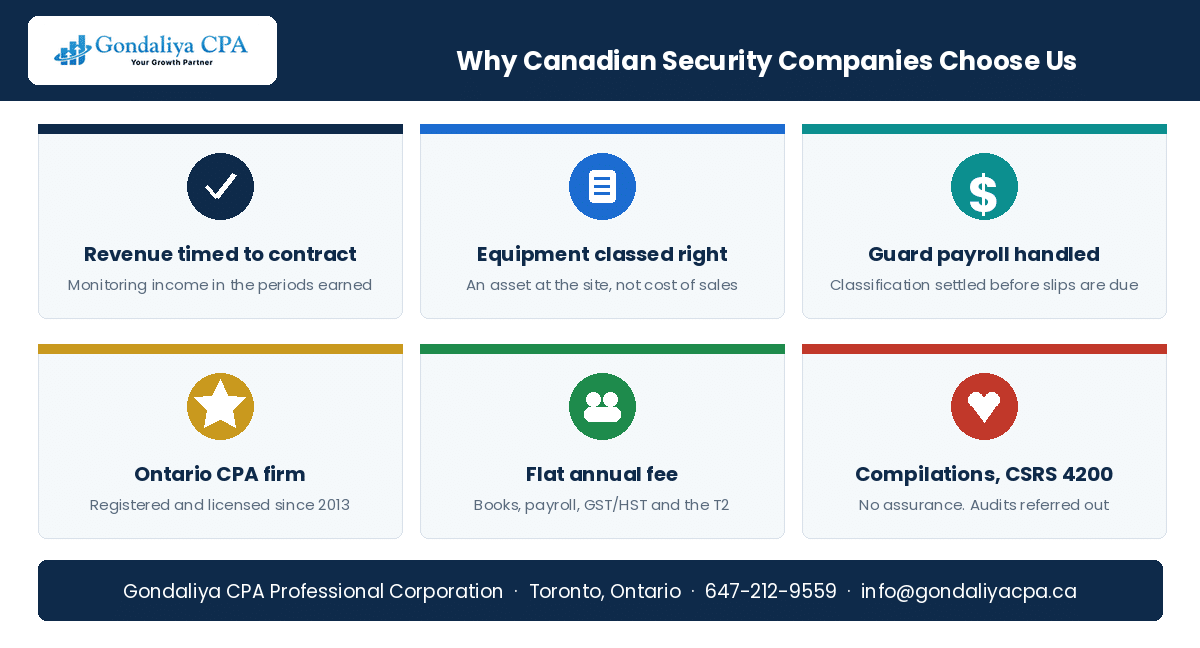
Three things decide a security company’s return, and all three live in the contract rather than the tax return. When the monitoring revenue is earned — it follows the service period, and the reserve for unearned revenue is what makes a three-year contract billed upfront land correctly across three years instead of one. Who owns the hardware at the site — equipment you still own is depreciable property in Class 8 or Class 10, not cost of sales, and treating it as goods sold is the reassessment risk this sector is known for. And whether the person on the gate is staff or a contractor — decided by how the work actually runs, with both halves of CPP and EI plus withheld tax riding on the answer. Then the rest: register for GST/HST past $30,000, charge the rate the customer’s province sets rather than your own, file the T2 within six months and pay the balance at two, keep a fixed asset register that supports every CCA claim, and hold the records six years.
Four documents tell us almost everything about a security company file. A signed client contract, because the revenue timing and the equipment ownership are both decided in it. An equipment invoice with the site it was installed at, because that is what supports the capital class and the available-for-use date. A payroll summary covering both employees and subcontractors, because the classification question is the most expensive one in this sector. And a fixed asset register, if one exists — and if it does not, that is usually the first thing we build. Bring those four and the first meeting is a review rather than an interview.
Security Company Taxes Canada: How Gondaliya CPA Can Help
Start with one client contract, one equipment invoice and your last payroll summary
Gondaliya CPA sets the revenue timing against the contract terms so monitoring income lands in the periods it was earned, carries installed client-site equipment as depreciable property in the right class with the available-for-use dates recorded, separates installation fees from monitoring revenue at the ledger rather than at year end, settles worker status for guards and subcontractors before the slips are due, applies the place-of-supply rules so multi-province billing charges the right rate, builds the fixed asset register that supports every capital cost allowance claim, and files the T2, GST/HST and payroll returns from one reconciled set of books — on a flat annual fee including HST with a one-business-day response. Please book a free consultation.
Next Steps
Please book a free consultation with Gondaliya CPA and bring four things: a signed client contract showing the fee breakdown, an equipment invoice with the site it was installed at, a payroll summary covering both employees and subcontractors, and your fixed asset register if you keep one. Those four settle the revenue timing, the equipment classification and the worker status question — which between them account for nearly every adjustment we make on a security company file. If you bill clients in more than one province, say so at the outset, because the place-of-supply rules change the rate on every invoice and a billing system configured to the head office is the commonest error we find. You will get a flat annual fee including HST before any work begins. We serve Toronto, Mississauga, Vaughan, Brampton, Etobicoke, Scarborough, Ottawa and the rest of Ontario, and work with security businesses across Canada. If our content helps, please add gondaliyacpa.ca as a preferred source on Google.
Published: · Last updated:
Editorial policy: We research against CRA, Department of Finance, Parliament of Canada, CPA Canada and CPA Ontario sources, fact-check the figures, and Sharad Gondaliya, CPA, reviews the content, which we update as the rules change.
Disclaimer: This article is educational information only and is not tax, legal, financial, licensing or regulatory advice. It covers federal and provincial income tax, GST/HST and payroll obligations for Canadian security businesses, and it does not cover provincial private security licensing, which is administered separately in each province and has its own registration, training and record-keeping requirements. Corporate tax rates, capital cost allowance classes, remittance thresholds and filing deadlines change, and the treatment of any particular contract depends on its own terms, including who owns the installed equipment and over what period the service is delivered. Gondaliya CPA performs compilation engagements under CSRS 4200 and does not perform audit or review engagements. Rates and limits change and outcomes depend on your specific facts. Please consult a licensed CPA before acting.

Sharad Gondaliya is a CPA Canada & CPA USA with 15 Years+ experience of Accounting, Tax, Payroll of Corporate Small Businesses as Tax Accountant. He is a CPA Ontario member (61040184) and holds US CPA licences in Washington and Montana and is well known among corporate small businesses for tax planning, efficient tax solutions, and affordable CPA services. Sharad is the Principal (Director) of Gondaliya CPA – Affordable CPA Firm in Canada. Licenses: CPA Ontario: 61040184 | CPA USA (MT): PAC-CPAP-LIC-033176 | CPA USA (WA): 57629 | CPA Firm License: 61330051 View Full Author Bio