



Duplex and Triplex Tax Deductions in Canada: Mortgage Interest, Repairs & Rental Expenses
Duplex and Triplex Tax Deductions Canada: A Guide to Rental Property Tax and Income for Landlords
Duplex tax deductions Canada and triplex tax deductions Canada offer landlords valuable ways to reduce taxable rental income through eligible expenses like mortgage interest, property taxes, and maintenance costs. Gondaliya CPA helps property owners understand how to claim these deductions properly while managing duplex rental property tax Canada and triplex rental income tax Canada requirements.
Quick Summary
A duplex or triplex you partly live in is the most apportionment-heavy property a small landlord will own. Mortgage interest is deductible under paragraph 20(1)(c), but only the share attributable to the rented units, and the principal never is. Financing fees come off over five years under paragraph 20(1)(e), not in the year you pay them. Repairs that restore are deducted now; improvements that add lasting value are capital, and paragraph 18(1)(b) is the line between them. Capital cost allowance puts the building in Class 1 at four per cent and appliances in Class 8, halved in the year of purchase by Regulation 1100(2), and Regulation 1100(11) stops it creating a rental loss. An ordinary rental loss is different: it comes off your other income for the year, including employment income, and only the excess becomes a non-capital loss under paragraph 111(1)(a). Everything goes on Form T776, and whichever basis you use to split costs, use the same one every year.
Reading time: 16 minutes.
Table of Contents
- Rental Income and Taxation for Duplex and Triplex Properties
- Types of Deductible Expenses
- Capital Cost Allowance and How It Applies
- Special Considerations for Duplex and Triplex Owners
- Calculating Net Rental Income and Record-Keeping
- Tax Implications When Selling
- Frequently Asked Questions
- Essential Insights for Landlords
- Businesses We Serve & Industry Spotlights
- Professional Guidance and Quick Reference
The Numbers That Matter
This article covers Canadian federal income tax for owners of duplex and triplex rental properties, with Ontario and Toronto context, and reflects rules current to 27 October 2026. It is written for landlords holding a two or three unit building, whether fully rented or partly owner-occupied, and it covers what counts as rental income, current versus capital expenses, mortgage interest and financing fees, apportioning shared costs, capital cost allowance and recapture, rental losses, co-ownership, non-resident landlords, record-keeping and Form T776, and the tax treatment of a sale. It is not a guide to provincial tenancy law or rent regulation, to municipal property tax assessment or appeals, or to whether a particular property qualifies for the principal residence exemption, which turns on the full facts. Gondaliya CPA performs compilation engagements under CSRS 4200, which provide no assurance; audit and review engagements are referred out. This is educational information only and not tax or legal advice.
Overview of Rental Income and Taxation for Duplex and Triplex Properties
Rental Income and Taxation for Duplex and Triplex Properties
Start Here
Understanding Rental Income and Its Taxable Nature
Rental income from duplex and triplex properties in Canada gets taxed. This means money landlords get from tenants counts as income. Rent is the main source, but it also includes fees, reimbursements, and some deposits. All these amounts must be reported on tax returns to follow the law.
What Qualifies as Rental Income: Rent, Fees, Reimbursements, and Deposits
When looking at triplex rental income tax in Canada, rental income covers more than just rent. It includes:
- Rent paid monthly by tenants
- Fees like late payments or pet charges
- Reimbursements for utilities or other shared costs
- Deposits that stay with the landlord after a lease ends can count as income if not returned
Knowing what counts helps landlords report correctly and claim any possible deductions.
Distinguishing Rental Income from Business Income for Landlords
The CRA treats rental income differently depending on how active a landlord is. If you only rent space in a duplex or triplex without extra services, it’s usually passive rental income. But if you offer services like cleaning or maintenance regularly, the CRA might see it as business income. Business income follows different tax rules than simple rental income.
How the Canada Revenue Agency (CRA) Monitors Rental Income Disclosures
The CRA watches rental incomes closely. They match information from banks and property sales with what landlords report. Landlords should keep good records like leases and bank statements. This proof helps during audits or if the CRA questions your reported income.
Reporting Rental Income Accurately on Tax Returns
Landlords must report all gross rents earned each year when filing taxes under duplex taxation rules in Canada. They use Form T776 – Statement of Real Estate Rentals to declare this money on personal tax returns (T1). Reporting less than actual rent can cause fines. Good records help claim expenses related to managing these rentals too.
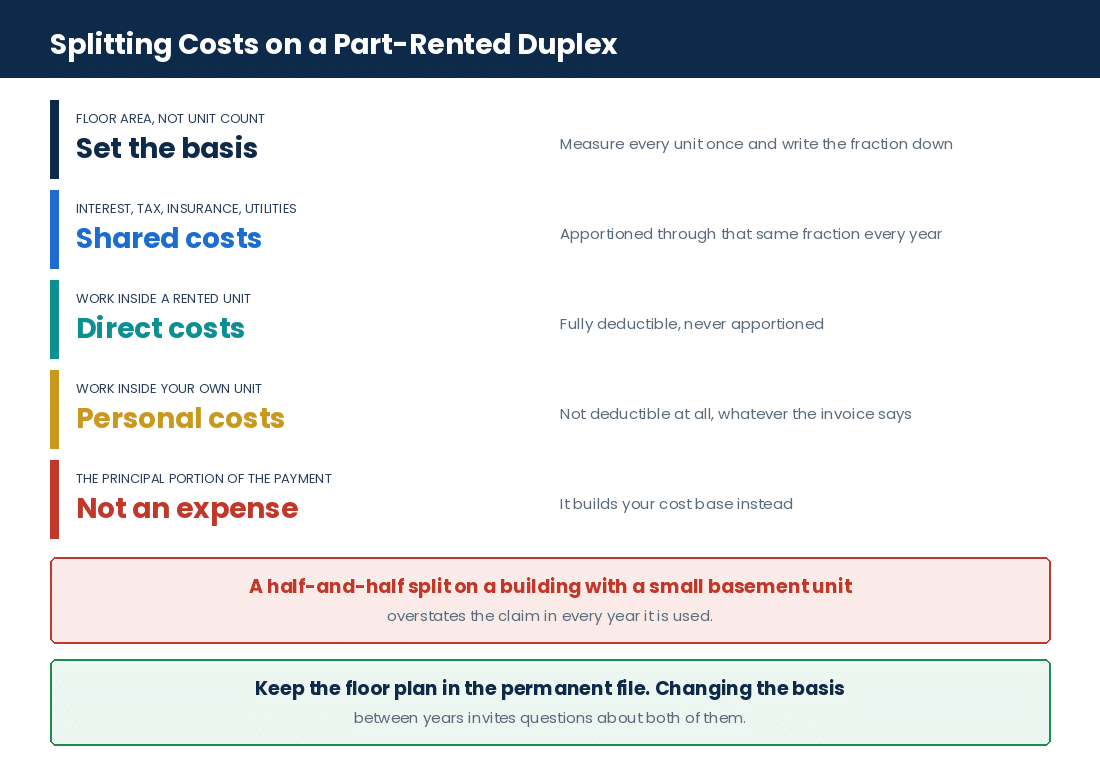
Owner-occupied duplexes are the files where apportionment gets decided once, informally, and then never revisited. Someone picks a half-and-half split in year one because the building has two units, keeps using it, and nobody asks whether the units are actually the same size.
They often are not. A basement unit at a third of the floor area carries a third of the shared costs, not half. Measuring once and writing the basis down takes an hour and settles the question for as long as the arrangement lasts. Figures changed for privacy.
Understanding these parts of duplex and triplex taxation lets landlords handle taxes better. It also helps them know what to report and which deductions apply to their properties in Canada.
Types of Deductible Expenses for Duplex and Triplex Rental Properties
Types of Deductible Expenses
What You Can Claim
If you own a duplex or triplex in Canada, you can claim different expenses to lower your rental income tax. It’s important to know which costs count as deductible under CRA rules. This helps you file your taxes right and avoid trouble. Here, we explain the main types of deductible expenses. We also look at current expenses versus capital expenses and how the CRA treats each.
Current Expenses Versus Capital Expenses
Current expenses cover costs to keep your property in its usual state. These do not increase the property’s value or life span. They include things like repairs, utilities, insurance paid for certain months, property taxes linked to rented parts, ads for tenants, management fees, wages tied to the rental work, travel for managing rentals, legal or accounting fees (CRA Line 8860), office costs related to rental activities (Line 8810), and everyday running costs.
Capital expenses are different. They cover big improvements that add value or extend your property’s life. Examples are major renovations or adding new features that last many years. You cannot deduct these right away. Instead, you add them to your capital cost allowance (CCA) and deduct some every year.
If you live in one unit of a duplex or triplex and rent out the others, you must split shared costs properly between personal use and rentals before claiming deductions [CRA Guide T4036]. The same split applies when deciding if an expense is current or capital. Work done on the whole building needs to be checked by what was done — not just by how much you spent [Income Tax Act para. 18(1)(b)].
Here’s a quick list to help:
- Current expenses cut your taxable income in the year you pay them.
- Capital expenses get deducted little by little over time via CCA.
- You must only claim amounts tied to rented spaces.
This distinction matches CRA advice on multi-unit properties like duplex tax deductions Canada and triplex tax deductions Canada.
Mortgage Interest and Loan Fees
You can deduct mortgage interest for loans partly used to earn rental income [Income Tax Act para. 20(1)(c)]. But paying back the loan principal is not deductible — it affects your cost base when selling instead.
Loan fees like origination charges can’t be deducted all at once either. You must spread them out over five years from when the loan starts under paragraph 20(1)(e).
Here’s how it breaks down:
- Mortgage interest: Deduct based on how much of the property is rented.
- Financing fees: Spread evenly over five years.
Usually, landlords pick a fair method — like using floor space ratios — and keep it consistent unless something big changes.
Mortgage principal gets claimed as an expense more often than any other single thing on a small landlord file. The reasoning is understandable: the payment leaves the account every month and it is unmistakably a cost of owning the building.
Only the interest is deductible. The principal portion is simply you buying more of the asset, and it comes back to you through the cost base when the property is eventually sold. The mortgage statement separates the two, which is why we ask for it rather than the bank statement. Figures changed for privacy.
Property Taxes and Utilities
You can deduct property taxes related only to rented units. You must split shared taxes fairly based on who uses what. Same with utilities — if tenants pay separately metered bills, those are fully deductible; if not, split them reasonably.
For example, water bills can be divided by tenant square footage vs owner space.
Insurance Premiums Prorated by Coverage Period
Insurance covers many months, often more than a year of tax time. You claim only the premium part for months when units were rented, and only the portion attributable to the rented space [Income Tax Act ss. 9(1), 18(1)(a); CRA Guide T4036].
If one policy covers both your personal space and rentals together, divide the cost fairly so only tenant coverage is claimed.
Advertising Related to Tenant Acquisition (Line 8521)
Costs for ads aimed at filling empty rental units count as current-year deductions. This includes online listings that help find tenants [CRA Form T776].
But ads not tied directly to getting renters don’t qualify here — they might fit somewhere else but need proof they relate clearly to rental income.
Repairs and Maintenance Expenses (Line 8960)
Fixing things that keep your property working counts as repairs deductible now — like patching walls or fixing leaks affecting tenant areas [Income Tax Act ss. 9(1), 18(1)(a)].
Don’t mix these with improvements that upgrade systems; those are capital expenses and deducted differently.
Remember: If work benefits both owner-used space and rentals, split costs properly before claiming.
Management and Administration Fees (Line 8871)
Paying someone else to manage tenant issues or collect rent? Those fees count as deductible management costs under this line [CRA Form T776 guide].
This covers agent commissions when they sign new leases too — whether you own a duplex or triplex in Canada.
Salaries, Wages and Employee Benefits (Line 9060)
If you hire staff just for helping with your rental properties — like part-time caretakers — you can deduct their wages and benefits here.
Make sure records prove their work is all about managing rentals; no personal jobs included.
Travel Expenses Associated With Property Management (Line 9200)
Trips you take strictly for managing your rental count as deductible travel expenses if backed up with detailed logs showing dates, reasons, and places visited.
If trips mix business with personal use, claim only the business portion fairly documented.
It helps prevent surprises from audits since CRA checks travel claims carefully across Ontario and other provinces often where duplexes and triplexes are common investments.
Keeping clear mileage logs is smart — especially if properties are far from where you live or office software tracks trips automatically.
Other Deductible Expenses and Prepaid Costs
You can also deduct landscaping services that maintain lawn areas around rental units, payments made when tenants break leases early, plus condo fees if applicable — all linked clearly to earning rental income.
Some prepaid costs need dividing between tax years based on when they apply — like prepaid rent or insurance premiums stretching into next fiscal period per CRA rules.
This guide should help Canadian landlords figure out what they can claim for their duplex tax deductions Canada style or triplex tax deductions Canada style without second guessing which side expense lands on.
Capital Cost Allowance (CCA) and Its Application to Duplex and Triplex Properties
Capital Cost Allowance and How It Applies
Depreciation
Definition and Purpose of Capital Cost Allowance for Rental Properties
Capital Cost Allowance, or CCA, lets owners of duplex and triplex buildings in Canada spread out the cost of their property’s wear and tear over time. Instead of taking one big tax deduction in a single year, they can claim smaller amounts yearly. This lowers the taxable income from duplex rental property tax Canada or triplex rental income tax Canada. The Income Tax Act supports this as a way to recognize that properties lose value each year.
The goal is to match expenses with rental income properly. The Canada Revenue Agency (CRA) requires clear records for any claims, especially if part of the building is owner-occupied and part rented. You must show which assets apply to your rental units to claim CCA correctly.
Eligible Capital Assets and Their CCA Classes
For duplex tax deductions Canada or triplex tax deductions Canada, different parts of your property fall into specific classes under Schedule II of the Income Tax Regulations:
- Buildings usually go into Class 1 with a fixed annual depreciation rate of four per cent.
- Appliances like fridges or stoves in rented units belong in Class 8.
- Other items like furniture may also count if they help generate rental income.
Each class has a set rate by CRA rules. It’s important to divide costs correctly based on bills or appraisals. That way, audits won’t flag your claims on duplex mortgage interest tax deduction or related expenses.
Calculating CCA Deductions and Understanding the Half-Year Rule
To figure out your CCA deduction, apply the right rate to the Undepreciated Capital Cost (UCC) at your fiscal year-end. UCC is what’s left after earlier claims reduce the asset’s value on paper.
Here’s the catch: The half-year rule limits how much you can claim in the year you buy an asset. Under Regulation 1100(2) of the Income Tax Regulations, you only use half the cost of the addition for that first year when calculating deductions. This stops landlords from writing off too much in one go for both duplex rental expenses Canada and triplex landlord accounting Canada.
| Asset Class | Rate (%) | Opening UCC ($) | Additions ($) | Half-Year Rule? | Deductible Amount ($) |
|---|---|---|---|---|---|
| Building (Class 1) | 4% | 300,000 | 50,000 | Yes | [(300k + (50k/2)) × 0.04] = 13,000 |
This rule spreads deductions out more evenly over years instead of front-loading them.
A Scarborough client had owned a triplex for eleven years and had never claimed capital cost allowance, which turned out to be the single best decision in the file. When he sold, the gain was about $240,000 and half of it was taxable. Had he claimed the allowance each year at four per cent on a building portion of roughly $310,000, he would have had around $108,000 of recapture coming back as ordinary income in the year of sale, on top of the taxable gain — and because he was already in a high bracket that year from the sale itself, the deferral he had skipped would have cost him more than it saved. The allowance is a timing choice, and on a property with a sale in prospect the timing usually runs the wrong way. Figures changed for privacy.
Benefits and Potential Drawbacks of Claiming CCA Including Recapture
Claiming CCA lowers taxable rent income now but can cause problems later:
Pros:
- Cuts current year’s taxes on rent income.
- Pushes some taxes into the future by spreading depreciation.
- Helps manage cash flow by reducing immediate taxes linked to duplex rental property tax Canada or triplex rental income tax Canada.
Cons:
- When you sell, any depreciation claimed beyond actual loss causes recapture. This adds back money as taxable income if sale proceeds are more than adjusted cost base minus past claims.
- Lowers Adjusted Cost Base, which may increase capital gains taxes later.
Tracking Undepreciated Capital Cost carefully is key during ownership. Firms like Gondaliya CPA help landlords with this in Ontario’s market.
Most small landlords should think hard before claiming CCA on the building at all. The four per cent is modest, the record-keeping runs for as long as you own the place, and the recapture on an eventual sale arrives as ordinary income at whatever rate you are paying that year.
Where it earns its place is a year with high rental profit and no prospect of selling soon. Where it rarely does is a property the owner expects to sell within a few years, or one already breaking even. It is optional, and treating it as automatic is the mistake. Figures changed for privacy.
Interaction Between Capital Expenses and Current Expense Deductions
You must decide if a cost is a current expense or capital expenditure:
- Current expenses fix damage or restore things to original condition. These get fully deducted in that tax year.
- Capital expenses improve or upgrade property beyond its original state. You need to add these costs as assets and claim depreciation via CCA over time [Income Tax Act para. 18(1)(b)].
Make sure you document what work was done well. If you share units between yourself and renters, split costs properly so only rental-related amounts get deducted on returns for duplex landlord tax filing rules.
When to Consider Applying CCA Versus Expense Classification
Choosing whether to claim a direct expense or apply CCA depends on two main points:
- Is it a repair or an improvement? CRA looks at whether the work gives a lasting benefit, and paragraph 18(1)(b) is what denies a deduction for an outlay on account of capital.
- Will claiming affect your overall taxes? Regulation 1100(11) prevents capital cost allowance on rental property from creating or increasing a rental loss.
Because of this limit, many landlords don’t always claim max CCA every year. They plan carefully when to take allowances — a strategy common among Toronto-area clients working with pros like Gondaliya CPA for duplex and triplex tax planning.
If you own a building with both personal use and rented spaces — or need help figuring out repairs versus improvements — talking to an accountant experienced in Canadian real estate tax is wise. They can guide you through proper recordkeeping and help avoid mistakes when filing taxes related to duplex mortgage interest tax deduction or rental property repair expenses.
For questions about your property’s unique situation — covering topics like financing fees treatment, repair costs, or recordkeeping — reach out to Gondaliya CPA at info@gondaliyacpa.ca or call 647-212-9559 for a free chat.
Duplex & Triplex Landlord Tax Check
Five quick questions on where your rental file stands. No fee shown.
Points to raise with us:
This is a general prompt, not tax or legal advice or a quote. Your position depends on your full facts. For a real review, please book a free consultation.
Special Considerations for Duplex and Triplex Rental Properties
Special Considerations for Duplex and Triplex Owners
The Tricky Parts
Owning a duplex or triplex in Canada brings some unique tax stuff to keep in mind. When you deal with rental income and expenses, things get a bit different than a regular rental. You gotta know how to split costs right, handle co-ownership, deal with losses, follow rules for landlords living outside Canada, and claim provincial credits. All these help with proper duplex tax deductions Canada and triplex tax deductions Canada.
Prorating Expenses for Partial Rental Use or Mixed-Use Properties
If you live in one unit of your duplex or triplex but rent out the others, you can’t just deduct everything. You have to split shared costs fairly. That includes mortgage interest, property taxes, insurance, utilities, repairs, and upkeep.
Usually, you base the split on floor space or how many units you rent out. The part you use yourself doesn’t count as a rental expense.
Here’s a simple way to think about it:
- Mortgage interest: Split by rented units’ floor area. Example: If two out of three units rent out, about 66% is deductible.
- Property taxes: Divide by number of rented units. Example: Two rented units means 67% deduction.
- Utilities: Use meters if possible to track tenant use only.
The CRA only lets you deduct expenses tied directly to rental income. This rule applies whether your duplex is partly owner-occupied or fully rented like a triplex.
Joint Ownership Implications and Reporting for Co-Owned Rentals
Owning a duplex or triplex with others makes reporting more tricky. Each owner must report their share based on legal ownership unless everyone agrees on another way.
Some examples:
- Two owners at 50/50 ownership each report half the rental income.
- Expenses like mortgage interest and repairs are also split by ownership shares.
Keep good records showing who got what rent and how expenses split up. This helps if CRA wants proof.
Handling Rental Losses and Carry-Forward Provisions
Sometimes rental costs go over what you earn from tenants. That means a loss — but rules limit what losses you can claim.
Important points:
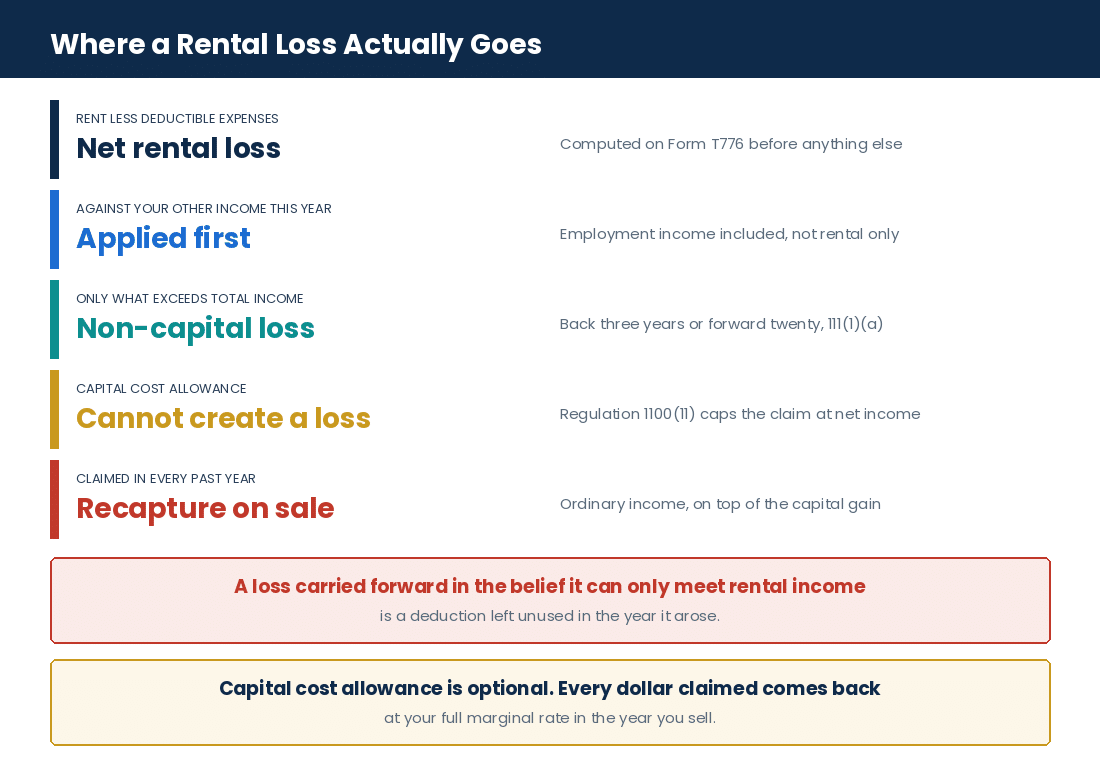
- You can’t use Capital Cost Allowance (CCA) to make a bigger loss.
- Regular expenses may cause small losses but need close attention.
A rental loss that is not created by capital cost allowance is applied against your other income for the year, including employment income. Only where it exceeds your total income does the balance become a non-capital loss, which can then be carried back three years or forward twenty under paragraph 111(1)(a) and applied against income generally. Keeping good books is key to staying within these rules.
A first-year duplex often runs at a loss, and the owner frequently has a salary. That combination is exactly where the loss is worth most, because it comes off employment income in the same year rather than waiting for the property to turn a profit.
We have seen people carry losses forward unnecessarily for years on the belief that rental losses can only meet rental income. They cannot be left sitting there: the deduction belongs in the year it arises. Figures changed for privacy.
Tax Rules Applicable to Landlords Residing Outside Canada
If you own a duplex or triplex in Canada but live abroad, some special rules apply:
- You have to file annual tax returns reporting all rental income from Canada.
- Tenants or agents often have to withhold tax unless CRA says otherwise.
Watch out for CRA checking full expense claims without clear splits between personal use and rentals. Also, keep your foreign address current with CRA so they can reach you. The withholding, the Form NR6 undertaking and the section 216 election are a subject of their own.
Treatment of Rental Income for Homeowners Working From Home
If you run a business or work from home in part of your duplex or triplex, the CRA expects careful cost splits.
You should:
- Split costs fairly between personal workspace and rented areas.
- Use things like square footage to show how you divided expenses.
Mortgage interest on your workspace isn’t deductible against rent income, since the workspace is not rented out, but a self-employed person can deduct the business-use portion against business income under subsection 18(12).
Claiming Applicable Provincial Tax Credits
Provincial and utility energy efficiency programmes change frequently, and any incentive received generally reduces the capital cost of the work rather than adding a separate deduction, so check the current terms before relying on one.
Make sure you include any relevant provincial claims when filing taxes along with your federal return. Talking with someone who knows both levels can help make sure no credits slip through.
For expert guidance tailored specifically toward duplex tax deductions Canada and triplex tax deductions Canada, contact Gondaliya CPA at 647-212-9559 or info@gondaliyacpa.ca for a free consultation today.
[1] Canada Revenue Agency — Guide T4036: Rental Income · [2] Income Tax Act s. 248(1) on co-ownership and partnership · [3] Income Tax Act para. 111(1)(a) — non-capital loss carryovers; Income Tax Regulations 1100(11) · [4] Canada Revenue Agency — Non-residents: Renting Out Your Property · [5] Income Tax Act s. 18(12) — work space in the home · [6] Government of Ontario and local utility energy efficiency programmes — confirm current terms
Calculating Net Rental Income and Record-Keeping Best Practices
Calculating Net Rental Income and Record-Keeping
The Paperwork
Figuring out net rental income for duplex and triplex properties in Canada means adding up all the rent you collect and then subtracting the expenses allowed by the CRA. You need good records to support your duplex tax deductions Canada or triplex tax deductions Canada. That helps with complying with CRA rules about duplex rental property tax Canada and triplex rental income tax Canada.
What you want to do:
- Track all rent from each unit over the year.
- Subtract costs linked to renting, like mortgage interest, repairs, property taxes, insurance, utilities paid by you, management fees, advertising, legal fees related to tenants (not disputes), and accounting fees.
- Make sure every expense has a receipt or proof showing it’s for your rental business.
Step-by-Step Approach to Calculating Net Rental Income
Start by adding up the total rent you get from every rented unit in your duplex or triplex over the year. Then subtract the costs that go with earning that rent. These costs include:
- Mortgage interest tied to rented parts (not principal)
- Repairs that fix things now (not big upgrades)
- Property taxes split between rented and owner space
- Insurance covering rented units
- Utilities paid by you for tenants
- Management and advertising fees
- Legal fees related to tenancy issues (not lawsuits)
- Accounting fees from professionals handling multi-unit rentals
Keep paperwork proving these expenses relate only to rental use.
Example: Say a Toronto landlord rents two units in a three-unit building for $36,000 a year. They pay $6,000 in mortgage interest split two thirds for those units, $1,200 in property taxes also split two thirds, $800 insurance, plus $2,500 in repairs for upkeep. Total deductible expenses are $8,100 — $4,000 of mortgage interest, $800 of property tax, $800 insurance and $2,500 repairs. That leaves $27,900 as net taxable rental income before considering any capital cost allowance claims.
A couple in Etobicoke came to us with three years of returns prepared on a 50/50 split of their duplex, on the reasoning that there were two units. The upper unit they lived in was about 1,450 square feet; the basement unit they rented was about 620. The correct fraction was closer to 30 per cent than 50, which meant roughly $4,900 a year of over-claimed interest, property tax and utilities across the three years. We filed T1 adjustments for all three rather than wait to be asked, measured the units properly, and put the floor plan in the permanent file so the same number is used every year from here. Figures changed for privacy.
Importance of Accurate and Organized Record-Keeping
Good records are key when you claim duplex tax deductions Canada or triplex tax deductions Canada. CRA wants proof for each expense linked to duplex rental property tax Canada or triplex rental income tax Canada.
Keep original receipts or scanned copies with dates and clear notes on what they are for. Store lease agreements where you can find them easily along with invoices for repairs or services just for rented parts. Keep bank statements separate if possible so rent deposits don’t get mixed with personal money.
Clear logs cut audit risks and make filling out Form T776 easier each year. They also help when you share costs between your own space and tenants’. The CRA expects you to use fair methods that you keep consistent over time.
A separate bank account for the rental side is the cheapest improvement a small landlord can make to their own file. It costs nothing and it converts a year of guesswork into a statement that reconciles.
Without one, rent deposits land among groceries and salary, and at year-end somebody is scrolling back through twelve months of personal banking trying to remember which hardware store trip was for the tenant’s bathroom. That reconstruction is where claims get lost. Figures changed for privacy.
Maintaining Logs for Motor Vehicle Use and Travel
If you drive for work tied directly to your rentals — like checking on properties or meeting contractors — keep detailed mileage logs. Note down:
- Date of trip
- Reason or purpose
- Where you went
- Kilometers driven
Also save fuel receipts if possible. Only count kilometers used strictly for earning triplex rental income tax Canada as deductible travel costs. Personal trips don’t count at all.
It’s best to update these logs as you go instead of trying to remember everything at year-end. That way your records stay accurate and CRA-friendly when claiming travel expenses related to managing rentals in Ontario or other provinces.
Using CRA Forms Such as Form T776
Landlords report rent earnings from duplexes or triplexes on Form T776 – Statement of Real Estate Rentals. This goes in with their yearly tax return. The form asks about total rents plus detailed expenses broken down by categories based on how much each unit earns.
You enter things like:
- Gross rent received
- Mortgage interest (only the part related to earning rent) not loan principal payments
- Repairs versus capital improvements (which have lasting value)
The CRA has instructions on how to fill this out properly. The line between a repair and an improvement is where renovation costs most often get misclassified, so check each project against what the work actually did.
Using bookkeeping software like QuickBooks or Xero helps keep info ready for Form T776. Firms like Gondaliya CPA offer services familiar with multi-unit rentals that can ease this process.
Available Tools and Resources
Several options help landlords deal with triplex rental income tax Canada matters:
- CRA website: Guides on what counts as deductible expenses specifically for residential rentals
- Tax software: Products that include Form T776 support so mistakes drop down
- Cloud bookkeeping: QuickBooks Online links directly with your bank feeds to organize transactions against approved deductions automatically
- Accounting services: Licensed Ontario CPA firms provide packages covering reports through filing while making sure claims stick within rules
These resources keep track of money flow linked only to your investment properties while cutting back time spent sorting complicated ownership stuff common among Canadian multiplex landlords.
For help preparing your duplex tax deductions in Canada — including bookkeeping focused on multi-unit buildings — contact Gondaliya CPA at 647-212-9559 or info@gondaliyacpa.ca today for a free consultation on maximizing benefits within CRA rules.
Tax Implications When Selling Duplex or Triplex Rental Properties
Tax Implications When Selling
On Exit
Selling a duplex or triplex rental property in Canada comes with specific tax rules. You need to think about capital gains tax, selling expenses you can deduct, and the possible recapture of depreciation claims. Knowing these things helps you handle your duplex tax deductions Canada and triplex tax deductions Canada correctly and avoid surprises with the CRA.
Overview of Capital Gains Tax on the Sale of Rental Properties
When you sell a duplex or triplex used as a rental, any profit counts as a capital gain. You figure this gain by subtracting the adjusted cost base (ACB) from the selling price. The ACB includes what you paid for the property plus certain improvements but not mortgage payments.
Only half of this gain is taxable income. You report it on your personal tax return (T1) or corporate return if a company owns the property. This applies whether it’s duplex rental property tax Canada or triplex rental income tax Canada.
Here are some key points:
- Half of net capital gains count as taxable income (Income Tax Act para. 38(a))
- Keep records of purchase price, improvements, and selling costs
- Accurate records help lower your taxable gains
Deductible Selling Expenses and Their Impact on Capital Gains
You can subtract some selling costs when figuring your capital gain on duplex or triplex sales. These include things like real estate commissions, legal fees for preparing sale papers, advertising costs for marketing the sale, appraisal fees asked by buyers or lenders, title transfer taxes if paid, and closing costs charged by professionals.
These deductions lower your proceeds, which means less capital gain to report under both duplex tax deductions Canada and triplex tax deductions Canada rules.
| Selling Expense | Treatment | Source |
|---|---|---|
| Real estate commission | Deductible against proceeds | CRA Guide T4037: Capital Gains |
| Legal fees (sale only) | Deductible as an outlay of disposition | Income Tax Act s. 40(1)(a)(i) |
| Advertising for sale | Deductible as an outlay of disposition | Income Tax Act s. 40(1)(a)(i) |
| Appraisal fees | Deductible if related to sale | CRA Guide T4037: Capital Gains |
Keep all invoices ready. Working with Gondaliya CPA can help you claim these properly.
Understanding CCA Recapture and Terminal Loss Rules
Over time, you claim Capital Cost Allowance (CCA) to reduce taxable income from rental buildings like duplexes or triplexes. But when you sell:
- CCA Recapture happens if sale proceeds are more than the remaining asset value but less than original cost. That difference becomes regular income.
- Terminal Loss happens if you sold all assets in that class and still have unclaimed CCA left. You can deduct this loss right away against other income.
These rules stop double benefits from claiming depreciation but then getting full sale price credit. They matter for both duplex tax deductions Canada and triplex cases.
Good tracking keeps you from surprise taxes when reporting yearly, especially with help from firms like Gondaliya CPA Professional Corporation in Ontario.
Recapture lands badly because of its timing. It arrives in the year of sale, as ordinary income, on top of the capital gain, and often in a year when the owner’s income is already higher than usual for exactly that reason.
Fifteen years of four per cent on a building is not a small number. Anyone who has claimed CCA throughout should have the recapture figure in front of them before they list, not after the deal firms. Figures changed for privacy.
GST/HST Considerations on Sale
GST/HST applies differently depending on how new or renovated your rental is. Generally:
- GST/HST applies where a builder sells a new or substantially renovated residential complex. Most resale residential property is exempt under Schedule V, Part I, and a builder who rents a unit out rather than selling it is caught by the self-supply rules in section 191, which turn on that change of use rather than on how long ago the building was finished.
- Older long-term rentals like typical owner-held duplexes or triplexes usually don’t have GST/HST on sale.
- If your units are mainly rented short-term commercially, GST/HST might apply.
Checking whether your property fits these rules helps avoid unexpected GST/HST charges when selling residential rentals in Ontario or across Canada.
Planning for Moving Expenses and New Home Purchases
Selling one part of your multiplex rental while buying another place — personal or investment — can affect moving expense claims:
- Moving costs usually aren’t deductible unless you move at least 40 kilometres closer to a job.
- Buying a new home doesn’t change your immediate taxes but will affect future adjusted cost bases when you sell later.
Make sure to plan carefully here, especially if dealing with triplex rental income tax Canada matters. Expert advice from accountants familiar with multiple-property moves is helpful.
Recommended Steps for Compliance and Tax Efficiency on a Sale
- Keep detailed records: contracts, receipts for repairs and selling expenses.
- Allocate ownership shares clearly if co-owned.
- Note any part-owner occupancy before claiming deductions.
- Check past CCA claims; prepare proper recapture and terminal loss schedules.
- Find out early about GST/HST applicability or exemptions.
- Hire CPAs who know multi-unit rentals and provincial laws, Ontario especially.
- File all required forms on time; stay transparent to reduce CRA audit risks.
Working with licensed professionals like Gondaliya CPA Professional Corporation helps keep everything straight according to Income Tax Act rules.
Frequently Asked Questions on Duplex and Triplex Rental Property Tax in Canada
Frequently Asked Questions
Answers
What is the Half-Year Rule for Capital Cost Allowance (CCA)?+
How long is the Financing Fee Amortization Period?+
What is the Rental Property Record Retention Period?+
When is the Income Tax Return Filing Deadline for rental income?+
Can rental expenses create a loss on my tax return?+
How does the GST/HST New Residential Rental Rebate work?+
What triggers a CRA review on duplex or triplex rental income?+
Should I file my duplex rental taxes myself or hire a CPA?+
How are shared costs split when I live in one unit and rent others?+
Can the apportionment basis for expenses change over time?+
Essential Insights for Duplex and Triplex Landlords
Essential Insights for Landlords
Key Points
Key concepts and best practices for duplex and triplex rental taxation:
- Mortgage Interest Apportionment: Allocate mortgage interest only to rented units based on floor space or unit count.
- Property Management Fees: Deduct fees paid to property managers as current expenses linked directly to rental activities.
- Financing and legal fees: Legal fees related to leasing can be deducted immediately; financing fees must be amortized over five years.
- Repair or Improvement Testing: Determine if work restores original condition (repair) or adds lasting value (improvement) to classify expenses correctly.
- Work Affecting Entire Building: Costs like roof replacement serving all units require prorated allocation between personal use and rentals before deduction.
- Pre-Rental Work Treatment: Expenses incurred before renting generally become part of the property’s capital cost, not current expenses.
- Should CCA Be Claimed Annually? Claiming CCA reduces taxable income but may increase recapture risk; many landlords defer claiming it strategically.
- Handling Previous Full Expense Claims: Avoid double claims by adjusting current-year deductions if expenses were fully claimed before.
- Rental Loss Limitation: Regulation 1100(11) stops capital cost allowance from creating or increasing a rental loss; plan CCA claims accordingly.
Practical Tips for Managing Duplex and Triplex Rental Taxes
- Keep detailed logs of motor vehicle travel strictly related to rental management tasks.
- Maintain organized receipts and lease agreements accessible for audits or tax filing needs.
- Use Form T776 annually to report all rental income and expenses accurately per CRA guidelines.
- Track Undepreciated Capital Cost (UCC) carefully to manage depreciation claims and future recapture scenarios.
- Choose consistent apportionment methods for shared expenses; update only when justified with proof.
Why Trust Gondaliya CPA?
Gondaliya CPA offers specialized knowledge in Canadian multiplex taxation, focusing on duplexes and triplexes. We provide personalized services including record keeping guidance, tax planning strategies around CCA, expense classification help, and audit support. Our firm helps landlords across Ontario maximize deductions while ensuring full CRA compliance.
For more personalized advice on duplex tax deductions Canada or triplex tax deductions Canada, contact Gondaliya CPA at info@gondaliyacpa.ca or call 647-212-9559 today.
Businesses We Serve & Industry Spotlights
Industry Expertise
Duplex and triplex owners sit inside a wider group of small landlords, and the questions that decide one of these files — how shared costs get split, whether work was a repair or an improvement, and whether to claim the allowance at all — recur across every one of these situations.
| Who | The Landlord Angle |
|---|---|
| Duplex and triplex owners | Apportioning shared costs, and buildings below the separate-class threshold |
| Rental property owners | Form T776, current versus capital, and recapture on sale |
| Basement apartment owners | Part-use of a principal residence and the change-in-use rules |
| Student rental owners | Turnover, furnishing costs and short occupancy cycles |
| Multi-residential building owners | A separate CCA class per building once $50,000 is passed |
| Commercial landlords | Taxable rent and a different GST/HST position entirely |
| Foreign investors in Canadian real estate | Part XIII withholding and the section 216 election |
| Real estate syndicators | Partnership reporting and allocations among investors |
| Joint venture businesses | Co-ownership reporting without a partnership return |
| House flippers | Inventory and business income rather than capital property |
| Home-based businesses | Work space in the home under subsection 18(12) |
Spotlights: duplex and triplex owners · rental property owners · basement apartment owners · student rental owners · multi-residential building owners · commercial landlords · foreign investors in Canadian real estate · real estate syndicators · joint venture businesses · house flippers · home-based businesses.
Professional Guidance and Quick Reference
Guidance
Essential Tax Points for Canadian Duplex and Triplex Landlords
Small landlord files go wrong in a predictable set of ways: mortgage principal claimed alongside the interest; a half-and-half split used on a building whose units are nowhere near the same size, and never revisited; financing fees deducted in full in year one instead of over five; a renovation expensed when the work plainly added lasting value; capital cost allowance claimed every year out of habit, with the recapture discovered at closing; and a first-year rental loss carried forward in the belief that it can only meet rental income. Gondaliya CPA prepares small landlord returns on a flat annual fee.
Quick Answers
At a Glance
- Mortgage interest: deductible under 20(1)(c), apportioned to the rented units
- Mortgage principal: never deductible, but it builds your cost base
- Financing fees: five years under 20(1)(e), not all in year one
- Repairs: restore to original condition, deducted now
- Improvements: lasting benefit, capital, denied by 18(1)(b)
- Apportionment: floor area or unit count, same basis every year
- Pre-rental work: generally capital, not a current expense
- Building: Class 1, four per cent
- Appliances: Class 8
- First year: half the claim, Regulation 1100(2)
- CCA limit: Regulation 1100(11) stops it creating a rental loss
- Ordinary rental loss: comes off your other income, including salary
- Excess loss: non-capital loss, back three years or forward twenty, under 111(1)(a)
- Recapture: ordinary income in the year of sale, on top of the gain
- Terminal loss: fully deductible against other income
- Capital gain: half taxable, paragraph 38(a)
- Selling costs: outlays of disposition under 40(1)(a)(i)
- Reporting: Form T776, filed with the T1
Who This Is For / Not For
Fit Check
- For: owners of a two or three unit building, fully rented or partly owner-occupied, filing on Form T776 with a personal return.
- For: landlords unsure how to split shared costs, whether a renovation was a repair, or whether claiming the allowance is worth the recapture later.
- Not for: provincial tenancy law, rent regulation or above-guideline increases, and not for municipal assessment appeals, each handled separately.
- Not for: deciding whether the principal residence exemption covers part of the building, which turns on the full facts and is worth proper advice before a sale.
People Also Ask
Related Questions
Can I deduct my whole mortgage payment?+
Only the interest, and only the share attributable to the rented units. The principal portion is not an expense at all — it is you acquiring more of the asset, and it comes back through the cost base when you sell. Your mortgage statement separates interest from principal, which is why that statement rather than the bank record is what an accountant asks for.
I live in one unit. What share of the costs can I claim?+
The share attributable to the rented units, on a basis you can justify and then keep to. Floor area is usually the most defensible, because units in the same building are often very different sizes — a basement unit at a third of the area carries a third of the shared costs, not half just because there are two units. Measure once, write the basis down, and apply it consistently.
My rental lost money this year. Can I use that against my salary?+
Yes, provided the loss was not created by capital cost allowance. An ordinary rental loss is a loss from property and comes off your other income for the year, salary included. Only where it exceeds your total income does the balance become a non-capital loss under paragraph 111(1)(a). What cannot create a loss is the allowance itself, which Regulation 1100(11) restricts.
New roof: repair or improvement?+
It depends on what the work did rather than what it cost. Replacing worn shingles with equivalent shingles restores the building and is a repair. Replacing a roof with a materially better one, or one that extends the building’s life beyond its original state, is capital and goes into Class 1. Paragraph 18(1)(b) is the provision doing the work here, and on a duplex the cost is apportioned either way.
Should I claim CCA on the building?+
Often not. The rate is four per cent, you must track undepreciated capital cost for as long as you own the property, and the whole amount comes back as recapture in the year you sell, as ordinary income on top of the capital gain. It earns its place in a high-profit year with no sale in prospect. It rarely does on a property you expect to sell within a few years. The claim is optional, which is the point most people miss.
Glossary of Key Terms
Definitions
- Duplex: a building containing two self-contained dwelling units.
- Triplex: a building containing three self-contained dwelling units.
- Owner-occupied: where the landlord lives in one unit and rents the others.
- Apportionment: splitting a shared cost between personal and rental use, usually by floor area.
- Current expense: a cost that restores or maintains, deducted in the year incurred.
- Capital expense: a cost that improves or extends life, added to the asset and recovered through CCA.
- Capital cost allowance (CCA): the optional deduction spreading an asset’s cost over several years.
- Class 1: the CCA class for buildings, at four per cent.
- Class 8: the CCA class for appliances and general equipment, at 20%.
- Half-year rule: Regulation 1100(2), halving the first-year claim on additions.
- Rental loss restriction: Regulation 1100(11), preventing CCA from creating or increasing a rental loss.
- Undepreciated capital cost (UCC): the balance of a class after CCA claimed to date.
- Recapture: CCA brought back into income on sale, as ordinary income.
- Terminal loss: the deductible shortfall when a class is emptied below its UCC.
- Non-capital loss: an unused business or property loss, carried back three years or forward twenty.
- Adjusted cost base (ACB): cost plus improvements and acquisition costs, used to compute the gain.
- Outlays of disposition: selling costs deducted in computing the gain under 40(1)(a)(i).
- Form T776: the Statement of Real Estate Rentals, filed with a personal return.
Want a checklist to work from? You can download our free duplex and triplex landlord tax checklist before your consultation.
Four things decide a duplex or triplex file. How the building is split — by floor area rather than unit count where the units differ in size, written down once and applied the same way every year, because every shared cost on the property runs through that fraction. Whether the work was a repair or an improvement — restoring is deductible now, adding lasting value is capital and denied by paragraph 18(1)(b), and the invoice description rarely settles it. Whether to claim capital cost allowance at all — it is optional, Regulation 1100(11) stops it creating a rental loss anyway, and every dollar claimed comes back as recapture in the year you sell. And what happens to a loss — an ordinary rental loss comes off your other income including employment income, and only the excess becomes a non-capital loss under paragraph 111(1)(a).
Three questions tell you where you stand, and the first takes a tape measure. First, do you know the floor area of each unit? Without it there is no defensible split, and a half-and-half assumption on a building with a small basement unit overstates the claim. Second, are you deducting mortgage interest or the whole payment? If the figure in your accounts matches what left your bank each month, the principal is in there and it should not be. Third, have you claimed capital cost allowance in any past year? If so, there is undepreciated capital cost to track and recapture waiting at the sale, and you need to know the balance before you plan a disposition.
Duplex and Triplex Taxes Canada: How Gondaliya CPA Can Help
Start with your mortgage statements and the floor areas
Gondaliya CPA sets an apportionment basis you can defend and applies it consistently, separates interest from principal off the mortgage statement rather than the bank record, amortises financing fees over five years instead of deducting them at once, tests each renovation against paragraph 18(1)(b) before it goes in as a repair, decides whether capital cost allowance is worth claiming on your facts rather than by default, tracks undepreciated capital cost so the recapture is not a surprise at closing, applies rental losses against your other income in the right order, reports co-ownership shares correctly across owners, and prepares Form T776 with the T1 behind it — on a flat annual fee including HST with a one-business-day response. Please book a free consultation.
Next Steps
Please book a free consultation with Gondaliya CPA and bring four things: your mortgage statements for the year, the floor areas of each unit, your invoices for any work done on the building, and any past year in which you claimed capital cost allowance. Those four settle the apportionment, the interest deduction, the repair-or-improvement question and the recapture position — which between them account for nearly every difficulty we see on a small landlord file. If you have never measured the units, say so at the outset; it takes an afternoon and it is the single thing that makes the rest of the return defensible. We advise on Canadian federal tax; provincial tenancy law, rent regulation and municipal assessment appeals are handled separately, and whether the principal residence exemption covers part of the building is worth advice of its own before a sale. You will get a flat annual fee including HST before any work begins. We serve Toronto, Mississauga, Brampton, Vaughan, Etobicoke, Scarborough, Hamilton, Ottawa and the rest of Ontario, and work with landlords across Canada. If our content helps, please add gondaliyacpa.ca as a preferred source on Google.
Published: · Last updated:
Editorial policy: We research against CRA, Department of Finance, Parliament of Canada, CPA Canada and CPA Ontario sources, fact-check the figures, and Sharad Gondaliya, CPA, reviews the content, which we update as the rules change.
Disclaimer: This article is educational information only and is not tax, legal or financial advice. It covers Canadian federal income tax for residents owning duplex and triplex rental properties, including rental income, current versus capital expenses, mortgage interest and financing fees, apportioning shared costs, capital cost allowance and recapture, rental losses, co-ownership, non-resident withholding, Form T776 and the tax treatment of a sale. It does not cover provincial tenancy law or rent regulation, municipal property tax assessment or appeals, or whether a property qualifies for the principal residence exemption, each of which is handled separately and turns on the full facts. Whether a particular expenditure is a repair or a capital improvement, and whether a given apportionment is reasonable, both depend on the specific circumstances. Rates, classes, filing deadlines and statutory references change; every reference should be confirmed against current CRA guidance before a return is filed. Gondaliya CPA performs compilation engagements under CSRS 4200 and does not perform audit or review engagements. Please consult a licensed CPA before acting.
