



Online Reseller Tax Filing in Canada: Inventory, Sales Income & Business Expenses
Online Reseller Taxes Canada Explained: Filing GST/HST, Bookkeeping Tips, and Online Reseller Income Tax Canada Guide
Online reseller taxes Canada explained by Gondaliya CPA covers essential topics like GST/HST filing, bookkeeping tips, and reporting online selling income accurately. Our expertise helps ecommerce resellers handle tax filing, corporate tax requirements, and income tax reporting to meet all Canada tax obligations.
Quick Summary
Reselling looks simple to account for and is not, because three different numbers all feel like revenue. Report gross sales, meaning what the buyer paid, with platform fees and payment processing shown separately as expenses rather than netted off the top. Only the cost of goods actually sold comes off, which is why inventory has to be counted and valued under section 10(1) at the lower of cost and fair market value, using one method you keep to year after year. GST/HST registration turns on $30,000 of worldwide taxable supplies across four consecutive quarters or in a single quarter, counting every platform together. The self-employed filing deadline is June 15, though any balance owing is still due April 30 and interest runs from there. Capital cost allowance on your equipment is halved in the year you buy it under Regulation 1100(2), and unlike rental property it can create a business loss. And records run six years from the end of the last tax year they relate to.
Reading time: 13 minutes.
Table of Contents
- Understanding Your Tax Filing Obligations
- Reporting Sales Income and Managing Inventory
- Deductible Business Expenses for Resellers
- GST/HST Filing Requirements
- Corporate and Personal Income Tax Considerations
- Tax and Accounting Services for Online Resellers
- Frequently Asked Questions
- Essential Insights for Resellers
- Businesses We Serve & Industry Spotlights
- Professional Guidance and Quick Reference
The Numbers That Matter
This article covers Canadian federal income tax and GST/HST for residents running online reselling businesses, with Ontario and Toronto context, and reflects rules current to 27 October 2026. It is written for resellers buying goods to sell on at a profit, whether as a sole proprietor or through a corporation, and it covers gross versus net revenue, inventory valuation and year-end counts, deductible expenses, the work space in the home test, capital cost allowance, GST/HST registration and input tax credits, and the choice between salary and dividends. It is not a guide to provincial sales taxes outside the HST provinces, to US or other foreign sales tax obligations, or to whether a particular sale is a business transaction or the disposal of a personal item, which turns on the full facts. Gondaliya CPA performs compilation engagements under CSRS 4200, which provide no assurance; audit and review engagements are referred out. This is educational information only and not tax or legal advice.
Online Reseller Taxes Canada: Understanding Your Tax Filing Obligations
Understanding Your Tax Filing Obligations
Start Here
Figuring out online reseller tax filing in Canada can feel tricky at first. But knowing your duties makes it easier. If you run an online reselling business, you gotta file taxes the right way. That way, CRA won’t give you any trouble. Here’s a simple guide about online reseller taxes in Canada.
What are online reseller taxes? They’re taxes on money you make selling stuff online.
Who needs to file? Anyone with an online reselling business has to report their income and costs.
When do I file my tax return? If you are self-employed, which most online resellers are, your return is due June 15, but any balance owing is still due April 30.
How do I calculate my taxable income? Add up all sales, then subtract any costs that count.
TL;DR
- Online resellers must show all sales as income.
- Keep good records of what you buy and sell.
- Deduct business costs when you file your tax return.
- Know if CRA thinks you’re a business or just a hobby seller.
Who This Is For / Not For. This info fits people running a one-person online resale business, and companies that sell stuff on the internet. It may NOT fit people who sell personal things sometimes without trying to make profit.
Knowing basics of online reseller tax filing in Canada helps you follow CRA rules and save money on your taxes.
What Are Online Reseller Taxes in Canada?
Online reseller taxes mean the rules for reporting money made from selling products online. The Income Tax Act says all this money counts as taxable income unless you prove otherwise (Income Tax Act section 9(1)).
- You must report ALL earnings as total sales before taking anything off.
- You can often subtract costs that helped you make that money to pay less tax.
How Do I File My Online Reselling Business Tax Return?
Follow these steps:
- Collect all papers like receipts for things you bought and proof of sales.
- Add up all the money you made from selling during the year.
- Find out which costs can be claimed, like shipping, platform fees, or what you paid for items sold.
Make sure every cost has proof like a receipt or invoice. If not, CRA may say no or check your info again.
Example: You sold $10,000 worth of goods but spent $4,000 buying inventory and $500 on shipping:
- Total Sales = $10,000
- Costs = $4,500 ($4,000 + $500)
- Net Income = $5,500 (what you report as business income)
That example assumes everything you bought in the year was also sold in it. Where stock is left over at year-end, only the cost of the goods actually sold comes off, and the rest stays in inventory.
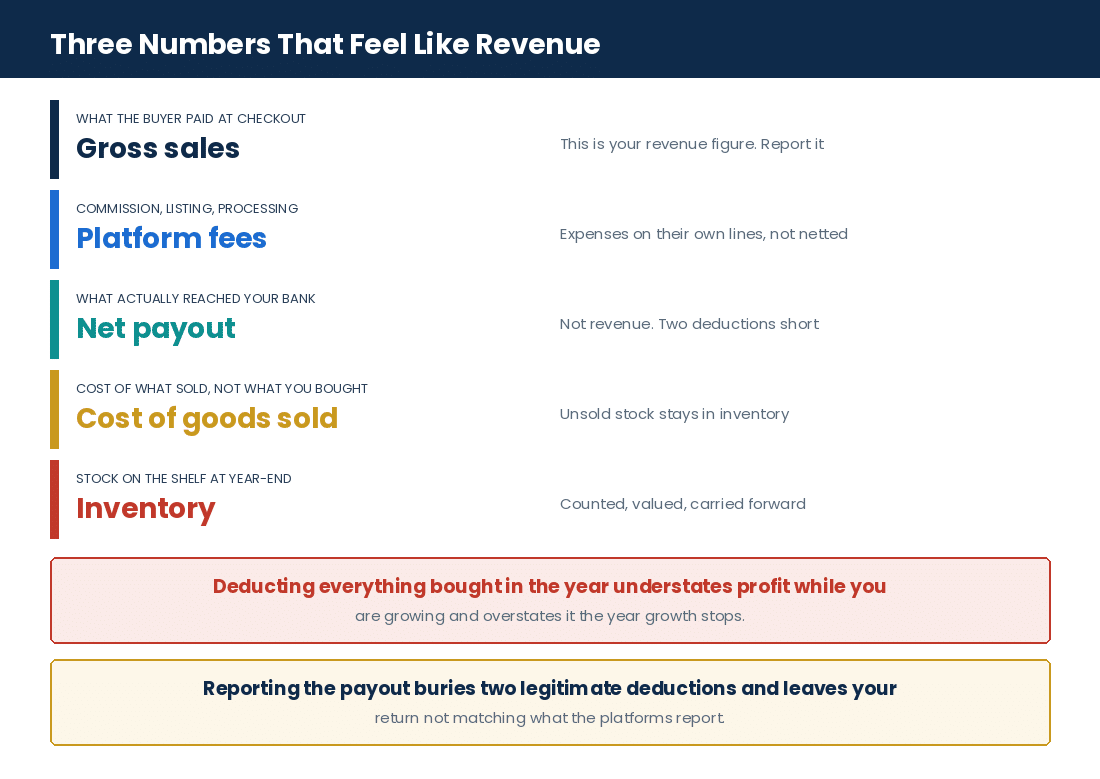
The commonest reseller file we see reports the platform deposit as revenue. It is an understandable mistake: that is the number in the bank, and it is the number the app shows you. It is also two deductions short of being right.
Reporting gross and expensing the fees separately produces the same tax in most years, but it produces a return that matches what the platforms report and a set of accounts that show what the business actually costs to run. Both matter more than the tax does. Figures changed for privacy.
Important Dates for Filing
A self-employed reseller files by June 15 after a year ending December 31, though any balance owing is still due April 30 and interest runs from that date. Companies have six months after their fiscal year-end under subsection 150(1).
Keep these points about online reseller taxes in Canada in mind. It helps handle your tax work right and follow Canadian laws for selling stuff online with Gondaliya CPA!
Reporting Online Selling Income and Inventory Management for Resellers
Reporting Sales Income and Managing Inventory
The Core Numbers
Understanding Income Reporting Requirements
If you sell online in Canada, you must report all your sales income as gross revenue. That means you count the total money you get before subtracting fees or costs. The Canada Revenue Agency (CRA) wants online resellers to list every sale in their tax return. It doesn’t matter what platform or payment method you used. You have to keep good records of each sale to prove your income.
Tracking Income from Multiple Platforms
Lots of resellers sell on more than one website. When you file an online reselling business tax return, you need to gather all your sales data from every platform. Look at each platform’s reports closely and take the total sales before fees. Adding these amounts together helps avoid mistakes and makes filing easier.
- Sell $15,000 on Platform A
- Sell $10,000 on Platform B
- Add both for your total business revenue
Reporting to the Canada Revenue Agency (CRA)
When filing your online reseller taxes Canada, use the right tax form. If you’re a sole proprietor, file a T1 personal form. If incorporated, file a T2 corporate return. The CRA asks that gross revenues show clearly along with any expenses like shipping or platform fees listed separately. Usually, corporations have six months after their fiscal year ends to file.
Inventory Valuation Methods
Canada expects sellers to use one inventory valuation method every year without switching. Some common ways are:
- Cost Method: Use what you paid for items, including shipping costs
- Lower of Cost or Fair Market Value: the test in subsection 10(1), so value comes down if market prices drop
- FIFO (First-In First-Out): Oldest stock counts as sold first; newest stays in inventory
Pick the method that fits your business and stick with it. This helps figure out the cost of goods sold correctly.
Resellers who buy in lots — estate clearances, liquidation pallets, bulk thrift runs — struggle most with inventory, because the cost arrives as one number for forty items that will sell over two years. Allocating that cost across the lot at the time of purchase is dull work and takes twenty minutes.
Doing it at year-end from memory, across several lots, is a different job entirely, and the resulting cost of goods sold is a guess. The allocation does not need to be clever, only recorded. Figures changed for privacy.
Year-End Inventory Adjustments
At year-end, count all your stock on hand at December 31 or your chosen date. If some goods are damaged or lost, write down their value with proof like photos or estimates. These changes affect your taxable profit because they change how much inventory you had before and after.
- Example: Sneakers worth $5,000 get water damage and now worth $3,500
- Keep photos and repair info to support this change
A December stock count is the single piece of work that separates a reseller’s return from an estimate, and it is skipped more often than any other. Without it there is no cost of goods sold, only everything bought in the year treated as though it all sold.
In a growing business that understates profit, which feels harmless until the year growth stops and the same method overstates it. A spreadsheet and an afternoon fixes it permanently. Figures changed for privacy.
Record-Keeping Best Practices
You must keep receipts for everything that makes up your inventory cost — like purchase bills and shipping fees tied to specific batches. Using bookkeeping software helps organize these records well. CRA requires them for six years from the end of the last tax year they relate to, under subsection 230(4).
Deductible Business Expenses for Online Resellers
Deductible Business Expenses for Resellers
What You Can Claim
If you sell stuff online in Canada, filing your taxes means tracking your expenses right. You want to know which costs you can deduct to pay less tax. This helps you fill out your online reselling business tax return correctly and follow CRA rules. Here, we’ll talk about common deductible expenses, what records to keep, and how to handle bookkeeping for online reseller tax filing Canada.
Identifying Common Online Reseller Business Expenses Eligible for Tax Deductions
When you do online reseller taxes Canada, you can deduct some costs tied to your business. These costs must help you earn money by reselling. For example:
- Platform fees from places like eBay, Amazon, Etsy, or Shopify.
- Shipping and packaging charges.
- Home office expenses if you use part of your home for your business.
- Advertising and marketing to get more buyers.
Make sure the expense is fair and that you have proof of it. The CRA says these expenses must link directly to your resale work [CRA: Business Expenses].
Shipping and Packaging Costs
You can deduct shipping costs in Canada if they relate to sending products sold online. This covers postage, courier fees, freight charges inside Canada, and packing stuff like boxes or bubble wrap.
Keep good invoices showing what you spent on each shipment during the right time period. Personal packages don’t count as deductible by CRA.
Platform Fees (e.g., eBay, Amazon, Etsy, Shopify)
Canadian resellers can claim platform fee deductions. These fees include commissions on sales or fixed listing fees from marketplaces. Don’t just subtract these fees from sales — record them as expenses properly.
Here’s how platform fees break down:
| Platform Fee Type | What It Is | How To Handle |
|---|---|---|
| Commission | Percent cut of sale price | Expense deduction |
| Listing Fee | Flat fee per item listed | Expense deduction |
| Payment Processing | Fees from payment gateways | Expense deduction |
Keep clear records of all platform fee statements for your online reselling business tax return.
Home Office Expenses and Utility Allocations
The CRA lets you deduct part of home bills under subsection 18(12) where the space is your principal place of business, which is the test most full-time resellers meet, or where you use it exclusively to earn income and also meet customers there on a regular and continuous basis. This includes utilities like electricity, heating, or property taxes.
You figure the deductible amount by measuring the work area compared to your whole home. Space that is your principal place of business qualifies even if the room has other uses, provided the claim is apportioned honestly; the exclusive-use route needs both of its conditions, not just the first.
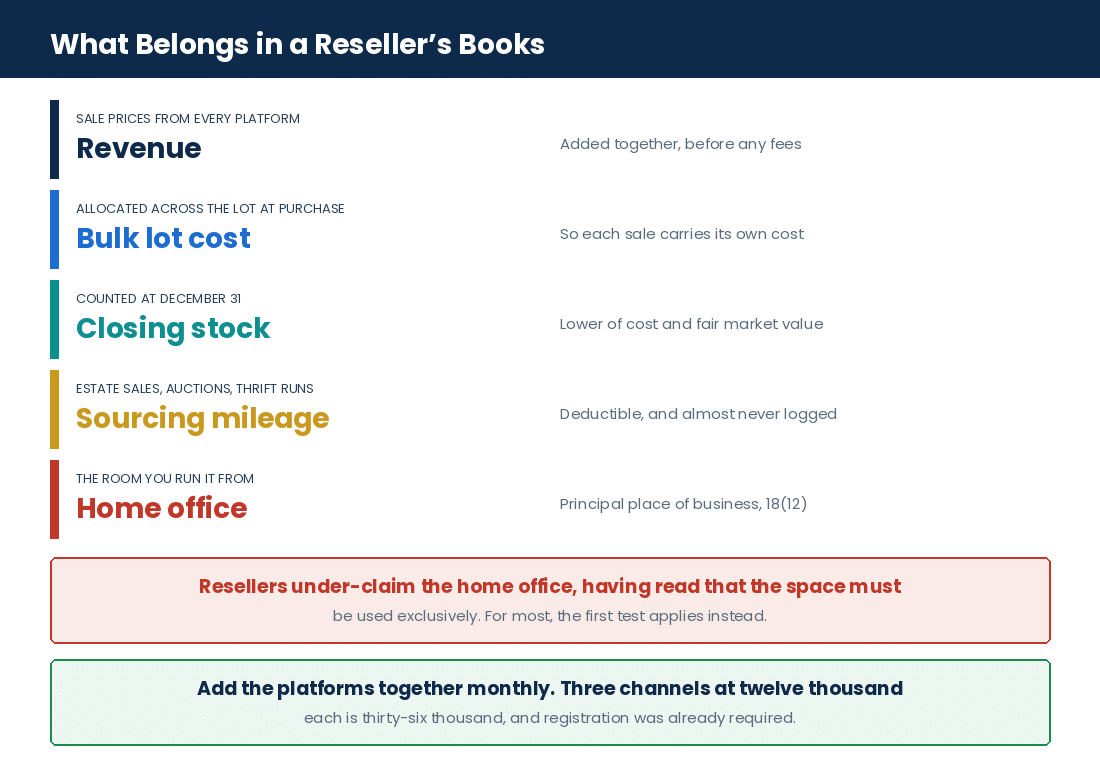
Resellers under-claim the home office more often than they over-claim it, because they have read that the space must be used exclusively for business and concluded that the spare room with the shelving in it does not qualify.
For most full-time resellers the first test applies instead: the home is where the business is run from, which is the whole of it. Measure the area honestly, apportion, keep a floor plan, and claim. Figures changed for privacy.
Advertising and Marketing Expenses
Money spent on ads for online reselling in Canada is deductible too. This includes Google Ads, Facebook promotions, or local flyers telling people about what you sell.
Make sure you keep receipts showing when you paid for ads during the tax year. The law lets you claim these if they help bring customers in [Income Tax Act ss. 9(1), 18(1)(a)].
Proper Documentation and Bookkeeping Practices to Support Deductions
Good bookkeeping is key when doing online reseller taxes in Canada. You need clear records that back up every cost claimed against income from selling stuff online.
Keeping detailed receipts and invoices. The CRA says ecommerce sellers must keep receipts that show vendor names, dates, prices plus proof of payment like bank statements or credit card slips. These should tie back directly to buying stock or paying business bills.
Maintaining organized digital and physical records. Organize records both on cloud systems and in physical folders sorted by date. This makes it easier if CRA ever asks for them or during GST/HST checks.
Reconciling bank and platform statements. Match bank deposits with marketplace payout reports after fees come off. Make sure commissions show as separate expenses instead of lowering gross sales figures wrongly. This stops mistakes flagged during audits anywhere in Canada — including Ontario where pro firms like Gondaliya CPA help out.
If managing all this feels tricky when dealing with online reseller tax filing Canada, call Gondaliya CPA at 647-212-9559 or email info@gondaliyacpa.ca for advice without charge.
Online Reseller Tax Readiness Check
Five quick questions on where your departure file stands. No fee shown.
Points to raise with us:
This is a general prompt, not tax or legal advice or a quote. Your position depends on your full facts. For a real review, please book a free consultation.
GST/HST Filing Requirements for Online Reselling Businesses
GST/HST Filing Requirements
Sales Tax
If you sell stuff online in Canada, you gotta know about GST/HST filing. The CRA wants online resellers to follow the rules on online reseller tax filing Canada. You also need to report your income right for online reseller income tax Canada. Getting this wrong can cause trouble.
Small Supplier Threshold and Registration Triggers
You have to register for GST/HST if your sales pass a certain amount called the small supplier threshold. If your total sales from everywhere go over this limit in one quarter or four quarters in a row, you must sign up. This includes all your sales from different online platforms.
If you stay below that amount, you don’t have to register. Once you pass it, you must apply to register before the thirtieth day after the first taxable supply you make while no longer a small supplier, under subsection 240(2.1) of the Excise Tax Act. They watch these numbers closely because they affect your taxes and credits.
- The small supplier threshold is $30,000 in gross sales before taxes.
- Applies to sole proprietors and corporations selling Canadian inventory.
- Keep good records to prove when you cross the limit.
Voluntary Registration Benefits and Considerations
Even if you don’t have to register, you might want to anyway. Voluntary registration lets you claim input tax credits (ITCs) on costs like shipping or platform fees. This can save money.
But if you register voluntarily, you must charge GST/HST on your sales. Plus, you’ll need to keep up with extra paperwork and file on time.
Think about registering if you plan to grow or have lots of expenses. It can help cash flow by letting you get tax credits back.
Voluntary registration is worth real money to a reseller who buys inventory from registered Canadian suppliers, because the tax on every purchase becomes recoverable instead of a cost. It is worth much less to someone sourcing from thrift stores, estate sales and private sellers, where there was no GST/HST charged to recover.
The answer turns on where the stock comes from, not on how big the business is. That is the question we ask first. Figures changed for privacy.
Calculating GST/HST Owing or Refundable
To figure out how much GST/HST you owe or get back, subtract your input tax credits from the tax collected on sales.
Input Tax Credits let you recover taxes paid on business stuff like inventory or shipping costs.
Keep clear papers showing each ITC claim with vendor info as needed by law [Excise Tax Act s. 169(4) and the Input Tax Credit Information (GST/HST) Regulations].
Doing this right helps avoid penalties and gets refunds where possible.
Filing Frequencies and Deadlines
How often you file depends on how much you sell each year:
- Annual filers submit one return yearly.
- Quarterly filers send returns every 3 months.
- Monthly filers send monthly returns (set by CRA).
If you’re an individual using a T1 form, your deadline is April 30, or June 15 where you are self-employed, with any balance owing due April 30 either way. Corporations follow their own income tax deadline of six months after year-end under subsection 150(1) of the Income Tax Act, while GST/HST reporting periods and filing frequency are set by sections 245 to 251 of the Excise Tax Act.
Late filings can lead to interest charges or fines. Good bookkeeping helps avoid missing deadlines.
The threshold catches resellers who sell across several platforms and watch each one separately. Three channels at twelve thousand each feels comfortably small. It is thirty-six thousand of taxable supplies and registration was required partway through the year.
Add the platforms together monthly. It is one line in a spreadsheet and it prevents the only GST/HST problem most resellers will ever have. Figures changed for privacy.
Avoiding Common Mistakes and Audits
The CRA expects neat records that show all your online reseller taxes Canada properly.
Common mistakes include:
- Not tracking receipts tied directly to inventory.
- Mixing personal items with business stock.
- Claiming ITCs without proper documents.
Save digital copies of invoices and match them with bank records. This lowers chances of an audit.
For expert help with ecommerce resale accounting in Ontario including Toronto and Hamilton areas, contact Gondaliya CPA at 647-212-9559 or info@gondaliyacpa.ca for a free consultation about online reseller tax filing Canada compliance.
Corporate and Personal Income Tax Considerations for Ecommerce Resellers
Corporate and Personal Income Tax Considerations
Structure
If you sell stuff online in Canada, you gotta know about both corporate and personal income tax. How you run your business — sole proprietor or corporation — changes how you pay taxes. The CRA wants all your online reseller income reported right. You list your total sales first. Then you take off the costs that the law lets you claim.
Keep good records. Track what you buy to sell, money you make, fees for platforms or payment services, shipping bills, and other costs. These help when you file your online reseller income tax Canada forms.
The CRA says report your full sales amount. Don’t subtract platform fees from sales. Claim those as expenses instead.
Differences Between Corporate Tax and Personal Income Tax
Online reseller taxes Canada work differently for companies versus people running their own show. Companies send in a T2 tax form. Individuals report on T1 forms under self-employment.
Companies pay tax at set rates set by federal and provincial rules. People pay tax that goes up when they make more money. Companies might pay less tax early on but must do more bookkeeping and paperwork.
Here’s a quick look:
- Corporate Tax: Uses T2 form, fixed rates, reports as a separate company, more paperwork.
- Personal Income Tax: Uses T1 form, rates go up with income, combines all income, less paperwork.
Picking corporate or personal depends on how big your business is and what goals you have (Income Tax Act ss. 9(1) and 18(1)(a)).
Sole Proprietorship vs Incorporated Business Tax Implications
Running your online reselling as a sole proprietor means reporting all money on your personal taxes. You don’t have a separate business entity here.
Incorporating makes your business its own thing for taxes. Your company pays taxes separately from you. You can pay yourself a salary or dividends too — each one taxed differently compared to taking profits straight out in a sole proprietorship.
Sole proprietors have simple reports but risk everything if things go wrong. Corporations give legal protection but need fancier accounting — often needing experts who know online resale business accounting Canada stuff.
Salary vs Dividends for Incorporated Online Resellers
If you have an incorporated online resale business, choosing salary or dividends to get money matters:
- Salary: Company treats it like an expense; lowers its taxable profit. You pay payroll taxes like CPP.
- Dividends: Paid from after-tax profits; not deducted by company but taxed favorably for you because of dividend credits.
Mixing salary and dividends can save money depending on your other income, though dividends paid to family members are caught by the tax on split income rules in section 120.4 and taxed at the top marginal rate unless the recipient meets an exclusion.
Calculating Taxable Business Income from Online Reselling Activities
You find taxable business income by subtracting allowed costs from total sales according to section 9(1) of the Income Tax Act. For ecommerce sellers:
- Report gross sales before any fees.
- Take off cost of goods sold using steady inventory methods.
- Remove shipping and fees tied only to orders shipped.
Good records are key: keep receipts proving cost and payment statements showing what you really got after returns.
Example: If someone makes $50,000 in sales with $10,000 spent buying goods plus $5,000 on shipping/fees correctly claimed — they get $35,000 taxable profit supported by their receipts and logs.
Allowable Deductions and Expense Allocation
Canada lets online reseller taxes Canada filers deduct expenses that are real and only for earning income (ITA s. 18(1)(a)). Typical deductible expenses include:
- Fees to list products on platforms
- Charges for payment processing
- Shipping paid to deliver products
- Ads promoting your items
- Office supplies if used only for business at home
If some costs cover both personal and work use — claim only the business part.
Keep clear records matching fees charged by marketplaces with each sale so audits don’t catch mistakes.
| Expense Type | How To Allocate |
|---|---|
| Platform Fees | Match per sale directly |
| Shipping Costs | Based on items shipped |
| Home Office Utilities | Percentage of area/time used |
Assessing and Claiming Capital Cost Allowance (CCA)
Capital Cost Allowance (CCA) lets you claim wear-and-tear on big assets like computers used in your resale biz (ITA s. 20(1)(a)). This cuts down taxable profit yearly based on CRA’s asset classes.
To claim CCA:
- Find which asset class fits your item
- Use declining balance method unless told otherwise
- Know exact purchase date
- Only claim the part used for business if shared with personal use
You can claim less than the maximum in any year, and the unclaimed amount simply stays in the undepreciated capital cost for future years. Unlike rental property, which is restricted by Regulation 1100(11), capital cost allowance on ordinary business assets can create or increase a business loss.
Example: Say a seller buys computer gear costing $3,000 in Class 50 with a 55% rate. The half-year rule in Regulation 1100(2) limits the first-year claim to half, so roughly $825 rather than $1,650, unless an accelerated measure applies to that acquisition (numbers just an example).
The half-year rule catches people who buy equipment in December expecting it to wipe out the year. It halves the first claim, so a December purchase and a January one produce much the same deduction for the year just ended — which is to say, half of one.
If the deduction is the reason for the purchase, the timing barely matters. If the equipment is needed, buy it when it is needed. Figures changed for privacy.
Tax & Accounting Services for Online Resellers by Gondaliya CPA
Tax and Accounting Services for Online Resellers
Working With Us
If you sell stuff online in Canada, taxes can get tricky. You need to report income, count your stock, and track expenses right. Gondaliya CPA helps with online reseller tax filing Canada. We know how to handle your online reselling business tax return so you don’t miss anything. We make sure your online reseller income tax Canada filings are done properly and on time.
How Gondaliya CPA Supports Online Resellers with Tax Filing and Bookkeeping
Gondaliya CPA helps online sellers with their taxes and books. We offer simple solutions for the special challenges of online reseller taxes Canada.
Personalized consultation and compliance support. We look closely at your records. This helps us check that sales income, stock costs, and deductions follow Canadian rules. We explain what you owe for online reseller income tax Canada. Our goal is to keep you clear of trouble with the CRA.
Assistance with digital bookkeeping tools. We help you use tools like QuickBooks or Xero for easy record-keeping. Good bookkeeping tracks what you buy, fees, shipping costs, and stock counts. These details affect your taxes when filing an online reselling business tax return.
Representation with CRA communications. If the CRA asks questions about your online reseller tax filing Canada, we step in. Our team handles talks with them so you can focus on selling without stress.
Benefits of Professional Tax Assistance for Maintaining Compliance and Maximizing Savings
Doing taxes yourself can cause mistakes that lead to fines or missed savings. A CPA firm knows best practices to protect you from common mistakes like mixing personal stuff with inventory or forgetting cost details.
Professional help makes sure you:
- Report gross sales correctly (not just net deposits)
- Use the same way to value inventory each year
- Match platform fees properly against sales
- Keep proof for mileage if you travel to buy stock
These steps lower risks and may save money by claiming expenses the CRA accepts.
Sourcing trips are the deduction resellers forget entirely. Someone driving a regular circuit of estate sales, auctions and thrift stores is incurring real business mileage, and almost none of them log it because the trips feel like errands rather than work.
A logbook kept properly for a year is worth more than most of the fiddly deductions people do chase. Without one, the claim is unsupported and comes straight back off on review. Figures changed for privacy.
File it yourself or hand it to a CPA firm: which route fits an online reseller? Sellers juggling many platforms or large stocks in places like Ontario or Hamilton often find it easier to outsource. It takes lots of work to collect data yearly under Income Tax Act rules [Income Tax Act ss. 9(1) and 18(1)(a)].
Good habits include:
- Keeping receipts safe and detailed
- Counting stock regularly at year-end
- Matching fees exactly to each sale
- Logging mileage every time
- Checking GST/HST status yearly
- Saving proof when writing off damaged goods
Expert advice helps more than doing it all alone.
Need help with Canadian online reselling taxes? Email info@gondaliyacpa.ca or call 647-212-9559 for a free chat about getting it right without guesswork.
Income Tax Act ss. 9(1), 10(1), 18(1)(a), 18(12), 20(1)(a), 54, 120.4, 150(1), 230(4) · Income Tax Regulations 1100(2), 1100(11) · Excise Tax Act ss. 169(4), 240(2.1), 245–251 · CRA Guide T4002 · CRA Guide RC4022
Frequently Asked Questions about Online Reseller Tax Filing Canada
Frequently Asked Questions
Answers
What is the GST/HST small supplier threshold for online resellers?+
How long must I keep inventory records for tax purposes?+
Is keeping a mileage log required for my online reseller business?+
When is the filing deadline for T1 individual online resellers?+
What is the corporate tax filing deadline for incorporated online resellers?+
What does “gross, not net” income mean for reporting sales?+
What qualifies as taxable and zero-rated supplies in online reselling?+
Why must I use a consistent inventory method every year?+
What evidence is needed to write down damaged or obsolete inventory?+
Essential Insights for Online Resellers
Essential Insights for Resellers
Key Points
Key points on online reseller reporting, and where DIY and CPA support differ:
- DIY reporting risks missing deductions and filing errors.
- Gondaliya CPA offers expert reviews of your sales and expense data.
- We handle CRA communications to reduce audit stress.
- Our team ensures proper fee allocation and matching gross income accurately.
- You get tailored advice on recordkeeping requirements and deadlines.
- We prepare clear deliverables including detailed tax returns and summaries.
- Our pricing fits small to mid-size online reseller budgets without surprises.
What to Prepare Before Working with Gondaliya CPA
- Gather all sales reports from every platform used during the tax year.
- Collect invoices and receipts for purchases, shipping, platform fees, and marketing.
- Maintain your mileage logs and home office expense records if applicable.
- List all damaged or written-down inventory with supporting evidence.
- Organize bank statements and payment processing reports for reconciliation.
Why Trust Gondaliya CPA With Your Online Reseller Tax Filing?
- Licensed CPA firm with deep knowledge of ecommerce tax laws in Canada.
- Over 1300 positive Google reviews attest to our professionalism and results.
- Personalized service focused on clarity, compliance, and maximizing savings.
- Expertise handling both personal (T1) and corporate (T2) filings for resellers.
- Free initial consultation to understand your needs before commitment.
Top Online Reseller Reporting Mistakes and How to Avoid Them
- Mixing personal expenses with business costs causing audit triggers.
- Reporting net sales instead of gross revenues leading to penalties.
- Inconsistent inventory valuation methods causing errors in cost of goods sold.
- Missing receipts or poor recordkeeping risking disallowed deductions.
- Late GST/HST registration past the small supplier threshold deadline.
Gondaliya CPA guides you through each step to prevent these issues efficiently.
Important Additional Duties and Conditions
- Report gross sales rather than the deposit that reached your bank, and make sure every cost you deduct against them is supported by a receipt.
- Keep logs required by CRA such as mileage or work-from-home usage logs diligently.
- Understand “adventure in the nature of trade” rules when assessing if selling is business or hobby activity.
- Know the listed personal property rules in section 54 if you deal in art, jewellery, rare books, stamps or coins: proceeds and cost are each treated as at least $1,000, and a loss on such property can only be applied against gains on other listed personal property.
- Be aware of remaining duties after registration like timely filing and payment requirements.
Businesses We Serve & Industry Spotlights
Industry Expertise
Online resellers sit inside a wider group of businesses that buy goods to sell on, and the questions that decide a reseller file — what the real revenue figure is, what is still sitting in stock at year-end, and which costs attach to which sale — recur across every one of these situations.
| Who | The Reseller Angle |
|---|---|
| Online resellers | Gross versus net, inventory counts and platform fees |
| Electronics resellers | High-value stock, warranties and write-downs |
| Cross-border e-commerce sellers | Multi-jurisdiction registration and export evidence |
| Wholesale e-commerce sellers | Bulk lots and allocating cost across them |
| Amazon US sellers based in Canada | FBA inventory nexus and gross payout reporting |
| Direct-to-consumer brands | Platform fees, advertising spend and returns |
| Print-on-demand businesses | Royalty income with no inventory at all |
| Clothing stores | Seasonal stock and obsolescence write-downs |
| Antique and specialty retailers | Listed personal property and unique-item costing |
| Side-hustle businesses | The hobby versus business line, and when it is crossed |
| Home-based businesses | Work space in the home under subsection 18(12) |
Spotlights: online resellers · electronics resellers · cross-border e-commerce sellers · wholesale e-commerce sellers · Amazon US sellers based in Canada · direct-to-consumer brands · print-on-demand businesses · clothing stores · antique and specialty retailers · side-hustle businesses · home-based businesses.
Professional Guidance and Quick Reference
Guidance
Essential Tax Points for Canadian Online Resellers
Reseller files go wrong in a predictable set of ways: the platform deposit reported as revenue instead of what the buyer paid; everything bought in the year deducted as cost of goods sold whether it sold or not; no stock count at December 31, so there is nothing to compute cost against; bulk lots bought as one number and never allocated across the items; a home office claim abandoned because the room is not used exclusively for business; mileage to estate sales and auctions never logged; and the June 15 deadline missed because April 30 was assumed. Gondaliya CPA prepares reseller returns on a flat annual fee.
Quick Answers
At a Glance
- Revenue: what the buyer paid, not the platform deposit
- Platform fees: an expense on their own line, never netted off sales
- Profit: computed under subsection 9(1), limited by 18(1)(a)
- Cost of goods sold: only the cost of what actually sold this year
- Inventory: lower of cost and fair market value, subsection 10(1)
- Method: pick one and keep to it year after year
- Year-end: count the stock, and document any write-down
- Filing, self-employed: June 15, with the balance still due April 30
- Filing, corporate: six months after year-end, subsection 150(1)
- GST/HST threshold: $30,000 across all platforms combined
- Registration: before the thirtieth day after the first supply as a non-small-supplier
- Zero-rated: 0% tax with input tax credits preserved, not exempt
- ITC records: subsection 169(4) and the information regulations
- Home office: subsection 18(12), principal place of business for most resellers
- Equipment: Class 50 at 55%, halved in year one by Regulation 1100(2)
- CCA and losses: can create a business loss, unlike rental property
- Family dividends: caught by tax on split income under section 120.4
- Records: six years from the end of the last tax year they relate to
Who This Is For / Not For
Fit Check
- For: Canadians buying goods to resell online at a profit, on one platform or several, whether as a sole proprietor or through a corporation.
- For: resellers reporting platform deposits as revenue, carrying no inventory figure at year-end, or who have never worked out whether registration was required.
- Not for: provincial sales taxes outside the HST provinces, or US and other foreign sales tax obligations, which are handled separately.
- Not for: someone clearing out their own belongings without a profit motive. Whether a particular pattern of selling is a business turns on the full facts, including the adventure in the nature of trade test.
People Also Ask
Related Questions
I’m just selling my old stuff. Is that a business?+
Do I report the eBay payout or the sale price?+
Can I deduct everything I bought this year?+
I bought a pallet of forty items for $600. How do I cost them?+
My spare room isn’t used only for the business. Can I still claim it?+
Glossary of Key Terms
Definitions
- Online reseller: a business buying goods to sell on at a profit through online marketplaces.
- Gross sales: what the buyer paid, before platform fees or processing come off.
- Net payout: what reaches your bank after fees, which is not your revenue figure.
- Platform fee: commission, listing and processing charges, recorded as expenses.
- Cost of goods sold: the cost of the items actually sold in the year.
- Inventory: stock on hand at year-end, valued under subsection 10(1).
- FIFO: first-in first-out, treating the oldest stock as sold first.
- Write-down: reducing inventory value for damage or obsolescence, with evidence.
- Adventure in the nature of trade: the test distinguishing a business from a personal disposal.
- Listed personal property: art, jewellery, rare books, stamps and coins, under section 54.
- Small supplier: a business under $30,000 of taxable supplies over four consecutive quarters.
- Input tax credit (ITC): recovery of GST/HST paid on costs incurred to make taxable supplies.
- Zero-rated supply: taxable at 0%, which preserves input tax credits.
- Exempt supply: outside the tax entirely, with no input tax credits.
- Capital cost allowance (CCA): the deduction spreading equipment cost over several years.
- Class 50: the CCA class for computer equipment, at 55%.
- Half-year rule: Regulation 1100(2), halving the first-year claim on new additions.
- Work space in the home: the deduction governed by subsection 18(12).
Want a checklist to work from? You can download our free online reseller tax checklist before your consultation.
Four things decide a reseller file. Which number is revenue — what the buyer paid, not the platform deposit, with fees and processing deducted separately, because profit is computed under subsection 9(1) from gross. What is actually deductible this year — the cost of goods sold, not everything bought, which means stock has to be counted at year-end and valued under subsection 10(1) at the lower of cost and fair market value, on one method kept to year after year. When you file — June 15 if self-employed, with the balance still due April 30, and the two dates are not the same thing. And what the small things add up to — the home office claim most resellers abandon unnecessarily, the sourcing mileage nobody logs, and the half-year rule that makes a December equipment purchase worth half what people expect.
Three questions tell you where you stand, and the first two come straight off a platform report. First, does your revenue line match the sale prices or the deposits? If it matches the deposits, fees are missing from both sides of your accounts. Second, do you have a stock count at December 31? Without one there is no cost of goods sold, only a guess. Third, have you ever logged a sourcing trip? If you drive a regular circuit of sales and auctions, that mileage is deductible and almost certainly unclaimed.
Online Reseller Taxes Canada: How Gondaliya CPA Can Help
Start with your platform reports and a year-end stock count
Gondaliya CPA rebuilds revenue from the sale prices rather than the deposits, itemises commission, listing and processing fees as deductions instead of letting them vanish into a net figure, sets an inventory method and applies it consistently so cost of goods sold reflects what actually sold, allocates bulk lot purchases across the items at cost, tests the GST/HST registration position across every platform combined rather than one at a time, claims the home office under the limb that actually applies to a full-time reseller, applies the half-year rule correctly to equipment, and prepares the T1 or T2 with the schedules behind it — on a flat annual fee including HST with a one-business-day response. Please book a free consultation.
Next Steps
Please book a free consultation with Gondaliya CPA and bring three things: your sales reports from every platform you use, your purchase receipts including any bulk lots, and a stock count if you have one. Those three settle the revenue figure, the cost of goods sold and whether registration was required — which between them account for nearly every difficulty we see on a reseller file. If you have never counted stock at a year-end, say so at the outset; it is the most common gap and it is fixable going forward even where past years have to be estimated. We advise on Canadian federal tax and GST/HST; provincial sales taxes outside the HST provinces and foreign sales tax obligations are handled separately. You will get a flat annual fee including HST before any work begins. We serve Toronto, Mississauga, Brampton, Vaughan, Etobicoke, Scarborough, Hamilton, Ottawa and the rest of Ontario, and work with resellers across Canada. If our content helps, please add gondaliyacpa.ca as a preferred source on Google.
Published: · Last updated:
Editorial policy: We research against CRA, Department of Finance, Parliament of Canada, CPA Canada and CPA Ontario sources, fact-check the figures, and Sharad Gondaliya, CPA, reviews the content, which we update as the rules change.
Disclaimer: This article is educational information only and is not tax, legal or financial advice. It covers Canadian federal income tax and GST/HST for residents running online reselling businesses, including gross revenue reporting, inventory valuation, deductible expenses, the work space in the home test, capital cost allowance and registration. It does not cover provincial sales taxes outside the HST provinces, or US and other foreign sales tax obligations, each of which is handled separately. Whether a particular pattern of selling amounts to a business rather than the disposal of personal property turns on the full facts. Thresholds, rates, filing deadlines and statutory references change; every reference should be confirmed against current CRA guidance before a return is filed. Gondaliya CPA performs compilation engagements under CSRS 4200 and does not perform audit or review engagements. Please consult a licensed CPA before acting.

Sharad Gondaliya is a CPA Canada & CPA USA with 15 Years+ experience of Accounting, Tax, Payroll of Corporate Small Businesses as Tax Accountant. He is a CPA Ontario member (61040184) and holds US CPA licences in Washington and Montana and is well known among corporate small businesses for tax planning, efficient tax solutions, and affordable CPA services. Sharad is the Principal (Director) of Gondaliya CPA – Affordable CPA Firm in Canada. Licenses: CPA Ontario: 61040184 | CPA USA (MT): PAC-CPAP-LIC-033176 | CPA USA (WA): 57629 | CPA Firm License: 61330051 View Full Author Bio