



Common Tax and Accounting Mistakes Online Education Businesses Make in Canada
Online Education Business Taxes Canada: Common Tax Mistakes, GST/HST Rules, and Accounting Tips by Gondaliya CPA
Managing online education business taxes Canada involves understanding Canadian tax rules for digital education, avoiding common tax mistakes, and correctly applying GST/HST for online courses. Gondaliya CPA offers expert advice on bookkeeping for online education, corporate tax for online education, and key tax deductions to help your online learning platform stay compliant and financially optimized.
Quick Summary
Online education sells access, and access is delivered over time, which is why the timing of income is where these files go wrong. Amounts you receive for services not yet rendered are brought into income under paragraph 12(1)(a) of the Income Tax Act, with a reserve available under paragraph 20(1)(m) for the part still unearned at year-end — so a December payment for a January cohort is not December’s profit. Report the gross course fee and show platform and processing charges as their own expense rather than recording the net payout. GST/HST turns on where your customer is, under section 142 and Schedule IX of the Excise Tax Act, which is why address evidence has to be collected at checkout rather than reconstructed later. Input tax credits on gear and software come from section 169 of the Excise Tax Act, while the cost of the gear itself is written off through capital cost allowance under paragraph 20(1)(a) of the Income Tax Act. Income tax records are kept six years under subsection 230(4), GST/HST records under section 286 of the Excise Tax Act. Corporate instalments sit in section 157, not section 156. And the credits worth chasing are narrower than they sound: SR&ED needs a technological advancement, not a better course.
Reading time: 15 minutes.
Table of Contents
- Understanding Online Education Business Taxes
- Essential Online Education Accounting Practices
- Common Tax Mistakes and What They Cost
- Practical Tips, Credits and Record-Keeping
- Optimising Your Online Education Finances
- Real-World Insights and Support
- Frequently Asked Questions
- Essential Points for Online Educators
- Businesses We Serve & Industry Spotlights
- Professional Guidance and Quick Reference
The Numbers That Matter
This article covers Canadian federal income tax and GST/HST for residents running online education businesses, with Ontario and Toronto context, and reflects rules current to 27 October 2026. It is written for course creators, membership operators, e-learning platforms and corporate trainers selling access to teaching rather than a physical product, and it covers the timing of course fee income and deferred revenue, refund guarantee obligations, gross reporting with platform fees shown separately, GST/HST registration and the small supplier threshold, place of supply and address evidence, filing frequency, input tax credits, capital cost allowance on production equipment and software, contractor and affiliate documentation, corporate filing and instalments, and record retention. Whether a particular course or training programme is an exempt supply under Part III of Schedule V turns on the specific facts, including who provides it and whether it leads to a certificate or licence, so that question should be settled for your own offerings rather than assumed from this article. Gondaliya CPA performs compilation engagements under CSRS 4200, which provide no assurance; audit and review engagements are referred out. This is educational information only and not tax or legal advice.
Understanding Online Education Business Taxes in Canada
Understanding Online Education Business Taxes
Start Here
Running an online education business in Canada? Taxes can get confusing fast. Lots of people mess up and cause trouble with the CRA. This guide breaks down what you need to know.
Registering Your Online Education Business with the CRA
Starting your business means you gotta register with the CRA. Here’s what to watch for:
- GST/HST Registration Mistakes: If you make more than a set amount, you must sign up for GST or HST. Skip this, and penalties might come.
- Small Supplier Threshold: If your taxable supplies are less than $30,000 a year, you might not have to register. But if you think you’ll grow, better to sign up early.
- Filing Frequency: After registration, file GST/HST returns on time—monthly, quarterly, or yearly depending on your annual taxable supplies, under sections 245 to 251 of the Excise Tax Act. Late filings cost interest.
Common Tax Obligations for Online Education Providers
Online educators have rules to follow by law:
- Income Tax Act paragraph 12(1)(a): This brings amounts you receive for services not yet rendered into income, and paragraph 20(1)(m) gives you a reserve for the part still unearned at year-end. Know it so you don’t report wrong.
- Instalment Payment Threshold: Owe over $3,000 in taxes? You may need to pay in instalments during the year instead of all at once.
- Corporate Tax Filing Deadline: Companies must file their T2 tax form within six months after the fiscal year ends. Late means penalties!
- Refund Guarantee Obligation Recognition: If you offer refunds that are still open at year-end, the tax treatment follows whether the teaching has actually been delivered — an unearned fee can be reserved under paragraph 20(1)(m), while a refund promise on a course already delivered is a contingent amount that paragraph 18(1)(e) will not let you deduct.
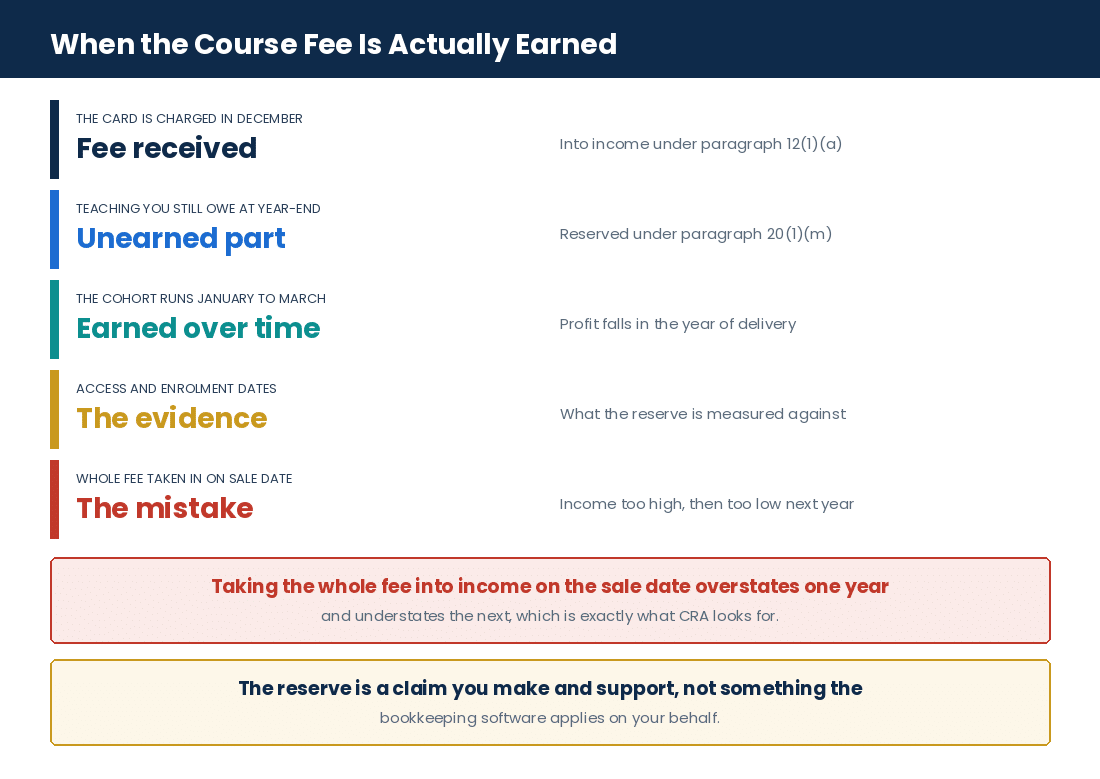
The first set of books we see on an online education file almost always has a January launch sitting in December’s income, because that is the month the card was charged. The platform report says the money arrived, the bookkeeping software agrees, and nobody asked the only question that matters, which is when the student actually got in.
It is a two-line fix in the year you catch it and a reconstruction job in the third year, when the enrolment records have moved platforms twice. Figures changed for privacy.
GST/HST Rules Applicable to Online Courses and Digital Products
Know these rules if you sell courses or digital stuff:
- GST/HST Filing Requirements: You usually charge GST or HST on course fees unless the law says otherwise. Know what counts as taxable or exempt supplies.
- Place of Supply Rules and Address Evidence: The tax rate depends on where your buyer lives, not where your business is, under section 142 of the Excise Tax Act and Schedule IX. Get proof of their address at checkout!
- Zero-Rated Supply Conditions: Some materials can be zero-rated under Schedule VI — no GST/HST charged but input credits still apply if rules meet CRA conditions.
- Exempt Supply Testing: Check often if products are exempt under Part III of Schedule V; missing this can cause surprise bills later.
Corporate Income Tax Considerations for Online Education Businesses
If your business is a corporation, here’s what matters:
Know which capital cost allowance classes cover stuff like computers and software used for making courses. These let you write off costs over time and lower taxes.
Track all expenses that go straight into running your courses—like software subscriptions. These can cut your taxable income when reported right.
Understand these parts of online education business taxes in Canada well. It helps avoid trouble with the CRA and keeps things smooth!
Essential Online Education Accounting Practices in Canada
Essential Online Education Accounting Practices
Get the Books Right
Keeping your online education accounting in Canada straight helps you handle business taxes right. Lots of online educators make common bookkeeping mistakes. These errors can mess up tax filings and bring CRA extra attention. Knowing how to keep good records, track money coming in and out, and handle payroll will keep you out of trouble.
Bookkeeping Fundamentals for Online Educators
Bookkeeping accuracy matters a lot for your online education business. Bad record keeping or mixing personal and business costs causes big problems during CRA audits.
Make sure you keep clear records of all money stuff linked to your courses, memberships, bundles, and platform fees. Save invoices, receipts, bank statements, contracts with affiliates or creators, plus refund details. Keep these papers for at least six years because subsection 230(4) of the Income Tax Act says so for income tax records, and section 286 of the Excise Tax Act says so for your GST/HST records.
Don’t mix personal spending with business bills in one bank account. Use separate accounts instead. This makes bookkeeping easier and helps when claiming expenses under the Income Tax Act.
Good bookkeeping lets you track income correctly—like when people get access to courses, not just when they pay. It also helps you follow GST/HST rules without trouble.
Here’s what to do:
- Keep all invoices and receipts safe
- Separate personal and business money
- Keep contracts and refund info handy
- Save records for six years
The six-year rule is the one clients think they have covered and usually have not, because the records that matter least are the ones they keep. Bank statements survive. The enrolment export showing which student got access on which date does not, and that is the document that decides the income timing question.
When a membership platform is cancelled, the access history goes with it. We now ask clients to pull a dated enrolment report every year-end and file it with the working papers, before there is any reason to want it. Figures changed for privacy.
Managing Revenue Streams and Tracking Expenses Accurately
Many online educators lump all production costs into one category. That’s confusing. Instead, split costs by type—like buying cameras versus paying designers.
Report your gross revenue from course sales before taking out any fees like platform charges or processing costs. The CRA wants total sales reported before expenses come off.
Track fees separately. Platform fees should show up as expenses, not reduce sales directly. This keeps your tax reports clear and honest.
To keep it clear:
- Separate different production costs
- Report total sales before fees
- Record platform fees as expenses
- Don’t just report the net payout
Netting the payout is the quietest of these mistakes because the profit comes out roughly the same, so nothing looks wrong. What changes is the revenue line, and the revenue line is what the small supplier threshold is measured against. We have had clients who were a year late registering for GST/HST purely because their books showed net deposits rather than gross course fees.
The registration date is not a matter of opinion once the gross figure is rebuilt, and the tax is owed from that date whether or not it was ever charged to the students. Figures changed for privacy.
Handling Payroll and Contractor Payments in the Online Education Sector
A lot of educators pay affiliates or content creators without proper agreements or records. That’s risky if the CRA checks your books.
Always have written contracts that say how much and when you’ll pay contractors or affiliates. Keep these signed papers safe.
Record every payment made to contractors along with dates and amounts. If any taxes are held back (like non-resident taxes), note those too.
Good paperwork means fewer problems when claiming payroll expenses on taxes and makes T4A slips easier to prepare if needed.
Remember to:
- Use written contracts for all contractors
- Keep detailed payment records
- Note tax withholdings properly
- Store all agreements safely
If you want help with online education business taxes Canada, especially bookkeeping accuracy through complex revenues, contact a licensed CPA who knows digital education well.
Common Tax Mistakes Made by Online Education Businesses
Common Tax Mistakes and What They Cost
Where It Goes Wrong
Online education businesses in Canada often mess up their taxes. They mix up income types, miss some deductions, get GST/HST wrong, and skip planning their corporate taxes. These slip-ups cause trouble with the CRA and messy records. Knowing these errors helps you keep things right.
Misclassifying Income and Its Impact on Tax Filing
Many online educators treat all payments as income right away. But the rule in paragraph 12(1)(a) brings the fee into income when received and then lets you reserve, under paragraph 20(1)(m), the part covering teaching you have not delivered yet. If a program starts in January but people pay in December, only the access given before year-end is earned. The rest is called deferred revenue. You list that as a liability until earned.
If you don’t do this, your income looks too high one year and too low the next. That’s a problem CRA watches for. Deferred revenue shows you haven’t fully earned all the money yet.
Risks of Incorrect Income Categorization
Counting all fees too soon makes your taxable income bigger than it really is. Also, if you promise lifetime access without clear limits, CRA might reject that claim. They want proof customers won’t use courses forever or they tax it all upfront.
If you have refund promises open at year-end, the question is whether the teaching has been delivered: an unearned fee can be reserved under paragraph 20(1)(m), while a refund promise on a course already delivered is contingent and paragraph 18(1)(e) denies the deduction. Get that wrong in either direction and your profits do not reflect what you have actually earned. CRA notices these mistakes during audits because they change how well your business seems to perform.
Consequences for Tax Compliance
Wrong income counting causes serious trouble:
- CRA flags unusual early income claims.
- You owe more taxes plus interest.
- Refund promises wrongly counted make profits seem fake.
You must separate earned money from what you owe clearly in your books. This matches CRA’s rules and keeps audits smooth.
Lifetime access is where we have the most uncomfortable conversations. A client wants the whole fee deferred across some notional forever, and the reserve in paragraph 20(1)(m) is measured against services you are still obliged to render — which, on a course that is finished, recorded and sitting there, is close to nothing.
The ones that hold up are the offerings with a stated period, a cohort with dates, a membership with a term. We have had clients redraw their own product pages after that conversation, which is the rare case of the tax answer improving the business. Figures changed for privacy.
Overlooking Deductible Expenses Specific to Online Learning Platforms
Lots of online teachers put all costs into one bucket instead of splitting them correctly. CRA wants capital assets like computers and software listed separately from regular expenses. This way you can claim Capital Cost Allowance (CCA) properly for gear.
Home office deductions have strict rules too. You can only claim the part of your home used just for work. Mixing personal use cuts or cancels this deduction.
Common Deductible Expenses
Here are some costs you can deduct:
- Computers and cameras
- Software licenses for courses
- Contracted help with course design
- Internet bills partly used for work
- Ads that promote just your courses
You also can claim Input Tax Credits (ITCs) on GST/HST paid for these if you keep proper invoices showing business use, under section 169 of the Excise Tax Act.
| Expense Type | CCA Class | Notes |
|---|---|---|
| Computer hardware | Class 50* | Includes laptops and desktops |
| Audio/visual gear | Class 8 | Cameras, mics, recorders |
| Software | Class 12* | Off-the-shelf application programs; systems software falls in Class 50 |
*Check exact classes for your assets
If you sell both free and paid content, be careful how you split ITCs so they match taxable sales only.
Maximizing Tax Savings
Try this checklist to get the most deductions:
- Separate capital vs regular expenses.
- Organize receipts by type.
- Apply CCA each year using correct rates.
- Measure home office space exactly.
- Claim ITCs only on business-related purchases.
- Check contracts to classify workers properly.
This helps lower taxes legally and manage money better over time.
Errors in Applying GST/HST and Filing Returns
GST/HST mistakes happen a lot because people don’t apply the right rate based on customer location. Each province has its own tax rate; charging one rate everywhere breaks rules.
Supplies made outside Canada fall outside the tax entirely, and exports of services or digital products to non-residents may be zero-rated under Part V of Schedule VI — but the conditions are specific and must be handled carefully. Also, some platforms collect tax but don’t cover everything—businesses still owe money if they pass thresholds but aren’t registered properly.
Mixing platform fees with sales hides true revenues; report gross sales then deduct fees separately in your records.
Common filing errors:
- Missing corporate return deadlines (6 months after fiscal year)
- Keeping poor records — CRA wants 6 years minimum
- Blending personal with business expenses messes things up
- Confusing contractors with employees affects payroll taxes
Good bookkeeping avoids these issues and keeps tax reports solid, especially when running multi-province online education services like ours at Gondaliya CPA know-how handles well.
One rate everywhere is the most common GST/HST error we see on course sales, and it is almost always 13 per cent, because the business is in Ontario and nobody thought the student’s province mattered. It does. Section 142 and Schedule IX put the supply where the customer is, and a year of Alberta and British Columbia students charged Ontario HST is a year of filings to fix.
The repair is bounded if the address data exists in the checkout records. If it does not, there is nothing to rebuild from, and that is the version that costs real money. Figures changed for privacy.
Neglecting Corporate Tax Planning for Digital Education Enterprises
Many digital educators skip planning their corporate taxes ahead of time. This hurts growth since they miss chances to manage cash flow or set budgets well around busy enrolment seasons common with cohort classes or memberships.
Good planning means watching instalments if tax owing goes above $3,000 so interest doesn’t add up later. For a corporation that is section 157 of the Income Tax Act, with the $3,000 de minimis in subsection 157(2.1); if you run the business personally, instalments sit in sections 156 and 156.1 and turn on net tax owing above $3,000. It also means budgeting production cost write-offs alongside tuition deferrals to keep cash steady through ups and downs typical in online learning markets here in Canada.
Place-of-supply and address-evidence rules already require proof of customer locations during sales to apply correct provincial rates, and the simplified GST/HST registration regime for digital economy businesses has been running since 1 July 2021, amid growing cross-border enrollments expanding Canadian market reach beyond usual spots.
Skipping these plans often strains cash flow and blocks reinvestment needed for fresh courses or tech upgrades that today’s learners expect worldwide.
Our team helps businesses sort out these tricky parts smoothly so they can focus on teaching while staying clear of tax problems long term.
Online Education Tax Readiness Check
Five quick questions on where your online education file stands. No fee shown.
Points to raise with us:
This is a general prompt, not tax or legal advice or a quote. Your position depends on your full facts. For a real review, please book a free consultation.
Practical Tips for Managing Online Learning Business Taxes in Canada
Practical Tips, Credits and Record-Keeping
What to Do
Running an online education business in Canada means you need to watch out for tax mistakes. It’s not just about paying taxes but also about being smart with your money. If you know what credits to claim and keep good records, you can avoid problems.
Leveraging Available Tax Credits and Deductions for Online Educators
If you teach online, you can save money by writing off certain costs. These are expenses tied to your digital learning work. Think about software you use, making course content, hosting your website, and marketing your classes.
You might hear about input tax credits or ITCs. If your business is registered for GST/HST, you can get back some of the tax you paid on business stuff under section 169 of the Excise Tax Act. But you need to keep every invoice and proof to claim them right.

Popular Tax Credits for Digital Education
Here are some tax credits people ask us about, and what they actually require:
- The SR&ED credit is for scientific research or experimental development aimed at a technological advancement — building new software or solving a technical uncertainty on your platform can qualify, but improving how your courses teach or writing new course material does not.
- Ontario’s Interactive Digital Media Tax Credit is narrower than its name suggests: an eligible product must be interactive and intended to entertain, or to educate or inform children under 12, so most adult professional training will not qualify.
Make sure you have proof showing what money went where. That helps when you claim these credits.
Eligibility and Claiming Process
To get these credits or deductions, here’s what to do:
- Register your business with the CRA.
- Keep clear records of every expense tied to your online courses.
- File your claims on time with the right forms, like T2 or GST/HST returns.
- Save contracts, receipts, and logs that prove your claims.
Following CRA rules helps avoid penalties or having to pay extra later.
SR&ED is the credit online educators most want to be eligible for and least often are. A better curriculum, a smarter assessment design, a course that gets results — none of that is experimental development, however much work went into it. What sometimes does qualify is the platform engineering underneath: a client building their own adaptive delivery system had a defensible claim, and the claim was about the software, not the teaching.
We would rather tell someone no in October than help them file something that comes apart under review two years later. Figures changed for privacy.
Best Practices for Maintaining Accurate Financial Records
Keeping neat books is key when handling online learning business taxes Canada-wide. Messy records lead to mistakes like counting income at the wrong time or mixing up personal and business costs.
Record-Keeping Systems
Use a system made for digital education sales. Track sales by when people access courses—not just when they pay. This matches the income timing rule in paragraph 12(1)(a) of the Income Tax Act and the reserve in paragraph 20(1)(m).
Also remember:
- Keep all records at least six years after the tax year ends, under subsection 230(4) of the Income Tax Act and section 286 of the Excise Tax Act.
- Electronic records must be kept in Canada in an intelligible form under subsection 230(4.1); keeping them outside Canada needs the Minister’s written permission.
- Regularly check bank statements against platform payouts (record gross amounts).
- Record fees separately—not netted—and keep track of affiliate payments.
Doing this lowers the chance of trouble during an audit.
When and Why to Hire a Professional Accountant
Hiring an accountant who knows online education taxes in Canada can save a lot of headaches. They understand tricky parts like fee bundles, memberships that stay open at year-end, and place-of-supply rules depending on where customers live, under section 142 of the Excise Tax Act and Schedule IX.
Getting help early stops errors like reporting income at the wrong time, or missing input tax credits under section 169 of the Excise Tax Act on things like filming gear — the cost of the gear itself being written off separately through capital cost allowance under paragraph 20(1)(a) of the Income Tax Act.
Gondaliya CPA works with many online educators across Ontario and beyond. Their flat-fee services come with lots of great reviews — so you can feel safer as your business grows.
Selecting Suitable Accounting Software Tailored for Online Education
Choosing the right accounting software makes life easier for online educators in Canada. Good software keeps your books tidy and meets CRA’s GST/HST filing rules, set out in CRA Guide RC4022.
Look for features like:
- Tracking deferred revenue by access periods rather than payment dates
- Handling different tax rates by province based on customer addresses
- Recording gross income plus separate entries for platform fees and affiliate commissions
- Connecting smoothly with popular apps like QuickBooks or Xero used by Canadian accountants
- Offering reports ready for audits and corporate filings (T2)
The right software saves time and cuts down manual fixes later while keeping data correct under current laws through 2026 reporting cycles.
If you want help with online education business taxes Canada, email Gondaliya CPA at info@gondaliyacpa.ca or call 647‑212‑9559. They offer free talks focused only on challenges faced by online educators.
How to Optimize Your Online Education Business Finances
Optimising Your Online Education Finances
Cash and Planning
If you run an online education business in Canada, managing your money right is key. Taxes and accounting can get tricky. Knowing how to handle expenses, plan your taxes through the year, and manage cash flow will help you avoid mistakes with online education business taxes Canada.
Identifying Eligible Business Expenses for Tax Savings
You need to know which costs you can subtract from your income to pay less tax. Many online education businesses group all production costs as one thing. But breaking them down is smarter.
Checklist of deductible expenses
Here are some common business expenses that count:
- Software subscriptions
- Website hosting fees
- Advertising costs
- Paying contractors who create courses
- Office supplies
If you work from home, you might claim part of your rent or utility bills. Just keep in mind CRA sets limits on home office expense deductions. Make sure you have clear records that connect these costs to your online learning platform’s tax needs in Canada.
Strategies to maximize deductions
You can claim input tax credits (ITCs) on GST/HST you pay for business purchases. If you buy stuff like computers or cameras for making courses, don’t write off the full cost right away. Use capital cost allowance classes instead. This spreads out your deduction over years. It follows CRA rules and fits good online education accounting Canada practices.
Strategic Tax Planning Throughout the Fiscal Year
Planning taxes all year helps avoid surprises when it’s time to file corporate taxes for your online education business.
Annual tax planning routines
Watch when you hit the GST/HST instalment threshold — an annual filer with net tax of $3,000 or more pays quarterly instalments under section 237 of the Excise Tax Act — and file GST/HST returns on time for the reporting period your annual taxable supplies put you in under sections 245 to 251. Don’t just file monthly or quarterly by default if not needed. Check if you qualify as a small supplier — staying under the limit means different registration rules but still needs solid records.
You must also record refund guarantee obligations right. Where the teaching is still undelivered at year-end, the fee can be reserved under paragraph 20(1)(m) of the Income Tax Act so you don’t report too much income during corporate or income tax time; where the course has been delivered and only the guarantee period is open, paragraph 18(1)(e) treats the promise as a contingent amount and no deduction is available.
Adapting plans as business evolves
Keep all your records safe for six years after transactions, per CRA rules. This includes sales info by customer location needed to apply the place-of-supply rules in section 142 of the Excise Tax Act and Schedule IX, and retained under section 286 of that Act. CRA often reviews businesses when records are missing or revenue doesn’t add up right. Stay alert about this.
Cohort businesses have the hardest cash flow pattern we deal with, because the money all arrives in the fortnight the doors open and the teaching obligation runs for months after. The instalment schedule does not care that the bank balance in March was a liability in disguise.
What has worked for clients is a separate account that holds the deferred portion and the tax on it, funded the week the launch closes. It is not a tax structure, it is a bank transfer, and it is the single change that has kept the most of our online education clients out of an instalment problem. Figures changed for privacy.
Efficient Cash Flow Management for Online Education Entrepreneurs
Many online educators have money problems because they record full course fees as income when sold, not when access is given. Taking the whole fee into income on the sale date is the most expensive habit in this sector.
It’s better to count income only when students get access. This matches what CRA says and good bookkeeping for online education accounting Canada suggests. Doing this avoids showing too much income too soon and stops cash shortages from surprise tax bills before customers’ payments arrive through sales platforms or direct methods.
If you want help with online education business taxes Canada, a licensed CPA team in Ontario can give expert bookkeeping support and handle yearly corporate filings designed for digital training businesses’ special needs.
You must defer amounts received before access unless a reserve applies; report gross revenues including platform fees shown separately as expenses. See CRA Guide RC4022 for GST/HST and CRA Guide T4002 for business income.
Recording full fee at sale date risks overstated income that may cause penalties
Use detailed schedules matching each product’s delivery dates with revenue recognition
Real-World Insights and Support from Gondaliya CPA
Real-World Insights and Support
From the Files
Client Success Stories Highlighting Improved Tax Compliance
Many online education businesses in Canada have trouble with tax rules. They often make mistakes like reporting money at the wrong time or mixing up GST/HST charges. One client with a course program didn’t spread out their income properly over the class time. That made their income look bigger than it was. After working with accountants who know online learning business taxes Canada, they fixed their records and counted refund guarantees correctly at year-end.
Another client ran a membership site and charged the same GST/HST rate to all customers, no matter where they lived. This caused problems because tax rates differ by location. The CRA could have reassessed their taxes. Gondaliya CPA helped them track where customers live before charging tax. They then fixed their tax filings.
Here’s what these stories teach us:
- Report income based on when customers get access.
- Charge GST/HST correctly by checking customer addresses.
- Reserve the unearned part of a fee, and treat a delivered course’s refund promise as the contingent amount it is.
These steps lower the chance of audits and build trust with the CRA.
Expert Advice on Avoiding Common Pitfalls in Digital Education Accounting
Good bookkeeping matters a lot for digital education businesses in Canada. Many people make this mistake: they record payouts after fees instead of total sales first. This hides real income and causes trouble if CRA checks your books.
Refund guarantees need care: the unearned fee is reserved under paragraph 20(1)(m) while the teaching is still owed, and once the course has been delivered the open guarantee is a contingent amount that paragraph 18(1)(e) does not let you deduct. Ignoring the distinction makes your income look wrong in one direction or the other, so you must track these carefully.
Try these tips:
- Record course fees for the full time customers get access.
- Gather address details from every sale to apply right GST/HST rates.
- List total sales separately from platform fees or commissions.
- Watch refund guarantee periods and treat them as liabilities till they close.
Following this helps you keep clear books that meet CRA’s rules for online education business taxes Canada.
How Gondaliya CPA Supports Online Education Businesses with Customized Solutions
Gondaliya CPA works closely with online education businesses across Ontario and Canada. We know rules like GST/HST filing frequency depend on your annual taxable supplies, under sections 245 to 251 of the Excise Tax Act.
We help clients set up proper bookkeeping using tools like QuickBooks or Xero linked to Stripe or Rotessa. These systems keep full details including where customers live, which matters for place-of-supply rules (Excise Tax Act section 142 and Schedule IX).
Our yearly flat-fee service includes:
- Corporate tax filing (T2)
- Fixing messy books
- Catch-up filing if you fall behind
- Payroll setup if needed
- Claiming input tax credits on filming, software licenses (Excise Tax Act section 169), with the equipment cost itself written off through capital cost allowance
- Representing you before CRA when needed
This approach cuts down errors common in digital training businesses nationwide while making your online education accounting Canada simple.
Catch-up work on an online education file is mostly a documents problem rather than a tax problem. Give us the gross sales report, the payout report and the enrolment dates and we can rebuild three years. Give us only the bank statements and we are estimating, and an estimate is the thing CRA will not accept where a record was required to exist.
The clients who come to us behind but with their platform exports intact get a cheaper and quieter resolution than the ones who are only one year behind with nothing kept. Figures changed for privacy.
Contact Gondaliya CPA for Personalized Tax and Accounting Assistance
Need help with your online learning business taxes Canada? Contact Gondaliya CPA now for a free talk about your situation.
We cover things like fee timing, GST/HST rules by province based on real customer addresses, handling bundles versus memberships under the incidental supply rule in section 138 of the Excise Tax Act and CRA policy on single and multiple supplies, plus reserving the unearned part of a fee rather than reporting it as immediate income.
Call us at 647‑212‑9559 or email info@gondaliyacpa.ca anytime during business hours. Our licensed Ontario CPAs can guide you through complex tax rules so you focus on growing your courses across Canada while staying compliant every step of the way.
Frequently Asked Questions (FAQs) on Online Education Business Taxes Canada
Frequently Asked Questions
Answers
What is the Instalment Payment Threshold for online education businesses?+
When is the Corporate Tax Filing Deadline for Canadian digital education companies?+
How do Refund Guarantee Obligations affect my tax reporting?+
What does Place of Supply mean for GST/HST on online courses?+
Why should I split Bundled Supplies and Memberships in my accounting?+
What risks come from taking the whole fee into income on the sale date?+
How do Input Tax Credits (ITCs) work for my online education expenses?+
Why is bookkeeping accuracy vital for online education businesses?+
How can I catch up if my books are behind?+
What triggers a CRA review of online education businesses?+
Essential Points on Managing Online Education Business Taxes with Gondaliya CPA
Essential Points for Online Educators
Key Points
- Proper Handling of Business Expenses: Separate capital assets from regular costs for accurate deductions under Capital Cost Allowance Classes.
- Testing Exempt Supply Status: Regularly verify if your products qualify as exempt supplies under Part III of Schedule V to avoid unexpected tax liabilities.
- Platform Collection Treated as Partial Obligation: Do not rely solely on platform fee collections; report full sales and deduct platform fees separately.
- Payouts Recorded Net of Fees Causes Issues: Record gross revenue before subtracting platform or affiliate fees for clear tax reporting.
- Affiliates and Creators Need Agreements: Always have written contracts and keep detailed payment records to support payroll expense claims.
- Small Supplier Threshold Awareness: Know if your taxable supplies keep you under $30,000 to decide GST/HST registration necessity.
- Choosing Accounting Software: Use software that supports deferred revenue recognition and multi-province GST/HST rate handling.
- Risk Controls and Prevention: Implement strong bookkeeping practices to minimize errors and reduce audit risks.
- The Reserve Is Not Automatic: Paragraph 20(1)(m) is a claim you make and must support with delivery dates, access periods and enrolment records, not something the software applies for you.
- Address Evidence Is Collected, Not Reconstructed: Capture the customer’s province at checkout, because a year of sales cannot be allocated to the right rate after the fact if the data was never taken.
- Deliverables from CPA Firm: Expect clean financial statements, timely tax filings, optimized deductions, and audit support from professionals like Gondaliya CPA.
- Cost of CPA Services: Flat-fee packages help manage expenses while getting expert support tailored to digital education needs.
- Two Retention Rules, Not One: Income tax records run six years under subsection 230(4) and GST/HST records under section 286, and electronic records must stay in Canada unless the Minister permits otherwise.
- Choosing a CPA Firm in Ontario: Look for experience in online education taxes, transparent pricing, and client testimonials before deciding.
Contact Gondaliya CPA for expert help with online education business taxes Canada at info@gondaliyacpa.ca or 647‑212‑9559. Stay compliant while growing your online learning platform confidently!
Businesses We Serve & Industry Spotlights
Industry Expertise
Online education businesses sit inside a wider group of businesses that are paid up front for access delivered over time, and the questions that decide an online education file — when the fee is actually earned, what the gross revenue figure is, and where the customer was when they bought — recur across every one of these situations.
| Who | The Timing and Tax Angle |
|---|---|
| Online education businesses | Deferred revenue on cohorts, and the 20(1)(m) reserve |
| Online course creators | Lifetime access promises and what can actually be reserved |
| E-learning platforms | Gross course fees against net platform payouts |
| Digital product businesses | Place of supply where nothing physical ships |
| Digital platforms | The collection and reporting obligations on the operator side |
| Corporate trainers | Multi-province delivery and the rate that applies to each client |
| Executive coaches | Retainers and packages paid before the sessions happen |
| Public speakers | Deposits, cancellations and non-resident withholding on fees |
| Subscription box businesses | Recurring revenue recognised across periods |
| Side-hustle businesses | The hobby versus business line, and when it is crossed |
| Home-based businesses | Work space in the home and mixed-use equipment |
Spotlights: online education businesses · online course creators · e-learning platforms · digital product businesses · digital platforms · corporate trainers · executive coaches · public speakers · subscription box businesses · side-hustle businesses · home-based businesses.
Professional Guidance and Quick Reference
Guidance
Essential Tax Points for Canadian Online Education Businesses
Online education files go wrong in a predictable set of ways: the whole fee taken into income on the day the card cleared, with no reserve claimed for teaching still owed; net payouts recorded as revenue so the gross course fee never appears and the registration threshold is measured against the wrong number; one provincial rate charged to every student regardless of where they live; address evidence never collected at checkout and therefore impossible to reconstruct; capital equipment expensed outright instead of written off through capital cost allowance; input tax credits claimed on the whole platform when half the content is free; affiliates and course designers paid with no written agreement; and SR&ED claimed for curriculum work that was never experimental development. Gondaliya CPA prepares online education returns on a flat annual fee.
Quick Answers
At a Glance
- What you sell: access to teaching delivered over a period, not a product handed over at the till
- When the fee is income: received into income under paragraph 12(1)(a) of the Income Tax Act
- The unearned part: reserved under paragraph 20(1)(m), claimed and supported, not automatic
- Refund guarantee on a delivered course: a contingent amount, and paragraph 18(1)(e) denies the deduction
- Revenue figure: the gross course fee, with platform and processing charges expensed separately
- GST/HST threshold: $30,000 of taxable supplies, measured on gross fees
- Place of supply: section 142 of the Excise Tax Act and Schedule IX, on the customer’s location
- Address evidence: collected at checkout, because it cannot be rebuilt later
- Filing frequency: set by annual taxable supplies under sections 245 to 251
- GST/HST instalments: annual filers with net tax of $3,000 or more, section 237
- Input tax credits: section 169 of the Excise Tax Act, apportioned where content is free
- Equipment cost: capital cost allowance under paragraph 20(1)(a), a separate question from the ITC
- CCA classes: Class 50 for computers, Class 8 for audio and video gear, Class 12 for off-the-shelf application software
- Corporate instalments: section 157, with the $3,000 de minimis in subsection 157(2.1)
- Corporate filing: six months after year-end
- Contractors: written agreements, payment records and T4A slips where required
- SR&ED: a technological advancement, not a better curriculum
- Records: six years under subsection 230(4) and Excise Tax Act section 286, kept in Canada
Who This Is For / Not For
Fit Check
- For: Canadian course creators, membership operators, e-learning platforms, corporate trainers and coaches selling access to teaching, whether as a sole proprietor or through a corporation.
- For: businesses whose books show net platform payouts as revenue, take the whole fee into income on the sale date, or charge one provincial rate to every student.
- Not for: a ruling on whether your particular course is an exempt supply. Part III of Schedule V turns on who provides the instruction and what it leads to, and that question should be settled for your own offerings rather than assumed.
- Not for: schools, colleges and universities operating under the vocational and educational exemptions, whose GST/HST position is governed by rules this article does not cover.
People Also Ask
Related Questions
A student paid in December for a January cohort. Whose income is it?+
The amount comes into income in the year it is received under paragraph 12(1)(a), and then you claim a reserve under paragraph 20(1)(m) for the part relating to teaching you have not yet delivered. So it appears in December and is reserved out of December, leaving the profit in the year the cohort actually runs. The reserve has to be supported by the cohort dates and the enrolment records, which is why those need to be kept.
Can I defer the whole fee on a lifetime access course?+
Realistically, no. The reserve in paragraph 20(1)(m) is measured against services you are still obliged to render, and a finished recorded course sitting on a platform involves very little remaining obligation. Offerings with a stated term, a cohort with dates or a membership period are far easier to support. If lifetime access is central to the product, expect the income to fall largely in the year of sale.
My platform collects the tax. Am I registered?+
Not necessarily, and the two things are separate. Some platforms collect and remit on supplies they are treated as making; others simply charge tax on your behalf and leave the obligation with you. Your own registration turns on your own taxable supplies against the $30,000 threshold, measured on gross course fees rather than net payouts. Check what your platform actually does before assuming it covers you.
Which rate do I charge a student in Alberta?+
Five per cent GST, because section 142 and Schedule IX put the supply where the customer is, not where you are. An Ontario business charging 13 per cent to everyone is over-collecting from Alberta and British Columbia students and under-collecting from the Atlantic provinces, and both directions are errors. The fix depends entirely on whether the checkout captured the student’s address at the time.
Can I claim SR&ED for improving my courses?+
No. SR&ED requires basic or applied research, or experimental development undertaken to achieve a technological advancement in the face of a technological uncertainty. Better pedagogy, new course material and improved learner outcomes are not that, however much work they take. Building novel software for your own platform can be a different matter, and that claim would be about the engineering rather than the teaching.
Glossary of Key Terms
Definitions
- Deferred revenue: fees received for teaching not yet delivered, carried as a liability until earned.
- Paragraph 12(1)(a): the rule bringing amounts received for services not yet rendered into income.
- Paragraph 20(1)(m): the reserve for the part of such an amount still unearned at year-end.
- Paragraph 18(1)(e): the prohibition on deducting a contingent amount, such as an open refund promise.
- Refund guarantee obligation: a promise to return a fee on request within a stated window.
- Gross reporting: showing the full course fee as revenue, with fees deducted separately.
- Platform fee: what the course platform retains, recorded as an operating expense rather than netted off.
- Place of supply: the rules in section 142 of the Excise Tax Act and Schedule IX deciding where a supply is made.
- Address evidence: the proof of a customer’s location collected at checkout to set the right rate.
- Small supplier: a business under $30,000 of taxable supplies, which need not register for GST/HST.
- Exempt supply: a supply carrying no GST/HST and no input tax credits, such as certain instruction under Part III of Schedule V.
- Zero-rated supply: a supply taxed at nil under Schedule VI, where input tax credits remain available.
- Input tax credit (ITC): recovery under section 169 of GST/HST paid on costs incurred to make taxable supplies.
- Capital cost allowance (CCA): the write-off of capital property over time under paragraph 20(1)(a) and the class rules.
- Class 50: the CCA class for general-purpose computer equipment and systems software.
- Class 12: the CCA class for off-the-shelf application software, written off in full subject to the half-year rule.
- SR&ED: the credit for research and experimental development seeking a technological advancement.
- T4A: the slip reporting fees for services paid to a contractor or affiliate.
Want a checklist to work from? You can download our free online education tax checklist before your consultation.
Four things decide an online education file. When the fee is earned — it comes into income under paragraph 12(1)(a) when received, and the part covering teaching you still owe is reserved under paragraph 20(1)(m), which is a claim you make and support rather than something the software does. What the revenue figure is — the gross course fee, with platform and processing charges expensed on their own line, because netting them understates revenue and with it the registration threshold. Where the customer was — section 142 and Schedule IX put the supply at the student’s location, and the address evidence has to be collected at checkout because it cannot be rebuilt afterwards. And which side of the Act each claim comes from — input tax credits under section 169 of the Excise Tax Act, capital cost allowance under paragraph 20(1)(a) of the Income Tax Act, and records retained six years under subsection 230(4) and section 286 respectively.
Three questions tell you where you stand, and all three are answered from your platform reports. First, does your revenue line show gross course fees or net deposits? If it matches the bank, you are reporting net, and the threshold calculation is wrong. Second, can you produce an access or enrolment date for every sale? That is what the reserve stands or falls on. Third, did the checkout record the student’s province? If it did, a rate problem is fixable; if it did not, there is nothing to rebuild from.
Online Education Business Taxes Canada: How Gondaliya CPA Can Help
Start with a gross sales report and your enrolment dates
Gondaliya CPA rebuilds revenue from the gross sales reports so the full course fee appears rather than the net deposit, itemises platform and processing charges as expenses instead of letting them vanish into a payout figure, works out the paragraph 20(1)(m) reserve from your actual cohort and access dates and documents the support for it, tests the registration question against gross taxable supplies, allocates GST/HST by the student’s province under the place-of-supply rules, apportions input tax credits where free and paid content sit side by side, puts equipment and software into the right capital cost allowance classes, reviews contractor and affiliate arrangements and prepares the T4A slips, and files the T2 with the right schedules — on a flat annual fee including HST with a one-business-day response. Please book a free consultation.
Next Steps
Please book a free consultation with Gondaliya CPA and bring three things: your gross sales reports from every platform you sell through, an enrolment or access export showing when each student actually got in, and your current books if you have them. Those three settle the revenue figure, the reserve you can support and the provincial allocation — which between them account for nearly every difficulty we see on an online education file. If the books show net payouts as revenue or the whole fee taken in on the sale date, say so at the outset; both are common, both are fixable, and neither is a reason to put off the conversation. Platform exports get harder to retrieve the longer a file is left, so catch-up work is better raised early than reconstructed late. We advise on Canadian federal income tax and GST/HST; whether a specific course is an exempt supply under Part III of Schedule V should be settled for your own offerings. You will get a flat annual fee including HST before any work begins. We serve Toronto, Mississauga, Brampton, Vaughan, Etobicoke, Scarborough, Hamilton, Ottawa and the rest of Ontario, and work with online educators across Canada. If our content helps, please add gondaliyacpa.ca as a preferred source on Google.
Published: · Last updated:
Editorial policy: We research against CRA, Department of Finance, Parliament of Canada, CPA Canada and CPA Ontario sources, fact-check the figures, and Sharad Gondaliya, CPA, reviews the content, which we update as the rules change.
Disclaimer: This article is educational information only and is not tax, legal or financial advice. It covers Canadian federal income tax and GST/HST for residents running online education businesses, including the timing of course fee income and the reserve for unearned amounts, refund guarantee obligations, gross reporting with platform fees shown separately, registration and the small supplier threshold, place of supply and address evidence, filing frequency and instalments, input tax credits, capital cost allowance, contractor documentation and record retention. Whether a particular course, programme or membership is a taxable, zero-rated or exempt supply turns on the full facts, including who provides the instruction and what it leads to, and that question should be settled for your own offerings before relying on this article. Some statements carried over from our source material remain general where we were not able to state a specific rule with confidence: the extent to which a particular lifetime-access offering supports a reserve, the conditions under which exports of digital instruction to non-residents are zero-rated, the allocation of input tax credits between free and paid content, and the treatment of a mixed bundle of instruction and materials all depend on facts we cannot assume, and we have deliberately left those general rather than invent a specific. Thresholds, filing deadlines, capital cost allowance classes and statutory references change; every reference should be confirmed against current CRA guidance before a return is filed. Gondaliya CPA performs compilation engagements under CSRS 4200 and does not perform audit or review engagements. Please consult a licensed CPA before acting.

Sharad Gondaliya is a CPA Canada & CPA USA with 15 Years+ experience of Accounting, Tax, Payroll of Corporate Small Businesses as Tax Accountant. He is a CPA Ontario member (61040184) and holds US CPA licences in Washington and Montana and is well known among corporate small businesses for tax planning, efficient tax solutions, and affordable CPA services. Sharad is the Principal (Director) of Gondaliya CPA – Affordable CPA Firm in Canada. Licenses: CPA Ontario: 61040184 | CPA USA (MT): PAC-CPAP-LIC-033176 | CPA USA (WA): 57629 | CPA Firm License: 61330051 View Full Author Bio