



The Ultimate Guide to Foreign Employer Taxes and Payroll Compliance in Canada
foreign employer payroll Canada and tax requirements: a guide to foreign company tax obligations and compliance – Gondaliya CPA
Foreign employer payroll Canada involves meeting specific tax requirements and adhering to payroll compliance for foreign companies operating in Canada. Gondaliya CPA provides expert guidance on managing foreign company tax obligations Canada to help businesses remain compliant and avoid penalties.
Quick Summary
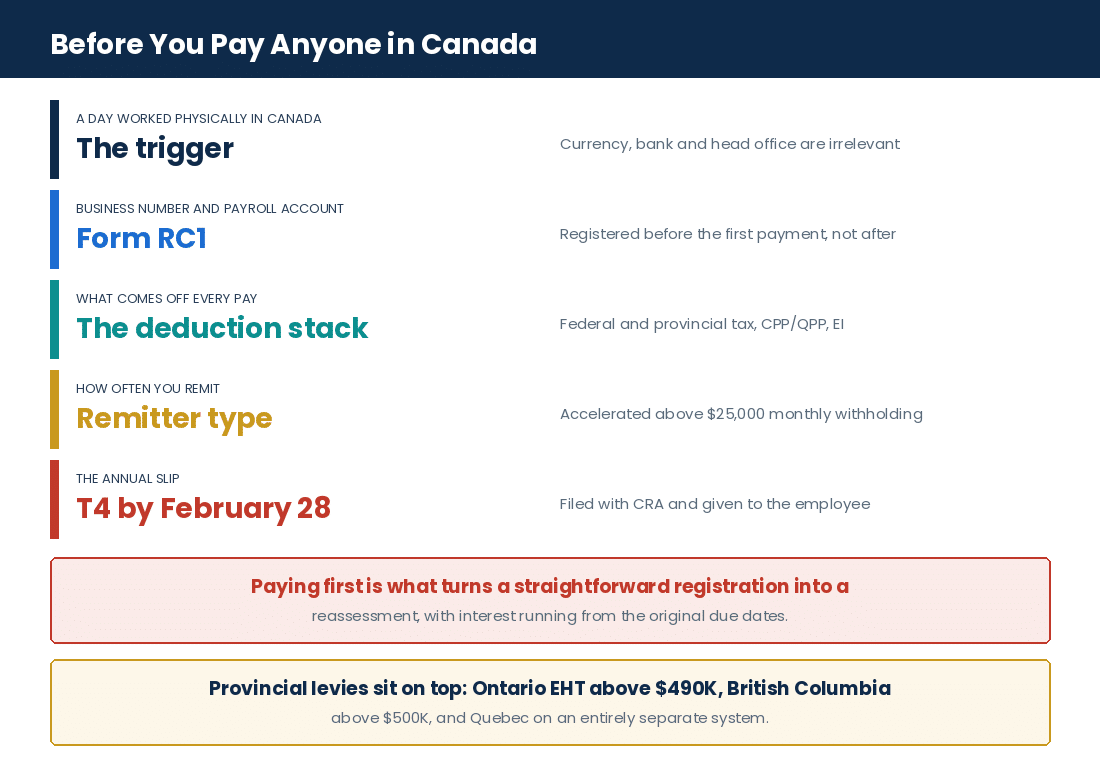
One principle runs through all of it: the obligation follows the work, not the money. A day worked physically in Canada creates Canadian payroll duties even when the salary is paid offshore from a foreign bank by a company with no office here. That means a CRA payroll account registered against a Business Number before the first payment, income tax withheld at federal and provincial rates, CPP and EI deducted and matched, remittances on the schedule your remitter type sets, and T4 slips by February 28. Relief exists but has to be applied for in advance: non-resident employer certification under 153(1.1), Regulation 102 waivers for individual employees, and coverage certificates under social security agreements for CPP and EI. None of it is retroactive. On top sits the provincial layer — Ontario’s Employer Health Tax above $490K, British Columbia’s above $500K, and Quebec’s entirely separate QPP, QPIP and Health Services Fund regime. Get the classification or the deadline wrong and directors can be personally liable.
Reading time: 15 minutes.
Table of Contents
- Understanding Foreign Employer Payroll Obligations
- Overview of Canadian Payroll and Tax Obligations
- Special Cases and Exemptions
- Payroll Compliance Risks and Penalties
- Key Takeaways and Practical Recommendations
- How Gondaliya CPA Can Assist
- Frequently Asked Questions
- Essential Points on Payroll Compliance
- Businesses We Serve & Industry Spotlights
- Professional Guidance and Quick Reference
The Numbers That Matter
This article covers Canadian federal and provincial payroll tax obligations, with Ontario and Toronto context, and reflects rules current to 15 October 2026. It is written for foreign companies that employ, assign or send staff to work physically in Canada, and it covers payroll registration, source deductions, CPP, EI, provincial levies, Quebec’s separate regime, certifications and waivers, and the penalties for getting it wrong. It is not advice on Canadian immigration or work permits, on employment standards and labour law, or on corporate income tax beyond noting that a permanent establishment may arise. Gondaliya CPA performs compilation engagements under CSRS 4200, which provide no assurance; audit and review engagements are referred out. This is educational information only and not tax or legal advice.
Understanding Foreign Employer Payroll and Tax Obligations in Canada
Understanding Foreign Employer Payroll Obligations
Where It Starts
If you’re a foreign employer with workers in Canada, you face some specific payroll and tax duties. These can get pretty tricky if you don’t know the rules. Foreign employer taxes in Canada cover things like income tax withholding, Canada Pension Plan (CPP) contributions, and Employment Insurance (EI) premiums. Sometimes, provinces have extra rules too.
Before paying any employee in Canada, you must register for a payroll account with the Canada Revenue Agency (CRA). Without this step, you can’t properly handle payroll taxes or deductions.
Who Should Read This Guide: Foreign Companies Hiring or Assigning Employees to Canada
This guide helps foreign companies who want to hire or send staff to work in Canada. It focuses on:
- Following the Rules: Making sure your company obeys Canadian laws about payroll and taxes.
- Understanding Your Duties: Learning what’s required when paying employees here.
- Avoiding Penalties: Knowing how to register on time and send payments correctly to avoid fines.
If you grasp these points, you’ll manage your Canadian workforce without trouble and reduce risks tied to breaking the law.
Importance of Compliance with Canadian Payroll and Tax Regulations for Foreign Employers
Sticking to Canadian payroll and tax laws matters for several reasons:
- Legal Risks: The CRA can hit you with big fines if you mess up your payroll taxes or filings.
- Building Trust: Employees expect their paychecks to reflect correct deductions for taxes and benefits.
- Smooth Operations: Following rules keeps your business running well without audits or disputes slowing things down.
Foreign employers who understand these rules protect their finances and keep everything running smoothly with payroll tasks done right.
The hardest part of this for a foreign employer is that nothing warns you. There is no notice, no threshold crossed, no moment the system flags.
A company hires one person in Toronto, pays them from head office the way they pay everyone else, and the obligation has already started. It usually surfaces a year or two later, when the employee files a personal return showing Canadian employment income with no T4 behind it. Figures changed for privacy.
Overview of Canadian Payroll and Tax Obligations for Foreign Employers
Overview of Canadian Payroll and Tax Obligations
The Deductions
Foreign employers who have employees working in Canada must follow Canadian payroll tax rules. These include income tax source deductions, sending payments, and filing reports. Foreign companies have specific tax obligations in Canada. They need to register a payroll account with the CRA. Then, they must withhold the right amounts from wages earned in Canada and meet all deadlines. If they don’t, penalties and interest can apply under the Income Tax Act.
Payroll compliance in Canada isn’t just about federal rules. Provinces have their own rules too, depending on where employees work. This section covers the main points foreign employers face with Canadian payroll taxes.
Canadian Income Tax Source Deductions for Employment Income Earned in Canada
Foreign employers must take off Canadian income tax from paychecks for work done inside Canada. It doesn’t matter where the money is paid or where the bank is Income Tax Act 153(1)(a). They have to get a special CRA payroll account tied to their business number for this.
How much tax to deduct depends on how much employees earn. The CRA updates federal and provincial tax rates each year. Employers must also deduct social program contributions like CPP or QPP and EI premiums if needed.
Employers send these amounts to CRA based on whether they are regular or accelerated remitters. Deadlines come monthly or quarterly CRA Remittance Schedules. Keeping accurate records helps when filing T4 slips yearly.
- Deduct federal income tax
- Deduct provincial/territorial income tax based on employee location
- Deduct CPP/QPP and EI premiums as required
Example: A software company from Europe hires someone working remotely in Toronto.
They register a BN payroll account first. Then, they deduct federal and Ontario taxes using current tables. Finally, they remit payments by month-end following regular remitter rules. Figures changed for privacy.
Canada Pension Plan (CPP) Contributions: Employer and Employee Responsibilities
CPP pays retirement benefits for workers in most provinces except Quebec. Both foreign employers and employees share CPP duties. Contributions are based on pensionable earnings between minimum ($3,500) and yearly maximum limits Canada Pension Plan Regulations 200.
Here’s what happens each pay period:
- Employers match employee CPP contributions one-for-one.
- Money is taken from gross salary after exempt earnings.
- Payments go with other source deductions through the payroll account.
Foreign employers still owe CPP unless covered by social security agreements that give exemptions CRA Guide RC4110. Even then, they must keep proof handy.
A UK consulting firm hires an engineer who works partly in Ontario. Both employer and employee pay CPP based on prorated earnings until exemption certificates say otherwise.
Employment Insurance (EI) Premiums: Rates, Exemptions, and Remittance Requirements
EI premiums help people during unemployment but only if their job fits insurable criteria under EI law EI Regulations. Foreign employers usually have to withhold EI unless:
- Employees qualify for exemption under social security agreements,
- Or their job type is excluded by law.
Rates change slightly each year. Employers pay a bit more than employees—about 1.4 times employee rates CRA EI Premium Tables.
Payments follow usual remittance schedules via the employer’s CRA payroll account. Not paying on time risks penalties like those for missing income tax deductions.
An Australian tech firm with remote BC workers calculates EI using current rates while checking exemption certificates that may reduce some obligations temporarily.
Provincial Payroll Taxes and Variations Across Provinces Including Ontario and British Columbia
| Province | Key Payroll Taxes & Notes |
|---|---|
| Ontario | Employer Health Tax (EHT): applies above $490K annual payroll; rates up to 1.95% |
| British Columbia | Employer Health Tax: applies over $500K annual taxable remuneration; starts at 0.98% |
These taxes need separate registrations from federal accounts but can often be done online via provincial portals like ServiceOntario Ontario Ministry of Finance EHT Guide.
Employers should watch thresholds closely because crossing them triggers new filings mid-year that can increase costs quickly without planning.
Example: A German company grows its Vancouver team past BC’s $500K limit mid-year.
It registers for BC’s health levy promptly to avoid late fees. The threshold is annual but the registration obligation arrives the moment it is crossed, which is why headcount growth belongs on the payroll calendar. Figures changed for privacy.
Quebec-Specific Payroll Obligations: Quebec Pension Plan (QPP), Quebec Parental Insurance Plan (QPIP), And Health Services Fund
Quebec has unique payroll rules unlike other provinces:
- QPP: Like CPP but run by Quebec; contributions are similar but reported separately through Revenu Québec.
- QPIP: Mandatory parental leave insurance paid by both employers and employees; different from federal EI parental benefits.
- Health Services Fund: Charged on total wages; rates vary by business size/type within Quebec Revenu Québec Guidelines.
Foreign companies with workers physically in Quebec must register directly with Revenu Québec besides having a BN/CRA program number for the rest of Canada. Ignoring these can lead to fines or restrictions since Quebec enforces these strictly Revenu Québec Official Site.
Registration Requirements For Payroll Program Accounts And Authorized Representatives
Non-resident employers paying workers inside Canada need a Business Number plus one or more payroll program accounts for withholding taxes properly under section 153(1)(a) ITA Income Tax Act Section 153(7).
To register, they file Form RC1 “Request for a Business Number” explaining this is for employment-related activities inside Canada CRA Form RC1 Instructions.
They can also appoint authorized reps—like accounting firms—using Form RC59 so others handle filings without direct owner involvement CRA Authorization Forms.
Delays risk owing unpaid amounts plus penalties and may block future relief applications that lower withholding needs later on.
An Irish startup hires two contractors partly working in Alberta. They file registration forms online fast, getting BN + PAYROLL ACCOUNT before first payment to avoid back taxes.
Remote Work Considerations Affecting Payroll Tax Responsibilities
Remote work makes figuring out where payroll taxes apply tricky but doesn’t remove employer duties tied to actual work location Income Tax Regulations 102(b).
If any workdays happen inside Canada, those days count toward Canadian payroll taxes no matter where salary is paid from offshore.
This means paying abroad doesn’t dodge foreign employer taxes Canada’s system or foreign employer payroll compliance rules. Keeping track of days worked onsite versus offsite helps prove correct tax treatment during audits.
Example: A US SaaS company employs success managers splitting time between California HQ & Toronto clients.
The days spent onsite trigger proportional Canadian deductions reflecting real service time supported by solid records as auditors expect. Figures changed for privacy.
Special Cases and Exemptions for Foreign Employers
Special Cases and Exemptions
The Relief
Foreign employers working in Canada have tax rules that differ from local companies. Knowing these special cases helps keep foreign employer payroll compliance Canada-wide on track. This part explains important exemptions, certifications, waivers, and work situations that affect foreign company tax obligations Canada.
Non-Resident Employer Certification (NREC) and Conditions for Relief from Withholding Income Tax
Non-resident employer certification (NREC) lets eligible foreign employers avoid withholding Canadian income tax on pay for workers doing jobs in Canada. The CRA gives NREC when the employer meets rules in subsection 153(1.1) of the Income Tax Act [ITA] and Regulation 102.
To get NREC:
- Employee must be a non-resident working partly or fully in Canada.
- Employer must not have a permanent establishment in Canada tied to those services.
- Payments must only cover work done outside any Canadian permanent establishment.
- Employer agrees to follow reporting rules even if they don’t withhold taxes.
Relief works only from approval date forward; pay before approval still faces withholding. Also, NREC doesn’t mean no CPP/EI payments unless supported by social security agreements or coverage certificates below [CRA: Payroll Deductions].
Example: A US software firm hires a developer working part-time remotely in Ontario but has no office there.
After getting NREC before paying, it doesn’t withhold income tax on wages for those times but files T4 slips yearly. The certification removes the withholding, never the reporting. Figures changed for privacy.
Application Process and Timing for NREC Approval
To apply for NREC, submit Form NR301 with info about where the employee works, how long they’re in Canada, type of income, and proof no permanent establishment exists under ITA s. 153(1.1).
File early because:
- CRA usually takes several weeks to process.
- Relief starts only after written approval; no retroactive exemption.
- Keep doing regular source deductions until you get certification.
Keep good records of days worked inside and outside Canada to back your application [CRA: Non-resident Employer Certification].
Example: A German consulting firm applies three months before paying short-term Ontario staff and gets approval on time.
It then pays without withholding but files reports as required. Three months ahead is not caution, it is the realistic lead time, and applications filed closer than that usually miss the first pay run. Figures changed for privacy.
Social Security Agreements and Coverage Certificates Exempting Contributions Under CPP/EI
Canada has social security agreements with some countries that can stop CPP/EI deductions for employees temporarily working here. These agreements prevent paying twice into similar systems.
Coverage certificates come from Canadian or home country agencies confirming if workers stay under their pension/insurance plans based on Employment Insurance Act s.7(2)(a), CPP rules Part XI [Income Tax Regulations], and international treaties.
Points to note:
- Certificates don’t change income tax withholding duties.
- They work only if both countries agree on pension/insurance status.
- Employers must check certificate validity every year for workers in provinces like Ontario [CRA: Social Security Agreements].
An Australian company sends engineers temporarily to British Columbia. With valid certificates showing Australian pension coverage continues, it stops CPP/EI deductions but keeps normal payroll taxes at source.
Regulation 102 Waivers for Individual Employees When NREC Does Not Apply
If a foreign employer can’t get full NREC, individual employees might still qualify under Regulation 102 waivers that relieve their pay from mandatory withholding if conditions apply:
Conditions include:
- Employee works briefly only within certain provinces.
- Pay stays below CRA thresholds.
- No other taxable presence triggers bigger registration needs.
Regulation 102 waivers need separate applications per worker submitted with annual returns or specific forms depending on province [Income Tax Regulations s.102].
This offers relief different but complementary to full non-resident employer certification, fitting particular workforce setups across provinces like Ontario or Quebec.
A UK marketing consultant on a short (<30 days) onsite visit at clients qualifies individually under Reg 102 waiver allowing zero deduction while the company lacks corporate certification nationwide.
Employment Scenarios Triggering or Exempting Payroll Deductions: Short-Term Assignments, Remote Work From Home Offices
Payroll deduction duties depend mainly on whether work happens physically inside Canada, regardless of payment currency or bank location per ITA ss115 & CRA updates June 2026 [CRA].
Short assignments cause partial-period obligations calculated by actual days worked inside provinces including Ontario. Remote telework complicates residency tests requiring detailed day counts showing cross-border activity matching treaty rules about business profits vs personal service income [ITA ss248(1)].
Exemptions happen when all work is outside Canada even if paid offshore—this needs strong proof of no physical presence during pay periods plus advance notifications if needed [CRA Notice].
An Indian tech vendor sends developers sporadically to Toronto offices less than two weeks yearly, triggering minimal source deduction based only on recorded days worked rather than total contracted salary paid offshore through European banks but adjusted locally after payroll runs.
Handling Multi-province Employment and Overlapping Provincial Payroll Obligations
When employees work in several provinces, it creates complex payroll liabilities since each province sets its own rates beyond federal taxes. For example, Ontario charges Employer Health Tax separately even though GST/HST filing is federal [Ontario Ministry Finance].
Foreign firms hiring across provinces must register wherever they have significant presence over set thresholds then allocate earnings based on time spent physically working there. This respects local labour laws affecting overall compliance risks though those aren’t covered here.
Proper allocation means correct payment schedules both federally (via Business Number with province suffixes) and provincially avoiding double payments while keeping records clear through accounting tools like QuickBooks linked with Gondaliya CPA bookkeeping workflows reducing errors across cities like Toronto and Ottawa.
Example Table – Provincial Allocation Sample
| Province | Days Worked | % Allocation | EHT Rate (%) | Federal Source Deduction Due |
|---|---|---|---|---|
| Ontario | 120 | 40% | 1.95 | $3,900 |
| Quebec | 90 | 30% | Varies | $2,925 |
| Alberta | 90 | 30% | – | Included federally |
Sources: CRA Business Number Registration Guide; Ontario Ministry Finance Publications Illustrative
Managing Payroll For Indigenous Workers And Special Employment Situations
Indigenous workers hired by foreign firms working with First Nations may face special issues mainly about provincial wage subsidies rather than changing federal payroll deductions set by ITA above. Still,
Some exemptions might apply such as waived provincial health premiums recognizing indigenous status via band cards but this does not change core foreign employer taxes canada or payment deadlines nationwide.
Other cases include seasonal workers hired sporadically needing precise start/end tracking so automated payroll calculations avoid late-filing penalties common among operators new to complex domestic rules.
Employers should ask advisors familiar with indigenous labor plus cross-border issues—like Gondaliya CPA—that serve many sectors around southern Ontario helping reduce risks before fiscal year-end reconciliations arrive.
For questions about your foreign company tax obligations canada, reach out at info@gondaliyacpa.ca or call 647‑212‑9559 for advice on foreign employer payroll canada tailored to your needs with licensed expertise trusted across Ontario businesses handling multinational teams year-round.
Foreign Employer Payroll Check
Five quick questions on where your Canadian payroll stands. No fee shown.
Points to raise with us:
This is a general prompt, not tax or legal advice or a quote. Your position depends on your full facts. For a real review, please book a free consultation.
Payroll Compliance Risks and Penalties
Payroll Compliance Risks and Penalties
What It Costs
Foreign employers working in Canada face real risks if they don’t follow payroll rules. They must withhold, remit, and report employment income tax deductions correctly for workers doing Canadian duties. Missing foreign employer taxes Canada requirements can bring heavy fines, interest charges, and hurt reputation. The Income Tax Act (ITA) sections 153(1)(a) and 227(8) set clear rules for foreign companies about payroll taxes in Canada.
Consequences of Worker Misclassification on Payroll Deductions and Remittances
Calling someone a contractor instead of an employee can cause big payroll mistakes. Foreign employer payroll compliance Canada demands that all pay for work done in Canada has proper tax deductions. Mislabeling workers leads to no withholding of income tax, CPP, or EI.
If a foreign company treats an employee like a contractor by mistake:
- It might skip withholding Canadian payroll deductions.
- The CRA can reassess amounts due plus penalties.
- The employer still owes CPP/EI contributions.
For example, paying $50,000 yearly without deductions because of misclassification may cause the CRA to add penalties up to 10% plus interest under Income Tax Act s. 227(9).
What makes misclassification expensive is that the employer ends up owing both halves of CPP and EI, having never collected the employee’s share. Figures changed for privacy.
Director Liability for Unremitted Payroll Deductions Including CPP, EI, and Income Tax
Directors of foreign companies with Canadian workers can be held personally responsible if payroll deductions aren’t sent properly. ITA section 227(3) makes directors liable along with the company for unpaid amounts like:
- Employee income tax withheld
- Both parts of CPP contributions
- Employer portion of EI premiums
This applies even if directors didn’t know about the issue unless they show they acted carefully.
Penalties and Interest for Failure to Deduct or Remit Payroll Taxes on Time
| Infraction | Penalty Rate | Source |
|---|---|---|
| Late remittance | Minimum $100 + percent-based fee | ITA s. 221; CRA Guide RC4110 |
| Failure to deduct | Up to 10% of amount not deducted | ITA s. 227(9) |
| Repeat failure in three years | Penalty up to twice initial amount | ITA s. 163 |
Interest grows daily after the due date until full payment is made at CRA’s published rates.
Impact of Late or Missed Remittances on Foreign Employers
Late payments mess with cash flow but also add extra costs through interest—usually prime rate plus a few points—and late fees starting at $100 each time [CRA Publication T4001]. Foreign employers new to Canadian remittance due dates might miss deadlines easily depending on their remitter type (regular vs accelerated).
For instance: A monthly remitter who misses two payments totaling $20,000 could face over $200 in late fees plus interest until cleared.
CRA’s Enforcement Approach to Compliance Exposures for Foreign Employers
The CRA watches for mismatches between T4 slips filed and remittances reported. Non-resident employers claiming exemptions through certifications also get extra checks [ITA ss.153(7)]. Things that set off reviews include:
- Issuing slips without filing source deduction returns
- Paying before getting needed waivers or certificates
- Odd pensionable earnings reports causing follow-ups
- Tips about unregistered activities
Enforcement can start with letters asking for fixes but lead to audits and director penalties if problems persist.
Record-Keeping Requirements and Reporting Obligations To Avoid Compliance Issues
Canadian law says employers keep detailed payroll records showing pay earned inside Canada for six years after year-end [ITA Regs., Section 102]. Records should clearly show how deductions were calculated for income tax, CPP, and EI.
Employers must keep items like:
- Timesheets proving days worked physically in Canada
- Copies of waiver applications or approvals
- Proof that payments were made on time
Missing records makes audits harder and raises the chance of penalties since it’s tough to prove proper withholding happened.
Directors may share personal liability equal to unpaid employee-source deductions under ITA section 227(3).
All income earned doing work in Canada needs correct withholding and timely filing/remittance—even if the employer is foreign (Canada.ca).
Misclassifying workers often leads to reassessments adding penalties up to 10% plus interest (Income Tax Act).
Keep detailed logs tracking days worked inside Canada aligned with pay periods before making payments that need withholding/remittance.
For help with complex foreign company tax obligations Canada, reach out to Gondaliya CPA’s cross-border team experienced in foreign employer payroll compliance Canada at info@gondaliyacpa.ca or call 647‑212‑9559 today.
Key Takeaways and Practical Recommendations for Foreign Employer Taxes and Payroll Compliance in Canada
Key Takeaways and Practical Recommendations
What To Do
Foreign employers who have staff working in Canada need to know their tax duties well. You must register a payroll account with the CRA. Then, you withhold taxes from Canadian income correctly. You also have to make payments on time and report properly. If you don’t follow these rules, penalties and interest can pile up fast. It’s smart to check if hiring in Canada creates a permanent establishment early on, as that can bring extra tax or GST/HST filing needs.
You can get some relief using certifications like the non-resident employer certification. But that doesn’t wipe out your filing or CPP/EI payment duties. Quebec payroll rules are quite different, and provinces like Ontario charge extra levies such as Employer Health Tax. Make sure you classify workers right to avoid wrong withholding amounts and reduce audit risks.
Starting payroll registration before employees begin work smooths out compliance during their employment.
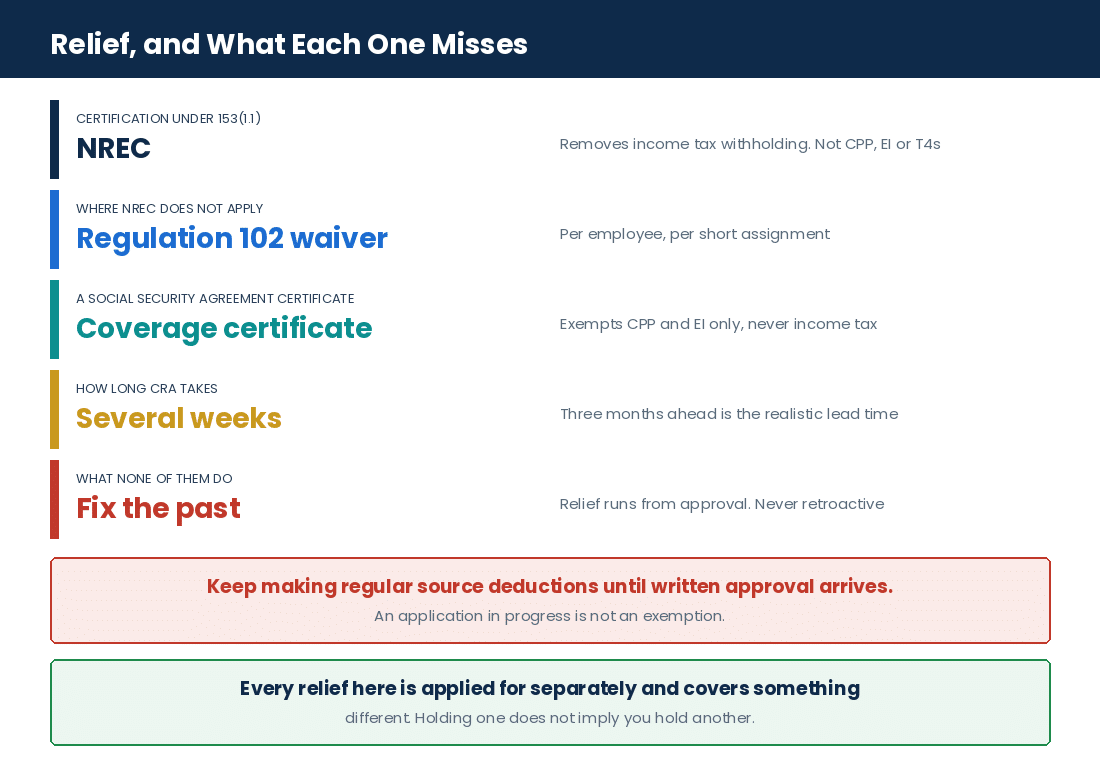
Summary of Primary Payroll Obligations Beginning With Employee Work Start Date in Canada
When a foreign company hires workers who do their job physically in Canada, payroll duties start immediately on day one foreign employer payroll Canada, foreign employer taxes Canada. Here’s what must happen:
- Register a foreign employer CRA payroll account with your business number.
- Calculate Canadian payroll deductions (income tax withholding using published rates).
- Pay the withheld amounts by deadlines (monthly or accelerated remitter).
- File annual T4 slips showing pay earned for Canadian work.
These steps matter no matter where you pay or bank the wages because tax obligations link directly to work done in Canada ITA s.153(1)(a). If you miss these, penalties for late remittance apply.
Example: A US software firm hires an employee working remotely in Ontario from March 1, 2026.
They open a CRA payroll account before that date, deduct federal and provincial taxes each pay period, send payments monthly by the 15th of the following month, and file T4s by February 28 yearly. Figures changed for privacy.
Importance of Assessing Remote Work and Permanent Establishment Risks Early
Hiring workers who perform services inside Canada may trigger more than just payroll duties. It might create a permanent establishment (PE) for your company under tax treaties.
Assess early if:
- Your presence counts as carrying on business requiring GST/HST registration.
- You need corporate tax filings because PE status applies.
Remote setups complicate things but don’t excuse checking if having staff physically present forms taxable connections federally or provincially CRA Business Number Registration.
Ignoring this can lead to audits and big back taxes plus interest owed.
Utilizing Certifications and Waivers Where Applicable To Manage Withholding Requirements
Foreign employers might reduce withholding through:
- Non-resident Employer Certification: Cuts or removes withholding if conditions about residency and treaty benefits hold true.
- Withholding Waiver: A formal request sent before payment suspends withholding temporarily pending review.
Both need approval before any payments; they don’t fix past payments nor remove filing duties like T4s or CPP/EI where applicable.
Keep detailed records of employee days worked inside/outside Canada because mistakes here cause penalty risks during CRA checks.
An Australian consulting firm applies three months early, gets certification by July 2026, stops full-source deductions but keeps filing slips regularly.
Provincial Nuances Especially Concerning Quebec Payroll Compliance
Provincial rules add complexity beyond federal laws:
- Quebec runs its own income tax deduction system; foreign employers must register with Revenu Québec too.
- Ontario charges Employer Health Tax (EHT) annually on wages over set limits.
- Workers’ compensation premiums vary by province; some require separate registrations that affect costs.
Missing these means fines from local agencies separate from federal penalties. Knowing these rules early avoids surprises at hire time.
Necessity of Accurate Worker Classification And Timely Remittances To Prevent Penalties
Classifying workers correctly—employee versus contractor—is critical under Canadian law. Wrong classification causes wrong withholding amounts and raises audit chances.
Send all remittances on time to avoid daily penalties under Income Tax Act rules. The CRA flags accounts missing payments when slips show taxable income but money isn’t sent.
Use strict controls on classification decisions and schedule payments well. This cuts risk while keeping clean records ready if authorities ask questions.
Emphasizing Proactive Payroll Registration And Ongoing Compliance Monitoring
Register your foreign employer payroll account as soon as you confirm someone will work physically in Canada. This sets up legal basis for proper withholding and payments federally.
Keep monitoring days worked inside/outside Canada for certification eligibility. Reconcile gross pay against deductions regularly to catch gaps early Payroll Account Maintenance Guidance.
Being proactive stops operational slip-ups like missed deadlines and avoids issues like double taxation without clear record trails over fiscal years worked.
How Gondaliya CPA Can Assist with Foreign Employer Payroll Compliance
How Gondaliya CPA Can Assist
Support
Foreign employers working in Canada must handle tricky payroll and tax rules. Gondaliya CPA helps foreign companies meet their tax obligations Canada-wide. We make sure foreign employer taxes Canada and payroll compliance run smoothly.
Expert Guidance on Canadian Payroll Registration and Tax Remittance Obligations for Foreign Companies
Any foreign company with employees in Canada has to register a Canadian payroll account. This lets you withhold income tax, CPP, and EI properly. Gondaliya CPA walks you through every step—from getting a business number (BN) to picking the right remitter type based on how often you pay employees.
We help calculate payroll deductions correctly by applying CRA rules for non-resident employers. You must send payments on time or face penalties and interest under the Income Tax Act (sections 153(1)(a) and 227(8)). Our team tracks due dates for your remitter type—whether regular or accelerated—and guides you on keeping proper records as CRA requires.
Assistance with Non-Resident Employer Certification Applications and Social Security Agreement Evaluations
Non-resident employer certification can reduce withholding income tax at source but has strict conditions under Income Tax Regulations section 102(2). Gondaliya CPA helps prepare your applications before you pay employees. Remember, this certification applies going forward, not backward, and doesn’t remove your need to file T4 slips.
We review social security agreements between Canada and other countries. These agreements might exempt employees from CPP or EI contributions if a certificate of coverage applies under the Employment Insurance Act. We ensure you handle all paperwork correctly while avoiding unnecessary payments.
Support for Complying with Provincial Payroll Tax Regimes and Quebec-Specific Requirements
Canadian provinces have different payroll taxes beyond federal ones. Ontario charges an Employer Health Tax (EHT), while Quebec has its own systems like QPIP (Quebec Parental Insurance Plan). Gondaliya CPA identifies which provincial taxes apply depending on where your workers are based.
If you employ people living or working in Quebec, we provide guidance on specific provincial forms like Relevé slips along with federal T4s. This helps avoid mistakes from missing filings or mixing up rules between provinces.
Risk Assessment and Mitigation Strategies for Penalties, Director Liability, and Payroll Audits
Not following rules puts foreign employers at financial risk. You could face late-filing penalties under section 227(9) of the Income Tax Act plus interest on unpaid amounts. Directors might be personally responsible if the company fails to deduct source taxes without good cause [CRA Bulletin IT-490R].
Gondaliya CPA checks risks tied to missed registrations, wrong withholding, late payments, poor records, or delayed annual filings like T4s. We suggest ways to fix problems early—like voluntary disclosures—to reduce chances of CRA audits triggered by mismatched wages versus withheld amounts.
Customized Solutions for Remote Work Compliance and Multi-Jurisdictional Payroll Management
Remote work makes it tricky to figure out payroll rules because where work happens affects tax obligations [Income Tax Act s115]. For global companies managing teams across borders—including partly remote workers—we offer solutions using tools like QuickBooks Online or ADP that handle multi-jurisdiction tracking.
We build processes that log days worked inside each province and adjust deductions automatically—a must-do since remote work is changing how payroll compliance works across Canada for foreign employers.
Contact Gondaliya CPA for Consultation and Payroll Compliance Support Tailored to Foreign Employers Operating in Canada
Foreign businesses needing clear advice about Canadian tax duties can turn to our experienced team. We handle files from Ontario to all over Canada. To talk about your situation concerning foreign employer taxes Canada email us at info@gondaliyacpa.ca or call 647-212-9559 for a free chat focused on your needs.
Penalties for not deducting start at $1000 per incident plus daily interest until paid — Income Tax Act s227(9).
Non-resident employers paying workers in Canada must register a CRA payroll account before paying wages subject to source deductions — ITA s153(1)(a).
Applying late—or after paying—for non-resident employer certification won’t fix past withholding or reporting duties — IT Regulations s102(2).
Keep detailed records showing days worked inside and outside provinces to support accurate taxable income allocation under Canadian tax rules.
FAQs on Foreign Employer Payroll Compliance and Tax Obligations in Canada
Frequently Asked Questions
Answers
What is the payroll account registration process for foreign employers in Canada?+
How do remittance due dates affect foreign employer payroll compliance Canada?+
What thresholds determine regular and accelerated remmitter status in Canada?+
What is the penalty for failure to remit payroll deductions in Canada?+
How long must foreign employers retain payroll records in Canada?+
When is the T4 slip filing deadline for foreign employers in Canada?+
What is the typical timeline for certification application approval under Income Tax Regulations section 102?+
How does Ontario Employer Health Tax affect foreign employers with Canadian employees?+
Are workers’ compensation premiums mandatory for foreign employers in Canada?+
What are key CRA payroll deduction rules foreign employers must follow?+
Essential Points on Payroll Compliance
Key Points
Essential Bullet Points on Foreign Employer Payroll Compliance Canada
- CRA Business Number Registration Guide: Explains steps to obtain BN and set up payroll accounts essential for tax withholding compliance.
- Non-Resident Employer Duties: Includes registering, withholding taxes, remitting payments timely, filing annual returns such as T4s.
- Source Deductions: Income tax, CPP/QPP contributions, EI premiums calculated based on employee earnings within Canada.
- Remitter Type Determination: Regular vs accelerated based on average monthly withholding amounts affecting payment deadlines.
- Payroll Account Maintenance: Keep active CRA accounts updated; inform CRA of changes like closure or new hires promptly.
- Certification and Waivers: Apply early for NREC or Regulation 102 waivers to reduce withholding but maintain reporting duties.
- Qualifying Employee & Employment Types: Distinguish employees from contractors to correctly apply source deductions avoiding reassessment risks.
- Pensionable Employment & Insurable Employment: Determine if earnings are subject to CPP/QPP contributions or EI premiums under Canadian law.
- Coverage Certificate Use: Leverage social security agreements to exempt CPP/EI deductions where applicable with valid certificates of coverage.
- Permanent Establishment Assessment: Analyze business presence in Canada that may trigger corporate tax filings alongside payroll obligations.
- Canada Revenue Agency Form RC1 & RC59: For BN registration and authorizing representatives who manage payroll filings on employer’s behalf.
- Employer of Record Arrangements: Consider alternatives like EOR providers when handling employment compliance complexities across jurisdictions.
- LOCK Principle Application: Maintain legal compliance by ensuring accurate classification, obligations fulfillment, clear recordkeeping from day one.
- Employer Health Tax Act Compliance: Monitor provincial thresholds triggering health tax liabilities besides federal payroll taxes.
- Income Tax Act ss153(1)(a), s227(8), (9), s230 Compliance: These govern withholding duties, penalties for non-remittance, and director liabilities ensuring adherence reduces audit risk.
- Income Tax Regulations Section 102 & Section 102(2): Detail conditions for waiver applications relating to withholding relief mechanisms for foreign employers.
- Canada Revenue Agency Bulletin IT-490R Guidance: Provides insight into director liability concerning unremitted source deductions safeguarding corporate officers’ interests.
- Form NR301 & NR4 Usage: Required forms supporting certification requests or reporting non-resident income payments beyond employment wages when applicable.
- Revenu Québec Guidelines & Quebec-Specific Reporting: Ensure compliance with QPP/QPIP contributions and distinct filing requirements apart from federal rules when employing Quebec-based workers.
- Social Security Agreements Impact on Payroll Taxes: Understand treaties that prevent double contributions into pension or insurance schemes benefiting cross-border workers temporarily assigned in Canada.
- Employment Insurance Act s7(2)(a) Interpretations: Defines insurable employment situations affecting mandatory EI premium withholding by foreign employers managing Canadian workforces.
For tailored guidance on navigating foreign employer taxes and comprehensive payroll compliance in Canada contact Gondaliya CPA at info@gondaliyacpa.ca or call 647‑212‑9559 today.
Businesses We Serve & Industry Spotlights
Industry Expertise
Foreign employers sit inside a wider group of people and companies whose Canadian obligations begin with a cross-border question, and the issues that decide a foreign employer’s payroll — where the work physically happened, whether a presence has been created here, and what has to be registered before the first payment — recur across every one of these situations.
| Who | The Foreign Employer Angle |
|---|---|
| Foreign employers hiring in Canada | Payroll registration, source deductions, NREC and waivers |
| Canadian companies expanding to the US | The same problem, run in the opposite direction |
| Foreign shareholders of Canadian corporations | Withholding on Canadian-source payments out |
| IT staffing companies | Placed workers creating obligations province by province |
| Managed service providers | Cross-border teams and multi-jurisdiction day tracking |
| Cloud service providers | Remote staff whose work location sets the deduction |
| Corporate trainers | Short onsite assignments and Regulation 102 waivers |
| Canadians working in the US | Day counts and withholding read from the other side |
| US citizens living in Canada | Employees whose own filing duties follow citizenship |
| Digital nomads | Residency tested against where the work was done |
| International students with businesses | Payroll obligations arising alongside study permits |
- Foreign employers hiring in Canada: The core of this work. Registration before the first payment, correct source deductions and a certification applied for in time account for almost every adjustment we make.
- Canadian companies expanding to the US: The mirror image — a Canadian employer discovering that US states have their own registration and withholding rules for staff on the ground.
- Foreign shareholders of Canadian corporations: Withholding on amounts leaving Canada, run on machinery that sits alongside the payroll system rather than inside it.
- IT staffing companies: Placed workers mean a separate answer for each province they physically work in, regardless of where the contract was signed.
- Managed service providers: Teams split across borders need day-level tracking before deductions can be allocated to the right jurisdiction.
- Cloud service providers: Fully remote hiring looks borderless from head office, but the employee’s physical location is what sets the obligation.
- Corporate trainers: Short onsite engagements are exactly the case Regulation 102 waivers were designed for, applied for one worker at a time.
- Canadians working in the US: The same day-count and withholding questions seen from the employee’s side rather than the employer’s.
- US citizens living in Canada: Employees who carry their own filing obligation wherever they work, which shapes what they need from the T4 their employer issues.
- Digital nomads: Residential ties weighed against where the work actually happened, which is the employee-side version of this whole question.
- International students with businesses: Payroll duties that arrive the first time someone is hired, alongside the study permit conditions already in play.
In every one of these, the deciding fact is physical: where the person was standing when they did the work.
Not where the contract was signed, not which entity employs them, not where the money moved. That one fact sets the registration, the deductions, the province and the slips — which is why a day-level record is the first thing we ask for and the last thing anyone thinks to keep.
Professional Guidance and Quick Reference
Guidance
Essential Tax Points for Foreign Employers With Staff in Canada
Foreign employers get caught out in a predictable set of ways: paying a Canadian-based worker before any payroll account exists; assuming that paying offshore from a foreign bank keeps the arrangement outside Canadian rules; treating an employee as a contractor and skipping deductions entirely; applying for non-resident employer certification after the first payment, when it cannot work retroactively; relying on a coverage certificate for CPP and EI and assuming it also covers income tax; missing a provincial Employer Health Tax threshold crossed mid-year; overlooking Quebec’s entirely separate registration; and keeping no day-level record of where the work was performed. Gondaliya CPA handles foreign employer payroll compliance on a flat annual fee.
Quick Answers
At a Glance
- What triggers it: work performed physically in Canada, whatever the currency or bank
- First step: a Business Number and payroll program account, before the first payment
- Registration form: Form RC1; Form RC59 to authorise a representative
- Deduct: federal income tax, provincial tax by employee location, CPP/QPP, EI
- CPP basis: pensionable earnings above the $3,500 exemption, matched by the employer
- EI employer share: around 1.4 times the employee rate
- Remitter type: regular below $25,000 average monthly withholding, accelerated above
- T4 slips: filed and provided by February 28 of the following year
- Ontario EHT: above $490K annual payroll, rates up to 1.95%
- British Columbia EHT: above $500K taxable remuneration, starting at 0.98%
- Quebec: separate registration with Revenu Québec for QPP, QPIP and Health Services Fund
- NREC: relief from income tax withholding under subsection 153(1.1), applied for on Form NR301
- NREC limits: forward-looking only, and does not remove CPP, EI or T4 duties
- Regulation 102 waiver: per-employee relief where NREC does not apply
- Coverage certificates: can exempt CPP and EI under a social security agreement, never income tax
- Director liability: personal, under ITA 227(3), for unremitted source deductions
- Failure to deduct: up to 10% under ITA 227(9), doubled on a repeat within three years
- Records: six years after year-end, including timesheets showing days worked in Canada
Who This Is For / Not For
Fit Check
- For: foreign companies hiring employees who live and work in Canada, and those assigning or seconding staff here for short or long periods.
- For: employers already paying someone in Canada without a payroll account, and those weighing whether non-resident employer certification or a Regulation 102 waiver fits their situation.
- Not for: advice on Canadian immigration, work permits or employment standards, on labour law, or on corporate income tax beyond noting that a permanent establishment may arise.
- Not for: companies whose Canadian-based people genuinely work entirely outside Canada. A single employee working a handful of days here is still squarely in scope, because the obligation is proportional rather than absent.
People Also Ask
Related Questions
We have no office in Canada and pay from abroad. Does any of this apply?+
Yes. The obligation attaches to work performed physically in Canada, not to where the salary is paid or which bank sends it. Under ITA 153(1)(a) a foreign employer with someone working here needs a payroll account and must withhold, remit and report. Having no office may help with a certification application, but it does not remove the duty.
Our worker is a contractor, so there are no deductions. Correct?+
Only if the classification holds up. CRA tests the substance of the relationship, not the label on the agreement. Where a worker is reassessed as an employee, the employer owes the withholding that should have happened plus both halves of CPP and EI — having never collected the employee’s share — with penalties up to 10% under 227(9) and interest.
Can we apply for the certification now and have it cover what we already paid?+
No. Non-resident employer certification runs from the date CRA approves it and is never retroactive. Keep making regular source deductions until written approval arrives, and allow several weeks — in practice around three months before the first pay run is a realistic lead time.
We have a coverage certificate. Does that mean no deductions at all?+
No. A certificate issued under a social security agreement can exempt CPP and EI, because those are the schemes the agreement covers. Income tax withholding is unaffected and continues unless separately relieved by certification or a waiver. The two reliefs are applied for separately and do different things.
What does CRA actually look at when it reviews a foreign employer?+
Mismatches, mostly. T4 slips filed without matching source deduction returns, payments made before a waiver or certificate was in hand, pensionable earnings figures that do not reconcile, and tips about unregistered activity. It usually begins as a letter asking for corrections and escalates to an audit, and to director liability, only if nothing is put right.
Glossary of Key Terms
Definitions
- Source deductions: amounts withheld from an employee’s pay — income tax, CPP/QPP and EI — and remitted to CRA.
- Payroll program account: the CRA account, attached to a Business Number, through which source deductions are remitted.
- Form RC1: the Request for a Business Number, used to register for a payroll account.
- Form RC59: the authorisation form appointing a representative to handle filings.
- Remitter type: regular or accelerated, set by average monthly withholding and determining the payment schedule.
- NREC: non-resident employer certification, relief from income tax withholding under subsection 153(1.1).
- Form NR301: the form cited in this article for the certification application.
- Regulation 102 waiver: per-employee relief from withholding where the employer does not hold certification.
- Coverage certificate: proof under a social security agreement that a worker remains in their home scheme, exempting CPP and EI.
- Permanent establishment: a presence in Canada that can trigger corporate tax filings alongside payroll duties.
- Employer Health Tax (EHT): the provincial payroll levy in Ontario and British Columbia, above their respective thresholds.
- QPP, QPIP and Health Services Fund: Quebec’s separate pension, parental insurance and wage levy regimes.
- Director liability: personal responsibility of directors for unremitted source deductions under ITA 227(3).
- T4 slip: the annual statement of employment income and deductions, due February 28.
- Employer of record: a third-party arrangement under which another entity employs the worker and carries the compliance.
Want a checklist to work from? You can download our free foreign employer payroll checklist before your consultation.
Four things decide a foreign employer’s position. The work, not the money — a day worked physically in Canada creates the obligation under 153(1)(a) regardless of currency, bank or incorporation, so the payroll account comes before the first payment, not after it. The full deduction stack — federal and provincial income tax, CPP above the $3,500 exemption and matched, EI at roughly 1.4 times the employee rate, remitted on your remitter type’s schedule and reported on T4 slips by February 28. Relief is applied for, never assumed — certification under 153(1.1) on Form NR301, Regulation 102 waivers per employee, coverage certificates for CPP and EI only, and none of it retroactive. And the provincial layer — Ontario EHT above $490K, BC above $500K, Quebec’s separate regime entirely. Get it wrong and 227(9) penalties, interest and personal director liability under 227(3) all follow.
Three questions tell you where you stand, and you can answer all of them today. First, is anyone being paid by your company for work done physically in Canada right now? If so, the question is not whether the obligation exists but how far back it runs. Second, do you have a Business Number with a payroll program account? Without it there is nowhere to remit, and paying first is what turns a manageable registration into a reassessment. Third, can you produce a day-level record of where each person worked? That record decides the province, the allocation and whether any certification or waiver can be supported — and it cannot be reconstructed convincingly a year later.
Foreign Employer Payroll Canada: How Gondaliya CPA Can Help
Start with who works where, and whether anyone has been paid yet
Gondaliya CPA registers the Business Number and payroll program account before the first payment, sets the remitter type and the remittance calendar, calculates federal and provincial deductions with CPP and EI applied correctly, prepares non-resident employer certification and Regulation 102 waiver applications with the lead time they actually need, reviews social security agreements and coverage certificates so CPP and EI exemptions are claimed where they exist, handles Ontario EHT and the separate Revenu Québec registrations, builds the day-level tracking that supports multi-province allocation, and works through unregistered periods via voluntary disclosure where that applies — on a flat annual fee including HST with a one-business-day response. Please book a free consultation.
Next Steps
Please book a free consultation with Gondaliya CPA and bring three things: a list of everyone doing work in Canada and which province they are in, the dates each of them started, and whatever payroll registration you already hold here if any. Those three settle whether registration is overdue, which provincial regimes apply and whether certification or a waiver is worth pursuing — which between them account for nearly every adjustment we make on a foreign employer file. If people have already been paid with nothing withheld, say so at the outset, because unregistered periods are routine to work through and considerably cheaper to raise than to have found. You will get a flat annual fee including HST before any work begins. We serve Toronto, Mississauga, Brampton, Vaughan, Etobicoke, Scarborough, Hamilton, Ottawa and the rest of Ontario, and work with foreign employers staffing teams across Canada. If our content helps, please add gondaliyacpa.ca as a preferred source on Google.
Published: · Last updated:
Editorial policy: We research against CRA, Department of Finance, Parliament of Canada, CPA Canada and CPA Ontario sources, fact-check the figures, and Sharad Gondaliya, CPA, reviews the content, which we update as the rules change.
Disclaimer: This article is educational information only and is not tax, legal, financial, immigration or employment advice. It covers Canadian federal and provincial payroll tax obligations arising when a foreign employer has staff working physically in Canada, and it does not cover immigration or work permits, employment standards and labour law, or corporate income tax beyond noting that a permanent establishment may arise, each of which is administered separately. Contribution rates, exemption amounts, provincial thresholds, remitter thresholds and penalty amounts are set annually and change; the figures and statutory references in this article are those stated in the source material, which cites more than one penalty figure for failure to deduct, and every one should be confirmed against current CRA, Revenu Québec and provincial guidance before a payroll is run. Whether a worker is an employee or a contractor, and whether a certification or waiver is available, both turn on the full facts. Gondaliya CPA performs compilation engagements under CSRS 4200 and does not perform audit or review engagements. Please consult a licensed CPA before acting.

Sharad Gondaliya is a CPA Canada & CPA USA with 15 Years+ experience of Accounting, Tax, Payroll of Corporate Small Businesses as Tax Accountant. He is a CPA Ontario member (61040184) and holds US CPA licences in Washington and Montana and is well known among corporate small businesses for tax planning, efficient tax solutions, and affordable CPA services. Sharad is the Principal (Director) of Gondaliya CPA – Affordable CPA Firm in Canada. Licenses: CPA Ontario: 61040184 | CPA USA (MT): PAC-CPAP-LIC-033176 | CPA USA (WA): 57629 | CPA Firm License: 61330051 View Full Author Bio