



Canadian Snowbird Rental Property Tax Rules: Reporting Rental Income While Spending Winters Abroad
Canadian snowbird rental property tax: essential rules for snowbird landlord taxes in Canada
Canadian snowbird rental property tax affects snowbird landlords who rent their homes while away, and it’s important to understand snowbird landlord taxes Canada and rental income reporting. Gondaliya CPA explains how Canadian rental income tax for snowbirds applies based on location, rental periods, and tax treaties.
Quick Summary
Renting out the house while you winter south is straightforward until residency enters the picture. Stay a factual resident — and most snowbirds do, because the home, the family and the ties remain — and you report worldwide rental income on a T1 with Form T776, deducting repairs, insurance, management fees, property taxes and utilities against it. Become a non-resident and the picture inverts: Part XIII withholding comes off the gross rent each month, remitted by whoever pays or manages the property, with no deductions at all — unless you file the section 216 net-rent election by March 31, which is a hard deadline with no way back. Then the paperwork around it: monthly remittances, NR4 slips by the end of February, records kept six years, and GST/HST once gross rents pass $30,000. And if the winter property is American, the US has its own forms, its own ID numbers and its own day counts.
Reading time: 12 minutes.
Table of Contents
- What Snowbird Rental Property Tax Rules Are
- Reporting Rental Income and Taxes
- U.S. Income Tax Requirements
- Foreign Tax Credits and Double Taxation
- Deductible Expenses for Snowbird Rentals
- Legal, Insurance and Ownership Structure
- Frequently Asked Questions
- Essential Points on Snowbird Rental Tax
- Businesses We Serve & Industry Spotlights
- Professional Guidance and Quick Reference
The Numbers That Matter
This article covers Canadian federal income tax and GST/HST on rental property, with Ontario and Toronto context, and reflects rules current to 15 October 2026. It is written for Canadian snowbirds who rent out property while wintering abroad, and it covers residency, worldwide and Canadian-source reporting, Part XIII withholding, the section 216 election, deductible expenses, and the US filing points that arise. It is not advice on provincial residential tenancy law, on insurance coverage, or on US state tax rules beyond noting that they differ by state. Gondaliya CPA performs compilation engagements under CSRS 4200, which provide no assurance; audit and review engagements are referred out. This is educational information only and not tax or legal advice.
What are snowbird rental property tax rules?
What Snowbird Rental Property Tax Rules Are
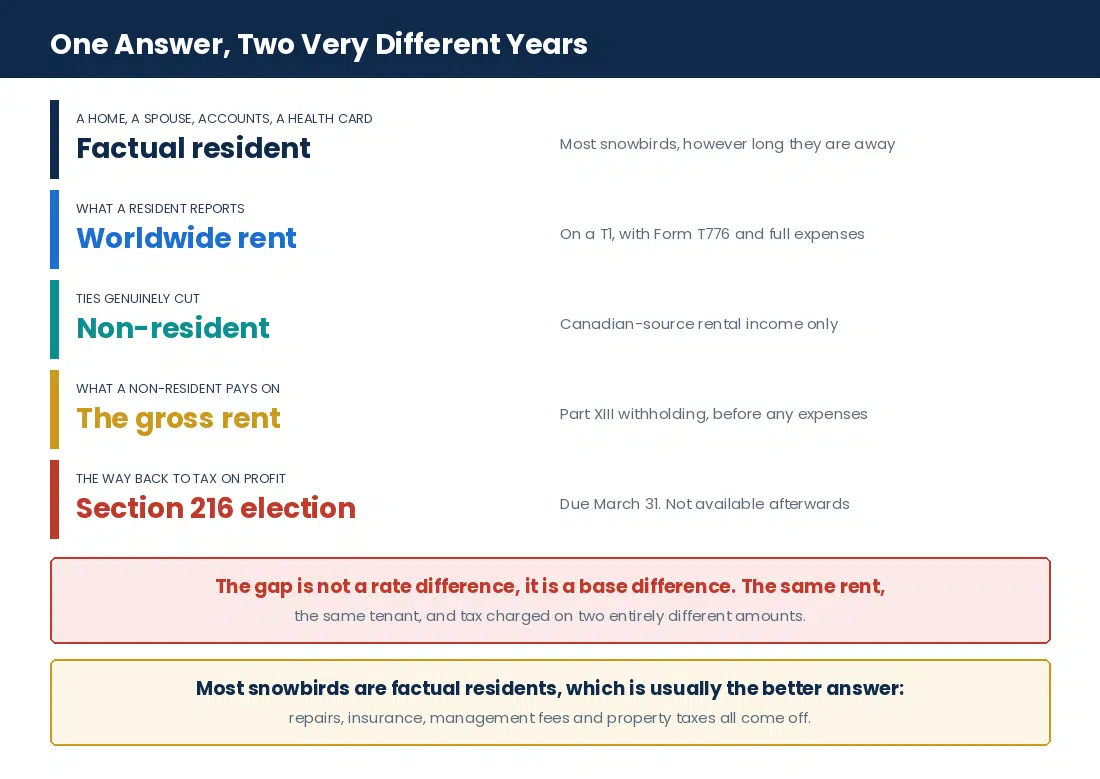
The Fork in the Road
Snowbird rental property tax rules tell Canadian landlords how to report and pay taxes on money they make from renting out homes while they spend winters in warmer places. The rules change a lot depending on if the landlord is a resident or not for tax reasons.
If you live in Canada, you must report all your rental income on your tax return, no matter where you live during winter. But if you don’t live here permanently, the rules are different. Non-residents pay tax on the total rent they get, and this tax is taken out at the source by whoever pays them rent or manages their property.
Knowing these rules helps avoid problems with Canadian snowbird rental property tax and keeps you clear of penalties.
Definition and overview of snowbird landlords
A snowbird landlord is a Canadian who owns a home but spends winter months living somewhere else, usually somewhere warmer. They often rent out their homes while away to earn extra money.
For taxes, snowbird landlords have to follow certain rules based on where they officially live:
- Resident Landlords: They report all income from everywhere in the world on their Canadian personal tax forms.
- Non-Resident Landlords: They only report income made from Canadian properties and may have different paperwork to file than residents.
Understanding these rules—called snowbird landlord taxes Canada—helps landlords stay legal and claim deductions connected to renting their homes.
Key differences between Canadian and U.S. tax regimes
Canadian rental income tax for snowbirds isn’t the same as in the U.S.:
- Residency Rules: Canada looks at your ties to the country, like family or home, not just days spent here. The U.S. counts how many days you’re physically present using a test called the substantial presence test.
- Taxation Basis: In Canada, residents pay taxes on income from anywhere in the world. Non-residents pay only on money earned inside Canada like rent from tenants living here.
- Filing Requirements: Canadians who live here file returns for both domestic and foreign incomes every year. Non-residents can choose to report net income instead of total rent but must get approval first—a step that doesn’t usually happen in U.S. tax law.
These differences matter a lot if you own property in one country but spend time living in another during winters. Planning helps avoid surprises later on.
The gap between the two positions is not a rate difference. It is a base difference.
A resident is taxed on the profit — rent less repairs, insurance, management fees, property taxes and utilities. A non-resident without the election is taxed on the rent itself, before any of that comes off. The same property, the same tenant, the same cheque, and two entirely different amounts of tax.
Potential tax risks and compliance issues
There are some risks when dealing with snowbird landlord taxes Canada:
- Wrong Residency Status: Saying you don’t live here when you do can cause trouble because gross rents might go unreported, leading to penalties from the CRA.
- Withholding Mistakes: If those paying your rent don’t send withheld taxes properly—or no one handles this—it can lead to big debts plus interest charges over time.
- Missing Important Deadlines: You have to file certain forms on time if you want to pay taxes based on net income rather than gross rent; missing these means higher tax rates with no way back later.
By keeping these details in mind about Canadian snowbird rental property tax rules, landlords can lower chances of costly mistakes down the line!
Reporting Rental Income and Taxes for Snowbird Landlords
Reporting Rental Income and Taxes
What You File
How to report rental income as a snowbird landlord
If you’re a Canadian snowbird with rental property, you still need to report rental income on your taxes. Canadian snowbird rental property tax rules say that if you keep strong ties here, like a home or family, you’re a factual resident. That means you include all your rent income worldwide on your personal tax return. Snowbird landlord taxes Canada vary depending on residency status. Non-residents must deal with withholding taxes on gross rent under Part XIII of the Income Tax Act. Usually, the payer or agent sends monthly payments to the CRA.
To handle Canadian rental income tax for snowbirds, keep detailed records of rent and expenses. The CRA wants accurate info even if you spend months outside Canada. Being away in winter doesn’t mean you stop filing here. If you don’t report correctly, CRA can charge tax based on total rent plus interest and fines.
Example: A Toronto owner spends winters in Florida but stays a factual resident due to strong home ties.
They report $24,000 yearly rent from their condo on line 12600 of the T1 return. They also list expenses backed by receipts. (Numbers changed for privacy.)
Source: CRA: Residency Status
Required documentation and records
You must keep good documents when reporting rental income as a snowbird landlord. Here’s what to hold onto:
- Rent payment records like bank statements or receipts
- Lease contracts or tenancy agreements
- Bills for repairs, maintenance, utilities, insurance, and property taxes
- Mortgage interest documents if you have a mortgage
- Records of any travel done just to manage the property
The CRA says keep these papers for at least six years after filing. These prove your expense claims and show real net income versus gross rent withheld when making an election.
What if you never reported rental income for years? The CRA may check bank deposits or third-party info and reassess taxes owed. This can bring penalties up to 50% of unpaid tax plus daily compound interest from the original deadline.
Example: An Ontario landlord missed filing two years’ worth of forms showing $18,000 unreported rent.
They caught it early by voluntary disclosure and filed late forms with full repair invoices totaling $4,500. Penalties were less because they acted before an audit started. (Figures changed.)
Sources: CRA: Record Keeping · CRA: Penalties & Interest
Reporting timelines and deadlines
| Task | Deadline | Reference |
|---|---|---|
| Net Rental Income Election | March 31 next year | ITA s215(6), CRA Guide RC413 |
| Monthly Withholding Remittance | Last day of month following payment month | ITA s216(4), NR4 Instructions |
| Annual NR4 Slip Issuance | End of February next year | ITA s231(3), NR4 Form Guide |
| Personal Tax Return (T1) | April 30 (June 15 if self-employed) | ITA s150(1)(a) |
Missing these dates can cause penalties or loss of election options that lower withholding.
Example: A non-resident’s agent paid monthly Part XIII withholding by January 31 for December rent but forgot to issue an NR4 slip by February end.
CRA sent a penalty notice that was fixed after quick action. (Numbers changed.)
Source: CRA: Non Resident Tax Deadlines
Impacts on personal tax returns
Factual resident reporting worldwide rental income
If you’re a factual resident, file your usual T1 return with all income sources worldwide — including foreign rentals. Use form T776 – Statement of Real Estate Rentals – to show revenue minus expenses like management fees or utilities paid while abroad.
You might owe instalment payments if your expected taxes go past CRA thresholds. This spreads out tax payments during the year instead of all at once.
Non-resident Part XIII withholding tax rules
Non-residents only get taxed on gross rents from Canadian properties under Part XIII rules. Usually, payers or agents deduct set amounts each month unless you filed a net-rent election before March 31 annually.
If this isn’t done properly, both payer/agent and recipient risk owing money until proper refunds are made with audited net income filings.
Example: A Quebec homeowner who winters outside Canada files T1 including US vacation home rents.
They also hire an agent who deducts withholding monthly on their Toronto condo rents and files slips early next year showing proper amounts withheld as law requires. (Details changed.)
CRA: Worldwide Income Reporting · CRA Instalments Info · Income Tax Act Section 216 & Regulations · CRA Net Rent Election Guidance RC413 · CRA Agent Responsibilities FAQ
For help with snowbird landlord taxes Canada matters—especially filing advice around your situation—contact Gondaliya CPA Professional Corporation in Ontario locations including Hamilton. They offer flat-fee annual services built around cross-border issues affecting Canadians wintering abroad with domestic rentals.
Free consultation at info@gondaliyacpa.ca or call 647-212-9559 today.
U.S. Income Tax Requirements for Snowbirds Renting Out Property
U.S. Income Tax Requirements
The Other Side
State-Level Taxes and Withholding Rules
If you’re a Canadian snowbird renting out property, your tax duties don’t stop at Canada’s border. You’ll need to think about U.S. state taxes too. Each state handles income from non-residents differently, especially rental income linked to foreign or Canadian properties.
Some states tax all income residents make anywhere. Others only tax income made inside that state. So, if you spend time in a state or have a connection there, that state might want its share of your rental earnings.
Snowbird landlord taxes Canada won’t protect you from these U.S. state rules if you meet residency or business activity conditions during your stay. Many states also require withholding on rent paid to non-residents — even if the rent comes from outside the U.S.
Tracking how many days you spend in each state is key. Spending too many days might mean you must file tax returns or have rent withheld by the state government.
A few quick examples:
- Florida has no personal income tax but may ask short-term rental owners to register for sales or use tax.
- New York charges personal income tax and often requires withholding on rental payments to non-resident landlords.
Here’s what to keep in mind:
- Check if your winter spot charges personal income taxes.
- Learn about any rent withholding rules.
- Register with the right state agencies when needed.
- File yearly returns reporting your rental income as required.
Getting advice from cross-border tax pros helps avoid paying twice—once in Canada and again in the U.S.—while staying on the right side of both countries’ rules.
IRS Forms, Elections, and Tax Identification Numbers
Canadian snowbirds who rent out property must follow U.S. federal tax rules too. The IRS sets specific filing demands based on whether you have U.S.-source rental income or meet other criteria.
If you count as a resident alien (by spending enough time in the U.S.) or have business ties there, you usually have to file IRS forms every year—even if most rental properties are outside the country.
Non-resident aliens getting gross rents from U.S. sources often face withholding before they see any cash. But there’s an option: some can elect to report net rental income instead of having taxes taken off gross rents right away.
Here’s what you should do:
- Get an Individual Taxpayer Identification Number (ITIN) if you don’t have a Social Security Number.
- File Form 1040-NR if you’re non-resident but owe taxes on U.S.-source rents.
- Use Form W-8BEN when dealing with agents or payers who need proof of your foreign status.
- Think about making elections like Section 871(d), letting you report net rental income instead of losing money upfront through withholding.
Without proper ID numbers, refund processing can drag on, which messes up your money flow while you’re away in winter.
Understanding these forms and choices helps manage both Canadian landlord rental income tax and U.S. filing rules without causing confusion or double reporting problems.
Both countries offer the same escape hatch, and in both it is an election rather than a default.
Canada’s section 216 net-rent election and the US Section 871(d) election do the same job — moving you from tax on gross rent to tax on profit — and neither happens automatically. Each has to be filed, on time, before the withholding starts rather than after.
For personalized help with cross-border filing rules affecting your Canadian snowbird rental property tax situation this winter season contact Gondaliya CPA.
Snowbird Landlord Tax Check
Five quick questions on where your rental filings stand. No fee shown.
Points to raise with us:
This is a general prompt, not tax or legal advice or a quote. Your position depends on your full facts. For a real review, please book a free consultation.
Claiming Foreign Tax Credits and Avoiding Double Taxation
Foreign Tax Credits and Double Taxation
The Relief
If you’re a snowbird landlord in Canada, rental property tax rules can get tricky. When you earn rent from a place outside Canada, you must report it on your Canadian tax return. The problem? You might also pay taxes in the country where your property sits. That means double taxation—paying tax twice on the same income. Luckily, the Canada Revenue Agency (CRA) lets you claim foreign tax credits to help avoid this.
How to claim foreign tax credits on Canadian returns
Snowbird landlord taxes Canada mean you report all your rental income, including what you get from outside the country. To claim a foreign tax credit:
- List your total gross rental income on your T1 personal return.
- Figure out how much foreign tax you paid on that income.
- Fill out Form T2209 for federal foreign tax credits (and provincial forms if needed).
- Include proof of paying those taxes—like official receipts or notices.
This credit lowers the Canadian taxes you owe but can’t be bigger than the Canadian tax you’d pay on that income. So, no extra credit beyond what’s fair.
You have to keep good records showing how much rent you got abroad and what part was taxed there. If not, CRA might refuse your claim or ask for changes.
Strategies to avoid double taxation
Here are some tips to deal with Canadian snowbird rental property tax rules and stop double taxation:
- Check if Canada has a tax treaty with the country where your property is. Treaties often cut withholding taxes or offer relief options.
- Use elections wisely. For example, non-residents renting Canadian properties can file net rental income instead of having gross rent taxed at source under section 216 of the Income Tax Act.
- Track all expenses carefully for deductions both here and abroad. This reduces taxable income that might be taxed twice.
These steps help make sure your rental income is reported correctly across borders without paying more than needed.
Common pitfalls and solutions for cross-border reporting
Cross-border reporting gets confusing for snowbird landlords because rules and residency can clash:
| Pitfall | Solution |
|---|---|
| Reporting gross instead of net rent causes CRA problems or missed withholding taxes. | Follow CRA rules strictly—non-residents owe Part XIII withholding on gross rents unless they file an approved election to report net amounts on time. |
| Missing filing deadlines leads to higher withholding or penalties. | Watch deadlines closely; elections must happen before certain yearly dates under Income Tax Act sections 215(2) & 216(6). |
| Mixing up capital expenses with current repairs can block deductions. | Keep invoices clear about repairs vs upgrades and get professional advice matching CRA guidelines. |
Good planning with expert help makes dealing with snowbird landlord taxes Canada easier while keeping more money in your pocket.
Deductible Expenses for Snowbird Rental Properties
Deductible Expenses for Snowbird Rentals
What Comes Off
If you own a rental property in Canada and spend winters away, you can deduct certain expenses from your rental income. These deductions lower your taxable income. They cover costs tied to managing and keeping your property while you’re away. Knowing which expenses count helps with filing Canadian rental income tax for snowbirds correctly.
Prepaid Expenses, Loan Fees, and Motor Vehicle Deductions
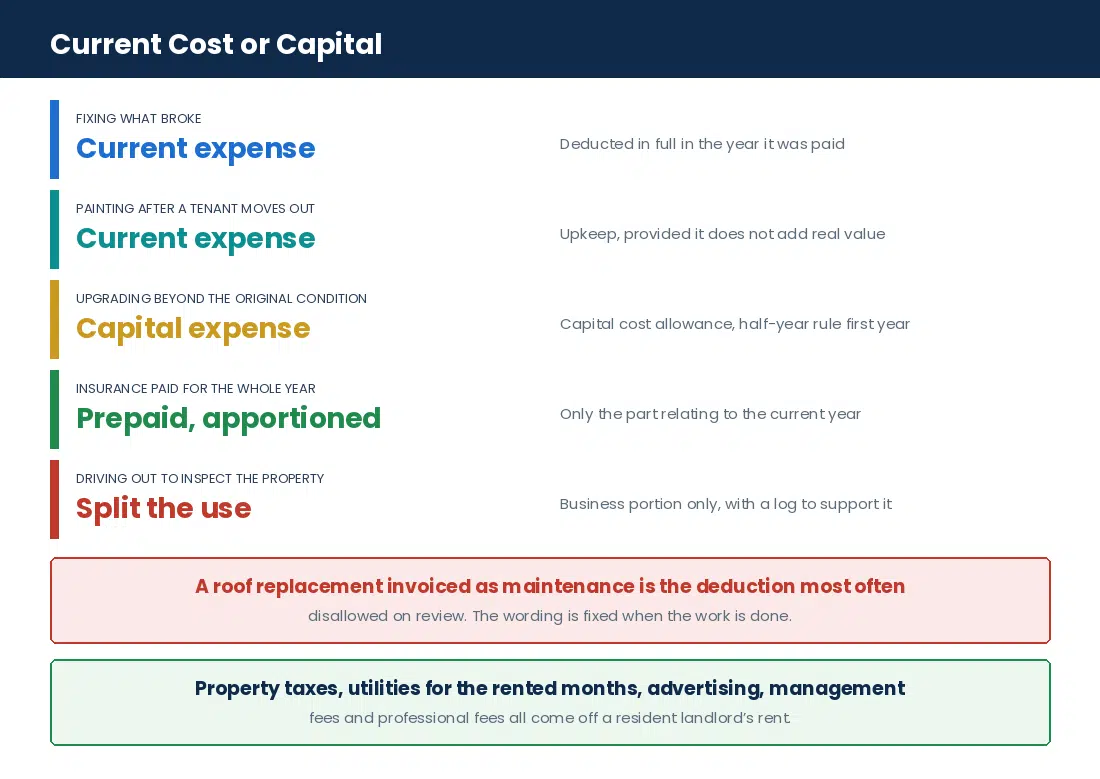
You can deduct prepaid expenses when they relate directly to your rental. For example: insurance premiums or maintenance contracts paid before year-end. But only the part that applies to the current year counts.
Loan fees for borrowing money to buy or fix your snowbird rental may also be deductible. These fees get spread out over time based on CRA rules. Make sure these fees tie only to your rental property loan.
Motor vehicle expenses linked just to managing the property can be claimed too. Say you drove only for inspections or repairs. You must split costs between business and personal use. Keep logs and receipts as proof.
Worked Example: You pay $1,200 upfront for insurance covering all of 2026 but leave in June.
You can deduct $600 on your T776 form—just the months you’re there. Figures changed for privacy.
Advertising, Insurance, Professional Fees, and Management Costs
Advertising that finds tenants is fully deductible under Canadian snowbird landlord taxes Canada rules. This includes things like online ads, signs, or agent fees paid to secure renters.
Insurance premiums protecting the property against fire or theft count as deductions too—if they only cover the rental activity.
Fees charged by accountants or lawyers for tax help or legal advice about renting are deductible under Canadian snowbird rental property tax rules.
Management fees paid directly by you or taken by a manager are also deductible if you have invoices showing when services were done matching rent dates.
Worked Example: An owner pays $800 yearly to an accountant for filing non-resident tax forms related to their rentals.
This lowers their taxable rental income. Figures changed for privacy.
Repairs, Maintenance, Salaries, Property Taxes, Utilities, and Other Allowable Deductions
Fixing damage to the rental property qualifies as a current-year deduction under Canadian snowbird rental property tax rules. But big upgrades don’t count here.
Regular upkeep like painting after tenants move out also counts if it doesn’t increase the home’s value much.
Salaries paid to caretakers who look after the place while you’re away count too—only if you have clear agreements about their tasks.
Property taxes stay deductible because they are regular ownership costs needed for making rent money no matter where you live.
Utilities like water and electricity billed separately from tenants can reduce taxable rent if they match months when renters live there outside winter months in Canada.
Other allowed expenses may include bank fees for collecting rent from afar or travel costs strictly for inspecting your place. Keep detailed records.
Worked Example: A landlord claims $3,000 on repairs fixing broken windows plus $1,500 on utilities from November 2025 to March 2026 while living out of province.
Both appear on Schedule T776 to cut taxable income. Figures changed for privacy.
Legal, Insurance, and Ownership Structure Considerations
Legal, Insurance and Ownership Structure
Around the Return
Personal Injury Liability and Insurance Coverage
When renting out property as a Canadian snowbird, you must think about personal injury liability. Snowbird landlord taxes Canada say you’re still responsible for tenant safety even if you’re away during winter. If someone gets hurt on your property and you lack proper insurance, you could face big financial problems.
You should get landlord insurance that covers damage, lost rent, and injury claims. This coverage helps if tenants slip or fall on your property. Make sure your policy covers times when you are not in Canada for the winter. This is key to avoid surprises.
Good insurance documentation helps when reporting Canadian rental income tax for snowbirds. Without proper coverage, CRA might question your claims or audit your records.
Importance of Written Rental Agreements
Written rental agreements matter a lot under snowbird rental property tax rules. These contracts spell out rent amounts, payment dates, maintenance duties, and how long tenants stay. For landlords living abroad part of the year, having a written lease keeps things clear and reduces confusion.
A signed agreement also proves legitimate expenses for deductions against landlord rental income tax in Canada. The CRA looks for solid proof like this during reviews.
Make sure your leases follow local tenancy laws but focus on keeping clear records to meet tax rules rather than legal battles with tenants.
Options for Ownership: Limited Partnerships and Trusts
How you own your rental affects snowbird landlord taxes Canada and Canadian rental income tax for snowbirds. Many owners use limited partnerships or trusts instead of owning directly.
Limited partnerships split control: general partners manage the property and face full liability while limited partners only risk what they invest but don’t run things. This setup can protect passive investors from some risks yet keep taxes flowing through their returns.
Trusts let owners share income among beneficiaries flexibly. This can help some families living abroad manage their overall taxes better under current rules on trust income from real estate.
Both options need careful setup with expert advice. Poor choices could cause unexpected withholding taxes or filing headaches when owners become non-residents.
Ownership structures are the one item on this page that is far easier to get right before the move than after it.
Transferring a rental into a partnership or trust once an owner has already become a non-resident can trigger withholding and filing obligations that would not have arisen a year earlier. The structure question belongs in the conversation about wintering abroad, not after the first season. Figures changed for privacy.
Key Points and Practical Guidance for Canadian Snowbird Landlords
- Keep ties to Canada to stay a resident; report all worldwide net rents yearly.
- Non-residents face monthly gross rent withholding unless they file net-rent elections.
- Sort expenses into current costs (deduct now) versus capital expenses (affect Capital Cost Allowance).
- Save all paperwork—leases, repair receipts, agent info—to back up your claims.
- Meet filing deadlines; late forms can lead to fines.
- Have good landlord insurance covering injury risks while you’re gone.
- Review ownership structures regularly; changes may add tax or filing duties.
Following these points cuts risk from wrong reporting under Canadian snowbird rental property tax rules. It also smooths annual filings if you live part-time outside Canada.
If you need help with Ontario’s specific rules or want advice about rentals in places like Toronto or Hamilton, professional accountants experienced in cross-border taxes can assist.
Contact us today at 647‑212‑9559 or info@gondaliyacpa.ca for a free chat about your rental income tax questions.
Frequently Asked Questions (FAQs) for Canadian Snowbird Rental Property Tax
Frequently Asked Questions
Answers
What is the deadline for the net rental income election under Canadian snowbird rental property tax rules?+
Who is responsible for monthly withholding remittance on rent paid to non-resident snowbird landlords?+
When must an annual NR4 slip be issued for non-resident rental income?+
How long should snowbird landlords keep rental income records?+
What forms should Canadian snowbird landlords file to report rental income?+
What are key responsibilities of withholding agents under Part XIII tax rules?+
Can snowbird landlords claim Capital Cost Allowance (CCA) on their Canadian rental properties?+
What are important filing deadlines for personal tax returns involving snowbird rental income?+
Does GST/HST apply to Canadian snowbird rental properties?+
Essential Points on Snowbird Rental Tax
Key Points
Essential Points on Canadian Snowbird Rental Property Tax Rules
- Maintain strong residential ties to determine tax residency status accurately.
- Use Form NR73 to support residency claims when uncertain.
- Understand non-resident withholding rules under Part XIII and make timely elections.
- File all required forms by CRA filing deadlines to avoid penalties.
- Retain thorough rental income records following CRA records retention guidelines.
- Engage a registered CPA Ontario firm like Gondaliya CPA for compliance and representation.
- Consider cross-border issues such as U.S. tax identification (ITIN) and Social Security Numbers.
- Monitor days spent in the U.S. using the Substantial Presence Test for accurate residency reporting.
- Review co-ownership reporting requirements when multiple owners share a property.
- Address deemed disposition and change in use events that may trigger capital gains tax.
- Use CRA voluntary disclosure program if past filings missed or errors occurred.
- Confirm agent duties include correct withheld taxes remittance responsibilities each month.
- Apply net-rent election application carefully before deadlines for reduced withholding rates.
For personalized advice on your snowbird landlord taxes Canada situation, contact Gondaliya CPA for professional assistance with cross-border filings and bookkeeping services.
Businesses We Serve & Industry Spotlights
Industry Expertise
Snowbird landlords sit inside a wider group of people whose tax position turns on where they are considered to live, and the questions that decide a snowbird’s return — which side of the residency line they fall on, whether tax comes off the gross or the net, and what has to be filed in the other country — recur across every one of these situations.
| Who | The Snowbird Angle |
|---|---|
| Canadian snowbird landlords | Renting the home out while wintering south, every year |
| Snowbirds | The same residency question, with or without a rental |
| Commercial landlords | Part XIII withholding on rents, at a larger scale |
| Real estate syndicators | Co-ownership reporting where several owners share a property |
| Emigrants leaving Canada | Departure returns, deemed disposition and change in use |
| Dual citizens | Two filing obligations running at once on the same rent |
| US citizens living in Canada | Citizenship-based filing alongside Canadian residency |
| Canadians working in the US | Day counts and the substantial presence test |
| Digital nomads | Residential ties tested against time spent away |
| Green card holders in Canada | US filing duties that follow the status, not the address |
| Foreign shareholders of Canadian corporations | Withholding on Canadian-source payments out |
- Canadian snowbird landlords: The core of this work. Residency, the section 216 election and the current-versus-capital split on expenses account for almost every adjustment we make.
- Snowbirds: Even without a rental, the residency question and the US day count still have to be answered each year rather than assumed.
- Commercial landlords: The same Part XIII withholding mechanics on a larger rent roll, where the agent’s monthly remittance obligations matter most.
- Real estate syndicators: Co-ownership reporting where several owners share one property, which is the structure question in the section above at scale.
- Emigrants leaving Canada: Where a snowbird’s winters turn into a permanent move, the departure return, deemed disposition and change-in-use rules all arrive together.
- Dual citizens: Two filing obligations running simultaneously on the same rental income, with the credit mechanics deciding the net result.
- US citizens living in Canada: A US filing duty that follows the passport rather than the address, layered on top of Canadian residency.
- Canadians working in the US: The substantial presence test counts days the Canadian test does not, which is how the two systems reach different answers about the same person.
- Digital nomads: Residential ties weighed against long absences, the same test a snowbird faces but spread across the whole year.
- Green card holders in Canada: US obligations attached to the status itself, which survive the move north and the rental income with it.
- Foreign shareholders of Canadian corporations: Withholding on Canadian-source payments leaving the country, run on the same Part XIII machinery as rent.
Every one of these turns on the same first question, and it is almost never the one people arrive asking.
They want to know what they can deduct, or which form to use. The answer to both depends entirely on which side of the residency line they are on, and that question has to be settled before anything else is worth working out.
Professional Guidance and Quick Reference
Guidance
Essential Tax Points for Canadian Snowbird Landlords
Snowbird landlords lose money in a predictable set of ways: assuming non-resident status without testing the ties, which usually turn out to be intact; missing the March 31 net-rent election and paying tax on gross rent for a whole year with no way back; leaving the withholding to a payer or agent who never remits it; treating a renovation as a repair and losing the deduction on review; failing to issue NR4 slips by the end of February; keeping no lease, no receipts and no record of which months the property was rented; and overlooking GST/HST once gross rents pass $30,000. Gondaliya CPA handles snowbird landlord filings on a flat annual fee.
Quick Answers
At a Glance
- What decides it: residential ties, not the months spent away
- Factual resident: worldwide rental income on a T1, with Form T776
- Non-resident: Part XIII withholding on gross rent, no deductions by default
- The election: section 216 net-rent election, due March 31 of the following year
- Missing it: gross-rent withholding applies for that year, with no way back
- Monthly remittance: by the last day of the month after the rent was paid
- Who remits: the payer or agent managing the property, not the landlord
- NR4 slips: issued by the end of February following the year
- Form NR6: filed by non-residents electing to report net rent
- Form NR73: supports a residency determination where it is uncertain
- Current expenses: repairs, insurance, management fees, property taxes, utilities, advertising
- Capital expenses: upgrades, claimed through capital cost allowance instead
- CCA first year: limited by the half-year rule
- Prepaid costs: only the portion relating to the current year
- Foreign rental income: reported here too, with foreign tax credits on Form T2209
- T1 deadline: April 30, or June 15 if self-employed
- GST/HST: registration may be required once gross rents exceed $30,000
- Records: six years from the filing date
- Unreported years: penalties up to 50% of unpaid tax, with voluntary disclosure available
Who This Is For / Not For
Fit Check
- For: Canadians who own property here and rent it out while wintering abroad, whether they remain factual residents or have become non-residents.
- For: snowbirds who also own and rent a property in the United States, and those who have let a year or more of rental income go unreported.
- Not for: advice on provincial residential tenancy law, on what insurance to buy, or on the specific tax rules of any individual US state, each of which is administered separately.
- Not for: owners who leave the property empty over the winter, who have no rental income to report. A landlord whose rent barely covers the costs is still squarely in scope, because the return is still due.
People Also Ask
Related Questions
I spend five months in Florida. Am I a non-resident?+
Almost certainly not. Canada tests residential ties, not months away — the home, a spouse or dependants here, bank accounts, a car, provincial health coverage. A snowbird who keeps all of those and returns each spring is a factual resident, reporting worldwide rental income on a T1 and deducting expenses against it. That is usually the better outcome anyway.
Why would tax come off my whole rent rather than my profit?+
Because Part XIII withholding applies to the gross rent a non-resident receives, before any expenses. The way out is the section 216 net-rent election, which moves you to tax on net rental income instead. It has to be filed by March 31 of the following year, and it is not retroactive once that date passes.
My tenant pays me directly. Who is supposed to withhold?+
The payer or the agent managing the property, remitting to CRA by the last day of the month after the rent was paid, and issuing an NR4 slip by the end of February. Where nobody has been doing it, the liability does not disappear — both the agent and the recipient can be pursued, with interest running from the original dates.
Can I deduct the new roof I put on before leaving?+
Probably not in that year. Fixing damage is a current expense and comes off immediately; an upgrade that improves the property beyond its original condition is capital, claimed through capital cost allowance with the half-year rule limiting the first year. The invoice wording matters, so keep it clear about what was repaired rather than improved.
I have rented it out for years and never reported it. What happens?+
CRA can reassess from bank deposits or third-party information, with penalties up to 50% of the unpaid tax plus daily compound interest from the original deadline. Coming forward through the voluntary disclosure programme before an audit begins generally produces a much better result, and the repair invoices you have kept reduce the amount in question.
Glossary of Key Terms
Definitions
- Snowbird landlord: a Canadian who owns a home here and rents it out while spending winter months somewhere warmer.
- Factual resident: someone living abroad temporarily who keeps significant residential ties and reports worldwide income.
- Part XIII tax: Canadian withholding tax on gross amounts, including rent, paid to non-residents.
- Section 216 election: the choice to be taxed on net rental income instead of gross rent, due March 31 of the following year.
- Form NR6: the undertaking filed by a non-resident and their agent to reduce withholding to net rental income.
- Form NR73: the CRA determination of residency status form used when residency is uncertain.
- NR4 slip: the annual statement of amounts paid to a non-resident and the tax withheld, due by the end of February.
- Form T776: the Statement of Real Estate Rentals filed with a resident’s T1 return.
- Form T2209: the federal foreign tax credit calculation.
- Current expense: a cost that keeps the property in its existing condition, deductible in the year incurred.
- Capital expense: a cost that improves the property beyond its original condition, claimed through capital cost allowance.
- Capital cost allowance (CCA): the depreciation claim on capital property, limited in the first year by the half-year rule.
- Substantial presence test: the US day-count test for residency, which works differently from Canada’s ties test.
- Section 871(d) election: the US election to report net rental income rather than face withholding on gross rents.
- Change in use: the event, such as converting a home to a rental, that can trigger a deemed disposition and capital gain.
Want a checklist to work from? You can download our free snowbird landlord tax checklist before your consultation.
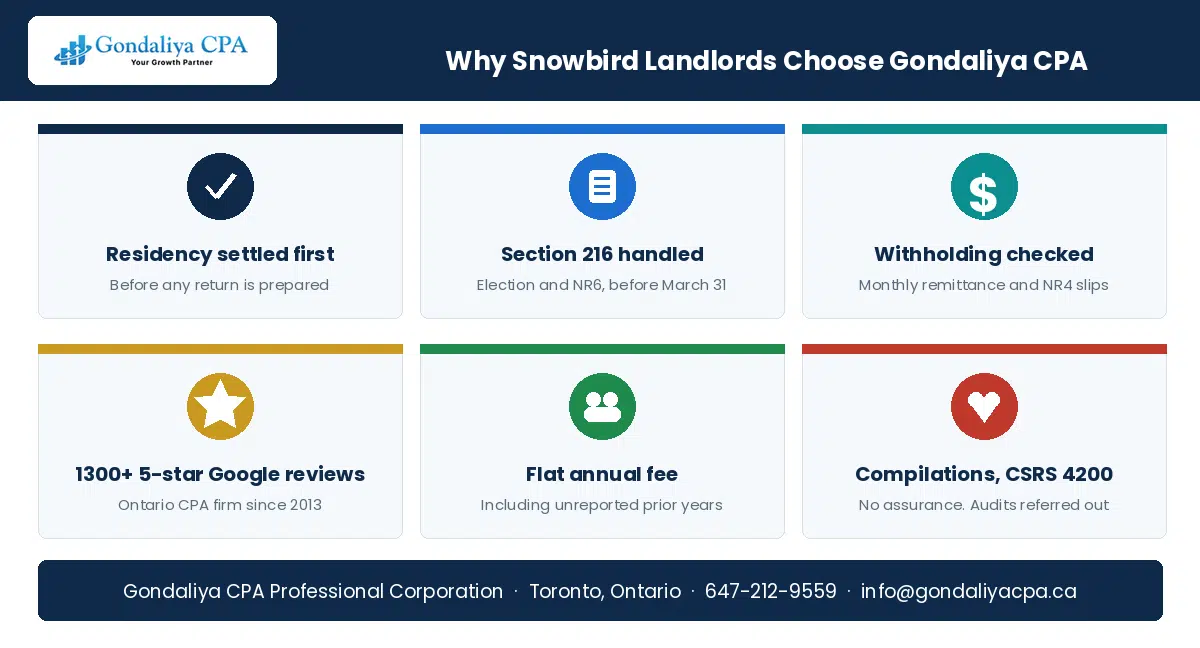
Four things decide a snowbird landlord’s year. Residency first — ties, not months away, and most snowbirds remain factual residents, reporting worldwide rental income on a T1 with Form T776 and deducting against it. Gross or net — a non-resident faces Part XIII withholding on the whole rent unless the section 216 election is filed by March 31, which is the single most expensive deadline on this page. The machinery around it — monthly remittances by the payer or agent, NR4 slips by the end of February, Form NR6 for the election, Form NR73 where residency is unclear, and GST/HST past $30,000 of gross rents. And the records — leases, repair invoices worded as repairs rather than improvements, utilities matched to the rented months, and everything kept six years.
Three questions tell you where you stand, and you can answer all of them today. First, what do you still have in Canada — the home, a spouse or dependants, accounts, a car, an active health card? That decides whether you are reporting profit or having tax taken off the gross. Second, if you are a non-resident, has the section 216 election been filed for this year? The deadline is March 31 and there is no relief afterwards. Third, do your invoices distinguish repairs from improvements? A roof replacement described as maintenance is the most common deduction we see disallowed on review, and the wording is fixed at the time the work is done.
Canadian Snowbird Rental Property Tax: How Gondaliya CPA Can Help
Start with your ties, your lease and one year of rental invoices
Gondaliya CPA settles the residency question against the ties before anything else is prepared, files the T1 with Form T776 and the full expense schedule where you remain a factual resident, handles the section 216 net-rent election and Form NR6 where you do not, checks that the payer or agent is remitting monthly and issuing NR4 slips on time, sorts repairs from capital improvements so the deductions hold up on review, claims foreign tax credits on Form T2209 where a foreign property is also taxed abroad, and works through unreported years via voluntary disclosure where that applies — on a flat annual fee including HST with a one-business-day response. Please book a free consultation.
Next Steps
Please book a free consultation with Gondaliya CPA and bring three things: a list of what you still have in Canada from the home down to the health card, your current lease or tenancy agreement, and a year of invoices for whatever has been spent on the property. Those three settle the residency position, the withholding question and the current-versus-capital split — which between them account for nearly every adjustment we make on a snowbird landlord’s file. If rent has been going unreported, or nobody has been remitting withholding on your behalf, say so at the outset, because both are routine to work through and considerably cheaper to raise than to be found. You will get a flat annual fee including HST before any work begins. We serve Toronto, Mississauga, Brampton, Vaughan, Etobicoke, Scarborough, Hamilton, Ottawa and the rest of Ontario, and work with snowbird landlords across Canada. If our content helps, please add gondaliyacpa.ca as a preferred source on Google.
Published: · Last updated:
Editorial policy: We research against CRA, Department of Finance, Parliament of Canada, CPA Canada and CPA Ontario sources, fact-check the figures, and Sharad Gondaliya, CPA, reviews the content, which we update as the rules change.
Disclaimer: This article is educational information only and is not tax, legal, financial, immigration or insurance advice. It covers Canadian federal income tax and GST/HST on rental property for snowbirds, with notes on United States filing points, and it does not cover provincial residential tenancy law, insurance coverage decisions, or the tax rules of any individual US state, each of which is administered separately. Filing deadlines, withholding rates, reporting thresholds and penalty amounts change, and the statutory references in this article are those cited in the source material; every figure and section reference should be confirmed against current CRA and IRS guidance before a return is filed. Whether a particular set of ties makes someone resident, and whether a particular cost is a current expense or capital, both turn on the full facts. Gondaliya CPA performs compilation engagements under CSRS 4200 and does not perform audit or review engagements. Please consult a licensed CPA before acting.

Sharad Gondaliya is a CPA Canada & CPA USA with 15 Years+ experience of Accounting, Tax, Payroll of Corporate Small Businesses as Tax Accountant. He is a CPA Ontario member (61040184) and holds US CPA licences in Washington and Montana and is well known among corporate small businesses for tax planning, efficient tax solutions, and affordable CPA services. Sharad is the Principal (Director) of Gondaliya CPA – Affordable CPA Firm in Canada. Licenses: CPA Ontario: 61040184 | CPA USA (MT): PAC-CPAP-LIC-033176 | CPA USA (WA): 57629 | CPA Firm License: 61330051 View Full Author Bio