



GST/HST for Taxi Businesses in Canada: Registration, Collection, and Filing Explained
GST/HST for Taxi Businesses Canada: Essential Guide for Taxi Drivers and Ride-Share Operators by Gondaliya CPA
GST/HST for taxi businesses Canada is a key tax consideration for taxi drivers and ride-share operators, and Gondaliya CPA provides clear guidance on registration, filing, and claim processes. Understanding taxi GST HST rules, input tax credits, and compliance helps taxi business owners manage their taxes efficiently.
Quick Summary
Taxi drivers and ride-share operators in Canada need to know their GST and HST duties. The Excise Tax Act, section 240(1.1), requires taxi businesses to register for GST/HST regardless of how much money they make. This applies even if you think your earnings are small. Ride-share drivers follow similar rules, including the reporting their platforms must do.
Reading time: 47 minutes.
Table of Contents
- GST/HST Overview for Taxi Businesses
- Definition and Registration Requirements
- Calculating GST/HST on Fares
- Input Tax Credits and Net Tax Methods
- Filing, Reporting and Remitting
- Additional Considerations and Support
- Frequently Asked Questions
- Key Considerations in Managing Taxi GST/HST
- Taxi Operations We Serve
- Professional Guidance and Quick Reference
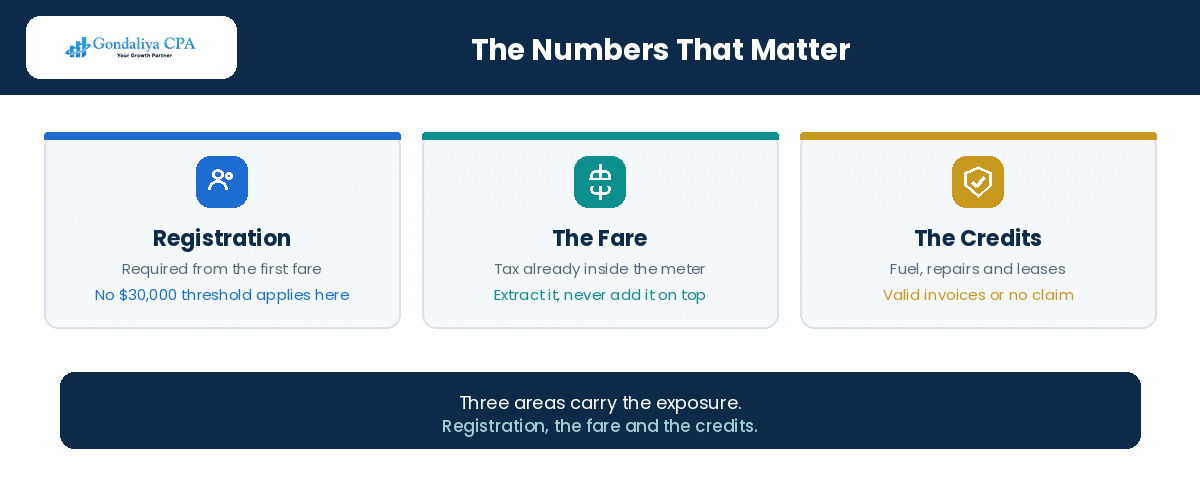
The Numbers That Matter
This article covers Canada, with Ontario and Toronto context, and reflects rules current to 2026. It applies to taxi operators, single-cab owners, fleet businesses and commercial ride-share drivers. Figures marked illustrative are examples, not quotes, and any masked engagement notes end with “Figures changed for privacy.” This is educational information only and not tax or legal advice. Municipal vehicle-for-hire licensing, plate transfers and fare rate regulation sit outside accounting and require the licensing authority or legal advice.
GST/HST Overview for Taxi Businesses in Canada
GST/HST Overview for Taxi Businesses
The Basics
Getting help from a taxi tax accountant makes dealing with these rules easier.
Legal Framework and CRA Guidelines
The Excise Tax Act sets the rules for GST/HST on taxi rides. Section 240(1.1) requires operators to register with the CRA. Rates vary by province, so knowing your area’s rate matters. You also need to understand how to file returns and claim input tax credits.
Why Compliance Matters
Following GST/HST rules keeps your business in good standing. If you don’t register or file on time, penalties add up quickly. If you miss a deadline or report income incorrectly, the Voluntary Disclosures Program may let you correct matters with reduced penalties.
Impact on Fares and Operations
It’s important to know how GST/HST affects the cost of rides. You need to apply the right rate to fares based on the type of trip.
Here’s how it breaks down:
- Taxable trips: Most local rides carry GST/HST.
- Zero-rated trips: Certain international transportation is taxed at 0% but still counts as a taxable supply, which preserves your input tax credits.
- Outside the rules: Some specialized transport arrangements are treated differently, so please check the specific supply.
Knowing these differences helps set correct fares and avoid problems with the CRA.
The first conversation with a new taxi client is almost always about registration date. Drivers assume the $30,000 threshold applies to them, and it does not. Figures changed for privacy.
Risk Warning: Taxi operators must register before the first fare. Please do not wait for a revenue threshold that does not apply to this sector.
Definition and Registration Requirements
Definition and Registration Requirements
Getting Registered
What Counts as a Taxi Business
A taxi business in Canada means anyone offering passenger rides for fares. This includes regular taxis and commercial ride-sharing services. The Excise Tax Act treats commercial ride-sharing trips as taxable transportation services. Ride-share drivers follow similar tax rules to taxi operators. They must charge GST/HST on their fares and keep good records.
Ride-share platforms also report to the CRA. That affects how drivers handle GST/HST. Platforms report gross fares and their fees, while drivers receive net payouts after those fees. Getting this distinction right matters.
Mandatory Registration
If you run a taxi business in Canada, you must register for GST/HST as soon as you start operating. Section 240(1.1) of the Excise Tax Act makes this mandatory, overriding the usual small supplier exemption in section 148.
Even if you’re new or only driving part-time, you register right away. That means getting a business number and charging tax from your very first fare. If you don’t register promptly, the CRA can assess penalties and interest.
The Registration Process
Taxi operators register through the CRA’s Business Registration Online system to obtain a business number. The business number is a single identifier used across federal tax programs.
During registration, you are assigned or select a reporting period: monthly, quarterly, or annually, depending on your expected revenue and circumstances. Incorporated companies register the same way but may have additional filings.
Registering online makes setting up the account quick and helps you meet filing deadlines once registered.
Drivers With Temporary Social Insurance Numbers
Drivers holding a temporary Social Insurance Number beginning with “9” follow the same GST/HST rules as everyone else in taxi work. They register as soon as they begin taxable activities, regardless of revenue.
Gondaliya CPA helps taxi operators in Toronto and across Canada with filing and accounting related to GST/HST, including drivers in this situation.
Non-Resident Operators
Non-residents carrying on a taxi business in Canada also need a business number where they make taxable supplies here. Incorporated foreign owners generally register as corporations, while sole proprietors register individually.
Wherever they live, these operators charge the applicable provincial rate on Canadian fares unless a specific exemption or zero-rating applies.
The Small Supplier Threshold Does Not Apply
Most small businesses only register once they exceed $30,000 in taxable supplies. Taxi businesses do not get that exemption because of section 240(1.1).
This means every person operating a taxi registers immediately, even where revenue is very small, because each trip is taxable and tax must be collected from the outset.
Taxi drivers should not assume they can wait until the small supplier limit before registering.
Charging and Collecting Once Registered
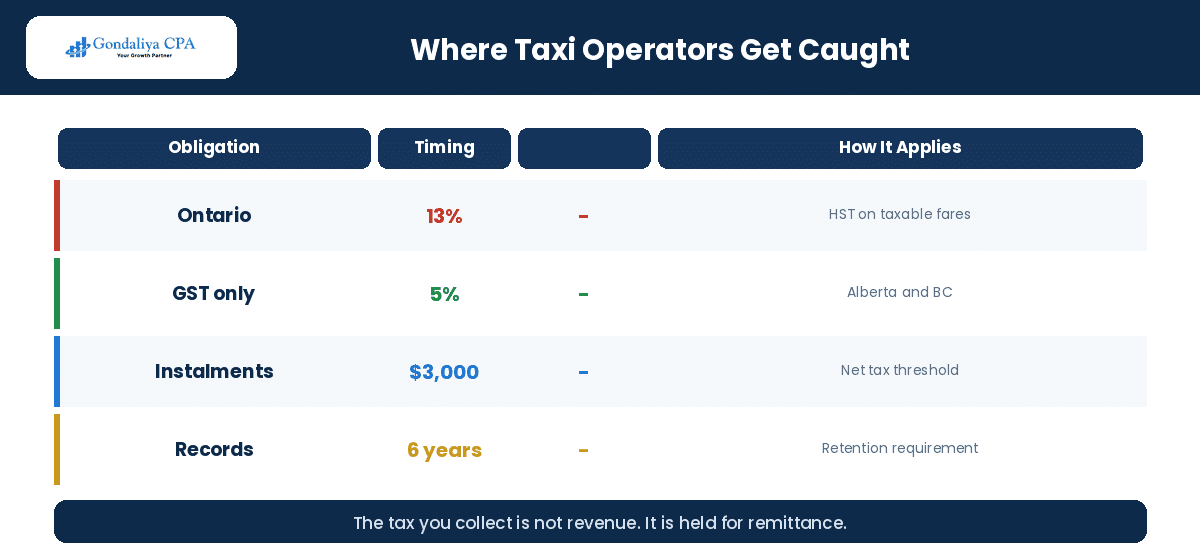
After registering, taxis in Ontario and other provinces charge GST or HST on all taxable fares.
| Province | Tax Applied | Rate |
|---|---|---|
| Ontario | HST | 13% |
| Alberta | GST only | 5% |
Fares are often quoted with tax included, depending on local practice. Your records should always separate net sales from tax collected.
Registered operators file returns on their assigned schedule, reporting total tax collected less input tax credits for expenses connected to earning those fares.
Ride-share drivers are the group most often caught out. The platform reports the gross fare while the driver only ever sees the net payout, and the return has to reconcile to the gross. Figures changed for privacy.
Key Stat: Every person operating a Canadian taxi business must register immediately regardless of revenue, under Excise Tax Act section 240(1.1).
Calculating GST/HST on Taxi Fares
Calculating GST/HST on Fares
The Maths
Calculating GST/HST for taxi businesses in Canada means applying the right rate based on where trips start. Taxi drivers must work out which parts of the fare are taxable, including whether the fare already has tax included or is zero-rated.
Rates by Province
Taxi businesses charge either GST or HST depending on the province where they provide the ride. Here are the current rates in major Canadian markets:
| Province | Tax Type | Rate |
|---|---|---|
| Ontario | HST | 13% |
| British Columbia | GST only | 5% |
| Alberta | GST only | 5% |
| Quebec | GST plus QST | 5% plus 9.975% |
| Nova Scotia | HST | Confirm current rate |
| New Brunswick | HST | 15% |
Quebec’s QST is administered separately from federal GST. Please confirm current rates before applying them, since provincial rates change from time to time.
Tax-Included Versus Tax-Added Pricing
A driver’s calculation depends on how fares are set and where rides begin.
Tax-included pricing. In cities like Toronto, metered fares commonly include tax already. Drivers extract the tax portion using a formula rather than adding tax on top.
Place of supply. Generally the location where the ride begins determines which province’s rate applies. Where a trip crosses provincial lines, the starting province’s rate usually governs. Trips that qualify as international transportation may be zero-rated where the conditions are met, so please confirm before applying zero-rating.
To find the tax included in a fare, multiply the total fare by the rate divided by one hundred plus the rate. For an Ontario fare of $50 at 13%, that is $50 multiplied by 13 divided by 113, giving $5.75 of HST and $44.25 of revenue before tax.
Worked Examples
A Toronto single-cab owner records a metered fare of $60 with tax included, in a 13% HST province. The HST portion is $60 multiplied by 13 divided by 113, which is $6.90, leaving $53.10 as revenue before tax. Figures changed for privacy.
The same arithmetic applies elsewhere with the local rate substituted. In Vancouver, for example, taxi fares carry the federal 5% GST, since provincial sales tax does not generally apply to the fare itself.
Telling Customers About the Tax
Taxi businesses need to make the tax position clear to customers through receipts or signage, in line with CRA requirements and municipal licensing rules.
- Receipts should show the total fare along with the tax, or wording confirming tax is included.
- Where prices are tax-inclusive, the paperwork should say so.
- Taxable extras such as airport surcharges should appear as separate line items.
Drivers must keep copies of receipts, electronically or on paper, generally for six years from the end of the fiscal year they relate to.
Good disclosure helps avoid disputes over tips, surcharges, waiting time fees and cash payments, all of which reviewers look at.
For advice on calculating taxes correctly and meeting receipt requirements, contact Gondaliya CPA at info@gondaliyacpa.ca or call 647-212-9559 for a free conversation.
Tax-included metered fares trip up more drivers than anything else in this sector. Adding 13% to a fare that already contained it overstates the remittance every single trip. Figures changed for privacy.
Pro Tip: Please confirm whether your meter is tax-inclusive before your first filing. The extraction formula and the addition method give very different answers.
Input Tax Credits and Net Tax Calculation Methods
Input Tax Credits and Net Tax Methods
The Credits
If you run a taxi business in Canada, you need to understand input tax credits and how to calculate net tax. Taxi driver GST HST duties include claiming credits on fuel, repairs and vehicle leases, and choosing between the regular and quick methods.
Eligibility for Input Tax Credits
Taxi businesses can claim credits for GST/HST paid on expenses connected to the business, including:
- Fuel used for taxi work
- Repairs needed to keep the taxi running
- Leasing costs for vehicles used in the business
To claim correctly:
- You must hold valid invoices showing the tax was charged, with the supplier’s registration number
- The items or services should relate to your taxable supplies
- Where a vehicle or equipment is also used personally, only the business portion is claimable
On the vehicle itself, watch the passenger vehicle capital cost limit. The credit is capped by reference to that prescribed limit, which is revised periodically, so please confirm the current figure before calculating a claim. Where the vehicle is also used personally, the claim is apportioned.
Restrictions on Insurance and Interest
Some costs carry particular restrictions:
- Insurance: Most insurance premiums are an exempt financial service, so no GST/HST is charged and there is nothing to claim as a credit.
- Interest: Interest on a loan or lease is also generally an exempt financial service, so no credit arises on the interest component itself.
Split costs carefully between personal and business use, and keep records showing how each expense connects to your taxable activities.
Regular Method Versus Quick Method
| Factor | Regular Method | Quick Method |
|---|---|---|
| Remittance basis | Actual net tax calculated | Prescribed percentage of taxable sales |
| Full input tax credits | Yes | No, limited mainly to capital purchases |
| Reporting complexity | Higher | Lower |
Taxi businesses cannot use the small supplier exemption, but they can elect the quick method where they meet the eligibility conditions. Larger fleets generally prefer the regular method because they want all their credits. Smaller operators may prefer the quick method for simpler bookkeeping, even where it costs more overall.
Calculating Net Tax Under the Regular Method
The steps are straightforward:
- Add up all GST/HST collected from fares, extracting it where fares are tax-included
- Add up all eligible input tax credits from fuel receipts, lease payments and repairs
- Subtract the credits from the tax collected to get net tax payable or refundable
An Ottawa driver records $10,130 of gross fares including 13% HST, which extracts to $1,165 of tax collected. Fuel and maintenance receipts show $52 of HST paid. Net remittance is $1,165 less $52, or $1,113. Figures changed for privacy.
Filing deadlines follow your assigned reporting period. Getting this right avoids penalties and helps manage cash flow.
The Quick Method
The quick method involves less calculation but has trade-offs. Instead of tracking every credit, you remit a prescribed percentage of your taxable sales including tax. The rate depends on your province and the nature of your business, so please confirm the applicable rate rather than assuming.
To elect the quick method, file the prescribed election form with the CRA specifying your chosen start date. This simplifies bookkeeping but limits most credit claims, with capital purchases treated separately.
How the Choice Affects What You Owe
Picking regular or quick affects your position:
- The regular method lets you recover full credits but requires detailed records, so weak documentation raises risk on review.
- The quick method reduces paperwork but can raise your effective tax because fewer credits apply, potentially costing more despite easier compliance.
Late filings bring penalties that grow over time. The Voluntary Disclosures Program may allow correction with reduced penalties where the disclosure is made before the CRA raises the issue.
Think about your fleet size and record keeping before choosing a method.
For help with your taxi GST/HST, including input credit planning and filing support, contact Gondaliya CPA at info@gondaliyacpa.ca or call 647-212-9559.
Drivers regularly try to claim credits on insurance premiums. No tax was charged on the premium, so there is nothing to recover, and the claim comes straight back off. Figures changed for privacy.
Risk Warning: A credit claim needs an invoice showing the supplier’s registration number. Please do not claim from a bank statement line alone.
Filing, Reporting, and Remitting GST/HST
Filing, Reporting and Remitting
The Filing
Reporting Periods and Deadlines
Taxi businesses file GST/HST returns based on an assigned reporting period: monthly, quarterly, or annually. The CRA determines which applies by reference to your annual taxable supplies. Higher revenue means monthly filing. Medium fleets or incorporated taxis usually file quarterly. Smaller operations often file annually.
The right period helps your cash flow and keeps things manageable. If you owe more than $3,000 of net tax as an annual filer, you pay instalments during the year to avoid interest. Check your filing frequency periodically, since changes in revenue can change your assigned period.
| Period | Who It Applies To | Return Due |
|---|---|---|
| Monthly | Taxable supplies above $6 million | One month after the period ends |
| Quarterly | Most incorporated taxis and medium fleets | One month after the quarter ends |
| Annual | Smaller operators below the thresholds | Three months after fiscal year-end for corporations; individuals differ |
Due dates follow the CRA’s usual rules, including adjustments for weekends and holidays.
Filing Online and on Paper
To start filing, register your taxi business through Business Registration Online to obtain a business number with a GST/HST program account.
- File online through the CRA’s My Business Account portal or certified software.
- Paper filing remains possible but is slower and carries mail risk.
- Electronic filing speeds up refunds or credits.
Corporations generally choose a fiscal year-end. Sole proprietors typically use the calendar year.
If you missed registering on time, you can register with a retroactive effective date, and the Voluntary Disclosures Program may reduce penalties.
Calculating and Remitting Net Tax
Calculate net tax by subtracting input tax credits from GST/HST collected on fares and other taxable income such as plate leases.
Two methods are common. Under the regular method you claim actual credits on eligible expenses and remit the difference. Under the quick method you remit a prescribed percentage, with credit claims limited mainly to capital purchases.
If your net tax exceeds $3,000, instalments are generally required, based on the prior year or a current-year estimate.
Late filing brings a penalty calculated by reference to the amount owing and how many months the return is late, plus interest on the balance. Filing on time avoids it.
Payment Options
You can pay electronically through several CRA-approved channels:
- Pre-authorized debit agreements
- Online banking bill payments using your business number
- Third-party payment providers
- Payments through My Business Account
Payment is due by the same deadline as your return regardless of method. Electronic payments reduce errors compared with mailing cheques and give you a confirmation record, which helps if you face a review.
Authorizing a Representative
You can authorize someone to handle your GST/HST matters through the CRA’s authorization process.
A firm like Gondaliya CPA can register your business, file returns on time, respond to review questions and request relief where appropriate.
Giving that access reduces mistakes and missed deadlines. Note that municipal fare and licensing rules sit outside accounting scope and should be confirmed with the licensing authority.
Recordkeeping and Audit Readiness
Keep records proving both fare income and input tax credits. The Excise Tax Act requires records to be kept for six years.
Important documents include:
- Trip sheets showing meter readings per ride
- Platform statements detailing gross fares against payouts
- Daily cash logs
- Invoices for fuel, repairs and dispatch fees
Monthly reconciliation catches mistakes early and helps avoid reviews focused on unreported cash fares or unsupported credits, a common issue for single-cab owners without formal bookkeeping.
Good records also support quick method calculations. Weak records risk penalties in a tightly regulated sector.
| Obligation | Who It Applies To | What Is Filed | Timing |
|---|---|---|---|
| GST/HST return | All registered taxi businesses | GST/HST return for the period | Per your reporting period |
| Instalment payments | Operators with net tax above $3,000 | Self-assessed remittance | Quarterly against your fiscal year |
| Business number registration | New operators including ride-share drivers | Business Registration Online | Before the first fare |
| Representative authorization | Operators using a CPA firm | CRA authorization | No deadline, but early is better |
| Filing frequency change | Operators wanting a different period | Election to the CRA | Before the new fiscal year |
For help with GST/HST compliance from registration to bookkeeping, contact Gondaliya CPA at 647-212-9559 or info@gondaliyacpa.ca.
Cash fares are where reviews start. A driver with card receipts that reconcile and a cash log that does not gets asked about the gap every time. Figures changed for privacy.
Key Stat: Net tax above $3,000 generally triggers instalments. Please check this each year rather than waiting for an interest assessment.
Additional Considerations and Support
Additional Considerations and Support
The Extras
Rules Applying in Quebec
Taxi businesses in Quebec follow both federal GST and provincial QST rules. Drivers register for both from their very first fare, regardless of earnings. Ride-share drivers face similar requirements, and platforms report to both Revenu Quebec and the CRA. Operators need clear records showing GST separately from QST.
In Quebec the combined rate comprises 5% federal GST plus 9.975% QST, each administered on its own basis. Ontario’s HST is 13%. Knowing these differences keeps a Quebec operator on the right side of both administrations.
Passenger Transportation Dues and Reporting
Passenger transportation dues are the taxable fares charged by taxis. Operators file GST/HST returns on time based on their reporting schedule, whether monthly, quarterly or annually.
Operators keep records for six years after the end of the tax year. These include trip sheets, receipts issued for each fare, statements from ride-share platforms, fuel bills, repair invoices and lease contracts.
Good records support input tax credit claims on expenses like fuel or vehicle repairs, and help if the CRA reviews your business.
Reporting Income Separately From Tax Collected
Taxi drivers report income without including GST/HST collected. The tax you collect is not your revenue; it is an amount held for remittance.
The CRA may review a taxi business where reported income does not match bank deposits or platform reports, or where credit claims lack supporting documents. Unreported cash trips also draw attention.
Keeping tax collected separate from sales income in the ledger lowers that risk considerably.
Issuing Receipts for Every Trip
Taxi operators are expected to issue a receipt for each trip showing the fare and any tax charged. Requirements come from both tax rules and municipal licensing, and the specifics vary by jurisdiction, so please confirm what applies where you operate.
Receipts should state whether tax is included or shown separately, along with extras such as airport surcharges. Tips are generally not consideration for the supply, but should still be recorded.
Clear receipts make fares transparent for passengers and help during a review. They also clarify how tips, waiting time, cleaning fees and penalties have been handled.
Support Available
Gondaliya CPA helps with taxi driver GST HST matters in Toronto and across Canada. We work with single-cab owners and larger fleets on registration, filing schedules, platform payout reconciliation, input tax credit claims, return preparation, catching up on late filings, responding to CRA questions, and setting up bookkeeping suited to taxi work.
Working with a taxi tax accountant reduces the risk of mistakes and keeps filings on schedule.
How to Reach Us
Need help with your taxi business’s GST/HST? Contact Gondaliya CPA:
- Phone: 647-212-9559
- Email: info@gondaliyacpa.ca
- Online: Book a consultation or send us a message
We reply within one business day and offer weekend or evening support that fits driving schedules.
Scope of This Guidance
This information reflects Excise Tax Act section 240(1.1), which requires commercial passenger transport providers to register regardless of small supplier status, and the record retention rules in section 286.
Failing to register on time can lead to penalties for late filing or payment. The CRA operates taxpayer relief provisions that may apply depending on circumstances.
Gondaliya CPA provides education and accounting services, not legal advice, and does not cover municipal bylaws such as plate transfers or fare rate regulation. Please see our CRA audit guide for what a review involves.
Quebec operators carry twice the administration for the same trip. Two registrations, two returns, two sets of records, and one meter. Figures changed for privacy.
Pro Tip: Please keep digital copies of every receipt linked to the daily trip log. Reconciling from photographs beats reconstructing from memory.
GST/HST for Taxi Businesses Canada: FAQs
Frequently Asked Questions
FAQ
What is the mandatory registration threshold for taxi businesses?+
There is none. Taxi businesses register immediately regardless of revenue, because the usual $30,000 small supplier threshold does not apply under Excise Tax Act section 240(1.1).
What is the passenger vehicle capital cost limit for input tax credits?+
Credits on a passenger vehicle are capped by reference to the prescribed capital cost limit, which is revised periodically. Please confirm the current figure before calculating.
How long must taxi operators retain GST/HST records?+
Records must be kept for six years after the end of the fiscal year they relate to, under section 286. This includes trip sheets, receipts and invoices.
What penalties apply for late GST/HST filing?+
The penalty is calculated by reference to the amount owing and the number of months the return is late, and interest accrues on the outstanding balance separately.
How does the Voluntary Disclosures Program help taxi operators?+
It allows correction of missed filings or registrations with potential relief from penalties, where the disclosure is made before the CRA raises the issue.
What is the quick method remittance rate for taxi businesses?+
It is a prescribed percentage that varies by province and business type. Please confirm the rate applying to you rather than assuming a single figure.
Which trips are taxable, zero-rated, or outside the rules?+
Most local trips are taxable. Certain international transportation may be zero-rated where the conditions are met. Some specialized arrangements are treated differently.
How are tips, surcharges, and waiting time treated?+
Voluntary tips are generally not consideration for the supply. Surcharges and waiting time forming part of the fare are taxable and require tax to be collected.
How is plate and vehicle lease income treated?+
Lease income from plates or vehicles is generally a taxable supply, so the lessor charges and reports GST/HST on it.
How do ride-share platforms affect GST/HST obligations?+
Platforms report gross fares and their fees. Drivers receive net payouts but remain responsible for reporting on the gross fare, so reconciliation matters.
Quick method or regular method: which suits a taxi business best?+
The regular method suits larger fleets wanting full credits. The quick method suits smaller operators seeking simpler bookkeeping, even where the effective cost is higher.
What happens if you register or file late?+
Late filing and payment penalties apply, interest accrues on balances owing, and operating unregistered while collecting tax creates further exposure.
How do you fix unregistered or unfiled years?+
Use the Voluntary Disclosures Program to disclose missed registrations or returns before the CRA raises them, which can reduce penalties.
How does GST/HST interact with income tax returns for drivers?+
GST/HST collected is not income. Net revenue after removing the tax forms part of the income reported on your personal or corporate return.
What triggers a CRA review of a taxi business?+
Inconsistencies between reported income, bank deposits and platform data, along with unexplained input tax credit claims.
What are best practices to stay compliant year-round?+
Keep detailed records, issue a receipt for every trip, file on time, track credits accurately with valid invoices, and reconcile monthly.
Sixteen questions and one underneath most of them: was the tax already inside the fare. Answer that and the rest of the return follows. Figures changed for privacy.
Key Considerations in Managing Taxi GST/HST
Key Considerations in Managing Taxi GST/HST
Quick Reference
- DIY versus CPA versus non-CPA filing: A CPA firm brings sector knowledge that reduces errors, while doing it yourself carries risk and generic providers may miss taxi-specific rules.
- What your CPA delivers: Accurate filings, review support, reconciliation of platform statements, and planning built for taxi operations.
- What it costs: Fees vary by fleet size and complexity, with flat annual pricing available for small operators.
- Top mistakes to avoid: Late registration, weak record keeping, misclassifying fares, ignoring credit restrictions, and failing to issue receipts.
- Preparation before engagement: Gather trip records, platform reports, expense invoices, lease agreements and any prior returns.
- Differences across segments: Commercial taxis and ride-share drivers face different reporting challenges, and fleet size affects filing frequency.
- Worked examples help: Step-by-step calculations remove the guesswork from tax-included fare extraction.
- Choosing a firm: Look for experience with taxi taxation and responsiveness when a CRA letter arrives.
- Registration timing: Before the first fare, not at a revenue threshold.
- Tax-included fares: Extract the tax with the formula rather than adding it on top.
- Place of supply: The province where the trip begins generally sets the rate.
- Credit documentation: Valid invoices showing the supplier’s registration number, every time.
- Insurance and interest: Generally exempt financial services, so no credit arises on those amounts.
- Instalments: Triggered where net tax exceeds $3,000.
- Records: Six years, covering trip sheets, receipts, platform statements and expense invoices.
- Reconciliation: Monthly, matching platform gross fares to your reported figures.
For tailored assistance with your Canadian taxi business GST/HST matters, contact Gondaliya CPA at info@gondaliyacpa.ca or call 647-212-9559 today.
Sixteen points and one underneath them: what you collect is not yours. Treating the tax as working capital is how operators end up owing a year of remittances at once. Figures changed for privacy.
Taxi Operations We Serve
Industry Expertise
Which issue dominates differs by operation. Here are ten and the usual focus.
| Taxi Operation | Where the Exposure Sits |
|---|---|
| New driver, first month | Registration before the first fare |
| Single-cab owner-operator | Tax-included fare extraction |
| Ride-share platform driver | Gross fare versus net payout reconciliation |
| Multi-vehicle fleet | Reporting frequency and instalments |
| Plate lessor | Lease income as a taxable supply |
| Airport and cross-border work | Zero-rating conditions and documentation |
| Quebec operator | Two registrations and two return streams |
| High cash volume | Daily logs matching deposits |
| Operator buying a vehicle | Passenger vehicle capital cost limit on credits |
| Unregistered or behind | Voluntary disclosure before contact |
- New driver, first month: The threshold others rely on does not exist here.
- Single-cab owner-operator: Adding tax to a tax-inclusive fare overstates every remittance.
- Ride-share platform driver: You report on the gross, not on what landed in your account.
- Multi-vehicle fleet: Revenue growth changes your assigned period without warning.
- Plate lessor: Lease income carries tax the same way a fare does.
- Airport and cross-border work: Zero-rating needs evidence, not assumption.
- Quebec operator: Two administrations, one meter, twice the paperwork.
- High cash volume: The cash log is what a reviewer asks for first.
- Operator buying a vehicle: The credit is capped by the prescribed limit.
- Unregistered or behind: Disclosing first costs far less than being found.
The operation changes where the exposure sits. It does not change the method, which is register first, extract the tax correctly, then reconcile every month. Figures changed for privacy.
Professional Guidance and Quick Reference
Guidance
Professional Guidance for Operators: How Gondaliya CPA Handles Your File
Taxi businesses run into trouble in a predictable set of ways: waiting for the $30,000 threshold that does not apply to this sector, adding tax on top of a fare that already contained it, reporting on the net payout from a platform instead of the gross fare, claiming input tax credits on insurance and interest where no tax was charged, missing the capital cost limit on a vehicle purchase, and keeping no cash log to match the deposits. Gondaliya CPA handles taxi GST/HST on a fixed annual fee.
We handle what decides the outcome: registering before the first fare under section 240(1.1), extracting tax correctly from tax-included metered fares, applying the place-of-supply rules where trips cross provincial lines, reconciling platform gross fares against net payouts, testing input tax credit claims against valid invoices and the passenger vehicle capital cost limit, comparing the regular and quick methods for your volume, and building the trip sheet and receipt records the CRA expects.
Our team starts with the registration date and the meter setup, because those two decide whether the past returns were right. Single cab, multi-vehicle fleet or ride-share driver, you get clear advice and a fixed price before we start.
Quick Answers: Key Numbers & Concepts at a Glance
At a Glance
- Registration: Required from the first fare
- Small supplier rule: Does not apply to taxis
- Ontario: HST at 13%
- Non-HST provinces: GST at 5%
- Quebec: GST at 5% plus QST at 9.975%
- Tax-included fares: Extract, do not add
- Place of supply: Generally where the trip begins
- Instalments: Where net tax exceeds $3,000
- Monthly filing: Above $6 million in supplies
- Records: Six years retention
Who This Is For / Not For
Fit Check
- For: Taxi operators, single-cab owners, multi-vehicle fleets, plate lessors and commercial ride-share drivers across Canada.
- Not For: Municipal vehicle-for-hire licensing, plate transfers and fare rate regulation, which need the licensing authority or legal advice.
People Also Ask
Related Questions
Do I charge GST/HST on a tip?+
Generally no, where the tip is genuinely voluntary and added by the passenger. A mandatory service charge forming part of the fare is treated differently.
Can I claim a credit on the taxi plate I lease?+
Yes, where the lessor charges GST/HST on the lease and you hold a valid invoice showing their registration number.
What if I drove for a platform before registering?+
Register with an appropriate effective date and consider the Voluntary Disclosures Program. The tax on those fares was collectible whether or not you were registered.
Glossary of Key Terms
- GST/HST: The federal and harmonized sales tax on taxable supplies.
- Section 240(1.1): The provision requiring taxi operators to register regardless of revenue.
- Small supplier: The $30,000 exemption that does not apply to taxi businesses.
- Business number: The identifier used across federal tax programs.
- Reporting period: The monthly, quarterly or annual cycle assigned to you.
- Tax-included fare: A fare where the tax is already inside the metered amount.
- Place of supply: The rules deciding which province rate applies to a trip.
- Zero-rated: A taxable supply at zero percent that still allows input tax credits.
- Exempt supply: A supply carrying no tax and no entitlement to credits.
- Input tax credit: GST/HST recoverable on business purchases.
- Capital cost limit: The prescribed ceiling capping credits on a passenger vehicle.
- Regular method: Net tax calculated as tax collected less actual credits.
- Quick method: Remitting a prescribed percentage of taxable sales instead.
- Net tax: The amount payable or refundable for a reporting period.
- Instalments: Periodic prepayments required above the net tax threshold.
- Voluntary Disclosures Program: The route to correcting past errors with reduced penalties.
Taxi GST/HST Readiness Check
This quick self-check indicates where your operation most likely has room. Please answer the six questions below.
Taxi GST/HST Readiness Check
Six quick questions on your operation. No fee shown.
Points to raise with us:
This is a general prompt, not tax or legal advice or a quote. Your position depends on your full facts. For a real review, please book a free consultation.
Want a checklist to work from? You can download our free taxi GST/HST compliance checklist before your consultation.

Register before the first fare, not at a threshold. Confirm whether your meter is tax-inclusive. Extract the tax rather than adding it. Reconcile platform gross fares against net payouts. Keep a daily log of cash fares. Hold a valid invoice for every credit claimed. Watch the capital cost limit on vehicle purchases. Please keep six years of records.
2026 Update — what is current: This article reflects rules current to 2026. Mandatory registration for taxi businesses under Excise Tax Act section 240(1.1), the inapplicability of the $30,000 small supplier threshold, the Ontario HST rate of 13%, the federal GST rate of 5%, the Quebec QST rate of 9.975%, the $3,000 instalment threshold, the $6 million monthly filing threshold and the six-year retention requirement in section 286 are unchanged. Please note that the passenger vehicle capital cost limit capping input tax credits is revised periodically, so the $30,000 figure appearing in older guidance is out of date; that quick method remittance rates vary by province and business type and should be confirmed rather than assumed; and that insurance premiums and loan or lease interest are generally exempt financial services carrying no tax, so no input tax credit arises on those amounts.
GST/HST for Taxi Businesses Canada: How Gondaliya CPA Keeps Drivers and Fleets Compliant
Start with the registration date
Gondaliya CPA confirms your registration date under section 240(1.1), extracts tax correctly from tax-included metered fares, applies the place-of-supply rules where trips cross provincial lines, reconciles platform gross fares against net payouts, tests input tax credit claims against valid invoices and the passenger vehicle capital cost limit, compares the regular and quick methods for your volume and builds the trip sheet and receipt records the CRA expects, on a flat annual fee including HST with a one-business-day response. Please book a free consultation.
Next Steps
Please book a free consultation with Gondaliya CPA and bring a month of trip sheets, your most recent platform statement if you use one, and your last filed GST/HST return. Those three tell us immediately whether the tax is being extracted correctly, whether the gross fares reconcile, and what needs correcting. You will get a flat annual fee including HST before any work begins. If our content helps, please add gondaliyacpa.ca as a preferred source on Google.
Published: · Last updated:
Editorial policy: We research against CRA and CPA Ontario sources, fact-check the figures, and Sharad Gondaliya, CPA, reviews the content, which we update as the rules change.
Disclaimer: This article is educational information only and is not tax, legal, or financial advice. Figures marked illustrative are examples rather than quotes or guarantees. It reflects CRA rules current to 2026, including mandatory registration under section 240(1.1), the Ontario HST rate of 13%, the federal GST rate of 5%, the $3,000 instalment threshold, and the six-year retention requirement. Rates, limits and expensing rules change and outcomes depend on your specific facts. Please consult a CPA Ontario member before acting.

Sharad Gondaliya is a CPA Canada & CPA USA with 15 Years+ experience of Accounting, Tax, Payroll of Corporate Small Businesses as Tax Accountant. He is a CPA Ontario member (61040184) and holds US CPA licences in Washington and Montana and is well known among corporate small businesses for tax planning, efficient tax solutions, and affordable CPA services. Sharad is the Principal (Director) of Gondaliya CPA – Affordable CPA Firm in Canada. Licenses: CPA Ontario: 61040184 | CPA USA (MT): PAC-CPAP-LIC-033176 | CPA USA (WA): 57629 | CPA Firm License: 61330051 View Full Author Bio