



The Ultimate Guide to Accounting and Tax Services for Towing Companies in Canada
Towing Company Accountant Canada: Expert Tax and Accounting Services for Auto Businesses by Gondaliya CPA
Towing company accountant Canada services by Gondaliya CPA offer specialized tax and accounting support tailored for auto businesses, ensuring accurate financial reporting and compliance. Trust our expertise in towing company accounting services to manage your bookkeeping, tax preparation, and financial planning efficiently across Canada.
Quick Summary
Towing companies in Canada have some unique money problems that need special attention. You can’t just use any regular accountant for this. A towing company accountant knows what works best. Whether you’re an incorporated towing operator, running many trucks, or managing a storage yard, you need accounting help made just for you.
Reading time: 47 minutes.
Table of Contents
- Specialized Accounting for Towing Companies
- Comprehensive Tax Solutions
- Bookkeeping and Payroll Management
- Advisory, Structure and Succession
- Why Choose Gondaliya CPA
- Getting Started
- Frequently Asked Questions
- Key Accounting and Tax Insights
- Towing Operations We Serve
- Professional Guidance and Quick Reference
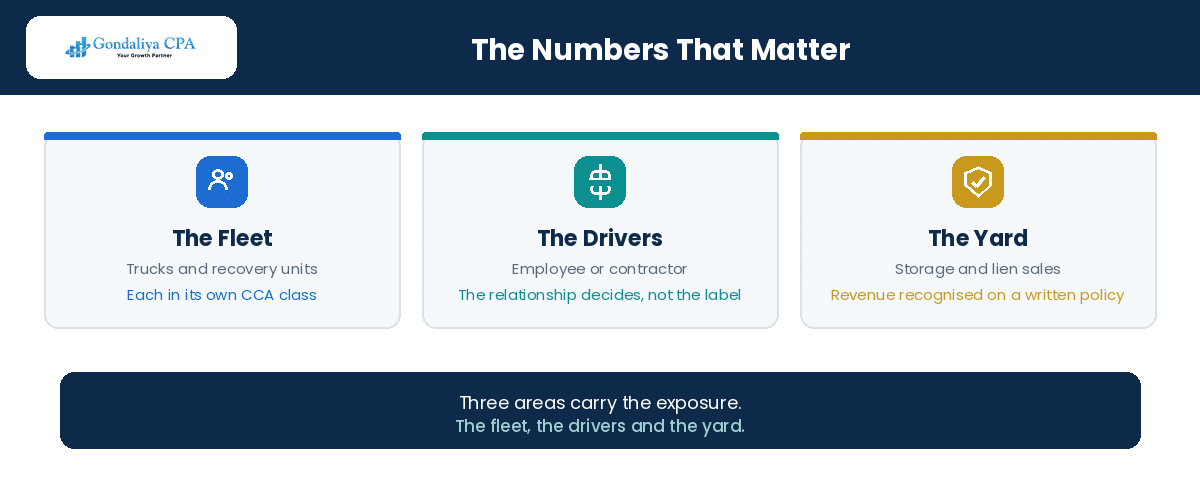
The Numbers That Matter
This article covers Canada, with Ontario and Toronto context, and reflects rules current to 2026. It assumes an incorporated towing operator, fleet owner or recovery business with trucks, drivers and possibly a storage yard. Figures marked illustrative are examples, not quotes, and any masked engagement notes end with “Figures changed for privacy.” This is educational information only and not tax or legal advice. Towing rates, licensing and municipal bylaws are regulated separately and need legal rather than accounting advice.
Specialized Accounting Services for Towing Companies Across Canada
Specialized Accounting for Towing Companies
The Basics
A towing company CPA handles things like bookkeeping, corporate tax planning, and GST/HST filing. They understand how to manage income from call-out fees, motor club billing, and impound charges. Using their industry knowledge helps keep your records clean and find ways to save on taxes.
Key Challenges in Accounting and Tax Compliance
Towing companies face a few tough spots when it comes to money and taxes:
- CRA representation: Dealing with the Canada Revenue Agency can be tricky. A good towing company tax accountant can stand up for you during audits or questions.
- Corporate tax planning: Finding ways to pay less tax legally helps keep more profit. This means knowing which vehicle costs or operations can be deducted.
- GST/HST filing deadlines: Filing returns on time avoids penalties. An experienced CPA makes sure these get done right and fast.
- Payroll remittance requirements: Paying drivers, whether employees or contractors, needs careful handling because the rules change based on status.
When you work with a firm like Gondaliya CPA, you get help that lets you focus on running trucks instead of worrying about taxes and forms.
Why Industry-Specific Knowledge Matters
Knowing the towing business well matters a lot when handling financial matters. Specialized accounting services built for incorporated towing operators bring approaches that follow CRA rules closely while cutting down administrative burden.
Getting expert help during a CRA audit is a real relief, since you want to know your books will pass inspection. CPAs who know transportation spot common errors like worker misclassification quickly, and fixing these stops costly penalties from appearing later.
So teaming up with a skilled towing company accountant means your business stays on track with the rules while getting advice that fits what tow truck owners in Canada actually need.
The first thing we look for is whether revenue is tracked per truck. Fleet owners who cannot see the cost of each unit are guessing at which trucks earn and which drain. Figures changed for privacy.
Risk Warning: Driver classification is where towing files most often go wrong. Please document the employee or contractor decision when you make it, not when the CRA asks.
Comprehensive Tax Solutions for Towing Companies
Comprehensive Tax Solutions
The Tax Work
Personal and Corporate Income Tax Preparation
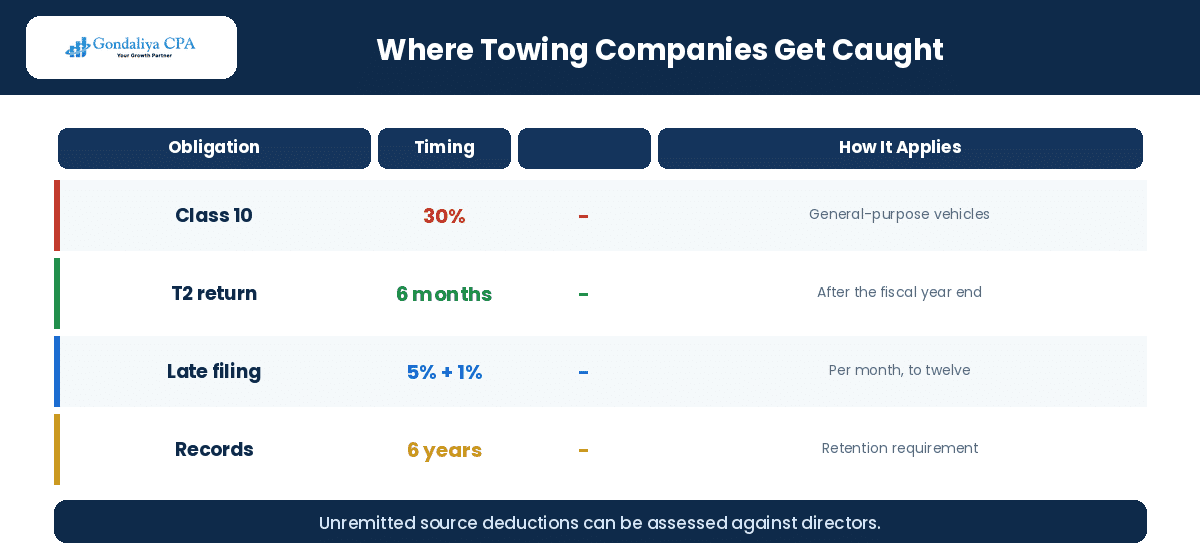
Towing companies in Canada have to meet strict tax filing rules. Incorporated towing businesses must file a T2 corporate return every year. The deadline is six months after the fiscal year ends. If they miss it, the CRA charges a late-filing penalty starting at 5% of the balance owing plus 1% for each complete month the return is late, to a maximum of twelve months, with higher amounts for repeat failures.
A towing company accountant Canada or towing company CPA Canada can handle these filings properly. They make sure the paperwork is right and done on time. They know how to claim expenses, calculate capital cost allowance on tow trucks, and apply the small business deduction where available.
If you run your business as a sole proprietor but want to incorporate, a towing company tax accountant can help. They guide you through the trade-offs while keeping costs down, and explain payroll reporting obligations for corporations.
A Toronto-based fleet filed its T2 three months late with $15,000 owing. The penalty was $750 at 5%, plus $450 being 1% for each of three complete months, totalling $1,200 before interest. Filing on time avoids all of it. Figures changed for privacy.
GST/HST Returns and Regulatory Compliance
Most towing companies in Canada must register for GST/HST once taxable revenue passes $30,000. Once registered, they charge GST/HST on services like towing fees. Storage fees may be treated differently depending on the arrangement and the province.
The GST/HST return deadline depends on your reporting period. Monthly and quarterly filers generally file one month after the period ends, while annual filers have a different schedule. Late returns attract penalties in the same way as income tax returns.
Input tax credits let you recover GST/HST paid on business purchases such as trucks, fuel used in operations, repairs, parts, and leases. You need proper invoices showing the vendor’s registration number to claim them.
Simplified methods such as the Quick Method are available for some businesses, but check eligibility carefully because it changes how you calculate credits.
Key points about GST/HST for towing companies:
- Must register once taxable revenue exceeds $30,000
- Charge GST/HST on most towing fees; storage arrangements vary
- Recover GST/HST paid on trucks, fuel and repairs with valid receipts
- File returns on the schedule set by your reporting period
Cross-Border and Interprovincial Considerations
Towing companies working across provinces or internationally face additional complexity. Interprovincial work turns mainly on the place-of-supply rules. Cross-border work between Canada and the United States, particularly near Windsor or Niagara Falls, needs more care.
Customs requirements may apply, and some payments face withholding under treaty rules. Long-haul operators using flatbeds or specialty recovery rigs should watch the place-of-supply rules closely, since certain freight transportation services crossing the border can be zero-rated under the Excise Tax Act.
Employees who work across borders require correct payroll deductions based on residency status. Getting this wrong risks double taxation or penalties.
Non-Resident Obligations and Property Tax
Non-resident owners who invest in Canadian real estate such as impound yards must follow the rules in section 116 of the Income Tax Act when selling property here. This includes notifying the CRA before the disposition unless an exemption applies.
Gondaliya CPA helps clients with non-resident filings where needed. We also review municipal property assessments so clients do not overpay. Foreign-owned fleets working temporarily in Ontario need to keep licensing records in line with provincial transport requirements, and those requirements should be confirmed with the regulator directly.
Clear audit trails keep things smooth with regulators and prevent problems later.
If you want advice for incorporated towing companies anywhere in Ontario or across Canada, contact Gondaliya CPA at 647-212-9559 or info@gondaliyacpa.ca.
Storage and impound revenue is where the timing questions start. The vehicle sits in the yard for weeks and the accounting has to decide when that income is earned. Figures changed for privacy.
Key Stat: The T2 is due six months after year end, but any balance owing is due earlier. Please diarise the payment date separately from the filing date.
Bookkeeping and Payroll Management for Towing Operators
Bookkeeping and Payroll Management
The Records
Accurate Records for Vehicle Expenses and Revenues
Keeping good records is key for towing companies. A towing company tax accountant helps track costs like fuel, repairs, insurance, and licences. They make sure each truck’s expenses and income are recorded correctly. This shows the true picture of money in and out, and makes deductions easier to support.
Tracking fuel means noting odometer readings alongside fuel receipts or card statements. Fuel cards help keep things organized but must be reconciled every month against actual use. That prevents mistakes or denied claims. If your trucks cross provincial lines, you need International Fuel Tax Agreement records as well.
Here are operating costs a towing company can deduct:
| Cost | Condition | Records Needed |
|---|---|---|
| Fuel | Business use only; personal use excluded | Receipts or fuel card statements |
| Repairs and maintenance | Must relate to business vehicles | Invoices |
| Tires | For tow trucks used on the job | Purchase invoices |
| Insurance | Commercial vehicle policies | Policy documents |
| Licensing and permits | Provincial or municipal, needed to operate | Payment proofs |
| Dispatch software | Used for the business | Subscription invoices |
| Yard rent | Storage or operations only | Lease agreements |
All these records must follow the CRA rules on deductibility. Expenses need to be reasonable, backed by documents, and incurred to earn business income.
Payroll for Drivers, Mechanics and Administrative Staff
Are your drivers employees or contractors? This matters a lot for payroll. The CRA looks at control over the work, who provides trucks and tools, chance of profit or loss, and how integrated the worker is into your business. If you get this wrong, expect penalties and assessment of the amounts that should have been withheld.
For employees such as drivers who work on your dispatch, or mechanics:
- Deduct income tax, Canada Pension Plan contributions, and Employment Insurance premiums.
- Follow the rules about overtime pay.
- Meal allowances may qualify where they meet the CRA conditions.
You must remit payroll deductions by the due dates set for your remitter type. Most small employers are regular remitters and pay by the 15th of the following month, while larger payrolls fall into accelerated categories with much tighter deadlines. Please confirm your remitter type rather than assuming.
Dispatchers paid hourly or on salary need T4 slips at year-end showing earnings and deductions.
If you pay people who are genuinely not employees, issue T4A slips, but be aware the CRA may reclassify the relationship on review.
Cloud Accounting for Streamlined Tracking
Cloud accounting helps towing companies keep track of money easily. It lets you see income from calls or impound fees in real time, and link bank accounts directly to track expenses.
Look for these features that suit towing businesses:
- Chart of accounts split by each truck or fleet
- Automatic receipt capture
- Payroll integration
- GST/HST filing that works with input tax credits
- Dashboards showing outstanding receivables, useful when dealing with motor club billings
Using cloud software cuts down on manual errors. It also makes financial statements easier to prepare under the compilation standard.
Remember to keep your records for six years after the end of the tax year they relate to. Cloud systems make it quicker to find what the CRA asks for during a review.
Contact Gondaliya CPA at info@gondaliyacpa.ca or call 647-212-9559 for guidance on your towing company’s accounting across Ontario and Canada-wide operations.
Fuel cards look like a solution until nobody reconciles them. A card used for a personal fill-up once a week becomes a shareholder benefit question at year end. Figures changed for privacy.
Risk Warning: Remittance deadlines depend on your remitter type, not on a single rule. Please confirm yours in writing, since assuming monthly when you are accelerated means late every cycle.
Expert Advisory and Planning to Support Towing Company Growth
Advisory, Structure and Succession
The Advisory
Incorporation and Structure Advice
Thinking about incorporating your towing business in Canada? It has real advantages. It can separate your personal assets from business risk, which matters in an industry with genuine liability exposure. Incorporation may also reduce tax through the small business deduction.
Canadian-controlled private corporations get a lower federal rate on the first $500,000 of active business income, shared across associated corporations. That is a meaningful saving for many towing companies.
But incorporation means extra administration. You file annually and keep your books tighter. If you run a small operation with one truck, those costs may outweigh the benefit.
Deciding between staying a sole proprietor or incorporating depends on several factors:
- How much money you make
- Your risk exposure
- Plans to grow
- Need for financing
A towing company accountant Canada can help you weigh these. We know the CRA rules and can advise how to set up your company. Note that accountants do not give legal advice on tow rates or licensing, which are regulated separately.
Cash Flow Management and Financial Statements
Managing cash flow well is key for towing businesses. Calls come and go, and payments from motor clubs or municipal contracts often lag. You want solid financial statements, both for yourself and for lenders or a CRA review.
A bookkeeping system built for towing is essential. It should track:
- Revenue per truck
- Fuel use
- Repairs
- Payroll
- Storage fees
It helps if your dispatch system feeds your accounting records, so you can see cost by truck or service type clearly.
Don’t forget to track fuel and mileage properly. Keep odometer logs plus fuel card receipts so your records hold up.
Most towing businesses prepare financial statements under ASPE. A CPA can perform a compilation engagement, which is less extensive than an audit. Such statements support loan applications and government programmes while showing how efficiently the operation runs.
Estate Planning and Succession
Passing your towing business on takes planning. A towing company tax accountant knows how to help owners manage the tax cost of transferring ownership while keeping family wealth intact.
Common steps include setting up holding companies so operating assets like trucks stay separate from real estate or other holdings. Transfers can happen through shares rather than selling assets outright, which makes transitions smoother.
Valuing trucks correctly matters because of capital cost allowance recapture when they are sold.
Owners often balance salary and dividends carefully in the years before a transfer. Doing this early helps avoid a forced sale if something unexpected happens.
An estate freeze combined with a shareholder agreement clarifies who controls what after the owner steps back. It also helps manage differences between family members who run daily operations and those who are simply beneficiaries.
Working with a CPA firm familiar with Ontario corporate tax adds real peace of mind, particularly where a section 85 rollover or similar provision is part of the plan.
For advice suited to your incorporated towing operation across Toronto, Ontario or Canada-wide, contact Gondaliya CPA at info@gondaliyacpa.ca or call 647-212-9559 for a free consultation.
Succession planning in towing usually starts too late. The trucks have depreciated to almost nothing on paper and the recapture on sale surprises everyone. Figures changed for privacy.
Key Stat: Selling a fully depreciated truck triggers recapture, which is taxable income. Please model the tax before agreeing a sale price.
Why Choose Gondaliya CPA for Your Towing Company
Why Choose Gondaliya CPA
The Firm
Picking the right towing company accountant matters. You want someone who knows towing and handles your books correctly. Gondaliya CPA focuses on towing company accounting services. We work with incorporated operators, owner-operators and fleets across Ontario and all over Canada.
Experienced CPAs With Automotive Industry Knowledge
Our team includes licensed Ontario CPAs who understand towing business problems. We have towing company tax accountants who know the corporate tax rules affecting tow trucks. They handle capital cost allowance for heavy trucks, GST/HST on storage fees, payroll deductions for drivers or contractors, and CRA reviews.
We design bookkeeping to track costs per truck carefully, and we build records that support provincial transport requirements. This helps avoid common mistakes like mixing up driver status or claiming input tax credits incorrectly.
Here is what we do:
- Sort out tax details specific to towing companies
- Handle GST/HST filings and payroll
- Represent you during CRA audits
- Set up bookkeeping systems fit for your fleet
Transparent Pricing and Responsive Support
We charge a flat annual fee that includes HST. That fee covers:
- Corporate tax filing
- Bookkeeping setup or cleanup
- GST/HST returns
- Payroll processing
- Compilation engagements
- Catch-up filings if needed
- Handling CRA letters and calls
No surprise bills.
You can get a free consultation anywhere in Toronto, Ontario or across Canada, from Etobicoke to Windsor and Vaughan to Ottawa. We respond fast, usually within one business day, and offer help evenings and weekends.
Many clients stay with us because we meet deadlines and help avoid CRA penalties or interest.
Track Record With Canadian Operators
Canadian businesses rely on our towing company CPA services every year. Clients tell us we helped them:
- Claim the right capital cost allowance on their trucks
- Use the small business deduction properly
- Avoid the errors that draw CRA attention
We work to CPA Ontario standards and know the sector requirements well, including freight transportation GST/HST treatment, contractor payment reporting on T4 and T4A slips, and record keeping that supports provincial licensing.
Choosing Gondaliya CPA means working with a firm that applies the rules properly while helping your business grow.
Fleet owners rarely need creative tax planning. They need the same three things done reliably every month: per-truck costing, payroll on time, and GST/HST filed right. Figures changed for privacy.
Pro Tip: Please set up cost centres by truck before your next fiscal year starts. Retrofitting them across a year of transactions is far more work.
Getting Started With Gondaliya CPA
Getting Started
Next Steps
Gondaliya CPA provides accounting services made for towing companies in Canada. We know the ins and outs of towing business finances. As a towing company accountant serving clients Canada-wide, we help with tax filing, bookkeeping, and making sure your records meet Canadian requirements. Whether you’re in Toronto or anywhere else, we can help.
Here’s what we offer:
- Clear advice on your business taxes
- Help with everyday bookkeeping tasks
- Support to keep you compliant with tax rules
Consultation Process and Service Plans
Our consultation process is straightforward. First, a towing company tax accountant reviews your current financial information. We ask about how many trucks you run, your call volume, payroll setup, and your GST/HST obligations.
Next, we create a service plan that fits your business size, whether you have one truck or a whole fleet.
We focus on:
- Accurate bookkeeping for towing companies
- Fixing common errors like misclassifying drivers
- Correct capital cost allowance claims
We make sure your taxes are handled properly under Canadian law.
How to Reach Us
You can contact Gondaliya CPA in several ways:
- Phone: 647-212-9559
- Email: info@gondaliyacpa.ca
- Online: Book a consultation or send us a message
We usually reply within one business day on weekdays. Need help after hours or on weekends? We offer support then too.
Our flexible contact methods keep things running smoothly all year. Whether you have questions about bookkeeping or an urgent CRA letter, we’re here to help.
Book a Free Consultation
Booking a free consultation connects you with people who specialize in towing company accounting services across Canada. The session costs nothing and comes with no obligation.
During the call, we look for ways to:
- Improve cash flow
- File GST/HST correctly for transportation services
- Manage payroll properly for drivers versus contractors
Working with a towing company CPA gives you clarity on the rules and a flat fee that does not surprise you.
Call 647-212-9559 or email info@gondaliyacpa.ca today to book your free consultation.
Most towing files we take on start the same way: a shoebox, a dispatch system nobody has connected to the books, and a CRA letter that arrived last month. Figures changed for privacy.
Pro Tip: Please bring your last CRA correspondence to the first meeting. It usually tells us more about the file than a year of bank statements.
FAQs on Towing Company Accounting and Tax
Frequently Asked Questions
FAQ
What is the T2 corporate tax filing deadline for towing companies?+
The T2 return is due six months after your corporation’s fiscal year-end. Filing late results in penalties and interest, and any balance owing is due earlier than the filing deadline.
When must towing companies file GST/HST returns?+
Monthly and quarterly filers generally file one month after the reporting period ends. Annual filers follow a different schedule, so please confirm which applies to you.
How do I know if my towing company must register for GST/HST?+
If your taxable revenue exceeds $30,000 measured across four consecutive calendar quarters, registration is required.
What records retention period applies to towing businesses?+
The CRA requires records to be kept for six years from the end of the last tax year they relate to.
What is the Capital Cost Allowance Class 10 rate?+
Class 10 covers general-purpose vehicles with a 30% declining balance rate. Heavier trucks may fall into a different class depending on weight and use.
How does the half-year rule affect capital cost allowance?+
It generally limits your claim to half the normal rate in the year the asset becomes available for use.
What penalties apply for late filing of returns or remittances?+
The corporate late-filing penalty starts at 5% of the balance owing plus 1% per complete month, to a maximum of twelve months, with higher amounts for repeat failures.
Who should consider incorporating their towing business?+
Incorporation suits operators seeking liability separation and access to the small business rate, where the income level justifies the added administration.
How should payroll source deductions be managed for drivers and contractors?+
Classify workers correctly as employees or contractors, then remit source deductions on the schedule set by your remitter type.
What are the mandatory filings for towing companies in Canada?+
Key filings include the T2 corporate return, GST/HST returns, payroll remittances, T4 and T4A slips, and your annual corporate return with the registry.
Ten questions and one underneath most of them: which truck, which driver, which period. Towing accounting is a tracking problem before it is a tax problem. Figures changed for privacy.
Key Accounting and Tax Insights for Canadian Towing Companies
Key Accounting and Tax Insights
Quick Reference
- Scope runs from single owner-operators to multi-truck fleets and roadside contractors.
- Compliance with provincial transport regulations and municipal towing bylaws is essential.
- Revenue streams include call-out fees, per-kilometre charges, motor club billings, and storage or impound fees.
- Capital cost allowance classes and the half-year rule shape truck depreciation claims.
- Payroll must address employee versus contractor classification using CRA criteria to avoid penalties.
- T4 and T4A slips are mandatory for employees and contractor payments respectively.
- Incorporation offers access to the small business rate plus separation of personal liability.
- Service offerings include compilation engagements under the applicable professional standard.
- Deadlines for the T2 return, GST/HST filing, payroll remittances and corporate annual returns must all be met.
- A NUANS name search is required when incorporating federally or in most provinces.
- Record bookkeeping separately by truck using cost centres, integrated with dispatch data where possible.
- Impound revenue and lien sale proceeds need a consistent, documented recognition policy.
- Regular financial statement preparation supports loan applications and regulatory requirements.
- Late filing penalties compound quickly, so prompt submission saves money.
- A free consultation is available from Gondaliya CPA with a flat fee quoted before work begins.
DIY Versus CPA Versus Non-CPA Providers
| Aspect | DIY | Non-CPA Provider | Gondaliya CPA |
|---|---|---|---|
| Industry Knowledge | Limited | Moderate | Specialized in the towing sector |
| Tax Filing Accuracy | Risk of errors | May miss nuances | Compliance and savings |
| CRA Audit Support | None | Limited | Full representation |
| Pricing | Low upfront cost | Variable | Transparent flat fee |
| Payroll Management | Manual | Basic | Integrated and compliant |
What to Prepare Before Engaging Us
- Current financial statements or bookkeeping records.
- Details about number of trucks, drivers, and payroll setup.
- Recent tax filings including GST/HST and corporate returns.
- Any CRA correspondence or audit notices received.
- Business structure information, whether sole proprietorship or corporation.
For expert guidance tailored to Canadian towing companies, contact Gondaliya CPA at info@gondaliyacpa.ca or call 647-212-9559 today.
Fifteen points and one underneath them: know what each truck earns and what it costs. Every other decision in a towing business follows from that number. Figures changed for privacy.
Towing Operations We Serve
Industry Expertise
Which issue dominates differs by operation. Here are ten and the usual focus.
| Towing Operation | Where the Exposure Sits |
|---|---|
| Single owner-operator | Incorporation decision and vehicle CCA class |
| Multi-truck fleet | Per-truck cost centres and payroll scale |
| Motor club contractor | Receivable timing against weekly payroll |
| Municipal or police rotation | Contract billing and documentation trails |
| Impound yard operator | Storage revenue recognition and lien sales |
| Heavy recovery specialist | Equipment classes and available-for-use timing |
| Cross-border operator | Place-of-supply rules and zero-rating |
| Owner-driver mix | Employee versus contractor classification |
| Owner holding the yard | Holdco rent at market rate, in writing |
| Behind on filings | Catch-up returns and remittance exposure |
- Single owner-operator: Incorporation only pays once income justifies the administration.
- Multi-truck fleet: Without cost centres you cannot tell which unit earns.
- Motor club contractor: The money arrives long after the driver has been paid.
- Municipal or police rotation: Contract terms drive both billing and record keeping.
- Impound yard operator: Storage accrues daily and needs a recognition policy.
- Heavy recovery specialist: Class and in-service date decide when the claim starts.
- Cross-border operator: Some freight services zero-rate; most towing does not.
- Owner-driver mix: The relationship governs, not the label on the agreement.
- Owner holding the yard: Market rent documented protects the deduction.
- Behind on filings: Unremitted source deductions reach directors personally.
The operation changes where the exposure sits. It does not change the method, which is cost each truck separately, classify the drivers, then file on the schedule you actually have. Figures changed for privacy.
Professional Guidance and Quick Reference
Guidance
Professional Guidance for Operators: How Gondaliya CPA Handles Your File
Towing companies run into trouble in a predictable set of ways: drivers treated as contractors when the relationship says employee, payroll remitted on the wrong schedule for the remitter type, storage and impound revenue recognised inconsistently, trucks placed in the wrong capital cost allowance class, fuel cards never reconciled against actual business use, and books that cannot show what each truck earns. Gondaliya CPA handles towing company accounting on a fixed annual fee.
We handle what decides the outcome: reviewing and documenting driver classification against the CRA tests, confirming your remitter type and building the remittance calendar around it, setting cost centres so each truck’s revenue and cost are visible, assigning tow trucks and recovery equipment to the correct CCA class, applying the half-year and available-for-use rules to new units, setting a consistent recognition policy for storage and lien sale income, and reconciling fuel cards so input tax credits hold up.
Our team starts with the truck-level costing, because a fleet that cannot see per-unit profit cannot plan anything else. Single operator, multi-truck fleet or impound yard, you get clear advice and a fixed price before we start.
Quick Answers: Key Numbers & Concepts at a Glance
At a Glance
- Corporate return: T2, six months after year end
- Balance owing: Due earlier than the filing date
- Late filing: 5% plus 1% per month, to twelve
- GST/HST: $30,000 registration threshold
- Slips: T4 and T4A by end of February
- Payroll: Schedule set by remitter type
- Class 10: 30% for general-purpose vehicles
- First year: Half-year rule applies
- Small business limit: $500,000, shared if associated
- Records: Six years retention
Who This Is For / Not For
Fit Check
- For: Incorporated towing operators, fleet owners, recovery specialists and impound yard operators across Canada.
- Not For: Tow rate regulation, licensing and municipal bylaw questions, which need legal rather than accounting advice.
People Also Ask
Related Questions
When is impound storage revenue earned?+
It depends on your arrangement and whether the amount is collectible. Storage accruing over weeks needs a consistent recognition policy rather than being booked at release.
Are tow trucks Class 10 or a heavier class?+
It depends on the vehicle’s weight and how it is used. Light recovery units and heavy wreckers do not always sit in the same class.
Can I claim input tax credits on fuel cards?+
Yes for business use, provided the card statements support the claim and personal fill-ups are excluded.
Glossary of Key Terms
- T2: The corporation income tax return.
- Capital cost allowance: Tax depreciation on trucks and equipment.
- Class 10: The 30% class covering general-purpose vehicles.
- Half-year rule: The first-year restriction on CCA claims.
- Available for use: When an asset becomes eligible for depreciation.
- Recapture: Income arising where sale proceeds exceed the class balance.
- Cost centre: A tracking code isolating revenue and cost by truck.
- Call-out fee: The base charge for dispatching a unit.
- Motor club billing: Invoicing an auto club rather than the vehicle owner.
- Impound storage: Daily charges accruing while a vehicle is held.
- Lien sale: Disposal of an unclaimed vehicle to recover charges.
- Source deductions: CPP, EI and income tax withheld from wages.
- Remitter type: The CRA classification setting your remittance due dates.
- Input tax credit: GST/HST recoverable on business purchases.
- IFTA: The fuel tax agreement covering interjurisdictional travel.
- Compilation engagement: Financial statements prepared without assurance.
Towing Company Readiness Check
This quick self-check indicates where your operation most likely has room. Please answer the six questions below.
Towing Company Readiness Check
Six quick questions on your operation. No fee shown.
Points to raise with us:
This is a general prompt, not tax or legal advice or a quote. Your position depends on your full facts. For a real review, please book a free consultation.
Want a checklist to work from? You can download our free towing company compliance checklist before your consultation.
Set cost centres so each truck is tracked separately. Confirm your remitter type in writing. Document driver classification when you decide it. Reconcile fuel cards against business use monthly. Assign each truck to the correct CCA class. Set a written policy for storage revenue. Diarise the balance due date separately from filing. Please keep six years of records.
2026 Update — what is current: This article reflects rules current to 2026. The six-month T2 filing deadline, the 5% plus 1% per month late-filing penalty, the $30,000 GST/HST registration threshold, the Class 10 rate of 30%, the half-year and available-for-use rules, the $500,000 small business limit shared across associated corporations and the six-year retention requirement are unchanged. Please note that payroll remittance due dates depend on your remitter type rather than a single rule, so a threshold quoted in general guidance may not be yours; that heavier recovery vehicles may fall outside Class 10 depending on weight and use; and that towing rates, licensing and municipal bylaws are regulated provincially and municipally and require legal rather than accounting advice.
Towing Company Accountant Canada: How Gondaliya CPA Keeps Fleets and Operators Compliant
Start with the truck-level costing
Gondaliya CPA reviews and documents driver classification against the CRA tests, confirms your remitter type and builds the remittance calendar around it, sets cost centres so each truck’s revenue and cost are visible, assigns tow trucks and recovery equipment to the correct capital cost allowance class, applies the half-year and available-for-use rules to new units, sets a consistent recognition policy for storage and lien sale income and reconciles fuel cards so input tax credits hold up, on a flat annual fee including HST with a one-business-day response. Please book a free consultation.
Next Steps
Please book a free consultation with Gondaliya CPA and bring a list of your trucks with purchase dates, a recent payroll register, and your last filed corporate return. Those three tell us immediately what remains to claim on the fleet, whether the driver classification and remittances hold up, and where the cash flow is being squeezed. You will get a flat annual fee including HST before any work begins. If our content helps, please add gondaliyacpa.ca as a preferred source on Google.
Published: · Last updated:
Editorial policy: We research against CRA and CPA Ontario sources, fact-check the figures, and Sharad Gondaliya, CPA, reviews the content, which we update as the rules change.
Disclaimer: This article is educational information only and is not tax, legal, or financial advice. Figures marked illustrative are examples rather than quotes or guarantees. It reflects CRA rules current to 2026, including the six-month T2 filing deadline, the 5% plus 1% late-filing penalty, the $30,000 GST/HST threshold, the Class 10 rate of 30%, and the six-year retention requirement. Rates, limits and expensing rules change and outcomes depend on your specific facts. Please consult a CPA Ontario member before acting.

Sharad Gondaliya is a CPA Canada & CPA USA with 15 Years+ experience of Accounting, Tax, Payroll of Corporate Small Businesses as Tax Accountant. He is a CPA Ontario member (61040184) and holds US CPA licences in Washington and Montana and is well known among corporate small businesses for tax planning, efficient tax solutions, and affordable CPA services. Sharad is the Principal (Director) of Gondaliya CPA – Affordable CPA Firm in Canada. Licenses: CPA Ontario: 61040184 | CPA USA (MT): PAC-CPAP-LIC-033176 | CPA USA (WA): 57629 | CPA Firm License: 61330051 View Full Author Bio