



Common Tax and Accounting Mistakes Heavy Equipment Operators Make in Canada and How to Avoid Costly Problems
Heavy Equipment Operator Accounting Mistakes and Tax Errors to Avoid | Gondaliya CPA
Heavy equipment operator accounting mistakes can lead to costly tax errors if not handled properly, and Gondaliya CPA specializes in helping operators avoid these pitfalls. With expertise in equipment operator bookkeeping mistakes and heavy equipment operator tax mistakes, we provide clear guidance to keep your finances accurate and compliant.
Quick Summary
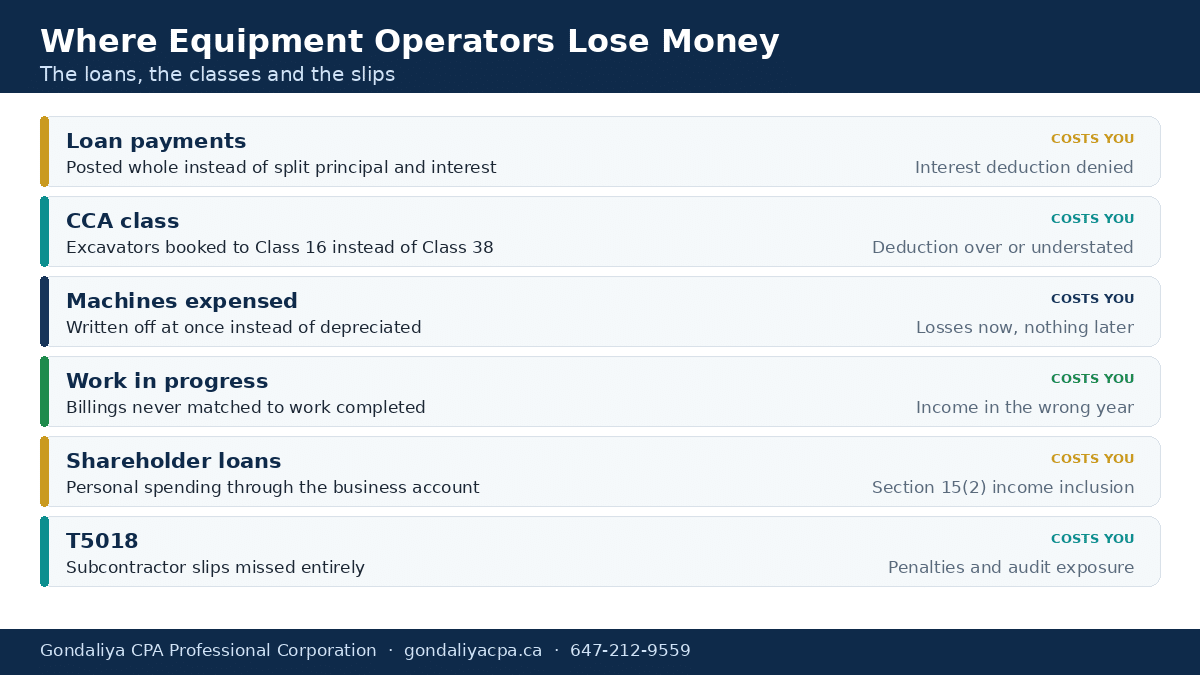
Heavy equipment files go wrong in a small number of predictable places: personal money mixed with business money, loan payments posted whole, machines expensed instead of depreciated, the wrong capital cost allowance class, work in progress never adjusted, and subcontractor slips missed. Each is cheap to fix early and expensive to fix late.
Reading time: 47 minutes.
Table of Contents
- Heavy Equipment Operator Accounting Mistakes Impacting Your Finances
- Frequent Bookkeeping Errors Among Equipment Operators
- Tax-Related Mistakes Specific to Heavy Equipment Operators
- Enhancing Financial Management Practices for Equipment Operators
- Practical Solutions and Clean-Up Strategies for Accounting Errors
- Keeping Personal and Business Finances Strictly Separate
- Frequently Asked Questions (FAQs)
- Essential Tax & Accounting Controls for Heavy Equipment Operators
- What You Get When Working With Gondaliya CPA
- Professional Guidance and Quick Reference
The Numbers That Matter
This article covers Canada, with Ontario and Toronto context, and reflects rules current to 2026. It applies to incorporated heavy equipment operators including excavation and earthworks contractors, single-machine owner-operators, small fleets, and equipment rental businesses. Figures marked illustrative are examples, not quotes, and any masked engagement notes end with “Figures changed for privacy.” This is educational information only and not tax or legal advice. Construction lien interpretation, WSIB classification appeals and equipment licensing sit with the relevant authority or with counsel rather than with your accountant.
Heavy Equipment Operator Accounting Mistakes Impacting Your Finances
Heavy Equipment Operator Accounting Mistakes Impacting Your Finances
The Mistakes
Heavy equipment operators often run into money issues because of accounting errors. These mistakes can cost you time and cash. Knowing the common heavy equipment operator accounting mistakes helps keep your business steady and legal. Here, we’ll talk about typical errors, what happens if you make them, and ways to avoid trouble.
Why Mixing Personal and Business Finances Creates Tax Risks
Mixing personal and business spending causes big headaches. It makes bookkeeping confusing and raises chances of tax mistakes. Under Income Tax Act s. 15(2), this can create shareholder loan risks if you don’t track personal expenses properly. That means tax folks might see personal costs as income you owe tax on.
To avoid this:
- Open separate bank accounts for business and personal use.
- Use one credit card just for business.
- Check your accounts often to sort expenses correctly.
A shareholder loan not repaid within the period the Act allows, generally by the end of the following taxation year, can be included in your personal income under section 15(2).
The Consequences of Misclassifying Expenses in Equipment Operations
Mislabeling costs is a common slip-up. For example, some expence a machine instead of using capital cost allowance (CCA). This means they miss out on tax relief over time. Also, mixing loan principal and interest payments into one amount messes up reports. Only interest counts as a deduction this year.
Here’s what you should do:
- Talk to an accountant who knows CCA rules for heavy gear.
- Track principal and interest payments separately for loans or leases.
A single loan payment posted as one expense is the most common finding on a first review of an equipment file. It denies the interest deduction and hides the principal entirely. Figures changed for privacy.
Overlooking GST/HST Registration Requirements and Its Effects
Not signing up for GST or HST on time causes penalties. Contractors working on construction often trip up on GST/HST related to progress draws, holdbacks, or rentals. The Excise Tax Act has rules about when to report these taxes that you must follow carefully.
To stay clear:
- Register as soon as your revenue hits the limit.
- Report collected GST/HST accurately each period.
- Learn what input tax credits you can claim back.
GST/HST registration is mandatory once worldwide taxable revenue exceeds $30,000 in a single calendar quarter or across four consecutive calendar quarters. In Ontario the rate is 13%.
How Failing to Reconcile Bank Accounts Monthly Leads to Financial Errors
Skipping monthly bank reconciliation leads to poor record keeping. This weak receipt discipline can cause you to miss T5018 contract payment reports if subcontractors are involved. Reconciling catches mistakes before they grow bigger problems.
Do this each month:
- Set time just for matching bank statements with your records.
- Look into mismatches quickly; they may hide unreported income or theft.
Importance of Maintaining Receipts and Proper Documentation for Operators
Keeping receipts matters a lot. They prove your claims during CRA audits where they check books hard. If you lose receipts, the CRA might deny your deductions and charge penalties.
Good habits include:
- Sorting receipts by date with scanning apps,
- Storing digital copies safely away from your main system,
- Knowing exactly which papers count under tax rules.
By spotting these common heavy equipment operator accounting mistakes early—and fixing how you handle money—you protect your finances better. You also stay in line with tax laws without surprises later on!
Frequent Bookkeeping Errors Among Equipment Operators
Frequent Bookkeeping Errors Among Equipment Operators
Bookkeeping
Heavy equipment operator accounting mistakes often happen when bookkeeping isn’t consistent. Mixing personal and business expenses is a big problem. Weak receipt management also causes trouble. Many operators miss deadlines for T2 returns, GST/HST payments, and payroll slips. These errors can mess up financial statements, cause surprise tax bills, and bring penalties from the CRA.
When personal spending mixes with business accounts, it creates issues with shareholder loans under section 15(2) of the Income Tax Act. If you rely only on credit card statements without keeping proper receipts, you risk penalties for poor record keeping. Missing filing deadlines for corporate taxes (T2), GST/HST returns, or slip submissions leads to late fees and interest.
Keep your business transactions in separate bank accounts. Proper paperwork helps you claim input tax credits (ITCs) on eligible purchases. Good bookkeeping lowers your chances of audits tied to construction tax errors common in Ontario’s heavy equipment field.
Ignoring Accounts Receivable and Its Cash Flow Implications
Not reconciling progress billings with actual work done can distort your revenue. Many heavy equipment operators forget to match work in progress (WIP) at year-end. This can either overstate or understate income depending on what’s billed versus completed.
Bad debts are often not recorded even though you can deduct them if collection efforts fail. Deposits that aren’t tracked properly confuse taxable income timing. Disputed draws left off the books throw off cash flow forecasts and taxable profit numbers.
For example: An excavation company billed $150,000 by December 31 but only completed $120,000 worth of work. Not adjusting WIP means income looks $30,000 higher than it should be. That error affects your corporate tax due March 31 after fiscal year-end.
Operators should keep monthly aged receivables reports along with WIP schedules that match contracts. Write-offs for bad debts need proof of collection attempts according to CRA rules.
Billed $150,000 by 31 December against $120,000 of work completed. Without a work in progress adjustment the return reports $30,000 of income that has not been earned, and the tax on it is paid a year early. Figures changed for privacy.
Confusing Cash Flow with Profit: What Heavy Equipment Operators Need to Know
Cash flow is not the same as profit. Many operators mix these up, which leads to poor money decisions. Corporate tax filing deadlines require accurate net income reporting — no matter how much cash you actually got.
GST/HST quarterly filings depend on annual revenue but must reflect taxable sales during each period under Excise Tax Act rules. Late or wrong filings risk reassessments and extra interest charges.
Knowing the difference between accrual and cash accounting clears this up: accrued revenue includes earned but unpaid amounts; cash basis counts only payments received—which incorporated companies in Canada usually can’t use.
Try comparing invoices to deposits monthly. This helps set provisional instalment payments based on estimated profits instead of just bank balances.
Payroll Errors Commonly Made by Small Equipment Businesses
Paying operators or crews as contractors without proper support risks CRA reclassifying them as employees later. This leads to retroactive source deductions plus penalties. Misclassifying workers also affects eligibility for workers’ compensation coverage in your province and complicates payroll remittances like T4 slip deadlines.
Common mistakes include:
- Giving T4A slips instead of T4s when workers are employees.
- Skipping CPP/QPP or EI deductions.
- Paying payroll taxes late, triggering penalties.
You must check control factors like supervision level over workers before deciding if they’re contractors or employees.
Delays in Bookkeeping and Their Impact on Year-End Tax Preparation
Putting off bookkeeping leads to incomplete records at year-end. Then you rush through adjustments prone to mistakes. This raises audit risks, especially when reconciling capital cost allowance claims or holdbacks linked to construction lien laws.
Fixing mistakes yourself often misses details that a CPA would catch. Non-CPA providers might cost less but increase the chance of missed deadlines and more fees.
Hiring a licensed heavy equipment CPA early helps clean up records systematically and submit amended returns on time if needed.
The Risks of Relying on Spreadsheets Instead of Professional Systems
Lots of small fleets depend too much on spreadsheets that don’t link well with other systems. Without automated tracking for machine hours or fuel use per project, there’s no clear picture of which jobs lose money.
Professional cloud accounting software with receipt capture automates data entry and cuts human errors. It shows live data on cost-per-hour for machines you run.
Spreadsheets cause problems too—version conflicts happen when several people update files separately. This hurts data accuracy during GST/HST audits.
Effects of Inconsistent Bookkeeping on Financial Visibility and Decision-Making
Inconsistent bookkeeping blocks quick access to solid financial info needed for managing working capital in seasonal earthworks. Poor document retention breaks CRA’s six-year rule risking notices or penalties.
Regular month-end closes with electronic storage keep records ready for audits. They help spot issues like negative shareholder loans caused by mixing personal-business expenses, which breaks Income Tax Act rules.
Set clear policies on record retention based on provincial laws. This keeps operations running smoothly and eases yearly reviews by CPAs who know Canadian heavy equipment taxes well.
Records are retained six years from the end of the last tax year they relate to. Electronic records count, and a credit card statement on its own is not a receipt.
Tax-Related Mistakes Specific to Heavy Equipment Operators
Tax-Related Mistakes Specific to Heavy Equipment Operators
Tax Errors
Heavy equipment operator tax mistakes often happen because of confused GST/HST rules, wrong expense entries, and missed filing deadlines. These slip-ups can lead to penalties and interest charges under Canadian tax law. Keeping books right and following CRA rules matters a lot for incorporated operators across Ontario and Canada.
Common trouble spots include:
- Misunderstanding GST/HST on progress draws, holdbacks, and rentals
- Missing T2 corporate returns or GST/HST filing dates
- Wrongly classifying expenses or payroll payments
Getting these right keeps your operation out of trouble.
Misunderstanding GST/HST Obligations and Small Supplier Thresholds
Many operators don’t realize when they must register for GST/HST or how input tax credits (ITCs) work. The Excise Tax Act says you must register if your taxable revenue hits more than $30,000 over four straight calendar quarters. If you don’t, CRA fines you and you lose ITCs on fuel, repairs, or parts.
Most contractors file GST/HST quarterly unless they choose yearly reporting. Progress draws and holdbacks can confuse GST timing. Charging GST too soon or late messes with cash flow and can cause CRA reassessments.
Tips to stay on track:
- Track revenue closely against the $30K limit
- Use accounting software set for correct GST periods
- Keep invoices handy for all ITC claims as per Excise Tax Act section 169
Claiming Ineligible Expenses and How It Affects Tax Returns
One big mistake is expensing machines right away instead of claiming Capital Cost Allowance (CCA). The Income Tax Regulations Schedule II lays out CCA classes for different equipment. Wrongly expensing inflates losses now but means you miss out on proper deductions over time.
Here are common CCA classes:
- Class 10: General trucks — 30% declining balance
- Class 16: Excavators — 25%
- Class 53: Zero-emission vehicles with faster rates (starting 2026)
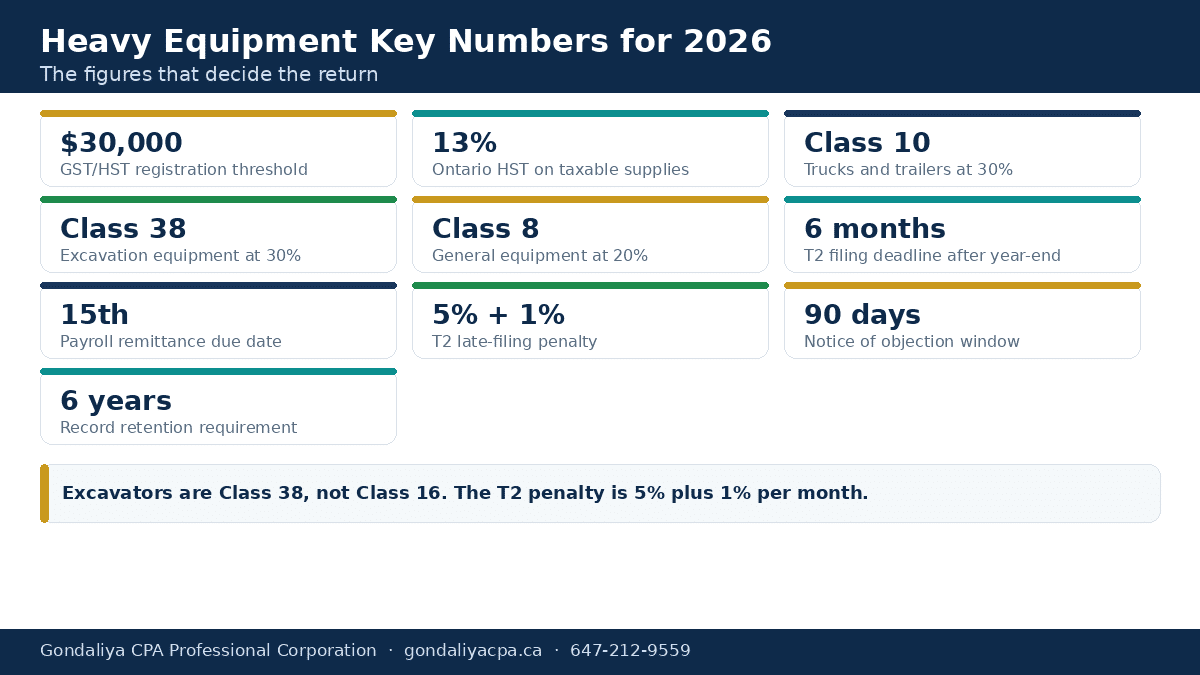
Please check the class before you claim. Class 16 at 40% covers taxis, rental vehicles, coin-operated machines and certain freight trucks, not excavators. Excavators and heavy power-operated excavation equipment sit in Class 38 at 30%. Class 53 is manufacturing and processing machinery at 50%, and zero-emission vehicles sit in Class 54, 55 and 56 rather than Class 53.
The half-year rule lets you claim only half the usual CCA in the first year, no matter when you buy the asset in that year.
What happens if you mess this up? You may show bigger losses than actual or report less income. This flags CRA audits or reassessments.
What helps?
- Keep a register listing each machine with its correct class
- Talk to a CPA experienced with heavy equipment about recent expensing rules starting in 2026
- Understand disposal rules that might cause recapture of CCA
Bill C-15 received Royal Assent on 26 March 2026, reinstating the accelerated investment incentive. For most depreciable property acquired after 2024 and available for use before 2030 the half-year rule is effectively suspended and an enhanced first-year deduction applies, phasing down after 2029.
Failing to Plan for Taxes Throughout the Year: Consequences and Solutions
Missing your T2 return deadline — which is six months after your fiscal year ends — triggers automatic late penalties starting at $250 plus daily fees up to $7,500 max. Payroll remittances are due by the 15th of the month after payroll runs; missing this causes interest charges.
The T2 late-filing penalty is not a flat $250 with daily fees. It is 5% of the unpaid tax plus 1% per complete month to a maximum of twelve months, with higher rates on a repeat failure, and interest runs daily at the prescribed rate.
Ignoring instalment payments adds daily compound interest until you pay up.
This all hurts your cash flow and cuts down money available during busy seasons.
How to avoid stress?
- Do monthly bookkeeping reconciliations
- Set up reminders in your payroll system
- Get help early from licensed CPA firms before penalties add up
Common Payroll Tax Mistakes and Compliance Issues
Some operators pay crews as contractors without following CRA’s tests. CRA checks things like how much control you have, who provides tools, and other factors under Income Tax Act section 153(1). If they decide workers are actually employees, you owe back taxes plus fines.
Payroll remittances must happen by the 15th of the next month worked. Missing this causes penalties based on what’s unpaid plus compound interest.
Non-compliance can trigger audits affecting both taxes and WSIB premiums under Ontario’s Construction Act.
How to stay safe?
- Use clear employment contracts that reflect real roles
- Keep timesheets or logs checked monthly
- Prepare accurate T4/T4A slips using cloud accounting tools
- Have professionals review payroll records regularly
Operators on subcontractor slips who run the company machine on the company schedule is the classification pattern that draws a payroll review. Figures changed for privacy.
Overlooking Available Tax Deductions for Equipment Operators
Operators sometimes miss claiming bad debts—these are uncollected invoices after reasonable collection efforts. Bad debts can be deducted once documented properly. Other overlooked deductions include:
- Half-year rule limiting first-year CCA claims
- Fuel expenses backed by receipts linked directly to business use
Missing these cuts down refunds or means paying more taxes than needed.
Stay organized by:
- Regularly reviewing accounts receivable reports to spot doubtful debts early
- Recording write-offs before year-end closes
- Working with CPAs who know construction industry tax rules in Ontario including Toronto areas like Etobicoke & Vaughan
A bad debt is deductible once it has been included in income and reasonable collection efforts have failed. Document the attempts before writing it off.
Preparing for Tax Season: Avoiding Last-Minute Book Review Stress
Poor receipt keeping breaks Income Tax Act section 230(1) which requires keeping records supporting transactions for six years after year-end. Missing original bills forces reliance on bank statements alone. Banks show cash flow but not proof of expenses; CRA won’t accept that during audits.
Last-minute scrambling often causes errors reconciling progress billings versus earned revenue. This slows down T2 filings and risks wrong reports.
How to keep calm?
- Use digital capture tools integrated with cloud bookkeeping
- Check records throughout the year—not just at tax time
- Get compilation reviews done early so returns file well before April-June deadlines across Ontario including Etobicoke & Vaughan
| What to Do | Deadline | Who it Affects | Risk if You Miss | Legal Reference |
|---|---|---|---|---|
| Register for GST/HST | Within 29 days after crossing threshold | Businesses over $30K in revenue | Penalties, lose ITCs | Excise Tax Act s.240 |
| File Quarterly | Last day of month after quarter ends | Most registered contractors | Late fees plus interest | CRA Guide RC4022 |
| Keep ITC Records | 6 years retention | All registrants | ITCs denied; audit risk | Excise Tax Act s.169 |
Enhancing Financial Management Practices for Equipment Operators
Enhancing Financial Management Practices for Equipment Operators
Better Practices
Heavy equipment operator accounting mistakes and tax errors happen when bookkeeping is sloppy or deadlines are missed. Poor financial oversight leads to costly problems. Keeping records straight with GST/HST filing deadlines (quarterly), payroll remittance due dates, and following CRA’s record retention rules helps avoid fines in Canada.
Building Accurate and Consistent Bookkeeping Habits
Equipment operator bookkeeping mistakes come from weak receipt handling and mixing personal with business expenses. This mix-up causes wrong financial reports and issues like shareholder loan troubles under section 15(2) of the Income Tax Act.
Good record-keeping means logging every transaction fast, with real receipts or electronic invoices—not just credit card statements—to meet CRA rules. Using a separate business bank account stops fund mixing that triggers audits.
Here’s what operators should do:
- Organize receipts daily
- Reconcile bank statements monthly
- Review expenses often, sorting costs like fuel vs. personal use
This approach cuts errors from lost papers or wrong expense categories.
The Role of Regular Financial Report Reviews in Preventing Errors
Skipping regular financial report checks creates blind spots in job costing. Operators then can’t tell which jobs lose money. Without tracking labour, machine hours, subcontractor fees properly, bad debts or disputed draws often go unrecorded.
Monthly checks catch unpaid bills turning into bad debts or deposits left hanging without clear job ties. These mistakes inflate assets on balance sheets and hide cash flow risks.
Making report reviews routine helps spot issues early before year-end fixes get tricky. It also ensures accurate T5018 reports for subcontractor payments.
Monitoring Cash Flow Closely to Avoid Operational Setbacks
Confusing cash flow with profit is a common heavy equipment operator tax mistake that threatens operations. Profit shows earned revenue minus costs recorded; cash flow tracks actual money moving in and out over time.
Operators face seasonal cash flow swings typical in construction work. They need solid cash forecasts to cover slow times without depending too much on credit.
Bad cash flow monitoring can cause missed payroll remittance due dates, which triggers penalties under Income Tax Act rules on source deductions.
Operators should:
- Match expected income vs upcoming bills monthly
- Account for seasonal shifts common in Ontario’s earthworks sector
Investing in Modern Accounting Systems to Replace Manual Processes
Manual bookkeeping often leads to weak receipt discipline and data entry errors, causing costly tax mistakes for heavy equipment operators.
Cloud-based software paired with receipt capture apps automates capture directly linked to accounts. This keeps records audit-ready per CRA standards.
Such systems track expenses accurately—like fuel per machine hour logged by telematics—cutting down memory-based logging errors.
Storing documents electronically meets Canadian tax retention rules and makes CRA audit retrieval easier. It also clears paper clutter common among small fleets across Ontario cities like Mississauga or Vaughan.
Fuel card charges matched to hour meter readings is what makes a fuel claim defensible. Without the meter reading it is a credit card total. Figures changed for privacy.
Identifying Warning Signs That Indicate Accounting Problems
You may already have trouble if CRA mail goes unopened—this shows ignored notices about missing T2 filings or late GST/HST returns that cause growing penalties and interest. Other red flags include:
- Missing capital asset registers (wrong depreciation claims)
- Loan payments posted as one expense (hides interest/principal split)
- No holdback schedules (wrong income timing)
- Missed T5018 slips (non-compliance risks)
- Ignored payroll reminders (WSIB risks)
- No job margin data (profit blind spots)
- Negative shareholder loans (possible undisclosed benefits under section 15(2))
- GST/HST returns not matching billing volumes (input credit errors)
These all demand quick fixes supported by professional help.
| Warning Sign | Meaning | Affected Parties | CPA Action |
|---|---|---|---|
| Unopened CRA mail | Filing/penalty issue | All incorporated operators | Client contact needed |
| Missing capital asset register | Depreciation claim errors | Equipment owners | Rebuild asset schedule |
| Single loan payment posting | Interest deduction denied | Asset financers | Setup amortization schedule |
| No holdback schedules | Incorrect income recognition | Contractors/renters | Track holdbacks properly |
How Professional Guidance from Gondaliya CPA Supports Equipment Operators
Fixing heavy equipment operator accounting mistakes needs skill balancing tax rules with practical workflows. Choosing DIY or non-CPA help often lacks authority if CRA disputes arise. Gondaliya CPA offers licensed expertise with clear flat-fee annual pricing including HST.
Our process starts by finding all big errors then cleaning up bookkeeping—splitting loans, setting holdback schedules—and building strong job costing plans per segment needs (like excavation contractors vs small fleet owners). We keep GST/HST filings quarterly on time and meet payroll remittance dates.
We also watch deadlines closely to avoid penalties plus plan capital cost allowance claims under new rules starting 2026.
Clients get clear steps showing who handles what with fast replies—often within one business day, even weekends—which builds trust backed by over “1450+ 5-star Google reviews.” This keeps equipment operators compliant across Toronto and Canada’s wider regions.
Sharad Gondaliya, CPA, has over 10 years helping Canadian business owners manage their finances right.
Practical Solutions and Clean-Up Strategies for Accounting Errors
Practical Solutions and Clean-Up Strategies for Accounting Errors
Clean-Up
Steps to Correct Misclassified Expenses and Reconcile Accounts
Misclassifying expenses causes trouble. For example, expensing a machine instead of claiming capital cost allowance (CCA) can cost you in taxes. Also, mixing loan and lease payments as one expense hides interest from principal. That leads to wrong deductions. Forgetting about recapture or terminal loss when selling or trading equipment skews your income reporting.
Here’s how to fix those issues:
- Sort Capital Assets Right: Find machinery wrongly expensed. Put each in its proper CCA class—like Class 10 for regular equipment at 30%, or Class 16 for heavy trucks at 40%. Remember the half-year rule.
- Split Loan Payments: Separate what you pay in principal (which isn’t an expense) from interest (which is deductible). Use the loan’s amortization schedule.
- Handle Recapture and Terminal Loss Correctly: When you sell assets, check if you owe recapture because proceeds were higher than undepreciated capital cost. Or if you have a terminal loss when no balance remains. Adjust your books to show this.
- Reconcile Your Records Carefully: Match bank statements, invoices, contracts, and payments against your ledger accounts. Don’t ignore mismatches.
Fixing these mistakes lowers risks of penalties from CRA and keeps your tax filing clean while improving tax savings.
Recapture on disposal is the item most often missed on a fleet upgrade. Larger first-year deductions make it more likely, because the class balance falls faster than the machine loses value.
Organizing Receipts and Documentation for Easy Access and Verification
Bad receipt management messes with bookkeeping. Mixing personal spending with business makes things worse. Not tracking fuel use or machine hours properly causes wrong job costs.
To stay organized:
- Use Digital Storage: Scan receipts fast using capture apps linked to your cloud ledger. Save copies by date, vendor, or job number.
- Keep Business and Personal Finances Separate: Always use business bank accounts only for business expenses. Don’t post personal costs in business books. Track shareholder loans carefully under rules.
- Track Fuel and Hour Meters Daily: Record fuel card charges with related vehicle or machine hour readings. This supports input tax credit claims under Excise Tax Act rules.
Good documentation helps during audits and backs up your GST/HST input tax credit claims without hassle.
Establishing a Year-Round Accounting Routine to Ease Tax Burdens
Missing deadlines hurts your wallet fast. Forgetting T2 corporate returns, GST/HST filings, slips like T4 or T5018, or instalment payments means penalties plus growing interest.
A steady routine includes:
- Monthly Bookkeeping Checks: Update records often. Reconcile bank accounts monthly. Make sure billing matches recognized revenue.
- Quarterly GST/HST Reviews: Confirm eligibility for input tax credits. Watch holdback releases that affect when supplies count.
- Prepare Slips Early: Get T5018 reports done before deadlines. Double-check contractor status before issuing slips.
Doing this keeps filing smooth and avoids last-minute panic for heavy equipment operators in Ontario’s construction field.
Streamlining Payroll Processing to Reduce Errors and Penalties
Classifying workers right matters a lot. Calling employees contractors by mistake means owing source deductions plus fines from CRA. Paying late payroll remittances triggers more penalties that hit cash flow.
Follow these steps:
- Check Worker Status Carefully: Look at control levels, who provides tools per CRA rules before giving T4s vs T4As.
- Pay Remittances on Time: Send payroll source deductions by due dates based on average monthly withholdings.
Using a dedicated payroll platform cuts manual errors and keeps compliance even if you serve many places through Toronto-based firms like Gondaliya CPA.
Transitioning from DIY Financial Management to Professional Support
Many accounting errors happen because heavy equipment operators handle complex rules alone—especially on asset depreciation or holdbacks treatment. DIY may work at first but often misses details causing expensive fixes later.
Bottom line: Hiring an experienced CPA firm focused on heavy equipment operators lowers risks and improves financial clarity needed for planning growth in Canada.
| Factor | DIY | CPA Firm | Non-CPA Provider |
|---|---|---|---|
| Accuracy | Moderate | High | Variable |
| Deadline Control | Risky | Reliable | Uncertain |
| Penalty Exposure | Elevated | Minimized | Possible |
| Industry-Specific Expertise | Limited | Extensive | Often Lacking |
How to Implement Proper Systems and Processes for Sustainable Growth
Without good job costing systems tracking machine hours per project plus related expenses like fuel, it’s impossible to spot losing jobs or manage resources well.
- Install time-tracking tools linked straight into your accounting system.
- Assign direct costs like subcontractor fees properly by job.
- Check margin reports monthly comparing estimates versus actuals.
- Train staff regularly on entering data fully.
- Tie maintenance plans into financial reviews considering downtime effects.
Clear profit visibility helps decide about fleet growth or contract bids fitting Ontario’s tough construction market.
Machine hours against job revenue is the report that tells an operator which contracts are losing money. Most fleets we take on do not have it. Figures changed for privacy.
Keeping Personal and Business Finances Strictly Separate
Keeping Personal and Business Finances Strictly Separate
Controls
Mixing personal and business spending is a common heavy equipment operator accounting mistake. It can cause shareholder loan risks and mess up your tax filings. Using the same bank account or credit card for both makes it hard to track expenses you can deduct. This might create taxable benefits under section 15(2) of the Income Tax Act, which means extra taxes and penalties for incorporated operators.
Keep business and personal accounts separate. This helps create clear audit trails and makes bookkeeping easier. If you take money out personally, document shareholder loans carefully with repayment terms. Otherwise, those loans could be seen as dividends and taxed. Reconcile your shareholder loan accounts regularly with help from a heavy equipment operator CPA who knows Canadian tax rules.
What to do:
- Open separate bank accounts for business
- Don’t mix funds
- Record shareholder loans right away
- Check accounts monthly
Regularly Updating GST/HST Registrations and Compliance Checks
Heavy equipment operators often miss updating GST/HST registrations on time or misunderstand Excise Tax Act timing rules. These mistakes lead to wrong remittances or late filings, which bring CRA interest charges or fines.
GST/HST filing deadlines depend on your reporting period—monthly, quarterly, or yearly. Missing them triggers automatic penalties under the Excise Tax Act. Progress billings need careful timing assessment. Usually, tax liability arises when you issue an invoice unless payment comes earlier. Holdbacks affect input tax credits differently and need good records.
Operators renting bare equipment versus operated rentals must apply place-of-supply rules right. Wrong application means charging incorrect rates or losing input tax credits on fuel and machines.
Tips:
- Review your GST/HST registration every year
- Watch filing deadlines closely
- Keep detailed records proving when supplies happened
Conducting Periodic Financial Statement Reviews: Profit and Loss, Balance Sheet, Cash Flow
Checking financial statements regularly helps catch problems before corporate tax filing deadlines come up. Profit and loss statements show if revenue is recorded correctly, like unbilled work in progress. Balance sheets reveal unsettled holdbacks that affect cash flow—key for meeting payroll remittance due dates.
By law, keep books and records for six years after the last related taxation year ends. Skipping this retention period puts you at risk during CRA audits. Timely reconciliations support accurate T2 corporate income tax returns filed within six months after your fiscal year ends to avoid late fees.
The T2 return is due six months after the fiscal year end. The balance is due three months after year end for a CCPC claiming the small business deduction, and two months otherwise.
How to manage:
- Do quarterly financial reviews focusing on cash flow
- Make sure documents meet retention rules
Avoiding Common Bookkeeping Pitfalls Through Continuous Training
Equipment operator bookkeeping mistakes often happen because of poor receipt handling or missed T2/GST/HST slip deadlines. If staff leave without proper training, mistakes pile up—especially in small fleets where one person does many jobs.
Make sure receipts match ledger entries rather than relying only on card statements that lack enough detail according to CRA’s evidence standards. Keep learning about changes in reporting rules too—like T5018 subcontractor slips that affect construction contractors with seasonal work.
Control steps:
- Train staff regularly on accurate record keeping
- Use checklists to ensure nothing is missing before deadlines
Leveraging Technology to Improve Accuracy and Efficiency
Technology cuts down errors common among heavy equipment operators juggling costs for machines, jobs, fuel, leases, and financing. Receipt capture apps pull documents automatically into cloud accounting software. This reduces manual entry and improves data accuracy.
Electronic records stored in the cloud meet CRA’s acceptance rules if backed up properly, making audits smoother than paper files alone. App integrations help track job costs from digital hour logs to reports automatically—boosting accuracy without losing compliance focus.
What works well:
- Use integrated digital bookkeeping suited for construction-heavy businesses
- Run regular IT security checks to protect financial info
Scheduling Consultations with Gondaliya CPA for Customized Accounting Solutions
Heavy equipment operators looking for expert help should consult a CPA Ontario Registered Firm familiar with construction sector challenges—from single machines to small fleets across Toronto and Canada-wide areas. Gondaliya CPA offers flat-fee annual pricing covering corporate taxes, bookkeeping, GST-HST filings, payroll, T5018 reporting, plus CRA representation.
For advice tailored to your operations and to avoid common heavy equipment operator accounting mistakes contact Gondaliya CPA at 647-212-9559 or info@gondaliyacpa.ca anytime during weekdays or weekends. The firm holds over 1450 five-star Google reviews showing client trust throughout Canada-wide service regions.
Keep business and personal money in separate accounts and document shareholder loans. Split every loan payment into principal and interest. Put excavators in Class 38 and check the class before claiming. Adjust work in progress at year end. Remit payroll by the 15th and file T5018 on the correct period. Please keep six years of records.
Frequently Asked Questions (FAQs)
Frequently Asked Questions (FAQs)
FAQ
What are the most common tax and accounting mistakes heavy equipment operators make in Canada?+
Common errors include mixing personal and business finances, misclassifying expenses, missing GST/HST registration, late corporate tax filings, and ignoring payroll remittance deadlines.
How can equipment operators avoid CRA penalties related to bookkeeping?+
Maintain separate bank accounts, keep detailed receipts, reconcile monthly bank statements, meet all filing deadlines, and work with a knowledgeable CPA.
When is the corporate tax filing deadline for incorporated heavy equipment operators?+
The T2 corporate tax return is due six months after the fiscal year-end of your corporation.
What is the GST/HST filing deadline for most heavy equipment operators?+
Quarterly filers must submit returns by the last day of the month following each quarter.
Why is the T5018 reporting deadline critical for equipment contractors?+
It ensures compliance with subcontractor payment reporting under CRA rules and avoids penalties.
What payroll remittance due date should operators follow to stay compliant?+
Payroll source deductions must be remitted by the 15th of the month following each pay period.
How do Capital Cost Allowance (CCA) class rates affect heavy equipment depreciation?+
CCA class rates determine how quickly you can claim depreciation deductions on machinery over time.
What is the half-year rule fraction in CCA claims?+
In the first year of asset purchase, you may only claim half the normal CCA amount.
How long should heavy equipment operators retain financial records?+
CRA requires retention of records for six years from the end of the last tax year they relate to.
Are there specific considerations for incorporation in Ontario or Toronto for equipment operators?+
Yes. Incorporation impacts shareholder loans rules, payroll compliance, and provincial tax obligations.
What options exist if you discover mistakes already made in accounting or taxes?+
You can file amended returns or use CRA’s Voluntary Disclosure Program (VDP) to minimize penalties.
What practical controls help prevent frequent accounting errors among equipment operators?+
Implement routine reconciliations, timely filings, proper expense classification, and periodic professional reviews.
How do DIY fixes compare to hiring a CPA or non-CPA provider for bookkeeping cleanup?+
CPAs offer higher accuracy and compliance assurance; non-CPA providers vary; DIY risks errors and penalties.
What deliverables do equipment operators get when hiring Gondaliya CPA?+
Accurate bookkeeping cleanup, timely GST/HST filings, payroll management, capital cost allowance advice, and audit support.
How much does it typically cost to fix an equipment business’s books in Canada?+
Costs vary by scope but Gondaliya CPA offers transparent flat-fee pricing tailored to your operation size.
What warning signs indicate existing accounting problems needing urgent attention?+
Unopened CRA notices, missed deadlines, unusual shareholder loan balances, inconsistent bank reconciliations, and lost receipts.
What should you prepare before starting a bookkeeping cleanup engagement with a CPA?+
Gather bank statements, receipts, loan documents, invoices, payroll records, and previous tax filings for review.
Seventeen questions and one underneath most of them: was the machine payment split, and was the class right. Those two settle most equipment files. Figures changed for privacy.
Essential Tax & Accounting Controls for Heavy Equipment Operators
Essential Tax & Accounting Controls for Heavy Equipment Operators
Quick Reference
- Separate personal from business finances strictly.
- Track all expenses accurately by category.
- Register promptly for GST/HST when revenue exceeds $30K.
- File T2 returns within six months after fiscal year-end.
- Submit GST/HST quarterly returns on time.
- Prepare T5018 subcontractor reports by deadline.
- Remit payroll deductions by 15th monthly deadline.
- Understand CCA classes relevant to your machinery.
- Apply half-year rule correctly in first-year CCA claims.
- Retain all financial documents at least six years.
- Document shareholder loans per Income Tax Act s.15(2).
- Monitor cash flow versus profit monthly.
- Use professional accounting software integrated with receipt capture tools.
- Schedule regular financial reviews to detect discrepancies early.
- Engage a CPA Ontario member firm familiar with Ontario/Toronto regulations.
How to Fix Accounting Mistakes: DIY vs CPA vs Non-CPA Provider
Choosing a CPA Ontario member reduces audit risk and ensures adherence to Canadian tax laws governing heavy equipment operations.
| Aspect | DIY | CPA Firm | Non-CPA Provider |
|---|---|---|---|
| Accuracy | Moderate | High | Variable |
| Compliance Control | Risky | Reliable | Uncertain |
| Penalty Exposure | Elevated | Minimized | Possible |
| Industry Expertise | Limited | Extensive | Often Lacking |
| Deadline Management | At Risk | Strict | Varies |
What You Get When Working With Gondaliya CPA
What You Get When Working With Gondaliya CPA
What You Get
- Comprehensive bookkeeping audit and cleanup.
- Accurate capital cost allowance schedules with new rules compliance starting 2026.
- Timely corporate tax return preparation (T2).
- GST/HST registration assistance and quarterly filings management.
- Payroll setup aligned with CRA guidelines including remittances and slips (T4/T4A).
- Support with T5018 reporting deadlines for subcontractors in construction sectors.
- Customized financial reviews focusing on job costing accuracy.
- Transparent flat fee pricing inclusive of HST across Toronto & Ontario regions.
- Expert CRA representation during audits or voluntary disclosures.
Signs You May Already Have Heavy Equipment Accounting Problems
- Late or missed corporate/T2 filings causing penalties.
- Negative or unexplained shareholder loan balances flagged under Income Tax Act s15(2).
- Bank reconciliations overdue or mismatched amounts detected frequently.
- Missing invoices or poorly managed receipts risking GST/HST ITC denial.
- Unfiled or late payroll remittances inviting CRA interest charges and fines.
- Inconsistent job costing resulting in distorted profitability analysis.
Address these issues early with professional guidance from Gondaliya CPA to reduce liability exposure.
Preparing For Your Cleanup Engagement With Gondaliya CPA
- Compile last 12 months bank statements (business accounts).
- Organize fuel cards receipts linked with machine usage logs.
- Provide loan agreements specifying principal/interest splits clearly documented.
- Gather previous T2 returns along with GST/HST filings records.
- Include payroll summaries detailing employee vs contractor status documentation.
- Collect contracts including holdback schedules affecting progress billing recognition timelines.
Proper preparation accelerates cleanup work while improving accuracy and compliance readiness during review periods.
Professional Guidance and Quick Reference
Guidance
Who This Is For
- For: Incorporated heavy equipment operators across Canada, including excavation and earthworks contractors, single-machine owner-operators, small fleets and equipment rental businesses.
- Also for: Operators financing their first machine, operators several years behind on filings, and owners preparing statements for a lender or bonding company.
- Not for: Unincorporated sole proprietors and partnerships, whose filing obligations run through a personal return rather than a T2.
- Not for: WSIB classification appeals, equipment licensing and operator certification, which sit with the relevant authority rather than accounting.
- Not for: Construction lien interpretation and contract disputes, which are legal questions for counsel.
People Also Ask
How much does accounting cost for a heavy equipment operator in Canada?+
Our fee is fixed, quoted annually and includes HST. It is set before work begins based on transaction volume, fleet size, payroll headcount and whether a cleanup of prior years is required.
Do I need a CPA or is a bookkeeper enough?+
A bookkeeper maintains the ledger. A CPA firm is required for compilation financial statements a lender or bonding company will accept, capital cost allowance planning, and representation on a CRA review.
What financial statements will a lender or bonding company expect?+
A balance sheet, an income statement and notes covering work in progress and holdbacks, prepared as a compilation engagement under CSRS 4200.
Glossary of Key Terms
- T2 Return: The corporation income tax return filed annually by an incorporated business.
- Shareholder Loan: Company funds used personally, taxable if not repaid within the period the Act allows.
- WIP: Work in progress, revenue earned but not yet billed at the year end.
- Holdback: An amount retained from a progress draw until the lien period expires.
- Progress Draw: A billing raised against work completed to a point in a contract.
- Bad Debt: An amount included in income that is written off after collection efforts fail.
- CCA (Capital Cost Allowance): The tax depreciation claimed on capital assets.
- UCC (Undepreciated Capital Cost): The remaining tax value of a capital cost allowance class.
- Half-Year Rule: The rule limiting first-year capital cost allowance to half the normal amount.
- Accelerated Investment Incentive: The enhanced first-year deduction reinstated by Bill C-15 in 2026.
- Available for Use: The point at which an asset can first earn capital cost allowance.
- Recapture: Income added back when an asset is sold above its undepreciated capital cost.
- Terminal Loss: The deduction arising when the last asset in a class is sold below its undepreciated capital cost.
- Class 10: The 30 percent class covering trucks and trailers.
- Class 38: The 30 percent class covering excavators and heavy power-operated excavation equipment.
- ITC (Input Tax Credit): The GST/HST recovered on business purchases supported by a supplier invoice.
- T5018: The contract payment information return for construction activity.
- VDP: The Voluntary Disclosures Program, which may reduce penalties on a complete disclosure made first.
Equipment Operator Readiness Check
This quick self-check indicates where your operation most likely has room. Please answer the six questions below.
Equipment Operator Readiness Check
Six quick questions on your company. No fee shown.
Points to raise with us:
This is a general prompt, not tax or legal advice or a quote. Your position depends on your full facts. For a real review, please book a free consultation.
Want a checklist to work from? You can download our free heavy equipment operator accounting checklist before your consultation.
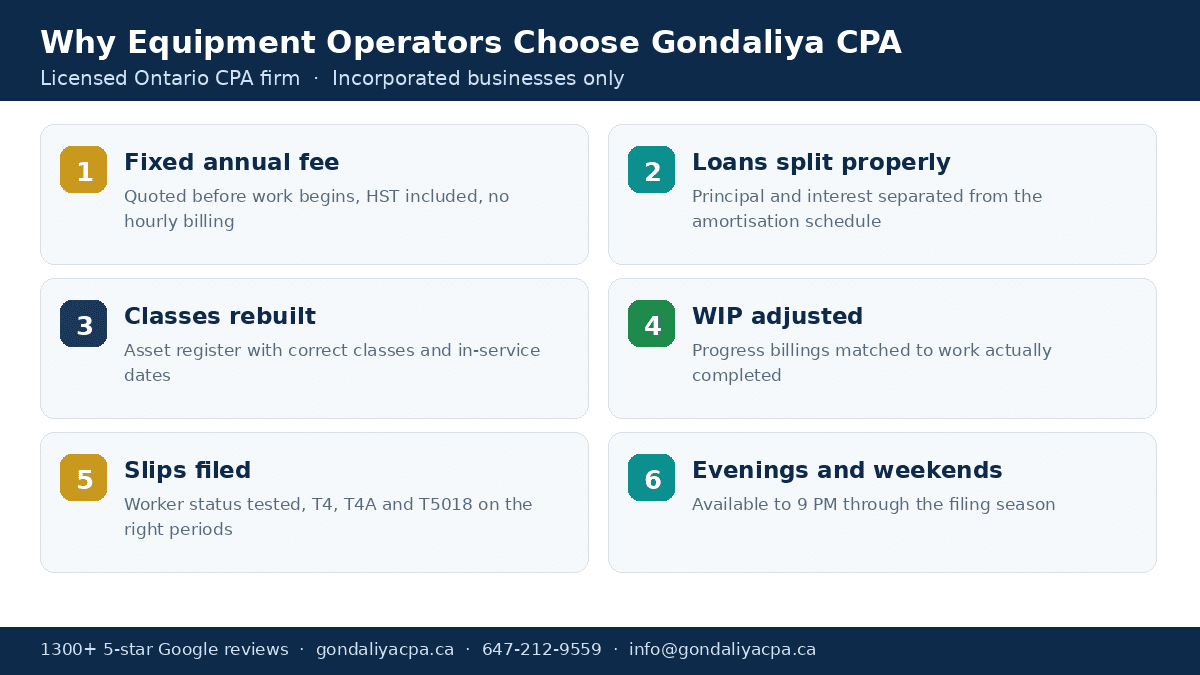
This article reflects rules current to 2026. The $30,000 GST/HST registration threshold, the 13% Ontario HST rate, the six-month T2 filing deadline, the 5% plus 1% per month late-filing penalty, the 15th of the month payroll remittance date for a regular remitter, the 90-day objection window of 90 days and the six-year retention requirement are unchanged. Bill C-15 received Royal Assent on 26 March 2026, reinstating the accelerated investment incentive for most depreciable property acquired after 2024. Please note that excavators sit in Class 38 rather than Class 16, that Class 53 is manufacturing and processing machinery rather than zero-emission vehicles, and that the T2 late-filing penalty is percentage based rather than a flat amount with daily fees.
Heavy Equipment Operator Accounting Canada: How Gondaliya CPA Supports Operators
Start with the loan agreements and the asset register
Gondaliya CPA splits every machine payment into principal and interest from the amortisation schedule, rebuilds the capital cost allowance register with the correct classes and available-for-use dates, applies the reinstated investment incentive where it fits, adjusts work in progress and holdbacks at year end, tests worker classification before slips are issued, and prepares T5018 on the correct period, on a flat annual fee including HST with a one-business-day response. Please book a free consultation.
Next Steps
Please book a free consultation with Gondaliya CPA and bring your equipment loan agreements, your asset register with purchase and in-service dates, and your last filed corporate return. Those three tell us immediately whether the loans were split, whether the classes are right, and what remains to claim. You will get a flat annual fee including HST before any work begins. If our content helps, please add gondaliyacpa.ca as a preferred source on Google.
Published: · Last updated:
Editorial policy: We research against CRA and CPA Ontario sources, fact-check the figures, and Sharad Gondaliya, CPA, reviews the content, which we update as the rules change.
Disclaimer: This article is educational information only and is not tax, legal, or financial advice. Figures marked illustrative are examples rather than quotes or guarantees. It reflects CRA rules current to 2026, including the $30,000 GST/HST threshold, capital cost allowance class treatment, the half-year rule and its 2026 suspension, and the six-year retention requirement. Rates, limits and expensing rules change and outcomes depend on your specific facts. Please consult a CPA Ontario member before acting.

Sharad Gondaliya is a CPA Canada & CPA USA with 15 Years+ experience of Accounting, Tax, Payroll of Corporate Small Businesses as Tax Accountant. He is a CPA Ontario member (61040184) and holds US CPA licences in Washington and Montana and is well known among corporate small businesses for tax planning, efficient tax solutions, and affordable CPA services. Sharad is the Principal (Director) of Gondaliya CPA – Affordable CPA Firm in Canada. Licenses: CPA Ontario: 61040184 | CPA USA (MT): PAC-CPAP-LIC-033176 | CPA USA (WA): 57629 | CPA Firm License: 61330051 View Full Author Bio