



Fine Dining Restaurant Bookkeeping Guide: How to Track Food Costs, Wine Sales, Labour, and Daily Revenue
Fine Dining Bookkeeping Services Canada: Expert Restaurant Sales Tracking, Payroll, and Supplier Payments by Gondaliya CPA
Fine dining bookkeeping services in Canada by Gondaliya CPA specialize in accurate restaurant sales tracking, fine dining payroll bookkeeping, and timely restaurant supplier payments. Their expertise ensures thorough restaurant expense tracking and strong financial records, helping fine dining restaurants stay organized and profitable.
Quick Summary
Fine dining carries a heavier food cost, a wine cellar worth real money, tips that must run through payroll, and a leasehold fit-out that sits in its own capital cost allowance class. The daily POS close matched to the bank deposit, monthly inventory counts, and correct tip and gift card treatment decide most of the outcome.
Table of Contents
- Why Fine Dining Restaurant Accounting Requires Specialized Bookkeeping
- Proper Treatment of Tip Income in Fine Dining Restaurants
- Essential Monthly Financial Reports Every Fine Dining Restaurant Should Review
- Common Bookkeeping Mistakes in Fine Dining and How to Address Them
- Maintaining Detailed Inventory Records: Food, Beverage, and Wine Inventory Accounting
- How Gondaliya CPA Supports Fine Dining Restaurants with Customized Bookkeeping Services
- Frequently Asked Questions (FAQs) for Fine Dining Restaurant Bookkeeping
- Quick Comparison Table: In-House vs Outsourced Bookkeeping for Fine Dining Restaurants
- People Also Ask
- Professional Guidance and Quick Reference
The Numbers That Matter
This article covers Canada, with Ontario and Toronto context, and reflects rules current to 2026. It applies to incorporated fine dining restaurants including chef-owned rooms, tasting menu operations, wine bars, private event venues and multi-location hospitality groups. Figures marked illustrative are examples, not quotes, and any masked engagement notes end with “Figures changed for privacy.” This is educational information only and not tax or legal advice. Employment standards interpretation, liquor licensing and AGCO compliance sit with the relevant authority or with counsel rather than with your accountant.
Why Fine Dining Restaurant Accounting Requires Specialized Bookkeeping
Why Fine Dining Restaurant Accounting Requires Specialized Bookkeeping
Why It Differs
Fine dining restaurant bookkeeping is different from regular restaurant accounting. These places deal with higher food costs and more complex menus. They also earn money from wine sales and private events. That means the bookkeeping needs to handle all these details carefully.
Bookkeeping for fine dining restaurants means tracking every sale and expense closely. It helps owners follow tax rules and see how well the business is doing. This way, they can make smart decisions that keep the restaurant growing.
Key Financial Metrics for Fine Dining: Understanding Prime Cost and Food Cost Percentage
Knowing prime cost and food cost percentage helps run a fine dining spot well.
- Prime Cost: This adds up food costs plus labor expenses. Good restaurants keep this under 60% of sales.
- Food Cost Percentage: Divide the cost of goods sold by total sales to get this number. It shows how well inventory is managed.
Watching these numbers helps spot problems or chances to change prices or operations.
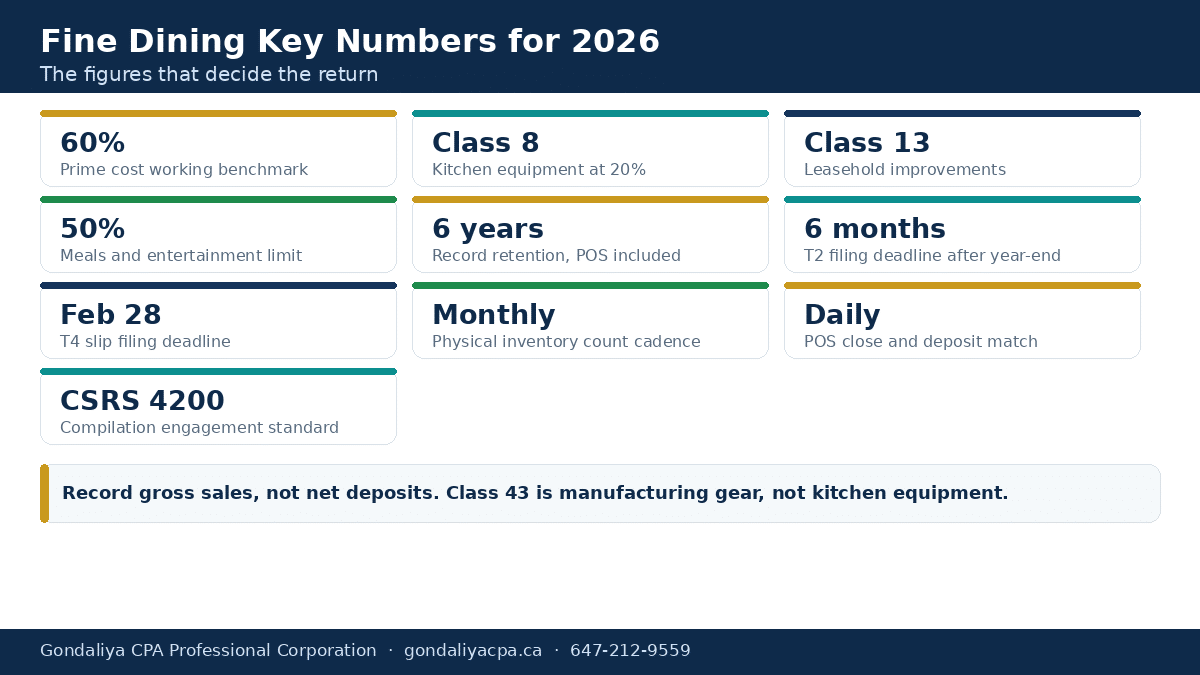
Prime cost is food plus labour as a share of sales. Under 60% is the working benchmark, and it is the single number worth watching weekly rather than monthly.
Weekly Tracking of Prime Cost to Maintain Profitability
Checking prime cost every week keeps profits on track:
- Weekly Reports Review: Look at weekly profit margins compared to your goals.
- Labour Expenses Tracking by Department: Separate kitchen and front-of-house labor costs to find where money might be wasted.
- Daily Sales Close Reconciliation: Match daily POS reports with cash deposits. If numbers don’t line up, fix it fast.
Doing this regularly stops small problems from hurting profits later.
Managing Restaurant Sales Tracking for Accurate Revenue Reporting
Good sales tracking leads to accurate revenue reports:
- Daily POS Sales Reports: Create daily summaries showing sales from all channels.
- Reconcile Card Batches with Delivery Platforms Cash: Make sure payment processor totals match bank deposits.
- Taxable vs Zero-Rated Sales Management: Know which items are taxed (like alcohol) and which aren’t (like basic groceries).
Following these steps helps keep financial records right and meets Canadian tax rules.
Handling GST/HST Compliance Specific to Canadian Fine Dining Restaurants
GST/HST rules need careful attention under the Excise Tax Act:
- GST/HST Filing Deadline Compliance: Learn your filing deadlines. Missing them can cause fines.
- Input Tax Credit Documentation Requirements: Keep clear proof of purchases used for tax credits on taxable sales.
- Excise Tax Act Compliance Monitoring: Stay updated on laws about tax rates or exceptions in hospitality.
Following these rules lowers risk of problems and helps manage taxes properly.
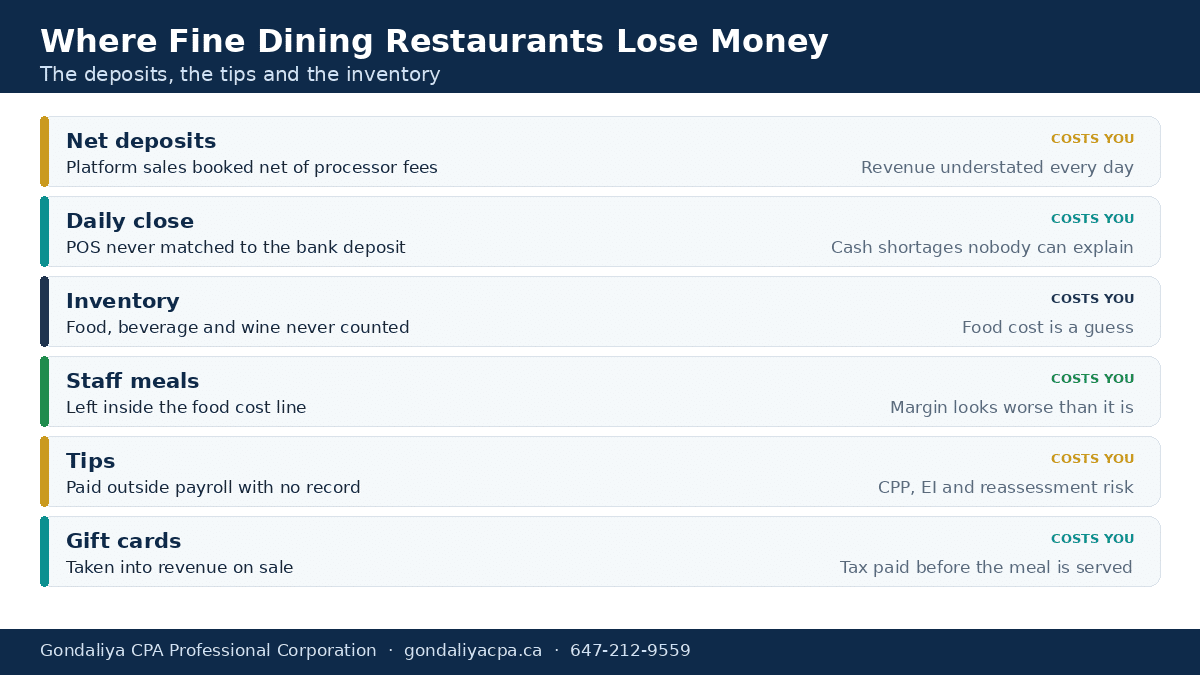
Gross sales recorded net of processor fees is the most common error we find on a restaurant file, and it understates revenue on every single day of the year. Figures changed for privacy.
Proper Treatment of Tip Income in Fine Dining Restaurants
Proper Treatment of Tip Income in Fine Dining Restaurants
Tips & Payroll
Fine dining restaurant bookkeeping needs to handle tips, tip-outs, and service charges clearly. These records help keep everything honest and in line with CRA rules. Tips count as taxable income, so restaurants must report them properly through payroll.
The Canada Revenue Agency says employees must report all tips, whether cash or electronic. These tips are pensionable and insurable earnings. Bookkeeping should split tips into two groups: controlled tips paid via payroll, and direct tips given straight to employees. Controlled tips go through payroll to make sure CPP, EI, and income tax get deducted.
Tip-outs happen when staff share gratuities among themselves. Bookkeepers must track these carefully. They go through payroll to show true labour costs per department. Service charges added automatically or by rule are sales revenue, not tips. These charges get separate accounting treatment and GST/HST applies.
Missing proper tip records can cause problems with the Employment Standards Act. It might also trigger CRA audits looking for unreported income. Restaurants should keep daily logs of total tips collected, distributions made, and payroll entries. This helps maintain control over tip income in fine dining bookkeeping.
Please treat controlled tips and direct tips separately. Controlled tips run through payroll with CPP, EI and income tax withheld. A mandatory service charge is sales revenue subject to GST/HST, not a tip.
Labour Cost Management and Payroll Bookkeeping Challenges in Fine Dining
Labour cost management needs exact tracking of hours by department. Payroll source deductions like income tax, CPP, and EI must be calculated right every pay period.
Employers face strict payroll remittance deadlines. In Ontario, they remit monthly or quarterly based on withholding amounts. Late payments lead to penalties and interest from CRA.
Filing T4 slips is another must-do task. These show yearly pay details including wages and taxable benefits such as staff meals if applicable. Controlled tip income reported via payroll appears on T4s too. Employers have until February 28 after year-end to file them.
Breaking down labour costs by department is key for fine dining profit checks:
- Kitchen staff wages
- Front-of-house servers
- Bar personnel
Managers’ pay often splits across departments based on their roles.
Running payroll well means connecting POS systems with scheduling and payroll tools used by Gondaliya CPA clients in Toronto/Ontario areas. This helps track labour costs against budgets while keeping within ESA rules about overtime pay.
Optimizing Capital Cost Allowance (CCA) for Kitchen Equipment and Leasehold Improvements
Capital Cost Allowance lets restaurants reduce taxes when they buy kitchen gear or make leasehold improvements.
Most kitchen equipment fits into CCA Class 8 with a 20% declining balance rate. This class covers things like stoves and fridges but not buildings. Sometimes energy-efficient gear may fall under Class 43 instead.
Leasehold improvements on rented spaces fall under Class 13. The claim spreads over five years or the remaining lease term if shorter. This method avoids big tax hits later unless something changes before the period ends.
Please check the class before claiming. Class 43 is manufacturing and processing equipment, not energy-efficient kitchen gear. Clean energy property sits in Class 43.1 and 43.2. Class 13 leasehold improvements are amortised over the lease term plus one renewal period, with a five-year minimum and a forty-year maximum, rather than simply the shorter of five years and the remaining term.
Bookkeepers should keep good asset lists showing purchase dates, invoice amounts (with GST/HST input credits handled properly), serial numbers when needed, plus all supporting documents kept per CRA rules.
To get the most out of CCA claims:
- Record capital purchases promptly
- Know the right CCA classes
- Coordinate with year-end tax planning professionals
Gondaliya CPA offers help here for incorporated operators in Ontario and across Canada.
Bill C-15 received Royal Assent on 26 March 2026, reinstating the accelerated investment incentive. For most depreciable property acquired after 2024 and available for use before 2030 the half-year rule is effectively suspended and an enhanced first-year deduction applies. Leasehold improvements are excluded, so Class 13 is unaffected.
Year-End Tax Planning Strategies for Fine Dining Restaurant Operators
Year-end tax planning starts way before closing books. Messy records cause issues during CRA reviews targeting hospitality businesses—things like missing sales-to-deposit matches or forgotten inventory changes raise red flags.
Good bookkeeping feeds into accurate T2 corporate returns prepared using CSRS 4200 compilation standards by CPA Canada/CPA Ontario. Correct trial balances mapped to GIFI codes make filling schedules easy:
- Schedule 100 (Balance Sheet)
- Schedule 125 (Income Statement)
- Schedule 141 (Cost Allocations)
Watch out for common errors like booking gift card sales as revenue immediately rather than deferring them till used. This mistake inflates taxable sales early. Also check prepaid tasting menu revenue; it must match the actual service timing.
Review expenses carefully too:
- Don’t expense leasehold improvements wrongly
- Capitalize assets properly to avoid future tax recapture risks
These affect net profit numbers crucial for owners deciding on expansions or investments.
Getting expert advice early helps spot needed installment payment changes. That lowers chances of penalty risk due around March after filing deadlines.
For help with your incorporated fine dining restaurant’s bookkeeping needs in Toronto/Ontario, reach out to Gondaliya CPA at info@gondaliyacpa.ca or call 647-212-9559 for a no-cost consultation about keeping your books clear and compliant.
Gift cards and prepaid tasting menus are liabilities until the meal is served. Taking them into revenue on sale inflates the year and pays tax early.
Essential Monthly Financial Reports Every Fine Dining Restaurant Should Review
Essential Monthly Financial Reports Every Fine Dining Restaurant Should Review
Monthly Reports
Monthly financial reports play a big role in fine dining restaurant bookkeeping and accounting. They show how well your restaurant makes money, handles cash, and runs day to day. Here are the main reports to check every month:
- Profit and Loss Statement (P&L): Lists money coming in from food, wine, and events. It also lists costs like labour, supplier bills, rent, and utilities.
- Balance Sheet: Shows what you own (like food and wine stock) and what you owe (such as unpaid supplier invoices or loans). It also shows the owner’s equity.
- Cash Flow Statement: Tracks cash going in from daily sales deposits versus cash going out like payroll or buying equipment.
- Inventory Valuation Report: Shows opening stock plus purchases minus ending stock. This helps figure out cost of goods sold right.
- Labour Cost Summary by Department: Breaks down wages for kitchen staff versus front-of-house staff. This helps watch labour costs carefully.
- Sales Reconciliation Report: Compares sales recorded on the POS with money deposited after fees taken by card processors or delivery apps.
Looking at these reports each month helps find mistakes in food cost or restaurant expense tracking quickly. It also shows which menu items make money or lose it.
The Role of Accurate Bookkeeping in Supporting Restaurant Audits and CRA Compliance
Good bookkeeping matters a lot when dealing with CRA rules for restaurants in Canada. The CRA wants you to keep all records including electronic POS data without deleting or hiding sales. Breaking this can lead to big fines for using sales suppression tools.
You must keep supporting documents like supplier invoices, bank deposit slips, payroll showing tips correctly reported, inventory counts including spoilage adjustments as per tax law.
Common errors that make CRA look closer include:
- Recording only net deposits from platforms instead of full sales
- Forgeting to match daily POS sales with bank deposits
- Not documenting voids or comps properly
- Paying tips outside payroll without recording them right
Keeping tidy books cuts chances of audit problems and keeps GST/HST filings on time. Accurate records also help claim correct input tax credits for expenses.
Daily POS close matched to the bank deposit is the control that prevents most of the rest. Where it is missing, everything downstream has to be rebuilt. Figures changed for privacy.
Integrating POS Systems with Accounting Software for Streamlined Operations
Linking your POS system to accounting software makes daily work easier and more accurate in fine dining restaurant bookkeeping.
Each day, close out sales from the POS. Use detailed reports that show total cash received, card batch totals sent for settlement, plus logs of voids or discounts. This prevents mistakes when you check accounts later.
Match card batch totals with monthly statements from delivery platforms too. Compare total sales recorded with net deposits after fees — track chargebacks separately to catch missed income.
Running payroll is easier when scheduling tools talk to wage software following Ontario’s rules on overtime pay, holiday pay, and source deductions filed yearly via T4 slips. This integration cuts manual errors especially around tip reporting.
Best Practices for Supplier Payment Processing and Expense Tracking
Managing supplier payments well protects your cash flow and keeps expense tracking clear for GST/HST compliance.
Use purchase orders checked against receiving reports before paying bills — this three-way check stops wrong payments. Regularly compare supplier statements with your ledger. Fix any differences fast to avoid overpaying.
Track expenses carefully by type—separate occupancy costs from kitchen supplies using your chart of accounts. Keep digital copies of invoices inside your accounting system so they’re easy to find during audits.
For GST/HST claims, save original receipts showing input tax credits claimed. Make sure taxable items differ from zero-rated groceries as per Excise Tax Act rules.
Set payment terms that balance getting early payment discounts without hurting cash flow. Use automated reminders so you don’t pay late fees but still keep good supplier relations important in hospitality.
Records must be kept for six years from the end of the last tax year they relate to, and that includes electronic POS data. Deleting or suppressing sales records is a separate and far more serious matter.
Common Bookkeeping Mistakes in Fine Dining and How to Address Them
Common Bookkeeping Mistakes in Fine Dining and How to Address Them
Mistakes & Fixes
Fine dining restaurant bookkeeping needs careful attention. Small errors can cause big problems, even a CRA review. One common slip is recording just the net card deposits as sales. That hides fees and lowers reported revenue. Another mistake is not matching daily sales with bank deposits. It makes cash flow confusing.
Inventory often gets overlooked, which messes up food cost calculations. Also, some restaurants mix staff meals into food costs instead of tracking them separately. This inflates expenses falsely. And when tips aren’t processed through payroll, it risks payroll tax issues.
If your books have fallen behind, start by gathering supplier invoices, POS reports, bank statements, and estimates of inventory. Work day-by-day to match sales and deposits. Post payroll by department monthly and check gift card balances carefully. Fix past mistakes by adjusting prior year entries if needed.
To avoid these pitfalls:
- Keep detailed logs of voided sales and comps
- Count inventory at least once a month
- Separate personal from business expenses
- Process all tips through payroll according to Employment Standards Act
- Document every supplier payment
- Use a chart of accounts designed for fine dining
Here’s a quick look at top mistakes and fixes:
| Top Bookkeeping Mistake | Impact | Control Measure |
|---|---|---|
| Recording net platform deposits as revenue | Understated sales & missed fee deductions | Reconcile gross vs net daily |
| No daily sales-to-deposit match | Unexplained cash shortages | End-of-day POS close-out mandatory |
| Inventory never counted | Inflated food cost & misstated assets | Monthly physical inventory count |
| Staff meals left in food cost | Overstated expenses | Track employee meals separately |
| Tips paid outside payroll | Payroll tax risk | Process tips via controlled tip pools |
Balancing In-House Bookkeeping and Outsourced Services for Fine Dining Restaurants
Should you keep bookkeeping in-house or hire a CPA firm? It depends on your restaurant’s size, transaction complexity, accuracy needs, risk tolerance, and budget.
In-house staff may be available anytime but might lack deep knowledge about fine dining specifics like wine inventory or labor split by department. Outsourcing to a CPA Ontario member firm means you get experts who know Canadian tax laws (Income Tax Act), GST/HST rules (Excise Tax Act), liquor licence conditions, and employment standards.
Here’s how they compare:
| Factor | In-House | CPA Firm | Non-CPA Provider |
|---|---|---|---|
| Cost | Lower fixed salary | Flat annual fees | Fees vary |
| Accuracy | Limited expertise | Licensed professionals | Quality varies |
| Maximizes audit readiness | |||
| Timeliness | Immediate updates | Monthly or quarterly closes | Limited control |
| Continuity | Risk if staff leaves | Professional backup | May lack consistency |
| Hospitality Experience | Often limited | Specialized knowledge | Varies widely |
So yeah, outsourcing fine dining restaurant bookkeeping usually gives better accuracy and compliance—especially if you’re incorporated or have complex records like wine cellars or multi-location labor.
At Gondaliya CPA, we mix hospitality know-how with modern cloud accounting tools tailored for fine dining clients across Toronto and Canada. We manage everything from data intake to final T2 filing so your books stay clean without surprises.
Using Automation and Software Solutions to Enhance Bookkeeping Accuracy and Efficiency
Software can make fine dining bookkeeping faster and more accurate. Modern tools link your POS directly with your accounting ledger while automatically capturing invoices from suppliers.
For example:
- Cloud accounting combined with receipt capture cuts down manual entry mistakes
- Dedicated payroll platforms handle payroll compliant with CRA remittance deadlines
Best practices include:
- Automating daily close templates that log voids/comps alongside deposit checks
- Scheduling monthly physical inventories using barcode scanning apps
- Linking recipe costing modules so menu profitability reports update after purchases
Your bookkeeping feeds right into the T2 corporate tax return via accurate trial balances mapped to GIFI codes per CRA rules. Year-end adjustments for assets—like kitchen equipment (Class 8) versus leasehold improvements (Class 13)—are key during compilation engagements under CSRS 4200.
Automation also helps meet CRA rules requiring six years of document retention including electronic POS data. Keeping digital backups with role-based access protects your info from loss or tampering — important for trustworthiness in professional services today.
Key Considerations for Payroll Compliance Including Digital Timesheets and Payroll Software
Payroll in fine dining requires close attention to remittance deadlines under the Income Tax Act. Employers must file T4 slips by February last day after year-end showing taxable wages including controlled tips per Ontario Employment Standards Act tip pooling rules.
Using digital timesheets linked with payroll software reduces errors compared to paper timesheets. This helps when splitting hours among kitchen vs front-of-house staff who earn different wages regulated provincially.
Service charges must be recorded correctly—mandatory charges are revenue subject to GST/HST input credits while voluntary tips affect taxable income differently impacting CPP/EI premiums.
Uniform allowances should be separate from wages unless they meet special non-taxable criteria under the Income Tax Act.
Training time arrangements need clear records distinguishing unpaid training from paid work periods to avoid audit risks.
Keep thorough digital records showing you met filing deadlines and withheld correct amounts all year long. This lowers penalties tied to late remittances or filings.
The source refers in places to tip reporting rules starting in 2026. We are not aware of a 2026 change to Ontario tip reporting. Controlled tips already run through payroll today, and the obligation is not new. Please plan on the current rules rather than a future change.
For help with your incorporated fine dining operation’s unique bookkeeping needs, contact Gondaliya CPA at info@gondaliyacpa.ca or call 647-212-9559 for a free consult focused on Canadian rules-compliant record keeping strategies.
Maintaining Detailed Inventory Records: Food, Beverage, and Wine Inventory Accounting
Maintaining Detailed Inventory Records: Food, Beverage, and Wine Inventory Accounting
Inventory & Menu
Keeping detailed inventory records matters a lot in fine dining restaurant bookkeeping. Good inventory accounting helps you follow CRA rules and keeps cost of sales accurate.
You should track food and beverage by categories like dry goods, perishables, and alcohol. Update these lists regularly to show purchases, usage, transfers, spoilage, and staff meals. Supplier invoices are your main proof; without them, tracking costs falls apart fast. The CRA wants you to keep these for six years after the tax year ends.
Inventory counts need doing at least once a month. For each count, write down opening stock, new purchases, usage or waste, and closing stock. Use a steady valuation method like FIFO or weighted average. Wrong counts mess up food cost percentages—a key metric for managing fine dining labour costs.
Wine inventory needs extra care. Bottles have high value and AGCO keeps watch on rules. Track every bottle in the cellar to find pour costs including breakage and tasting pours. Also watch liquor licence rules about where you buy wine. Moves between bar and kitchen must be clear to avoid mixing up food costs.
A wine inventory log usually shows purchase date, invoice number from supplier, quantity received, sold or spoiled bottles. This detail helps menu profitability accounting by matching beverage costs with revenue from wine sales or corkage fees.
| Inventory Type | Key Records Required | Common Breaks Without Record | Control Mechanism | Source |
|---|---|---|---|---|
| Food | Purchase invoices; physical counts | Over or understated food costs | Monthly cycle counts | CRA ITA s230(1); Ontario ESA |
| Beverage | Delivery slips; transfer logs | Misallocated expenses; theft risk | Par-level monitoring | Excise Tax Act s169 |
| Wine | Bottle-level logs; tasting notes | Pour cost errors; licence breaches | Daily cellar reconciliation | AGCO Liquor Licence Act |
Menu Profitability Accounting and Recipe Costing to Improve Financial Performance
Menu profitability starts with exact recipe costing. You figure out ingredient amounts for each dish served. This gives you the plate cost—sum of all ingredients plus overhead like packaging or plating items.
To find contribution margin per dish, subtract direct variable costs (food + labour) from menu price. Fine dining spots use this data with course sequencing in tasting menus since margins add up over courses.
Keep recipes standardized with portion sizes checked on scales during prep. Compare theoretical ingredient use to actual consumption to spot waste that needs fixing in daily controls.
Track menu mix performance to see which items sell best and help meet prime cost targets—usually combined food plus labour percentages below industry guides.
This info helps chef-owners who run complex multi-course or seasonal menus common in private dining settings. Financial insight guides pricing decisions within Canadian tax law frameworks.
Bottle-level cellar tracking is what separates a defensible pour cost from a guess. On a serious wine list it is also the largest single inventory balance in the building. Figures changed for privacy.
Tracking Restaurant Sales and Customer Transactions Through Integrated Systems
Closing daily sales right means creating a POS report that shows gross sales by payment type—cash, cards—and any voids or comps recorded as they happen.
Count cash in tills daily and check against reported cash sales. Use over-and-short logs for any differences found right away so you can fix unrecorded revenue problems that CRA frowns on.
Match third-party processor statements too. These show net deposits after fees, so gross revenue stays accurate on books avoiding underreporting taxable income.
Delivery platforms work differently since they send net amounts after fees too. That causes timing differences needing accrual entries till full payment comes through. This makes sure GST/HST credits claim the right amounts based on invoices not just received money.
Integrated systems link POS data directly into bookkeeping software. This cuts manual errors and speeds up reporting — especially useful if you run many locations across Toronto or Ontario.
Expense Management and Electronic Payment Systems for Vendor Transactions
A clean monthly close means checking supplier accounts carefully through three-way matching: compare purchase orders with receiving reports/invoices then confirm before paying. This stops double payments or missed bills that hurt cash flow forecasts.
Electronic payments speed vendor deals but you need good document capture to link every expense back to an approved invoice that meets CRA proof rules for GST/HST credits.
Monthly close checklists should also post accrued expenses not billed yet but belong in the period. This keeps financials true to real operations reducing audit risks especially for leasehold improvements needing special capital treatment.
Reconcile supplier statements too to catch credit memos missed during routine processing so cash flow stays smooth — very important in busy hotel resort restaurants common around Ontario’s hospitality scene.
Meal expenses have tight limits under the Income Tax Act. Most get denied except when part of “cost-of-sales” like staff meal benefits kept separate from general expenses avoiding tax trouble later.
For expert help improving your fine dining restaurant bookkeeping system made for Canadian businesses including Toronto-area clients contact Gondaliya CPA at info@gondaliyacpa.ca or call 647-212-9559 for a free consult focused only on incorporated restaurants with licensed expertise trusted by over 1450+ five-star Google reviews.
How Gondaliya CPA Supports Fine Dining Restaurants with Customized Bookkeeping Services
How Gondaliya CPA Supports Fine Dining Restaurants with Customized Bookkeeping Services
How We Help
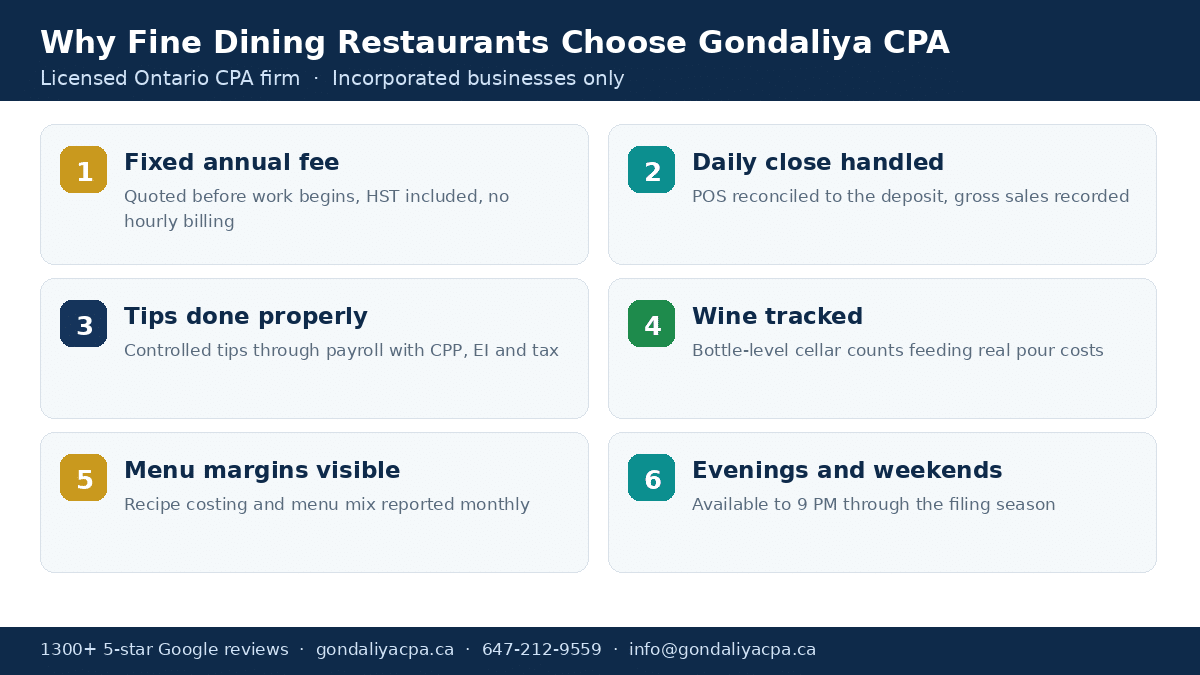
Gondaliya CPA offers fine dining restaurant bookkeeping that fits the needs of chef-owners, multi-location groups, and managers across Canada. We focus on details like daily POS sales reports, food cost tracking, wine inventory, labour costs by department, and supplier payments. Our team uses cloud accounting and payroll tools to keep everything accurate and follow CRA rules.
We create a chart of accounts that splits income into food sales and wine sales. Expenses get sorted too—labour costs separate for front-of-house and kitchen staff. This helps track menu profitability and prime cost — key for running a fine dining spot well. We make sure records meet Ontario’s Employment Standards Act tip reporting and AGCO liquor rules to avoid fines.
Our service covers daily closes, monthly reconciliations, and year-end work under CSRS 4200 standards. We charge one flat fee per year with ongoing support in Toronto, Vaughan, Mississauga, Ottawa, Hamilton, and beyond. Weekends? We’re available to reply within one business day.
Split the chart of accounts by revenue stream and by department from day one. Food against wine, kitchen against front of house. Retrofitting it later means rebuilding a year of postings.
Practical Tips for Ongoing Financial Growth and Business Profitability
Choosing how to handle bookkeeping depends on your restaurant’s needs. You can try DIY bookkeeping or hire a CPA firm or non-CPA provider.
Here’s a quick look:
- DIY has moderate error risks but costs the least.
- CPA firms deliver accuracy, compliance, and are ready for CRA reviews.
- Non-CPA providers offer mixed quality at medium-low cost.
For incorporated owners or places with many locations, a CPA often works best.
Common mistakes to watch out for:
- Recording only net card deposits understates revenue.
- Skipping daily checks between POS and bank causes missing cash issues.
- Forgetting inventory counts inflates profits falsely.
- Not tracking staff meals messes with food cost percentages.
- Paying tips off the books breaks ESA rules.
Fix these by keeping strict docs at purchase points; reviewing voids weekly; counting inventory regularly; handling tips via payroll; automating bank feeds.
Check these reports every week:
- Sales by daypart & covers
- Food & beverage cost percentages
- Labour split by department
- Prime cost ratio (labour + food)
- Average cheque size trends
- Comps/voids summary
- Cash flow status
These help spot problems early before month-end closes hit profits.
Seven reports weekly beats thirty reports monthly. By the time a month-end close shows the problem, four weeks of covers have already gone through the room. Figures changed for privacy.
Contact Information and Steps to Schedule a Free Consultation or Financial Review
Want to see how our fine dining bookkeeping services can boost your restaurant’s finances? Call 647-212-9559 or email info@gondaliyacpa.ca to book a free consultation. Our CPAs will review your current setup against CRA rules on record keeping, ESA tip reporting, and AGCO liquor license bookkeeping needs. Then we suggest steps that fit your incorporated restaurant specifically.
Legal Disclaimer and Information About the Informational Nature of This Content
This guide shares accounting and bookkeeping advice just for Canadian incorporated fine dining restaurants. It does not give legal advice about employment laws or liquor licensing rules governed by provincial Labour Ministries or the Alcohol Gaming Commission of Ontario (AGCO). For legal questions on those topics, please contact qualified lawyers separately from your accountant’s services.
Sharad Gondaliya, CPA, has over 10 years helping many Canadian business owners manage their finances well.
Only 50% of meals and entertainment is deductible. Staff meals provided as a benefit are treated separately and belong out of the food cost line.
Frequently Asked Questions (FAQs) for Fine Dining Restaurant Bookkeeping
Frequently Asked Questions (FAQs) for Fine Dining Restaurant Bookkeeping
FAQ
What is the required records retention period for fine dining restaurants in Canada?+
The CRA requires all financial records, including electronic POS data and invoices, to be kept for at least six years from the end of the tax year. This ensures compliance during audits.
When are payroll remittance deadlines due for fine dining businesses?+
Payroll source deductions must be remitted monthly or quarterly depending on your total withholding amounts. Late payments can trigger penalties and interest from CRA.
What is the T4 slip filing deadline for restaurant employers?+
Employers must file T4 slips and summaries by February 28th following the calendar year-end. These include taxable wages and controlled tip income details.
What are GST/HST filing deadlines for fine dining restaurants?+
GST/HST returns are generally filed quarterly or annually based on your filing frequency. Missing deadlines results in penalties and interest charges.
How are meal and entertainment expenses limited for tax purposes?+
Only 50% of meal and entertainment expenses related to business activities can be claimed as tax deductible under Canadian tax rules.
Which Capital Cost Allowance (CCA) classes apply to restaurant assets?+
Kitchen equipment often falls under Class 8 (20% declining balance). Leasehold improvements use Class 13 with straight-line depreciation. Some energy-efficient equipment may qualify under Classes 14.1, 50, or 53.
What penalties exist for sales suppression in restaurant bookkeeping?+
Using sales suppression tools or deleting electronic sales records violates CRA rules and can lead to severe fines, audits, or criminal charges.
Who should use specialized bookkeeping services like Gondaliya CPA?+
Incorporated fine dining operators, multi-location groups, and owners seeking detailed compliance with Canadian tax laws benefit most from expert CPA bookkeeping.
Eight questions and one underneath most of them: was the sale recorded gross, on the day it happened. Everything else follows from that. Figures changed for privacy.
Quick Comparison Table: In-House vs Outsourced Bookkeeping for Fine Dining Restaurants
Quick Comparison Table: In-House vs Outsourced Bookkeeping for Fine Dining Restaurants
Common Questions
| Factor | In-House | Outsourced CPA Firm | Non-CPA Provider |
|---|---|---|---|
| Cost | Lower fixed cost | Flat fees, often higher | Variable, generally lower |
| Accuracy | Moderate | High due to expertise | Varies |
| Compliance & Audit Readiness | Limited | Strong with licensed CPAs | Mixed quality |
| Timeliness | Immediate updates | Monthly/quarterly closes | Limited control |
| Continuity | Risk if staff leaves | Professional backup | May lack consistency |
| Hospitality Industry Knowledge | Often limited | Specialized knowledge | Varies widely |
How Do You Handle Supplier Accounts and Payment Terms?
- Use purchase orders to confirm orders before payment.
- Match receiving reports with invoices before processing payments.
- Reconcile supplier statements monthly to avoid errors or duplicate payments.
- Set clear payment terms balancing early payment discounts with cash flow needs.
- Maintain digital copies of invoices linked to payments for GST/HST audit support.
What Does a Clean Monthly Close Look Like?
- All sales reconciled between POS reports and bank deposits.
- Payroll expenses posted correctly by department.
- Supplier invoices matched with payments and accrued expenses recorded.
- Inventory counts updated reflecting spoilage and staff meals.
- Capital purchases recorded accurately with proper CCA classification.
Which Reports Should an Owner Review Every Week?
- Daily sales by category and payment method report.
- Labour cost summary split by kitchen vs front-of-house staff.
- Food and beverage cost percentages compared to budgets.
- Void and comp transactions log reviewed for irregularities.
- Cash over-and-short report from daily till counts checked.
How Do You Keep Personal and Restaurant Spending Separate?
- Use separate bank accounts and credit cards strictly for business use.
- Track owner withdrawals as shareholder loans or draws, not business expenses.
- Avoid mixing personal expenses in the company’s books to prevent audit flags.
- Keep receipts organized with clear labels showing business purpose.
Which Sales Are Taxable and Which Are Zero-Rated?
- Alcohol sales are taxable under GST/HST rules; apply standard rates accordingly.
- Basic groceries used in menu items are often zero-rated but consult specific exemptions.
- Service charges added automatically are taxable revenue; voluntary tips are not sales but income passed through payroll.
How Does Bookkeeping Feed the T2 Return and Financial Statements?
Accurate bookkeeping creates trial balances mapped to GIFI codes required in T2 corporate returns. It provides reliable data for Schedule 100 (Balance Sheet), Schedule 125 (Income Statement), and Schedule 141 (Cost Allocations), ensuring compliance with CSRS 4200 compilation standards.
What Bookkeeping Errors Trigger a CRA Review?
Common red flags include: recording only net deposits as revenue, unmatched daily sales-to-deposit figures, missing inventory counts, unreported tip income outside payroll, incorrect treatment of prepaid revenues like gift cards, and lack of proper documentation for GST/HST credits.
Which Software and Tools Suit a Fine Dining Operation?
Popular tools include cloud accounting linked with receipt capture for invoices; dedicated payroll platforms compliant with CRA deadlines; POS systems integrated directly into accounting software; barcode scanning apps for inventory; and recipe costing modules to track menu profitability.
How Do You Clean Up Books That Fell Behind?
Start by gathering all supporting documents—supplier invoices, bank statements, POS reports—and reconcile daily sales against deposits day-by-day until current. Post payroll accurately per department monthly. Adjust prior periods only when supported by valid documentation after consulting your CPA advisor.
What Are the Best Practices to Keep Records Clean Year-Round?
Maintain daily POS close-outs; conduct regular physical inventory counts monthly; separate personal from business expenses; process all tips through payroll according to ESA rules; reconcile supplier statements promptly; automate bank feeds where possible; document all voids or comps clearly; keep electronic backups safely stored per CRA requirements.
How Much Does Bookkeeping Cost for a Fine Dining Restaurant in Canada?
Fees vary based on transaction volume, complexity, number of locations, and scope of services offered. Gondaliya CPA provides flat annual fees including ongoing support tailored to incorporated fine dining clients across Canada, balancing affordability with high compliance standards.
What Should You Prepare Before a Bookkeeping Engagement Starts?
Gather prior financial statements, recent bank statements, POS reports, payroll records including T4 slips if applicable, supplier invoices organized by date, inventory valuation sheets, capital asset lists with purchase dates/invoices, current chart of accounts if available, plus any outstanding bills or payments pending posting.
Which Records Matter Most Across 10 Fine Dining Segments We Serve?
Critical records include detailed POS sales logs showing taxes applied properly; tip distribution logs matching payroll entries; supplier invoices supporting input tax credit claims; accurate capital asset lists grouped by CCA class; complete inventory counts by category including wine cellar tracking; payroll timesheets broken down by department labor costs.
A Realistic Numeric Walkthrough
If weekly food sales total $50K with prime cost targeted at 60%, weekly food + labor costs should not exceed $30K combined to maintain profitability targets consistent with industry benchmarks overseen by Gondaliya CPA specialists serving fine dining clients across Ontario/Canada.
How To Choose the Right CPA Firm in Toronto/Ontario for a Fine Dining Restaurant
Look for firms experienced in hospitality industry bookkeeping focused on fine dining specifics: wine inventory management, labour cost segmentation by department, GST/HST compliance nuances unique to restaurant sector plus strong track record preparing CSRS-compliant financials backed by client testimonials emphasizing trustworthiness like Gondaliya CPA’s over 1450+ positive reviews.
Why Trust Gondaliya CPA
Our team combines licensed CPA credentials with over ten years specializing exclusively in Canadian hospitality accounting including incorporated fine dining restaurants’ complex needs like controlled tip pools reporting compliant with the Employment Standards Act.
Close the POS daily and match it to the deposit. Record gross sales, not net of processor fees. Run controlled tips through payroll. Count food, beverage and wine monthly and keep staff meals out of food cost. Defer gift cards and prepaid menus until served. Classify kitchen equipment in Class 8 and leasehold improvements in Class 13. Please keep six years of records, POS data included.
People Also Ask
People Also Ask
People Also Ask
- Can I claim full input tax credits on alcohol purchases? No—only purchases used directly in taxable supplies qualify fully under Excise Tax Act guidelines.
- Is it mandatory to process all tips through payroll? Yes—for controlled tips subject to CPP/EI deductions per ESA regulations across provinces including Ontario.
- How often should I do physical inventory counts? Monthly counts provide reliable data aligning food costs accurately without disrupting operations excessively.
Glossary of Key Terms
- Prime Cost: Sum of food plus labor costs as percentage of sales used as profitability benchmark.
- CCA (Capital Cost Allowance): Tax depreciation classes assigned to assets per ITA rules reducing taxable income gradually over years.
- GST/HST: Goods and Services Tax / Harmonized Sales Tax applicable depending on province affecting most restaurant revenues/supplies differently depending on product types.
- Tip Pooling: Distribution method grouping employee tips paid via payroll enabling legal compliance regarding source deductions done properly.
Next Steps
Contact Gondaliya CPA today at info@gondaliyacpa.ca or call 647-212-9559 to schedule your free consultation focused on improving your fine dining restaurant’s bookkeeping accuracy while staying fully compliant within Canadian tax frameworks specific to hospitality operators nationwide.
Professional Guidance and Quick Reference
Guidance
Who This Is For
- For: Incorporated fine dining restaurants across Canada, including chef-owned rooms, tasting menu operations, wine bars, private event venues and multi-location hospitality groups.
- Also for: Operators opening a second room, operators several months behind on the books, and owners preparing statements for a landlord, lender or investor.
- Not for: Unincorporated sole proprietors and partnerships, whose filing obligations run through a personal return rather than a T2.
- Not for: Liquor licensing, AGCO compliance and food safety certification, which sit with the relevant authority rather than accounting.
- Not for: Employment standards interpretation and tip pooling disputes, which are legal questions for counsel.
More Questions Owners Ask
How much does bookkeeping cost for a fine dining restaurant in Canada?+
Our fee is fixed, quoted annually and includes HST. It is set before work begins based on transaction volume, covers per week, number of locations and whether a wine cellar needs bottle-level tracking.
Do I need a CPA or is a bookkeeper enough?+
A bookkeeper maintains the ledger. A CPA firm is required for compilation financial statements a landlord or lender will accept, corporate tax planning, and representation on a CRA review.
What financial statements will a landlord or lender expect?+
A balance sheet, an income statement and notes covering inventory and deferred revenue on gift cards, prepared as a compilation engagement under CSRS 4200.
Fine Dining Readiness Check
This quick self-check indicates where your room most likely has room. Please answer the six questions below.
Fine Dining Readiness Check
Six quick questions on your company. No fee shown.
Points to raise with us:
This is a general prompt, not tax or legal advice or a quote. Your position depends on your full facts. For a real review, please book a free consultation.
Want a checklist to work from? You can download our free fine dining bookkeeping checklist before your consultation.
This article reflects rules current to 2026. The six-year record retention requirement including electronic POS data, the 50% meals and entertainment limitation, the Class 8 rate of 20% on kitchen equipment, Class 13 treatment of leasehold improvements, the last-day-of-February T4 slip deadline, the six-month T2 filing deadline and the 90-day objection window are unchanged. Bill C-15 received Royal Assent on 26 March 2026, reinstating the accelerated investment incentive for most depreciable property acquired after 2024, with leasehold improvements excluded. Please note that Class 43 is manufacturing and processing equipment rather than energy-efficient kitchen gear, that clean energy property sits in Class 43.1 and 43.2, and that we are not aware of a 2026 change to Ontario tip reporting.
Fine Dining Bookkeeping Canada: How Gondaliya CPA Supports Restaurants
Start with the daily close
Gondaliya CPA sets the chart of accounts by revenue stream and department, reconciles the POS close to the bank deposit daily, records gross sales against processor and platform fees, runs controlled tips through payroll, schedules monthly food, beverage and bottle-level wine counts, defers gift cards and prepaid menus until served, and classifies kitchen equipment and leasehold improvements correctly, on a flat annual fee including HST with a one-business-day response. Please book a free consultation.
Book a Review
Please book a free consultation with Gondaliya CPA and bring a month of daily POS close reports, your last three bank statements, and your most recent inventory count. Those three tell us immediately whether sales are being recorded gross, whether the deposits reconcile, and whether food cost is real. You will get a flat annual fee including HST before any work begins. If our content helps, please add gondaliyacpa.ca as a preferred source on Google.
Published: · Last updated:
Editorial policy: We research against CRA and CPA Ontario sources, fact-check the figures, and Sharad Gondaliya, CPA, reviews the content, which we update as the rules change.
Disclaimer: This article is educational information only and is not tax, legal, or financial advice. Figures marked illustrative are examples rather than quotes or guarantees. It reflects CRA rules current to 2026, including the six-year retention requirement, the 50% meals and entertainment limitation, Class 8 and Class 13 treatment, and the half-year rule and its 2026 suspension. Rates, limits and expensing rules change and outcomes depend on your specific facts. Please consult a CPA Ontario member before acting.

Sharad Gondaliya is a CPA Canada & CPA USA with 15 Years+ experience of Accounting, Tax, Payroll of Corporate Small Businesses as Tax Accountant. He is a CPA Ontario member (61040184) and holds US CPA licences in Washington and Montana and is well known among corporate small businesses for tax planning, efficient tax solutions, and affordable CPA services. Sharad is the Principal (Director) of Gondaliya CPA – Affordable CPA Firm in Canada. Licenses: CPA Ontario: 61040184 | CPA USA (MT): PAC-CPAP-LIC-033176 | CPA USA (WA): 57629 | CPA Firm License: 61330051 View Full Author Bio