



Interlocking & Hardscape Contractor Year-End Accounting Checklist: Prepare Your Books for Corporate Tax Filing in Canada
Interlocking Contractor Year-End Accounting and Hardscape Year-End Checklist: Tax Filing and Financial Statements Guide by Gondaliya CPA
Interlocking contractor year-end accounting requires careful attention to unfinished project accounting, material inventory reconciliation, and outstanding customer invoices to ensure accurate hardscape financial statements. Gondaliya CPA specializes in construction year-end accounting in Canada, helping contractors with interlocking business tax filing and equipment CCA hardscape reporting.
Quick Summary
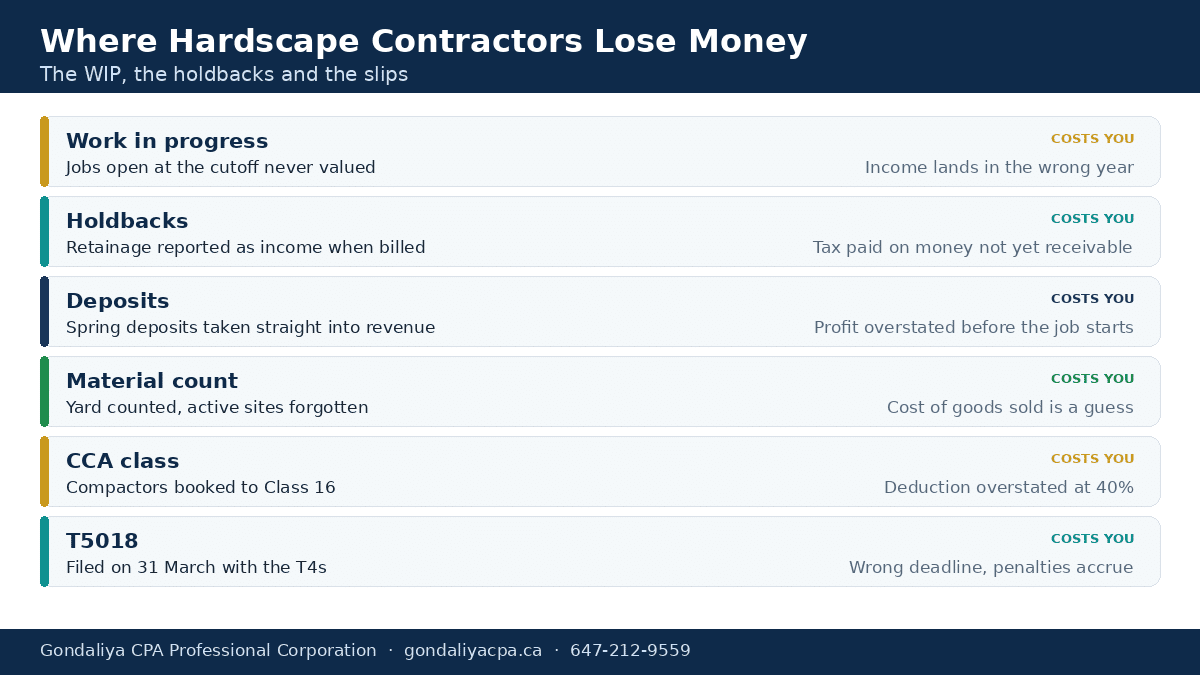
A hardscape year end turns on four adjustments: work in progress on jobs part-finished at the cutoff, holdbacks left out of income until they become receivable, customer deposits deferred until the work is delivered, and a material count that covers the yard and every active site. Get those four right and the return largely writes itself.
Reading time: 40 minutes.
Table of Contents
- Preparing for Year-End Accounting in Interlocking and Hardscape Businesses
- Reconcile All Bank, Credit Card, Equipment, and Vehicle Accounts
- Address Unfinished Project Accounting and Work-in-Progress (WIP) Reporting
- Inventory and Asset Management for Hardscape Contractors
- Prepare and Review Hardscape Financial Statements Including Balance Sheets and Income Statements
- Maximize Deductible Business Expenses Specific to Construction and Hardscape Activities
- Closing the Year and Preparing for the New Fiscal Year
- Frequently Asked Questions
- Essential Corporate Governance and Tax Planning Tips for Interlocking Contractors
- Professional Guidance and Quick Reference
The Numbers That Matter
This article covers Canada, with Ontario and Toronto context, and reflects rules current to 2026. It applies to incorporated interlocking and hardscape contractors including driveway and patio installers, retaining wall builders, pool deck specialists and municipal hardscape firms. Figures marked illustrative are examples, not quotes, and any masked engagement notes end with “Figures changed for privacy.” This is educational information only and not tax or legal advice. Construction lien interpretation, WSIB classification and municipal permitting sit with the relevant authority or with counsel rather than with your accountant.
Preparing for Year-End Accounting in Interlocking and Hardscape Businesses
Preparing for Year-End Accounting in Interlocking and Hardscape Businesses
Getting Ready
Confirm Your Fiscal Year-End Date and Canadian Tax Deadlines
Start by confirming your fiscal year-end date. This date sets the schedule for your tax duties. For example:
- T2 Corporate Tax Return Deadline: You must file this about six months after your fiscal year ends.
- Payroll Remittance Due Date: Usually, you pay this within 15 days after each month ends.
- GST/HST Filing Deadlines: These depend on how often you report — monthly, quarterly, or yearly.
- Shareholder Loan Repayment Window: You need to repay loans within one year. Otherwise, taxes under Section 15(2) apply.
Knowing these dates helps you follow CRA rules and avoid penalties for late filings.
The T2 return is due six months after the fiscal year end. The balance is due three months after year end for a CCPC claiming the small business deduction, and two months otherwise. A regular payroll remitter pays by the 15th of the following month.
Set Up and Review Your Accounting System for Year-End Closing
Make sure your accounting system is ready for the year-end close. Use a hardscape year-end checklist that fits CRA rules and the Ontario Construction Act. Key steps to take:
- Check all financial records carefully.
- Match bank statements with your recorded transactions.
- Confirm every invoice is included before you close the books.
Hiring a CPA can help catch mistakes when you do your interlocking business tax filing.
Review and Clean Your Chart of Accounts Specific to Construction and Hardscape
Your chart of accounts needs a good cleaning. This makes reports clearer and more accurate for incorporated interlocking contractors operating in Canada. Focus on:
- Removing accounts that aren’t used anymore.
- Grouping similar accounts together to keep things simple.
- Making sure all active accounts reflect your construction work.
This step clears up bookkeeping tasks and helps when you share reports with others.
Establish Year-End Bookkeeping Tasks Related to Interlocking Contractor Operations
Set up clear bookkeeping jobs for the end of the year. Important things to track include:
- Payroll Remittances Due Date: Pay payroll taxes on time based on employee earnings.
- T5018 Subcontractor Reporting Deadline: Report payments to subcontractors correctly by March 31 if needed.
- Shareholder Loan Repayment Window: Watch loans from shareholders closely; pay them back within one year to avoid taxes under Section 15(2).
- Late-Filing Penalty Rate Awareness: Know what penalties might apply if you file late—usually a percent of what you owe plus interest.
The T5018 return is not due on 31 March. It is due within six months of the end of your chosen reporting period, which may be the calendar year or your fiscal period, applied consistently. February and March are T4 and T5 dates and the three get conflated constantly.
Following these tips lowers risks and keeps things running smoothly as tax season approaches.
Reconcile All Bank, Credit Card, Equipment, and Vehicle Accounts
Reconcile All Bank, Credit Card, Equipment, and Vehicle Accounts
Reconciling
Reconciling your bank, credit card, equipment, and vehicle accounts matters a lot for accurate interlocking contractor year-end accounting. This step helps make sure your financial records match actual transactions before you file corporate taxes.
Start by comparing your bank statements with your general ledger. Check all deposits—including cash jobs—and payments against cleared checks or transfers. Don’t forget fees from payment processors; those costs need to show up correctly in your books.
Look over credit card statements carefully every month. Spot any personal charges that got mixed in with business expenses and fix them. If you find any unknown charges, look into them fast to keep your records clean.
For equipment and vehicles—think skid steers, plate compactors, trailers, trucks—check all additions and sales against purchase invoices and sales documents. Update your capital asset register with key info:
- Purchase dates
- Costs including taxes (if applicable)
- CRA Capital Cost Allowance classes (like Class 10 for small vehicles or Class 16 for heavy gear)
- Half-year rule for new assets bought during the year
- Recapture amounts when you sell assets
- Terminal losses if they apply
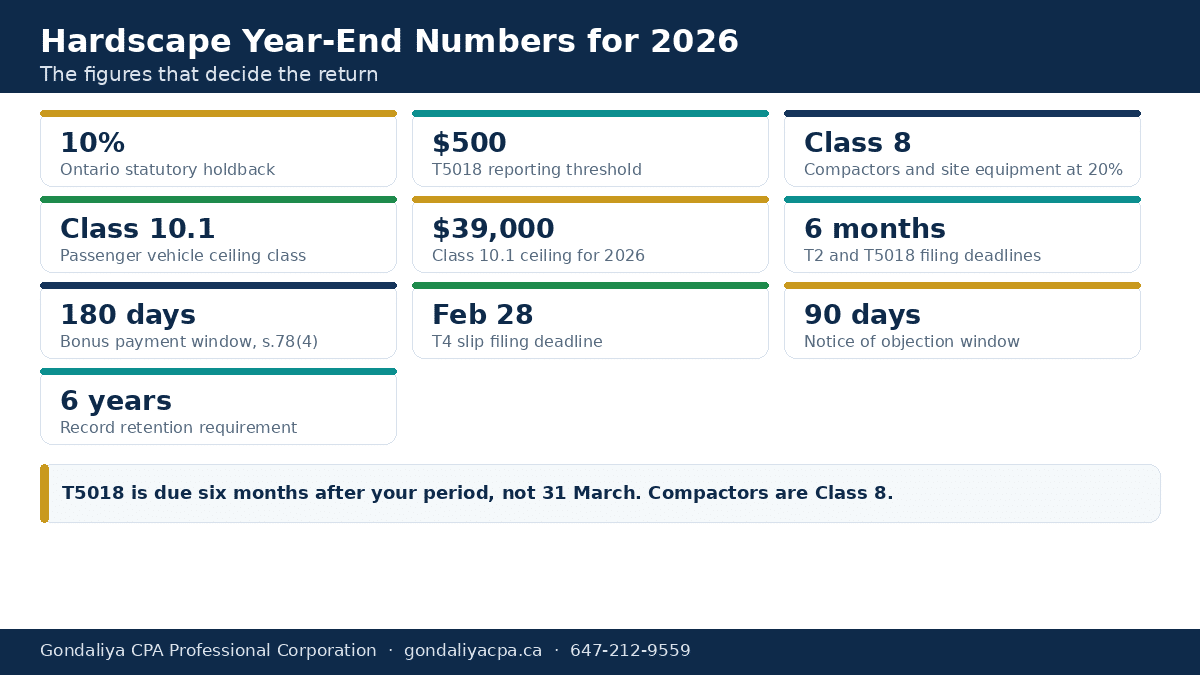
Please check the class before you claim. Class 16 at 40% covers taxis, rental vehicles, coin-operated machines and certain freight trucks, not hardscape machinery. Skid steers and plate compactors are generally Class 8 at 20%, with Class 38 at 30% for heavy power-operated excavation equipment.
This careful reconciliation helps you claim correct depreciation on your T2 tax return schedules. It also keeps errors from showing up during CRA audits.
Bill C-15 received Royal Assent on 26 March 2026, reinstating the accelerated investment incentive. For most depreciable property acquired after 2024 and available for use before 2030 the half-year rule is effectively suspended and an enhanced first-year deduction applies, phasing down after 2029. Leasehold improvements are excluded.
Review and Clear Outstanding Customer Invoices and Unpaid Supplier Bills
Cleaning up outstanding customer invoices is a must before closing your books for interlocking business tax filing. Start by aging your receivables:
- Current (0-30 days)
- Overdue (31-90 days)
- Long-term delinquent (over 90 days)
Handle any disputed jobs or work issues separately. Keep notes on how you try to fix them since CRA wants proof before allowing bad debt write-offs.
Write off debts only after you’ve tried hard to collect them. This lowers your taxable income properly without raising red flags in an audit. If you get money back later on a written-off invoice, record it as income when received.
Do the same for supplier bills. Match vendor statements carefully so you include unpaid bills at year-end. Add accruals too—these are bills that come after cutoff but relate to work done inside the fiscal period. Keep disputed charges separate but track them well.
Clear payables help avoid understating expenses, which could cost you penalties or interest if CRA reassesses your taxes.
Address Unfinished Project Accounting and Work-in-Progress (WIP) Reporting
Address Unfinished Project Accounting and Work-in-Progress (WIP) Reporting
WIP & Retainage
Accounting for unfinished projects using work-in-progress reports keeps revenue lined up with actual job status—a key part of Canadian construction year-end accounting.
Work-in-progress covers costs spent plus revenue earned but not yet invoiced at year-end. Use percentage-of-completion methods adapted locally. Recognize revenue based on how much work is done—for example, crew hours logged or square footage installed compared to contract scope.
Keep detailed job cost reports that show:
- Labour hours per crew member
- Materials used from inventory onsite or in yard stock
- Subcontractor fees paid vs contracted amounts pending T5018 slip filing
- Holdbacks receivable/payable per Ontario Construction Act rules
- Progress billings compared to estimated total contract value
Unbilled WIP becomes part of your closing trial balance entries. These support schedules needed for the T2 corporate tax return like Schedule 141.
If you mess this up, you risk misstating income timing which affects GST/HST filings and taxable profits. CRA auditors who know construction watch this closely.
Work in progress never adjusted is the single largest year-end entry on most hardscape files, and it moves income between two fiscal years. Figures changed for privacy.
Manage Accounts Receivable and Accounts Payable with Focus on Retainage and Subcontractor Verification
Managing accounts receivable means handling customer deposits right alongside progress billings during contracts according to Canadian standards adapted for contractors.
Customer deposits count as “amounts received in advance” until work actually starts onsite. You can’t record this money as income too soon or else profits get overstated before tax filing for hardscape businesses under Income Tax Act rules about revenue recognition.
Holdbacks kept under contracts governed by the Ontario Construction Act get recorded separately from normal receivables because their release depends on lien periods ending after project finish dates. Usually, holdbacks are about 10% unless stated otherwise. They only become taxable income when released legally after adjudication timelines documented carefully in financial records filed with annual returns.
For subcontractors paid during jobs—whether incorporated crews or third-party providers—you must file T5018 slips if payments exceed $500 annually per subcontractor providing construction services including landscaping/hardscaping tasks. These slips report gross payments and help keep bookkeeping clear on payroll deductions vs contractor classification based on CRA guidelines.
Also verify subcontractors by getting WSIB clearance certificates before paying them to avoid gaps in workers’ compensation coverage affecting premiums reported yearly with payroll reconciliations submitted on time per federal/provincial rules.
Doing this right cuts financial risk tied to penalties and keeps final filed returns accurate—usually best done with a CPA who knows hardscape contractor specifics around Toronto/Ontario law.
The T5018 threshold is $500 of construction payments to a subcontractor in the reporting period. The statutory holdback under the Ontario Construction Act is 10% of the contract price.
For expert help reconciling accounts payable and receivable including retainage tracking tailored for incorporated interlocking businesses across Toronto/Ontario contact Gondaliya CPA today at info@gondaliyacpa.ca or call 647-212-9559 for a free consultation backed by our flat-fee pricing model trusted through over 1450+ five-star Google reviews.
Inventory and Asset Management for Hardscape Contractors
Inventory and Asset Management for Hardscape Contractors
Inventory & Assets
Conduct Material Inventory Count and Verify Hardscape Supplies
Counting your materials right is key for interlocking contractor year-end accounting. It helps figure out the cost of goods sold and checks off the hardscape year-end checklist. You need to count everything—pavers, retaining wall blocks, sand, base materials, adhesives, edging parts. Use count sheets sorted by yard or site. That way you don’t miss anything.
Pick one way to value your inventory, like FIFO (first-in-first-out) or weighted average cost. This number shows up in your T2 corporate tax filing as cost of goods sold. If some stock is old or damaged, write it down so the value matches what you can actually sell. CRA rules want this. Writing down old stuff keeps you from saying your assets or income are higher than they really are.
Say you got 500 square feet of pavers at $3 a foot that got ruined by weather while stored. You’d write down $1,500 before closing your books.
Count the yard and every active site on the same day. A count spread over a week double-counts material moved between sites, and that is exactly what an auditor looks for.
Update Fixed Asset Records Including Equipment and Vehicle Depreciation (CCA)
Check your capital asset register carefully. Make sure all equipment bought or sold shows up right for equipment CCA reporting on taxes. Look for things like plate compactors or skid steers bought before year-end. Put them in the right Capital Cost Allowance class — usually Class 8 for most gear (20% declining balance), or Class 10.1 for passenger vehicles with special rules.
Remember the Capital Cost Allowance Half-Year Rule: new purchases get only half the usual depreciation claim the year you buy them, unless you use immediate expensing under 2026 changes. Keep track of any gear you sold; if there’s a recapture or loss when selling, record it.
Good records help you follow CRA rules and claim what’s allowed in construction year-end accounting Canada.
Available for use is the test, not the invoice date. A compactor delivered in December but not commissioned until spring belongs to the following fiscal year. Figures changed for privacy.
Review Prepaid Expenses and Make Necessary Adjusting Journal Entries
Look over prepaid expenses like insurance paid early when doing accruals capture unpaid supplier bills at year-end. You need to split these prepaids between current expenses and future periods with adjusting journal entries. This matches costs to when they really happen, which Canadian accounting rules require.
Also check for unpaid bills you haven’t gotten yet but that belong to this fiscal period. Record those as accrued liabilities so expenses don’t get left out just because payment happens later.
For example, if a supplier invoice arrives in January but covers December work worth $5,000 plus GST/HST credits, record an entry to show this liability now.
Verify Payroll Year-End Compliance Including Employee and Contractor Information
You must finish payroll year-end steps by CRA deadlines. Send in source deductions on time. Prepare T4 slips with exact employee earnings including taxable perks like vehicle allowances often used by multi-crew hardscape firms around Toronto.
Subcontractors are different—file T5018 slips by February following the calendar year end. Make sure subcontractors are classified right based on CRA’s employee vs contractor rules; wrong classification risks penalties affecting payroll compliance and taxes.
Keep all payroll documents handy including WSIB clearances—they matter during audits triggered by GST/HST checks or shareholder loan reviews common in incorporated landscape firms.
Prepare and Review Hardscape Financial Statements Including Balance Sheets and Income Statements
Prepare and Review Hardscape Financial Statements Including Balance Sheets and Income Statements
The Statements
Getting your hardscape financial statements right is key for interlocking contractor year-end accounting and corporate tax filing in Canada. The balance sheet shows what you own and owe at the end of the year. The income statement lists your revenues and expenses during that time. Together, they form the base for your T2 filing with the CRA.
You need to check every account carefully. Reconcile bank statements, count materials, value work-in-progress, and track holdbacks as per Ontario Construction Act rules. Don’t forget accrued payroll and any unpaid invoices. Make sure you classify costs properly — know the difference between direct job costs and overhead. This gives a clear view of your finances.
If you run an incorporated interlocking or hardscape business, these statements help beyond taxes. They show which projects like patios or retaining walls are profitable. Using ASPE standards keeps things consistent. Lenders and bonding companies expect that too.
Example: A Toronto paving stone company double-checked its equipment depreciation before filing its 2026 T2 return. This helped claim capital cost allowance properly under CRA rules.
Analyze Year-End Financial Performance Relevant to Interlocking Business Operations
Looking over your year-end numbers helps spot what’s working and what’s not in your interlocking business tax filing. Watch metrics like gross margin per installed square foot. Check how crew labor hours compare to billed revenue. Compare material use with inventory records. Track holdback income on time following Ontario Construction Act schedules.
Your year-end checklist should cover revenue recognition under Canadian tax laws—like percentage-of-completion methods when used. Mistakes here can trigger CRA audits.
Cash flow changes by season affect instalment payments too. Plan ahead for taxes owed after year-end. Also, make sure deposits from customers aren’t recorded as income before you actually earn them—this is a common mistake.
Example: An Etobicoke driveway company fixed an overstated profit by adjusting customer deposits before filing its corporate tax return.
Document Adjusting Journal Entries and Ensure Proper Classification of Expenses and Income
Adjusting journal entries close out the books by capturing unpaid bills or vacation pay owing at year-end. You’ll adjust material inventory based on physical counts that show damaged or obsolete stock needing write-downs per CRA guidance.
Work-in-progress costs must match invoiced amounts using consistent percentage-of-completion calculations that follow federal rules and provincial construction laws.
Customer deposits at year-end need deferring unless the contract says otherwise or work is complete.
Holdbacks require careful handling too: only include them as income once released according to lien laws under the Ontario Construction Act. GST/HST claims go hand-in-hand here, backed by solid paperwork.
| Adjustment Type | Record Needed | Impact | Source |
|---|---|---|---|
| Inventory Write-down | Physical count sheets + valuation | Lowers asset value & COGS | CRA ITA s12(1)(a), Guide T4002 |
| Accrued Supplier Invoices | Supplier statements + invoice copies | Adds liabilities | CPA Canada Accounting Standards |
| Work-in-Progress Recognition | Job costing reports + contracts | Matches revenue & expenses | Income Tax Regulations Schedule II |
| Deferred Customer Deposits | Contract terms + payment receipts | Defers income recognition | CRA Interpretation Bulletin IT-490R3 |
| Holdback Release | Lien release documentation | Recognizes taxable income | Ontario Construction Act; Excise Tax Act |
Organize Supporting Documents for Corporate Tax Filing and GST/HST Return Preparation
Staying organized with your documents makes corporate tax filing easier for incorporated hardscape contractors in Toronto/Ontario. Keep these ready:
- Bank statements reconciled up to month end
- Payroll remittance summaries showing source deductions paid on time
- Details on subcontractor payments plus WSIB clearance certificates where needed
- Prepared T5018 slips filed by February 28 yearly
- Shareholder loan records showing advances and repayments within allowed times to avoid tax issues
Having everything in place cuts down risks during CRA reviews when they check for mismatches between returns.
Using digital bookkeeping tools linked with receipt capture can help capture documents quickly and correctly before deadlines.
Example: A Scarborough commercial hardscape company gathered all subcontractor invoices with WSIB clearances early, making T5018 reporting smooth before deadlines.
To discuss how Gondaliya CPA can assist you preparing accurate financial statements tailored specifically for your interlocking contractor operations in Toronto/Ontario contact us today at info@gondaliyacpa.ca or call 647-212-9559 for a free consultation backed by our flat-fee annual pricing model trusted across Canada-wide clients including Mississauga, Vaughan, and Brampton areas.
Maximize Deductible Business Expenses Specific to Construction and Hardscape Activities
Maximize Deductible Business Expenses Specific to Construction and Hardscape Activities
Deductions & Timing
If you want your interlocking contractor year-end accounting to be right, you need to maximize your deductible business expenses. Your hardscape financial statements will look better too. The Capital Cost Allowance (CCA) half-year rule matters a lot here. It means you can only claim 50% of the CCA rate on new assets in the first year. This includes heavy machines used in your hardscape work. Following this rule helps you avoid CRA audits.
Don’t miss your payroll remittance due dates. Incorporated contractors must send source deductions within seven days after each pay period. Late payments mean penalties and interest, which hurt your cash flow.
Source deductions are not due seven days after every pay period. That window applies only to a threshold two accelerated remitter. A regular remitter pays by the 15th of the month following the month the employees were paid, as this article states correctly earlier.
GST/HST filing deadlines change depending on how often you report, usually monthly or quarterly. Filing on time means you can claim input tax credits (ITCs) on materials and equipment without issues.
Here’s what to keep in mind:
- Keep good records of capital assets and apply CCA classes correctly.
- Make sure payroll amounts are fully accounted for before year-end.
- Check GST/HST accounts before deadlines.
Plan Income and Expense Timing to Optimize Tax Obligations
Picking the right fiscal year-end helps control tax timing for incorporated interlocking businesses. Choose a date that fits your cash flow cycle. This also makes meeting T2 corporate tax return deadlines easier—they’re six months after year-end.
Watch out for shareholder loans. If they stay unpaid more than one year after the corporation’s taxation year, the amount may count as income for the shareholder under section 15(2). So, repay or fix this before filing.
Holdbacks need careful handling at year-end. Keep clear records of money owed versus payable because Ontario Construction Act rules require it. Don’t report holdbacks as income too soon—this inflates revenue wrongly.
Customer deposits paid before jobs finish are liabilities until you earn them. Record these as “amounts received in advance” according to CRA guidance.
A holdback under a provincial construction or lien act is generally not included in income until it becomes receivable. Keep the schedule by contract with substantial performance and lien expiry dates on it.
Quick summary:
| Task | Key Record | Impact if Missed | Source |
|---|---|---|---|
| Fiscal Year-End Selection | Corporate resolution | Cash flow issues; late filings | CRA T2 Guide |
| Shareholder Loan Repayment | Loan agreements & repayments | Shareholder income inclusion | Income Tax Act s.15(2) |
| Holdback Accounting | Holdback schedules | Wrong income/liability reporting | Ontario Construction Act |
| Customer Deposits Recognition | Deposit receipts | Early revenue recognition errors | CRA Revenue Recognition Policy |
Consult with a CPA Specializing in Hardscape Contractor Tax Filing and Year-End Strategies
Working with a CPA who knows hardscape contractors is really helpful. They understand how interlocking business tax filing works across Canada and all those tricky details like work-in-progress values and holdback timing under local laws.
These CPAs handle corporate tax filings carefully. They include all needed forms like Schedule 100 (Balance Sheet), Schedule 125 (Income Statement), Schedule 141, and make sure everything follows ASPE standards. They also know Toronto/Ontario rules well, which helps avoid costly mistakes.
You have to file your T2 corporate return within six months after your fiscal year ends. Missing this deadline starts penalties at $250 and can get worse over time.
The T2 late-filing penalty does not start at a flat $250. It is 5% of the unpaid tax plus 1% per complete month to a maximum of twelve months, with higher rates on a repeat failure. This article states the 5% rule correctly further on.
A good CPA also guides you on things like immediate expensing for eligible property starting January 2026, helping reduce your taxes while staying legal.
The earlier you ask for help, the less last-minute scrambling you face during tax season.
Identify GST/HST Optimization Opportunities and Confirm Compliance with Canadian Tax Regulations
Check your GST/HST accounts carefully before filing to avoid mistakes that cost cash flow. You can claim input tax credits only if you have valid proof of tax paid on materials—including those under holdbacks—and other allowed expenses.
GST/HST deadlines depend on how often you file, usually monthly or quarterly by month-end. If you file late, expect penalties based on net taxes owing plus daily interest until paid.
Holdbacks make claiming ITCs tricky since law says you usually can’t claim until payment happens per Excise Tax Act section 169. Track these well so you don’t claim too early and risk an audit.
Regularly match sales invoices with collected GST/HST amounts. Verify vendor bills support ITCs claimed in allowed periods. Fix any gaps early using cloud accounting tools that many contractors use today.
For help managing complex interlocking contractor year-end accounting—maximizing deductions, timing income and expenses smartly, meeting all filing deadlines across Canada, or sorting out tricky GST/HST rules—contact Gondaliya CPA Professional Corporation at info@gondaliyacpa.ca or call 647-212-9559. We offer consultations designed just for Canadian hardscape contractors who want smooth corporate tax handling without surprises.
Adjust work in progress and defer customer deposits before you close. Keep the holdback schedule by contract and leave holdbacks out of income until they become receivable. Count the yard and every site on one day. Check the capital cost allowance class before claiming. File T5018 six months after your reporting period ends. Please keep six years of records.
Closing the Year and Preparing for the New Fiscal Year
Closing the Year and Preparing for the New Fiscal Year
Closing the Year
Closing your books right matters a lot for interlocking contractor year-end accounting. It also helps with hardscape business tax filing in Canada. Following a solid hardscape year-end checklist keeps you on track with CRA rules. Plus, it makes your financial reports spot on. This sets you up well for the next fiscal year.
Finalize All Financial Statements and Corporate Year-End Filings (Including T2)
You must finish all financial statements and filings on time to avoid penalties. The T2 Corporate Tax Return has a deadline of six months after your fiscal year ends. This return includes important schedules like Schedule 100 (Balance Sheet), 125 (Income Statement), and 141.
To get these right, you need to check things like:
- Inventory levels and work in progress
- Holdbacks owed or owing under the Ontario Construction Act
- Customer invoices not yet paid
- Supplier bills waiting payment
- Equipment capital cost allowance claims, like Class 8 or Class 10.1
- Payroll accruals and GST/HST reconciliations
- Subcontractor payments reported via T5018 slips
Late filing triggers fines starting at 5% of what you owe plus extra daily penalties. Using corporate tax filing services made for hardscape contractors can help avoid mistakes that slow down refunds or cause audits.
Worked Example:
A Toronto retaining wall contractor closed their year by listing $250,000 in work-in-progress costs not billed yet. They filed their T2 return before deadline with financials prepared by a CPA firm experienced in construction.
Set Financial Goals and Budgets for the Upcoming Year Based on Year-End Analysis
Year-end numbers show what drives profits — crew productivity, material use, overhead control, equipment depreciation claimed through CCA, cash flow timing from deposits vs holdbacks after year-end.
Setting budgets means looking at past results plus fresh forecasts. Seasonal ups and downs affect driveway specialists or snow removal businesses a lot. Doing bookkeeping yourself vs hiring a CPA shows how much accuracy changes budget reliability.
Good steps include:
- Checking old unpaid invoices to boost collections
- Updating labor cost estimates using payroll accruals data
- Planning capital expenses with options to expense immediately starting 2026
- Considering holdback release timing changes by province
This helps cut surprises come tax time while supporting smart growth plans.
Implement Process Improvements and Update Accounting Procedures for Better Efficiency
Start by automating bank reconciliation across payment types — credit cards, e-transfers — using cloud accounting software. These are common tools among incorporated contractors. Regular vendor statement checks stop missed bills from slipping into taxable income calculations.
Match payroll bonus accrual periods to CRA rules. Bonuses paid within three months after fiscal year-end count as deductible if accrued properly before closing. Track vacation pay each year too, or audit risks rise.
The bonus accrual rule sits in subsection 78(4). A bonus accrued at year end must be paid within 180 days of that year end for the deduction to hold in the year it was accrued, which is a little longer than three months.
Update workflows so small crews keep clear job costs while bigger firms manage multi-site inventory well.
These fixes trim down last-minute fixes during next year’s close versus relying on manual records alone.
Schedule Year-End Strategy Sessions with Gondaliya CPA and Outline Next Steps for Continued Compliance and Growth
Working with Gondaliya CPA early lets you spot issues unique to your work — pool deck builders with seasonal jobs or municipal hardscape firms juggling many subcontractors needing precise T5018 reporting.
Our process covers everything from initial review to final report delivery including:
- Trial balances
- Inventory summaries
- Work-in-progress schedules
- Holdback tracking following Ontario Construction Act rules
- Payroll info including T4 slips
- GST/HST returns matching input tax credit docs
Clients get flat annual fees and weekend support to avoid last-minute stress. Our sessions focus on smart tax planning like timing equipment buys with immediate expensing rules from 2026, dividend vs salary decisions keeping shareholder loans in mind, plus advice on changing rules across Toronto/Ontario service areas.
With over 1450 five-star Google reviews, we build trust helping Canadian hardscape contractors stay compliant without losing focus on their work.
For help closing your books right this season or planning ahead, contact us at info@gondaliyacpa.ca or call 647-212-9559 today.
Contractors who close monthly file on time. Contractors who close once a year spend February rebuilding a ledger from a shoebox. The difference shows up in the fee as well as the filing. Figures changed for privacy.
Frequently Asked Questions
Frequently Asked Questions
FAQ
What is the role of the Ontario Construction Act in year-end accounting for hardscape contractors?+
The Ontario Construction Act governs holdbacks and lien periods. It ensures proper recognition of retainage and prevents premature income reporting during year-end accounting.
How do I apply the percentage of completion method for work-in-progress (WIP) reporting?+
Calculate revenue based on project progress, such as labor hours or materials used. This method aligns revenue with actual job status and meets Canadian tax standards.
When must T4 slips be issued for payroll year-end reconciliation?+
T4 slips must be prepared and distributed by the end of February following the calendar year to comply with CRA deadlines.
What are WSIB clearance certificates, and why are they important?+
WSIB clearance certificates confirm subcontractors are covered by workers’ compensation. They reduce financial risk and ensure compliance before making payments.
How does the capital cost allowance half-year rule affect equipment depreciation?+
New assets can only claim half the normal CCA in the purchase year. This limits initial depreciation claims and complies with CRA rules.
What is the shareholder loan repayment window, and what happens if it is missed?+
Loans must be repaid within one year after fiscal year-end. Failure to repay may result in shareholder income inclusion under Section 15(2) of the Income Tax Act.
How does the late-filing penalty rate impact corporate tax returns?+
CRA charges penalties starting at 5% of tax owing plus daily interest for late filings, increasing costs significantly over time.
What records should be included in holdback schedules?+
Holdback schedules should list amounts withheld, release dates, lien periods, and related contract details following Ontario Construction Act rules.
When is the T5018 subcontractor reporting deadline?+
T5018 slips must be filed by February 28 for payments made in the previous calendar year to subcontractors providing construction services.
What are key considerations for payroll remittances at year-end?+
Remit payroll deductions on time based on pay periods. Accurate records prevent penalties and support correct T4 slip preparation.
Records are retained six years from the end of the last tax year they relate to, and an objection must be filed within 90 days of the date on the notice.
Essential Corporate Governance and Tax Planning Tips for Interlocking Contractors
Essential Corporate Governance and Tax Planning Tips for Interlocking Contractors
Quick Reference
- Select a fiscal year-end date that matches your cash flow cycle to simplify filings.
- Maintain updated corporate governance documents for smooth audits and compliance reviews.
- Use Schedule 100, 125, and 141 with accurate GIFI codes to prepare financial statements aligned with CSRS 4200 standards.
- Track installment payments carefully; reset instalment calculations after significant changes in income or expenses.
- Consider dividend vs salary decisions to optimize tax liabilities and personal income strategies.
- Plan immediate expensing for eligible assets starting 2026 to reduce taxable income legally.
- Utilize loss carry-forwards to offset future taxable profits efficiently.
These actions help hardscape businesses stay compliant and financially efficient throughout tax cycles.
Professional Guidance and Quick Reference
Guidance
Who This Is For
- For: Incorporated interlocking and hardscape contractors across Canada, including driveway and patio installers, retaining wall builders, pool deck specialists and municipal hardscape firms.
- Also for: Contractors closing their first full year, contractors several years behind on filings, and owners preparing statements for a lender or bonding company.
- Not for: Unincorporated sole proprietors and partnerships, whose filing obligations run through a personal return rather than a T2.
- Not for: WSIB classification appeals, municipal permitting and landscape trade certification, which sit with the relevant authority.
- Not for: Construction lien interpretation, adjudication and contract disputes, which are legal questions for counsel.
People Also Ask
How much does year-end accounting cost for a hardscape contractor in Canada?+
Our fee is fixed, quoted annually and includes HST. It is set before work begins based on transaction volume, crew size, number of active contracts with holdbacks, and whether prior years need catch-up work.
Do I need a CPA or is a bookkeeper enough?+
A bookkeeper maintains the ledger. A CPA firm is required for compilation financial statements a lender or bonding company will accept, work in progress and holdback treatment, and representation on a CRA review.
What financial statements will a lender or bonding company expect?+
A balance sheet, an income statement and notes covering work in progress, holdbacks and customer deposits, prepared as a compilation engagement under CSRS 4200.
Glossary of Key Terms
- T2 Return: The corporation income tax return filed annually by an incorporated business.
- WIP: Work in progress, costs incurred and revenue earned but not yet billed at the year end.
- Percentage of Completion: Recognising revenue in proportion to the work actually performed.
- Holdback: An amount retained from a progress draw until the lien period expires.
- Substantial Performance: The point under provincial lien legislation that starts the holdback release clock.
- Progress Billing: A billing raised against work completed to a point in a contract.
- Deferred Revenue: A customer deposit carried as a liability until the work is delivered.
- Bad Debt: An amount included in income that is written off after collection efforts fail.
- COGS: Cost of goods sold, the material cost attached to completed work.
- Inventory Write-down: Reducing damaged or obsolete stock to what it can actually realise.
- CCA (Capital Cost Allowance): The tax depreciation claimed on capital assets.
- Half-Year Rule: The rule limiting first-year capital cost allowance to half the normal amount.
- Accelerated Investment Incentive: The enhanced first-year deduction reinstated by Bill C-15 in 2026.
- Recapture: Income added back when an asset is sold above its undepreciated capital cost.
- Terminal Loss: The deduction arising when the last asset in a class is sold below its undepreciated capital cost.
- Class 8: The 20 percent class covering compactors, saws and site equipment.
- Class 10.1: A separate class opened for each passenger vehicle above the prescribed cost ceiling.
- T5018: The contract payment information return for construction activity.
- WSIB Clearance: Confirmation that a subcontractor’s workers’ compensation account is in good standing.
- Shareholder Loan: Company funds used personally, taxable if not repaid within the period the Act allows.
Hardscape Year-End Readiness Check
This quick self-check indicates where your books most likely need work before the close. Please answer the six questions below.
Hardscape Year-End Readiness Check
Six quick questions on your company. No fee shown.
Points to raise with us:
This is a general prompt, not tax or legal advice or a quote. Your position depends on your full facts. For a real review, please book a free consultation.
Want a checklist to work from? You can download our free hardscape year-end checklist before your consultation.
This article reflects rules current to 2026. The 10% Ontario statutory holdback, the $500 T5018 threshold, the Class 8 rate of 20%, the six-month T2 filing deadline, the 5% plus 1% per month late-filing penalty, the 15th of the month payroll remittance date for a regular remitter, the 180-day bonus payment window under subsection 78(4), the last-day-of-February T4 deadline, the objection window of 90 days and the six-year retention requirement are unchanged. The Class 10.1 ceiling rose to $39,000 before tax for 2026. Bill C-15 received Royal Assent on 26 March 2026, reinstating the accelerated investment incentive. Please note that T5018 is due six months after your reporting period ends rather than on 31 March or 28 February, that hardscape machinery sits in Class 8 or Class 38 rather than Class 16, and that the T2 late-filing penalty is percentage based rather than a flat $250.
Interlocking Contractor Year-End Accounting Canada: How Gondaliya CPA Closes Your Books
Start with the job list and the holdback schedule
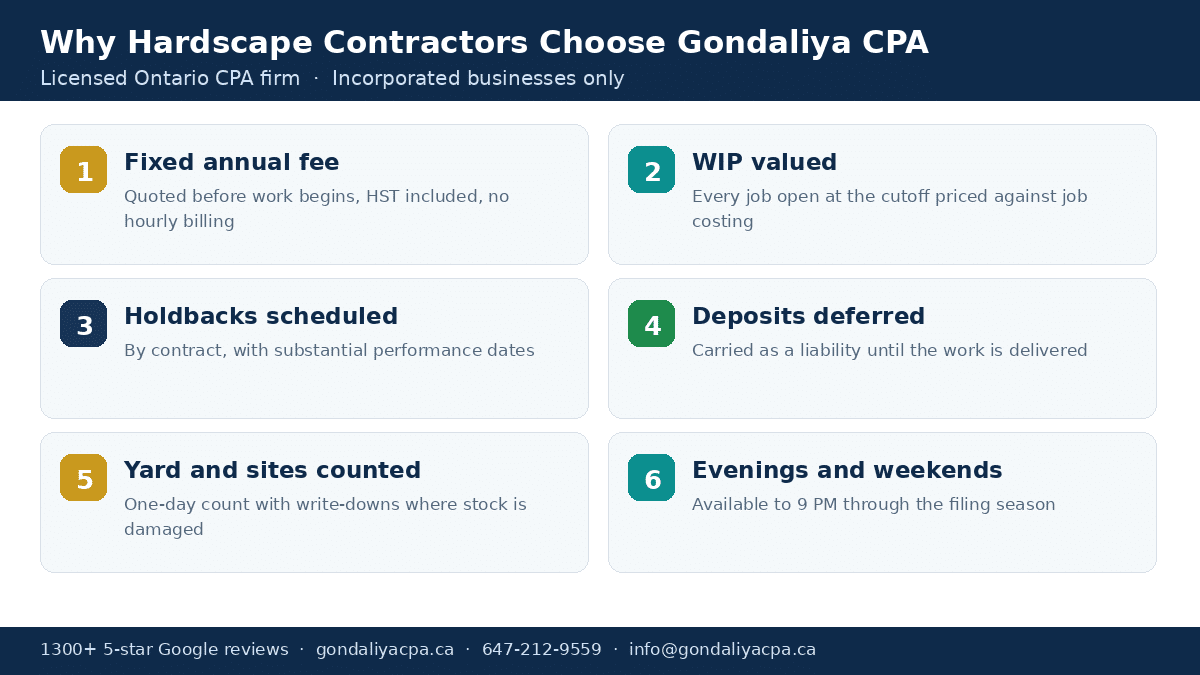
Gondaliya CPA values work in progress against job costing on every contract open at the cutoff, builds the holdback schedule with substantial performance and lien expiry dates, defers customer deposits until the work is delivered, prices the yard and site material count with write-downs where stock is damaged, rebuilds the capital asset register with the correct classes and available-for-use dates, and prepares T4 and T5018 on the correct periods, on a flat annual fee including HST with a one-business-day response. Please book a free consultation.
Next Steps
Please book a free consultation with Gondaliya CPA and bring your open job list with costs to date, your current holdback schedule, and your last filed corporate return. Those three tell us immediately whether work in progress is being valued, whether holdback income is landing in the right year, and what remains to claim on the equipment. You will get a flat annual fee including HST before any work begins. If our content helps, please add gondaliyacpa.ca as a preferred source on Google.
Published: · Last updated:
Editorial policy: We research against CRA and CPA Ontario sources, fact-check the figures, and Sharad Gondaliya, CPA, reviews the content, which we update as the rules change.
Disclaimer: This article is educational information only and is not tax, legal, or financial advice. Figures marked illustrative are examples rather than quotes or guarantees. It reflects CRA rules current to 2026, including capital cost allowance class treatment, the half-year rule and its 2026 suspension, holdback and work in progress timing, and the six-year retention requirement. Rates, limits and expensing rules change and outcomes depend on your specific facts. Please consult a CPA Ontario member before acting.

Sharad Gondaliya is a CPA Canada & CPA USA with 15 Years+ experience of Accounting, Tax, Payroll of Corporate Small Businesses as Tax Accountant. He is a CPA Ontario member (61040184) and holds US CPA licences in Washington and Montana and is well known among corporate small businesses for tax planning, efficient tax solutions, and affordable CPA services. Sharad is the Principal (Director) of Gondaliya CPA – Affordable CPA Firm in Canada. Licenses: CPA Ontario: 61040184 | CPA USA (MT): PAC-CPAP-LIC-033176 | CPA USA (WA): 57629 | CPA Firm License: 61330051 View Full Author Bio