



Tax Deductions for Lawn Care Businesses in Canada: What Business Owners Can Legally Claim
Lawn Care Business Tax Deductions and Expenses: A Gondaliya CPA Guide for Contractors and Companies
Lawn care business tax deductions are essential for reducing expenses and maximizing profits in this competitive industry. Gondaliya CPA highlights key lawn care contractor deductions and common business expenses that lawn care companies should track to benefit fully from available tax breaks.
Quick Summary
Lawn care deductions turn on three tests: is the cost a repair or an asset, is it business or personal, and is it documented. Get the capital cost allowance class right, keep a monthly mileage log, and keep the owner’s own property off the books, and most of the return follows.
Reading time: 41 minutes.
Table of Contents
- Business-Use-of-Home Expenses for Lawn Care Contractors
- Common Business Expenses and Tax Deductions for Lawn Care Companies
- Insurance, Licenses, and Professional Service Deductions for Lawn Care Businesses
- Vehicle and Transportation Expense Deductions: Standard Mileage vs. Actual Expenses
- Seasonal and Weather-Related Expenses Impacting Lawn Care Business Deductions
- Integrating Automated Expense Tracking and Financial Tools for Better Tax Management
- Summary of Essential Lawn Care Business Tax Deductions and Expense Tracking Tips
- Frequently Asked Questions (FAQs) on Lawn Care Business Tax Deductions
- Quick Reference: Key Terms and Concepts in Lawn Care Tax Deductions
- Professional Guidance and Quick Reference
The Numbers That Matter
This article covers Canada, with Ontario and Toronto context, and reflects rules current to 2026. It applies to incorporated lawn care businesses including mowing and maintenance route operators, fertiliser and weed control programmes, landscape installers and lawn care companies running a winter division. Figures marked illustrative are examples, not quotes, and any masked engagement notes end with “Figures changed for privacy.” This is educational information only and not tax or legal advice. Pesticide applicator licensing, municipal business licensing and WSIB classification sit with the relevant authority rather than with your accountant.
Business-Use-of-Home Expenses for Lawn Care Contractors
Business-Use-of-Home Expenses for Lawn Care Contractors
Home & Forms
Deducting Workspace and Storage Costs Related to Lawn Care Operations
If you’re a lawn care contractor, you can deduct some costs for using part of your home as a workspace or storage spot. But the space must be used only for your business. So, if you have a home office or a place to keep your equipment, you might be able to claim some expenses.
Here’s what you can usually deduct:
- Rent or Mortgage Interest: You can claim a portion based on how much space your work area takes compared to your whole home. If you rent, it’s easier to calculate. For homeowners, mortgage interest works the same way.
- Utilities: Electricity, heating, and other bills can be partly deducted. The share depends on how big your business area is.
- Internet and Phone: If these are needed for your lawn care work, you can claim a reasonable part of the bills.
To figure out these deductions:
- Measure the square footage of your business space.
- Divide that by your home’s total square footage.
- Use that percentage to find the deductible amount from bills like rent or utilities.
Keep good records! Save receipts and notes that show how you did these calculations.
A corporation does not claim business-use-of-home the way a sole proprietor does. The usual route is a written rent or reimbursement arrangement between the owner and the company, priced reasonably and supported by the same square footage calculation. Please set the agreement up before claiming.
Key Forms and Publications Relevant to Lawn Care Business Tax Deductions
When dealing with lawn care business taxes in Canada, some forms and rules matter a lot.
T2 Corporate Tax Return Filing Deadline
If your lawn care business is incorporated, you must file the T2 corporate tax return within six months after your fiscal year ends. Missing this deadline could mean penalties or interest on any unpaid tax.
The T2 return is due 6 months after the fiscal year end. The balance is due three months after year end for a CCPC claiming the small business deduction, and two months otherwise.
GST/HST Input Tax Credit Documentation
If you’re registered for GST/HST, keep all invoices that show taxes paid on business buys like equipment or supplies. These help when claiming input tax credits (ITCs). Without clear proof of GST/HST amounts paid, CRA may reject your claim during an audit.
Organize all paperwork well. Knowing which forms apply and filing on time helps avoid trouble and may save money with proper deductions allowed by CRA rules.
Common Business Expenses and Tax Deductions for Lawn Care Companies
Common Business Expenses and Tax Deductions for Lawn Care Companies
Common Expenses
Lawn care business expenses are the costs you pay to run your lawn care company. These costs can be tax deductions for lawn care companies if they are reasonable, directly linked to earning money, and you keep good records. Common deductible expenses include buying equipment, fuel, paying employees, advertising, insurance, supplies like fertilizer or grass seed, fixing machines, vehicle costs, subcontractor fees, and office stuff.
The Canada Revenue Agency (CRA) wants invoices or receipts that show when you paid and what you bought. You can’t claim the part used for personal stuff. For example, if you use a mower for your own yard sometimes, that part can’t be deducted.
Key Rules for Deductions:
- Expenses must help you make business income.
- Only claim the part used for business.
- Keep receipts or contracts to prove each expense.
- Claim expenses in the year you paid or recorded them.
A lot of incorporated lawn care businesses mess up by mixing personal yard work with business. Only expenses truly tied to your lawn care business count as deductions.
The owner’s own lawn done with company equipment on company fuel is the first thing an auditor asks about on a lawn care file. Keep it off the books or record it properly. Figures changed for privacy.
Equipment and Machinery: How to Deduct Mowers, Tools, and Heavy Equipment
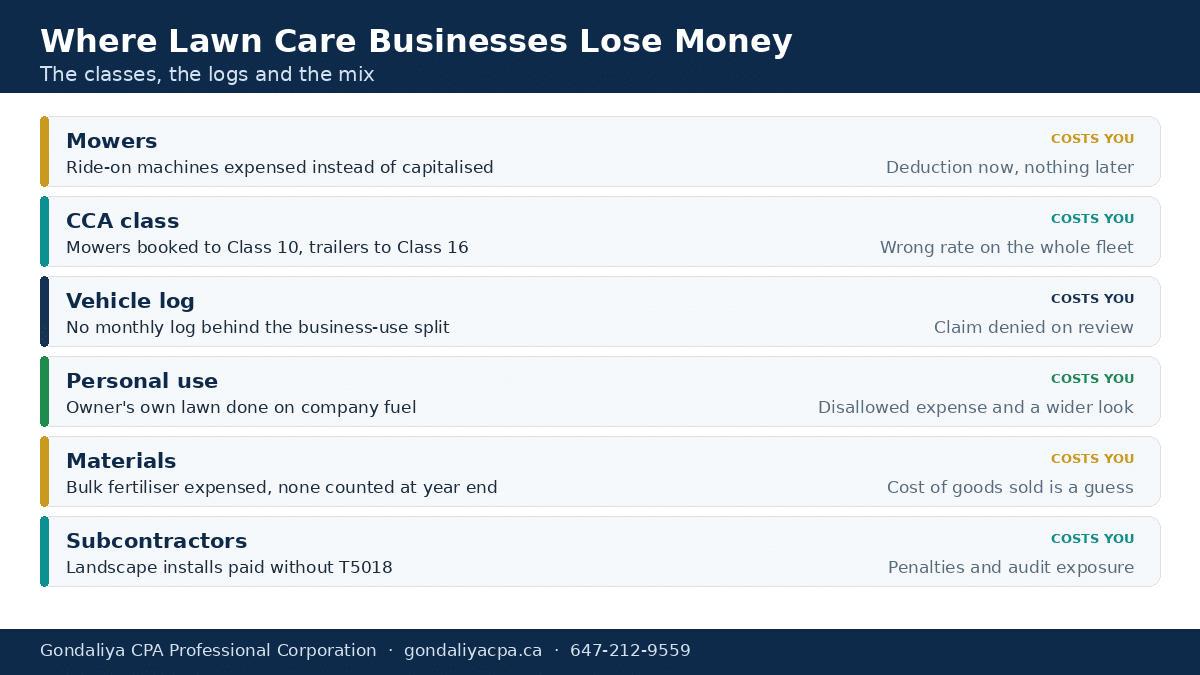
Lawn care contractor deductions usually include big buys like zero-turn mowers and heavy gear such as aerators or spreaders. CRA treats repairs differently from buying equipment. Repairs can be expensed right away. But equipment purchases are capital assets and get depreciated over time using Capital Cost Allowance (CCA).
How To Deduct Different Assets:
- Ride-on Mower: Use CCA Class 8. Half-year rule applies. Keep purchase invoice and usage logs.
- Small Hand Tools: Can be current expense or CCA Class 12 if under $500 per item. Save receipts.
- Engine Repairs: Expense now but only if they don’t extend how long the engine lasts. Keep repair bills.
- Replacement Blades: Deduct as current expense since they get replaced often. Keep invoices.
Class 12 covers small tools costing less than $500 each but more than $50 yearly total.
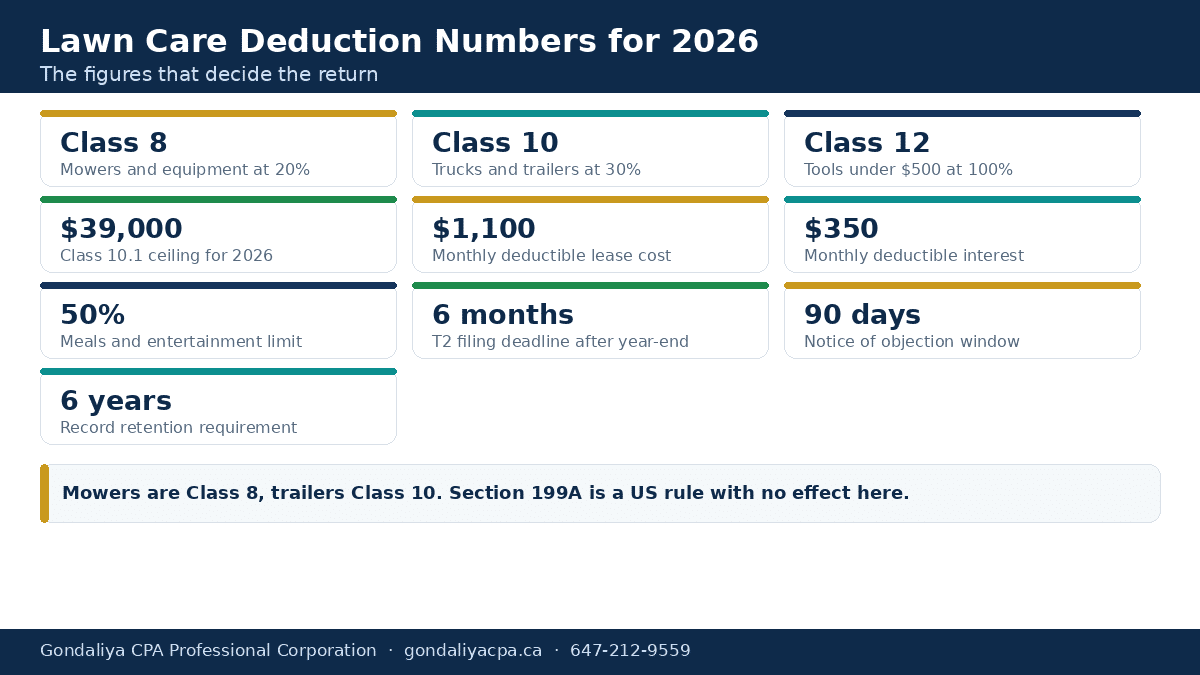
Class 12 covers tools costing less than $500 each and is claimed at 100%, with no annual $50 total. Ride-on mowers and powered equipment sit in Class 8 at 20%. Class 10 covers vehicles and trailers, and Class 16 covers taxis, rental vehicles and certain freight trucks rather than lawn equipment.
If you operate in Toronto or Ontario with many routes and machines, track hours well to allocate depreciation correctly. Starting 2026, some new equipment below certain amounts can be expensed fully instead of capitalized.
Methods to Write Off Lawn Care Equipment: Section 179 Equivalent Does Not Apply in Canada
Canada doesn’t have a Section 179 deduction like the U.S., nor bonus depreciation under MACRS. But starting 2026, there are new rules letting you expense some equipment fully right away.
Here’s what these new rules mean:
- New equipment under certain price limits can be fully deducted instead of spreading out depreciation.
- This applies to classes used by lawn care contractors like class 8 machinery with half-year adjustments.
You need to follow some rules:
- Buy assets after March 31st of the tax year.
- Keep proof of purchase date and cost.
If you’re incorporated in Ontario, check with your CPA about applying this right.
Bill C-15 received Royal Assent on 26 March 2026, reinstating the accelerated investment incentive. The test is that property was acquired after 2024 and is available for use before 2030. There is no rule requiring assets to be bought after 31 March of the tax year.
Fuel and Mileage Deductions for Lawn Care Routes
Fuel is a big part of lawn care business expenses since you drive a lot between clients. CRA lets you deduct fuel costs based only on business use proven by mileage logs.
Important Things About Fuel & Mileage Deductions:
- Figure business use by comparing total kilometers driven vs service calls.
- Keep a logbook with trip dates/purposes plus odometer readings for at least one continuous period yearly.
- Both fuel cards and receipts work if linked to your vehicle; split personal vs business charges if mixed.
- Vehicle repairs and maintenance also count based on the same logs.
Some people use CRA’s flat per-kilometre rate when exact tracking is hard but this is less common among incorporated businesses needing detailed records for multiple trucks in places like Toronto.
If you’d like help sorting out lawn care contractor deductions or figuring out what counts as repair versus equipment purchase costs call Gondaliya CPA at 647-212-9559 or email info@gondaliyacpa.ca for free advice on Ontario rules affecting your incorporated Toronto-area operation.
Insurance, Licenses, and Professional Service Deductions for Lawn Care Businesses
Insurance, Licenses, and Professional Service Deductions for Lawn Care Businesses
Insurance & Wages
When you run a lawn care business, you can deduct certain expenses like insurance premiums, licenses, and professional service fees. These costs must be needed to earn your income.
Insurance covers things like liability protection against damages or injuries. You can also deduct equipment insurance for mowers and tools. Vehicle insurance for trucks used in the business counts too. Workers’ compensation premiums apply if you have employees. Only the part related to business use is deductible—personal coverage doesn’t count.
Licenses are another expense. Fees paid for pesticide permits or other required approvals can be deducted. Keep copies of these licenses and receipts to prove you paid for business reasons.
Professional services like accountants who help with tax filing or lawyers giving advice about contracts are deductible too. Make sure invoices say what services were provided. Personal legal fees don’t qualify.
Here’s a quick look at common expenses:
- Liability and equipment insurance: Deduct only the business-use portion.
- Vehicle insurance: Deduct based on how much the vehicle is used for work.
- Licensing fees: Fully deductible if they’re for required business permits.
- Accounting and legal fees: Deduct only if they relate to your lawn care operations.
Keep good records like receipts, licenses, and invoices. The CRA expects proof that these costs help run your lawn care company.
Pesticide applicator licensing sits with the provincial regulator, not with the CRA. The fee is deductible, but the licence itself has to be current before the work is done.
Employee Wages and Subcontractor Payments: Deductibility and Compliance
You can deduct wages you pay to employees doing lawn care work as long as you keep proper payroll records and issue T4 slips.
Payments to subcontractors need more attention. If subcontractors handle landscaping installations or other construction-type jobs, these payments must be reported on T5018 forms. Not reporting risks penalties.
For simpler jobs like mowing or applying fertilizer, subcontractor payments still need written agreements but don’t require T5018 reports. You do need invoices.
If you hire family members, pay them fairly for actual work done. The CRA checks that wages are reasonable; paying too much may cause trouble.
Remember to include employer contributions such as CPP or QPP premiums, EI premiums when needed, and vacation pay in your wage deductions. Also, safety gear provided only for employees counts as a deductible cost under wages.
To keep everything legit:
- Use signed employment contracts.
- Provide T4 or T4A slips as required.
- Track hours worked carefully.
- Avoid paying workers in cash without documentation.
For example: A mower operator in Toronto pays seasonal student crews $15/hour with timesheets and statutory deductions recorded properly. These wages fully qualify as deductions under Canadian lawn care tax rules.
Seasonal student crews paid in cash without timesheets is the pattern that turns a routine review into a payroll assessment. Slips and hours, every time. Figures changed for privacy.
Home Office Deduction Eligibility and Calculation Methods for Lawn Care Contractors
You may claim home office expenses if part of your home is used regularly and only for work purposes:
- Your main place of business
- A spot where you meet clients often
- A space used solely for admin tasks related to your incorporated lawn care company
You can deduct a share of utilities like electricity or heating, internet bills proportionate to business use, and property taxes based on how much space you use exclusively.
Garage or yard space used mainly to store tools might count partially but needs clear separation from personal areas. Shared spaces reduce how much you can claim.
There are two ways CRA lets you calculate this deduction:
- Simplified method: A flat rate per square foot up to a max area.
- Detailed method: Actual expenses multiplied by the percentage of your home used just for work. You’ll need floor plans and logs showing exclusive use.
Keep these records handy:
- Floor plans showing workspace size compared to total home
- Utility bills split between personal and business use
- Proof that the area is used only for work
Claiming shared living spaces incorrectly often leads to denied deductions during audits with possible extra charges.
The flat rate per square foot described here is a United States rule. Canada has no square-footage simplified method for a business. The temporary flat rate method that existed in Canada applied to employees only and has ended.
Software and Technology Expenses Commonly Deducted in Lawn Care Businesses
Costs for software that helps manage routes, schedule jobs, invoice customers, or handle other business tasks usually count as deductible expenses when split properly between personal and business use.
Examples include GPS tracking apps that improve route efficiency, booking systems, CRM software, online ads, website hosting fees, domain registration costs, digital marketing tools, plus phone plans used mostly for client contact and billing.
How these costs get deducted depends on ownership:
- Purchased software usually becomes a capital asset that you depreciate over time using Capital Cost Allowance (CCA) rules.
- Subscription services paid yearly are expensed immediately unless prepaid over several years; then they get amortized over that period.
Phone bills should show which calls or data were strictly for customers versus personal use. Keep itemized statements plus usage logs that prove your claimed percentage each year to avoid disputes.
Here’s a simple table showing how some tech costs get treated:
| Cost Type | Treatment |
|---|---|
| Subscription software | Expense yearly with invoices as proof. |
| Purchased software | Capital asset with CCA applied; keep purchase records. |
| Phone plans | Split cost by call logs; keep bills plus usage logs. |
Good records help you claim the right amounts while staying within CRA rules — especially important if you operate an incorporated lawn care company anywhere in Ontario or nearby Toronto suburbs.
Vehicle and Transportation Expense Deductions: Standard Mileage vs. Actual Expenses
Vehicle and Transportation Expense Deductions: Standard Mileage vs. Actual Expenses
Vehicles & Materials
If you run a lawn care business, you can deduct vehicle expenses two ways: the standard mileage or actual expense method. Each works differently depending on your situation. Incorporated lawn care companies must keep good records to meet CRA rules.
The standard mileage rate lets you claim a set amount per kilometre driven for work. It’s easier since you don’t need to track every bill. This rate changes every year and covers fuel, repairs, insurance, and vehicle wear.
The actual expense method means tracking all costs—fuel, fixes, insurance, lease or capital cost allowance (CCA) for owned vehicles. You then figure out how much is for business by comparing business kilometres to total kilometres.
For lawn care contractors using passenger vehicles like cars or SUVs, remember there’s a passenger vehicle cost limit. This limits how much CCA you can claim. Work trucks usually aren’t capped but still need proof of use.
You should always keep a detailed logbook with dates, destinations, purpose of trips, and odometer readings. Without this, the CRA might reject your claims.
A mower in Toronto drives 20,000 km yearly but only 15,000 km for work (75%). Using the standard rate at $0.68/km means a $10,200 deduction without extra receipts. The actual expense method might total $18,000 in costs; after applying 75%, that’s $13,500 deductible if well documented.
A corporation does not choose between a per-kilometre rate and actual costs. The per-kilometre rate is a tax-free allowance an employer pays an employee who uses a personal vehicle. A company that owns the vehicle deducts actual costs. Please confirm the current-year rate before using any figure.
Materials and Supplies: Deducting Landscaping Materials, Chemicals, and Operational Supplies
Lawn care businesses can write off costs for things like fertilizer; grass seed; herbicides; pesticides; sod; topsoil; mulch; and other needed supplies.
Only stuff used directly for business counts as deductible lawn care business expenses under tax law section 18(1)(a). Personal use or products kept too long without selling should be handled as inventory instead of immediate deductions.
Here’s how to manage inventory for these deductions:
- Do a physical count at year-end to find closing inventory.
- Write down spoiled or expired stock with proof.
- Split bulk buys into current use versus future periods.
Keep invoices showing product type and quantity. Usage logs help too when you can track consumption.
| Material Type | Treatment | Limit/Condition | Record Required | Source |
|---|---|---|---|---|
| Fertilizer | Current Expense | Must be reasonable | Supplier invoice | CRA ITA s18(1)(a) |
| Grass Seed | Current Expense | Inventory rules apply | Receipt + count | CRA ITA s18(1)(a) |
| Herbicides/Pesticides | Current Expense | Follow licensing rules | Purchase + license copy | Provincial Regulator |
| Sod | Cost of Goods Sold | Track as inventory | Invoice + stock count | CRA ITA s18 |
Marketing and Business Development Expenses Including Digital and Traditional Approaches
Lawn care companies can deduct money spent on marketing to get customers in places like Toronto or Mississauga.
You can write off:
- Lawn signs at customer locations
- Truck decals showing your logo
- Flyers handed out door-to-door
- Social media ads
- Website hosting and booking tools
- Referral bonuses for clients who send others
Advertising must directly promote your incorporated lawn care services—not personal stuff. Always save receipts that show who you paid and what service they gave.
If you buy meals while meeting clients, only half the cost is usually deductible unless law says otherwise.
Meals and entertainment are limited to 50%. Advertising must be aimed at a Canadian market to be fully deductible, and lawn signs, truck decals and flyers all qualify.
Education and Professional Development Deductions for Certifications and Training
Incorporated lawn care businesses can deduct training costs that keep skills sharp or improve them. That includes courses like pesticide applicator certifications approved by provinces, safety workshops required by workplace rules, or bookkeeping classes specific to groundskeeping offered by CPAs.
You can also deduct licensing fees linked strictly to your work—not general memberships unrelated to your job.
Wages paid while employees attend training count under wage crew subcontractor costs if recorded correctly on T4 slips showing training hours only.
Keep course bills describing the content plus payment proof along with payroll records showing when workers attended.
Seasonal and Weather-Related Expenses Impacting Lawn Care Business Deductions
Seasonal and Weather-Related Expenses Impacting Lawn Care Business Deductions
Seasonal & Structure
Weather and seasons change how much you spend on lawn care. These changes affect the tax deductions your business can claim. If you spend money on seasonal jobs—like snow removal in winter or extra fertilizer in spring—you can deduct those costs. But you need to keep proof that these expenses relate to your work.
For example, buying salt or sand for winter snow clearing counts as a deductible expense if your company offers that service. Extra fuel used because of bad weather also counts toward vehicle expense deductions.
Repairs to equipment damaged by rough weather also qualify as deductible business expenses. But be careful not to include any personal use costs.
You must keep good records that show how these seasonal expenses link to your jobs. This makes it easier when CRA checks your claims.
Here’s what to keep:
- Invoices showing dates and what was bought
- Mileage logs proving extra driving
- Contracts listing seasonal services you provide
A mowing company that adds winter plowing is running two seasons through one ledger. Splitting the revenue and the costs by season is what makes either one readable. Figures changed for privacy.
Strategies to Maximize Tax Savings Including Section 199A Qualified Business Income Deduction
Lawn care contractors can save more taxes by using all possible deductions and the Section 199A Qualified Business Income (QBI) deduction. This rule lets certain Canadian-controlled private corporations deduct up to 20% of their qualified income after claiming proper lawn care contractor deductions.
Section 199A is a United States provision and has no application in Canada. There is no 20% qualified business income deduction here. The Canadian equivalent benefit is the small business deduction, which gives a reduced federal rate of 9% on active business income up to a $500,000 business limit shared across associated corporations. Please disregard the QBI framing entirely.
To get the most from this, plan carefully. Make sure you claim all valid lawn care business tax deductions without mixing personal expenses.
Common deductible items include:
- Employee wages
- Fees paid to subcontractors with correct T5018 forms
- Advertising costs tied directly to getting clients
- Capital cost allowance (CCA) on qualifying equipment
It’s important to separate current expenses from capital expenses. That affects when you take deductions and influences your QBI calculation.
Talking with a CPA who knows Ontario rules is smart. They can help you follow new rules about immediate expensing through 2026.
Keep these records:
- Financial statements that separate different income sources
- Payroll slips for employees
- Invoices for subcontractor payments
- Asset lists for CCA claims
Optimizing Business Structure and Retirement Contributions to Enhance Tax Benefits
Your business setup changes how expenses affect taxes. Incorporated companies pay less tax on active business income than sole proprietors or partnerships. They also can defer taxes by keeping earnings in the company.
Making retirement contributions through plans like Individual Pension Plans (IPPs) or Group RRSPs lowers taxable income while helping owners save for retirement. These contributions count as employee wages if paid properly in incorporated companies.
Mixing salary and dividends matters too. Salaries are deductible but come with payroll taxes like CPP premiums. Dividends don’t lower company taxes but might be better for cash flow after tax.
This mix is important for lawn care businesses because income goes up and down during the year, especially in places like Toronto or other parts of Ontario.
An Individual Pension Plan is funded on salary, so the salary has to come first. A dividend-only owner has no earned income to base the plan on.
Don’t forget these records:
- Corporate decisions approving pension plans
- Payroll records showing retirement payments
- Plan documents meeting provincial rules
Building Effective Documentation and Audit Protection Practices for Lawn Care Businesses
Good documentation helps prove your lawn care business tax deductions are real and protects you if CRA audits you.
Keep original invoices showing purchase dates linked clearly to when you did the work. For example, fertilizer invoices should match customer jobs during that time.
Vehicle logs need odometer readings at trip start and end plus why you drove those miles. Keep them updated every month.
Payroll must produce T4 slips on time reflecting actual hours worked by employees—even family members—and pass reasonableness tests so wages are not too high without real work done.
Subcontractors should send accurate invoices supported by T5018 forms when construction work applies per tax rules.
Using digital tools with receipt capture makes it easier to stay ready if audited and meet record retention rules of six years after filing.
Here’s what documentation to keep:
- Original receipts/invoices sorted by date
- Digital mileage logs updated monthly
- Signed employment contracts matching pay periods reported with T4 or T5018 slips
For advice on maximizing your lawn care contractor deductions, contact Gondaliya CPA at 647-212-9559 or info@gondaliyacpa.ca for a free consultation focused on Toronto/Ontario incorporated businesses serving clients nationwide.
Records are retained six years from the end of the last tax year they relate to, electronic records included, and an objection must be filed within 90 days of the date on the notice.
Integrating Automated Expense Tracking and Financial Tools for Better Tax Management
Integrating Automated Expense Tracking and Financial Tools for Better Tax Management
Tools & Tracking
Automated expense tracking makes it easier to manage lawn care business expenses. It helps keep accurate records needed for tax deductions. Financial tools built for lawn care companies catch deductible costs like equipment repairs and fuel.
These tools save time by syncing receipts, invoices, and payments straight into accounting software. For Canadian incorporated lawn care businesses, cloud accounting platforms link with bank feeds to sort expenses automatically. This covers things like fertilizer costs or subcontractor payments.
Automation also helps meet CRA rules while getting the most from tax deductions for lawn care contractors. Keeping digital records lets businesses claim capital cost allowance (CCA) on assets such as mowers and trucks easily. These records store purchase dates and values without fuss.
Businesses see their finances in real time. That helps decide when to expense equipment right away or spread costs under 2026 rules.
Here’s an example: A company in Toronto that runs multiple crews uses automated tools to track grass seed expenses apart from fuel taxes. This clear split avoids mistakes during corporate tax filing without manual work.
Contractor Management Best Practices to Simplify Labour Reporting and Reduce Errors
Tracking wage crew subcontractor costs needs careful record keeping. It ensures you claim valid lawn care business tax deductions. Mixing up employees with subcontractors causes penalties under Canadian payroll laws.
Incorporated lawn care firms should get signed contracts explaining work done by subcontractors. They also need T4A slips when required. Keeping detailed invoices supports claims and meets CRA’s test on labor expenses.
Good contractor management means tracking hours, payments, and issued slips in one place. Payroll software works well with bookkeeping systems. This cuts mistakes when reporting wages versus subcontractor fees.
Also, landscaping tied to construction may need T5018 reporting.
Thinking about claiming deductions yourself or using help? Here’s a quick look:
- DIY: Risk of errors; might miss filings; cheaper upfront.
- CPA Firm: Accurate; follows all rules; finds more deductions; costs more.
- Non-CPA Provider: Quality varies; less reliable; lower cost but riskier.
Most find a CPA Ontario member firm worth it because it lowers audit chances around wage crew subcontractor costs.
Leveraging Real-Time Tax Insights to Identify Additional Deduction Opportunities
Watching your finances in real time helps spot missed chances inside lawn care business expenses. These can boost year-end tax positions without breaking CRA rules.
Here’s what works well:
- Capture daily job expenses with mobile apps linked to accounting.
- Check inventory monthly against fertilizer or herbicide use.
- Keep strict vehicle mileage logs.
- Review insurance premiums for possible write-offs.
CRA often checks businesses when materials bought don’t match revenue or cash jobs lack documents. Early tech alerts catch these problems fast.
Before a deduction review starts, get these ready:
- Past T2 returns and notices.
- Supplier invoices sorted by type.
- Detailed mileage logs.
- Up-to-date inventory sheets showing spoilage losses.
- Payroll records including reasonable family wages paid.
These steps make reviews smoother at firms like Gondaliya CPA serving Ontario companies around Toronto.
The clients who never get a query are the ones with a separate business bank account, a mileage log kept monthly, and a year-end inventory count. Nothing clever, just consistent. Figures changed for privacy.
Summary of Essential Lawn Care Business Tax Deductions and Expense Tracking Tips
Summary of Essential Lawn Care Business Tax Deductions and Expense Tracking Tips
The Summary
Tax deductions for lawn care companies depend on careful tracking following Canadian laws about business expenses. Important categories include:
- Equipment repairs
- Commercial vehicle costs within limits
- Employee wages with proper T4 slips
- Advertising tied to promotions
- Input tax credits backed by GST/HST docs
Gondaliya CPA reviews these carefully using capital asset registers covering CCA classes:
- Class 10 for zero-turn mowers
- Class 12 for small tools
- Class 16 for trailers
They also track maintenance per machine. Inventory checks ensure fertilizer expenses match sales cycles so expired stock isn’t overstated.
The class list here conflicts with the correct list given earlier in this article. Ride-on and zero-turn mowers are Class 8 at 20%, not Class 10. Trailers are Class 10 at 30%, not Class 16. Please use the earlier list.
Combining automated financial tools with expert checks during yearly filings gives owners confidence their claims hold up under scrutiny. It also helps manage cash flow across the year.
You can contact info@gondaliyacpa.ca or call 647-212-9559 for advice tailored to Ontario-incorporated lawn care operators working in Toronto and beyond.
Put mowers and powered equipment in Class 8, tools under $500 in Class 12, and trailers and trucks in Class 10. Keep a monthly mileage log. Split personal yard work out entirely. Count fertiliser and seed at year end. File T5018 where the work is construction. Please keep six years of records.
Frequently Asked Questions (FAQs) on Lawn Care Business Tax Deductions
Frequently Asked Questions (FAQs) on Lawn Care Business Tax Deductions
FAQ
What makes an expense deductible for a lawn care business?+
An expense must be reasonable, directly related to earning business income, and properly documented to qualify as deductible.
How do you decide between current expense or capital cost for equipment?+
Repairs are current expenses; purchases of assets like mowers are capital costs and depreciated over time using CCA.
Which mowers and equipment qualify for Capital Cost Allowance?+
Ride-on mowers fall under Class 8, small tools under Class 12, and trailers under Class 16 for CCA purposes.
How do you deduct trucks, trailers, and vehicle costs?+
Track actual expenses or use mileage logs; apply passenger vehicle limits where relevant; keep detailed records.
Which materials and consumables can you claim as expenses?+
Fertilizer, grass seed, herbicides, pesticides, sod, topsoil, and mulch used in your business are deductible.
How is materials and product inventory treated for tax purposes?+
Inventory must be tracked with physical counts at year-end; unused or expired stock should be adjusted accordingly.
What happens when you sell or trade equipment used in the business?+
You report any gain or loss on the sale; adjust your CCA claims accordingly to reflect disposal.
How do you claim input tax credits on equipment, fuel, and materials?+
Keep GST/HST invoices showing tax paid; claim ITCs proportional to business use of purchases.
Which costs are not deductible for lawn care businesses?+
Personal expenses, fines or penalties, personal portion of vehicle use, and costs unrelated to the business are not deductible.
What triggers a CRA review of a lawn care business?+
Inconsistent records, excessive expenses compared to income, missing invoices, or mixing personal with business costs may prompt a review.
What are the best practices to capture every deduction?+
Keep organized receipts, maintain mileage logs, separate personal from business use clearly, and use accounting software regularly.
Eleven questions and one underneath most of them: repair or asset. Get that call right and the rest of the return is bookkeeping. Figures changed for privacy.
Choosing Your Deduction Review Path: DIY vs CPA vs Non-CPA Provider
- DIY saves money but risks errors or missed deductions.
- CPA firms provide accuracy and full compliance with CRA rules.
- Non-CPA providers may offer lower cost but less expertise.
- Gondaliya CPA recommends licensed professionals for reliable filing.
Gondaliya CPA Deduction Review Services: What We Offer
- Thorough review of all possible lawn care deductions.
- Identification of missed claims on equipment and labor.
- Customized advice based on Ontario tax rules.
- Clear deliverables including financial reports and filing support.
- Contact us for tailored support that maximizes savings.
How Much Does a Deduction Review Cost in Canada?
Costs vary by complexity but expect competitive pricing for small to mid-sized lawn care firms. Gondaliya CPA offers transparent fees with value-focused service plans.
Top Deduction Mistakes Lawn Care Businesses Make
- Mixing personal and business expenses.
- Poor mileage log documentation.
- Claiming non-deductible items like fines.
- Not tracking inventory accurately.
- Avoid these by following professional guidance from Gondaliya CPA.
Preparing For Your Lawn Care Business Deduction Review
Gather these before your review:
- Receipts and invoices sorted by category.
- Vehicle mileage logs covering work trips.
- Payroll records including T4 slips if applicable.
- Inventory lists with physical counts.
- Proper prep speeds up the review process.
Which Deductions Matter Most Across Lawn Care Segments?
Equipment depreciation, fuel costs, wages, advertising expenses, materials used onsite, insurance premiums – all impact tax savings significantly across different services like mowing or landscaping.
A Realistic Numeric Walkthrough Example
A company buys a $25k mower (Class 8). Using half-year rule applies first year depreciation at 15%. Fuel costs $5k with 80% business use deducted as $4k fuel expense.
A Class 8 asset at 20% subject to the half-year rule gives 10% in the first year, not 15%. On a $25,000 mower that is $2,500 rather than $3,750, before the reinstated investment incentive is applied.
How To Choose The Right CPA Firm In Toronto/Ontario For A Lawn Care Business?
Look for experience in lawn care taxes, transparent fees, personalized service focus on incorporated businesses in Toronto/Ontario regions like Gondaliya CPA offers specialized support.
Why Trust Gondaliya CPA For Your Lawn Care Business?
We combine industry expertise with deep Canadian tax knowledge focused on lawn care contractors. Our proven processes ensure compliance while maximizing deductions tailored to your operations.
Quick Reference: Key Terms and Concepts in Lawn Care Tax Deductions
Quick Reference: Key Terms and Concepts in Lawn Care Tax Deductions
Quick Reference
- Capital Cost Allowance Classes: Categories for asset depreciation (e.g., Class 8 for mowers).
- Half-Year Rule Fraction: Limits depreciation claimed in the first year of asset purchase.
- Per-Kilometre Allowance Rate: CRA’s set rate per km driven for work purposes (updated yearly).
- Meals and Entertainment Deduction Limit: Usually capped at 50% of cost incurred during business activities.
- Records Retention Period: Minimum six years after filing tax returns recommended by CRA.
These help guide accurate filings and audit readiness.
Summary Bullet Points on Remaining Important Topics
- Who This Is For / Not For: Incorporated lawn care companies needing structured tax strategies benefit most; sole proprietors may have simpler rules.
- Claiming Input Tax Credits: Requires clear GST/HST receipts tied directly to eligible purchases with proper bookkeeping evidence.
- Current Expense vs Capital Cost Test: Repairs are immediate expenses; acquisitions become capital assets with gradual write-off through CCA schedules.
- Automated Financial Tools: Use cloud accounting software synced with bank feeds to categorize expenses effortlessly and prepare reports quickly.
- Best Practices To Avoid CRA Audits: Keep separate bank accounts; document all trips fully; regularly reconcile payroll details including subcontractor forms where required; maintain digital backup copies of invoices.
For personalized advice or assistance in optimizing your lawn care business tax deductions contact Gondaliya CPA today at info@gondaliyacpa.ca or 647-212-9559.
Professional Guidance and Quick Reference
Guidance
Who This Is For
- For: Incorporated lawn care businesses across Canada, including mowing and maintenance route operators, fertiliser and weed control programmes, landscape installers and companies running a winter division.
- Also for: Operators buying their first ride-on mower or truck, operators several years behind on filings, and owners preparing statements for a lender.
- Not for: Unincorporated sole proprietors and partnerships, whose filing obligations run through a personal return rather than a T2.
- Not for: Pesticide applicator licensing, municipal business licensing and WSIB classification, which sit with the relevant authority.
- Not for: Contract drafting and customer disputes, which are legal questions for counsel.
People Also Ask
How much does accounting cost for a lawn care business in Canada?+
Our fee is fixed, quoted annually and includes HST. It is set before work begins based on transaction volume, crew size, number of vehicles, and whether the company runs a winter division as well.
Do I need a CPA or is a bookkeeper enough?+
A bookkeeper maintains the ledger. A CPA firm is required for compilation financial statements a lender will accept, the current expense against capital cost decisions, and representation on a CRA review.
Is Section 199A available to a Canadian company?+
No. Section 199A is a United States provision. The Canadian benefit is the small business deduction, a reduced federal rate of 9% on active business income up to a $500,000 business limit.
Glossary of Key Terms
- T2 Return: The corporation income tax return filed annually by an incorporated business.
- Current Expense: A cost deducted in full in the year it is incurred, such as a repair.
- Capital Cost: The cost of an asset written off over time through capital cost allowance.
- CCA (Capital Cost Allowance): The tax depreciation claimed on capital assets.
- Half-Year Rule: The rule limiting first-year capital cost allowance to half the normal amount.
- Accelerated Investment Incentive: The enhanced first-year deduction reinstated by Bill C-15 in 2026.
- Available for Use: The point at which an asset can first earn capital cost allowance.
- Class 8: The 20 percent class covering mowers, aerators, spreaders and shop equipment.
- Class 10: The 30 percent class covering trucks and trailers.
- Class 10.1: A separate class opened for each passenger vehicle above the prescribed cost ceiling.
- Class 12: The 100 percent class covering tools costing less than $500 each.
- Recapture: Income added back when an asset is sold above its undepreciated capital cost.
- ITC (Input Tax Credit): The GST/HST recovered on business purchases supported by a supplier invoice.
- SBD (Small Business Deduction): The reduced federal rate on active business income up to the $500,000 business limit.
- Reasonableness: The requirement in section 67 that an expense be reasonable in the circumstances.
- T4: The slip reporting employment income, due by the last day of February.
- T4A: The slip reporting certain other amounts, including some contractor payments.
- T5018: The contract payment information return for construction activity.
- IPP: An Individual Pension Plan, funded on salary rather than dividends.
Lawn Care Deduction Readiness Check
This quick self-check indicates where your claims most likely need work. Please answer the six questions below.
Lawn Care Deduction Readiness Check
Six quick questions on your company. No fee shown.
Points to raise with us:
This is a general prompt, not tax or legal advice or a quote. Your position depends on your full facts. For a real review, please book a free consultation.
Want a checklist to work from? You can download our free lawn care deduction checklist before your consultation.
This article reflects rules current to 2026. The Class 8 rate of 20%, the Class 10 rate of 30%, the Class 12 threshold of $500 at 100%, the 50% meals and entertainment limitation, the six-month T2 filing deadline, the last-day-of-February T4 deadline, the objection window of 90 days and the six-year retention requirement are unchanged. The Class 10.1 ceiling rose to $39,000 before tax for 2026, with deductible lease cost at $1,100 per month and interest at $350 per month. Bill C-15 received Royal Assent on 26 March 2026, reinstating the accelerated investment incentive. Please note that Section 199A and the qualified business income deduction are United States provisions with no application in Canada, that there is no square-footage simplified home office method for a business here, and that mowers are Class 8 rather than Class 10 with trailers in Class 10 rather than Class 16.
Lawn Care Business Tax Deductions Canada: How Gondaliya CPA Supports Operators
Start with the asset list and the mileage log
Gondaliya CPA sorts every purchase into repair or capital, allocates mowers and equipment to Class 8, tools under $500 to Class 12 and trucks and trailers to Class 10, applies the reinstated investment incentive where it fits, tests the vehicle log against the passenger vehicle ceiling, separates personal yard work from business, counts fertiliser and seed at year end, and prepares T4, T4A and T5018 on the correct periods, on a flat annual fee including HST with a one-business-day response. Please book a free consultation.
Next Steps
Please book a free consultation with Gondaliya CPA and bring your equipment purchase invoices, your vehicle log, and your last filed corporate return. Those three tell us immediately whether the classes are right, whether the vehicle claim will hold, and what remains to claim. You will get a flat annual fee including HST before any work begins. If our content helps, please add gondaliyacpa.ca as a preferred source on Google.
Published: · Last updated:
Editorial policy: We research against CRA and CPA Ontario sources, fact-check the figures, and Sharad Gondaliya, CPA, reviews the content, which we update as the rules change.
Disclaimer: This article is educational information only and is not tax, legal, or financial advice. Figures marked illustrative are examples rather than quotes or guarantees. It reflects CRA rules current to 2026, including capital cost allowance class treatment, the half-year rule and its 2026 suspension, the 50% meals and entertainment limitation, and the six-year retention requirement. Rates, limits and expensing rules change and outcomes depend on your specific facts. Please consult a CPA Ontario member before acting.

Sharad Gondaliya is a CPA Canada & CPA USA with 15 Years+ experience of Accounting, Tax, Payroll of Corporate Small Businesses as Tax Accountant. He is a CPA Ontario member (61040184) and holds US CPA licences in Washington and Montana and is well known among corporate small businesses for tax planning, efficient tax solutions, and affordable CPA services. Sharad is the Principal (Director) of Gondaliya CPA – Affordable CPA Firm in Canada. Licenses: CPA Ontario: 61040184 | CPA USA (MT): PAC-CPAP-LIC-033176 | CPA USA (WA): 57629 | CPA Firm License: 61330051 View Full Author Bio