



How Corporate Tax Cleanup Can Recover Missed Business Tax Deductions
Corporate Tax Cleanup in Canada: What You Can Still Recover, and By When
Business tax deductions in Canada can be recovered through corporate tax cleanup and a careful review of past filings. Gondaliya CPA reviews prior years, identifies what was missed, and files the adjustments while the window is still open.
The word doing the work in that sentence is “window”. Most guidance on this topic explains what to look for and never mentions how long you have, which is the only thing that determines whether looking is worth anything.
Quick Summary
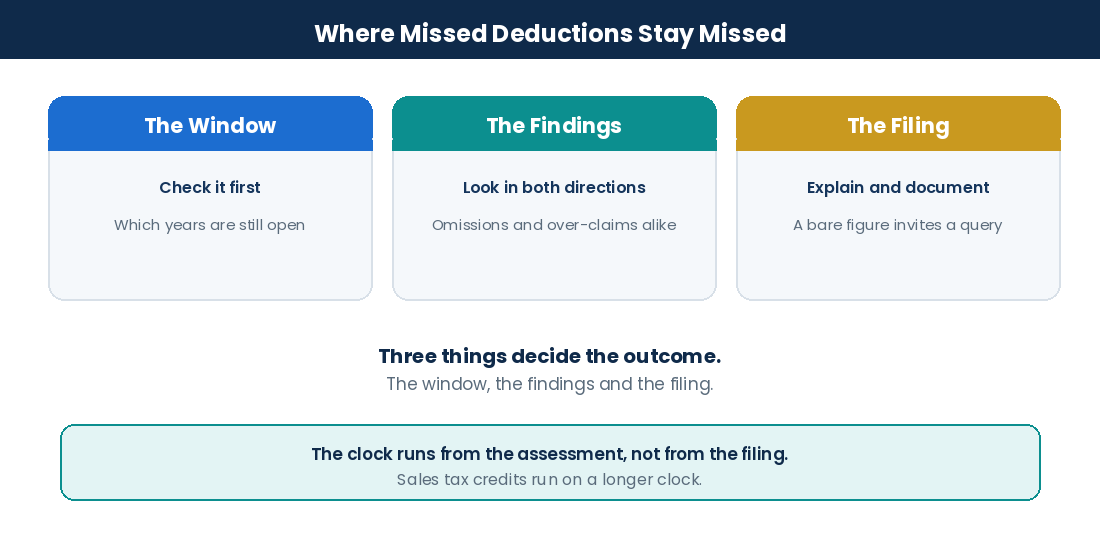
A corporation can generally adjust a return within its normal reassessment period, usually three years from the notice of assessment. Sales tax credits run on a separate and longer clock. Once the corporate window closes, the deduction is gone, because the extended relief available to individuals does not apply to corporations.
Reading time: 52 minutes.
Table of Contents
The Numbers That Matter
This article covers Canada, with Ontario and Toronto context, and reflects rules current to 2026. It is written for incorporated Canadian small businesses. Figures marked illustrative are examples, not quotes, and any masked engagement notes end with “Figures changed for privacy.” This is educational information only and not tax or legal advice. What a cleanup recovers depends entirely on your own figures, so no article can tell you what yours is worth.
The Window Is the Whole Story
The Window Is the Whole Story
The Deadline
What Most Guidance Leaves Out
Articles on recovering missed deductions describe what to look for at length and rarely mention how long you have to act. That omission matters more than everything else they cover.
A deduction identified inside the window is money. The same deduction identified a month after it closes is a piece of information with no cash value at all, and no process exists to change that for a corporation.
The Corporate Disadvantage
Individuals get a second chance. Where an individual missed a deduction beyond the normal reassessment period, taxpayer relief can allow a refund going back up to ten years.
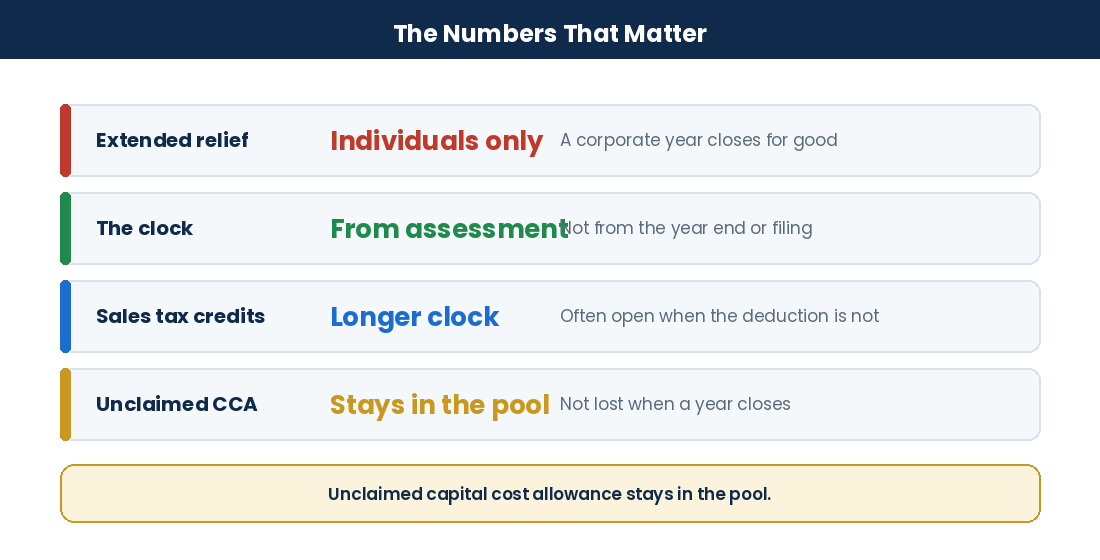
That relief does not extend to corporations. A corporation and its shareholders sit outside it. Once the normal reassessment period closes on a corporate year, an unclaimed deduction in that year is permanently unrecoverable.
| Taxpayer | Beyond the Normal Period |
|---|---|
| Individual | Relief may allow a refund up to ten years back |
| Graduated rate estate | Same relief available |
| Corporation | No equivalent relief. The window closes and stays closed |
This is the single most consequential fact in the subject and it appears in almost none of the guidance written about it. It is why a cleanup that has been postponed for a year is not the same cleanup, and why “we will look at it after this year end” quietly costs money.
What Runs the Clock
The normal reassessment period runs from the date of the original notice of assessment for the year, not from the year end and not from the filing date. Two corporations with the same year end can have different deadlines because their returns were assessed months apart.
- Find the original notice of assessment for each year you want to review
- Note its date, because that is what the clock runs from
- Work out which years are still open before doing any other work
- Prioritise the year closing soonest, not the year with the largest suspected error
- A reassessment does not restart the clock on the original assessment
The fourth point changes how a cleanup is sequenced. Working chronologically feels natural and is often wrong, because the oldest open year is the one about to disappear.
Owners ask what a cleanup will find. The better first question is which years are still open, because that decides whether finding anything matters. Figures changed for privacy.
Risk Warning: The extended taxpayer relief that lets individuals recover refunds up to ten years back does not apply to corporations. Please do not assume an old year can be reopened.
What Actually Gets Missed
What Actually Gets Missed
The Findings
The Real List
Cleanup findings cluster in a predictable set of places. This is what turns up repeatedly, rather than the generic list of deductible categories that appears in most articles.
| What Was Missed | Why It Happens |
|---|---|
| Sales tax credits on purchases never claimed | Invoices filed but never entered |
| Capital assets expensed into general accounts | Bought once, coded to supplies, never in the register |
| Costs paid personally and never reimbursed | Owner’s card used, never entered anywhere |
| Professional fees buried in a mixed account | Coded to a catch-all and never separated |
| Assets in the wrong class for years | Set up once, never revisited |
| Disposals never recorded | Asset sold or scrapped, pool never adjusted |
| Losses never carried anywhere | Nobody looked at the prior three years |
| Refundable credits never claimed | Nobody identified the entitlement |
Every row is an amount already spent. None of it requires a new transaction or an aggressive position, which is why cleanup findings are usually straightforward once identified.
Costs Paid Personally
This one accounts for more missed deductions in owner-managed corporations than anything else. The owner pays for something on a personal card, the business benefits, and nothing is ever entered.
- Software and subscriptions on a personal account
- Tools, equipment and supplies bought at the counter
- Vehicle costs paid personally
- Professional dues and licence renewals
- Home internet and phone used for the business
- Early expenditure before the business account existed
The correction is to reimburse the shareholder, or to credit the shareholder loan account, with the underlying receipts supporting the entry. Both are legitimate. Doing nothing is what loses the deduction.
Premises and Vehicles: The Recurring Error
Guidance frequently tells incorporated owners to claim a proportion of home utilities, rent, mortgage interest and property taxes based on the space used. That is the sole proprietor method and it does not apply to a corporation.
A corporation does not prorate personal premises costs. The workable routes are for the corporation to pay a reasonable amount for the use of the space under a proper arrangement, or to reimburse specific supported costs. The route chosen has consequences, so it is worth deciding deliberately rather than applying a rule borrowed from a different taxpayer.
Vehicles work the same way. A corporation claims the costs of a company vehicle in full and reports a taxable benefit for personal use. It does not apply a business-use percentage to reduce the claim. Applying the proprietor method understates the deduction and leaves an unreported benefit at the same time.
Capital Assets That Never Reached the Register
Equipment bought in a busy month gets coded to supplies or repairs. It never enters the asset register, so it never generates a capital cost allowance claim, and it is invisible to every subsequent year.
Recovering it means identifying the purchase, establishing the correct class, and adjusting the years still open. Two current points matter here. Bill C-15 received Royal Assent on 26 March 2026, reinstating the accelerated investment incentive for most depreciable property acquired after 2024 and available for use before 2030, so returns prepared on the plain half-year rule for recent purchases may be worth revisiting. And unclaimed capital cost allowance is not lost when a year closes, because the undepreciated balance stays in the pool and remains available in later years.
What Cleanup Is Not
Cleanup is not finding aggressive positions. Every finding above is an expenditure that was made, was deductible, and was not claimed. Nothing here involves stretching a rule.
That distinction matters for how a cleanup is viewed. Correcting an omission with supporting documents is ordinary compliance work. It is not what invites attention.
The largest recoveries are usually the most boring ones: a capital purchase coded to supplies, and two years of sales tax credits nobody entered. Figures changed for privacy.
Key Stat: A corporation does not prorate home premises costs by space used. Please use a proper arrangement or reimbursement instead.
The Recovery Clocks
The Recovery Clocks
The Deadlines
They Are Not the Same Clock
Different taxes run on different periods. Treating them as one deadline is how a business concludes a year is closed when the sales tax side is still open, or the reverse.
| What You Are Recovering | The Window |
|---|---|
| A corporate income tax deduction | Generally three years from the notice of assessment for a CCPC |
| The same, for other corporations | Generally four years |
| Sales tax credits, most registrants | Generally four years from the due date of the return in which it could first have been claimed |
| Sales tax credits, specified persons | Generally two years, for larger registrants |
| Carrying a non-capital loss back | Three preceding years |
| Carrying a non-capital loss forward | Twenty years |
| Carrying a net capital loss | Three years back, forward indefinitely |
| Unclaimed capital cost allowance | Stays in the pool, so not lost by a closing year |
Two rows deserve attention. The sales tax window is generally longer than the income tax one, so credits are often recoverable in years where a deduction no longer is. And the last row is the exception to everything else here.
Why the Capital Cost Allowance Row Is Different
If you claimed less capital cost allowance than you could have, the unclaimed amount stays in the undepreciated balance. It is available in a later year, so a closing window does not destroy it.
That means an under-claim in a closed year is recoverable in a way that a missed operating expense is not. It is worth knowing before spending effort trying to reopen a year, because the deduction may simply be waiting in the pool.
The qualification is that the asset has to have been in the pool at all. Equipment never recorded anywhere gets no such protection, which is why the asset register matters so much.
Loss Carrybacks
A loss year is a recovery opportunity that is frequently missed entirely. Carrying a non-capital loss back to a profitable year produces a refund of tax already paid.
- Check the three preceding years for tax actually paid
- Carry back to the year where the recovery is greatest, not automatically the earliest
- Consider whether carrying forward is worth more, given expected profitability
- Watch the effect on the small business deduction and on credit balances
- Remember that the loss year itself has to have been filed
The second point is a real decision. Where rates or circumstances differed across the three years, the choice of which year to carry back to changes the recovery.
How the Adjustment Is Made
| Route | When It Applies |
|---|---|
| Amended corporate return or adjustment request | Correcting a filed year within the reassessment period |
| Claiming the credit in a later sales tax return | Credits within the claim period, in most cases |
| Loss carryback request | Applying a loss against a prior profitable year |
| Original filing | Where the year was never filed at all |
| Voluntary Disclosures Program | Where a past filing was wrong in a way carrying a penalty |
Processing times vary considerably by route, volume and complexity. Published figures suggesting a fixed number of weeks are not reliable, and the honest answer is that it depends on the CRA’s workload and on how well documented the request is.
Documentation
An adjustment request is far more likely to succeed where it explains what changed, why, and points to the supporting documents. A bare revised figure with no explanation invites a query that adds months.
Assemble the support before filing rather than after. If the documents do not exist, the honest position is that the deduction is not recoverable, and that is better established at the start than three months into a process.
Sales tax credits are often recoverable in years where the income tax deduction has already closed. The clocks are different and it is worth checking both. Figures changed for privacy.
Key Stat: Unclaimed capital cost allowance stays in the pool and is not lost when a year closes. Please check the pool before trying to reopen a year.
What Cannot Be Recovered
What Cannot Be Recovered
The Limits
Being Honest About It
A cleanup proposal that promises recovery from every year is not describing a real service. Several categories are simply gone, and knowing which before starting saves fees on work that cannot produce anything.
| Situation | Position |
|---|---|
| Operating expense in a closed year | Gone. No corporate relief extends the period |
| Expenditure with no supporting record | Not claimable, whatever the year |
| Sales tax credit outside the claim period | Gone |
| Costs that were genuinely personal | Never deductible |
| Pre-commencement expenditure | Generally not deductible at all |
| Non-capital loss older than twenty years | Expired |
Start-Up Costs: A Persistent Misunderstanding
Guidance often states that Canadian rules let a business deduct early costs such as market research immediately, or amortise them over a period, and that an election exists to choose between them.
That describes United States law. Canada has no start-up cost amortisation regime and no such election. Expenditure incurred before the business actually commenced is generally not deductible, and the question of when a business commenced is a factual one that has been litigated repeatedly.
Some pre-commencement costs form part of the cost of an asset and are recovered that way. Others are simply lost. Either way, an incorporated business should not plan on a rule that does not exist here.
Documentation That Never Existed
The most common limit is not the deadline. It is that the supporting record was never kept, and no window helps with that.
- A bank statement shows money left the account, not what it bought
- A credit card statement is not an invoice
- Sales tax credits need the supplier’s registration number specifically
- Reconstruction from genuine underlying data is legitimate
- Creating a document after the fact is not, and is far more serious
Where a supplier can reissue an invoice, ask. Many will, and a reissued genuine invoice is entirely proper support. Where nothing exists, the deduction goes.
When Cleanup Increases the Tax
A proper cleanup looks in both directions. Sometimes it finds over-claims: personal costs run through the business, expenses claimed twice, capital items expensed, credits taken without documents.
That has to be dealt with, not quietly ignored. Where the net position across open years is still a recovery, the correction is straightforward. Where a past filing was wrong in a way that carries a penalty, the Voluntary Disclosures Program may reduce the consequences, but only where you come forward before the CRA raises the issue.
That condition is the whole programme. Once contact is made about a matter, the route generally closes on it.
A Word on Recovery Figures
You will see cleanup articles containing before-and-after tables with specific dollar amounts, showing tax dropping by a stated figure after a stated adjustment. Those tables are illustrative at best and their arithmetic frequently does not correspond to any Canadian corporate tax rate.
A useful check: an adjustment reduces tax by roughly the amount multiplied by the corporation’s effective rate on that income. For a small business claiming the small business deduction in Ontario, that rate is modest. Any table showing a much larger drop is not describing Canadian corporate tax.
Telling an owner which years are closed before starting costs us a smaller engagement and saves them fees on work that cannot produce anything. Figures changed for privacy.
Risk Warning: Canada has no start-up cost amortisation regime. Please do not plan on a United States rule that does not exist here.
Doing the Cleanup Properly
Doing the Cleanup Properly
The Method
Sequence It by Deadline
- Establish which years are open, using the notice of assessment dates
- Work the year closing soonest first, regardless of where the money looks bigger
- Reconcile the bank and card accounts for that year before touching anything else
- Rebuild the ledger period by period rather than in aggregate
- Quantify the effect in both directions before deciding what to file
- File the adjustment with a clear explanation and the supporting documents
- Fix the process so the same omissions do not repeat
The second step is the one that separates a deadline-aware cleanup from a general tidy-up. Working chronologically or by size feels rational and quietly loses the year that was about to close.
Where to Look First
| Source | What It Surfaces |
|---|---|
| The owner’s personal card statements | Business costs never entered anywhere |
| Supplies, repairs and miscellaneous accounts | Capital items coded as expenses |
| The asset register against actual assets | Missing additions and unrecorded disposals |
| Sales tax filings against purchase records | Credits never claimed |
| Prior returns for loss years | Carrybacks never made |
| The shareholder loan account | Amounts misdescribed in both directions |
The first row is consistently the most productive on owner-managed files and the one businesses least expect. Nobody thinks of a personal statement as an accounting record, which is precisely why nothing from it was ever entered.
What a Cleanup Costs
The main drivers are the number of years, the volume of transactions, the condition of the records, and whether returns also need preparing rather than adjusting.
- Fewer years and clean records cost less
- Reconstructing from statements costs more than correcting a ledger
- Unfiled years mean preparation, not adjustment
- Multiple taxes involved add work
- Urgency against a closing window adds cost
Please note the last point in particular. A year approaching its deadline has to be done at whatever pace the deadline requires, which is more expensive than the same work done with time in hand. Pricing is quoted before work begins, including HST.
Fixing the Process
Correcting three years without changing how the books are kept means doing this again. The findings tell you exactly which controls were missing.
| What Was Missed | The Control That Prevents It |
|---|---|
| Costs paid personally | A monthly reimbursement routine |
| Capital items expensed | A threshold above which purchases are reviewed |
| Sales tax credits unclaimed | Purchase entry before each filing |
| Assets missing or disposed | An annual asset register review |
| Losses never carried | A carryback check in any loss year |
| Everything at once | A monthly close rather than an annual one |
Our catch-up bookkeeping services handle the correction, and ongoing bookkeeping and accounting keeps the controls in place afterwards.
The personal card statement is the most productive document in a cleanup and the one nobody thinks to bring. It is not an accounting record, which is exactly the problem. Figures changed for privacy.
Pro Tip: Please work the year closing soonest first, not the year where the money looks largest. One of them disappears.
Working With Gondaliya CPA
Working With Gondaliya CPA
The Engagement
How We Start
The first thing we establish is which years are still open, because that determines whether the rest of the work is worth doing. It takes an hour and it changes the shape of the engagement.
Bring three things: the notices of assessment for the last few years, your last filed corporate return, and your most recent sales tax return. From those we can tell you what is open, what is closing, and what is already gone.
What the Engagement Covers
We handle corporate tax cleanup for incorporated businesses on a fee quoted before work begins, covering the open-year assessment, reconciliation of bank and card accounts, identification of costs paid personally, review of expense accounts for capital items, reconstruction of the asset register including class review and the reinstated investment incentive, sales tax credit review against purchase records, loss carryback analysis, quantification in both directions, adjustment requests with documented explanations, and disclosure submissions where a past filing carried a penalty.
Where returns were never filed at all, catch-up corporate tax filing comes first, because a year cannot be adjusted until it has been filed.
What We Will Tell You
We will tell you which years are closed before you engage us, even where that makes the engagement smaller. Charging for a review of a year that cannot produce a recovery is not a service.
We will also tell you what we find in both directions. Where the review surfaces over-claims as well as omissions, you get the whole picture, because filing an adjustment that only reflects one side is not a defensible position.
Terms
| Item | How We Handle It |
|---|---|
| Pricing | Quoted before work begins, including HST |
| Basis | Fixed fee, not hourly |
| Response time | One business day |
| Availability | Evenings and weekends |
| Guarantee | 30-day money-back arrangement |
| Fee matching | 60-day arrangement |
| Clients | Incorporated businesses only |
Afterwards
An adjustment request is not the end of it. The CRA may query the submission, and having the support assembled means answering it is straightforward rather than a second project.
We stay with the file through that. Where a query becomes something larger, our CRA audit resolution services handle the representation, and our guide to the difference between a CRA audit and a review explains what the letter means.
Getting Started
Contact Gondaliya CPA at info@gondaliyacpa.ca, call 647-212-9559, or send us a message. If a year is close to its deadline, please say so when you make contact, because that changes the sequencing.
We tell owners which years are closed before they engage us. It makes the engagement smaller and it is the only honest way to price this work. Figures changed for privacy.
Pro Tip: Please bring the notices of assessment, not just the returns. The assessment date is what runs the clock.
FAQs on Corporate Tax Cleanup
Frequently Asked Questions
FAQ
How far back can a corporation recover a missed deduction?+
Generally within the normal reassessment period, usually three years from the notice of assessment for a CCPC and four for other corporations. The clock runs from the assessment date, not the year end.
Can a corporation get relief beyond that period?+
No. The extended taxpayer relief that allows individuals a refund going back up to ten years does not apply to corporations. Once the window closes on a corporate year, the deduction is gone.
What date does the clock actually run from?+
The date of the original notice of assessment for that year. Two corporations with the same year end can have different deadlines because their returns were assessed months apart.
How long do I have to claim missed sales tax credits?+
Generally four years from the due date of the return in which the credit could first have been claimed. Larger registrants classed as specified persons have a shorter period, generally two years.
Can sales tax credits be recovered after the income tax year closes?+
Often yes. The two windows are different lengths, so credits are frequently still claimable in years where an income tax deduction no longer is. It is worth checking both.
Is unclaimed capital cost allowance lost when a year closes?+
No. The unclaimed amount stays in the undepreciated balance and remains available in later years, which makes it the exception to everything else here.
What gets missed most often?+
Costs paid on the owner’s personal card and never entered anywhere, capital purchases coded to supplies or repairs, and sales tax credits on invoices that were filed but never recorded.
Can my corporation claim a proportion of my home costs?+
Not by the sole proprietor method. A corporation does not prorate home utilities, rent, mortgage interest and property taxes by space used. It pays a reasonable amount under a proper arrangement or reimburses supported costs.
How does a corporation handle vehicle costs?+
It claims the costs in full and reports a taxable benefit for personal use. Applying a business-use percentage understates the deduction and leaves an unreported benefit at the same time.
What if I paid for things personally and never claimed them?+
Reimburse yourself, or credit the shareholder loan account, with the receipts supporting the entry. Both are legitimate. Doing nothing is what loses the deduction.
Can I carry a loss back to get a refund?+
A non-capital loss can be carried back three years and forward twenty. Choose the carryback year by where the recovery is greatest rather than automatically the earliest.
Can I deduct costs from before the business started?+
Generally not. Canada has no start-up cost amortisation regime and no election to choose between immediate deduction and amortisation. Guidance describing one is describing United States law.
What if the receipts no longer exist?+
The deduction generally goes. A bank statement shows money left the account, not what it bought. Ask suppliers to reissue invoices where possible, but never create a document after the fact.
What if the cleanup finds I over-claimed?+
It has to be dealt with rather than ignored. Where a past filing was wrong in a way carrying a penalty, the Voluntary Disclosures Program may reduce the consequences if you come forward before the CRA raises it.
How long does an adjustment take to process?+
It varies considerably by route, volume and complexity. Articles quoting a fixed number of weeks are not reliable. A well-documented request with a clear explanation moves faster than a bare revised figure.
How much will a cleanup recover?+
Nobody can tell you without your figures. An adjustment reduces tax by roughly the amount multiplied by your effective rate, which for a small business claiming the small business deduction is modest.
Sixteen questions and one underneath most of them: is that year still open. The answer decides whether anything else matters. Figures changed for privacy.
The Recovery Checklist
The Recovery Checklist
Quick Reference
Establish the Deadlines First
- Find the notice of assessment for each year you want to review.
- Note its date, because the clock runs from there, not the year end.
- Work out which years are still open before doing anything else.
- Check the sales tax clock separately, since it runs longer.
- Sequence the work by deadline, not by chronology or size.
- Remember no extended relief exists for corporations.
Where to Look
- The owner’s personal card statements, for costs never entered.
- Supplies, repairs and miscellaneous, for capital items expensed.
- The asset register against the assets you actually own.
- Purchase records against sales tax filings, for unclaimed credits.
- Prior returns for loss years and unmade carrybacks.
- The shareholder loan account, in both directions.
- Professional fees buried in mixed accounts.
- Recent equipment purchases, for the reinstated incentive.
Getting It Right
- Check the supporting documents exist before planning on the deduction.
- Ask suppliers to reissue invoices where they can.
- Never create a document after the fact.
- Confirm sales tax invoices carry the supplier’s registration number.
- Reimburse personal payments or credit the shareholder loan.
- Do not apply the sole proprietor premises method to a corporation.
- Claim vehicle costs in full and report a benefit.
- Quantify the effect in both directions before filing.
- Explain the adjustment and attach the support.
- Deal with over-claims rather than filing one side only.
- Fix the control that allowed the omission.
- Close the books monthly so it does not recur.
To find out which of your years are still open, contact Gondaliya CPA at info@gondaliyacpa.ca, call 647-212-9559, or book a free consultation.
Twenty-six points and the first six matter most. Everything after them assumes the year is still open. Figures changed for privacy.
Businesses We Serve
Industry Expertise
Every sector has its own recurring omissions. Below are nine, with what a cleanup actually finds in each.
Doctors and Dentists: Professional Practice Tax Optimization
Medical professionals often miss deductible costs tied to their practice. Cleanup work can spot those missed chances.
- Legal and accounting fees: Fees for advice about business matters count. This covers incorporation, contract review, and CPA work during catch-up filing.
- Premises used at home: Many practitioners work from home for administration and patient follow-up. A corporation does not prorate utilities, rent, mortgage interest and property taxes by space used, which is the sole proprietor method. It pays a reasonable amount for the space under a proper arrangement, or reimburses specific supported costs.
- Salaries, wages and benefits: Amounts paid to employees and subcontractors, including benefits, are deductible where properly tracked and reported.
- Mixed taxable and exempt supplies: Most medical services are exempt, so sales tax credits have to be apportioned on a defensible basis rather than claimed in full.
Why it matters: Correcting expense treatment here recovers real amounts, provided the years are still open.
Daycare Services: Operational Expense Claims
Daycares have many costs that qualify but often go underreported.
- Meals and entertainment limits: The general limit is 50%, though food provided as part of the service being supplied is treated differently. Records decide which applies.
- Rent: Rent on daycare premises is deductible where separated from any personal use.
- Property taxes: Property taxes on the daycare portion of an owned building can be claimed on a reasonable basis.
- Sales tax position: Childcare services are exempt, not zero-rated, so tax paid on costs is not recoverable. Guidance describing them as zero-rated has the consequence backwards.
Tax strategy: Cleanup fixes the personal against business split, which is the most common reason deductions are lost here.
Real Estate Professionals: Commission and Marketing Deductions
Real estate professionals sometimes miss commissions or marketing costs because of poor record keeping.
- Commissions paid: Deductible where backed by invoices or contracts.
- Advertising: Online listings, print advertising, signage and open house costs all qualify where documented.
- Costs tied to the wrong property: Expenses allocated to the wrong file distort both years and complicate any later review.
Tip: Checking bank statements against receipts regularly keeps deductions from falling through the cracks.
Property Developers and Builders: Project Cost Allocations
Developers need to split project costs correctly between capital assets and current expenses.
- Capital cost allowance classes: Putting items in the right class affects the rate for the life of the asset. A wrong class costs the difference every year.
- The reinstated incentive: Bill C-15 received Royal Assent on 26 March 2026, reinstating the accelerated investment incentive for most depreciable property acquired after 2024 and available for use before 2030. Returns prepared on the plain half-year rule for recent purchases are worth revisiting.
- Specific classes for clean energy equipment: Classes 43.1 and 43.2 carry their own enhanced rates and are separate from the general incentive above. The two are frequently conflated.
Keeping the asset register current produces the best long-term result on depreciation.
Construction Companies and Skilled Trades: Equipment and Material Expense Recovery
This field has particular rules on equipment that affect deductions.
- Equipment depreciation: Heavy gear falls into specific classes. A purchase never entered in the register generates no claim at all, in any year.
- Vehicles: Where the corporation owns the vehicle, it claims the costs in full and reports a taxable benefit for personal use. It does not apply a business-use percentage, which is the sole proprietor method.
- Materials and subcontractors: Invoices filed but never entered are the single most common finding on these files.
Correcting the register and the material records during cleanup recovers amounts that would otherwise stay lost.
Startups and Emerging Businesses: Initial Capital and Operational Cost Deductions
New businesses are often unclear on what early costs deduct now and what capitalises.
- Pre-commencement expenditure: Canada has no start-up cost amortisation regime and no election of the kind found in United States law. Costs incurred before the business actually commenced are generally not deductible, and when a business commenced is a question of fact.
- Costs that form part of an asset: Some early expenditure is recovered through the asset rather than deducted, which is a different route to the same money.
- Costs paid personally before the business account existed: Extremely common, and recoverable through reimbursement or the shareholder loan where supported.
Cleanup here focuses on fixing miscoded items and identifying what was paid personally and never entered.
E-commerce Businesses: Digital Marketing and Fulfillment Expenses
E-commerce firms face costs that affect taxable income when tracked correctly.
- Processor settlements: Where fees are deducted before settlement, recording only the net amount understates both revenue and expense. Record gross, with fees as an expense.
- Software and subscriptions: Hosting, inventory systems and platform fees are operating costs, and each carries recoverable sales tax where the supplier is registered.
- Digital advertising: A major deductible spend, frequently paid on a personal card and never entered.
Fixing expense tracking also stops inventory values being overstated, which distorts cost of goods sold at year end.
Restaurants and Hospitality: Inventory and Staffing Expense Management
Restaurants work on thin margins, so every deduction matters, particularly labour and supplies.
- Meals and entertainment: Generally limited to 50%, with different treatment for certain employee events.
- Wages including tips: Fully deductible where payroll reporting is done correctly.
- Rent and maintenance: Costs tied to kitchen and service space are ongoing deductible expenses.
- Equipment: Kitchen equipment bought in a busy month is routinely coded to supplies and never reaches the register.
Better records recover the equipment claims and remove the ambiguity around meal entries at the same time.
Transportation and Logistics Companies: Vehicle, Fuel and Travel Expenses
Transport companies handle substantial travel costs that need tight records.
- Vehicles: Corporate-owned vehicles are claimed in full with a taxable benefit reported, not prorated by use.
- Fuel: Reconciled to distance and to the vehicle, so that unentered fuel purchases are found.
- Travel: Accommodation and meals on freight routes are deductible where the trip and the documentation support it.
- Payroll: Reporting has to match gross wages, and mismatches here surface in any subsequent review.
Fuel and vehicle records are where the recoverable amounts usually sit on these files.
Across All Sectors
What turns up differs by business. Here are ten and the usual finding.
| Business | The Recovery That Usually Appears |
|---|---|
| Owner-managed corporations generally | Costs paid on a personal card, never entered |
| Equipment-heavy trades | Capital purchases coded to supplies or repairs |
| Businesses with recent equipment | Returns filed before the incentive was reinstated |
| Online sellers | Sales tax credits on platform and processor costs |
| Professional practices | Premises arrangements applied the proprietor way |
| Transport operators | Vehicle costs prorated instead of claimed in full |
| Businesses with a loss year | A carryback nobody made |
| Corporations with assets sold | Disposals never recorded, pools overstated |
| Anyone behind on the books | Two years of credits never claimed at all |
| Corporations with unfiled years | Filing first, because you cannot adjust an unfiled year |
- Owner-managed corporations generally: Bring the personal statements.
- Equipment-heavy trades: Check supplies and repairs.
- Businesses with recent equipment: The 2026 change may help.
- Online sellers: Processor costs carry credits.
- Professional practices: A corporation is not a proprietor.
- Transport operators: Full claim, plus a benefit.
- Businesses with a loss year: Look back three years.
- Corporations with assets sold: Adjust the pool.
- Anyone behind on the books: Check the sales tax clock.
- Corporations with unfiled years: File, then adjust.
The business changes what turns up. It does not change the first question, which is which years are still open. Figures changed for privacy.
Professional Guidance and Quick Reference
Guidance
Professional Guidance: How Gondaliya CPA Handles Your Cleanup
Corporations lose recoverable deductions in a predictable set of ways: never establishing which years are still open so a window closes unnoticed, assuming the extended relief that helps individuals also helps corporations when it does not, working a cleanup chronologically instead of by deadline so the year about to expire goes last, never entering costs the owner paid personally, coding capital purchases to supplies so they never generate a claim, leaving assets in the wrong class or leaving sold assets in the pool, missing sales tax credits whose clock runs longer than the income tax one, and never checking whether a loss year could have been carried back. Gondaliya CPA handles corporate tax cleanup on a fee quoted before work begins.
We handle what decides the outcome: establishing open years from the notice of assessment dates, sequencing by deadline rather than chronology, reconciling accounts and identifying costs paid personally, reviewing expense accounts for capital items, rebuilding the asset register with class review and the reinstated incentive, checking sales tax credits against purchase records, analysing loss carrybacks, and filing documented adjustments that reflect both directions.
Our team starts with the notices of assessment, your last filed corporate return and your most recent sales tax return. Those three establish what is open, what is closing and what has already gone. Whatever your sector, you get clear advice and a fixed price before we start.
Quick Answers
- First question: Which years are still open
- Corporate window: Generally three years for a CCPC
- Clock runs from: The notice of assessment date
- Sales tax credits: Generally four years, longer clock
- Extended relief: Individuals only, not corporations
- Unclaimed CCA: Stays in the pool, not lost
- Loss carryback: Three years back, twenty forward
- Biggest finding: Costs paid on a personal card
- Premises: A corporation is not a proprietor
- Sequencing: By deadline, never by size
Who This Is For
- For: Incorporated Canadian businesses that suspect past returns missed deductions they were entitled to claim.
- Not For: A prediction of what a cleanup will recover, since that depends entirely on your own figures and which years remain open.
People Also Ask
Which year should I clean up first?+
The one closing soonest, established from the notice of assessment dates, rather than the year where the missed amount looks largest. One of them disappears.
What should I bring to the first meeting?+
The notices of assessment for recent years, your last filed corporate return, and your most recent sales tax return. Those establish what is still open.
Does a cleanup increase audit risk?+
Correcting an omission with supporting documents is ordinary compliance work. What matters is that the adjustment is explained and documented rather than filed as a bare revised figure.
Glossary of Key Terms
- Corporate tax cleanup: Reviewing filed years to recover what was missed.
- Normal reassessment period: How long a year stays open, generally three years for a CCPC.
- Notice of assessment: The document whose date starts the clock.
- Adjustment request: A documented request to change a filed return.
- Claim period: How long a sales tax credit remains claimable.
- Specified person: A larger registrant with a shorter claim period.
- Non-capital loss: Carried back three years, forward twenty.
- Net capital loss: Carried back three years, forward indefinitely.
- Capital cost allowance: Tax depreciation, a maximum not an obligation.
- Undepreciated balance: The pool, where unclaimed amounts remain available.
- Available for use: When an asset becomes eligible for depreciation.
- Recapture: Income arising where proceeds exceed the pool balance.
- Shareholder loan: The account recording amounts between owner and corporation.
- Taxable benefit: What a corporation reports for personal use of its property.
- Taxpayer relief: Cancellation of penalties and interest, and for individuals, extended refunds.
- Voluntary Disclosures Program: Correcting filings before CRA contact.
Recovery Window Check
This quick self-check indicates where your operation most likely has room. Please answer the six questions below.
Recovery Window Check
Six quick questions on your years. No fee shown.
Points to raise with us:
This is a general prompt, not tax or legal advice or a quote. Your position depends on your full facts. For a real review, please book a free consultation.
Want a checklist to work from? You can download our free tax cleanup checklist before your consultation.
Establish which years are still open before anything else. Run the clock from the notice of assessment date. Sequence the work by deadline, not by size. Check the sales tax clock separately, since it runs longer. Bring the personal card statements. Do not apply the proprietor premises method to a corporation. Quantify both directions before filing. Please keep six years of records.
2026 Update — what is current: This article reflects rules current to 2026. The generally three-year normal reassessment period for a CCPC, the generally four-year period for other corporations, the six-year record retention requirement, the three-year carryback and twenty-year carryforward for non-capital losses, and the general four-year input tax credit claim period with a shorter period for specified persons are unchanged. Bill C-15 received Royal Assent on 26 March 2026, reinstating the accelerated investment incentive for most depreciable property acquired after 2024 and available for use before 2030, so returns prepared on the plain half-year rule for recent purchases are worth revisiting. Please note that the extended taxpayer relief permitting a refund going back up to ten years applies to individuals and graduated rate estates and not to corporations, so a corporate year that closes stays closed; that the normal reassessment period runs from the date of the original notice of assessment rather than the year end or filing date; that unclaimed capital cost allowance stays in the undepreciated balance and is therefore not lost when a year closes; that Canada has no start-up cost amortisation regime or election of the kind found in United States law, so pre-commencement expenditure is generally not deductible; and that a corporation does not prorate home premises costs by space used or apply a business-use percentage to a company vehicle, but instead uses a proper arrangement or reimbursement and reports a taxable benefit.
Corporate Tax Cleanup Canada: How Gondaliya CPA Recovers Missed Deductions
Start with the notices of assessment
Gondaliya CPA establishes which years are still open from the notice of assessment dates, sequences the work by deadline rather than chronology, reconciles accounts and identifies costs paid personally, reviews expense accounts for capital items wrongly expensed, rebuilds the asset register with class review and the reinstated incentive, checks sales tax credits against purchase records on their separate clock, analyses loss carrybacks and files documented adjustments reflecting both directions, on a fee quoted before work begins including HST with a one-business-day response. Please book a free consultation.
Next Steps
Please book a free consultation with Gondaliya CPA and bring the notices of assessment for recent years, your last filed corporate return, and your most recent sales tax return. Those three tell us what is open, what is closing, and what remains to claim on the equipment, and where the documentation is thin. You will get a flat annual fee including HST before any work begins. If our content helps, please add gondaliyacpa.ca as a preferred source on Google.
Published: · Last updated:
Editorial policy: We research against CRA and CPA Ontario sources, fact-check the figures, and Sharad Gondaliya, CPA, reviews the content, which we update as the rules change.
Disclaimer: This article is educational information only and is not tax, legal, or financial advice. Figures marked illustrative are examples rather than quotes or guarantees. It reflects CRA rules current to 2026, including the $30,000 GST/HST threshold, the Class 8 rate, Class 13 leasehold treatment, the half-year rule, and the six-year retention requirement. Rates, limits and expensing rules change and outcomes depend on your specific facts. Please consult a CPA Ontario member before acting.

Sharad Gondaliya is a CPA Canada & CPA USA with 15 Years+ experience of Accounting, Tax, Payroll of Corporate Small Businesses as Tax Accountant. He is a CPA Ontario member (61040184) and holds US CPA licences in Washington and Montana and is well known among corporate small businesses for tax planning, efficient tax solutions, and affordable CPA services. Sharad is the Principal (Director) of Gondaliya CPA – Affordable CPA Firm in Canada. Licenses: CPA Ontario: 61040184 | CPA USA (MT): PAC-CPAP-LIC-033176 | CPA USA (WA): 57629 | CPA Firm License: 61330051 View Full Author Bio