



How to Incorporate a Business in Ontario Completely Online in 2026
How to Incorporate a Business in Ontario Online in 2026
Incorporating a business online in Ontario is pretty straightforward. Gondaliya CPA handles Ontario incorporation services for owners who want the filing done right the first time, and this 2026 guide covers everything from incorporating an Ontario business corporation to a checklist for small business owners to ensure smooth online business incorporation. You pick a name, gather some paperwork, and file it through an online portal, which is how to register your business online efficiently.
Quick Summary
Incorporating is a legal step with a filing process behind it, and almost all of that process now happens from your computer. Please note that fees come from provincial rules and can change each year without notice, so the current cost should be checked on the government website at the time you file.
| Aspect | Details |
|---|---|
| What you file | Articles of Incorporation, the initial registered office address, and the notice of directors. |
| Where you file it | Online, through the Ontario Business Registry and the ServiceOntario business registration portal. |
| What it costs | A government filing fee, possibly legal advice, and licence fees for certain businesses. |
| How long it takes | One to three days to prepare, instant to file, and up to 10 business days for approval notification. |
Reading time: 16 minutes.
Table of Contents
- Understanding Ontario Business Incorporation Online
- Step-by-Step Process to Incorporate Online in 2026
- When to Incorporate Your Business in Ontario
- Provincial Against Federal Incorporation
- Your Options for Incorporating Online
- Post-Incorporation Requirements for Ontario Corporations
- Frequently Asked Questions
- Essential Points for Business Owners
- Industry Spotlights: Sectors We Represent
- Professional Guidance and Quick Reference
The Numbers That Matter
This article covers how to incorporate a business in Ontario online in 2026, current to 6 November 2026. It covers the definition and benefits of incorporating a business in Ontario, how incorporation differs from a sole proprietorship or partnership, the Ontario Business Registry online platform, the key terms NUANS report, Articles of Incorporation and Business Number, when it makes sense to incorporate, what small and medium-sized incorporated businesses should expect, the effect of business structure on compliance and taxation, the decision between provincial and federal incorporation, the DIY route through the registry, what a Registered CPA firm does differently, what non-CPA providers do and do not cover, the step-by-step filing process including the NUANS search, the Articles of Incorporation and share structure, the registered office address and initial directors, the Individuals with Significant Control filing, submission and fees through the registry, and the post-incorporation requirements for Business Number registration, GST/HST, corporate records and minute books, a corporate bank account, and permits and licences. It does not state current government fee amounts, which come from provincial rules and change; it does not advise on incorporation outside Ontario and the federal jurisdiction; and it does not cover the law of any particular regulated profession. Gondaliya CPA performs compilation engagements under CSRS 4200, which provide no assurance; audit and review engagements are referred out. Gondaliya CPA does help clients through CRA audits. This is educational information only and not tax, legal or accounting advice.
Understanding Ontario Business Incorporation Online
The Basics
What Online Incorporation Is, and What the Registry Does
Incorporating a business in Ontario online is pretty simple now. The government made a digital platform that helps you register your corporation without needing to deal with lots of papers. This is great for small and medium businesses all over Canada.
You can do everything from home — submit your Articles of Incorporation, run name checks with NUANS reports, and get your Business Number (BN) for taxes. All this happens in one place. The Ontario corporation online registration guide walks you through every step. It tells you what documents to prepare and how much to pay. Whether you are starting fresh or changing your business type, this guide keeps you on track for 2026 rules.
Definition and Benefits of Incorporating a Business in Ontario
To incorporate a company in Ontario 2026 means you create a legal business entity that is separate from you. This entity has its own rights and responsibilities. Here are some benefits:
- Limited Liability Protection: Your personal stuff is safe if the business owes money.
- Tax Advantages: Corporations often pay less tax on active business income, which is where corporate tax planning starts to matter.
- Credibility: People tend to trust incorporated companies more.
- Continuity: The company stays even if owners change.
- Capital Raising: You can sell shares to get money from investors.
To incorporate online, prepare your Articles of Incorporation and submit them through the official site. After approval by the Ministry of Government and Consumer Services (MGCS), your corporation legally exists right away.
Differences Between Incorporation and Other Business Registrations
| Aspect | Sole Proprietorship / Partnership | Corporation |
|---|---|---|
| Legal Status | Not separate; owners liable personally | Separate legal entity |
| Liability | Unlimited personal liability | Liability limited to the company |
| Tax Treatment | Taxes as personal income | Pays corporate tax |
| Registration Process | Just register trade/business name | File Articles of Incorporation + more |
| Name Protection | No exclusive rights | Exclusive rights if registered |
Online business incorporation Ontario Canada needs more paperwork but offers better protection than these simpler options. Pick based on your risk level, goals, and funding needs.
Two partners ran a landscaping business as a partnership for four years and came to us after a client dispute reached a lawyer’s letter. Because the partnership was not a separate legal entity, the claim named them personally, and the roughly $70,000 at issue sat against their own assets rather than against the business. We incorporated them the same month and moved the contracts across to the corporation as they renewed. The liability on the old dispute did not move — incorporating later does not reach backwards — but everything signed after that point sat behind the company. The cost of incorporating at the start would have been a rounding error against what the dispute cost them. Figures changed for privacy.
Overview of the Ontario Business Registry Online Platform
The Ontario Business Registry is where you do it all online. This platform lets you:
- File Articles of Incorporation
- Run NUANS name searches
- Register for CRA accounts and get your BN
- Manage annual returns after incorporating
It saves time by handling many services in one spot. You also get instant feedback on mistakes or missing info before sending forms. This system matches perfectly with how to incorporate a business in Ontario online under the new 2026 rules.
Key Terms: NUANS Report, Articles of Incorporation & Business Number (BN)
Here is what these key terms mean.
NUANS Report. This report checks if your chosen corporate name already exists federally or provincially. It helps avoid naming clashes before approval. You must get one unless using an assigned numbered name.
Articles of Incorporation. This paper lists your company’s basic details like name, address, shares, and directors. Filing it officially creates your corporation.
Business Number (BN). After registering federally or provincially, CRA gives you this unique number. It handles tax accounts like GST/HST and payroll deductions for your corporation.
These parts are important for anyone learning how to incorporate a company in Ontario 2026 online.
| Term | What It Is | Why It Matters |
|---|---|---|
| NUANS Report | Searches if the name is free | Stops legal/name conflicts |
| Articles Of Incorp | Legal doc making your corp official | Gives legal status & rules |
| Business Number (BN) | Unique tax ID from CRA | Needed for all tax dealings |
Step-by-Step Process to Incorporate Online in 2026
The Filing
Step-by-Step Process to Incorporate a Company in Ontario Online in 2026
Starting a business in Ontario is easier now with online incorporation. This shows you how to incorporate a business in Ontario online for 2026. You will find steps on picking your corporate name, filing papers, and sending your application using ServiceOntario. Whether you want to incorporate a company in Ontario 2026 or need an Ontario corporation online registration guide, this gets it done.
Summary of the Online Incorporation Process and Key Steps
Here is what you do to incorporate a business in Ontario online:
- Pick a unique business name that follows the rules.
- Get your documents ready, like Articles of Incorporation.
- Submit everything on the Ontario government’s website.
- Check if you need extra licenses or permits.
- Wait for confirmation with your corporation number.
This process helps you avoid running around offices and dealing with lots of forms. It is all mostly done from your computer.
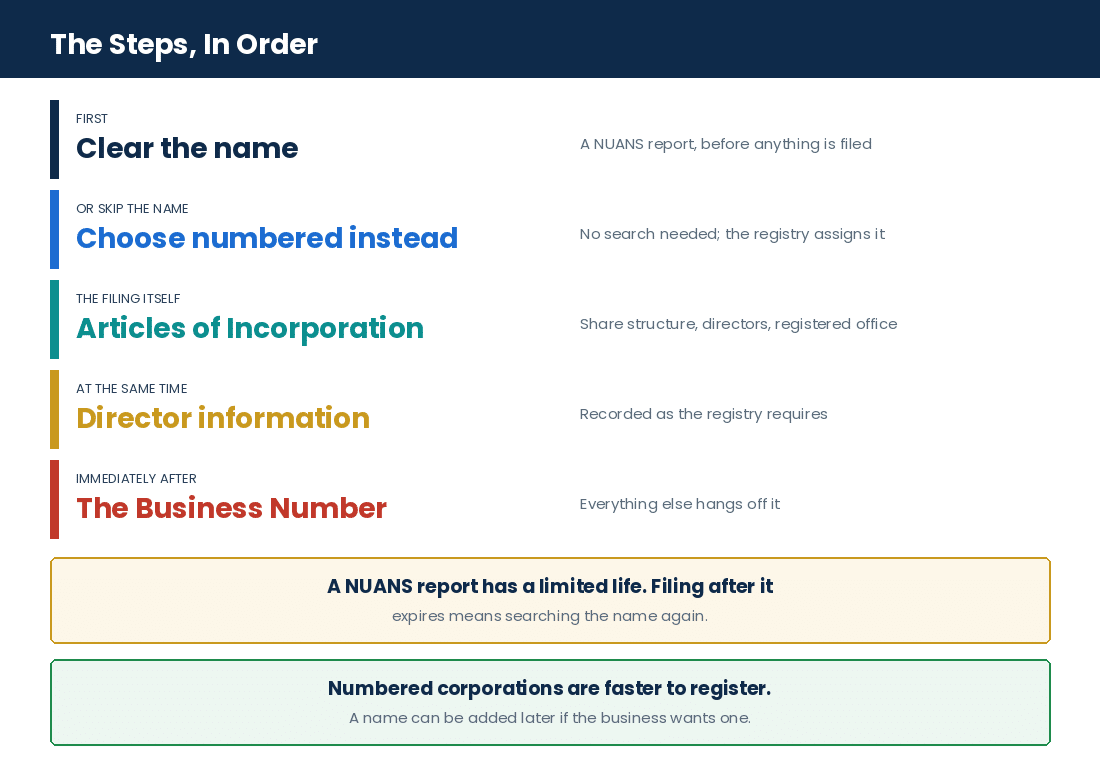
Choosing and Reserving Your Corporate Name (NUANS Search Requirements)
Before anything else, pick a corporate name that fits the rules in Ontario. You must do a NUANS (Newly Upgraded Automated Name Search). It checks if other companies already use that name anywhere in Canada. Here is what you should know about NUANS:
- It stops you from using a name others already took.
- You send your chosen name to get reviewed.
- If okay, you get a NUANS Name Search Report.
- Your name stays reserved for usually 90 days while finishing paperwork.
Some words are not allowed or need special permission. Check what is allowed before going ahead. Quick points: a NUANS Name Search is needed to make sure your name is unique, and reserved names last about 90 days so no one else takes it.
A client had a name printed on signage, vehicle wraps and about $6,000 of packaging before running the NUANS search. The report came back with a near-identical Ontario corporation in the same sector, and the name was not usable. He incorporated with a numbered company to get the corporation in place, then went back and cleared a second name properly before reprinting. The search costs a fraction of what the signage did. We now run the NUANS report before a client commits a dollar to branding, because that is the only order in which the search can actually save anything. Figures changed for privacy.
Preparing Your Articles of Incorporation Including Share Structure and Directors
After reserving your name, you write the Articles of Incorporation. This legal paper makes your company official. Important parts include:
- Share structure details like types of shares, number allowed, voting rights, and dividends.
- Names and addresses of the first directors; at least one director must meet rules.
- What your company will do (usually a short general description).
You must fill these out right. Mistakes can slow down or mess up your registration. You can file Articles of Incorporation online on ServiceOntario’s site. They have an electronic system just for this.
Establishing Registered Office Address and Initial Board of Directors Details
Your company needs a registered office address inside Ontario. This is where official mail goes. The address becomes public record once you register. Also:
- The board of directors runs the company’s big decisions.
- Initial directors must be 18 or older.
- At least 25% of directors usually have to live in Canada unless exceptions apply.
Make sure the address and director info are correct. Mistakes here often cause delays under the Ontario Business Corporations Act compliance rules.
A founder filed his own Articles of Incorporation with a single class of common shares, because the form allowed it and the extra classes looked like complication he did not need. Two years later an investor wanted preferred shares and his accountant wanted a structure that allowed dividends to a family trust. Amending the articles and reorganising the share capital after the fact cost him roughly $9,000 in professional fees and several weeks, against nothing at all if the classes had been set up at incorporation. The share structure is the part of the Articles of Incorporation that is cheap to get right and expensive to fix. Figures changed for privacy.
Filing Information on Individuals with Significant Control as Required by Law
Recent rules want companies to say who really controls them when they start up:
- These “Individuals With Significant Control” (ISC) hold major power through shares or choices.
- You need to file ISC details with director consent documents too.
- Directors confirm they agree to manage the company under provincial law.
This step helps keep things clear and fights money crimes inside Ontario companies.
Submitting Your Application and Paying Incorporation Fees Online Through the Registry
When all forms are ready — including your reserved name proof, Articles of Incorporation, and ISC info — do this:
- Send everything electronically using ServiceOntario’s business registration portal.
- Pay fees which depend on what type of incorporation you pick: basic filings, or extra options like faster processing.
Fees come from provincial rules. They can change each year so check current costs when you file.
Overview of Required Documents and Fees for Ontario Incorporation
To incorporate a company in Ontario in 2026, you will need these papers:
- Articles of Incorporation (basic info about your business).
- Initial Registered Office Address form.
- Notice of Directors.
You will also pay some fees:
- Government filing fee.
- Maybe extra if you want legal advice.
- Possible license fees for certain businesses.
Check the government website often since fees can change without notice.
Typical Timeline for Online Registration Completion
| Step | Time Needed |
|---|---|
| Preparing Documents | 1 to 3 days |
| Filing Online | Instant |
| Getting Approval Notification | Up to 10 business days |
If you have everything ready, the process goes faster. Missing info can slow things down.
Summary Table: Key Steps Overview
| Step | Description | Where/How Filed |
|---|---|---|
| Choose & Reserve Corporate Name | Do NUANS search & reserve unique corporate name | Through NUANS provider / ServiceOntario |
| Prepare Articles | Draft share structure & list directors | File online via ServiceOntario |
| Set Registered Office & Directors Info | Give official address & eligible director details | Included in articles filing |
| File ISC Information | Declare people with significant control | Submit with articles |
| Submit Application & Pay Fees | Final submission + pay required fees | Fully online at registry website |
Follow these steps carefully to meet all legal rules when you incorporate a company online in Ontario in 2026.
When to Incorporate Your Business in Ontario
Timing
The Signs That It Is Time, and What Changes Afterwards
Incorporating a business in Ontario online is a big step. It gives you legal and financial perks. Knowing when to incorporate helps you use those perks right. This section talks about when to incorporate, what SMBs should think about, and how incorporation changes taxes and rules.
Who Should Consider Incorporating in Ontario Online?
Think about online incorporation if:
- You want limited liability protection.
- You run a small business aiming to grow bigger.
- Your company needs a formal structure for operations.
If you want to enter new markets or get investors interested, incorporating is worth it.
Scenarios Indicating the Need for Incorporation
Many business owners ask when is the best time to incorporate a company in Ontario 2026 or later. Here are some common signs:
- Business Growth: If your sales or customers keep growing, incorporation helps protect your personal stuff from business problems.
- Liability Protection: Incorporation makes your business a separate legal thing. That means you do not lose your own money if the company owes debts.
- Tax Planning Opportunities: Corporations pay different tax rates than sole proprietors. This lets you plan how to pay less tax or split income smartly.
- Attracting Investors: It is easier to get investors if you have a corporation. You can sell shares to raise money.
- Professional Image & Credibility: Being incorporated looks more serious and builds trust with clients and suppliers.
Knowing how to incorporate a business in Ontario online helps you do all this without missing steps.
A consultant billing roughly $190,000 a year as a sole proprietor was paying personal rates on all of it while drawing about $85,000 for living costs. Incorporating let the rest stay in the corporation at the lower active business rate until she needed it, and the difference in the first full year was in the region of $21,000 of deferred tax. She had been told for three years that incorporating was not worth it below some threshold she could not name. The threshold that actually mattered was the gap between what she earned and what she spent, and she had been well past it for two of those years. Figures changed for privacy.
Considerations for Small and Medium-Sized Incorporated Businesses (SMBs)
If you run an SMB thinking about online business incorporation Ontario Canada, here are some things to think about:
- Administrative Responsibilities: Corporations must keep good records and file annual reports. Be ready for that extra work.
- Cost Implications: You pay fees at the start like filing articles of incorporation. But sometimes the tax savings make it worth it.
- Ownership Structure Flexibility: A corporation can have many shareholders with different rights. This fits businesses planning to grow or change owners later.
- Access to Government Programs & Credits: Some grants only go to corporations.
Knowing how to incorporate a business in Ontario online means knowing these details so you do not get surprises.
Impact of Business Structure on Compliance and Taxation
| Aspect | Sole Proprietorship/Partnership | Corporation |
|---|---|---|
| Legal Entity | Same as owner(s) | Separate legal person |
| Liability | You are fully liable | Liability is limited |
| Tax Filing | Personal income tax | Corporate T2 return required |
| Tax Rates | Personal rates | Often lower corporate rates |
| GST/HST Registration | Required if sales high | Must register if applicable |
| Payroll Remittances | Same | Same |
| Annual Filings | Minimal | Annual returns plus extra reports |
This shows why an Ontario corporation online registration guide is useful: corporations have more rules but get better protections. The corporate return is a separate obligation from your personal one, and corporate tax return filing starts in the first year the corporation exists.
Ontario Incorporation Readiness Check
Five quick questions on where your incorporation stands. No fee shown.
Points to raise with us:
This is a general prompt, not tax or legal advice or a quote. Your position depends on your full facts. For a real review, please book a free consultation.
Provincial Against Federal Incorporation
The Choice
Decision Factors: Provincial vs Federal Incorporation
When choosing how to incorporate a company in Ontario 2026 style, the question is where you work now and where you intend to work next.
Comparison of Provincial vs Federal Incorporation Options
| Factor | Provincial (Ontario) | Federal |
|---|---|---|
| Where It Works | Only within Ontario | All across Canada |
| Name Protection | Limited to Ontario | Protected everywhere in Canada |
| Fees | Usually cheaper | More expensive |
| Rules After Incorporation | Fewer ongoing requirements | More rules to follow |
If you mainly want to work in Ontario, provincial is easier and cheaper. But if you plan to grow nationwide, federal might be better.
Provincial Incorporation Advantages
- Easier process focused on Ontario only
- Lower fees at the start
- Good if you only work inside Ontario
- Name approval uses NUANS search for the province
Federal Incorporation Advantages
- Name protected across all Canada
- Use same corporate name everywhere
- Good if you plan to expand beyond one province
- More complex forms but wider recognition
Both ways let you file forms online now. The choice depends on where you do business now and where you want to grow.
A client incorporated federally because a friend told him the name protection was worth having, then operated entirely out of one shop in Scarborough for three years. The federal corporation still had to be registered extra-provincially in Ontario, and he carried two sets of annual filings and two registries to keep current for a business that never sold outside the province. We did not undo it — continuing a corporation from one jurisdiction to another costs more than the duplicated filings — but the extra compliance ran to roughly $900 a year he did not need to spend. Where you actually trade decides this, not where the name sounds better. Figures changed for privacy.
Knowing when it makes sense financially and legally — and the difference between provincial vs federal — helps before starting how to incorporate a business in Ontario online. Talking with experts who know Canadian rules can help too.
Your Options for Incorporating Online
Three Routes
Options for Incorporating Your Business in Ontario Online
In 2026, you have a few ways to incorporate your business online in Ontario. You can do it yourself or get some help from pros. Knowing your choices helps you follow the rules and save time. This section looks at three main options: doing it yourself using the Ontario Business Registry platform, hiring Registered CPA firms like Gondaliya CPA, or using non-CPA services. It also checks how each one handles compliance risks, quality, and CRA audit readiness.
Do-It-Yourself (DIY) Approach via Ontario Business Registry Platform
If you like handling paperwork on your own, the DIY way is there for you. The Ontario Business Registry lets you file everything online for incorporating a company in Ontario 2026. You just upload your documents like articles of incorporation and register your business name if needed. Here is what you do:
- Make an account on the registry site.
- Run a NUANS name search to see if your business name is free.
- Fill out online forms, including Articles of Incorporation.
- Pay the fees online.
This way works well if your business setup is simple and you want full control without paying extra middleman fees. But watch out — mistakes can slow down registration or cause issues later with compliance. Things to keep in mind:
| Aspect | Details |
|---|---|
| Cost | Cheaper; just pay government fees |
| Complexity | Medium; know some legal terms and rules |
| Time | Usually done in a few days if no errors |
| Support | Mostly self-help materials |
| Risk | More chance of mistakes affecting CRA compliance |
This option answers how to incorporate a business in Ontario online at low cost. Still, it needs care filling forms and staying on top of rules after incorporation.
Using a Registered CPA Firm Like Gondaliya CPA for Incorporation Services
Hiring a Registered CPA firm means experts guide you through setting up your corporation. Firms like Gondaliya CPA know Canadian laws well and work with many small businesses in Toronto and beyond. They do more than just file papers — they give tax advice and help with all steps after incorporation. Benefits are:
- Pros check your documents to avoid mistakes.
- Help picking the right share structure for your goals.
- Assist getting registrations like GST/HST accounts or payroll numbers from CRA.
- Keep supporting you to stay compliant in 2026 and after.
With pros, chances of filing errors drop a lot. The process stays mostly online but includes personal talks based on your business type — like tech startups or real estate. Here is how this option compares:
| Feature | Description |
|---|---|
| Compliance Assurance | High – Registered pros review everything |
| Quality Control | Careful checks on documents |
| Audit Readiness | Better prep reduces CRA problems |
| Convenience | They handle most steps so you do not worry |
This path fits well if you want to know how to incorporate a business in Ontario online but want experts making sure it is done right. Our accounting and bookkeeping services pick up from the day the corporation exists.
Non-CPA Providers and Their Role in the Process
Non-CPA providers offer packages to make incorporation easier across Canada. They often help entrepreneurs who want fast setups without needing accountants directly. These could be lawyers who do legal filings or agents who bundle things like name searches plus filing help at good prices. They usually do:
- File articles of incorporation through provincial registries.
- Offer extras like registered office addresses or minute books.
While handy for simple setups that do not need tax planning, these providers do not usually offer deep tax advice or represent you during CRA audits later. This matters especially with changes coming in 2026 that affect incorporated small businesses all over Canada. A quick look here:
| Factor | Non-CPA Provider |
|---|---|
| Compliance Depth | Moderate – mostly initial filings only |
| Tax Advisory | Limited or none |
| CRA Representation | Not provided |
| Cost | Competitive but varies |
| Suitability | Good for simple setups without tax needs |
Knowing these limits helps when picking between easy DIY steps or solid support from CPAs for future growth plans.
An owner used a filing agent for roughly $400 and got a correctly registered corporation, which is what the agent sold. What he did not get was a GST/HST account, a payroll account, or anyone telling him that the corporation now had its own return. He came to us fourteen months later with a CRA letter about an unfiled corporate return, no bookkeeping for the period, and HST that should have been charged on about $140,000 of billings and had not been. Cleaning up the first year cost several times what the incorporation itself had. The filing was never the risky part. Figures changed for privacy.
Comparison: Compliance Risk, Quality Assurance & CRA Audit Readiness
Choosing how to incorporate your company online in Ontario 2026 means thinking about risks tied to rules. Below is a quick comparison showing how DIY stacks up against professional help on key points that affect smooth registration and later audits by CRA:
| Criteria | DIY Approach | Registered CPA Firm | Non-CPA Provider |
|---|---|---|---|
| Compliance Risk | Higher due to possible errors | Low thanks to expert checks | Medium; filings only |
| Quality Assurance | Self-managed papers | Pros review everything | Basic checks |
| CRA Audit Readiness | Little prep | Strong prep | No audit support |
| Ongoing Support | None unless extra hired | Continuous help available | Usually none |
| Time Efficiency | Fast if no mistakes | Takes longer due to reviews | Quick filing |
| Cost Considerations | Lowest fees | Higher fees for expertise | Mid-range prices |
Your choice depends on what fits your budget versus how much confidence you want about meeting both initial rules and ongoing laws by Canadian agencies. This helps anyone searching online business incorporation Ontario Canada or for an Ontario corporation online registration guide decide what suits them best — whether hands-on founders ready to manage themselves or folks wanting trusted pros handling every step right away.
Post-Incorporation Requirements for Ontario Corporations
After Filing
Post-Incorporation Requirements for Ontario Corporations
Starting a business by incorporating a company in Ontario online is just the beginning. After you register, there are important steps to follow. These help your business stay legal and avoid fines. Knowing what to do after you incorporate keeps things running smooth.
Common Post-Incorporation Requirements To Prepare For
- Get an Employer Identification Number (EIN).
- Register for GST/HST if it applies to your business.
- Set up accounting systems that meet CRA standards.
- Keep up with filings like annual returns based on your corporate status.
Doing these helps keep your business legal and organized moving forward.
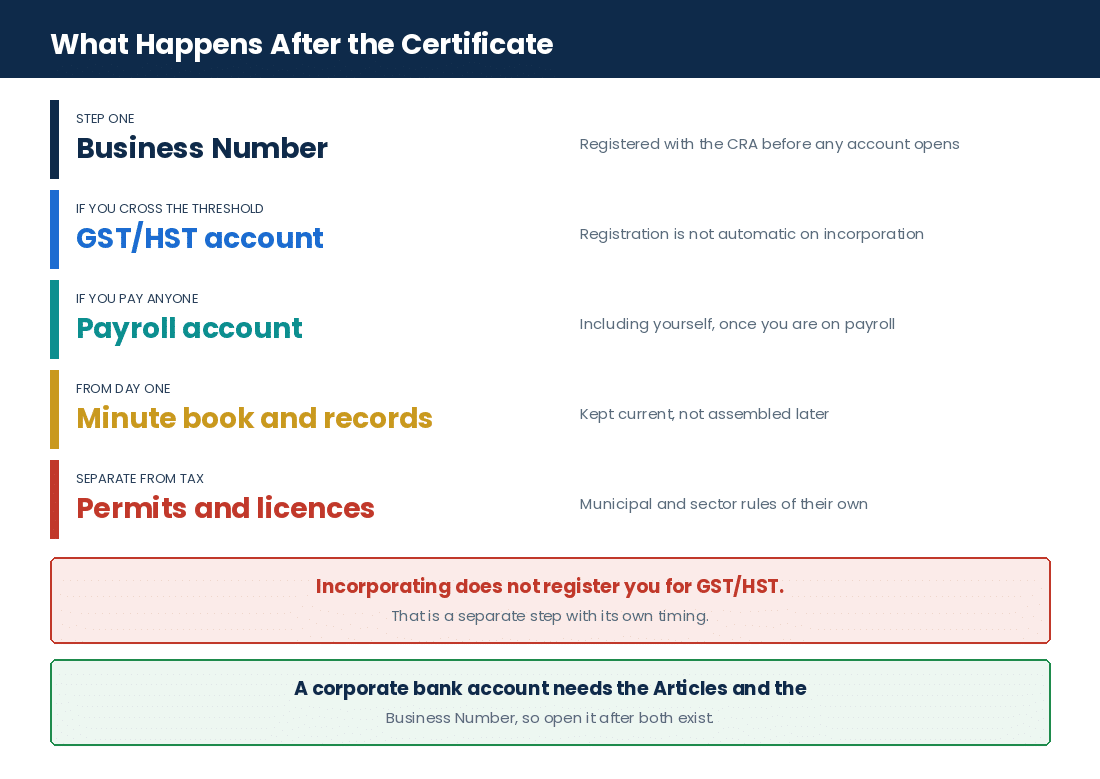
Registering for a Business Number (BN) with CRA and Understanding BIN Differences
After you incorporate your business in Ontario, you need to get a Business Number (BN) from the Canada Revenue Agency (CRA). The BN is like an ID for your company. You use it when dealing with taxes, payroll, and import or export accounts.
The BN has nine digits and some extra codes for programs like GST/HST or payroll. Sometimes people confuse BN with BIN. BIN is an internal number used by some provinces, but in Ontario, the BN from CRA is the main one.
You can register online on CRA’s website right after you incorporate. This speeds things up and lets you access tax accounts fast.
- Get your Business Number (BN) from CRA
- Know the difference between BN and BIN
- Register online soon after incorporation
This step makes sure you can handle your taxes and government paperwork without trouble.
GST/HST Registration Obligations for Incorporated Businesses in Ontario
Once you set up your corporation online in Ontario, check if you must register for GST/HST. Usually:
- You have to register if your taxable sales pass a certain limit set by CRA.
- You can also choose to register even if sales are below that limit. This helps if you want to claim input tax credits.
In Ontario, businesses charge 13% HST — 5% federal GST plus 8% provincial tax. Registering means you follow rules for paying taxes and filing reports. If you skip this step when needed, the government can add penalties or interest later. Getting it done early makes accounting easier, and it is the point at which tax preparation and filing becomes a recurring obligation rather than a once-a-year event.
A new corporation passed the registration threshold in month seven and did not register for GST/HST until month nineteen, because the owner assumed the threshold was tested at year end. CRA assessed the HST that should have been charged on roughly $115,000 of billings in between, and he could not go back to those clients for it, so it came out of his own margin — about $14,900 of tax he had never collected. The input tax credits he could claim against it recovered only part. Registering on the day the threshold was crossed would have cost nothing. Figures changed for privacy.
Setting Up Corporate Records, Minute Books, and Shareholder Registers
Keeping good corporate records matters under integrated corporate compliance 2026 laws in Ontario. After incorporation:
- Make a minute book to record meetings of shareholders and directors.
- Keep track of who owns shares in shareholder registers.
- Save official papers like articles of incorporation and bylaws safely but where they can be seen when asked.
These documents prove your company is real and help during audits or getting loans. If you do not keep them right, fines or legal problems may happen. A clear minute book also helps run your company smoothly as required after online business incorporation Ontario Canada.
Opening a Business Bank Account Under the Corporation’s Name
It is smart to open a bank account using your corporation’s legal name. This keeps personal money separate from business funds. Many CPAs advise doing this right after incorporating bank accounts in Ontario Canada. To open an account, banks usually want:
- Certificate of Incorporation
- Articles of Incorporation
- A resolution saying someone can open the account
- ID from directors or officers
This separation helps bookkeeping and shows suppliers and clients that your business is professional. Banks offer special services for incorporated companies that make managing money easier once post-incorporation steps finish online successfully.
Obtaining Necessary Permits or Licenses Based on Industry or Location
Just incorporating does not let you run every kind of business anywhere in Ontario freely. Some industries need permits or licenses depending on local rules or sector laws — these fall under incorporate company permits ontario 2026 requirements. For example:
- Restaurants must pass health inspections
- Builders need trade certifications
- Transport companies follow safety license rules
Finding what licenses fit your business early avoids delays after finishing online business incorporation Ontario Canada. Talking with experts helps make sure you meet all rules before starting operations officially.
Additional Incorporation Essentials for Ontario Businesses
- WSIB registrations ensure workplace safety coverage for employees.
- Corporate minute book kits help organize meeting records and shareholder details.
- Rush filings speed up processing times for urgent incorporations.
- Professional corporation filings are needed for regulated professions like doctors or lawyers.
- Construction-specific licenses and contractor licensing are mandatory for trades businesses.
- RCDSO certification applies to dental professionals incorporated in Ontario.
- OHIP registration connects healthcare professionals to provincial health insurance programs.
- RCPSC certification is required for specialists seeking professional corporation status.
- Business plan or strategy creation supports funding applications and growth planning.
- CWELCC program funding may be available to eligible incorporated childcare businesses.
- SR&ED claims help companies recover R&D tax credits through government incentives.
- SaaS startups benefit from proper share structures and early compliance setup.
- Audit readiness ensures your records meet CRA standards before potential reviews.
- Internal QA processes improve accuracy of filings and reduce errors or penalties.
Frequently Asked Questions
FAQs
FAQs on Incorporating a Business in Ontario Online
What is ServiceOntario’s role in online business incorporation?+
ServiceOntario hosts the official platform for filing incorporation documents and paying fees securely online. That is where the Articles of Incorporation, the registered office address and the director details are submitted, and where the fees are paid when you incorporate a company in Ontario 2026.
What documents do I need to incorporate in Ontario online?+
Three: the Articles of Incorporation, which carry the basic information about your business; the Initial Registered Office Address form; and the Notice of Directors. Alongside them you will pay a government filing fee, possibly a cost for legal advice, and licence fees for certain businesses. Fees can change without notice, so check the government website when you file.
Can non-resident entrepreneurs incorporate a company in Ontario online?+
Yes, non-residents can incorporate but may need to appoint a nominee director living in Canada. At least 25% of directors usually have to live in Canada unless exceptions apply, which is the rule the nominee arrangement exists to satisfy.
What are flat-fee packages for incorporation services?+
These packages bundle all necessary steps at a fixed price, often including filing, name search, and compliance guidance. At Gondaliya CPA fees are fixed and annual with no hourly billing, shown before tax with sales tax on its own line, and agreed before any work begins.
Why use a Registered CPA firm like Gondaliya CPA for incorporation?+
They offer expert reviews, tax advice, audit readiness, and ongoing corporate compliance support. Pros check your documents to avoid mistakes, help pick the right share structure for your goals, and assist with getting registrations like GST/HST accounts or payroll numbers from CRA.
What is the benefit of ongoing corporate compliance guidance after incorporation?+
It helps keep your business legal by managing filings like annual returns and T2 corporate returns. Corporations must keep good records and file annual reports, and the minute book, the shareholder register and the accounting records all have to be kept current rather than assembled when someone asks for them.
How do nominee director services assist non-resident entrepreneurs?+
They provide a local resident director required by law to fulfill provincial rules. Initial directors must also be 18 or older, and the director details form part of the public record once the incorporation is filed.
What is professional corporation status?+
It is a special designation for certain professions with distinct legal and tax requirements. Professional corporation filings are needed for regulated professions like doctors or lawyers, and certifications such as RCDSO for dental professionals and RCPSC for specialists sit behind the status.
Do I need to set up payroll accounts when incorporating?+
Yes, setting up payroll accounts with CRA is essential if you hire employees. The payroll account is one of the program accounts that attaches to the nine-digit Business Number the CRA issues after you incorporate.
How can using authorized providers benefit my Ontario incorporation process?+
Authorized providers simplify filings and ensure submissions meet all regulatory standards. The NUANS name search is normally run through a NUANS provider, and the registry gives instant feedback on mistakes or missing information before the forms are sent.
Essential Points for Business Owners
Key Takeaways
What Decides Whether an Online Incorporation Goes Smoothly
The filing itself is short. What varies is whether the name was cleared first, whether the share structure fits what the business will become, and whether the post-incorporation registrations were done at the time rather than a year later.
| Point | The Rule | Where It Applies |
|---|---|---|
| Corporate name | A NUANS search is required unless you take an assigned numbered name | Before the articles are filed |
| Name reservation | Usually holds about 90 days while you finish the paperwork | NUANS provider / ServiceOntario |
| Articles of Incorporation | Name, address, share structure and directors; filing it creates the corporation | ServiceOntario electronic system |
| Registered office | Must be inside Ontario and becomes public record | Included in the articles filing |
| Directors | 18 or older, and at least 25% usually resident in Canada unless exceptions apply | Notice of Directors |
| ISC information | Individuals with Significant Control must be declared, with director consent documents | Submitted with the articles |
| Approval | Instant to file; up to 10 business days for the approval notification | Ontario Business Registry |
| Fees | Set by provincial rules and can change each year without notice | Checked at the time of filing |
| Business Number | Nine digits from CRA, plus program codes for GST/HST and payroll | Registered online after incorporating |
| GST/HST | 13% in Ontario, being 5% federal GST plus 8% provincial | Once the CRA threshold is passed, or voluntarily |
| Records | Minute book, shareholder register, articles and bylaws kept and producible | From incorporation onward |
| Permits and licences | Industry and location specific; incorporation alone is not permission to operate | Before operations begin |
The Six Things We Check First
- Has the name actually been cleared? A NUANS report, not a Google search and not the registry’s own availability hint.
- Is the share structure right for where this business is going? Classes, voting rights and dividend entitlements are cheap now and expensive to amend later.
- Provincial or federal? Decided on where the business trades and intends to trade, not on which name protection sounds better.
- Who are the directors, and does the residency rule work? Age, address and the 25% Canadian residency position before anything is filed.
- Who holds significant control? The ISC declaration and the director consent documents are part of the filing, not an afterthought.
- Which registrations and permits are needed on day one? GST/HST, payroll, WSIB and the industry licence, so none of them is discovered a year late.
Our Approach
Gondaliya CPA runs the NUANS report before a client commits anything to branding; sets the share structure against what the business is expected to become rather than against the simplest form on the screen; confirms the registered office and the director residency position before filing; prepares and files the Articles of Incorporation, the initial registered office address, the Notice of Directors and the Individuals with Significant Control information together through the registry; registers the Business Number and the GST/HST and payroll program accounts with CRA at the same time rather than later; sets up the minute book, the shareholder register and the bookkeeping so the first year is not reconstructed; and identifies the permits and licences the industry needs before operations start. Fees are fixed and annual with no hourly billing, shown before tax with sales tax on its own line, and agreed before any work begins.
Industry Spotlights: Sectors We Represent
Industry Expertise
Every sector incorporates for slightly different reasons. Here are eleven, and what the filing has to get right in each.
| Industry | What the Incorporation Has to Get Right |
|---|---|
| Technology startups & SaaS | Share structures that survive a funding round, and SR&ED claims set up from the first year |
| E-commerce & online retailers | GST/HST registration at the point sales cross the threshold rather than at year end |
| Consulting firms | A corporate bank account from day one, so personal and business money never mix |
| Construction, contractors & skilled trades | Contractor licensing and construction-specific licences alongside the incorporation |
| Property developers & builders | Trade certifications for builders, and a registered office that can receive official mail |
| Real estate investors & holding companies | Multiple share classes where properties and investors are held separately |
| Transportation, logistics & trucking | Safety licence rules that apply before the trucks move, not after |
| Restaurants & food and beverage | Health inspections and permits, which incorporating does not by itself provide |
| Daycare, childcare & CWELCC services | CWELCC program funding eligibility, which is available only to some incorporated operators |
| Dentists & dental practices | Professional corporation filings and RCDSO certification for the practitioners |
| Medical doctors & physician corporations | Professional corporation status, RCPSC certification for specialists, and OHIP registration |
- Technology startups & SaaS: SaaS startups benefit from proper share structures and early compliance setup, and an SR&ED claim is easier to support when the corporation was set up with it in mind.
- E-commerce & online retailers: Taxable sales pass the CRA limit quietly on a platform, so the GST/HST registration has to be watched from the month it happens rather than at the year end.
- Consulting firms: Opening a bank account in the corporation’s legal name on day one keeps personal money separate from business funds, which is the single cheapest thing a new corporation can do.
- Construction, contractors & skilled trades: Construction-specific licenses and contractor licensing are mandatory for trades businesses, and incorporating does not substitute for either.
- Property developers & builders: Builders need trade certifications, and the registered office address inside Ontario becomes public record the moment the corporation is registered.
- Real estate investors & holding companies: A corporation can have many shareholders with different rights, which is what makes it fit businesses planning to grow or change owners later.
- Transportation, logistics & trucking: Transport companies follow safety license rules, and finding which ones apply early avoids delays after the online business incorporation is finished.
- Restaurants & food and beverage: Restaurants must pass health inspections, and just incorporating does not let you run every kind of business anywhere in Ontario freely.
- Daycare, childcare & CWELCC services: CWELCC program funding may be available to eligible incorporated childcare businesses, and some grants only go to corporations.
- Dentists & dental practices: RCDSO certification applies to dental professionals incorporated in Ontario, and the professional corporation filing has its own distinct legal and tax requirements.
- Medical doctors & physician corporations: OHIP registration connects healthcare professionals to provincial health insurance programs, and RCPSC certification is required for specialists seeking professional corporation status.
A dentist incorporated through an online package before her professional corporation application went in, and the Articles of Incorporation did not meet the share ownership restrictions her regulator requires. The corporation existed, but it could not be used for the practice. Amending the articles, refiling and getting the professional corporation certificate took about eleven weeks and roughly $5,500, during which the practice income kept running through her personally. The order matters in regulated professions: the regulator’s requirements decide what the articles say, not the other way around. Figures changed for privacy.
Professional Guidance and Quick Reference
Guidance
Essential Points for Ontario and Canadian Corporations
Online incorporations go wrong in a predictable set of ways: branding ordered before the NUANS report comes back; a single class of common shares filed because the form allowed it, then amended expensively when an investor or a dividend plan arrives; a federal incorporation chosen for a business that only ever trades in Ontario, carrying two sets of filings; director residency not checked until the filing is rejected; the GST/HST registration left until year end when the threshold was crossed in month seven; and permits discovered after operations have already started. Gondaliya CPA clears the name first and registers the CRA accounts at the same time as the corporation.
Quick Answers
At a Glance
- Where you file: the Ontario Business Registry and ServiceOntario’s business registration portal
- What creates the corporation: filing the Articles of Incorporation
- Who approves it: the Ministry of Government and Consumer Services (MGCS)
- When it exists: right away on approval
- Name search: NUANS, the Newly Upgraded Automated Name Search
- What NUANS checks: whether the name already exists federally or provincially
- When you can skip it: only if you take an assigned numbered name
- Name reservation: usually about 90 days
- Restricted words: some are not allowed or need special permission
- Documents required: Articles of Incorporation, Initial Registered Office Address, Notice of Directors
- In the articles: share structure, voting rights, dividends, directors, and what the company does
- Registered office: must be inside Ontario, and becomes public record
- Director age: 18 or older
- Director residency: at least 25% usually resident in Canada unless exceptions apply
- ISC filing: Individuals with Significant Control, with director consent documents
- Fees: a government filing fee, possibly legal advice, possibly licence fees
- Fee changes: set by provincial rules and can change each year without notice
- Rush option: faster processing is available as an extra
- Preparing documents: 1 to 3 days
- Filing online: instant
- Approval notification: up to 10 business days
- Business Number: nine digits from CRA, plus program codes
- BN against BIN: BIN is an internal provincial number; in Ontario the CRA BN is the main one
- GST/HST in Ontario: 13%, being 5% federal GST plus 8% provincial
- When to register: when taxable sales pass the CRA limit, or voluntarily to claim input tax credits
- Corporate return: a T2 is required, separate from your personal return
- Records to keep: minute book, shareholder registers, articles and bylaws
- Bank account: opened in the corporation’s legal name, with a resolution and director ID
- Permits: industry and location specific, and incorporation is not permission to operate
- Provincial against federal: Ontario only against all of Canada, and cheaper against more expensive
Who This Is For / Not For
Fit Check
- For: owners who want limited liability protection, run a small business aiming to grow bigger, or need a formal structure for operations.
- For: founders entering new markets or trying to interest investors, and small and medium-sized businesses weighing the administrative load against the tax position.
- Not for: a statement of the current government fee amounts, which come from provincial rules, change each year without notice, and should be checked on the government website at the time you file.
- Not for: the specific requirements of any one regulated profession, where the regulator’s own rules decide what the Articles of Incorporation must say.
People Also Ask
Related Questions
Can I really incorporate in Ontario completely online?+
Yes. The government made a digital platform that handles the whole filing, so you submit your Articles of Incorporation, run the NUANS name check and register for your Business Number without dealing with piles of paper. It is all mostly done from your computer, which is what removes the long waits and the running around offices. The parts that are not online are the ones that were never a government filing in the first place, such as opening the corporate bank account and getting an industry permit.
Do I have to use a NUANS report, or can I take a numbered company?+
You must get a NUANS report unless you are using an assigned numbered name. A numbered company is a legitimate way to get the corporation in place quickly, and you can clear a name properly afterwards. What you cannot do is commit the name to signage, packaging or a domain before the report comes back, because the report is the only thing that tells you whether an identical or near-identical corporate name already exists federally or provincially.
What happens if I get the share structure wrong at incorporation?+
It can be amended, but amending the articles and reorganising the share capital after the fact costs several times what setting the classes up correctly would have. The share structure covers types of shares, the number allowed, voting rights and dividends, and it is the part of the Articles of Incorporation that an investor, a lender or a family income-splitting plan will test. Decide it against what the business is expected to become rather than against the simplest option on the form.
Is incorporating enough to start operating?+
No. Just incorporating does not let you run every kind of business anywhere in Ontario freely. Restaurants must pass health inspections, builders need trade certifications, transport companies follow safety licence rules, and regulated professions need professional corporation filings and their regulator’s certification. Finding which licences fit your business early is what avoids delays once the incorporation itself is finished.
How soon after incorporating should I register with CRA?+
Right away. You can register online on CRA’s website immediately after you incorporate, which speeds things up and gives you access to the tax accounts fast. The Business Number carries the program accounts for GST/HST and payroll, and leaving GST/HST until the year end when taxable sales crossed the limit months earlier means the tax was owed on sales you never charged it on. Setting up accounting systems that meet CRA standards belongs in the same week.
Glossary of Key Terms
Definitions
- Incorporation: creating a legal business entity that is separate from you.
- NUANS report: the Newly Upgraded Automated Name Search, checking whether a corporate name is free.
- Articles of Incorporation: the document carrying name, address, shares and directors; filing it creates the corporation.
- Business Number (BN): the nine-digit tax identifier CRA issues, plus program codes.
- BIN: an internal number used by some provinces; in Ontario the CRA BN is the main one.
- Ontario Business Registry: the online platform where the filings and annual returns are handled.
- ServiceOntario: host of the official portal for filing incorporation documents and paying fees.
- MGCS: the Ministry of Government and Consumer Services, which approves the incorporation.
- Registered office address: the Ontario address where official mail goes, which becomes public record.
- Notice of Directors: the filing giving the names and addresses of the initial directors.
- Individuals with Significant Control (ISC): the people holding major power through shares or choices, who must be declared.
- Minute book: the record of shareholder and director meetings, kept with the shareholder registers.
- GST/HST: 13% in Ontario, being 5% federal GST plus 8% provincial tax.
- Professional corporation: a special designation for certain professions with distinct legal and tax requirements.
Want a checklist to work from? You can download our free Ontario incorporation checklist before your consultation.
Four things decide whether an online incorporation serves you. Whether the name was cleared before anything was committed to it — the NUANS report is the only check that tells you whether the name exists federally or provincially, it holds the name for about 90 days, and it costs a fraction of the signage people order before running it. Whether the share structure fits what the business will become — types of shares, voting rights and dividends are set in the Articles of Incorporation, and amending them later to satisfy an investor or a dividend plan costs several times what getting them right at the start would. Whether provincial or federal matches where you actually trade — Ontario only against all of Canada, cheaper against more expensive, and fewer ongoing requirements against more rules to follow, decided on the business rather than on which name protection sounds better. And whether the post-incorporation registrations were done at the time — the Business Number, GST/HST at 13% once the threshold is passed, payroll where there are employees, the minute book, the corporate bank account and the industry permit, because incorporating alone is not permission to operate.
Three questions settle most of the filing, and none of them requires a lawyer. First, has the name been through a NUANS search? If not, nothing else should be ordered or printed yet, and a numbered company is a perfectly good way to get the corporation in place meanwhile. Second, who will own shares, and will that change? One class of common shares is the easy answer on the form and the expensive answer two years later if an investor or a family trust arrives. Third, do your directors satisfy the rules? They must be 18 or older, and at least 25% usually have to live in Canada unless exceptions apply, which is the point at which non-resident founders look at nominee director arrangements.
Ontario Online Incorporation: How Gondaliya CPA Can Help
Get the name cleared and the corporation filed properly
Gondaliya CPA runs the NUANS name search before anything is committed to the name, sets the share structure against what the business is expected to become, confirms the registered office and the director residency position, and prepares and files the Articles of Incorporation, the Initial Registered Office Address, the Notice of Directors and the Individuals with Significant Control information through the Ontario Business Registry. We register the Business Number with CRA and open the GST/HST and payroll program accounts at the same time, set up the minute book, shareholder registers and bookkeeping so the first year is not reconstructed later, advise on provincial against federal incorporation for where you actually trade, and identify the permits and licences your industry needs before operations start. We perform compilation engagements under CSRS 4200 and we represent clients through CRA audits. Fees are fixed and annual with no hourly billing, shown before tax with sales tax on its own line, and agreed before any work begins. Please book a free consultation.
Next Steps
Please book a free consultation with Gondaliya CPA and bring three things: the corporate name or names you are considering, a sketch of who will own shares and whether that is likely to change, and the addresses and ages of the people who will act as directors. We will run the NUANS search before anything is printed, tell you whether provincial or federal incorporation fits where you actually trade, and set the share structure so an investor or a dividend plan later does not force an amendment. If you are a non-resident, say so at the outset, because the Canadian residency requirement for directors shapes the filing rather than following it. If you are in a regulated profession, bring your regulator’s requirements for professional corporations, since those decide what the Articles of Incorporation have to say. We perform compilation engagements under CSRS 4200, which provide no assurance, and we refer audit and review engagements out; we do represent clients through CRA audits. You will get a fixed annual fee, shown before tax, agreed before any work begins. We serve Toronto, Mississauga, Brampton, Vaughan, Etobicoke, Scarborough, Hamilton, Ottawa and the rest of Ontario, and work with corporations across Canada. If our content helps, please add gondaliyacpa.ca as a preferred source on Google.
Published: · Last updated:
Editorial policy: We research against the Ontario Business Corporations Act, Ontario Business Registry and ServiceOntario guidance, CRA publications, the Income Tax Act and Excise Tax Act, CPA Canada Handbook standards and CPA Ontario sources, fact-check the figures, and Sharad Gondaliya, CPA, reviews the content, which we update as the rules change.
Disclaimer: This article is educational information only and is not tax, legal or accounting advice. It covers how to incorporate a business in Ontario online in 2026, including the definition and benefits of incorporating, how incorporation differs from a sole proprietorship or partnership, the Ontario Business Registry online platform, the NUANS report, the Articles of Incorporation and the Business Number, when to incorporate and what small and medium-sized incorporated businesses should expect, the effect of business structure on compliance and taxation, provincial against federal incorporation, the DIY route and the role of Registered CPA firms and non-CPA providers, the step-by-step filing process covering the corporate name, the share structure and directors, the registered office address, the Individuals with Significant Control filing and the submission and payment of fees, and the post-incorporation requirements for the Business Number, GST/HST, corporate records and minute books, a corporate bank account and industry permits and licences. Government and third-party fees are set by provincial rules and can change each year without notice; every figure, form and requirement should be confirmed against current ServiceOntario, Ontario Business Registry and CRA guidance at the time of filing. The requirements of regulated professions are set by their own regulators. Gondaliya CPA performs compilation engagements under CSRS 4200, which provide no assurance, and does not perform audit or review engagements; the firm does represent clients through CRA audits. Please talk with a Registered CPA at Gondaliya CPA for advice that fits your situation.

Sharad Gondaliya is a CPA Canada & CPA USA with 15 Years+ experience of Accounting, Tax, Payroll of Corporate Small Businesses as Tax Accountant. He is a CPA Ontario member (61040184) and holds US CPA licences in Washington and Montana and is well known among corporate small businesses for tax planning, efficient tax solutions, and affordable CPA services. Sharad is the Principal (Director) of Gondaliya CPA – Affordable CPA Firm in Canada. Licenses: CPA Ontario: 61040184 | CPA USA (MT): PAC-CPAP-LIC-033176 | CPA USA (WA): 57629 | CPA Firm License: 61330051 View Full Author Bio