



The Ultimate Guide to Marine Repair Business Taxes and Accounting in Canada
Marine Repair Business Taxes Canada: Expert Marine Repair Accounting and Tax Accountant Services by Gondaliya CPA
For marine repair business taxes Canada, Gondaliya CPA provides specialized services including marine repair accounting Canada, GST HST management, and marine repair tax deductions to optimize your tax position. Their expertise covers boat repair business taxes, CCA claims, labour costs, parts accounting, and comprehensive marine repair bookkeeping tailored for Canadian businesses.
Quick Summary
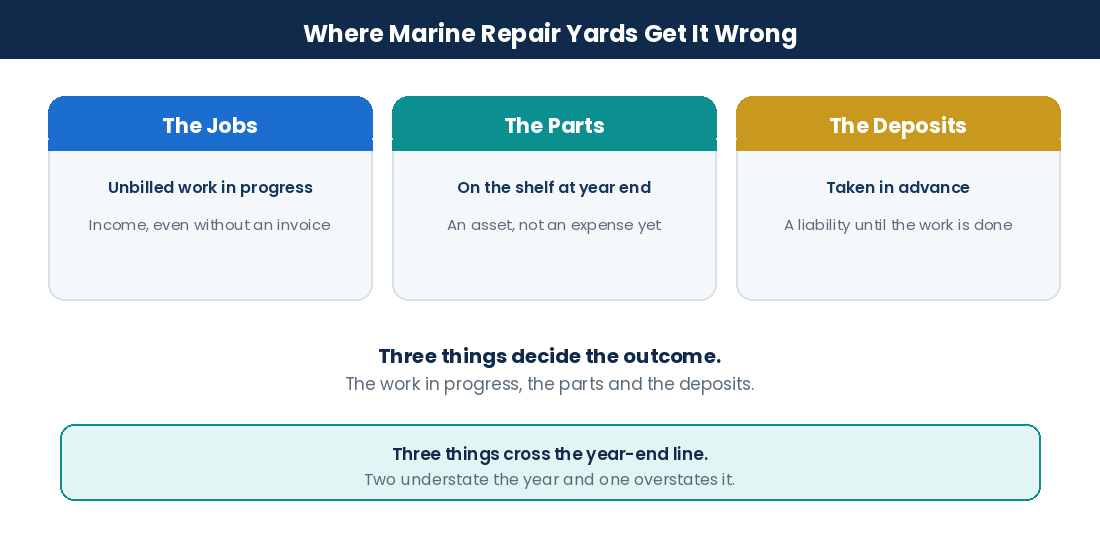
The three items that cross a boatyard’s year end are unbilled work in progress, parts on the shelf, and customer deposits taken in advance. One is income, one is an asset, one is a liability, and each is regularly recorded as the wrong thing.
Reading time: 54 minutes.
Table of Contents
- What Crosses the Year-End Line
- Overview and Key Considerations
- Accounting Systems and Bookkeeping
- Deductions, Equipment and Credits
- GST/HST, Records and Deadlines
- Structure, Cash Flow and Working With Us
- Frequently Asked Questions
- Essential Points on Compliance
- Businesses We Serve
- Professional Guidance and Quick Reference
The Numbers That Matter
This article covers Canada, with Ontario and Toronto context, and reflects rules current to 2026. It is written for incorporated Canadian marine repair businesses, boatyards and mobile marine mechanics. Figures marked illustrative are examples, not quotes, and any masked engagement notes end with “Figures changed for privacy.” This is educational information only and not tax or legal advice. Rates and thresholds change, so please confirm the current position before acting.
What Crosses the Year-End Line
What Crosses the Year-End Line
The Three Items
Three Things, Three Different Answers
| Item at Year End | What It Is | The Usual Error |
|---|---|---|
| Unbilled work in progress | Income, even though no invoice went out | Left out entirely, understating income |
| Parts on the shelf | An asset, not an expense | Expensed on purchase, understating income |
| Customer deposits taken | A liability until the work is done | Recorded as revenue, overstating income |
Two of these push income down and one pushes it up, which is why a boatyard’s reported profit can be wrong in either direction while every individual transaction looks fine.
Work in Progress Is Income
A boat hauled in November and finished in February straddles the year end. The labour and parts consumed before the year end represent income earned, and business income is computed on the accrual basis: earned when the work is done, not when the invoice is raised or the cheque clears.
Please note this, because it is where guidance most often goes wrong. Business income for a corporation is not a choice between cash and accrual. A marine repair business reports on accrual, and a cash-basis set of books produces a return that does not reflect the year.
- Value unbilled labour and parts at the year end
- Tie the figure to open work orders and technician time
- Keep the supporting schedule, since it is the first thing asked for
- Reverse it in the following period so nothing is counted twice
Parts Are Inventory Until Used
Parts bought and still on the shelf are inventory, carried at the lower of cost and net realizable value. They become an expense when consumed on a job, through cost of goods sold.
Where stock is genuinely obsolete, a write-down reduces income legitimately. What it needs is a documented basis identifying the specific items and why they cannot be sold, rather than a round figure entered at year end.
Deposits Are a Liability
A deposit taken in autumn for spring work is not revenue. It is money held against work not yet performed, and it sits as a liability until the work is done or the deposit is forfeited.
Seasonal yards take deposits heavily in the shoulder months, which means a busy October can produce a bank balance that looks like a profitable year and is not. Recording deposits as revenue overstates income and pulls tax forward.
A yard can have a strong bank balance in November and a weak year, because half of it is deposits and the other half is work not yet done. Figures changed for privacy.
Risk Warning: Business income is reported on the accrual basis. Please do not treat cash and accrual as a choice for a marine repair corporation.
Marine Repair Business Taxes: Overview and Key Considerations
Overview and Key Considerations
The Framework
What Defines a Marine Repair Business for Tax Purposes
A marine repair business services boats and watercraft: engine work, hull and gelcoat, electronics, rigging, winterization and storage. For tax purposes the defining feature is that revenue comes from labour and parts together, and those two behave differently on margin, on inventory and sometimes on sales tax.
Industry-Specific Tax Challenges
- Deciding whether costs are current expenses or capital
- Managing parts inventory across a long off-season
- Seasonal swings in cash flow and payroll
- Work that straddles the fiscal year end
- Deposits taken well ahead of the work
Federal vs. Provincial Tax Responsibilities
| Obligation | Level | Note |
|---|---|---|
| T2 corporate return | Federal, with provincial schedules | Ontario is administered with the federal return |
| GST/HST | Federal | On your CRA return |
| Provincial sales tax | Provincial | BC, Saskatchewan, Manitoba and Quebec file separately |
| Payroll source deductions | Federal | Provincial workplace insurance is separate |
| Workplace safety insurance | Provincial | Ontario employers register with the WSIB |
The last row matters for a yard with seasonal technicians. Workplace safety insurance is a provincial obligation separate from payroll withholding, and it is frequently overlooked when staffing up in spring.
Relevant Legislative Changes Impacting Marine Repairs
Bill C-15 received Royal Assent on 26 March 2026, reinstating the accelerated investment incentive for most depreciable property acquired after 2024 and available for use before 2030. Where it applies, an enhanced first-year deduction replaces the ordinary half-year rule, which matters on lifts, compressors and yard equipment.
Ontario’s corporate small business rate also moves to 2.2% from 1 July 2026, changing the combined rate on active business income.
Income Tax Basics
An incorporated yard files a T2 within six months of its fiscal year end. Payment is due earlier: generally three months for an eligible Canadian-controlled private corporation and two months for other corporations.
Those are different dates and they catch corporations out every year. Diarise them separately.
Payroll Taxes
Withhold income tax, Canada Pension Plan contributions and Employment Insurance premiums, and remit by the deadline for your remitter type. A regular remitter pays by the 15th of the following month.
The remitter type changes as average monthly withholdings grow, so a yard that staffs up materially can move to a more frequent schedule without noticing. Amounts withheld are held in trust, and directors can be assessed personally for amounts not remitted.
Corporate vs. Sole Proprietorship Obligations
Incorporation creates a separate legal entity filing its own return, with liability separation and a lower rate on active income retained in the company. A sole proprietor reports on their personal return and carries the liability personally.
Two practical differences for a marine business. A corporation does not prorate home premises costs by area the way a proprietor does; it uses a proper arrangement or reimbursement. And where the corporation owns a service vehicle, it claims the costs in full and reports a taxable benefit rather than applying a business-use percentage.
Charging GST/HST on Marine Repair Services
Repair labour and parts are generally taxable. Register once taxable sales exceed $30,000 over four consecutive calendar quarters, or in a single calendar quarter.
Please note the single-quarter test, which most guidance omits. A yard can cross $30,000 in one busy spring quarter, long before four quarters have passed. Our page on GST/HST registration covers the mechanics.
Where the customer is a non-resident, some supplies can be zero-rated, and repair services performed on goods that are then exported have their own conditions. Zero-rated is not exempt: credits on related costs remain fully recoverable, so a yard doing significant non-resident work should confirm its position rather than assume tax applies.
Input Tax Credits for Marine Businesses
Registered businesses recover tax paid on tools, equipment, shop supplies, rent and utilities. Each claim needs an invoice carrying the prescribed information, and above a modest threshold that includes the supplier’s registration number.
That single line is where most denied claims originate, and counter receipts from smaller suppliers are where it goes missing. Our guide to input tax credits in Canada sets out the full requirements.
Understanding Capital Cost Allowance (CCA) for Marine Repair Equipment
| Asset | Typical Class | Rate |
|---|---|---|
| Travel lifts, hoists, compressors, welders | Class 8 | 20% |
| Forklifts and yard vehicles | Class 10 | 30% |
| Passenger vehicles | Class 10.1 | 30%, with a cost cap |
| Computers and systems software | Class 50 | 55% |
| Application software, tools under $500 | Class 12 | 100% |
| Leasehold improvements, including dock work on leased sites | Class 13 | Over the lease term |
| Buildings you own | Class 1 | 4% |
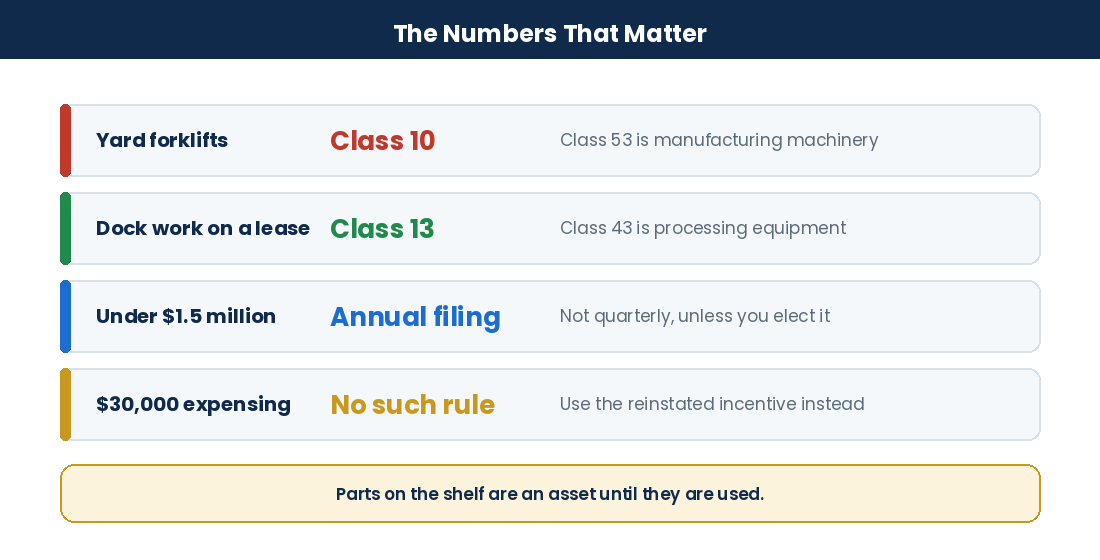
A correction on forklifts. Guidance circulating on this topic assigns forklifts to Class 10 at 30% in one place, Class 53 at 30% in another and Class 53 at 40% in a third. Class 53 is manufacturing and processing machinery, which a repair yard forklift is not, and its rate was never 30% or 40%. A forklift used around a yard is ordinarily Class 10.
Two further corrections. Class 43 is manufacturing and processing equipment, so dock structures do not belong there. Dock work on a leased marina site is generally Class 13; a structure on land you own is assessed on its own facts. And a service truck is either outside the passenger vehicle definition, in which case it is Class 10 with no cost cap, or it is a passenger vehicle in Class 10.1 with the cap. It cannot “qualify fully” in Class 10.1, since the cap is the point of that class.
Three different articles gave three different classes for the same forklift. The class decides the rate, so getting it wrong costs every year the asset is held. Figures changed for privacy.
Key Stat: Class 53 is manufacturing and processing machinery. Please do not put a yard forklift there; Class 10 is the ordinary answer.
Setting Up Marine Repair Business Accounting Systems
Accounting Systems and Bookkeeping
The Setup
Choosing the Right Accounting Method
Business income is computed on the accrual basis: income when earned, expenses when incurred. That is the requirement rather than a preference, and it is what makes work in progress reportable at the year end.
Cash-basis reporting is available only to specific activities such as farming and fishing. A marine repair corporation does not have that option, and guidance presenting cash and accrual as a choice is describing a rule that does not apply here.
Setting Up Chart of Accounts for Marine Repair Operations
| Account Type | What It Covers |
|---|---|
| Revenue – Labour | Billable technician hours |
| Revenue – Parts | Parts sold, at the price charged |
| Revenue – Hauling and launch | Lift and travel charges |
| Revenue – Winterization | Seasonal service work |
| Revenue – Storage | Yard and indoor storage charges |
| Revenue – Sublet | Work sent out, recorded gross |
| Expense – Labour wages | Technician pay and burden |
| Expense – Parts purchased | Feeding cost of goods sold |
| Expense – Shop supplies | Lubricants, abrasives, consumables |
| Expense – Marina rent or lease | Yard and premises |
| Expense – Utilities and insurance | Operating overhead |
| Expense – Disposal fees and advertising | Waste handling and marketing |
| Capital purchases | Anything over the threshold, so it reaches the register |
| Liability – Customer deposits | Held until the work is done |
The last two rows are added deliberately. A capital purchases account stops equipment landing in shop supplies, which is the most expensive routine error in a yard because it costs the depreciation claim in every year afterwards. A deposits liability account stops advance money being read as revenue.
Daily Transaction Tracking
Record sales, invoices, payroll, deposits and refunds as they happen. Separate labour revenue from parts revenue so margin is visible by department rather than averaged across two different businesses.
Reconciling Accounts Monthly
- Match bank statements to the ledger every month
- Compare sales tax collected against what was reported
- Review payroll remittances against the withholding calculation
- Check the deposits liability against open work orders
- Reconcile parts purchases against parts issued to jobs
Monthly reconciliation is what keeps a year-end close manageable in a seasonal business. A twelve-month gap turns a small discrepancy into a reconstruction exercise during the busiest part of the year.
Job Costing for Marine Repair Projects
Job costing assigns technician hours and the associated burden directly to each work order. That gives gross profit by job type, which is what tells you whether a repower is worth more than a gelcoat repair.
Labour burden includes employer contributions and vacation pay accrued but not yet paid. Allocating it properly is what makes the job-level margin real rather than notional.
- Link timesheets to work orders, not to weeks
- Allocate burden on hours, consistently
- Record sublet work gross, with the cost against the job
- Track unbilled hours, since they become work in progress at year end
Allocating Labour vs. Parts
Separating labour from parts matters for margin analysis and for inventory. Issue parts to jobs as they are used so stock does not accumulate unrecorded, and value what remains at the year end.
A perpetual inventory system tracks parts used against parts purchased, which supports both the cost of goods sold figure and any write-down. Financial statements for a Canadian private company are prepared under ASPE, and where a CPA compiles them the engagement is performed under CSRS 4200.
Managing Digital and Physical Records for Tax Compliance
Keep records for six years from the end of the taxation year they relate to. That is the correct measure; describing it as six years from filing understates the period where a return was filed late.
- Scanned invoices and work orders in cloud bookkeeping software
- Signed contracts and estimates, whether captured on paper or digitally
- Technician timesheets matching the electronic job records
- Year-end parts counts, signed
- Secure backups held off-site
Please note that record retention here is a tax requirement rather than a Transport Canada one. Marine regulators have their own obligations, but the six-year rule comes from the tax legislation.
Electronic records are acceptable provided they stay readable and retrievable for the whole period. A system migration that leaves years of attachments unopenable is a retention failure even though the data technically exists. Our bookkeeping and accounting services keep this running through the year.
Yards close their books in the one month they have time, which is January. That works only if the reconciliations happened monthly all season. Figures changed for privacy.
Pro Tip: Please set a capital purchases account and a deposits liability account in your software. Between them they prevent the two most common misstatements in a yard.
Maximizing Tax Deductions and Credits for Marine Repair
Deductions, Equipment and Credits
The Claims
Identifying Eligible Marine Repair Business Expenses
- Rent or lease for yard space
- Utility bills
- Insurance payments
- Fees for disposing of fuel or antifouling waste
- Tools and consumables used in repairs
- Safety gear costs
- Training and certification fees
- Advertising costs
- Meal and entertainment expenses, within limits
Expenses must be incurred to earn income and must pass the reasonableness requirement, which is tested on the amount relative to the work rather than on whether the category is deductible. Keep invoices that separate labour from parts, since that split feeds both your margin analysis and any review of the file.
Meals and entertainment are generally limited to 50%. Where a service truck is used personally, that use has to be dealt with, and for a corporation the route is a taxable benefit rather than a reduced claim.
Equipment and Parts Tax Deductions Specific to Marine Repair
| Asset Type | Class | Rate | Notes |
|---|---|---|---|
| Travel lifts and hoists | 8 | 20% | Declining balance |
| Welders and compressors | 8 | 20% | Declining balance |
| Forklifts and yard vehicles | 10 | 30% | Not Class 53, which is manufacturing machinery |
| Computers and systems software | 50 | 55% | Application software is Class 12 |
| Dock work on a leased site | 13 | Over the lease term | Not Class 43, which is processing equipment |
| Tools under $500 | 12 | 100% | Generally still subject to the half-year rule |
Parts consumed on a job are a current cost. Parts remaining at the year end are inventory at the lower of cost and net realizable value. Core charge refunds on returned parts should be tracked separately so they do not distort either figure.
The 2026 Position on Expensing
An important correction. Guidance stating that small-value assets, or equipment under $30,000, can be fully deducted in the year of purchase from 2026 is describing rules that do not exist. There is no such threshold.
What does apply is the accelerated investment incentive, reinstated by Bill C-15 with Royal Assent on 26 March 2026, for most depreciable property acquired after 2024 and available for use before 2030. Where it applies, an enhanced first-year deduction replaces the ordinary half-year rule.
- Check purchases made after 2024 against the incentive
- The test is when the asset became available for use, not the invoice date
- Returns still within the reassessment period may be worth revisiting
- Capital cost allowance is a maximum, so claim less in a weak year if that suits
The second point matters in a seasonal trade. A lift bought in December and commissioned in March is available for use in the later year, and that decides which year carries the claim.
Labour Costs and Job Costing Strategies for Tax Efficiency
Labour is the largest cost in most yards, and job costing is what turns it into information. Track billed hours against actual hours to see unbilled work in progress, which is income at the year end whether or not it has been invoiced.
Allocate payroll costs and benefits across jobs on hours. Comparing margin by job type, such as warranty work against commercial contracts, is what supports pricing decisions before the spring rush.
Leveraging SR&ED Tax Credits for Innovation in Marine Repair
Scientific research and experimental development credits are available for genuine technological advancement: developing a new process, resolving a technological uncertainty, or systematic investigation with recorded results.
The qualifying condition matters more than the credit rate. Routine repair work does not qualify, however skilled. Nor does applying an existing technique to a new boat, or improving a process by ordinary trial and adjustment. What qualifies is work addressing a technological uncertainty that could not be resolved by standard practice, documented as it happens.
- Eligible costs include wages of staff performing the work and materials consumed
- A CCPC may claim an enhanced refundable federal credit on qualifying expenditure up to a limit
- Provincial credits may be available in addition
- Contemporaneous documentation is what supports a claim, not a description written afterwards
Please take advice before assuming a project qualifies. A claim built on routine work costs preparation fees and produces a denial, and it draws attention to the file.
Other Canadian Tax Credits Applicable to Marine Repair Operators
| Credit | What It Covers | Condition |
|---|---|---|
| Apprenticeship Job Creation Tax Credit | A portion of eligible apprentice salaries | Registered apprentices in the first two years of an eligible trade |
| Provincial apprenticeship support | Varies by province | Programme dependent |
| Clean energy equipment incentives | Accelerated write-off on qualifying property | Specific classes, specific equipment |
One correction worth making. Interactive digital media credits are aimed at products developed for sale or licence, not at internal booking or inventory software a marina builds for its own use. A yard should not plan around that credit on the strength of an internal system.
Each credit has its own eligibility and its own documentation. Our corporate tax planning service works through which ones actually apply rather than listing everything that exists.
SR&ED claims in the trades fail on the qualifying condition, not the arithmetic. Skilled work is not the same as technological advancement. Figures changed for privacy.
Risk Warning: There is no $30,000 immediate expensing rule. Please check the reinstated investment incentive instead for property acquired after 2024.
Understanding GST/HST Reporting for Marine Repair Businesses
GST/HST, Records and Deadlines
Compliance
Registration and Filing Frequency
Register once taxable sales exceed $30,000, on either threshold test. Reporting frequency is then assigned by size.
| Annual Taxable Supplies | Assigned Frequency | Return Due |
|---|---|---|
| $1.5 million or less | Annually | Generally three months after the year end |
| Over $1.5M up to $6M | Quarterly | One month after the period end |
| Over $6 million | Monthly | One month after the period end |
This table corrects a figure that circulates widely. Guidance saying that businesses under $1.5 million file quarterly and those over file monthly has dropped the annual tier and shifted everything up a level. Most marine repair yards fall in the first row and are assigned annual filing, with the option to elect something more frequent.
Electing quarterly is often worth it for a yard with heavy spring equipment purchases, because credits are recovered sooner rather than sitting until the following year.
Reporting Requirements
Report tax collected less the credits you claim. To claim credits properly:
- Keep invoices carrying the supplier’s registration number
- Keep business and personal expenditure separate
- Claim only the business portion where use is mixed
- Retain the documentation for the full retention period
Collected tax is held in trust. Set it aside as it arrives, because directors can be assessed personally for amounts not remitted.
Proper Classification of Capital Assets vs. Current Expenses
| Work Done | Treatment |
|---|---|
| Servicing a lift to keep it operating | Current expense |
| Replacing a worn component in the ordinary course | Generally current |
| Rebuilding equipment to extend its life materially | Capital |
| Adding capability the asset did not have | Capital |
| Repainting the shop | Current |
| Building a new dock or bay | Capital |
Where the amount is significant, decide deliberately and write the reasoning on the invoice. Reconstructing it eighteen months later is where yards lose the argument.
Maintaining Accurate Financial Statements for Audit Readiness
- Balance sheet showing assets, liabilities and the deposits held
- Income statement with labour and parts separated
- Cash flow statement, which matters in a seasonal trade
- Work-in-progress schedule supporting the year-end figure
- Parts inventory listing with the count sheet attached
Organise records by job number. During a review the questions come job by job, and a filing system organised by month makes a straightforward request into a search.
Handling Tax Inquiries and CRA Communication Effectively
Common triggers include cash volumes without matching paperwork, large parts write-downs without support, contractor payments without the required slips, sales that do not reconcile to credits claimed, and personal use of shop assets that has never been reported.
A correction on penalties. Guidance stating that penalties “start at $250” is wrong. The corporate late-filing penalty is 5% of the unpaid tax plus 1% per complete month the return is late, to a maximum of twelve months, with a higher rate on repetition. The $250 figure is a separate penalty for failing to file electronically where required.
The practical consequence differs. A late return with no balance owing generally carries little or no late-filing penalty. A late return on a profitable season carries a serious one.
Interest compounds daily until paid, and only payment reliably stops it. Taxpayer relief is discretionary and reaches back ten years, on grounds such as circumstances beyond your control or CRA delay.
Meeting Regulatory Deadlines and Filing Obligations
| Filing Type | Due Date | Who It Applies To |
|---|---|---|
| T2 Corporate Tax Return | Six months after fiscal year end | All corporations, including dormant ones |
| Balance payment | Three months for an eligible CCPC, two for others | Corporations with a balance owing |
| Instalment payments | Monthly, or quarterly where the corporation qualifies | Corporations above the threshold |
| GST/HST returns | By assigned frequency | Registered businesses |
| Payroll source deductions | 15th of the following month for a regular remitter | Employers |
| T4 and T4A slips | End of February | Employers and payers |
Two points on this table. The balance payment row is often reversed in published versions: three months is the longer window and it applies to eligible CCPCs, while other corporations have two. And corporate instalments default to monthly, with quarterly available only where the corporation meets the conditions.
Our GST/HST filing service and corporate tax filing service cover these together.
Most yards are assigned annual sales tax filing and are told they should be quarterly. Electing quarterly can still be worth it, but for cash flow, not compliance. Figures changed for privacy.
Risk Warning: Under $1.5 million the assigned frequency is annual, not quarterly. Please confirm your assigned period rather than assuming.
Incorporation, Cash Flow and Working With a Marine Repair Tax Accountant
Structure, Cash Flow and Working With Us
The Engagement
Incorporation vs. Sole Proprietorship: Tax Implications
| Factor | Sole Proprietorship | Corporation |
|---|---|---|
| Return filed | T1, with a business statement | T2 |
| Rate on business income | Personal graduated rates | Small business rate on active income |
| Deferral | None; taxed as earned | Available on income retained |
| Liability | Personal | Separated, subject to guarantees |
| Compliance cost | Lower | Higher, with formal statements |
An eligible Canadian-controlled private corporation claims the small business deduction on the first $500,000 of active business income. In Ontario the combined rate on that income has been around 12.2%, and moves lower as the provincial rate drops to 2.2% from 1 July 2026. Personal rates on the top bracket in Ontario reach the low fifties.
The deferral is the real benefit and it is conditional. It applies to income left in the company. Money taken out is taxed in the owner’s hands, so a yard that distributes everything each year gets far less from incorporating than the rate comparison suggests.
Planning Quarterly Tax Instalments and Cash Flow Management
Corporate instalments are based on the prior year, the year before that, or an estimate of the current year, and the basis is a genuine choice for a business whose season varied.
A correction on dates. Corporate instalments are due on the last day of each month, or each quarter where the corporation qualifies for quarterly instalments, measured against its own fiscal year. The 15 March, June, September and December pattern belongs to personal instalments and does not apply to a corporation.
- Choose the instalment basis deliberately after a weak or strong season
- Track invoices weekly through the busy months
- Match payroll to technician schedules rather than to a flat year
- Time equipment purchases against availability for use
- Set collected sales tax aside as it arrives
Forecasting Future Expenses and Investment in Equipment
Distinguish maintenance from capital improvement before the invoice is coded. Hull painting on your own equipment is maintenance; installing a new hoist is capital.
Before a significant purchase, weigh the class rate against the asset’s working life, compare lease against buy on total cost rather than monthly payment, and consider whether the reinstated incentive applies. And remember the claim is a maximum, so a purchase in a weak season does not have to be claimed in full that year.
Building a Tax-Efficient Payroll Structure for Staff
- Withhold income tax, CPP and EI and remit by your remitter deadline
- Confirm the remitter type as withholdings grow through the season
- Issue Records of Employment on seasonal layoffs, which are common in this trade
- Classify technicians correctly as employees or contractors
- Register for provincial workplace safety insurance where required
Classification is decided on the facts: control over the work, who supplies the tools, chance of profit or loss, and integration. A written agreement calling someone a contractor does not settle it, and misclassification produces reassessments plus the employer contributions never made.
Utilizing Tax Planning to Support Business Growth and Stability
- Time significant purchases against the availability-for-use test
- Choose the capital cost allowance claim rather than defaulting to the maximum
- Use loss carrybacks where a poor season follows profitable ones
- Review the shareholder loan balance before the year end
- Plan the deposit position so autumn cash is not mistaken for profit
On carrybacks, a non-capital loss carries back three years and forward twenty. The year you choose to apply it against changes the recovery, so it is a decision rather than a default.
Benefits of Working With Gondaliya CPA
Gondaliya CPA works with incorporated Canadian marine and trade service businesses on bookkeeping with reconciliation, job costing, the asset register and capital cost allowance decisions, sales tax filings, payroll and the corporate return.
Fees are quoted before work begins, including HST, with a one-business-day response and evening and weekend availability. Our engagements carry a 30-day money-back arrangement and a 60-day fee-matching arrangement, and we say plainly where a position will not hold.
Preparing for Your Tax Appointment
| Document | Purpose |
|---|---|
| Year-to-date bookkeeping files | Confirming income and expenses |
| Open work orders and invoices | Supporting job costing and work in progress |
| Parts inventory count | Valuing closing stock and any write-down |
| Payroll summaries | Confirming remittances are current |
| GST/HST returns filed | Reviewing credits claimed |
| Equipment purchase agreements | Assigning classes and dates |
| Customer deposit records | Establishing what is revenue and what is not |
Contact Gondaliya CPA at info@gondaliyacpa.ca, call 647-212-9559, or send us a message. Where records have drifted, our catch-up bookkeeping services handle the correction first.
The open work orders and the deposits list are the two documents that change the answer most, and they are the two nobody brings. Figures changed for privacy.
Key Stat: Corporate instalments fall on the last day of each month or quarter of your fiscal year. The 15 March pattern is personal, not corporate.
Frequently Asked Questions (FAQs) on Marine Repair Business Taxes Canada
Frequently Asked Questions
FAQ
What is the T2 corporate tax filing deadline for marine repair businesses?+
Six months after fiscal year end. Payment is due earlier, generally three months for an eligible CCPC and two months for other corporations.
How often should I file GST/HST returns for my marine repair business?+
By assigned frequency: annual at $1.5 million or less, quarterly above that to $6 million, and monthly above $6 million. Most yards are assigned annual and may elect more frequent filing.
When is the payroll remittance due date for marine repair companies?+
A regular remitter pays by the 15th of the month following the payroll. The remitter type changes as average withholdings grow, so confirm it as you staff up.
What are the main capital cost allowance classes for marine repair assets?+
Travel lifts, hoists, welders and compressors in Class 8 at 20%, forklifts and yard vehicles in Class 10 at 30%, computers in Class 50 at 55%, and leasehold improvements in Class 13 over the lease term.
Are forklifts Class 53?+
No. Class 53 is manufacturing and processing machinery, which a repair yard forklift is not. Class 10 is the ordinary answer for a yard forklift.
Can I claim meals and entertainment expenses in my marine repair business?+
Generally 50% of reasonable amounts related to the business. Keep the receipt and note the purpose and who attended.
What is the per-kilometre allowance rate for service vehicles?+
The CRA sets prescribed rates annually and they are tiered by distance. Use the current year’s figures rather than a rate quoted in an older article.
How long must I keep records for my marine repair business?+
Six years from the end of the taxation year the records relate to, not six years from filing. Electronic records must stay readable for the whole period.
What accounting method applies to recognizing revenue on long-term repairs?+
Business income is computed on the accrual basis. Work performed but unbilled at the year end is income, so a work-in-progress figure is required rather than optional.
How do I handle customer deposits and progress billings correctly?+
A deposit is a liability until the work is performed or it is forfeited. Progress billings recognise revenue as the work is done, supported by the work order record.
What bookkeeping tools help manage parts inventory effectively?+
A perpetual inventory system tracking parts issued to jobs against parts purchased, with a physical count at year end and any write-down documented item by item.
Is there a $30,000 immediate expensing rule from 2026?+
No. That rule does not exist. The measure that applies is the accelerated investment incentive, reinstated by Bill C-15 on 26 March 2026 for property acquired after 2024.
Does routine repair work qualify for SR&ED credits?+
No. Skilled repair work is not technological advancement. A claim needs a technological uncertainty that standard practice could not resolve, with contemporaneous documentation.
Are corporate instalments due on 15 March, June, September and December?+
No. Those are personal instalment dates. Corporate instalments fall on the last day of each month, or each quarter where the corporation qualifies for quarterly instalments.
What is the corporate late-filing penalty?+
5% of the unpaid tax plus 1% per complete month the return is late, to a maximum of twelve, with a higher rate on repetition. There is no flat $250 starting penalty.
Do I still file if my yard was dormant over the winter?+
Yes. A corporation with no activity still has a filing obligation. Dormancy is not an exemption, and the return generally carries little or no penalty since the calculation runs on unpaid tax.
Sixteen questions, and several exist because published guidance on this trade contradicts itself. Check the class before you check the rate. Figures changed for privacy.
Essential Points on Marine Repair Business Accounting & Tax Compliance
Essential Points on Compliance
Quick Reference
- Maintain clear work order structures including mobile call-outs, warranty, insurance jobs, and abandoned boats.
- Allocate overhead fairly across labour, parts, sublet work, and shop expenses.
- Use job costing software to track unbilled labour and work-in-progress accurately.
- Issue T4 and T4A slips timely for employees and contractors.
- Assess employee vs contractor status carefully to avoid CRA reclassification risks.
- Follow CSRS 4200 compilation standards when preparing financial statements reported on ASPE.
- File GST/HST returns on your assigned frequency, considering the quick method where you qualify.
- Separate personal use taxable benefits properly to avoid unintended taxable income.
- Manage seasonal payroll with attention to provincial workplace safety insurance obligations.
- Track core charges, consignment parts, and refundable deposits distinctly in accounting records.
- Monitor filing deadlines strictly to prevent penalties and interest charges.
- Keep a topical FAQ and glossary handy for staff training on marine repair tax essentials.
- Choose a CPA firm with expertise in Toronto and Ontario marine repair businesses.
- Use taxpayer relief requests judiciously if facing penalties due to unforeseen circumstances.
- Document customer contracts precisely to support the timing of revenue recognition.
The Year-End Decisions
- Value unbilled work in progress at the year end, since it is income under accrual reporting.
- Count parts physically and value them at the lower of cost and net realizable value.
- Hold customer deposits as a liability until the work is performed or forfeited.
- Confirm the class before the rate, since the class decides everything after it.
- Check equipment is available for use before the year end where you want that year’s claim.
- Choose the capital cost allowance claim rather than defaulting to the maximum.
- Confirm your assigned sales tax frequency rather than assuming quarterly.
Corrections Worth Carrying
- Class 53 is manufacturing machinery, not yard forklifts.
- Class 43 is processing equipment, not dock structures.
- There is no $30,000 or small-value immediate expensing rule.
- The corporate late-filing penalty is 5% plus 1% per month, not a flat amount.
- Corporate instalments follow your fiscal year, not the personal March to December pattern.
- Records run six years from the end of the year concerned, not from filing.
- Routine skilled repair work does not qualify for SR&ED.
For expert assistance on marine repair business taxes Canada, contact Gondaliya CPA at info@gondaliyacpa.ca, call 647-212-9559, or book a free consultation.
Twenty-nine points, and the seven in the last group exist because they appear wrongly in guidance dealers actually read. Figures changed for privacy.
Businesses We Serve
Industry Expertise
Marine and trade service businesses share the same issues. Here are ten and the usual finding.
| Business | The Issue That Usually Appears |
|---|---|
| Boatyards and marine repair shops | Work in progress omitted at the year end |
| Mobile marine mechanics | Service vehicle treatment and personal use |
| Marinas with storage | Autumn deposits recorded as revenue |
| Yards with parts counters | Parts expensed on purchase rather than on use |
| Shops with travel lifts | Equipment coded to supplies, never in the register |
| Anyone with dock structures | Placed in the wrong class entirely |
| Seasonal employers | Remitter type changed without anyone noticing |
| Yards using subcontractors | Worker classification untested until reviewed |
| Businesses under $1.5 million | Assuming quarterly sales tax filing when annual applies |
| Anyone buying equipment | Post-2024 purchases on the plain half-year rule |
- Boatyards and marine repair shops: Value the open jobs.
- Mobile marine mechanics: A benefit, not a proration.
- Marinas with storage: A liability until earned.
- Yards with parts counters: Issue to jobs, count at year end.
- Shops with travel lifts: Check the supplies account.
- Anyone with dock structures: Leased site means Class 13.
- Seasonal employers: Confirm it each spring.
- Yards using subcontractors: The facts decide, not the contract.
- Businesses under $1.5 million: Check your assigned period.
- Anyone buying equipment: Check the 2026 incentive.
The trade changes the equipment. It does not change the three items that cross the year end, or the fact that two understate income and one overstates it. Figures changed for privacy.
Professional Guidance and Quick Reference
Guidance
Professional Guidance: How Gondaliya CPA Handles Your Yard
Marine repair businesses get their numbers wrong in a predictable set of ways: leaving unbilled work in progress out of the year end when accrual reporting makes it income, expensing parts on purchase rather than carrying them as inventory until used, recording autumn deposits as revenue when they are a liability until the work is done, assigning yard forklifts to Class 53 which is manufacturing machinery, putting dock structures in Class 43 which is processing equipment, planning around a $30,000 immediate expensing rule that does not exist, assuming quarterly sales tax filing when a yard under $1.5 million is assigned annual, and using personal instalment dates for a corporation. Gondaliya CPA handles yard accounting on a flat annual fee.
We handle what decides the outcome: valuing work in progress against open work orders, counting and valuing parts at the lower of cost and net realizable value, holding deposits as a liability until earned, assigning equipment to the correct classes with availability-for-use timing, applying the reinstated investment incentive to eligible purchases, confirming the assigned sales tax frequency, and testing worker classification before a review does it for you.
Our team starts with your last filed corporate return, your open work orders and your deposits list. Those three change the answer more than anything else. Whatever your yard, you get clear advice and a fixed price before we start.
Quick Answers
- Work in progress: Income, even unbilled
- Parts on the shelf: An asset until used
- Customer deposits: A liability until earned
- Reporting basis: Accrual, not a choice
- Yard forklifts: Class 10, not Class 53
- Dock work on a lease: Class 13, not Class 43
- Under $1.5 million: Annual sales tax filing
- Immediate expensing: No $30,000 rule exists
- Late-filing penalty: 5% plus 1% monthly
- Instalments: Your fiscal year, not March to December
Who This Is For
- For: Incorporated Canadian marine repair businesses, boatyards, marinas with service departments and mobile marine mechanics.
- Not For: A statement of current prescribed rates or vehicle limits, which are set annually and should be confirmed for the year concerned.
People Also Ask
What is work in progress and why does it matter?+
Labour and parts consumed on jobs not yet invoiced at the year end. It is income under accrual reporting, so omitting it understates the year.
Are deposits taxable when received?+
For income tax they are a liability until earned. For sales tax a deposit generally becomes consideration when applied to the price or forfeited.
Should my yard elect quarterly GST/HST filing?+
Often worth it where spring equipment purchases put you in a refund position, since credits are recovered months sooner than under annual filing.
Glossary of Key Terms
- Work in progress: Labour and parts consumed on jobs not yet invoiced.
- Accrual basis: Income when earned, expenses when incurred.
- Job costing: Assigning hours and burden to individual work orders.
- Labour burden: Employer contributions and accrued vacation on wages.
- Net realizable value: The ceiling at which inventory is carried.
- Perpetual inventory: Tracking parts issued against parts purchased.
- Core charge: A refundable amount on an exchange part.
- Customer deposit: A liability until the work is performed or forfeited.
- Sublet work: Work sent out, recorded gross against the job.
- Capital cost allowance: Tax depreciation, a maximum not an obligation.
- Available for use: When an asset becomes eligible for depreciation.
- Class 13: Leasehold improvements, amortised over the lease term.
- ASPE: The standards Canadian private company statements follow.
- CSRS 4200: The standard governing a CPA compilation engagement.
- Remitter type: How often payroll withholdings must be sent.
- Trust amounts: Collected sales tax and payroll source deductions.
Year-End Readiness Check
This quick self-check indicates where your operation most likely has room. Please answer the six questions below.
Year-End Readiness Check
Six quick questions on your yard. No fee shown.
Points to raise with us:
This is a general prompt, not tax or legal advice or a quote. Your position depends on your full facts. For a real review, please book a free consultation.
Want a checklist to work from? You can download our free marine repair year-end checklist before your consultation.
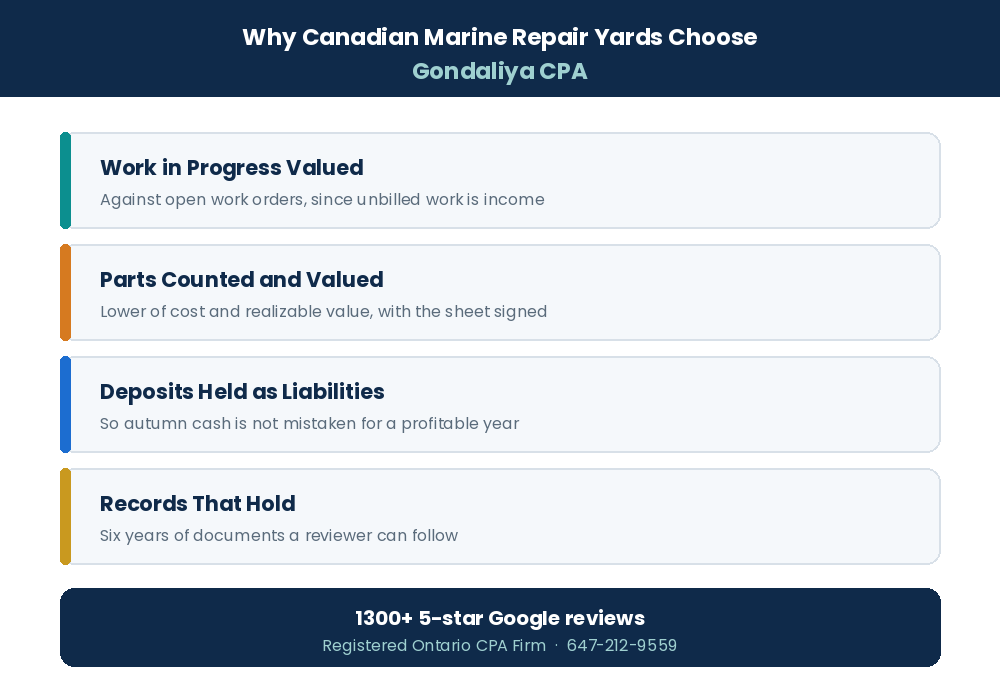
Value work in progress against open work orders at the year end. Count parts and value them at the lower of cost and net realizable value. Hold deposits as a liability until the work is done. Confirm the class before the rate. Check equipment is available for use before the year closes. Apply the reinstated incentive to post-2024 purchases. Confirm your assigned sales tax frequency. Please keep six years of records.
2026 Update — what is current: This article reflects rules current to 2026. The Class 8 rate of 20%, the Class 10 and 10.1 rates of 30%, the Class 50 rate of 55%, the $1.5 million and $6 million GST/HST reporting frequency thresholds, the $30,000 small supplier threshold on both tests, the six-month T2 filing deadline and the six-year record retention requirement are unchanged. Bill C-15 received Royal Assent on 26 March 2026, reinstating the accelerated investment incentive for most depreciable property acquired after 2024 and available for use before 2030, and Ontario\u2019s small business rate moves to 2.2% from 1 July 2026. Please note that business income is computed on the accrual basis and cash reporting is not available to a marine repair corporation, so unbilled work in progress is income at the year end; that Class 53 is manufacturing and processing machinery and a yard forklift belongs in Class 10, while Class 43 is processing equipment and dock work on a leased site belongs in Class 13; that there is no $30,000 or small-value immediate expensing rule and guidance describing one is describing something that does not exist; that a business with annual taxable supplies of $1.5 million or less is assigned annual GST/HST filing rather than quarterly, with more frequent filing available by election; that the corporate late-filing penalty is 5% of unpaid tax plus 1% per complete month rather than a flat $250; that corporate instalments fall on the last day of each month or qualifying quarter of the corporation\u2019s own fiscal year rather than on the personal March, June, September and December pattern; that the balance payment window is three months for an eligible CCPC and two for other corporations; and that record retention runs six years from the end of the taxation year concerned rather than from filing.
Marine Repair Business Taxes Canada: How Gondaliya CPA Supports Yards
Start with the open work orders
Gondaliya CPA values work in progress against open work orders, counts and values parts at the lower of cost and net realizable value, holds deposits as a liability until earned, assigns equipment to the correct classes with availability-for-use timing, applies the reinstated investment incentive to eligible purchases, confirms your assigned sales tax frequency and tests worker classification, on a flat annual fee including HST with a one-business-day response. Please book a free consultation.
Next Steps
Please book a free consultation with Gondaliya CPA and bring your last filed corporate return, your open work orders, and your customer deposits list. Those three show where the real position is, what is misstated, and what remains to claim on the equipment, and where the documentation is thin. You will get a flat annual fee including HST before any work begins. If our content helps, please add gondaliyacpa.ca as a preferred source on Google.
Published: · Last updated:
Editorial policy: We research against CRA and CPA Ontario sources, fact-check the figures, and Sharad Gondaliya, CPA, reviews the content, which we update as the rules change.
Disclaimer: This article is educational information only and is not tax, legal, or financial advice. Figures marked illustrative are examples rather than quotes or guarantees. It reflects CRA rules current to 2026, including the $30,000 GST/HST threshold, the Class 8 rate, Class 13 leasehold treatment, the half-year rule, and the six-year retention requirement. Rates, limits and expensing rules change and outcomes depend on your specific facts. Please consult a licensed CPA before acting.

Sharad Gondaliya is a CPA Canada & CPA USA with 15 Years+ experience of Accounting, Tax, Payroll of Corporate Small Businesses as Tax Accountant. He is fully certified CPA Ontario and CPA USA and is well known among corporate small businesses for tax planning, efficient tax solutions, and affordable CPA services. Sharad is the Principal (Director) of Gondaliya CPA – Affordable CPA Firm in Canada. Licenses: CPA Ontario: 61040184 | CPA USA (MT): PAC-CPAP-LIC-033176 | CPA USA (WA): 57629 | CPA Firm License: 61330051 View Full Author Bio