



Medical Device Distributor Tax Rules in Canada: Inventory, Imports & Business Expenses
Medical device distributor tax Canada: inventory valuation, import taxes, and allowable business expenses
Medical device distributor tax rules in Canada cover inventory valuation, import duties, and allowable business expenses essential for accurate medical device distribution tax filing. Gondaliya CPA highlights the importance of tracking landed cost, input tax credits, and managing consignment stock to optimize compliance with GST/HST and CRA requirements.
Quick Summary
Zero-rating for medical devices is in Schedule VI, Part II of the Excise Tax Act, not in section 123(1), which is the definitions provision. A large part of that Part zero-rates a device only when supplied on the written order of a medical practitioner for a named consumer, and parts and accessories specially designed for a listed device are zero-rated in their own right under section 32. Inventory is valued under section 10 at the lower of cost and fair market value — it is not a free choice between two methods. And customs duty is never recoverable as an input tax credit: only the Division III GST imposed under section 212 comes back, claimed under 169(1).
Reading time: 32 minutes.
Table of Contents
- Three Things You Have Been Told
- Overview of Medical Device Distributor Tax Rules
- Inventory Taxation and Valuation
- Import Duties, Taxes and Compliance
- Business Expenses and Tax Deductions
- Practical Guidance for Compliance and Filing
- Regulatory Context and Updates
- Frequently Asked Questions
- Key Controls and Warning Signs
- Businesses We Serve & Industry Spotlights
- Professional Guidance and Quick Reference
The Numbers That Matter
This article covers Canada, with Ontario and Toronto context, and reflects rules current to 8 October 2026. It is written for incorporated distributors of medical devices — importers of record, wholesalers supplying hospitals, clinics and retail, and distributors carrying mixed catalogues of zero-rated and taxable product. Gondaliya CPA performs compilation engagements; we do not perform audits or review engagements. Device classification under the Food and Drugs Act and the Medical Devices Regulations is a regulatory matter separate from GST/HST rating, and a Health Canada licence does not decide the tax treatment. This is educational information only and not tax or legal advice.
Three Things You Have Been Told
Three Things You Have Been Told
The Corrections
Three claims circulate in distributor tax guidance. Each one sends a reader to the wrong provision, and the third costs real money on every import.
Zero-Rating Is Schedule VI, Part II — and Half of It Is Conditional
Risk Warning: “imported listed medical devices are zero-rated under section 123(1)(b) of the Excise Tax Act” points at the wrong provision. Section 123(1) is the definitions section. There is no paragraph in it that zero-rates a device.
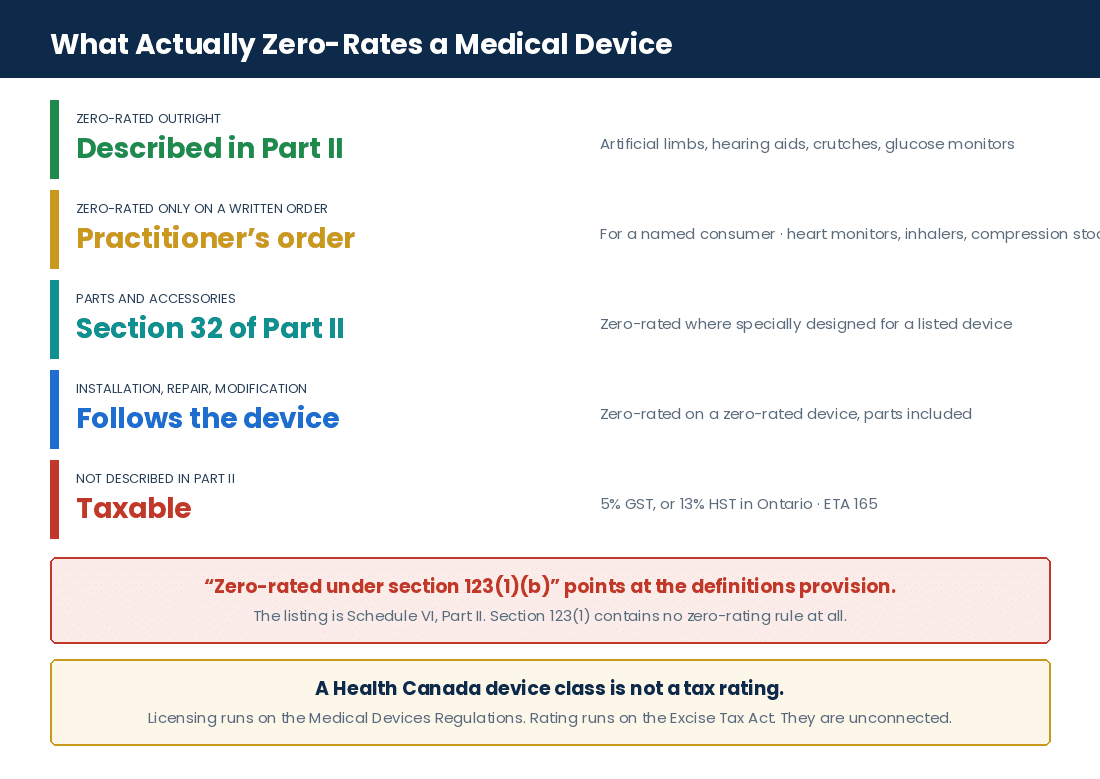
Zero-rating for medical devices is in Schedule VI, Part II. A device is zero-rated because it is described in a section of that Part, and for a great many entries the description carries a condition.
| Category | Condition | Examples |
|---|---|---|
| Zero-rated outright | None — the description alone governs | Artificial limbs and eyes, hearing aids, crutches, blood-glucose monitors and testing strips, insulin pumps, lancets, custom-made orthotics, patient lifters, wheelchair ramps |
| Zero-rated only on a written order | Supplied on the written order of a medical practitioner for a named consumer | Heart-monitoring devices, aerosol chambers and metered-dose inhalers, graduated compression stockings, lymphedema pumps, non-custom orthotic devices, specially designed clothing and footwear |
| Parts and accessories | Specially designed for a listed device | Zero-rated in their own right under section 32 of Part II |
| Installation, repair and modification | Performed on a zero-rated device | The service, and parts supplied with it, are zero-rated |
| Everything else | Not described in Part II | Taxable at the ordinary rate |
Two consequences follow for a distributor. The first is that parts and accessories are not automatically taxable: where they are specially designed for a listed device, section 32 zero-rates them, and a catalogue that rates every accessory as taxable is overcharging customers and holding tax it never owed. The second is that the written-order items cannot be rated once and forgotten — the same SKU can be zero-rated on one invoice and taxable on the next, depending on whether the order is on file.
Inventory Is the Lower of Cost and Fair Market Value, Not a Choice
Risk Warning: “Canadian tax law requires sticking to either cost or fair market value” describes a choice the Act does not offer.
Under subsection 10(1), inventory is valued at the lower of its cost and its fair market value at the end of the year. It is not a cost method against an FMV method; it is one rule that takes the lower of the two figures, item by item.
The alternative is an election, not a method. Regulation 1801 permits a taxpayer to value all of its inventory at fair market value, and once made that basis must be used consistently. Subsection 10(2.1) requires the method used in a year to continue in later years unless the Minister concurs in a change. So the consistency the source describes is real; the free choice between two methods is not.
Customs Duty Is Never an Input Tax Credit
Risk Warning: “if goods qualify as zero-rated supplies later, some import taxes might be claimed back as ITCs” conflates two different charges at the border.
Customs duty is a charge under the Customs Tariff. It is never recoverable as an input tax credit by anyone. It forms part of the landed cost of the goods and is deducted through cost of goods sold when they are sold.
| Charged at the border | Recoverable? | Where it goes |
|---|---|---|
| GST under Division III, imposed by section 212 | Yes, as an input tax credit under 169(1) | Claimed on the GST/HST return, with the CBSA accounting document as support |
| Customs duty under the Customs Tariff | No. Never. | Capitalised into inventory, deducted through COGS on sale |
| Brokerage and freight | GST on the service is recoverable; the fee itself is not a tax | Capitalised into inventory |
| Provincial sales tax in a non-harmonised province | No | Capitalised into inventory |
The zero-rated status of the goods makes no difference to whether the duty comes back. It never does. What zero-rating preserves is the right to claim the Division III GST as an input tax credit even though no tax will be charged on the eventual sale — which is exactly the difference between a zero-rated supply and an exempt one.
A distributor had been expensing customs duty and brokerage on payment rather than capitalising them.
Current-year expenses were overstated and closing inventory understated by roughly the same amount, so the error largely reversed year to year and nobody noticed. It surfaced on a review, where the inventory figure on the balance sheet could not be reconciled to the import entries. Figures changed for privacy.
Overview of Medical Device Distributor Tax Rules in Canada
Overview of Medical Device Distributor Tax Rules
Foundations
Medical device distribution tax obligations under Canadian law
An incorporated distributor files a T2 return within six months of its fiscal year-end under paragraph 150(1)(a). The balance of tax falls earlier, at two months under paragraph 157(1)(b), or three for an eligible Canadian-controlled private corporation claiming the small business deduction. That gap is where distributors most often get caught: the return feels like the deadline, and interest has already been running for four months by the time it is filed.
Late filing is penalised under subsection 162(1) at 5% of the unpaid tax plus 1% per complete month to a maximum of twelve, and arrears interest compounds daily under subsection 161(1). CRA reviews of distributors usually begin with a mismatch — GST/HST returns that do not reconcile to reported revenue, or an inventory figure that does not tie to the import entries.
Key tax concepts for medical device distributors: GST/HST, input tax credits, and zero-rated supplies
| Concept | What it means | Credits on inputs? |
|---|---|---|
| Zero-rated supply | Taxable at 0%. Listed in Schedule VI; medical devices in Part II | Yes — fully recoverable |
| Exempt supply | No tax charged, listed in Schedule V. Most health care services, not devices | No |
| Ordinary taxable supply | 5% GST, or 13% HST in Ontario, under section 165 | Yes |
| Input tax credit | Recovery of GST/HST paid on business inputs, under 169(1) | Needs documentation meeting 169(4) |
The distinction that matters to a distributor is zero-rated against exempt. Both put nothing on the customer invoice. Only one lets you recover the tax you paid on the way in. A distributor whose catalogue is mostly Part II devices will be in a persistent refund position, and that is the expected outcome rather than a red flag.
Understanding inventory management’s impact on tax reporting
- Valuation under section 10 at the lower of cost and fair market value, applied consistently year to year under 10(2.1).
- Landed cost capitalised into inventory rather than expensed on payment, so the deduction follows the sale.
- Write-downs of obsolete or expired stock recognised at year-end, supported by dated evidence rather than a journal entry alone.
- Physical counts reconciled to the ledger, because the count is what makes the closing figure defensible.
Overview of import tax considerations for medical devices in Canada
- Landed cost includes the purchase price, customs duty, brokerage, freight to the point of arrival and any non-recoverable taxes.
- Importer of record accounts to CBSA for the value for duty, the tariff classification and the origin, and is the person who pays the Division III tax.
- Where goods are imported on behalf of another person, section 178.8 of the Excise Tax Act decides who may claim the credit.
Is the Tax Paid at the Border Recoverable?
Partly, and the part that comes back is not the part most people expect. The Division III GST imposed under section 212 is recoverable as an input tax credit under 169(1), with the CBSA accounting document as proof. The customs duty is not, in any circumstances, and no amount of zero-rating on the eventual sale changes that.
Importance of accurate bookkeeping and tax filing for medical device distributors
- A catalogue rating file recording, for every SKU, which section of Schedule VI Part II applies and whether a written order is required.
- Import entries filed and reconciled, with duty, brokerage and freight allocated to the right stock.
- Inventory records matched to physical counts on a regular cycle.
- Consignment and distribution agreements kept accessible, because they decide who owns the goods and who reports the sale.
- Records retained six years from the end of the taxation year to which they relate under paragraph 230(4)(b), with the same period for GST/HST under section 286 of the Excise Tax Act. The figure is six, not seven, and it runs from the year-end rather than from the filing date.
Registration is required once you cease to be a small supplier — $30,000 of taxable supplies, measured over four consecutive calendar quarters or in a single quarter, under section 148 of the Excise Tax Act with the registration requirement in 240(1). That threshold governs registration; the duty to keep books and records in section 286 applies to a registrant regardless of revenue. A distributor whose catalogue is largely zero-rated will usually want to register well before the threshold, because registration is what makes the Division III tax recoverable.
GST/HST filing frequency then follows annual taxable supplies: annual to $1.5M, quarterly to $6M, monthly above. The band is assigned rather than chosen, though a distributor in a persistent refund position often elects to file more frequently to get the money back sooner.
A distributor filed GST/HST annually while carrying a catalogue that was almost entirely zero-rated.
Every dollar of Division III tax paid at the border sat with CRA for up to a year before the refund arrived. Moving to monthly filing did not change the tax by a cent and changed the working capital position materially. Figures changed for privacy.
Inventory Taxation and Valuation for Medical Device Distributors
Inventory Taxation and Valuation
Inventory
Inventory is where a distributor’s taxable income is actually decided. Get the valuation and the landed cost right and the rest of the return follows; get them wrong and every year is misstated in the same direction.
Methods for valuing medical device inventory for tax purposes
Key Stat: subsection 10(1) requires inventory to be valued at the lower of cost and fair market value at the end of the year. Fair market value here means what the property would fetch, not an estimate of the sale price net of selling costs.
Regulation 1801 offers the one alternative: an election to value all inventory at fair market value. Having chosen a basis, subsection 10(2.1) requires it to be used in later years unless the Minister concurs in a change.
| Element | Treatment | Provision |
|---|---|---|
| Default valuation | Lower of cost and fair market value, item by item | ITA 10(1) |
| Alternative | Elect fair market value for all inventory | Regulation 1801 |
| Consistency | The basis used must continue unless the Minister concurs in a change | ITA 10(2.1) |
| Opening inventory | Equals the closing value of the preceding year | ITA 10(2) |
| Cost flow | FIFO or weighted average, applied consistently. LIFO is not accepted for Canadian tax purposes | Section 10; ASPE 3031 |
| What is included in cost | Purchase price plus all costs of bringing the goods to their present location and condition | ASPE 3031; section 10 |
The point on LIFO is worth stating plainly because the source material for distributors is often American. Last-in first-out is permitted in the United States and is not an acceptable basis in Canada.
Treatment of consignment stock, demo units, and returned goods
- Consignment stock remains the property of the consignor until sold. The consignee does not include it in inventory and does not report the purchase; it tracks the goods separately and accounts for the sale when title passes. For GST/HST, where the consignee sells as agent, section 177 of the Excise Tax Act governs who is treated as having made the supply.
- Demo and evaluation units start as inventory. Where a unit is taken out of stock and used in the business — loaned to clinicians, kept for training, shown at trade shows over several years — it has been converted from inventory to capital property and belongs in a capital cost allowance class, generally Class 8 at 20%. The conversion is a disposition of inventory at fair market value.
- Returned goods move in two directions at once: the sale is reversed and the stock comes back. The GST/HST side runs on a credit note under section 232, which is what permits the tax originally charged to be adjusted, and the physical side has to reach the count.
Handling write-downs, recalls, and allowances in inventory accounting
A write-down is a valuation conclusion, not a journal entry. Subsection 10(1) measures the inventory at the end of the year, so the facts that support a reduced value have to exist at that date.
| Situation | Treatment | Evidence that holds up |
|---|---|---|
| Expired stock | Written down to fair market value at year-end | Dated count sheet showing lot and expiry, disposal record |
| Obsolete or superseded product | Written down where fair market value is below cost | Supplier discontinuation notice, aged stock report, markdown history |
| Damaged goods | Written down or written off | Inspection report, photographs, insurance correspondence |
| Recall | Sales reversed by credit note, with the returned stock valued on its actual recoverability | Recall notice, credit notes under ETA 232, customer-level reconciliation |
| Volume rebates and pricing allowances | Reduce the consideration; adjust GST/HST by credit note | The distribution agreement setting the rebate terms |
Timing is the part that gets disallowed. A write-down decided in February on stock that was saleable at 31 December belongs in the following year. A write-down recorded at 31 December with no count, no notice and no disposal record behind it is a number, and CRA treats it as one.
Calculating cost of goods sold (COGS) including landed cost and duties
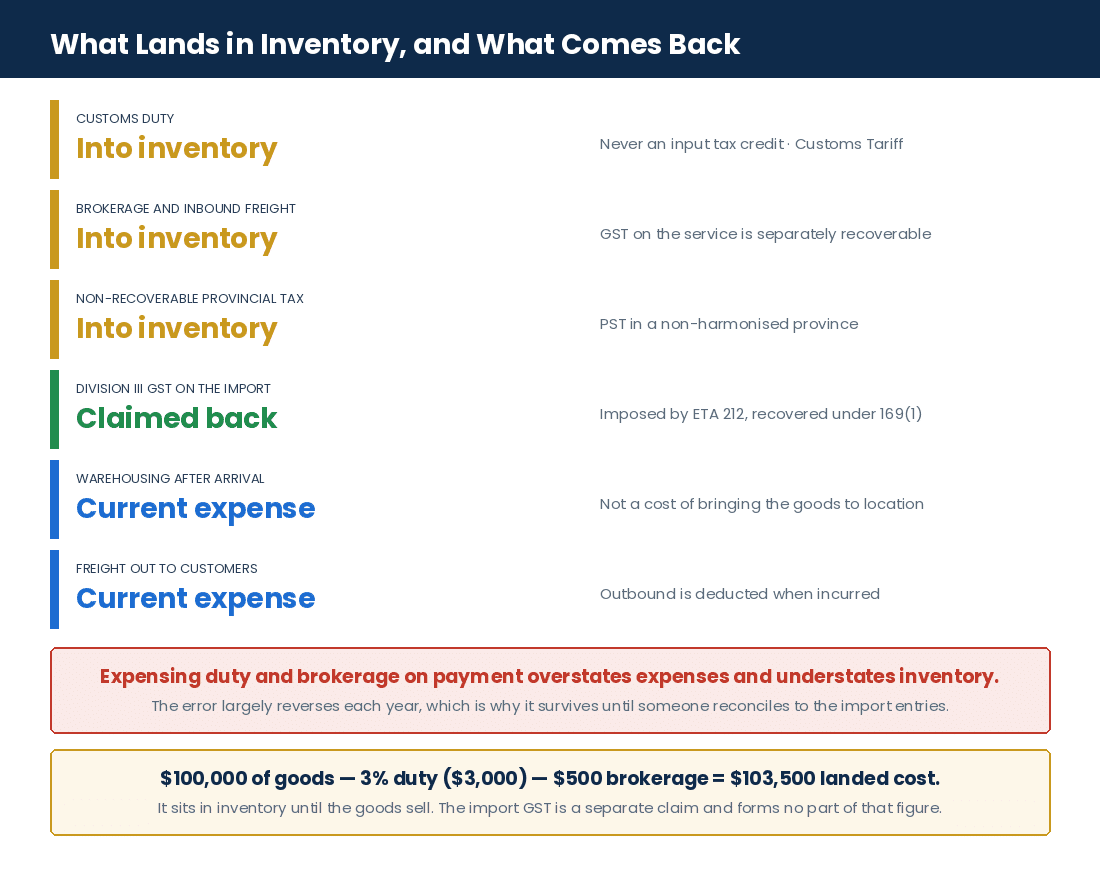
Landed cost is the whole of what it took to put the goods on your shelf. Each component is capitalised into inventory and released to cost of goods sold on the sale.
| Component | In landed cost? | Note |
|---|---|---|
| Supplier purchase price | Yes | Converted at the relevant spot rate on the day the amount arose |
| Customs duty | Yes | Never an input tax credit, in any circumstances |
| Customs brokerage fees | Yes | GST on the broker’s fee is recoverable; the fee is capitalised |
| Freight and insurance to the point of arrival | Yes | Inbound only; freight out to customers is a current expense |
| Non-recoverable provincial sales tax | Yes | PST in a non-harmonised province, where no credit is available |
| Division III GST under section 212 | No | Recovered as an input tax credit, so it never enters cost |
| Warehousing after arrival | No | Period cost, not a cost of bringing the goods to location |
Worked example. A distributor imports $100,000 of devices subject to 3% duty ($3,000) with $500 of brokerage. The landed cost is $103,500, and it sits in inventory until the goods are sold. The Division III GST paid at the border is claimed separately as an input tax credit and forms no part of that figure. Figures changed for privacy.
Expensing the duty and brokerage on payment overstates current expenses and understates closing inventory by the same amount. It is one of the first things a reviewer tests, because the import entries and the inventory ledger will not agree.
Impact of foreign currency conversion on inventory valuation and taxes
Risk Warning: foreign currency conversion is section 261, not paragraph 18(1)(b). Paragraph 18(1)(b) denies a deduction for a capital outlay and has nothing to do with exchange rates.
Subsection 261(2) requires an amount in a foreign currency to be converted using the relevant spot rate for the day the amount arose, defined in subsection 261(1) by reference to the Bank of Canada rate.
- Use the Bank of Canada rate for the day of the transaction, or the closest preceding day for which a rate is quoted.
- An average rate is accepted by CRA for recurring income items, per Income Tax Folio S5-F4-C1. It is not the basis for converting the cost of a capital purchase.
- The cost of imported inventory is fixed at the rate on the day the amount arose. Movement between that date and payment is a foreign exchange gain or loss on the payable — a separate item, not an adjustment to inventory cost.
- Keep the bank advice showing the rate actually obtained, which is what supports the figure if the conversion is questioned.
A distributor converted every US-dollar purchase at the rate on the day the supplier was paid rather than the day the liability arose.
On a falling dollar that pushed cost into inventory that belonged in exchange loss, and the two accounts drifted apart over three years. Rebuilding the conversions on the 261(1) basis moved the amounts into the right lines without changing the total. Figures changed for privacy.
Import Duties, Taxes, and Compliance Requirements
Import Duties, Taxes and Compliance
Border
Two separate charges arrive at the border and they behave in opposite ways. Keeping them apart is most of what import compliance amounts to for a distributor.
Import Tax Rules Specific to Medical Devices: Duty Rates and Tariff Classifications
Duty depends on the tariff classification CBSA accepts for the goods under the Customs Tariff, and on their origin. Many medical instruments and appliances classify in Chapter 90 and carry a Most-Favoured-Nation rate of free, and goods originating in a free trade partner may enter duty-free under the applicable tariff treatment. None of that is automatic: it turns on the classification and on holding a valid certification of origin.
Zero-rated GST/HST status and duty-free entry are two different questions decided under two different statutes. A device can be zero-rated under Schedule VI, Part II and still attract duty, and it can enter duty-free and still be taxable on sale.
| Item | Treatment | Records needed |
|---|---|---|
| Customs duty | Added to inventory cost | CBSA accounting document (Form B3 / CARM entry) |
| Brokerage | Added to inventory cost | Broker invoice showing the GST separately |
| Inbound freight | Added to inventory cost | Freight bills and the bill of lading |
| Division III GST | Claimed as an input tax credit | CBSA accounting document showing the tax paid |
Goods and Services Tax (GST) and Harmonized Sales Tax (HST) on Imported Medical Devices
Section 212 imposes Division III tax at 5% on goods imported into Canada, payable by the importer at the time of accounting. Where the goods are listed in Schedule VI, Part II, section 6 of Schedule VII relieves the import tax on non-taxable importations, and the eventual sale is zero-rated. Where they are not, the Division III tax is paid at the border and recovered as an input tax credit.
The sale in Canada is then rated on its own terms: zero-rated if the device answers a description in Part II and any written-order condition is met, taxable at 5% GST or 13% HST in Ontario under section 165 otherwise. Place of supply for the provincial component follows the Place of Supply Regulations and Schedule IX — for goods delivered to a customer, generally the province of delivery.
Key Stat: zero-rated supplies let you claim input tax credits. Exempt supplies do not. That is the whole commercial difference, and it is why a device distributor and a clinic have opposite GST/HST positions on the same product.
Can Distributors Claim Input Tax Credits on Imports?
Yes, where the importer is registered, the goods are for use in commercial activity, and the documentary requirements are met. Entitlement is under 169(1); the documentation standard is 169(4) and the Input Tax Credit Information Regulations.
- The CBSA accounting document in the claimant’s name, showing the tax paid.
- Supplier name and registration number on purchased services, with the GST shown separately.
- Date, description, quantity and value agreeing to the purchase records.
- Evidence the goods were acquired for use in commercial activity.
- Claimed within the time limit in subsection 225(4) — generally four years, and two years for larger registrants and certain others.
Where goods are imported on behalf of another person, section 178.8 decides who is entitled to the credit. A distributor that is not the importer of record but bears the tax needs the agreement and the documentation to support the claim.
Role of the Importer of Record and Related Tax Responsibilities
The importer of record accounts to CBSA for the value for duty, the tariff classification and the origin, and pays the duty and the Division III tax. Those three declarations set the landed cost that flows into inventory and ultimately into cost of goods sold, so a customs error is also an income tax error.
- Bills of lading and the commercial invoice.
- CBSA accounting documents and release notices.
- Broker invoices separating duty, GST and the brokerage fee.
- Proof of origin where a preferential tariff treatment was claimed.
Correction obligations run the other way too. Under section 32.2 of the Customs Act, an importer that has reason to believe a declaration of origin, classification or value for duty was incorrect must correct it within 90 days, and CBSA may re-determine within four years under section 59.
Filing Accurate Declarations with Canada Border Services Agency (CBSA) To Avoid Delays
Accurate declarations keep shipments moving and keep the accounting records usable. A complete import file — commercial invoice, bill of lading, CBSA accounting document, release notice, broker invoice, proof of payment — is what lets duty, brokerage and freight be allocated to the right stock rather than dumped into a single expense account.
Common Reasons for Shipment Refusals at The Border And How To Mitigate Risks
- Wrong tariff classification, producing the wrong duty and an incorrect landed cost.
- Incomplete invoice data, where the description does not let CBSA verify the classification.
- Value for duty declared without accounting for assists, royalties or subsequent proceeds.
- Origin claimed under a free trade agreement without a valid certification on hand.
- Device licensing under the Medical Devices Regulations — a Class II, III or IV device needs a Health Canada licence and the importer an establishment licence. This is a regulatory requirement, not a tax one, but it stops the shipment just the same.
The mitigation is unglamorous: review each line against its classification and against the Part II listing, keep the certifications current, and reconcile the broker’s entry to your own purchase record before it is posted.
A distributor claimed input tax credits for Division III tax on entries where a related company was the importer of record.
The tax had been paid, but not by the claimant, and section 178.8 put the credit with the other party. Restructuring the arrangement and the documentation fixed it going forward; the earlier claims were reassessed. Figures changed for privacy.
Business Expenses and Tax Deductions for Medical Device Distributors
Business Expenses and Tax Deductions
Deductions
Deductibility rests on paragraph 18(1)(a) — incurred for the purpose of earning income — with the capital restriction in 18(1)(b) and the reasonableness limit in section 67. The specific limits below are the ones that bite in a distribution business.
Allowable Business Expenses: Salaries, Reasonable Meals, Vehicle and Travel Costs
| Expense | Treatment | Provision |
|---|---|---|
| Freight out to customers | Fully deductible when incurred — unlike inbound freight, which is capitalised | ITA 18(1)(a) |
| Salaries and employer CPP and EI | Deductible, with T4 reporting and remittance | ITA 18(1)(a); 153 |
| Meals and entertainment | 50% of the amount paid. There is no per-meal dollar cap | ITA 67.1 |
| Travel and accommodation | Deductible on actual cost with receipts, personal days excluded | ITA 18(1)(a) |
| Vehicle costs | Apportioned on a logbook between business and personal use | ITA 18(1)(a); 13(7) |
| Passenger vehicle lease | Capped | ITA 67.3 |
| Fines and penalties | Denied | ITA 67.6 |
| Club dues for dining, recreation or sport | Denied | ITA 18(1)(l) |
| Prepaid amounts covering a later period | Apportioned to the period they relate to | ITA 18(9) |
Section 67.1 has exceptions, in subsection 67.1(2): amounts where the meal is included in an employee’s income as a taxable benefit, amounts billed through to a client and disclosed, and a handful of others. The general rule for a distributor entertaining clinicians and procurement staff is 50%.
The input tax credit on meals and entertainment is recaptured to 50% to match section 67.1, so the GST/HST side follows the income tax side.
Source Deductions, Worker Classification, and Timing for Remittances
Risk Warning: “remit by the 15th of the month following the payroll” is one band of four, not the rule.
Regulation 108 assigns a remittance schedule based on your average monthly withholding amount, and a growing distributor moves up the bands without being told.
| Remitter type | Average monthly withholding | Due |
|---|---|---|
| Quarterly | Small employers meeting the compliance conditions | 15th of the month after the quarter |
| Regular | Under $25,000 | 15th of the following month |
| Threshold 1 | $25,000 to under $100,000 | Twice monthly |
| Threshold 2 | $100,000 or more | Within 3 working days of each quarter-month period |
Late remittance is penalised on a graded scale under subsection 227(9): 3% at one to three days late, 5% at four or five, 7% at six or seven, and 10% beyond seven days or not remitted, rising to 20% on a repeat involving gross negligence. Directors can be personally liable under section 227.1.
Worker classification is decided on the common-law factors from Wiebe Door, as refined in Sagaz and Connor Homes: control, ownership of tools, chance of profit, risk of loss and integration. CRA Guide RC4110 sets them out and a binding ruling is available on Form CPT1. Independent sales representatives are the usual pressure point in this sector. A T4A is required for fees for services above $500 under Regulation 200(1), with both T4 and T4A due the last day of February under Regulation 205(1).
Capital Cost Allowance Application Relevant to Medical Device Distribution
| Asset | Class | Rate |
|---|---|---|
| Warehouse building, non-residential | Class 1 | 4%, with an additional 2% allowance for an eligible non-residential building acquired after 18 March 2007, or 6% where used in manufacturing or processing, each requiring a separate class election |
| Racking, shelving, warehouse fixtures | Class 8 | 20% |
| Rider forklifts and other self-propelled units | Class 10 | 30% — automotive equipment. A non-automotive pallet mover or hand stacker is Class 8 at 20% |
| Delivery vans and trucks | Class 10 | 30% |
| Passenger vehicle above the prescribed limit | Class 10.1 | 30%, with no recapture or terminal loss |
| Computers, servers and systems software | Class 50 | 55% — or 100% in the first year where acquired after 15 April 2024 and available for use before 2027 |
| Purchased application software | Class 12 | 100% |
| Leasehold improvements | Class 13 | Straight-line over the lease term plus the first renewal |
| Demo units converted from inventory | Class 8 | 20%, from the date of conversion at fair market value |
Two timing rules govern the first claim. No capital cost allowance arises before the asset is available for use under subsections 13(26) to (32). And the half-year rule is suspended by the Accelerated Investment Incentive. Bill C-15, which received Royal Assent on 26 March 2026, reinstated the incentive at three times the normal first-year amount for property acquired after 2024 and available for use before 2030 — one and a half times where the half-year rule would not normally have applied — with a 2× band from 2030 through 2033 and normal rates after that. On a Class 8 racking addition that is 30% in year one rather than 10%, and on a Class 10 delivery van 45% rather than 15%.
Property acquired after 20 November 2018 but before 2025 stays under the original incentive, so the acquisition date decides which version applies before the available-for-use date decides the factor. The same bill gives Classes 44, 46 and 50 acquired after 15 April 2024 and available for use before 2027 a 100% first-year deduction, which covers the warehouse management servers and systems software.
Managing Bad Debts and Expense Write-Offs Under Canadian Tax Rules
Risk Warning: a bad debt has its own provision, and the source material rarely names it. Paragraph 20(1)(p) allows the deduction where the amount was previously included in income and is established to have become bad in the year.
There is a second recovery most distributors miss. Where GST/HST was charged and remitted on an invoice that goes bad, section 231 of the Excise Tax Act allows the tax to be recovered on the written-off portion — a separate claim from the income tax deduction.
- Keep the collection file: statements, demand letters, the decision to write off and its date.
- A debt is not bad because it is old. The test is whether, on the facts, it has become uncollectible.
- A recovery in a later year is brought back into income under paragraph 12(1)(i).
- Inventory write-downs and bad debts are different things under different provisions — section 10 and 20(1)(p) — and should not share a general provision account.
Record Retention Requirements And Their Importance For CRA Audits And Reviews
Records are kept six years from the end of the last taxation year to which they relate under paragraph 230(4)(b), with the same period for GST/HST under section 286 of the Excise Tax Act. Not seven years, and not six years from the filing date. Early destruction needs CRA permission on Form T137. CRA Guide RC188, Keeping Records, sets out the practical requirements.
- Catalogue rating files showing the Schedule VI, Part II section relied on for each SKU and whether a written order is required.
- Import entries with duty, brokerage and freight allocated to stock.
- Inventory counts reconciled to the ledger, with the write-down evidence attached.
- Consignment and distribution agreements setting out when title passes.
- Payroll registers agreeing gross pay to deductions and to remittances.
- Sales invoices with the credit notes that adjust them.
- Written orders from medical practitioners where zero-rating depends on them.
Electronic records satisfy the requirement where they remain accessible and readable for the full period.
A distributor rated an entire accessory line as taxable because the accessories were not themselves named in Part II.
They were specially designed for a listed device, which section 32 zero-rates. The company had been charging and remitting tax it never owed, and unwinding it meant credit notes to every affected customer. Figures changed for privacy.
Practical Guidance for Compliance and Tax Filing
Practical Guidance for Compliance and Filing
Filing
Key Considerations for Timely and Accurate T2 Corporate Tax Filings and GIFI Reporting
The T2 is due six months after fiscal year-end under paragraph 150(1)(a), and the balance of tax at two months under paragraph 157(1)(b). Financial data is reported in GIFI codes on Schedule 100 (balance sheet), 125 (income statement) and 141 (notes checklist), with Schedule 1 reconciling accounting income to taxable income. Electronic filing is mandatory under subsection 150.1(2.1), with a $1,000 penalty for paper under 162(7.2).
Before filing, agree the trial balance to the inventory listing, the import entries and the GST/HST returns. The reconciliation that catches the most is revenue per the T2 against revenue per the GST/HST returns, split between zero-rated and taxable — a gap there is the single most common reason a distributor hears from CRA.
Worked example. A distributor with a 31 December year-end files the T2 by 30 June. The balance of tax was due 28 February. Filing on time and paying in June produces no late filing penalty and four months of daily compound interest. Figures changed for privacy.
Best Practices in Medical Device Distributor Bookkeeping to Support Tax Compliance
- A catalogue rating file keyed by SKU, recording the Part II section relied on, whether a written order is required, and the date of the last review.
- Zero-rated and taxable revenue tracked in separate ledger accounts, so the GST/HST return is a report rather than a reconstruction.
- Landed cost allocated to stock on receipt, not accrued to a holding account and forgotten.
- An annual physical count, with the variance investigated rather than posted.
- Write-down schedules dated within the fiscal period claimed, with the supporting notice or count attached.
- Consignment agreements filed with the customer master, so the revenue recognition question has an answer on the record.
- A demo unit log recording which serial numbers left inventory, when, and at what value.
- Payroll registers separating employees from contractors, with the classification analysis written down.
Worked example. A Toronto distributor maintains a rating file covering roughly 500 SKUs against Schedule VI, Part II, with a column for the written-order condition. The quarterly GST/HST return is produced from the ledger split rather than estimated, and the file is what answers a rating question in a review. Figures changed for privacy.
How To Optimize Input Tax Credit Claims While Maintaining CRA Compliance
- Keep the CBSA accounting document for every entry, in the claimant’s own name.
- Hold supplier invoices showing the registration number and the GST separately, to the 169(4) standard: over $30 the supplier’s name and date, over $150 the registration number, your name, the terms and a description.
- Recapture meals and entertainment to 50%.
- Where inputs are used partly in exempt activity, apportion on a method that is fair and reasonable and used consistently, under section 141.01.
- Claim within the 225(4) window — four years generally, two for larger registrants.
- Never claim customs duty. It is not a tax that generates a credit.
A bank statement is not acceptable support. Subsection 169(4) and the Input Tax Credit Information Regulations require supplier-level detail that a statement line does not carry.
Worked example. An Ontario importer pays $12,000 of customs duty and $800 of brokerage, both capitalised into landed cost, and recovers roughly $3,000 of Division III GST as an input tax credit against the CBSA documents. The duty stays in inventory; only the GST comes back. Figures changed for privacy.
Addressing Penalties, Interest, And Catch-Up Filing Scenarios Proactively
| Failure | Consequence | Provision |
|---|---|---|
| Late T2 filing | 5% + 1% per complete month to twelve | ITA 162(1) |
| Repeat late filing after a demand | 10% + 2% per month to twenty | ITA 162(2) |
| Late GST/HST return with an amount owing | 1% plus 0.25% per month, to twelve months | ETA 280.1 |
| Late payroll remittance | 3% to 10%, graded by lateness | ITA 227(9) |
| Arrears interest | Compounded daily | ITA 161(1) |
| Gross negligence | 50% of the understated tax | ITA 163(2) |
Reviews in this sector usually start in one of three places: a catalogue rated by category rather than line by line, duty and brokerage expensed instead of capitalised, or an inventory figure with no count behind it.
Where something was not reported at all, the Voluntary Disclosures Program under Information Circular IC00-1R6 may limit penalties — but only where the disclosure is voluntary, meaning before CRA makes contact, and it must be complete, involve a penalty and concern information at least one year overdue. Relief from penalties and interest is a separate route under subsection 220(3.1), applied for on Form RC4288 within ten calendar years.
Catching up on books that have fallen behind runs in a fixed order: rebuild from the import entries and bank statements, re-rate the catalogue against Part II as it stood in each year, value inventory on a consistent basis, then amend. Write-offs with no evidence behind them will not survive the exercise.
Consulting Tax Professionals Like Gondaliya CPA For Complex Distributor Tax Issues
| Route | Works when | Breaks when |
|---|---|---|
| File it yourself | A small catalogue, one tariff classification, no consignment, no demo fleet | Rating questions arise, imports are regular, or inventory needs a defensible valuation |
| Non-CPA bookkeeping service | Transaction processing on a clean chart of accounts | Catalogue rating, landed cost allocation and CRA correspondence — none of which is bookkeeping |
| Licensed CPA firm | Mixed catalogues, regular imports, consignment arrangements, a review under way | Costs more up front than doing nothing |
Gondaliya CPA is a licensed Ontario firm working with distributors across Canada on a flat annual fee, and performs compilation engagements under CSRS 4200, which provide no assurance. Audit and review engagements are referred out.
A distributor lost two years of broker invoices in a system migration and wrote off roughly $25,000 of unclaimed input tax credits as gone.
CBSA accounting documents were retrievable, the entries were rebuilt against bank records, and the claims were made inside the 225(4) window. The amount recovered exceeded the cost of the exercise several times over. Figures changed for privacy.
Regulatory Context and Updates Affecting Taxation of Medical Device Distributors
Regulatory Context and Updates
Context
Overview of Relevant Medical Devices Regulations Impacting Import and Distribution Taxes
| Statute | What it governs |
|---|---|
| Customs Act and Customs Tariff | Import declarations, value for duty, tariff classification, origin, duty rates, correction under section 32.2 and re-determination under section 59 |
| Income Tax Act | Inventory valuation in section 10, deductibility in 18(1)(a), capital cost allowance, bad debts in 20(1)(p), records in 230(4)(b) |
| Excise Tax Act | Division III tax on imports in section 212, input tax credits in 169, zero-rating in Schedule VI, Part II, credit notes in 232, records in 286 |
| Food and Drugs Act and Medical Devices Regulations | Device classification I to IV, device licences, establishment licences — a regulatory regime that does not decide GST/HST treatment |
The last row is the one that causes confusion. A Health Canada device class and a Schedule VI, Part II listing are unrelated. A Class II device may be taxable; a product needing no licence may be zero-rated. The tax answer comes from the Excise Tax Act and nowhere else.
Clarification of Exemptions, Zero-Rated Supply Status, and Listed Device Classifications
- Zero-rated supply: taxed at 0%, listed in Schedule VI. Input tax credits remain fully recoverable.
- Exempt supply: no tax charged, listed in Schedule V, and no input tax credits on related inputs. Most health care services sit here; devices generally do not.
- Listed device: a product answering a description in Schedule VI, Part II, including any condition in that description — most often a written order of a medical practitioner for a named consumer.
- Parts and accessories: zero-rated under section 32 of Part II where specially designed for a listed device. Not every consumable qualifies, and general-purpose supplies do not.
- Rating is done line by line. A device being zero-rated does not carry its packaging, its service contract or an unrelated item on the same invoice.
Implications of Recent Regulatory Amendments on Distributor Tax Obligations
The framework for medical device distributors is stable. The changes that matter to a 2026 year-end are general rather than sector-specific.
- CARM is now the system of record for commercial accounting with CBSA. Importers post their own financial security and manage their account directly rather than relying on a broker’s bond, and the accounting document comes out of the CARM Client Portal.
- The half-year rule is suspended by the Accelerated Investment Incentive, which Bill C-15 reinstated on 26 March 2026 at 3× the normal first-year amount for property acquired after 2024 and available for use before 2030, with a 2× band from 2030 through 2033. On warehouse and fleet additions that is 30% on Class 8 and 45% on Class 10 in year one.
- Classes 44, 46 and 50 acquired after 15 April 2024 and available for use before 2027 are deducted at 100% in the first year under the same bill, which reaches warehouse management servers and systems software. This one has a deadline worth diarising.
- Mandatory electronic filing of the T2 under subsection 150.1(2.1), with the $1,000 penalty under 162(7.2) for paper.
- Record retention and the Part II listing itself are unchanged: six years under 230(4)(b), and the same device descriptions and written-order conditions.
Where a source tells you that zero-rating rules are “changing through 2026” without naming the amendment, treat that as a reason to check rather than a reason to act. The Part II listing changes by legislative amendment, and each change is published.
Coordination Between Tax and Regulatory Compliance for Medical Device Businesses
The customs declaration and the income tax return are built from the same numbers. The value for duty declared to CBSA sets the landed cost; the landed cost sets inventory; inventory sets cost of goods sold. A classification corrected two years later under section 32.2 of the Customs Act therefore changes an income tax figure as well, and the amendment has to run both ways.
Reviews frequently begin where the two do not agree — import values that do not reconcile to purchases, or a zero-rated revenue line larger than the catalogue can support.
Resources for Ongoing Updates, Official Contacts, and Further Guidance From Authorities
| Resource | What it covers |
|---|---|
| GST/HST Memorandum 4.2, Medical and Assistive Devices | CRA’s administrative position on Schedule VI, Part II, device by device |
| Schedule VI, Part II, Excise Tax Act | The listing itself, on the Justice Laws website |
| CRA Guide RC4022, General Information for GST/HST Registrants | Filing frequency, input tax credits, documentation |
| CRA Guide RC188, Keeping Records | Retention periods and acceptable formats |
| CRA Guide T4012, T2 Corporation Income Tax Guide | Filing deadlines, GIFI schedules, instalments |
| CBSA CARM Client Portal | Accounting documents, statements of account, financial security |
| Customs Tariff schedules | Classification and duty rates by heading |
A distributor rated its catalogue from the Health Canada device class, on the assumption that a licensed medical device is a zero-rated one.
The two regimes are unconnected. Re-rating line by line against Schedule VI, Part II moved product in both directions — some had been taxed that should not have been, and some had been zero-rated with no written order on file. Figures changed for privacy.
Frequently Asked Questions
Frequently Asked Questions
FAQ
What payroll source deductions remittance deadlines should medical device distributors follow?+
It depends on your band. Regulation 108 sets four schedules on your average monthly withholding amount. A regular remitter, under $25,000, pays by the 15th of the following month. Threshold 1, from $25,000, pays twice monthly. Threshold 2, at $100,000 or more, pays within 3 working days of each quarter-month period. Late remittance is penalised on a graded scale from 3% to 10% under subsection 227(9).
Which tax returns does a medical device distributor file and when?+
The T2 within six months of fiscal year-end under paragraph 150(1)(a), with the balance of tax at two months under 157(1)(b). GST/HST filing frequency follows annual taxable supplies: annual to $1.5M, quarterly to $6M, monthly above. T4 and T4A slips are due the last day of February.
Which provision zero-rates medical devices?+
Schedule VI, Part II of the Excise Tax Act. Not section 123(1), which is the definitions provision. A device is zero-rated because it answers a description in a section of Part II, and many of those descriptions require the device to be supplied on the written order of a medical practitioner for a named consumer.
Are parts and accessories zero-rated?+
Yes, where they are specially designed for a device listed in Part II. Section 32 of Part II zero-rates parts, accessories and attachments in their own right, and the service of installing, maintaining, repairing or modifying a zero-rated device is zero-rated too. General-purpose supplies that happen to be sold alongside a device are not.
Can I recover the customs duty I paid at the border?+
No. Customs duty is never an input tax credit. It is capitalised into the landed cost of the goods and deducted through cost of goods sold when they are sold. What is recoverable is the Division III GST imposed under section 212, claimed under 169(1) with the CBSA accounting document as support.
How do I value inventory for tax purposes?+
At the lower of cost and fair market value at the end of the year, under subsection 10(1). The only alternative is the election in Regulation 1801 to value all inventory at fair market value. Subsection 10(2.1) requires the basis to continue in later years unless the Minister concurs in a change. LIFO is not accepted in Canada.
What goes into landed cost?+
Purchase price, customs duty, brokerage, inbound freight and insurance, and any non-recoverable provincial tax. Not the Division III GST, which is recovered as a credit, and not warehousing after arrival or freight out to customers, which are period costs.
Do I include consignment stock in my inventory?+
Not if you are the consignee. The goods belong to the consignor until sold, so you track them separately and account for the sale when title passes. Where you sell as agent, section 177 of the Excise Tax Act decides who is treated as making the supply for GST/HST. The agreement is what settles it, which is why it belongs in the records.
How are demo units treated?+
They start as inventory. A unit taken out of stock for ongoing business use has been converted to capital property at fair market value and belongs in a capital cost allowance class, generally Class 8 at 20%. Keep a log of the serial numbers, the conversion date and the value, because the conversion is a disposition of inventory.
When can I write down obsolete or expired stock?+
When fair market value is below cost at the year-end, under subsection 10(1). The supporting facts have to exist at that date: a dated count showing lot and expiry, a supplier discontinuation notice, an inspection report. A write-down decided after year-end on stock that was saleable at year-end belongs in the following year.
What exchange rate do I use on foreign purchases?+
The relevant spot rate for the day the amount arose, under subsection 261(2), defined in 261(1) by reference to the Bank of Canada rate. Movement between that date and payment is a foreign exchange gain or loss on the payable, not an adjustment to the cost of the inventory.
How long do records have to be kept?+
Six years from the end of the last taxation year to which they relate, under paragraph 230(4)(b), with the same period for GST/HST under section 286. Not seven years, and not six years from the filing date. Early destruction needs CRA permission on Form T137.
What common issues trigger a CRA review for medical device distributors?+
A catalogue rated by category rather than line by line; duty and brokerage expensed instead of capitalised; an inventory figure with no physical count behind it; zero-rated revenue that the catalogue cannot support; and input tax credits claimed on entries where another party was the importer of record.
How do I catch up if the books are behind?+
Rebuild from the import entries and bank statements, re-rate the catalogue against Schedule VI, Part II as it stood in each year, value inventory on a consistent basis, then amend. Input tax credits can still be claimed inside the 225(4) window. Where something was never reported, the Voluntary Disclosures Program under IC00-1R6 closes the moment CRA makes contact.
Should a distributor file taxes themselves or hire a CPA firm?+
A single-classification catalogue with no imports and no consignment is manageable in-house. Mixed catalogues, regular imports, consignment arrangements and demo fleets are not, because each one turns on a provision rather than on bookkeeping. Only a licensed firm can issue a compilation engagement report under CSRS 4200 or represent you before CRA.
Fifteen questions, and the one that decides the most money is the least technical: which section of Part II does this SKU answer to.
Every other question — the credits, the invoices, the reconciliations — follows from that answer. A rating file built once and reviewed annually prevents more adjustments than any other control in a distribution business. Figures changed for privacy.
Essential Insights for Medical Device Distributors: Managing Tax & Accounting
Key Controls and Warning Signs
Quick Reference
Top Tax Mistakes and Prevention Tips
- Do not mix consignment stock with owned inventory. The agreement decides ownership, and the count has to follow it.
- Capitalise landed cost precisely, by shipment, rather than accruing duty and brokerage to a holding account.
- Keep dated evidence for every write-down, created before the year-end rather than reconstructed after it.
- File GST/HST on time, and consider a more frequent band if the catalogue leaves you in a refund position.
- Rate the catalogue line by line against Schedule VI, Part II, and record whether a written order is required.
- Never claim customs duty as an input tax credit.
Pre-Work Preparation Checklist
- Import documents for the year: CBSA accounting documents, broker invoices, freight bills, proofs of origin.
- Inventory count sheets, dated, with lot and expiry where relevant.
- The catalogue rating file, with the date of the last review.
- Payroll registers agreeing gross pay to deductions and remittances.
- Consignment and distribution agreements.
- The demo unit log.
- Three years of financial statements and T2 returns, plus the GST/HST returns for the same period.
Key Questions Across Ten Compliance Areas
| Area | The question to answer |
|---|---|
| Catalogue rating | Which section of Part II does each SKU answer to, and is a written order needed? |
| Parts and accessories | Are any specially designed for a listed device, and therefore zero-rated under section 32? |
| Inventory valuation | Is it the lower of cost and fair market value, on the same basis as last year? |
| Landed cost | Are duty, brokerage and inbound freight in inventory rather than in expenses? |
| Import credits | Is the claimant the importer of record on every CBSA document? |
| Documentation | Does every credit meet the 169(4) standard? |
| Write-downs | Did the facts supporting the reduced value exist at the year-end? |
| Consignment | Does the agreement say when title passes, and does the ledger agree? |
| Payroll | Which Regulation 108 band applies, and has it changed? |
| Records | Are six years retained from the end of each taxation year? |
Realistic Compliance Walkthrough
- Count the inventory and reconcile it to the ledger.
- Value it at the lower of cost and fair market value, documenting every write-down.
- Agree the import entries to purchases and confirm landed cost is capitalised.
- Reconcile zero-rated and taxable revenue to the GST/HST returns for the year.
- Review the catalogue rating file and record the date.
- Update the capital cost allowance schedule, including demo units converted from inventory.
- Pay the corporate balance at two months, then file the T2 with matched GIFI codes by six.
Warning Signs
| Sign | What it usually means |
|---|---|
| Duty and brokerage appear in the expense accounts | Landed cost is not being capitalised; inventory is understated |
| Every accessory is rated taxable | Section 32 is being missed; tax is being charged that is not owed |
| The whole catalogue is zero-rated | Written-order conditions are not being tested on each sale |
| Inventory is a plug figure | No physical count; the closing balance cannot be defended |
| GST/HST revenue does not agree to the T2 | The split between zero-rated and taxable is being estimated |
| Import credits claimed on another company’s entries | Section 178.8 puts the credit elsewhere |
| Demo units still sitting in inventory after three years | A conversion to capital property was never recorded |
Choosing a CPA Firm in Ontario
Look for distribution and import experience specifically, verification on the CPA Ontario public firm directory, a flat fee quoted before work begins, and the ability to represent you before CRA. Only a licensed firm can issue a compilation engagement report under CSRS 4200, which provides no assurance.
Why Trust Gondaliya CPA
- Catalogue rating against Schedule VI, Part II, SKU by SKU, with the written-order conditions flagged.
- Landed cost allocation and inventory valuation that reconcile to the import entries.
- Input tax credit recovery against CBSA documents, inside the 225(4) window.
- Capital cost allowance schedules including demo units converted from inventory.
- Compilation engagements under CSRS 4200; audit and review engagements referred out.
- Flat annual fee including HST, with a one-business-day response.
Points Worth Carrying
- Zero-rating is Schedule VI, Part II, not section 123(1).
- Many Part II entries require a written order of a medical practitioner.
- Parts and accessories specially designed for a listed device are zero-rated under section 32.
- Inventory is the lower of cost and fair market value under section 10, not a choice of methods.
- LIFO is not accepted in Canada.
- Customs duty is never an input tax credit.
- The Division III GST under section 212 is recoverable under 169(1).
- Foreign currency runs on the relevant spot rate in 261(1), not paragraph 18(1)(b).
- Bad debts are 20(1)(p), with the GST/HST recovered separately under ETA 231.
- Records are six years from the end of the taxation year, not seven and not from filing.
- The corporate balance of tax is due at two months, the return at six.
Eleven points, and three of them are about telling two similar things apart.
Duty against import GST. Zero-rated against exempt. A Health Canada device class against a Schedule VI listing. Each pair looks like one subject and behaves like two, and nearly every adjustment we see in this sector comes from treating one as the other. Figures changed for privacy.
Businesses We Serve & Industry Spotlights
Industry Expertise
Medical device distribution sits inside a wider import and wholesale practice, and the same questions surface across every sector we act for. Here are eleven and the form the issue usually takes.
| Industry | The Distributor Angle |
|---|---|
| Transportation, logistics & trucking | Inbound freight is capitalised, outbound is expensed |
| E-commerce & online retailers | Landed cost per SKU and the same rating discipline |
| Medical doctors & physician professional corporations | The customer side of the zero-rating question |
| Dentists & dental practices | Operatory equipment and its GST/HST treatment on purchase |
| Daycare, childcare & CWELCC services | Exempt supplies, where no input tax credits arise at all |
| Restaurants & food and beverage | Zero-rated basic groceries on the same Schedule VI logic |
| Technology startups & SaaS | Hardware imports beside software revenue |
| Construction, contractors & skilled trades | Imported equipment and the Class 8 against Class 10 question |
| Property developers & builders | Inventory valuation where the stock is not finished goods |
| Real estate investors, landlords & holding companies | Warehouse premises held in a separate corporation |
| Consulting firms | Service revenue alongside product, each rated separately |
- Transportation, logistics & trucking: The split that catches distributors catches carriers too — freight to the point of arrival is part of the cost of the goods, and freight out to a customer is a current expense.
- E-commerce & online retailers: Same import mechanics, same need to allocate duty and brokerage to stock rather than to a single expense line, and the same place of supply question on delivery.
- Medical doctors & physician professional corporations: The other side of the counter. A practice making exempt supplies recovers no input tax credits, which is why a zero-rated purchase is worth more to it than a taxable one.
- Dentists & dental practices: Operatory equipment buying raises the same Part II questions from the purchaser’s side, alongside Class 8 and Class 13 on the fit-out.
- Daycare, childcare & CWELCC services: A clean illustration of exempt supplies, where no credits arise on inputs at all — the opposite position to a zero-rated distributor.
- Restaurants & food and beverage: Zero-rated basic groceries run on the same Schedule VI structure, with the same line-by-line discipline and the same consequences for getting a category wrong.
- Technology startups & SaaS: Where a device carries software, the hardware import and the licence revenue are rated separately and the bundle needs unpicking.
- Construction, contractors & skilled trades: Imported plant raises the identical question a forklift raises in a warehouse: automotive equipment in Class 10, or general equipment in Class 8.
- Property developers & builders: Section 10 governs their inventory too, and the lower of cost and fair market value test applies to land and work in progress on the same basis.
- Real estate investors, landlords & holding companies: Warehouse and office premises are frequently held separately, which raises association under section 256 and one business limit shared under 125(3).
- Consulting firms: Distributors that also sell installation, training or service contracts are selling two things on one invoice, and each line is rated on its own terms.
The product changes. The three questions do not: what is this line rated at, what did it cost to land it, and who was the importer of record.
A catheter distributor and an industrial parts wholesaler keep different warehouses and file nearly identical returns. Figures changed for privacy.
Professional Guidance and Quick Reference
Guidance
Professional Guidance: How Gondaliya CPA Handles Your Distribution Business
Medical device distributors get into difficulty in a predictable set of ways: citing section 123(1) for zero-rating, when the listing is Schedule VI, Part II; rating a catalogue once and never testing the written-order conditions that many Part II entries carry; treating every accessory as taxable, when section 32 zero-rates parts specially designed for a listed device; expecting customs duty back as an input tax credit, when only the Division III GST under section 212 is recoverable under 169(1); treating inventory valuation as a choice between cost and fair market value, when subsection 10(1) takes the lower of the two and Regulation 1801 is the only alternative; expensing duty and brokerage on payment rather than capitalising them into landed cost; converting foreign purchases under paragraph 18(1)(b), which is the capital expenditure prohibition, rather than the relevant spot rate in section 261; remitting payroll on the 15th regardless of band, when Regulation 108 sets four; keeping records for seven years from filing, when paragraph 230(4)(b) says six from the end of the taxation year; and paying the corporate balance with the return, when it was due at two months under 157(1)(b). Gondaliya CPA handles distributor accounting and tax on a flat annual fee.
We handle what decides the outcome: rating the catalogue SKU by SKU against Part II with the written-order conditions flagged, allocating landed cost to stock so inventory reconciles to the import entries, valuing inventory at the lower of cost and fair market value with the write-down evidence attached, recovering Division III tax against CBSA documents inside the 225(4) window, tracking demo units out of inventory and into their capital cost allowance class, setting the payroll remittance band from the average monthly withholding amount, and preparing compiled statements under CSRS 4200 that state plainly that no assurance is provided.
Our team starts with one month of import entries, your catalogue and your last return. Whatever you distribute, you get clear advice and a fixed price before we start.
Quick Answers
At a Glance
- Zero-rating: Schedule VI, Part II
- Parts and accessories: section 32 of Part II
- Written order: required for many Part II entries
- Import GST: Division III, ETA 212
- Credit: ETA 169(1); documents to 169(4)
- Customs duty: never an input tax credit
- Inventory: lower of cost and FMV, ITA 10(1)
- FMV election: Regulation 1801
- Foreign currency: relevant spot rate, ITA 261(1)
- Bad debts: ITA 20(1)(p); GST/HST under ETA 231
- Credit notes: ETA 232
- Payroll bands: Regulation 108
- Records: six years from the taxation year-end
- Corporate balance: two months, ITA 157(1)(b)
Who This Is For
Fit Check
- For: Incorporated Canadian medical device distributors — importers of record, wholesalers supplying hospitals, clinics and retail, and distributors carrying mixed catalogues of zero-rated and taxable product across the GTA and nationally.
- Not For: Clinics and practitioners buying devices, whose question is the exempt-supply side rather than distribution, and businesses requiring a review or audit engagement, which we refer out. Device licensing and regulatory classification under the Medical Devices Regulations sits with your regulatory consultant.
People Also Ask
Quick Answers
Does a Health Canada device licence make a product zero-rated?+
No. Device classification under the Medical Devices Regulations and zero-rating under Schedule VI, Part II are separate regimes. A licensed Class II device may be fully taxable, and a product needing no licence may be zero-rated.
Is the duty I paid recoverable if the goods are zero-rated?+
No. Zero-rating makes no difference to duty, which is never an input tax credit. What zero-rating preserves is your right to recover the Division III GST even though you will charge no tax on the sale.
Can I expense customs duty when I pay it?+
No. It forms part of the landed cost of the goods and is deducted through cost of goods sold when they sell. Expensing it on payment overstates current expenses and understates closing inventory by the same amount.
Do I have to use the same inventory method every year?+
Yes. Subsection 10(2.1) requires the basis used in a year to continue in later years unless the Minister concurs in a change. Opening inventory must equal the prior year’s closing value under 10(2).
What is the deadline I am most likely to miss?+
The corporate balance of tax at two months under paragraph 157(1)(b). It falls four months before the return it belongs to and generates interest rather than a notice, so nothing tells you it has passed.
Glossary of Key Terms
Glossary
- Schedule VI, Part II: The Excise Tax Act listing that zero-rates medical and assistive devices.
- Section 32 of Part II: Zero-rates parts, accessories and attachments specially designed for a listed device.
- Written order: The condition attached to many Part II entries, requiring supply on a medical practitioner’s order for a named consumer.
- Zero-rated supply: Taxed at 0%, with input tax credits fully recoverable.
- Exempt supply: No tax charged and no input tax credits, listed in Schedule V.
- Division III tax: GST on imported goods, imposed by section 212 of the Excise Tax Act.
- Landed cost: Purchase price plus duty, brokerage, inbound freight and non-recoverable taxes.
- Importer of record: The person who accounts to CBSA for value for duty, classification and origin.
- Section 10: Values inventory at the lower of cost and fair market value.
- Regulation 1801: The election to value all inventory at fair market value.
- Relevant spot rate: The Bank of Canada rate for the day, defined in subsection 261(1).
- Section 232: The credit note provision that adjusts GST/HST on a return or allowance.
- Paragraph 20(1)(p): The bad debt deduction for an amount previously included in income.
- CSRS 4200: The compilation engagement standard, providing no assurance.
Medical Device Distributor Tax Check
This quick self-check indicates where your books most likely need attention. Please answer the five questions below.
Medical Device Distributor Tax Check
Five quick questions on your business. No fee shown.
Points to raise with us:
This is a general prompt, not tax or legal advice or a quote. Your position depends on your full facts. For a real review, please book a free consultation.
Want a checklist to work from? You can download our free medical device distributor tax checklist before your consultation.
Rate the catalogue line by line against Schedule VI, Part II, and record for every SKU which section it answers to and whether a written order is required, because that one file decides most of what follows. Do not assume accessories are taxable; section 32 zero-rates those specially designed for a listed device, and charging tax you do not owe is its own problem. Keep duty, brokerage and inbound freight in inventory and let them out through cost of goods sold, and never expect the duty back as a credit, because it never comes. Claim the Division III GST under 169(1) against the CBSA documents, in your own name as importer of record. Value inventory at the lower of cost and fair market value under section 10, on the same basis as last year, and support every write-down with evidence that existed at the year-end. Convert foreign purchases at the relevant spot rate in 261(1), not at the payment date. Move demo units out of inventory into Class 8 when they stop being stock. Set the payroll band from your average monthly withholding amount. Keep six years from each year-end. And pay the corporate balance at two months, not with the return.
2026 Update — what is current: This article reflects rules current to 8 October 2026. CARM is the system of record for commercial accounting with CBSA, so importers post their own financial security and obtain accounting documents through the CARM Client Portal rather than relying on a broker’s bond. The half-year rule is suspended by the Accelerated Investment Incentive, reinstated by Bill C-15 on 26 March 2026 at 3× the normal first-year amount for property acquired after 2024 and available for use before 2030, with a 2× band from 2030 through 2033 and normal rates after 2033 — 30% in year one on a Class 8 racking addition and 45% on a Class 10 delivery van. Property acquired before 2025 remains under the original measure. The same bill gives Classes 44, 46 and 50 acquired after 15 April 2024 and available for use before 2027 a 100% first-year deduction, which covers warehouse management servers and systems software. Electronic filing of the T2 is mandatory under subsection 150.1(2.1), with a $1,000 penalty under 162(7.2) for paper. Unchanged: the zero-rating listing in Schedule VI, Part II and its written-order conditions, the parts and accessories rule in section 32, Division III tax on imports under section 212 with credits under 169(1), inventory valuation at the lower of cost and fair market value under section 10 with the Regulation 1801 election, the six-year retention requirement in paragraph 230(4)(b) and section 286, the GST/HST filing bands at $1.5M and $6M, and the corporate balance of tax at two months under 157(1)(b).
Medical Device Distributor Tax Canada: How Gondaliya CPA Can Help
Start with a month of import entries and your catalogue
Gondaliya CPA rates your catalogue against Schedule VI, Part II with the written-order conditions flagged, allocates landed cost so inventory reconciles to the import entries, values stock at the lower of cost and fair market value with the write-down evidence attached, recovers Division III tax against your CBSA documents, tracks demo units into the right capital cost allowance class, and files the GST/HST, payroll and T2 from one reconciled set of books — on a flat annual fee including HST with a one-business-day response. Please book a free consultation.
Next Steps
Please book a free consultation with Gondaliya CPA and bring one month of import entries, your product catalogue, and your last filed return. Those three settle the rating question, the landed cost question and the input tax credit question, which is where almost all of the exposure sits for a distributor. You will get a flat annual fee including HST before any work begins. We serve Toronto, Mississauga, Vaughan, Brampton, Etobicoke, Scarborough, Ottawa and the rest of Ontario, and work with distributors across Canada. If our content helps, please add gondaliyacpa.ca as a preferred source on Google.
Published: · Last updated:
Editorial policy: We research against CRA, CBSA, CPA Canada and CPA Ontario sources, fact-check the figures, and Sharad Gondaliya, CPA, reviews the content, which we update as the rules change.
Disclaimer: This article is educational information only and is not tax, legal, or financial advice. Figures marked illustrative are examples rather than quotes or guarantees. It reflects rules current to 2026, including the zero-rating listing in Schedule VI, Part II of the Excise Tax Act, Division III tax on imports in section 212 with input tax credits in section 169, inventory valuation in section 10 of the Income Tax Act with the election in Regulation 1801, foreign currency conversion in section 261, and the six-year retention requirement in paragraph 230(4)(b). Device classification and licensing under the Medical Devices Regulations is a separate regulatory matter on which we do not advise. Rates and limits change and outcomes depend on your specific facts. Please consult a licensed CPA before acting.

Sharad Gondaliya is a CPA Canada & CPA USA with 15 Years+ experience of Accounting, Tax, Payroll of Corporate Small Businesses as Tax Accountant. He is a CPA Ontario member (61040184) and holds US CPA licences in Washington and Montana and is well known among corporate small businesses for tax planning, efficient tax solutions, and affordable CPA services. Sharad is the Principal (Director) of Gondaliya CPA – Affordable CPA Firm in Canada. Licenses: CPA Ontario: 61040184 | CPA USA (MT): PAC-CPAP-LIC-033176 | CPA USA (WA): 57629 | CPA Firm License: 61330051 View Full Author Bio