



Second-Generation Family Business Tax Planning in Canada: Succession, Ownership & Tax Considerations
Family business succession planning Canada: family corporation tax, succession accounting, and transferring your family business to children
Family business succession planning in Canada involves managing family corporation tax, succession accounting, and the process of transferring your family business to children effectively. Gondaliya CPA offers comprehensive guidance on family business succession tax planning, second generation business tax Canada, and family business estate planning tax to help secure your business legacy.
Quick Summary
The anti-surplus-stripping rule on a sale of shares to a child’s corporation is section 84.1 — not 84(1), which deems a dividend on an increase in paid-up capital, and not 84(2), which applies on a winding-up. The intergenerational business transfer exception sits in subsections 84.1(2.31) and 84.1(2.32), applies to dispositions on or after 1 January 2024, and turns on transferring voting control and management to the child rather than on what the seller does with the money. The lifetime capital gains exemption is $1,275,000 for 2026 dispositions, and the asset tests behind it are two different thresholds: 90% at the moment of sale and more than 50% throughout the preceding 24 months.
Reading time: 38 minutes.
Table of Contents
- Three Provisions You Have Been Given Wrong
- Understanding Family Business Succession Planning
- Tax Considerations in Family Business Succession
- Structuring a Tax-Efficient Succession Plan
- Managing Family Dynamics Throughout Succession
- Case Studies in Succession and Tax Strategy
- Supporting Resources and Next Steps
- Frequently Asked Questions
- Key Controls and Warning Signs
- Businesses We Serve & Industry Spotlights
- Professional Guidance and Quick Reference
The Numbers That Matter
This article covers Canada, with Ontario and Toronto context, and reflects rules current to 7 October 2026. It is written for owners of Canadian-controlled private corporations planning a transfer to the next generation — parents, adult children already in the business, and siblings holding shares without working in it. Gondaliya CPA performs compilation engagements; we do not perform audits or review engagements. Succession work also needs a tax lawyer for the share agreements, trust deeds and wills, and often a chartered business valuator; we work alongside both. This is educational information only and not tax or legal advice.
Three Provisions You Have Been Given Wrong
Three Provisions You Have Been Given Wrong
The Corrections
Family succession guidance circulates with the section numbers scrambled. Three mistakes recur, and each one points a reader at the wrong rule entirely.
The Rule Is Section 84.1, Not 84(1) or 84(2)
Risk Warning: “section 84(1)” and “subsection 84(2)” are different provisions and neither governs a sale of shares to your child’s corporation.
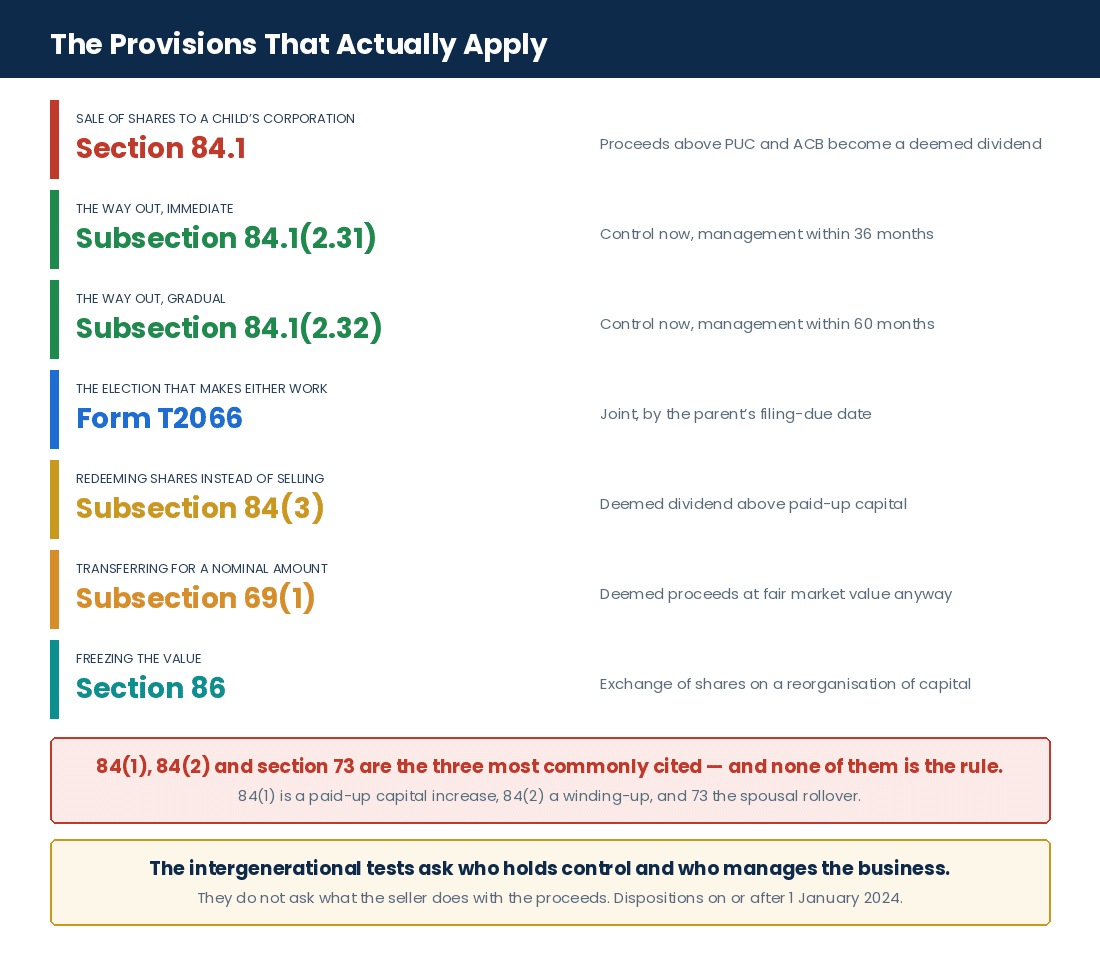
Section 84.1 is the anti-surplus-stripping rule. It applies where an individual resident in Canada disposes of shares of a Canadian corporation to another corporation with which they do not deal at arm’s length, and the two corporations are connected immediately after. Where it applies, the proceeds above the greater of paid-up capital and adjusted cost base are recharacterised as a deemed dividend.
| Provision | What it actually does |
|---|---|
| ITA 84.1 | The rule for a non-arm’s length share sale to a corporation. Converts a capital gain into a deemed dividend where the conditions are met |
| ITA 84(1) | Deems a dividend where a corporation increases the paid-up capital of a class of shares without a matching increase in net assets |
| ITA 84(2) | Deems a dividend on a distribution of property on the winding-up, discontinuance or reorganisation of a business |
| ITA 84(3) | Deems a dividend on a redemption, acquisition or cancellation of shares, to the extent the amount paid exceeds paid-up capital |
| ITA 15(1) | A shareholder benefit, not a recharacterisation of sale proceeds |
| ITA 15(2) | A shareholder loan inclusion, unrelated to share transfers |
Conflating these is not pedantry. A reader told to “follow section 84(1)” on a share sale to a child’s holding company is reading about paid-up capital increases and will not find the rule that is about to tax them.
The Intergenerational Exception Is About Control, Not Reinvestment
Risk Warning: “the buyer reinvests the sale proceeds right away in eligible property” is not the immediate transfer test, and “full payment at sale, no delayed amounts allowed” is not it either.
The intergenerational business transfer exception lives in subsections 84.1(2.31) (immediate) and 84.1(2.32) (gradual), enacted by Bill C-59 and applying to dispositions occurring on or after 1 January 2024. The conditions are about who holds voting control, who manages the business, and how quickly the parent gets out.
| Condition | Immediate — 84.1(2.31) | Gradual — 84.1(2.32) |
|---|---|---|
| Voting control | Child acquires more than 50% of voting shares at the time of disposition | Same, with the condition running to the later of 60 months and the final sale time |
| Parent ceases control | Immediately on the transfer | Immediately on the transfer |
| Management transferred | Within 36 months | Within 60 months |
| Parent’s common shares | All non-preferred shares divested within 36 months | All non-preferred shares divested within 36 months |
| Residual economic interest | Parent may remain a creditor for the price, or an arm’s length employee or consultant | Reduced below 30% of the value held at disposition for QSBC shares, 50% for farm and fishing corporations, by a final sale time within 10 years |
| Child’s engagement | Active on a regular, continuous and substantial basis | Same, running to the final sale time |
| Election | Joint election on Form T2066, signed by the parent and each qualifying child, filed by the parent’s filing-due date for the year of disposition | |
Nothing in either test asks what the seller does with the money. What they do ask is that the business genuinely change hands, and the conditions keep running for years after closing.
The QSBC Asset Test Is Two Thresholds, Not One
Risk Warning: “at least 90% of assets must be used in an active business over the past 24 months” merges two separate tests into one that is harder than the law and easier to fail on paper.
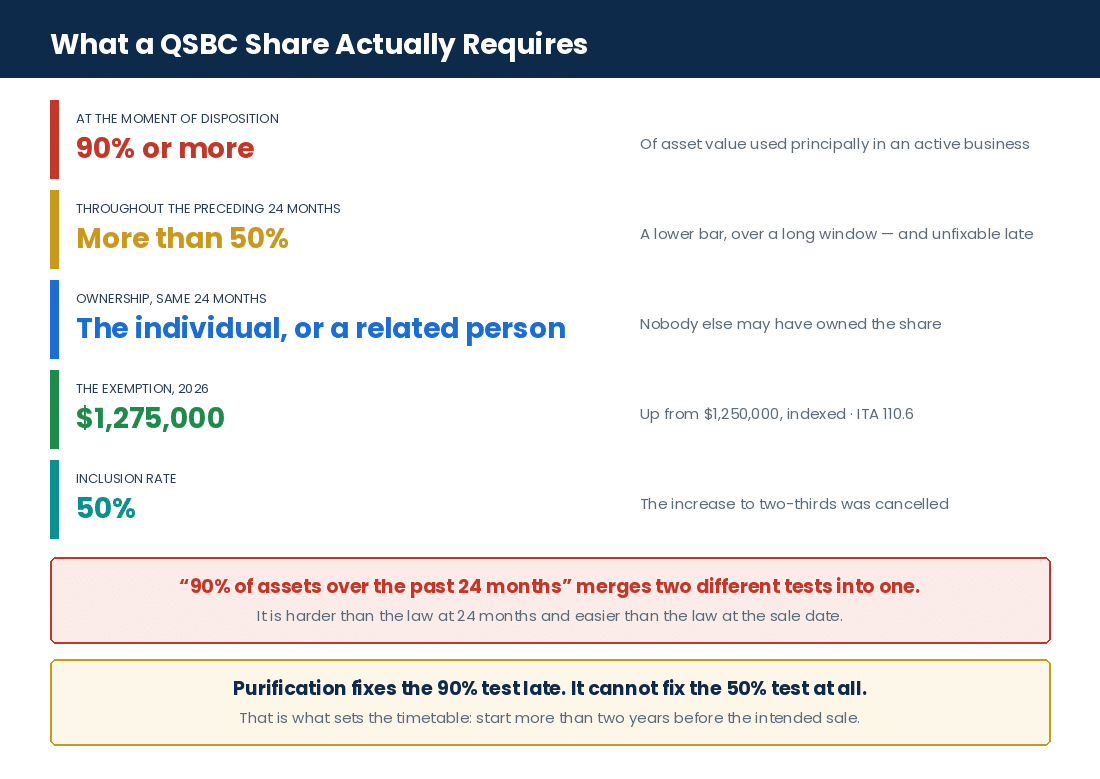
For a share to be a qualified small business corporation share under subsection 110.6(1), two asset tests apply at different moments:
| Test | When | Threshold |
|---|---|---|
| Point-in-time test | At the moment of disposition | 90% or more of the fair market value of assets used principally in an active business carried on primarily in Canada |
| Holding-period asset test | Throughout the 24 months before disposition | More than 50% of the fair market value of assets so used |
| Ownership test | Throughout the 24 months before disposition | The share was owned by no one other than the individual or a person or partnership related to them |
The practical consequence runs the other way from the usual advice. Purification to 90% can be done close to the sale; the test that cannot be fixed late is the 50% test across 24 months. A company that drifted above half its value in passive investments two years ago cannot repair that now.
A parent sold shares to a child’s holding company on advice that quoted “section 84(1)” throughout.
No Form T2066 was filed, because the adviser’s checklist called for “proper election forms” without naming one. Section 84.1 applied, the proceeds became a deemed dividend, and the lifetime capital gains exemption the family had planned around was unavailable against a dividend. Figures changed for privacy.
Understanding Family Business Succession Planning in Canada
Understanding Family Business Succession Planning
Foundations
Family businesses in Canada need a plan to pass control smoothly. Succession planning moves leadership and ownership to the next generation without surprises, deals with the tax consequences, and keeps family goals aligned with what the business actually needs.
The Importance of Succession Planning for Family Businesses
A good succession plan keeps the business legacy alive and protects its capital. Families have to prepare for leadership change and tax consequences well before either arrives.
Why Early Planning Is Essential
Start early to identify who can take over, set clear roles, and train future leaders. That reduces disruption and keeps the business running. It also matters mechanically: the 24-month asset and ownership tests behind the lifetime capital gains exemption look backwards from the sale, so a structure fixed today may still fail a test two years from now.
Common Consequences of Poor Succession Planning
- Disputes between family members over value, roles and dividend policy.
- Loss of key non-family staff who cannot see who they will be reporting to.
- A sale that triggers a deemed dividend under section 84.1 instead of a capital gain, against which no lifetime capital gains exemption is available.
- Shares that fail the qualified small business corporation tests because passive assets were never removed in time.
- A deemed disposition of everything the owner holds at death under subsection 70(5), at fair market value, with no plan for the resulting tax bill.
Key Dynamics of Family-Owned Enterprises and Their Impact on Succession
Family relationships shape succession plans more than any other input. Getting them right is what lets the tax structure survive contact with the family.
Balancing Business and Family Goals
Mixing personal hopes with job duties is the central difficulty in preparing second-generation leaders. Families should state what they expect out loud and test each member against what the business needs. The tax system is indifferent to fairness between siblings, so whatever the family decides has to be documented in share terms and agreements rather than understood.
Ownership Structure Complexities
Who owns which shares is what makes succession difficult. Splitting shares among siblings, or leaving inactive members holding common equity, takes deliberate design. Two features do most of the work: separate share classes for voting and economic rights, and a shareholders’ agreement with buy-sell terms, valuation mechanics and a dispute procedure.
The Three-Circle Model: Balancing Family, Business, and Ownership Interests
The three-circle model maps three overlapping groups — family, business and ownership — and shows that most people sit in more than one.
Explaining the Three-Circle Model
The model’s point is that a decision which looks obvious from inside one circle often looks wrong from another. A daughter who manages the company sits in all three; a son who holds shares but works elsewhere sits in two; a spouse with no shares sits in one. Dividend policy, salary levels and buy-sell terms land differently on each.
Practical Usage in Canadian Family Businesses
Canadian families use it to work out where a plan will meet resistance before it is announced. It also maps cleanly onto the tax questions: the business circle drives whether a child meets the active engagement test in the intergenerational transfer rules, the ownership circle drives the excluded shares exception to tax on split income, and the family circle drives who is a related person for the purposes of section 84.1.
Assessing Leadership and Role Definition in Succession Planning
Choosing leaders inside the family is what keeps the business growing after the handover, and under the current intergenerational transfer rules it is also a statutory condition rather than a preference.
Identifying Next-Generation Leaders
Look for commitment and capability, then build the second through hands-on responsibility and formal training. Where the family intends to use subsection 84.1(2.31) or 84.1(2.32), at least one qualifying child must be actively engaged on a regular, continuous and substantial basis in the business, and must stay engaged for the period the subsection requires. A child who is a shareholder in name only will not satisfy it.
Role Clarity And Avoiding Overlap
Writing down who decides what prevents the confusion that damages teamwork. It also produces the evidence CRA looks for in two places: the excluded business exception to tax on split income, which needs an average of 20 hours a week in the business during the year or in any five prior years, and the reasonableness test in section 67, which asks whether a salary matches the work performed.
Establishing Effective Governance Structures For Family Businesses
- A shareholders’ agreement setting out voting, transfer restrictions, buy-sell triggers and the valuation method.
- Directors’ and shareholders’ resolutions kept current, with the share register reconciled to them.
- A dividend policy stated in writing, distinguishing return on capital from reward for work.
- An annual valuation, or at least an agreed valuation mechanic, so nobody is negotiating price during a crisis.
- A dispute procedure that runs to mediation before it runs to litigation.
Governance is also a tax document. Where a shareholders’ agreement gives one party the right to acquire shares, it can affect control for the purposes of the intergenerational transfer conditions, and where a trust is in the structure, the trust deed’s terms drive whether income can be allocated at all.
Two siblings inherited equal common shares. One had run the business for nine years; the other had never worked in it.
Equal common shares meant equal dividends, which the working sibling experienced as a pay cut and the other as an entitlement. Splitting the equity into a voting and participating class for the operator and a separate non-voting class for the passive holder, with a salary set against section 67 reasonableness, resolved in structure what two years of conversation had not. Figures changed for privacy.
Tax Considerations in Family Business Succession Planning
Tax Considerations in Family Business Succession
The Provisions
Family business tax planning in Canada means working with rules written specifically because families do not deal at arm’s length. The Income Tax Act treats a transfer to a child differently from a sale to a stranger, and the differences cut both ways.
Overview of Canadian Tax Rules Relevant to Family Business Transfers
Three bodies of rule do most of the work: the lifetime capital gains exemption in section 110.6, the anti-surplus-stripping rule in section 84.1, and the attribution and split income rules that follow income paid to family members.
| Requirement | What it means | Provision |
|---|---|---|
| Qualifying shares | Shares of a small business corporation at the time of disposition, meeting the 90% active asset test | ITA 110.6(1) |
| Holding-period asset test | More than 50% of asset value used in an active business throughout the preceding 24 months | ITA 110.6(1) |
| Ownership test | Owned by the individual or a related person throughout those 24 months | ITA 110.6(1) |
| Exemption amount | $1,275,000 for 2026 dispositions, up from $1,250,000, and indexed | ITA 110.6(2.1) |
| Inclusion rate | 50%. The proposed increase to two-thirds was cancelled and never became law | ITA 38(a) |
| Capital gains reserve | Available over up to five years where the price is payable over time, and up to ten on a transfer of shares to a child | ITA 40(1)(a)(iii); 40(1.1) |
Every adult family member has their own exemption, which is what makes a family trust holding growth shares worth the administration in the right case. It is also why the planning has to be in place years ahead: a trust added a month before a sale does not create 24 months of history.
Intergenerational Business Transfer Rules and Their Application
Left alone, section 84.1 catches the most natural succession transaction there is: a parent sells shares to a company owned by their child, and the proceeds come out as a deemed dividend rather than a capital gain. The intergenerational exception disapplies that result where the transfer is genuine.
The current framework was enacted by Bill C-59, which received Royal Assent on 20 June 2024, and applies to dispositions occurring on or after 1 January 2024. It replaced the Bill C-208 rules of 2021, which were widely criticised for permitting transfers with no real change of hands.
| Requirement | Detail |
|---|---|
| Subject shares | Qualified small business corporation shares, or shares of a family farm or fishing corporation |
| Purchaser | A corporation controlled by one or more qualifying children — child, grandchild, stepchild, child-in-law, niece or nephew, each 18 or older |
| Transfer of control | The child, with their spouse or common-law partner, acquires more than 50% of the voting shares; the parent ceases to control |
| Transfer of management | Within 36 months (immediate) or 60 months (gradual), after which the parent permanently ceases to manage |
| Election | Joint election on Form T2066, filed by the parent’s filing-due date for the year of the disposition |
| Reassessment | The normal reassessment period is extended, because the conditions run for years after closing |
A late election may be accepted at the Minister’s discretion under subsection 220(3), with a penalty under 220(3.5). That is a remedy, not a plan.
Estate Freeze Strategies for Managing Capital Gains Tax
An estate freeze fixes the value of what the founder holds today and directs future growth to the next generation. It is not a sale and it does not trigger tax when done correctly.
Key Stat: the freeze runs on section 86, not section 73. Section 86 is the exchange of shares in a reorganisation of capital, which is the ordinary freeze mechanism. Section 85 is the rollover used where assets or shares are transferred to a corporation, and section 51 covers a conversion of convertible property.
Section 73 is the rollover on an inter vivos transfer to a spouse or certain trusts. It has nothing to do with freezing a corporation’s value for the next generation.
- The freezor exchanges common shares for fixed-value preferred shares, redeemable and retractable at the frozen value, usually carrying the votes so control is retained.
- New growth common shares are issued for nominal consideration to the children, or to a family trust of which they are beneficiaries.
- A price adjustment clause is included so that a later CRA challenge to the valuation adjusts the preferred share value rather than producing a shareholder benefit.
- Future appreciation accrues to the growth shares, where it can be sheltered by each child’s own lifetime capital gains exemption on a later sale.
- The freezor’s own gain is deferred until they dispose of the preferred shares or die.
A trust in the freeze adds flexibility — the beneficiaries do not have to be chosen today — at the cost of the 21-year deemed disposition in paragraph 104(4)(b), trust filing obligations, and the need to run every distribution against the attribution and split income rules.
Section 84.1 and Its Implications on Family Business Transfers
Section 84.1 exists to stop corporate surplus being extracted as a capital gain. It applies where an individual resident in Canada disposes of shares of a Canadian corporation to a corporation they do not deal with at arm’s length, and the two are connected immediately afterwards.
| Element | Effect |
|---|---|
| Proceeds above the greater of PUC and ACB | Recharacterised as a deemed dividend, taxed at dividend rates with no lifetime capital gains exemption available |
| Hard ACB | Cost stepped up using the exemption, or acquired from a non-arm’s length person, is ground down for 84.1 purposes |
| Paid-up capital of the new shares | Reduced so the surplus cannot be withdrawn tax-free later |
| The exception | Subsections 84.1(2.31) and 84.1(2.32), on a joint T2066 election with a genuine transfer |
A nominal or no-consideration transfer does not avoid the problem. Where shares move between non-arm’s length parties for less than fair market value, subsection 69(1) deems proceeds at fair market value to the transferor while the transferee’s cost may be the lower amount actually paid, producing double tax on the same value.
Comparing Dividend Payments and Share Redemption Approaches
Paying the outgoing generation through dividends and redeeming their shares are different transactions with different tax mechanics, and the source of most confusion is that both can produce a dividend.
| Factor | Dividend | Share redemption |
|---|---|---|
| Character | Taxable dividend, grossed up with the dividend tax credit | Deemed dividend under subsection 84(3) to the extent the redemption amount exceeds paid-up capital; the balance is proceeds of disposition |
| Split income | Caught by section 120.4 unless an exception applies | The deemed dividend is equally split income unless an exception applies |
| Exemption available | No | Only against the capital gain portion, not the deemed dividend |
| Equity reduced | No | Yes — the shares are cancelled |
| Cash requirement | Can be declared and paid over time | Needs liquidity, or a promissory note, and the corporation must satisfy the solvency tests in its governing statute |
| Corporate shareholder | Generally deductible under section 112, subject to subsection 55(2) | Same, and subsection 55(2) is the live risk on a redemption used to separate shareholders |
Tax on split income — TOSI — under section 120.4 taxes the amount at the top marginal rate with no personal credits other than the dividend tax credit and foreign tax credit. It is not a surtax and it does not merely remove a lower rate. The exceptions that matter in a family business are:
- Excluded business: the individual was actively engaged on a regular, continuous and substantial basis in the year, or in any five previous years — averaging 20 hours a week is a deemed safe harbour.
- Excluded shares: for an individual 25 or older, shares carrying at least 10% of votes and value, where the company earns less than 90% of its income from services and is not a professional corporation.
- Reasonable return: for an individual 25 or older, an amount reasonable against labour and capital contributed and risks assumed.
- Amounts received by a spouse where the business owner is 65 or older.
Salaries are tested separately. Section 67 denies the deduction to the extent an amount is unreasonable, which on a family payroll means the work has to be real and the records have to show it.
A family redeemed the founder’s shares and reported the whole amount as a capital gain against the lifetime capital gains exemption.
Subsection 84(3) deemed the excess over paid-up capital to be a dividend. Only the small remainder was proceeds of disposition, so almost none of the exemption was usable, and the reassessment arrived with interest. A sale of the shares rather than a redemption would have reached the result the family had been told to expect. Figures changed for privacy.
Structuring a Tax-Efficient Succession Plan
Structuring a Tax-Efficient Succession Plan
Structure
Structuring is where the family’s intentions meet the qualification tests. The order of operations matters more than the individual steps, because several of the tests look backwards over 24 months and cannot be satisfied retroactively.
Restructuring Before Estate Freeze to Optimize Tax Outcomes
A freeze locks in today’s value. If the shares being frozen would not qualify as QSBC shares today, freezing does not fix that; it preserves the problem at a fixed price. Purification comes first.
- Value the company, and identify every asset not used principally in the active business — surplus cash, portfolio investments, rental property, loans to shareholders.
- Remove or reposition them: pay a dividend to a holding company, repay shareholder debt, acquire active assets, or move the passive holdings out under a subsection 85(1) rollover, elected on Form T2057.
- Confirm the more than 50% test will be met throughout the coming 24 months, which is the test that drives the timetable.
- Carry out the freeze under section 86, with a professional valuation and a price adjustment clause.
- Issue growth shares to the children or a family trust, and document the subscription.
- Update the share register, the shareholders’ agreement and the minute book in the same sitting.
A Toronto family moved two rental properties out of the operating company before freezing.
At the time the rentals represented roughly a third of asset value — enough to fail the 90% point-in-time test at a sale, though not the 50% test. Moving them early meant the 24-month clock started that year rather than two years later, and the exemption was available when the shares eventually changed hands. Figures changed for privacy.
Aligning Ownership Structure with Succession Objectives
Ownership design is where the family’s answer to “who gets what” becomes enforceable. Family trusts give flexibility about who receives growth and when, while control stays with the trustees.
- Separate share classes for voting and economic rights, so the operator can run the business without the passive holders being disinherited.
- Discretionary family trust holding growth shares, with the trustees deciding allocations annually.
- A shareholders’ agreement covering buy-sell triggers, valuation, drag and tag rights and the dispute route.
- Life insurance funding the buy-sell, held where the proceeds and the capital dividend account land usefully.
Three constraints shape every trust in this structure. The 21-year deemed disposition in paragraph 104(4)(b) treats trust property as sold at fair market value, so a plan is needed well before year 21, usually a rollout to beneficiaries under subsection 107(2). Subsection 75(2) attributes income back to a contributor who can regain the property, which is why the settlor is generally not a trustee or beneficiary. And allocations to beneficiaries have to clear section 120.4 before they are worth making.
Managing Equity Distribution and Wealth Preservation
Equity distribution has to be fair enough to survive the family and precise enough to survive CRA. Where the transfer is a sale to a child’s corporation, the intergenerational exception is what keeps the result a capital gain.
| Choice | Immediate — 84.1(2.31) | Gradual — 84.1(2.32) |
|---|---|---|
| Management handover window | 36 months | 60 months |
| Parent’s residual equity | Preferred shares only after 36 months; otherwise creditor or arm’s length employee | Below 30% of original value for QSBC shares, 50% for farm and fishing, by a final sale time within 10 years |
| Suits | A child already running the business | A founder who needs several more years in the chair |
| Risk | Conditions tested over 36 months after closing | Conditions tested for up to 10 years after closing |
Where the price is payable over time, the capital gains reserve spreads the gain — up to five years generally under subparagraph 40(1)(a)(iii), and up to ten years under subsection 40(1.1) on a transfer of qualifying shares to a child. The reserve is claimed on the return; it does not arise from the payment schedule alone.
Watch retained earnings too. Clearing surplus out as dividends to fund a buyout raises personal tax and strips the cash the next operator needs, and inter-corporate dividends paid to separate shareholders run into subsection 55(2).
Leveraging Capital Gains Exemptions and Tax-Exemptions in Transfers
The lifetime capital gains exemption is $1,275,000 for 2026 dispositions, indexed annually, and is claimed on Form T657, with CRA Guide T4037 setting out the mechanics. It is available against a capital gain on QSBC shares and on qualified farm or fishing property. It is not available against a dividend, deemed or otherwise.
- Room is reduced by prior claims and by a cumulative net investment loss under section 110.6(1).
- An allowable business investment loss claimed in an earlier year also reduces the available amount.
- Claiming the exemption can trigger alternative minimum tax, which is refundable against regular tax over the following seven years but is cash out the door in the year of sale.
- Multiplying the exemption across adult family members through a trust needs the 24-month tests met by the trust’s holding, not just by the parent’s.
A second route has become relevant for families without a successor. The $10 million capital gains exemption on a qualifying business transfer to an employee ownership trust was legislated as a temporary measure for 2024 through 2026, and the Spring Economic Update tabled 28 April 2026 announced it would be made permanent, in Bill C-30. Treat the permanence as announced rather than enacted until the bill passes.
Role of Professional Advisors in Tax Planning and Compliance
Succession is one of the few areas where the cost of advice is reliably smaller than the cost of its absence, because most of the failures are irreversible by the time they are noticed.
- A transfer priced at nominal or no consideration, which engages subsection 69(1).
- A claim on shares that do not meet the QSBC tests, where the 24-month history cannot now be changed.
- A missed T2066 election, leaving section 84.1 to apply in full.
- Dividends paid to family members with no analysis of section 120.4.
- A family trust approaching year 21 with no rollout plan.
- A freeze with no price adjustment clause and no independent valuation.
The working team is a CPA for the tax structure and the filings, a tax lawyer for the share terms, trust deed and will, and a chartered business valuator where the numbers will be tested. Gondaliya CPA performs the accounting and tax work and compilation engagements under CSRS 4200; audit and review engagements are referred out, and legal drafting sits with counsel.
Reporting obligations have also tightened. Enhanced trust reporting requires most express trusts to file a T3 return with Schedule 15 identifying trustees, settlors and beneficiaries, which for a family trust that previously filed nothing is a new annual task rather than an occasional one.
Managing Family Dynamics Throughout Succession
Managing Family Dynamics Throughout Succession
People
Family dynamics decide whether a technically correct plan survives. When personal relationships carry the business, disagreements land on structures that were designed for tax reasons and were never explained.
Addressing Potential Conflicts Between Family and Business Interests
- Disputes over share value, and over paying dividends versus reinvesting.
- Different expectations about pay where one sibling works in the business and another does not.
- Confusion about why the operator holds a different class of share.
- Disagreement about timing, where the founder’s retirement date is also a statutory deadline under the intergenerational transfer conditions.
A father began a transfer to his child’s corporation while the company still held a substantial investment portfolio.
The 90% point-in-time test would have failed on the day of sale. Catching it before closing allowed the portfolio to be moved to a holding company first; starting the sale and discovering it afterwards would have cost the exemption outright. Figures changed for privacy.
Conflict Resolution Strategies
- A formal dispute procedure written into the shareholders’ agreement, with defined steps and timelines.
- Mediation before positions harden, with a neutral third party rather than a family member.
- Decision rules set in advance: what needs unanimity, what needs a majority, what the operator decides alone.
- Everything agreed written down, so the next disagreement starts from a record rather than a recollection.
Where emotions attach to valuation, an independent chartered business valuator usually settles more than another family meeting does — and the report is also what supports the price if CRA tests it.
Facilitating Open Communication and Family Meetings
Regular meetings give the plan somewhere to be discussed before it is executed. Four subjects belong on the agenda every time: share transfers and their timing, dividend policy against section 120.4, salaries against the reasonableness test in section 67, and the state of any freeze or trust.
Importance of Communication
Communication does real tax work here, not just relational work. The excluded business exception turns on hours actually worked, the excluded shares exception on votes and value actually held, and section 67 on duties actually performed. Each is a fact about what family members do, and each is far easier to evidence if it was discussed and recorded as it happened.
Best Practices for Meetings
| Practice | Detail |
|---|---|
| Frequency | Quarterly, or semi-annually at minimum |
| Participation | All shareholders, active and passive, plus advisers when a structural item is on the agenda |
| Agenda | Valuation update, qualification test status, dividend and salary decisions, trust year count |
| Documentation | Written minutes kept with the corporate records, not in an inbox |
Integrating Family, Business, and Ownership Circles in Decision-Making
Bringing the three circles into one decision is what stops a plan that works for the business from failing in the family, or the reverse. It also forces the tax questions into the open: whether the asset mix still supports an exemption claim, and how dividends to minor or inactive shareholders will be taxed.
Bringing Stakeholders Together
Include the children who work full time and the siblings who do not. Treating inactive members as an afterthought is how buyout demands appear at the worst moment, and differential treatment is defensible only when it was explained and documented at the time.
Methods for Inclusive Decision-Making
- Working sessions led by the CPA on the intergenerational transfer conditions, so everyone hears the same deadlines.
- Side-by-side scenarios showing the outcome with and without the T2066 election.
- Annual review of the valuation, the asset mix and the purification status.
- A written record of what was decided and why, kept with the minute book.
Ensuring Continuous Evaluation and Adaptation of Succession Plans
A succession plan is a position that has to be re-tested, because the facts underneath it move.
- Changes in asset mix that affect the 90% and 50% tests.
- New beneficiaries or shareholders entering through a trust, and the trust’s year count against paragraph 104(4)(b).
- A death, which triggers a deemed disposition at fair market value under subsection 70(5), subject to the spousal rollover in subsection 70(6).
- Value movements that change what the exemption will cover.
- Ongoing compliance with the intergenerational transfer conditions, which continue for 36 months or up to 10 years after closing.
Set a review cycle with your CPA and counsel so that T2 and T3 deadlines are met, elections are filed on time, and the records exist if the file is examined.
Case Studies Illustrating Family Business Succession and Tax Strategies
Case Studies in Succession and Tax Strategy
Worked Through
The same handful of failures recur. Each one below is a real pattern, with figures changed.
Realistic Scenarios on Transferring Family Businesses Across Generations
| Scenario | What happened | Provision |
|---|---|---|
| Sale to a child-controlled holding company | Joint T2066 election filed, voting control and management transferred on the 36-month timetable; the gain stayed a capital gain | ITA 84.1(2.31) |
| Inactive assets left in the company | The 90% test failed at the moment of sale; the exemption was denied and the structure had to be rebuilt | ITA 110.6(1) |
| Siblings with unequal involvement | Dividends and salaries reset against the excluded shares and excluded business exceptions, and against reasonableness | ITA 120.4; ITA 67 |
| Redemption treated as a sale | The excess over paid-up capital was a deemed dividend; almost no exemption was usable | ITA 84(3) |
| Trust at year 19 | Rollout to beneficiaries planned and executed before the deemed disposition date | ITA 104(4)(b); 107(2) |
Lessons from Successful and Challenging Succession Experiences
The successful files share a shape. The freeze happened years before anyone needed it, the purification happened before the freeze, the valuation was independent, and the election was filed with the return rather than remembered afterwards.
The difficult files share a different shape: an assumption that owning the business was enough to qualify, and a discovery during a review that the holding period, the asset mix or the price did not support what had been filed.
- Re-test the asset mix and the ownership history every year, not at the point of sale.
- Keep the shareholders’ agreement current with who actually does what.
- File elections on time; a late T2066 is discretionary relief, not a right.
- Never transfer shares for nominal consideration without a valuation and a price adjustment clause.
- Track the intergenerational transfer conditions after closing, because that is where they are tested.
A founder froze at roughly $2 million and issued growth shares to a family trust eight years before stepping back.
By the time the children bought in, the growth above the freeze value sat on their shares, each child’s own lifetime capital gains exemption was available against it, and the founder’s preferred shares were redeemed over time against a known number. The valuation argument that normally dominates these files never happened, because the number had been fixed in advance. Figures changed for privacy.
Impact of Tax Rules and Legal Compliance on Business Continuity
Tax outcomes decide whether the business survives the handover with its working capital intact. Where section 84.1 applies unexpectedly, a planned capital gain becomes a dividend taxed at personal rates, and the cash to pay it usually comes out of the company.
Corporate records matter for the same reason. A share register that does not agree to the resolutions, or a T2 filed on figures that do not reconcile to the statements, turns a routine review into a long one. And where an owner dies without a plan, subsection 70(5) deems a disposition of everything at fair market value, which on a successful private company is the largest single tax event the family will ever face.
Post-mortem planning — the pipeline, the subsection 164(6) loss carry-back, the capital dividend account — is available, but it runs on short deadlines measured from the date of death and needs legal and accounting work in parallel.
The penalties sit alongside the tax. A late T2 is penalised under subsection 162(1) at 5% of the unpaid tax plus 1% per complete month to twelve, and a transfer year is exactly when a balance is large enough for that to matter. A salary to a family member disallowed as unreasonable under section 67 is denied outright rather than reduced. And where a return is filed on a position the taxpayer knew to be wrong — shares claimed as qualifying when they plainly were not — subsection 163(2) adds a gross negligence penalty of 50% of the understated tax, on top of arrears interest compounding daily under subsection 161(1).
Supporting Resources and Next Steps for Family Business Succession
Supporting Resources and Next Steps
Practical
Planning a transfer needs the right documents in front of you before the first meeting. These are the tools that shorten the work.
Available Tools, Guides, and Checklists for Succession Planning
- Succession readiness checklist: shareholders’ agreement, valuation reports, trust deed, dividend history, minute book, share register, last three years of financial statements and T2 returns.
- Qualification tracker: asset mix by month against the 90% and 50% tests, and the ownership history across 24 months.
- Scenario comparison: gift versus sale, immediate versus gradual, trust versus direct holding, with the tax result of each.
- Valuation calendar: when the next valuation is due and which decisions depend on it.
- Election diary: T2066 filing deadline, section 85 rollover elections on Form T2057, and the trust’s year count toward 21.
How Gondaliya CPA Supports Families in Managing Succession Tax and Accounting
- Testing shares against the QSBC asset and ownership tests, and saying plainly whether they qualify today.
- Designing and sequencing purification so the 24-month clock starts when it needs to.
- Modelling the immediate and gradual intergenerational options against the family’s actual retirement timetable.
- Preparing the T2066 and section 85 elections and filing them with the return.
- Working alongside counsel on freezes, trust deeds and shareholders’ agreements, without giving legal advice ourselves.
- Compilation engagements under CSRS 4200, which provide no assurance; audit and review engagements are referred out.
- Bookkeeping and corporate year-end accounting on QuickBooks Online or Xero, so the records stand up when a transfer is examined.
- T2 and T3 filing, including Schedule 15 for trusts, on a flat annual fee including HST with a one-business-day response.
Scheduling Consultations for Tailored Succession and Tax Planning Advice
Book early enough that the 24-month tests can still be met. A first meeting covers:
- The corporate structure and share register as they stand.
- Three years of financial statements, split between active and passive assets.
- Who in the family works in the business, and for how many hours.
- Which elections the plan will need, and by when.
- Who else needs to be in the room — counsel, a valuator, an insurance adviser.
Starting early is the difference between choosing a route and being left with whichever one the facts still allow.
Related Articles and Further Reading on Family Business Tax and Succession
Three areas repay reading before a first meeting: how non-arm’s length sales are treated when shares move inside a family, how the intergenerational share transfers exception keeps a transfer out of deemed dividend treatment, and how timing on valuations affects the exemption during a generational handoff. Our guide to the lifetime capital gains exemption works through a share sale end to end, and our note on CRA audit representation covers what happens if the file is reviewed.
Frequently Asked Questions on Family Business Succession Tax Planning in Canada
Frequently Asked Questions
FAQ
What are the key challenges in family business succession planning in Canada?+
Managing family relationships, meeting the qualification tests on a timetable that looks back 24 months, filing the elections the structure depends on, and keeping the conditions satisfied for years after closing. Clear governance and written records address most of them.
Which provision applies when I sell shares to my child’s corporation?+
Section 84.1. It recharacterises proceeds above the greater of paid-up capital and adjusted cost base as a deemed dividend. Subsection 84(1) deals with paid-up capital increases, 84(2) with distributions on a winding-up and 84(3) with redemptions — none of them is the rule on a sale to a related corporation.
How do sections 110.6 and 104(4) affect succession planning?+
Section 110.6 governs the lifetime capital gains exemption, including the qualified small business corporation tests and the $1,275,000 limit for 2026. Paragraph 104(4)(b) deems a trust to dispose of its property at fair market value every 21 years, which sets a hard planning date for any family trust holding growth shares.
What are the recharacterisation rules in second-generation planning?+
They stop corporate surplus being extracted as a capital gain. Section 84.1 is the main one on a non-arm’s length share sale to a corporation; subsection 84(3) produces a deemed dividend on a redemption; and subsection 69(1) deems fair market value proceeds where shares move for less than they are worth.
What are the conditions for the intergenerational business transfer exception?+
The child must acquire more than 50% of the voting shares and the parent must cease to control. Management transfers within 36 months under subsection 84.1(2.31) or 60 months under 84.1(2.32), the parent’s non-preferred shares go within 36 months, and at least one child stays actively engaged. A joint election on Form T2066 is filed by the parent’s filing-due date. The rules apply to dispositions on or after 1 January 2024.
When must corporate tax returns be filed after a family business transfer?+
The T2 is due six months after fiscal year-end under paragraph 150(1)(a). The balance of tax is due earlier, at two months under paragraph 157(1)(b), or three for an eligible Canadian-controlled private corporation claiming the small business deduction. A transfer year often produces tax that is payable before anyone has thought about the return.
How can family trusts be used effectively in succession planning?+
A discretionary trust holding growth shares lets the trustees decide allocations later and can multiply the lifetime capital gains exemption across adult beneficiaries. The constraints are the 21-year deemed disposition in paragraph 104(4)(b), the attribution rule in subsection 75(2), tax on split income on allocations, and annual T3 filing with Schedule 15.
Why does purification matter before claiming the exemption?+
Because passive assets break the tests. At the moment of sale, 90% of asset value must be used principally in an active business; throughout the preceding 24 months, more than 50% must be. The 90% test can be fixed close to the sale. The 50% test cannot be fixed retroactively at all.
How do split income rules affect family dividends?+
Section 120.4 taxes split income at the top marginal rate, with no personal credits other than the dividend tax credit and foreign tax credit. The exceptions that matter are excluded business (an average of 20 hours a week), excluded shares (10% of votes and value, for someone 25 or older, outside a professional or mainly-services corporation), a reasonable return, and amounts received by a spouse where the owner is 65 or older.
Can I just give the shares to my children?+
You can, but it is not free. Subsection 69(1) deems you to have received fair market value proceeds, so the gain is taxed to you, while the children’s cost may be only what they actually paid — which taxes the same value twice on a later sale. A properly priced transfer with a price adjustment clause avoids that.
What happens to the business if the owner dies without a plan?+
Subsection 70(5) deems a disposition of all capital property at fair market value immediately before death, so the full accrued gain on the shares is realised. Subsection 70(6) defers it where the shares pass to a spouse or spousal trust. Post-mortem routes such as the subsection 164(6) loss carry-back run on deadlines measured from the date of death.
Is a redemption the same as a sale for exemption purposes?+
No. On a redemption, subsection 84(3) deems the amount above paid-up capital to be a dividend, and only the remainder is proceeds of disposition. The lifetime capital gains exemption applies to the capital gain, not to the deemed dividend, so a redemption usually wastes most of it.
Does claiming the exemption cost anything in the year of sale?+
It can. A large exempt gain is an alternative minimum tax item. AMT paid is recoverable against regular tax over the following seven years, but it is cash out the door in the year of the sale and needs to be budgeted alongside the rest of the transaction.
What is the capital gains inclusion rate for 2026?+
50%. The proposed increase to two-thirds was deferred and then cancelled, and never became law. The lifetime capital gains exemption increase was kept, and the limit is $1,275,000 for 2026 dispositions.
What should families prepare before a succession planning conversation?+
The shareholders’ agreement, the share register and minute book, the most recent valuation, trust documents if any, three years of financial statements and T2 returns, the dividend and salary history, and an honest list of who works in the business and roughly how many hours.
Fifteen questions, and the one that decides the most money is the least technical: who is actually going to run this.
Every route through section 84.1 now depends on a child holding voting control and being genuinely engaged in the business. Where the honest answer is nobody, the plan is a third-party sale or an employee ownership trust, and no amount of structuring changes that. Figures changed for privacy.
Essential Considerations for Effective Family Business Succession
Key Controls and Warning Signs
Quick Reference
- Know which decisions sit in which circle — family, business, ownership — so conflicts are anticipated rather than discovered.
- Compare gifting against selling before choosing, because subsection 69(1) prices a gift at fair market value anyway.
- Schedule an annual review with your advisers against the current Income Tax Act position.
- Keep compilation financial statements current for transparency and for anyone examining the file.
- Address the common failures early: a missed T2066, an unsupported valuation, unclear governance.
- Choose a CPA firm that works in Ontario small business taxation and knows the intergenerational rules as amended.
- Bring accountants, counsel and a valuator into the first conversation rather than the last.
- Track T2 and T3 deadlines after the transfer, not only before it.
- Watch recharacterisation risk under sections 84.1, 84(3) and 69(1).
- Diarise the trust’s 21-year date from the day it is settled.
- Explain the split income rules to every family member who receives a dividend.
- Prepare the document checklist before the first planning meeting.
- Understand that purification is what makes section 110.6 available, and that half of it cannot be done late.
- Revisit the strategy whenever the law changes or the family does.
What Gondaliya CPA Provides
- QSBC qualification testing against both asset thresholds and the ownership history.
- Purification sequencing, with the 24-month clock mapped to the intended sale date.
- Intergenerational transfer modelling, immediate against gradual, with the post-closing conditions diarised.
- Preparation and filing of T2066 and section 85 elections with the return.
- Estate freeze accounting and the share register work that follows it.
- Family trust compliance including T3 returns with Schedule 15, and the 21-year rollout plan.
- Dividend and salary design against section 120.4 and section 67.
Warning Signs Your Succession Plan Needs Review
| Sign | What it usually means |
|---|---|
| Nobody can say what the company is worth | No valuation, so no freeze value and no defensible transfer price |
| Cash and investments have been accumulating for years | The 50% test may already be failing, and 24 months of history cannot be rebuilt |
| Shares were transferred for $1 or “as a gift” | Subsection 69(1) priced it at fair market value regardless |
| Dividends go to family members who do not work in the business | Section 120.4 may be taxing them at the top rate |
| The family trust was settled more than 15 years ago | The 21-year deemed disposition is close enough to need a plan now |
| The minute book has not been updated since the last transfer | The share register will not support the position on review |
| The founder still signs everything, two years after “retiring” | The management transfer condition may already have failed |
Choosing a CPA Firm in Toronto or Ontario
Look for owner-managed private company experience specifically, verification on the CPA Ontario public firm directory, a flat fee quoted before work begins, and the willingness to work alongside your lawyer rather than around them. Only a licensed firm can issue a compilation engagement report under CSRS 4200, which provides no assurance.
Points Worth Carrying
- The rule on a sale to a child’s corporation is 84.1, not 84(1) or 84(2).
- The intergenerational exception is 84.1(2.31) and 84.1(2.32), for dispositions on or after 1 January 2024.
- It turns on voting control and management, not on what the seller does with the proceeds.
- The election is a joint T2066, filed by the parent’s filing-due date.
- QSBC asset tests are 90% at sale and more than 50% across 24 months.
- The exemption is $1,275,000 for 2026, and the inclusion rate stayed at 50%.
- Estate freezes run on section 86 or 85, not section 73.
- A redemption produces a deemed dividend under 84(3), against which no exemption applies.
- Tax on split income is section 120.4, at the top marginal rate.
- A trust is deemed to dispose of its property every 21 years under 104(4)(b).
- Death triggers a deemed disposition under 70(5), not section 150.
Eleven points, and most of them are corrections to something a family had already been told.
None of the provisions is obscure. What goes wrong is a digit: 84(1) for 84.1, 90% for 50%, section 73 for section 86. Each one sends a reader to a rule that does not apply to them. Figures changed for privacy.
Businesses We Serve & Industry Spotlights
Industry Expertise
Second-generation transfers look different in each sector, mostly because the asset mix and the licensing rules differ. Here are eleven and the form the question usually takes.
| Industry | The Succession Angle |
|---|---|
| Medical doctors & physician professional corporations | Shareholder restrictions limit who can hold the equity |
| Dentists & dental practices | Practice goodwill valuation and associate buy-ins |
| Daycare, childcare & CWELCC services | Licence transfer alongside the share transfer |
| Real estate investors, landlords & holding companies | Rental assets are passive and break the QSBC tests |
| Property developers & builders | Inventory and work in progress distort the asset mix |
| Construction, contractors & skilled trades | Equipment pools and bonding capacity pass with control |
| Technology startups & SaaS | Growth shares to the next generation before value accrues |
| E-commerce & online retailers | Inventory valuation at the freeze date |
| Restaurants & food and beverage | Leases and licences that need landlord consent on transfer |
| Transportation, logistics & trucking | Fleet depreciation drives the freeze valuation |
| Consulting firms | Services income limits the excluded shares exception |
- Medical doctors & physician professional corporations: Who may hold shares is set by the regulator, which narrows the freeze design before tax is considered, and a professional corporation is outside the excluded shares exception to split income.
- Dentists & dental practices: Most of the value is goodwill, so the valuation drives the freeze number and the buy-in price for an associate who is also the successor.
- Daycare, childcare & CWELCC services: The licence and the funding agreement transfer on their own terms, which run alongside the share transfer rather than following it.
- Real estate investors, landlords & holding companies: Rental property is generally not used in an active business, which is why these structures almost always need purification before any exemption claim is possible.
- Property developers & builders: Work in progress and land inventory move the asset mix between year-ends, so the 24-month test needs watching rather than assuming.
- Construction, general contractors & skilled trades: Equipment pools, bonding and the relationships that carry the work all pass with control, which is exactly what the intergenerational conditions require to move.
- Technology startups & SaaS: The cheapest freeze is the earliest one, because growth shares issued before the value arrives cost almost nothing to put in the next generation’s hands.
- E-commerce & online retailers: Inventory valuation at the freeze date sets the preferred share value, and an aggressive number there is what a price adjustment clause protects against.
- Restaurants & food and beverage: Leases and liquor licences frequently need consent on a change of control, which can set the closing date before the tax plan does.
- Transportation, logistics & trucking: Fleet value and the undepreciated capital cost behind it drive both the freeze valuation and what the next operator inherits in deductions.
- Consulting firms: Where more than 90% of income comes from services, the excluded shares exception is unavailable, so dividends to inactive family members need another route out of section 120.4.
The sector changes. The three questions do not: do the shares qualify today, who is taking control, and what will the parent still hold afterwards.
A dental practice and a trucking company look nothing alike and sit in front of exactly the same tests. Figures changed for privacy.
Professional Guidance and Quick Reference
Guidance
Professional Guidance: How Gondaliya CPA Handles Your Family Transfer
Family corporations get into difficulty in a predictable set of ways: following guidance that cites 84(1) or 84(2) when the rule is section 84.1; believing the intergenerational exception turns on reinvesting the proceeds, when subsections 84.1(2.31) and 84.1(2.32) turn on transferring voting control and management; treating the qualified small business corporation test as a single 90% threshold across 24 months, when it is 90% at the moment of sale and more than 50% throughout the preceding 24 months; freezing under section 73, which is the spousal rollover, rather than section 86; redeeming shares and expecting a capital gain, when subsection 84(3) deems a dividend above paid-up capital; transferring shares for a nominal amount, when subsection 69(1) prices them at fair market value anyway; citing sections 120 to 125 for split income, when the provision is 120.4; treating a death as a filing question under section 150, when subsection 70(5) deems a disposition of everything at fair market value; and paying the corporate balance with the return, when it was due at two months under 157(1)(b). Gondaliya CPA handles family corporation accounting and tax on a flat annual fee.
We handle what decides the outcome: testing the shares against both asset thresholds and the ownership history before anyone commits to a date, sequencing purification so the 24-month clock starts in time, modelling immediate against gradual transfer on the founder’s real retirement timetable, preparing and filing the T2066 and section 85 elections with the return, doing the estate freeze accounting and the share register work that follows, keeping family trust compliance current including the 21-year date, designing dividends and salaries against section 120.4 and section 67, and preparing compiled statements under CSRS 4200 that state plainly that no assurance is provided.
Our team starts with your share register, three years of statements and an honest list of who works in the business. Whatever the sector, you get clear advice and a fixed price before we start.
Quick Answers
At a Glance
- Sale to a child’s corporation: ITA 84.1
- Intergenerational exception: 84.1(2.31) immediate, 84.1(2.32) gradual
- Election: joint Form T2066, by the parent’s filing-due date
- In force: dispositions on or after 1 January 2024
- LCGE 2026: $1,275,000, indexed
- QSBC at sale: 90% active asset value
- QSBC over 24 months: more than 50%
- Inclusion rate: 50%
- Estate freeze: section 86, or 85 where assets move
- Redemption: deemed dividend under 84(3)
- Split income: section 120.4, top marginal rate
- Trust deemed disposition: 21 years, 104(4)(b)
- Death: deemed disposition under 70(5)
- Corporate balance: two months, ITA 157(1)(b)
Who This Is For
Fit Check
- For: Owners of Canadian-controlled private corporations planning a transfer to the next generation — founders approaching a handover, adult children already running the business, and families holding shares through a trust.
- Not For: Individuals with no corporation, who need personal tax and estate planning rather than corporate succession work, and businesses requiring a review or audit engagement, which we refer out. Legal drafting of share terms, trust deeds and wills sits with counsel.
People Also Ask
Quick Answers
Is section 84.1 the same as section 84(1)?+
No. Section 84.1 recharacterises proceeds on a non-arm’s length sale of shares to a corporation. Subsection 84(1) deems a dividend where paid-up capital is increased without a matching increase in net assets. Different rules, different triggers.
Can I claim the exemption if my company holds investments?+
Only if the investments are small enough. 90% of asset value must be used principally in an active business at the moment of sale, and more than 50% throughout the preceding 24 months. Purification fixes the first; the second needs two years of lead time.
Do I need to file anything to use the intergenerational exception?+
Yes. A joint election on Form T2066, signed by you and each qualifying child, filed by your filing-due date for the year of the disposition. Without it, section 84.1 applies in full.
Does an estate freeze trigger tax?+
Not when done correctly. A section 86 exchange of common shares for fixed-value preferred shares is a rollover. Tax arises later, when the preferred shares are redeemed or disposed of, or on death under subsection 70(5).
What is the deadline I am most likely to miss?+
The corporate balance of tax at two months under paragraph 157(1)(b). A transfer year often produces a large tax bill, and the balance is due four months before the return it belongs to, generating interest rather than a notice.
Glossary of Key Terms
Glossary
- Section 84.1: The anti-surplus-stripping rule on a non-arm’s length share sale to a corporation.
- Subsection 84.1(2.31): The immediate intergenerational business transfer exception.
- Subsection 84.1(2.32): The gradual intergenerational business transfer exception.
- Form T2066: The joint election for an immediate or gradual intergenerational business transfer.
- Subsection 84(3): Deems a dividend on a redemption above paid-up capital.
- Subsection 69(1): Deems fair market value proceeds on a non-arm’s length transfer for less than value.
- Section 110.6: The lifetime capital gains exemption and the QSBC share definition.
- QSBC share: 90% active assets at disposition, more than 50% across 24 months, with the ownership test met.
- Section 86: Exchange of shares in a reorganisation of capital, the ordinary estate freeze mechanism.
- Section 85: The rollover on a transfer of property to a corporation, elected on Form T2057.
- Price adjustment clause: A term resetting share value if CRA successfully challenges the valuation.
- Paragraph 104(4)(b): The 21-year deemed disposition of trust property.
- Subsection 75(2): Attributes trust income back to a contributor who can regain the property.
- Section 120.4: Tax on split income, at the top marginal rate.
- Subsection 70(5): Deemed disposition of capital property at fair market value on death.
- CSRS 4200: The compilation engagement standard, providing no assurance.
Family Business Succession Check
This quick self-check indicates where your structure most likely needs attention. Please answer the five questions below.
Family Business Succession Check
Five quick questions on your structure. No fee shown.
Points to raise with us:
This is a general prompt, not tax or legal advice or a quote. Your position depends on your full facts. For a real review, please book a free consultation.
Want a checklist to work from? You can download our free family business succession checklist before your consultation.
Start with the section numbers, because most of what circulates is wrong about them. The rule on a sale to your child’s corporation is 84.1, and the exception that saves it is 84.1(2.31) or 84.1(2.32) on a joint T2066 election, for dispositions on or after 1 January 2024. Those tests ask who holds voting control and who manages the business, not what you do with the money, and they keep running for 36 months or up to 10 years after closing. Test the shares against both QSBC thresholds before you commit to a date, remembering that 90% at sale can be fixed late and more than 50% across 24 months cannot. Freeze under section 86 with an independent valuation and a price adjustment clause, not under section 73. Sell shares rather than redeem them where the exemption matters, because 84(3) turns a redemption into a dividend above paid-up capital. Price every transfer at fair market value, because 69(1) will anyway. Diarise the trust’s 21-year date from the day it is settled. And pay the corporate balance at two months, not with the return.
2026 Update — what is current: This article reflects rules current to 7 October 2026. The intergenerational business transfer rules in subsections 84.1(2.31) and 84.1(2.32), enacted by Bill C-59 with Royal Assent on 20 June 2024, apply to dispositions occurring on or after 1 January 2024 and replaced the Bill C-208 rules. The lifetime capital gains exemption is $1,275,000 for 2026 dispositions, up from $1,250,000, and remains indexed. The capital gains inclusion rate stays at 50%: the proposed increase to two-thirds was deferred and then cancelled, and never became law. The $10 million exemption on a qualifying business transfer to an employee ownership trust, legislated for 2024 through 2026, was announced in the Spring Economic Update of 28 April 2026 as becoming permanent through Bill C-30 — announced rather than enacted, so confirm the status before relying on it. Enhanced trust reporting continues, with most express trusts filing a T3 return and Schedule 15. Unchanged: the QSBC tests at 90% and more than 50% in section 110.6, the 21-year deemed disposition in paragraph 104(4)(b), tax on split income in section 120.4, the deemed disposition on death in subsection 70(5), and the corporate balance of tax at two months under 157(1)(b).
Family Business Succession Planning Canada: How Gondaliya CPA Can Help
Start with your share register and three years of statements
Gondaliya CPA tests your shares against both QSBC thresholds, sequences purification so the 24-month clock starts in time, models the immediate and gradual intergenerational routes against your real retirement date, prepares and files the T2066 and section 85 elections with the return, handles the estate freeze accounting and family trust compliance, and files the T2 and T3 from one reconciled set of books — on a flat annual fee including HST with a one-business-day response. Please book a free consultation.
Next Steps
Please book a free consultation with Gondaliya CPA and bring your share register, three years of financial statements, and an honest list of who works in the business and roughly how many hours. Those three answer the qualification question, the control question and the split income question, which is where almost all of the exposure sits in a family transfer. You will get a flat annual fee including HST before any work begins. We serve Toronto, Mississauga, Vaughan, Brampton, Etobicoke, Scarborough, Ottawa and the rest of Ontario, and work with family corporations across Canada. If our content helps, please add gondaliyacpa.ca as a preferred source on Google.
Published: · Last updated:
Editorial policy: We research against CRA, CPA Canada and CPA Ontario sources, fact-check the figures, and Sharad Gondaliya, CPA, reviews the content, which we update as the rules change.
Disclaimer: This article is educational information only and is not tax, legal, or financial advice. Figures marked illustrative are examples rather than quotes or guarantees. It reflects rules current to 2026, including the anti-surplus-stripping rule in section 84.1, the intergenerational business transfer exceptions in subsections 84.1(2.31) and 84.1(2.32), the lifetime capital gains exemption in section 110.6, the 21-year deemed disposition in paragraph 104(4)(b), tax on split income in section 120.4 and the deemed disposition on death in subsection 70(5). Succession planning requires legal advice on share terms, trust deeds and wills, which we do not provide. Rates and limits change and outcomes depend on your specific facts. Please consult a licensed CPA and a tax lawyer before acting.

Sharad Gondaliya is a CPA Canada & CPA USA with 15 Years+ experience of Accounting, Tax, Payroll of Corporate Small Businesses as Tax Accountant. He is a CPA Ontario member (61040184) and holds US CPA licences in Washington and Montana and is well known among corporate small businesses for tax planning, efficient tax solutions, and affordable CPA services. Sharad is the Principal (Director) of Gondaliya CPA – Affordable CPA Firm in Canada. Licenses: CPA Ontario: 61040184 | CPA USA (MT): PAC-CPAP-LIC-033176 | CPA USA (WA): 57629 | CPA Firm License: 61330051 View Full Author Bio