



Common Tax and Payroll Mistakes Security Guard Companies Make in Canada
Security Guard Company Taxes Canada: Avoid Common Tax Mistakes and Ensure Payroll Compliance with Gondaliya CPA
Managing security guard company taxes Canada requires careful attention to payroll taxes, tax deductions, and bookkeeping to prevent costly errors. Gondaliya CPA helps security guard businesses stay compliant with CRA rules on employee vs contractor status, T4 filing, and corporate tax obligations.
Quick Summary
Four mistakes account for most of what CRA finds in this sector, and all four live in payroll rather than in the corporate return. Flat allowances paid without receipts — boots, uniforms, mileage — are taxable benefits, not tax-free reimbursements, and they belong on the T4. Shift premiums, public holiday pay, bonuses and retroactive pay are pensionable and insurable, so remitting on base wages alone leaves a shortfall on both the employee’s share and the employer’s. Calling a guard a contractor does not make him one; the CRA tests control, tools, and chance of profit or risk of loss. And late remittances start at 3% and climb. Around those sit the ordinary obligations: employer CPP at 5.95%, EI on insurable earnings, T4 slips by the end of February, and records kept six years.
Reading time: 26 minutes.
Table of Contents
- Overview of Taxes and Payroll Compliance
- Employer and Employee Payroll Taxes
- Common Tax Mistakes and How to Avoid Them
- Accounting Best Practices
- Employee Security (Stock) Options
- Supporting Compliance and Minimizing Risks
- Frequently Asked Questions
- Essential Compliance Points
- Businesses We Serve & Industry Spotlights
- Professional Guidance and Quick Reference
The Numbers That Matter
This article covers Canada, with Ontario and Toronto context, and reflects rules current to 14 October 2026. It is written for Canadian security guard companies — staffed guarding operations, mobile patrol firms and businesses using subcontracted guards — and focuses on payroll compliance, source deductions and the corporate filings that follow. It is not advice on provincial private security licensing, employment standards or labour relations, each of which is regulated separately. Gondaliya CPA performs compilation engagements under CSRS 4200, which provide no assurance; audit and review engagements are referred out. This is educational information only and not tax or legal advice.
Overview of Security Guard Company Taxes and Payroll Compliance in Canada
Overview of Taxes and Payroll Compliance
The Basics
Running a security guard company in Canada means dealing with taxes. These taxes can get tricky fast. If you don’t handle them right, you could face fines or extra charges. This overview talks about common tax mistakes, how to manage payroll accounting, and what you need for corporate tax filing in this field.
Understanding Payroll Taxes and Corporate Tax Obligations for Security Guard Companies
Security guard companies pay different kinds of taxes. This includes payroll taxes and corporate income taxes. Here’s what you should know about security guard company taxes Canada:
- Employer CPP Contribution Rate: Employers pay 5.95% of employees’ pensionable earnings to the Canada Pension Plan (CPP).
- Employer EI Premium Rate (Ontario): The rate for Employment Insurance (EI) is 1.58% on insurable earnings.
- Corporate Tax Return (T2) Due Date: You must file your T2 tax return within six months after your fiscal year ends.
Ignoring these rules can cause penalties or interest from the CRA.
Distinguishing Employee vs Contractor Status under CRA Guidelines
It’s easy to call every security guard a contractor, but that’s not how the CRA sees it. The worker’s status depends on facts, not just the label you give them.
Here’s what matters:
- How much control do you have over their work?
- Do they use their own tools?
- Do they have chances to make profits or take losses?
If you misclassify workers, you might owe back taxes or benefits.
Registering Your Security Guard Business with the Canada Revenue Agency (CRA)
If your business passes certain limits, you must register with the CRA. Some companies skip this step, but it’s required once you cross thresholds for sales or number of employees.
Make sure to:
- Get a payroll account number.
- File GST/HST returns on time when needed.
- Check your registration regularly to stay on the right side of the law.
Importance of Accurate Tax Filing and Payroll Reporting
Many security guard firms mess up by filing late or leaving info off forms. That can lead to audits or fines.
Watch out for:
- Missing remittance due dates — late payments add penalties.
- Leaving allowances off slips — this makes things messy with the CRA.
Filing correctly and on time keeps your business safe from trouble and builds trust with regulators.
Knowing these basics about security guard company taxes in Canada helps owners avoid costly errors and keep their payroll in good shape.
A guarding firm had forty people on site and a payroll account that had never been opened, because every guard signed a contractor agreement on their first day.
The agreements were real and everybody had signed one. None of it mattered: the company set the schedules, supplied the uniforms and the vehicles, and the guards had no other clients. The assessment covered both halves of CPP and EI plus the income tax that should have been withheld, across three years. Figures changed for privacy.
Employer and Employee Payroll Taxes: CPP, EI, and Income Tax Withholding
Employer and Employee Payroll Taxes
Payroll
In Canada, security guard payroll taxes cover CPP, EI, and income tax withholding. Employers must figure out these deductions right for each worker. They use current rates and max insurable earnings.
The employer CPP contribution rate is 5.95% of pensionable earnings. It applies only up to the yearly max set by CRA for 2026. For Ontario, the employer EI premium rate sits at 2.63%, charged on insurable earnings below the yearly limit. Employers send in both their own and the employee’s CPP and EI amounts together.
The max CPP pensionable earnings in 2026 are $69,700. Earnings over this aren’t taxed for CPP. The max EI insurable earnings cap for Ontario employers is $61,500 in 2026.
Employers hold back federal and provincial income tax using CRA payroll deduction tables or online calculators that show current numbers. Getting these amounts right keeps you clear of trouble under Income Tax Act rules.
A guard making $50,000 a year pays CPP on all $50,000 since it’s under the max limit. The employer adds 5.95% of that too. EI premiums are charged on that full salary as well but only up to $61,500.
Calculating Source Deductions and Remitting Payroll Taxes on Time
Source deductions mean income tax withheld plus both employee’s and employer’s CPP and EI shares. Security guard firms must pay these by CRA deadlines based on their remittance type.
Remittance frequency depends on past average monthly withholding:
| Frequency | Average Monthly Withholding |
|---|---|
| Quarterly | Under $25,000 |
| Monthly | $25,000 to $99,999 |
| Accelerated Monthly | Over $100,000 |
This sets how often payments must be sent to avoid fees.
For instance: Monthly remitters pay three business days after month-end; accelerated remitters pay two days after payday.
If you pay late, penalties start at 3% of what’s unpaid right after due date plus daily interest until paid fully. Repeat lateness makes penalties bigger.
If a company misses its March payment by five days owing $10K in payroll taxes (including employer share), expect a $300 penalty plus extra interest until cleared.
Handling Overtime Pay, Shift Premiums, Bonuses, and Retroactive Pay in Payroll
Shift premiums paid for evening or night work count as taxable income. They need full source deductions like CPP (both shares) and EI unless law says otherwise. Public holiday pay follows similar rules.
Bonuses need special care separate from regular pay periods. They use either bonus method or aggregate method for withholding taxes right without over or under deducting during payout months. Running bonuses as usual payroll can cause mistakes leading to extra charges or reassessments later.
Retroactive pay also gets full source deductions if prior wages were too low before. Missing this means owing extra taxes plus penalties on both employee’s withheld share plus employer contributions.
An overnight shift premium adds extra hourly wages into pensionable/insurable earnings requiring added CPP/EI calculations beyond base salary—a common miss in firms with guards working various shifts across Ontario.
A company remitted faithfully, on time, every month — on base hourly wages only.
Night differentials, statutory holiday pay and a year-end bonus had all been paid outside the deduction calculation, on the reasoning that the base rate was what the guards were hired at. All of it was pensionable and insurable. The shortfall was small per guard and substantial across the roster, and the employer owed both halves of it. Figures changed for privacy.
Managing Taxable Benefits and Allowances Relevant to Security Personnel
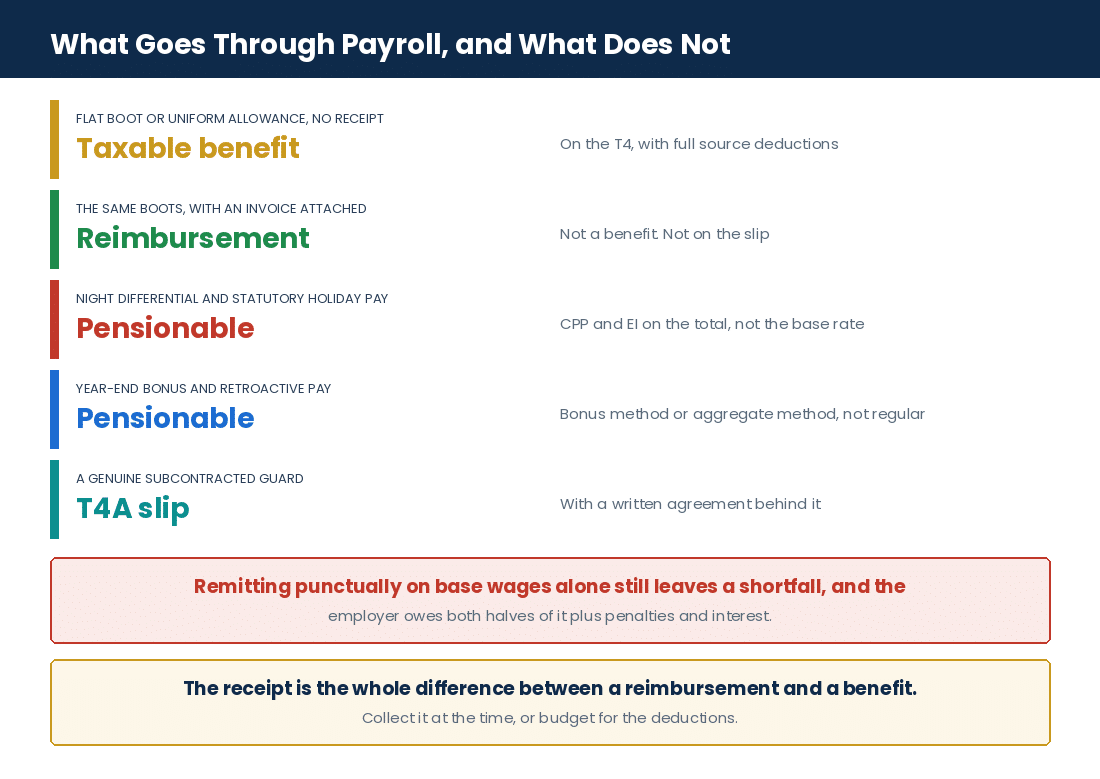
Mistake One: Paying a Flat Allowance Without Receipts Isn’t Tax-Free. Many security firms make an error by paying flat allowances—for boots or uniforms—without needing receipts assuming it’s tax-free reimbursement. CRA rules say any allowance paid without proof counts as taxable benefit included in employment income with source deductions reported on T4 slips.
Mistake Two: Leaving Allowances Off T4 Slips. Not reporting taxable allowances properly leads to wrong slip filing breaking Income Tax Act rules. This risks reassessments and triggers audits affecting overall payroll compliance.
If employees provide receipts showing expenses relate directly to work items like safety boots bought only for guarding duties, those reimbursements don’t count as benefits nor need reporting on slips.
Examples:
- Paying guards a flat boot allowance of $200 yearly without receipts makes it taxable benefit increasing reported income.
- Letting guards submit boot purchase invoices avoids tax while keeping good records supporting non-benefit status.
Sharad Gondaliya CPA (Canada & USA) has over 10 years helping Canadian businesses handle security guard payroll tax challenges while staying compliant nationwide including Toronto clients seeking help with accounting functions like bookkeeping support available anytime.
For help improving your security company’s payroll compliance reach out at info@gondaliyacpa.ca or call 647‑212‑9559 for a free chat today.
Common Tax Mistakes Made by Security Guard Companies and How to Avoid Them
Common Tax Mistakes and How to Avoid Them
Errors
Security guard company taxes in Canada can be tricky. Many companies slip up when reporting payroll or filing taxes. They might miss allowances on slips or send remittances only for base wages. These errors lead to penalties and extra costs. Knowing the usual mistakes helps security guard companies stay clear of CRA problems and keep their money safe.
Misreporting Income and Inaccurate Payroll Reporting Pitfalls
Many security guard companies mess up income reporting and payroll taxes in Canada. A common slip-up happens when they pay flat allowances, like for uniforms or mileage, and treat them as tax-free without proper proof. The CRA says if you pay allowances without receipts, it counts as taxable benefits subject to CPP, EI, and income tax deductions. But if you reimburse guards with receipts, that’s not taxable.
Some firms forget to put these taxable allowances on T4 slips. The law requires all taxable benefits appear on employee slips. Leaving them off causes corrected slips and reassessments later. Others just remit deductions on base wages only, ignoring premiums like shift pay or holiday pay that must be included for pensionable and insurable earnings. Employers must match contributions based on total earnings, including those extras.
Here’s a simple example: A security company in Brampton paid $50 weekly boot allowances with no receipts. They didn’t include this on T4s or deduct CPP/EI. CRA caught this and made them pay back remittances plus interest covering both employee and employer shares.
To avoid trouble:
- Classify payments correctly with records
- Report all taxable benefits fully
- Calculate remittances including all eligible pay types
- File amended slips quickly if needed
Missing Out on Eligible Business Expenses and Tax Deductions
Security guard companies often treat expenses like uniforms, radios, vehicles, or licences all the same way — and that’s a problem under Canadian tax rules. Uniforms required only for work can usually be deducted right away if documented well. But vehicles count as capital assets needing depreciation over time instead of immediate expense claims.
Licence fees differ depending on who owns them. Corporate licences are deductible business expenses. Personal licences reimbursed to employees need careful handling to avoid creating taxable benefits accidentally. Radios used mainly at work sites often qualify as capital assets subject to depreciation unless they cost very little.
Mixing up current expenses with capital costs leads to wrong bookkeeping and affects how much corporate tax you owe — an important part of good security guard company accounting in Canada.
Here’s a quick table showing how to treat these expenses:
| Item | Treatment | Notes |
|---|---|---|
| Uniforms | Current expense | Must be mandatory & exclusive |
| Patrol Vehicle | Capital asset (Class 10) | Depreciate using CCA |
| Radio Equipment | Capital asset (Class 8) | Depreciate over time |
| Licence Fees | Current expense | Deductible if corporate-owned |
Getting this right means accurate tax filings and using legit deductions allowed by CRA.
A firm expensed eleven patrol vehicles in the year it bought them, on the view that they were tools of the trade.
They were Class 10 capital assets. The deduction was denied in the year claimed and spread across the class instead, which turned a loss year into a taxable one and produced an unplanned balance owing. Nothing about the purchase was wrong. Only where it was recorded. Figures changed for privacy.
Risks of Filing Late or Incomplete Tax Returns
Late tax filings cause big problems for security guard companies in Canada. Missing source deduction remittance deadlines or T4 slip due dates triggers penalties from CRA. These start at 3% of unpaid amounts and grow bigger with time plus daily interest charges.
Filing employee info returns late adds fines per slip too — which can add up fast when a company has many workers.
These delays also mess up year-end balancing for GST/HST filings and corporate taxes.
Here’s what you should remember:
- Remittance frequency depends on monthly withholding amounts but missing any deadline means penalties
- T4 slips must be filed yearly by the last day of February after the calendar year end
It’s smart to set reminders aligned with official deadlines, maybe using payroll software like QuickBooks or ADP which lots of companies use now.
Maintaining Proper Record-Keeping to Support Tax Filings
Good record-keeping prevents most errors tied to security guard payroll taxes in Canada. Important papers include detailed timesheets showing hours worked per site or shift that match client billing records closely.
Subcontracted guards create extra risks without proper paperwork. CRA wants written agreements that explain terms clearly plus issuing T4A slips when needed. Missing this raises audit risks because unreported payments could bring reassessments plus fines.
Keep mileage logs supporting travel claims with dates so these reimbursements stay non-taxable benefits.
Also, keep records for at least six years after filing your taxes — this matches federal rules and helps during reviews.
Understanding CRA Audit Triggers Specific to Security Guard Businesses
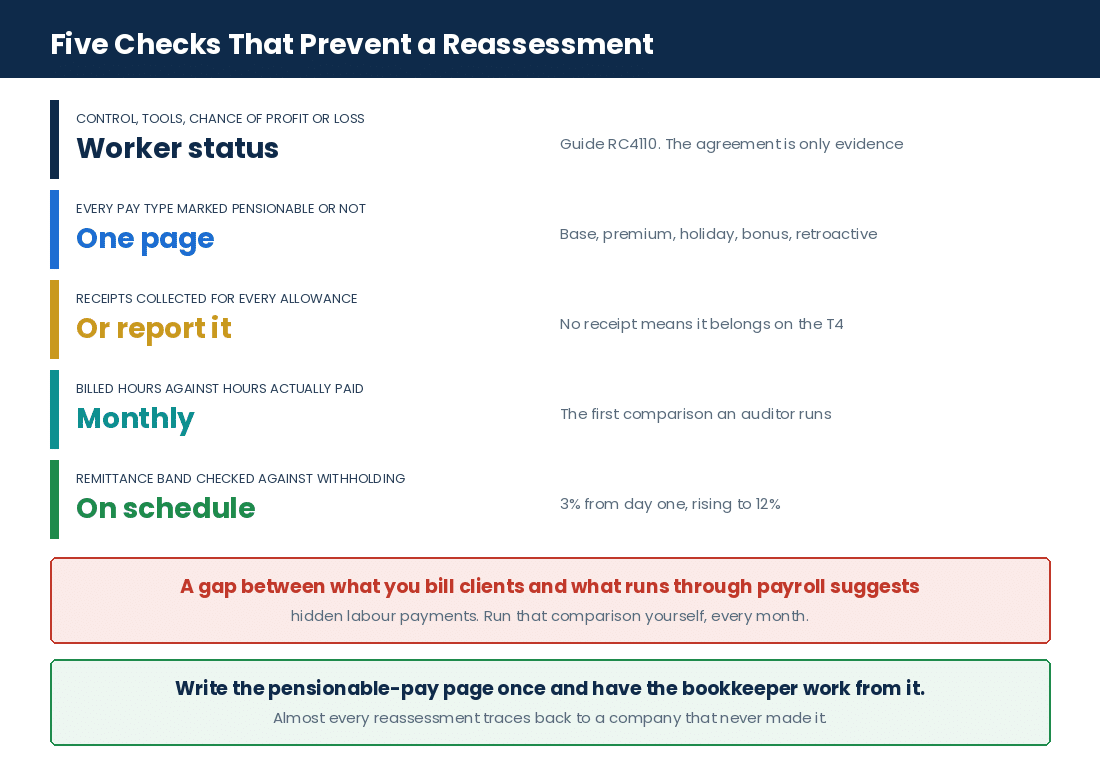
CRA audits often target security companies when things don’t line up right—like client bills not matching reported payroll costs. This may suggest hidden labour payments.
Other triggers include:
- Not reporting known allowances on slips
- Falling short on remitting required deductions found via data matching
- Misclassifying contractors without formal agreements
- Repeatedly filing late returns
You can reduce audit chances by regularly checking billed hours against paid hours carefully.
Doing internal checks before filing plus working with a CPA can spot problems early and cut risks down.
A client billed roughly 3,100 guard hours in a month and ran about 2,400 through payroll.
The gap was covered by casual fill-in guards paid in cash with nothing issued to them at all. The billing records were the company’s own, filed with its own clients, and the two numbers were never going to agree. That comparison is the first thing an auditor runs in this sector, and it takes an hour a month to run yourself. Figures changed for privacy.
Security Guard Payroll Check
Five quick questions on where your payroll stands. No fee shown.
Points to raise with us:
This is a general prompt, not tax or legal advice or a quote. Your position depends on your full facts. For a real review, please book a free consultation.
Security Guard Company Accounting Best Practices in Canada
Accounting Best Practices
Bookkeeping
Running security guard company accounting in Canada means keeping a close eye on payroll taxes, expenses, and tax filings. You have to follow CRA rules exactly to avoid trouble. Good bookkeeping and quick reporting help prevent common mistakes that many security guard companies make. Using best practices made for security services keeps your finances tight and compliant.
Implementing an Effective Bookkeeping System for Security Services Payroll Compliance
A solid bookkeeping system makes handling security guard payroll taxes Canada easier. It keeps track of all income, deductions, allowances, premiums, and reimbursements as CRA expects. You should set up a clear chart of accounts. That way, wages stay separate from taxable benefits like flat allowances paid without receipts.
Cloud-based software with payroll tools like QuickBooks or Xero saves time and cuts errors. It helps you track pensionable and insurable earnings under rules like the Income Tax Act, Canada Pension Plan, and Employment Insurance Act.
Gondaliya CPA suggests having fixed procedures for recording receipts that back up reimbursements vs taxable allowances. Detailed records stop mix-ups that cause source deduction mistakes or needing amended slips later.
Check payroll records against bank statements every month. This step spots errors early. Doing monthly reviews keeps your remittances matching the amounts reported on T4 slips filed by February 28 after year-end.
Tracking Security Guard Business Expenses and Payroll Costs Accurately
Tracking business expenses correctly affects security guard company taxes Canada. Many companies make mistakes here — like putting uniform or vehicle costs under current expenses when they’re actually capital assets. That choice changes depreciation claims under Capital Cost Allowance (CCA) rules.
Payroll costs include more than base pay: shift premiums, overtime (if applicable), public holiday pay, bonuses, and retroactive raises all count as pensionable and insurable earnings unless laws say otherwise.
If you miss these when calculating source deductions, expect penalties and interest on both employee’s withheld share and employer’s part. Detailed timesheets for each site help match billed hours with paid hours — a place where errors often happen.
Be careful with allowances: flat rate payments without receipts are taxable and go on T4 slips; reimbursed amounts backed by receipts don’t.
Preparing and Filing T4 Slips and Year-End Tax Documentation
Leaving a taxable allowance off the T4 slip breaks CRA rules shown in Guide RC4120 – Employers’ Guide – Payroll Deductions & Remittances. All income counted as employment earnings must appear on T4 slips by February 28 each year.
If you pay a flat allowance without receipts, treat it as a taxable benefit included with wages on employees’ slips. Skipping this risks CRA reassessing your returns during audits.
If you spot mistakes after filing — like missing allowances or wrong figures — file amended slips right away to fix them within allowed deadlines. Not fixing leads to fines per slip plus interest until you pay what’s owed including employer shares.
Have checks in place before submitting returns: compare payroll summaries with each employee record carefully. Benefits reported depend if receipts exist or not. Here’s an example:
| Item | Reported On Slip? |
|---|---|
| Flat boot allowance | Yes |
| Reimbursed boot expense | No |
| Shift premium | Yes |
| Public holiday pay | Yes |
A payroll clerk had been reconciling the bank to the ledger every month for years, faithfully, and never once compared the remittances to what the T4 summary would eventually say.
The two had drifted apart over four years by an amount nobody noticed until the summary was filed and the balance did not match. The monthly reconciliation was real work and it was checking the wrong thing. Figures changed for privacy.
Using Payroll Management Systems Suitable for Small Security Companies
Deciding to handle payroll yourself or hire a CPA firm depends on how complex your setup is — number of sites, shifts, etc.
Modern payroll software for small businesses can automate tax calculations following Canadian laws on pensionable earnings, EI contributions, source deduction thresholds, remittance deadlines, record retention — all important especially with upcoming 2026 threshold updates.
- But doing it yourself takes time and skill to keep settings current.
- Mistakes can mean costly reassessments over missed premiums or benefits.
- Manual work wastes time better spent elsewhere.
Best practice? Use secure cloud systems tied into accounting software paired with occasional help from firms like Gondaliya CPA that know security guard company accounting Canada well. This way you balance cost with avoiding tax problems others face.
Sharad Gondaliya, CPA (Canada & USA), has 10+ years helping Canadian businesses deal with tricky security guard company taxes Canada issues through reliable bookkeeping aligned strictly to current law.
Tax Treatment of Employee Security (Stock) Options in Security Guard Companies
Employee Security (Stock) Options
Equity Pay
Handling employee stock options in security guard companies can be tricky when it comes to taxes in Canada. The rules around security guard company taxes Canada are clear but need close attention. If you don’t follow them, you risk making common tax mistakes that could cost you later. The Income Tax Act and CRA guidelines set out how these options affect payroll taxes. Employers must keep good records and report everything properly to stay on the right side of security guard payroll taxes Canada.
Types of Security Agreements: Stock Options Plan, ESPP, Stock Bonus Plan, RSUs
Security guard company accounting Canada must separate different kinds of equity plans. These include:
- Stock Option Plans: Let employees buy shares at a set price after they vest.
- Employee Share Purchase Plans (ESPPs): Employees use payroll deductions to buy shares, often with a discount.
- Stock Bonus Plans: Give shares outright as part of pay, no purchase needed.
- Restricted Stock Units (RSUs): Promise shares once certain conditions or time frames are met.
Each one has its own tax rules for both the company and the worker. Getting these classifications right helps figure out when and how much taxable benefit shows up on tax slips.
Determining if Security Option Agreements Are Employment Related
Not all stock options count as employment income. You must figure this out before handling security guard payroll taxes Canada. The CRA looks at several points:
- Is the option linked to the job?
- Does it require you to keep working there?
- Are there limits on selling or transferring the shares?
- Are there vesting rules tied to your time at work?
Mixing up these facts causes tax mistakes that can trigger problems during audits. Many security guard company tax mistakes come from not sorting this properly. (CRA Guide T4130 – Employers’ Guide – Taxable Benefits)
Taxable Benefit Inclusion and Calculation for Security Options
When an option is considered employment income, a taxable benefit occurs at exercise or vesting, based on plan rules. You calculate it by subtracting what the employee paid from the fair market value (FMV) at that time.
This amount counts toward pensionable and insurable earnings under CPP and EI rules, so employers must withhold the right amounts for security guard payroll taxes Canada. Forgetting this leads to shortfalls and penalties.
Here’s a simple example:
| Event | FMV per share | Exercise Price | Number Shares | Total Benefit |
|---|---|---|---|---|
| Exercise | $15 | $10 | 100 | (15 – 10) × 100 = $500 |
Income Tax Act sections 6(1)(a), CPP Regulations Schedule II
Applying the $200,000 Vesting Limit and Related Deductions
The Income Tax Act limits eligible stock option benefits to $200,000 CAD per year per employee based on FMV at grant. Benefits over this lose special tax breaks.
Employers must track grants carefully every calendar year. Missing this cap causes unexpected corporate tax hits under security guard company taxes Canada. Extra benefits become fully taxable without deductions.
Also, companies can claim deductions for related expenses under section 8(1)(i) if documentation is kept.
ITA Section 110(1)(d); CRA Interpretation Bulletin ITSD-MISC-015
Reporting Security Options Benefits on Employee Tax Slips
Employees getting stock options must have taxable benefits shown properly on their T4 slips. These amounts go in Box 14 with code “38” for stock option benefits.
Leaving these out is a common mistake that affects employer remittances and employee returns under security guard payroll taxes Canada rules.
If errors happen after filing, employers should send amended slips quickly. This keeps things aligned with CRA rules before deadlines.
CRA Payroll Deductions Online Calculator; T4 Guide RC4120 · CRA Information Circular IC75‑17R6
Equity is rare in guarding, but it turns up when an owner brings a site manager or an operations lead into the ownership.
The mistake is almost always the same: the shares are treated as a shareholder matter rather than as pay, so nothing runs through payroll and nothing appears on a T4. The benefit was employment income from the moment it was tied to continued work. Settle that before the shares move, not after. Figures changed for privacy.
Supporting Compliance and Minimizing Risks with Gondaliya CPA
Supporting Compliance and Minimizing Risks
Support
Security guard companies in Canada handle payroll taxes that can get pretty tricky. Mistakes like misclassifying allowances, underreporting pensionable earnings, or missing payment deadlines happen more often than you’d think. To manage security guard payroll taxes Canada right, you need solid accounting tailored to your business.
Gondaliya CPA knows the ins and outs of security guard company accounting Canada. We help make sure you follow CRA rules for source deductions, T4 slips, and corporate tax filings. Keeping good records and knowing taxable benefits and insurable earnings rules helps avoid penalties.
Working with a licensed Ontario CPA firm like Gondaliya CPA means you get full support. We keep your payroll in line with Canadian laws and help you make the most of legal business expense claims.
Practical Steps to Ensure Security Guard Payroll Compliance Across Canadian Provinces
Payroll tax rules change depending on the province. But a few steps help everywhere:
- Classify payments right: Know the difference between taxable allowances (no receipts) and reimbursements (with receipts). Follow CRA guides on taxable benefits.
- Include all pensionable pay: Add shift premiums, overtime, public holiday pay, bonuses—all count for CPP/EI.
- Keep detailed records: Timesheets should show site and shift details. Keep logs for allowances like mileage too—this helps if the CRA audits you.
- Follow remittance schedules: New 2026 thresholds may mean switching from monthly to quarterly payments based on how much tax you deduct.
- File slips on time: Make sure T4 slips cover all income properly. Fix errors quickly by issuing amended slips.
Skipping any of these can lead to missed payments or incorrect tax filings—a common cause of CRA reassessments.
| Step | Purpose | Reference |
|---|---|---|
| Payment classification | Avoids unreported taxable benefits | CRA Guide T4130 |
| Inclusion of premiums | Ensures full CPP/EI coverage | Income Tax Act s.6(1)(a) |
| Record retention | Supports audits | Employment Insurance Act s.82 |
| Updated remittance adherence | Prevents late payment penalties | CRA Payroll Deductions Tables |
| Timely slip filing | Complies with statutory deadlines | Income Tax Act s.230 |
How Gondaliya CPA Assists with Employer Payroll Taxes Preparation and Filing
Gondaliya CPA handles payroll tax prep for security firms in Canada carefully:
- We check your payroll setup against current rules on source deductions like CPP/QPP limits set every year.
- We confirm all pay types—including flat allowances treated as taxable benefits—get recorded properly.
- We prepare accurate T4 slips showing both employee income and employer contributions per CRA standards.
- We schedule your remittances using updated 2026 thresholds so you avoid interest or fines.
- For multi-site operations or subcontracted guards needing separate reports (like T4A), we guide you based on worker status defined by the CRA.
This service cuts down mistakes in filings or missed payments while freeing up time from managing complex security guard payroll taxes Canada.
Avoiding Audit Risks Through Proactive Tax Advisory and Record Maintenance
Audit chances rise when companies miss recordkeeping or make repeated security guard company tax mistakes. To lower these risks:
- Keep proof showing every allowance without receipts is reported as a taxable benefit under Income Tax Act section 67(1).
- Regularly match wages paid against hours billed; mismatches can trigger questions about fake workers or misclassification under CRA’s worker status rules.
- Review payments versus insurable earnings including premiums/bonuses often—CRA charges penalties plus interest if shortfalls appear under sections 227 & 227.1 ITA.
- Hold subcontractor contracts proving independent status with factors from CRA’s RC4110 guide to avoid costly reclassifications.
- Use digital bookkeeping tools like QuickBooks or Xero set up for security guard company accounting Canada needs to keep data clean during reports.
Being proactive with advice and strong record keeping reduces audit triggers linked directly to non-compliance seen often across firms.
Final Recommendations for Staying Compliant and Reducing Tax Liability
To keep compliant and control costs in security guard company accounting Canada, try these tips:
- Set clear written policies separating reimbursed expenses from flat-rate allowances backed by strict receipt checks following CRA rules.
- Identify every earning type (base pay, overtime, etc.) by pensionable/insurable status to avoid missing contributions during remittances.
- Train bookkeeping staff regularly on changing laws especially those hitting in fiscal year 2026 about deduction thresholds.
- Hire CPAs familiar with guarding services taxation who know which business expenses like uniforms count as costs versus assets—helping reduce tax bills legally.
Doing this cuts financial risk while making annual reports smoother and GST/HST returns clearer so cash flow stays steady year-round.
The firms that never get a payroll reassessment all do one small thing: they write down, once, which payment types are pensionable and insurable, and the bookkeeper works from that list.
It is a single page. Base pay, shift premium, statutory holiday pay, bonus, retroactive pay, flat allowance, reimbursed expense — each with a yes or a no beside it. Every reassessment we have unwound in this sector traces back to a company that never made that page. Figures changed for privacy.
For advice tuned exactly to your business call us at 647‑212‑9559 or email info@gondaliyacpa.ca for a free chat about handling security guard company taxes Canada issues across provinces.
Income Tax Act RSC c I‑3 ss5–8 · Canada Pension Plan Regulations SOR/96–446 · Employment Insurance Act RSC c E–5 ss67–68 · CRA Guide T4130: Employers’ Guide – Taxable Benefits · Pensionable Earnings Definitions – Government of Canada · Payroll Deductions Tables – Updated Thresholds Effective Jan 2026 · Filing Deadlines & Amended Slips – Income Tax Folio S7-FS · Worker Status Review Factors – RC4110 Employee vs Contractor Determination · Further citations: Referenced throughout above citing Acts & Guides noted earlier.
Sharad Gondaliya, CPA (Canada & USA), has over ten years helping Canadian businesses manage tricky payroll compliance within regulated fields.
FAQs on Security Guard Company Taxes Canada
Frequently Asked Questions
Answers
What are the key payroll tax deadlines for security guard companies?+
How much is the maximum CPP pensionable earnings for 2026?+
When should amended slips be filed?+
What details should a payroll register include for security guard firms?+
How is retroactive pay treated for payroll taxes?+
Are public holiday payments subject to payroll deductions?+
What are CRA penalty rules for late payroll remittances?+
When must GST/HST returns be filed by security guard companies?+
Is T4A reporting required for subcontractors in security guard businesses?+
How long must security guard companies keep payroll records?+
What is Capital Cost Allowance (CCA) in relation to security company assets?+
Essential Compliance Points
Key Points
Essential Compliance Points for Security Guard Payroll Taxes Canada
- Maximum CPP Earnings: $71,100 cap applies in 2026 for pensionable earnings calculation.
- Late Remittance Penalty: Starts at 3% plus daily 1% until paid in full.
- Remittance Due Dates: Generally 15th following month; frequency depends on withheld amounts.
- Amended Slip Filing: Required promptly upon discovering errors to avoid penalties under ITA s.230.
- Payroll Register Requirements: Must detail premiums, retroactive pay, bonuses, and public holiday payments accurately.
- Retroactive Pay Treatment: Full source deductions mandatory including CPP/EI and income tax.
- Public Holiday Pay: Included as pensionable and insurable earnings subject to deductions.
- CRA Penalty Specifics: Include escalating rates per ITA s.227 & s.227.1 with interest charges applied daily.
- GST/HST Filing Obligations: Must register per Excise Tax Act s.165 when thresholds met; file returns timely.
- T4A Reporting: For subcontractors meeting CRA worker status criteria requiring separate slips.
- Record Keeping Duration: Maintain all payroll-related documentation minimum six years per Employment Insurance Act s.82 requirements.
- Capital Cost Allowance Application: Deduct assets over time using CCA classes recognized by CRA rules (Income Tax Act s.20(1)(a)).
- Employment Insurance Act Reference: Penalties retain under section s.82 with respect to remittance compliance.
- Payroll Deductions Tables Use: Follow prescribed withholding methods including bonus vs aggregate approaches consistently.
- Bonus Method vs Aggregate Method: Apply correct method when withholding tax on bonuses to avoid errors in deduction amounts.
- CRA Taxable Benefits Guide Compliance: Classify allowances correctly referencing CRA Guide T4130 standards.
- Business Registration with CRA: Ensure registration under Excise Tax Act s.165 once sales/employees thresholds exceed limits.
- Subcontractor Payroll Compliance: Follow CRA RC4110 guidelines verifying independent contractor status before T4A issuance.
- Information Circular IC75‑17R6 Application: Used when issuing amended slips and correcting past reporting mistakes efficiently.
- Stock Option Plan Handling Per CRA T4130: Record taxable benefits accurately on T4 slips with appropriate codes (Box 14 code 38).
- Employee Share Purchase Plans & Stock Bonus Plans Treatment: Accounted properly following Income Tax Act requirements for taxable benefits.
- Restricted Stock Units (RSUs) Accounting: Recognize vesting income inclusion timing based on plan conditions per CRA directives.
- Section 8(1)(i) Deductions Eligibility: Track deductible expenses related to stock option benefits carefully under Income Tax Act provisions.
- Income Tax Act Section 110(1)(d): Monitors $200K annual vesting limit affecting eligible stock option tax benefits.
For professional help navigating complex security guard company taxes Canada, contact Gondaliya CPA at info@gondaliyacpa.ca or call 647‑212‑9559 today.
Businesses We Serve & Industry Spotlights
Industry Expertise
Guarding sits inside a wider group of shift-based, labour-heavy service businesses, and the questions that decide a guard company’s payroll — who is an employee, what counts as pensionable pay, and which allowances are taxable — recur across every one of these sectors.
| Industry | The Security Guard Angle |
|---|---|
| Security guard companies | Worker status, shift premiums and the boot allowance |
| Security companies | The same payroll questions, plus installed equipment on the books |
| Private investigators | Casual operatives engaged per assignment, and whether that holds |
| Alarm and camera installers | Technicians on call, with premiums for after-hours attendance |
| Cleaning and janitorial businesses | Dispersed night-shift workforces, assessed on the same four factors |
| Call centres | Around-the-clock staffing with differentials on every evening shift |
| Fire protection contractors | Licensed technicians, with the licence fee question on each one |
| Event venues | Casual staff hired for single dates, paid fast and often paid wrong |
| Bus and coach companies | Drivers on split shifts, with vehicles as Class 10 assets |
| Retail stores | Payroll across many locations with holiday pay on every one |
| Construction project management firms | Site-based workers and the subcontractor paperwork behind them |
- Security guard companies: The core of this work. Worker status, the pensionable status of every pay type, and the allowances that belong on a T4 account for almost every adjustment we make.
- Security companies: The same payroll file, with monitoring contracts and installed client-site equipment sitting on top of it.
- Private investigators: Operatives engaged assignment by assignment look like contractors and often are, but the test is still control, tools and risk of loss.
- Alarm and camera installers: On-call technicians earn after-hours premiums, which are pensionable and insurable exactly like a guard’s night differential.
- Cleaning and janitorial businesses: Night work across many sites with high turnover, which is the same classification risk a guard roster carries.
- Call centres: Twenty-four-hour coverage means a shift differential on most hours worked, and every one of them is pensionable.
- Fire protection contractors: Licensed trades where the question of who owns the licence decides whether reimbursing it creates a taxable benefit.
- Event venues: Casual staff engaged for a single date are the easiest workers to pay informally and the hardest to defend on a review.
- Bus and coach companies: Split shifts and premiums on the payroll side, Class 10 vehicles on the capital side — the same two files a patrol operation runs.
- Retail stores: Payroll across several locations, where public holiday pay is the line item most often left out of the deduction calculation.
- Construction project management firms: Site-based labour engaged through subcontractors, with the T4A question arriving the same way it does on a guarding contract.
Across all of these sectors, the reassessments come from the same three places: a worker called a contractor who was not, a pay type left out of pensionable earnings, and an allowance paid without a receipt.
None of them is a difficult question of tax law. Each is a question about what the company actually does, answerable from the agreements, the timesheets and the payment records it already has. Figures changed for privacy.
Professional Guidance and Quick Reference
Guidance
Essential Payroll Points for Canadian Security Guard Companies
Security guard companies lose money in a predictable set of ways: calling every guard a contractor because that is what the agreement says; paying flat boot and uniform allowances without receipts and leaving them off the T4; remitting on base wages while shift premiums, public holiday pay, bonuses and retroactive pay sit outside the calculation; expensing patrol vehicles that belong in Class 10; missing a remittance deadline and taking the 3% from day one; paying subcontracted guards with no written agreement and no T4A; and billing more hours to clients than ever ran through payroll. Gondaliya CPA handles security guard company payroll and tax on a flat annual fee.
Quick Answers
At a Glance
- Employer CPP: 5.95% of pensionable earnings
- Employer EI, Ontario: stated in this article as both 1.58% and 2.63% — confirm against the current CRA tables
- Maximum CPP pensionable earnings, 2026: stated as both $69,700 and $71,100 — confirm before running payroll
- Maximum EI insurable earnings, Ontario 2026: $61,500
- Remittance frequency: quarterly under $25,000, monthly to $99,999, accelerated over $100,000
- Monthly remitters: three business days after month-end
- Accelerated remitters: two days after payday
- Late remittance: 3% from day one, plus 1% a day to a maximum of 12%
- T4 slips: due the last day of February after the calendar year
- Flat allowance, no receipt: taxable benefit, on the T4
- Reimbursement with receipt: not a benefit, not on the T4
- Pensionable and insurable: shift premiums, public holiday pay, bonuses, retroactive pay
- Worker status guide: RC4110, on control, tools and chance of profit or loss
- Subcontractors: written agreement plus a T4A where the status holds
- Patrol vehicles: Class 10. Radio equipment: Class 8. Uniforms: current expense
- Records: six years from the end of the tax year
Who This Is For / Not For
Fit Check
- For: Canadian security guard companies with staff on payroll — static guarding, mobile patrol, event and construction site coverage — incorporated or not.
- For: firms using subcontracted guards who want the worker status and T4A position settled before CRA asks.
- Not for: advice on provincial private security licensing, employment standards or labour relations, each of which is regulated separately.
- Not for: individual guards employed by a firm and paid on a T4, who have no payroll obligations of their own. A company with one guard on the books is still squarely in scope.
People Also Ask
Related Questions
Our guards all signed contractor agreements. Isn’t that enough?+
No. The worker’s status depends on facts, not just the label you give them. The CRA looks at how much control you have over the work, whether they use their own tools, and whether they have a chance of profit or a risk of loss. Where the company sets the schedule, supplies the uniform and the vehicle, and the guard has no other clients, the agreement will not hold.
We pay a boot allowance. Why is that taxable?+
Because nobody produced a receipt. Any allowance paid without proof counts as a taxable benefit included in employment income, with source deductions, reported on the T4. If guards submit invoices for boots bought only for guarding duties, that is a reimbursement — not a benefit, and not reported on the slip. The receipt is the whole difference.
We remit every month on time. Can we still be short?+
Easily, if you are remitting on base wages only. Shift premiums, public holiday pay, bonuses and retroactive pay are all pensionable and insurable earnings, and the employer has to match on the total rather than on the base rate. Remitting punctually on the wrong number still leaves a shortfall, on both the employee’s withheld share and yours.
What makes CRA look at a guarding company in the first place?+
Most often, client bills that do not line up with reported payroll costs, which can suggest hidden labour payments. Other triggers are allowances known to be paid but missing from slips, remittance shortfalls found through data matching, contractors with no formal agreement, and a pattern of late returns. Comparing billed hours to paid hours each month removes the first one.
Can we expense patrol vehicles in the year we buy them?+
No. Vehicles count as capital assets needing depreciation over time instead of immediate expense claims — Class 10 for patrol vehicles, with radio equipment in Class 8. Uniforms required only for work can usually be deducted right away if documented well, and corporate-owned licence fees are a current expense. Mixing the capital items in with the current ones is the commonest bookkeeping error in this sector.
Glossary of Key Terms
Definitions
- Source deductions: income tax withheld plus both the employee’s and the employer’s CPP and EI shares, remitted together to the CRA.
- Pensionable earnings: the pay on which CPP contributions are calculated, including shift premiums, public holiday pay, bonuses and retroactive pay.
- Insurable earnings: the pay on which EI premiums are calculated, up to the annual maximum.
- Taxable benefit: a payment or allowance given without receipts, included in employment income and reported on the T4 with source deductions taken.
- Reimbursement: a payment backed by a receipt for a work expense, which is not a benefit and is not reported on the slip.
- Shift premium: extra hourly pay for evening or night work, taxable and subject to full source deductions.
- Retroactive pay: wages paid later to correct an earlier underpayment, requiring full source deductions on the total owed.
- Remittance frequency: how often source deductions must be paid, set by the average monthly withholding amount.
- Capital Cost Allowance (CCA): depreciation of capital assets like vehicles or radios over time, rather than an immediate expense deduction.
- T4A slip: the information slip issued to a subcontractor who meets the CRA’s independent contractor criteria.
Want a checklist to work from? You can download our free security guard payroll compliance checklist before your consultation.
Four things decide whether a guarding company gets reassessed, and all four are settled by documents you already have. Worker status — the agreement is evidence, not the answer; control, tools and chance of profit or loss decide it, and Guide RC4110 is where the CRA sets out its approach. What counts as pensionable and insurable — shift premiums, public holiday pay, bonuses and retroactive pay all do, so remitting on base wages alone leaves a shortfall the employer owes both halves of. Allowances versus reimbursements — no receipt means a taxable benefit on the T4; a receipt means neither. And the remittance calendar — 3% applies from day one and climbs. Then the rest: patrol vehicles in Class 10, radios in Class 8, uniforms as a current expense, T4 slips by the end of February, T4A slips for genuine subcontractors, and records kept six years.
Three things tell us how exposed your payroll is, and you can check all of them this week. First, write down every pay type you use — base, shift premium, statutory holiday, overtime, bonus, retroactive, allowance — and mark each one pensionable or not. If that page does not exist, making it is the single highest-value hour available to you. Second, compare one month of billed hours against one month of paid hours. That is the first comparison an auditor runs, and it costs you an afternoon to run first. Third, pull one guard’s file: is there an agreement, does the practice match it, and if they are a subcontractor was a T4A issued? Answer those three and you will know where you stand.
Security Guard Company Taxes Canada: How Gondaliya CPA Can Help
Start with one guard agreement, one month of timesheets and your last remittance
Gondaliya CPA settles worker status against the CRA’s control, tools and risk-of-loss factors before the slips are due, marks every pay type pensionable or not so the remittance is calculated on the right number, separates flat allowances from receipted reimbursements and puts the taxable ones on the T4, reconciles billed hours against paid hours so the comparison an auditor runs comes back clean, assigns patrol vehicles and radios to the right capital classes, files the T4 and T4A slips by the deadline and amends quickly where something was missed, and sets the remittance schedule against your actual withholding band — on a flat annual fee including HST with a one-business-day response. Please book a free consultation.
Next Steps
Please book a free consultation with Gondaliya CPA and bring three things: one guard agreement, a month of timesheets showing site and shift detail, and your most recent remittance along with the payroll summary behind it. Those three settle worker status, the pensionable pay question and whether your remittances are calculated on the right base — which between them account for nearly every adjustment we make on a guarding file. If you pay any allowance without collecting receipts, or use subcontracted guards without written agreements, say so at the outset, because both are straightforward to put right going forward and expensive to leave running. You will get a flat annual fee including HST before any work begins. We serve Toronto, Mississauga, Brampton, Vaughan, Etobicoke, Scarborough, Hamilton, Ottawa and the rest of Ontario, and work with security businesses across Canada. If our content helps, please add gondaliyacpa.ca as a preferred source on Google.
Published: · Last updated:
Editorial policy: We research against CRA, Department of Finance, Parliament of Canada, CPA Canada and CPA Ontario sources, fact-check the figures, and Sharad Gondaliya, CPA, reviews the content, which we update as the rules change.
Disclaimer: This article is educational information only and is not tax, legal, financial, licensing or regulatory advice. It covers federal payroll, source deduction and corporate tax obligations for Canadian security guard companies, and it does not cover provincial private security licensing, employment standards or labour relations, each of which is administered separately. Contribution rates, maximum pensionable and insurable earnings, remittance thresholds and penalty rates are set annually and change; the rate and threshold figures in this article are those stated in the source material, which gives more than one value for the Ontario employer EI premium rate and for the 2026 maximum CPP pensionable earnings, and every figure should be confirmed against the current CRA payroll deductions tables before running a payroll. Worker status turns on the facts of each engagement. Gondaliya CPA performs compilation engagements under CSRS 4200 and does not perform audit or review engagements. Please consult a licensed CPA before acting.

Sharad Gondaliya is a CPA Canada & CPA USA with 15 Years+ experience of Accounting, Tax, Payroll of Corporate Small Businesses as Tax Accountant. He is a CPA Ontario member (61040184) and holds US CPA licences in Washington and Montana and is well known among corporate small businesses for tax planning, efficient tax solutions, and affordable CPA services. Sharad is the Principal (Director) of Gondaliya CPA – Affordable CPA Firm in Canada. Licenses: CPA Ontario: 61040184 | CPA USA (MT): PAC-CPAP-LIC-033176 | CPA USA (WA): 57629 | CPA Firm License: 61330051 View Full Author Bio