



Startup Bookkeeping Guide: How Proper Financial Records Help Founders Avoid Costly Tax Mistakes
Startup bookkeeping Canada is key for managing accurate startup accounting records and tracking expenses efficiently. Gondaliya CPA offers affordable bookkeeping services, including QuickBooks setup, cloud accounting, and monthly financial reporting to help startups avoid common bookkeeping mistakes and maintain clear startup cash flow tracking.
Quick Summary
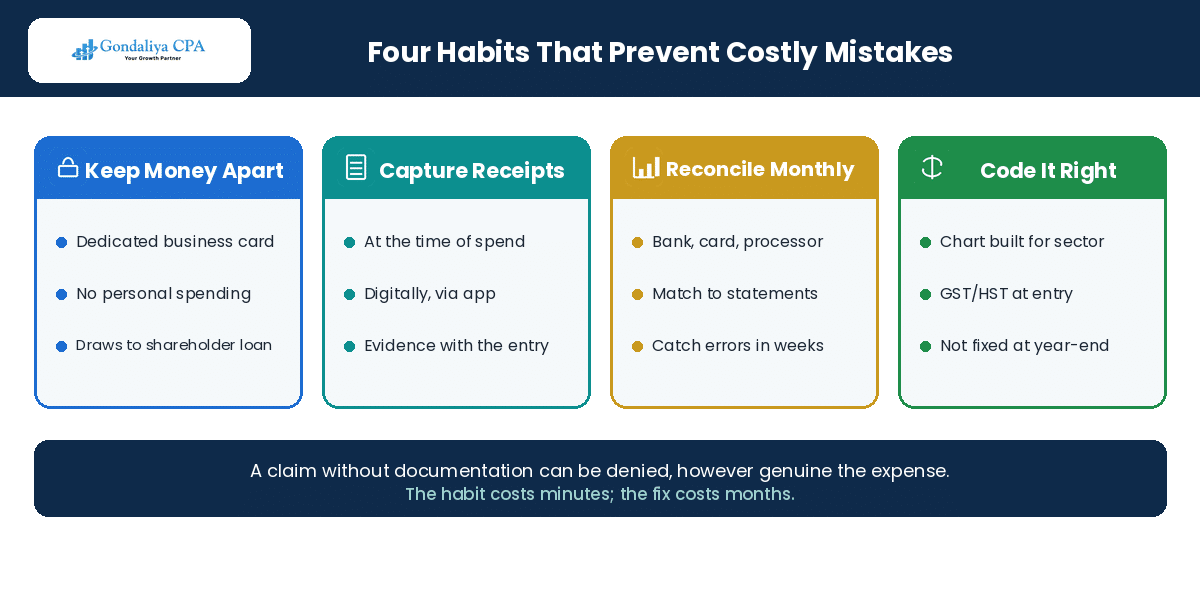
Good startup bookkeeping rests on four habits: keep personal and business money strictly apart, capture every receipt digitally, reconcile every account monthly, and code transactions to a chart of accounts built for your sector. Please note the CRA requires records to be kept six years after the fiscal year they relate to, and a claim without documentation is a claim that can be denied.
| Aspect | Details |
|---|---|
| The separation habit | Dedicated cards and accounts, never mixed. |
| The evidence habit | Receipts captured digitally at the time of spend. |
| The reconciliation habit | Every bank, card and processor matched monthly. |
| The retention rule | Six years after the last tax year the records relate to. |
Reading time: 34 minutes.
Table of Contents
- Why Accurate Startup Bookkeeping is Vital for Canadian Small Businesses
- Comprehensive Bookkeeping Services Tailored for Canadian Startups
- Benefits of Outsourcing Bookkeeping for Startups and Small Businesses
- Transparent Pricing Models for Startup Bookkeeping Services in Canada
- Real Client Success Stories Highlighting Effective Startup Bookkeeping Solutions
- Addressing Frequently Asked Questions About Startup Bookkeeping in Canada
- Frequently Asked Questions
- Startup Bookkeeping Essentials: Key Topics You Should Know
- Industry Spotlights: Sectors We Represent
- Professional Guidance and Quick Reference
The Numbers That Matter
This article covers Canada, with Ontario and Toronto context, and reflects CRA rules current to 2026. It assumes an incorporated Canadian startup or small business keeping its own books or considering outsourcing. Figures marked illustrative are examples, not quotes, and any masked engagement notes end with “Figures changed for privacy.” This is educational information only and not tax, legal, or financial advice. Rules, thresholds, and record-keeping requirements change, so please confirm your own situation with a Registered CPA before acting.
Why Accurate Startup Bookkeeping is Vital for Canadian Small Businesses
Why Accurate Startup Bookkeeping is Vital for Canadian Small Businesses
The Basics
Accurate startup bookkeeping matters a lot for Canadian small businesses. It keeps your finances clear and helps you follow rules. Good startup accounting records show how your business is doing financially. This helps you make smart choices. In Canada, tax rules are strict. Keeping books right means fewer problems when tax time comes.
Startups in Canada need to watch their income and expenses carefully. This helps with budgeting and makes sure every transaction is recorded properly. The Canada Revenue Agency (CRA) may check your books, so having good small business bookkeeping from the start saves trouble later.
Key Benefits of Accurate Bookkeeping
- Follows CRA tax rules correctly
- Shows clear info on cash flow and profits
- Gives owners solid facts to decide next steps
Common Bookkeeping Challenges Faced by Startups in Canada
Many startups face problems managing their bookkeeping well. A lot don’t have experience with finance, which can lead to errors.
One big mistake is mixing personal money with business money. This makes records messy and causes wrong financial reports or tax issues. Another problem is not checking accounts often enough. Without regular reconciliations, errors build up and mess up reports.
Missing paperwork also causes headaches. Lost receipts or sales that aren’t recorded leave gaps in startup accounting records. That can cause trouble if CRA audits you.
Common Mistakes Startups Make
- Mixing personal and business money
- Forgetting to keep receipts or proof
- Skipping regular account checks
- Using spreadsheets without backups
Knowing these mistakes early helps you pick good bookkeeping services for startups that fit your needs.
How Monthly Bookkeeping Helps Maintain Financial Clarity for Startups
Doing bookkeeping every month really helps startups keep track of money clearly. It stops surprises from popping up at year-end.
Monthly financial reports show where money comes in and goes out. They help you spot trends and plan costs or investments better.
Also, monthly checks catch mistakes before they turn into bigger problems. In fast-moving startup worlds, this quick fix approach saves headaches down the line.
Advantages of Monthly Bookkeeping
- Gets fresh financial info every month
- Finds issues before they grow worse
- Helps manage cash flow steadily
Avoiding Frequent Bookkeeping Mistakes Made by New Businesses
New businesses often miss important bookkeeping details that hurt them later on—payroll source deduction remittance frequency is one tricky example!
Many owners don’t know how often to send payroll taxes to CRA, which depends on employee numbers. Late payments bring fines for sure! Other common slips include:
- Not tracking employee hours well enough;
- Confusing employees with contractors;
- Missing out on deductions from federal or provincial programs;
These errors show why hiring skilled bookkeeping services matters a lot—especially since tax rules vary across provinces like Ontario.
Using reliable software built for this stuff can help avoid these errors easily. Setting good habits now puts your business in a better spot without delays or penalties ahead!
A founder used one credit card for personal and business spending across a full year. Untangling it took longer than the rest of the close, and several genuine expenses could not be supported once the two were mixed. Figures changed for privacy.
Key Stat: The CRA requires books and records to be kept for six years after the fiscal year they relate to. A deduction without supporting documentation can be denied on review, regardless of whether the expense was genuine.
Comprehensive Bookkeeping Services Tailored for Canadian Startups
Comprehensive Bookkeeping Services Tailored for Canadian Startups
The Services
Startup bookkeeping Canada needs special attention because early-stage businesses face unique challenges. Bookkeeping services for startups help keep financial records accurate and up-to-date. This helps startups follow CRA rules and make better business choices. Small business bookkeeping Canada means carefully tracking sales, payroll, and GST/HST filings.
Startups in Canada often have limited resources and changing transaction levels. Pro bookkeeping services stop costly mistakes by setting up strong systems from the start. They cover tasks like bank reconciliations, managing bills and payments, payroll processing, sales tax reports, and preparing monthly financial statements that fit startup needs.
Working with experts who know Ontario’s rules—especially in Toronto and nearby areas—helps startups stay CRA-compliant. Good records lower audit risks, support timely T2 tax filings, and back solid growth plans.
Setting Up QuickBooks and Cloud Accounting Solutions for Startups
QuickBooks setup matters a lot when creating startup accounting records. Cloud accounting tools like QuickBooks Online or Xero give real-time access to your finances on any device. This is great for founders working remotely or juggling multiple projects.
Setting up the software means making a chart of accounts fit for your industry. You should also set bank feeds to import transactions automatically. Don’t forget to map sales tax codes following CRA rules and connect receipt capture apps like Hubdoc. Control user permissions so only authorized people can access sensitive info while still letting bookkeepers and accountants collaborate.
Cloud platforms make monthly bookkeeping faster by automating reconciliations and producing reports that meet Canadian standards. They support GIFI codes needed at year-end submissions. Also, they help keep digital records as required by 2026 CRA updates.
Using cloud-based systems cuts down manual mistakes often found in spreadsheets. Plus, they scale well when your transaction volume grows during fundraisers or new product launches.
| Feature | QuickBooks Online | Xero |
|---|---|---|
| Bank Feed Automation | Yes | Yes |
| Receipt Capture | Integrated via Hubdoc | Integrated via Hubdoc |
| Sales Tax Tracking | Supports GST/HST & PST | Supports GST/HST & PST |
| User Access Controls | Role-based permissions | Role-based permissions |
| Mobile App Availability | iOS & Android | iOS & Android |
Source: CPA Canada; CRA Books & Records Guidelines
Managing Startup Accounting Records with Precision and Transparency
Keeping startup accounting records accurate is key for clear internal management and meeting outside rules. Accurate financial statements show real business results by recording revenues, expenses, assets, liabilities, shareholder loans, equity, and cash flows properly.
Cash flow management matters because many startups run on tight budgets. They need to track money coming in versus money going out every month. Monthly bank statement reconciliations catch errors early so income isn’t misstated when filing T2 corporate taxes.
Founders should regularly check trial balances along with overdue invoices or unpaid bills reports. Transparent records make it easier for CPAs to do compilation engagements under CSRS 4200 standards without full audits but giving more trust to lenders or investors.
Our Actual Experience: We helped a Toronto tech startup managing over 300 monthly transactions across three bank accounts plus Stripe feeds. Consistent reconciliation cut their month-end close from ten days to four while making forecasts more reliable.
Startup Expense Management and Efficient Tracking of Business Costs in Canada
Expense tracking is vital in small business bookkeeping Canada because it captures all costs correctly with supporting documents like receipts or invoices that meet CRA rules. Digital receipt capture apps linked to cloud accounting prevent lost paperwork common among busy founders.
Meals-and-entertainment costs deserve special care since only 50% are deductible unless exceptions apply (like employee events). Misclassifying these could cause audits.CRA Meals Deduction Rules Founders must keep personal spending separate using dedicated cards or accounts tied directly to their accounting software.
Good expense management means:
- Uploading or scanning receipts quickly using OCR tech.
- Coding each cost into correct chart of account categories.
- Reviewing unusual amounts before closing monthly books.
This practice cuts unsupported claims that auditors might reject while helping recover input tax credits on eligible purchases under GST/HST.
Ensuring Startup Cash Flow Tracking to Support Sustainable Growth
Tracking cash flow well lets Canadian startups keep enough money flowing for daily operations without problems. Watching actual cash coming in compared to budgeted burn rates helps spot funding shortfalls early so you can fix them by cutting spending or chasing receivables faster.
The number of transactions per month affects how detailed tracking needs to be. For example, high-volume e-commerce startups may check daily, while service businesses might track weekly but still follow invoices closely.Industry Spotlight Table §16
Key steps include:
- Updating cash flow forecasts using the latest transaction info.
- Reconcile deposits from banks versus third-party processors.
- Spotting timing differences between accrual revenue recognition and actual cash received that affect working capital.
Clear cash flow insight supports growth strategies by ensuring enough runway until funding closes or profits kick in.
Our Actual Experience: A Mississauga SaaS client with about 450 monthly multi-currency subscription transactions cut manual work by half thanks to automated workflows and real-time dashboards.
Risk Warning: Input tax credits require documentary evidence showing the supplier’s GST/HST number. A bank statement line alone is not enough, and credits claimed without the underlying invoice are among the first items reversed on a GST/HST review. Please capture the document, not just the payment.
Benefits of Outsourcing Bookkeeping for Startups and Small Businesses
Benefits of Outsourcing Bookkeeping for Startups and Small Businesses
The Case
Outsourcing startup bookkeeping Canada gives startups and small businesses expert help without hiring full-time staff. Bookkeeping services for startups keep records accurate and on time. This helps meet CRA rules and avoid costly mistakes. Founders can spend more time growing their business while trusting their startup accounting records stay clean.
This setup grows with your business. As transactions increase, you get flexible monthly bookkeeping for startups that matches your needs. Cash flow becomes clearer because expenses are tracked carefully. For small business bookkeeping Canada clients, outsourcing cuts costs by skipping recruitment and using tech tools smartly.
Working with pros brings advice on GST/HST credits, payroll deadlines, and other compliance matters. It also avoids common errors like missing receipts or unrecorded loans that cause CRA trouble.
Key benefits include:
- Expert knowledge of Canadian tax rules
- Consistent accounting standards applied
- Lower risk of bookkeeping errors startups often make
- Faster month-end closing for timely insights
- Easy integration with cloud accounting tools
This suits incorporated SMBs in Toronto/Ontario or anywhere in Canada wanting affordable, solid support as they grow.
The Role of a CPA Firm in Supporting Startup Financial Reporting Needs
CPA firms do more than just data entry for startup accounting records. They make sure bookkeeping is audit-ready and follows CRA rules. Gondaliya CPA, for example, guides from setup to corporate tax filing (T2). This keeps books clear and ready if regulators check.
CPAs set up charts of accounts right, handle sales taxes properly, and deal with complex stuff like shareholder loans under Income Tax Act rules. They prepare compilation engagements under CSRS 4200 standards to confirm accuracy without giving full audits. They also suggest year-end fixes affecting financial statements for startups.
They reduce risks like unsupported expenses or wrong classifications that can trigger CRA reassessments or lost tax credits. CPAs coordinate payroll deductions and file T4 slips on time, following new 2026 electronic filing rules via My Business Account portals.
For incorporated businesses dealing with cross-border issues or special programs like CWELCC childcare subsidies, CPA firms offer precise guidance. They fit into monthly financial reporting schedules investors or lenders expect.
In brief:
- Ensure compliance with record-keeping laws
- Provide professional reviews supporting good governance
- Help avoid late filing penalties
- Link business results to tax strategies
Working with a trusted Ontario CPA firm builds confidence in your startup’s financial health from start to finish.
Integrating Bookkeeping Automation to Streamline Startup Accounting Processes in Canada
Cloud accounting software changes how Canadian startups handle finances fast while meeting CRA documentation needs. Automating tasks cuts manual errors often caused by spreadsheets—a big source of bookkeeping mistakes startups make—and speeds up month-end closing before taxes are due.
QuickBooks setup remains popular thanks to strong bank feed integration plus receipt capture tools like Hubdoc. These digitize invoices when you submit receipts by phone app or email forwarding. Payroll integrations connect wage payments directly with deduction tracking through platforms like ADP or Wagepoint common in Ontario startups now.
Automation gives real-time expense tracking across Canada so founders see cash flow trends instantly instead of waiting weeks after manual reconciliations:
| Automation Feature | Benefit |
|---|---|
| Bank Feed Rules | Auto-categorizes recurring transactions |
| Receipt Capture Software | Stops lost paper receipts |
| Payroll Sync | Calculates source deductions correctly |
| Cloud Collaboration | Lets users access remotely & manage permissions |
These tools meet 2026 electronic record storage mandates requiring digital formats available during CRA audits. Automated workflows cut admin work so owners focus more on growing their business than fixing paperwork errors.
How Regular Financial Statements Assist Startups in Strategic Decision Making
Monthly financial reports give Canadian startups clear views of profit, cash flow, and efficiency at every stage—from pre-launch to fast growth.
Important reports include income statements showing revenue vs expenses; balance sheets listing assets and liabilities; cash flow statements highlighting money in and out; plus AR/AP aging reports revealing collection status which affects working capital:
Reviewing these regularly helps track cash flow startup Canada-wide — spotting timing gaps between incoming payments and bills avoids overdrafts and helps negotiate better vendor terms. Founders use gross margin data to price products competitively yet profitably in markets like Toronto/Ontario tech SaaS.
Consistent financial statements catch surprises early—like unexpected expense jumps during reconciliations—helping avoid tax filing issues later.
Benefits summarized:
- Supports budgeting based on real numbers
- Helps build trust when raising investor funds
- Improves capital forecasting accuracy
- Strengthens spending controls
Startups relying on informal summaries may miss warning signs that lead to bad decisions risking their future.
A company reviewed its first six months of statements only at year-end and found a subscription cost that had doubled quietly in month three. Monthly reporting would have caught it in weeks rather than months. Figures changed for privacy.
Transparent Pricing Models for Startup Bookkeeping Services in Canada
Transparent Pricing Models for Startup Bookkeeping Services in Canada
The Pricing
Startup bookkeeping Canada needs pricing that’s clear and easy to understand. Founders want to keep their costs in check. Many bookkeeping services for startups offer flat fees or fixed yearly prices made for small business bookkeeping Canada. This kind of pricing stops surprise bills and matches the service to the startup’s budget.
Here are some common pricing types:
- Flat Annual Fee: One set price for monthly bookkeeping, reconciliations, and reports.
- Tiered Pricing: Costs change based on how many transactions, bank accounts, payrolls, or GST/HST filings there are.
- Add-On Fees: Extra charges for catch-up work or more companies added later.
Clear pricing helps startups plan money well. It also builds trust between the startup and the bookkeeper.
| Pricing Model | Description | Best For |
|---|---|---|
| Flat Annual Fee | Fixed yearly cost covering standard monthly tasks | Startups wanting steady costs |
| Tiered Pricing | Cost changes with transaction volume & complexity | Growing startups with changing needs |
| Add-On Fees | Extra fees for backlog or extra work | Startups needing occasional help |
Comparing Bookkeeping Service Levels to Match Startup Budgets and Needs
Bookkeeping services for startups cover many things. They range from simple data entry to full accounting record keeping. Picking the right service level fits both your startup accounting records needs and your budget.
Services usually come in these levels:
- Basic Bookkeeping: Coding transactions, bank reconciliation, tracking sales tax; good for early-stage or low activity startups.
- Standard Monthly Bookkeeping: Adds payroll entries, aging reports for accounts receivable/payable; fits most Canadian incorporated startups.
- Advanced Accounting Support: Helps prepare financial statements and hands over year-end trial balance; good when investors want detailed reports.
To pick right, think about your monthly transactions (often 100–300), payroll size, if you file GST/HST, and if you need multi-currency support. Founders handling startup accounting records on their own might switch to pro help as things get complex. This stops costly mistakes near tax time.
One client we helped was a Toronto SaaS startup with 150 transactions monthly across three banks plus payroll for five people every two weeks. After six months, they moved from basic to standard support because investors asked for more detailed reports.
Key Metrics Demonstrating the Impact and Accuracy of Professional Bookkeeping
Good startup accounting records give clear financial info that helps with decisions in small business bookkeeping Canada. Some key numbers show how much professional bookkeeping helps:
- Monthly Transactions Processed — Captures all income and expenses on time.
- Bank Reconciliation Rate — How many items match bank statements each month shows control over cash flow.
- GST/HST Input Tax Credit Accuracy — Right coding avoids losing credits during audits.
- Payroll Posting Timeliness — Paying source deductions on time keeps penalties away.
- Financial Statement Delivery Time — Fast reports help with tax planning.
Watching these metrics spots problems early—like missing receipts causing unmatched items—and keeps you ready for CRA checks.
For example, a Mississauga e-commerce client we worked with regularly matched 98% of transactions within a week after month end. They used QuickBooks with cloud tools our team set up. (Names changed)
Choosing the Right Bookkeeping Provider Based on Expertise and Communication Skills
Finding the right provider skilled in startup bookkeeping Canada means checking their knowledge of Canadian SMB rules and how well they communicate during fast growth times.
Look at these factors:
- Canadian Incorporation Knowledge: Know local laws like Ontario’s shareholder loan rules under subsection 15(2) of the Income Tax Act.
- CRA Compliance Skills: Experience with electronic record retention rules updated by new regulations helps audits go smoother.
- Industry Know-How: Understanding fields like tech startups or e-commerce helps build accurate charts of accounts reflecting real revenue streams.
- Communication Speed: Providers who answer emails quickly or offer weekend/evening support reduce delays.
- Tech Skills: Using modern tools like QuickBooks/Xero plus Hubdoc receipt capture speeds work without errors.
Gondaliya CPA shows this mix well—they are Registered Ontario CPAs offering expert yet affordable solutions backed by “1300+ 5-star Google reviews.” They provide free talks to help founders pick the right service level that fits their needs while keeping financial records clean across Canada.
Pro Tip: Ask what a quoted fee covers before you compare prices. Two quotes at the same number can differ by payroll, GST/HST returns, and year-end trial balance handover. The transaction count, not the revenue figure, is what usually drives the cost.
Real Client Success Stories Highlighting Effective Startup Bookkeeping Solutions
Real Client Success Stories Highlighting Effective Startup Bookkeeping Solutions
The Results
Many Canadian startups find that good startup bookkeeping Canada services help keep their finances clear and taxes in check. For example, a tech startup in Toronto used bookkeeping services for startups to handle tricky SaaS revenue and monthly billing. They set up a custom chart of accounts and automated receipt capture, cutting down errors in reconciliation by 40% over six months.
Another client, an e-commerce shop in Mississauga, used cloud accounting combined with expert help to track startup expenses Canada well across different payment platforms. This prevented costly mistakes with GST/HST input tax credits when filing their first year-end taxes.
A health tech startup in Ottawa hired monthly bookkeeping for startups to keep their books clean despite quick growth and complex payroll. Their founder says the reliable financial statements for startups from their CPA firm helped them get investor funds faster because records were complete.
These stories show how clear startup accounting records paired with specialized bookkeeping services cut down audit risks, missed tax breaks, and late filings—issues many new Canadian businesses face.
Why clients succeed with good bookkeeping:
- Tailored accounts and automation reduce errors.
- Cloud tools track expenses across payments.
- Monthly reviews keep fast-growing firms on track.
- Clear financials help with investor trust.
Trusted Bookkeepers: Profiles of CPA Professionals Serving Canadian Startups
Gondaliya CPA employs skilled pros focused on keeping startup accounting records CRA-compliant. Sharad Gondaliya, CPA (Sharad) Gondaliya, a CPA Ontario member, leads the team. He crafts smart tax strategies for small incorporated businesses across Toronto and Canada.
Vandana Goel handles varied industry transactions at Gondaliya CPA. She makes sure bank reconciliations and sales tax filings happen on time under the new electronic record rules valid through 2026.
Their bookkeepers use QuickBooks for startups plus Hubdoc to automate data entry while keeping audit trails per CRA standards. They watch closely to separate personal spending from shareholder loans—a common mistake in startup bookkeeping—and send clear month-end reports to help managers decide.
Clients like that they get quick replies within one business day plus weekend support. This matters when CRA deadlines shift or they need voluntary disclosure for past errors. These CPAs blend deep knowledge with real-world service made for growing Canadian companies that want affordable small business bookkeeping Canada help.
What sets Gondaliya CPA apart:
- QuickBooks and Hubdoc automate tasks.
- Strong focus on tax rules and record-keeping laws.
- Clear separation of personal vs business funds.
- Fast response times including weekends.
Industry-Specific Bookkeeping Requirements and Customized Service Approaches
Small business bookkeeping Canada needs change depending on the sector because transaction types vary a lot:
- Technology Startups & SaaS: Must track deferred revenue carefully since subscriptions bring in money over time. Automated schedules stop errors.
- E-commerce & Online Retailers: Handle lots of sales on different platforms, so they need solid inventory control linked to cloud accounting.
- Professional Services & Consulting: Bill based on hours worked, so precise accounts receivable aging helps plan cash flow.
- Health Tech & Medical Clinics: Follow strict rules for expenses like OHIP billings; detailed documentation is a must.
- Daycare & CWELCC Startups: Use separate ledger codes to match government subsidy reporting.
These tailored setups include charts of accounts using terms like GMV (Gross Merchandise Value), WIP (Work In Progress), or MRR (Monthly Recurring Revenue). It avoids confusion during year-end corporate filings with CSRS 4200 rules or GIFI codes.
Custom workflows solve issues like cross-border currency or different payroll remittance timings required provincially versus federally. This creates scalable startup bookkeeping Canada systems that adapt as your business grows while lowering risk of mistakes.
Key industry focuses:
| Industry Sector | Transaction Type | Record-Keeping Focus | Regulatory Needs |
|---|---|---|---|
| Technology Startups & SaaS | Subscription billing cycles | Deferred revenue tracking | CRA software validation |
| E-commerce | Multi-channel sales volume | Inventory valuation | GST/HST input tax accuracy |
| Professional Services | Time-based invoicing | Accounts receivable aging | Payroll deduction compliance |
| Health Tech | Regulated medical billing | Expense categorization | OHIP/RCDSO adherence |
Locations and Accessibility of Reliable Bookkeeping Services Across Canada
Bookkeeping services for startups exist all over Canada but vary in quality depending on local know-how about incorporation laws and CRA rules. Gondaliya CPA serves clients all over Ontario — places like Toronto, Etobicoke, Vaughan, Mississauga — plus Ottawa, Hamilton, Windsor. They also serve other provinces remotely using cloud tools like Xero or QuickBooks Online with Hubdoc automation.
This reach lets founders from anywhere in Canada work with affordable small business bookkeeping Canada pros who get local details—such as payroll remittance schedules or city licensing fees affecting expense categories.
Remote onboarding works through digital authorizations via CRA My Business Account portals. This keeps communication smooth about T4 deadlines or GST/HST payments between bookkeeper and client no matter where they are located—even if face-to-face meetings aren’t possible due to distance.
Service availability highlights:
| Location | Province | Service Style |
|---|---|---|
| Toronto | Ontario | Full onsite plus remote support |
| Mississauga | Ontario | Cloud-first; flexible hours |
| Ottawa | Ontario | Focus on healthcare/startups |
| Hamilton | Ontario | Manufacturing/trades expertise |
| Windsor | Ontario | US-cross border advice available |
Founders should look for firms offering Registered CPA oversight paired with modern tech stacks that speed up transaction processing—from receipt capture through monthly closing—to cut errors before yearly corporate returns file.
— Sharad Gondaliya, CPA, brings more than 10 years’ experience helping hundreds of Canadian business owners manage their books right.
A multi-platform seller reconciled Shopify and Stripe against the bank only at year-end. Three months of processor fees had been booked as revenue reductions rather than expenses, which changed the GST/HST position as well as the profit. Figures changed for privacy.
Addressing Frequently Asked Questions About Startup Bookkeeping in Canada
Addressing Frequently Asked Questions About Startup Bookkeeping in Canada
Common Questions
Startup bookkeeping Canada means keeping your financial records clear and correct. This helps you follow CRA rules and make smart business choices. Many founders wonder how to keep startup accounting records right, what bookkeeping services for startups offer, and how these differ from general small business bookkeeping Canada.
What are the essential startup accounting records?
Startups need to track all income, expenses, payroll info, GST/HST filings, shareholder loans, and purchases of capital assets. These records are needed for tax reporting and financial statements the CRA asks for.
Can founders manage their own books using spreadsheets?
You can try with spreadsheets at first. But it’s easy to make mistakes—like missing transactions or mixing up categories. Bookkeeping services for startups help with setting up software like QuickBooks, linking bank feeds, capturing receipts automatically, and doing monthly checks to avoid problems.
How often should a startup update its books?
It’s best to update books every month. This keeps things tidy before tax time. Monthly updates also catch errors sooner and help you send GST/HST payments on time as the CRA requires.
Are there specific rules for electronic record retention?
Yes. The CRA says businesses must keep electronic copies of important documents safe for six years after the last tax year they relate to. Using cloud services makes it easier to follow this rule.
These common questions show why hiring professional startup bookkeeping services makes sense in Canada’s strict tax world.
Best Practices in Bookkeeping Before Tax Season for Canadian Startups
Getting ready before tax season helps you avoid costly mistakes with your startup accounting records. Small business bookkeeping Canada needs clear steps made for incorporated startups.
Here are some good habits:
- Do monthly bank reconciliations: Match your bank statement with your records every month to spot errors early.
- Track sales taxes well: Keep GST/HST collected separate from what you pay; check input tax credits carefully following CRA rules.
- Capture receipts fast: Use apps that link with your cloud accounting software to digitize receipts quickly.
- Keep personal and business money apart: Mixing them can cause trouble with shareholder benefit rules.
- Check payroll carefully: Calculate source deductions right each pay period; file T4 slips when due.
- Use a clear chart of accounts: Make sure it fits your industry and matches codes used in corporate filings.
- Track shareholder loans properly: Record advances separately from income or dividends as per subsection 15(2) rules.
Following these steps keeps your year-end trial balance accurate and lowers the risk of audits. Fixing problems early saves you from big headaches later on.
How Cloud Accounting Enhances Collaboration and Data Security for Startups
Cloud accounting has changed how Canadian startups manage money. It lets founders, bookkeepers, accountants, and advisors work together in real time no matter where they are.
Here’s what cloud accounting brings:
- Safe centralized data storage: Upload invoices and contracts straight into platforms like QuickBooks Online or Xero. Files get encrypted backups that meet Canadian privacy laws.
- Automatic bank feeds & receipt capture: Cut down manual typing errors by connecting directly to banks (even Toronto-area ones). Tools like Hubdoc make gathering documents easy.
- Role-based access control: Control who sees or edits sensitive info. This helps follow CPA Ontario advice about dividing duties inside incorporated businesses.
- Up-to-date financial reports & dashboards: Founders can see current cash flow anytime without waiting weeks after month-end close.
- Simplified compliance tracking: Automated reminders help you file GST/HST on time; digital trails smooth out audits done under CSRS 4200 rules.
Cloud accounting fits well with affordable bookkeeping services that grow as your transactions increase—common for tech SaaS startups or e-commerce sellers in Ontario or Toronto.
Calls to Action: Scheduling Consultations and Engaging with Expert Bookkeeping Advisors
If you run an incorporated Canadian startup looking for trustworthy startup bookkeeping Canada support that follows CRA rules—contact Gondaliya CPA today. Our Ontario CPA firm offers fixed yearly pricing with no surprises plus complete bookkeeping services for startups designed around what you really need.
Book a free consult by phone at 647‑212‑9559 or email info@gondaliyacpa.ca. Join over 1300 happy clients who praise our accuracy, quick replies—even on weekends—and helpful advice that stops costly tax errors by keeping startup accounting records neat.
Build a solid money foundation so your startup grows confidently across Toronto, Ontario, or anywhere in Canada.
Frequently Asked Questions
Frequently Asked Questions
FAQ
What is the CRA books and records retention period for startups in Canada?+
The CRA requires startups to keep books and records for six years after the fiscal year-end. This helps during audits and tax reviews.
How often should GST/HST filings be submitted based on revenue?+
If your startup collects over $1,500 monthly or $3,600 quarterly in GST/HST, you must file monthly or quarterly returns accordingly.
What payroll source deduction remittance frequencies are common for Canadian startups?+
Remittance frequencies depend on your payroll size: weekly, bi-weekly, or monthly schedules apply based on CRA thresholds.
When is the T4 slip filing deadline each year?+
T4 slips must be filed with the CRA by the last day of February annually to avoid penalties.
What does a flat annual startup bookkeeping fee typically include?+
Flat fees usually cover monthly bookkeeping, reconciliations, financial reporting, GST/HST filings, and basic payroll support including HST.
How long is the typical bookkeeping backlog cleanup period for startups?+
A usual cleanup involves about three months of backlog to bring records current and accurate.
What is the deductible limit for meals and entertainment expenses?+
Only 50% of meals and entertainment costs are deductible unless specific exceptions apply.
Startup Bookkeeping Essentials: Key Topics You Should Know
Startup Bookkeeping Essentials: Key Topics You Should Know
Quick Reference
- Startup Bookkeeping Guide: A roadmap for managing your accounting from day one.
- Scope & Assumptions: Defines what bookkeeping services cover for startups.
- Table of Contents: Clear listing of all bookkeeping topics relevant to Canadian startups.
- Quick Comparison Table: Differences between DIY bookkeeping, freelance bookkeepers, and CPA firms.
- Bookkeeping Route Options: Pros and cons of DIY vs freelancers vs professional CPA firms like Gondaliya CPA.
- How Do We Deliver Startup Bookkeeping at Gondaliya CPA?: Our process ensures accuracy and compliance.
- What Bookkeeping Deliverables Do You Get?: Monthly reports, reconciliations, payroll entries, tax filings.
- How Much Does Startup Bookkeeping Cost in Canada?: Pricing models explained including flat fees and tiers.
- Risks & Compliance Issues with Prevention Controls: Common errors and how we mitigate them.
- Founder Preparation Checklist: What documents founders should have ready before handing over books.
- Industry Differences in Startup Bookkeeping: How service needs vary across ten key sectors we serve.
- Realistic Numeric Walkthrough: Sample case showing bookkeeping flow and timelines.
- Choosing the Right Bookkeeping Provider in Toronto/Ontario: Tips to select expert help near you.
- Why Trust Gondaliya CPA?: Our credentials, client reviews, and commitment to startups.
- People Also Ask & FAQs: Answers to common startup bookkeeping questions.
- Glossary of Key Terms: Definitions of important accounting concepts for founders.
- Next Steps for Your Startup Accounting Journey: How to begin working with professional bookkeepers.
- SEO & Publishing Pack: How content aligns with search engines to reach Canadian startups effectively.
- Sources & References: Credible links and regulations supporting our guidance.
Key Numbers at a Glance for Canadian Startups
- GST/HST Filing Thresholds: $1,500/month or $3,600/quarter collections determine filing frequency.
- Payroll Remittance Frequency: Weekly, bi-weekly or monthly based on total payroll amounts reported.
- T4 Slip Deadline: Must submit by February 28th annually without fail.
- Books Retention Period: Keep all financial records for six years post fiscal year-end per CRA rules.
- Meals & Entertainment Deduction Limit: Only half the expense is tax deductible under standard rules.
Bookkeeping Delivery Models Compared
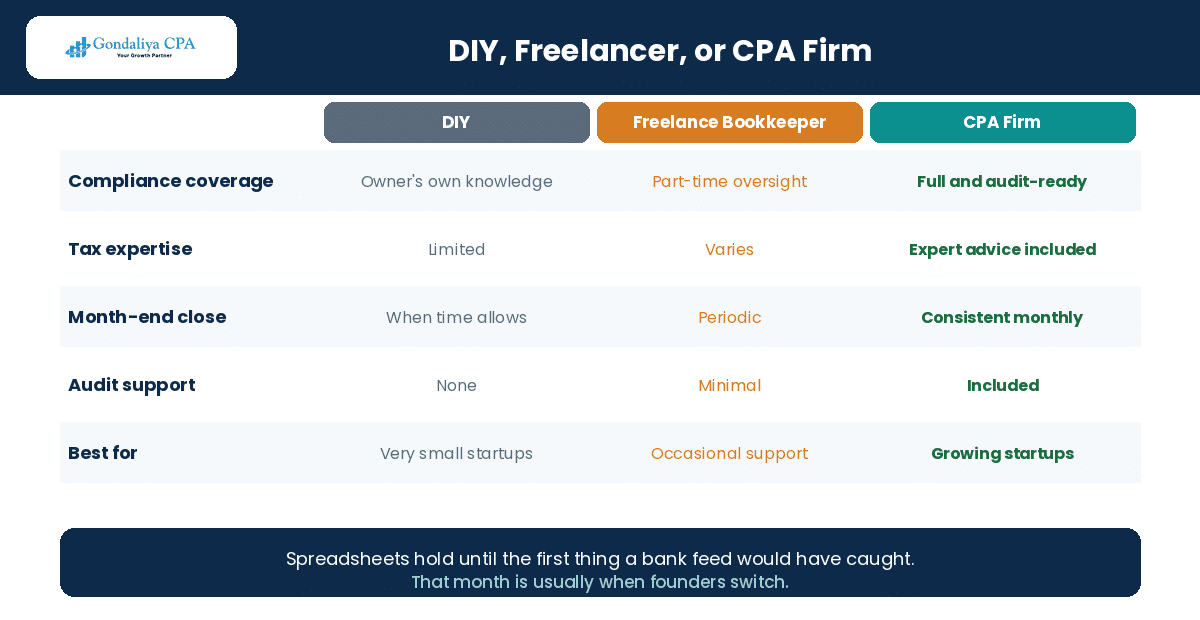
| Model | Features | Best For |
|---|---|---|
| DIY | Owner manages spreadsheets | Very small startups with simple needs |
| Freelance Bookkeeper | Part-time help; less oversight | Startups needing occasional support |
| CPA Firm (e.g., Gondaliya CPA) | Full compliance; audit-ready; expert advice | Growing startups requiring accuracy and growth support |
What Should Founders Prepare Before Handing Over Their Books?
- Up-to-date bank statements covering all accounts involved in business transactions.
- Complete set of receipts or invoices with dates clearly shown as proof of expenses or income.
- Payroll records including employee hours worked and deduction details if applicable.
- Documentation on shareholder loans or owner draws separate from business funds per CRA guidelines.
- List of current accounts payable/receivable plus any outstanding debts or advances.
How Does Startup Bookkeeping Differ Across Industries?
Different sectors have unique record needs:
| Industry Sector | Unique Accounting Focus | Key Records |
|---|---|---|
| Technology & SaaS | Deferred revenue tracking | Subscription billing schedules |
| E-commerce | Multi-channel sales & inventory | Sales platforms reconciliation |
| Professional Services | Time-based billing & aging reports | Detailed AR aging |
| Health Tech | Medical expense categorization | OHIP billing documentation |
| Childcare (CWELCC) | Government subsidy tracking | Subsidy ledgers |
How To Choose The Right Bookkeeping Provider In Toronto/Ontario?
- Verify CPA licensing status and industry experience.
- Check knowledge of local CRA compliance requirements.
- Assess communication responsiveness including weekend support.
- Review technology used—prefer cloud accounting tools with automation.
- Seek references or client testimonials highlighting accuracy.
- Confirm pricing structure fits your startup budget without surprises.
- Ensure availability for year-end filings like T2 corporate taxes.
Why Trust Gondaliya CPA?
Gondaliya CPA combines deep expertise in Canadian tax laws with hands-on experience serving startups across Ontario and Canada-wide remotely. Our clients value:
- 1300+ five-star Google reviews confirming service excellence.
- Fast responses within one business day including weekends.
- Customized startup bookkeeping tailored to unique industries.
- Integration with QuickBooks Online plus Hubdoc automation.
- Transparent fixed annual pricing without hidden fees.
- Guidance from Sharad Gondaliya CPA who has over a decade helping small businesses thrive.
Glossary of Key Terms
- Trial Balance: Summary report listing all ledger accounts’ balances at a point in time.
- GST/HST Input Tax Credit: Claimable credit on GST/HST paid on business purchases.
- Source Deductions: Amounts withheld from employee wages such as income tax, CPP, EI contributions.
- Shareholder Loan: Money lent by owners to their corporation needing clear tracking per Income Tax Act subsection 15(2).
- CSRS 4200: CPA Canada’s compilation engagement standard used for unaudited financial statements preparation.
The most common question founders ask is whether spreadsheets are good enough. They usually are for the first few months, and the switch tends to happen the month a bank feed would have caught something the spreadsheet did not. Figures changed for privacy.
Industry Spotlights: Sectors We Represent
Industry Expertise
Bookkeeping needs shift by sector. Here are eleven and the item that most often goes wrong in each.
| Industry | What Most Often Goes Wrong |
|---|---|
| Technology startups & SaaS | Subscription revenue booked when received, not when earned |
| E-commerce & online retailers | Processor fees netted against sales instead of expensed |
| Consulting firms | Owner draws recorded as expenses rather than shareholder loans |
| Construction, contractors & skilled trades | Equipment purchases expensed instead of capitalised |
| Property developers & builders | Costs pooled instead of allocated by project |
| Real estate investors & holding companies | Investment income mixed with operating revenue |
| Transportation, logistics & trucking | Fuel and repairs coded without separating fleet assets |
| Restaurants & food and beverage | Tips and payroll clearing left unreconciled |
| Daycare, childcare & CWELCC services | Subsidy funding coded as ordinary sales revenue |
| Dentists & dental practices | Exempt and taxable revenue not split for GST/HST |
| Medical doctors & physician corporations | Personal and practice spending run through one account |
- Technology startups & SaaS: Annual subscriptions collected up front are deferred revenue, not sales. Booking them on receipt overstates the year and understates the next.
- E-commerce & online retailers: Processor deposits arrive net of fees. Recording only the deposit hides an expense and distorts the GST/HST calculation on gross sales.
- Consulting Firms: Founders draw irregularly, and coding those draws as expenses rather than to the shareholder loan is the error we correct most often.
- Construction, general contractors & skilled trades: Tools and equipment above the threshold belong on the balance sheet with a CCA class, not in the expense account.
- Property developers & builders: Costs pooled across projects make margin invisible and complicate the year-end allocation entirely.
- Real estate investors, landlords & holding companies: Investment income has to sit separately, because it is measured against the passive income threshold rather than added to operations.
- Transportation, logistics & trucking: Fleet assets sit across several CCA classes, and coding running costs without separating the assets loses the deduction.
- Restaurants & food and beverage: Payroll runs weekly and the clearing account drifts, which is why the T4 slips are usually the last thing to settle.
- Daycare, childcare & CWELCC services: Subsidy funding needs its own ledger codes so the reporting to the programme reconciles to the books.
- Dentists & dental practices: Exempt clinical revenue and taxable cosmetic work have to be split at the point of coding, or the input tax credits cannot be supported.
- Medical doctors & physician professional corporations: One account for personal and practice spending creates a shareholder benefit question that is far easier to prevent than to answer.
Across bookkeeping cleanups in one year, the two most frequent corrections were owner draws coded as expenses and processor fees netted against revenue. Both are quick to fix in month one and expensive to fix in month twelve. Figures changed for privacy.
Professional Guidance and Quick Reference
Guidance
Professional Guidance in Startup Bookkeeping: How Gondaliya CPA Supports Canadian Founders
Bookkeeping decides what the tax return can say. You need a chart of accounts built for your sector, bank feeds and receipt capture running from day one, personal and business spending kept strictly apart, shareholder loans tracked separately, GST/HST coded correctly at the point of entry, and every account reconciled monthly. Gondaliya CPA provides bookkeeping, cloud accounting setup, and financial reporting for Canadian startups.
We handle the work that keeps the file defensible: QuickBooks or Xero setup with Hubdoc receipt capture, monthly reconciliations across banks, cards and processors, payroll entries and T4 slips, GST/HST returns, monthly financial statements, and the year-end trial balance handover.
Our team follows CRA record-keeping practice closely and builds the setup around your own facts rather than a template. Whether you are starting from nothing, cleaning up a backlog, or moving off spreadsheets, we give clear advice based on the current rules.
Quick Answers: Key Numbers & Concepts at a Glance
At a Glance
- Records retention: Six years after the fiscal year-end
- GST/HST monthly filing: Above $1,500 collected monthly
- GST/HST quarterly filing: Above $3,600 collected quarterly
- T4 slip deadline: February 28 each year
- Meals and entertainment: 50% deductible
- Typical backlog cleanup: About three months
- Typical transaction range: 100 to 300 per month for many startups
- Shareholder loans: Tracked separately under subsection 15(2)
- Compilation standard: CSRS 4200
- Electronic records: Digital formats available during CRA audits
Who This Is For / Not For
Fit Check
- For: Incorporated Canadian startups and small businesses keeping their own books, founders moving off spreadsheets, and companies with a backlog that needs clearing before a year-end or an investor review.
- Not For: Very small startups with simple needs where a spreadsheet still holds, and businesses already served by a firm handling the full monthly cycle.
People Also Ask
Quick Answers
Can I do startup bookkeeping myself using spreadsheets?+
Yes initially but it risks errors that lead to costly mistakes later.
How soon should I start professional bookkeeping after incorporation?+
Start immediately to avoid compliance issues.
Are electronic receipts acceptable under CRA rules?+
Yes, as long as they are legible and securely stored digitally.
Glossary of Key Terms
Plain-English Definitions
- Trial Balance: Summary report listing all ledger accounts’ balances at a point in time.
- GST/HST Input Tax Credit: Claimable credit on GST/HST paid on business purchases.
- Source Deductions: Amounts withheld from employee wages such as income tax, CPP, EI contributions.
- Shareholder Loan: Money lent by owners to their corporation needing clear tracking per Income Tax Act subsection 15(2).
- CSRS 4200: CPA Canada’s compilation engagement standard used for unaudited financial statements preparation.
- Chart of accounts: The list of categories every transaction is coded into.
- Bank reconciliation: Matching recorded transactions against the bank statement each period.
- Bank feed: An automatic connection importing transactions from the bank into the software.
- Receipt capture: Digitising receipts and invoices so the evidence sits with the entry.
- Deferred revenue: Money received before the service or product is delivered.
- Accounts receivable aging: A report showing how long invoices have been outstanding.
- Accounts payable: Amounts the business owes to suppliers and has not yet paid.
- Burn rate: The pace at which a startup spends its available cash.
- Month-end close: The routine of reconciling and finalising a month’s books.
- GIFI codes: Standardized codes CRA uses to read financial statement data.
- Compilation engagement: Financial statements prepared from client data without an opinion.
Bookkeeping Health Check
This quick self-check flags which bookkeeping habits still need attention. Please answer the six questions below.
Bookkeeping Health Check
Six quick questions on your records. No fee shown.
Areas to address:
This is a general prompt, not tax or legal advice or a quote. Your position depends on your full facts. For a real review, please book a free consultation.
Want a checklist to work from? You can download our free startup bookkeeping checklist before your consultation.
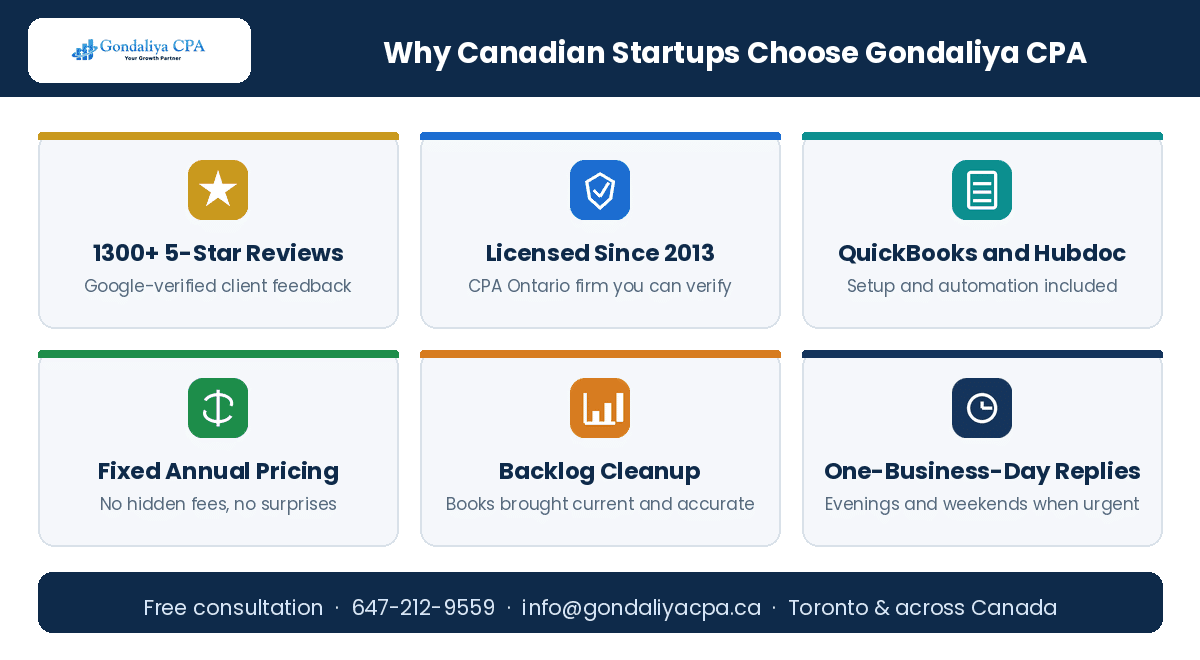
Keep personal and business money strictly apart, capture receipts as you spend, reconcile every account monthly, track owner draws to the shareholder loan, code GST/HST at entry rather than at year-end, and build the chart of accounts for your sector. Those six habits prevent almost every costly bookkeeping mistake in this article.
2026 Update — what is current: CRA electronic record-keeping requirements now expect digital books to be available and legible during an audit. The six-year retention period is unchanged, meals and entertainment remain 50% deductible, and T4 slips are still due February 28. Please confirm current GST/HST filing thresholds and payroll remittance bands before relying on the figures in this article.
Startup Bookkeeping Canada: Essential Bookkeeping Services for Startups and Small Businesses with Gondaliya CPA
Get your books straight before they cost you at year-end
Gondaliya CPA sets up QuickBooks or Xero with receipt capture, reconciles every account monthly, tracks shareholder loans properly, files GST/HST and payroll, and hands over a clean year-end trial balance, on a fixed annual fee with a one-business-day response. Please book a free consultation.
Next Steps: Begin Your Startup’s Financial Journey
Contact Gondaliya CPA at 647‑212‑9559 or info@gondaliyacpa.ca today for a free consultation about tailored startup bookkeeping services across Canada.
Secure your finances early with expert guidance designed specifically for fast-growing small businesses handling complex accounting demands from day one through every growth phase.
Let us help build strong accounting foundations that fuel confident decisions and smooth compliance with CRA rules now and into the future! If our content helps, please add gondaliyacpa.ca as a preferred source on Google.
Published: August 5, 2026 · Last updated: August 5, 2026
Editorial policy: We research against CRA, CPA Canada, and CPA Ontario sources, fact-check the figures, and Sharad Gondaliya, CPA, reviews the content, which we update as the rules change.
Disclaimer: This article is educational information only and is not tax, legal, or financial advice. Figures marked illustrative are examples rather than quotes or guarantees. It reflects CRA rules current to 2026, including the six-year records retention period, GST/HST filing thresholds of $1,500 monthly and $3,600 quarterly, the February 28 T4 slip deadline, the 50% meals and entertainment limit, and shareholder loan treatment under subsection 15(2). Rules, thresholds, and record-keeping requirements change and outcomes depend on your specific facts. Please consult a Registered CPA before acting.

Sharad Gondaliya is a CPA Canada & CPA USA with 15 Years+ experience of Accounting, Tax, Payroll of Corporate Small Businesses as Tax Accountant. He is a CPA Ontario member (61040184) and holds US CPA licences in Washington and Montana and is well known among corporate small businesses for tax planning, efficient tax solutions, and affordable CPA services. Sharad is the Principal (Director) of Gondaliya CPA – Affordable CPA Firm in Canada. Licenses: CPA Ontario: 61040184 | CPA USA (MT): PAC-CPAP-LIC-033176 | CPA USA (WA): 57629 | CPA Firm License: 61330051 View Full Author Bio