



Top 7 GST/HST Filing Mistakes Businesses Must Avoid for Maximum Refunds
GST/HST Return Filing for Small Businesses: Expert Tips on HST and GST Compliance
GST/HST filing helps Canadian businesses follow tax rules. Gondaliya CPA prepares GST/HST returns for incorporated small and medium businesses in Ontario and across Canada, covering the return itself, the input tax credit claims behind it, and the reconciliations that keep the numbers defensible. Filing correctly avoids CRA fines and lets you claim ITCs, and claiming ITCs can lower your total taxes for incorporated small and medium businesses with over $30,000 yearly revenue.
Quick Summary
Many small Canadian businesses must file GST/HST returns by law. Please note that you figure out whether you owe money or get some back by subtracting input tax credits from the tax you collected, so the credits are where most of the money is won or lost. Seven mistakes account for most of the damage we see on GST/HST filings.
| Aspect | Details |
|---|---|
| What | Many small Canadian businesses must file GST/HST returns by law. |
| Why | Filing correctly avoids CRA fines and lets you claim input tax credits. |
| Who | Incorporated small and medium businesses with over $30,000 yearly revenue. |
| Benefit | Claiming ITCs can lower your total taxes. |
Reading time: 16 minutes.
Table of Contents
- What GST/HST Return Filing Is and When You Must File
- Mistakes One to Four: Deadlines, Mixed Expenses, Documents, Classification
- Mistakes Five to Seven: Reconciliation, Stale Records, Wrong ITC Claims
- Your Options: DIY, a CPA Firm, or a Non-CPA Provider
- How the Service Works at Gondaliya CPA
- What to Prepare, and One Realistic Numeric Example
- Frequently Asked Questions
- Essential Points on Managing GST/HST Filing Challenges
- Industry Spotlights: Sectors We Represent
- Professional Guidance and Quick Reference
The Numbers That Matter
This article covers GST/HST return filing for incorporated small and medium businesses in Ontario and across Canada, and the seven mistakes that most often cost them money. It covers what GST/HST return filing is, the $30,000 small supplier threshold and voluntary registration below it, input tax credit claims and the documentation behind them, the choice between filing yourself, hiring a CPA firm and using a non-CPA tax service provider, the phases of a filing engagement from intake through post-filing support, the pricing drivers that decide what the work costs, late filing penalties and incorrect ITC claims as the two principal risks, the twelve-item checklist to prepare before filing, how GST/HST filing differs across key sectors, and a realistic numeric example for a quarterly filer. It does not advise on Provincial Sales Tax filing in British Columbia, Manitoba or elsewhere beyond noting that it is separate, on corporate income tax filing in detail, on payroll remittances beyond their relationship to the same accountants, or on the GST/HST position of any particular supply. Gondaliya CPA performs compilation engagements under CSRS 4200, which provide no assurance; audit and review engagements are referred out. We do help clients through CRA audits. This is educational information only and not tax, legal or accounting advice.
What GST/HST Return Filing Is and When You Must File
The Basics
Reporting What You Collected, Less What You Paid
GST/HST return filing means reporting the tax you collected from customers to the CRA. You also figure out if you owe money or get some back by subtracting input tax credits. You send the net amount to CRA after counting your sales and credits.
- Goods and Services Tax (GST) is a federal tax.
- Harmonized Sales Tax (HST) combines GST with provincial taxes in some provinces.
- Input tax credits let you get back tax paid on business stuff.
When You Need GST/HST Return Filing in Canada
You must file your GST/HST return when:
- Your annual taxable sales go over about $30,000. This means registration is required.
- You want to claim input tax credits to get back some of the taxes you paid on business expenses.
- Even if under $30,000, you can sign up voluntarily to claim ITCs and save money.
Knowing when to file keeps your business legal and may save you cash by getting credits on what you spend. We help mostly in Ontario but serve clients all over Canada.
Quick Comparison: DIY vs. CPA vs. Non-CPA Provider
| Situation | Best Move | Why | Risk | Timeframe |
|---|---|---|---|---|
| Simple returns | DIY filing on CRA site | Saves money if you know the steps | Low | Right away |
| Complex cases | Hire a CPA | Better accuracy and tax savings | Medium | Depends on case |
| Not sure about rules | Ask a Registered CPA | Follow CRA rules exactly | High | Needs meeting |
Who This Service Is For
This is for incorporated small and medium businesses in Ontario and across Canada. If your business earns more than about $30,000 a year, you will want exact GST/HST filings.
Who This Service Is Not For
If you are a sole proprietor making less than the $30,000 limit, you usually do not need to file or register for GST/HST.
A Toronto consultant came to us convinced she was below the threshold and had never registered. Her invoices for the year added to roughly $44,000 of taxable sales, well over the $30,000 limit, because she had been counting only the work she had been paid for rather than the work she had billed. Registration had been required from the quarter she crossed it. We registered the corporation, filed the back periods, and claimed the ITCs on roughly $9,000 of software, subcontractor and home-office costs she had never thought to collect receipts for in a tax account. The credits covered a meaningful part of what the back filings produced. The lesson she took away was that the threshold is measured on sales, not on collections. Figures changed for privacy.
Filing GST/HST returns correctly is the base that everything else in GST compliance sits on. Get the registration and the filing frequency right, and the seven mistakes below become much easier to avoid.
Mistakes One to Four: Deadlines, Mixed Expenses, Documents, Classification
The Mistakes
Many Canadian SMBs Make the Same Seven Errors
Many Canadian SMBs make similar errors that cause trouble. Seven of them account for most of the lost refunds and most of the penalties we see on GST/HST filing work. The first four are below; the remaining three follow in the next section.
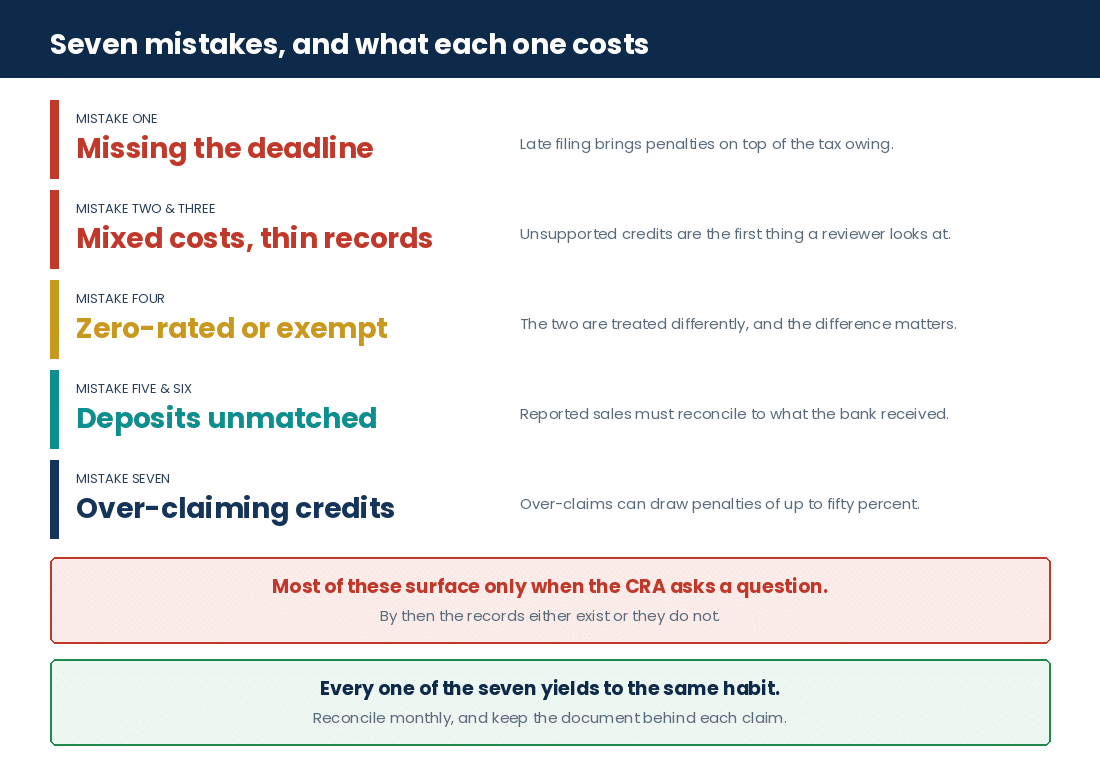
Mistake 1: Missing Deadlines Causing Late-Filing Penalties
Missing deadlines is the first and commonest error. Filing late brings automatic fines plus daily interest until paid. The impact is late penalties, and the prevention is straightforward: set calendar alerts and review deadlines monthly.
CPAs help by setting reminders matched to each client’s deadlines. If delays happen, they help negotiate with CRA. Your filing frequency decides how often the deadline comes around, whether monthly, quarterly or yearly, and missing a quarterly deadline four times a year costs four times as much as missing an annual one once. Proof you paid GST/HST on time helps avoid penalties, and late payments bring interest charges, so plan ahead.
A Mississauga equipment supplier filed quarterly and missed three of the four deadlines in a year, each by a few weeks, because the bookkeeper was reconciling the quarter after the return was already due. Each late return brought its own fine plus daily interest on roughly $18,000 of net tax per quarter. The cost of the lateness across the year came to about $2,400, none of which bought anything. We moved the reconciliation to a monthly cycle so the numbers were ready before the quarter closed, and put the four filing dates in a calendar with a reminder two weeks ahead of each. The following year all four went in on time. Figures changed for privacy.
Mistake 2: Mixing Personal Expenses Into Business Claims
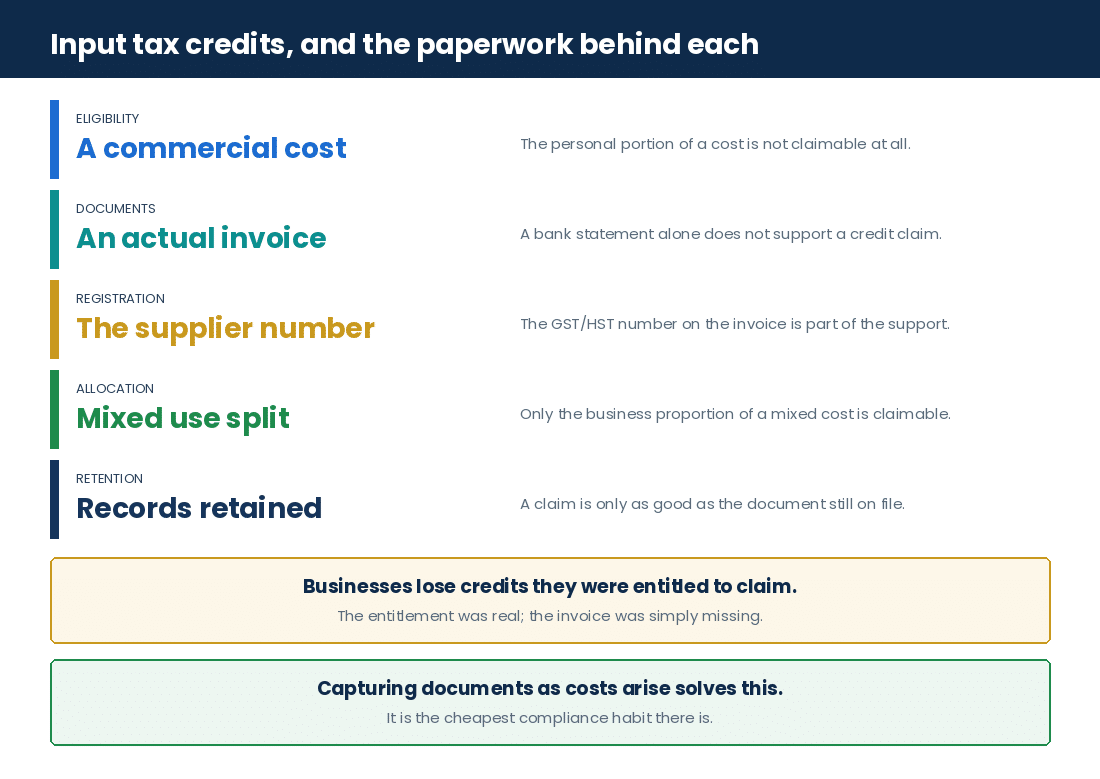
Mixing personal and business expenses produces incorrect deductions and invites audits. The prevention is separate accounts and meticulous record-keeping.
This is one of the problems incorporated SMBs face every day: reporting correctly despite mixing personal and business expenses. A personal purchase run through the business account and claimed as an input tax credit is a credit CRA can disallow, and a pattern of them is the sort of thing that turns a routine review into a longer one. One business account, used only for the business, removes the problem at source rather than requiring it to be unpicked at filing time.
Mistake 3: Not Keeping Good Documents for the ITCs Claimed
Inadequate documentation leads to disallowed claims and penalties. The prevention is to keep receipts and digital backups.
Purchase receipts are what you claim input tax credits with. You get them from suppliers or expense reports, and lost receipts or bad paperwork cause problems. Bookkeeping tools like QuickBooks or Xero help here, because a receipt attached to the transaction when it happens is a receipt you still have at filing time. Documenting ITC claims carefully is also the single best preparation for a GST/HST audit inquiry, since the claim and the evidence for it sit together.
A Scarborough contractor claimed input tax credits on roughly $70,000 of material purchases for a year and could produce supplier invoices for about half of it. The rest was on credit card statements that showed an amount and a vendor name but no tax breakdown, which is not enough to support a claim. We recovered a good part of it by writing to the suppliers for duplicate invoices, but about $3,100 of credits had to be dropped because the paperwork could not be rebuilt. He now photographs every supplier invoice into his bookkeeping software on the day of purchase. The claims have not changed; the evidence behind them has. Figures changed for privacy.
Mistake 4: Confusing Zero-Rated With Exempt Supplies
Wrong classification of supplies results in overpaid taxes or penalties, and the prevention is to regularly update your knowledge of classifications. Misclassification errors mean wrong rates affect taxes owed, which is why a proper classification review matters for all businesses, and why current CRA classifications should be consulted.
Zero-rated and exempt are not the same thing and do not have the same consequence for your input tax credits. HST rates also vary by province and can confuse your calculations, so a business selling into several provinces has more classification work to do, not less. Reporting must cover all provinces where you do business because HST rates differ.
Common Mistakes Prevention Table
| Common Mistake | Impact | Prevention Tips |
|---|---|---|
| Missing Deadlines | Late penalties | Set calendar alerts; review deadlines monthly |
| Mixing Personal & Business Expenses | Incorrect deductions; audits | Separate accounts; meticulous record-keeping |
| Inadequate Documentation | Disallowed claims; penalties | Keep receipts; digital backups |
| Wrong Classification Of Supplies | Overpaid taxes or penalties | Regularly update knowledge of classifications |
| Failing To Reconcile Bank Statements | Undetected errors; missed claims | Monthly bank reconciliations |
| Not Updating Software / Records Timely | Outdated info; errors | Schedule regular updates & reviews |
Mistakes Five to Seven: Reconciliation, Stale Records, Wrong ITC Claims
The Mistakes
The Three That Cost the Most in Lost Refunds
The last three of the seven are the ones most likely to show up as money you never got back, or money you have to give back later.
Mistake 5: Forgetting to Match Bank Deposits With Reported Sales
Failing to reconcile bank statements leaves undetected errors and missed claims. The prevention is monthly bank reconciliations.
Bank statements show payments made and received, and you use them to match your numbers and spot errors. Checking reconciliations often is what turns a set of books into a return you can defend. A business activity summary that pulls all transactions in the period from your accounting system lets you cross-check sales and purchases before anything is filed. It is key to check that reports match real transactions before filing.
A Vaughan retailer reported sales from the point-of-sale system and never compared them to the bank. Over three quarters, roughly $26,000 of deposits had gone through the bank with no matching entry in the sales ledger, mostly from a second card terminal nobody had set up in the software. The GST/HST on it had been collected from customers and never reported. We reconciled the three quarters, corrected the returns and remitted the difference before CRA asked about it, which is a much cheaper conversation than the one that starts with a letter. Monthly reconciliations now catch the gap in weeks rather than quarters. Figures changed for privacy.
Mistake 6: Not Updating Software or Records Timely
Not updating software or records in good time leaves outdated information and errors behind. The prevention is to schedule regular updates and reviews.
Keeping organized books year-round using tools like QuickBooks or Xero is what makes this manageable. Integrating bookkeeping software with tax filings ensures accurate data flow and reduces filing mistakes, and linking the accounting software properly is part of smooth GST/HST return preparation. Watching for CRA updates yearly matters too, because industries often see rule changes that affect their tax work, and staying up to date keeps your business safe from mistakes or fines over time.
Mistake 7: Incorrect ITC Claims Impacting Business Taxes
Claiming too much ITC can lead to reassessments where you owe back taxes plus possible penalties up to 50%. Accountants check eligibility carefully before claiming anything. This cuts audit risks while getting all legitimate credits.
This is the mistake that runs in the opposite direction from the others. Mistakes three and five lose you credits you were entitled to; mistake seven hands you credits you were not, and then takes them back with interest. The discipline that solves both is the same: claiming eligible input tax credits without triggering audits, verified against eligibility and supported by an audit trail.
A Toronto professional services corporation had been claiming full input tax credits on a vehicle and a home office used substantially for personal purposes, and on roughly $14,000 a year of meals and client entertainment claimed at the full rate. On review, about $4,800 of credits across two years were not supportable as claimed. We corrected the positions before CRA reached them, which kept the exposure to the tax plus interest rather than the tax plus a penalty on top. Claiming less than you think you are entitled to is uncomfortable; claiming more and being reassessed is worse. Figures changed for privacy.
How To Avoid This Mess
- Keep organized books year-round using tools like QuickBooks or Xero
- Check reconciliations often
- Talk to professionals who know current rules
- Use checklists made for Canadian incorporated businesses
- Watch for CRA updates yearly
Risk & Compliance Table: Key Areas Addressed by CPAs
GST/HST compliance means filing on time and being accurate, especially with input tax credit claims. Messing up can cost you penalties from late filings or wrong information.
| Risk Area | Description | Mitigation | Target Audience | Additional Notes |
|---|---|---|---|---|
| Late Filing Penalties | Fines + interest charges | Deadline tracking + reminders | All registered businesses | Check official deadline sources |
| Incorrect ITC Claims | Owing back taxes + penalties | Verify eligibility + audit trails | Businesses claiming input credits | Follow CRA guidance often |
| Audit Triggers | More scrutiny risking bigger assessments | Good record keeping + pre-audit checks | All taxpayers | Adopt consistent record practices |
| Misclassification Errors | Wrong rates affect taxes owed | Proper classification review | All businesses | Consult current CRA classifications |
| Poor Record Keeping | Inadequate documentation | Maintain detailed records | All taxpayers | Use digital storage solutions |
Working with CPAs who know Canadian corporate tax like Gondaliya CPA gives small businesses peace knowing risks are managed carefully, cutting exposure a lot.
GST/HST Filing Risk Check
Five quick questions on where your GST/HST filing stands. No fee shown.
Points to raise with us:
This is a general prompt, not tax or legal advice or a quote. Your position depends on your full facts. For a real review, please book a free consultation.
Your Options: DIY, a CPA Firm, or a Non-CPA Provider
Your Options
Three Ways to File, and What Each One Risks
When you file your GST/HST return, you can do it yourself, hire a CPA firm like Gondaliya CPA, or go with a non-CPA tax service. Each way has its own pros and cons for GST compliance, business tax savings, and audit risk.
DIY GST/HST Return Filing
Doing your GST/HST filing yourself seems easy and cheap. The CRA lets businesses file electronically using My Business Account or approved software.
Here is what is good about DIY:
- It costs less since you do not pay professionals
- You control when and how to file your return
- CRA tools help track filing deadlines
But watch out for these problems:
- You must meet strict CRA filing deadlines or face penalties
- You might miss claiming input tax credits (ITCs) if you are not sure what to look for
- HST rates vary by province and can confuse your calculations
At first, DIY looks cheap. But errors often lead to audits or missed refunds. You also need well-organized bookkeeping records to keep things right.
Hiring a CPA Firm like Gondaliya CPA
A Registered CPA firm helps make sure your GST/HST return is correct. They also work to get you the best business tax savings.
Here is why hiring a CPA helps:
- They catch all eligible ITCs so you do not lose money
- They file on time and accurately, cutting audit risks
- Their checks stop common mistakes before filing
- They stand by you during audits or late filings
Gondaliya CPA works with incorporated small businesses across Canada. We link with your bookkeeping software like QuickBooks or Xero to speed up the process.
Using a Non-CPA Tax Service Provider
Non-CPA services may cost less but come with risks. Possible issues are:
- No formal license means less responsibility if they mess up
- They cannot fully represent you in CRA disputes or audits
- They might not know complex HST rules for different provinces
Non-CPA options can seem cheap but may cause penalties or lost credits without expert help.
Decision Matrix: Which Option Is Best for You?
| Your Situation | Complexity Score (1–5) | Recommended Option | Why It Fits |
|---|---|---|---|
| DIY electronic filing | 2 | DIY | Cheaper but higher chance of mistakes; best if you know the rules well. |
| CPA firm filing | 4 | CPA Firm | Full review plus audit support; good for complex cases. |
| Non-CPA provider | 3 | Non-CPA Provider | Often cheaper but may lack full knowledge of rules. |
Using professional help lowers the risk of wrong credit claims or missed deadlines while improving your overall business tax results. Choosing professional help for Canadian incorporated SMBs means meeting your GST/HST duties well. You get fewer risks than doing it yourself or using unlicensed providers, and save money in the long run by avoiding costly mistakes.
A Brampton e-commerce seller used an unlicensed preparer for two years at roughly a third of what a CPA firm had quoted. The returns went in on time, but place-of-supply was applied as though every sale were an Ontario sale, so HST was over-remitted on sales into provinces with lower rates and under-remitted on none. The over-remittance across the two years was about $7,600, and when CRA queried an unrelated item the preparer could not act for her. We corrected the place-of-supply coding, filed the adjustments and recovered most of the over-remitted tax. The saving on fees was about $2,900 across the two years. Figures changed for privacy.
How to Choose the Right CPA Firm in Toronto or Ontario for GST/HST Return Filing
Picking the right CPA firm matters for correct HST tax filing and cutting audit risks. Experts often make fewer mistakes than DIY methods or non-CPA providers who might miss some rules.
Look for firms that know Canadian corporate tax well, especially for small incorporated businesses. Check if they respond quickly near deadlines, charge clear fees, and have experience with CRA audits or fixing past errors.
Hiring a Registered Ontario CPA means they must follow provincial rules set by CPA Ontario. Some firms offer flat fees with set services like thorough reviews that catch errors before sending returns. This helps avoid fines from late or wrong filings. At Gondaliya CPA, fees are fixed and annual with no hourly billing, shown before tax with sales tax on its own line.
Questions to Ask on a Free Consultation
- How do you make sure I claim all my input tax credits?
- What steps do you take to avoid errors when filing HST returns?
- Can you help fix past returns if they were wrong?
- How do you handle CRA audits if they contact us?
- What are your turnaround times near quarterly deadlines?
- Do you charge fixed fees with no surprise costs?
- Which accounting programs do you work with?
- Can you advise on ways to save more on business taxes besides just filing?
These questions help find CPAs who do not just meet minimum standards but also give advice to improve your finances based on Ontario SMB rules. If you want specific help with GST/HST filing, HST tax filing, GST compliance, or saving more on business taxes, call Gondaliya CPA at 647-212-9559 or email info@gondaliyacpa.ca for a free consult.
Why Trust Gondaliya CPA
Trust matters when you deal with GST/HST filing, GST compliance, HST tax filing, and business tax savings. Gondaliya CPA brings years of experience working with incorporated small and medium businesses (SMBs) in Ontario and across Canada. We focus on accuracy and follow the required filing frequency so you do not miss deadlines. Plus, we work hard to reduce your CRA audit risk, helping keep your business on the right track while saving money where possible.
Here is what we do well:
- Handle GST/HST filings with care
- Keep up with all compliance rules
- File HST taxes on time
- Help find business tax savings
Credentials & Registrations
Gondaliya CPA is a fully Registered Chartered Professional Accountant firm registered with CPA Ontario, a Registered Ontario CPA Firm since 2013. That means we meet strict quality and ethics standards. Meeting your filing frequency deadlines, whether monthly, quarterly, or yearly, is a must. We submit all filings electronically through CRA’s My Business Account, which helps avoid delays.
Our team does not just fill out forms. We offer real professional CPA assistance to catch errors before they happen. We know Canadian tax laws and have lots of experience dealing with tricky filings for incorporated SMBs. This helps you avoid fines caused by late or wrong submissions.
We also focus on CRA audit risk mitigation. We spot possible problems early so you do not face surprise audits that can mess up your cash flow or operations. We do help clients through CRA audits when they happen. Gondaliya CPA performs compilation engagements under CSRS 4200, which provide no assurance; audit and review engagements are referred out.
| Trust Signal | What It Means for Clients | Where It Matters |
|---|---|---|
| Registered CPA Firm (Ontario) | Guarantees professional and ethical service | Filing frequency compliance |
| Electronic Filing via CRA Portal | Faster processing; fewer errors | Timely submission & record keeping |
| Incorporated SMB Specialization | Advice made for small/medium businesses | Business tax savings & compliance |
| Professional CPA Assistance | Expert help to reduce mistakes | Accurate GST/HST returns |
| CRA Audit Risk Mitigation | Finds issues early to avoid penalties | Minimizing penalties & operational risks |
Registered CPA Firm (Ontario)
As a fully Registered Ontario CPA firm, Gondaliya CPA follows all provincial rules about accounting practices. Our licence means we stay responsible under groups like CPA Ontario who watch over ethics and training.
Canadian incorporated SMBs often juggle many sales channels or payroll schedules alongside their GST/HST duties. Our licence gives clients confidence that they get advice based on current rules for filing frequency, payment deadlines, input tax credit claims, and how to handle reconciliations properly.
We file electronically through CRA’s My Business Account system too. This way, your information goes securely from certified professionals who know the system well, cutting down errors or delays caused by incomplete forms or DIY mistakes.
Incorporated SMB Specialization
Gondaliya CPA works mainly with incorporated small- and medium-sized businesses in many fields:
- Healthcare providers like physician corporations under OHIP
- Dental offices governed by RCDSO rules
- Tech startups growing fast online via Shopify stores
- Construction companies managing subcontractor payments under HST
This focus lets us offer solutions for problems these businesses face every day:
- Claiming eligible input tax credits without triggering audits
- Reporting correctly despite mixing personal and business expenses
- Timing payments to fit cash flow needs better
By working closely with this group, not just doing general bookkeeping, we help you get real business tax savings while staying fully compliant with CRA rules that change often. Trust comes from solid credentials and real knowledge about your industry. Gondaliya CPA stands ready to help with GST/HST filing so your business avoids costly errors and keeps things running smoothly inside Canada’s rules.
How the Service Works at Gondaliya CPA
The Process
Six Phases, From Intake to Post-Filing Support
Gondaliya CPA follows clear steps to file your GST/HST returns on time and right. Most corporations must do electronic filing through CRA’s My Business Account, and this is part of the process.
| Phase | Typical Duration | Client Actions | Gondaliya CPA Actions | Outputs | Common Delays + Prevention |
|---|---|---|---|---|---|
| Intake & Onboarding | 1–2 weeks | Give incorporation papers; confirm registration status | Check new SMB registration; start setup | Registered account ready | Delay if client does not send documents |
| Document Collection | 2–3 weeks | Send organized bookkeeping records | Check records; ask questions if needed | Full dataset | Messy books slow things down |
| Return Preparation | 1–2 weeks | Review and approve numbers | Figure out ITC claims; prepare reports for all provinces | Draft GST/HST return | Missing receipts slow ITC claims |
| Review & Quality Assurance | 3–5 days | Answer questions fast | Perform quality checks; finalize return | Final error-free GST/HST return | Delays in response risk errors |
| Filing & Remittance | One day before deadline | Confirm payment method | File electronically via CRA portal | Confirmation of filing | Missed deadline causes fines |
| Post-filing Support | Ongoing | Tell us about follow-ups from CRA | Support audit readiness; fix late submissions | Stay compliant | Late replies raise penalty chances |
Intake & Onboarding Phase
If you are a new incorporated SMB registering for GST/HST, this phase makes sure your registration is done right from the start. That stops future problems with CRA accounts. A CPA firm helps with the registration process, ensuring you register at the right time and understand your filing frequency.
Document Collection Phase
You need to provide well-organized bookkeeping records here. This includes sales invoices, expense receipts, and payroll summaries that back up your GST compliance.
Return Preparation Phase
This step focuses on claiming input tax credits (ITCs) properly. Getting these right helps boost your cash flow by lowering what you owe. Also, reporting must cover all provinces where you do business because HST rates differ.
Review & Quality Assurance Phase
Before sending the return in, we do quality assurance and cross-checks. This avoids mistakes that could cause penalties or extra work later.
Filing & Remittance Phase
Most corporations must file electronically through the CRA portal now. Filing on time avoids penalties and keeps things smooth with the CRA.
Post-Filing Support
If CRA asks questions later or audits happen because of late filings, Gondaliya CPA helps. We guide remedial filings and support audit readiness so you avoid bigger problems.
What You Get From a CPA Firm
When you use a CPA firm for GST/HST filing, you get more than just sending your tax returns. We focus on accuracy, compliance, and helping your business save on taxes by claiming the right input tax credits (ITCs). Here is what you get:
- Accurate GST/HST Returns: We prepare and file your returns, making sure all taxable sales match CRA rules.
- Input Tax Credit (ITC) Claims: We find and help document all ITCs you qualify for to lower what you owe.
- CRA Representation: We handle any talks with the Canada Revenue Agency if your filings get reviewed or audited.
- Business Tax Savings Strategies: We advise on when and how much to pay, so you keep cash flowing but stay legal.
- Reconciliation Reports: We compare your sales records to filed numbers to catch errors early.
These services help small and medium incorporated businesses avoid fines or missing out on refunds. Doing HST tax filing properly also keeps you in good standing with the CRA, which is key for running your business smoothly.
| Deliverable | Description | Who Uses It | When Delivered | Client Input Needed |
|---|---|---|---|---|
| Accurate GST/HST Returns | Filed return showing correct taxable sales | Business owner/CRA | Every reporting period | Sales data; invoices |
| ITC Claim Documentation | Proof and support for eligible input credits | Business owner/CPA | With each return | Expense receipts/invoices |
| CRA Representation | Liaison during audits or reviews | Business owner/CPA | As needed | Authorization documents |
| Reconciliation Report | Report showing differences found | Business owner/CPA | After filing | Accounting records |
| Tax Savings Advice | Tips on timing payments & claiming credits | Business owner | Ongoing | Financial statements |
What Decides the Price
The price for GST/HST filing depends on several things tied to how complex your business is and how much work is needed. Knowing these helps plan your budget without surprises. Here are the main pricing factors:
- Complexity of Operations: Businesses with many sales types or selling across provinces take more work.
- Volume of Transactions: Lots of transactions mean more bookkeeping and time before filing.
- Data Cleanup & Reconciliation Needs: Messy or incomplete records require extra hours to fix before filing.
- Filing Frequency: Filing monthly costs more than quarterly or annually because it needs more work.
Hiring a CPA helps handle these issues well. We reduce chances of errors that might cause penalties. Below is a quick look at how these affect costs:
| Pricing Driver | Impact on Cost | How To Keep Costs Efficient |
|---|---|---|
| Complexity of Operations | More complex means longer review time | Keep financial systems clear |
| Volume of Transactions | Many transactions need more processing | Use good accounting software |
| Data Cleanup & Reconciliation | Fixing records adds billable hours | Update bookkeeping regularly |
| Filing Frequency | More frequent filings add to total fees | Pick right frequency based on CRA rules |
Ask firms about how they handle these factors. This helps pick fair-priced, reliable service for small incorporated businesses in Ontario or across Canada.
What to Prepare, and One Realistic Numeric Example
Preparation
Checklist: What to Prepare Before You Start
Getting ready for GST/HST filing matters. It helps you avoid mistakes and saves money on business taxes. Having your papers in order makes the HST tax filing easier. Plus, it keeps you clear of trouble. Here is a simple list for Canadian small and medium businesses to get GST/HST filing and compliance right:
- Business Number (BN). This is your ID for GST/HST accounts. You find it in CRA letters or registration papers. Do not mix up numbers. Check your BN matches CRA records before you file.
- Sales Invoices. Use these to report your sales correctly. Find them in your accounting software or paper files. Missing or messy invoices cause errors. Keep digital copies sorted by date.
- Purchase Receipts. Claim input tax credits with these. Get them from suppliers or expense reports. Lost receipts or bad paperwork cause problems. Try bookkeeping tools like QuickBooks or Xero.
- Previous GST/HST Returns. Look back at what you filed before. Get them from your CRA My Business Account. Forgetting old amounts can mess things up. Check past returns early.
- Bank Statements. These show payments made and received. Use them to match your numbers and spot errors.
- Payroll Records. Keep track of wages and deductions properly.
- Expense Reports. Summarize business costs clearly for easy reference.
- GST Payment Receipts. Proof you paid GST/HST on time helps avoid penalties. Find these in CRA payment confirmations or bank statements. Late payments bring interest charges, so plan ahead.
- Financial Statements. These reports show revenue and expenses yearly. They help check your tax filings are accurate.
- Inventory Records. If you hold stock, count it right. Wrong inventory affects tax credits claims.
- Contracts & Agreements. Contracts affect how you report supplies and taxes. Missing details can cause wrong filings.
- Business Activity Summary. Summarize all transactions in the period from your accounting system to cross-check sales and purchases.
Having all these ready makes GST compliance smoother. You will avoid missing tax credits, wrong sales numbers, and late submissions that cost penalties.
One Realistic Numeric Example
Here is a simple example to understand GST/HST filing better. This will show how following rules helps save business taxes and avoid audit troubles. Imagine a small incorporated business in Toronto filing every three months.
| Assumptions (Illustrative) | Details |
|---|---|
| Business Type | Incorporated retail company |
| Annual Revenue | $1,200,000 CAD |
| Filing Frequency | Quarterly GST/HST returns |
| Number of Transactions per Month | 150 sales invoices; 100 purchase receipts |
| Input Tax Credit Claims | Regular claims on supplies, inventory, utilities |
| Accounting System Used | QuickBooks Online with bank feeds |
This company files GST/HST every quarter because it makes over $1 million a year. The owner keeps digital records but sometimes takes time to match invoices to payments.
Good GST compliance means reporting sales correctly and claiming all valid input tax credits (ITCs). Missing or wrong claims can cause penalties or lost money. It is key to check that reports match real transactions before filing.
Here is what a professional GST/HST service would deliver:
| Outputs / Deliverables | Description |
|---|---|
| Accurate Quarterly Returns | Filed on time with correct taxable amounts |
| ITC Maximization | Claiming all eligible credits without mistakes |
| Reconciliation Report | Summary matching transactions to filings |
| Compliance Review | Spotting possible risk areas |
This example shows how proper filing helps keep cash flow steady. It avoids late fees and claims all refunds due. If you lag in checking or are unsure about credits, a CPA can help fix errors and lower audit chances.
Next Steps for This Case
- Collect all sales and purchase records before each quarter ends.
- Use accounting software regularly to track everything.
- Talk with a Registered CPA if you spot mistakes.
- Set up regular checks to stay on top of GST rules.
- Think about advice focused on saving business taxes.
A Toronto retail corporation at roughly $1.1 million of annual revenue filed quarterly and had been preparing the return from the sales report alone, with no purchase side at all beyond inventory. Across four quarters it had claimed nothing on utilities, rent, insurance, software, repairs or professional fees. Rebuilding the purchase side from a year of bank statements and supplier accounts produced about $11,400 of input tax credits that had simply never been claimed. The work took nine days. Nothing about the claims was aggressive; the credits were ordinary business ones the return had never been asked about. Figures changed for privacy.
Frequently Asked Questions
FAQs
FAQs on GST/HST Filing, Compliance, and Related Topics
What is the small supplier threshold for GST/HST registration?+
The small supplier threshold is $30,000 in taxable sales per year. Businesses below this do not have to register for GST/HST unless they choose voluntary registration. Voluntary registration can benefit even small suppliers below the threshold, because it allows input tax credits to be claimed on business purchases.
How can I get GST/HST registration assistance?+
A CPA firm like Gondaliya CPA helps with the registration process. We ensure you register at the right time and understand your filing frequency. Getting the registration right at the start stops future problems with CRA accounts, which is why it is the first phase of the engagement rather than an afterthought.
What are payroll remittances in relation to GST/HST?+
Payroll remittances are separate from GST/HST but often handled by the same accountants. They involve sending employee tax withholdings to CRA on schedule. Payroll summaries are still part of the document collection for a GST/HST engagement, because they back up your GST compliance.
Do I need to file corporate income tax along with GST/HST returns?+
Yes, corporate income tax filing is separate but important. CPAs can coordinate both to avoid missing deadlines. The two have different deadlines and different consequences for lateness, so coordinating them is cheaper than treating each one as a separate emergency.
How does Provincial Sales Tax (PST) filing differ from GST/HST filing?+
PST applies only in some provinces like BC and Manitoba. It has different rules and requires separate filings from GST/HST. Filing your GST/HST return correctly does not discharge a PST obligation where one exists.
What if my business makes sales in multiple provinces?+
Multi-provincial sales require careful tracking of provincial tax rates and HST variations. Accurate GST reconciliation is vital. Reporting must cover all provinces where you do business because HST rates differ, and this is one of the pricing drivers as well, since businesses selling across provinces take more work.
Can I change my GST/HST filing frequency?+
Yes, you can request a filing frequency change with CRA if your business circumstances change. Track your filing frequency and change it if business volumes shift significantly. Filing monthly costs more than quarterly or annually because it needs more work, so the right frequency is the one CRA rules permit for your volumes.
What causes GST/HST return rejection by CRA?+
Errors in reporting, mismatched numbers, or late submissions can cause return rejection. CPA reviews help prevent this. Respond quickly to any GST/HST return rejection, fixing errors promptly, because the deadline does not pause while a rejected return is being corrected.
How does bookkeeping integration support GST compliance?+
Integrating bookkeeping software with tax filings ensures accurate data flow and reduces filing mistakes. We link with your bookkeeping software like QuickBooks or Xero to speed up the process, and a receipt attached to a transaction when it happens is a receipt that still supports the input tax credit at filing time.
Why do GST rates vary across Canada?+
GST is 5% federally; HST combines this with provincial rates that vary by region, impacting total tax owed. Knowing how provincial and federal rules affect your tax duties differently is part of getting the classification and the place of supply right.
Essential Points on Managing GST/HST Filing Challenges
Key Takeaways
What Decides Whether a GST/HST Filing Goes Well
The rules do not change from one business to the next. What varies is whether the records were ready, whether the credits were documented, and whether anybody checked the numbers against the bank before the return went in.
| Point | What To Do |
|---|---|
| Filing risks | Understand GST/HST filing risks, such as late fees and wrong ITC claims. |
| Deadlines | Monitor filing deadlines closely to avoid CRA penalties. |
| Reconciliation | Use GST reconciliation tools regularly for accurate tax reporting. |
| Audit inquiries | Prepare for GST/HST audit inquiries by keeping thorough documentation. |
| Compliance reviews | Seek expert help for GST/HST compliance reviews, especially if rules change. |
| Federal and provincial rules | Know how provincial and federal rules affect your tax duties differently. |
| Filing frequency | Track your filing frequency, changing it if business volumes shift significantly. |
| Errors and pitfalls | Avoid frequent GST/HST filing errors and pitfalls, which trigger audits or fines. |
| Return preparation | Ensure smooth GST/HST return preparation, linking accounting software properly. |
| Penalty avoidance | Follow CRA penalty avoidance guidance, such as early payments or corrections. |
| Rejections | Respond quickly to any GST/HST return rejection, fixing errors promptly. |
| Voluntary registration | Understand how voluntary registration can benefit even small suppliers below the threshold. |
These actions reduce compliance risks while improving business tax savings efficiently.
The Six Things We Check First
- Is the registration right, and is the filing frequency right? Monthly, quarterly or annual, confirmed against CRA’s record rather than against what the owner remembers.
- Does the Business Number match CRA records? Mixed-up numbers are a slow and avoidable way to have a return rejected.
- Do the bank deposits agree with the reported sales? This is where unreported revenue surfaces, and it surfaces more cheaply here than in a CRA letter.
- Is every input tax credit supported by a supplier invoice? A statement line showing an amount and a vendor name is not enough to support a claim.
- Are any supplies classified wrongly? Zero-rated and exempt are different, and the difference changes what credits you can claim.
- Is anything personal sitting in the business claims? Asked directly, because it is rarely deliberate and almost never volunteered.
Our Approach
Gondaliya CPA confirms the registration and the filing frequency before quoting, so the scope is the real one; collects the sales invoices, purchase receipts, bank statements, payroll records and prior returns against a checklist rather than piecemeal; reconciles the bank to the reported sales before anything is prepared; figures out the ITC claims and documents each one against a supplier invoice; prepares the reporting for every province the business sells into; runs quality checks and cross-checks before the return is finalised; files electronically through CRA’s My Business Account ahead of the deadline; and stays with the file afterwards for CRA follow-ups, audit readiness and remedial filings. We do help clients through CRA audits. Fees are fixed and annual with no hourly billing, shown before tax with sales tax on its own line, and agreed before any work begins.
Industry Spotlights: Sectors We Represent
Industry Expertise
GST/HST filing works differently depending on your industry. Here are eleven, and what goes wrong in each.
| Industry | The GST/HST Pitfall |
|---|---|
| Technology startups & SaaS | Digital product taxation nuances, including zero-rated exports |
| E-commerce & online retailers | Multi-channel sales complicating place-of-supply determinations |
| Consulting firms | Personal and business spending run through one account and claimed as credits |
| Construction, contractors & skilled trades | Progress billing complexities requiring careful invoicing practices |
| Property developers & builders | Large volume purchases subject to ITC claims, with land sale exemptions |
| Real estate investors & holding companies | Property rental exemptions against commercial leasing taxes |
| Transportation, logistics & trucking | Fuel surcharge taxes varying provincially |
| Restaurants & food and beverage | Mixed supply issues around food and beverage categories |
| Daycare, childcare & CWELCC services | CWELCC subsidy interactions affecting fee structures and taxable status |
| Dentists & dental practices | RCDSO regulations affecting service categorization, and mixed supply challenges |
| Medical doctors & physician corporations | Exempt against taxable services, and OHIP billing integration |
- Technology startups & SaaS: Digital product taxation nuances including zero-rated exports mean intangible asset treatment gets scrutinized in audits, and proper coding maximizes refundable credits reducing upfront costs.
- E-commerce & online retailers: Multi-channel sales complicate place-of-supply determinations on Shopify and Amazon FBA, frequent cross-border import and export declarations are needed, and accurate multi-jurisdictional HST/GST application avoids double taxation.
- Consulting firms: One account for everything is the commonest pattern we see, and it turns into mistake two, personal expenses mixed into business claims, before it turns into anything else.
- Construction, contractors & skilled trades: Progress billing complexities require careful invoicing practices, labour subcontractor classifications are reviewed closely by CRA, and clear separation between materials and supplies aids accurate refund calculations.
- Property developers & builders: Large volume purchases are subject to ITC claims and land sale exemptions apply, sales contract reviews are important during assessments, and efficient reconciliation prevents costly audit adjustments.
- Real estate investors & holding companies: Complex property rental exemptions sit against commercial leasing taxes, maintaining separate books per entity is critical during audits, and input credit optimization on maintenance and construction expenses reduces cash outflow.
- Transportation, logistics & trucking: Fuel surcharge taxes vary provincially, payroll remittances include owner-operator contractor distinctions, and detailed mileage logs support valid input credit claims.
- Restaurants & food and beverage: Mixed supply issues around food and beverage categories combine with cash-based accounting that requires robust daily reconciliations, and timely refunds improve cash flow amid tight margins.
- Daycare, childcare & CWELCC services: CWELCC subsidy interactions affect fee structures and taxable status, government funding reconciliation is required annually, and harmonizing subsidy income with taxable fees gives the correct net remittance calculation.
- Dentists & dental practices: RCDSO regulations impact service categorization and bring mixed supply challenges, tax audits focus on claim legitimacy and payroll deductions scrutiny, and detailed invoice tracking ensures proper HST collection and refund claims.
- Medical doctors & physician corporations: OHIP billing integration and the exempt against taxable services distinction sit alongside physician professional corporation rules, requiring careful classification of exempt and non-exempt supplies and payroll remittances review, to maximize eligible ITCs, avoid misfiling exempt revenues and maintain OHIP-related record accuracy.
How GST/HST Return Filing Matters Across 10 Key Sectors
Each sector has its own rules, transactions, and reports to deal with. Knowing these helps keep you within the rules and save on business taxes. Here is a closer look at ten sectors Gondaliya CPA works with:
| Industry | Unique Financial/Tax Features | Common CRA Touchpoints | How GST/HST Filing Helps |
|---|---|---|---|
| Medical Doctors & Physician PCs | OHIP billing integration; exempt vs taxable services distinction; physician professional corporation rules | Careful classification of exempt/non-exempt supplies; payroll remittances review | Maximize eligible ITCs; avoid misfiling exempt revenues; maintain OHIP-related record accuracy |
| Dentists & Dental Practices | RCDSO regulations impact service categorization; mixed supply challenges | Tax audits focus on claim legitimacy; payroll deductions scrutiny | Detailed invoice tracking ensures proper HST collection/refund claims |
| Daycare/CWELCC Services | CWELCC subsidy interactions affect fee structures/taxable status | Government funding reconciliation required annually | Harmonize subsidy income with taxable fees for correct net remittance calculation |
| Real Estate Investors/Landlords + Holding Cos | Complex property rental exemptions vs commercial leasing taxes | Maintaining separate books per entity critical during audits | Input credit optimization on maintenance/construction expenses reduces cash outflow |
| Property Developers & Builders | Large volume purchases subject to ITC claims; land sale exemptions apply | Sales contract reviews important during assessments | Efficient reconciliation prevents costly audit adjustments |
| Construction Companies + Skilled Trades | Progress billing complexities require careful invoicing practices | Labour subcontractor classifications reviewed closely by CRA | Clear separation between materials/supplies aids accurate refund calculations |
| Technology Startups & SaaS Companies | Digital product taxation nuances including zero-rated exports | Intangible asset treatment scrutinized in audits | Proper coding maximizes refundable credits reducing upfront costs |
| E-commerce & Online Retailers (Shopify/Amazon FBA) | Multi-channel sales complicate place-of-supply determinations | Frequent cross-border import/export declarations needed | Accurate multi-jurisdictional HST/GST application avoids double taxation |
| Restaurants + Food/Beverage Businesses | Mixed supply issues around food/beverage categories | Cash-based accounting requires robust daily reconciliations | Timely refunds improve cash flow amid tight margins |
| Transportation/Logistics + Trucking Owner-Operators | Fuel surcharge taxes vary provincially | Payroll remittances include owner-operator contractor distinctions | Detailed mileage logs support valid input credit claims |
Across these industries, some things stay the same: good record keeping supports GST compliance, timely HST tax filing avoids penalties, and smart claim handling saves business money. Knowing your sector’s details lets small businesses focus their efforts better, whether dealing with exempt healthcare services or tricky e-commerce border rules.
Gondaliya CPA knows these industries well and offers advice that fits real-world needs. This cuts down audit risks while helping clients claim all eligible input tax credits through solid GST/HST return filing work. Industries often see rule changes that affect their tax work, and staying up to date keeps your business safe from mistakes or fines over time.
A Toronto dental practice treated all of its revenue as exempt and claimed no input tax credits at all. In fact a meaningful slice of the billings were for cosmetic work that was taxable, and the practice had neither collected HST on it nor claimed the credits on the supplies and equipment attributable to it. Across two years the unreported taxable billings came to roughly $130,000, and the credits available against them to about $6,900. We separated the taxable and exempt streams in the practice software, corrected the periods, and the net cost of fixing it was far below what a reassessment on unreported taxable supplies would have been. Mixed supply is the thing that catches dental practices. Figures changed for privacy.
Professional Guidance and Quick Reference
Guidance
Essential Points for Canadian Incorporated Businesses
GST/HST filings go wrong in a predictable set of ways: a deadline missed because the books were being reconciled after the return was due; personal purchases run through the business account and claimed as credits; input tax credits claimed against statement lines rather than supplier invoices; zero-rated and exempt supplies treated as the same thing; bank deposits never matched to reported sales; records and software left to go stale; and input tax credits over-claimed, which brings back taxes plus possible penalties up to 50%. Gondaliya CPA reconciles the bank to the sales before anything is prepared and documents every credit it claims.
Quick Answers
At a Glance
- Small supplier threshold: $30,000 in taxable sales per year
- Below the threshold: registration is optional, and voluntary registration allows ITC claims
- GST: 5% federally, a federal tax
- HST: combines GST with provincial taxes in some provinces
- Input tax credits: get back tax paid on business purchases
- Net remittance: tax collected less input tax credits
- Filing frequency: monthly, quarterly or annually
- Changing it: request a filing frequency change with CRA
- How to file: electronically through CRA’s My Business Account or approved software
- Most corporations: electronic filing is required
- Mistake one: missing deadlines, which brings late penalties
- Mistake two: mixing personal and business expenses
- Mistake three: inadequate documentation for the ITCs claimed
- Mistake four: confusing zero-rated with exempt supplies
- Mistake five: failing to reconcile bank deposits with reported sales
- Mistake six: not updating software or records timely
- Mistake seven: incorrect ITC claims, with possible penalties up to 50%
- Late filing: automatic fines plus daily interest until paid
- Over-claimed ITCs: reassessment, back taxes and possible penalties
- Checklist: twelve items, from the Business Number to the business activity summary
- PST: separate, in provinces like BC and Manitoba
- Corporate income tax: separate filing, worth coordinating
- Payroll remittances: separate from GST/HST, often the same accountants
- Multi-province sales: track provincial rates and HST variations
- Software: QuickBooks or Xero, integrated with the filings
- Intake and onboarding: 1–2 weeks
- Document collection: 2–3 weeks
- Return preparation: 1–2 weeks
- Review and quality assurance: 3–5 days
- Filing and remittance: one day before the deadline
- Pricing drivers: complexity, transaction volume, data cleanup, filing frequency
- Our fees: fixed and annual with no hourly billing, shown before tax with sales tax on its own line
Who This Is For / Not For
Fit Check
- For: incorporated small and medium businesses in Ontario and across Canada. If your business earns more than about $30,000 a year, you will want exact GST/HST filings.
- For: businesses below $30,000 that want to register voluntarily to claim ITCs and save money.
- Not for: sole proprietors making less than the $30,000 limit, who usually do not need to file or register for GST/HST.
- Not for: a ruling on the GST/HST treatment of any particular supply, which turns on its own facts and on current CRA classifications.
People Also Ask
Related Questions
What guidance helps avoid CRA penalties on GST/HST filings?+
Following filing deadlines, claiming accurate ITCs, and regular compliance reviews reduce penalty risks. Follow CRA penalty avoidance guidance, such as early payments or corrections. Correcting a position yourself keeps the exposure to tax and interest rather than tax, interest and a penalty on top.
How should businesses prepare for possible GST/HST audit inquiries?+
Keep clear records, document ITC claims carefully, and work with a CPA for audit preparedness. Good record keeping plus pre-audit checks is the stated mitigation for audit triggers, and adopting consistent record practices is what makes it work across periods rather than for one quarter. Gondaliya CPA does help clients through CRA audits.
What happens during a GST/HST compliance review by CRA?+
CRA examines filings for errors or discrepancies. CPA assistance helps resolve issues quickly. Seek expert help for GST/HST compliance reviews, especially if rules change, because a review answered slowly tends to widen rather than close.
What are typical GST/HST remittance schedules?+
Schedules depend on your business size and filing frequency, whether monthly, quarterly or annually. Proof you paid GST/HST on time helps avoid penalties, and late payments bring interest charges, so plan ahead rather than remitting on the deadline itself.
How do I prevent common GST/HST filing mistakes?+
Organize records well, reconcile accounts often, follow checklists, and consult professionals as needed. Keep organized books year-round using tools like QuickBooks or Xero, check reconciliations often, talk to professionals who know current rules, use checklists made for Canadian incorporated businesses, and watch for CRA updates yearly.
Glossary of Key Terms
Definitions
- GST: the Goods and Services Tax, a federal tax, 5% federally.
- HST: the Harmonized Sales Tax, which combines GST with provincial taxes in some provinces.
- Input tax credit: a credit that lets you get back tax paid on business purchases.
- GST/HST return filing: reporting the tax you collected from customers to the CRA.
- Net remittance: the amount sent to CRA after counting your sales and credits.
- Small supplier threshold: $30,000 in taxable sales per year, below which registration is optional.
- Voluntary registration: registering below the threshold in order to claim ITCs.
- Filing frequency: whether you file monthly, quarterly or annually.
- Business Number: your identifier for GST/HST accounts, found in CRA letters or registration papers.
- My Business Account: the CRA portal through which returns are filed electronically.
- Zero-rated supply: a supply taxed at a nil rate, which is not the same as an exempt supply.
- Exempt supply: a supply outside the tax, with consequences for the credits you can claim.
- GST reconciliation: matching your sales records and bank deposits to the figures filed.
- PST: Provincial Sales Tax, which applies only in some provinces and is filed separately.
Want a checklist to work from? You can download our free GST/HST filing checklist before your consultation.
Four things decide whether a GST/HST return produces the refund it should. Whether the deadline was met — filing late brings automatic fines plus daily interest until paid, and a quarterly filer has four chances a year to get this wrong. Whether every input tax credit is documented — purchase receipts are what you claim ITCs with, lost receipts or bad paperwork cause problems, and a credit card statement showing an amount and a vendor name does not support a claim. Whether the bank was reconciled to the reported sales — failing to reconcile leaves undetected errors and missed claims, and it is the mistake most likely to produce unreported revenue nobody intended to hide. And whether the claims are right rather than merely large — claiming too much ITC can lead to reassessments where you owe back taxes plus possible penalties up to 50%, so eligibility gets checked carefully before anything is claimed.
Three questions settle where you actually stand, and none of them requires the return. First, do your annual taxable sales go over about $30,000? That is the small supplier threshold, registration is required above it, and it is measured on sales rather than on what you have collected. Second, can you produce a supplier invoice for every input tax credit on your last return? If the answer is no for a meaningful share of them, the claims are not yet defensible. Third, do your bank deposits for the period agree with the sales you reported? That one comparison catches more GST/HST errors than any other single check.
GST/HST Filing Mistakes: How Gondaliya CPA Can Help
File accurately, and claim every credit you are entitled to
Gondaliya CPA confirms your registration and filing frequency before quoting, so you know what the work actually is. We collect the sales invoices, purchase receipts, bank statements, payroll records and prior returns against a checklist, reconcile the bank deposits to the reported sales before anything is prepared, figure out and document the input tax credit claims against supplier invoices, prepare the reporting for every province you sell into, run quality checks and cross-checks before the return is finalised, file electronically through CRA’s My Business Account ahead of the deadline, and stay with the file afterwards for CRA follow-ups, audit readiness and remedial filings. We do help clients through CRA audits. We link with your bookkeeping software like QuickBooks or Xero to speed up the process. Fees are fixed and annual with no hourly billing, shown before tax with sales tax on its own line, and agreed before any work begins. Please book a free consultation.
Next Steps
Please book a free consultation with Gondaliya CPA and bring three things: your Business Number and confirmation of your GST/HST registration status, the last two returns you filed, and whatever sales invoices, purchase receipts and bank statements you can pull together today. We will check that the Business Number matches CRA records, confirm the filing frequency, and compare the deposits to the sales you reported, which is usually where the first real finding comes from. If you are not sure whether some of your supplies are zero-rated or exempt, say so at the outset, because that classification changes both what you collect and what you can claim. If a CRA letter has arrived about a return, a review or an audit, bring it; we do help clients through CRA audits, and a letter answered promptly is cheaper than one answered late. We perform compilation engagements under CSRS 4200, which provide no assurance, and we refer audit and review engagements out. You will get a fixed annual fee, shown before tax, agreed before any work begins. We serve Toronto, Mississauga, Brampton, Vaughan, Etobicoke, Scarborough, Hamilton, Ottawa and the rest of Ontario, and work with corporations across Canada. If our content helps, please add gondaliyacpa.ca as a preferred source on Google.
Published: · Last updated:
Editorial policy: We research against the Excise Tax Act, CRA guidance and GST/HST memoranda, Department of Finance announcements, CPA Canada Handbook standards and CPA Ontario sources, fact-check the figures, and Sharad Gondaliya, CPA, reviews the content, which we update as the rules change.
Disclaimer: This article is educational information only and is not tax, legal or accounting advice. It covers GST/HST return filing for incorporated small and medium businesses in Ontario and across Canada, including what GST/HST return filing is, the $30,000 small supplier threshold and voluntary registration below it, input tax credits and the documentation required to support them, the seven most common filing mistakes and how to prevent each one, the choice between filing yourself, hiring a CPA firm and using a non-CPA tax service provider, the phases of a filing engagement and the pricing drivers behind the fee, late filing penalties and the reassessment risk on incorrect input tax credit claims, the twelve-item preparation checklist, sector-specific GST/HST considerations, and an illustrative numeric example. It does not cover Provincial Sales Tax filing in detail, corporate income tax filing, payroll remittances beyond their relationship to the same engagement, or the GST/HST treatment of any particular supply. Rates, thresholds, forms and classifications change, and every figure should be confirmed against current CRA guidance and the current Excise Tax Act before it is relied on. Gondaliya CPA performs compilation engagements under CSRS 4200, which provide no assurance, and does not perform audit or review engagements; we do, however, help clients through CRA audits. Please consult a licensed CPA before acting.

Sharad Gondaliya is a CPA Canada & CPA USA with 15 Years+ experience of Accounting, Tax, Payroll of Corporate Small Businesses as Tax Accountant. He is a CPA Ontario member (61040184) and holds US CPA licences in Washington and Montana and is well known among corporate small businesses for tax planning, efficient tax solutions, and affordable CPA services. Sharad is the Principal (Director) of Gondaliya CPA – Affordable CPA Firm in Canada. Licenses: CPA Ontario: 61040184 | CPA USA (MT): PAC-CPAP-LIC-033176 | CPA USA (WA): 57629 | CPA Firm License: 61330051 View Full Author Bio