



The Ultimate GST/HST Filing Checklist for Canadian SMEs
SME Tax Planning and HST Compliance: A Guide from Gondaliya CPA
Effective SME tax planning includes understanding HST compliance to help small businesses reduce costs and avoid penalties. Gondaliya CPA’s guide covers essential aspects of GST/HST rules and compliance strategies tailored for small business needs. This guide shares simple tips on tax planning and what you need to do to stay on the right side of the rules. Plus, it shows ways to save money by making your taxes work better for your business.
Quick Summary
Most Canadian businesses must file GST/HST. Please note that this is educational information only and not tax or legal advice, so consult a Registered CPA or tax professional in Canada for your specific situation. Good SME tax planning helps you pay less tax legally.
| Aspect | Details |
|---|---|
| The obligation | Most Canadian businesses must file GST/HST. |
| The planning | Good SME tax planning helps you pay less tax legally. |
| The compliance | Knowing about HST compliance stops you from getting fined. |
| The pay-off | Smart moves boost your business tax efficiency. |
Reading time: 17 minutes.
Table of Contents
- What GST/HST Is, and the Terms Behind It
- When You Need GST/HST Compliance Support
- Your Options: DIY vs CPA vs Non-CPA Provider
- How the Work Runs and What You Receive
- Risks, CRA Compliance and Common Mistakes
- What It Costs and What to Prepare Before You Start
- Frequently Asked Questions
- Essential Points for Business Owners
- Industry Spotlights: Sectors We Represent
- Professional Guidance and Quick Reference
The Numbers That Matter
This article is a pre-filing checklist for GST/HST returns prepared by incorporated small and medium businesses in Toronto, Ontario and across Canada, current to 6 November 2026. It covers what GST and HST are and the 5 per cent and 13 per cent rates, taxable supplies, exempt supplies and input tax credits, the scenarios in which an SME needs compliance support, the choice between filing yourself, engaging a Registered CPA firm and using a non-CPA provider, how the work runs from intake through ongoing support, the deliverables you receive, what drives the cost, the risks and the common mistakes CRA picks up, and the five documents to assemble before the return is opened. It does not set out filing deadlines by reporting period, the rates of every province, the small supplier threshold figure, rebate calculations, place-of-supply rules in detail, or corporate income tax and payroll obligations except where they sit alongside a GST/HST engagement. Gondaliya CPA performs compilation engagements under CSRS 4200, which provide no assurance; audit and review engagements are referred out. We do represent clients through CRA audits, which is a different service from performing an audit engagement. This is educational information only and not tax, legal or accounting advice.
What GST/HST Is, and the Terms Behind It
The Basics
Quick Comparison: DIY vs. CPA vs. Non-CPA Provider
Before the checklist itself, it helps to know which route fits the situation you are in. Four situations cover most of what we see.
| Situation/Trigger | Best Next Step | Why | Risk Level | Typical Timeline | Source/Note |
|---|---|---|---|---|---|
| Starting a new business | Talk to a CPA | To get things set up right | Medium | About 1 week | Expert advice |
| Complex deals | Use a CPA | Lowers chance of problems | High | Ongoing | Needs experience |
| Simple tax returns | Do it yourself (DIY) | Saves money | Low | Varies | – |
| Unsure about deductions | Non-CPA provider | Help with claims | Medium | Depends | May lack expertise |
What Is GST/HST?
GST stands for Goods and Services Tax. HST means Harmonized Sales Tax. Both are taxes on selling goods and services in Canada, including Ontario. The GST rate is 5%. HST combines GST with a provincial sales tax, so it’s higher in some places—like 13% in Ontario.
These taxes help fund government services. Businesses get input tax credits when they pay GST/HST on costs needed for their work.
Knowing which sales are taxable and which are exempt matters a lot for small businesses, and it is the first thing we settle on a new file. Simple tips on tax planning only work once the classifications underneath them are right.
Key Definitions Table
| Term | What It Means |
|---|---|
| Taxable Supplies | Items or services that must have GST/HST charged. |
| Exempt Supplies | Items or services that don’t have these taxes. |
| Input Tax Credits | Money you can get back on GST/HST paid for business costs. |
A Mississauga equipment supplier had been treating a line of installation work as exempt because the goods it attached to were sold to an exempt purchaser. The purchaser’s status does not decide the classification of the supply; the supply does. Three reporting periods had gone in on that basis, understating net tax by roughly $14,000 in total. We reclassified the work, corrected the periods before CRA asked anything, and the owner’s own invoicing template was rewritten so the next hundred invoices went out right. Getting taxable and exempt sorted out at the start of a file is not theory, it is the cheapest hour anybody spends on a GST/HST engagement. Figures changed for privacy.
If you get these ideas clear, you can follow rules easier and make smarter choices with your money as an SME.
When You Need GST/HST Compliance Support
Decision Points
When You Need GST/HST Compliance Support in Canada
Canadian small and medium businesses (SMBs) often face times when they need help with GST/HST filing and compliance. Knowing when to get support can save time and avoid costly mistakes.
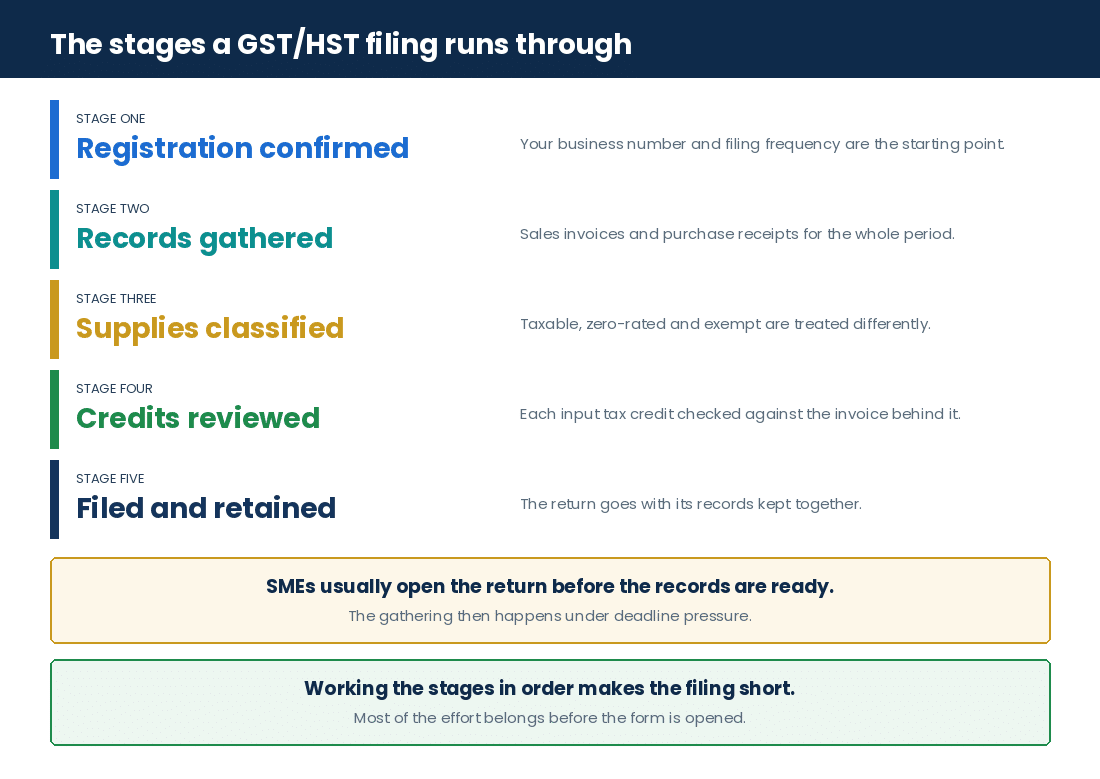
Newly incorporated SMBs usually find filing GST/HST the first time confusing. They may miss registration rules, input tax credit (ITC) claims, or reporting dates. Errors here can lead to fines or audits.
Even small businesses with simple bookkeeping can slip up. Mistakes like wrong sales classification or missed ITCs happen more than you think. Careful checking helps meet CRA rules fully.
Things get trickier with complex multi-provincial sales. Provinces have different HST rates and rules. Businesses selling across provinces must follow these closely to stay legal.
Some small businesses choose voluntary registration. They register even if revenue is low, so they can claim ITCs on purchases.
Facing a CRA audit on GST/HST is serious, and it is work we do. Having a CPA’s help means better prep, proper answers, and lower risks during the audit. Gondaliya CPA represents clients through CRA GST/HST audits from the first information request to the final letter.
| Scenario | Why It Matters | CRA/Compliance Touchpoint |
|---|---|---|
| Incorporated SMB filing GST/HST first time | Avoid setup mistakes; start right | Registration confirmation; first return deadlines |
| Small business with simple bookkeeping | Stop common errors; get all credits | Accurate quarterly/annual returns |
| Complex multi-provincial sales | Use correct provincial rates; prevent penalties | Multi-jurisdictional reporting |
| Voluntary registration for ITCs | Claim ITCs even below revenue limit | Registration approval |
| Facing CRA GST/HST audit | Get documents ready; answer properly | Audit notices; information requests |
A Toronto online retailer registered voluntarily in its first year, well under any revenue limit, because the owner was buying inventory and a packing line and wanted the credits. The first two returns were refund returns, giving back roughly $11,000 of GST/HST paid on start-up purchases, which is money that would simply have stayed with the supplier had the business waited to register. Voluntary registration is not the right answer for everybody, because it brings the filing obligation with it. It was clearly right for her, and nobody had mentioned it. Figures changed for privacy.
Knowing these scenarios early lets SMBs find help fast. This cuts risks of late filings, wrong payments, or missing tax benefits.
Your Options: DIY vs CPA vs Non-CPA Provider
Your Options
Your Options: DIY vs CPA vs Non-CPA Provider
When it comes to GST/HST filing in Canada, you have three choices: do-it-yourself (DIY), hire a Registered CPA firm, or use a non-CPA provider.
Each choice has pros and cons for cost, accuracy, legal backing, and audit readiness.
DIY Using CRA Electronic Services
The CRA offers free online portals for filing returns. This works if your books are very simple and you feel confident. But:
- Guidance is limited.
- You might miss errors until CRA points them out.
- No one checks your work formally.
- Tax saving tips rarely come up here.
CPA Firm With Tax Planning Expertise
CPAs know SME tax rules well. They catch mistakes and spot ways to save money.
- They review your filings carefully.
- They help plan your taxes for better cash flow.
- They stand behind their work under law.
- They represent you if the CRA audits you.
Some CPAs offer subscriptions for year-round support—good if your business grows or sells in several provinces.
Non-CPA Providers
These folks might charge less but lack CPA licensing required by law.
- They usually do basic filings okay.
- But they might miss tricky details in tax rules.
- They don’t offer deep advice on interprovincial sales or voluntary registrations.
Picking non-CPAs can risk more errors since they don’t have the same quality checks as CPAs.
| Aspect | DIY | Registered CPA Firm | Non‑CPA Provider | Best For | Key Risk |
|---|---|---|---|---|---|
| Cost | Low | Moderate – Higher Value | Lower–Moderate | Very small/simple books | Filing errors & missed credits |
| Accuracy & Review Quality | Limited self-checking | Thorough review & validation | Variable quality | Complex cases needing precision | Audit exposure |
| Accountability | None legally binding | Regulated/licensed | Not regulated professionally | Legal/regulatory assurance needed | Inadequate defense |
| Tax Planning Advice | Minimal | Comprehensive advice | Basic/general advice only | Growth-oriented SMEs | Missed savings |
| Audit Readiness | Low | High | Medium | Businesses facing frequent audits | Potential penalties |
A Scarborough trades business filed its own returns for two years through the CRA portal and did it competently, except that the owner never claimed the GST/HST on his tools, his van repairs or his phone, because he assumed personal-name receipts could not support a corporate credit. The portal does not ask. Going back over what the records could properly support recovered roughly $9,000 of input tax credits. DIY filing is a reasonable choice on simple books, as the table above says, and the thing it cannot do is tell you what you have not claimed. Figures changed for privacy.
For many Canadian SMBs that want steady growth and strong HST compliance, Registered CPAs offer value beyond their fees by lowering risks and improving tax efficiency. Our fees are fixed and annual with no hourly billing, shown before tax with sales tax on its own line.
GST/HST Filing Readiness Check
Five quick questions on whether you are ready to file. No fee shown.
Points to raise with us:
This is a general prompt, not tax or legal advice or a quote. Your position depends on your full facts. For a real review, please book a free consultation.
How the Work Runs and What You Receive
The Process
How the Service Works at Gondaliya CPA
At Gondaliya CPA, we handle your GST/HST filing so you don’t have to stress about it. We help small and medium businesses follow HST compliance rules and plan their taxes smartly. Our goal is to boost your business tax efficiency while keeping you ready in case the CRA ever checks your records. We focus on filing on time and making sure all input tax credits (ITCs) are properly claimed.
Intake and Onboarding
First, we start with intake and onboarding. This step sets up clear communication between you and our team of CPAs who know SME tax planning inside out. We collect info about your business, sales channels, accounting systems, and past GST/HST filings.
Here’s what we do during onboarding:
- Explain your GST/HST filing deadlines
- Spot any early issues that might affect HST compliance
- Give advice to help improve business tax efficiency
- Set up secure ways to share data safely
We make sure everything is clear so there are no surprises down the road.
Data Collection and Review
Next comes data collection and review. We ask you for all your financial documents like:
- Sales invoices
- Receipts for input tax credits (ITCs)
- Payroll summaries if needed
- Bank statements
- Reports from QuickBooks or Xero
We check each claim carefully to follow CRA rules on ITCs. This helps get you back as much money as you can without risking penalties. Our process links with popular accounting software to cut down errors and speed things up.
Every sale or purchase subject to GST/HST gets reviewed so you stay compliant while boosting business tax efficiency through correct ITC claims.
A Vaughan distributor arrived with a clean-looking set of books and a bank feed that had been running for two years without anybody reconciling it. Roughly 300 supplier bills had been entered twice, once from the feed and once from the paper, which had inflated claimed input tax credits by about $21,000 across eight reporting periods. Finding that in the review stage rather than in a CRA letter is the whole point of the stage. We corrected the periods ourselves, and the duplicate-detection rule we set in his accounting file costs him nothing and has caught four more since. Figures changed for privacy.
Compliance Work
After we confirm your data is solid, we prepare your GST/HST returns following CRA regulations. Our team knows HST compliance well, so they calculate taxes owed or refunds accurately.
We also use SME tax planning ideas here by looking for ways to lower taxable amounts within legal limits—like timing when you buy things or how you invoice customers.
On top of that, we organize documents clearly in case of a CRA audit. Keeping good records shows you’re following the rules, which helps with CRA audit readiness. This proactive approach beats trying to handle things yourself or working with less expert firms.
Quality Assurance and Delivery
Before we send in any GST/HST filings, we run tough accuracy checks at Gondaliya CPA. These checks confirm everything fits HST compliance standards perfectly—no mistakes left behind that could cause problems later.
Here’s what we deliver:
- Completed return forms ready for electronic filing
- Summary reports showing taxes payable or refundable
- Reconciled ITC details backing those numbers
These documents help clients see their tax status clearly while discussing SME tax planning ideas that improve business tax efficiency over time.
| Phase | Description |
|---|---|
| Accuracy Check | Check calculations match latest CRA rules |
| Compliance Review | Confirm all fields complete; verify ITC eligibility |
| Client Summary Report | Break down taxes owed/refunded with supporting papers |
| Submission Prep | Format files for government e-filing system |
Ongoing Support
GST/HST filing isn’t just once a year work—it needs ongoing support. We keep clients updated on HST compliance changes so businesses can react early instead of scrambling last minute.
Our team stays ready throughout the year offering advice tailored to SMEs. This helps with smart SME tax planning focused on keeping business tax efficiency high every day.
If an audit happens despite care during preparation, we step in as your representative. We handle talks with authorities so you don’t have to worry about technical stuff yourself.
Our process covers everything from intake through ongoing support. That way, Canadian small and medium businesses get full help with GST/HST filing while sticking strong to HST compliance rules and smart SME tax planning that really helps improve business tax efficiency year after year.
Deliverables: What You Get
When you use GST/HST filing services for your incorporated small or medium business in Canada, it helps to know what you get. These documents keep your business in line with CRA rules and help you save on taxes.
- GST/HST Return
This is the form you send to the CRA. It shows the GST/HST you collected on sales and the input tax credits you want to claim from purchases. It tells how much tax you owe or if you get a refund. - Input Tax Credit Report
This report lists all expenses where GST/HST was paid and can be claimed back. It supports your input tax credit (ITC) claims and lowers what you pay overall. - Compliance Checklist
A simple list that checks if all documents, numbers, and filings follow CRA rules. It stops mistakes that might cause audits or penalties. - Audit Readiness Report
This looks for risks in your GST/HST filings. It points out gaps before any CRA audit or review happens, so you’re prepared. - Filing Confirmation Receipt
Proof that you sent your return to CRA. It shows when you filed and gives reference numbers to keep. - Professional Guidance Notes
Advice from CPAs that explains tricky parts of HST compliance for your business setup. They also offer tips for future tax plans to help save money.
| Deliverable | What it Is | Who Uses It | When Delivered | What You Provide |
|---|---|---|---|---|
| GST/HST Return | Official filing form | Business owner/CRA | Filing deadline | Sales & purchase records |
| Input Tax Credit Report | List of reclaimable taxes | Business owner/CPA | With return | Expense invoices |
| Compliance Checklist | Checklist tool | CPA / Client | Before filing | Financial statements |
| Audit Readiness Report | Risk check | CPA / Client / Auditor | After filing/before audit | Complete financial data |
| Filing Confirmation Receipt | Proof of submission | Business owner | Get after filing | — |
A Brampton food importer was selected for a GST/HST review four months after we took the file on. The audit readiness report had already flagged that one supplier’s invoices carried no registration number, so those credits, about $6,500 worth, had been held back rather than claimed. Because the gap had been found before CRA found it, the review closed on the documents we sent with no adjustment and no penalty. The deliverable that looks least interesting on the list is the one that decided that outcome. Figures changed for privacy.
Together, these deliverables clear things up, lower the chance of problems with CRA, and back up smart SME tax planning based on Canadian rules.
Risks, CRA Compliance and Common Mistakes
The Risks
Risks, CRA Compliance, and Common Mistakes
Filing your GST/HST is a big deal for small and medium businesses. Missing important rules can cause fines, interest fees, or even CRA audits. Knowing what can go wrong and how a CPA helps you avoid trouble is smart. It keeps your business safe and saves money.
Top Common Mistakes and Prevention
Many Canadian small businesses struggle with GST/HST because the rules get tricky. Here are some usual errors that mess up HST compliance:
- Late Filing Deadlines: Filing late means paying penalties plus interest on what you owe.
- Incorrect Tax Rates Applied on Sales: Using wrong GST/HST rates for different provinces causes payment mistakes.
- Failure to Register for GST/HST When Required: If your sales go past certain limits, you must register or face penalties.
- Overclaiming Input Tax Credits Without Proper Documentation: Claiming credits without proper receipts can lead to audits or fines.
These mistakes cost you money through penalties or missed tax credits. A good CPA helps make sure your filings follow the latest CRA rules.
| Risk Area | What Happens If Missed | CPA Mitigation / Control | Who Is Affected | CRA / Authority Source |
|---|---|---|---|---|
| Late Filing Deadlines | Penalties + interest charges | Reminders; track deadlines carefully | All registrants | CRA GST/HST guidelines |
| Incorrect Tax Rates | Under/overpayment; risk of audit | Check rates by province regularly | Sellers in multiple areas | Provincial sales tax acts |
| Failure to Register | Penalties; pay back taxes | Watch revenue limits closely | Growing small businesses | CRA registration criteria |
| Overclaiming ITCs | Reassessments; penalty notices | Review and verify documents | Anyone claiming credits | CRA input tax credit rules |
A Hamilton SaaS company crossed into selling across four provinces in one quarter and kept charging the Ontario rate to everybody, because that is what the invoicing template said. Nobody had changed the template; nobody had been asked to. The under-collection came to roughly $18,000 before we picked it up, and the awkward part is that it is not recoverable from customers who have already paid, so it came out of margin. Rates by province are the mistake in the table above that costs real money rather than a letter. We now check the template whenever a client tells us they have a new province. Figures changed for privacy.
Common SME Tax Planning Mistakes Impacting Compliance
Planning taxes well is key but many small businesses slip up when filing GST/HST. Some common slip-ups include:
| Mistake | Impact | Prevention |
|---|---|---|
| Ignoring provincial differences in HST/GST | Charging wrong combined federal/provincial rates causes errors | Check current rates from official sources regularly |
| Not tracking taxable vs exempt supplies properly | Reporting wrong net tax; could get reassessed | Classify sales carefully during bookkeeping |
| Not reconciling accounts before filing returns | Errors cause wrong reports and may trigger audits | Reconcile bank accounts monthly before filing |
| Forgetting small supplier status changes based on revenue | Missing registration deadlines if revenues pass limits | Monitor revenue every quarter |
What It Costs and What to Prepare Before You Start
Cost & Prep
Pricing: What Affects the Cost of GST/HST Compliance
The price for GST/HST filing depends a lot on your own business’s details in Canada. Knowing what makes costs go up helps avoid surprise fees. Plus, it keeps services focused on being right and legal.
Here’s what changes the cost:
- Volume of Transactions
More deals mean more work checking which sales are taxable or exempt. - Complexity
Selling in different provinces with various HST rates or mixed types means harder math and more time spent. - Quality of Bookkeeping
Clean records save time. Messy books need fixing before filing, which costs more. - Number of Entities Filed For
If you have many companies or divisions, each may need its own return—more work equals higher price. - Timing & Deadlines
Need stuff done fast? That usually costs extra because it bumps other work down the list. - Advisory Depth
Extra consulting for tax strategies or cash flow ideas adds value but also raises fees depending on how deep it goes.
Here’s a quick table showing these price factors:
| Driver | What Increases Cost | How To Keep Efficient | Questions To Ask Your Firm | Notes |
|---|---|---|---|---|
| Volume Of Transactions | Lots of transactions take more time to handle | Enter data daily and neat | Do you handle big volumes well? | Know your transaction count |
| Complexity | Sales across many provinces; mixed goods need more work | Use software tools | Can you deal with multiple HST rates? | Complex work takes longer |
| Quality Of Bookkeeping | Messy books need cleanup before filing | Regular monthly checks help | How do you help improve bookkeeping? | Clean books cut costs |
| Number Of Entities | Many companies need separate filings | Group entities if possible | Do consolidated reports exist? | More entities mean more fees |
| Timing & Deadlines | Rush jobs cost more | Plan early; set reminders | Any extra fee for rush service? | Early filings save money |
| Advisory Depth | More advice sessions add hours | Be clear on what advice you want | Does advisory cover SME tax tips? | Advisory helps long-term |
Knowing these pricing details helps SMEs in places like Toronto and across Canada make smart choices about GST/HST filing without surprises. Our fees are fixed and annual with no hourly billing, shown before tax with sales tax on its own line.
Checklist: What to Prepare Before You Start
Getting ready before filing GST/HST makes things faster and easier. Here’s what you need:
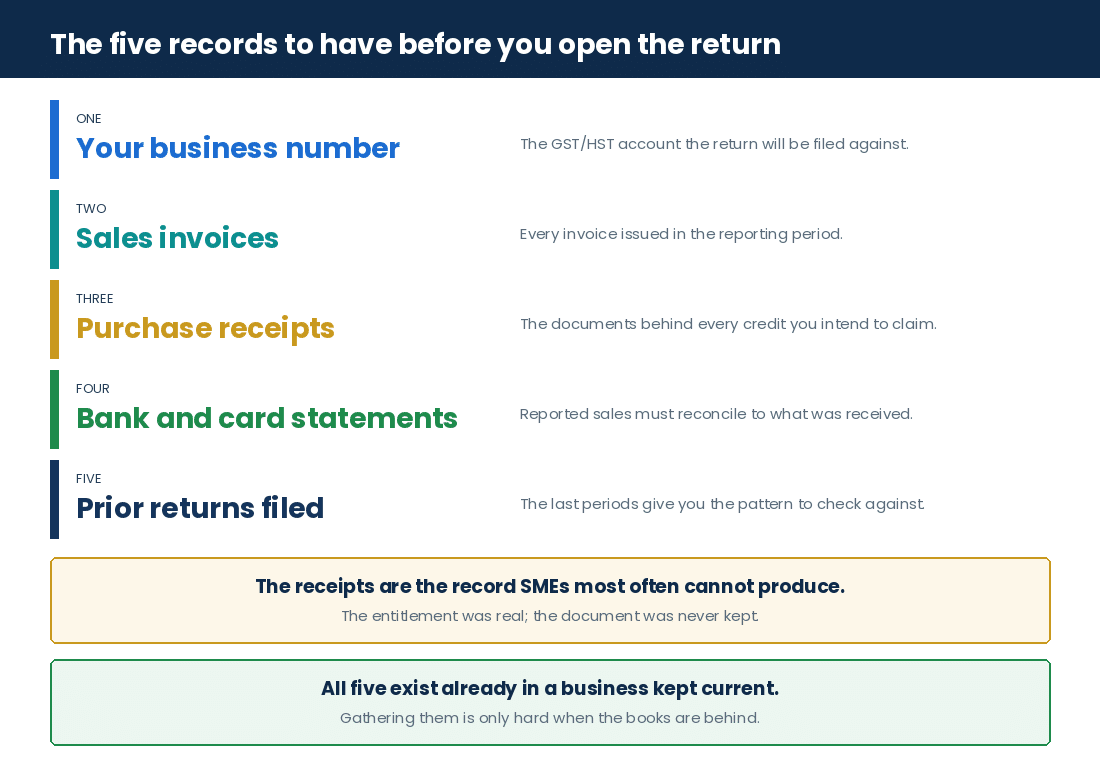
- CRA Business Number (BN): Your unique ID for filing.
- Sales Invoices: Proof of what you sold during the reporting period.
- Purchase Receipts/Invoices: Needed to claim input tax credits.
- Bank and Credit Card Statements: Helps confirm recorded transactions.
- Prior GST/HST Returns Filed: To keep past filings consistent.
Have these handy to avoid delays or missing info when you file.
| Item | Why Needed | Where To Find | Common Mistakes | CPA Tip |
|---|---|---|---|---|
| CRA Business Number (BN) | Identifies your business uniquely | CRA registration notice | Using old or wrong BN | Make sure BN matches your records |
| Sales Invoices | Proof of goods/services sold | Billing system or invoice software | Missing invoice dates or numbers | Keep organized digital copies |
| Purchase Receipts/Invoices | Support input tax credit claims | Supplier files or accounts payable | Lost or misplaced receipts | Use tools like Hubdoc to manage expenses |
| Bank/Credit Card Statements | Verify cash flow entries | Online banking portals | Unmatched transactions | Do monthly reconciliations |
| Prior GST/HST Returns Filed | Reference for current filings | Copies from prior filings | Data doesn’t match between periods | Keep electronic archive accessible |
A North York consultant filed under a business number from a sole proprietorship she had closed when she incorporated, for three reporting periods, because it was the number saved in her browser. The returns were accepted and the remittances, roughly $23,000, sat against an account that no longer had any filing obligation while the corporation’s own account showed three periods outstanding. Sorting out which account held the money took longer than preparing the returns had. The first line of the checklist above is the first line for a reason. Figures changed for privacy.
Having this checklist ready speeds up your HST compliance work and improves accuracy.
Frequently Asked Questions
FAQs
FAQs on GST/HST Filing and SME Tax Planning
What are the filing frequencies for GST/HST returns?+
Filing can be monthly, quarterly, or annually based on your revenue and CRA rules. Choose the right frequency to avoid penalties. The frequency also decides how often the checklist in this article gets worked through, which is worth knowing before you pick one.
How do input tax credits (ITCs) affect my GST/HST filing?+
ITCs let you recover GST/HST paid on business purchases. Proper documentation is required to claim them, which is why purchase receipts and invoices sit on the pre-filing checklist rather than being gathered afterwards.
Can a CPA help with audit representation for GST/HST issues?+
Yes. Professional CPA firms provide audit support, and Gondaliya CPA represents clients through CRA GST/HST audits. We communicate with CRA and protect your interests, from the first information request through to the closing letter. Representing a client through a CRA audit is a real service and a different thing from performing an audit engagement.
What bookkeeping tools integrate well with GST/HST compliance?+
QuickBooks, Xero, and Hubdoc link smoothly to accounting processes, improving accuracy and speed in filings. Reports from QuickBooks or Xero are among the documents we ask for at the data collection stage.
What impacts the pricing of GST/HST filing services?+
Pricing depends on transaction volume, number of entities, advisory depth, timing needs, and complexity. The quality of the bookkeeping matters too, because messy books have to be fixed before the return can be prepared. Our fees are fixed and annual with no hourly billing, shown before tax with sales tax on its own line.
Who should consider voluntary GST/HST registration despite low revenue?+
Businesses wanting to claim ITCs early should register voluntarily even if under the small supplier threshold. Registration brings the filing obligation with it, so the question is whether the credits on your purchases are worth the returns you then have to file.
How do non-CPA providers differ from Registered CPA firms in filing GST/HST?+
Non-CPAs may offer lower costs but lack full expertise, accountability, and audit readiness that CPAs provide. They usually handle basic filings adequately, and they do not offer deep advice on interprovincial sales or voluntary registrations.
What do I need to have ready before I open a GST/HST return?+
Five things: your CRA business number, the sales invoices for the reporting period, the purchase receipts and invoices behind your input tax credit claims, your bank and credit card statements, and the prior GST/HST returns you have filed. Having them in front of you before you start is what makes the filing short rather than difficult.
What is the difference between taxable and exempt supplies?+
Taxable supplies are items or services that must have GST/HST charged. Exempt supplies are items or services that don’t have these taxes. Knowing which sales are taxable and which are exempt matters a lot for small businesses, because reporting them the wrong way round reports the wrong net tax and can get you reassessed.
Why do my prior returns matter when I file the current one?+
They keep past filings consistent. Where data doesn’t match between periods, the mismatch is visible to CRA and is the sort of thing that draws a question, so we read the prior returns before preparing the next one and keep an electronic archive accessible for exactly that reason.
Essential Points for Business Owners
Key Takeaways
Key Points: Efficient GST/HST Filing and SME Tax Planning for Canadian SMBs
Fifteen points decide whether a GST/HST year runs quietly or turns into correspondence. None of them is difficult on its own, and almost all of them are settled before the return is opened.
| Point | The Rule |
|---|---|
| Account setup | CRA GST/HST account setup is essential after incorporation or name registration. |
| Payroll remittances | Keep payroll remittances separate unless linked directly to taxable supplies. |
| Small supplier threshold | Understand the small supplier threshold exempting businesses from mandatory registration. |
| Corporate returns alongside | Corporate income tax filing (T2 returns) often runs alongside GST/HST reporting for incorporated SMBs. |
| SR&ED credits | SR&ED tax credits can complement SME tax planning strategies to reduce overall tax burdens. |
| Bookkeeping reviews | Conduct bookkeeping optimization reviews regularly to maintain accurate records for compliance. |
| Integrated reporting | Use integrated corporate tax planning reports combining GST/HST with income taxes for better business tax efficiency. |
| Deadlines | Track deadlines carefully; missing them leads to late or missed filing penalties. |
| Multi-jurisdictional filings | Monitor multi-jurisdictional filings when operating across provinces with different HST rates. |
| Guidance notes | Maintain professional guidance notes throughout the year for ongoing SME tax planning advice. |
| Compliance checklists | Prepare compliance checklists before filing to catch common bottlenecks or errors early. |
| Audit readiness report | Obtain an audit readiness report periodically to reduce risks of CRA disruptions or reassessments. |
| Filing confirmations | Keep filing confirmation receipts as proof of timely submissions to CRA electronic systems. |
| Client involvement | Involve clients actively during each process step to gather accurate data and ensure smooth communication. |
| Risk areas | Recognize risk areas such as mixing personal/business expenses or ignoring legislative changes in your tax planning. |
The Six Things We Check First
- Is the GST/HST account actually set up, and in the right name? After incorporation or a name registration this is the step most often assumed rather than done.
- Are taxable and exempt supplies being classified correctly? Everything downstream, including the net tax, follows from this.
- Does the input tax credit claim have documents behind every line? Credits without receipts are the item CRA reassesses most readily.
- Which provinces are being sold into, and at what rates? Rates differ, and invoicing templates do not update themselves.
- Have the accounts been reconciled for the reporting period? Filing an unreconciled period means filing numbers that will change.
- Do the prior returns agree with what we are about to file? Data that doesn’t match between periods is visible from outside.
Our Approach
Gondaliya CPA starts with intake and onboarding, explains your filing deadlines and sets up a secure way to share data; collects your sales invoices, ITC receipts, payroll summaries where needed, bank statements and QuickBooks or Xero reports, and reviews every claim against CRA rules on ITCs; prepares the returns, looking for ways to lower taxable amounts within legal limits, such as the timing of purchases and how you invoice; runs accuracy and compliance checks before anything is submitted and delivers the return forms, summary reports and reconciled ITC details; organises the documents so you are ready if CRA checks your records; represents you through a CRA audit if one comes; and keeps you updated on HST compliance changes through the year rather than at the deadline. Fees are fixed and annual with no hourly billing, shown before tax with sales tax on its own line, and agreed before any work begins.
Industry Spotlights: Sectors We Represent
Industry Expertise
Knowing how GST/HST filing, SME tax planning, HST compliance, and business tax efficiency work in different fields helps small and medium Canadian businesses follow the rules and save money, so here are eleven sectors and what the checklist turns on in each.
| Industry | What GST/HST Turns On, and the CRA Touchpoints |
|---|---|
| Technology startups & SaaS | SME tax planning, business tax efficiency. Tech startups selling software as a service must watch new digital goods rules that affect their registration needs across provinces. Planning ahead helps avoid late penalties when expanding beyond Ontario, and claiming credits on cloud hosting or development tools cuts down costs nicely. Considerations: digital goods place-of-supply. Touchpoints: registration threshold monitoring. |
| E-commerce & online retailers | GST/HST filing, HST compliance, business tax efficiency. Online sellers must follow new e-commerce tax laws requiring tax collection even with small sales outside physical stores. Knowing who collects and remits taxes when selling through marketplaces makes things simpler, and charging correct rates per province keeps prices clear and meets regulations fully. Considerations: marketplace facilitator roles. Touchpoints: sales volume thresholds. |
| Consulting firms | Service fees are generally taxable supplies, so the classification question is usually settled quickly and the work moves to the input tax credit side: subscriptions, travel and home-office costs, each needing a receipt that supports the claim. Touchpoints: quarterly or annual returns, and the revenue limits that decide registration. |
| Construction firms, contractors & skilled trades | GST/HST filing, business tax efficiency. Construction businesses juggle many contracts covering materials and labor that impact their taxes. Charging the right rates depending on where work happens is important because provinces vary in GST/HST rules, and good accounting helps get back ITCs for things like rented equipment or subcontractor costs, lowering overall expenses. Considerations: interprovincial service complexities. Touchpoints: subcontractor expense tracking. |
| Property developers & builders | HST compliance, GST/HST filing. Developers deal with complex rules about new housing rebates and building materials that may have different tax rates. Using builder rebates correctly can really help cash flow, and tracking payments as the project moves along keeps filing on schedule with CRA deadlines. Considerations: new housing rebate eligibility. Touchpoints: progress payment schedules. |
| Real estate investors & landlords, residential and commercial, with holding companies | Business tax efficiency, GST/HST filing. Real estate folks handle sales and leases that bring specific GST/HST rules which affect profits. Rent from residential properties is usually exempt from HST; commercial leases normally require charging HST unless a rebate applies; holding companies should be set up to recover input credits on repairs or upgrades efficiently; and filing on time is critical to avoid fines on big transactions. Considerations: rental income exemptions versus commercial lease taxation. Touchpoints: large transaction reporting. |
| Transportation, logistics & trucking | Freight and delivery work crosses provincial lines routinely, so the rate charged follows where the service is supplied rather than where the yard is. Fuel, repairs and leased equipment are the main input tax credit pools, and they need receipts that tie to the vehicle. Touchpoints: multi-jurisdictional reporting. |
| Restaurants, food & beverage businesses | HST compliance, GST/HST filing. Food businesses juggle items taxed differently—from drinks taxed fully to some groceries not taxed—so point-of-sale systems need to sort this out well for accurate returns. Regular checks between sales records and reports cut audit risks, and using industry-specific deductions at the right times saves on overall business taxes. Considerations: varied product rate applications. Touchpoints: point-of-sale reconciliations. |
| Daycare, childcare & CWELCC services | SME tax planning, HST compliance. Childcare services under the CWELCC program deal with tricky funding that changes their GST/HST status. Many fees might be exempt from tax; government subsidies can change how you report taxes; good tax planning includes watching payroll taxes and indirect taxes to keep cash flow steady; and knowing what is taxable and what’s not stops mistakes on returns. Considerations: subsidy impacts on fee exemptions. Touchpoints: payroll remittances. |
| Dentists & dental practices | HST compliance, SME tax planning. Dental offices face mixed rules—some treatments get taxed, others don’t—which affects what they charge and what credits they can claim. Provincial dental plan-covered services often don’t have HST; elective dental work usually does; buying big-ticket items like dental chairs right can boost ITC claims; and staying in line with dental regulations and CRA rules means keeping neat records. Considerations: mixed supply classifications. Touchpoints: capital asset acquisitions. Entity terms: RCDSO. |
| Medical doctors & physician professional corporations | GST/HST filing, HST compliance, SME tax planning. Doctors running professional corporations need to watch their GST/HST rules closely, because many healthcare services are exempt from GST/HST but some extras might not be. Most medical services paid by OHIP don’t get taxed; cosmetic or non-insured services usually do have HST; tracking ITCs on stuff like office gear or software helps with tax planning; and good records are key to avoid problems if CRA checks your books. Considerations: exempt insured services versus taxable ancillary offerings. Touchpoints: professional corporation filings. Entity terms: OHIP / RCPSC. |
- Technology startups & SaaS: We prepare the business for cross-provincial compliance before the expansion happens rather than after the first penalty.
- E-commerce & online retailers: We simplify multi-province filings and settle who collects and remits on each marketplace you sell through.
- Consulting firms: We work through the input tax credit side line by line, because that is where a consulting practice leaves money behind.
- Construction, contractors & skilled trades: We improve ITC recovery on rented equipment and subcontractor costs and check the rate against where the work actually happened.
- Property developers & builders: We apply builder rebates properly and keep the filing on schedule as the progress payments land.
- Real estate investors & holding companies: We help structure holding companies so input credits on repairs and upgrades are recovered efficiently.
- Transportation, logistics & trucking: We tie the fuel, repair and equipment credits to the vehicles that earned them so the claim stands up to a question.
- Restaurants & food and beverage: We help report categories accurately and reconcile the point-of-sale records to the returns each period.
- Daycare, childcare & CWELCC services: We clarify what is exempt and how the subsidies change the way the period is reported.
- Dentists & dental practices: We help get maximum input credit claims, particularly around the capital purchases that make up most of the recoverable tax.
- Medical doctors & physician corporations: We make sure exemptions are applied correctly so insured work and ancillary offerings are not reported the same way.
A physician corporation in Toronto had been filing nil returns for four years on the basis that medical services are exempt, which was right as far as it went. It missed a cosmetic line of work and a room rented to a visiting practitioner, both of them taxable, and about $38,000 of HST had never been collected or remitted across the period. We brought the periods current, and the ancillary revenue was separated in the billing system so the two streams stop sharing a code. These industries serving incorporated SMBs in Ontario and across Canada, including cities like Toronto, must handle GST/HST filing, HST compliance, SME tax planning and business tax efficiency carefully, and doing so avoids costly mistakes while helping save money with advice from CPAs who know each sector’s details well. Figures changed for privacy.
Professional Guidance and Quick Reference
Guidance
Essential Points for Toronto and Canadian SMEs
GST/HST files go wrong in a predictable set of ways: the account never properly set up after incorporation or a name registration; sales classified as exempt because of who bought them rather than what they were; input tax credits claimed from a bank line with no receipt behind it; one invoicing template charging the same rate into every province; a period filed before the accounts were reconciled; and prior returns that nobody read before the next one went in. Getting ready before filing GST/HST makes things faster and easier, and almost everything on this list is settled before the return is opened.
Quick Answers
At a Glance
- GST: Goods and Services Tax
- HST: Harmonized Sales Tax
- The GST rate: 5%
- HST in Ontario: 13%, GST combined with a provincial sales tax
- Why HST varies: it is higher in some places than others
- Who must file: most Canadian businesses
- Filing frequency: monthly, quarterly or annually, based on revenue and CRA rules
- Taxable supplies: must have GST/HST charged
- Exempt supplies: don’t have these taxes
- Input tax credits: money back on GST/HST paid for business costs
- What ITCs need: proper documentation
- Voluntary registration: register below the revenue limit to claim ITCs
- Checklist item one: CRA business number
- Checklist item two: sales invoices for the period
- Checklist item three: purchase receipts and invoices
- Checklist item four: bank and credit card statements
- Checklist item five: prior GST/HST returns filed
- Software that fits: QuickBooks, Xero, Hubdoc
- Deliverable one: the GST/HST return
- Deliverable two: input tax credit report
- Deliverable three: compliance checklist
- Deliverable four: audit readiness report
- Deliverable five: filing confirmation receipt
- Deliverable six: professional guidance notes
- Cost drivers: volume, complexity, bookkeeping quality, entities, timing, advisory depth
- Four common mistakes: late filing, wrong rates, failing to register, overclaiming ITCs
- CRA audits: we represent clients through them
- Our fees: fixed and annual with no hourly billing, shown before tax with sales tax on its own line
- Our engagements: compilations under CSRS 4200
- Response standard: 1 business day
Who This Is For / Not For
Fit Check
- For: incorporated small and medium businesses in Toronto, Ontario and across Canada that collect GST/HST and want the return prepared properly rather than quickly.
- For: newly incorporated SMBs filing GST/HST for the first time, businesses selling into more than one province, and businesses considering voluntary registration to claim ITCs.
- Not for: a substitute for the deadline schedule that applies to your own reporting period, which depends on the frequency CRA has assigned you.
- Not for: provincial sales tax regimes outside the harmonized system, which work differently and are not covered here.
People Also Ask
Related Questions
How long does it take to work through this checklist?+
With the five records in front of you and the accounts reconciled, a straightforward period is short work. What stretches it is hunting for receipts after the return is already open, because every missing document is a decision about whether to claim the credit without it. Gathering first and filing second is the whole reason the checklist exists.
I have no sales this period. Do I still file?+
Registration brings the filing obligation with it, and the obligation does not pause because a period was quiet. A nil period is quick, and the expensive version is the one that gets missed, because tracking deadlines carefully is what stops late or missed filing penalties. A quiet period is also a good time to reconcile and to check the prior returns agree with each other.
My bookkeeper does the filing. What should I be checking?+
Three things, none of which needs accounting knowledge. That the business number on the return is the corporation’s current one. That somebody reconciled the bank accounts for the period before it was filed. And that the rate charged matches the province the customer was in, which is the mistake an invoicing template makes silently and repeatedly.
Is a credit card statement enough to support an input tax credit?+
Statements belong on the checklist because they help confirm recorded transactions, which is a different job from supporting a claim. Claiming credits without proper receipts can lead to audits or fines, so the receipt or supplier invoice is the document that carries the credit and the statement is what proves the payment happened.
We just incorporated. Does the old GST/HST account carry over?+
CRA GST/HST account setup is essential after incorporation or name registration, and treating it as automatic is one of the commonest problems we unpick. The corporation is a new person for tax purposes, so remittances made against a predecessor account are sitting in the wrong place while the corporation’s own account shows periods outstanding.
Glossary of Key Terms
Definitions
- GST: Goods and Services Tax, charged at 5% on selling goods and services in Canada.
- HST: Harmonized Sales Tax, GST combined with a provincial sales tax, 13% in Ontario.
- Taxable supplies: items or services that must have GST/HST charged.
- Exempt supplies: items or services that don’t have these taxes.
- Input tax credits: money you can get back on GST/HST paid for business costs.
- CRA business number: the unique identifier your business files under.
- Voluntary registration: registering below the revenue limit so ITCs can be claimed.
- Small supplier threshold: the level exempting a business from mandatory registration.
- Filing frequency: monthly, quarterly or annual reporting, set by revenue and CRA rules.
- Compliance checklist: a list checking documents, numbers and filings against CRA rules.
- Audit readiness report: a risk check that points out gaps before a CRA audit or review.
- Filing confirmation receipt: proof a return reached CRA, with the reference numbers.
- Reconciliation: agreeing the accounts to the records before a return is filed.
- Multi-jurisdictional filing: reporting sales across provinces with different HST rates.
Want a checklist to work from? You can download our free SME GST/HST filing checklist before your consultation.
Four things decide whether a GST/HST filing is quick or expensive. Whether the five records were gathered before the return was opened — the business number, the sales invoices, the purchase receipts behind the input tax credits, the bank and credit card statements, and the prior returns filed, because every one of them found afterwards is a decision made under time pressure. Whether taxable and exempt supplies are being classified correctly — the net tax follows from the classification, and reporting them the wrong way round is what gets a period reassessed. Whether the rate matches the province the customer was in — provinces differ, invoicing templates do not update themselves, and under-collected tax cannot be recovered from customers who have already paid. And whether the accounts were reconciled first — filing an unreconciled period means filing figures that are going to change, and errors cause wrong reports and may trigger audits.
Three questions settle whether you are ready to file, and none of them requires an accountant. First, is the business number on the return the corporation’s current one? Account setup after incorporation or a name registration is assumed far more often than it is checked. Second, does every input tax credit you intend to claim have a receipt or supplier invoice behind it? A bank line is proof of payment, not support for a claim. Third, have the accounts been reconciled for the whole reporting period? If not, the figures are provisional and the return will need amending.
GST/HST Filing for Canadian SMEs: How Gondaliya CPA Can Help
Gather first, then file
Gondaliya CPA prepares GST/HST returns for incorporated small and medium businesses in Toronto, Ontario and across Canada. We start with intake and onboarding, explain your filing deadlines and set up a secure way to share data; collect your sales invoices, ITC receipts, payroll summaries, bank statements and QuickBooks or Xero reports; review every input tax credit claim against CRA rules so you recover what you are entitled to without risking penalties; classify taxable and exempt supplies properly and check the rate against the province each sale was made into; reconcile the period and read the prior returns before anything is submitted; deliver the return, a summary of tax payable or refundable, the reconciled ITC details, a compliance checklist, an audit readiness report, the filing confirmation and professional guidance notes; represent you through a CRA GST/HST audit if one comes; and keep you updated on HST compliance changes through the year. Fees are fixed and annual with no hourly billing, shown before tax with sales tax on its own line, and agreed before any work begins. Please book a free consultation.
Next Steps
Please book a free consultation with Gondaliya CPA and bring five things: your CRA business number, the sales invoices for the period you are filing, the purchase receipts and invoices behind the input tax credits you want to claim, your bank and credit card statements, and copies of the GST/HST returns you have already filed. That is the whole checklist, and having it ready is what makes the first conversation a short one. Tell us at the outset which provinces you sell into and whether anything has changed about how you are set up, because a new province changes the rate on your invoices and an incorporation or a name registration changes which account the remittances belong to. If CRA has written to you about a period, bring the letter; we represent clients through GST/HST audits and reviews, and the earlier we see the correspondence the better the answer we can give. You will get a fixed annual fee, shown before tax with sales tax on its own line, agreed before any work begins. We serve Toronto, Mississauga, Brampton, Vaughan, Etobicoke, Scarborough, Hamilton, Ottawa and the rest of Ontario, and work with incorporated small and medium businesses across Canada. If our content helps, please add gondaliyacpa.ca as a preferred source on Google.
Published: · Last updated:
Editorial policy: We research against the Excise Tax Act, CRA GST/HST guidance and publications, Department of Finance announcements, CPA Canada Handbook standards and CPA Ontario sources, fact-check the figures, and Sharad Gondaliya, CPA, reviews the content, which we update as the rules change.
Disclaimer: This article is educational information only and is not tax, legal or accounting advice. It is a pre-filing checklist for GST/HST returns prepared by incorporated small and medium businesses in Toronto, Ontario and across Canada, covering what GST and HST are and the 5 per cent and 13 per cent rates, taxable supplies, exempt supplies and input tax credits, when an SME needs compliance support, the choice between filing yourself, engaging a Registered CPA firm and using a non-CPA provider, how the work runs from intake through ongoing support, the deliverables, what drives the cost, the common mistakes, and the five records to assemble before the return is opened. It does not cover filing deadlines by reporting period, the rate in every province, the small supplier threshold figure, rebate calculations, place-of-supply rules in detail, provincial sales tax regimes outside the harmonized system, or corporate income tax and payroll obligations except where they sit alongside a GST/HST engagement. Rates, thresholds and CRA guidance change, and every figure should be confirmed against the current Excise Tax Act and current CRA guidance before it is relied on. Gondaliya CPA performs compilation engagements under CSRS 4200, which provide no assurance, and does not perform audit or review engagements; audit and review engagements are referred out. We do represent clients through CRA audits, which is a service we provide and is distinct from performing an audit engagement. Please consult a licensed CPA before acting.

Sharad Gondaliya is a CPA Canada & CPA USA with 15 Years+ experience of Accounting, Tax, Payroll of Corporate Small Businesses as Tax Accountant. He is a CPA Ontario member (61040184) and holds US CPA licences in Washington and Montana and is well known among corporate small businesses for tax planning, efficient tax solutions, and affordable CPA services. Sharad is the Principal (Director) of Gondaliya CPA – Affordable CPA Firm in Canada. Licenses: CPA Ontario: 61040184 | CPA USA (MT): PAC-CPAP-LIC-033176 | CPA USA (WA): 57629 | CPA Firm License: 61330051 View Full Author Bio