



How to Maximize Tax Savings with Expert GST/HST Filing Strategies
GST/HST Filing Strategies for Canadian Small and Medium Businesses
GST/HST filing is a key part of business tax filing, and Gondaliya CPA offers a clear guide on how to file your GST/HST return accurately using the online GST/HST NETFILE form. This helps ensure HST compliance and smooth GST tax planning for small and medium-sized businesses. This information mostly helps small and medium incorporated businesses in Canada.
Quick Summary
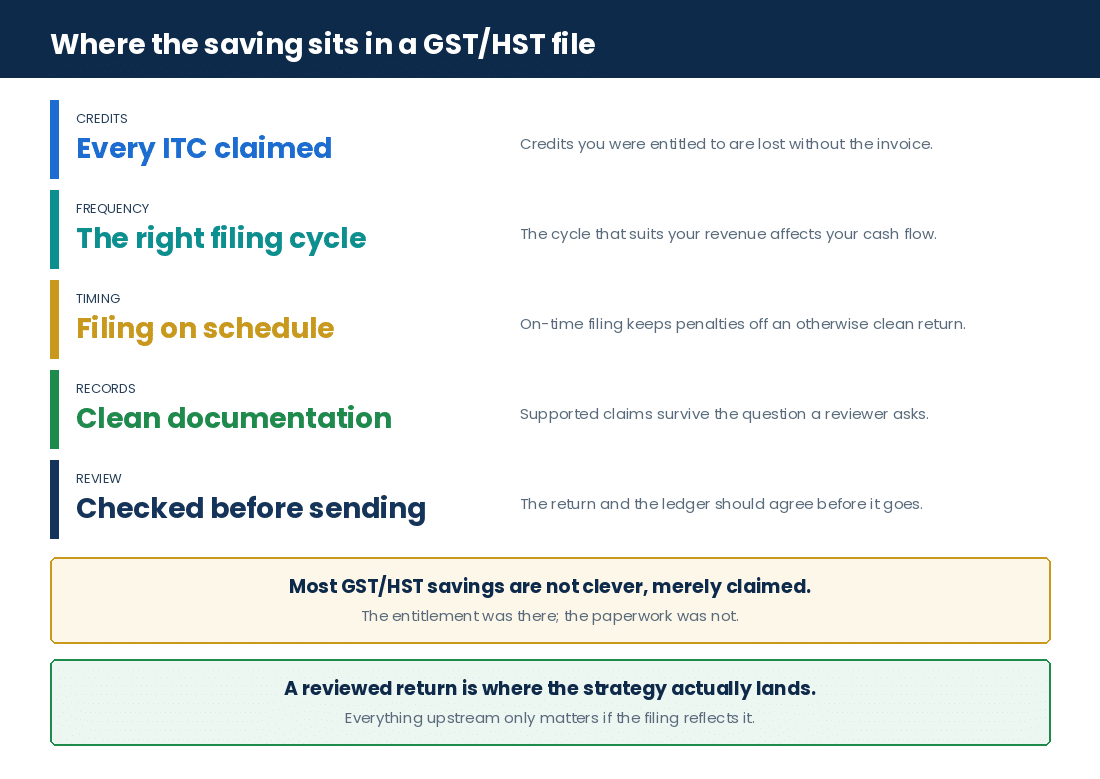
Planning your GST taxes helps you pay less or get bigger refunds. Please note that following HST rules keeps you out of trouble with the government, so the saving and the compliance are one piece of work rather than two. The strategy sits in the credits you claim, the frequency you file on, and when you buy.
| Aspect | Details |
|---|---|
| The obligation | GST/HST filing is something Canadian businesses must do to follow tax rules. |
| Where the saving is | You can get back some money by claiming input tax credits on what you buy for your business. |
| An extra credit | Some businesses get extra money from SR&ED credits if they do research work. |
| Who it helps | Small and medium incorporated businesses in Canada that collect GST/HST. |
Reading time: 18 minutes.
Table of Contents
- What GST/HST Filing Is and What It Solves
- When You Need to File: Decision Points
- Your Options: DIY, CPA Firm or Non-CPA Provider
- How the Work Runs and What You Receive
- Risks, CRA Compliance and Common Mistakes
- What Affects the Cost, and What to Prepare
- Frequently Asked Questions
- Essential Points for Business Owners
- Industry Spotlights: Sectors We Represent
- Professional Guidance and Quick Reference
The Numbers That Matter
This article covers GST/HST filing and the filing strategies that maximize tax savings for incorporated small and medium businesses in Toronto, Ontario and across Canada, current to 6 November 2026. It covers what GST/HST filing is and the problem it solves, what is inside the scope of a filing engagement and what sits outside it, the key terms, the decision points that tell you when to register and when to get help, the scenario table for incorporated SMBs, the choice between doing it yourself, a CPA firm and a non-CPA provider, the process and timeline at Gondaliya CPA, CRA follow-ups and representation, the deliverables you receive, the drivers that affect cost, the risks and the common mistakes, the preparation checklist, a worked numeric example, ten industry spotlights, and filing frequency management and software integration. It does not advise on business income reporting, which is done in the corporate T2 return, on payroll deductions and remittances, which follow separate CRA rules and are filed independently, or on cross-border US tax filing, which deals with US taxes. Registration thresholds, rates and reporting rules change, so check CRA for current numbers. Gondaliya CPA performs compilation engagements under CSRS 4200, which provide no assurance; audit and review engagements are referred out. This is educational information only and not tax, legal or accounting advice.
What GST/HST Filing Is and What It Solves
The Basics
What Is GST/HST Filing?
GST/HST filing means telling the Canada Revenue Agency (CRA) how much Goods and Services Tax (GST) or Harmonized Sales Tax (HST) your business collected. You also pay the amount you owe. This tax applies to most things sold in Canada. If your business is registered for GST/HST, you must collect tax from customers. Then, you keep track of it and send reports regularly.
For small and medium businesses (SMBs), GST/HST filing is part of business tax filing. It helps you follow Canadian tax laws. It also keeps your cash flow in check. Doing HST compliance right means no penalties or interest from CRA. You also avoid audits that take time and money.
What Problem Does It Solve?
GST/HST filing fixes some big problems for Canadian SMBs:
- Keeps your business legal: Filing on time means CRA rules are met.
- Helps with tax planning: You see input credits and taxes collected clearly.
- Stops costly errors: Avoid mistakes that cause audits or fines.
- Gets back money paid: Claim Input Tax Credits for GST/HST on purchases.
Good GST tax planning means fewer surprises with taxes. Your business runs smoother without sudden costs.
A Toronto consulting corporation had been filing its own GST/HST returns for three years and reporting only the tax collected, leaving the input tax credit line at nil because the owner thought credits were something you applied for separately. The purchases were ordinary and fully supported by invoices: software subscriptions, a leased vehicle, office rent, professional fees. Rebuilding the credit claims across the twelve open reporting periods recovered roughly $26,000. Nothing about the business changed and no position was aggressive; the credits had simply never been put on the form. We now reconcile the credit line to the purchase ledger every period rather than once a year. Figures changed for privacy.
Scope: What’s Included vs Not Included
| Topic/Task | Included? | Why it matters | Notes |
|---|---|---|---|
| Collecting GST/HST | Yes | Must collect before paying to CRA | Only if registered |
| Calculating net tax owing | Yes | Shows how much to pay or get back | Sales minus input credits |
| Claiming Input Tax Credits | Yes | Lowers the amount owed | Need receipts to prove claims |
| Filing periodic returns | Yes | Reports your tax status to CRA | Monthly, quarterly, or yearly |
| Paying owed amounts | Yes | Stops penalties | Must meet deadlines |
| Business income reporting | No | Separate from GST/HST filing | Done in corporate T2 return |
| Payroll deductions | No | Different rules and reports | Filed separately |
Key Terms Defined
| Term | Definition |
|---|---|
| GST | Goods and Services Tax; federal sales tax across Canada except some provinces. |
| HST | Combined federal + provincial sales tax used in provinces like Ontario. |
| Input Tax Credit (ITC) | Money back for GST/HST paid on business expenses you qualify for. |
| NETFILE | CRA’s online tool to send your GST/HST returns safely and fast. |
Who This Service Is For / Not For
This service is for:
- Small and medium incorporated Canadian businesses that want easier GST/HST handling.
- Startups who need help registering and following GST rules.
- Businesses wanting GST/HST filing services with fixed prices and no surprise fees.
This service is not for:
- Sole proprietors who don’t charge GST/HST or earn less than required to register.
- Big companies with their own accounting teams handling complex tax filings themselves.
When You Need to File: Decision Points
Triggers
When You Need GST/HST Filing in Canada
You need to know when to file your GST/HST return so you don’t get in trouble with the government. If you run an incorporated SMB, you must register once your taxable revenue passes certain limits in any quarter or over four quarters combined. Check CRA for current numbers—they change sometimes.
Quick Comparison Table
| Situation/Trigger | Best Next Step | Why | Risk Level | Typical Timeline | Source/Note |
|---|---|---|---|---|---|
| New business needs GST registration | Talk to a CPA | To start right and follow rules | Medium | 1–2 weeks | Professional advice |
| Business unsure about filing | Check current ways | Stops problems or fines | High | Ongoing | Regular reviews |
| Want to claim input tax credits | Collect receipts | Helps you claim all you can | Low | Before filing | Keep good records |
| Getting ready for an audit | Hire a CPA | They know how to help | High | When needed | Audit support |
Here’s when you might need help with gst/hst filing requirements:
- Your income hits the registration limit, so registration becomes mandatory.
- You want tips on when exactly to file returns based on your business year.
- You look for gst tax planning ways to lower taxes legally.
- Your business works in different provinces with different rates and rules.
- You want help claiming input tax credits right without risking audits.
- An audit targets your past gst/hst filings, and you need support.
- You want reminders about canadian business tax filing deadlines each period.
An Ontario equipment supplier registered late. Revenue had crossed the registration limit in a single strong quarter and nobody had looked at the quarterly figure, only the annual one, so registration happened nine months after it became mandatory. The sales in those nine months had been invoiced with no tax on them, and the liability did not disappear because the invoices were silent. Roughly $58,000 of tax had to be accounted for on sales already collected in full, and the input tax credits on the same period offset about a third of it. We now check the quarterly revenue figure, not just the annual one, at every bookkeeping close for clients approaching the limit. Figures changed for privacy.
Scenario Decision Table: When To Act On Your GST/HST Needs
This table shows common situations for incorporated SMBs dealing with gst/hst rules:
| Scenario | What Can Go Wrong | CRA Touchpoint | CPA Role | First Step To Prepare |
|---|---|---|---|---|
| Revenue exceeds registration threshold | Late registration & penalties | Registration requirement | Register timely & advise client | Review quarterly revenues |
| Multiple provinces involved | Wrong tax rate used | Multi-jurisdiction audit | Use correct rates & keep records | List all provinces operating |
| Claiming ITCs without records | Claims denied & reassessments | Audit focus area | Check eligibility & support claim | Gather purchase receipts |
| Missed deadline | Interest + late fees | Return submission deadlines | Remind clients early | Set calendar alerts |
| Confusing transactions | Wrong reporting & compliance issues | Detailed audit review | Explain transaction details | Collect transaction data |
| New startups unsure | Risk missing registration | Initial review by CRA | Teach client about rules | Confirm legal status & register quickly |
Filing right and on time cuts risks down a lot. It also helps cash flow by getting all input credits properly claimed—a key part of good hst compliance work.
Your Options: DIY, CPA Firm or Non-CPA Provider
The Choice
Your Options (DIY vs CPA vs Non-CPA Provider)
If you run a small or medium business in Canada, you have to file your GST/HST and handle business tax filing. You have three main ways to do this: do it yourself (DIY), hire a CPA firm like Gondaliya CPA, or use a non-CPA provider. Each has its good points and risks depending on what your business needs.
Here’s a quick look at your choices:
| Factor | DIY | CPA Firm | Non-CPA Provider | Best For | Key Risk |
|---|---|---|---|---|---|
| Compliance | You follow CRA rules yourself; easy to miss updates. | Experts know GST/HST rules well and keep you compliant. | May not know all the rules well for Canadian taxes. | Simple returns or tight budgets for DIY. | Mistakes can cause fines or penalties. |
| Review Quality | No formal review; mistakes can slip through. | CPAs check carefully to avoid errors. | Quality varies; usually no professional review process. | Businesses wanting accuracy and expert help. | Errors might lead to audits or fines. |
| Accountability | You take full blame for errors and filings. | Registered CPAs answer under CPA Ontario standards. | Less regulated, less accountability than CPAs. | Companies wanting trusted advisors with clear liability. | No backup if problems happen after filing. |
| Audit Readiness | Little prep if CRA checks your files later on. | CPA plans ahead to help you pass audits smoothly. | Usually only help when audit starts, reactively. | Businesses wanting protection from audits. | Unpreparedness costs more fines and stress. |
| Tax Planning | DIY rarely includes tax strategy due to difficulty. | CPAs plan smartly to lower your taxes legally. | Some basic advice but no deep tax planning services. | SMBs looking for expert tax saving help early on. | Missed chances for refunds or credits exist. |
| GST Audit Protection | No support if CRA calls; you handle it solo. | Full audit support and representation by CPAs here. | Usually no help with audits from non-CPA providers. | Firms wanting full service including disputes with CRA. | Risk of penalties without professional help. |
Think about how tricky your taxes are, how sure you feel doing it alone, and if you want expert advice plus ongoing support.
What Full Audit Support Actually Means
Gondaliya CPA represents clients through CRA audits of their GST/HST filings. We handle all contact with CRA auditors, we defend the positions taken in the filings, and we work to resolve issues fast so you focus on business. That is a service we deliver, not a referral we make. We also perform compilation engagements under CSRS 4200 where financial statements are needed alongside the returns.
An e-commerce client had used an unlicensed filing service for two years. The returns looked tidy, but every input tax credit had been taken at the Ontario rate regardless of where the supplier was, and marketplace fees had been claimed twice: once from the platform statement and once from the credit card. CRA queried the credits and the provider stopped answering the phone. We rebuilt the claims from source invoices, conceded the duplicated fees of roughly $9,000 before being asked, and defended the rest. The reassessment came in at about a quarter of the opening position. Being the one who finds the error first changes the whole conversation. Figures changed for privacy.
GST/HST Savings Check
Five quick questions on where your input tax credits stand. No fee shown.
Points to raise with us:
This is a general prompt, not tax or legal advice or a quote. Your position depends on your full facts. For a real review, please book a free consultation.
How the Work Runs and What You Receive
Process & Deliverables
How the Service Works at Gondaliya CPA (Process + Timeline)
Gondaliya CPA helps incorporated small & medium businesses all over Canada with GST/HST filing and HST compliance in a clear, step-by-step way. Here’s how the process flows:
| Phase | Timing | Client Actions | CPA Actions | Outputs | Common Delays + Prevention |
|---|---|---|---|---|---|
| Initial Consultation | Usually within one week after you reach out | You tell us about your business size, bookkeeping status, past filings. You ask about pricing and what we offer. | We quickly check if we can work together. We explain what happens next. | An agreement showing what we’ll do. | Delays happen if clients don’t share info fast. Tip: Have your papers ready early. |
| Document Collection | Can take up to two weeks depending on how ready you are | You collect sales invoices, purchase receipts, payroll summaries if needed, bank statements. | We send a checklist that fits your business type. We use software that works with QuickBooks, Xero, Wagepoint when possible. | All data ready for us to prepare your return. | Delays come from missing or messy records. Tip: Keep files neat and follow our checklist. |
| Return Preparation | Usually about a week after we get everything | You stay available for questions on individual transactions. | We calculate taxable amounts using correct rates per province and activity. We carefully check input tax credits according to CRA rules. We look for ways to save taxes legally while staying compliant. | Draft GST/HST return ready for review. | Double-checking helps avoid mistakes. |
| Review and QA | About 2–3 days after preparation is done | Quick answers from clients help finish this faster. | A senior accountant reviews every line for errors. They make sure forms match CRA laws exactly—especially Ontario rules if they apply. | Final report ready to file plus notes explaining key points or tax moves made. | Slow answers to review questions. Tip: Reply the same day where you can. |
| Filing and Submission | Same day client approves by email or signed form | You approve by email or signed form. | We file electronically through CRA-approved channels. This means secure submission before deadlines—avoiding late fees or penalties. | Official receipt of filed return with date/time stamp sent back to you. | Helps avoid problems later if CRA asks questions or starts an audit. |
A Mississauga wholesaler sent us a carrier bag of receipts four days before a quarterly deadline, having done nothing for the period. We filed on time, but the credits we could support that day came to roughly $14,000 against an estimated $21,000 available, because a third of the purchase invoices were missing and the suppliers needed a week to reissue them. We filed the return, then amended it once the invoices arrived. The amendment was work nobody needed to pay for. The following quarter the same client delivered a clean QuickBooks file on day three and the whole engagement took two days. Figures changed for privacy.
CRA Follow-ups / Representation
If CRA asks for more info or opens an audit:
- Tell Gondaliya CPA right away;
- We handle all contact with CRA auditors;
- This lowers risk of mix-ups;
- We defend positions taken in filings;
- We work to resolve issues fast so you focus on business.
This kind of support goes beyond just filing papers—it really helps protect your business from big tax troubles.
By using this clear method at Gondaliya CPA—made just for incorporated SMBs in Toronto/Ontario and across Canada—we keep every step open, simple, accurate, and built around real challenges businesses face with GST/HST rules every year.
Deliverables + What You Get
When you use GST/HST filing services from Gondaliya CPA, you get clear papers that help your business follow Canadian tax rules. These papers make sure your GST/HST returns are right and on time. Knowing what to expect makes things easier and less stressful.
| Deliverable | What It Is | Who Uses It | When Delivered | What You Provide | Source/Note |
|---|---|---|---|---|---|
| Completed GST/HST Return | Official form sent to CRA showing taxes collected and paid | Incorporated small or medium businesses | Before CRA deadline | Sales records, purchase invoices | CRA rules |
| Input Tax Credit Summary | List of expenses that count for tax credits | Businesses claiming ITCs | When return is sent | Receipts or invoices for business buys | HST Compliance guidelines |
| Filing Confirmation Receipt | Proof that CRA accepted your filing | Business owners or accountants who file returns for clients | After filing is accepted by CRA | Filed return data (electronic or paper) | Check current rules on the CRA website |
| Reconciliation Report | Paper that compares sales and purchases to accounting records | Accountants & bookkeepers | During review before final submission | Financial statements & bookkeeping info | Good for GST tax planning |
| Audit Support Documentation | Papers made to help if CRA checks your filings | Businesses wanting audit help | When needed in audits | Copies of filed returns & support papers | Part of good HST compliance |
| Year-End Summary Report | A report showing yearly GST/HST activity | Business owners & managers | At year end or on request | Annual financial reports & summaries | Useful for business tax filing |
These deliverables cover everything from start to finish. They help businesses stay neat and sure about GST/HST duties. Getting detailed reports with official forms helps plan money flow and avoid costly mistakes.
A Toronto clinic group asked what the reconciliation report was for, since CRA never sees it. Two periods later it earned its keep. The report showed taxable sales roughly $47,000 higher than the bookkeeping ledger, which traced to a second point-of-sale terminal at a satellite location that had never been mapped into the accounting file. Had the return gone in on the ledger figure, the tax collected on those sales would have been held and not remitted, which is the version CRA treats least kindly. We caught it before filing because the two numbers are compared every period as a matter of course. Figures changed for privacy.
Risks, CRA Compliance and Common Mistakes
Risk
Risks, CRA Compliance, and Common Mistakes
Filing your GST/HST right is really important for your business tax filing. If you mess up or miss steps, you might get fines or an audit. Knowing the risks helps you follow HST rules and stop costly mistakes.
Risk Area
Here are common risk areas in GST/HST filing:
- Calculating net tax wrong
- Forgetting to claim input tax credits (ITCs)
- Filing late or not filing at all
- Mixing personal and business expenses
- Keeping poor records for CRA checks
- Putting sales in wrong categories
These risks can hurt your HST compliance and business tax filing accuracy. They overlap with the common mistakes we see most often on returns prepared without review.
What Happens If Missed
If you miss things, you could face:
- CRA penalties for late or wrong filings
- Interest on unpaid taxes
- Losing ITC claims that help cash flow
- Higher chance of CRA audits
- Surprises like extra taxes owed
Not fixing these can cost your business money and cause trouble later.
A trucking owner-operator had claimed input tax credits on fuel for two years using the total on the fuel card statement, which included purchases made in a province where the card was used but no return was filed, plus a run of personal fill-ups on the same card. CRA selected the file and the exposure looked severe. Reconstructing the claim from the card’s own transaction detail separated the eligible fuel from the rest and supported roughly $31,000 of the $38,000 claimed. The denied portion carried interest but no gross-negligence penalty, because the records existed and the error was traceable rather than invented. Keeping the business card clean is the cheapest control there is. Figures changed for privacy.
CPA Mitigation/Control
A CPA firm like Gondaliya CPA helps lower risks by:
- Checking all numbers carefully with software like QuickBooks.
- Making sure all eligible ITCs are claimed right.
- Sending reminders so deadlines aren’t missed.
- Helping organize receipts and invoices as CRA wants.
- Reviewing sales categories to fit rules properly.
- Getting paperwork ready if CRA asks for it.
These steps keep your HST compliance smooth and cut down stress when filing taxes.
Who Is Affected
All small and medium businesses that collect GST/HST need to follow these rules. This includes startups and companies in health care, construction, tech, retail, restaurants, real estate, transport, and more.
Missing anything hurts not just your current return but also ongoing GST rules under Canadian law.
CRA/Authority Source
The Canada Revenue Agency (CRA) gives clear rules on GST/HST registration limits, when to report, what ITCs you can claim, fees for being late, and interest on unpaid amounts—all key parts of HST compliance businesses must watch closely.
This part shows big risks with GST/HST filing plus ways CPAs lower those risks well—helping Canadian SMBs keep good HST compliance while avoiding common errors that hurt their business tax filings every year.
What Affects the Cost, and What to Prepare
Cost & Prep
Pricing: What Affects the Cost of GST/HST Filing (Canada)
The cost of filing your GST/HST return depends on how tricky your business’s tax stuff is. Knowing what changes the price helps you plan money well while getting good service that follows Canada Revenue Agency rules.
Here are the main things that change the cost:
| Driver | What Increases Cost | How to Keep It Efficient | Questions to Ask a Firm |
|---|---|---|---|
| Lots Of Sales | More sales and many transactions mean more work | Use software like QuickBooks | “How do you handle many transactions?” |
| Different Sales Ways | Many sales channels add tracking jobs | Try to keep fewer channels | “Can you handle multi-channel sales?” |
| More Companies | More companies means separate filings | Keep entities few if you can | “Do fees cover several companies?” |
| Messy Books | Unreconciled accounts need extra work | Keep books updated often | “What cleanup should I do before filing?” |
| Last Minute Requests | Rush jobs cost more | Plan ahead early | “Do you charge extra for rush jobs?” |
| Extra Advice | More advice costs more | Ask only needed questions | “Are advisory services included or extra?” |
Knowing these points helps keep costs down without losing accuracy. For example, tidy books all year stop surprises later. Asking firms how they handle hard cases shows clear pricing early.
Talking about this with a trusted CPA firm like Gondaliya CPA helps small- and medium-sized businesses understand costs linked to their HST compliance and business tax filing. This way, they get gst/hst tax planning fit just right for Canadian rules. Fees are fixed and annual with no hourly billing, shown before tax with sales tax on its own line, and the clear pricing is agreed before any work begins.
Checklist: What to Prepare Before You Start
Getting ready before you file GST/HST saves time and stops mistakes. Here’s what to have:
| Item | Why Needed | Where to Find | Common Mistakes | CPA Tip |
|---|---|---|---|---|
| Business Number (BN) | Tells CRA who you are | Registration papers | Using wrong BN format | Check BN matches your company docs |
| Sales Records & Invoices | To total taxable sales | Accounting system or files | Missing some sales entries | Keep digital records if possible |
| Purchase Receipts | To claim Input Tax Credits | Supplier invoices | Losing original receipts | Sort by date and vendor |
| Previous Period Returns | To check past filings | Old filed returns | Forgetting carry-forward amounts | Keep copies easy to reach |
| Bank Statements | To check deposits & payments | Online banking | Missing fees or taxes | Reconcile monthly |
| Payroll Records | Get payroll credit info | Get reports from payroll provider | — | Match pay dates carefully |
Having this ready helps things go smoother with a CPA or if you do it yourself.
Important Checklist Items Before Filing
- Business Incorporation Documents: Needed to confirm legal status and register for GST/HST.
- Incorporation Documents and GST/HST Account Numbers: Keep these handy for accurate registration and filing.
- Previous GST/HST Returns and CRA Correspondence: Review past filings to avoid mistakes or missed credits.
- Filing Confirmation Documents Retention: Keep official proof of filed returns to show compliance if asked.
- Bookkeeping Software Export or Data Files: Provide data exports for accurate return preparation.
- Cleanup Needed for Backlog/Unreconciled Data: Clear old records before filing to avoid errors.
- Number of Entities Effect on Cost: Multiple companies increase complexity and fees.
- Integration Requirements for Software Data Imports/Exports: Ensure systems connect well to streamline reporting.
- Advisory Depth for Proactive Planning: Seek expert advice early for best tax savings.
- Compliance Risk Review Deliverable: A report that identifies risks before filing.
- Tax Planning Recommendations Deliverable: Advice document to lower future tax costs.
- Risks Related to Misclassification: Wrongly categorizing sales or purchases can cause fines.
- Failure to Register Retroactive Liabilities: Not registering on time may cause penalties on past sales.
- Non-compliance with Rates (Provincial Rate Verification): Using wrong provincial rates leads to errors.
- Incomplete Records Due to Digital Bookkeeping Integration: Missing data hurts accurate ITC claims.
- Not Claiming SR&ED Coordinately: Overlooking scientific research credits loses potential refunds.
- Common Mistake: Overclaiming Input Tax Credits can trigger audits and reassessments.
- Common Mistake: Using Incorrect GST/HST Rates causes wrong payments owed or refunds claimed.
- Common Mistake: Mixing Personal and Business Expenses complicates audits and reduces ITC claims.
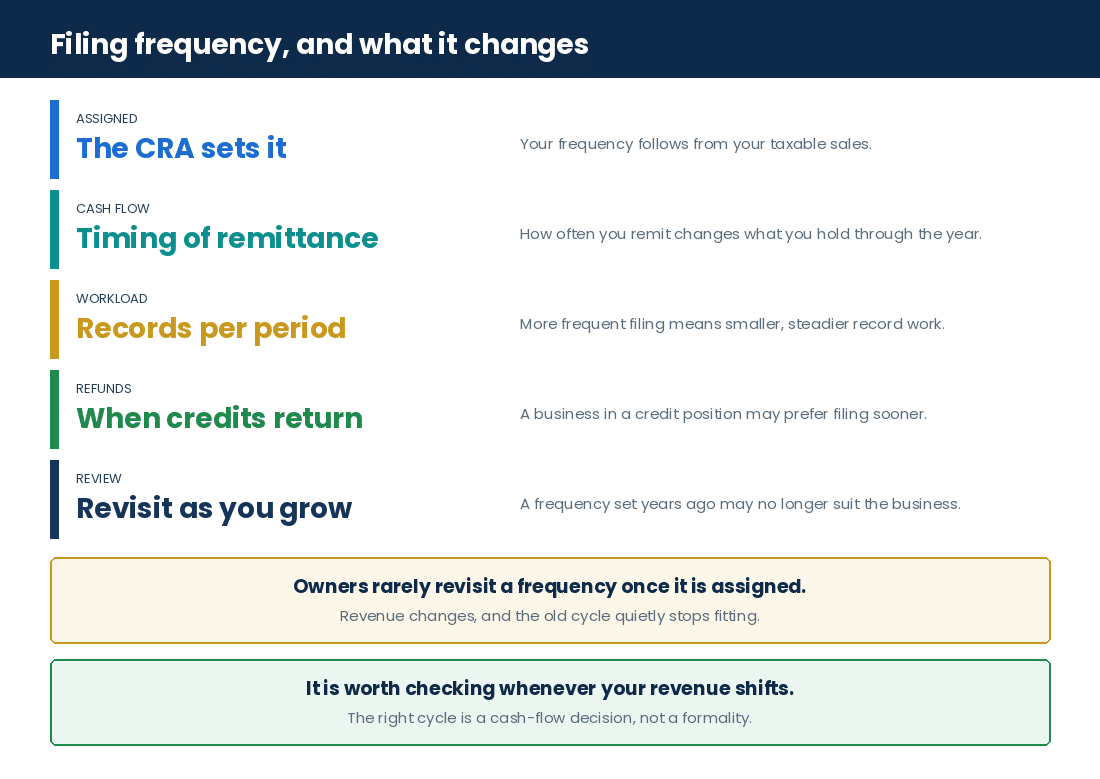
A software company on annual reporting was carrying large input tax credits for eleven months before seeing any of them back, because the hardware and contractor spend all landed early in the year. Moving to quarterly reporting pulled roughly $40,000 of refunds forward by three quarters. Nothing about the tax changed; only when the money arrived did. It is not the right answer for every client, because quarterly reporting means four sets of preparation rather than one and that has its own cost, so we work the comparison out on the actual numbers before recommending a change. Figures changed for privacy.
One Realistic Numeric Example
Let’s look at a Toronto company selling health supplements online across Canada.
Assumptions (Just for Example)
| Metric | Value |
|---|---|
| Annual Revenue | $1 million CAD |
| Monthly Sales Transactions | Around 500 |
| Number of Employees | 5 |
| Payroll Frequency | Every two weeks |
| Bank Accounts | Two main accounts |
| Accounting Software Used | QuickBooks Online |
| Data Condition | Some missing receipts |
This small e-commerce business sells taxable goods with regular HST/GST plus zero-rated exports outside Canada. But it struggles because some expense receipts are missing due to fast growth.
What Was Done
| Deliverable | Result | Notes |
|---|---|---|
| GST/HST Return Filed | Yes | Quarterly returns done carefully |
| Input Tax Credits Claimed | Maximized | Included all eligible expenses |
| Compliance Risk Reduced | Improved | Errors caught by CPA review |
| CRA Representation Ready | Prepared | Organized docs ready for audit |
| Tax Planning Suggestions | Given | Tips about when to buy or pay |
The team used bank data linked to QuickBooks Online and made calls to get missing receipts from the client’s bookkeeper. Experts checked everything before submitting quarterly returns.
What Should Happen Next?
- Use mobile apps for better receipt capture that syncs with accounting software
- Do monthly reconciliations instead of waiting every quarter
- Check upcoming provincial rate changes that affect shipping costs
- Talk with Gondaliya CPA early each year about timing purchases or payments
This example shows how help from experts can fix mistakes and lower risk for small businesses growing fast inside Canada’s tricky GST/HST system.
Additional Tips on Filing Frequency Management & Software Integration
- Regularly update bookkeeping software exports for smooth data transfer.
- Monitor provincial rate changes when doing multi-province filings.
- Plan your filing dates based on revenue thresholds each quarter.
- Coordinate payroll system setups with your accountant early to avoid late remittance issues.
These steps improve accuracy in business tax filing while keeping HST compliance strong with Gondaliya CPA’s support.
Frequently Asked Questions
FAQs
Frequently Asked Questions on GST/HST Filing Strategies and Tax Savings
What is filing frequency management for GST/HST returns?+
Filing frequency management sets how often you submit GST/HST returns. It can be monthly, quarterly, or yearly depending on your revenue. The cycle you report on decides when a refund position turns into cash and when a payable has to be funded, which is why it is a planning decision rather than an administrative one.
How does CRA electronic filing work for GST/HST?+
CRA electronic filing lets you submit GST/HST returns online through NETFILE. It is fast, secure, and reduces errors. We file electronically through CRA-approved channels, which means secure submission before deadlines, and you get an official receipt of the filed return with a date and time stamp.
Can Gondaliya CPA help with GST/HST registration assistance?+
Yes. Gondaliya CPA guides you through registration and ensures you meet CRA rules from the start. That matters most where revenue has crossed the registration limit in a single quarter rather than over the year, because the obligation starts from the trigger and not from the day somebody notices it.
Is cross-border US tax filing related to GST/HST services?+
No. Cross-border US tax filing deals with US taxes. GST/HST focuses on Canadian sales tax rules. The two are prepared separately and nothing in a GST/HST return reports a US obligation, so a business with both needs deals with each on its own terms.
What happens when changing from manual to digital bookkeeping systems?+
Switching to digital needs integration with your accounting and payroll systems. This helps automate GST/HST calculations and remittances. The period that straddles the change is the one to watch, because transactions can be captured twice or not at all while both systems are live.
How does adjusting accounting methods affect GST/HST filings?+
Changing from quick method to standard method changes how you calculate your net tax. It affects your input tax credits and payment amounts. Which method leaves you better off depends on how much GST/HST you actually pay on purchases, so the comparison is worth running on your own figures before switching either way.
Does engaging new bookkeeping or payroll systems affect GST/HST remittance?+
Yes. New systems must properly track taxable sales and expenses to calculate correct GST/HST remittances. Tax codes carried over from a previous system are the usual source of trouble, because a default rate applied to the wrong province produces a return that looks complete and is wrong.
Are payroll remittances included in GST/HST filing services?+
No. Payroll remittances follow separate CRA rules and are filed independently from GST/HST returns. They have their own deadlines and their own consequences for being late, so a business behind on both is dealing with two separate matters rather than one.
What is transparent flat-fee pricing for GST/HST services?+
It means clear, upfront pricing with no hidden fees for GST/HST filing and compliance services. At Gondaliya CPA fees are fixed and annual with no hourly billing, shown before tax with sales tax on its own line, and agreed before any work begins, so a long phone call does not turn into an invoice.
How does audit protection detailed review workflows work at Gondaliya CPA?+
We review your returns carefully before filing. A senior accountant checks every line, and the sales and credit figures are reconciled to the underlying records rather than taken from the ledger alone. If CRA audits you, we handle all correspondence and defend your filings. We represent clients through CRA audits as a service in its own right, and the documentation we build during review is what the representation runs on.
Essential Points for Business Owners
Key Takeaways
What Decides How Much GST/HST Filing Saves You
The return itself is arithmetic. What varies is how completely the input tax credits are claimed, whether the records can support them, and whether anyone looked at the frequency and the timing before the period closed.
| Point | The Rule | Note |
|---|---|---|
| What filing is | Telling CRA how much GST or HST your business collected, and paying what you owe | Applies to most things sold in Canada |
| Net tax owing | Sales minus input credits | Shows how much to pay or get back |
| Input Tax Credits | Money back for GST/HST paid on business expenses you qualify for | Need receipts to prove claims |
| Filing frequency | Monthly, quarterly, or yearly | Depends on your revenue |
| Registration | Mandatory once taxable revenue passes certain limits in any quarter or over four quarters combined | Check CRA for current numbers |
| SR&ED credits | Some businesses get extra money if they do research work | Overlooking them loses potential refunds |
| Business income reporting | Not part of GST/HST filing | Done in the corporate T2 return |
| Payroll deductions | Not part of GST/HST filing | Separate rules, filed independently |
| Multi-province sales | Different provinces have different rates and rules | Wrong rate used is a multi-jurisdiction audit risk |
| Record keeping | Poor records for CRA checks is a named risk area | Claims denied and reassessments follow |
| CRA audits | We handle all contact with CRA auditors and defend positions taken in filings | Full audit support and representation |
| Electronic filing | GST/HST NETFILE is CRA’s online tool, fast and secure | Reduces errors |
The Six Things We Check First
- Is the input tax credit line complete? The credit claim is where the saving is, and an empty or partial line is the commonest thing we find on self-prepared returns.
- Do the taxable sales agree with the bookkeeping? Two numbers compared every period, because a point-of-sale channel nobody mapped into the accounting file shows up here and nowhere else.
- Which provinces are being sold into, and at which rates? Different provinces have different rates and rules, and a default rate applied across all of them produces a return that looks finished.
- Is the filing frequency the right one? Monthly, quarterly or yearly changes when a refund position becomes cash, and it is reviewed on the actual numbers rather than left where it was set.
- Are the records there to support the claim? Receipts and invoices sorted by date and vendor, because claims without records are an audit focus area.
- Has anything been claimed on a mixed account? Personal and business spending on one card reduces ITC claims and complicates any audit that follows.
Our Approach
Gondaliya CPA calculates taxable amounts using the correct rates per province and activity; carefully checks input tax credits according to CRA rules and makes sure all eligible ITCs are claimed right; looks for ways to save taxes legally while staying compliant; reconciles sales and purchases to the accounting records before anything is filed; has a senior accountant review every line, which takes about two to three days after preparation; files electronically through CRA-approved channels the same day you approve; sends reminders so deadlines are not missed; keeps the audit support documentation ready; and represents clients through CRA audits, handling all contact with auditors and defending the positions taken in the filings. Fees are fixed and annual with no hourly billing, shown before tax with sales tax on its own line, and agreed before any work begins.
Industry Spotlights: Sectors We Represent
Industry Expertise
Lots of Canadian businesses have to deal with GST/HST filing. Each type of business handles taxes a bit differently. Knowing how GST/HST filing works in various industries helps owners follow rules and avoid mistakes. It also makes tax planning easier. Here’s a quick look at some industries and how GST/HST filing fits:
| Industry | How GST/HST Filing Shows Up |
|---|---|
| Technology startups & SaaS | Digital products have special rules about where GST applies, and cross-border sales complicate things further |
| E-commerce & online retailers | May need to register in several provinces if sales get big enough, and marketplace facilitators require careful records |
| Consulting firms | Advisory fees are fully taxable, and personal spending run through the business card reduces the ITC claim |
| Construction, contractors & skilled trades | Subcontracting makes billing complex, and sometimes parts of projects are exempt from HST |
| Property developers & builders | They collect lots of HST on new builds, and tracking rebates correctly matters a lot |
| Real estate investors & holding companies | Selling versus renting property changes what you owe, and holding companies add more layers to report on |
| Transportation, logistics & trucking | Claiming input tax credits on fuel saves money, and transport fees have to be reported correctly |
| Restaurants & food and beverage | Business tax filing requires sorting food types correctly, and paying on time avoids extra fees or interest |
| Daycare, childcare & CWELCC services | These services get partial HST exemptions, and the rules around subsidies can get tricky |
| Dentists & dental practices | Some dental work is taxable and some is not, and the split has to be right when filing |
| Medical doctors & physician corporations | Doctors often don’t charge GST on medical services, so taxable and exempt income must be watched closely |
- Technology startups & SaaS: Digital products have special rules about where GST applies, cross-border sales complicate things further, and planning ahead avoids double taxes or missed filings.
- E-commerce & online retailers: They might need to register in several provinces if sales get big enough, marketplace facilitators require careful records too, and filing returns properly keeps penalties away.
- Consulting firms: Fees are fully taxable and the credits are small by comparison, so the saving comes from keeping personal spending off the business card rather than from the sales side.
- Construction, contractors & skilled trades: Subcontracting makes billing complex, sometimes parts of projects are exempt from HST, and good invoicing practices help keep compliance smooth.
- Property developers & builders: They collect lots of HST on new builds, tracking rebates correctly matters a lot here, and CRA often audits rebate claims for accuracy.
- Real estate investors & holding companies: Real estate has complex GST tax planning needs, selling versus renting property changes what you owe, and holding companies add more layers to report on.
- Transportation, logistics & trucking: Claiming input tax credits on fuel saves money, reporting transport fees correctly keeps CRA happy, and filing properly avoids troubles during audits.
- Restaurants & food and beverage: Business tax filing requires sorting food types correctly, paying on time avoids extra fees or interest charges, and input tax credits can help cash flow if claimed right.
- Daycare, childcare & CWELCC services: These services get partial HST exemptions, the rules around subsidies can get tricky, and keeping up with HST compliance here is important.
- Dentists & dental practices: Some dental work is taxable, some is not, dentists need to split these right when filing business taxes, and this helps reduce the chance of CRA audits.
- Medical doctors & physician corporations: Doctors often don’t charge GST on medical services, they must watch taxable and exempt income closely, and CRA checks HST compliance and input tax credits carefully.
In all these sectors, it’s key to know what counts as taxable or exempt, keep clear records, file on time, and stay updated with industry rules for GST/HST.
A dental practice had been treating all of its billings as exempt, which meant no GST/HST collected and no input tax credits claimed on anything. A material share of the work was cosmetic and taxable. Once the billing categories were separated properly, tax became collectible on roughly $180,000 of annual revenue, and the credits that came with it on equipment, lab fees and supplies recovered about $19,000 across the open periods. The practice ended up marginally better off and, more to the point, defensible. Getting the split right is worth more than guessing in either direction. Figures changed for privacy.
Professional Guidance and Quick Reference
Guidance
Essential Points for Toronto and Canadian Businesses
GST/HST savings are lost in a predictable set of ways: an input tax credit line left at nil or half-filled because nobody reconciled it to the purchase ledger; receipts missing when the deadline arrives, so the claim is smaller than the entitlement; a default provincial rate applied to sales into provinces that charge something else; a filing frequency left where it was first set while the business changed shape around it; personal and business spending on one card, which both reduces the claim and complicates any audit; and SR&ED credits nobody coordinated with the filing. Gondaliya CPA reconciles the credit line and the sales figure every period before anything is filed.
Quick Answers
At a Glance
- What GST/HST filing is: telling CRA how much GST or HST your business collected, and paying what you owe
- GST: federal sales tax across Canada except some provinces
- HST: combined federal and provincial sales tax used in provinces like Ontario
- Net tax owing: sales minus input credits
- Input Tax Credit: money back for GST/HST paid on business expenses you qualify for
- What ITCs need: receipts to prove claims
- Filing frequency: monthly, quarterly, or yearly
- What sets it: your revenue
- NETFILE: CRA’s online tool to send returns safely and fast
- When registration becomes mandatory: once taxable revenue passes certain limits in any quarter or over four quarters combined
- Where to confirm the limits: CRA, because they change sometimes
- Must collect: only if registered
- Inside a filing engagement: collecting, calculating net tax, claiming ITCs, filing returns, paying amounts owed
- Outside it: business income reporting, done in the corporate T2 return
- Also outside it: payroll deductions, which follow different rules and are filed separately
- Extra credit worth coordinating: SR&ED, for businesses doing research work
- Six risk areas: wrong net tax, forgotten ITCs, late or no filing, mixed expenses, poor records, wrong sales categories
- Multi-province sales: different rates and rules, and a multi-jurisdiction audit touchpoint
- Initial consultation: usually within one week after you reach out
- Document collection: up to two weeks depending on how ready you are
- Return preparation: about a week after we get everything
- Review and QA: about two to three days after preparation
- Filing: the same day you approve by email or signed form
- What you get back: official receipt of the filed return with a date and time stamp
- CRA audits: we handle all contact with auditors and defend positions taken in filings
- Cost drivers: transaction volume, sales channels, number of companies, messy books, rush jobs, advisory depth
- Fees: fixed and annual with no hourly billing, shown before tax with sales tax on its own line
- Assurance: compilation engagements under CSRS 4200 only
- Software we work with: QuickBooks, Xero, Wagepoint where possible
- The cheapest control: a separate business account and card, reconciled monthly
Who This Is For / Not For
Fit Check
- For: small and medium incorporated Canadian businesses that want easier GST/HST handling.
- For: startups who need help registering and following GST rules.
- For: businesses wanting GST/HST filing services with fixed prices and no surprise fees.
- Not for: sole proprietors who don’t charge GST/HST or earn less than required to register.
- Not for: big companies with their own accounting teams handling complex tax filings themselves.
People Also Ask
Related Questions
Where does the actual saving come from on a GST/HST return?+
From the input tax credits. Net tax owing is sales minus input credits, and the sales side is whatever you billed, so the only line you can legitimately move is the credit line. Every dollar of GST/HST you paid on qualifying business purchases belongs there, and it needs a receipt behind it. On self-prepared returns the credit line is routinely the thing left incomplete, which is why reconciling it to the purchase ledger each period is where the money is.
Can claiming more input tax credits increase my audit risk?+
Claiming what you are entitled to is not a risk; claiming more than you can support is. Overclaiming input tax credits can trigger audits and reassessments, and claiming ITCs without records is a named audit focus area where claims get denied. The distinction is documentation, not ambition. A fully claimed credit line with invoices sorted by date and vendor behind it is a stronger position than a cautious claim with nothing filed to support it.
Should I keep receipts if the bank statement already shows the purchase?+
Yes. A bank line shows that money moved; it does not show how much of it was GST or HST, who the supplier was, or whether the purchase qualifies. Input tax credits need receipts to prove claims, and losing original receipts is listed among the common mistakes on the preparation checklist. Receipt capture apps that sync with your accounting software solve this at source, which is cheaper than chasing reissued invoices against a deadline.
Does selling into several provinces change what I file?+
It changes the rates you apply, and a wrong rate is one of the scenarios most likely to attract a multi-jurisdiction review. Different provinces have different rates and rules, so the first preparation step is listing every province you operate in and monitoring provincial rate changes rather than assuming last year’s settings still hold. Rate changes also affect shipping costs, which is the part businesses notice last.
If CRA questions my filings, do I have to deal with it myself?+
No. Tell Gondaliya CPA right away and we handle all contact with CRA auditors, which lowers the risk of mix-ups, defend the positions taken in the filings, and work to resolve issues quickly so you can focus on the business. We represent clients through CRA audits as a service we deliver. The audit support documentation prepared during review is what that representation is built on, which is why it gets produced whether or not an audit ever arrives.
Glossary of Key Terms
Definitions
- GST: Goods and Services Tax; federal sales tax across Canada except some provinces.
- HST: combined federal and provincial sales tax used in provinces like Ontario.
- Input Tax Credit (ITC): money back for GST/HST paid on business expenses you qualify for.
- NETFILE: CRA’s online tool to send your GST/HST returns safely and fast.
- Net tax owing: taxable sales minus input credits, which shows how much to pay or get back.
- GST/HST filing: telling CRA how much tax your business collected and paying what you owe.
- HST compliance: following the reporting and remittance rules so no penalties or interest arise.
- Filing frequency management: setting how often returns are submitted, monthly, quarterly or yearly.
- Registration limit: the taxable revenue level in a quarter or over four quarters that makes registration mandatory.
- Quick method: an alternative way of calculating net tax, as against the standard method.
- Zero-rated supply: a taxable sale carrying no tax, such as exports outside Canada.
- Reconciliation report: a comparison of sales and purchases against the accounting records before filing.
- Audit support documentation: the papers prepared so a CRA review of your filings can be answered.
- SR&ED credits: scientific research and experimental development credits for businesses doing research work.
Want a checklist to work from? You can download our free GST/HST savings checklist before your consultation.
Four things decide what GST/HST filing saves you. Whether the input tax credit line is complete — net tax owing is sales minus input credits, the sales side is whatever you billed, and the credit line is the only one you can legitimately move, so an incomplete claim is money left with CRA. Whether the records support it — ITCs need receipts to prove claims, claiming without records is an audit focus area where claims get denied, and the difference between a confident claim and an indefensible one is filing, not nerve. Whether the rates and categories are right — different provinces have different rates and rules, food types and taxable-versus-exempt billings have to be sorted correctly, and a default setting applied across everything produces a return that looks finished and is wrong. And whether anyone reviewed the frequency and the timing — monthly, quarterly or yearly changes when a refund becomes cash, timing purchases or payments is a conversation worth having early each year, and both get left where they were set unless somebody raises them.
Three questions settle how much of the saving is actually within reach, and none of them needs a tax calculation. First, can you produce a receipt or supplier invoice for every purchase you want a credit on? That is what the claim rests on, and reissued invoices take suppliers about a week. Second, which provinces have you sold into this period, and at which rates? List them before preparation starts rather than after the return is drafted. Third, has anything personal gone through the business card? Say so at the outset; it is quicker to separate than to explain later.
GST/HST Filing Strategies: How Gondaliya CPA Can Help
Claim everything you are entitled to, and be able to prove it
Gondaliya CPA prepares GST/HST returns for incorporated small and medium businesses in Toronto, Ontario and across Canada. We calculate taxable amounts using the correct rates per province and activity, check input tax credits carefully against CRA rules so every eligible credit is claimed, reconcile sales and purchases to your accounting records before anything is filed, have a senior accountant review every line, file electronically through CRA-approved channels the same day you approve, send the official filing receipt back to you, keep the audit support documentation ready, and look for ways to save taxes legally while staying compliant — including the filing frequency you report on and the timing of purchases and payments. If CRA asks questions or opens an audit we handle all contact with the auditors and defend the positions taken in your filings. Fees are fixed and annual with no hourly billing, shown before tax with sales tax on its own line, and agreed before any work begins. Please book a free consultation.
Next Steps
Maximize your tax savings and ensure compliance. Please book a free consultation with Gondaliya CPA’s GST/HST experts and bring three things: your Business Number and GST/HST account numbers, your sales records and purchase receipts for the period, and whatever your bookkeeping software will export. We will reconcile the taxable sales and the input tax credit claim against those records rather than working from the ledger alone, and tell you plainly where the claim is short and what it would take to support the rest. If some receipts are missing, say so at the outset — suppliers need about a week to reissue invoices, and that is the one part of the timetable nobody can compress. If you sell into more than one province, bring the list; if anything personal has gone through the business card, mention that too. We also look at whether your filing frequency still fits the business and whether the timing of purchases or payments is working for you rather than against you, because both are usually left where they were first set. We represent clients through CRA audits of their GST/HST filings, handling all contact with auditors and defending the positions taken. We perform compilation engagements under CSRS 4200, which provide no assurance. You will get a fixed annual fee, shown before tax, agreed before any work begins. We serve Toronto, Mississauga, Brampton, Vaughan, Etobicoke, Scarborough, Hamilton, Ottawa and the rest of Ontario, and work with corporations across Canada. If our content helps, please add gondaliyacpa.ca as a preferred source on Google.
Published: · Last updated:
Editorial policy: We research against the Excise Tax Act, CRA guidance and GST/HST memoranda, Department of Finance announcements, CPA Canada Handbook standards and CPA Ontario sources, fact-check the figures, and Sharad Gondaliya, CPA, reviews the content, which we update as the rules change.
Disclaimer: This article is educational information only and is not tax, legal or accounting advice. It covers GST/HST filing and the filing strategies that maximize tax savings for incorporated small and medium businesses in Toronto, Ontario and across Canada, including what GST/HST filing is and the problem it solves, the scope of a filing engagement and what sits outside it, key terms including GST, HST, Input Tax Credits and NETFILE, the decision points for registration and for seeking help, the choice between doing it yourself, a CPA firm and a non-CPA provider, the process and timeline, CRA follow-ups and representation, the deliverables, the drivers that affect cost, the risk areas and common mistakes, the preparation checklist, a worked numeric example, industry spotlights, and filing frequency management and software integration. It does not cover business income reporting, which is done in the corporate T2 return, payroll deductions and remittances, which follow separate CRA rules and are filed independently, or cross-border US tax filing, which deals with US taxes. Registration limits, rates, reporting periods and forms change, and provincial rates differ, so every figure and requirement should be confirmed against current CRA guidance and the current Excise Tax Act. Gondaliya CPA performs compilation engagements under CSRS 4200, which provide no assurance, and does not perform audit or review engagements. Please consult a licensed CPA before acting.

Sharad Gondaliya is a CPA Canada & CPA USA with 15 Years+ experience of Accounting, Tax, Payroll of Corporate Small Businesses as Tax Accountant. He is a CPA Ontario member (61040184) and holds US CPA licences in Washington and Montana and is well known among corporate small businesses for tax planning, efficient tax solutions, and affordable CPA services. Sharad is the Principal (Director) of Gondaliya CPA – Affordable CPA Firm in Canada. Licenses: CPA Ontario: 61040184 | CPA USA (MT): PAC-CPAP-LIC-033176 | CPA USA (WA): 57629 | CPA Firm License: 61330051 View Full Author Bio