



CRA Audit vs CRA Review: Key Differences Every Business Owner Must Know
CRA Audit vs CRA Review in Canada: How Income Tax Reviews and Full Audits Actually Differ
CRA audit vs review is key to knowing how income tax review and tax return review differ within the CRA compliance review process. Gondaliya CPA explains the triggers, the information involved, and the steps that follow when a return is examined.
The practical question is never which is “worse”. It is which one you are in, because that determines how much you say, how fast, and to whom. Our CRA audit resolution services start with reading the letter properly.
Quick Summary
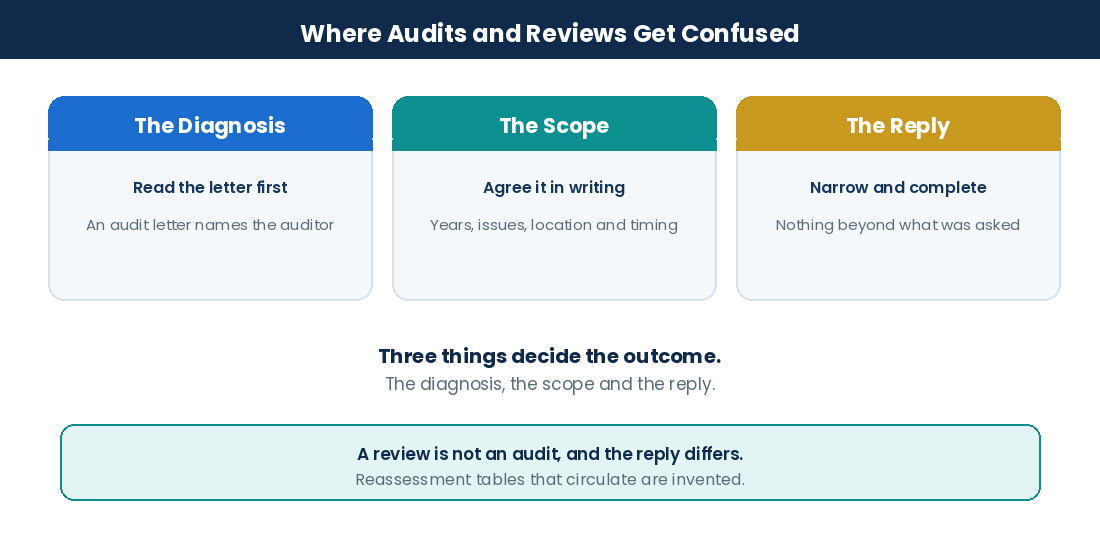
A review is a narrow query about specific items, usually handled by correspondence, with a short deadline. An audit is a scoped examination of records by an assigned auditor. The response to each should be different, and the letter itself tells you which you have received.
Reading time: 52 minutes.
Table of Contents
The Numbers That Matter
This article covers Canada, with Ontario and Toronto context, and reflects rules current to 2026. It is written for incorporated Canadian businesses receiving CRA correspondence. Figures marked illustrative are examples, not quotes, and any masked engagement notes end with “Figures changed for privacy.” This is educational information only and not tax or legal advice. Outcomes depend entirely on your own facts and records, so no article can predict what a particular review or audit will produce.
Read the Letter First
Read the Letter First
The Diagnosis
What Distinguishes Them
| Signal in the Letter | Review | Audit |
|---|---|---|
| Who is contacting you | A processing or compliance area | A named auditor with a direct line |
| What is asked for | Specific items or amounts | Books and records for a period |
| Period covered | Usually one return | Often several years |
| Deadline given | Short, commonly around 30 days | Arranged with the auditor |
| Method | Correspondence | Correspondence or an on-site visit |
| What the letter calls it | A review, or a request for information | An audit, and it says so |
The last row does most of the work. The CRA is not coy about this. An audit letter says audit and names the person conducting it. A review letter asks about specific line items and gives you a date.
Where the letter is genuinely ambiguous, the safest reading is the more serious one. Preparing for an audit and finding it was a review costs you a few hours of organisation. Preparing for a review and finding it was an audit means the first substantive contact happened without representation, without an agreed scope, and possibly with an answer given informally that now sits on the file.
Why the Distinction Changes Your Response
A review is a narrow question with a narrow answer. Sending three years of general ledgers in response to a query about one deduction does not help you; it introduces material nobody asked about and invites questions that were never going to be asked.
An audit is the opposite problem. Treating it casually, answering informally, or letting an auditor work through your records without a considered approach is how a scoped examination expands.
| Situation | Right Response | Wrong Response |
|---|---|---|
| Review of one deduction | Answer that item, fully, on time | Send everything you have |
| Audit letter naming an auditor | Authorise a representative, agree scope | Handle it informally by phone |
| Deadline you cannot meet | Ask for an extension before it passes | Miss it and hope |
What the Source Material Usually Gets Wrong
Two things circulate widely and are worth correcting.
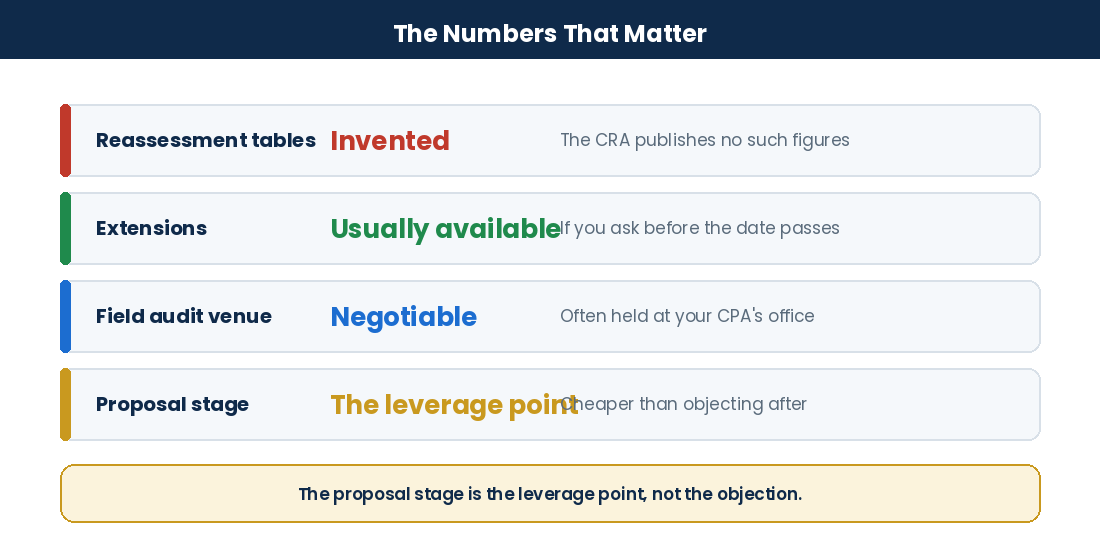
First, tables giving estimated reassessment amounts by type of examination, or severity bands running from minor to serious with dollar ranges attached, are invented. The CRA publishes nothing of the kind, and the amount depends entirely on your own numbers.
Second, tables rating individual expense categories as “low risk, review” or “high risk, audit” are equally made up. Selection does not work by expense category in that way, and no published model assigns audit probability to office supplies against entertainment.
Both patterns are worth naming because they cause real harm. A business that reads a table saying a full audit produces a certain reassessment figure will make decisions against a number that was invented, and a business that believes entertainment expenses attract audits will avoid claiming legitimate ones. Neither belief has anything behind it.
The One Thing to Do Immediately
- Diarise the deadline on the day the letter arrives
- Note the reference number, the tax year and the exact items raised
- Send it to your accountant before responding to anything
- Do not reply informally by phone before you know what you are answering
- If the timeline is unrealistic, ask for an extension early rather than late
The most expensive mistake is answering fast and wide. A narrow query answered with a wide response creates work nobody was going to do. Figures changed for privacy.
Risk Warning: Tables giving estimated reassessment amounts by examination type are invented. Please do not plan around figures the CRA never published.
What a Review Actually Is
What a Review Actually Is
The Narrow One
The Purpose
A review verifies something specific. It is not an accusation and it is not the opening move of an audit. In most cases the CRA is confirming a figure it already has a reason to check.
- An amount that does not agree with information filed by someone else
- A deduction or credit that requires supporting documentation
- A figure that changed materially from the prior year
- A random selection as part of a broader verification programme
- A sales tax filing that does not reconcile to income reported
The random point matters. Not every letter means the CRA thinks something is wrong. Some verification is routine and being selected carries no implication about your file.
Where the query does stem from a mismatch, the most common source is the comparison between revenue reported on the corporate return and sales reported on your sales tax filings. That is a comparison you can run yourself at any time, and our guide to the bookkeeping mistakes that raise audit risk sets out the others alongside it.
The Common Types
| Type | What It Checks |
|---|---|
| Pre-assessment review | An item before the return is assessed |
| Processing review after assessment | Support for a claim already assessed |
| Matching programme | Amounts reported by third parties against your return |
| GST/HST verification | Credits claimed, or sales reported against income |
| Payroll examination | Remittances, slips and worker classification |
Note the payroll row. A payroll examination sits somewhere between a review and an audit in practice, and it can move quickly into the trust money territory where directors carry personal exposure.
How the Process Runs
- A letter arrives identifying the year, the items and a deadline
- You supply the documents requested for those items
- The CRA considers the response
- Either the matter closes, more is requested, or an adjustment is proposed
- Where an adjustment is proposed you can respond before it is finalised
The reply window is commonly around 30 days, though it varies and the letter governs. Extensions are usually available where requested before the date passes and with a reason, which is a very different thing from simply missing it.
What They Ask For
- Invoices and receipts supporting a specific claim
- Bank statements for a defined period
- Contracts or agreements underlying a transaction
- Payroll records and slips
- A written explanation of how a figure was calculated
Send exactly that. A clear covering letter that answers the question directly, with the documents indexed and referenced, closes reviews faster than a large unsorted bundle.
Where the request concerns sales tax credits, the documentary requirements are specific and one item defeats more claims than any other: the supplier’s registration number. A receipt without it will not support a credit however genuine the purchase was, and no amount of explanation substitutes for it. Our overview of input tax credits in Canada sets out the full list, and it is worth checking your bundle against it before sending rather than after.
If You Cannot Support It
Sometimes the honest answer is that the documentation does not exist. That is worth knowing early, because the options then are different: reconstruct what you can, concede the item, or explain the circumstances.
What does not work is an incomplete response that hopes the question goes away. It generally produces an adjustment plus a follow-up, and it costs credibility on everything else.
Most reviews close on the first reply if the reply actually answers the question. The ones that drag on are the ones answered partially. Figures changed for privacy.
Key Stat: Extensions are usually available if requested before the deadline passes. Please ask early rather than missing the date.
What an Audit Actually Is
What an Audit Actually Is
The Broad One
An Assigned Person and a Defined Scope
The defining features of an audit are that a named auditor is assigned to your file and that a period and subject matter are set. Both matter to how you handle it.
Having a named person means there is someone to negotiate scope, timing and format with, which is not true of a correspondence review. Having a defined scope means there is a boundary, and boundaries can move if nobody is watching them.
Desk and Field
| Feature | Desk Audit | Field Audit |
|---|---|---|
| Where it happens | Remotely, by correspondence | At your premises or your representative’s office |
| What is examined | Records you send | Books, records and often the operation itself |
| Interaction | Written, with some calls | In person, over days or longer |
| Typical scope | Narrower, often one issue area | Broader, often several years |
| Where records sit | You choose what to send | Access is to the records generally |
A field audit can usually be held at your accountant’s office rather than your premises. That is worth requesting. It keeps the examination in a controlled environment, keeps your staff working, and means questions route through someone who understands what is being asked.
What an Auditor Can Do
- Examine books, records and supporting documents
- Request documents and information within the scope
- Ask questions of you and your staff
- Inspect premises and inventory where relevant
- Contact third parties for information in defined circumstances
- Extend the scope where findings warrant it
The last point is the one to manage. An audit that starts on one issue can widen if what the auditor sees suggests problems elsewhere, and volunteering material outside the scope is the most common way that happens.
Your Rights
| Right | What It Means in Practice |
|---|---|
| To be told what is being examined | Ask for the scope in writing at the outset |
| To be represented | Authorise your CPA so correspondence routes through them |
| To reasonable timelines | Ask for time where a request is large |
| To understand proposed adjustments | The reasoning should be explained before assessment |
| To respond before finalisation | The proposal stage exists for exactly this |
| To object afterwards | Within 90 days of the notice |
| To professional treatment | There is a service complaint process if needed |
Authorising a representative early is the highest-value administrative step available. It means questions arrive at someone who can assess what is really being asked before an answer is given.
Your Responsibilities
You have to provide reasonable access to books and records, respond within the timelines set, and answer honestly. None of that requires volunteering material outside the scope, and there is no obligation to speculate.
“I will confirm that and come back to you” is a complete and proper answer to a question you are not certain about. Guessing on the spot creates a record that then has to be corrected.
That matters more than it sounds during a field audit, where questions arrive conversationally over several days and it feels unnatural to defer. An auditor asking how a particular figure was arrived at is asking a technical question, and answering it from memory in a corridor is how inconsistencies enter the record. Nobody is being tested on recall. A written answer a day later is better in every respect, and no auditor objects to receiving one.
Asking to hold a field audit at your accountant\u2019s office is granted more often than owners expect, and it changes the character of the whole process. Figures changed for privacy.
Key Stat: A field audit can often be held at your representative’s office. Please ask, because it keeps the examination controlled.
Responding to Each Differently
Responding to Each Differently
The Method
The Governing Principle
Answer what was asked, completely, and nothing beyond it. That single sentence covers most of what a business needs to know about handling CRA correspondence.
It is not evasive. Being complete on the question is the whole point. What it excludes is volunteering material that was not requested, which serves nobody and can open subjects that were closed.
Responding to a Review
- Identify precisely which items and which year are in question
- Assemble the documents supporting those items only
- Check the documents actually say what you think they say
- Write a short covering letter answering the question directly
- Index the attachments and reference them in the letter
- Send by the deadline, keeping a copy of everything sent
The third step is skipped more than any other. Sending an invoice that does not show what you claimed is worse than asking for more time to find one that does.
Responding to an Audit
- Authorise your representative before substantive contact begins
- Ask for the scope, the years and the issues in writing
- Agree a location and a schedule rather than accepting the first proposal
- Prepare the records for the scope before the examination starts
- Route questions through one person so answers stay consistent
- Keep a log of every request made and every document provided
- Answer in writing where the question is technical
The log is worth the effort. Audits run for months, personnel can change, and being able to show exactly what was asked and what was provided settles disputes that otherwise become disagreements about memory.
Keep it simple: date, what was requested, who requested it, what was provided, and the date it went. A spreadsheet is sufficient. The value shows up months later when a proposal letter says something was never provided and you can demonstrate in one line that it was, with the date and the format.
What Not to Do
| Behaviour | Why It Hurts |
|---|---|
| Ignoring the letter | An assessment issues on the information the CRA has |
| Answering off the cuff by phone | Creates a record you may have to correct |
| Sending everything you own | Introduces material nobody asked about |
| Creating documents after the fact | Far more serious than the original problem |
| Missing a deadline silently | Extensions are usually available if you ask first |
| Arguing before understanding the position | Wastes the goodwill you may need later |
The fourth row deserves emphasis. Reconstructing a genuine record from real underlying data is legitimate. Manufacturing a document to support a claim is a different act entirely and it converts a tax dispute into something much worse.
Getting Records Ready
- Bank and credit card statements with reconciliations
- Sales invoices and the revenue ledger
- Purchase invoices, especially those supporting sales tax credits
- Payroll records, slips and remittance confirmations
- Contracts and agreements for significant transactions
- The asset register with acquisition and disposal detail
- Shareholder loan account detail with explanations
- Prior returns, assessments and any earlier correspondence
Our CRA audit guide covers preparation in more detail.
The log of requests and responses is the unglamorous thing that decides disputes months later. Memory is not evidence and neither party has a perfect one. Figures changed for privacy.
Risk Warning: Never create a document after the fact to support a claim. Please reconstruct from real underlying data or concede the item.
When a Review Becomes an Audit
When a Review Becomes an Audit
The Escalation
It Is Not Automatic
Most reviews close as reviews. The idea that a letter inevitably leads somewhere worse is not how it works, and the anxiety it produces causes people to over-respond in ways that make things harder.
It is worth saying plainly because the fear is common and disproportionate. A letter asking for support for one deduction is a request for support for one deduction. Answering it properly ends it. The businesses that end up in extended examinations are almost never the ones that received a routine query and answered it.
What does escalate a review is a pattern in the response rather than the original question.
What Actually Escalates It
- A response that does not support the item, revealing a broader issue
- Documents that raise questions the original query did not
- The same problem visible across several years
- No response at all, or a materially incomplete one
- Amounts that do not reconcile once the documents are examined
- Signs that the records themselves are unreliable
The second point is the argument for a narrow response. A review of one deduction answered with three years of ledgers is an invitation, and it is entirely self-inflicted.
Signals to Watch
| Signal | What It Suggests |
|---|---|
| The second letter asks about different items | The scope is widening |
| Additional years are mentioned | The period is widening |
| A named officer appears on correspondence | It may have moved to an audit function |
| A request to meet or visit | Field work is being contemplated |
| Questions about your accounting system | Reliability of the records is in issue |
Any of these is the point to bring in representation if you have not already. Handling a narrow review alone is often reasonable. Handling a widening examination alone rarely is.
If the Records Are the Problem
Sometimes a review surfaces that the underlying bookkeeping does not support what was filed. That is a different problem from a disputed deduction and it needs a different response.
The options are to reconstruct properly from source records, or to come forward about what was wrong. Where a past filing contained an error carrying a penalty, the Voluntary Disclosures Program may reduce the consequences, but only if you come forward before the CRA raises the issue.
That condition is the entire programme, and it means the window closes at the moment contact is made. Once a letter has arrived about a matter, disclosure on that matter is generally no longer available.
Multiple Years
Where an issue exists across several years, deciding how to handle it is a judgement call worth taking advice on. Correcting one year while leaving identical treatment in others is visible and rarely holds.
The same logic applies in your favour. Where a review establishes that a position was wrong, it is often wrong in both directions across the same years, and errors that overstated tax are as correctable as those that understated it. Bringing the full picture rather than only the conceded item is both more credible and frequently better arithmetic. Where returns were never filed for some of those years, catch-up corporate tax filing has to happen before the position can be settled at all.
The normal reassessment period for a CCPC is generally three years from the notice of assessment, but there is no time limit where there was misrepresentation attributable to neglect, carelessness or wilful default. Assuming older years are safe is not reliable.
Reviews escalate because of the answer, not the question. A narrow response to a narrow query closes files that a wide one keeps open. Figures changed for privacy.
Risk Warning: Voluntary disclosure generally closes once the CRA has contacted you about a matter. Please act before a letter arrives, not after.
Afterwards, and Working With Gondaliya CPA
Afterwards, and Working With Us
The Outcome
The Proposal Stage
Before an audit results in an assessment, the CRA generally sets out the adjustments it intends to make and gives you an opportunity to respond. This is the most valuable point in the entire process and it is routinely wasted.
Responding here is cheaper, faster and more likely to succeed than objecting afterwards. The auditor still has the file, the reasoning is fresh, and nothing has been formalised. Once an assessment issues, changing it requires a different and slower process.
- Read exactly what is proposed and on what basis
- Separate points you accept from points you dispute
- Respond in writing, with documents, on the disputed points
- Conceding what is genuinely wrong strengthens the rest
- Ask for more time if the response needs work
Assessment and Objection
| Stage | What Happens |
|---|---|
| Notice of reassessment | The adjustments are formalised, with tax, interest and any penalty |
| Notice of objection | Filed within 90 days, moving the file to Appeals |
| Appeals review | An officer independent of the audit reconsiders |
| Tax Court | Available where the objection does not resolve it |
| Taxpayer relief | Separate request for penalties and interest, not the tax |
The Appeals stage is genuinely independent of the auditor, which is why objections succeed more often than people expect. It is also why the objection needs to be a properly argued document rather than a letter expressing disagreement.
Note that interest generally continues to accrue while an objection is outstanding, so there is a cash decision about whether to pay the disputed amount in the meantime.
Penalties
Penalty structures are formula-based and depend on the amounts and periods involved. Late filing is a percentage of unpaid tax with a monthly element; failure to remit is tiered by lateness; gross negligence is a substantial percentage of the understated amount.
What no article can tell you is what a particular situation will cost, because every one of those is a calculation on your own figures. Anyone quoting a number without seeing them is guessing.
How We Work on These
We handle CRA correspondence for incorporated businesses on a flat fee quoted before work begins, covering assessment of what the letter actually is, authorisation as representative, scope negotiation, records preparation, written responses and submissions, attendance at meetings, proposal stage response, and objections where required.
Where the underlying records need correcting before anything is submitted, we do that first. Responding on the basis of books that do not hold up is how a manageable review becomes a serious problem. Our corporate tax cleanup service handles that stage.
We also tell you plainly where we think a position will not hold. Defending something indefensible costs money on the way to the same outcome, and the better use of that time is usually to concede the point cleanly and defend what is actually arguable. Owners generally prefer knowing that at the start rather than discovering it at the proposal stage.
Pricing depends on the periods and issues involved, the volume of documents and the state of the records. It is quoted before work begins, including HST, with a one-business-day response and evening and weekend availability. Our engagements carry a 30-day money-back arrangement and a 60-day fee-matching arrangement.
Getting Started
Bring three things: the letter itself, the return for the year in question, and the records supporting the items raised. Those let us tell you which process you are in and what the response should be.
Contact Gondaliya CPA at info@gondaliyacpa.ca, call 647-212-9559, or send us a message.
The proposal stage is the cheapest place to change an outcome and the most frequently missed. After assessment everything costs more and takes longer. Figures changed for privacy.
Pro Tip: Please respond properly at the proposal stage. It is faster, cheaper and more likely to work than objecting after assessment.
FAQs on CRA Reviews and Audits
Frequently Asked Questions
FAQ
How do I tell whether I have a review or an audit?+
The letter says. An audit letter names the auditor conducting it and sets a period and subject matter. A review letter asks about specific items on one return and gives a date.
Does a review mean the CRA thinks something is wrong?+
Not necessarily. Some verification is routine or random. Being selected carries no implication by itself; what matters is whether the item can be supported.
How long do I have to reply to a review letter?+
Commonly around 30 days, though it varies and the letter governs. Extensions are usually available where requested before the date passes and with a reason.
Should I send everything I have?+
No. Answer what was asked, completely, and nothing beyond it. A wide response to a narrow query introduces material nobody asked about and can widen the examination.
What is the difference between a desk audit and a field audit?+
A desk audit is conducted remotely on records you send. A field audit takes place at your premises or your representative’s office and typically covers a broader scope.
Can I have a field audit held somewhere other than my premises?+
Often yes. Holding it at your accountant’s office keeps the examination controlled, keeps your staff working, and routes questions through someone who understands them.
Should I authorise my accountant as representative?+
Yes, and early. It means correspondence and questions arrive at someone who can assess what is really being asked before an answer is given.
Can an audit expand beyond what it started on?+
Yes, where findings warrant it. The most common way that happens is volunteering material outside the scope, which is entirely within your control.
What if I cannot support an item?+
Say so early. The options are to reconstruct from real underlying data, concede the item, or explain the circumstances. An incomplete response that hopes the question goes away rarely works.
Can I create a document to support a claim?+
No. Reconstructing a record from genuine underlying data is legitimate. Manufacturing a document is a different act entirely and far more serious than the original problem.
What is the proposal stage?+
Before an assessment issues, the CRA sets out the adjustments it intends to make and invites a response. It is the cheapest and most effective point to change an outcome.
How long do I have to object to an assessment?+
90 days from the notice. The objection moves the file to an Appeals officer independent of the audit, which is why objections succeed more often than people expect.
Does interest stop while I object?+
Generally not. Interest continues to accrue on a disputed amount, so there is a cash decision about whether to pay it in the meantime.
How far back can the CRA reassess?+
Generally three years from the notice of assessment for a CCPC. There is no time limit where there was misrepresentation attributable to neglect, carelessness or wilful default.
Can I still use voluntary disclosure once a letter arrives?+
Generally not for that matter. Disclosure has to be voluntary, so the window closes once the CRA has made contact about the issue.
What will a reassessment cost me?+
Nobody can tell you without your figures. Tables giving estimated reassessment amounts by examination type, or severity bands with dollar ranges, are invented.
Sixteen questions and one underneath most of them: which process is this, and what does the answer need to cover. Figures changed for privacy.
The Response Checklist
The Response Checklist
Quick Reference
On the Day the Letter Arrives
- Diarise the deadline immediately.
- Note the reference, the year and the exact items raised.
- Establish whether it names an auditor or asks about specific items.
- Send it to your accountant before replying to anything.
- Do not answer informally by phone first.
- Ask for an extension early if the timeline is unrealistic.
Answering a Review
- Assemble documents for the items raised only.
- Check each document actually supports what was claimed.
- Write a short covering letter answering the question directly.
- Index the attachments and reference them in the letter.
- Send nothing that was not asked for.
- Keep a full copy of everything sent, and the date.
Handling an Audit
- Authorise your representative before substantive contact.
- Ask for scope, years and issues in writing.
- Request the location and schedule that suit you.
- Prepare records for the scope before it starts.
- Route all questions through one person.
- Answer technical questions in writing.
- Say you will confirm rather than guessing.
- Log every request and every document provided.
- Respond properly at the proposal stage.
- Concede what is genuinely wrong to strengthen the rest.
- Object within 90 days if the assessment is wrong.
- Never create a document after the fact.
For help with a letter you have received, contact Gondaliya CPA at info@gondaliyacpa.ca, call 647-212-9559, or book a free consultation.
Twenty-four points and one principle underneath them: answer what was asked, completely, and nothing beyond it. Figures changed for privacy.
Businesses We Serve
Industry Expertise
What arrives differs by business. Here are ten and the usual response.
| Situation | What It Calls For |
|---|---|
| A query about one deduction | A narrow, complete answer on that item |
| A slip you did not report | Confirm, correct and explain the omission |
| Sales tax credits questioned | Invoices showing supplier registration numbers |
| A payroll examination | Remittances, slips and classification support |
| A letter naming an auditor | Authorise a representative before responding |
| A request to visit your premises | Ask to hold it at your accountant’s office |
| A second letter widening the years | Representation, if not already in place |
| A proposal letter | A written, documented response before assessment |
| An assessment you dispute | An objection within 90 days |
| Records that will not support the filing | Advice before anything is submitted |
- A query about one deduction: Narrow beats wide.
- A slip you did not report: Correct it plainly.
- Sales tax credits questioned: The number must be there.
- A payroll examination: Trust money, so take it seriously.
- A letter naming an auditor: That word means audit.
- A request to visit your premises: Ask; it is often granted.
- A second letter widening the years: The scope is moving.
- A proposal letter: The cheapest place to change it.
- An assessment you dispute: Ninety days, properly argued.
- Records that will not support the filing: Fix first, reply second.
What arrives changes the detail. It does not change the principle, which is answer what was asked, completely, and nothing beyond it. Figures changed for privacy.
Professional Guidance and Quick Reference
Guidance
Professional Guidance: How Gondaliya CPA Handles Your CRA Correspondence
Businesses handle CRA correspondence badly in a predictable set of ways: not establishing whether the letter is a review or an audit before responding, answering a narrow query with three years of ledgers and inviting questions nobody was going to ask, replying informally by phone and creating a record that later needs correcting, missing a deadline silently when an extension was available for the asking, letting a field audit run at their own premises without asking for an alternative, treating the proposal letter as a formality rather than the cheapest place to change the outcome, and relying on articles quoting invented reassessment figures. Gondaliya CPA handles CRA correspondence on a fee quoted before work begins.
We handle what decides the outcome: reading the letter to establish which process it is, authorising representation before substantive contact, agreeing scope and location in writing, preparing records for the scope rather than generally, answering narrowly and completely, logging every request and response, responding properly at the proposal stage, and objecting within 90 days where the assessment is wrong.
Our team starts with the letter, the return for the year in question and the records supporting the items raised. Those three tell us what the response should be. Whatever your sector, you get clear advice and a fixed price before we start.
Quick Answers
- Which is it: The letter says
- Audit letter: Names an auditor
- Review letter: Asks about specific items
- Reply window: Commonly around 30 days
- Extensions: Usually available if you ask first
- Principle: Answer what was asked, nothing more
- Field audit: Ask to hold it at your CPA’s office
- Proposal stage: The cheapest place to change it
- Objection: 90 days from the notice
- Reassessment amounts: Nobody can quote yours
Who This Is For
- For: Incorporated Canadian businesses that have received CRA correspondence, or that want to understand the process before one arrives.
- Not For: A prediction of what any particular review or audit will produce, since outcomes depend entirely on your own facts and records.
People Also Ask
Do expense categories carry different audit risk?+
Tables rating office supplies as low risk and entertainment as high risk are made up. Selection does not work by expense category in that way.
What records should I have ready?+
Bank statements with reconciliations, sales and purchase invoices, payroll records and remittances, the asset register, shareholder loan detail and prior correspondence.
Can penalties be cancelled?+
A taxpayer relief request may cancel penalties and interest where circumstances were beyond your control. It does not change the underlying tax.
Glossary of Key Terms
- Review: A narrow verification of specific items by correspondence.
- Audit: A scoped examination of records by an assigned auditor.
- Desk audit: An audit conducted remotely on records you send.
- Field audit: An audit conducted at premises, over a broader scope.
- Matching programme: Comparing third-party information to your return.
- Scope: The years and issues the examination covers.
- Representative: A person you authorise to deal with the CRA for you.
- Proposal letter: Adjustments set out before assessment, inviting response.
- Reassessment: A formal revision of a previously assessed return.
- Notice of objection: A formal dispute filed within 90 days.
- Appeals: The function that reconsiders, independent of the audit.
- Taxpayer relief: A request to cancel penalties and interest.
- Normal reassessment period: Generally three years for a CCPC.
- Misrepresentation: Where no reassessment time limit applies.
- Gross negligence penalty: A substantial percentage of an understatement.
- Voluntary Disclosures Program: Correcting filings before CRA contact.
CRA Letter Check
This quick self-check indicates where your operation most likely has room. Please answer the six questions below.
CRA Letter Check
Six quick questions on your letter. No fee shown.
Points to raise with us:
This is a general prompt, not tax or legal advice or a quote. Your position depends on your full facts. For a real review, please book a free consultation.
Want a checklist to work from? You can download our free CRA response checklist before your consultation.
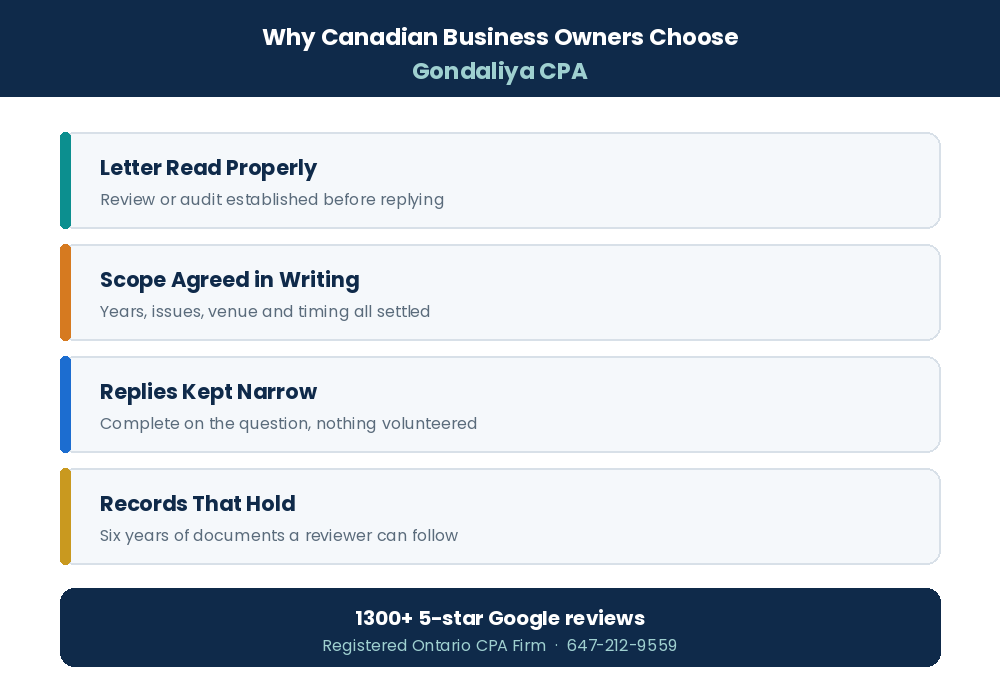
Read the letter to establish which process it is. Diarise the deadline the day it arrives. Authorise a representative before substantive contact. Answer what was asked, completely, and nothing beyond it. Ask to hold a field audit at your accountant\u2019s office. Respond properly at the proposal stage. Object within 90 days where the assessment is wrong. Please keep six years of records.
2026 Update — what is current: This article reflects rules current to 2026. The 90-day period to file a notice of objection, the generally three-year normal reassessment period for a CCPC, the six-year record retention requirement and the formula-based structure of the late-filing, failure-to-remit and gross negligence penalties are unchanged. Please note that the CRA publishes no table of estimated reassessment amounts by examination type, and no severity bands with dollar ranges attached, so figures of that kind circulating in guidance are invented; that no published model assigns audit probability to individual expense categories, so tables rating office supplies against entertainment are equally made up; that a review letter identifies specific items on a return while an audit letter names the auditor conducting it and sets a period and subject matter; that extensions on review deadlines are usually available where requested before the date passes; that a field audit can often be held at your representative\u2019s office rather than your premises; that the proposal stage before assessment is the most effective point to change an outcome; that interest generally continues to accrue while an objection is outstanding; and that voluntary disclosure requires the disclosure to be voluntary, so it generally closes once the CRA has made contact about the matter.
CRA Audit vs Review Canada: How Gondaliya CPA Supports Businesses
Start with the letter itself
Gondaliya CPA reads the letter to establish which process it is, authorises representation before substantive contact, agrees scope and location in writing, prepares records for the scope rather than generally, answers narrowly and completely, logs every request and response, responds properly at the proposal stage and objects within 90 days where the assessment is wrong, on a fee quoted before work begins including HST with a one-business-day response. Please book a free consultation.
Next Steps
Please book a free consultation with Gondaliya CPA and bring the letter itself, the return for the year in question, and the records supporting the items raised. Those three tell us which process you are in, what the response should be, and what remains to claim on the equipment, and where the documentation is thin. You will get a flat annual fee including HST before any work begins. If our content helps, please add gondaliyacpa.ca as a preferred source on Google.
Published: · Last updated:
Editorial policy: We research against CRA and CPA Ontario sources, fact-check the figures, and Sharad Gondaliya, CPA, reviews the content, which we update as the rules change.
Disclaimer: This article is educational information only and is not tax, legal, or financial advice. Figures marked illustrative are examples rather than quotes or guarantees. It reflects CRA rules current to 2026, including the $30,000 GST/HST threshold, the Class 8 rate, Class 13 leasehold treatment, the half-year rule, and the six-year retention requirement. Rates, limits and expensing rules change and outcomes depend on your specific facts. Please consult a CPA Ontario member before acting.

Sharad Gondaliya is a CPA Canada & CPA USA with 15 Years+ experience of Accounting, Tax, Payroll of Corporate Small Businesses as Tax Accountant. He is a CPA Ontario member (61040184) and holds US CPA licences in Washington and Montana and is well known among corporate small businesses for tax planning, efficient tax solutions, and affordable CPA services. Sharad is the Principal (Director) of Gondaliya CPA – Affordable CPA Firm in Canada. Licenses: CPA Ontario: 61040184 | CPA USA (MT): PAC-CPAP-LIC-033176 | CPA USA (WA): 57629 | CPA Firm License: 61330051 View Full Author Bio