



Common Year-End Accounting Mistakes That Cost Businesses Thousands in Taxes
Quick Summary
Year-end accounting mistakes are the errors that slip into a corporation’s books and filings at year-end and surface later as extra tax, interest, and penalties. The common ones are misclassified expenses, mixed personal and business spending, GST/HST that does not reconcile, missing accruals, and self-filed T2 errors. A CPA review before filing catches most of them.
| Aspect | Details |
|---|---|
| What goes wrong | Errors in the books and the T2 that raise tax, interest, and penalties. |
| Why it costs money | The CRA reassesses, deductions are lost, and penalties and interest are added. |
| How to catch it | A year-end review before filing finds and fixes most errors early. |
| Important caveat | Honest errors are usually fixed by adjustment; larger or older issues may need a voluntary disclosure. |
Reading time: 23 minutes.
Table of Contents
- What Are the Most Common Year-End Accounting Mistakes?
- How Do These Mistakes Cost You in Taxes?
- Adjustment vs Voluntary Disclosure
- DIY vs CPA vs Non-CPA Provider
- How Do We Find and Fix Year-End Mistakes?
- What Deliverables Do You Get?
- How Much Does Fixing Year-End Mistakes Cost?
- Risks, CRA Compliance & the 2026 Update
- What to Prepare Before a Year-End Review
- How Mistakes Show Up Across 10 Industries
- A Realistic Numeric Walkthrough
- How to Choose the Right CPA Firm
- Why Trust Gondaliya CPA
- People Also Ask
- Frequently Asked Questions
- Glossary of Key Terms
Year-End Mistakes at a Glance
This article covers Canada, with Ontario context, and reflects CRA rules in effect for the 2026 tax year, including the Voluntary Disclosures Program changes effective October 1, 2025. Any figure marked “figures changed for privacy” is masked from a real engagement, and penalties and rules are cited to government sources. This is educational information only and not tax, legal, or financial advice.
What Are the Most Common Year-End Accounting Mistakes?
The Common Errors
The most common year-end accounting mistakes are misclassified expenses, personal spending run through the business, GST/HST that does not reconcile, missing accruals, and self-filed T2 errors. Each one is small on its own but adds tax, interest, or penalties when the CRA reviews the return.
These errors share one root cause: books that were never reconciled to the year-end date before the return was filed. The fix is a review before filing, not a scramble after a CRA letter arrives.
| Mistake | What it looks like | Why it matters |
|---|---|---|
| Misclassified expenses | Costs in the wrong account | Wrong deductions and tax |
| Mixed personal and business | Personal spending in the company | Shareholder benefit risk |
| Unreconciled GST/HST | Filed amounts do not match sales | Reassessment and interest |
| Missing accruals | Year-end costs not recorded | Overstated income and tax |
| Self-filed T2 errors | Schedules or amounts wrong | Reassessment and penalties |
Key Stat: The CRA can reassess a CCPC’s T2 within three years of the original notice of assessment, and longer where there is misrepresentation due to neglect or carelessness (CRA, canada.ca). A mistake does not have to be caught the year you make it.
We took on a Toronto corporation whose books had personal spending mixed into business accounts for two years. We separated the entries before filing, which removed a shareholder-benefit exposure the owner did not know existed. Catching it before the CRA did made the fix simple. Figures changed for privacy.
How Do These Mistakes Cost You in Taxes?
The Core Answer
These mistakes cost you through CRA reassessments, lost deductions, interest on unpaid tax, and penalties for errors or omissions. A single misclassified account can change your taxable income; an unreconciled GST/HST balance can trigger a review. Here are the 14 we see most.
| # | Year-end mistake | How it costs you | Prevention |
|---|---|---|---|
| 1 | Misclassified expenses | Wrong deductions, higher tax | Review the chart of accounts |
| 2 | Personal spending in the business | Shareholder benefit, reassessment | Separate personal and business |
| 3 | GST/HST not reconciled to sales | Reassessment and interest | Reconcile before filing |
| 4 | Missing year-end accruals | Overstated income and tax | Record costs in the right year |
| 5 | Unrecorded shareholder loans | Income inclusion risk | Track the shareholder loan account |
| 6 | Wrong capital vs expense split | Denied deductions | Apply capital cost allowance rules |
| 7 | Payroll and source-deduction errors | Penalties and interest | Use proper payroll reporting |
| 8 | Contractors treated as suppliers | Source-deduction exposure | Check worker status |
| 9 | Unreconciled bank and credit accounts | Missing or doubled entries | Reconcile every account |
| 10 | Missed deductible expenses | More tax than owed | Capture all eligible costs |
| 11 | Incorrect T2 schedules | Reassessment and penalties | Have the T2 reviewed |
| 12 | Late or wrong instalments | Interest charges | Set instalments from the plan |
| 13 | Ignoring prior-year notices | Carryforwards lost | Read every CRA notice |
| 14 | Filing with books behind | Errors built into the return | Close the books first |
Risk Warning: The harshest cost is the gross negligence penalty, 50% of the understated tax on a false statement or omission made knowingly or in circumstances amounting to gross negligence (CRA, canada.ca; Income Tax Act s.163(2)). Honest mistakes rarely reach it, but careless filing can.
A corporation filed its own T2 with the GST/HST never reconciled to sales. The CRA reviewed it and added interest on the difference. We reconciled the accounts, corrected the return, and built a monthly check so it would not recur. The interest was avoidable. Figures changed for privacy.
Adjustment vs Voluntary Disclosure
The Top Comparison
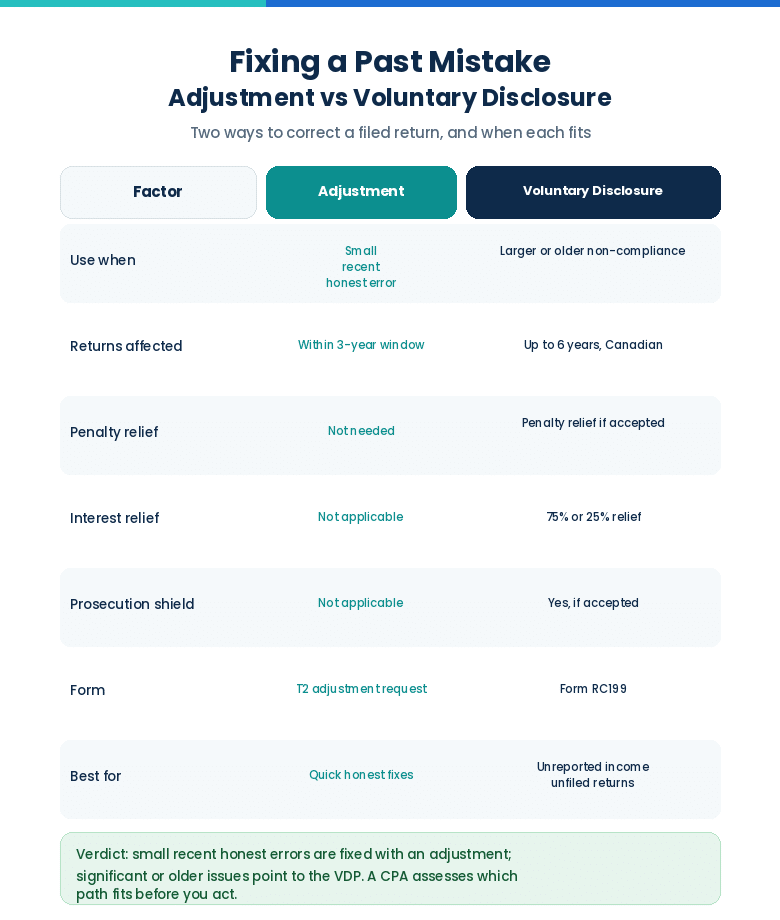
A small, recent, honest error is usually fixed with a simple adjustment to the return; a larger or older problem, like unreported income or unfiled returns, points to the CRA’s Voluntary Disclosures Program. The right path depends on the size, age, and nature of the mistake.
| Factor | Adjustment | Voluntary Disclosure |
|---|---|---|
| Use when | Small, recent, honest error | Larger or older non-compliance |
| Returns affected | Within the 3-year window | Up to 6 years, Canadian-sourced |
| Penalty relief | Not needed | Penalty relief if accepted |
| Interest relief | Not applicable | 75% or 25%, by type |
| Prosecution shield | Not applicable | Yes, if accepted |
| Form | T2 adjustment request | Form RC199 |
Small, recent, honest errors are fixed with an adjustment. Significant or older issues, such as unreported income or unfiled returns, point to the Voluntary Disclosures Program. A CPA assesses which path fits before you act, because applying to the wrong one can cost relief.
Our Take: The worst move is doing nothing once you know about an error. The Voluntary Disclosures Program only helps if you come forward before the CRA contacts you about the issue. After that, the door narrows.
A business owner found two years of unreported side income inside the corporation. Because the CRA had not contacted them, we assessed the Voluntary Disclosures Program as the right path and prepared the application before any letter arrived. Coming forward first protected them. Figures changed for privacy.
DIY vs CPA vs Non-CPA Provider
Compare The Routes
A Registered CPA is the route that catches year-end mistakes before filing and stands behind the corrected return. DIY filing is where most errors start, and a non-CPA provider may file the books as given without checking for the mistakes that cost you.
| Factor | DIY | CPA firm | Non-CPA provider | Best for |
|---|---|---|---|---|
| Catches errors before filing | Rarely | Built in | Inconsistent | CPA firm |
| Reconciliation and review | Often skipped | Standard | Varies | CPA firm |
| Knows the fix path | No | Adjustment or VDP | Limited | CPA firm |
| CRA representation | None | Yes | Rarely | CPA firm |
| Accountability | None | Registered and regulated | Limited | CPA firm |
For an incorporated business that wants errors caught before they cost money, a Registered CPA firm is the route that reviews the books, fixes mistakes the right way, and represents you with the CRA if a question comes up.
A company used a non-CPA provider who filed the books exactly as handed over, errors included. When we reviewed two prior years, we found misclassified accounts and an unreconciled HST balance, then corrected both. The review caught what filing-as-is had missed. Figures changed for privacy.
How Do We Find and Fix Year-End Mistakes?
Seven-Step Workflow
We find and fix year-end mistakes in seven steps, starting by reading your past filings and ending by setting controls so the same error does not return. Each step narrows from what looks wrong to the exact correction and the right way to file it.
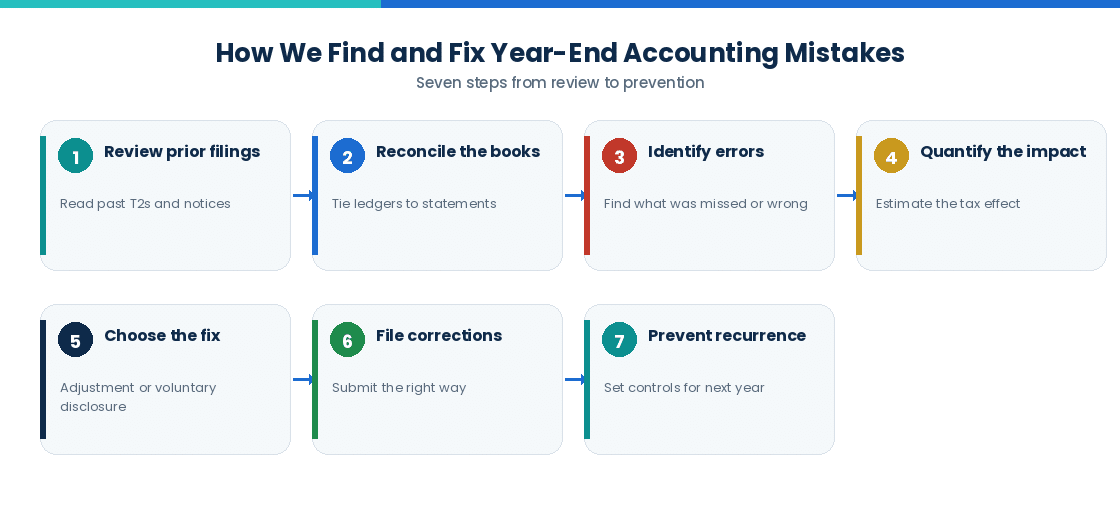
- Review prior filings: read past T2s and CRA notices to see what was filed.
- Reconcile the books: tie ledgers to bank, credit, and tax statements.
- Identify errors: find what was missed, misclassified, or wrong.
- Quantify the impact: estimate the tax, interest, and penalty effect.
- Choose the fix: decide between an adjustment and a voluntary disclosure.
- File corrections: submit the correction the right way.
- Prevent recurrence: set controls so the error does not return.
| Phase | Timing (illustrative) | Client actions | CPA actions | Outputs |
|---|---|---|---|---|
| Review and reconcile | 3 business days | Share filings and ledgers | Reconcile and read notices | Reconciled books |
| Identify and quantify | 2 business days | Answer questions | Find and size the errors | Corrections-found report |
| Choose the fix | 1 business day | Approve the path | Recommend adjustment or VDP | Fix plan |
| File corrections | 2 business days | Sign off | Prepare and submit | Filed corrections |
| Prevent recurrence | 1 business day | Adopt the controls | Set monthly checks | Control checklist |
Pro Tip: Bring your last two filed T2s and every CRA notice to the first review. Half of fixing a mistake is seeing exactly what was filed, and the notices often flag the issue before we open the books.
A client suspected one bad year but was not sure. We reviewed two filed returns and reconciled the accounts, which surfaced a misclassification in the year they had not flagged. We corrected both and set a monthly reconciliation so it would not return. Figures changed for privacy.
What Deliverables Do You Get?
Tangible Outputs
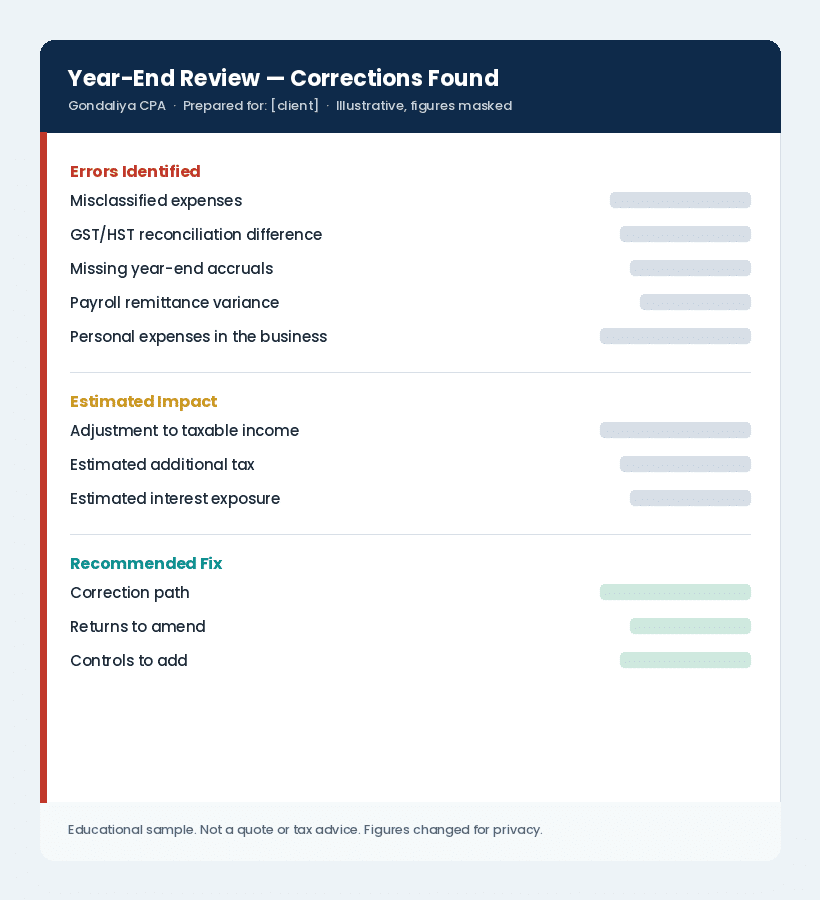
You get a clear corrections-found report, reconciled books, the filed corrections, and a short list of controls to stop the errors returning. The report shows what was wrong, the estimated impact, and the recommended fix, in plain language.
| Deliverable | What it is | Who uses it | When delivered |
|---|---|---|---|
| Corrections-found report | Errors, impact, and fix | Owner | After the review |
| Reconciled books | Ledgers tied to statements | Owner, CRA if asked | During the work |
| Filed corrections | Adjustment or VDP submission | CRA | At filing |
| Control checklist | Steps to prevent recurrence | Owner, bookkeeper | At wrap-up |
| Supporting workpapers | The calculations behind the fix | Owner, CRA if asked | At filing |
Pro Tip: Keep the corrections-found report and the control checklist together. If the CRA ever asks about a corrected year, the report shows you found and fixed the error yourself, which matters.
A client received a corrections-found report listing five errors, the estimated impact, and the fix for each. Seeing it on one page made the decision easy, and the control checklist stopped two of the errors from recurring the next year. Figures changed for privacy.
How Much Does Fixing Year-End Mistakes Cost in Canada?
Transparent Pricing
Gondaliya CPA charges a flat fee with no surprise invoices, and the compiled year-end financial statements start at $282.50 per year including HST ($250 plus 13% HST); the review and any cleanup or corrections are quoted to the volume of work. Fixing an error early almost always costs less than the interest and penalties of leaving it.
| Driver | What increases cost | How to keep it efficient | Ask the firm |
|---|---|---|---|
| Number of years | Multiple years to correct | Address errors early | Is each year quoted? |
| Bookkeeping state | Unreconciled accounts | Keep books current | Is cleanup separate? |
| Size of the error | Larger, complex issues | Bring full records | Adjustment or VDP? |
| Number of accounts | Many bank and credit accounts | Provide all statements | What do you need from me? |
| Fix path | A voluntary disclosure | Come forward early | Which path do I need? |
You can estimate the corporate tax behind a correction with our corporate tax calculator.
Year-End Mistake Risk Checker
Answer six quick questions to see which error areas are worth a review. No fee shown.
Risk areas flagged:
This is a general prompt, not tax advice or a quote. Your actual risk depends on your full records. For a real review, please book a free consultation.
A corporation engaged us for a flat-fee year-end review after a near-miss with the CRA. We reviewed two years, corrected three errors, and set monthly checks. The review cost a fraction of the interest they had already paid on one unreconciled balance. Figures changed for privacy.
Risks, CRA Compliance & the 2026 Update
What’s Changing
The main risks are reassessment within the open period, interest on unpaid tax, and penalties on careless errors. The 2026 update below changed how businesses fix past mistakes, and it generally runs in your favour if you come forward early.
2026 Update — the overhauled Voluntary Disclosures Program: Effective October 1, 2025, the CRA replaced the old General and Limited programs with two tiers based on whether a disclosure is unprompted or prompted (Information Circular IC00-1R7; CRA, canada.ca). An unprompted disclosure can receive 75% interest relief and full penalty relief; a prompted one can receive 25% interest relief and up to full penalty relief. A new Form RC199 is now required, and prior CRA reminders or education letters no longer automatically disqualify you. The change makes fixing an honest past error more accessible, but only before the CRA opens an audit or investigation on the issue.
CRA Deadline: A Voluntary Disclosures Program application must relate to information that is at least one year past its filing due date (CRA, IC00-1R7). Recent slip-ups are corrected by adjustment, not the VDP.
Risk Warning: Statute-barred protection is not absolute. The CRA can reopen years beyond the normal three-year period where a return contains a misrepresentation attributable to neglect, carelessness, or wilful default (CRA, canada.ca; Income Tax Act s.152(4)). Careless errors can come back years later.
| Risk area | What happens if missed | CPA mitigation |
|---|---|---|
| Reassessment in the open period | Extra tax and interest | Review and correct early |
| Careless errors | Years reopened beyond three | File accurate, reviewed returns |
| Unreported income | Penalties and prosecution risk | Voluntary disclosure before contact |
| Wrong fix path | Lost relief | Assess adjustment vs VDP first |
| Repeated errors | Higher scrutiny | Set controls to prevent recurrence |
For background only: corrected amounts are reported on the T2, which the CRA requires to be filed within six months of the fiscal year-end (Canada Revenue Agency, canada.ca).
A client came to us unsure whether the new Voluntary Disclosures Program applied to their unfiled GST/HST. We confirmed they had not been contacted, treated it as an unprompted disclosure, and prepared the Form RC199 application. Coming forward first preserved the relief. Figures changed for privacy.
What to Prepare Before a Year-End Review
Six-Point Checklist
Gather six things before a year-end review and a CPA can find errors quickly. Your last two filed returns and every CRA notice matter most, because they show exactly what was filed and what the CRA has already flagged.
| Item | Why needed | Common mistake | CPA tip |
|---|---|---|---|
| Last two filed T2 returns | Shows what was filed | Only providing one year | Include both years |
| All CRA notices | Flags issues already raised | Ignoring notices | Share every notice |
| Bank and credit statements | Lets us reconcile | Missing an account | Provide all accounts |
| General ledger and trial balance | Shows the bookkeeping | Books behind | Bring current books |
| GST/HST filings | Checks reconciliation to sales | Not matching sales | Include the returns |
| Payroll records | Checks source deductions | Informal payments | Provide remittance records |
Want this as a one-pager? You can download the free year-end review checklist and bring it to your first call.
A client arrived with two filed returns, all CRA notices, and full statements. Because everything was ready, we reconciled and found the errors in the first sitting rather than over several rounds of follow-up. Preparation made the review fast. Figures changed for privacy.
How Mistakes Show Up Across 10 Industries
Industry Spotlights
Year-end mistakes differ by sector, so the error that costs the most shifts with the business model. Below are ten industries we serve and the mistake each one most often makes.
| Industry | Most common year-end mistake | How a review helps |
|---|---|---|
| Physician professional corporations | Personal expenses in the corporation (OHIP, RCPSC) | Removes shareholder-benefit risk |
| Dentists and dental practices | Equipment expensed instead of capitalized (RCDSO) | Applies CCA correctly |
| Daycare and CWELCC services | Grant income misrecorded | Records funding correctly |
| Real estate holdcos and investors | Mixed capital and current costs | Splits them properly |
| Property developers and builders | Wrong project income timing | Times income across years |
| Construction and skilled trades | Cash jobs and subcontractor status | Checks worker status |
| Technology startups and SaaS | Missed SR&ED and deferred revenue | Captures credits and timing |
| E-commerce and online retailers | Multi-channel sales and GST/HST | Reconciles every channel |
| Restaurants and food and beverage | Tips, cash, and payroll errors | Fixes payroll reporting |
| Transportation and logistics | Fuel, mileage, and fleet costs | Classifies expenses correctly |
Related services, please: see our bookkeeping cleanup, corporate tax filing for your T2, GST/HST filing, corporate tax planning, and CRA audit resolution if the CRA has already contacted you.
Pro Tip: If your business handles a lot of cash or pays subcontractors, get worker status and cash sales reviewed first. Those are the two areas the CRA looks at hardest in trades, construction, and restaurants.
A restaurant client had been paying part-time staff without formal payroll. We reviewed the arrangement, set up proper source-deduction reporting, and corrected the prior period before it became a CRA problem. Fixing it early kept the cost contained. Figures changed for privacy.
A Realistic Numeric Walkthrough
Flagship Example
Here is how a year-end review can play out for a Toronto CCPC that filed with errors: a misclassification and an unreconciled HST balance are found, quantified, and corrected by adjustment. The figures below are illustrative and masked; correcting early reduces interest, but no outcome is guaranteed.
| Assumptions (illustrative) | Figure |
|---|---|
| Annual revenue | $680,000 |
| Bank and credit accounts | 4 |
| Misclassified expenses found | $22,000 |
| HST under-reported | $3,400 |
| Years reviewed | 2 |
The review found $22,000 of expenses booked to the wrong accounts and an HST balance under-reported by $3,400 against sales. Both errors sat inside the three-year reassessment window, so the fix was a straightforward adjustment, not a voluntary disclosure.
We corrected the expense classification, refiled the HST difference, and reconciled all four accounts. Because the corporation came to us before any CRA contact, the correction was clean and the only cost beyond our fee was the tax and interest actually owed on the $3,400.
| Outputs (illustrative) | Result |
|---|---|
| Expense classification corrected | $22,000 reclassified |
| HST difference refiled | $3,400 |
| Accounts reconciled | 4 |
| Fix path | Adjustment, not VDP |
| Controls added | Monthly reconciliation |
Our Take: The deciding factor here was timing and size. Because the errors were recent, honest, and inside the open window, an adjustment was enough. The same facts left for years, or hiding income, would have pointed to the Voluntary Disclosures Program instead.
Next steps for this situation:
- Pull the last two filed returns and all CRA notices.
- Reconcile every bank and credit account.
- Quantify each error before choosing a fix, please.
- Correct by adjustment while inside the open window.
- Add a monthly reconciliation to prevent recurrence.
We ran this kind of review for a Toronto corporation that had filed two years with a misclassification and an HST gap. Both were inside the open window, so we corrected by adjustment and reconciled the accounts. Coming in early kept the fix simple. Figures changed for privacy.
How to Choose the Right CPA Firm
Buyer’s Guide
Choose a Registered CPA firm that reviews your books before filing, knows when to adjust versus disclose, and represents you with the CRA. The right firm finds errors early and fixes them the right way, at a flat fee you agree to up front.
| Your situation | What to look for | Why it matters |
|---|---|---|
| Suspect a past error | Prior-year review | Finds it before the CRA |
| Books behind | Cleanup and reconciliation | Removes built-in errors |
| Unreported income | VDP experience | Protects relief and you |
| Files own T2 | Pre-filing review | Catches schedule errors |
| Wants budget certainty | Flat fee | No surprise invoices |
Questions to ask on a free consultation:
- Do you review prior years before filing?
- How do you decide between an adjustment and a voluntary disclosure?
- Do you reconcile every account?
- What does your corrections-found report include?
- Will you represent me if the CRA asks questions?
- Is bookkeeping cleanup quoted separately?
- Is your fee a flat amount including HST?
- How do you prevent the error from recurring?
- Are you a Registered Ontario CPA firm I can verify?
- Who reviews the corrected return?
Pro Tip: Ask one question first: “How do you decide between an adjustment and a voluntary disclosure?” A firm that cannot explain the difference may apply to the wrong path and cost you relief.
An owner interviewed us after another preparer suggested simply refiling a year with significant unreported income. We explained why that situation pointed to the Voluntary Disclosures Program instead, and assessed the path properly. Choosing the right route protected them. Figures changed for privacy.
Why Trust Gondaliya CPA
E-E-A-T & Editorial Policy
Gondaliya CPA is a Registered Ontario CPA firm that works only with incorporated businesses, finds and fixes year-end errors before they cost money, and charges a flat fee with no surprise invoices. Our work is verifiable on the CPA Ontario public firm directory.
| Trust signal | What it means for you | Where it matters |
|---|---|---|
| Registered Ontario CPA firm | Regulated, verifiable work | Reviews and corrections |
| Business-only focus | Deep corporate experience | T2 and bookkeeping errors |
| Flat fee | No surprise invoices | Budget certainty |
| CRA representation | We deal with the CRA for you | Reviews and disclosures |
| 1300+ 5-star Google reviews | Consistent client experience | Choosing a firm |
| 30-Day Money-Back Guarantee | Confidence in the service | Engaging us |
You can verify our firm on the CPA Ontario public firm directory. We are dual-credentialed in Canada and the USA (Washington and Montana), which supports cross-border business tax work where relevant.
Editorial policy: This article was researched against CRA sources, fact-checked, and reviewed by a Registered CPA. Penalties, deadlines, and program rules are cited to government pages and updated when they change.
CPA Ontario | US CPA licences in Washington and Montana | Registered Ontario CPA Firm | 1300+ 5-star Google reviews
A new client verified our licence on the CPA Ontario directory before their first call, then asked how we handle a corrected year if the CRA asks. We explained our corrections-found report and representation approach, and started the review that week. Figures changed for privacy.
People Also Ask
Quick Answers
These are common questions Canadian business owners search about year-end accounting mistakes, each answered on its own.
What is the most common year-end accounting mistake? Filing with the books behind. When the ledgers are not reconciled to the year-end date, errors like misclassified expenses and unreconciled GST/HST get built into the return, then surface later as extra tax and interest.
How far back can the CRA reassess my corporation? The CRA can reassess a CCPC’s T2 within three years of the original notice of assessment. Beyond that, statute-barred years can be reopened where there is misrepresentation due to neglect, carelessness, or wilful default.
What is the penalty for a false statement on a return? The gross negligence penalty under the Income Tax Act is 50% of the understated tax on a false statement or omission made knowingly or in circumstances amounting to gross negligence. Honest errors rarely reach it.
Can I fix a mistake on a return I already filed? Yes. A small, recent, honest error is usually corrected with an adjustment request. A larger or older issue, such as unreported income, may need the CRA’s Voluntary Disclosures Program instead.
What changed about the Voluntary Disclosures Program in 2025? Effective October 1, 2025, the CRA replaced the old programs with unprompted and prompted tiers, increased interest relief, and required a new Form RC199. Coming forward before a CRA audit on the issue is what unlocks the best relief.
Will fixing an error trigger an audit? Correcting an error properly, with reconciled books and a clear record, generally lowers risk rather than raising it. The bigger risk is leaving a known error in place for the CRA to find on its own.
What happens if my GST/HST does not match my sales? A mismatch between filed GST/HST and reported sales is a common review trigger. The CRA can reassess the difference and add interest. Reconciling before filing avoids it.
Do I need a CPA to fix a year-end mistake? Not legally, but a Registered CPA finds the full set of errors, picks the right fix path, files it correctly, and can represent you with the CRA, which a self-correction often misses.
An owner asked whether fixing an old error would just invite trouble. We explained that a clean, documented correction usually reduces risk, then made it. They were relieved to have it handled before the CRA reached the year. Figures changed for privacy.
Frequently Asked Questions
FAQ
Short answers to the questions we hear most about year-end accounting mistakes in Canada.
| Question | Short answer |
|---|---|
| How far back can the CRA reassess? | Three years for a CCPC, longer for misrepresentation. |
| What is the gross negligence penalty? | 50% of the understated tax on a false statement. |
| How do I fix a small error? | A T2 adjustment request, if it is recent and honest. |
| What about unreported income? | The Voluntary Disclosures Program, before CRA contact. |
| Do you file the corrections? | Yes, the review and the corrections go together. |
| Do you serve clients outside Toronto? | Yes, across Ontario and Canada, entirely virtually. |
A first-time caller worked through these same questions before deciding to engage us. We answered each, scoped a flat-fee review of two years, and booked it on the call. Having the questions ready made the first conversation efficient. Figures changed for privacy.
How do I know if my past return has a mistake?+
A year-end review against your filed returns and reconciled books shows it. We read your last two T2s and CRA notices, tie your ledgers to bank, credit, and tax statements, and flag what was missed, misclassified, or wrong. Most errors surface quickly once the accounts are reconciled.
Is it better to fix a mistake or wait?+
Fixing it early is almost always cheaper. Interest runs while an error sits unfixed, and the Voluntary Disclosures Program only helps if you come forward before the CRA contacts you about the issue. Waiting narrows your options and raises the cost.
What is the difference between an adjustment and a voluntary disclosure?+
An adjustment corrects a small, recent, honest error on a filed return. The Voluntary Disclosures Program is for larger or older non-compliance, such as unreported income or unfiled returns, and can provide penalty and interest relief plus protection from prosecution if accepted. A CPA assesses which fits.
Will the CRA penalize an honest mistake?+
Honest errors usually result in the corrected tax plus interest, not the gross negligence penalty, which requires a false statement made knowingly or in circumstances amounting to gross negligence. Correcting promptly and keeping a clear record is the best protection.
Do I need to be in Toronto to work with you?+
No. We serve incorporated businesses across Ontario and Canada entirely virtually. Documents are shared through our secure portal, and reviews happen by phone or video, including evenings and weekends. Your corporation does not need to be in the same city as your CPA.
What does the October 2025 Voluntary Disclosures change mean for me?+
Effective October 1, 2025, the program is easier to access. It now sorts disclosures into unprompted and prompted tiers, offers more interest relief, and uses a new Form RC199. Prior CRA reminders no longer automatically disqualify you, but an open audit on the issue still does.
Can you help if my bookkeeping is years behind?+
Yes. We bring the books up to date, reconcile each year, identify the errors, and file the corrections, whether by adjustment or voluntary disclosure. Catch-up and cleanup are quoted to the volume of work so you know the cost before we start.
How much does a year-end review cost?+
We charge a flat fee with no surprise invoices, quoted to the number of years and the state of the books. The compiled year-end statements start at $282.50 per year including HST, with the review and corrections quoted on top. Please ask for a quote on a free consultation.
Catch the mistake before the CRA does
Gondaliya CPA finds and fixes year-end accounting errors for incorporated Canadian businesses, files the corrections, and charges a flat fee. Please book a free consultation and bring your last two returns.
Glossary of Key Terms
Plain-English Definitions
- Year-end accounting mistake: An error in a corporation’s books or filings at year-end that raises tax, interest, or penalties.
- Reassessment: A CRA review that changes a filed return, often adding tax and interest.
- Normal reassessment period: The three-year window in which the CRA can reassess a CCPC’s T2 after the original assessment.
- Statute-barred year: A year past the normal reassessment period, reopenable only for misrepresentation or fraud.
- Gross negligence penalty: A penalty of 50% of understated tax for a false statement made knowingly or with gross negligence.
- Adjustment: A request to correct a small, recent, honest error on a filed return.
- Voluntary Disclosures Program (VDP): A CRA program to correct larger or older errors with relief from penalties and interest if accepted.
- Form RC199: The CRA application form required for a Voluntary Disclosures Program submission.
- Reconciliation: Matching the books to bank, credit, and tax statements so the numbers agree.
- Shareholder benefit: A taxable benefit when personal costs are paid by the corporation.
- Capital cost allowance (CCA): The tax depreciation claimed on capital assets, separate from current expenses.
- T2 return: The federal corporate income tax return every incorporated business files with the CRA.
Next Steps
Year-end accounting mistakes cost the most when they sit unfixed. A review before filing, or as soon as you suspect an error, catches them while the fix is still simple. Gondaliya CPA finds and corrects them, files the right way, and charges a flat fee with no surprise invoices. Please reach out for a free consultation, call 647-212-9559, or email info@gondaliyacpa.ca. If our content helps, please add gondaliyacpa.ca as a preferred source on Google.
Published: June 24, 2026 · Last updated: June 24, 2026
Disclaimer: This article is educational information only and is not tax, legal, or financial advice. It reflects CRA rules for the 2026 tax year, including the Voluntary Disclosures Program changes effective October 1, 2025. No outcome is guaranteed; penalties and relief depend on your specific facts. Tax rules change. Please consult a Registered CPA in Canada or Ontario before acting. Fees are subject to applicable taxes.

Sharad Gondaliya is a CPA Canada & CPA USA with 15 Years+ experience of Accounting, Tax, Payroll of Corporate Small Businesses as Tax Accountant. He is a CPA Ontario member (61040184) and holds US CPA licences in Washington and Montana and is well known among corporate small businesses for tax planning, efficient tax solutions, and affordable CPA services. Sharad is the Principal (Director) of Gondaliya CPA – Affordable CPA Firm in Canada. Licenses: CPA Ontario: 61040184 | CPA USA (MT): PAC-CPAP-LIC-033176 | CPA USA (WA): 57629 | CPA Firm License: 61330051 View Full Author Bio